How-To Guides
Piano and Specialty Movers for Santa Monica and Pacific Palisades - Stairs, Terraces, and Crane Access
Key Takeaways
- Hillside lots, tight streets, and older homes around Santa Monica and Pacific Palisades make specialty moves harder than standard jobs.
- Piano handling varies by type - uprights run 300-500 lbs while grands can top 1,200 lbs and need a full crew with skid boards.
- Stair moves require pre-move measurement, powered stair climbers, and floor and railing protection; spiral stairs often rule out large items.
- Terrace and balcony lifts need load-capacity checks, HOA coordination, railing removal, and weather timing around marine layer fog and coastal wind.
- Crane lifts are the safe choice for blocked stairwells and hillside homes, and they require permits, rigging, spotters, and neighbor coordination.
- Wait two to three weeks after a move before tuning a piano so it acclimates to the new room's coastal humidity.
- Costs rise with stairs, distance, crane needs, and crating; crane permits and summer coastal demand call for booking well ahead.
- A free walkthrough produces an accurate quote, and added valuation coverage protects high-value pianos, art, and antiques.
In This Article
A homeowner near the Palisades bluffs called us last spring in a bit of a panic. She had just bought a Steinway grand, and the delivery crew had left it in the driveway because the only way inside was a narrow staircase with a hard right turn at the landing. The piano would not fit, and the sloped lot made every option feel risky.
That scene plays out more often than you might think in this stretch of coastline. Homes near Ocean Avenue, along the canyon roads, and up the bluffs were not built with grand pianos and 800-pound safes in mind. Moving heavy, fragile, or high-value items here takes more than muscle and a truck.
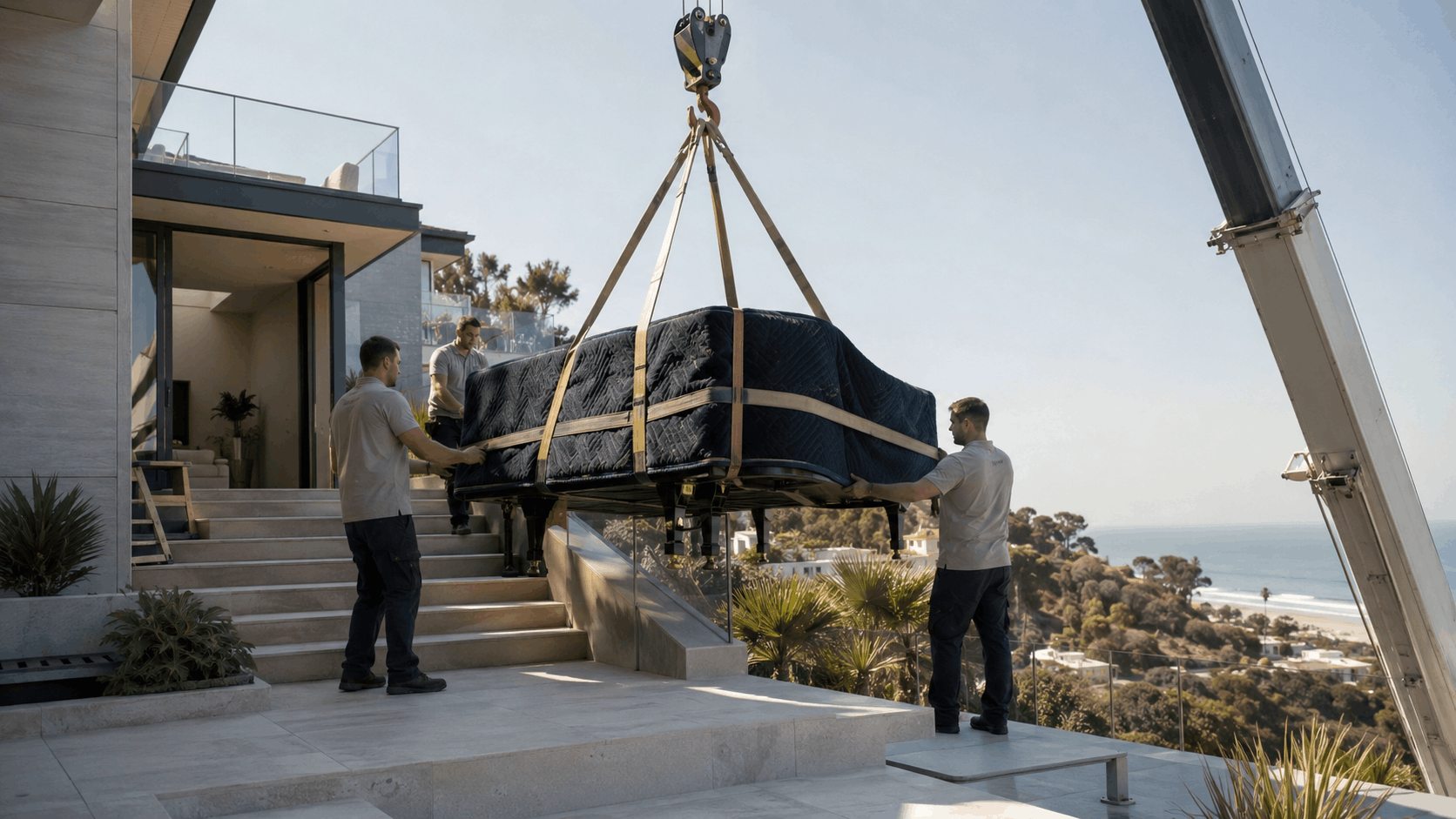
Why Piano and Specialty Moves Are Different in This Part of LA
Standard movers do fine with couches and boxes. But specialty items in this area run into problems that a general crew is not trained or equipped to solve.
The trouble usually comes down to three things - the land, the streets, and the age of the homes. Here is why piano movers and specialty movers approach a job in Santa Monica and the Palisades differently:
- Sloped driveways and multi-level floor plans that fight against heavy loads
- Tight streets and strict parking rules for large trucks
- Older construction with delicate floors, doorways, and stairs
- High-value pieces where a single mistake costs thousands
Steep Lots and Hillside Homes Near the Palisades Bluffs
Many hillside homes in Pacific Palisades sit on lots that drop or climb sharply from the street. A driveway might run at a grade that makes rolling a loaded piano dolly feel like fighting gravity every foot of the way. Our crews plan the approach angle before anyone touches the instrument.
Canyon roads like those off Chautauqua and up toward the bluffs often lead to homes with the main living area two floors above the garage. That means the piano has to travel up before it ever reaches its final room. We map that vertical distance during the walkthrough so the crew knows exactly what they are dealing with.
Sloped lots also limit where a truck can safely park and unload. A flat staging area matters when you are sliding a 900-pound grand onto a skid board. When the ground works against us, we bring extra crew and gear rather than improvising on the spot.
These conditions are why a piano move near the bluffs is a planned operation, not a quick lift-and-carry. The geography sets the rules, and we respect them.
Narrow Streets and Parking Limits in Santa Monica
North of Montana Avenue and around Ocean Park, the streets get tight and the parking gets tighter. A large moving truck cannot always pull up in front of the house, so we scout for the closest legal staging spot ahead of time. That short walk from truck to door changes the whole plan for a heavy item.
Some blocks require a parking permit or a posted no-parking zone so the truck has room to work. The City of Santa Monica handles these permits, and we coordinate the paperwork so the space is clear on moving day. Skipping this step can mean a ticket or a truck stuck a block away.
Street sweeping schedules, resident-only zones, and metered blocks all factor in near the coast. We know which streets tend to fill up early and which ones stay open. That local read saves time and keeps the move on schedule.
For homes in the Wilshire Montana area, we plan the truck position first and everything else second. Our Wilshire Montana moving crews deal with these parking realities every week.
Older Construction and Fragile Interiors
Vintage homes near the Palisades Village and the older craftsman houses across Santa Monica were built with charm, not heavy freight, in mind. These older homes often have original hardwood floors that scratch and dent easily. We lay protection down before the first item comes through the door.
Doorways in these houses can be narrower than modern standards, and trim work adds another inch or two of obstacle. A baby grand that clears a modern door might not clear a 1920s opening without careful angling. We measure everything so there are no surprises at the threshold.
The staircases in these homes deserve extra caution. Original railings, treads, and plaster walls were not made to take the weight of a piano board leaning against them. Our crew braces and pads these surfaces before the load ever reaches them.
Respecting the house is part of the job. A good move leaves the home exactly as we found it, minus the item we came to relocate.
The Cost of Hiring the Wrong Crew
We have been called in to clean up after moves that went sideways with an untrained crew. A scratched piano lid, a cracked terrace tile, a gouged floor - these are common results when general movers try specialty work. Piano damage alone can run into thousands to repair.
There is also the risk to people. A grand piano that shifts on a staircase can injure a worker or a homeowner in seconds. Trained crews use the right straps, boards, and positioning to keep the load controlled at every step.
Then there is the liability question. If an uninsured crew damages your home or drops your instrument, you may be left holding the bill. Proper insurance and valuation coverage exist for exactly this reason, and a specialty mover carries it.
Hiring the right crew is cheaper than fixing the wrong one. The difference shows up in the details long before anything goes wrong.
Get Your Free Quote
Tell us about your move and we'll get back to you fast.
Moving Pianos: Upright, Grand, and Baby Grand
Every piano type calls for its own method. Weight, shape, and internal parts all change how our crew handles the instrument from pickup to final placement.
Here is a quick look at what grand piano moving, upright piano work, and piano weight ranges mean for the process:
| Piano Type | Typical Weight | Handling Method | Crew Size |
|---|---|---|---|
| Spinet / Console Upright | 300-500 lbs | Padded dolly, blankets | 2-3 movers |
| Studio / Full Upright | 400-600 lbs | Piano dolly, straps | 3 movers |
| Baby Grand | 500-650 lbs | Leg removal, skid board | 3-4 movers |
| Grand / Concert Grand | 650-1,200 lbs | Full skid system, piano board | 4+ movers |
Upright Pianos and Spinets
An upright piano is the most common instrument we move in local homes. Spinets and consoles usually run 300 to 500 pounds, which sounds manageable until you factor in the awkward top-heavy shape. The weight sits high, so tipping is a real concern without proper technique.
We wrap the piano in moving blankets first, securing them so nothing shifts during transport. The instrument then goes onto a heavy-duty piano dolly rated for the load. Straps hold it firmly in place while the crew guides it.
Even a mid-size upright needs at least two trained movers, and three for stairs. The extra hands keep the load balanced on turns and landings. Rushing a piano with too few people is how finishes get scratched and toes get crushed.
Uprights feel simple, but they still demand the right gear and hands. We treat every one with the same care as a grand.
Grand and Baby Grand Pianos
A grand piano is a different animal. Before it moves an inch, the crew removes the legs and the lyre, then lays the body on its side onto a padded skid board. This protects the frame and makes the shape manageable through doorways and around corners.
A piano board supports the full length of the instrument while it is strapped down and rolled. Baby grands run 500 to 650 pounds, while full concert grands can top 1,200 pounds. That weight range is exactly why a grand needs a full crew of four or more.
Each leg, the lid prop, and the pedal assembly get wrapped and boxed separately. Reassembly at the destination is just as careful as the breakdown. A rushed reassembly can leave a leg loose or the lyre misaligned.
Moving a grand is a coordinated effort with every person knowing their role. Our specialty piano moving crews handle these lifts regularly across the Westside.
Protecting the Finish and Internal Parts
The finish on a piano scratches at the lightest contact, so piano padding comes first every time. We wrap the case in thick blankets and secure any exposed edges. The lid stays closed and latched or padded so it cannot swing open on a bump.
Coastal living adds a wrinkle. Coastal humidity near the ocean can swell wood and affect the instrument if it sits exposed to damp air. During transport we keep the piano covered and out of direct moisture, and we avoid leaving it in a hot or humid truck longer than needed.
Inside the instrument, the soundboard and the action are the sensitive parts. We keep the piano stable so these components do not take a jolt. Sudden shocks can knock the action out of alignment or stress the soundboard.
Protecting both the outside and the inside is what separates a careful move from a costly one. We plan for both on every job.
Tuning and Settling After the Move
Almost every piano needs tuning after a move, and that is normal. The instrument gets jostled and, more than that, it needs time to adjust to a new room. We advise homeowners to wait a few weeks before scheduling piano tuning.
That waiting period is about acclimation. A piano moved from an inland home to an ocean-facing house near the coast will react to the new humidity and temperature. Tuning too soon means it drifts out again as it settles.
Ocean-air moisture is the biggest factor for homes near the water. The wood and strings respond to the damper coastal air, and it takes time to stabilize. Giving it two to three weeks usually produces a tuning that holds.
Patience here saves money on repeat tunings. Let the instrument find its new home before you call the tuner.
Need Help in Los Angeles?
Popeye Moving & Storage serves Los Angeles and all of Los Angeles County.
Handling Stairs Safely in Multi-Level Homes
Two- and three-story homes are everywhere in the canyons and up the bluffs. Moving a heavy item up or down those stairs is where most of the real work and real risk lives.
Good stair moving comes down to preparation and technique. Getting a heavy item up stairs in a multi-level home without damage takes the right gear and a crew that has done it hundreds of times.
Assessing Staircases Before Moving Day
We never show up to a piano or safe move blind. A pre-move walkthrough lets us take stair measurement readings for width, turn radius, and landing size. Those numbers tell us whether the item fits and what technique the crew will use.
Canyon and bluff homes throw curveballs - a switchback landing, a low ceiling over the stairs, or a tight turn at the bottom. The walkthrough catches these before they become moving-day problems. We would rather find the tight spot on paper than at the top of a staircase with 900 pounds in hand.
We also check the destination room and its doorway during the same visit. There is no point getting a piano up the stairs if it cannot enter the room at the top. Measuring both ends prevents that exact headache.
This planning step is free and it shapes the entire move. It is the difference between a smooth day and an improvised scramble.
Stair Climbers and Manual Techniques
For the heaviest loads, we use powered stair climber equipment that walks an item up steps in controlled increments. These machines carry the weight so the crew can focus on balance and direction. On a long straight run of stairs, they are a huge help.
When a climber will not fit, the crew relies on a tilt-and-lift moving technique with careful positioning. One or two movers control the top while others manage the base. Everyone moves on the same count so the load never gets ahead of the crew.
Crew positioning matters most on turns and landings. We pause, reset grips, and reposition rather than force a piece around a corner. That discipline keeps both the item and the people safe.
The gear helps, but the technique is what protects your home. A trained crew reads each staircase and adapts.
Protecting Walls, Railings, and Flooring
Before anything heavy comes near the stairs, we set up floor protection. Runners cover hardwood and stone, while padded coverings guard the stair treads themselves. This keeps grit and weight from marking the surfaces.
Walls take a beating on tight staircases, so we install corner guards at every pinch point. Padding goes on newel posts and railing tops where a piano board might lean or brush against them. These older railings crack under pressure they were never built for.
We also protect the destination room and the entry path with the same care. If we are wrapping full-service protection for a delicate home, our packing and crating team often preps fragile surrounds ahead of the lift.
Protection gear is cheap compared to a repaired wall or refinished floor. We put it down first, every time.
Spiral and Narrow Staircases
Some Palisades hillside homes have a spiral staircase as the only interior route to an upper floor. A spiral almost never allows a piano or large safe to pass, no matter how skilled the crew. The turning geometry simply does not leave room.
Very narrow stairs present the same problem for wide items. When the walkthrough shows the stairs cannot work, we say so honestly rather than damage the home trying. Forcing a piece where it does not fit helps no one.
In those cases we look at the alternatives - a terrace lift or a crane. Sometimes the item goes in through a balcony or gets lifted over the roofline. We would rather change the plan than break the piece or the house.
Knowing when stairs are off the table is part of the expertise. An honest answer up front saves everyone grief.
Terrace and Balcony Access Moves
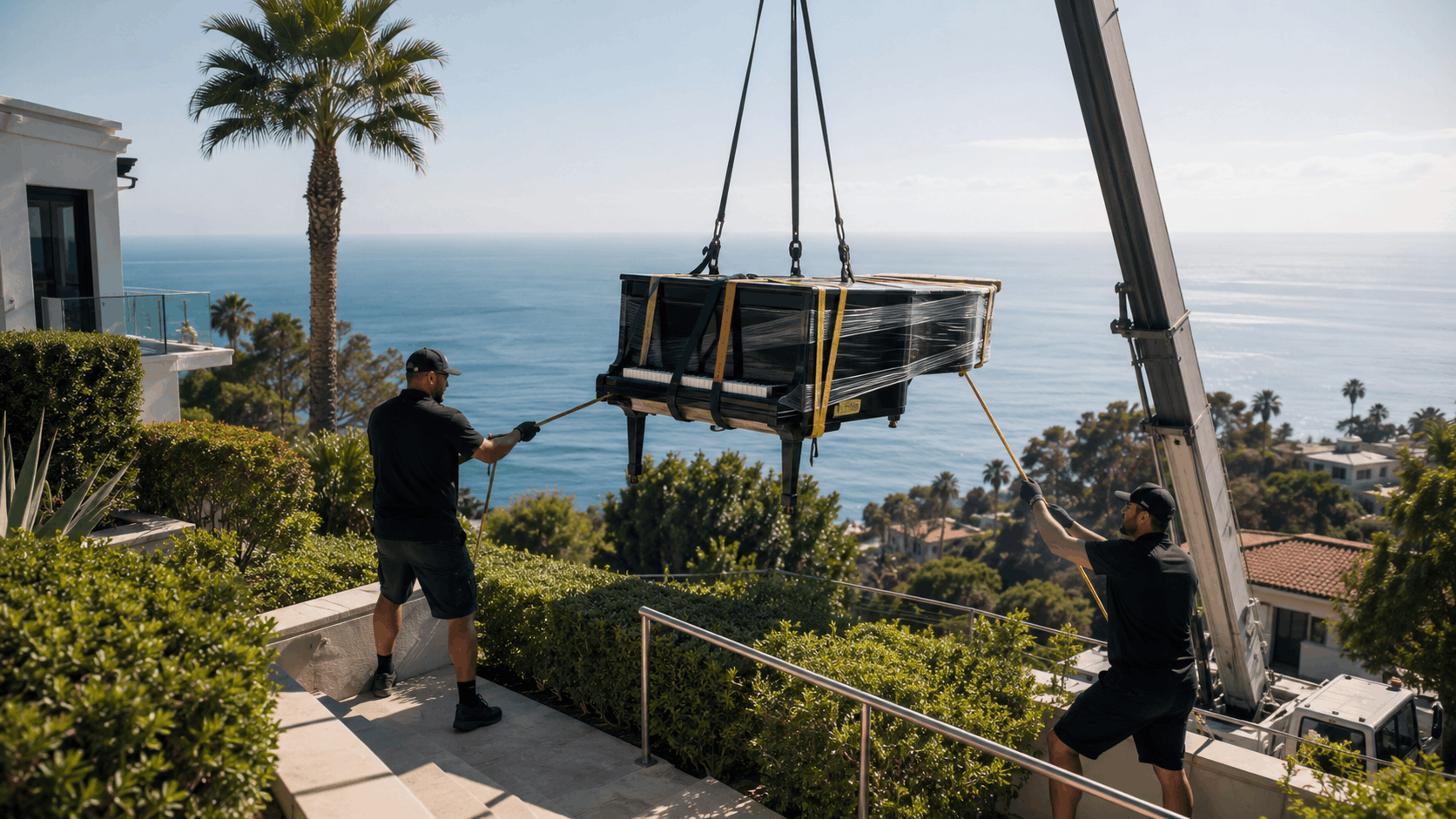
Ocean-view homes love their outdoor space, and many have a terrace or balcony that turns out to be the best way in. Moving a piano or large furniture through one of these takes planning and coordination.
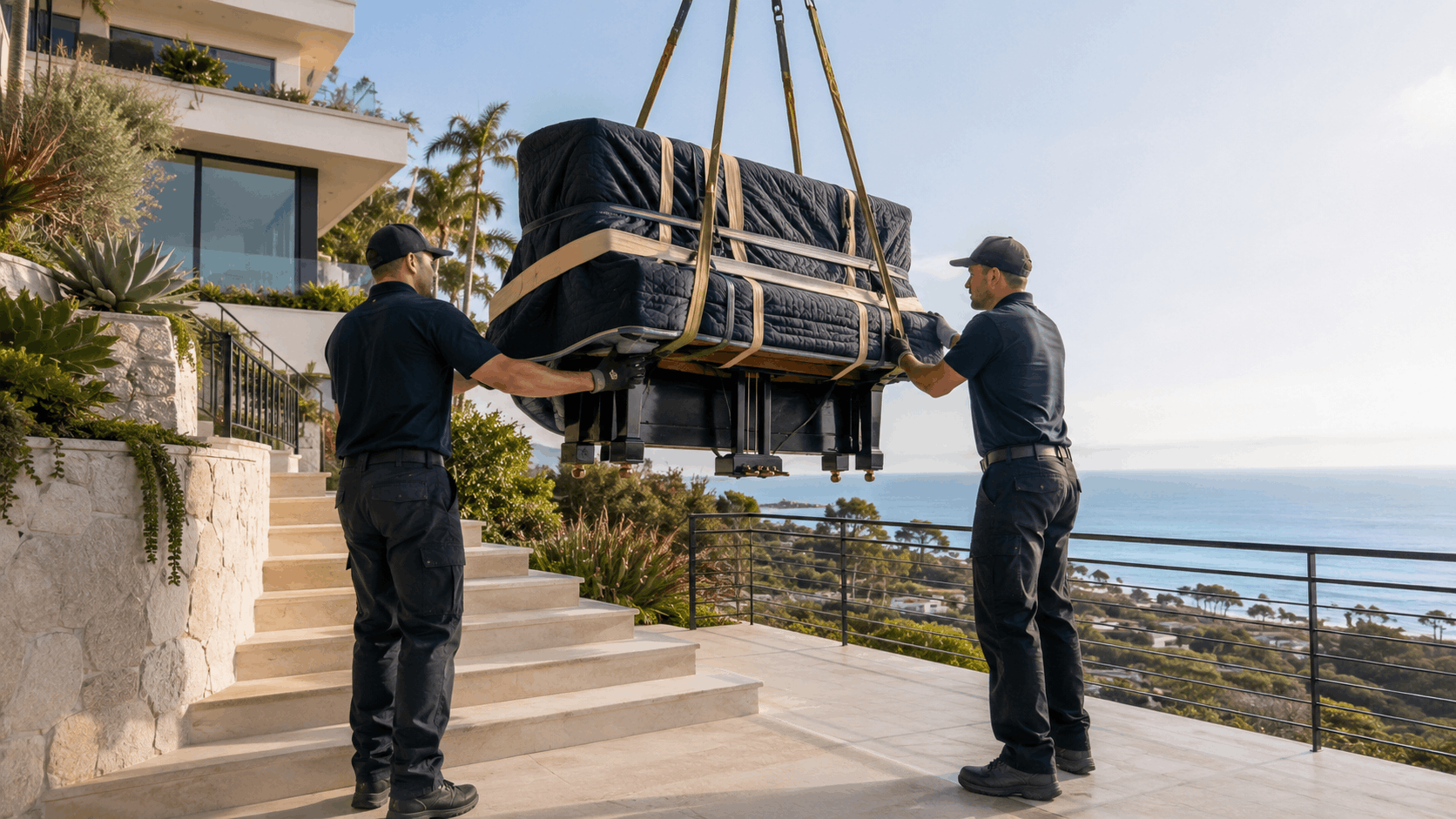
A terrace access move brings furniture or instruments onto an upper level or rooftop when the interior path fails. Balcony moving and rooftop delivery are more common here than in most cities because of how these homes are built.
When Terraces Are the Only Way In
Homes near Ocean Avenue and up in the Palisades often have tight interior stairs and narrow halls. When the inside route cannot handle a large item, a terrace lift becomes the answer. We assess whether the outdoor space gives enough clearance for the piece and the crew.
Often the terrace faces the ocean on the very floor where the item needs to go. That makes it a natural entry point once the railing question is sorted. We check the approach from below and the landing above.
A terrace move usually pairs with a lift or crane, since the item still has to get up there. The terrace is the doorway, not the whole solution. We plan the ground setup and the lift path together.
When the front door and stairs say no, the terrace often says yes. It just takes the right coordination to use it.
Weight Limits and Structural Checks
Before we set a heavy item on any balcony, we confirm its load capacity. A balcony rated for people and patio furniture may not be built for a 1,000-pound grand landing on it. We verify the structure can take the load and the concentrated weight of the crew.
Many of these homes sit in communities with an HOA or a property manager who needs to sign off. We coordinate with them ahead of time so there are no day-of surprises. Some associations have rules about crane placement and common-area use.
When there is any doubt about the structure, we get confirmation before proceeding. Better to pause and verify than to overload a balcony. Safety of the home and the crew comes first.
These checks add a little lead time, and they are worth it. Nobody wants a structural failure during a move.
Railing Removal and Reinstallation
Glass and metal railings often block the exact space we need. Temporary railing removal creates the clearance for a piano or large sofa to swing onto the terrace. We remove the panels carefully and store them safely during the lift.
Glass panels especially need gentle handling, since a chipped edge means a costly replacement. Our crew documents how each section comes apart so reassembly matches the original. Nothing gets forced or improvised.
Once the item is safely inside, we reinstall the railing and check that it is secure. The homeowner should not be able to tell it ever came off. That final check is part of the job, not an afterthought.
Railing work is delicate but routine for our crew. It opens up access that would otherwise be impossible.
Weather Timing for Ocean-Facing Terraces
The coast has its own moods, and we schedule around them. The marine layer fog can roll in thick during morning hours, cutting visibility for an outdoor lift. We often time terrace and crane work for later in the day when the fog burns off.
Coastal wind is the bigger concern. A suspended piano catches the breeze, and coastal wind can make a lift unsafe. We watch the forecast and will reschedule rather than lift a heavy item in gusty conditions.
Afternoon marine breezes tend to pick up along the bluffs and near the water. We factor that into the schedule for homes facing the ocean. A calm window is worth waiting for.
Weather planning is part of a safe terrace move. We would rather move the appointment than take a risk in bad conditions.
Crane Lifts for Impossible Access Situations
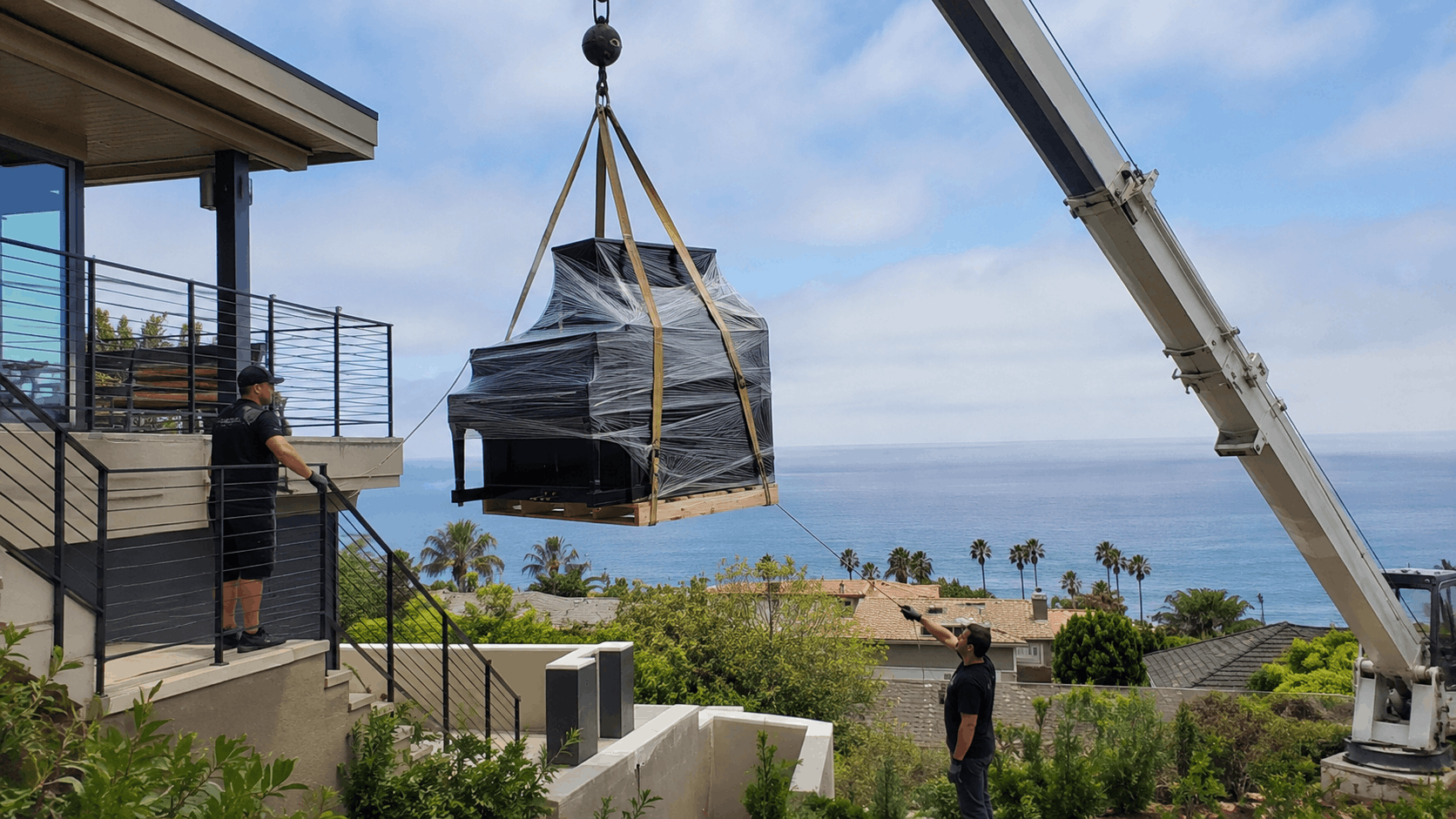
Sometimes stairs and terraces both fail, and a crane is the only safe way. It sounds dramatic, but for certain hillside and multi-story homes it is the standard solution.
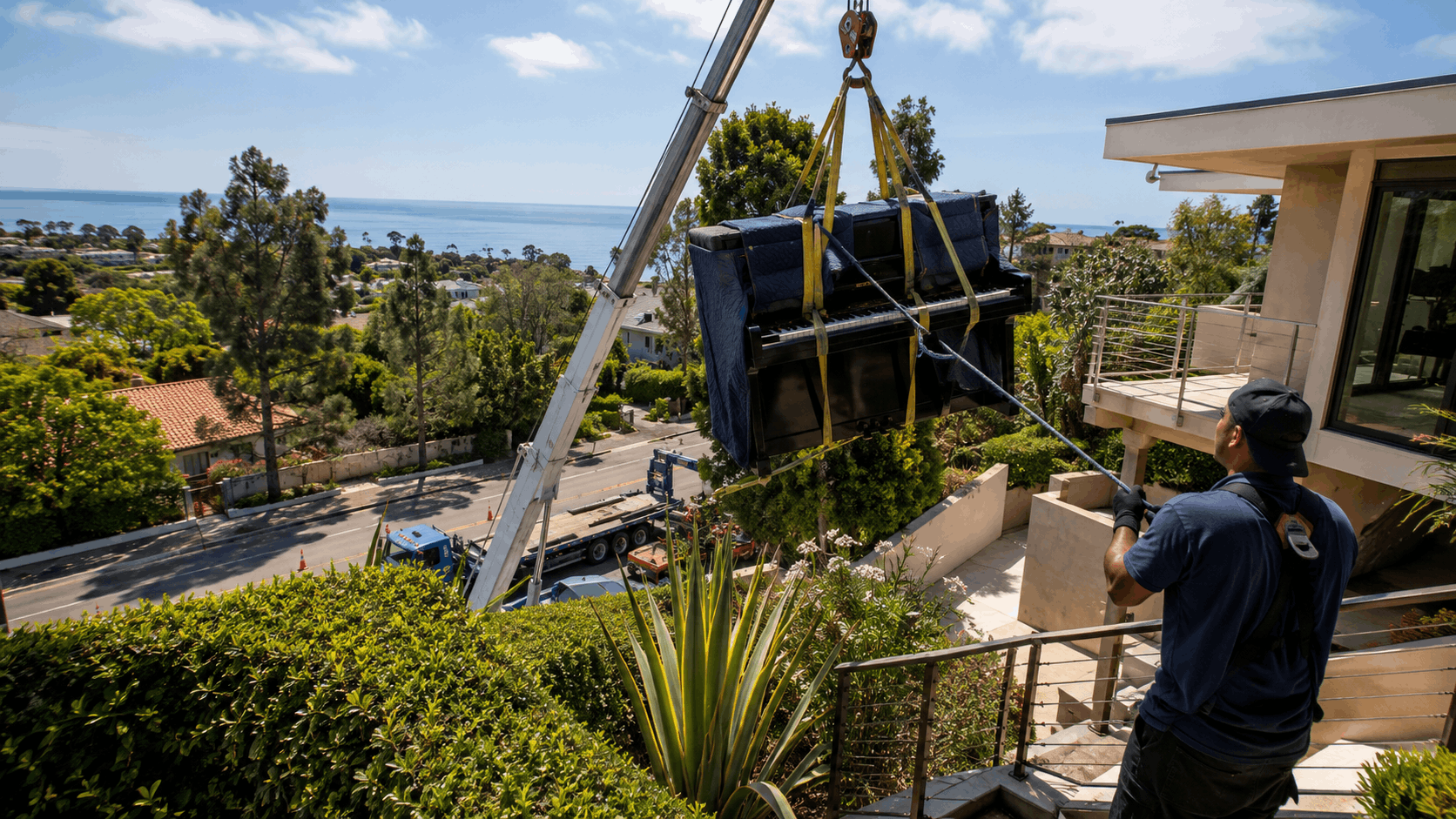
A crane moving job takes planning, permits, and coordination. Whether it is a crane lift for a rooftop terrace or a piano crane lift over a hillside home, the setup follows a careful process.
Signs a Move Needs a Crane
A few situations point clearly to a crane. Hillside homes off Chautauqua Boulevard where the living space sits well above the street often qualify. So do third-floor units with no elevator and a staircase that cannot handle the load.
A blocked or spiral stairwell is another sign a crane needed flag should go up. If the walkthrough shows no interior or terrace path that works, the crane becomes the answer. We identify this early so we can plan the permits.
Very heavy items like a concert grand or a large gun safe sometimes call for a crane even when stairs technically fit. The weight risk on stairs may simply be too high. In those cases a lift is the safer bet.
We do not recommend a crane lightly, since it adds cost. But when it is the safe choice, it is the right one.
Permits and Street Closures in Santa Monica
A crane usually needs to sit in the street, and that requires paperwork. We work with the Santa Monica building department and the relevant city offices to secure a street closure permit or lane closure. This keeps the operation legal and the site clear.
Permit timelines vary, so we start the process well before moving day. A short lane closure on a busy Santa Monica street needs approval and sometimes traffic control. We handle that coordination so the homeowner does not have to.
For guidance on general crane and rigging safety standards, the OSHA cranes and derricks resources outline the rules professional operators follow. We work only with licensed, insured crane operators who meet these standards.
The permit step is one reason crane moves need extra lead time. We build that into the schedule from the start.
Rigging and Lift-Day Setup
On lift day, the item gets prepared before it ever leaves the ground. We crate or heavily pad the piece so it is fully protected in the air. A piano goes into a custom crate or onto a secured board.
Rigging straps are placed at balance points so the load hangs level and stable. The crane operator and our crew confirm the rigging before any lift. A misjudged balance point is not an option at height.
A spotter guides the load throughout the lift, watching for swing and clearance. Communication between the spotter, the operator, and the receiving crew stays constant. Everyone knows the plan before the item rises.
The setup takes time, and that time is what makes the lift safe. We do not rush the rigging.
Safety Zones and Neighbor Coordination
Before the crane extends, we scan for power lines and overhead obstacles. Canyon streets in the Palisades often have lines running close to homes. The lift path is planned to keep the load well clear of them.
We set a ground safety zone around the crane and the lift path, keeping people out of the drop area. Cones, tape, and a crew member manage the zone during the operation. Nobody stands where a load could swing.
On tight canyon streets, we give neighbors advance notice about a brief closure or crane setup. A little courtesy goes a long way in these close-knit blocks. Most neighbors appreciate the heads-up.
Coordination and clear zones keep everyone safe and the neighbors happy. It is part of running a professional lift.
Need Help in Los Angeles?
Popeye Moving & Storage serves Los Angeles and all of Los Angeles County.
Other Specialty Items the Team Handles
Pianos get the headlines, but homeowners here own plenty of other valuable and awkward items. Our specialty moving team handles a wide range of them.
From fine art moving to antique moving, this kind of specialty moving calls for custom crating and careful handling. Here is what else we move with the same care as a grand piano.
Fine Art, Sculpture, and Gallery Pieces
Palisades and Santa Monica homes often hold serious art collections. Fine art needs more than a blanket - it needs a custom crate built to its exact dimensions. We measure and build so the piece cannot shift inside.
Sculpture presents its own puzzle, since odd shapes and fragile points make handling tricky. We pad pressure points and secure the piece so weight rests where the material is strongest. Heavy bronze and delicate glass both get their own approach.
Framed works get corner protection and glass-safe wrapping before crating. We handle the pieces with clean gloves to avoid marking finishes or canvases. For gallery-level collections, this level of care is standard.
Art is often the most valuable thing in the home. We treat it accordingly, from packing to placement.
Antiques, Safes, and Heavy Furniture
Heavy and awkward is our specialty. Safe moving for gun safes and floor safes takes serious rigging, since these units can weigh over 1,000 pounds. We use the same skid and dolly systems as we do for grand pianos.
Marble tables and stone-top furniture crack under their own weight if handled wrong. We remove tops when possible and transport them flat and padded. Reassembly puts everything back exactly as it was.
Antiques and heirloom heavy furniture often combine value with fragility. Old joinery can loosen under stress, so we support these pieces fully rather than lifting from a single point. Padding and bracing protect delicate surfaces.
These items reward patience and the right gear. Our crew brings both to every specialty job.
Home Gym Equipment and Pool Tables
Home gyms and game rooms hold some of the heaviest gear in the house. Pool table moving means disassembly - the slate top comes off in sections, gets padded, and travels flat. A slate pool table is far too heavy and fragile to move whole.
Reassembly requires leveling the slate precisely so the table plays true. We rebuild it on site and re-level before the felt goes back on. A rushed reassembly ruins the game.
Heavy gym equipment like cable machines and power racks often needs partial disassembly to clear doorways and stairs. We break these down, label the parts, and put them back together at the destination. The weight demands proper lifting technique.
Game and gym rooms move smoothly when the crew knows how each piece comes apart. We do this work regularly across the Westside.
Wine Collections and Climate-Sensitive Goods
Serious wine collection owners know that heat and jostling can ruin bottles. We pack wine in specialized cases and keep it out of hot conditions during transport. Temperature swings are the enemy of a good cellar.
For longer moves or storage, climate control keeps the collection at a steady temperature. We coordinate the timing so the wine spends as little time as possible outside a controlled environment. This protects both value and drinkability.
Delicate electronics and other sensitive goods get similar attention. We pad, secure, and shield them from heat and moisture. Coastal humidity makes this extra worthwhile near the water.
Climate-sensitive items reward careful timing and the right packing. We plan the route and the handling around their needs.
What These Moves Cost and How to Plan Ahead
Homeowners always want a straight answer on price, so here is one. Specialty moves cost more than a standard move because of the gear, crew, and planning involved.
Below are honest ranges for piano moving cost, crane rental cost, and what to expect from a moving estimate in this market. Every job is different, so treat these as starting points.
Typical Price Ranges by Item and Access Type
A local upright piano move in the Santa Monica and Palisades area often runs a few hundred dollars for a simple ground-floor job. A grand piano move typically starts higher and climbs with access difficulty. The price range reflects weight, distance, and stairs.
A stair fee usually applies per flight, since stairs add crew, time, and risk. Expect an added charge for each level a heavy item travels. Two flights of stairs roughly doubles that portion of the cost.
Crane lifts sit at the top of the range, since they involve a licensed operator, permits, and a larger crew. A crane move can run well into four figures depending on the item and setup. The lift itself is only part of the total.
These figures give you a rough budget. A walkthrough turns them into a firm number.
What Drives the Final Quote
Several factors shape a moving quote. Distance between homes matters, especially for a long-distance or interstate specialty move. The farther the drive, the more the transport adds.
Floor count is a big one of the cost factors - each level of stairs raises the price. Crane needs add the operator, permit, and setup time. Custom crating for art or antiques adds material and labor.
The item itself drives cost too. A 1,200-pound concert grand takes more crew and gear than a spinet. High-value pieces may also carry added valuation coverage.
Every one of these factors comes up during the walkthrough. That is how we build an accurate number rather than a guess.
Booking Windows and Best Times to Schedule
Timing affects both price and availability. Crane permits need lead time, so a crane lift should be booked well ahead. Rushing a permit is not always possible.
For general scheduling, the busy summer weeks near the coast fill up fast. Families move between school years, and crews book solid from June through August. Booking early locks in your date.
Midweek slots often have more availability than weekends. If your schedule allows, a Tuesday or Wednesday move can be easier to secure. It sometimes helps with parking on residential streets too.
Plan ahead and you get the date and crew you want. Last-minute specialty moves are possible, but they limit options.
Insurance and Valuation Coverage
High-value items deserve real protection. Basic coverage comes standard, but for a Steinway or a fine art collection, added valuation coverage makes sense. It reflects the true replacement value of the piece.
Moving insurance options let you choose the level of protection that fits the item. We walk homeowners through the choices so they understand what is covered. Nobody should guess about this.
For guidance on your rights and coverage types during a move, the FMCSA Protect Your Move resource explains valuation and liability clearly. We follow these consumer protection standards on every job.
Proper coverage turns a stressful worry into a settled matter. We recommend it for anything valuable or irreplaceable.
Why Popeye Moving & Storage Co. Handles These Jobs Well
Plenty of companies say they move pianos. Fewer have actually done crane lifts up the Palisades bluffs and terrace moves along Ocean Avenue.
Here is what sets our Los Angeles movers apart for specialty work. As local movers, the Popeye Moving team knows these neighborhoods and brings the right gear to each job.
| What Matters | What We Bring |
|---|---|
| Local routes | Knowledge of Sunset, PCH, and canyon roads |
| Piano and rigging gear | Skid boards, stair climbers, crane partners |
| Storage | Short and long-term climate-aware options |
| Estimates | Free walkthrough and firm quotes |
Local Knowledge of Santa Monica and the Palisades
We drive these roads every week. Sunset Boulevard winding down toward the coast, the Pacific Coast Highway along the water, and the canyon roads up the bluffs are all familiar territory. That knowledge shapes how we plan truck staging and timing.
Neighborhood parking rules differ block by block, and we know them. Where a truck can legally sit near Ocean Park differs from north of Montana. That read saves time on move day.
We also know the traffic patterns that clog PCH and Sunset at certain hours. Scheduling around them keeps the move efficient. Our Santa Monica moving team uses this local read on every job.
Local knowledge is not a slogan for us. It is the difference between a smooth move and a stalled one.
Trained Crews and the Right Equipment
Our trained crew handles rigging, piano boards, and stair climbers as routine work. Specialty moving is not an occasional job for us - it is a core part of what we do. That repetition builds real skill.
We carry the right moving equipment for each item, from skid systems for grands to custom crating for art. When a job calls for a crane, we work with licensed, insured crane operators we trust. Those partnerships come from years of shared work.
Every crew member knows their role on a specialty lift. That coordination is what keeps heavy items and homes safe. Guesswork has no place in this work.
The gear and the training work together. One without the other is not enough for these jobs.
Storage Options for In-Between Moves
Renovations and staggered move dates happen, and pianos need somewhere safe to wait. Our storage solutions cover short and long-term needs. Piano storage in a climate-aware facility protects the instrument from coastal humidity.
Specialty items like art and antiques get the same careful storage. We track and secure every piece so it is ready when you are. These storage options bridge the gap during a remodel.
For longer waits, our long-term storage keeps items safe for months. The environment stays controlled so wood and finishes do not suffer. That matters most for pianos and fine furniture near the coast.
Storage removes the pressure of matching move dates exactly. We hold your items until the home is ready.
How to Get an Accurate Estimate
Getting a number is simple. We offer a free estimate that starts with a walkthrough of the item, the access, and the destination. That visit is where the real planning happens.
During the walkthrough we measure stairs, check terraces, and note whether a crane is needed. Those details turn a rough range into a firm quote. No surprises on move day.
You can reach out through our contact page to schedule. We will walk the site, answer questions, and lay out the plan. The estimate is yours to review with no pressure.
An accurate quote starts with seeing the job. That is why we always recommend the walkthrough for specialty moves.
Need Help in Los Angeles?
Popeye Moving & Storage serves Los Angeles and all of Los Angeles County.
Final Thoughts
Moving a piano or specialty item across Santa Monica and Pacific Palisades is not about muscle alone. It is about reading the land, the streets, and the home, then choosing the right method - stairs, terrace, or crane.
The homeowner near the bluffs with the Steinway got her piano inside, by the way. It took a terrace lift and a temporary railing removal, but it arrived without a scratch.
If you have a piano, a safe, fine art, or any awkward heavy piece to move, let our team take a look. Call Popeye Moving & Storage Co. or reach out through our contact page to schedule a free walkthrough and get a firm quote.
Frequently Asked Questions
How much does it cost to move a piano in Santa Monica?
A simple ground-floor upright move often runs a few hundred dollars, while grand pianos start higher. The final price depends on the piano type, the distance between homes, and how many flights of stairs are involved. Stairs add a per-flight fee, and crane lifts push the total well up. A free walkthrough gives you a firm number based on your exact situation.
When do I need a crane to move furniture or a piano?
A crane makes sense when stairs and terraces both fail to provide a safe path. Hillside homes with living space far above the street, third-floor units without an elevator, and blocked or spiral stairwells often require a lift. Very heavy items like concert grands or large safes may also call for a crane even when stairs technically fit, since the weight risk on stairs is too high.
Can movers get a grand piano up a spiral staircase?
Almost never. A spiral staircase does not leave the clearance a grand piano needs to turn through it safely. When our walkthrough shows a spiral or very narrow stair, we recommend a terrace lift or a crane instead of forcing the piece. Being honest about this up front protects both your instrument and your home from damage that is difficult and costly to repair.
Do I need a permit for a crane lift in Pacific Palisades?
A crane sitting in the street usually requires a permit and sometimes a brief lane or street closure. We handle this coordination with the relevant city offices and building department so you do not have to. Permit approval takes lead time, which is why crane lifts should be booked well in advance. We also give neighbors notice about any short closure on tight canyon streets.
How far in advance should I book a specialty move?
For standard piano or specialty moves, a couple of weeks of lead time is usually enough. Crane lifts need more, since permits take time to secure. The busy summer weeks near the coast fill up fast, so booking early during June through August is smart. Midweek slots tend to have more availability if your schedule is flexible.
Will moving my piano put it out of tune?
Most pianos need tuning after a move, which is completely normal. The bigger factor is acclimation - the instrument needs time to adjust to the new room's temperature and humidity, especially near the ocean. We advise waiting two to three weeks before scheduling a tuning so the piano settles first. Tuning too soon usually means it drifts out again as it stabilizes.
Are specialty items covered if something gets damaged?
Basic coverage comes standard, and for high-value items we recommend added valuation coverage that reflects true replacement value. This applies to pianos, fine art, antiques, and wine collections. We walk you through the options so you understand what is protected before the move. Choosing proper coverage turns a worry into a settled matter for anything valuable or irreplaceable.
Can you move items onto a rooftop terrace or balcony?
Yes. Terrace and balcony access moves are common in ocean-view homes where interior paths are too tight. We confirm the balcony's load capacity, coordinate with any HOA or property manager, and temporarily remove glass or metal railings to create clearance. The item usually reaches the terrace by lift or crane, and we reinstall the railing securely once it is inside.
Do you offer storage while my home is being renovated?
We offer both short and long-term storage for pianos and specialty items during renovations. The facility is climate-aware, which protects wood, finishes, and instruments from coastal humidity. We track and secure every piece so it is ready when your home is. This removes the pressure of matching your move-out and move-in dates exactly during a remodel.
How do you protect floors and stairs during the move?
We lay floor runners over hardwood and stone, and pad the stair treads before any heavy item comes through. Corner guards go on wall pinch points, and we pad newel posts and railing tops where a piano board might lean. Older homes near the Palisades Village and Santa Monica have delicate original surfaces, so this protection goes down first on every job.
Frequently Asked Questions
- How much does it cost to move a piano in Santa Monica?
- A simple ground-floor upright move often runs a few hundred dollars, while grand pianos start higher. The final price depends on the piano type, the distance between homes, and how many flights of stairs are involved. Stairs add a per-flight fee, and crane lifts push the total well up. A free walkthrough gives you a firm number based on your exact situation.
- When do I need a crane to move furniture or a piano?
- A crane makes sense when stairs and terraces both fail to provide a safe path. Hillside homes with living space far above the street, third-floor units without an elevator, and blocked or spiral stairwells often require a lift. Very heavy items like concert grands or large safes may also call for a crane even when stairs technically fit, since the weight risk on stairs is too high.
- Can movers get a grand piano up a spiral staircase?
- Almost never. A spiral staircase does not leave the clearance a grand piano needs to turn through it safely. When our walkthrough shows a spiral or very narrow stair, we recommend a terrace lift or a crane instead of forcing the piece. Being honest about this up front protects both your instrument and your home from damage that is difficult and costly to repair.
- Do I need a permit for a crane lift in Pacific Palisades?
- A crane sitting in the street usually requires a permit and sometimes a brief lane or street closure. We handle this coordination with the relevant city offices and building department so you do not have to. Permit approval takes lead time, which is why crane lifts should be booked well in advance. We also give neighbors notice about any short closure on tight canyon streets.
- How far in advance should I book a specialty move?
- For standard piano or specialty moves, a couple of weeks of lead time is usually enough. Crane lifts need more, since permits take time to secure. The busy summer weeks near the coast fill up fast, so booking early during June through August is smart. Midweek slots tend to have more availability if your schedule is flexible.
- Will moving my piano put it out of tune?
- Most pianos need tuning after a move, which is completely normal. The bigger factor is acclimation - the instrument needs time to adjust to the new room's temperature and humidity, especially near the ocean. We advise waiting two to three weeks before scheduling a tuning so the piano settles first. Tuning too soon usually means it drifts out again as it stabilizes.
- Are specialty items covered if something gets damaged?
- Basic coverage comes standard, and for high-value items we recommend added valuation coverage that reflects true replacement value. This applies to pianos, fine art, antiques, and wine collections. We walk you through the options so you understand what is protected before the move. Choosing proper coverage turns a worry into a settled matter for anything valuable or irreplaceable.
- Can you move items onto a rooftop terrace or balcony?
- Yes. Terrace and balcony access moves are common in ocean-view homes where interior paths are too tight. We confirm the balcony's load capacity, coordinate with any HOA or property manager, and temporarily remove glass or metal railings to create clearance. The item usually reaches the terrace by lift or crane, and we reinstall the railing securely once it is inside.
- Do you offer storage while my home is being renovated?
- We offer both short and long-term storage for pianos and specialty items during renovations. The facility is climate-aware, which protects wood, finishes, and instruments from coastal humidity. We track and secure every piece so it is ready when your home is. This removes the pressure of matching your move-out and move-in dates exactly during a remodel.
- How do you protect floors and stairs during the move?
- We lay floor runners over hardwood and stone, and pad the stair treads before any heavy item comes through. Corner guards go on wall pinch points, and we pad newel posts and railing tops where a piano board might lean. Older homes near the Palisades Village and Santa Monica have delicate original surfaces, so this protection goes down first on every job.
P
Popeye Moving & Storage Co. Team Team
Licensed moving and storage professionals serving Los Angeles and Los Angeles County.
Licensed in California · License #PUC: CAL T 189749 | DOT: 1472924 | MC: 498816C
Why trust Popeye Moving & Storage?
Founded in 1994, Popeye Moving & Storage is a licensed and insured moving and storage service serving Los Angeles and Los Angeles County. All content is reviewed by our licensed technicians.

Need Help in Los Angeles?
Popeye Moving & Storage serves Los Angeles and all of Los Angeles County.
Related Articles
How-To Guides
Moving to Santa Monica: Parking Rules, Street Restrictions, and Building Access
Everything new Santa Monica residents need to know about permit parking zones, moving truck restrictions, building elevator rules, and city permits before moving day.
How-To Guides
Pacific Palisades Movers: Bluff and Cliffside Home Logistics
How bluff and cliffside homes in Pacific Palisades change moving logistics - shuttle trucks, long carries, permits, costs, and how Popeye Moving & Storage plans these jobs.

Tips & Advice
Santa Monica Movers North of Montana: Coastal Estate Service
A local expert guide to estate moving north of Montana Avenue in Santa Monica, covering coastal conditions, fragile crating, neighborhood logistics, storage, and permits.