How-To Guides
Moving to Santa Monica: Parking Rules, Street Restrictions, and Building Access
Key Takeaways
- Santa Monica operates independently from Los Angeles with its own parking enforcement, permit system, and utility providers - rules from other LA neighborhoods do not apply here.
- Temporary no-parking signs from the City of Santa Monica reserve a metered space or permit parking zone; the City's steps must be done no less than 24 hours ahead, and you post the signs and have them inspected between 72 and 24 hours before.
- Most high-rise buildings along Wilshire Boulevard and Ocean Avenue require advance service elevator reservations and a refundable deposit, with terms set by each building.
- Posted weight, height and turn restrictions, plus tree canopy in North of Montana, make pre-move route planning a necessary step.
- Many Santa Monica condo and apartment buildings block move-ins on holiday weekends including Memorial Day, July 4th, and Labor Day - confirm blackout dates at least three weeks before moving.
- The City of Santa Monica handles water and wastewater service independently from LADWP, so new residents must open a separate account directly with the City after moving in.
- Early morning starts before 8 a.m. on weekdays avoid street sweeping conflicts, beach traffic congestion near the pier, and elevator competition with other tenants.
- A reputable local moving company like Popeye Moving can assist with permit applications, provide customized certificates of insurance for building managers, and conduct pre-move route assessments for Santa Monica-specific conditions.
In This Article
Maria had everything planned for her move into a Santa Monica apartment off Ocean Avenue. She hired a truck, took the day off work, and showed up ready at 8 a.m. By 8:45, the truck had a parking citation tucked under the wiper blade. The street was a permit parking zone, and the moving truck did not have a temporary exemption. The tow truck was already circling by 9:15.
That story is not unusual. The crew at Popeye Moving in Santa Monica sees some version of it several times a month. Santa Monica is an independent city with its own parking enforcement, its own permit system, and building access rules that vary block by block. None of that is obvious to someone moving in from another part of Los Angeles County.
How Santa Monica Parking Zones Work for Moving Trucks
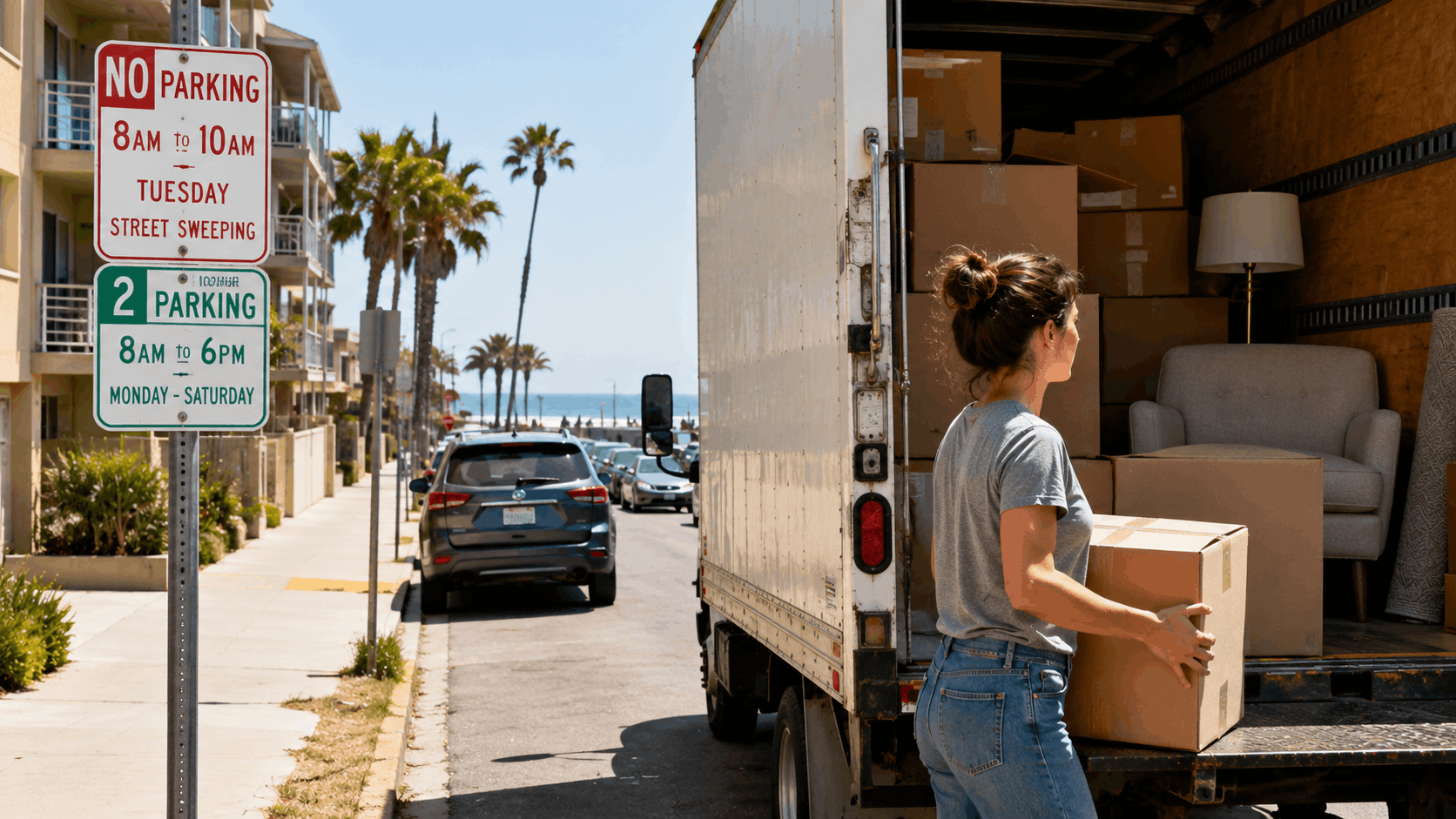
Santa Monica permit parking zones catch a lot of new residents off guard because the rules are not posted in one obvious place. The city operates a network of residential permit zones that restrict non-permitted vehicles during specific hours - and a 26-foot moving truck is exactly the kind of vehicle enforcement officers are watching for.
Most violations happen because the driver assumed that a brief stop would go unnoticed. In beachside neighborhoods where parking is already scarce, enforcement is consistent and fast. A citation can arrive within minutes of parking, and a tow can follow shortly after that.
Here is what every person planning a Santa Monica move needs to know about the parking zone system:
- Santa Monica uses a lettered and numbered district system to define residential permit zones across the city
- Signs in each zone show the district letter or number, the restricted hours, and which vehicles are exempt
- Most zones restrict non-permitted vehicles Monday through Friday during morning and afternoon hours
- A standard moving truck without a temporary exemption is treated the same as any non-permitted vehicle
- Some zones near the beach restrict parking seven days a week, including weekends
- Parking enforcement in Santa Monica operates independently from LADOT - so rules that apply in other LA neighborhoods do not always apply here
- The city posts zone maps on the Santa Monica city website where residents can look up their specific street
Permit Parking Districts and Which Neighborhoods Have Them
The Ocean Park neighborhood south of Pico Boulevard has a well-established permit district that restricts non-resident vehicles during morning hours on weekdays. Streets near Santa Monica College - especially those between Pico Boulevard and Olympic Boulevard, east of Lincoln - also fall under active permit zones because of student parking pressure.
The Pico neighborhood, running roughly from 20th Street toward Cloverfield Boulevard, has a mix of permit zones and unrestricted blocks. Residents need to check the signage on the exact street, not just the general neighborhood, before assuming a truck can park freely.
Many blocks near Santa Monica College have restricted hours from 8 a.m. to 6 p.m. on weekdays, which directly conflicts with standard moving hours. Ocean Park parking districts often mirror those restrictions. Checking the city's parking zone map before move day is not optional - it is a basic step that prevents costly mistakes.
How to Request a Moving Day Parking Exemption from the City
The City of Santa Monica handles temporary no-parking sign requests, which allow a moving truck to legally occupy one or more parking spaces on a residential or commercial street. The City's steps must be completed no less than 24 hours before the reservation, and a single reservation can last up to 72 hours.
Applicants need to provide the specific address, the date and time of the move, the number of parking spaces needed, and the truck's dimensions. Metered spaces can be reserved, but the meter numbers are needed for the request. The signs are sold per sign at a small published cost, so the total depends on how many spaces are requested; confirm current pricing with the City.
The resident or mover picks up the temporary "No Parking" signs in person at City Hall East (323 Olympic Drive) or City Hall Historic (1685 Main Street), posts them on the block, then calls Traffic Services at (310) 458-8466, ext. 4, or (310) 458-8491 for an inspection between 72 and 24 hours before the reservation starts. Signs inspected less than 24 hours ahead are not enforceable. If the truck will not be parked overnight between 9 p.m. and 6 a.m., the City advises signs rather than requiring them, but on a busy block they are still the only way to guarantee the space.
What Happens If You Skip the Permit Process
The consequences of skipping the permit process in Santa Monica are more disruptive than in many other cities. Citations in residential permit zones are costly. If enforcement determines the truck is blocking traffic flow or sitting in a red or yellow zone, a tow can follow quickly.
Retrieval from a tow yard adds significant fees to the day's expenses, plus the time it takes to get the truck back - often two to three hours that cannot be recovered. The move falls behind, the building's elevator reservation window closes, and the entire schedule collapses.
Popeye Moving's crew sees this pattern consistently in beachside neighborhoods where parking is already scarce and enforcement officers are actively patrolling. The small cost of the signs is almost always the better financial decision compared to the alternative.
Get Your Free Quote
Tell us about your move and we'll get back to you fast.
Street Restrictions That Affect Moving Trucks on Santa Monica Roads
Santa Monica's street grid was built before 26-foot box trucks existed. Many residential blocks were designed for passenger vehicles, and the city has posted weight limits, height restrictions, and turn prohibitions on specific streets as a result. Movers who do not check these in advance can find themselves unable to complete a route - or worse, causing property damage that creates liability issues.
Large vehicle restrictions in Santa Monica are not always prominently signed. Some are posted only at the entrance to a block. A crew arriving with a fully loaded truck and discovering a posted weight limit halfway down the street has no good options.
Planning alternate routes before moving day is the only reliable way to avoid these problems. The team at Popeye Moving does this for every Santa Monica job as part of pre-move planning.
Weight and Size Limits on Residential Streets Near the Beach
Posted limits can apply on residential streets anywhere in the city, so the specific block matters more than the neighborhood. A fully loaded box truck is heavy, and the only reliable check is the signage on the actual route. In neighborhoods like North of Montana, mature tree canopy over narrow streets is often the bigger constraint, limiting truck height rather than weight.
The alleys behind Montana Avenue homes present a different challenge. Some alley overhangs and utility infrastructure create clearance issues, and the alleys themselves are often too narrow for trucks longer than 20 feet. The Popeye Moving crew plans alternate routes for these addresses in advance, often using side streets off 7th or 14th Street to approach from a less restricted direction.
Residents should specifically ask their moving company whether the truck's weight, length and height have been checked against the posted limits and tree clearance on their block. This is a question worth asking before signing any moving contract.
Low-Clearance Alleys and Parking Structures to Watch For
The parking structures on 2nd Street and 4th Street in downtown Santa Monica are frequently used as reference points for navigation, but their clearance heights make them off-limits for moving trucks. Most standard box trucks stand between 12 and 14 feet tall. Several downtown structures post clearances of 7 to 8 feet - a gap that causes serious damage if a driver misjudges.
Older alley overhangs near the Wilshire corridor, especially in buildings constructed before 1970, can have irregular clearances that are not always well marked. The practical rule for moving truck drivers is to measure the truck's height before the move and compare it against every posted clearance sign on the planned route.
If the route is unclear, the Popeye Moving team recommends calling the city directly or doing a physical scout of the block the day before the move. A five-minute check prevents expensive repairs and delays.
Street Cleaning Schedules and How They Create Moving Day Conflicts
Santa Monica enforces street sweeping schedules with consistent frequency. A citation for parking during a sweep window is automatic - enforcement does not consider whether the vehicle belongs to a moving crew or a resident. Streets around Pico Boulevard and 20th Street are swept multiple times per week, sometimes on both Tuesday and Friday mornings.
The city's online tool allows anyone to look up the sweep schedule for a specific street address. Entering the address before scheduling a move is a five-minute step that can prevent a citation that shows up before the first box is unloaded.
Early morning starts - before 7 a.m. - often allow a truck to load or unload before sweeping begins. This is one of several reasons Popeye Moving recommends starting Santa Monica moves at 7 a.m. or earlier whenever the client's building and schedule allow it.

Need Help in Los Angeles?
Popeye Moving & Storage serves Los Angeles and all of Los Angeles County.
Building Access Rules at Santa Monica Apartments and Condos
Getting a truck to the curb is only part of the challenge. Once the crew arrives at a Santa Monica apartment or condo building, a separate set of rules governs how and when they can move items through the building. These rules vary significantly from one property to the next and are often not shared with new tenants until they ask specifically.
Buildings near Downtown Santa Monica and along the Wilshire corridor tend to have the most detailed requirements - reserved elevators, loading dock time windows, and HOA approvals that must happen before moving day. Skipping any of these steps can result in a building manager denying access and the crew sitting outside with a loaded truck.
Residents who are planning an apartment move in Santa Monica should contact their property manager at least two weeks before moving day to get all building-specific requirements in writing.
Elevator Reservations and Time Windows at High-Rise Buildings
Most high-rise buildings along Wilshire Boulevard and Ocean Avenue require residents to book the service elevator in advance, with the notice period set by each building. Many schedule elevator access in fixed blocks on weekday mornings, and the slots fill up quickly near the end and beginning of each month when lease turnovers peak.
A refundable deposit is common at Santa Monica high-rises, in an amount set by each building. The deposit is returned after management inspects the elevator and common areas for damage. Booking late often means getting an afternoon slot or being pushed to the following week entirely.
Residents who schedule their move without confirming elevator availability first sometimes arrive to find the service elevator already booked by another tenant. At that point, the options are limited and expensive. Confirming elevator access is one of the first calls anyone planning a high-rise move should make.
Loading Dock Access and HOA Move-In Policies
Newer mixed-use buildings near the Third Street Promenade area and the Santa Monica Place corridor often have dedicated loading docks with strict time windows - sometimes as short as 90 minutes. These docks may require a specific truck length or configuration to enter, and a truck that is too long for the dock approach has to unload from the street instead.
Many HOA-managed buildings in Santa Monica require the moving company to provide proof of licensing and insurance before granting any access at all. This requirement is one reason residents in these buildings specifically request Popeye Moving by name. The documentation Popeye Moving carries is accepted by building managers across the city without additional back-and-forth.
Residents moving into HOA buildings should request the move-in policy document from their HOA at least three weeks before moving day. That document will list every requirement - from insurance minimums to allowable move hours - in detail.
Communicating with Property Managers Before Moving Day
A productive conversation with a property manager before a move covers several specific items: the freight elevator's interior dimensions, the width of hallways and doorways on the resident's floor, the building's insurance certificate requirements, and any restricted hours for moving activity. Getting this in writing - even by email - prevents disputes on moving day.
Popeye Moving provides a standard certificate of insurance (COI) for every booking. The COI lists the company's liability coverage, workers' compensation coverage, and the specific property address as an additional insured. Many Santa Monica buildings require a COI naming the building's ownership or HOA specifically, and Popeye Moving prepares those customized documents routinely.
If a property manager mentions specific floor plan access points or freight elevator panel dimensions, sharing that information with the moving company in advance allows the crew to confirm that large furniture pieces - sofas, bed frames, dining tables - will clear the space before moving day arrives.
Neighborhood-Specific Challenges Across Santa Monica
Santa Monica is not a single uniform city block. The logistics of moving into a North of Montana craftsman are completely different from moving into an Ocean Park bungalow or a Pico neighborhood apartment building. Each area has its own combination of street widths, parking conditions, and access constraints.
Residents who research their specific neighborhood before moving day avoid the problems that catch people off guard. The Popeye Moving crew has worked all of these neighborhoods and carries area-specific knowledge into every job.
North of Montana - Narrow Streets and Mature Tree Canopies
The streets north of Montana Avenue, particularly between 7th Street and 14th Street, are some of the most beautiful in Santa Monica - and some of the most challenging for large moving trucks. The blocks are lined with mature eucalyptus and jacaranda trees whose root systems have lifted sidewalks and narrowed effective driving lanes over the decades.
A standard 26-foot box truck on these blocks sometimes has less than a foot of clearance on each side while in motion. Low-hanging branches can scrape the roof of a tall truck. The Popeye Moving crew regularly uses 20-foot trucks in this neighborhood specifically to reduce the risk of property damage and to maintain enough maneuverability to complete a three-point turn when needed.
Residents in this area should also be aware that the narrow street widths make it physically impossible to have a truck parked on one side while traffic passes in both directions. A local residential moving plan for North of Montana almost always involves coordinating with neighbors in advance about temporary lane use.
Ocean Park and the South Side - Beach Proximity and Limited Parking
Ocean Park, south of Pico Boulevard and running toward the beach, faces a parking situation that gets genuinely difficult between June and September. Tourist parking overflow from the beach pushes into residential streets by mid-morning on warm weekends. By 10 a.m. on a Saturday in July, finding a legal space anywhere near Ocean Park Avenue for a moving truck is nearly impossible without a pre-arranged permit.
Early morning moves - starting before 8 a.m. - are the practical answer. The streets are clear, enforcement is minimal, and the building's morning elevator slot is often available. For Ocean Park bungalows specifically, the alley running behind the property is often the most practical access point for a moving truck, avoiding the street entirely.
The alleys in this area are generally wide enough for a 20-foot truck and provide direct access to rear garages and back doors. Popeye Moving recommends scoping the alley access during a pre-move site visit to confirm width and any overhead clearance issues before the crew arrives with a full load.
Mid-City and the Pico Neighborhood - Mixed Housing and Active Commercial Streets
The Pico neighborhood runs through the middle of Santa Monica and contains a mix of 1960s apartment buildings, newer townhomes, and commercial strips that create variable moving conditions block by block. An older building on one side of Cloverfield Boulevard might have no loading dock and a single stairwell, while a newer townhome development across the street has a designated moving zone.
Streets near Cloverfield Boulevard and 26th Street have seen recurring construction-related lane closures tied to ongoing residential development in the area. A lane closure that was not there during a pre-move site visit can appear by moving day. Popeye Moving's crew checks current traffic conditions the morning of each job and has backup approach routes for the Pico neighborhood specifically.
Residents in older Pico neighborhood apartment buildings should specifically confirm with their property manager whether there is a loading zone or designated truck access area. Many of these buildings were constructed before loading zones were standard, and the crew will need to work from the street - which makes the parking permit even more important.

Santa Monica Moving Permits - What the City Actually Requires
The permit question is where most people get confused. Not every Santa Monica move requires a city permit. But the moves that do require one have clear legal thresholds, and crossing those thresholds without a permit creates real liability for the resident and the moving company.
Knowing the difference between a situation that requires a permit and one that does not saves time and money. It also helps residents have an honest conversation with their moving company about who handles what before moving day arrives.
When a Permit Is Required vs. When It Is Optional
A city permit is required in Santa Monica when a moving truck needs to occupy a metered parking space, a permit parking zone, block any portion of a traffic lane, or park in a red or yellow curb zone. These are situations where the truck is using public right-of-way in a way that affects other drivers or requires special authorization.
When a move can be completed from a private driveway, an off-street parking area, or a designated building loading zone, no city permit is needed. Many single-family homes in North of Montana and the Pico neighborhood have driveways that can accommodate a short truck or can be used for a partial load. In those cases, the move proceeds without any city involvement.
The honest answer is that the majority of apartment and condo moves in Santa Monica do require some form of temporary no-parking permit because the truck must park on a public street. Residents should assume a permit is needed unless their property manager or building specifically confirms that off-street access is available.
How to Apply Through the Santa Monica Public Works Department
Temporary no-parking zone permits for moving purposes are processed through the Santa Monica Public Works Department. Applications can be submitted online through the city's permit portal or in person at City Hall. The application requires the move date, the specific address, the truck's length and height, and the number of parking spaces the truck needs to occupy.
The City uses this information to issue the temporary "No Parking" signs, which the resident or mover then posts on the block. The signs must be inspected by Traffic Services between 72 and 24 hours before the reservation, which gives any vehicles already parked in the zone time to move.
The City requires the steps to be completed no less than 24 hours before the reservation, but the inspection window means planning several days ahead, and City Hall is closed every other Friday. During the summer months - particularly June through August when move volume peaks in Santa Monica - starting early is the only reliable way to guarantee the signs are posted and inspected in time.
Permit Fees, Timelines, and Who Typically Handles This
The City sells temporary no-parking signs per sign, so the cost depends on the number of spaces requested; containers and PODs placed on the street need a separate Use of Public Property Permit from Public Works. The permit is typically issued in the resident's name, not the moving company's name, though the moving company can assist with gathering and submitting the required information.
Popeye Moving assists clients with the permit process as part of pre-move planning. The crew gathers the truck dimensions, confirms the number of spaces needed based on the job scope, and walks the client through the online application. This does not transfer legal responsibility for the permit to the moving company, but it removes the administrative burden from a client who is already managing dozens of other moving tasks.
Residents who handle the permit themselves should budget at least two weeks of lead time to account for application processing, sign installation, and any back-and-forth with the city if additional information is needed.
Need Help in Los Angeles?
Popeye Moving & Storage serves Los Angeles and all of Los Angeles County.
Seasonal and Weather Factors That Affect Moving in Santa Monica
Santa Monica's coastal climate feels mild compared to inland Los Angeles, but it creates specific moving challenges that residents from other parts of the city do not anticipate. The marine layer, summer beach crowds, and holiday building restrictions all affect how a move gets planned and executed.
The Popeye Moving crew has learned to read Santa Monica's seasonal patterns and build them into the scheduling and logistics for every job in the city. These factors are not hypothetical - they show up on nearly every summer and winter move.
Summer Weekends Near the Pier - Traffic and Crowd Congestion
From late June through Labor Day, the area between Lincoln Boulevard and the Pacific Ocean becomes one of the most congested zones in Los Angeles on Saturday and Sunday afternoons. Ocean Avenue and Colorado Avenue - two of the primary routes for trucks approaching from the east - can back up for 30 to 60 minutes starting around 10 a.m.
The Popeye Moving crew schedules summer moves near the pier area to start at 7 a.m. or earlier. At that hour, the streets are clear, loading zones are available, and the truck can complete its work before beach traffic builds. A move that would take four hours starting at 10 a.m. often takes six hours due to traffic delays alone in this corridor.
Residents moving into buildings on Ocean Avenue or within a few blocks of the Santa Monica Pier should plan their entire moving day schedule around a very early start. Waiting until a comfortable 9 a.m. on a summer Saturday is a decision that tends to create regret by noon.
June Gloom and Winter Rain - Protecting Furniture and Floors
May and June bring the marine layer that Santa Monica locals call June Gloom. Even without rainfall, the damp air leaves walkways, driveways, and building lobbies slick and wet during morning hours. Hardwood floors - common in both older craftsman homes in North of Montana and in newer luxury condos along Wilshire - are vulnerable to moisture damage during moves if the crew does not take protective measures.
The packing and protection practices at Popeye Moving include floor runners and protective mats for every job in Santa Monica during the damp season. Furniture wrapping with moisture-resistant materials is standard during June Gloom months, not an add-on. These steps prevent the kind of floor scratches and water stains that create disputes between tenants and landlords after move-out.
Winter rain events - though infrequent - can arrive quickly in Santa Monica and create similar floor protection concerns in any month between November and March. The crew keeps floor protection materials on every truck regardless of the forecast, because coastal weather changes faster than most weather apps predict.
Holiday Weekend Blackout Dates at Many Santa Monica Buildings
Many condo and apartment buildings near the beach block move-ins on major holiday weekends. Memorial Day, the Fourth of July, and Labor Day are the three most consistent blackout periods across Santa Monica's professionally managed residential buildings. Some buildings also restrict moves on the weekends surrounding Thanksgiving and New Year's Day.
The reasoning is straightforward - building staff are reduced, parking and elevator demand from existing residents is high, and management does not want the liability of a move happening in a crowded building during an event period. Residents who do not confirm blackout dates in advance sometimes arrive on a holiday weekend to find the loading dock locked.
Confirming blackout dates with the building manager at least three weeks before the target move date is the minimum lead time. If the preferred date falls on or near a holiday, having an alternate date in mind when contacting the building prevents a scheduling gap that forces a last-minute rebooking.

How to Get a Temporary Parking Permit for Moving Day in Santa Monica
A temporary no-parking zone permit from Santa Monica Parking Operations is the official mechanism that allows a moving truck to legally hold one or more parking spaces on a residential or commercial street during a move. Without this permit, a truck parked in a permit zone has no legal protection regardless of how briefly it stops.
Applications must be submitted at least 5 to 7 business days before the move date and require the street address, move date and time, number of spaces needed, and the truck's dimensions. The fee typically falls between $50 and $100 depending on the number of spaces requested. Once the city approves the application, it posts temporary no-parking signs on the relevant block before moving day. Those physical signs are what legally protects the truck from citation or tow. Movers who skip this step face citations exceeding $100 and potential tow fees of $300 or more, along with lost time that can collapse an entire move-day schedule.
Understanding Santa Monica's Residential Parking Permit Zone System
Santa Monica uses a lettered and numbered district system to define residential permit zones, and the boundaries of those zones do not always follow neighborhood lines in predictable ways. Each zone is identified by signs that show the district letter or number, the restricted hours, and which vehicles are exempt.
The practical challenge for movers is that zone boundaries can change from one block to the next. A street that is unrestricted at one end may carry full permit restrictions midway down the same block. The city posts zone maps on its official website, and checking the specific block address rather than the general neighborhood is the only reliable approach. Some zones near the beach restrict parking seven days a week, which means weekend moves carry the same enforcement risk as weekday moves. Enforcement in Santa Monica operates independently from LADOT, so assumptions carried over from other Los Angeles neighborhoods do not apply. Identifying the correct zone designation for a move address before scheduling the truck is a necessary step that prevents enforcement surprises on moving day.
Working with a Moving Company That Knows Santa Monica
There is a measurable difference between a moving company that has worked Santa Monica streets for years and one that treats it as just another Los Angeles neighborhood. Santa Monica has its own city government, its own parking enforcement division, its own permit process, and building access requirements that evolve as new construction changes the city's housing stock.
A crew that arrives without that knowledge is not prepared for the specific conditions they will encounter. The problems that follow are not abstract - they show up as delays, citations, and damaged items that could have been avoided with better preparation.
Pre-Move Site Visits and Route Planning
Before a Santa Monica move, the Popeye Moving team conducts a pre-move assessment - either in person or through a virtual walkthrough using photos and video provided by the client. The assessment covers truck access at the origin and destination, elevator dimensions and availability, stairwell clearances, and any posted weight or size restrictions on the planned truck route.
This step is what prevents a four-hour move from becoming an eight-hour one. When the crew arrives on moving day already knowing that the service elevator is 7 feet tall and 5 feet wide, that the alley behind the property fits a 20-foot truck but not a 26-footer, and that the street sweeper comes at 8 a.m. on Wednesdays, the job moves efficiently.
Popeye Moving, based in Los Angeles, has worked Santa Monica regularly enough to carry neighborhood-specific knowledge into pre-move planning without needing to start from scratch on each job. Residents can book a pre-move consultation directly on the Popeye Moving website to get this process started.
Insurance Documentation and Building Manager Approval
Newer construction near Downtown Santa Monica and the Bergamot Station corridor tends to have the most detailed insurance requirements of any buildings in the city. Property managers at these locations require a COI that meets specific minimums - often a specified minimum of general liability coverage - before allowing any moving activity through the loading dock or service elevator.
Popeye Moving provides a certificate of insurance as a standard part of every booking. When a building requires the COI to name the property ownership or HOA as an additional insured, the Popeye Moving office prepares that customized document and sends it directly to the building manager before moving day. This eliminates the back-and-forth that can delay access on the morning of the move.
Residents should confirm with their building's management office exactly what the COI must include - the named insured, the coverage amounts, and whether the document must be received a certain number of days before the move. Sharing that requirement with Popeye Moving at booking ensures the correct document is ready on time.
What to Confirm with Your Mover Before the Santa Monica Move
Before signing a contract with any moving company for a Santa Monica job, residents should ask a short list of direct questions. The answers quickly reveal whether the company has genuine local experience or is learning the city's rules for the first time on moving day.
- Are you familiar with Santa Monica's temporary no-parking zone permit process, and can you assist with the application?
- Have your crews moved into buildings on Wilshire Boulevard or Ocean Avenue before, and do you know the elevator reservation requirements at those properties?
- Does your company carry a COI that can be customized to name the building's HOA or ownership as an additional insured?
- What size trucks do you use in neighborhoods with narrow streets, such as North of Montana?
- Do you do a pre-move route check for weight limits and clearance restrictions before arriving on moving day?
A moving company with real Santa Monica experience answers these questions without hesitation. The Popeye Moving team welcomes these questions and considers them a sign that the client is thinking seriously about the job ahead.
Utility Transfers and Address Changes After Moving to Santa Monica
Once the truck is unloaded and the crew has left, a new set of tasks begins. Santa Monica operates several city services independently from the rest of Los Angeles, which means the utility setup and address change process works differently here than it does for residents moving from other parts of LA County. Missing these steps creates practical problems within days of move-in.
Setting Up Water and Trash Service Through Santa Monica Municipal Utilities
Santa Monica runs its own water and wastewater services through the City of Santa Monica, entirely separate from LADWP. New residents cannot transfer an LADWP account to a Santa Monica address - they must open a new account directly with the City.
The setup process is handled through the City's utility account portal and requires proof of residency (a signed lease or closing documents), the service address, and a contact phone number and email. Activation can take a few business days after the application is submitted. Starting this process before moving day ensures water service is active when the resident arrives.
Trash and recycling service in Santa Monica is managed separately through the city's Public Works department and is often set up as part of the City utility account for residential properties. Apartment residents should confirm with their property manager whether trash service is included in rent or requires a separate setup, as policies vary by building.
Registering for a Residential Parking Permit After Move-In
Once the move is complete and proof of residency is established, new Santa Monica residents living on permit-required streets can apply for a residential parking permit through the City. The application requires a current utility bill or lease as proof of address, the vehicle's registration, and an annual fee set by the City.
Blocks near Centinela Avenue and the eastern boundary of Santa Monica - where the city borders Los Angeles neighborhoods like Mar Vista - sometimes have their own specific permit district requirements that differ from the central Santa Monica zones. Residents in these border areas should confirm which district their street falls under before applying.
The permit is issued as a physical sticker or a hangtag, depending on the district. It is vehicle-specific, so each car in the household requires a separate permit. Processing is not instant, so applying shortly after move-in ensures the vehicle is covered before a citation appears on the windshield.
Updating Your California DMV Records and Voter Registration
California law requires a DMV address update within 10 days of moving to a new address. This can be completed online through the California DMV website using the driver's license number and the last four digits of the Social Security number. No in-person visit is required for an address-only change on an otherwise valid license.
Voter registration should be updated through the Santa Monica City Clerk's office or directly through the California Secretary of State's online registration portal. Registering with a Santa Monica address means the voter will receive a Santa Monica-specific ballot, which includes city council elections and local ballot measures that do not appear on LA County ballots.
Both updates take less than 15 minutes combined online. Doing them in the first week after move-in - while the new address is fresh - prevents the kind of bureaucratic backlog that accumulates when these tasks get pushed to later.

Need Help in Los Angeles?
Popeye Moving & Storage serves Los Angeles and all of Los Angeles County.
Final Thoughts
Moving to Santa Monica involves a set of logistics that goes well beyond loading boxes and renting a truck. The city's permit parking zones, street weight limits, building elevator reservations, and independent utility providers create a moving checklist that is longer and more specific than most new residents expect.
The residents who have the smoothest move days are the ones who start the permit process two weeks out, confirm elevator reservations the same week they sign a lease, and choose a moving company that has already worked their specific neighborhood. Every problem covered in this article has a solution - and almost all of them require nothing more than a phone call or an online application done far enough in advance.
If the logistics of a Santa Monica move feel like a lot to track, that is exactly where Popeye Moving's experience becomes useful. Contact the Popeye Moving team to discuss the specifics of an upcoming move and get a clear plan in place before moving day arrives.
Frequently Asked Questions
Do I need a permit to park a moving truck on a Santa Monica street?
A temporary no-parking reservation is how a moving truck legally holds a metered space or a permit parking zone. Red curb, blue curb, loading zones, bike lanes and valet zones can never be reserved. The City's steps must be completed no less than 24 hours before the reservation, and signs are advised rather than required if the truck will not be parked overnight between 9 p.m. and 6 a.m. Without a reservation, the truck is exposed to a citation and possible tow, which adds retrieval fees to the day's costs.
How far in advance should I apply for a moving permit in Santa Monica?
The City requires the steps to be completed no less than 24 hours before the reservation, and the signs must be inspected between 72 and 24 hours before it starts, so planning several days ahead is sensible. During summer months - June through August - demand increases as lease turnovers peak across the city, and City Hall is closed every other Friday. Leaving it late risks the signs not being posted and inspected in time, leaving the crew without legal protection on the street.
What are the elevator reservation rules at Santa Monica high-rise buildings?
Most high-rise buildings along Wilshire Boulevard and Ocean Avenue require residents to book the service elevator in advance, with the notice period set by each building. Time windows are usually fixed blocks, most often available on weekday mornings. A refundable deposit, in an amount set by the building, is common and is returned after management confirms no damage to the elevator or common areas following the move.
Are there streets in Santa Monica where moving trucks are not allowed?
Yes. Certain residential streets have posted weight, height or turn restrictions, and the specific block matters more than the neighborhood. In North of Montana, mature tree canopy over narrow streets often limits truck height. Some alleys have overhead clearance restrictions that prevent tall trucks from entering. Checking posted signage and doing a pre-move route assessment are both necessary steps before committing to a specific approach.
Can my moving company handle the permit process for me?
Reputable local movers like Popeye Moving can assist with gathering the required information, completing the application, and coordinating with the City of Santa Monica. The permit is typically issued in the resident's name rather than the moving company's name, so the resident remains the applicant of record. Popeye Moving walks clients through this process as part of pre-move planning and considers it a standard part of the job, not an extra service.
What is the best day and time to move in Santa Monica?
Weekday mornings starting before 8 a.m. offer the most favorable conditions in Santa Monica. Street sweeping schedules are often mid-morning or later, beach traffic has not yet built, and building elevator slots are more available on weekdays than weekends. Summer Saturday and Sunday moves near the pier area are the most difficult to execute efficiently due to traffic volume on Ocean Avenue and Colorado Avenue, which can add an hour or more to truck arrival times.
Does my building in Santa Monica require a certificate of insurance from my mover?
Most professionally managed buildings and HOA-governed properties in Santa Monica require a COI from the moving company before allowing access to the loading dock or service elevator. The document typically includes general liability coverage at a minimum the building specifies and may need to name the building's ownership or HOA as an additional insured. Popeye Moving provides this documentation automatically for every booking and can customize the named insured field to match the building's specific requirements.
How do I set up water and trash service after moving to Santa Monica?
Water and wastewater service in Santa Monica is handled by the City of Santa Monica, independent from LADWP. New residents must open an account directly with the City, providing proof of residency and the service address. Activation can take a few business days. Trash service is managed through the city's Public Works department - apartment residents should confirm with their property manager whether this is included in their lease or requires a separate city account.
What happens if a moving truck gets towed in Santa Monica?
Tow and storage fees in Santa Monica are substantial and grow the longer the vehicle sits at the tow yard before retrieval. The driver or owner must present proof of ownership and pay fees in full before the truck is released. The retrieval process typically takes 2 to 3 hours, which collapses the day's moving schedule - causing elevator reservation windows to close and building access to be lost. Prevention through a proper permit is far less expensive in both time and money.
How is moving into Santa Monica different from moving into other parts of Los Angeles?
Santa Monica is an independent city with its own municipal government, its own parking enforcement division, its own utility providers, and its own permit processes - all of which operate separately from LADWP and LADOT. Rules that applied in a previous Los Angeles neighborhood do not automatically transfer. Residents moving from West Hollywood, Culver City, or other parts of LA County often discover these differences on moving day rather than before it, which is exactly why local knowledge from a company that works Santa Monica regularly makes a measurable difference in how the day goes.
Frequently Asked Questions
- Do I need a permit to park a moving truck on a Santa Monica street?
- A temporary no-parking reservation is how a moving truck legally holds a metered space or a permit parking zone. Red curb, blue curb, loading zones, bike lanes and valet zones can never be reserved. The City's steps must be completed no less than 24 hours before the reservation, and signs are advised rather than required if the truck will not be parked overnight between 9 p.m. and 6 a.m. Without a reservation, the truck is exposed to a citation and possible tow, which adds retrieval fees to the day's costs.
- How far in advance should I apply for a moving permit in Santa Monica?
- The City requires the steps to be completed no less than 24 hours before the reservation, and the signs must be inspected between 72 and 24 hours before it starts, so planning several days ahead is sensible. During summer months - June through August - demand increases as lease turnovers peak across the city, and City Hall is closed every other Friday. Leaving it late risks the signs not being posted and inspected in time, leaving the crew without legal protection on the street.
- What are the elevator reservation rules at Santa Monica high-rise buildings?
- Most high-rise buildings along Wilshire Boulevard and Ocean Avenue require residents to book the service elevator in advance, with the notice period set by each building. Time windows are usually fixed blocks, most often available on weekday mornings. A refundable deposit, in an amount set by the building, is common and is returned after management confirms no damage to the elevator or common areas following the move.
- Are there streets in Santa Monica where moving trucks are not allowed?
- Yes. Certain residential streets have posted weight, height or turn restrictions, and the specific block matters more than the neighborhood. In North of Montana, mature tree canopy over narrow streets often limits truck height. Some alleys have overhead clearance restrictions that prevent tall trucks from entering. Checking posted signage and doing a pre-move route assessment are both necessary steps before committing to a specific approach.
- Can my moving company handle the permit process for me?
- Reputable local movers like Popeye Moving can assist with gathering the required information, completing the application, and coordinating with the City of Santa Monica. The permit is typically issued in the resident's name rather than the moving company's name, so the resident remains the applicant of record. Popeye Moving walks clients through this process as part of pre-move planning and considers it a standard part of the job, not an extra service.
- What is the best day and time to move in Santa Monica?
- Weekday mornings starting before 8 a.m. offer the most favorable conditions in Santa Monica. Street sweeping schedules are often mid-morning or later, beach traffic has not yet built, and building elevator slots are more available on weekdays than weekends. Summer Saturday and Sunday moves near the pier area are the most difficult to execute efficiently due to traffic volume on Ocean Avenue and Colorado Avenue, which can add an hour or more to truck arrival times.
- Does my building in Santa Monica require a certificate of insurance from my mover?
- Most professionally managed buildings and HOA-governed properties in Santa Monica require a COI from the moving company before allowing access to the loading dock or service elevator. The document typically includes general liability coverage at a minimum the building specifies and may need to name the building's ownership or HOA as an additional insured. Popeye Moving provides this documentation automatically for every booking and can customize the named insured field to match the building's specific requirements.
- How do I set up water and trash service after moving to Santa Monica?
- Water and wastewater service in Santa Monica is handled by the City of Santa Monica, independent from LADWP. New residents must open an account directly with the City, providing proof of residency and the service address. Activation can take a few business days. Trash service is managed through the city's Public Works department - apartment residents should confirm with their property manager whether this is included in their lease or requires a separate city account.
- What happens if a moving truck gets towed in Santa Monica?
- Tow and storage fees in Santa Monica are substantial and grow the longer the vehicle sits at the tow yard before retrieval. The driver or owner must present proof of ownership and pay fees in full before the truck is released. The retrieval process typically takes 2 to 3 hours, which collapses the day's moving schedule - causing elevator reservation windows to close and building access to be lost. Prevention through a proper permit is far less expensive in both time and money.
- How is moving into Santa Monica different from moving into other parts of Los Angeles?
- Santa Monica is an independent city with its own municipal government, its own parking enforcement division, its own utility providers, and its own permit processes - all of which operate separately from LADWP and LADOT. Rules that applied in a previous Los Angeles neighborhood do not automatically transfer. Residents moving from West Hollywood, Culver City, or other parts of LA County often discover these differences on moving day rather than before it, which is exactly why local knowledge from a company that works Santa Monica regularly makes a measurable difference in how the day goes.
P
Popeye Moving & Storage Co. Team Team
Licensed moving and storage professionals serving Los Angeles and Los Angeles County.
Licensed in California · License #PUC: CAL T 189749 | DOT: 1472924 | MC: 498816C
Why trust Popeye Moving & Storage?
Founded in 1994, Popeye Moving & Storage is a licensed and insured moving and storage service serving Los Angeles and Los Angeles County. All content is reviewed by our licensed technicians.

Need Help in Los Angeles?
Popeye Moving & Storage serves Los Angeles and all of Los Angeles County.
Related Articles
How-To Guides
Beverly Hills Moving Permits and Restrictions: What You Need Before Moving Day
Beverly Hills moving permits, time restrictions, and street-by-street rules explained - what you need before moving day to avoid fines, towing, and delays.

Tips & Advice
Moving Into a Downtown LA High-Rise: Building Rules, Elevators, and Logistics
Moving into a Downtown Los Angeles high-rise? Elevator blocks, COI, loading docks, and move-in fees—here's what to expect and how to plan your DTLA move.
Tips & Advice
Moving in the LA Hills: What Steep Streets and Narrow Roads Mean for Your Move
Hillside moves in Los Angeles aren’t like flat-land moves. Here’s what to expect with steep streets, narrow roads, and limited truck access in neighborhoods from Hollywood to Brentwood.