How-To Guides
Furniture Installation Day for Designers: White Glove Delivery, Placement, and Debris-Out in One Visit

Key Takeaways
- A single-visit white glove install combines delivery, assembly, precise placement, and debris removal into one coordinated appointment instead of three separate trips.
- Prep work like measuring doorways and elevators, approving building COIs early, and sharing a marked floor plan keeps install day running smoothly.
- Fragile pieces such as marble tops, glass consoles, and vintage antiques require specific handling techniques to avoid costly damage.
- The crew hauls away all cardboard, foam, and shrink wrap, and can remove old furniture during the same visit, saving designers from dumpster rentals.
- LA neighborhoods each bring challenges - hillside carries in Bel Air, freight elevators in DTLA lofts, tight parking in Venice, and gated access in Beverly Hills.
- White glove installs typically run $400 to $900 for one room, $1,200 to $3,500 for a multi-room home, and more for large estates, with access difficulty adding to the total.
- Climate-controlled storage, early receiving, and vendor consolidation let designers hold shipments and combine them into one clean reveal-day install.
- Booking two to four weeks ahead, and earlier for large or holiday-season projects, gives time to coordinate storage, COIs, and the install date.
In This Article
It is the morning of a big client reveal in Brentwood. An interior designer has staged every corner, picked every pillow, and promised her client a finished room by noon. Then the delivery truck drops the sofa at the curb and drives off. The assembly team is not scheduled until tomorrow. The packaging haul-away is a separate call entirely. Now there are boxes stacked in the driveway, a half-built sectional, and a client who arrives in three hours.
This scene plays out across Los Angeles more often than most designers would like to admit. Separate crews for delivery, assembly, and trash pickup mean three appointments, three windows to sit through, and three chances for something to go wrong. A single-visit white glove install solves all of it in one coordinated appointment.

What White Glove Furniture Installation Means for Designers?
A true single-visit white glove install is not a delivery with a nicer name. It is a full-service appointment where the crew brings the furniture in, builds it, places it to the inch, and hauls every scrap of packaging away before they leave. Designers get a finished room, not a pile of boxes on the floor.
Standard delivery ends when the item touches the ground. White glove ends when the space is ready to photograph. That difference matters when a client reveal is on the line.
Here is what a real white glove delivery and furniture installation covers in a single visit:
- Inside delivery - pieces are carried into the exact room, not left at the door
- Full assembly - beds, sectionals, dining tables, and casegoods built on site
- Precise placement - furniture set according to the designer's floor plan
- Debris removal - all boxes, foam, and wrap leave with the crew
- Final walkthrough - a quick check so nothing is missed
Delivery, Placement, and Debris-Out in One Visit
The service breaks down into three parts that most companies treat as separate jobs. First comes delivery, where the crew moves each piece from the truck into the home and up to the correct floor. This is the heavy lifting stage, and it sets up everything that follows.
Second is placement. Once items are unboxed and assembled, the crew positions each piece where the designer wants it. A sectional gets angled toward the window, a console lands under the mirror, and rugs get squared to the room. Placement is where a room stops looking like a warehouse and starts looking staged.
Third is debris-out. Instead of leaving cardboard and shrink wrap piled on the client's curb, the crew loads all of it back onto the truck. Everything happens in one visit, on one appointment, with one team that owns the whole result. No waiting for a second crew, no second trash run.
How It Differs From Standard Curbside Delivery
Curbside delivery and freight drop-off stop at the property line. The driver rolls the item to the sidewalk or the front door, gets a signature, and leaves. Whatever happens next is the customer's problem, boxes and all.
Threshold delivery is a small step up. The driver brings the item just inside the front door, but no further. There is no assembly, no carrying upstairs, and no packaging removal. For a designer staging a third-floor bedroom in a Larchmont walk-up, threshold delivery leaves most of the work undone.
White glove replaces all of that with a crew that treats the finished space as the goal. They protect the floors, unbox in a staging area, build each piece, and clean up after themselves. The contrast is night and day when a client is expecting a ready room, not a delivery slip.
Why Designers Care About a Reveal-Ready Room
A designer's reputation rides on the reveal. When a client walks into a space for the first time, the emotional payoff comes from seeing it complete, not from imagining what it will look like once someone assembles the bed. A staged, finished room is the product designers actually sell.
Boxes on the floor and tools scattered around break that spell instantly. It makes the project feel unfinished and makes the designer look disorganized, even when the delay is entirely the delivery company's fault. Clients remember how a reveal felt more than they remember the details.
Single-visit white glove installs protect that reveal moment. The designer controls the timeline, the room is complete when the client arrives, and the photos for the portfolio can happen the same day. Our team has handled installs across the city for designers who treat that first impression as their livelihood, and we plan every visit around protecting it.
Get Your Free Quote
Tell us about your move and we'll get back to you fast.
Planning Install Day Before the Truck Arrives
Install day runs smoothly when the prep is done right. Most problems on delivery day trace back to something that could have been checked a week earlier - a doorway too narrow, a building that needed paperwork, or a parking spot that never existed.
Good install day planning comes down to measurements, access, and timing. LA properties throw a lot of curveballs, so a little homework up front saves hours later.
Measuring Doorways, Elevators, and Stairwells
The first job is confirming that every piece will actually fit through every opening. That means measuring doorway clearance at the narrowest point, including the swing of the door itself. A sofa that measures fine on paper can still jam if the hallway behind the door is too tight to pivot.
Hillside homes in Silver Lake and Los Feliz are famous for this. Many were built decades ago with narrow front doors, steep entry steps, and switchback staircases that no oversized sectional was ever meant to climb. We check for these choke points before the truck loads, not after it arrives.
For condos, elevator dimensions decide everything. A freight elevator with a 78-inch ceiling limits how tall a piece can stand, and a small cab may force a diagonal tilt. Older walk-ups near Larchmont often have no elevator at all, so stairwell width and landing turns become the deciding factor. We record these numbers ahead of time and match them against each item on the manifest.
Coordinating COIs for High-Rise Buildings
High-rise buildings in Downtown LA and Century City almost always require a certificate of insurance before a moving crew can enter. The building management wants proof of coverage naming them as an additional insured, and they will turn a crew away at the loading dock without it.
These building requirements vary by property, and some management companies take days to approve a COI. We ask for the building's insurance requirements as soon as a project is booked so there is time to submit and get it stamped. Waiting until install day is how deliveries get bounced.
Beyond the COI, many towers restrict move-in hours to weekdays or reserve the freight elevator by appointment. A designer coordinating a full loft install in the Arts District needs to lock in both the elevator window and the certificate at the same time. Our team handles this paperwork routinely, so designers do not have to chase it down themselves.
Setting a Delivery Window That Beats LA Traffic
Timing a delivery window in Los Angeles is its own skill. A crew stuck on the 405 or crawling along the 10 during rush hour burns billable time and pushes back the whole day. We schedule around known chokepoints, usually starting early to clear the worst of the freeway congestion.
Street parking rules add another layer. West Hollywood enforces permit zones and short posted limits, and a truck without a spot means the crew has to carry pieces much farther. In parts of Venice, the streets are so narrow that a full-size truck barely fits, so we sometimes shuttle with a smaller vehicle.
When a job needs curb space for hours, we look into temporary parking permits through the city ahead of time. A little planning here keeps the crew close to the door and keeps the clock from running while someone hunts for parking. For designers coordinating tight reveal deadlines, that saved time is the difference between finishing early and finishing late.
Sharing a Floor Plan With the Crew
A marked floor plan turns guesswork into precision. When a designer sends over a placement diagram showing where each piece belongs, the crew can set the room correctly the first time instead of dragging heavy furniture back and forth.
The best diagrams label each item and note orientation - which way the sofa faces, where the nightstands sit, how the rug lines up. Even a quick sketch with arrows beats a verbal description. It also prevents the awkward situation where the designer is not on site and the crew has to guess the furniture layout.
We treat the floor plan as the source of truth for the install. If a designer wants a console centered on a wall to the inch, that detail goes on the diagram and the crew delivers it. Sharing that plan in advance is one of the simplest ways to make install day faster and calmer for everyone.

Need Help in Los Angeles?
Popeye Moving & Storage serves Los Angeles and all of Los Angeles County.
How the White Glove Delivery Process Works
Knowing the white glove process step by step takes the mystery out of install day. From the moment the truck parks, the crew follows a routine built to protect the home and get the room finished without drama.
Here is how the delivery steps and furniture handling generally unfold:
- Site protection - floor runners and door guards go down first
- Staging - a clear area is set aside for unboxing
- Inspection - each piece is checked before it moves further in
- Assembly - items are built in the staging zone or the target room
- Placement - furniture is set per the floor plan
- Cleanup - all debris is loaded out and the room is wiped down
Protecting Floors, Walls, and Corners
Before a single box comes in, the crew lays floor protection along the path from the truck to the room. Ram board or padded runners cover hardwood, tile, and stone so wheels and feet never touch the finish directly. In a freshly renovated Beverly Hills home, this step is not optional.
Corner guards go on the wall corners and doorway edges where pieces are most likely to bump. A tall headboard rounding a tight hallway corner can gouge drywall in a second, and corner guards stop that from happening. Door jamb protectors cover the frames on the way through.
This damage prevention work takes fifteen or twenty minutes at the start, and it pays for itself the moment a heavy piece needs to squeeze past a finished wall. Designers who have watched a careless crew scuff a client's new floors understand why we never skip it. Protecting the space is part of the job, not an add-on.
Unboxing and Inspecting Every Piece
Once the protection is down, the crew unboxes each item in the staging area and inspects it before assembly. This damage inspection catches freight damage - a cracked leg, a scratched top, a torn upholstery seam - before the piece is built and placed. Finding a flaw early is far better than discovering it after everything is set.
Any issue gets documented on the spot with photos and notes. If a marble top arrived chipped or a drawer front is dented, the designer has a clear record to bring back to the vendor or the freight carrier. This quality check protects the designer from being blamed for damage that happened in transit.
The unboxing stage also keeps mess contained. Instead of ripping open boxes in the middle of the finished room, the crew works in the staging zone and carries only the clean, assembled piece into place. It keeps packing debris away from the client's new furniture and floors.
Assembly and Precise Placement
Assembly is where the crew earns its reputation. Beds get their rails and slats, sectionals get their connectors and legs, and casegoods like dressers and media units get hardware installed and drawers aligned. The team carries the tools and knows the common brands, so there is no scrambling for a missing Allen key.
Sectionals deserve special mention because they are heavy, awkward, and easy to assemble wrong. A crew that has built hundreds knows how the modules lock together and how to level the whole run so it sits flush. Getting that right the first time saves the designer from a lopsided centerpiece.
Then comes precise placement. Following the floor plan, the crew sets each piece exactly where it belongs, squares it to the walls, and adjusts by inches until it matches the design. When the last item lands and the room reads as complete, that is the finished result designers are paying for.
Handling Fragile and High-Value Design Pieces
High-end LA projects run on statement pieces - the marble dining table, the vintage credenza, the oversized mirror. These are the items that make a room, and they are also the ones that cost the most to replace. Fragile furniture demands technique, not muscle.
Our crews train specifically on high-value pieces because a single mistake on luxury furniture can wipe out a project budget. Here is how the most demanding items get handled.
Glass, Marble, and Stone Tops
Marble and stone tops are deceptively dangerous. They are extremely heavy and they crack if lifted flat or set down on an uneven surface. Stone handling means carrying these tops on their edge, never flat, with padding and enough hands to control the weight.
A large marble dining top can weigh several hundred pounds, and the stress of a flat lift is exactly what snaps it. The crew keeps it vertical during the carry and lowers it onto the base slowly with everyone in position. Rushing this step is how expensive slabs break.
Glass tables and glass consoles get the same respect. Glass handling involves padded blankets, edge protection, and careful placement so the piece is never torqued or bumped against a hard surface. For pieces sourced from a designer's favorite showroom, we treat every glass and stone top as irreplaceable, because often it is.
Custom and Vintage Statement Pieces
One-of-a-kind items carry a risk that mass-produced furniture does not - there is no reorder. A vintage credenza pulled from a Pasadena antique shop or a custom piece sourced along Melrose cannot simply be replaced if it gets scratched. That reality shapes how the crew handles it.
Antiques and vintage furniture often have delicate joinery, aged finishes, and hardware that has loosened over decades. The crew moves these pieces slowly, supports them from the frame rather than pulling on trim, and pads every contact point. A wobbly antique leg gets extra care, not a hard yank.
Custom pieces built for a specific room deserve the same patience. Because these items were commissioned for the project, damaging one can delay a reveal by weeks while a replacement is remade. We would rather take an extra ten minutes wrapping and carrying a statement piece than gamble on a shortcut.
Art, Mirrors, and Lighting Installation
A full room install often includes hanging the art, mirrors, and lighting that complete the space. Large mirrors are heavy and fragile at the same time, so mounting them securely into studs or proper anchors matters for both looks and safety. A mirror that falls in an earthquake-prone city is a real hazard.
Art hanging follows the designer's layout, whether it is a single large canvas or a gallery wall that needs to line up perfectly. The crew measures, levels, and spaces each piece so the arrangement reads exactly as designed. Crooked art undermines an otherwise flawless room.
Lighting installation covers hanging fixtures, setting floor and table lamps, and positioning them per the plan. When the art is up, the mirrors are mounted, and the lamps are glowing, the room finally feels finished. That is the full install designers picture when they book white glove service.
Debris Removal and Site Cleanup
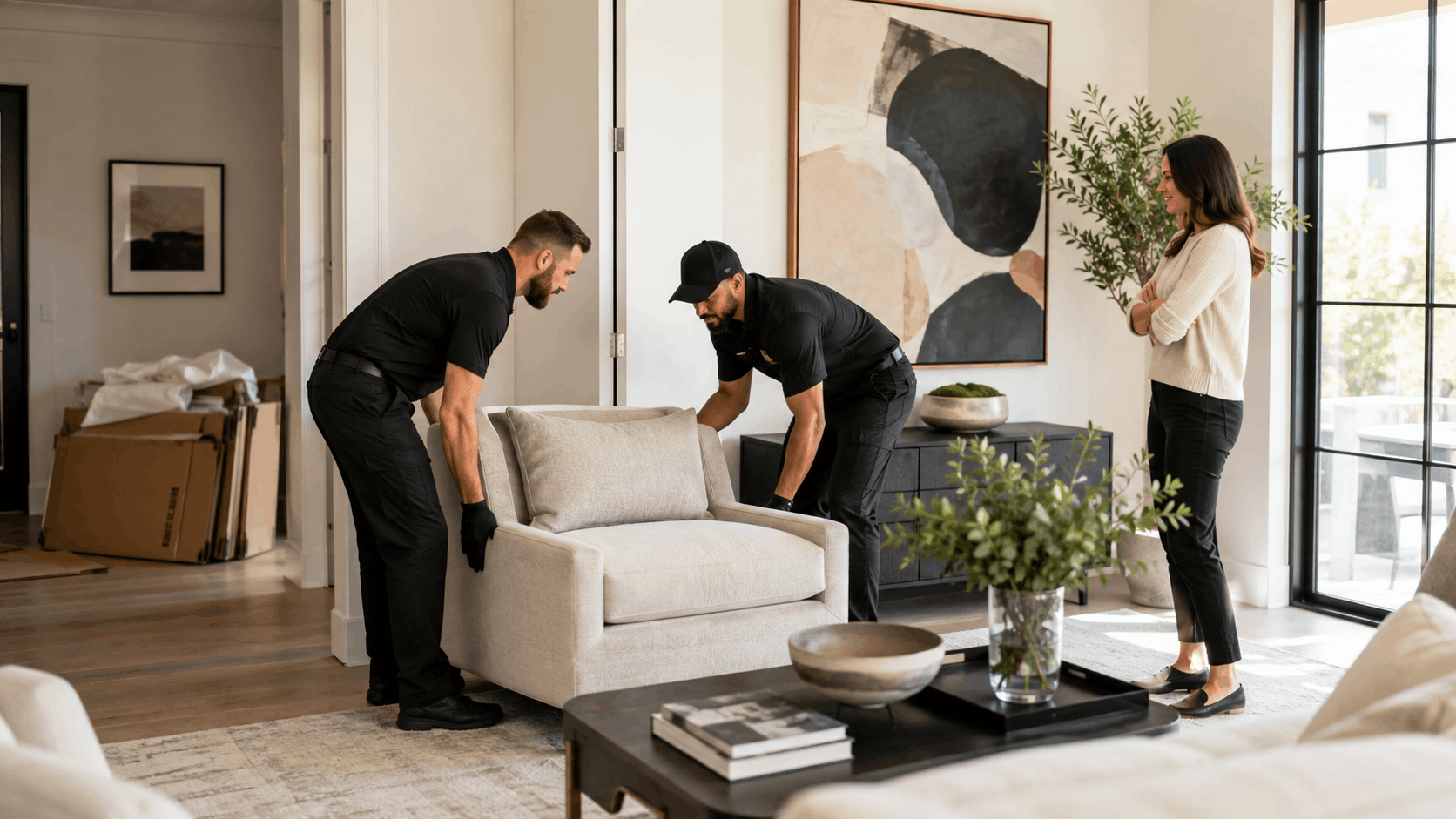
The part designers appreciate most often comes at the end. Debris removal means the crew takes every box, every foam block, and every strip of shrink wrap with them. No dumpster rental, no trips to the dump, no packaging piled on the client's curb the day of the reveal.
Packaging cleanup and site cleanup turn a chaotic delivery into a clean handoff. The room is ready, and the mess is gone.
Cardboard, Foam, and Shrink Wrap Haul-Away
Furniture arrives buried in packing material. A single sectional can generate a mountain of cardboard, foam corner blocks, plastic bags, and shrink wrap. If a crew leaves all of it behind, the designer is stuck dealing with it hours before a client walks in.
Cardboard removal and packing material haul-away solve that. As the crew unboxes each piece, they break down the boxes and load the debris onto the truck. By the time the last item is placed, the packing waste is already gone.
This matters even more in buildings with strict trash rules. A Downtown loft or a Century City tower will not let a designer stack broken-down boxes in the hallway or overflow the building bins. Hauling it all away in one visit keeps the designer on good terms with building management and the client.
Recycling and Responsible Disposal in LA
Not all of that packaging belongs in a landfill. Clean cardboard, certain plastics, and foam can be recycled, and we sort material so recyclables go where they should. Los Angeles takes waste diversion seriously, and so do we.
Bulky item disposal follows local rules. The LA Sanitation and Environment guidelines govern how large items and bulky waste get collected and processed in the city. Handling disposal correctly keeps designers clear of any code issues and keeps material out of the wrong bin.
Responsible disposal also reflects on the designer. Clients notice when a project is handled cleanly from start to finish, and leaving a pile of trash behind sends the wrong message. Our approach to recycling and disposal keeps the whole install professional through the last step.
Removing Old Furniture During the Same Visit
Many installs are really swaps. The client wants the old sofa gone and the new one in its place, all in one afternoon. Old furniture removal during the same visit makes that possible without a separate haul-off appointment.
As the crew brings new pieces in, they can carry the outgoing pieces out. This furniture swap is a natural fit for staged room makeovers where the space needs to be cleared before the new design goes in. It keeps the whole change contained to a single day.
Designers just need to flag which pieces are leaving when they book. Whether the old furniture gets donated, disposed of, or moved to storage, we plan the truck space so incoming and outgoing loads both fit. One visit handles the full turnover.
Need Help in Los Angeles?
Popeye Moving & Storage serves Los Angeles and all of Los Angeles County.
Serving Designers Across Los Angeles Neighborhoods
Every LA neighborhood delivers its own challenges, and knowing them ahead of time is what keeps an install on schedule. The crews who work these streets every week learn the tight turns, the parking traps, and the building quirks that trip up outsiders.
Here is how local delivery plays out across the areas where designer clients concentrate.
Hillside Homes in the Hollywood Hills and Bel Air
The Hollywood Hills and Bel Air are gorgeous and brutal for large deliveries. Narrow winding roads like the ones off Mulholland leave no room for a big truck to maneuver, and some driveways are so steep and short that parking a full-size vehicle is impossible.
Many of these homes sit down a flight of exterior steps or up a hillside path from the street. Hillside access often means hand-carrying heavy pieces a long way, sometimes on an incline. We scout these approaches in advance so the crew arrives with the right number of hands and the right equipment.
Timing matters here too, because these roads get congested and neighbors guard their limited curb space. Planning the arrival and the carry route ahead of time keeps a Bel Air install from stalling on the driveway. Experience with these streets is what makes the difference.
Condos and Lofts in Downtown and the Arts District
Downtown LA and the Arts District are loft and high-rise country. These buildings usually run deliveries through a loading dock and a freight elevator, both of which need to be reserved. Show up without a booking and the crew waits in the alley.
Loft delivery in converted warehouses can mean oversized freight elevators but also long interior hauls from the dock to the unit. Building coordination is the name of the game, from the COI to the elevator pads to the move-in hours. We handle that coordination as part of our commercial and residential work across West LA and the central city.
The payoff for good planning is a smooth, fast install even in a busy DTLA tower. When the dock is booked, the elevator is reserved, and the paperwork is approved, the crew moves straight from truck to unit without a hitch. That is how a high-rise loft install stays on schedule.
Coastal Properties in Santa Monica and Venice
Beach-adjacent installs come with their own headaches. Parking near the coast in Santa Monica and Venice is tight, metered, and heavily enforced, so a truck cannot just idle at the curb for hours. Coastal delivery planning starts with figuring out where the vehicle can legally sit.
Venice streets and walk-street homes can be especially tricky, with narrow lanes and properties that face pedestrian paths rather than driveable roads. That sometimes means carrying pieces a good distance from the nearest truck spot. We plan the shortest safe route and bring the crew to match.
Salt air is a quieter concern. Fine wood, leather, and metal pieces should not sit exposed near the ocean any longer than needed, so the crew moves quickly from truck to interior. Getting delicate items inside fast protects them from the coastal moisture that beach homes deal with year-round.
Estates in Beverly Hills and Brentwood
Large estates in the Flats of Beverly Hills and Brentwood bring gated entries, HOA rules, and long multi-room installs. Gated communities often require advance notice at the guard gate, and some HOAs restrict delivery days and hours.
These estate installs frequently span several rooms and a full day of work. A crew might set a primary bedroom, a formal dining room, a study, and a family room in one visit, following a detailed floor plan for each. Coordinating that much placement takes a team that can keep the sequence organized.
We handle the gate clearances, the HOA notifications, and the room-by-room plan so the designer can focus on the details that matter to the client. A large estate install is exactly where single-visit white glove service shows its value, turning what could be days of chaos into one coordinated appointment.
What a Single-Visit Install Costs and How to Budget
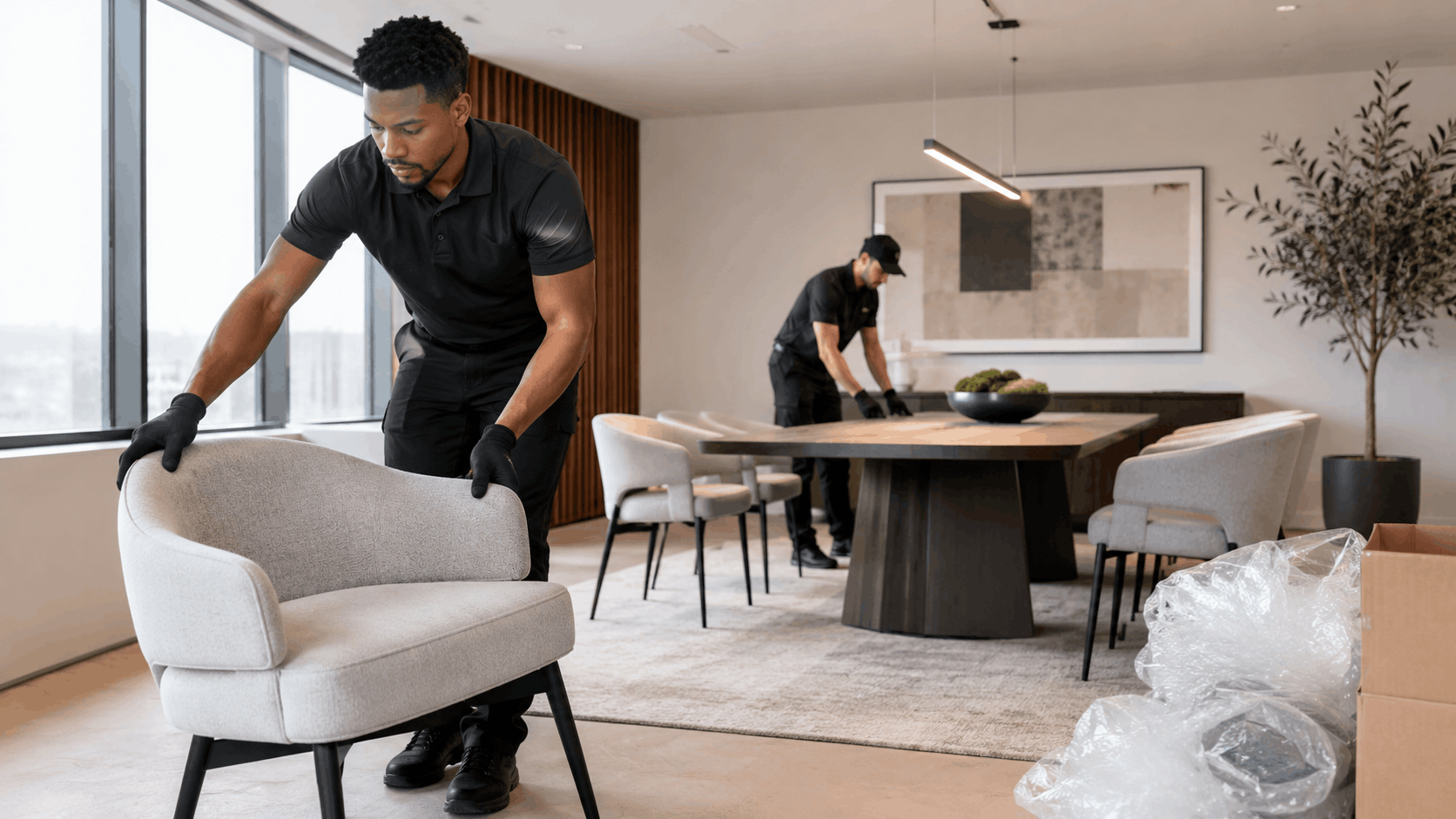
Designers need real numbers to build install day into a client proposal. White glove cost varies with the size and difficulty of the job, but the ranges below give a working starting point for budgeting an install in Los Angeles.
| Project Type | Typical Range | What It Covers |
|---|---|---|
| Single room, few pieces | $400 - $900 | Delivery, assembly, placement, debris-out for one room |
| Multi-room home | $1,200 - $3,500 | Several rooms, larger crew, full-day install |
| Large estate install | $3,500 - $8,000+ | Whole-home staging, art and mirror hanging, old furniture removal |
| Difficult access add-on | +15% - 40% | Hillside carries, stairs, long walks from the truck |
Factors That Affect Pricing
The biggest pricing factors are crew size, the number of pieces, access difficulty, and stairs. A larger job needs more movers, and more hands mean a higher rate but a faster finish. A two-person crew and a six-person crew price very differently.
The number and complexity of pieces matter too. A room with one bed and two nightstands assembles quickly, while a room full of casegoods, a sectional, and a marble table takes far longer. More assembly means more labor time.
Access difficulty is the wild card. A ground-floor condo with elevator access costs less than a Hollywood Hills home with forty exterior steps. Stairs, long carries, and tight turns all add time and effort, which is why difficult access can push a quote up meaningfully.
Flat Rate vs Hourly for Install Day
A flat rate works best when the scope is clear. If a designer knows the exact piece list and the crew has details on access, a flat project rate gives everyone a predictable number to plan around. That certainty is easy to drop into a client proposal.
Hourly billing fits jobs where the scope is fuzzy or likely to change. If the designer is still finalizing pieces or the placement may shift on the day, hourly keeps the arrangement fair for both sides. It bills for the actual time spent rather than a guess.
For a full room install with a locked plan, most designers prefer the flat rate for its simplicity. For open-ended staging or projects with lots of adjustments, hourly project pricing can end up more reasonable. We help designers pick the model that fits the specific job.
Building the Service Into Client Proposals
Smart designers line-item install and debris removal in their client proposals rather than absorbing the cost. Breaking out white glove delivery, assembly, placement, and haul-away as its own line shows the client exactly what they are paying for. It reframes the service as value, not overhead.
Clients rarely understand how much work goes into a finished reveal until it is spelled out. Listing the install separately makes the effort visible and justifies the number. It also protects the designer's margin by keeping delivery costs out of the furniture markup.
We are glad to provide a written quote a designer can drop straight into a proposal. Clear pricing on the front end means no surprises for the designer or the client on install day. That transparency keeps the whole project on solid footing.
Storage and Staging Support for Design Projects
Furniture rarely arrives all at once. Different vendors ship on different timelines, and pieces often turn up weeks before the room is ready. Furniture storage and receiving support bridge that gap so everything can land in one clean install visit.
Staging support connects the warehouse to install day in a few ways:
- Early receiving - shipments arrive and get inspected before install day
- Climate control - delicate pieces are held in the right conditions
- Consolidation - multiple vendor deliveries are combined into one
- Scheduled release - everything ships to the site on the chosen day
Receiving and Inspecting Shipments Early
A receiving service lets designers have items shipped to the warehouse weeks ahead instead of to the client's home. When each shipment arrives, the crew inspects it for freight damage and logs its condition. Problems get caught early, while there is still time to fix them.
This shipment inspection matters because vendor damage is common and clients should never see it. Finding a cracked leg in the warehouse means a replacement can be ordered before install day, not discovered during a reveal. The designer stays in control of the timeline.
Holding pieces at the warehouse also keeps the client's home clear until the room is ready. Instead of boxes stacking up in a guest room for weeks, everything waits safely offsite. Our designer receiving and consolidation service is built exactly for this workflow.
Climate-Controlled Storage for Delicate Goods
LA heat and humidity are hard on fine furniture. Wood can warp and crack in a hot uncontrolled space, leather dries out, and upholstery can develop mildew in humid stretches. Climate-controlled storage holds temperature and humidity steady so these materials stay in showroom condition.
For pieces waiting weeks or months for a project to finish, that stable environment is worth the cost. A custom walnut table sitting in a sweltering warehouse can develop damage that only shows up after it is installed. Controlled storage prevents that slow ruin.
Delicate goods like antiques and high-end upholstery especially benefit. Our climate-controlled space protects the very pieces designers spend the most on, so they arrive at install day exactly as intended. Furniture protection starts long before the truck rolls up.
Consolidating Multiple Vendor Deliveries
A single room might pull from five different vendors, each with its own ship date. Vendor consolidation means all those deliveries route to the warehouse, get held together, and then travel to the site as one coordinated load. Multiple deliveries become a single install.
This is what makes the one-visit reveal possible. Instead of five separate delivery trucks showing up on five different days, everything arrives together on install day. The designer picks one date and the whole room comes to life at once.
Consolidation also cuts down on the client's exposure to the chaos. They never see the drip of individual shipments or the pile of boxes - they see a finished room. Pairing storage and consolidation with single-visit white glove install is how designers deliver a clean, dramatic reveal every time.

Need Help in Los Angeles?
Popeye Moving & Storage serves Los Angeles and all of Los Angeles County.
Final Thoughts
A single-visit white glove install gives designers what they actually need: a finished, reveal-ready room delivered on their schedule, with the packaging gone before the client arrives. Delivery, assembly, precise placement, and debris-out happen in one coordinated appointment instead of three separate trips.
Good planning makes it work - measured clearances, approved COIs, a smart delivery window, and a marked floor plan. Add climate-controlled storage and vendor consolidation, and even a whole-home estate install becomes one clean visit. Across the Hollywood Hills, Downtown lofts, coastal Venice, and Beverly Hills estates, our crews know the streets and the buildings.
If you are a designer planning a reveal, contact Popeye Moving & Storage Co. to talk through your install day. Call us for a consultation, and we will help you turn a stack of vendor shipments into a finished room your client will remember.
Frequently Asked Questions
What is included in white glove furniture installation?
White glove furniture installation covers everything in one appointment. The crew delivers each piece inside, unboxes it, assembles beds, sectionals, and casegoods, places every item to the inch per your floor plan, and hauls away all cardboard, foam, and shrink wrap. Many installs also include hanging art, mirrors, and lighting. You end up with a finished, reveal-ready room instead of boxes on the floor.
How long does a single-visit install take?
Timing depends on the room count and how complex the pieces are. A single room with a few items often takes two to four hours. A multi-room home usually runs a half to full day, and a large estate install with art hanging and old furniture removal can fill a full day or more. We give a time estimate when we quote the job so you can plan the reveal.
Can the crew remove old furniture at the same time?
Yes. Old furniture removal can happen during the same visit, which makes room swaps simple. As the crew brings new pieces in, they carry the outgoing pieces out. Just flag which items are leaving when you book so we can plan the truck space for both loads. We can donate, dispose of, or move the old pieces to storage depending on what you need.
Do you provide a certificate of insurance for buildings?
Yes. We provide certificates of insurance for high-rises and managed buildings, including towers in Downtown LA and Century City. Building management often needs a COI naming them as additional insured before a crew can enter. Send us the building's requirements as soon as you book, since some management companies take a few days to approve one. We handle the paperwork so the crew is cleared for install day.
How much does white glove delivery cost in Los Angeles?
A single room typically runs $400 to $900, a multi-room home falls around $1,200 to $3,500, and a large estate install can reach $3,500 to $8,000 or more. Difficult access like hillside carries or long stair runs can add 15 to 40 percent. The final price depends on crew size, number of pieces, and access. We provide a written quote you can drop into a client proposal.
Can you handle deliveries to hillside or gated homes?
Yes. We regularly deliver to hillside homes in the Hollywood Hills and Bel Air, where narrow roads and steep steps require extra crew and planning. We also handle gated communities in Beverly Hills and Brentwood, including guard gate clearances and HOA delivery rules. We scout the access route in advance so the crew arrives with the right equipment and enough hands for the carry.
What happens if a piece arrives damaged?
The crew inspects every piece during unboxing, before assembly. If we find freight damage like a cracked leg, chipped stone, or torn upholstery, we document it with photos and notes on the spot. That gives you a clear record to take back to the vendor or freight carrier. Catching damage early, especially on items received at our warehouse, means there is time to order a replacement before the reveal.
Do you assemble beds, sectionals, and casegoods?
Yes. Our crews assemble beds with rails and slats, sectionals with their connectors and legs, and casegoods like dressers, media units, and dining tables. We carry the tools and know the common brands, so there is no scrambling for hardware. Sectionals in particular get leveled so the whole run sits flush. Assembly is a standard part of every white glove install we handle.
Can you store furniture before install day?
Yes. We offer receiving and climate-controlled storage so items shipped weeks ahead can be delivered to our warehouse, inspected, and held until install day. Climate control protects wood, leather, and upholstery from LA heat and humidity. We can also consolidate deliveries from multiple vendors and release everything to the site on your chosen date for one clean install visit.
How far in advance should designers book install day?
Booking two to four weeks ahead is a good target for most projects. Large estate installs and busy seasons around the holidays fill up faster, so earlier is better for those. If you are using our receiving and storage service, let us know as soon as vendor shipments start so we can coordinate the hold and set your install date. Early booking also gives time to approve building COIs.
Frequently Asked Questions
- What is included in white glove furniture installation?
- White glove furniture installation covers everything in one appointment. The crew delivers each piece inside, unboxes it, assembles beds, sectionals, and casegoods, places every item to the inch per your floor plan, and hauls away all cardboard, foam, and shrink wrap. Many installs also include hanging art, mirrors, and lighting. You end up with a finished, reveal-ready room instead of boxes on the floor.
- How long does a single-visit install take?
- Timing depends on the room count and how complex the pieces are. A single room with a few items often takes two to four hours. A multi-room home usually runs a half to full day, and a large estate install with art hanging and old furniture removal can fill a full day or more. We give a time estimate when we quote the job so you can plan the reveal.
- Can the crew remove old furniture at the same time?
- Yes. Old furniture removal can happen during the same visit, which makes room swaps simple. As the crew brings new pieces in, they carry the outgoing pieces out. Just flag which items are leaving when you book so we can plan the truck space for both loads. We can donate, dispose of, or move the old pieces to storage depending on what you need.
- Do you provide a certificate of insurance for buildings?
- Yes. We provide certificates of insurance for high-rises and managed buildings, including towers in Downtown LA and Century City. Building management often needs a COI naming them as additional insured before a crew can enter. Send us the building's requirements as soon as you book, since some management companies take a few days to approve one. We handle the paperwork so the crew is cleared for install day.
- How much does white glove delivery cost in Los Angeles?
- A single room typically runs $400 to $900, a multi-room home falls around $1,200 to $3,500, and a large estate install can reach $3,500 to $8,000 or more. Difficult access like hillside carries or long stair runs can add 15 to 40 percent. The final price depends on crew size, number of pieces, and access. We provide a written quote you can drop into a client proposal.
- Can you handle deliveries to hillside or gated homes?
- Yes. We regularly deliver to hillside homes in the Hollywood Hills and Bel Air, where narrow roads and steep steps require extra crew and planning. We also handle gated communities in Beverly Hills and Brentwood, including guard gate clearances and HOA delivery rules. We scout the access route in advance so the crew arrives with the right equipment and enough hands for the carry.
- What happens if a piece arrives damaged?
- The crew inspects every piece during unboxing, before assembly. If we find freight damage like a cracked leg, chipped stone, or torn upholstery, we document it with photos and notes on the spot. That gives you a clear record to take back to the vendor or freight carrier. Catching damage early, especially on items received at our warehouse, means there is time to order a replacement before the reveal.
- Do you assemble beds, sectionals, and casegoods?
- Yes. Our crews assemble beds with rails and slats, sectionals with their connectors and legs, and casegoods like dressers, media units, and dining tables. We carry the tools and know the common brands, so there is no scrambling for hardware. Sectionals in particular get leveled so the whole run sits flush. Assembly is a standard part of every white glove install we handle.
- Can you store furniture before install day?
- Yes. We offer receiving and climate-controlled storage so items shipped weeks ahead can be delivered to our warehouse, inspected, and held until install day. Climate control protects wood, leather, and upholstery from LA heat and humidity. We can also consolidate deliveries from multiple vendors and release everything to the site on your chosen date for one clean install visit.
- How far in advance should designers book install day?
- Booking two to four weeks ahead is a good target for most projects. Large estate installs and busy seasons around the holidays fill up faster, so earlier is better for those. If you are using our receiving and storage service, let us know as soon as vendor shipments start so we can coordinate the hold and set your install date. Early booking also gives time to approve building COIs.
P
Popeye Moving & Storage Co. Team Team
Licensed moving and storage professionals serving Los Angeles and Los Angeles County.
Licensed in California · License #PUC: CAL T 189749 | DOT: 1472924 | MC: 498816C
Why trust Popeye Moving & Storage?
Founded in 1994, Popeye Moving & Storage is a licensed and insured moving and storage service serving Los Angeles and Los Angeles County. All content is reviewed by our licensed technicians.

Need Help in Los Angeles?
Popeye Moving & Storage serves Los Angeles and all of Los Angeles County.
Related Articles
How-To Guides
Office Furniture Storage Between Leases: Decommission Today, Refurnish the Next Space Later
Learn how LA businesses store office furniture between leases, decommission the old space, and refurnish later - with costs, timing, and expert tips from Popeye Moving.
How-To Guides
Preparing Furniture for Months in Storage: Wrapping, Moisture, and Pest Prevention Done Professionally
A professional guide to preparing furniture for months in storage in Los Angeles, covering cleaning, breathable wrapping, moisture control, pest prevention, and smart unit loading.

Tips & Advice
Receiving Services for Homeowners Mid-Renovation: Where Your Furniture Deliveries Go Before Install Day
Mid-renovation and furniture arriving early? Learn how receiving services hold your deliveries in climate-controlled storage until install day across Los Angeles.