How-To Guides
Office Furniture Storage Between Leases: Decommission Today, Refurnish the Next Space Later
Key Takeaways
- Buildout delays and permit waits in areas like the Arts District and Century City often leave a gap between an old lease ending and a new office being ready.
- Storing furniture costs a small fraction of replacing it, since a full mid-size office of new desks and chairs can top $80,000 to $150,000.
- Decommissioning means fully clearing and restoring the old space to broom-clean condition to protect your deposit and avoid lease penalties.
- Labeling and photographing every cubicle part during disassembly makes reassembly in the new space fast and accurate.
- Climate-controlled storage protects wood, leather, and custom pieces from LA's summer heat and marine-layer humidity.
- Sorting furniture into keep, store, donate, and recycle before the move cuts storage costs by shrinking the load.
- Booking several weeks ahead locks in freight elevator windows, COIs, and crew availability, especially for Downtown high-rise moves.
- An on-site walkthrough gives an accurate quote instead of a phone guess, with pricing driven by size, item count, storage length, and building access.
In This Article
A Downtown LA design firm called us last spring in a real bind. Their lease on Grand Avenue ran out on the last day of the month, but the buildout on their new floor near Figueroa was three weeks behind schedule. They had 40 desks, a custom reception counter, and a conference table nobody wanted to throw away, and no place to put any of it.
This happens more often than most business owners think. The old lease ends before the new space is ready, and companies get stuck deciding whether to trash good furniture, pay for two rents at once, or find a smarter middle path. That middle path is office furniture storage between leases - decommission today, refurnish the next space later.
Why Businesses Store Office Furniture Between Leases
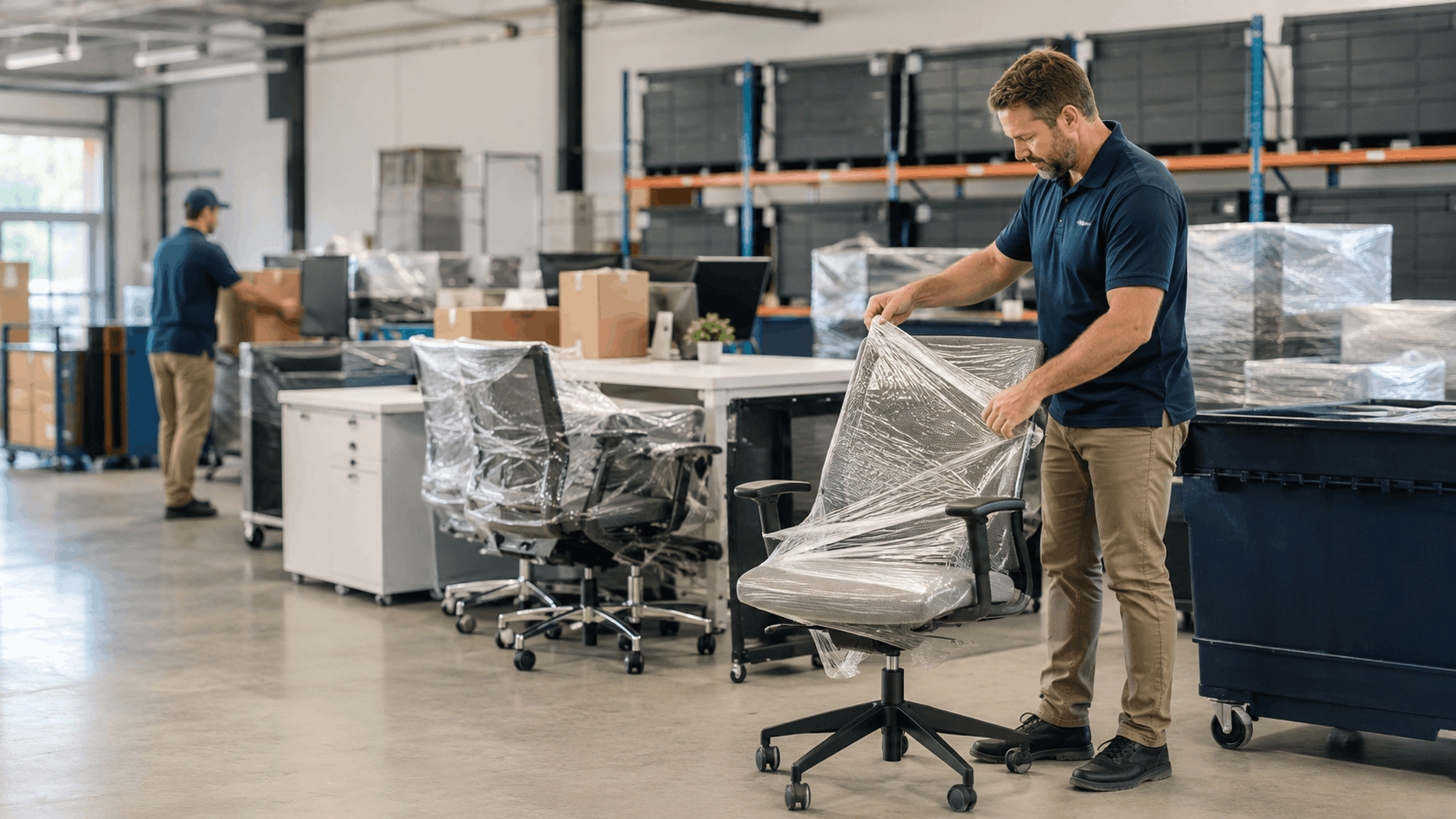
Most companies do not plan to store their furniture. It happens because the calendar forces their hand. The old lease ends on a fixed date, and the new space is not finished, so the furniture needs somewhere to live in between.
Here are the main reasons LA businesses choose storage over other options:
- The new office buildout runs late and cannot accept furniture yet
- Buying all new desks and chairs would cost far more than a few months of storage
- Custom and branded pieces cannot be replaced quickly or cheaply
- Dumping usable furniture wastes money and creates disposal fees
- Two overlapping leases cost more than storing and moving once
Storage turns a stressful gap into a manageable pause. The furniture stays safe, the old space gets handed back clean, and the new office fills up when it is ready.
The Timing Gap Most LA Companies Face
The gap between an old lease ending and a new space being ready is one of the most common problems we see in commercial moves. A company signs a new lease, expects a 60-day buildout, and then the schedule slips. Permits, contractor delays, and material backorders all push the finish date later than anyone planned.
In the Arts District, older brick buildings often need extra permit review before any wall or electrical work can start. That review process with the LA Department of Building and Safety can add weeks that nobody budgeted for. We have watched Arts District tenants sit on a finished lease while their contractor waited on a single signoff.
Century City runs into a different version of the same trouble. High-rise buildouts along Avenue of the Stars involve building engineers, freight elevator scheduling, and strict work-hour rules that stretch timelines. A firm might vacate one tower on schedule but wait a month for their new floor to pass inspection.
When the lease timing and the buildout do not line up, furniture needs a home. That is where a short stint in storage bridges the gap without forcing anyone to rush an unfinished space.
Saving Money by Keeping What You Own
Replacing a full office of furniture is expensive. A quality office chair runs $300 to $900 each, and a solid sit-stand desk lands between $500 and $1,500. Multiply that across 30 or 40 workstations and the number climbs fast.
Conference tables and reception furniture push the total even higher. A large conference table can cost $2,000 to $8,000, and a custom reception desk often runs several thousand more. For a mid-size office, buying everything new can easily top $80,000 to $150,000.
Storing that same furniture for a few months costs a tiny fraction of replacement. Even a large office might spend a few hundred to a couple thousand dollars a month on commercial business storage, plus the move itself. Against a six-figure replacement bill, the cost savings speak for themselves.
Keeping what you own also avoids the hidden costs of buying new, like delivery lead times and assembly labor. Good furniture lasts years. There is no reason to throw away working assets because of a scheduling gap.
Protecting Brand-Specific and Custom Pieces
Some furniture cannot be replaced with a quick online order. A custom reception desk built to match a brand's colors and logo took time, money, and a designer to create. Losing it means starting that whole process over.
Branded pieces carry more than function. Signage, matched furniture sets, and lobby installations shape how clients see a company the moment they walk in. Swapping them for generic replacements changes the whole feel of the space.
Custom furniture also tends to come in matched sets. If one credenza gets tossed, finding an exact match later is nearly impossible because manufacturers discontinue lines and change finishes. Storing the full set keeps everything consistent for the new office.
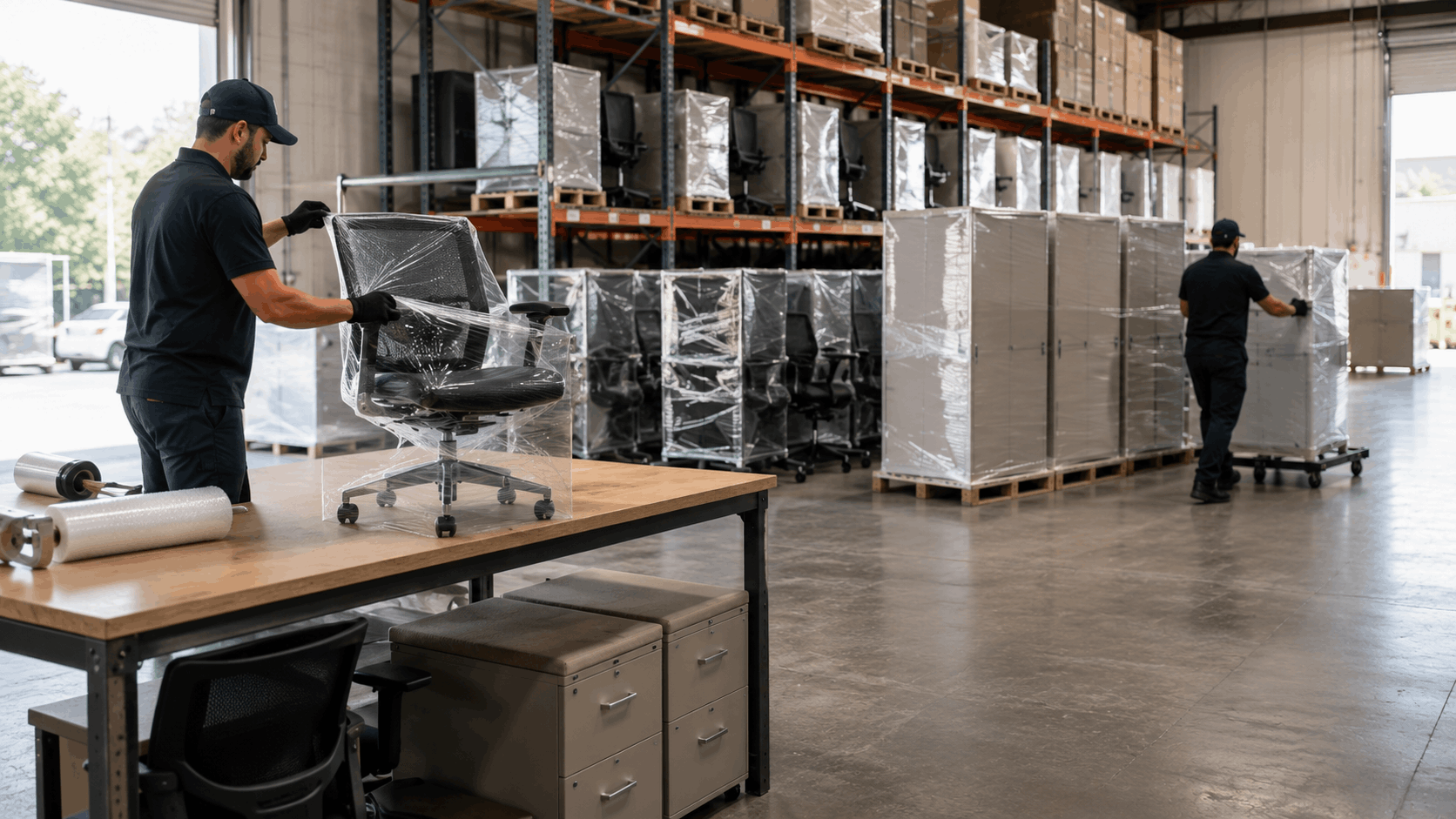
Our team handles these pieces with extra care because we know they are hard to replace. Custom and branded items get wrapped, padded, and logged so they come back to the new space in the same condition they left.
Get Your Free Quote
Tell us about your move and we'll get back to you fast.
What Office Decommissioning Actually Involves
Office decommissioning means fully clearing out a leased space and returning it to the landlord in the condition the lease requires. It is more than just moving furniture out. It is a complete space clearing that leaves the office empty, clean, and ready for handover.
Done right, decommissioning protects a company from lease penalties and gets the deposit back. Done poorly, it leaves damage, debris, and disputes with the landlord. Our office and business moving crews handle every step of this process so nothing gets missed at lease handover.
Disassembly of Cubicles and Workstations
Modular cubicles and systems furniture look simple, but they come apart in a specific order. Panels connect to each other with hidden clips and brackets, and pulling them apart wrong bends the frames or cracks the fabric panels. Our crews know the major systems like Herman Miller and Steelcase and how each one breaks down.
Cubicle disassembly starts with clearing the surfaces and removing any attached storage. Then the work surfaces, panels, and hardware come apart piece by piece. Rushing this step is how parts get damaged or lost, which turns into a headache when it is time to rebuild.
The trick that saves everyone time later is labeling. Every panel, bracket, and bag of hardware gets tagged so the pieces match up during reassembly. Without labels, rebuilding a 30-station office becomes a guessing game that eats hours of billable labor.
We photograph each workstation before taking it apart. That way the new setup can mirror the old one exactly, or the layout can change on purpose with a clear record of what belonged where.
Meeting Landlord Move-Out Conditions
Most LA commercial leases spell out move-out conditions in detail. The space usually has to be returned broom-clean, meaning swept, cleared of all property, and free of debris. Some leases go further and require patching walls, removing signage, or restoring anything the tenant changed.
Landlords in Downtown and Century City towers tend to enforce these terms closely. If the space is not returned properly, they can charge cleanup and repair costs against the security deposit, and those lease penalties add up quickly. We have seen tenants lose thousands over debris left behind and holes that were never patched.
Our crews clear the space completely, from furniture down to the last cable and cardboard box. We coordinate cleanup so the floor meets the broom-clean standard the lease calls for. When the landlord walks through, there should be no surprises.
Getting the move-out conditions right is part of protecting the deposit. A clean handover keeps the relationship with the landlord smooth and avoids disputes that drag on for weeks.
Sorting Keep, Store, Donate, and Recycle
Not every piece of furniture deserves a spot in storage. Paying to store a broken chair or an outdated filing cabinet is money down the drain. That is why we sort everything into four groups before anything leaves the building.
The four categories are simple: keep and store, donate, recycle, or dispose. Furniture sorting up front cuts storage costs because you only pay to store what you actually plan to use again. A quick triage often shrinks the storage load by a third or more.
Los Angeles has good options for the items that do not make the cut. Organizations like Goodwill Southern California take usable office furniture, and the city offers electronics and material recycling through programs listed by CalRecycle. Donating usable pieces can also come with a tax benefit.
Office recycling keeps old furniture out of the landfill and often costs less than straight disposal. We help sort the pile and route each item where it belongs, so the new office starts with only the pieces worth keeping.
Handling IT Equipment and Electronics
IT equipment needs different handling than desks and chairs. Monitors, servers, and network gear are fragile and expensive, and they carry company data that has to stay secure during the move. We always coordinate with the client's IT team before we touch anything.
Before pickup, servers get powered down and disconnected in the right order, and cables get labeled so the network can be rebuilt correctly. Electronics packing uses padded cases and anti-static materials, not just standard moving blankets. A dropped monitor or a bent server rail can cost far more than the packing materials would have.
Coordination matters most with data-sensitive gear. The IT team decides what travels with them, what we transport, and what needs special chain-of-custody handling. We work around their schedule so nothing critical goes offline at the wrong moment.
Our packing and crating team can crate delicate electronics for both storage and transport. Proper packing here prevents the kind of damage that shows up only when equipment gets set up in the new space.
Need Help in Los Angeles?
Popeye Moving & Storage serves Los Angeles and all of Los Angeles County.
How Popeye Moving & Storage Handles Decommissioning in Los Angeles
As Los Angeles office movers, we have cleared offices in nearly every part of the city. Our decommissioning service follows a set process so nothing slips through the cracks, and we plan every job around the building's rules and the city's traffic.
Popeye Moving builds a timeline for each decommission that accounts for elevator windows, loading dock access, and the fastest routes between the old and new sites. Here is how a typical job breaks down:
| Phase | What Happens | Typical Timing |
|---|---|---|
| Walkthrough | On-site inventory, sorting plan, and quote | 1-2 weeks before |
| Prep | Labeling, IT coordination, COI filing | Days before move |
| Decommission | Disassembly, packing, loading, cleanup | Move day(s) |
| Storage | Transport to facility, inventory logging | Same or next day |
| Refurnish | Delivery, reassembly, setup | When new space is ready |
Serving Downtown, Century City, and West LA
We clear offices in the high-rises Downtown all the time, from the towers around Bunker Hill to buildings near Pershing Square. High-rise moves live and die by freight elevator scheduling, so we book those windows early and stick to them. Missing a reserved elevator slot can cost a full day.
Century City and the office corridor along Wilshire Boulevard bring their own rhythm. Buildings there have busy loading docks that need advance reservations, and traffic on Wilshire means timing the truck arrival carefully. We know which docks are tight and plan the crew size to work fast once we are in.
Over in West Los Angeles and near Culver City, the mix of older buildings and new creative-office space keeps us on our toes. Some spots have easy street loading, while others share a single dock with several tenants. We scout access ahead of time so move day runs without surprises.
Every district has its quirks, and years of working these streets means we already know most of them. That local knowledge keeps decommission jobs on schedule across the whole west side.
Working Around Building Rules and COIs
Almost every LA high-rise requires a certificate of insurance before movers can enter the building. The COI names the building and property manager as insured parties and proves the moving company carries proper coverage. We file these documents ahead of time so nothing holds up the crew at the door.
Building access windows are strict in most commercial towers. Many buildings only allow moves before 8 a.m., after 6 p.m., or on weekends to avoid disrupting other tenants. We plan crews and truck timing around those windows so the work fits inside the allowed hours.
After-hours moves are common Downtown and in Century City, and we staff for them regularly. Working nights and weekends means the office empties out without interrupting the rest of the building's business day. It takes coordination with building security and engineers, which we handle as part of the job.
Getting the paperwork and timing right up front is what keeps a decommission smooth. When the COI is on file and the access window is booked, the crew shows up and works instead of waiting in the lobby.
Inventory Tracking and Labeling
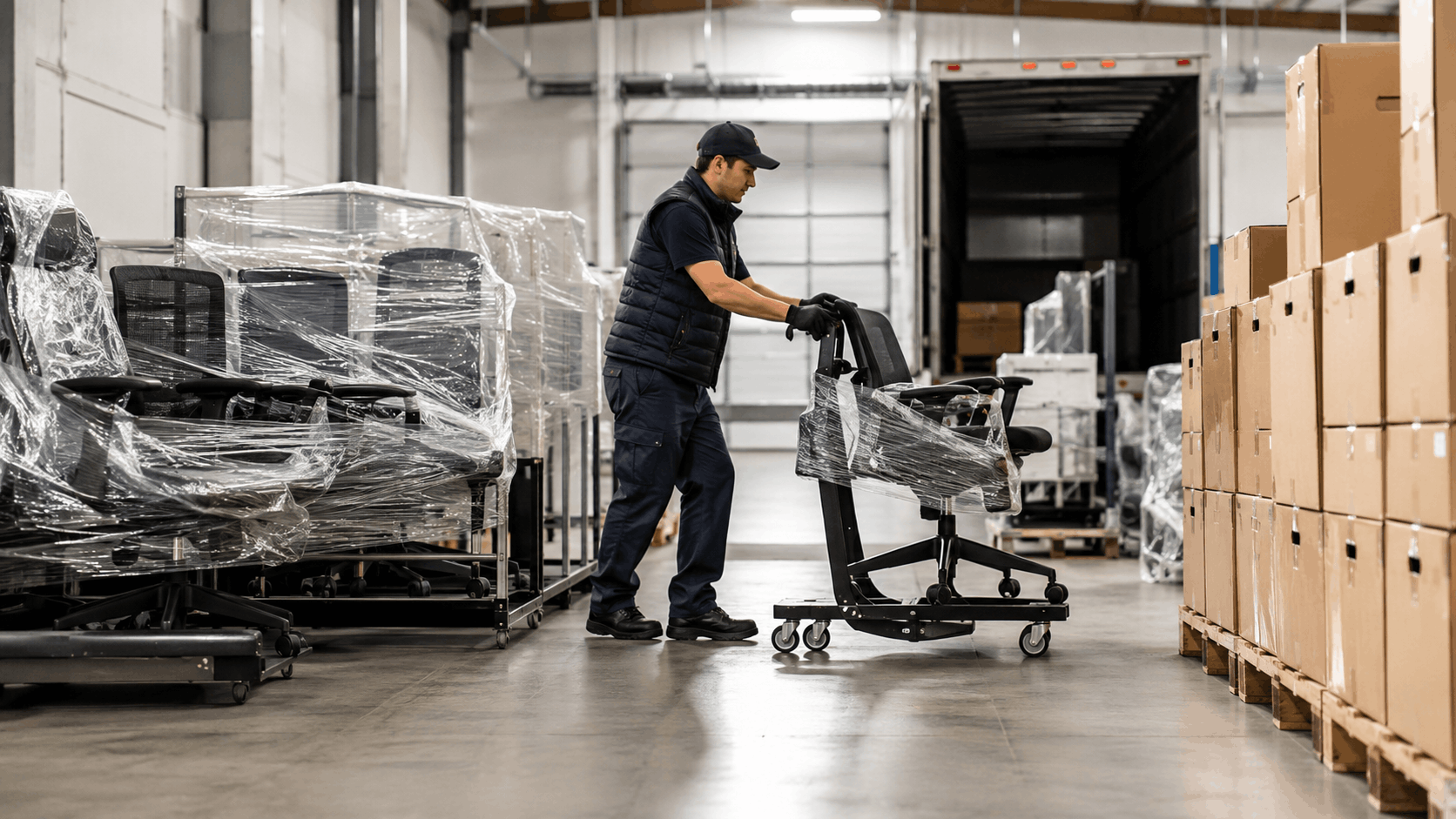
The single thing that makes refurnishing easy is good inventory tracking. Every item that leaves the office gets logged, photographed, and labeled before it goes on the truck. That record follows the furniture into storage and back out again.
Item labeling ties each piece to its place. A desk from the fifth-floor corner gets a tag, and the tag matches an entry in the inventory list. When it is time to rebuild, the crew knows exactly what they have and where it goes.
Photos add another layer of protection. If a question ever comes up about condition, the pre-move photos settle it. This documentation also helps with insurance claims in the rare case something gets damaged.
A clean inventory turns a chaotic move into an organized one. Nothing gets lost, nothing gets forgotten in storage, and the new office fills back up piece by matched piece.
Where Your Furniture Stays While You Wait
A good office furniture storage facility does more than hold boxes. It protects business assets from heat, humidity, theft, and damage while a company waits for its new space. The quality of the facility matters as much as the move itself.
Our commercial storage in LA gives businesses a secure place to park their furniture for however long the gap lasts. From a few weeks to over a year, the furniture stays safe and accounted for until the new office is ready.
Climate-Controlled Space for LA Weather
Los Angeles weather is mild most of the year, but the swings still cause damage in a non-climate space. Summer heat in the LA basin can push warehouse temperatures high enough to warp wood and dry out veneers. A conference table that sat in a hot unit can crack or split at the seams.
Humidity is the other threat. Marine layer moisture rolls in off the coast and settles into fabric and cushions. Over months, that dampness breeds mildew in upholstery and can rust metal frames on chairs and cabinets.
Climate-controlled storage keeps temperature and humidity steady year round. For wood desks, leather chairs, and custom pieces, that stability is what keeps them looking new. The cost difference is small compared to replacing furniture that warped or molded in the wrong environment.
We recommend climate control for any furniture a business plans to reuse. The pieces worth storing are worth protecting, and LA's climate makes that protection worth the modest added cost.
Security and Insurance for Business Assets
Office furniture represents real money, so the facility holding it needs real security. Our storage uses monitored access, surveillance, and access logs that track who enters and when. Business assets are not left in an open warehouse where anyone can wander in.
Access logs matter for accountability. When every entry is recorded, there is a clear trail if a question ever comes up about the stored items. Combined with the inventory list, this keeps the whole storage period transparent.
Insurance coverage is the other piece. We offer coverage options for stored furniture so a company's assets are protected against the unexpected. Confirming the coverage level before the furniture goes in is a smart step for any business.
Between monitored security and insurance, stored furniture stays as protected as it would be in a working office. That protection lets business owners stop worrying about their assets and focus on their new space.
Short-Term vs Long-Term Storage Options
Lease gaps come in all sizes, so storage terms need to flex. Some businesses only need a few weeks while a contractor finishes trim work. Others face a six-month or year-long wait for a major buildout to clear final inspection.
Short-term storage covers the quick gaps where furniture waits a month or two. Billing usually runs month to month, so a company only pays for the time it actually needs. There is no reason to lock into a long contract for a short wait.
For longer waits, long-term storage handles gaps that stretch past several months. The furniture stays logged and protected the whole time, and monthly billing keeps the cost predictable. Rates often improve for longer commitments.
We help clients pick the right storage terms based on their real timeline. If the buildout date is uncertain, month-to-month keeps options open. Either way, the goal is paying only for the storage the gap actually requires.
Refurnishing the New Space When You're Ready
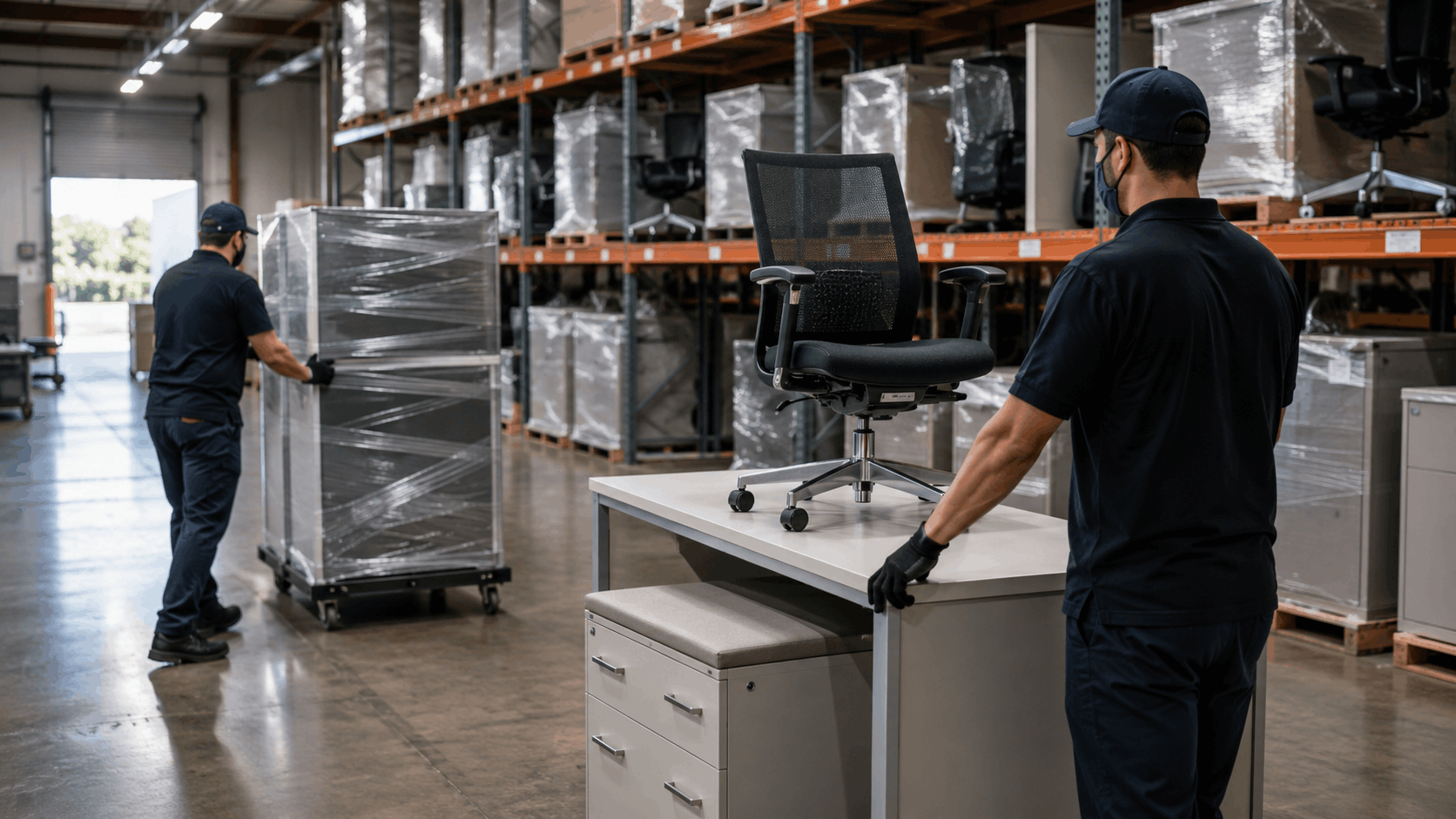
The payoff of storing furniture comes when the new office is finally ready. Office refurnishing pulls the pieces out of storage and sets them up in the new space, and good planning makes that day smooth instead of chaotic.
We handle furniture delivery and office setup as one coordinated job. Because everything was labeled and logged going in, the pieces come out in an order that makes the setup fast and accurate.
Planning the New Floor Layout First
Before a single item leaves storage, the new floor layout needs to be mapped. Working from the architect's floor plan, we mark where each department, workstation, and shared area goes. That map guides the whole delivery.
A clear office layout prevents the mess of furniture piling up in the wrong rooms. When the crew knows the corner office gets the executive desk and the open area gets the workstation cluster, everything lands in its right spot the first time. No shuffling heavy furniture around after the fact.
Floor plans also catch problems early. If the new space has fewer private offices or a different footprint, the plan shows what fits and what does not before move day. That is the time to adjust, not when a truck full of furniture is waiting at the dock.
We walk the new space with the client and match the plan to the inventory list. Every stored piece gets a destination before delivery starts, which keeps the setup organized and quick.
Reassembly of Cubicles and Furniture
Furniture reassembly is where the labeling from the decommission pays off. The panels, brackets, and hardware that got tagged coming apart go back together in the same order. Workstation setup moves fast because nothing has to be figured out from scratch.
Our crews rebuild the cubicles and systems furniture using the labeled parts and the pre-move photos. If the layout is staying the same, the photos guide an exact match. If the new space calls for a different arrangement, the labeled parts still make the rebuild straightforward.
Systems furniture like power and data connections gets reconnected as the panels go up. Cubicles are more than dividers - they carry the wiring that feeds each desk. Getting those connections right the first time keeps the office ready to work the moment people arrive.
By the end of the setup, the workstations look and function like they did in the old space, or better if the layout was improved. That continuity lets a team walk in and get back to work without a long adjustment.
Coordinating Delivery With Buildout Completion
Delivery timing is everything when a buildout is finishing. Furniture that arrives before the space is done sits in the way of contractors, and furniture that arrives late leaves employees without desks. We aim the delivery right at the sweet spot.
That means staying in touch with the client's contractor and property manager as the finish date approaches. Buildout completion often slides by a few days, so flexibility matters. We adjust the delivery date as the real signoff gets close.
Permit signoffs and final inspections are the last hurdle. Furniture usually should not go in until the space passes those checks, since inspectors need clear access. We plan around the inspection schedule so delivery follows right behind the green light.
When the timing lines up, the furniture arrives just as the space becomes usable. The office fills up over a day or two, and the team is back in business with minimal downtime.
Need Help in Los Angeles?
Popeye Moving & Storage serves Los Angeles and all of Los Angeles County.
What This Kind of Storage and Move Costs
Cost is the first question most businesses ask, and the honest answer is that it depends on the job. Office storage cost and decommissioning price both shift based on the size of the office and how the buildings are set up. Still, ranges help with budgeting.
Below are rough figures to plan around before you get a real moving quote. Actual numbers come from a walkthrough, but these give a starting point:
| Office Size | Decommission & Move | Monthly Storage |
|---|---|---|
| Small (up to 10 staff) | $1,500 - $4,000 | $150 - $500 |
| Medium (10-40 staff) | $4,000 - $12,000 | $500 - $1,500 |
| Large (40+ staff) | $12,000 - $30,000+ | $1,500 - $4,000+ |
Factors That Change the Price
Square footage and item count are the biggest cost factors. A larger office with more furniture takes more crew hours, more truck space, and more storage room. The price scales with the volume of what needs to move and be stored.
Storage length affects the ongoing cost. A two-week gap barely registers, while a year in storage adds up month by month. This is why sorting out furniture you do not need is such an easy way to trim the bill.
Building access difficulty is the factor people forget. A ground-floor suite with a private dock moves fast, while a 20th-floor office with a shared freight elevator and an after-hours-only window takes longer. Storage pricing and move labor both climb when access is tight.
The distance between the old office, the storage facility, and the new space also plays in. A move that stays within the west side costs less than one that crosses the whole county. We factor route and traffic into every estimate.
Sample Ranges for LA Businesses
A small office of up to ten people usually runs $1,500 to $4,000 for the decommission and move, plus $150 to $500 a month for storage. These jobs often wrap in a single day and store in a modest unit.
A medium office of ten to forty staff lands around $4,000 to $12,000 for the move, with monthly storage cost between $500 and $1,500. This is the most common size we handle, with cubicle disassembly and reassembly making up a good share of the labor.
A large office of forty or more people can run $12,000 to $30,000 or higher for a full decommission, and storage often exceeds $1,500 a month. These jobs may span multiple days and involve careful elevator and dock scheduling. The price ranges shift with all the factors above.
These figures cover typical LA jobs, but every office is different. A space full of custom pieces or heavy specialty items sits at the higher end, while a lean office with mostly standard furniture stays lower.
How to Get an Accurate Quote
A real number comes from an on-site walkthrough, not a phone guess. When we visit the office, we count the items, note the building access, and build a sorting plan on the spot. That on-site estimate turns a rough range into a firm figure.
The walkthrough also catches details that change the price, like a tight loading dock or furniture that needs special crating. Seeing the space in person means the quote reflects reality instead of assumptions. Nobody likes a surprise charge on move day.
An accurate quote depends on an honest inventory count. The more complete the picture during the walkthrough, the tighter the number. We would rather spend an hour on-site up front than deal with a mismatched estimate later.
Reach out through our contact page to set up a walkthrough. We will look at the space, count the load, and give a quote you can actually budget around.
Mistakes to Avoid When Storing Office Furniture
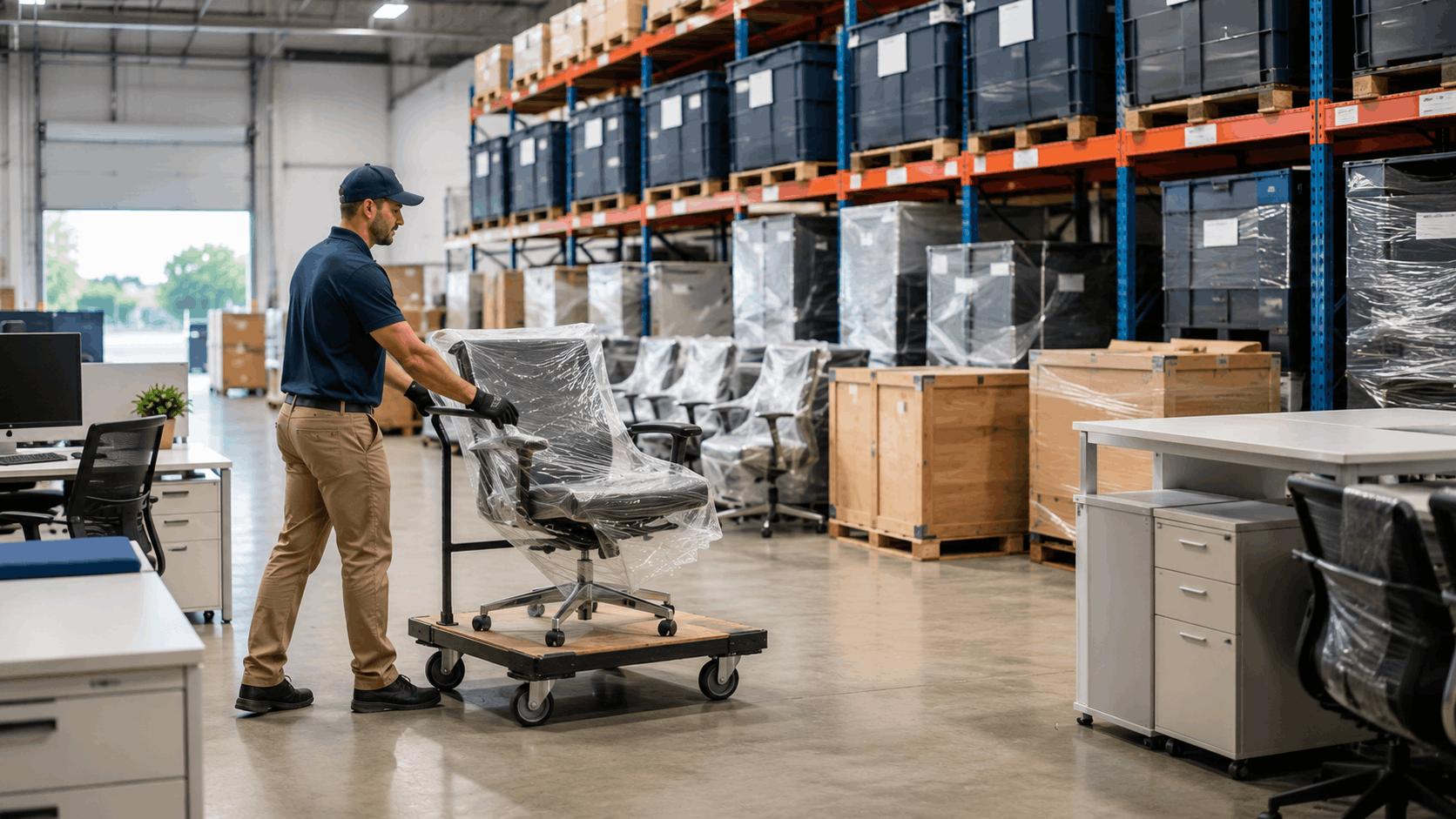
After hundreds of office moves across LA, we see the same avoidable mistakes over and over. Each one costs a business money or time, and each one is easy to prevent with a little planning. Here are the storage mistakes worth steering clear of.
These office move tips come straight from the field, from jobs Downtown to Culver City and everywhere between. Getting ahead of these problems keeps a move on budget and on schedule.
Skipping the Inventory Step
The most common mistake is moving furniture into storage without a proper inventory. Without documentation, items go missing and nobody notices until setup day. Then the crew is short a desk or a set of panels with no record of where it went.
Inventory documentation is what keeps every piece accounted for from the old office to the new one. A logged, photographed, labeled list means nothing gets lost in the shuffle. It also speeds up refurnishing because the crew knows exactly what they have.
Skipping this step feels like a time-saver, but it costs far more later. Hunting for missing furniture or re-buying pieces that got lost wipes out any time saved up front. A good inventory is cheap insurance against a chaotic setup.
We build the inventory as a standard part of every decommission. It is not an add-on, it is how the whole process stays organized from start to finish.
Storing Damaged or Unneeded Furniture
Paying to store furniture that should have been tossed is pure waste. A cracked desk or a wobbly chair does not get better in storage, and it takes up space you are paying for every month. That is money spent on items headed for the dumpster anyway.
Furniture triage before the move solves this. Sorting the keep pile from the donate, recycle, and dispose piles means storage only holds what the business will actually reuse. That single step often shrinks the storage footprint enough to drop into a smaller, cheaper unit.
Wasted storage adds up quietly over a long gap. Storing a dozen unneeded items for a year could cost hundreds of dollars for furniture nobody wanted. Cutting that clutter is one of the fastest ways to lower the bill.
We help sort during the walkthrough so the decision gets made before anything ships. Donating and recycling the extras also clears the old space faster for a clean handover.
Booking Movers Too Late
Waiting until the last minute to book a move is a costly mistake in LA. Building access windows fill up, especially in high-rises where the freight elevator serves many tenants. A last-minute move might not get the elevator time it needs, which stalls the whole job.
Booking timing also affects the crew and truck availability. During busy moving seasons, the best crews get reserved weeks ahead. Calling a few days before the lease ends limits the options and often raises the price for rushed scheduling.
A last-minute move Downtown or in Century City runs into building rules that cannot be rushed. COIs take time to process, and access windows have to be reserved. Skipping that lead time means scrambling, and scrambling costs money.
The fix is simple: book several weeks ahead. Early booking locks in the elevator windows, the crew, and the timing, and it leaves room to handle any surprise the buildout throws in.
Need Help in Los Angeles?
Popeye Moving & Storage serves Los Angeles and all of Los Angeles County.
Final Thoughts
Storing office furniture between leases turns a stressful timing gap into a manageable pause. Instead of buying everything new or dumping good furniture, a business keeps what it owns, hands back the old space clean, and refurnishes when the new office is ready.
The whole process comes down to good planning: a solid inventory, smart sorting, the right storage, and careful timing on both ends. Done well, it saves a business thousands of dollars and a lot of headaches. Done poorly, it leads to lost items, wasted storage, and lease penalties.
Our team has run this process across Downtown, Century City, West LA, and beyond, and we handle every step from decommission to refurnishing. If your lease is ending before your new space is ready, reach out to Popeye Moving & Storage Co. for a walkthrough and a real quote. Call us or send a message, and we will help you bridge the gap.
Frequently Asked Questions
What does office decommissioning mean?
Office decommissioning means fully clearing out and restoring a leased office space when you move out. It covers removing all furniture, cubicles, IT gear, and debris, then returning the space broom-clean to meet the landlord's move-out conditions. Done right, it protects your security deposit and avoids lease penalties. Our crews handle the disassembly, sorting, cleanup, and handover so the space passes the landlord's final walkthrough.
How long can I store office furniture between leases?
Storage terms flex to match your gap. Some businesses store furniture for just a few weeks while a contractor finishes small work, and others need six months or over a year for a major buildout. Billing usually runs month to month, so you pay only for the time you use. If your new space date is uncertain, month-to-month storage keeps your options open without a long contract.
How much does office furniture storage cost in Los Angeles?
Monthly storage in LA generally runs $150 to $500 for a small office, $500 to $1,500 for a medium office, and $1,500 or more for a large one. The price depends on how much furniture you store, how long you keep it, and the space it takes up. Sorting out items you do not need lowers the bill. A walkthrough gives an exact number for your load.
Do you disassemble and reassemble cubicles?
Yes. Our crews take apart modular cubicles and systems furniture like Herman Miller and Steelcase, then rebuild them in your new space. Every panel, bracket, and bag of hardware gets labeled during disassembly, and we photograph each workstation first. That labeling makes reassembly fast and accurate, whether you keep the same layout or change it. The workstations come back together the way they were, or better.
Is the storage facility climate controlled?
Yes, and it matters in LA's climate. Summer heat in the basin can warp wood and dry out veneers, while marine layer humidity breeds mildew in upholstery and rusts metal frames. Climate-controlled storage keeps temperature and humidity steady year round, protecting wood desks, leather chairs, and custom pieces. For furniture you plan to reuse, the small added cost of climate control is worth it.
Can you handle move-outs in Downtown LA high-rises?
Absolutely. We clear offices in Downtown towers regularly and know how to work with freight elevators, shared loading docks, and strict building rules. We file the certificate of insurance ahead of time, book the elevator window early, and staff after-hours moves when the building requires them. Our crews plan around building access windows so the job runs on schedule without holding up other tenants.
What happens to furniture I don't want to keep?
We sort your furniture into keep, donate, recycle, and dispose during the walkthrough. Usable pieces can go to organizations like Goodwill Southern California, which may come with a tax benefit. Other items get recycled through local programs to keep them out of the landfill. This sorting cuts your storage costs because you only pay to store what you will actually use again in the new space.
How do you keep track of my stored items?
Every item gets logged, photographed, and labeled before it goes on the truck. The label ties each piece to an entry on the inventory list, so we always know what we have and where it belongs. Photos document condition in case a question ever comes up. This tracking means nothing gets lost in storage and refurnishing goes quickly, with each piece landing in its right spot.
Is my furniture insured while in storage?
Yes. We offer insurance coverage options for furniture stored in our facility, so your business assets are protected against the unexpected. The facility also uses monitored access, surveillance, and access logs that record who enters and when. Between the coverage and the security, your furniture stays as protected as it would be in a working office. We recommend confirming the coverage level before storage begins.
How far in advance should I book?
Book several weeks ahead whenever possible. Building access windows and freight elevator slots fill up fast in LA high-rises, and certificates of insurance take time to process. Early booking locks in the crew, the truck, and the timing, and it leaves room to handle any buildout delay. Last-minute booking limits your options and often raises the cost, so plan as soon as you know your lease end date.
Frequently Asked Questions
- What does office decommissioning mean?
- Office decommissioning means fully clearing out and restoring a leased office space when you move out. It covers removing all furniture, cubicles, IT gear, and debris, then returning the space broom-clean to meet the landlord's move-out conditions. Done right, it protects your security deposit and avoids lease penalties. Our crews handle the disassembly, sorting, cleanup, and handover so the space passes the landlord's final walkthrough.
- How long can I store office furniture between leases?
- Storage terms flex to match your gap. Some businesses store furniture for just a few weeks while a contractor finishes small work, and others need six months or over a year for a major buildout. Billing usually runs month to month, so you pay only for the time you use. If your new space date is uncertain, month-to-month storage keeps your options open without a long contract.
- How much does office furniture storage cost in Los Angeles?
- Monthly storage in LA generally runs $150 to $500 for a small office, $500 to $1,500 for a medium office, and $1,500 or more for a large one. The price depends on how much furniture you store, how long you keep it, and the space it takes up. Sorting out items you do not need lowers the bill. A walkthrough gives an exact number for your load.
- Do you disassemble and reassemble cubicles?
- Yes. Our crews take apart modular cubicles and systems furniture like Herman Miller and Steelcase, then rebuild them in your new space. Every panel, bracket, and bag of hardware gets labeled during disassembly, and we photograph each workstation first. That labeling makes reassembly fast and accurate, whether you keep the same layout or change it. The workstations come back together the way they were, or better.
- Is the storage facility climate controlled?
- Yes, and it matters in LA's climate. Summer heat in the basin can warp wood and dry out veneers, while marine layer humidity breeds mildew in upholstery and rusts metal frames. Climate-controlled storage keeps temperature and humidity steady year round, protecting wood desks, leather chairs, and custom pieces. For furniture you plan to reuse, the small added cost of climate control is worth it.
- Can you handle move-outs in Downtown LA high-rises?
- Absolutely. We clear offices in Downtown towers regularly and know how to work with freight elevators, shared loading docks, and strict building rules. We file the certificate of insurance ahead of time, book the elevator window early, and staff after-hours moves when the building requires them. Our crews plan around building access windows so the job runs on schedule without holding up other tenants.
- What happens to furniture I don't want to keep?
- We sort your furniture into keep, donate, recycle, and dispose during the walkthrough. Usable pieces can go to organizations like Goodwill Southern California, which may come with a tax benefit. Other items get recycled through local programs to keep them out of the landfill. This sorting cuts your storage costs because you only pay to store what you will actually use again in the new space.
- How do you keep track of my stored items?
- Every item gets logged, photographed, and labeled before it goes on the truck. The label ties each piece to an entry on the inventory list, so we always know what we have and where it belongs. Photos document condition in case a question ever comes up. This tracking means nothing gets lost in storage and refurnishing goes quickly, with each piece landing in its right spot.
- Is my furniture insured while in storage?
- Yes. We offer insurance coverage options for furniture stored in our facility, so your business assets are protected against the unexpected. The facility also uses monitored access, surveillance, and access logs that record who enters and when. Between the coverage and the security, your furniture stays as protected as it would be in a working office. We recommend confirming the coverage level before storage begins.
- How far in advance should I book?
- Book several weeks ahead whenever possible. Building access windows and freight elevator slots fill up fast in LA high-rises, and certificates of insurance take time to process. Early booking locks in the crew, the truck, and the timing, and it leaves room to handle any buildout delay. Last-minute booking limits your options and often raises the cost, so plan as soon as you know your lease end date.
P
Popeye Moving & Storage Co. Team Team
Licensed moving and storage professionals serving Los Angeles and Los Angeles County.
Licensed in California · License #PUC: CAL T 189749 | DOT: 1472924 | MC: 498816C
Why trust Popeye Moving & Storage?
Founded in 1994, Popeye Moving & Storage is a licensed and insured moving and storage service serving Los Angeles and Los Angeles County. All content is reviewed by our licensed technicians.

Need Help in Los Angeles?
Popeye Moving & Storage serves Los Angeles and all of Los Angeles County.
Related Articles
Tips & Advice
Storage Between Escrow Fall-Through and the Next Offer: When the Sale Dies but the Truck Was Booked
Escrow died but the truck was already booked? Learn how LA sellers protect belongings, deposits, and sanity with short-term storage while waiting for the next offer.
How-To Guides
Storage During a Probate-Free Estate Cleanout: The Sort-Later Strategy That Unblocks a Sale
How the sort-later storage method clears a probate-free estate home fast in Los Angeles, unblocking a quicker sale while families sort belongings on their own time.
Tips & Advice
Storage for Santa Monica and Brentwood Households: Where Westside Furniture Actually Goes Between Homes
A local guide to furniture storage for Santa Monica and Brentwood households, covering storage types, costs, coastal climate risks, and how Westside families bridge the gap between homes.