How-To Guides
Jacuzzi and Spa Moving in LA: Crane Days, Drainage, and Site Prep
Key Takeaways
- Full-size spas weigh 500 to 1,000 pounds dry, and thousands more with water, so draining is required before any move.
- Drain the spa the night before using gravity or a submersible pump, then clear the lines and footwell of leftover water.
- Spa water must go into a sewer cleanout, not a storm drain, to follow LADWP and LA Sanitation rules and avoid fines.
- A crane is needed when a yard is fenced in, on a hillside lot, or the spa sits on a second-story deck.
- Crane rentals run $500 to $1,200 with a half-day minimum, and LADOT permits are needed to block LA streets.
- The new location needs a level concrete pad, gravel base, or reinforced deck plus a proper 220V line and GFCI disconnect.
- HOAs in areas like Porter Ranch limit crane access and work hours, so those rules should be checked early.
- Popeye Moving handles the survey, drainage planning, permits, crane coordination, storage, and insurance for LA spa moves.
In This Article
Picture a homeowner in the Hollywood Hills standing in the backyard, staring at a 700-pound spa wedged between a fence and a steep set of steps. The gate is 34 inches wide. The spa is 84 inches across. There is no way it rolls out the front, and the hill drops off behind the deck. This is the moment most people realize a hot tub is not like moving a couch.
We get calls like this every week, from Sherman Oaks to Silver Lake. A spa looks simple sitting on the patio, but the weight, the fragile shell, and the tight yard access turn it into one of the hardest items to move in any home. Add LA's narrow streets and hillside lots, and the job needs real planning.
Why Moving a Jacuzzi or Spa Is Harder Than It Looks
Hot tub moving is a different animal than regular furniture. A spa is heavy, awkward, and full of parts that break if handled wrong. Spa relocation asks for gear and know-how that a standard two-person crew simply does not carry.
Here is what makes heavy item moving with a spa so tricky:
- The weight is spread wide and low, so it fights every lift
- Acrylic shells crack under pressure or a bad drop
- Plumbing and jets snap when the unit flexes
- Cabinet panels warp if the spa tilts too far
- Most LA yards were never built with a spa exit in mind
Once you see these problems together, it makes sense why a spa move is a specialty job and not a weekend favor from friends.
The Real Weight of a Full-Size Spa
Most people badly underestimate what a spa weighs. A typical full-size hot tub has a dry weight between 500 and 1,000 pounds. A small two-person model might sit near the bottom of that range, while a large seven-seater with a hardwood cabinet lands near the top.
The spa weight problem gets worse when the unit is not drained. A full-size tub holds 300 to 500 gallons of water. Water weighs about 8.3 pounds per gallon, so a full spa can carry an extra 2,500 to 4,000 pounds of water alone.
Even a spa that looks empty rarely is. Water hides in the footwell, the pump lines, and the filter housing. Mud, leaves, and debris settle in the base over years of use and add hundreds more pounds.
This is why we always confirm the hot tub dry weight and check for leftover water before moving day. A spa that was not fully drained can turn a two-hour job into a half-day battle and risk hurting both the crew and the unit.
Fragile Shells, Plumbing, and Cabinets
The acrylic shell is the part that scares us most. It looks tough, but acrylic cracks when a spa is dropped, dragged, or set down hard on an uneven surface. A single hairline crack can spread and ruin the whole tub.
Spa plumbing is just as delicate. The pipes, jets, and manifolds are glued and threaded together inside the cabinet. When a spa flexes or twists during a lift, those joints crack and start leaking the first time the tub is filled again.
Cabinet panels are another weak point. Many modern spas use composite or wood-look panels that warp or snap under strap pressure. We pad these areas and set straps only at the frame points that can take the load.
Handling a spa the right way means keeping it as level as possible and supporting the base, not the shell. Our crews use spa dollies and wide straps for this exact reason, which we cover later in the guide.
Tight LA Yards and Narrow Access Points
Los Angeles homes are famous for backyards that are hard to reach. In Silver Lake and Echo Park, older lots often have side gates only 30 to 36 inches wide with a spa that needs 40 or more inches of clearance.
Steep steps make it worse. Many hillside homes have a stairway between the yard and the street, and carrying a 700-pound spa down uneven steps is not safe with a hand crew. That is when yard access becomes the deciding factor between a roll-out and a crane lift.
Older Westside lots near Mar Vista and Palms deal with narrow gate openings and tight side yards squeezed between the house and a fence line. Retaining walls, AC units, and low-hanging eaves all block a straight path.
We survey every one of these access points before quoting a spa job. A narrow gate or a blind corner changes the whole plan, and finding those problems early keeps moving day from falling apart. For broader home moves, our residential moving team handles the same access challenges across the city.
Get Your Free Quote
Tell us about your move and we'll get back to you fast.
Draining Your Hot Tub the Right Way
Draining a hot tub is the single most important prep step before a move. Skipping it adds thousands of pounds, risks water damage, and drives up the cost of the job. An empty spa is safer, lighter, and faster to move.
Getting spa drainage right takes a little planning:
- Start draining the day before, not the morning of the move
- Know where the water can legally go before you open the valve
- Clear the pump lines and footwell after the main drain
- Check for hidden water in filters and jet channels
Do these steps and your empty spa will be ready to roll or lift without surprises.
How Long Draining Actually Takes
Draining time depends on the method. A gravity drain through the spa's built-in valve is the slowest option and can take two to four hours for a full-size tub. The flow slows to a trickle near the end, which is normal.
A submersible pump is much faster. Drop it in the footwell, run a garden hose to the drain point, and most spas empty in 30 to 60 minutes. We recommend a pump for anyone on a tight schedule or with a large tub.
Either way, do not wait until moving day morning. Start the drain the night before so there is time to handle slow flow, clear lines, and mop up without holding up the crew.
We often remind clients that a rushed drain leaves water behind, and that leftover water is what causes the biggest weight and mess problems during the actual move.
Where the Water Can Legally Go
Spa water is not always safe to dump anywhere. Chlorinated water and water treated with bromine can harm plants and wildlife. In Los Angeles, dumping it into a storm drain is against the rules because storm drains flow straight to the ocean.
The LADWP and LA Sanitation guidance point homeowners toward the sewer system instead. That usually means draining into a sewer cleanout or an indoor drain, where the water gets treated before release.
If you want to use spa water for landscaping, let the chlorine level drop to near zero first. Stop adding chemicals a few days before draining and test the water so it is safe for grass and soil.
Getting the storm drain rules right protects you from fines and protects local waterways. When we handle a full spa job, we help clients plan a legal drain point before we ever arrive.
Clearing Lines and Removing Standing Water
After the main drain, water still hides inside the spa. The pump lines, heater, and jet channels hold gallons that a gravity drain leaves behind. We blow out lines with a shop vac or air to push that water clear.
The footwell almost always holds standing water once the main valve stops flowing. We sponge and vacuum the footwell water so the base is dry before the spa moves. A dry base means less weight and no sloshing.
Leftover water is a real problem during transport. It leaks onto the truck and into cabinets, and in colder months it can freeze and expand inside the plumbing. That freeze can crack the very pipes you worked to protect.
Taking 20 extra minutes to clear the lines and dry the footwell saves headaches on the far end. It is a small step that prevents leaks, weight surprises, and hidden damage.
Need Help in Los Angeles?
Popeye Moving & Storage serves Los Angeles and all of Los Angeles County.
Crane Days: When You Need a Lift Over the House
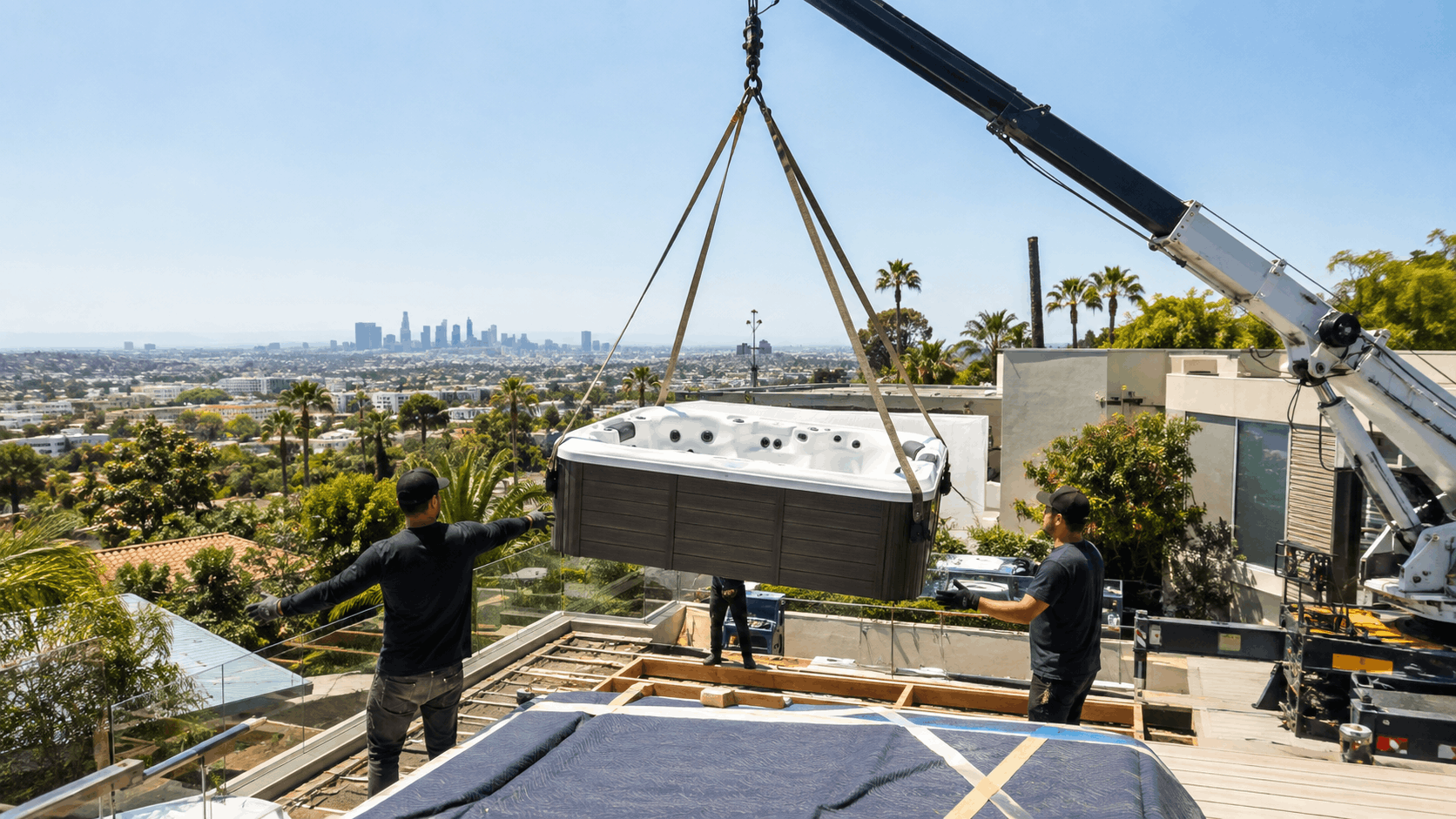
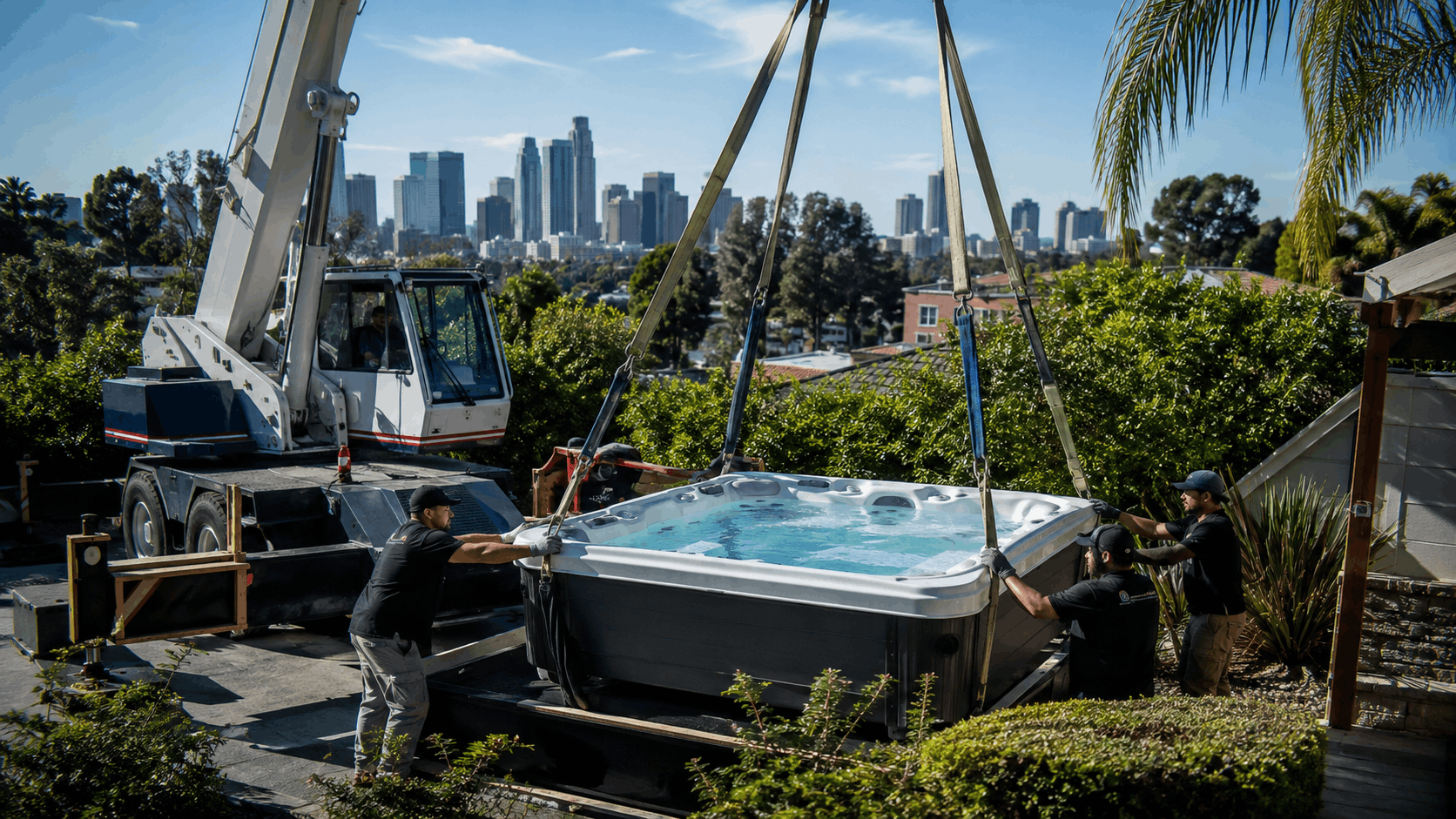
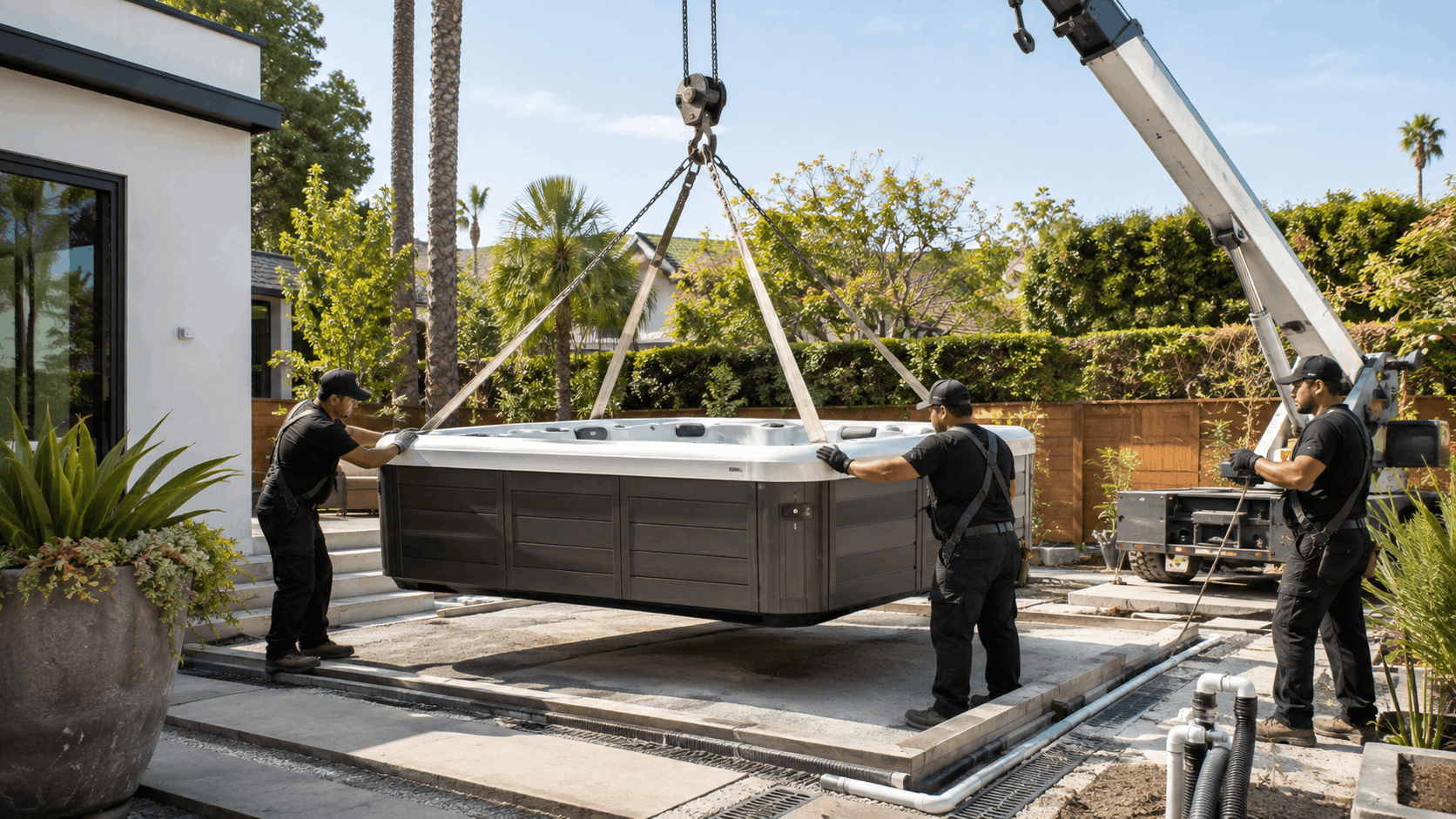
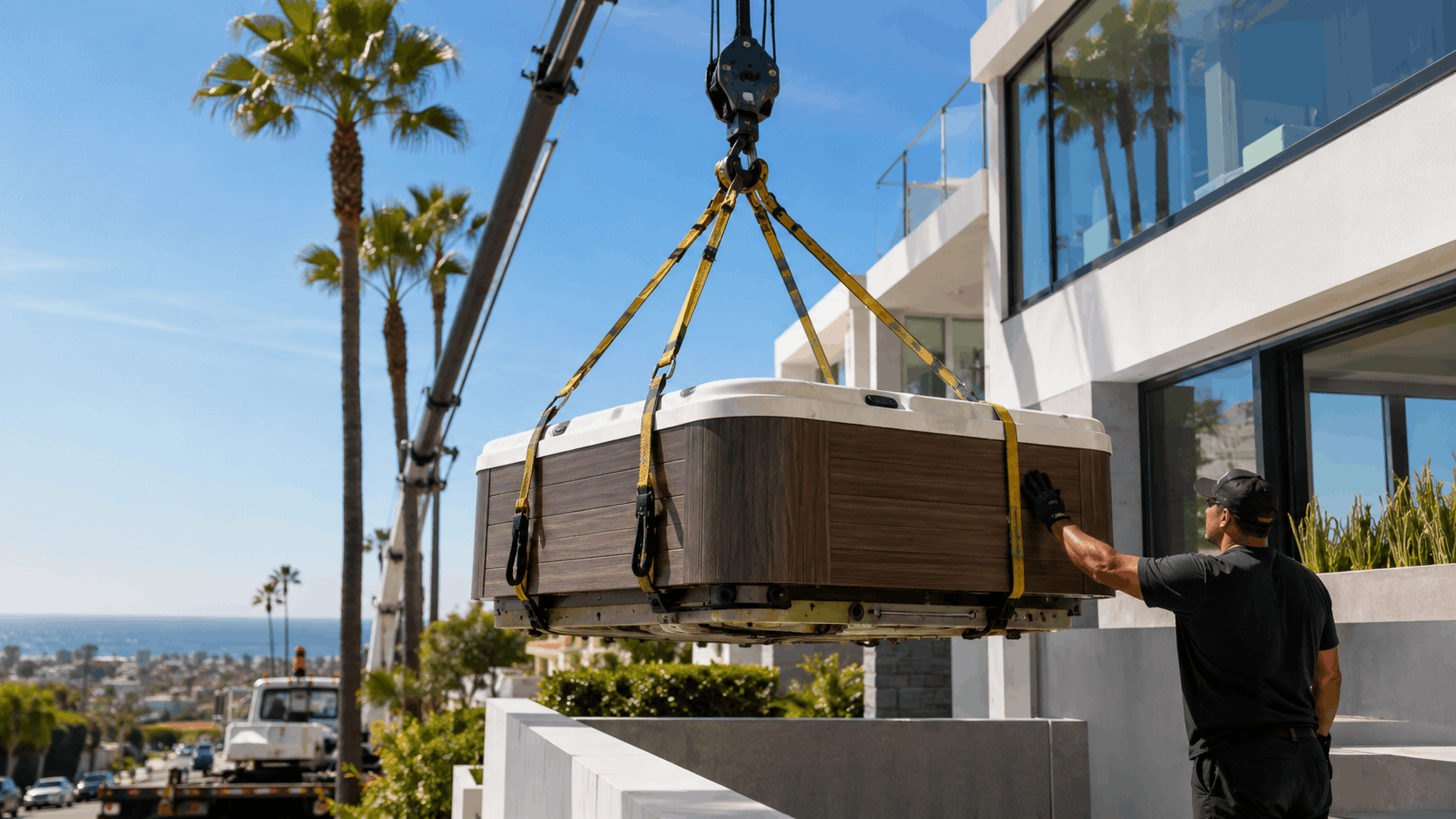
Sometimes there is no path wide enough for a spa to roll out. When the yard is boxed in, a crane hot tub lift is the safest and often the only way to get the unit out. A crane day takes planning, but it turns an impossible move into a smooth one.
A spa crane lift raises the tub up and over the house or fence, then sets it down on the truck or in the new yard. Here is what goes into a crane day and when you need one.
Signs You Cannot Avoid a Crane
The clearest sign is a backyard with no wide exit. If every gate is narrow, the side yard is blocked, or a fence wraps the whole property, a crane is usually the answer. A spa cannot fit through a 30-inch gate no matter how careful the crew is.
Second-story decks and rooftop patios almost always need a crane. There is no way to safely carry a 700-pound spa up or down a staircase, so lifting it over the edge is the only real option.
Hillside lots create the same problem. Homes in the Hollywood Hills, Mount Washington, and parts of Laurel Canyon often sit above or below the street with no level path. When backyard access means stairs or a steep slope, a crane is needed.
We spot these situations during the survey. If we see a hillside lot or a fully enclosed yard, we plan for a crane from the start rather than discovering the problem on moving day.
How the Crane Placement Gets Planned
Crane placement starts with measuring reach. The crane operator needs to know how far the spa sits from where the truck can park and how high the lift has to go. That distance and height decide what size crane the job needs.
Overhead power lines are the biggest hazard. Many LA streets have low utility lines running right where a crane would swing. We check for these lines during the survey and plan the lift path to keep the boom well clear.
The crane truck also needs a stable, flat spot to set up. A driveway, a wide street, or a level pad works. On steep or narrow streets, finding that spot is the hardest part, and sometimes it means placing the crane a block away with a longer reach.
Our team coordinates the crane reach and setup with a certified operator before the day arrives. Good planning here is what keeps the lift fast and safe once everyone is on site.
What a Crane Day Costs and How Long It Takes
Crane cost surprises people, so it helps to know the ranges up front. A crane rental in Los Angeles usually runs $500 to $1,200 for a standard spa lift, and most companies charge a half day minimum even for a quick job.
The lift itself is fast. Once the crane is set and rigged, raising a spa over a house takes only 15 to 30 minutes. Most of the crane day is setup, rigging, and takedown, not the actual lift.
Timing matters because the crane and our moving crew have to arrive together. If the spa is not drained or the path is not clear when the crane shows up, the meter keeps running and costs climb.
We coordinate the schedule so everything lines up. When the crew, the crane, and the prepped spa all meet at the right time, a crane day stays efficient and the total cost stays predictable.
Street Permits and Traffic Control in LA
Blocking a street with a crane usually needs a permit. The LADOT issues permits for temporary street closures and for parking large equipment in the roadway. Skipping the permit risks fines and a shut-down job.
Dense areas make this harder. In spots like Larchmont Village, the streets are tight and parked cars fill every space. A crane needs clear room, so we often arrange to reserve curb space ahead of the lift.
Traffic control comes into play on busier roads. A flagger or cones may be required to keep cars moving safely around the crane. LADOT rules spell out when this is needed based on the street and the closure.
We handle the permit and traffic control planning as part of the move. Sorting out the street closure early means the crane can set up legally and the neighbors stay happy.
Site Prep at the Old and New Locations
Site prep is the work that happens before and after the spa travels. Both the old yard and the new spot need attention. Clearing the moving path and setting up the spa pad keeps the unit safe and the yard undamaged.
Here is a quick look at the main site prep tasks at each end:
| Task | Old Location | New Location |
|---|---|---|
| Path clearing | Remove gates, clear side yard | Clear route to the pad |
| Surface protection | Plywood over grass and pavers | Protect walkways and decking |
| Base check | Confirm spa is loose and level | Level concrete pad or reinforced deck |
| Utilities | Disconnect 220V line | GFCI disconnect and hookup ready |
Clearing the Path and Protecting the Yard
The first step is opening a clear path. We remove gates off their hinges when needed and clear anything in the way, from planters to patio furniture. A wide, straight path lets the spa roll on dollies without stops.
Grass and soft ground need protection. Rolling a heavy spa across a lawn digs deep ruts, so we lay a plywood path to spread the weight. The plywood gives the dollies a firm, flat surface and saves the grass.
Delicate features get special care. Sprinkler heads, low-voltage lighting, and paver walkways crack or shift under a spa's weight. We mark sprinkler heads, avoid them, and lay boards over pavers so they do not chip or sink.
Yard protection is not just about being tidy. A cracked paver or a torn-up lawn is an extra cost the homeowner pays later, so we plan the path to leave the yard the way we found it.
Prepping the New Spa Pad
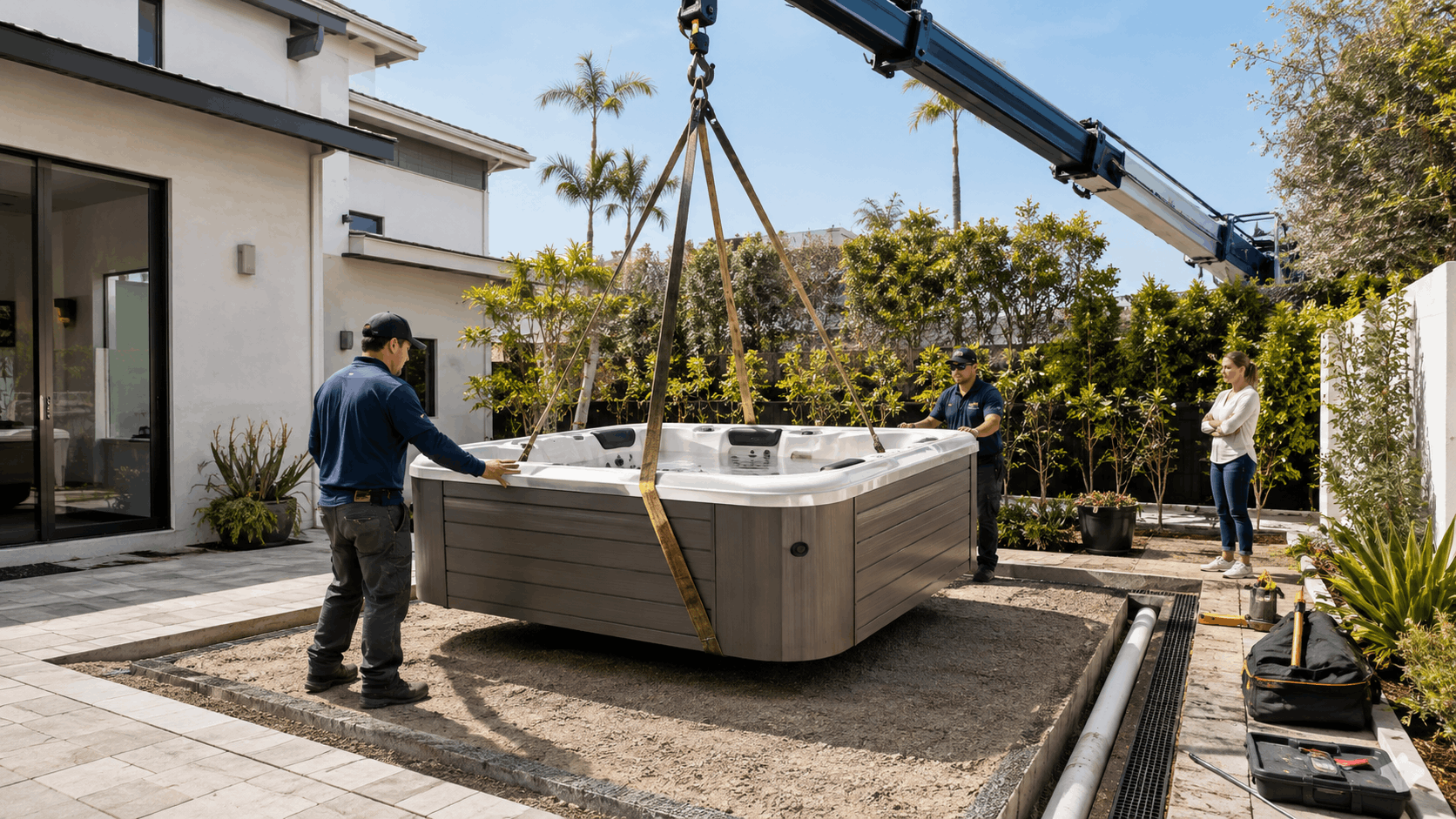
A spa needs a solid, level base at the new location. The best option is a level concrete pad poured to hold the full filled weight, which can top 4,000 pounds with water and people inside.
A gravel base is another common choice. A few inches of compacted gravel drains well and supports the spa if it is graded level. What you cannot do is set a spa on bare dirt or grass, which shifts and settles over time.
Decks need extra thought. A standard deck is not built for spa weight, so it may need reinforced framing and added support posts below. A contractor should confirm the deck support before the spa arrives.
We check the new pad during the survey and flag any problems early. If the base is not ready, we can hold the spa in storage until it is, which we cover further down.
Checking Electrical and GFCI Hookups
Most full-size spas run on a 220V hookup, not a standard outlet. That line has to be in place and correct before the spa can be used at the new home. Moving the tub is only half the job.
A GFCI disconnect is required for safety. This is a shutoff box that cuts power fast if there is a fault, and code requires it within sight of the spa. If the new spot has no disconnect, one has to be added.
Spa electrical work is not a DIY task. A licensed electrician should pull the permit, run the line, and install the disconnect. Getting this wrong risks shock hazards and a failed inspection.
We do not perform the electrical hookup ourselves, but we coordinate the timing so the spa is set and ready when the electrician arrives. That keeps the whole project moving without gaps.
Permits, HOAs, and Local Rules Across LA
Moving a spa can trigger paperwork you might not expect. A spa permit, HOA approval, and rules from the Los Angeles building department all come into play depending on where you live. Knowing these ahead of time avoids delays and fines.
Every part of LA has its own quirks. What flies in a hillside neighborhood may be blocked in a gated community, so we walk clients through the local rules before the move.
When the LA Building Department Gets Involved
Moving a spa itself does not usually need a permit, but the work around it often does. When a new 220V line or a spa disconnect goes in, LADBS requires an electrical permit for that work.
Structural work can trigger permits too. If a deck needs reinforcing to hold the spa, or a new concrete pad ties into existing structures, the building department may need to sign off. This protects you and any future buyer.
Inspections follow permitted work. An inspector confirms the electrical and structural work meets code before the spa goes into service. Skipping this step can cause problems when you sell the home later.
We flag when a job likely needs an LADBS electrical permit so clients can line up a licensed pro early. Catching it in the survey keeps the project from stalling at the finish line.
HOA and Gated Community Restrictions
HOA restrictions catch a lot of homeowners off guard. Communities like Porter Ranch and many gated Valley neighborhoods have rules about crane access, equipment on shared roads, and how work is done on the property.
Work hours are a common limit. Many HOAs only allow noisy work or large equipment during set hours, often 8 a.m. to 5 p.m. on weekdays. A crane lift outside those hours may be blocked.
Gated community access takes coordination. The crane truck and moving crew need gate clearance and sometimes an escort. We arrange this with the HOA or security office before the move so no one is turned away at the gate.
Checking HOA rules early saves a wasted trip. When we know the restrictions upfront, we schedule the crane and crew to fit the community's rules the first time.
Water Disposal and Environmental Rules
LA takes water disposal seriously. LA Sanitation guidance is clear that spa water with chlorine or bromine should not go into storm drains, since those flow untreated to the ocean and local creeks.
The right disposal path is the sewer system. Draining into a sewer cleanout or an indoor drain sends the water for treatment. For landscaping use, the chemical level has to drop to near zero first.
Environmental fines are real. Dumping treated spa water into the wrong drain can bring penalties from the city. It is an avoidable cost that comes down to draining in the right spot.
We help clients plan a legal drain point as part of the job. Doing it right protects your wallet and the waterways that make LA a great place to live.
Need Help in Los Angeles?
Popeye Moving & Storage serves Los Angeles and all of Los Angeles County.
Navigating LA Streets and Neighborhood Challenges
Moving a spa across LA neighborhoods is as much about the drive as the lift. Narrow streets, tight parking, and heavy traffic all shape how a spa move goes. Our crews know these roads because we work them every day.
Spa moving access changes block by block in this city. A plan that works in a beach town falls apart on a hillside, so we scout the route before we roll.
Steep and Winding Hillside Routes
The hillside roads near the Hollywood Hills and Laurel Canyon are some of the toughest in the city. Tight switchbacks, blind curves, and roads barely wide enough for two cars make large trucks struggle.
A big moving truck or crane cannot always reach the house directly. On the narrowest Laurel Canyon streets, we sometimes stage a smaller truck to shuttle gear up, then bring the spa down to a wider spot for loading.
Grade is another factor. Steep driveways and roads make it hard to keep a spa level on a dolly or trailer. We rig extra straps and take slow, planned routes to keep the unit stable on the descent.
Knowing these hillside routes ahead of time is what keeps a move on schedule. We plan the drive as carefully as the lift when a spa comes off a canyon lot.
Parking and Loading in Dense Areas
Dense neighborhoods bring a different challenge: finding space to park and load. In Koreatown, West Hollywood, and older Mid-City blocks, curb space fills fast and driveways are short.
A spa needs room to roll out to the truck. When there is no loading space near the door, we reserve curb space ahead of time or arrange a permit so the truck can sit close to the exit path.
Apartment and condo moves near the West Hollywood Sunset Strip area add tight alleys and shared driveways to the mix. We scout the loading spot during the survey so moving day is not a scramble.
Getting the truck close cuts the carry distance and lowers the risk to the spa. In dense areas, that planning is what separates a smooth move from a stressful one.
Timing Your Move Around LA Traffic
LA traffic can wreck a tight schedule. The 101 freeway and the 405 both crawl during rush hour, and a crane or big truck stuck in gridlock burns time and money.
We time spa moves to dodge the worst of it. Mid-morning starts after the 9 a.m. crush and midday windows tend to work best. We avoid the 4 to 7 p.m. slowdown whenever we can.
Crane deliveries need extra care in scheduling. Since a crane charges by the half day, we line up its arrival for a lighter traffic window so it is not idling in a jam on the way over.
Weekdays outside rush hour often beat weekends for crane work, since some streets are busier with local traffic on Saturdays. We pick the day and time that gives the smoothest run to your home.
How Popeye Moving & Storage Handles Spa Relocations
Popeye Moving has handled spa moves across every corner of LA, from beach towns to hillside lots. Our spa moving service follows a clear process so nothing gets missed. As experienced Los Angeles movers, we treat each spa like the delicate, heavy item it is.
Here is a look at how a spa move with our team comes together:
| Step | What We Do |
|---|---|
| Survey | Measure access, plan the route, decide crane or dolly |
| Prep | Confirm drain, clear path, protect the yard |
| Move day | Rig, lift or roll, load and transport |
| Delivery | Set on the new pad, position level, tidy up |
| Storage | Hold the spa if the new spot is not ready |
Our On-Site Survey Before Moving Day
Every spa move starts with an on-site survey. We come out, measure the gate widths, check the side yard, and look at the steps and slopes between the spa and the street. Nothing is guessed.
The access check tells us the method. If a clear path exists, we plan a dolly roll-out. If the yard is boxed in or on a hill, we plan a crane lift and start the permit process.
We also build the route plan for the drive. That means scouting the streets, parking, and any low power lines between the old and new homes. For hillside and canyon jobs, this step matters most.
Doing the survey up front means no surprises on moving day. When we arrive to move the spa, every measurement and decision is already made. Our specialty moving team handles this kind of detailed planning for heavy and awkward items.
Equipment We Bring to Every Spa Move
The right gear makes a spa move safe. We bring heavy-duty spa dollies rated for the weight, which let the crew roll the tub across a plywood path without dragging or dropping it.
Wide moving straps do the lifting. These spread the load across the spa's frame instead of the fragile shell, so the acrylic and plumbing stay protected during the carry and the set-down.
Furniture pads and shrink wrap guard the surface. We wrap the cabinet and shell to shield them from scuffs, straps, and weather during transport. The spa arrives looking the way it left.
For crane days, we coordinate with a certified crane operator who handles the rigging and lift. Our crew works with the operator to guide the spa in and out cleanly.
Short-Term Spa Storage Options
Sometimes the new spot is not ready when the spa has to leave. Maybe the concrete pad is still curing or the deck needs reinforcing. That is when short-term storage saves the day.
We can hold the spa in our facility until the new base is set. The unit stays wrapped and protected, off the ground and out of the weather, so it is ready to install when you are.
This flexibility helps with timed moves. If you close on a new home before the yard is finished, our storage solutions bridge the gap without you scrambling for a spot.
Spa storage in LA is one less thing to worry about. We schedule the redelivery once your pad or deck is ready, and the spa goes straight into place.
Insurance and Damage Protection
A spa is a big investment, so protection matters. We wrap, pad, and rig every unit to prevent damage in the first place. Prevention is always the goal.
Moving insurance backs that up. Our coverage protects the spa during the move, so if something goes wrong, you are not left holding the loss. We walk clients through what the coverage includes before the job.
Damage protection also comes from experience. A crew that has moved hundreds of spas knows how to handle the shell, the plumbing, and the tight corners without incident.
We are happy to explain our coverage options during the quote. Knowing your spa is protected lets you focus on enjoying it at the new home. Reach out through our contact page to go over the details.
Need Help in Los Angeles?
Popeye Moving & Storage serves Los Angeles and all of Los Angeles County.
Final Thoughts
Moving a jacuzzi or spa in LA is a real project, not a quick chore. The weight, the fragile parts, the tight yards, and the city's streets all demand planning. Drain it right, prep both ends, and know when a crane is the only safe path.
From the hillsides of Laurel Canyon to the dense blocks of Koreatown, our team has moved spas through it all. With the right survey, gear, and permits handled up front, a spa move goes smoothly and your unit arrives ready to fill.
If you have a spa to move anywhere in Los Angeles, reach out to Popeye Moving in Los Angeles for a consultation. We will survey your site, plan the safest route, and give you a clear quote. Call us today to get your spa move on the calendar.
Frequently Asked Questions
How much does it cost to move a hot tub in Los Angeles?
Hot tub moving cost in LA usually ranges from $350 to $700 for a straightforward local move with good access. When a crane is needed, add $500 to $1,200 for the crane rental on top. Distance, access difficulty, and stairs all raise the price. The best way to get an accurate number is an on-site survey where we can see the real conditions.
Do I need a crane to move my spa?
A crane is needed when the spa cannot roll out. If your yard is boxed in by fences, sits on a hillside lot, or the tub is on a second-story deck, a crane lift is the only safe option. If there is a clear, wide path to the street with no steep steps, we can usually do a straight roll-out on dollies instead. The survey decides which method fits.
Should I drain my hot tub before the movers arrive?
Yes, always drain your hot tub before moving day. A full spa adds thousands of pounds of water and risks leaks and damage during transport. Start the drain the night before, since a gravity drain can take two to four hours or 30 to 60 minutes with a submersible pump. Also clear the pump lines and sponge out the footwell so no water is left behind.
Where can I legally dump the spa water in LA?
Spa water disposal in LA should go into the sewer system, not a storm drain. Drain into a sewer cleanout or an indoor drain so the water gets treated. Chlorinated water in a storm drain flows untreated to the ocean and can bring fines under LA Sanitation rules. If you want to water plants with it, stop adding chemicals days ahead so the chlorine level drops to near zero first.
Can a hot tub be moved on its side?
Moving a hot tub on its side is sometimes done to fit through tight spots, but it carries risk. Tilting can stress the acrylic shell and crack the plumbing inside the cabinet. When it is unavoidable, the spa must be padded, supported at the frame, and moved slowly. Our crew only tilts a spa when access requires it and we can do so without harming the shell or jets.
How long does a spa move take?
A standard spa move with good access takes two to four hours from start to finish. A crane day runs longer, often four to six hours, since setup, rigging, and takedown add time even though the actual lift is only 15 to 30 minutes. Hillside routes and tight parking can stretch the timeline. We give a realistic time estimate after the on-site survey.
Do I need a permit to use a crane on my street?
Yes, using a crane on a public street in LA usually needs an LADOT permit for a temporary closure or to park large equipment in the road. In dense areas like Larchmont Village, we also reserve curb space and may add traffic control. We handle the permit and coordination as part of the move so the crane can set up legally and safely.
What kind of base does my new spa location need?
Your new spa needs a solid, level base that holds the full filled weight, which can top 4,000 pounds. A level concrete pad is best, and a few inches of compacted gravel works too. Never set a spa on bare dirt or grass, which shifts over time. If you are placing it on a deck, have a contractor confirm the framing can support the load.
Can you store my spa if my new yard is not ready?
Yes, we offer short-term spa storage for exactly this situation. If your concrete pad is still curing or your deck needs work, we hold the wrapped spa in our facility until the new spot is ready. Then we schedule redelivery and set it straight into place. This keeps your move on track even when the yard timeline slips.
Is my hot tub covered if it gets damaged during the move?
Our moving coverage protects your spa during the move, so you are not stuck with the loss if something goes wrong. We also wrap, pad, and rig every unit to prevent damage in the first place. During your quote, we explain exactly what the coverage includes so you know your spa is protected from the old yard to the new pad.
Frequently Asked Questions
- How much does it cost to move a hot tub in Los Angeles?
- Hot tub moving cost in LA usually ranges from $350 to $700 for a straightforward local move with good access. When a crane is needed, add $500 to $1,200 for the crane rental on top. Distance, access difficulty, and stairs all raise the price. The best way to get an accurate number is an on-site survey where we can see the real conditions.
- Do I need a crane to move my spa?
- A crane is needed when the spa cannot roll out. If your yard is boxed in by fences, sits on a hillside lot, or the tub is on a second-story deck, a crane lift is the only safe option. If there is a clear, wide path to the street with no steep steps, we can usually do a straight roll-out on dollies instead. The survey decides which method fits.
- Should I drain my hot tub before the movers arrive?
- Yes, always drain your hot tub before moving day. A full spa adds thousands of pounds of water and risks leaks and damage during transport. Start the drain the night before, since a gravity drain can take two to four hours or 30 to 60 minutes with a submersible pump. Also clear the pump lines and sponge out the footwell so no water is left behind.
- Where can I legally dump the spa water in LA?
- Spa water disposal in LA should go into the sewer system, not a storm drain. Drain into a sewer cleanout or an indoor drain so the water gets treated. Chlorinated water in a storm drain flows untreated to the ocean and can bring fines under LA Sanitation rules. If you want to water plants with it, stop adding chemicals days ahead so the chlorine level drops to near zero first.
- Can a hot tub be moved on its side?
- Moving a hot tub on its side is sometimes done to fit through tight spots, but it carries risk. Tilting can stress the acrylic shell and crack the plumbing inside the cabinet. When it is unavoidable, the spa must be padded, supported at the frame, and moved slowly. Our crew only tilts a spa when access requires it and we can do so without harming the shell or jets.
- How long does a spa move take?
- A standard spa move with good access takes two to four hours from start to finish. A crane day runs longer, often four to six hours, since setup, rigging, and takedown add time even though the actual lift is only 15 to 30 minutes. Hillside routes and tight parking can stretch the timeline. We give a realistic time estimate after the on-site survey.
- Do I need a permit to use a crane on my street?
- Yes, using a crane on a public street in LA usually needs an LADOT permit for a temporary closure or to park large equipment in the road. In dense areas like Larchmont Village, we also reserve curb space and may add traffic control. We handle the permit and coordination as part of the move so the crane can set up legally and safely.
- What kind of base does my new spa location need?
- Your new spa needs a solid, level base that holds the full filled weight, which can top 4,000 pounds. A level concrete pad is best, and a few inches of compacted gravel works too. Never set a spa on bare dirt or grass, which shifts over time. If you are placing it on a deck, have a contractor confirm the framing can support the load.
- Can you store my spa if my new yard is not ready?
- Yes, we offer short-term spa storage for exactly this situation. If your concrete pad is still curing or your deck needs work, we hold the wrapped spa in our facility until the new spot is ready. Then we schedule redelivery and set it straight into place. This keeps your move on track even when the yard timeline slips.
- Is my hot tub covered if it gets damaged during the move?
- Our moving coverage protects your spa during the move, so you are not stuck with the loss if something goes wrong. We also wrap, pad, and rig every unit to prevent damage in the first place. During your quote, we explain exactly what the coverage includes so you know your spa is protected from the old yard to the new pad.
P
Popeye Moving & Storage Co. Team Team
Licensed moving and storage professionals serving Los Angeles and Los Angeles County.
Licensed in California · License #PUC: CAL T 189749 | DOT: 1472924 | MC: 498816C
Why trust Popeye Moving & Storage?
Founded in 1994, Popeye Moving & Storage is a licensed and insured moving and storage service serving Los Angeles and Los Angeles County. All content is reviewed by our licensed technicians.

Need Help in Los Angeles?
Popeye Moving & Storage serves Los Angeles and all of Los Angeles County.
Related Articles
How-To Guides
Beverly Hills Moving Permits and Restrictions: What You Need Before Moving Day
Beverly Hills moving permits, time restrictions, and street-by-street rules explained - what you need before moving day to avoid fines, towing, and delays.
How-To Guides
LADOT Moving Truck Parking Permits: Complete Application Guide
Learn how to apply for LADOT moving truck parking permits in Los Angeles - permit types, fees, timelines, posting rules, and neighborhood-specific tips from local movers.

How-To Guides
Piano and Specialty Movers for Santa Monica and Pacific Palisades - Stairs, Terraces, and Crane Access
Expert guide to piano and specialty moving in Santa Monica and Pacific Palisades - covering stairs, terrace lifts, crane access, costs, and how to plan safely.