Tips & Advice
Art and Antiques in Vaulted Storage - The Conditions Fine Pieces Actually Need
Key Takeaways
- Fine art and antiques need a steady 65-72 degrees and 45-55 percent relative humidity, and stable conditions matter more than any single number.
- Sealed wooden vaults protect delicate pieces from dust, pests, light, and outside air far better than open self-storage units.
- LA-specific conditions like Santa Ana dryness, coastal marine layer moisture, and wildfire smoke stress materials and make climate control important.
- Sudden humidity and temperature swings cause more cracking and warping than a steady warm environment.
- Different materials react differently: canvas and paint crack, wood splits, textiles attract moths, and metals tarnish, so each needs specific care.
- Correct packing with acid-free materials, glassine, custom crates, and breathable wraps protects pieces before they reach the vault.
- High-value collections need appraisals, declared value, fine art insurance riders, condition reports, and detailed inventory tracking.
- Choose a local storage partner with real climate control, handling experience, monitored security, and knowledge of LA neighborhoods and routes.
In This Article
A Hancock Park collector called us last spring in the middle of a full home remodel. She had a wall of oil paintings, a pair of French veneered cabinets, and a Persian rug that had been in her family for three generations. The contractors needed the rooms cleared for months, and she was worried that a regular self-storage unit would ruin everything she cared about.
She was right to worry. Fine pieces do not react well to the swings in heat, dust, and moisture that a standard unit lets through. Art and antiques in vaulted storage need very specific conditions, and most people do not learn what those conditions are until something has already cracked or faded.
What Vaulted Storage Actually Means for Fine Pieces
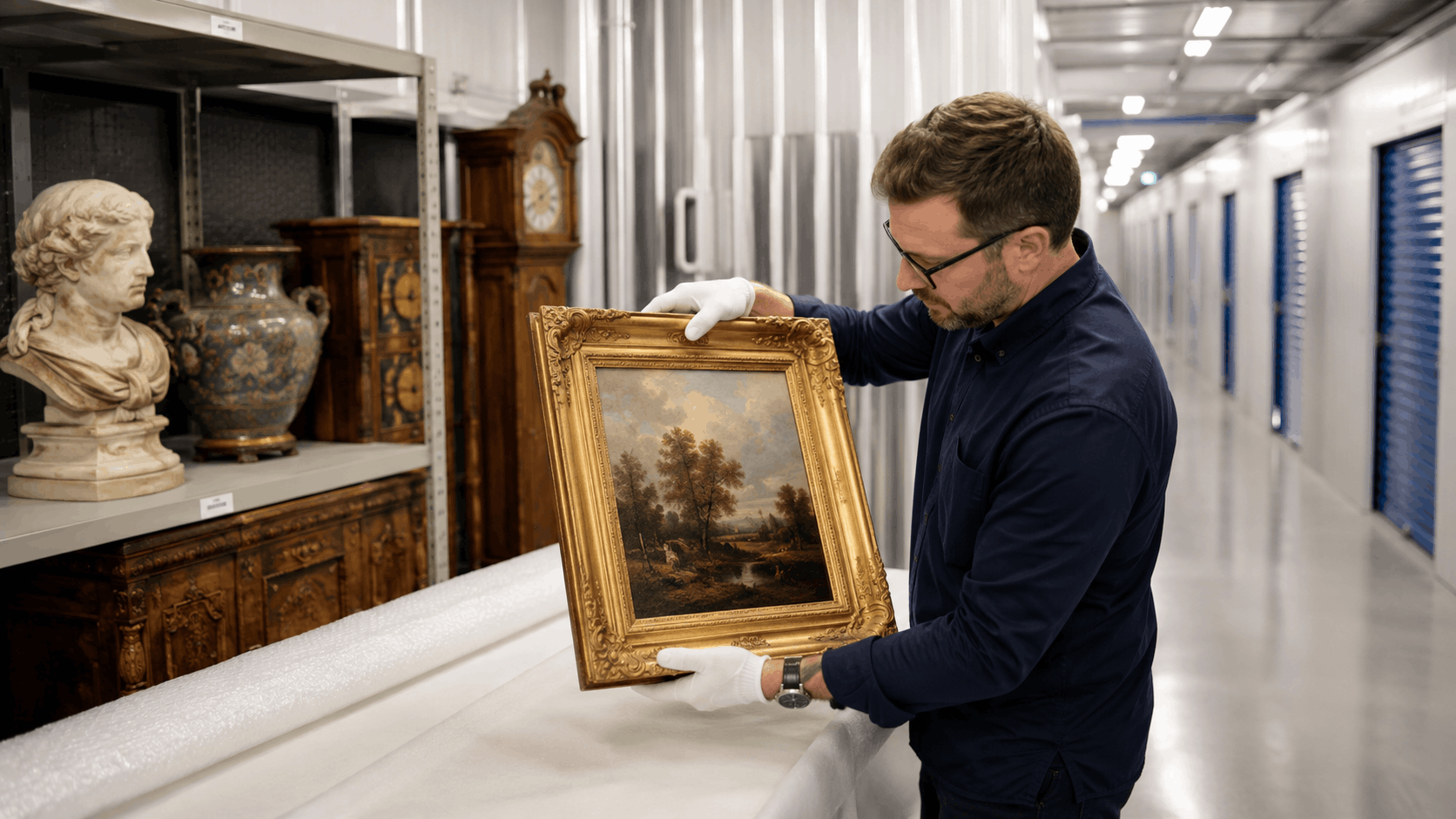
Vaulted storage is not a fancy name for a bigger locker. It uses individual wooden containers, called vaults, that hold your pieces inside a controlled warehouse. Each vault is sealed, padded, and stacked in a monitored building rather than sitting behind a metal roll-up door open to the parking lot.
For fine art storage, that difference matters more than people expect. Standard self-storage exposes items to outside air, temperature changes, and foot traffic. Secure storage in a vaulted system keeps each collection separated, enclosed, and handled only by trained staff.
| Feature | Vaulted Storage | Standard Self-Storage |
|---|---|---|
| Enclosure | Sealed wood vault inside a warehouse | Open unit behind a roll-up door |
| Climate | Controlled and steady | Follows outside temperature |
| Access | Scheduled and staffed | Daily self-access |
| Handling | Trained movers only | Owner handles everything |
| Best for | Art, antiques, delicate items | Boxes and general goods |
Vaulted Storage vs. Standard Self-Storage Units
Think about a wooden storage vault as a private room with walls on every side. Your paintings and furniture go inside, the vault gets closed, and it stays that way until you ask for it. Nothing rubs against a neighbor's boxes and no stranger walks past your things.
A self-storage comparison shows the gap quickly. A roll-up door unit shares air with the whole row, and every time someone opens their door down the hall, dust and outside heat drift in. That constant exchange is fine for a couch you do not care about, but it slowly wears on canvas and old wood.
The vault system also stacks neatly in a warehouse, which keeps items off the ground and away from concrete moisture. We load each vault once, seal it, and it does not get reopened for casual reasons. That single-handling approach cuts down on the bumps and scrapes that happen in a unit you visit weekly.
For a family collection worth more than the storage bill, that added protection pays for itself. One cracked panel or warped tabletop costs far more to restore than the difference between the two options. Our vaulted storage service was built for exactly this kind of piece.
Why Sealed Vaults Reduce Dust and Pest Exposure
Dust is not just a cleaning chore for fine pieces. Fine airborne grit settles into paint texture, carved wood, and rug fibers, and over months it dulls surfaces and holds moisture against the material. A sealed vault blocks most of that airflow, so dust protection starts the moment the vault closes.
Pests are the quieter threat. Moths chew wool rugs and upholstery, silverfish eat paper and canvas sizing, and rodents will nest in anything soft they can reach. Open self-storage units give these visitors plenty of entry points, and once they get in, the damage spreads fast.
Enclosed vaults inside a monitored warehouse give pests far fewer ways in. Good pest control also means the building itself is treated and inspected, not just the individual containers. That layered approach protects the whole collection instead of hoping one item stays lucky.
We see the difference in pieces that come out of vaults versus units. Vaulted items come out clean and stable. Items from open units often need a full cleaning before they are safe to hang or use again.
Access Frequency and How It Affects Delicate Items
Every time a storage door opens, the inside air changes to match the outside. In a unit you visit daily, that means constant temperature and humidity shifts, and delicate items feel every one of them. Vaulted storage uses access control, so the vault stays sealed until you schedule a visit.
Less access also means less handling. Most damage to art and antiques happens when people move them, not when they sit still. Fewer openings means fewer chances to bump a frame, drop a corner, or scrape a veneer.
Climate stability is the other payoff. A vault that stays closed for months holds a steady environment, which is exactly what old wood and layered paint need. Slow and steady beats a room that heats up and cools down every afternoon.
When clients do need something, we pull the vault, let them view or retrieve the piece in a controlled space, and reseal it. That way the collection gets the calm it needs while owners still have real access when they want it.
Get Your Free Quote
Tell us about your move and we'll get back to you fast.
Temperature and Humidity Ranges That Protect Art
Climate controlled storage is where most collections are won or lost. Art and antiques are built from materials that move with heat and moisture, and Los Angeles gives them plenty of both to react to. Getting the temperature range and humidity right keeps those materials calm.
The goal is not a single perfect number. It is a narrow, steady band that does not swing much from day to day or season to season. Below is the range we aim for and why each part matters.
| Condition | Recommended Range | Why It Matters |
|---|---|---|
| Temperature | 65-72°F | Slows aging, prevents expansion and contraction |
| Relative Humidity | 45-55% | Stops drying cracks and mold growth |
| Daily Swing | Under 5% | Reduces material stress and fatigue |
| Air Movement | Gentle and filtered | Prevents stagnant pockets and dust buildup |
The Target Temperature and Humidity Numbers
For most fine art and antiques, a temperature control target of 65 to 72 degrees works well. That range is cool enough to slow the chemical aging of paint, varnish, and paper, but not so cold that condensation becomes a risk. Museums and conservators use similar bands for the same reasons.
Relative humidity should sit between 45 and 55 percent. Below that, wood and canvas dry out and shrink. Above it, mold and corrosion start looking for a home. That middle band keeps materials at a comfortable moisture content.
The American Institute for Conservation publishes guidance along these lines, and it lines up with what we see in the field. You can read more from the American Institute for Conservation on care of collections.
Hitting these numbers takes real equipment and monitoring, not just a thermostat on the wall. We track conditions in our storage space so the band stays where it belongs, even when the weather outside does something dramatic.
How LA Heat Waves and Santa Ana Winds Change the Math
Los Angeles does not have gentle weather for storage. Santa Ana winds push hot, bone-dry air across the region, and humidity can drop into the teens in a matter of hours. That kind of dryness pulls moisture straight out of wood and canvas.
Summer heat waves make it worse. In the San Fernando Valley, storage buildings without real climate control can hit well over 90 degrees inside during a July afternoon. Paint softens, glue lets go, and veneers start to lift.
A standard unit follows those swings almost exactly. A vaulted, climate controlled warehouse holds its band no matter what the wind and sun are doing outside. That is the whole point of controlling the environment instead of just enclosing it.
We plan pickups and deliveries around these conditions too. Moving a painting across the Valley during a heat wave means padded, climate-aware transport, not a bare truck sitting in traffic on the 101.
Why Sudden Swings Cause More Damage Than Steady Heat
Here is the part that surprises people. A stable warm room is often safer than a room that keeps cycling between cool and hot. Humidity swings and temperature swings are what actually break things.
When humidity rises, wood and canvas absorb moisture and expand. When it drops, they release moisture and contract. Do that over and over, and the paint layer, which does not flex the same way, starts cracking along the stress lines.
Joints loosen the same way. A dresser that expands and contracts every day works its glue joints apart over a season, even if nothing ever gets too hot. The cycling is the enemy, not the heat by itself.
That is why we chase stability, not just a low number. A vault holding a steady 70 degrees and 50 percent humidity protects a collection far better than a room that averages the same numbers but bounces around all day.
Coastal Moisture Near Venice and Santa Monica
Owners on the Westside face a different problem than the Valley crowd. The marine layer rolls in off the water most mornings, and coastal humidity near Venice, Marina del Rey, and Santa Monica runs higher than inland areas year round.
That extra moisture feeds mold, mildew, and metal corrosion. Silver tarnishes faster, paper foxes sooner, and upholstery holds damp longer near the coast. A garage in Venice is one of the worst places to keep a canvas.
Salt in the coastal air adds another layer of trouble for metals and frames. It speeds corrosion and leaves a fine residue that is hard to clean off delicate finishes. Enclosed climate control keeps that salty, damp air away from the pieces.
For Westside collectors, moving items into a controlled vault usually solves a problem they did not know they had. Many call us after finding mildew on the back of a frame that lived in a beach-adjacent closet.
Need Help in Los Angeles?
Popeye Moving & Storage serves Los Angeles and all of Los Angeles County.
Light, Air Quality, and Other Hidden Threats
Temperature and humidity get all the attention, but they are not the only enemies. Light, air quality, and even vibration quietly wear on fine pieces. Good art preservation accounts for all of them.
These threats are easy to miss because they work slowly. You do not notice a painting fading day by day, but over a few years the difference is obvious. Here is what to watch for.
UV Light and Why Darkness Matters
Light fades art, and UV light does it fastest. Sunlight and even fluorescent bulbs carry ultraviolet energy that breaks down pigments and dyes over time. Reds, yellows, and delicate paper inks go first.
UV damage is permanent. Once a pigment fades, no cleaning or restoration brings the original color back fully. The only real defense is to keep the light off the piece in the first place.
Vaults handle this by keeping pieces in the dark. A sealed vault gets no sunlight and no room lighting, so fading pigments simply stop fading. Months in a dark vault do nothing to the color, while months in a sunny room would show.
This is why we never recommend storing valuable art in a spare room with windows during a remodel. Even indirect daylight adds up. The dark, controlled vault is the safest place for anything with color you want to keep.
Air Pollutants From LA Traffic and Wildfire Smoke
Los Angeles air carries more than dust. Soot, ozone, and vehicle exhaust drift through neighborhoods near the 405 freeway and the 101, and those air pollutants settle on any surface they reach. Over time they dull varnish and eat at metal and paper.
Wildfire smoke is the bigger seasonal problem. During fire season, fine smoke particles travel for miles and slip into buildings that are not sealed. That smoke leaves an oily film and a smell that clings to textiles and canvas.
A sealed, filtered vault system keeps that outside air out. The warehouse controls what comes in, so smoke and traffic pollution never reach the pieces. That matters most in the late summer and fall when fires flare up across the region.
We have taken in collections during smoke events specifically to get them out of homes filling with haze. Once inside a controlled vault, they are shielded from the particulate that was settling on everything at the house.
Mold and Mildew Risks in Enclosed Spaces
Enclosing a piece the wrong way can trap moisture and grow mold. Wrap a damp canvas in plastic, seal it in a hot unit, and you have built a small greenhouse for mildew. Mold prevention starts with airflow and correct materials.
Mold loves canvas backs, paper edges, and the underside of upholstery. Once it takes hold, it stains permanently and weakens the fibers it feeds on. Persian rugs and tapestries are especially prone when stored damp.
The fix is controlled humidity plus breathable wrapping, not airtight plastic. Pieces need to be dry before storage and kept in that 45 to 55 percent band while they wait. A vault with steady humidity almost never grows mold.
We check items for existing moisture before they go into storage. If something comes from a damp Westside garage, we make sure it is properly dried and wrapped so it does not carry a mold problem into the vault.
Vibration From Nearby Roads and Rail
Vibration is the threat almost nobody thinks about. Storage buildings near busy roads, freeways, or rail lines shake a little all day long. That constant low-level vibration damage works joints and frames loose over months.
For antique furniture, vibration slowly separates glued joints and loosens veneer that was already fragile. For framed art, it can shift the piece in its frame and loosen mounting hardware. The structural stress is small each moment but adds up.
A well-chosen storage location and proper stacking reduce this. Vaults padded and set on stable racking absorb far more vibration than items sitting loose on a concrete floor near a loading dock. Placement inside the warehouse matters.
When we pack and load vaults, we cushion pieces so they do not rattle against anything. That padding does double duty, protecting against both handling shocks and the steady hum of a working building.
How Different Materials React to Storage
Not every antique needs the same care. A silver tea set, an oil painting, and a wool rug all respond to storage conditions in their own way. Good material preservation means knowing how each behaves.
Below is a quick look at how common materials react, followed by the details on each. Knowing this helps you spot which of your pieces are most at risk.
| Material | Main Risk | Best Condition |
|---|---|---|
| Oil paintings | Paint cracking | Stable humidity, dark, vertical |
| Antique wood | Splitting, veneer lift | 45-55% humidity, no dry swings |
| Textiles and rugs | Moths, fading, fiber rot | Clean, dry, pest-controlled |
| Metals and paper | Tarnish, foxing | Low humidity, filtered air |
Oil Paintings and Canvas
Canvas is a living surface in a way. It expands and contracts with humidity, tightening and loosening on its stretcher through the seasons. Canvas storage has to keep that movement to a minimum.
The paint layer is the problem. Dried oil paint is far less flexible than the canvas under it, so when the fabric moves, the paint cannot follow. That mismatch causes paint cracking, and over time those cracks lift and flake.
Steady humidity is the answer. Hold the canvas at a stable moisture content and it stops moving, which means the paint stops cracking. Paintings should also stand vertical, never flat where the surface can sag or press.
We store paintings upright in padded slots inside the vault, separated so nothing touches the painted surface. Combined with darkness and stable climate, that keeps a canvas as calm as it can be while in storage.
Antique Wood Furniture and Veneers
Older Los Angeles estates are full of beautiful antique furniture, and dry air is its worst enemy. When humidity drops, solid wood shrinks and can split along the grain. That is a common sight in pieces that sat through a Santa Ana season unprotected.
Veneers suffer even more. The thin decorative wood is glued to a base, and when the two layers shrink at different rates, the veneer lifts, bubbles, or cracks. Veneer damage on a French cabinet is expensive and slow to repair.
Hide glue, common in older furniture, also fails in the wrong conditions. Too dry and it becomes brittle, too damp and it softens. Holding 45 to 55 percent humidity keeps those old joints intact.
We wrap wood pieces in breathable pads and keep them in a controlled vault where the humidity never crashes. For heavy or delicate items, our packing and crating team builds proper protection before anything moves.
Textiles, Rugs, and Upholstery
Textiles have their own list of enemies. Moths top the list, since their larvae eat wool and silk from the inside of tapestries, rugs, and upholstery. A single infestation can ruin a rug that took years to make.
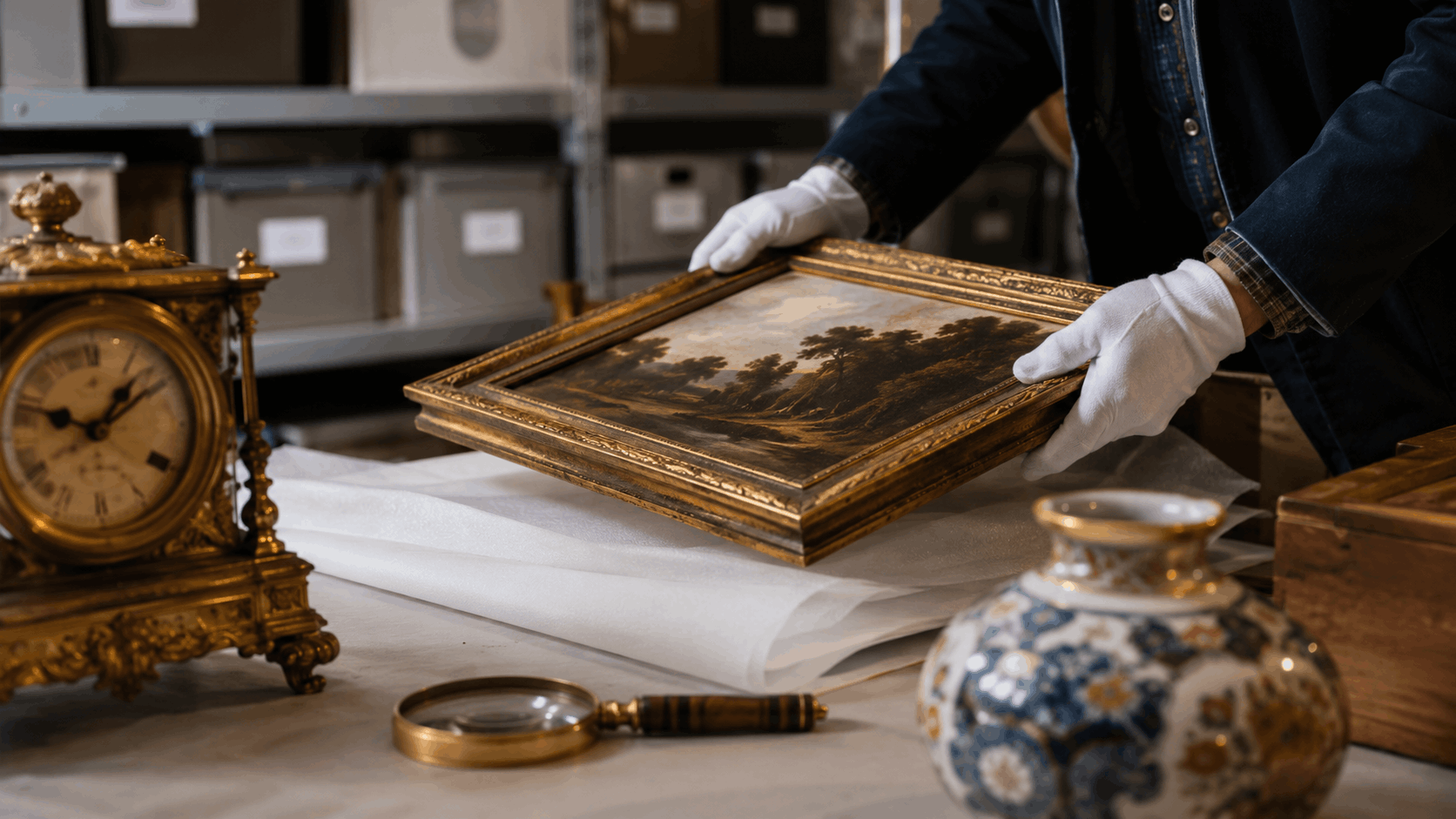
Fading is the next concern. Natural dyes in an antique Persian rug lose their depth under any light, so textile storage means keeping them dark. Rug preservation also means storing them rolled, not folded, so the fibers do not crease and break.
Moisture rounds out the trouble. Damp fibers weaken and rot, and they invite both mold and pests. A clean, dry, pest-controlled vault keeps all three problems at bay.
We clean and inspect textiles before storage, roll rugs on tubes with breathable wrapping, and keep them in a controlled environment. That combination protects both the color and the fibers for the long haul.
Metals, Silver, and Framed Works on Paper
Metals react to moisture and air chemistry. Silver tarnish speeds up in humid, polluted air, and bronze and iron can corrode outright. A stable, low-humidity environment slows tarnish to a crawl.
Works on paper are fragile in a different way. High humidity causes foxing, the small brown spots that spread across old prints, watercolors, and documents. Once foxing sets in, it is hard to reverse.
Paper also needs acid-free contact materials, since ordinary cardboard and wood give off acids that yellow and weaken it. Framed works need to breathe without touching anything that will off-gas onto them.
We store metals with anti-tarnish materials and keep paper works flat or upright in acid-free housing inside the controlled vault. Low humidity and filtered air do most of the work of keeping these pieces stable.
Packing and Preparing Fine Pieces Before Storage
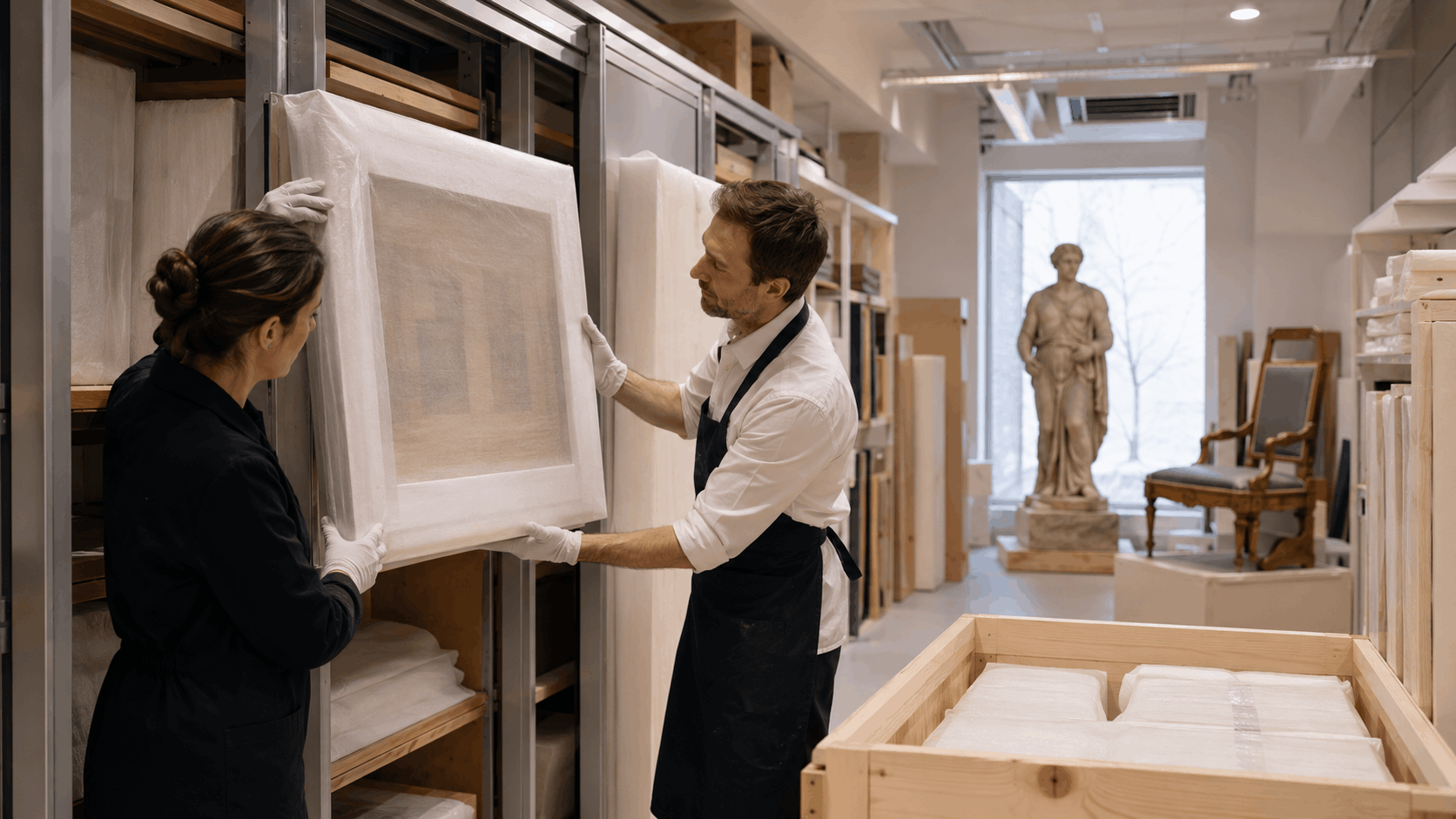
A vault only protects what is already packed correctly. Most damage to art and antiques happens during handling and packing, before a piece ever reaches storage. Good art packing sets the whole job up for success.
The right materials and methods depend on the piece. A marble sculpture, an oil painting, and a set of framed prints each need different treatment. Here is how we prepare pieces for the vault.
Custom Crating for Paintings and Sculpture
Standard boxes work for books, not for a bronze sculpture or a large framed canvas. Custom crating means building a wood crate sized to the exact piece, with internal bracing that holds it still. That precise fit is what prevents movement.
Shock protection comes from the layers inside. Foam, corner blocks, and floating mounts absorb bumps so the piece never takes the hit directly. For a heavy sculpture, the crate also spreads the weight so nothing presses on a weak point.
Crates matter most for transport and long-term storage of high-value items. A crate keeps a painting rigid so the canvas cannot flex, and it protects sharp frame corners from chips. For anything fragile or valuable, it is worth the extra step.
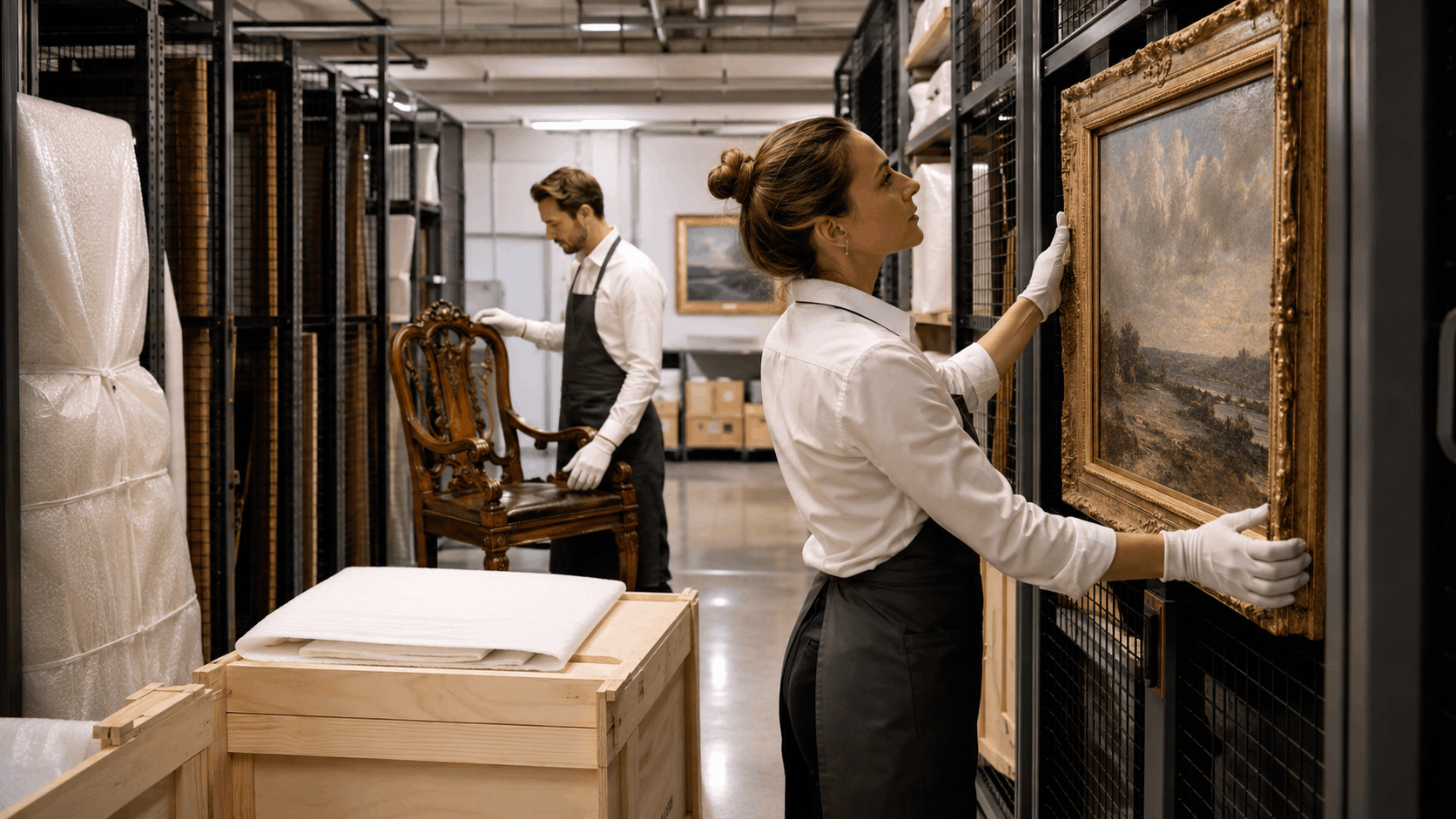
Our team measures each piece and builds crates to fit through our specialty moving service. That way the same protection that guards a piece in transit also guards it in the vault.
Acid-Free Wrapping and Barrier Materials
What touches a piece matters as much as the box around it. Acid-free materials are the standard for anything that will sit in contact for months. Ordinary newspaper and tape can stain and damage delicate surfaces.
Glassine is a favorite for art. It is a smooth, non-stick paper that shields painted surfaces without pulling at them. Paintings, prints, and photographs all take glassine well as a first layer.
Breathable wraps come next. Cotton pads and unbleached muslin let a piece release moisture instead of trapping it, which is the mistake plastic makes. That breathability is what keeps mold from forming under the wrap.
We match the wrapping to the material, glassine and acid-free tissue for art and paper, breathable pads for wood and upholstery. The goal is protection without trapping moisture against the surface.
Documenting Condition and Photographing Pieces
Before anything goes into a vault, it should be documented. A condition report notes existing scratches, cracks, or wear, so there is a clear record of how the piece looked going in. That record protects both the owner and everyone handling it.
Photographs back up the report. We shoot each valuable piece from multiple angles, capturing details and any existing damage. Those images are the reference point if a question ever comes up later.
This paperwork also feeds the inventory. Every documented piece gets logged so the collection can be tracked as a whole. For insurance, that documentation is what makes a claim provable.
Owners of large collections appreciate having this record on hand. It doubles as an estate document and an insurance file, useful well beyond the storage period itself.
How Our Team Handles Pickup Across LA Neighborhoods
Getting pieces from the home to the vault is its own careful job. We pick up from homes in Bel Air, Pasadena, and Silver Lake with padded transport built for delicate items. Each neighborhood brings its own access quirks.
Bel Air estates often have long driveways and tight gates, so we plan the route and equipment before arrival. Pasadena's historic homes near Bungalow Heaven have narrow doorways and original staircases that need slow, careful handling. Silver Lake's hillside streets add parking and slope challenges.
Our trucks carry padding, straps, and climate-aware handling for art transport. Pieces are wrapped and crated at the home, not thrown in loose and sorted later. That means the protection starts the moment we lift the first item.
We know these streets, the traffic patterns, and the timing that keeps a delicate load out of the worst heat and congestion. That local knowledge is part of what keeps pieces safe from door to vault.
Need Help in Los Angeles?
Popeye Moving & Storage serves Los Angeles and all of Los Angeles County.
Insurance, Inventory, and Security for Valuables
Physical protection is only half the picture. A high-value collection also needs the right paperwork and security behind it. Storage insurance, careful inventory, and monitored access round out valuables protection.
These pieces are often worth more than the home they came from. Treating them casually is a costly mistake. Here is how proper protection works.
Valuation and Coverage Options
Coverage starts with knowing what a collection is worth. A current appraisal sets the value for each piece, which matters when you declare value for storage and insurance. Guessing leaves you underinsured when it counts.
Declared value coverage lets you set the amount the storage is insured for. For fine art, a separate fine art rider on a homeowner or specialty policy usually gives broader protection than basic coverage. The two work together.
The California Department of Insurance offers guidance on how personal property and specialty coverage work. You can review consumer resources from the California Department of Insurance before choosing a policy.
We help owners understand valuation options so the coverage matches the collection. Getting an appraisal before storage means the numbers are ready if you ever need to file a claim.
Detailed Inventory Tracking Systems
A collection is only as manageable as its records. Inventory tracking logs every piece that enters storage, with its condition report, photos, and location. Nothing goes into a vault unrecorded.
Item tagging ties each physical piece to its record. A tag or code links the object to its file, so it can be found without opening every vault to look. For a large collection, that saves hours and reduces handling.
The system also tracks movement. If a piece is pulled for a viewing or retrieval, the log notes it. That running record keeps the whole collection accounted for at all times.
Owners can request their inventory whenever they want. It gives a clear picture of what is stored, where, and in what condition, which matters for both peace and planning around a collection.
Facility Security and Monitored Access
A vault protects against climate and dust. Facility security protects against theft. Monitored access, alarms, and cameras keep the building itself secure around the clock.
Controlled entry means not just anyone can walk in. Access is logged, staffed, and limited, so the people near your collection are accounted for. That is a real difference from a self-storage row anyone can drive up to.
Cameras and alarm systems add another layer. They deter problems and create a record if anything ever needs review. For a high-value collection, that oversight is worth having.
Our storage keeps art and antiques behind monitored, controlled access as part of our long-term storage options. Owners know their pieces are watched, not just parked.
Choosing the Right Storage Partner in Los Angeles
Not every mover or storage company handles fine pieces the right way. Choosing a Los Angeles storage partner means asking the right questions and looking for real experience. The wrong choice shows up later as damage.
Good fine art movers do more than lift heavy things. They understand materials, climate, and handling, and they can prove it. Here is how to judge a provider.
Questions to Ask Before You Commit
Start with climate. Ask what temperature and humidity the storage holds and how it is monitored. If the answer is vague or the space is just an insulated warehouse, keep looking.
Ask about handling experience next. A provider should be able to describe how they pack a painting, crate a sculpture, or roll a rug. These storage questions separate real art handlers from general movers.
Access and security matter too. Ask how you retrieve items, how the building is secured, and how the inventory is tracked. Vetting movers on these points tells you whether they treat fine pieces seriously.
Finally, ask about insurance and documentation. A serious partner offers condition reports, valuation help, and clear coverage. If those are missing, the collection is not as protected as it should be.
Local Experience Matters for LA Collectors
Los Angeles is a hard city to move things through. Traffic, hills, narrow historic streets, and long distances all add risk to a delicate load. Local movers who know the ground plan around those problems.
Knowing the routes from Downtown LA to the Valley, or from the Westside to Burbank, means timing a move to avoid the worst heat and congestion. That timing protects pieces from sitting in a hot truck in gridlock.
Neighborhood knowledge matters at the door too. We know which historic homes have tight stairwells, which hillside streets are hard to park, and which gated communities need advance notice. That planning keeps handling smooth.
A local team has also seen the local conditions, the Santa Ana dryness, the marine layer, the fire season smoke. That firsthand experience shapes how we protect and transport each collection.
How Our Vaulted Storage Serves the Area
Popeye Moving serves art and antique owners across greater Los Angeles with vaulted storage services built for delicate pieces. From Los Angeles proper to the surrounding beach and valley communities, we handle collections with the care they need.
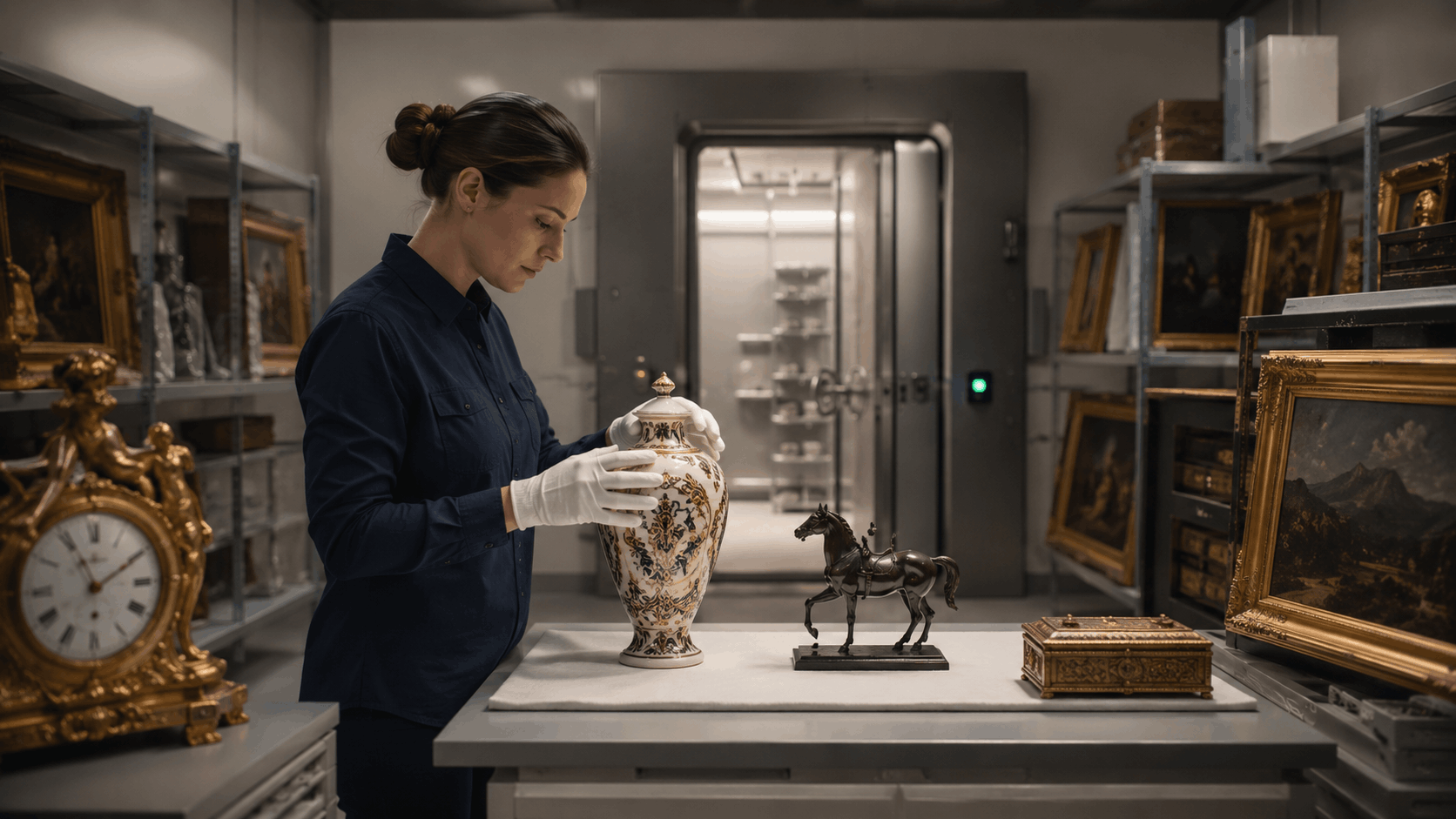
Our antique storage LA service combines climate-controlled vaults, careful packing, and monitored security. Each piece is documented, wrapped correctly, and stored in a stable, dark, sealed vault.
We also handle the full journey, from pickup at the home to placement in the vault and retrieval when you are ready. That single, careful chain of handling is what keeps fine pieces safe.
Whether it is a remodel, a downsizing, or a move, we help collectors across the region protect what matters. Our storage solutions are built around the real conditions these pieces need.
Need Help in Los Angeles?
Popeye Moving & Storage serves Los Angeles and all of Los Angeles County.
Final Thoughts
Fine art and antiques do not need luck to survive storage. They need steady temperature and humidity, darkness, clean air, correct packing, and real security. Vaulted storage gives them all of that in one controlled place.
Los Angeles makes it harder than most cities, between Santa Ana dryness, coastal moisture, heat waves, and fire season smoke. A sealed, climate-controlled vault keeps those conditions away from the pieces you care about.
If you have art, antiques, or family heirlooms that need safe storage, our team is ready to help. Contact Popeye Moving for a consultation, and we will walk you through the right way to protect your collection.
Frequently Asked Questions
What temperature and humidity should art storage stay at?
Fine art and antiques do best at 65 to 72 degrees with relative humidity between 45 and 55 percent. Those numbers slow aging, stop wood and canvas from drying out, and keep mold from forming. Steady conditions matter more than the exact number, since repeated swings cause cracking and warping. A vault that holds a stable band protects a collection far better than a room that changes all day.
Is vaulted storage better than a regular self-storage unit for antiques?
Yes, for fine pieces the difference is large. Vaulted storage seals each collection in a padded wood vault inside a climate-controlled, monitored warehouse. A regular self-storage unit follows outside temperature, shares air with the whole row, and invites dust and pests. For anything delicate, valuable, or irreplaceable, the enclosed, controlled vault gives protection a standard unit cannot match. General household goods are fine in a unit, but art and antiques are not.
How much does fine art and antique storage cost in Los Angeles?
Costs vary with the size of the collection, the level of climate control, packing needs, and how long you store. Vaulted, climate-controlled storage generally runs more than a basic self-storage unit because of the added protection and handling. Custom crating, appraisal, and insurance add to the total. The best way to get an accurate figure is a consultation where we assess the pieces and give a clear quote for your specific collection.
Can I access my stored pieces whenever I want?
Vaulted storage uses scheduled access rather than daily self-entry, which is part of what protects your pieces. You contact us to arrange a visit, and we pull the vault so you can view or retrieve items in a controlled space. This keeps the vault sealed and the climate steady between visits. It is a small trade-off that greatly reduces handling risk and temperature swings for delicate items.
How should paintings be wrapped for long-term storage?
Paintings should first be covered with glassine or acid-free tissue to shield the painted surface without sticking. Over that, use breathable materials like cotton pads or muslin, never plastic, which traps moisture and grows mold. For long-term storage, a custom crate keeps the canvas rigid and protects the frame corners. Store paintings upright, never flat, and keep them in a dark, climate-controlled vault to prevent fading and cracking.
Will LA humidity or wildfire smoke reach items in storage?
Not in a sealed, climate-controlled vault. The whole point of the system is to block outside conditions, so marine layer moisture from the Westside, Santa Ana dryness, and wildfire smoke stay out. The warehouse controls temperature, humidity, and filtered air, and each vault is enclosed. Items stored in an open self-storage unit or a home garage are exposed, but a proper vault keeps those outside threats away from your pieces.
Do I need special insurance for high-value collections?
High-value art and antiques usually need coverage beyond basic storage protection. A current appraisal sets the value, and a fine art rider on a homeowner or specialty policy gives broader protection than standard coverage. Declared value on the storage adds another layer. We help owners understand valuation and coverage options so the numbers match the collection. Documenting condition and photos before storage makes any future claim far easier to prove.
How do you protect antique wood from cracking in dry weather?
Dry air, especially during Santa Ana winds, pulls moisture from wood and causes splitting and veneer lift. We protect wood by keeping it in a vault held at 45 to 55 percent humidity, so it never dries out and cycles. Pieces are wrapped in breathable pads rather than plastic, and delicate items are crated. Holding steady humidity keeps old hide glue and joints intact, which is what prevents the cracking dry weather causes.
Can you pick up items from my home across Los Angeles?
Yes, we pick up from homes across greater Los Angeles, including Bel Air, Pasadena, Silver Lake, the Westside, and the Valley. Our team wraps and crates pieces at the home, then moves them with padded, climate-aware transport built for delicate items. We plan routes and timing around traffic and heat, and we know the access quirks of historic and hillside neighborhoods. The protection starts the moment we lift the first piece.
How long can fine pieces safely stay in vaulted storage?
With proper conditions, fine pieces can stay in vaulted storage for years without harm. Stable temperature and humidity, darkness, clean air, and correct packing keep materials calm no matter how long they wait. Long-term storage is safe precisely because the environment never swings. We monitor conditions and can inspect items periodically for owners storing collections over extended periods, so pieces come out in the same shape they went in.
Frequently Asked Questions
- What temperature and humidity should art storage stay at?
- Fine art and antiques do best at 65 to 72 degrees with relative humidity between 45 and 55 percent. Those numbers slow aging, stop wood and canvas from drying out, and keep mold from forming. Steady conditions matter more than the exact number, since repeated swings cause cracking and warping. A vault that holds a stable band protects a collection far better than a room that changes all day.
- Is vaulted storage better than a regular self-storage unit for antiques?
- Yes, for fine pieces the difference is large. Vaulted storage seals each collection in a padded wood vault inside a climate-controlled, monitored warehouse. A regular self-storage unit follows outside temperature, shares air with the whole row, and invites dust and pests. For anything delicate, valuable, or irreplaceable, the enclosed, controlled vault gives protection a standard unit cannot match. General household goods are fine in a unit, but art and antiques are not.
- How much does fine art and antique storage cost in Los Angeles?
- Costs vary with the size of the collection, the level of climate control, packing needs, and how long you store. Vaulted, climate-controlled storage generally runs more than a basic self-storage unit because of the added protection and handling. Custom crating, appraisal, and insurance add to the total. The best way to get an accurate figure is a consultation where we assess the pieces and give a clear quote for your specific collection.
- Can I access my stored pieces whenever I want?
- Vaulted storage uses scheduled access rather than daily self-entry, which is part of what protects your pieces. You contact us to arrange a visit, and we pull the vault so you can view or retrieve items in a controlled space. This keeps the vault sealed and the climate steady between visits. It is a small trade-off that greatly reduces handling risk and temperature swings for delicate items.
- How should paintings be wrapped for long-term storage?
- Paintings should first be covered with glassine or acid-free tissue to shield the painted surface without sticking. Over that, use breathable materials like cotton pads or muslin, never plastic, which traps moisture and grows mold. For long-term storage, a custom crate keeps the canvas rigid and protects the frame corners. Store paintings upright, never flat, and keep them in a dark, climate-controlled vault to prevent fading and cracking.
- Will LA humidity or wildfire smoke reach items in storage?
- Not in a sealed, climate-controlled vault. The whole point of the system is to block outside conditions, so marine layer moisture from the Westside, Santa Ana dryness, and wildfire smoke stay out. The warehouse controls temperature, humidity, and filtered air, and each vault is enclosed. Items stored in an open self-storage unit or a home garage are exposed, but a proper vault keeps those outside threats away from your pieces.
- Do I need special insurance for high-value collections?
- High-value art and antiques usually need coverage beyond basic storage protection. A current appraisal sets the value, and a fine art rider on a homeowner or specialty policy gives broader protection than standard coverage. Declared value on the storage adds another layer. We help owners understand valuation and coverage options so the numbers match the collection. Documenting condition and photos before storage makes any future claim far easier to prove.
- How do you protect antique wood from cracking in dry weather?
- Dry air, especially during Santa Ana winds, pulls moisture from wood and causes splitting and veneer lift. We protect wood by keeping it in a vault held at 45 to 55 percent humidity, so it never dries out and cycles. Pieces are wrapped in breathable pads rather than plastic, and delicate items are crated. Holding steady humidity keeps old hide glue and joints intact, which is what prevents the cracking dry weather causes.
- Can you pick up items from my home across Los Angeles?
- Yes, we pick up from homes across greater Los Angeles, including Bel Air, Pasadena, Silver Lake, the Westside, and the Valley. Our team wraps and crates pieces at the home, then moves them with padded, climate-aware transport built for delicate items. We plan routes and timing around traffic and heat, and we know the access quirks of historic and hillside neighborhoods. The protection starts the moment we lift the first piece.
- How long can fine pieces safely stay in vaulted storage?
- With proper conditions, fine pieces can stay in vaulted storage for years without harm. Stable temperature and humidity, darkness, clean air, and correct packing keep materials calm no matter how long they wait. Long-term storage is safe precisely because the environment never swings. We monitor conditions and can inspect items periodically for owners storing collections over extended periods, so pieces come out in the same shape they went in.
P
Popeye Moving & Storage Co. Team Team
Licensed moving and storage professionals serving Los Angeles and Los Angeles County.
Licensed in California · License #PUC: CAL T 189749 | DOT: 1472924 | MC: 498816C
Why trust Popeye Moving & Storage?
Founded in 1994, Popeye Moving & Storage is a licensed and insured moving and storage service serving Los Angeles and Los Angeles County. All content is reviewed by our licensed technicians.

Need Help in Los Angeles?
Popeye Moving & Storage serves Los Angeles and all of Los Angeles County.
Related Articles
Tips & Advice
Storage Near the 405 in West LA: What's Actually Available and Why a Mover-Run Warehouse Beats the Roll-Up Units
A clear guide to storage near the 405 in West LA, comparing roll-up self-storage units with a mover-run warehouse on cost, safety, and hassle for local movers.
Tips & Advice
Storage for Santa Monica and Brentwood Households: Where Westside Furniture Actually Goes Between Homes
A local guide to furniture storage for Santa Monica and Brentwood households, covering storage types, costs, coastal climate risks, and how Westside families bridge the gap between homes.
Cost Guides
What Vaulted Storage Billing Includes - Wrapping, Inventory, and the Line Items Self-Storage Never Shows
A clear breakdown of what vaulted storage billing includes - wrapping, inventory, handling, and coverage - and why self-storage quotes never show these line items upfront.