What Vaulted Storage Billing Includes - Wrapping, Inventory, and the Line Items Self-Storage Never Shows
Key Takeaways
- Vaulted storage stores belongings in sealed wooden crates stacked in a warehouse, unlike open drive-up metal self-storage units.
- Wrapping charges cover furniture pads, shrink wrap, custom crating, disassembly, and appliance prep that self-storage leaves to the customer.
- A numbered inventory sheet with condition codes protects you against loss claims and disputes over pre-existing damage.
- Handling fees pay for warehouse labor moving vaults in and out, plus retrieval fees for mid-storage access by appointment.
- Released value coverage is minimal and free, while full replacement valuation pays real value and appears as a separate premium line.
- A vaulted storage bill separates one-time setup costs from recurring monthly rent, plus mileage and delivery zone fees.
- Homeowner and renter policies often cap or exclude off-site storage, so valuation coverage fills the gap.
- Popeye Moving & Storage provides flat quotes with every line explained upfront for LA neighborhoods from Westwood to Highland Park.
In This Article
A family in Culver City recently pulled up two quotes side by side. One was a drive-up self-storage unit off La Cienega, listed at a clean monthly rate. The other was a vaulted storage quote from a moving company, and it looked more expensive at first glance. They called us confused, asking why the numbers looked so different for what they assumed was the same thing.
The short answer is that they were not comparing the same thing at all. A self-storage price sheet shows one number, the rent for an empty metal box. A vaulted storage quote bundles in wrapping, professional inventory, warehouse labor, and coverage that a self-storage company simply never puts on paper because the customer does all that work themselves.

What Vaulted Storage Actually Means?
Most people picture a garage-style unit with a roll-up door when they hear the word storage. Vaulted storage works nothing like that. Your belongings sit inside a wooden container, sealed and stacked inside a warehouse, and you never touch the box yourself.
The difference matters because it changes who does the labor and how your items are protected. With warehouse storage, trained crews wrap, load, and stack everything. With a metal unit, you are the crew, the packer, and the loader all at once.
| Feature | Vaulted Storage | Self-Storage Unit |
|---|---|---|
| Container | Sealed wooden vault | Open metal room |
| Labor | Done by movers | Done by you |
| Access | By appointment | Drive-up anytime |
| Dust exposure | Sealed out | Common |
| Wrapping | Included in service | Your responsibility |
How a Storage Vault Is Built and Sealed
A storage vault is a crate built from plywood and lumber, usually around 5 feet by 7 feet by 7 feet tall. That size holds roughly one to one and a half rooms of furniture and boxes. The wooden vault has a solid floor, four walls, and a lid that closes over the top.
Our crews pad and wrap each item before it goes inside. Sofas get blankets, dressers get shrink wrap, and boxes get stacked so nothing shifts during handling. The goal is a snug fit where furniture cannot slide or rub against itself.
Once the vault is packed, the lid goes on and the crate becomes a sealed crate. That seal keeps out dust, keeps items from being disturbed, and lets the vault be stacked safely with others. For long-term holding, that sealed condition is what protects your things month after month.
Because the vault is a fixed container, we know exactly how much space your belongings take. That count of vaults feeds directly into your monthly rate, which we explain later in the billing section.
Vaulted Storage vs. a Drive-Up Self-Storage Unit
Drive up to any of the storage rows along La Cienega or Sepulveda and you will see the self-storage model. You rent an empty metal room, you back your car up, and you unload your own boxes. A self-storage unit gives you drive-up access whenever the gate is open, which some people love.
The tradeoff is exposure and effort. Those metal units heat up in summer, collect dust through the door gaps, and leave your furniture unwrapped unless you buy and apply materials yourself. Nobody inspects your load or notes its condition.
Vaulted storage flips that. You give up daily walk-in access in exchange for professional handling, sealed protection, and a full inventory. Items are wrapped, logged, and stacked by people who move furniture every day.
Neither model is wrong. A self-storage unit fits someone who needs frequent access to a few items. A vault fits someone storing a full home who wants it protected and does not plan to visit weekly.
Why LA Movers Use Vaults Instead of Open Shelving
Open shelving in a warehouse sounds simple, but it wastes space and exposes belongings. Sealed vaults let us stack furniture vertically, three high in many cases, without crushing anything. Stacked vaults use warehouse height that open shelves cannot.
The climate here makes the case even stronger. Los Angeles gets warm, dry stretches and Santa Ana wind events that push fine dust everywhere. An open shelf lets that dust settle on every surface, while a sealed vault keeps it out.
There is also a security angle. Each vault is closed and logged, so items are not sitting exposed on a shelf where anything could bump them. The vault becomes its own small locked room inside the larger building.
For anyone comparing options, our vaulted storage service page lays out how the system works in practice across the LA area.
Get Your Free Quote
Tell us about your move. We'll be in touch soon.
The Wrapping and Prep Charges People Miss
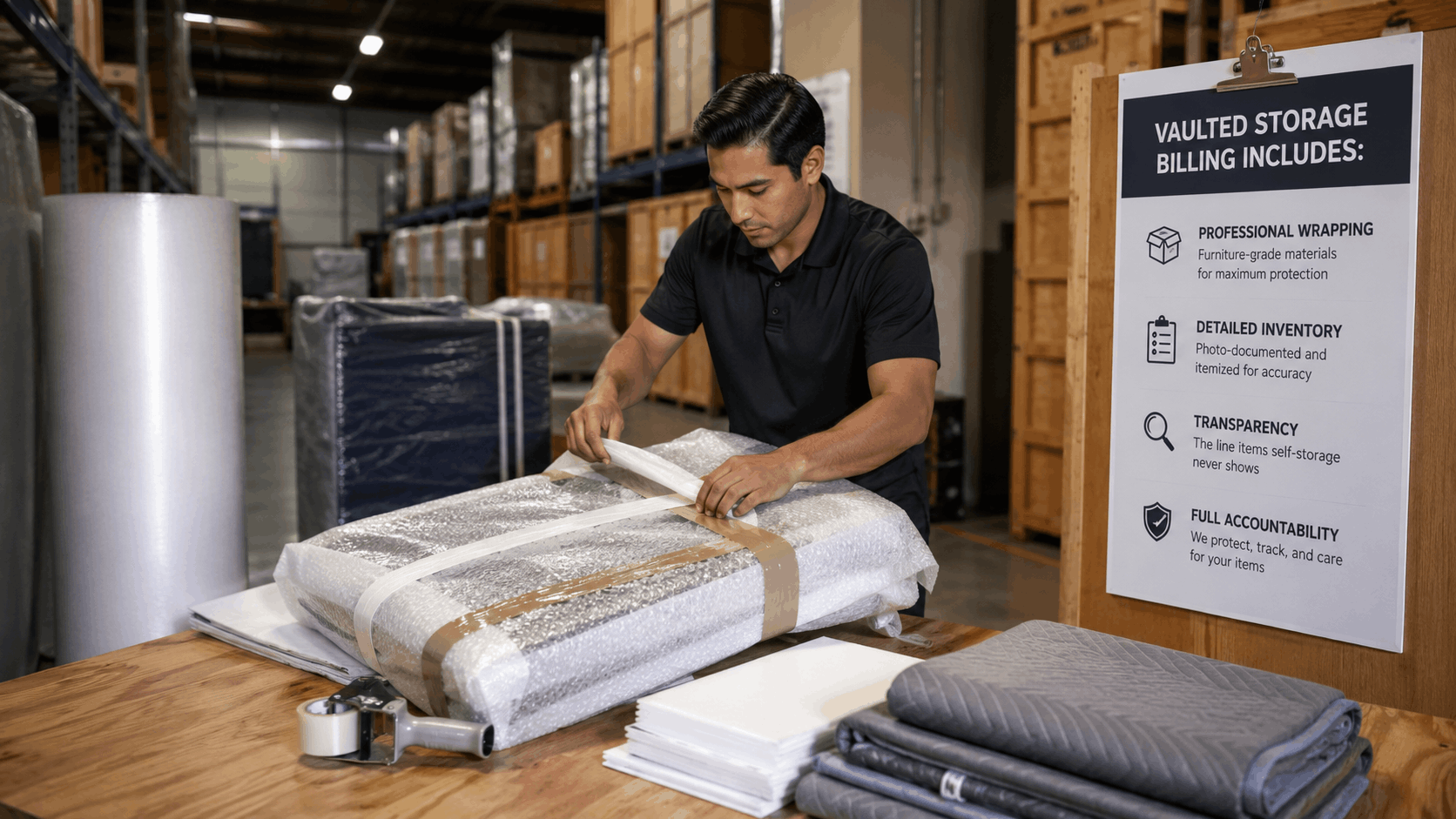
Here is where the two quotes start to separate. A self-storage price sheet shows rent and nothing else. A vaulted quote includes wrapping charges because a crew physically protects every piece before it goes in the vault.
These prep costs are real work with real materials. Furniture protection and packing materials add up, but they also prevent the scratches and dents that self-storage customers often discover months later.
Furniture Pads, Shrink Wrap, and Blankets
The first layer of protection is padding. Our crews wrap sofas, dressers, and tables in quilted furniture pads before anything else touches them. These moving blankets cushion corners and stop surfaces from rubbing.
Over the pads, we apply shrink wrap to hold everything tight and keep drawers and doors closed. Shrink wrap also locks the blankets in place so they do not slide off during stacking. A typical dresser might use a pad and a full roll of wrap.
On a bill, these materials show up as a wrapping or prep line, often a few dollars per pad and per roll of wrap. For a full home, materials and labor together might land in the low hundreds. That number covers what a self-storage customer would otherwise buy and apply on their own.
The value is not just the material, it is the trained wrapping. A pad applied correctly protects a corner far better than one thrown loosely over a table.
Custom Crating for Mirrors, Art, and Glass
Some items need more than a blanket. Large mirrors, framed art, glass tabletops, and marble pieces call for custom crating. Our team builds a wooden box sized to the piece so it cannot flex or crack.
Older homes near Hancock Park and Windsor Square often hold antique mirrors and oversized art that predate standard box sizes. Those fragile items do not fit a stock carton, so a custom crate is the safe option. We measure the piece, build the crate, and pad the inside.
Custom crating is a separate line item because it involves lumber, labor, and time. A single large crate might run anywhere from 75 to several hundred dollars depending on size and complexity. Our packing and crating team handles these builds in house.
Self-storage never offers this. If a customer stores a glass tabletop in a metal unit, they wrap it themselves and hope for the best. A crate removes that gamble.
Disassembly and Reassembly Labor
Beds, sectional sofas, shelving units, and dining tables often come apart for storage. Taking them down saves vault space and lowers the chance of damage. That disassembly is a labor line on the bill.
Our crews bag and label the hardware so nothing gets lost. A bed frame's bolts stay with that bed, taped to a rail or bagged and numbered against the inventory. When furniture goes back together, every piece is accounted for.
At delivery, reassembly labor puts everything back the way it was. The bed gets built, the shelving goes back up, and the dining table legs reattach. This labor is billed by time and shows separately from the storage rent.
Self-storage customers do all of this themselves, usually twice, once going in and once coming out. With a vault, the crew handles it and logs the parts so reassembly is smooth and correct.
Mattress Bags and Appliance Prep
Small charges matter too. A mattress bag is a heavy plastic cover that keeps a mattress clean and dry inside the vault. These run only a few dollars each but make a real difference over months of storage.
Appliances need prep before storage. Appliance prep means draining and drying a washer so no water sits inside, and defrosting and airing out a refrigerator so it does not grow mildew. A sealed fridge with moisture inside turns into a problem.
These items appear as their own small lines, often a handful of dollars for a bag and a modest labor charge for appliance prep. They are easy to overlook on a quote, but they protect items that are expensive to replace.
A self-storage customer who forgets to defrost a fridge before storing it learns this lesson the hard way. The prep step is cheap insurance against a ruined appliance.
Need Help in Los Angeles?
Popeye Moving & Storage serves Los Angeles and all of Los Angeles County.
Inventory Line Items and Why They Matter
When a full home goes into vaults, we build a storage inventory. Every item is counted, tagged, and noted. This record protects both the customer and us, and it drives part of the billing.
The inventory sheet and condition report are documents self-storage never creates. In a metal unit, nobody knows what is inside or what shape it was in. With a vault, there is a written record from day one.
| Inventory Element | What It Records | Why It Helps |
|---|---|---|
| Item number | Unique tag per piece | Nothing gets lost |
| Description | What the item is | Clear identification |
| Condition code | Existing wear or damage | Prevents disputes |
| Vault number | Which crate holds it | Simple retrieval |
The Numbered Inventory List Explained
Each item gets a number when it is loaded. A sticker or tag goes on the piece, and that same number goes on the numbered inventory sheet. Item 42 might be a walnut dresser, item 43 a matching nightstand.
Those item tags stay on through storage and come off at delivery. When your things come back, we check each number against the list. If the sheet says 118 items went in, 118 items come out.
This record is the customer's protection. If something is ever missing, the inventory proves it existed and was received into storage. Without that list, a claim comes down to memory, which never holds up well.
The inventory also speeds up any partial retrieval. If you need item 42 mid-storage, we know exactly which vault holds it instead of opening everything.
Condition Codes and Pre-Existing Damage Notes
As items are logged, our crew notes their condition using shorthand condition codes. A code might mark a scratch, a chip, a stain, or worn upholstery. These notes go on the sheet next to each item number.
The point is honesty on both sides. If a dresser already had a scratched leg, we note it as pre-existing damage before it ever enters the vault. That way nobody argues later about who caused it.
Customers should read these codes at loading and speak up if anything looks off. It is far easier to correct a note in the driveway than to dispute it at delivery. The condition report is a shared document, not something hidden from you.
This same practice appears in professional moving standards nationwide. The Federal Motor Carrier Safety Administration encourages written inventories and condition records to protect both parties on any household move.
How Inventory Feeds Into Your Storage Bill
The inventory does more than protect you, it sets part of the price. The number of vaults your home fills determines the monthly storage rate. Three vaults cost more per month than two.
The vault count comes straight from how items are packed and stacked. A skilled crew fits belongings efficiently so you are not paying for empty space. Loose packing wastes a vault, and a wasted vault is real money over a year.
Handling fees also tie back to the inventory. Moving more vaults in and out means more labor, so the item and vault counts shape those charges too. When we quote storage, the vault count is the anchor number.
For extended holds, our long-term storage option keeps that monthly rate steady and predictable across many months.
Handling and Access Fees Self-Storage Hides
Self-storage avoids handling fees by making you do the handling. You carry your own boxes, so there is no labor to bill. Vaulted storage includes warehouse labor, and that shows up as handling and access lines.
These are not hidden in a sneaky way, they are simply charges for work self-storage never performs. Once you see what the handling fee and access fee pay for, the difference in quotes makes sense.
| Fee Type | When It Applies | Typical Range |
|---|---|---|
| Handling in | Loading vaults into warehouse | Per vault |
| Handling out | Pulling vaults for delivery | Per vault |
| Vault access | Mid-storage retrieval | Per appointment |
| Redelivery | Return to your home | By distance and volume |
Warehouse Handling In and Out Charges
When your vaults arrive at the warehouse, crews unload them from the truck and stack them in place. That labor is the handling in charge. It covers the physical work of getting sealed vaults into their storage slot.
At the end of storage, the reverse happens. Crews pull your vaults from the stack and load them for delivery, which is the handling out charge. Both are usually billed per vault, so two vaults cost less to handle than four.
These charges exist because moving a loaded vault takes equipment and people. A vault packed with furniture is heavy, and stacking it three high safely takes a forklift and a trained operator. Self-storage skips this entirely because you wheel your own boxes in.
Knowing these are per-vault helps you plan. Efficient packing that keeps your vault count down lowers both handling and monthly rent at the same time.
Pulling a Vault for Mid-Storage Access
Sometimes you need something while your belongings are still in storage. Maybe it is a seasonal item or a document you forgot. Getting to it means a vault access appointment.
Because vaults are stacked and sealed, a crew has to pull yours down and open it in a staging area. That work is billed as a retrieval fee. It is not a penalty, it is the labor to reach a sealed crate buried in a stack.
This is the tradeoff versus drive-up self-storage, where you walk in and grab what you want. With a vault, access takes an appointment and a small fee. Most vault customers plan around this since they are storing a full home, not a working closet.
Our advice is to keep frequently needed items out of the vault in the first place. Tell us at loading and we can flag those items so they stay accessible.
Redelivery and Final Move-Out Costs
When storage ends, your belongings come back to a home. The redelivery fee covers the truck, the crew, and the drive to your address. Delivering to Silver Lake looks different from delivering to Sherman Oaks because of distance and access.
The move-out also includes unloading, unwrapping, and often reassembly of the furniture we took apart. That is a full crew doing the reverse of the move-in. It is billed by volume and time, not as a flat mystery number.
Neighborhood matters for this line. A hillside home in Silver Lake with a narrow street and stairs takes longer than a flat driveway in the Valley. We factor those real conditions into the redelivery estimate.
For customers combining storage with a move, our local residential moving team coordinates delivery so storage and move-in happen in one smooth handoff.

Need Help in Los Angeles?
Popeye Moving & Storage serves Los Angeles and all of Los Angeles County.
Insurance and Valuation Coverage Options
Coverage is where many people misread their real risk. A vaulted storage bill includes a valuation line, and understanding it prevents an expensive surprise. Storage insurance and valuation coverage are not the same as your home policy.
The basic option is released value, which is minimal and free. The stronger option is full replacement, which costs more but pays real value. Knowing the difference lets you choose on purpose.
Released Value vs. Full Replacement Coverage
Every regulated mover includes released value protection at no charge. It pays a set amount per pound per item, commonly around 60 cents per pound. That means a heavy but cheap item pays out more than a light valuable one.
A 30-pound flat-screen television under released value might pay about 18 dollars if damaged. That is clearly not enough to replace it. Released value is the legal minimum, not real protection for valuables.
Full replacement coverage is the paid upgrade. Under it, a damaged item is repaired or replaced at current value, not paid by weight. This shows as a valuation line on your bill, priced by the total declared value of your goods.
The federal guidance on these two options is explained clearly by the FMCSA valuation resource. We walk every customer through both before storage begins.
What Your Homeowner or Renter Policy Does Not Cover
Many people assume their home policy follows their stuff into storage. Often it does not, or it covers far less than expected. A renter policy in particular may exclude items kept off the rented premises.
Even homeowner policies frequently limit off-site coverage to a small percentage of the total, and they may exclude certain causes of loss in a warehouse. Reading the fine print before storage saves grief later. Call your agent and ask specifically about goods stored in a commercial warehouse.
The gap is real. Someone storing a full home worth tens of thousands of dollars may find their policy caps off-site items at a few thousand. That gap is exactly what valuation coverage fills during the storage period.
We recommend confirming your policy limits and then choosing valuation to cover whatever your home insurance leaves out. It is a short conversation that prevents a large loss.
High-Value Item Declarations
Some belongings carry outsized value: jewelry, fine art, electronics, and collectibles. These high-value items usually need a separate declaration on the storage paperwork. Listing them sets their declared value so coverage actually applies.
Without a declaration, a valuable piece may be treated at a default limit far below its worth. Declaring a collection of watches or a piece of original art puts its real value on record. That declaration affects the valuation premium line, since higher value means more coverage.
Our team asks about these items at the estimate stage. It is far better to declare a valuable early than to discover a coverage gap after a loss. Photos and appraisals help set an accurate declared value.
For truly irreplaceable pieces, we also recommend our specialty moving handling, which adds an extra layer of care to fragile and high-value goods.
Reading a Vaulted Storage Bill Line by Line
Once you know the parts, a storage bill stops looking mysterious. A clear billing statement separates one-time work from monthly rent and spells out delivery costs. The so-called hidden fees are usually just charges nobody explained.
We believe in laying every line out before you sign. Here is how to read the statement so you know exactly what you are paying for.
One-Time Charges vs. Recurring Monthly Charges
The first thing to spot is which charges happen once and which repeat. Wrapping, crating, disassembly, and handling in are one-time charge items tied to getting your goods into storage. You pay them at the start.
The monthly rent is the recurring line. It is based on your vault count and repeats every billing cycle until you move out. Mixing these two up is what makes some people think vaulted storage is more expensive month to month than it really is.
A clean statement groups them plainly. One section for setup costs, one line for monthly rent, and a separate section for delivery at the end. When you read a quote, ask which numbers are one-time so you know the true ongoing cost.
Over a year of storage, the one-time setup often becomes a small share of the total. The monthly rent is what you live with, so focus there when comparing options.
Fuel, Mileage, and Delivery Zone Fees
Delivery back to your home carries its own costs. A mileage fee reflects the distance from our warehouse to your address. Delivering to Venice on the Westside differs from delivering to Pasadena on the far side of the basin.
Many movers use a delivery zone map to keep this fair and predictable. Closer neighborhoods fall in a lower zone, farther ones in a higher zone. Fuel and time both climb with distance, so the zone captures that in one clear line.
Access conditions can adjust it too. A long carry from the truck, stairs, or a tight street may add time. We prefer to note these upfront so the delivery bill matches what you were quoted.
Asking about your delivery zone at the start prevents surprises at the end. We map your address to a zone during the estimate so the number is set early.
Questions to Ask Before You Sign a Storage Contract
Before signing any storage contract, ask direct questions that surface every cost. A good provider answers all of them without hesitation. Vague answers are a warning sign of hidden costs down the road.
Ask these: What are the one-time charges versus the monthly rent? What does access mid-storage cost and how much notice is needed? What is the redelivery fee to my specific neighborhood? What valuation coverage is included and what does the upgrade cost?
Also ask about rate increases and minimum terms. Some contracts raise rent after a period or require a minimum number of months. Knowing this before signing lets you compare offers honestly.
Finally, ask for the inventory and condition process in writing. A provider who documents your goods properly is one who takes your belongings seriously. If you want to talk through these questions with us, our contact page is the fastest way to reach the team.

Need Help in Los Angeles?
Popeye Moving & Storage serves Los Angeles and all of Los Angeles County.
How Popeye Moving & Storage Handles Vaulted Storage in Los Angeles
At Popeye Moving Storage, we built our Los Angeles storage service around one idea: no surprises. Every charge is explained before your belongings leave your home. That commitment to transparent billing is what sets a vault quote apart from a mystery price sheet.
Our crews wrap, inventory, and stack your goods, then hand you a clear statement of what each line means. Here is how that works across the neighborhoods we serve.
| What We Handle | How We Do It |
|---|---|
| Wrapping and prep | Pads, shrink wrap, and crating by trained crews |
| Inventory | Numbered list with condition codes |
| Storage | Sealed vaults stacked in a secure warehouse |
| Billing | Flat quote with every line explained upfront |
Serving Neighborhoods From Westwood to Highland Park
We know these streets because we drive them every week. From Westwood near the UCLA campus to Highland Park along York Boulevard, our crews know the parking, the hills, and the tight turns. That knowledge keeps move-in and delivery smooth.
On the Westside we regularly serve Brentwood and the surrounding canyons, where narrow drives call for careful planning. Across town we handle homes near Eagle Rock and Mount Washington where steep streets test any crew.
Because we work these areas constantly, our delivery zone estimates are accurate. We are not guessing at drive times, we know them from experience. That accuracy shows up as a fair, predictable delivery line on your bill.
Wherever you are in the LA basin, our Los Angeles service area page shows the neighborhoods we cover for storage and moving.
Climate and Dust Protection for LA Storage
LA weather is hard on stored belongings if they are exposed. When Santa Ana winds kick up, fine dust travels everywhere and settles into every gap. An open metal unit lets that dust coat furniture over months.
Our sealed vaults give real dust protection. Once the lid is on and the crate is sealed, wind-blown grit cannot reach your things. That matters during dry autumn stretches when the winds run for days.
Heat is the other factor. Metal units can bake in summer, which is rough on wood, leather, and electronics. A vault inside our warehouse stays out of direct sun and extreme swings, which keeps furniture stable over long holds.
For anyone who has stored items in an open unit and pulled out dusty, sun-worn pieces, the sealed vault is a clear improvement. It is protection built for this climate specifically.
Flat Quotes and No Surprise Line Items
We give a flat quote that lists every charge before storage begins. Wrapping, crating, handling, monthly rent, and redelivery are all laid out. You see the one-time costs and the recurring rent separately, so nothing sneaks up later.
Our promise of no surprise fees means the number we quote is the number you plan around. If access or delivery conditions change, we tell you before we bill you. That upfront honesty is the whole point of choosing a professional over a guessing game.
We also explain your valuation options plainly so you choose coverage that fits. No pressure, just a clear picture of what each choice pays out. Customers store with more confidence when they understand every line.
If you are weighing a self-storage unit against a vault, we are happy to walk you through both honestly. Our storage solutions team can compare the two for your exact situation.
Final Thoughts
Those two quotes the Culver City family compared were never equal. One was rent for an empty box, the other was a full service that wrapped, logged, stored, and protected a home. Once you break out the line items, the vault quote makes complete sense.
Vaulted storage billing includes wrapping, crating, inventory, handling, and coverage that self-storage simply hands back to you as unpaid labor and unmanaged risk. The right choice depends on whether you want to do that work yourself or have professionals handle it. Either way, you deserve to know what each number means before you sign.
If you are storing a full home in Los Angeles and want a clear, honest quote, call our team for a consultation. We will explain every line, map your delivery zone, and show you exactly what vaulted storage protects. Reach out through our contact page and we will help you plan it right.

Frequently Asked Questions
- What does vaulted storage billing include that self-storage does not?
- Vaulted storage billing bundles in professional wrapping, custom crating, disassembly and reassembly labor, a numbered inventory with condition notes, and warehouse handling in and out. Self-storage shows only rent for an empty unit because the customer does all that work themselves. The extra lines on a vault quote pay for labor, materials, and protection that a metal unit never provides upfront.
- How much does vaulted storage cost per month in Los Angeles?
- Monthly vaulted storage in LA generally runs based on how many vaults your belongings fill, since each vault holds about one to one and a half rooms. A single vault often falls in a modest monthly range, and the total climbs with more vaults. One-time wrapping, handling, and later redelivery are separate. Distance to your neighborhood and coverage choices also shift the final figure.
- Why are wrapping charges separate from the storage rent?
- Wrapping is a one-time prep cost, while rent recurs every month. The pads, shrink wrap, and crating labor happen once when your goods enter storage, so they are billed once at the start. Rent repeats monthly based on your vault count. Keeping them separate on the statement lets you see the true ongoing cost versus the upfront setup, which makes comparing quotes far easier.
- Can items be accessed while in a storage vault?
- Yes, but access works by appointment rather than drive-up. Because vaults are sealed and stacked, a crew pulls yours down and opens it in a staging area, which involves a retrieval fee for the labor. If you know you will need certain items often, tell us at loading so we can keep them accessible instead of buried in a sealed crate.
- What is a storage inventory sheet and why does it matter?
- A storage inventory sheet is a numbered list of every item entering storage, each tagged and marked with a condition code. It records what went in and what shape it was in. That written record protects you against loss, since a missing item can be proven, and it prevents damage disputes because pre-existing wear is noted before anything enters the vault.
- Is my homeowner insurance enough for stored items?
- Often it is not. Many homeowner policies cap off-site coverage at a small percentage of your total, and renter policies may exclude items kept away from the rented home entirely. Check your specific limits with your agent before storing. Valuation coverage from the mover fills the gap, paying real value for damaged goods rather than the minimum weight-based amount.
- Are there fees to deliver my items back out of storage?
- Yes. Redelivery covers the truck, crew, unloading, unwrapping, and reassembly, plus a mileage or delivery zone fee based on your address. Returning goods to Venice differs from Pasadena because of distance and access. Stairs, long carries, or tight streets can add time. We map your zone at the estimate stage so the redelivery number is set early, not a surprise.
- How is vaulted storage priced compared to a self-storage unit?
- Vaulted storage uses a bundled service model where wrapping, inventory, handling, and protection are included in the price. A self-storage unit uses a do-it-yourself model, charging only rent while you supply the labor, materials, and risk management. The vault quote looks higher because it covers more, but it reflects real work a self-storage customer would otherwise perform alone.
- What questions should I ask before signing a storage contract?
- Ask which charges are one-time versus monthly rent, what mid-storage access costs and how much notice it needs, what redelivery to your neighborhood runs, and what valuation coverage is included versus the upgrade price. Also ask about rate increases, minimum terms, and whether the inventory and condition process is documented in writing. Clear answers signal a provider that lists all fees in writing up front.
- How long can belongings stay in vaulted storage?
- Vaulted storage works for both short-term and long-term needs. Some customers store for a few weeks between moves, while others hold belongings for months or even years during a remodel, relocation, or overseas assignment. The monthly rate stays steady for long holds, and sealed vaults keep items protected the entire time. There is no strict limit on how long goods can stay.
Popeye Moving & Storage Co. Team Team
Licensed moving and storage professionals serving Los Angeles and Los Angeles County.
Licensed in California · License #CAL T 189749 | USDOT 1472924 | MC 498816C
Why trust Popeye Moving & Storage?
Founded in 1994, Popeye Moving & Storage is a licensed and insured moving and storage service serving Los Angeles and Los Angeles County. All content is reviewed by our licensed technicians.

Need Help in Los Angeles?
Popeye Moving & Storage serves Los Angeles and all of Los Angeles County.
Related Articles
Storage for Marina del Rey and Venice Residents - Minutes Away Without the Beach-Adjacent Price
Venice and Marina del Rey residents can find affordable storage minutes inland without beach-adjacent prices. Learn routes, unit sizes, salt air protection, and money-saving tips.
What Vaulted Storage Costs in Los Angeles - and Why It Beats a Self-Storage Unit for Furniture
Vaulted storage in LA runs $75-$150 per vault monthly and protects furniture better than a self-storage unit. See real costs, hidden fees, and when a vault wins.
Vaulted Storage vs Self-Storage in LA: Why Full-Service Storage Saves You Money
Vaulted full-service storage vs self-storage in LA: see the real costs, hidden fees, and why more Angelenos are switching to vault storage with Popeye Moving.