Tips & Advice
Storage for Professional Stagers: Inventory in Vaults, Staged Homes on Schedule

Key Takeaways
- Sealed wooden storage vaults protect staging inventory from LA humidity, dust, and handling damage between jobs.
- Each vault holds a small room set and gets a labeled contents list plus photo records for fast pulls.
- Check-in and check-out logs track which pieces are placed in homes so no sofa gets double-booked.
- Coordinated pickups and deliveries let stagers hit photo days, open houses, and same-week rush listings.
- LA crews plan routes around the 405, 101, and 10, plus hillside streets and high-rise building rules.
- Vault storage typically runs $75 to $150 per vault monthly and scales up or down with seasonal demand.
- Stagers should budget storage and delivery into client bids to protect their margins.
- Popeye Moving & Storage Co. combines vault storage, inventory help, and LA-wide delivery in one local company.
In This Article
It is 7 a.m. on a Tuesday, and a stager has three listings going live this week. One sits in Brentwood, another in Silver Lake, and a third just called for a rush job in Sherman Oaks. She needs a clean white sofa, two matching nightstands, and a pair of brass lamps. The problem is they are buried somewhere in a warehouse packed floor to ceiling, and the photographer arrives at noon.
Every professional stager in Los Angeles knows that feeling. The business lives and dies by whether the right pieces show up at the right home on the right day. When inventory is scattered, mislabeled, or damaged, deadlines slip and clients notice.

Why Professional Stagers Need Purpose-Built Storage?
Staging is a furniture business first and a design business second. The more listings a stager takes on, the more sofas, rugs, art, and accessories they need on hand. That inventory has to live somewhere clean, secure, and easy to reach.
- Staging inventory grows fast across multiple active listings
- Home garages run out of room and expose furniture to damage
- A proper stager warehouse keeps pieces protected between jobs
- Central furniture storage cuts drive time across a spread-out city
The Volume Problem Stagers Face
A single staged home might need eight to twelve furniture pieces plus dozens of accessories. Multiply that across five or six active listings, and the furniture volume climbs quickly. A stager who started with one sofa and a few lamps can own three full living room sets within a year.
Staging accessories are the quiet space hog. Vases, books, throw pillows, trays, and framed art stack up in bins that never seem to stop multiplying. Each listing wants a slightly different look, so the collection keeps growing rather than shrinking.
Rugs are another challenge. A stager building a real business carries area rugs in several sizes and colors, and rolled rugs eat floor space fast. Add dining sets, bed frames, and mirrors, and the inventory outgrows any spare room in a matter of months.
The point is that staging is not a hobby storage problem. It is a warehouse-scale operation that needs room to breathe and a system to match.
Why a Home Garage or Retail Unit Stops Working
Plenty of stagers start out in a home garage, and that works for a while. The trouble comes when furniture stacks two and three pieces deep against the wall. Reaching the sofa in the back means moving everything in front of it first.
Self-storage limits show up quickly too. A standard 10 by 20 unit fills fast, and furniture packed tight without spacing rubs against itself. Upholstery snags, wood corners chip, and finishes scuff. Furniture damage in a cramped unit shows up in listing photos, which is the last place a stager wants it.
Climate is the other issue. Garages heat up, and many self-storage units are not sealed against dust and moisture. High-value furniture stored in those conditions ages faster than it should.
Access hours also work against a working business. Many retail storage sites close early or limit loading, which does not fit a stager racing to hit a photo deadline. A real business needs a real storage solution.
How Vault Storage Solves It
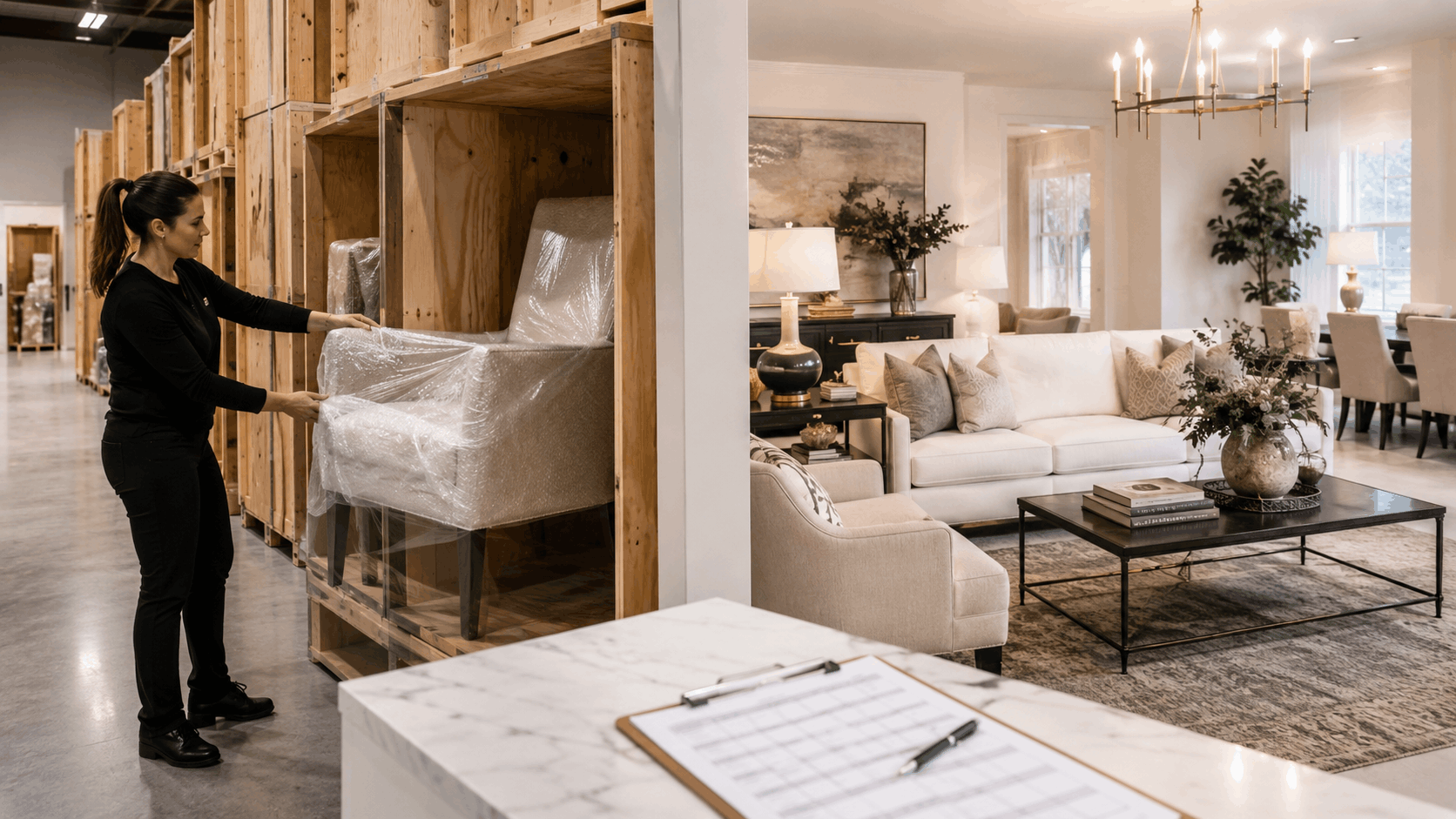
Wooden storage vaults change the math. A vault is a sealed wooden container, usually around 5 by 7 by 7 feet, that holds a grouped set of furniture and accessories. Items go in padded and wrapped, then the vault gets sealed and stacked.
Because vaults stack, a warehouse holds far more inventory in the same footprint than open shelving ever could. Each vault stays closed between jobs, so dust and handling damage drop sharply. Our vaulted storage service is built around this exact workflow.
Wooden vaults also keep inventory organized by project or style. Instead of one giant pile, a stager has labeled boxes they can pull from in order. That structure is what makes fast, reliable staging possible.
Serving Stagers Across the Los Angeles Area
LA stagers do not work one neighborhood. A typical week might run from the Palisades to Los Feliz, with stops in Culver City and Pasadena in between. That spread makes central storage with easy freeway access worth real money in saved drive time.
Our warehouse sits where crews can reach the 405, the 10, and the 101 without fighting local surface streets first. That matters when a photographer is waiting in Brentwood and the truck is still loading.
Los Angeles staging also means variety. One listing is a modern Culver City condo, the next is a hillside craftsman. A central storage base lets a stager serve both without a wasted trip.
Get Your Free Quote
Tell us about your move and we'll get back to you fast.
How Storage Vaults Protect Staging Inventory
A staged home only works if the furniture looks new. Scuffed arms and dusty cushions ruin the effect. Vault storage keeps furniture in showroom shape by controlling how pieces are packed, wrapped, and sealed.
| Vault Feature | What It Protects Against |
|---|---|
| Sealed wooden walls | Dust, debris, and handling scuffs |
| Moving blankets | Scratches on wood and metal finishes |
| Shrink wrap | Fabric snags and moisture on upholstery |
| Spacing and padding | Pressure marks from stacked pieces |
| Separate crates | Cracked glass, mirrors, and art |
What a Storage Vault Actually Is
A standard wooden vault runs roughly 5 feet wide by 7 feet deep by 7 feet tall. That gives about 245 cubic feet of protected space inside a solid wooden container. It is built to be lifted, moved, and stacked without shifting the contents.
One vault typically holds the furniture for a small to mid-size room set. Think a sofa, a chair, a coffee table, two side tables, lamps, and a bin or two of accessories. Larger jobs simply use more vaults, so inventory scales cleanly.
The vault dimensions matter because they set a predictable unit for both storage and billing. A stager can count vaults instead of guessing at loose square footage. That makes planning far easier as the collection grows.
Because each wooden container is sealed and stackable, the warehouse stays tidy and dense. There is no open furniture collecting dust on a floor.
Padding, Wrapping, and Damage Prevention
Furniture protection starts with moving blankets. Every wood and metal piece gets wrapped so corners and edges do not rub against neighbors. Blankets absorb the small bumps that happen any time a vault is moved.
Upholstery gets a layer of furniture wrap or breathable covering to guard against snags and surface dirt. Cushions are positioned so nothing presses hard against a fabric face for months at a time. That spacing is what prevents permanent dents and creases.
Inside the vault, crews build the load with heavier pieces low and lighter items up top. Accessories go in labeled bins rather than loose. Our packing and crating team handles this exact kind of careful loading every day.
Done right, a sofa can sit in storage for months and come out looking like it just left the showroom. That is the standard staging demands.
Guarding Against LA Humidity and Dust
The Westside carries real coastal moisture. Homes and warehouses near Santa Monica and Marina del Rey deal with damp air that can leave upholstery smelling musty over time. Sealed vaults slow that moisture from reaching wrapped furniture.
Valley warehouses face the opposite problem, which is dust. Air near the 101 corridor carries fine grit that settles on any open surface. A sealed wooden container keeps that dust off cushions and finishes between jobs.
For humidity control, our team stores vaults in a managed indoor space rather than an open lot. Combined with wrapping, that keeps fabric and wood stable through the seasons. Climate storage is not just for pianos and art; staging inventory benefits too.
Dust protection also saves time on the back end. Furniture that comes out clean does not need a wipe-down before it goes into a home, which keeps tight schedules on track.
Handling Fragile Art, Mirrors, and Lighting
Stagers rely on mirrors and art to make rooms feel larger and finished. These are also the pieces most likely to crack in transit. Art crating gives framed pieces and large mirrors a rigid wooden box built to their size.
Lighting is its own puzzle. Table lamps and floor lamps have thin necks and fragile shades that crush easily under pressure. We store shades separately and pad lamp bases so nothing bends or snaps.
Fragile decor like ceramic vases and glass objects go into padded bins with dividers. Grouping breakables away from heavy furniture keeps a shifting sofa from landing on a $200 vase. Our specialty moving crews treat these items the way a gallery would.
The result is that a stager can carry statement pieces without fearing every delivery. That confidence lets them design bolder rooms.

Need Help in Los Angeles?
Popeye Moving & Storage serves Los Angeles and all of Los Angeles County.
Tracking Inventory So Nothing Gets Lost
Storage only helps if a stager can find the right piece fast. A warehouse full of unlabeled vaults is just an expensive pile. Good inventory tracking turns storage into a working furniture catalog.
Labeling and Photo Records for Every Vault
Each vault gets a number and a vault inventory list that names everything inside. That list lives both on the vault and in a shared digital record. A stager checking their phone can see that vault 14 holds the coastal living room set.
Photo records make it even faster. A few clear photos of the packed contents mean a stager recognizes a piece at a glance instead of reading a text description. When a client asks for the gray velvet chair, the photo confirms which vault to open.
This system saves the worst part of the job, which is digging. Instead of pulling three vaults to find one lamp, the record points straight to the right box. That is minutes saved on every pull, and those minutes add up across a busy week.
We help stagers set up this labeling and photo system when they store with us so it stays consistent as inventory grows.
Grouping Items by Style or Project
Smart stagers do not store furniture randomly. They build staging sets, grouping pieces that work together into the same vault or cluster. A neutral modern set stays together, and a warmer traditional set lives nearby.
Project grouping is the other approach. During an active listing, all the pieces for that home can be staged in one or two vaults so the pull is a single stop. When the job wraps, they return to their style groups.
Grouping by color palette also speeds design decisions. If a stager knows vaults 8 through 10 hold everything in soft neutrals, planning a calm bedroom becomes a quick task. The organization does the thinking in advance.
This structure is what lets a stager say yes to a rush job without panic. The pieces are already sorted and ready to load.
Tracking What Is Out and What Is Home
At any moment, a good chunk of a stager's inventory is placed inventory sitting in homes across the city. Knowing exactly what is out prevents double-booking the same sofa for two listings. A check-in check-out log solves this.
When furniture leaves the warehouse, it gets logged against the listing address. When the home sells and the pieces return, they get checked back in and refiled. The record always shows what is available today.
This matters most in a hot market with many active listings. Without a log, a stager might promise a dining set that is already staged in Pasadena. The check-out system removes that guesswork entirely.
Our storage solutions support this kind of in-and-out tracking so stagers always know where their furniture stands.
Reordering and Retiring Worn Pieces
Furniture wear is real. A sofa that has staged fifteen homes shows it in the arms and cushions. Tracking how often a piece is used helps a stager retire tired items before they hurt a listing photo.
Notes in the inventory record flag pieces that need cleaning, repair, or replacement. A quick tag on a scuffed console table reminds the stager not to send it to a high-end listing. That small step protects their reputation.
Tracking also guides reordering. If the popular gray sectional is booked every week, the record shows it is time to buy a second one. Inventory refresh becomes a planned decision rather than a scramble.
Over time, this keeps the whole collection looking current and photo-ready, which is exactly what clients pay for.
Keeping Staged Homes on Schedule
Staging runs on deadlines. The photographer books a slot, the agent sets the open house, and the furniture has to be in place before either. Coordinated pickups and deliveries are what hold that staging schedule together.
Timing Deliveries Around Photo and Open House Days
Photo day is the hard deadline. Most listing photos are shot in a single morning, so the home must be fully staged the day before or early that morning. Delivery timing has to match the photographer's arrival to the hour.
Our crews plan pulls the afternoon before a shoot so the vault is loaded and ready at dawn. That avoids the panic of loading furniture while the photographer waits in the driveway. A calm setup makes for better photos too.
Open house prep follows the same logic. Everything needs to look staged and settled before the first buyer walks in. We build delivery windows around these fixed events so nothing arrives late.
When the schedule is tight, that coordination is the difference between a listing that goes live on time and one that slips a week.
Fast Pulls for Same-Week Listings
The LA market moves fast, and rush staging requests are common. An agent lands a listing on Monday and wants it staged by Thursday. An organized vault system makes that quick turnaround possible.
Because inventory is grouped and labeled, our team can pull a full room set in a fraction of the time an unsorted warehouse would take. The stager picks the pieces, and the vault comes out ready. If they need help moving quickly, our last minute moving crews know how to work under pressure.
Speed depends on the prep done earlier. A stager who kept clean records can commit to a same-week job with confidence. One who did not is stuck digging.
That reliability wins repeat business from agents who need a stager they can count on in a pinch.
De-Staging and Return to Storage
When a home sells, the furniture has to come out cleanly. De-staging is the pickup after closing, and it needs the same care as delivery. Rushed teardown is where scratches and lost accessories happen.
Our crews wrap and pad pieces during pickup just as they did going in. Everything gets checked against the listing's log so no lamp or pillow gets left behind. The furniture return runs in reverse of the delivery.
Back at the warehouse, pieces go into their labeled vaults, not just dropped anywhere. That clean return is what keeps the whole system working for the next job. Skipping it creates the mess that slows future pulls.
A tidy de-stage today is a fast pull next week. The discipline pays off every time.
Managing Multiple Listings at Once
A busy stager often has furniture moving to and from several homes in a single day. Multi-listing staging is only manageable with smart crew routing. A poorly planned route wastes hours in traffic.
We map the day so a crew might hit Culver City in the morning, swing through the Westside midday, and finish in Pasadena before evening. The route follows traffic patterns, not just the map.
Grouping deliveries by area cuts backtracking. A drop in Sherman Oaks pairs with a pickup nearby rather than a return trip across town. That planning keeps the whole day on schedule.
For stagers running many listings, this routing is what makes the workload possible without a second warehouse across the city.
Navigating Los Angeles Traffic and Access for Deliveries
LA geography shapes every staging delivery. The freeways, the hills, and the building rules all affect when furniture can arrive. A crew that knows the city plans around these hurdles instead of getting caught by them.
- Freeway timing decides whether a delivery beats or fights gridlock
- Narrow hillside streets often need smaller trucks
- High-rise condos require elevator and dock reservations
- Parking permits and street cleaning limit curb access
Planning Around the 405, 101, and 10 Freeways
The 405 through the Sepulveda Pass can turn a 20-minute trip into an hour. Crews heading to westside and hillside homes time their runs to avoid the worst 405 traffic windows. Early morning or midday moves beat the crush.
The 101 and the 10 carry the same risk at rush hour. A delivery route to the Valley or the Eastside gets planned around these choke points. Leaving the warehouse at the right time saves more than any shortcut.
We build a delivery route with backup surface streets in mind. If the 10 locks up near La Cienega, the crew has a plan B. That flexibility keeps photo-day deliveries on time.
Knowing the city's rhythm is half the job. The furniture is only useful if it arrives when it is needed.
Tight Streets in the Hills and Older Neighborhoods
Laurel Canyon roads twist and narrow in ways a full-size truck cannot handle. Hillside access there often calls for a smaller truck or a shuttle from a wider street. A crew that shows up in the wrong vehicle wastes the whole trip.
Echo Park and Highland Park have their own narrow streets, many lined with parked cars all day. These older neighborhoods were not built for large delivery trucks. Planning the vehicle to the street is part of the prep.
Our team scouts access ahead of tricky hillside jobs. Knowing where a truck can park and how far furniture must be carried avoids surprises. That is the kind of detail that keeps a tight schedule intact.
Silver Lake and the surrounding hills demand the same care, which is why local knowledge beats a generic delivery outfit every time.
HOA and Building Rules for High-Rises
Downtown and Century City condos come with strict building rules. Most require an elevator reservation and a booked loading dock window. Show up without one, and the building turns the crew away.
HOA rules often limit delivery hours to weekday business times. That narrows when a stager can move furniture into a high-rise unit. We confirm these rules before the delivery date so the schedule holds.
Loading dock access can also mean a long push from the dock to the unit. Padding and floor protection matter in these buildings, since scuffed lobby floors bring fines. Our crews handle high-rise moves regularly and know the drill.
Getting the paperwork and timing right ahead of time is what keeps a condo staging from falling apart on delivery morning.
Parking Permits and Curb Access
Many LA neighborhoods have permit-only parking that blocks a delivery truck from the curb. A parking permit or temporary allowance may be needed for a large truck to stage a load. Without it, the crew hunts for a spot blocks away.
Street cleaning schedules add another wrinkle. On certain mornings, whole blocks clear out, and a truck parked wrong risks a ticket. We check these schedules when planning curb access for a delivery.
In dense areas like parts of West Hollywood and the Eastside, curb space is scarce all day. Planning the delivery window around the calmest hours makes loading smoother. That planning protects both the schedule and the client's neighbors.
Small details like a permit or a cleared curb decide whether a delivery runs on time or drags. We handle them so the stager does not have to.
Need Help in Los Angeles?
Popeye Moving & Storage serves Los Angeles and all of Los Angeles County.
Choosing the Right Storage Partner for a Staging Business
Not every storage company understands how stagers work. The right storage partner treats furniture as inventory, not boxes to warehouse. A few traits separate a real stager moving company from a generic one.
Trained Crews Who Handle High-Value Furniture
Furniture handling is a skill, not just muscle. Trained movers know how to lift a marble console without cracking it and how to wrap a velvet sofa so it stays clean. Day labor rarely brings that care.
A scratched dining table or a torn cushion costs a stager real money and a lost look for a listing. Experienced crews protect finishes and upholstery because they know what damage means to the client. That care shows in the photos.
Our teams train specifically on high-value pieces, from designer sofas to fragile lighting. That is the difference between furniture that lasts fifty jobs and furniture that looks tired after ten. The people behind our crews take that seriously.
For a staging business, the movers are an extension of the brand. Careful handling protects both the furniture and the stager's name.
Flexible Access and Scheduling
Staging does not follow a nine-to-five rhythm. A stager needs storage access on short notice when a rush listing lands. Scheduling flexibility is what makes that possible.
Quick appointment windows matter. A stager who can book a pull for tomorrow morning stays competitive in a fast market. One who waits three days for a slot loses the job.
Predictable pickup times also help planning. When a stager knows a crew will arrive at 8 a.m., they can line up the photographer with confidence. That reliability is worth as much as the storage itself.
We build our scheduling around the way stagers actually work, with the flexibility a listing calendar demands.
Insurance and Liability Coverage
A stager's inventory is a serious investment, often worth tens of thousands of dollars. Storage insurance and liability coverage protect that investment while it sits in a vault or rides in a truck. A company without proper coverage puts the stager at risk.
Coverage should apply both to stored items and to furniture in transit. A sofa can be damaged in the warehouse or on the way to a listing, and both need protection. Ask any storage partner exactly what their coverage includes.
The California Bureau of Household Goods and Services licenses movers in the state, and working with a licensed company matters. You can verify a mover through the Bureau of Household Goods and Services. Federal guidance from the FMCSA Protect Your Move program is worth a read too.
Clear coverage means a stager can focus on design instead of worrying about a costly loss.
Why Local Popeye Moving & Storage Co. Fits Stagers
Popeye Moving brings vault storage, inventory help, and LA-wide delivery under one local roof. That means a stager is not juggling a storage company, a mover, and a labeling system separately. It all runs through one team.
Our Los Angeles storage base sits with easy freeway access, so crews reach listings from the Palisades to Pasadena without wasted miles. We know the streets, the buildings, and the traffic because we work them every day. Our designer receiving and consolidation service already serves the design trade closely.
We also understand the staging workflow, from rush pulls to clean de-stages. That familiarity means fewer explanations and faster jobs. A stager can hand us the plan and trust the execution.
For a working staging business, having storage and delivery in one local company removes a lot of friction. That is the fit we aim for.

Costs and Planning for Stager Storage
Storage and delivery are real line items in a staging business. Knowing how the pricing works lets a stager budget across projects and quote clients accurately. Here is how the numbers usually break down.
| Cost Item | Typical Basis | What Affects It |
|---|---|---|
| Vault storage | Per vault, monthly | Number of vaults, term length |
| Delivery and pickup | Per crew and truck | Distance, access, job size |
| Rush service | Added fee | Same-week or after-hours timing |
| Crating | Per item | Art, mirrors, fragile decor |
How Vault Storage Is Priced
Vault pricing is charged per vault, per month. A single vault in the LA area commonly runs somewhere in the range of $75 to $150 monthly, depending on the facility and term. Monthly storage keeps the cost predictable.
The total depends on inventory size. A stager with three vaults pays for three; a growing business with ten pays for ten. That per-unit structure makes it easy to see exactly what storage costs.
Longer commitments sometimes lower the monthly rate. A stager who knows they will store year-round can often negotiate better terms than someone month to month. It pays to ask about longer-term options.
Because vaults are a fixed unit, budgeting is straightforward. Count the vaults, multiply by the rate, and the monthly storage cost is clear.
Delivery and Pickup Charges
Delivery cost usually reflects crew time and truck use. A typical staging delivery might involve two movers and a truck for several hours. The labor fee scales with how long the job takes.
Distance plays a part. A delivery to nearby Burbank costs less in drive time than a run out to Malibu. Access matters too, since a hillside home or high-rise takes longer to load into than a ground-floor house.
Job size is the other factor. A full home staging with three vaults of furniture takes more crew and time than a single accent room. The quote reflects the actual work involved.
Getting a clear estimate up front lets a stager plan the trip cost into each project without surprises.
Scaling Storage as the Business Grows
Scalable storage is one of the biggest advantages of the vault model. As a stager takes on more listings, they add vaults. When the market slows, they drop a few and cut cost.
Seasonal demand is real in LA real estate. Spring and early fall often bring more listings, so a stager might carry extra vaults then. In slower winter months, they can trim inventory and reduce storage spend.
This flexibility keeps overhead in line with income. A stager does not pay for a full warehouse year-round when they only need it half the year. The cost follows the workload.
We make it easy to add or release vaults as a stager's needs shift through the seasons.
Budgeting Storage Into a Staging Bid
Smart stagers fold storage and delivery into their client quotes. A staging bid should account for the monthly storage share of the pieces used plus the delivery and pickup runs. That cost pass-through keeps margins healthy.
Breaking the numbers out helps clients understand the value. When an agent sees delivery, staging, and de-staging as line items, the price makes sense. Transparency builds trust and repeat work.
A stager who ignores storage cost in their bids quietly loses money on every job. Building it in from the start protects the business. The math should always cover the true cost of getting furniture there and back.
With clear per-vault and per-delivery pricing, plugging these numbers into a bid is simple.
Need Help in Los Angeles?
Popeye Moving & Storage serves Los Angeles and all of Los Angeles County.
Final Thoughts
Staging is a furniture logistics business dressed up as a design business. The stagers who thrive in LA are the ones whose inventory is protected, organized, and ready to move on a moment's notice. Vault storage, careful tracking, and tight scheduling make that possible.
Popeye Moving & Storage Co. brings all of it together in one local company, from clean wooden vaults to LA-wide delivery that beats the traffic. If you stage homes across Los Angeles and want your inventory protected and your listings on schedule, reach out to us. Contact our team or call to set up a consultation and see how we fit your workflow.

Frequently Asked Questions
What is a storage vault and how much fits inside one?
A storage vault is a sealed wooden container measuring roughly 5 by 7 by 7 feet, offering about 245 cubic feet inside. One vault usually holds a small to mid-size room set, such as a sofa, a chair, a coffee table, two side tables, lamps, and a couple of bins of accessories. Larger jobs simply use more vaults, which lets a staging business scale storage cleanly.
How do stagers keep track of inventory across many vaults?
Stagers track inventory with three tools working together. Each vault gets a number and a contents list, photo records show what is packed inside at a glance, and a check-in check-out log records which pieces are placed in homes right now. That system lets a stager find the right sofa or lamp in seconds instead of digging through piles, and it prevents double-booking a piece for two listings.
How fast can furniture be pulled for a last-minute listing?
With an organized vault system, a full room set can often be pulled the same day or within a day or two of the request. Because inventory is grouped and labeled by style or project, crews load the right vault quickly instead of hunting through a warehouse. For same-week or rush staging jobs common in the LA market, that speed is what lets a stager say yes with confidence.
Is stored furniture protected from LA humidity and dust?
Yes. Sealed wooden vaults keep dust and coastal moisture off wrapped furniture between jobs. Pieces are covered with moving blankets and furniture wrap, and vaults are stored in a managed indoor space rather than an open lot. That combination guards against the damp air common near the Westside and the fine dust found around Valley warehouses, so furniture comes out clean and photo-ready.
Can crews deliver to hillside homes and high-rise condos?
Yes. Hillside deliveries in areas like Laurel Canyon or Echo Park often use a smaller truck or a shuttle from a wider street, and our crews scout access ahead of time. High-rise condos in Downtown or Century City require booked elevator and loading dock windows, which we confirm before delivery day. Planning the vehicle and paperwork to the location keeps tight schedules intact.
How much does vault storage cost per month?
Vault storage in the LA area commonly runs about $75 to $150 per vault, per month, depending on the facility and term length. The total cost depends on how many vaults a stager needs, so three vaults cost roughly triple a single one. Longer-term commitments can sometimes lower the monthly rate, so it is worth asking about extended options when planning a budget.
What happens to inventory after a staged home sells?
After a home sells, our crews handle the de-staging pickup with the same care used during delivery. Pieces are wrapped and padded, checked against the listing's log so nothing gets left behind, and returned to the warehouse. Back at storage, each item goes into its labeled vault rather than a random spot, which keeps the system organized and speeds up the next pull.
Can storage scale up or down with the season?
Yes. The vault model is scalable, so a stager adds vaults during busy spring and fall listing seasons and drops a few during slower winter months. That flexibility keeps storage cost in line with actual workload, so a business does not pay for space it is not using. We make it easy to add or release vaults as inventory changes through the year.
Is stored and transported furniture insured?
Coverage options apply both to furniture stored in vaults and to pieces in transit during delivery. Because a staging inventory represents a serious investment, this protection matters against damage or loss in either setting. We work as a licensed California mover, and stagers can verify any company through the state Bureau of Household Goods and Services. Ask about exactly what coverage includes when setting up storage.
Which Los Angeles areas does Popeye Moving & Storage Co. serve?
We serve staging jobs across the greater Los Angeles area, from the Palisades and Brentwood on the Westside to Los Feliz and Silver Lake on the Eastside. Our reach includes Culver City, Santa Monica, Pasadena, Burbank, Sherman Oaks, and the South Bay beaches. With central storage and easy freeway access, our crews route across these neighborhoods to keep staged homes on schedule.
Frequently Asked Questions
- What is a storage vault and how much fits inside one?
- A storage vault is a sealed wooden container measuring roughly 5 by 7 by 7 feet, offering about 245 cubic feet inside. One vault usually holds a small to mid-size room set, such as a sofa, a chair, a coffee table, two side tables, lamps, and a couple of bins of accessories. Larger jobs simply use more vaults, which lets a staging business scale storage cleanly.
- How do stagers keep track of inventory across many vaults?
- Stagers track inventory with three tools working together. Each vault gets a number and a contents list, photo records show what is packed inside at a glance, and a check-in check-out log records which pieces are placed in homes right now. That system lets a stager find the right sofa or lamp in seconds instead of digging through piles, and it prevents double-booking a piece for two listings.
- How fast can furniture be pulled for a last-minute listing?
- With an organized vault system, a full room set can often be pulled the same day or within a day or two of the request. Because inventory is grouped and labeled by style or project, crews load the right vault quickly instead of hunting through a warehouse. For same-week or rush staging jobs common in the LA market, that speed is what lets a stager say yes with confidence.
- Is stored furniture protected from LA humidity and dust?
- Yes. Sealed wooden vaults keep dust and coastal moisture off wrapped furniture between jobs. Pieces are covered with moving blankets and furniture wrap, and vaults are stored in a managed indoor space rather than an open lot. That combination guards against the damp air common near the Westside and the fine dust found around Valley warehouses, so furniture comes out clean and photo-ready.
- Can crews deliver to hillside homes and high-rise condos?
- Yes. Hillside deliveries in areas like Laurel Canyon or Echo Park often use a smaller truck or a shuttle from a wider street, and our crews scout access ahead of time. High-rise condos in Downtown or Century City require booked elevator and loading dock windows, which we confirm before delivery day. Planning the vehicle and paperwork to the location keeps tight schedules intact.
- How much does vault storage cost per month?
- Vault storage in the LA area commonly runs about $75 to $150 per vault, per month, depending on the facility and term length. The total cost depends on how many vaults a stager needs, so three vaults cost roughly triple a single one. Longer-term commitments can sometimes lower the monthly rate, so it is worth asking about extended options when planning a budget.
- What happens to inventory after a staged home sells?
- After a home sells, our crews handle the de-staging pickup with the same care used during delivery. Pieces are wrapped and padded, checked against the listing's log so nothing gets left behind, and returned to the warehouse. Back at storage, each item goes into its labeled vault rather than a random spot, which keeps the system organized and speeds up the next pull.
- Can storage scale up or down with the season?
- Yes. The vault model is scalable, so a stager adds vaults during busy spring and fall listing seasons and drops a few during slower winter months. That flexibility keeps storage cost in line with actual workload, so a business does not pay for space it is not using. We make it easy to add or release vaults as inventory changes through the year.
- Is stored and transported furniture insured?
- Coverage options apply both to furniture stored in vaults and to pieces in transit during delivery. Because a staging inventory represents a serious investment, this protection matters against damage or loss in either setting. We work as a licensed California mover, and stagers can verify any company through the state Bureau of Household Goods and Services. Ask about exactly what coverage includes when setting up storage.
- Which Los Angeles areas does Popeye Moving & Storage Co. serve?
- We serve staging jobs across the greater Los Angeles area, from the Palisades and Brentwood on the Westside to Los Feliz and Silver Lake on the Eastside. Our reach includes Culver City, Santa Monica, Pasadena, Burbank, Sherman Oaks, and the South Bay beaches. With central storage and easy freeway access, our crews route across these neighborhoods to keep staged homes on schedule.
P
Popeye Moving & Storage Co. Team Team
Licensed moving and storage professionals serving Los Angeles and Los Angeles County.
Licensed in California · License #PUC: CAL T 189749 | DOT: 1472924 | MC: 498816C
Why trust Popeye Moving & Storage?
Founded in 1994, Popeye Moving & Storage is a licensed and insured moving and storage service serving Los Angeles and Los Angeles County. All content is reviewed by our licensed technicians.

Need Help in Los Angeles?
Popeye Moving & Storage serves Los Angeles and all of Los Angeles County.
Related Articles

Tips & Advice
Storage During a Divorce or Household Split: Neutral-Ground Storage While Decisions Get Made
Neutral-ground storage gives Los Angeles couples a fair, safe place to keep shared belongings during a divorce or household split. Learn setups, access rules, costs, and legal tips.
Tips & Advice
Storage for Santa Monica and Brentwood Households: Where Westside Furniture Actually Goes Between Homes
A local guide to furniture storage for Santa Monica and Brentwood households, covering storage types, costs, coastal climate risks, and how Westside families bridge the gap between homes.
Cost Guides
What Vaulted Storage Billing Includes - Wrapping, Inventory, and the Line Items Self-Storage Never Shows
A clear breakdown of what vaulted storage billing includes - wrapping, inventory, handling, and coverage - and why self-storage quotes never show these line items upfront.