How-To Guides
Sculpture and Statue Moving - Rigging, Crating, and Placement for LA Collectors
Key Takeaways
- Sculpture moving needs specialized handling because pieces are heavy, fragile, and often irreplaceable.
- A pre-move survey documents weight, balance points, condition, and access routes before anyone lifts.
- Rigging uses gantries, skates, and soft slings, with padding to protect bronze and marble finishes.
- Custom wood crates with foam blocking and moisture barriers protect pieces during transport and storage.
- Air-ride trucks, careful route planning around the 405 and 101, and secure anchoring keep loads safe in transit.
- Placement includes load-bearing checks, seismic anchoring for earthquakes, and precise leveling.
- Climate-controlled, secure storage with inventory tracking protects collections between moves.
- Choose a crew with rigging experience, real art insurance, and local knowledge of LA neighborhoods.
In This Article
A collector in Hancock Park called us one spring morning with a problem. She had bought a life-size bronze figure at auction, and the piece sat in her entry hall on Rossmore Avenue weighing close to 900 pounds. She needed it moved to a new estate in Bel-Air by the weekend, and the front door had a marble threshold she did not want scratched.
That call is a common one for us. Moving a heavy statue is nothing like moving a couch. The finish is delicate, the weight is unevenly spread, and one wrong lift can cost more than a car.
Why Sculptures and Statues Need Specialized Moving
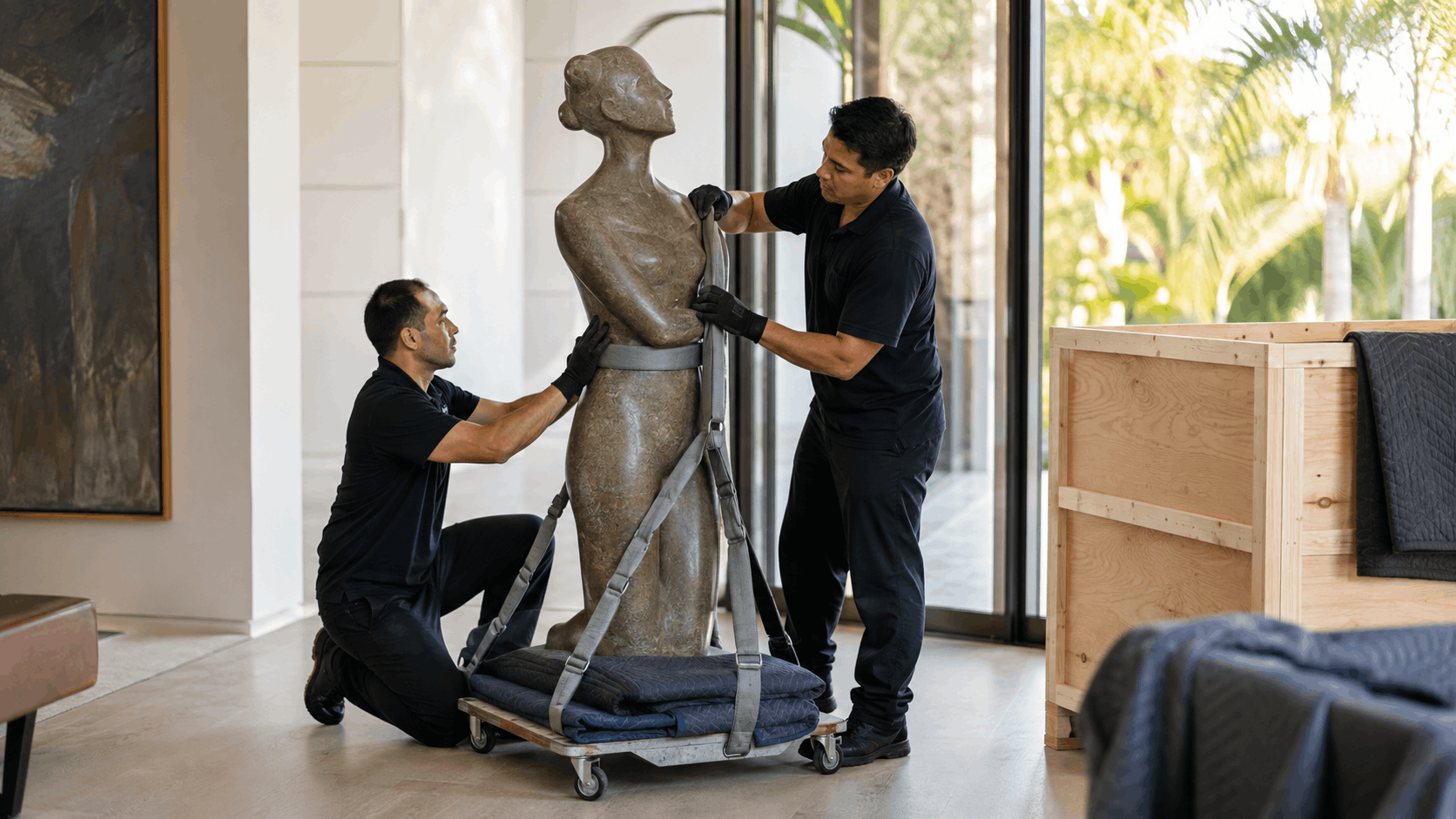
Sculpture moving sits in its own category for good reason. These pieces are heavy, oddly shaped, and often worth six or seven figures. A standard moving crew treats a box the same as a bookshelf, but fine art handling demands a slower, more careful approach.
Los Angeles collectors hire specialized teams because the risks stack up fast. Here is what sets these jobs apart:
- The weight is rarely balanced, so lifting points matter
- Finishes scratch, dent, or crack with light contact
- Many pieces are one of a kind and cannot be replaced
- Access routes in older LA homes are tight and unforgiving
The Difference Between Furniture and Fine Art Handling
Furniture is built to be handled. A dresser can take a bump, and a sofa can lean against a wall while a crew catches their breath. A marble bust or a cast bronze cannot take that kind of casual treatment.
Fine art handling starts with weight distribution. A tall statue might carry most of its mass in the base or lean forward at the shoulders, which changes where the team grips and lifts. Getting that wrong can tip a piece in a second.
Then there are fragile finishes. Bronze patina, polished marble, and painted surfaces all mark easily from bare hands, straps, or a corner of a door frame. Our crew uses barrier layers on every contact point, and no one touches a surface without gloves.
The last difference is value. A scratched table is a repair. A cracked sculpture can be a total loss, so the whole plan is built around zero contact damage from start to finish.
Common Materials and Their Risks
Every material carries its own weak spots. A bronze statue is strong overall, but thin extended arms or fingers snap under stress, and the patina scratches if a strap rubs it wrong.
A marble sculpture looks solid but behaves like stone glass. Marble cracks along natural veins, and a hard set-down on a hard floor can split a piece that survived a hundred years untouched. We treat every marble move as if the stone has a hidden fault line.
Glass and ceramic pieces bring the highest material risk during a move. They chip at the edges, shatter under point pressure, and react badly to temperature swings inside a hot truck. These need full crating almost every time.
Mixed-media works combine metal, wood, glass, and resin in one piece, and each part expands and shifts at a different rate. Our team plans around the most fragile element, then protects the rest to match.
What Damage Costs a Collector
Art damage hits a collector twice. There is the money, and there is the loss of something that cannot be bought again. Both matter, and both are avoidable with the right prep.
On the financial side, a chipped edge can drop collector value by a large share even after restoration. Buyers and appraisers note damage in the record, and that mark follows the piece for life. A crack on a rare bronze can wipe out tens of thousands in resale worth.
The sentimental loss runs deeper for many of our clients. A sculpture inherited from a parent or bought on a trip abroad carries a story, and no insurance check replaces that. We hear that grief in the voices of collectors who called too late after a bad move.
This is why prep and proper coverage go together. A solid condition report plus real insurance means a rare accident becomes a claim, not a catastrophe.
When to Call Professionals Instead of Movers Friends
Some moves look simple until they are halfway done. If a piece is over roughly 150 pounds, taller than a person, or worth more than a used car, it is time for professional riggers.
Height is its own warning sign. A tall statue tips easily, and once it starts to go, two people with no gear cannot stop it. We have seen the aftermath of a friend-led lift that went sideways in a Silver Lake living room.
Odd balance points are another signal. If the weight sits high or leans to one side, the lift needs planning, not muscle. Heavy sculpture with an unpredictable center of gravity belongs in trained hands.
Value alone should decide it. When a single mistake could cost more than a full professional move, the math is easy. Our specialty moving team exists for exactly these jobs.
Get Your Free Quote
Tell us about your move and we'll get back to you fast.
Assessing the Piece Before the Move
Good sculpture assessment happens before anyone lifts a finger. Our pre-move survey tells us what we are dealing with, what could go wrong, and how to prevent it.
Collectors often ask why we spend an hour walking around a piece and the property. The answer is that a slow start prevents a fast disaster. Here is what that visit covers.
Measuring Weight, Height, and Balance Points
We start with the numbers. The team records exact height, width, depth, and estimated weight, then compares those figures to every doorway and vehicle in the plan.
Weight measurement is more than a single number. We map how the mass is spread, because a 600-pound piece with a heavy top handles nothing like a 600-pound piece with a heavy base. That difference changes the rigging setup entirely.
Finding the center of gravity is the heart of a safe lift. Our riggers locate the balance point so slings sit correctly and the piece stays level in the air. A statue lifted off its true center will swing, and a swinging piece is a damaged piece.
We also test how the piece connects to its base. Some statues are bolted down, others just rest in place, and knowing that before the lift keeps the two parts from separating at the wrong moment.
Photographing Condition for Records
Before anything moves, we build a condition report. The team photographs every side, plus close-ups of edges, seams, and any existing marks. Art documentation like this protects both the collector and our crew.
These photos serve two jobs. First, they give an honest record of the piece before the move, so any question about a scratch has a clear answer. Second, they support an insurance claim in the rare case something goes wrong.
We note existing flaws in writing too. A hairline crack or a worn spot that was there on day one gets recorded, so no one argues about it later. Collectors appreciate that we point these out rather than hide them.
The full record travels with the job file. If the piece goes into storage or moves again, we already have the baseline images ready to compare against.
Mapping Access Routes and Doorways
Many LA homes were built long before anyone thought about moving a 1,000-pound statue through them. We walk the full access route from the piece to the truck, measuring as we go.
Doorway clearance is the first checkpoint. A statue might clear a door by an inch on paper but still catch on a hinge, a light fixture, or a tight turn just past the frame. We measure the whole path, not just the opening.
Older homes near Hancock Park and Windsor Square often have narrow halls, tight stair turns, and gated driveways that add steps to the plan. We check gate widths, elevator sizes in condos, and any low beams along the route.
When a route simply will not work, we plan an alternative early. That might mean a window removal, a different door, or a crane lift, and we would rather know that days before, not on moving morning.
Spotting Hidden Structural Issues
A piece can look perfect and still hide trouble inside. Our structural inspection checks for internal cracks, old repairs, and weak mounting that could fail under lifting stress.
Bronze pieces sometimes have thin interior walls or hidden welds that give way if a strap pulls the wrong spot. We tap, inspect seams, and look for stress marks before choosing lift points.
Mounting is another weak link. If a statue is fixed to a base with old hardware or crumbling adhesive, that joint might not survive the trip. We check every connection and reinforce or separate parts as needed.
Marble and stone carry the risk of internal fault lines from the quarry. We look for veins and past restoration, then adjust the handling plan so pressure never lands on a weak zone.
Need Help in Los Angeles?
Popeye Moving & Storage serves Los Angeles and all of Los Angeles County.
Rigging Heavy and Oversized Sculptures
Sculpture rigging is where the heavy lifting happens, literally. This is the stage that separates a trained crew from a group of strong people, because heavy lifting done wrong ends careers and destroys art.
Statue moving at this scale uses real equipment and real math. Below is how our team approaches the lift.
Equipment: Gantries, Skates, and Slings
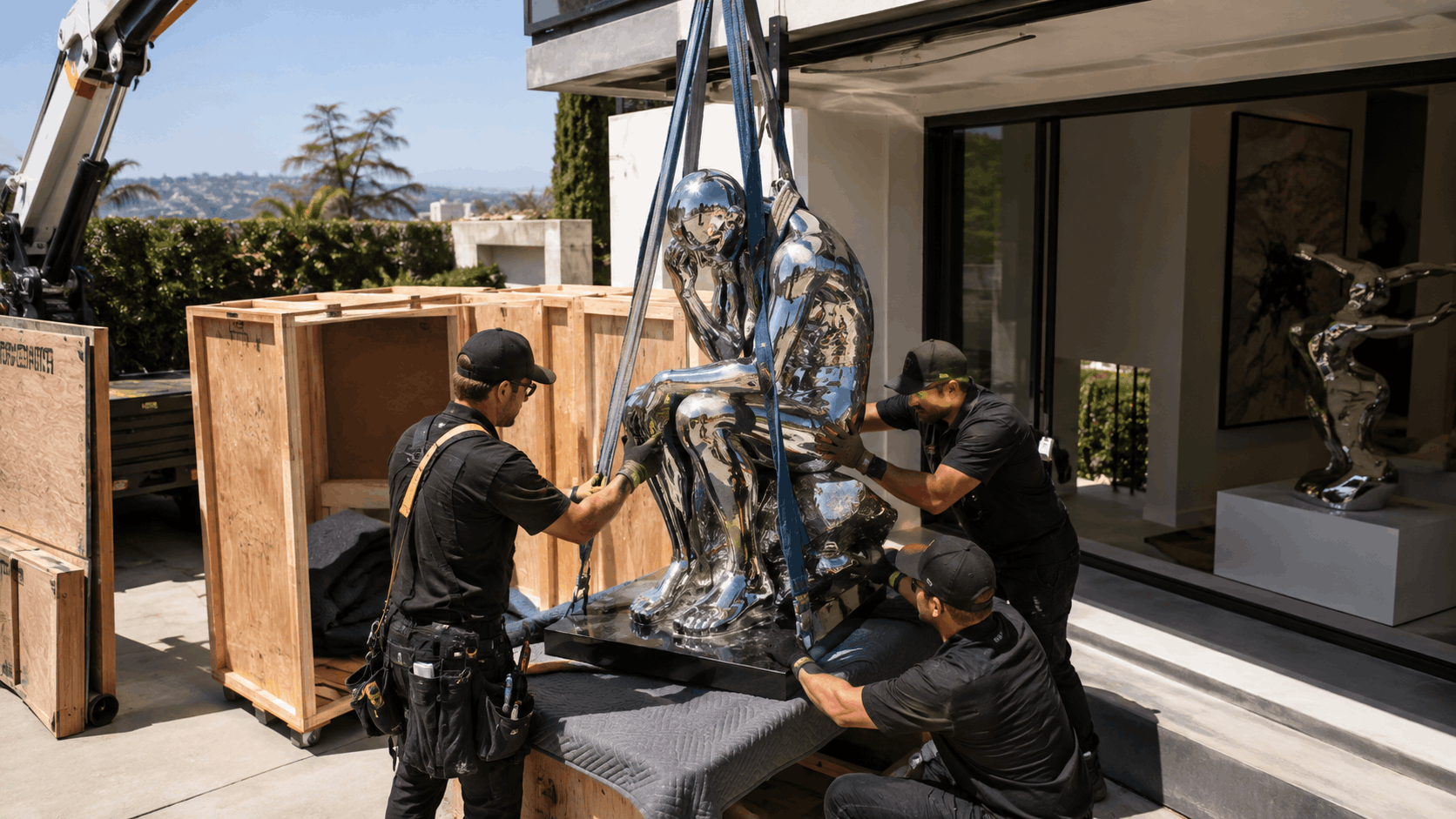
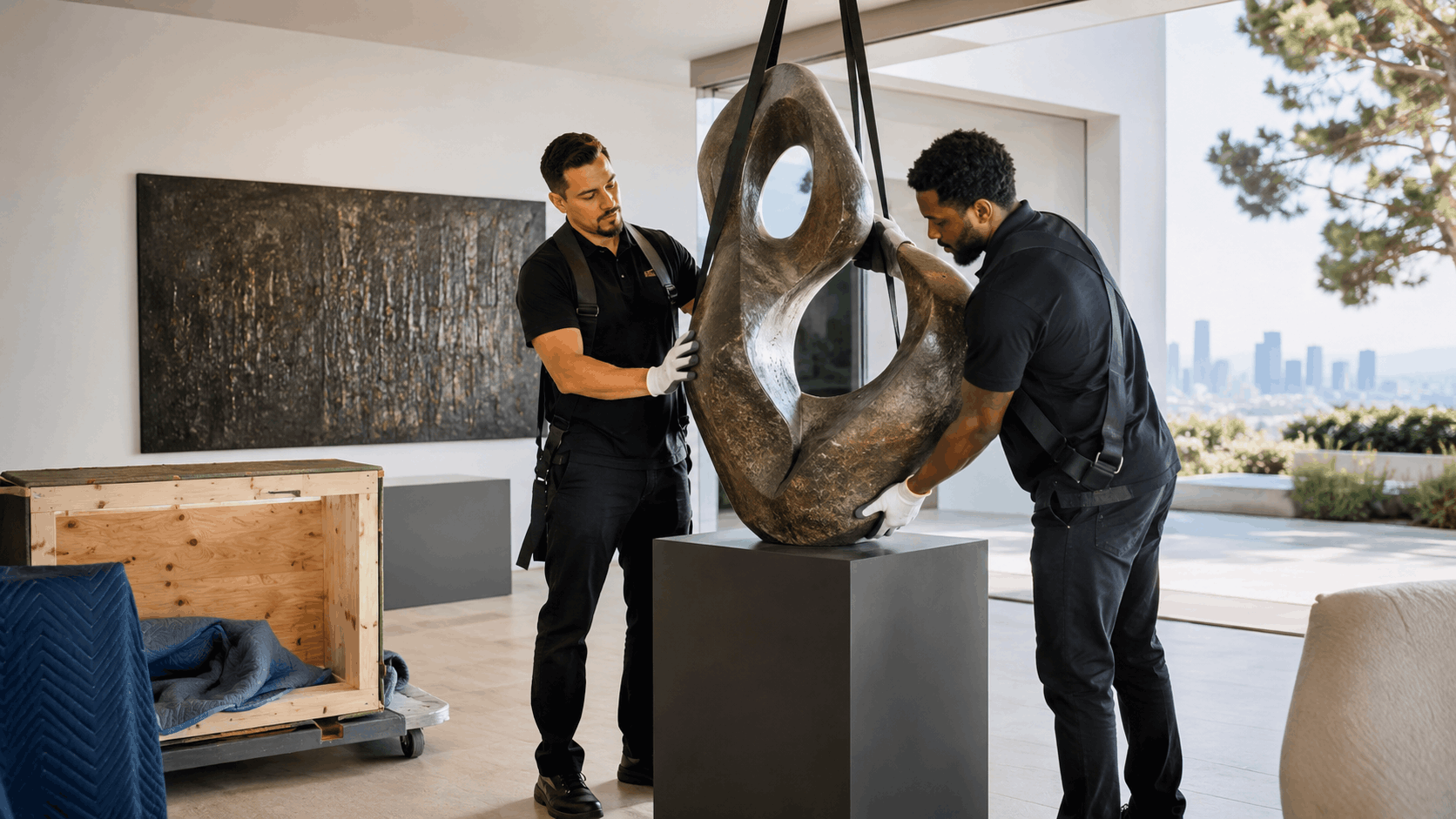
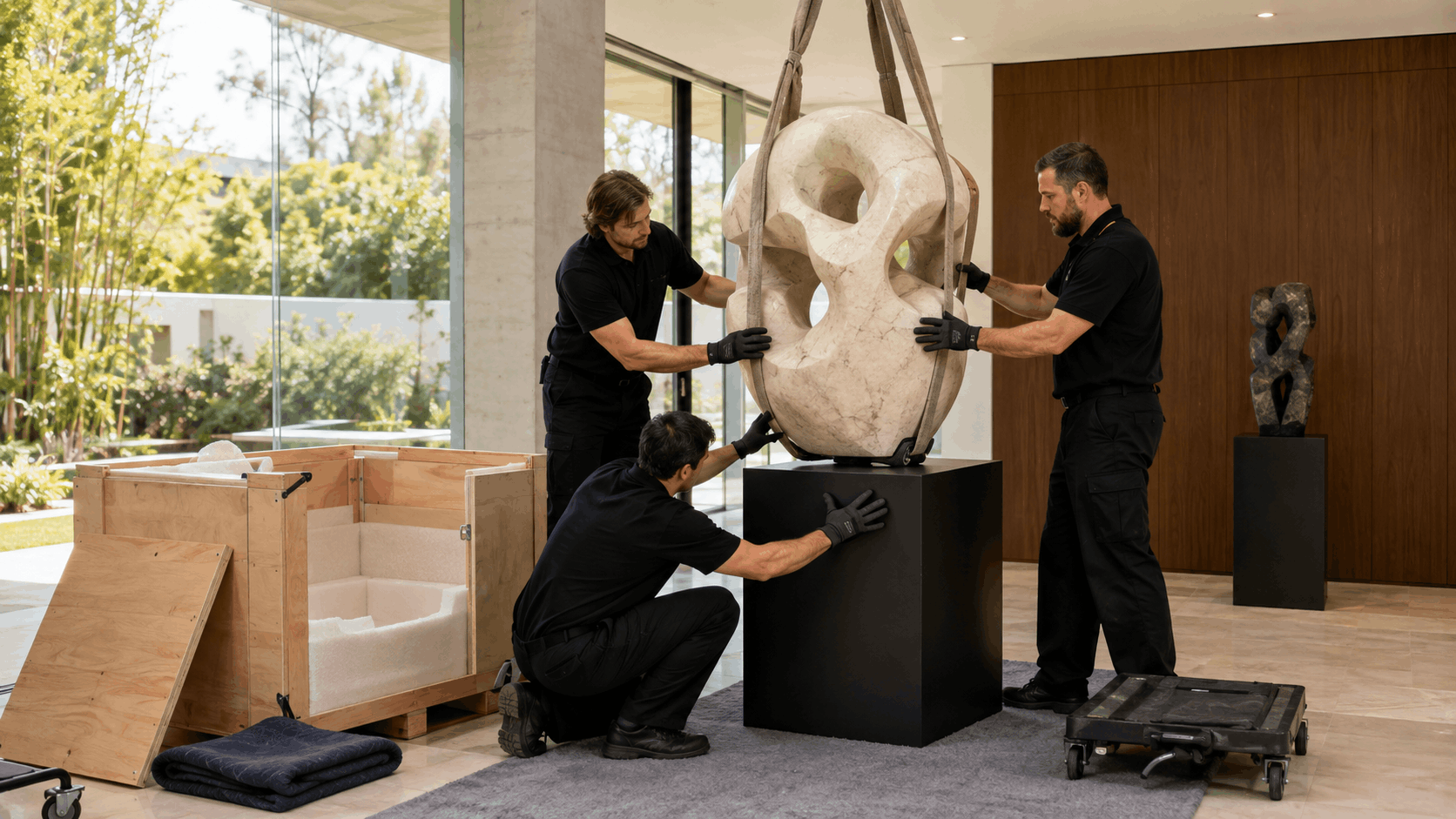
Different jobs call for different gear. A gantry crane lets us lift a very heavy piece straight up and set it down with control, which suits statues too big for hand lifting.
Machine skates come in for horizontal moves across a floor. Once a piece is lowered onto skates, a small crew can roll a multi-ton sculpture across a room without dragging or straining it.
Lifting slings and soft straps cradle a piece during the actual lift. We choose sling width and material based on weight and finish, and we always spread the load so no single point takes too much pressure.
For odd shapes, we sometimes build a custom frame or use spreader bars to keep the piece level. The gear list changes for every job, and matching the right tool to the piece is what keeps the lift smooth.
Protecting Finishes During the Lift
Surface protection starts before the straps go on. Every contact point gets padding, and delicate finishes get a barrier layer between the sculpture and any strap or edge.
We use soft moving blankets, foam wrap, and non-marking straps on bronze and marble. Bronze patina scuffs easily, so we never let a bare strap touch it. Marble gets extra padding at corners where a chip is most likely.
For polished or painted surfaces, we add a smooth barrier film so nothing rubs directly on the finish. The goal is simple: the piece should look exactly the same after the lift as it did before.
Padding also cushions against small bumps during the move. A statue swinging even a few inches into a wall would be a problem, so soft barriers stay in place until the piece is fully set at its destination.
Moving Pieces Through Tight LA Spaces
LA geography adds its own puzzles. Steep driveways in the Los Angeles hills mean a truck cannot always park close, so we plan the carry distance and the slope in advance.
Homes in the Hollywood Hills often sit at the end of winding roads with no flat staging area. We bring gear to move pieces down long paths and around switchback stairs without rushing the descent.
Narrow lots near Silver Lake and Echo Park bring tight access of a different kind. Small setbacks, shared driveways, and street parking limits mean timing and truck size have to be right the first time.
We scout these spots during the survey so nothing surprises us on the day. Knowing the neighborhood saves hours and keeps the piece safe while it is most exposed.
Safety Rules the Team Follows
Rigging safety keeps both the crew and the art intact. Every job runs under set load limits, and we never push gear past its rated capacity, even by a little.
Each lift has a lead and spotters. The spotters watch clearances, call out hazards, and keep hands off the load unless needed. One clear voice runs the lift so there is no confusion at the worst moment.
We double-check every clearance before the piece leaves the ground. Overhead lights, door frames, and railings all get measured against the load, because a lifted statue cannot easily dodge an obstacle. The Occupational Safety and Health Administration sets rigging standards our team follows closely, which you can review through OSHA.
If anything feels off, we stop and reset. A pause costs minutes. A rushed lift can cost a masterpiece.
Custom Crating and Packing for Art
Custom crating is the armor that keeps a sculpture safe during transport and storage. A good crate turns a fragile piece into a protected unit that can travel across town or across the country.
Art packing is not one-size-fits-all. Here is how we decide what each piece needs:
- Full custom crates for fragile, valuable, or long-distance moves
- Soft padding for sturdy pieces on short local trips
- Climate barriers for anything sensitive to moisture
- Clear labeling so every handler knows the plan
Building Crates to Fit Each Piece
We build each wood crate around the exact shape and weight of the sculpture. A crate that fits loosely lets the piece shift, and a piece that shifts is a piece that breaks.
The custom fit starts with the measurements from our survey. We frame the crate so the walls sit close but never press on the sculpture, then reinforce the base to carry the full weight without flexing.
For very heavy pieces, we build the crate with reinforced skids so a forklift or pallet jack can move it safely. The crate becomes part of the handling plan, not just a box around the art.
Our packing and crating team builds these on site or in our shop, depending on the piece and the schedule. Either way, the crate matches the sculpture and nothing else.
Foam, Bracing, and Climate Barriers
Inside the crate, foam blocking holds the piece still. We cut foam to cradle the sculpture at its strong points, so the weight rests where the piece can take it and never on a fragile edge.
Bracing keeps everything locked in place during bumps and turns. We add internal supports so the piece cannot slide, tip, or rattle, even if the truck hits a rough patch on the freeway.
A moisture barrier protects surfaces that react to humidity. Bronze can spot, wood can swell, and some finishes cloud when damp, so we line crates with barrier material for sensitive pieces.
For long trips or storage, we add desiccant packs to control moisture inside the sealed crate. These small steps keep a piece stable through weeks of transit or months in a warehouse.
Soft Crating for Shorter Local Moves
Not every piece needs a full wood crate. Soft crating with heavy blankets and pads works well for a sturdy sculpture on a short local move across town.
We reach for soft packing when a piece is solid, the trip is short, and the truck is padded and secure. A bronze that travels five miles from Hancock Park to Bel-Air often rides safely in soft wrap with proper anchoring.
The choice depends on the piece, not just the distance. A fragile ceramic still gets a crate even for a short hop, while a durable stone base might ride padded and strapped.
We talk this through with each collector during the survey. Soft crating saves cost and time when it is safe, and we say so plainly rather than upselling a crate that is not needed.
Labeling and Handling Instructions
Every crate leaves our hands clearly marked. Crate labeling shows which side is up, where the lift points are, and how fragile the contents are.
Clear handling instructions guide anyone who touches the crate later. If a piece must stay upright or cannot be stacked, the crate says so in plain text and arrows on every side.
We add the piece name or job number too, so a collector with many works knows what is inside without opening it. This matters most when several crates move or go into storage together.
Good labels prevent honest mistakes. A warehouse worker or a delivery crew reads the crate and handles it right, even if they were not part of the original lift.
Transporting Sculptures Across Los Angeles
Art transport is more than a drive. The road between two homes is full of potholes, hard stops, and traffic that can jostle a piece if the load is not right.
Sculpture delivery across Los Angeles takes planning for the vehicle, the route, and the timing. Here is how we handle the drive.
Choosing the Right Vehicle and Suspension
Shock-sensitive pieces ride in an air-ride truck. The air suspension absorbs road bumps that a standard truck would pass straight through to the load, which matters for cracked-prone marble and glass.
We match the truck to the job. A single small sculpture might travel in a padded van, while a large crated bronze needs a lift-gate truck with room to anchor the crate securely.
Secure transport also means climate control when needed. A hot truck sitting in traffic can reach temperatures that stress finishes, so we control the environment for sensitive pieces.
The loading matters as much as the driving. We position each piece low and centered when possible, so the ride stays stable and the load does not fight the truck through every turn.
Planning Routes Around LA Traffic
LA traffic is its own hazard for art. We plan routes to avoid the worst potholes and rough stretches, because every hard bump is a risk to a fragile piece.
Timing beats fighting the crowd. We schedule trips to miss peak hours on the 405 and the 101, since stop-and-go traffic means constant hard braking that jostles a load.
Route planning also considers the surface. Some surface streets are smoother than a cracked freeway, and for a very delicate piece we sometimes choose a slower, gentler path on purpose.
We know which stretches to avoid across the region, from the rough sections near downtown to the tight canyon roads heading toward the coast. Local knowledge shapes every route we pick.
Securing Loads for the Drive
Load securing keeps the piece still from door to door. We strap and anchor every crate or padded sculpture to the truck so nothing shifts, even during a sudden stop.
Anchoring uses rated straps and tie-down points, not whatever is handy. We cross-strap heavy crates so they cannot slide forward or side to side, and we pad any point where a strap meets the crate.
For uncrated pieces, we build a nest of blankets and braces, then anchor that nest to the truck walls. The piece rides as one unit with the truck, not as a loose object that can rock.
We check the load before pulling out and again after the first few miles. Straps settle, and a quick recheck keeps everything tight for the rest of the drive.
Handling Gallery, Estate, and Museum Deliveries
Different destinations have different rules. A gallery delivery in the Arts District often means a loading dock, a schedule window, and staff who direct exactly where a piece goes.
Estate deliveries in Bel-Air work differently. Gated entries, long driveways, and specific placement requests mean we coordinate with house staff or the collector directly, sometimes days ahead.
Museum drops carry the tightest standards. Condition checks, sign-offs, and strict handling rules apply, and our crew follows the receiving institution's process to the letter.
We adjust for each type. Whether the piece lands at a designer receiving facility or a private home, the delivery matches the site's needs.
Need Help in Los Angeles?
Popeye Moving & Storage serves Los Angeles and all of Los Angeles County.
Placement and Installation at the New Location
Placement is the payoff. Sculpture installation done right makes the piece look like it was always meant to stand there, and it keeps the work safe for years.
Statue placement takes the same care as the lift. Here is how we set a piece in its final spot.
Choosing a Stable Base or Pedestal
A heavy piece needs a base that can hold it. Before we set anything down, we check that the floor, patio, or pedestal can carry the load without cracking or sinking.
A load-bearing floor is not a given, especially in older homes with wood subfloors. A 1,000-pound bronze on a spot that cannot bear it can dent hardwood or, worse, stress the structure below.
For a pedestal, we confirm it is rated for the weight and sits level and solid. A wobbly or undersized pedestal is a fall waiting to happen, so we reinforce or replace it before placing the piece.
Outdoors, we check the ground and any footing. A statue on soft soil or an uneven patio needs a proper pad so it stays put and level over time.
Anchoring for Earthquake Safety
In LA, earthquake anchoring is part of the plan, not an afterthought. A tall sculpture that is not secured can topple in a moderate quake and be destroyed in seconds.
Seismic safety options range from base bolts to museum-grade putty and brackets. We match the method to the piece, the surface, and how visible the anchor can be.
For freestanding statues, we often anchor the base to the floor or pedestal with hidden hardware. For smaller pieces on shelves, we use quake-hold products that keep them from walking off the edge during a tremor.
California collectors take this seriously, and so do we. Guidance from the Ready.gov earthquake resources backs up why securing heavy objects protects both the art and the people near it.
Outdoor Placement and Weather Exposure
Outdoor sculpture faces the sky. Sun, rain, and wind all wear on a piece, so placement has to account for weather exposure from the start.
Coastal areas bring salt air that speeds corrosion on metal. For a garden statue in Pacific Palisades or near Malibu, we consider a spot with some shelter and recommend protective coatings for exposed bronze.
Drainage matters too. A piece sitting in a low spot that pools water can suffer at the base, so we place outdoor works where water runs off rather than collects.
Sun exposure can fade painted or delicate finishes. We help collectors pick a placement that balances how the piece looks with how long it will last outdoors.
Leveling and Final Positioning
The last step is getting it exactly right. Leveling makes sure the piece sits straight, because even a slight tilt shows on a tall statue and stresses the base unevenly.
Final positioning is about how the piece reads from every angle. We turn and adjust it so the best view faces the room, the light hits it well, and it relates to the space the way the collector wants.
We use shims, levels, and patience for these fine adjustments. A few degrees of rotation can change the whole feel of a sculpture in a room, so we take the time to get it perfect.
Then we step back with the collector and confirm. The piece only counts as placed when they look at it and smile.
Storing Sculptures Between Moves
Sometimes a piece needs a safe home between locations. Art storage covers collectors who are renovating, between homes, or rotating pieces in and out of view.
Sculpture storage done right protects the work for as long as it sits. Here is what proper storage looks like.
Climate-Controlled Storage for Art
Climate-controlled storage keeps temperature and humidity steady. Swings in either can crack wood, spot bronze, and warp mixed-media pieces, so a stable environment protects the whole collection.
Humidity control is the biggest concern for most materials. Too much moisture invites corrosion and mold, while too little dries out wood and adhesives, so we hold a steady middle range.
Temperature matters alongside it. A warehouse that bakes in summer and chills in winter stresses art through constant expansion and contraction, and steady climate storage removes that cycle.
Our storage solutions keep sensitive pieces in the right conditions, whether they stay a month or a year.
Secure Racking and Padding in Storage
In storage, pieces stay off the ground on secure racking. Ground contact invites moisture, pests, and accidental bumps, so we elevate and support each work.
Storage padding cushions every contact point. We wrap or pad pieces so they never rest metal on metal or stone on a hard shelf, which prevents slow contact damage over time.
Heavy sculptures get their own space rather than being crowded. Packing pieces too close risks a chain reaction if one shifts, so we give each work room and stability.
Crated pieces stay crated in storage when that is safest. The crate that protected the piece in transit also shields it on the rack, and we store it with the same care.
Inventory and Access Records
Collectors want to know where each piece sits. Our inventory tracking logs every work by location, condition, and move history, so nothing gets lost in a large collection.
Storage access is controlled and recorded. We track who enters, when a piece moves, and where it goes next, which gives collectors a clear chain of custody.
The condition photos from the original survey stay in the record. If a piece comes out of storage, we compare it against the baseline images to confirm nothing changed.
This record also helps at insurance and appraisal time. A clean, documented history supports value and makes any future move or sale smoother.
Short-Term vs Long-Term Storage Plans
The right plan depends on the reason. Short-term storage suits a renovation or a quick gap between homes, where pieces come out again within weeks.
Long-term storage fits collectors holding pieces for months during a build, a sale, or a gallery rotation. These pieces get full crating and the strictest climate control since they sit longer.
We help collectors choose based on their timeline and budget. A three-week hold and a year-long hold call for different setups, and we scope each honestly. Our long-term storage options cover extended holds.
Plans can change, and we build in flexibility. If a renovation runs long or a sale falls through, we adjust the storage without putting the art at risk.
Choosing a Sculpture Moving Team in Los Angeles
Picking the right crew protects your collection. Not every mover handles sculpture, and hiring the wrong one costs far more than it saves.
Here is what to look for in art movers in Los Angeles before you sign anything.
Experience With Fine Art and Rigging
Ask about past sculpture jobs directly. A crew with real rigging experience can talk through specific lifts, tools they used, and problems they solved, not just general moving talk.
Fine art movers train differently. They know how to find a center of gravity, protect a patina, and build a crate that fits. If a company cannot explain those steps, keep looking.
Ask who does the actual lift. You want trained riggers on your bronze, not a general crew handed a hard job for the first time that day.
References help too. A collector or gallery who trusted the crew with a valuable piece is the best proof that they can handle yours.
Insurance and Liability Coverage
Confirm coverage before the truck arrives. Art moving insurance should match the real value of your pieces, not a flat per-pound rate that would never replace a rare sculpture.
Understand the liability terms. Some movers cover only a fraction of value unless you buy added protection, so read what is included and what is not.
Ask how claims work with a condition report. A crew that documents each piece before the move gives you the evidence a claim needs if something ever goes wrong.
A serious art mover carries proper coverage and explains it plainly. If a company is vague about insurance, that vagueness is your answer.
Local Knowledge of LA Neighborhoods
Local knowledge saves real time and stress. A crew that knows the gated streets of Hancock Park plans for the entry rules before they arrive.
Santa Monica loading rules, permit zones, and tight beach-area streets all slow a crew that has never worked them. We move often through Santa Monica and know how to work within those limits.
Hillside homes, canyon roads, and narrow lots each have their own tricks. A team that has driven these streets knows where a truck fits and where it does not.
That familiarity shows up as a smoother move. Fewer surprises on the day means less time with your art exposed and more time getting it placed right.
How Popeye Moving & Storage Handles Sculpture Jobs
At Popeye Moving & Storage, we treat every sculpture as one of a kind. Our approach runs from the first survey through rigging, custom crating, transport, and final placement for LA collectors.
We plan each job around the piece and the property. That means measuring, documenting, and mapping the route before we lift, so nothing is left to chance on moving day.
Our crew rigs with proper gear, crates to fit, drives with care, and installs with a level in hand. We also store pieces safely for collectors between moves.
Collectors across the region trust us with bronze, marble, and mixed-media works. We are glad to walk any collector through the plan for their piece.
Need Help in Los Angeles?
Popeye Moving & Storage serves Los Angeles and all of Los Angeles County.
Final Thoughts
Moving a sculpture is a careful process, not a quick lift. From the first survey to the final level check, every step protects a piece that cannot be replaced.
Rigging, custom crating, smart transport, and correct placement all work together to keep your art safe. Add proper storage and real insurance, and a collector can move a prized piece with confidence.
If you have a statue or sculpture to move in Los Angeles, our team is ready to help. Contact Popeye Moving & Storage or call us for a consultation, and we will build a plan around your piece.
Frequently Asked Questions
How much does it cost to move a large sculpture in Los Angeles?
Cost depends on weight, access, crating, and distance. A heavy piece that needs a gantry lift, a custom crate, and a tricky hillside carry costs more than a sturdy statue moving a few miles with soft packing. Distance and any permits also factor in. We give each collector a clear estimate after the on-site survey, so the price reflects the real job rather than a guess.
How long does a sculpture move usually take?
Timelines vary by piece and route. A simple local move can be done in a day, including assessment, padding, transport, and placement. A large crated bronze needing a custom crate might take several days, since the crate is built ahead of time. Long-distance moves add transit days. We give a realistic schedule after the survey so collectors can plan around crating and delivery windows.
Do collectors need custom crates for every piece?
No. A custom crate is worth it for fragile, valuable, or long-distance moves, where full protection matters most. For a sturdy sculpture on a short local trip, soft crating with blankets and secure anchoring often does the job safely. We assess each piece during the survey and recommend the right level of packing, so collectors never pay for a crate they do not need.
How are heavy bronze statues lifted safely?
We start by finding the center of gravity and choosing lift points that will not stress thin parts. Soft slings and padding protect the patina. Depending on weight, we use a gantry crane to lift and machine skates to roll the piece. A lead rigger directs the lift with spotters watching every clearance, so the statue stays level and never contacts a hard edge.
Is my sculpture insured during the move?
Proper art moving insurance should cover the real value of your piece, not a flat per-pound rate. We document each work with a condition report and photos before the move, which supports any claim. Collectors should confirm coverage limits and terms before the job begins. We explain exactly what is covered so there are no surprises, and the documentation protects both sides.
Can outdoor statues be anchored for earthquakes?
Yes. In earthquake-prone LA, we anchor freestanding statues to the floor, pedestal, or footing with hidden hardware rated for the weight. Smaller pieces get museum-grade putty or brackets that keep them from tipping during a tremor. We match the method to the piece and the surface, indoors or out, so the sculpture stays secure and the finish stays protected.
What if my sculpture will not fit through the door?
We plan for that during the survey. Options include an alternate door or route, removing a window, a crane lift over a wall or balcony, or disassembly when a piece is built in sections. In hillside and older homes, a crane is often the safest path. We map these choices before moving day so tight access never becomes an emergency.
Do you offer storage for art collections?
Yes. We provide climate-controlled, secure storage for sculptures and collections. Pieces stay off the ground on padded racking, sensitive works keep their crates, and humidity and temperature stay steady. We track each piece by location and condition, with controlled access records. Whether a collector needs a short hold during a renovation or long-term storage, we keep the art safe.
Which LA neighborhoods do you serve for sculpture moves?
We serve the greater Los Angeles area, including Bel-Air, Hancock Park, Silver Lake, and the Arts District. We also work throughout Santa Monica, Brentwood, Holmby Hills, Beverly Hills, Pasadena, Malibu, and the coastal and hillside communities in between. Our crew knows the gates, loading rules, and access quirks of these areas, which keeps each move smooth.
How far in advance should a collector book a move?
For a straightforward local move, a week or two of lead time works well. For pieces that need custom crates, a crane lift, or permits, we recommend three to four weeks so the crate can be built and any approvals arranged. Booking early also secures your preferred date. We can handle urgent moves too, but more notice always means a smoother plan.
Frequently Asked Questions
- How much does it cost to move a large sculpture in Los Angeles?
- Cost depends on weight, access, crating, and distance. A heavy piece that needs a gantry lift, a custom crate, and a tricky hillside carry costs more than a sturdy statue moving a few miles with soft packing. Distance and any permits also factor in. We give each collector a clear estimate after the on-site survey, so the price reflects the real job rather than a guess.
- How long does a sculpture move usually take?
- Timelines vary by piece and route. A simple local move can be done in a day, including assessment, padding, transport, and placement. A large crated bronze needing a custom crate might take several days, since the crate is built ahead of time. Long-distance moves add transit days. We give a realistic schedule after the survey so collectors can plan around crating and delivery windows.
- Do collectors need custom crates for every piece?
- No. A custom crate is worth it for fragile, valuable, or long-distance moves, where full protection matters most. For a sturdy sculpture on a short local trip, soft crating with blankets and secure anchoring often does the job safely. We assess each piece during the survey and recommend the right level of packing, so collectors never pay for a crate they do not need.
- How are heavy bronze statues lifted safely?
- We start by finding the center of gravity and choosing lift points that will not stress thin parts. Soft slings and padding protect the patina. Depending on weight, we use a gantry crane to lift and machine skates to roll the piece. A lead rigger directs the lift with spotters watching every clearance, so the statue stays level and never contacts a hard edge.
- Is my sculpture insured during the move?
- Proper art moving insurance should cover the real value of your piece, not a flat per-pound rate. We document each work with a condition report and photos before the move, which supports any claim. Collectors should confirm coverage limits and terms before the job begins. We explain exactly what is covered so there are no surprises, and the documentation protects both sides.
- Can outdoor statues be anchored for earthquakes?
- Yes. In earthquake-prone LA, we anchor freestanding statues to the floor, pedestal, or footing with hidden hardware rated for the weight. Smaller pieces get museum-grade putty or brackets that keep them from tipping during a tremor. We match the method to the piece and the surface, indoors or out, so the sculpture stays secure and the finish stays protected.
- What if my sculpture will not fit through the door?
- We plan for that during the survey. Options include an alternate door or route, removing a window, a crane lift over a wall or balcony, or disassembly when a piece is built in sections. In hillside and older homes, a crane is often the safest path. We map these choices before moving day so tight access never becomes an emergency.
- Do you offer storage for art collections?
- Yes. We provide climate-controlled, secure storage for sculptures and collections. Pieces stay off the ground on padded racking, sensitive works keep their crates, and humidity and temperature stay steady. We track each piece by location and condition, with controlled access records. Whether a collector needs a short hold during a renovation or long-term storage, we keep the art safe.
- Which LA neighborhoods do you serve for sculpture moves?
- We serve the greater Los Angeles area, including Bel-Air, Hancock Park, Silver Lake, and the Arts District. We also work throughout Santa Monica, Brentwood, Holmby Hills, Beverly Hills, Pasadena, Malibu, and the coastal and hillside communities in between. Our crew knows the gates, loading rules, and access quirks of these areas, which keeps each move smooth.
- How far in advance should a collector book a move?
- For a straightforward local move, a week or two of lead time works well. For pieces that need custom crates, a crane lift, or permits, we recommend three to four weeks so the crate can be built and any approvals arranged. Booking early also secures your preferred date. We can handle urgent moves too, but more notice always means a smoother plan.
P
Popeye Moving & Storage Co. Team Team
Licensed moving and storage professionals serving Los Angeles and Los Angeles County.
Licensed in California · License #PUC: CAL T 189749 | DOT: 1472924 | MC: 498816C
Why trust Popeye Moving & Storage?
Founded in 1994, Popeye Moving & Storage is a licensed and insured moving and storage service serving Los Angeles and Los Angeles County. All content is reviewed by our licensed technicians.

Need Help in Los Angeles?
Popeye Moving & Storage serves Los Angeles and all of Los Angeles County.
Related Articles
How-To Guides
Beverly Hills Moving Permits and Restrictions: What You Need Before Moving Day
Beverly Hills moving permits, time restrictions, and street-by-street rules explained - what you need before moving day to avoid fines, towing, and delays.
How-To Guides
Jacuzzi and Spa Moving in LA: Crane Days, Drainage, and Site Prep
A local expert guide to moving a jacuzzi or spa in LA, covering crane days, proper drainage, site prep, permits, and how Popeye Moving handles spa relocations.
How-To Guides
Moving to Santa Monica: Parking Rules, Street Restrictions, and Building Access
Everything new Santa Monica residents need to know about permit parking zones, moving truck restrictions, building elevator rules, and city permits before moving day.