Cost Guides
Home Gym and Peloton Moves in LA - Disassembly, Weight, and Stairs Priced
Key Takeaways
- A Peloton Bike weighs around 135 pounds and a power rack often exceeds 300 pounds, so weight drives the entire moving plan and crew size.
- Screens and treadmill motors crack or fail easily, so removing and padding electronics before any carry prevents the most expensive gym-move damage.
- Power racks, Smith machines, and cable towers must come apart bolt by bolt before stairs or narrow halls, with hardware bagged and labeled.
- Stairs raise the price through per-flight fees, and narrow or steep steps in older Echo Park and Highland Park homes force more disassembly.
- Hillside homes in the Hollywood Hills and Silver Lake add long-carry fees, while elevators or hoisting can be cheaper and safer in condos.
- Total cost depends on weight, crew size, disassembly labor, LA distance and traffic, plus packing materials that protect gear and floors.
- Measuring doorways and stair widths, gathering manuals and hardware, and reserving truck parking before moving day all lower the final bill.
- Popeye Moving offers walkthroughs, written estimates, and climate-controlled short-term storage for gyms across LA neighborhoods.
In This Article
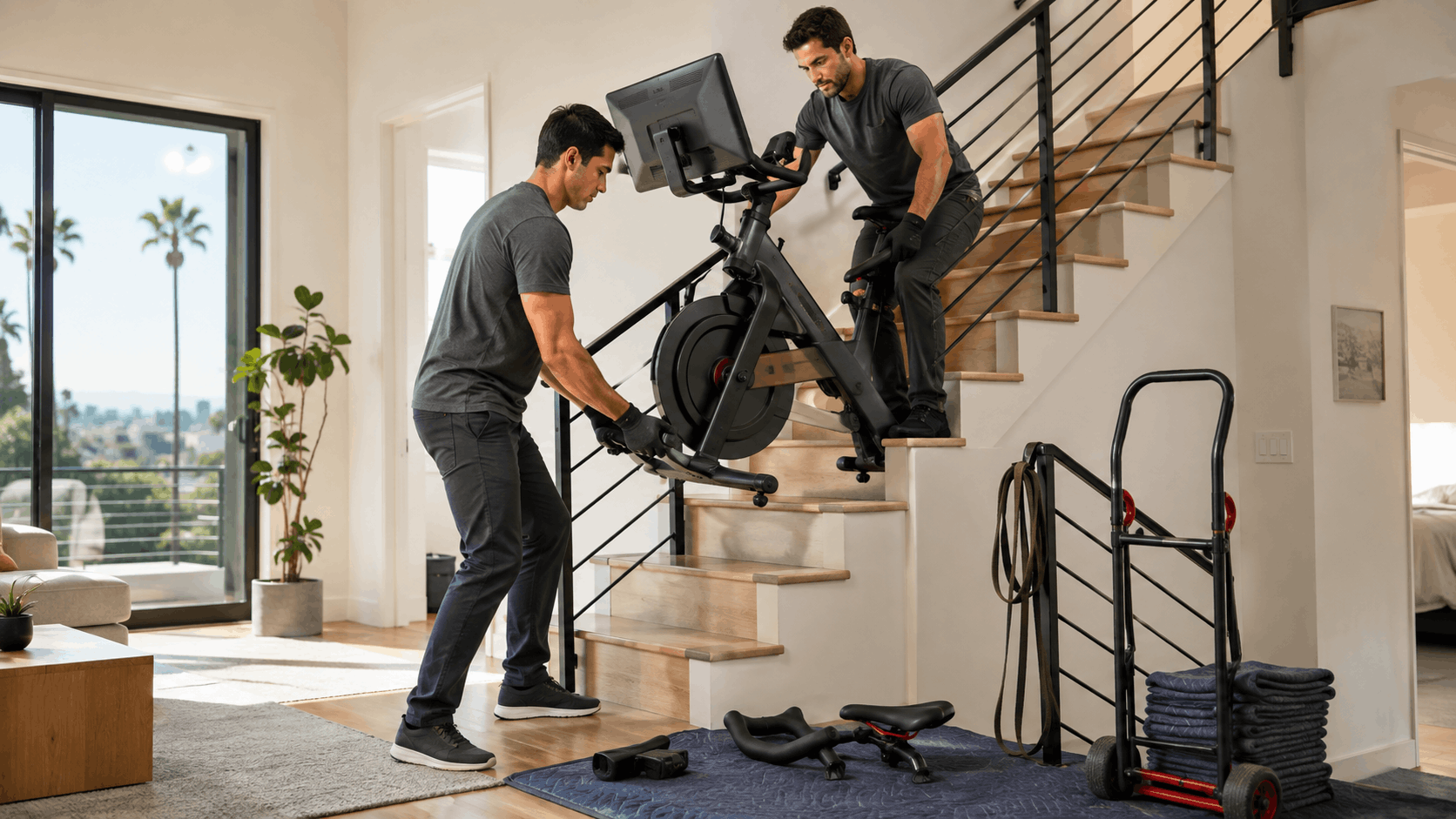
A family in Silver Lake called us last spring with a problem we hear a lot. They had a Peloton Bike sitting at the top of a narrow, turning staircase, and two friends had already tried to carry it down and given up halfway. The bike weighed more than they expected, the screen was in the wrong spot for a good grip, and the stairs had a tight switchback that left no room to pivot.
That call sums up why moving a home gym is nothing like moving a couch. Fitness gear is heavy, the electronics crack easily, and the shapes fight every doorway and hallway in an LA home. On top of that, stairs and hillside walks change the price in ways most people never plan for.
Let's talk about what comes apart, how weight and screens drive the plan, and how stairs and distance shape the final bill. We will share real numbers, real neighborhood examples, and a prep checklist so your specialty moving day goes smoothly and stays affordable.
Why Home Gym and Peloton Moves Need Special Handling
Home gym moving looks simple until you try to lift a loaded rack. Regular furniture spreads its weight and has handholds. Gym equipment concentrates hundreds of pounds into steel frames with sharp corners and no easy grip points.
That is why homeowners across LA call for help instead of risking a hernia or a cracked screen. A Peloton relocation mixes heavy equipment with fragile touchscreens, and one wrong move ends in a repair bill. Our crews handle these items every week, and the difference shows in how the gear arrives.
The Real Weight of a Loaded Rack or Bike
Weight drives the whole plan. A Peloton Bike weighs around 135 pounds, and the Bike+ runs a little heavier. That does not sound like much until you add stairs and a bad grip angle, which is exactly what tripped up that Silver Lake family.
Power rack weight is where things get serious. An empty power rack often starts at 300 pounds, and heavy-gauge models go well past that. Once you stack loaded plates on the uprights or store them on the frame, you can add several hundred more pounds to the same footprint.
Peloton weight is manageable for two trained movers on a flat floor, but a power rack is a different story. We plan crew size around the heaviest single item, not the average. When we know the real numbers up front, we bring the right people and the right straps so nobody gets hurt and the floor stays intact.
This is also why guessing hurts your budget. A crew sized for a couch cannot safely handle a 350-pound Smith machine, and a last-minute upgrade costs time. Honest weight estimates during the walkthrough keep the price fair and the day on schedule.
Fragile Screens and Sensitive Electronics
The Peloton screen is the part people worry about most, and for good reason. A single tap against a doorframe can spider the glass, and a replacement touchscreen is not cheap. The screen also sticks out from the frame, which makes it the first thing to hit a wall during a carry.
Treadmill motor damage is the quieter risk. The motor and belt assembly sits low and takes the shock if the machine gets dropped on a stair edge or bounces around loose in a truck. A jarred motor mount can throw off the belt alignment and shorten the life of the unit.
We remove or heavily pad the screen before any carry, then wrap the console in a screen box or thick moving blankets. For treads, we engage the motor lock or transport bolts when the model has them. That keeps the internal parts from shifting on a bumpy stretch of the 101.
Padding and securing are not extras we tack on for show. They are the difference between a Peloton that boots up in the new house and one that needs a service visit. A few dollars of blankets protects hundreds in electronics.
Awkward Shapes That Do Not Fit Through Doors
Standard interior doors run about 30 to 32 inches wide. Plenty of gym gear is wider than that, especially cable machines with outrigger arms and power racks with pull-up crossbars. A long flat bench can also jam in a hallway turn even when it clears the door itself.
Doorway clearance is the number one reason a move stalls out. A cable machine that will not fit through the front door has to come apart, and that eats time nobody planned for if they skipped measuring. We have seen homeowners in older Echo Park bungalows discover their rack was assembled inside a room it can never leave in one piece.
Measuring first saves real money. When we know a doorway is 29 inches and the rack is 48 inches wide, we plan the disassembly before we arrive. That turns a surprise into a scheduled task with the right tools already on the truck.
Long items also need turning room, not just a wide opening. A 7-foot barbell or a full-length bench needs clearance at the top and bottom of a stairwell to pivot. We measure the tight spots, not just the door, so there are no dead ends on moving day.
Get Your Free Quote
Tell us about your move and we'll get back to you fast.
Disassembly: What Comes Apart and What Stays Whole
Equipment disassembly is half the battle with a home gym. Some pieces roll out whole, and some have to come down bolt by bolt. Knowing which is which before the truck arrives keeps the gym breakdown quick and the reassembly clean.
Here is the general rule we follow:
- Move whole: most Peloton Bikes on a flat exit, adjustable benches, kettlebells, and small accessories.
- Partial breakdown: Peloton Tread, spin bikes with tall consoles, and rowing machines that fold.
- Full breakdown: power racks, Smith machines, cable towers, and any wide steel structure heading down stairs.
Breaking Down a Peloton Bike or Tread
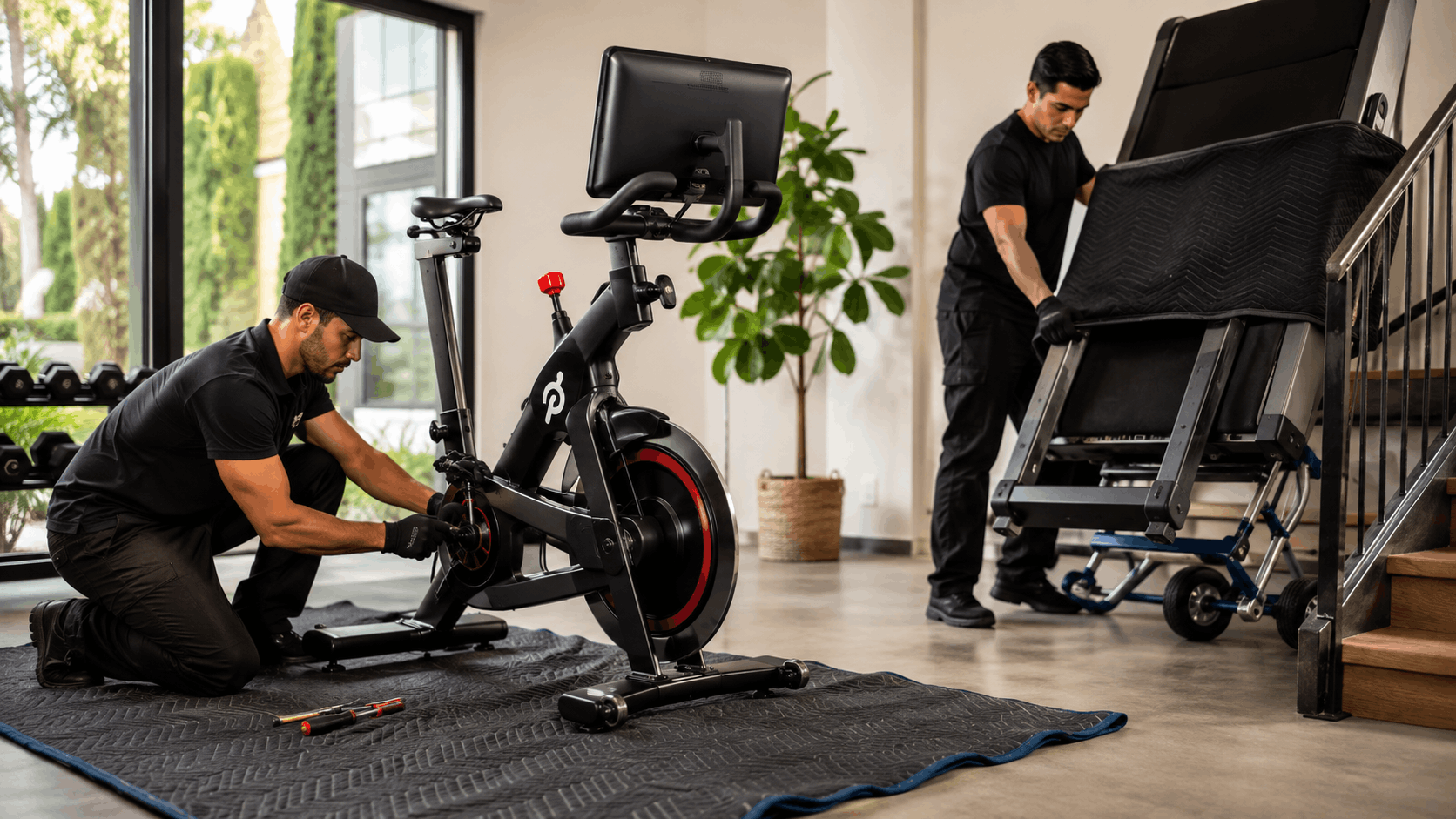
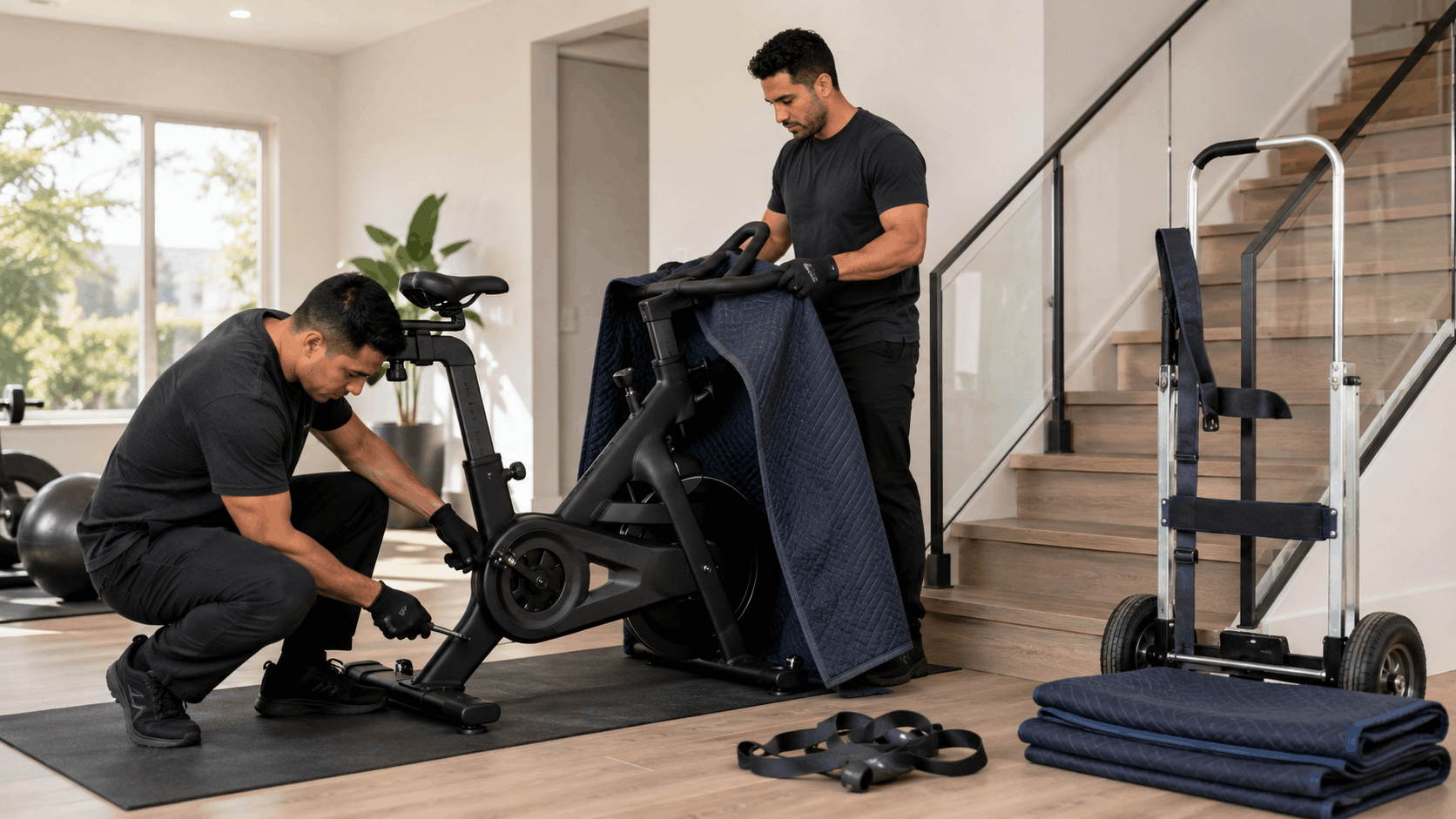
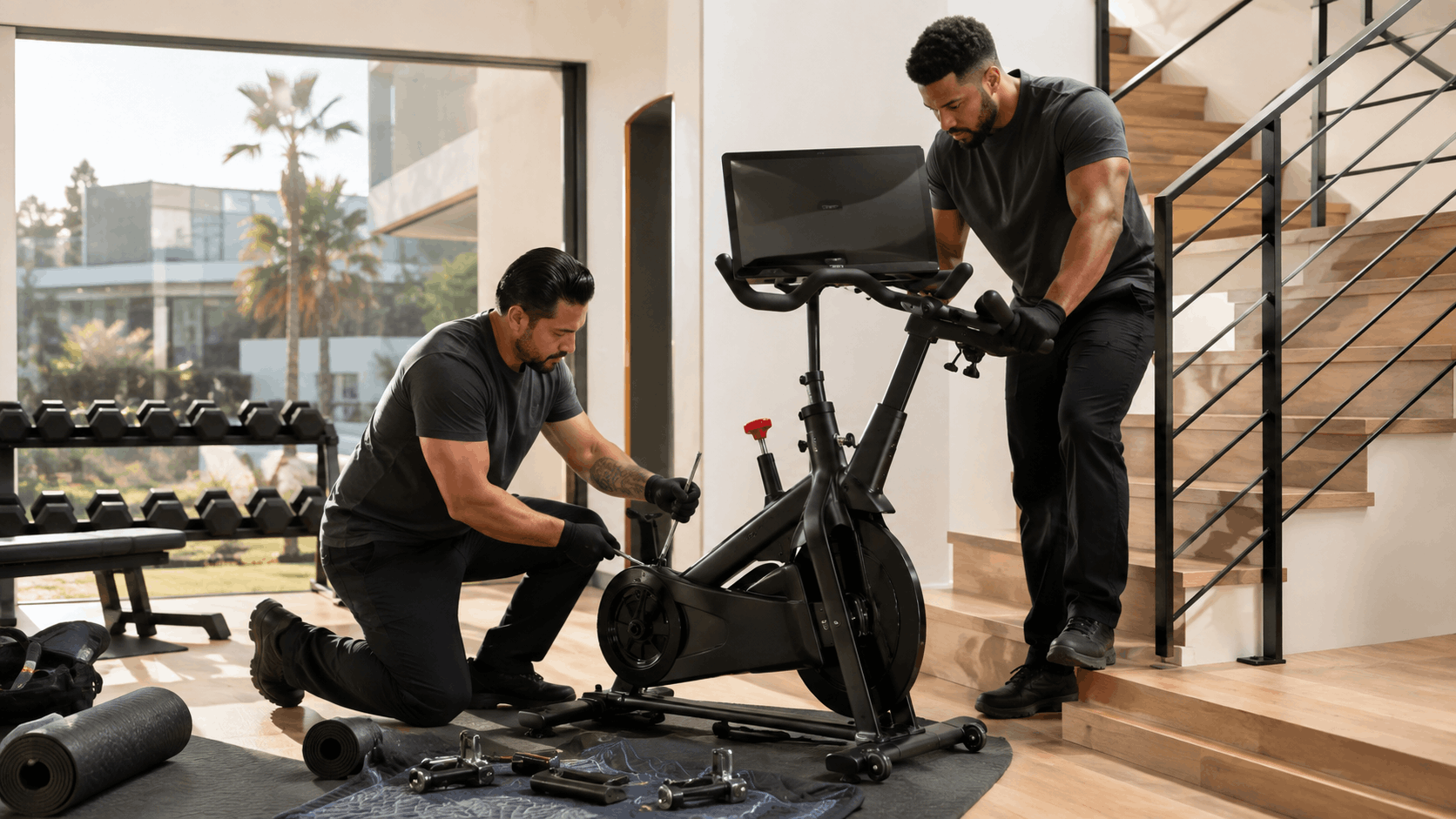
A Peloton Bike disassembly is usually light. We remove the touchscreen, take off the pedals, and pull the water bottle holders and any weight rack accessories. That drops the awkward weight and gets the fragile glass out of harm's way before the carry.
The Peloton Tread is a bigger job. On models that fold, we lock the deck in the raised position, and on others we secure the motor and running belt so nothing shifts. The Tread is long and front-heavy, so we plan the carry angle before we lift it an inch.
We bag every removed part and label it by machine. Pedals, screen bolts, and bottle holders all go in one marked pouch so nothing rolls under a truck seat. That small habit saves 20 minutes of hunting during reassembly.
At the new home, we rebuild the Bike or Tread and confirm the screen powers on before we leave. If a customer wants to handle final setup themselves, we still reinstall the heavy parts so only the light finishing steps remain.
Power Racks, Smith Machines, and Cable Towers
Large steel structures almost always come apart. A power rack breaks into uprights, crossbars, and safety arms, and a Smith machine adds a guide-rail carriage and counterweights on some models. We work bolt by bolt, from the top down, so the frame never becomes unstable while a mover is under it.
Cable towers hide their weight in the plate stack and pulleys. We release cable tension, remove the weight stack, and separate the tower sections before anything goes near a staircase. A fully assembled tower is both too wide for most halls and too heavy to control on stairs.
Hardware labeling is where a good crew earns its keep. Every bolt, pin, and washer gets grouped by the section it came from and bagged with a note. A power rack can have 40 or more fasteners, and mixing them up turns a two-hour rebuild into a half-day puzzle.
We also photograph the assembly before we start. Those pictures act as a map at the new home, especially on cable routing and rack pin placement. It is a simple step that keeps the reassembly accurate.
Free Weights, Dumbbells, and Plates
Dumbbell moving is all about box discipline. We sort loose weights by size and load them into small, heavy-duty boxes, never the big ones. A big box tempts you to fill it, and a filled box of plates can top 150 pounds and blow out the bottom.
Weight plates go on edge, packed tight so they cannot slide and crack a floor if the box tips. We cap most weight boxes at around 50 pounds so a single mover can carry them safely up and down stairs. Two lighter boxes always beat one back-breaker.
Dumbbells get the same treatment, grouped in pairs and cushioned so the coated ones do not chip. Adjustable dumbbell sets travel in their factory cradles when we have them, since those hold the plates in place.
We keep the heavy boxes low in the truck and toward the front wall. That keeps the load balanced and stops a runaway box from shifting into your Peloton screen on the freeway.
Time and Tools Needed for Reassembly
Reassembly time depends on what came apart. A Peloton Bike goes back together in about 15 to 30 minutes. A power rack or Smith machine usually takes 45 minutes to a couple of hours, and a cable machine with routing can run longer.
Our crews carry the moving tools these jobs need as standard kit. That includes metric and standard hex keys, socket sets, adjustable wrenches, and rubber mallets for stubborn pins. We do not want to stop mid-build because a single Allen key stayed at the old house.
Keeping the original manuals handy speeds everything up. Torque specs and bolt sequences matter on racks that hold a loaded barbell over your head. When the manual rides along in the hardware bag, the rebuild follows the maker's exact steps.
We test every rebuilt machine before we consider the job done. Racks get checked for level and tight bolts, and screens get powered on. A gym you can use the same day is the whole point of doing the reassembly right.
Need Help in Los Angeles?
Popeye Moving & Storage serves Los Angeles and all of Los Angeles County.
How Stairs Change the Price of Your Move
Stairs are the number one thing homeowners ask us about, and for good reason. Stair carry cost is real because moving 300 pounds up a flight is slower and riskier than rolling it across a driveway. A stair fee reflects the extra labor, time, and care each level demands.
Labor pricing for heavy gym gear scales with three things: how many flights, how wide the stairs are, and how many turns they have. Here is a rough guide to how those factors add up:
| Stair Factor | Typical Impact on a Gym Move |
|---|---|
| 1 flight, straight and wide | Minor added time, small or no stair fee |
| 2+ flights or a switchback | Larger crew or extra hours, moderate fee |
| Narrow stairs under 34 inches | Slower carries, may require disassembly |
| Exterior hillside steps | Long-carry factor, highest added labor |
Counting Flights and Landings
Most movers price stair work per flight, and a flight of stairs means one run between two floors. A two-story Studio City home with a single straight staircase is easy math. A three-level hillside house with a flight to each floor is a different quote entirely.
Landings and switchbacks slow things down more than the steps themselves. Every turn forces the crew to reposition a heavy rack section, and a tight landing may not give a long bench room to pivot. Those pauses add up across dozens of trips.
Stair pricing also depends on how many trips a piece needs. A boxed set of plates might take ten trips up alone, and each one counts. We estimate trips during the walkthrough so the number on your quote is not a guess.
Common LA multi-level homes make this a frequent talk. Split-levels, homes over garages, and hillside builds all stack flights between the truck and the gym room. We count every level so nothing surprises you on the invoice.
Narrow Staircases in Older LA Homes
Older homes in Echo Park and Highland Park are full of charm and full of narrow stairs. Many were built long before home gyms existed, with steep runs and walls close on both sides. A 34-inch-wide staircase leaves almost no room for a mover's hands on a wide rack.
Narrow stairs often force more disassembly than a newer house would. A power rack that might travel in two sections elsewhere may need to come fully apart to clear a tight 1920s stairwell. That extra breakdown adds time, so we plan for it up front.
Steep steps also change the carry technique. We use stair-climbing dollies and shoulder straps to keep the load controlled on a sharp pitch. Control matters more than speed when you have a treadmill on a steep flight.
If you live in one of these older homes, tell us during the walkthrough. We have carried gear out of hundreds of vintage properties around Northeast LA, and we know the tricks that keep the walls and the gear safe.
Exterior Steps, Hills, and Long Walks
Hillside homes in the Hollywood Hills and around the reservoir in Silver Lake add a whole new factor: distance from the truck to the door. When the truck parks on a narrow road and the house sits up 40 outdoor steps, every item takes a long climb.
The long carry fee covers that outdoor distance and elevation. Exterior steps are often uneven, sometimes wet, and rarely straight. Carrying a 135-pound Peloton up a garden staircase is far harder than the same weight indoors.
We scout the walk path before we start. Loose pavers, low branches, and gate widths all matter when a crew is hauling a power rack. Clearing that path ahead of time cuts the long-carry time.
Some hillside homes in areas like Brentwood have long driveways where we can get the truck closer. When that is an option, we take it, because shortening the walk is the fastest way to lower this part of the bill.
When Elevators or Hoisting Are Cheaper
In apartments and condos, an elevator move often beats a stair carry on both cost and safety. Rolling a padded Peloton onto a service elevator is quicker than wrestling it down eight flights. We reserve the elevator with building management when the property allows it.
Some units are too tall or too wide to fit any elevator, and the stairwell is a nightmare. In those cases, hoisting equipment through a balcony or large window can be the smart call. A hoist lifts the item straight up the outside of the building with rigging and a crew top and bottom.
Hoisting sounds dramatic, but for the right piece it saves time and reduces the risk of a stairwell accident. We assess whether a balcony rail and window opening can handle it during the walkthrough. Not every building qualifies, so we confirm first.
The point is that stairs are not the only option. When we spot a faster, safer route, we tell you, because a lower-risk move usually means a lower price too.
What Drives the Total Cost of a Gym or Peloton Move
Moving cost for a home gym comes down to a handful of factors you can actually budget around. There is no single flat rate for every job because a single Peloton is worlds apart from a full garage gym. Below is how the gym move price usually breaks down.
| Cost Factor | Typical Range or Effect |
|---|---|
| Single Peloton Bike, flat move | Lower end, often a set flat rate |
| Full home gym with rack and plates | Higher, priced by crew hours plus stairs |
| Disassembly and reassembly labor | Added time on top of the carry |
| Stairs and long carries | Per-flight and long-carry fees |
| Distance and traffic window | Affects total truck and crew hours |
Weight, Volume, and Crew Size
Heavier loads often need a bigger crew, and crew size is one of the biggest cost levers. Two movers handle a Peloton and a bench fine. A power rack, a treadmill, and 500 pounds of plates usually calls for three or four to work safely.
Volume matters alongside weight. A garage packed with machines fills a truck and takes more trips, even if no single item is huge. We size the truck and crew to the whole load, not just the star piece.
Hourly rate work rewards efficiency, and a right-sized crew is faster per dollar than a short-handed one. Three movers finishing in three hours often costs less than two movers grinding through five. We aim for the crew size that gets you the lowest total.
For very large home gyms, we sometimes suggest a flat rate instead. When the scope is clear from the walkthrough, a flat quote gives you a firm number with no clock-watching.
Disassembly and Reassembly Labor
Breaking down and rebuilding racks and machines is labor time that folds right into the estimate. A full power rack teardown and rebuild can add one to three hours across both homes. That time is real work, and we quote it honestly.
The assembly fee, when we itemize it, reflects the tools, care, and testing that go into a safe rebuild. A rack that holds a loaded barbell has to be tight and level, and that is not a corner we cut. You are paying for equipment you can trust the same day.
You can trim this cost by handling some breakdown yourself. If you remove pedals and accessories before we arrive, that is time off the clock. We are glad to leave the light finishing steps to homeowners who want them.
We always confirm the disassembly plan before moving day. Knowing in advance which pieces come apart lets us schedule the right hours instead of discovering the scope mid-move.
Distance Across LA and Traffic Windows
Distance and LA traffic shape the truck and crew hours more than people expect. A move from the Westside to Downtown can crawl on the 10 at rush hour and fly at 6 a.m. The clock runs during that drive, so timing matters.
Moving distance across a spread-out city like ours is rarely a straight shot. Getting from Culver City to Pasadena means the 10 to the 110, and a Silver Lake to Santa Monica run leans on the 101 and surface streets. We plan routes around the worst chokepoints.
We book start times to dodge the heaviest windows when we can. An early start often saves an hour of idling on the 405 near the Sepulveda Pass. That hour is money back in your pocket.
For longer hauls, our California long distance moving team plans the drive as part of the quote. Whether it is across town or across the state, the route is part of the price.
Packing Materials and Protection
Moving blankets, screen boxes, and floor protection are small line items next to the value they protect. A dozen blankets and a screen box cost a fraction of a cracked Peloton display. We would rather over-protect than gamble your gear.
Screen protection is non-negotiable on our jobs. Every console gets wrapped or boxed before it leaves the room. That single step prevents the most common and most expensive gym-move damage.
Floor and wall materials protect your home, not just the gear. Runners, corner guards, and doorframe padding keep a heavy rack from gouging your hardwood or chipping paint. Repairing a floor costs far more than the protection did.
If you want to supply your own blankets to save a little, we are fine with that. We will tell you exactly what and how much you need. For most people, letting us bring proper materials is the cheaper insurance.
Protecting Floors, Walls, and Equipment During the Move
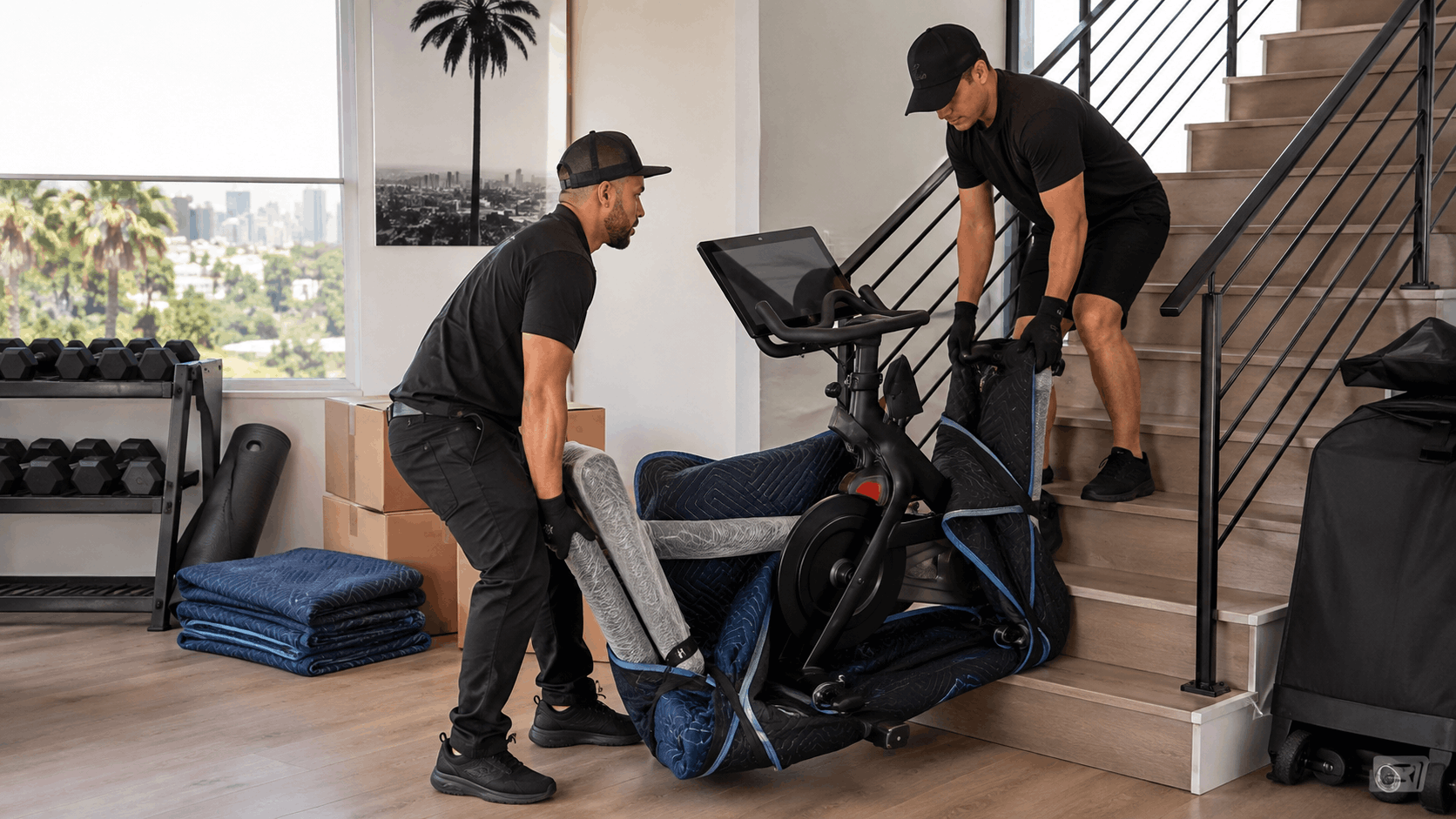
Homeowners worry about scratched hardwood and dinged drywall almost as much as the gear itself, and rightly so. Damage prevention is built into how we work, not an afterthought. Floor protection and wall guards go down before the first heavy item moves.
A home gym move puts more weight over small floor points than almost any other job. That means guarding the house is part of the plan from the first step.
Guarding Hardwood and Tile Floors
Hardwood floors are everywhere in LA remodels, from Craftsman restorations to modern flips. A dragged plate or a dropped dumbbell leaves a gouge that stands out on refinished wood. We lay rubber runners along the whole path before we carry anything.
Floor runners give the crew sure footing and give your floor a barrier. On tile, they also stop a heavy corner from cracking a single expensive tile that is hard to match. We roll them out from the gym room all the way to the truck.
Dollies do the heavy lifting so weight never grinds against the floor. A padded appliance dolly under a treadmill spreads the load and rolls smoothly on the runners. That combination keeps refinished floors looking untouched.
We check the path for area rugs and thresholds too. A curled rug edge or a raised threshold is a trip hazard with 300 pounds in your arms, so we flatten or remove them first.
Corner and Doorframe Protection
Tight corners and doorframes take the most hits during a gym move. A wide rack section swinging around a hallway corner can crack drywall or chip a painted frame in a second. We pad every pinch point before the carry starts.
Doorframe padding wraps the jambs where a heavy item squeezes through. Those few inches of clearance are exactly where scrapes happen, so we protect them. It costs us minutes and saves you a paint touch-up.
Corner guards protect both the wall and the gear. A steel upright dinging a corner damages the paint and can scratch the equipment's finish. Padding between the two keeps both clean.
In older homes with plaster walls, this care matters even more. Plaster cracks and crumbles more easily than modern drywall, so we go heavier on the padding in vintage Highland Park and Echo Park houses.
Securing Gear Inside the Truck
A perfect carry means nothing if the load shifts on the freeway. We strap and block every piece so a treadmill or rack cannot slide during a hard stop on the 101. Truck straps anchor the heavy items to the walls of the truck.
Blocking fills the gaps so nothing has room to move. A power rack section wedged and strapped stays put through stop-and-go traffic. Loose gear is how screens crack between the old house and the new one.
We load with weight balance in mind. Heavy plate boxes go low and forward, and the Peloton screen rides padded and secured away from anything that could swing into it. Load securing is as much about placement as it is about straps.
Rough roads are part of LA, from patched surface streets to freeway expansion joints. We pack the truck expecting bumps, so your gym arrives the way it left. Careful loading is the last line of defense for your equipment.
Need Help in Los Angeles?
Popeye Moving & Storage serves Los Angeles and all of Los Angeles County.
How Popeye Moving & Storage Handles Fitness Equipment Across LA
Popeye Moving has carried a lot of Pelotons and power racks up and down LA staircases. Our approach to gym movers work is built around the two things that go wrong most: heavy carries and cracked screens. We plan for both before we lift a thing.
As Los Angeles movers, here is how our process runs:
- Walkthrough first: we count stairs, measure doorways, and list every piece.
- Written estimate: you get a clear price with stairs and disassembly spelled out.
- Protect the home: runners, corner guards, and doorframe padding go down.
- Break down and pad: screens off, racks apart, hardware bagged and labeled.
- Secure and drive: strapped loads and routes planned around traffic.
- Reassemble and test: gear rebuilt and checked before we leave.
Areas the Team Serves Every Day
Our crews work across LA neighborhoods every day of the week. On any given morning we might be in Studio City, Sherman Oaks, or up a hillside street in the Hollywood Hills. We know the parking, the stairs, and the traffic in each.
On the Westside, we handle a lot of gyms in Culver City and Brentwood. These range from condo units with service elevators to two-story homes with a garage gym below.
Being real local movers means we do not learn your street on moving day. We already know which blocks are tight for a truck and which hillside roads need a smaller vehicle. That knowledge keeps your move on schedule.
From the beach cities down to Santa Monica and inland toward Pasadena, our coverage spans the whole basin. Wherever your gym is, chances are we have moved one near it.
The Walkthrough and Written Estimate
Every gym move starts with a walkthrough, in person or by video. We count the flights, measure the tight doorways, and log every machine and how much weight comes with it. That is how we build a moving estimate you can trust.
The walkthrough is where surprises get caught early. A rack that has to come fully apart or a narrow stair that needs a smaller crew are things we would rather know now than mid-move. Catching them keeps the price stable.
Your written estimate spells out the stairs, the disassembly, and the materials. No vague line items, no mystery fees on moving day. You approve the number before we schedule.
If your plans change, we update the estimate. Adding a treadmill or switching a stair-carry to an elevator move both change the math, and we keep it transparent throughout.
Storage Options for Between Moves
Sometimes the new place is not ready when the old lease ends. Our storage solutions hold your gym safely in the gap, whether that is a week or a few months. Short-term storage takes the pressure off a tight timeline.
Climate matters for the electronics. A Peloton screen and a treadmill motor do not like extreme heat or damp, so we keep sensitive gear in conditioned space. Steel racks and plates are hardier but still store better dry.
We label and inventory everything that goes into storage. When your new home is ready, your bagged hardware and manuals come out with the machines they belong to. Nothing gets lost in the shuffle.
Storing between moves also lets us reassemble on your schedule. We can deliver and rebuild the gym the day your new floor is finished, not before.
Preparing Your Home and Gear Before Moving Day
A little moving prep on your end makes the whole job faster and cheaper. The crew spends less time solving surprises and more time carrying. Here is a checklist you can knock out before moving day.
None of these steps are hard, and each one shaves time off the clock or protects your gear.
Measuring Doorways and Stair Widths
Grab a tape measure and check the width of every door your gym has to pass through. Note the narrowest one, since that is the one that decides what has to come apart. Measuring doorways early tells us the disassembly plan before we arrive.
Stair width matters just as much. Measure the clear space between walls or railings on the staircase, not just the step depth. A stair width under 34 inches often means a wider rack has to break down further.
Do not forget the turns and landings. A door might be wide enough while the landing above it is too tight to pivot a long bench. Measure the smallest spot on the whole path.
Share those numbers with us ahead of time. When we know your doorway is 30 inches and your rack is 48, we plan the exact breakdown and bring the right tools. It turns guesswork into a set plan.
Finding Manuals and Hardware
Dig out the assembly manual for each machine before moving day. The manual has the bolt sequences and torque specs that make reassembly fast and safe. If you tossed the paper copy, most are free to download from the maker's site.
Gather any original bolts and hardware you have set aside. Some homeowners keep a spare-parts baggie from the first build, and those extras are handy if a bolt goes missing. Having them on hand prevents a hardware-store detour.
Use a hardware bag for the small parts you remove yourself. Zip-top bags labeled by machine keep pedals, pins, and screws from wandering off. A single lost bolt on a power rack can stall the whole rebuild.
Keep the manuals and hardware bags together in one box. Point us to that box on moving day, and reassembly goes quickly. Everything the crew needs is in one place.
Clearing a Path and Parking
Clear the hallways and the exit path before we arrive. Move small furniture, roll up loose rugs, and open the gates. A clear path means the crew is not setting down a 300-pound rack to shuffle a chair.
Parking is its own project on busy LA streets. Save a spot near the door if you can, because a shorter carry is a cheaper carry. On tight blocks in Silver Lake or Echo Park, that head start really helps.
Some areas need a parking permit for a moving truck. The city offers temporary no-parking permits through the LA Department of Transportation, and reserving curb space avoids fines and long carries. Check the rules for your street a week ahead.
Tell us where the truck can realistically park. If the only spot is a block away or down a hill, we plan the carry around it. Knowing the parking reality up front keeps the estimate accurate.
Need Help in Los Angeles?
Popeye Moving & Storage serves Los Angeles and all of Los Angeles County.
Final Thoughts
Moving a home gym in LA comes down to three things: weight, fragile electronics, and stairs. A Peloton Bike near 135 pounds and a power rack past 300 both demand the right crew, and stairs and hillside walks are where the price really moves. Plan for disassembly, protect the screens, and measure your doorways, and the job goes smooth.
Our team handles these moves across the city every week, from Studio City condos to hillside homes in Silver Lake. We break down the racks, guard your floors, secure the load, and rebuild your gym so you can use it the same day.
If you are moving a Peloton or a full garage gym, contact Popeye Moving & Storage for a walkthrough and a written estimate. Call us, share your stair count and equipment list, and we will give you a clear price before moving day.
Frequently Asked Questions
Do movers disassemble a Peloton Bike before moving it?
In most cases, yes. We remove the touchscreen, pedals, and water bottle holders to protect the fragile glass and lighten the awkward weight. On a flat exit with wide doors, a Bike can sometimes move whole with the screen padded. Stairs, narrow doors, or a Tread almost always call for partial disassembly. We rebuild and test everything at your new home before we leave.
How much does it cost to move a home gym in LA?
It varies with weight, stairs, and distance. A single Peloton on a flat move often runs a modest flat rate. A full home gym with a power rack, treadmill, and hundreds of pounds of plates costs more because it needs a bigger crew, disassembly time, and stair labor. The best way to get a real number is a walkthrough and written estimate.
Why do stairs add to the moving price?
Stairs add labor, time, and risk. Carrying 300 pounds up a flight is far slower than rolling it across a driveway, and each turn or landing forces the crew to reposition a heavy load. More flights and narrow, steep steps mean more trips and often a larger crew. That extra work shows up as a per-flight or stair fee on your estimate.
How heavy is a Peloton and can two people carry it?
A Peloton Bike weighs around 135 pounds, and the Bike+ is a bit heavier. Two trained movers can handle it safely on a flat floor with proper straps. Stairs, narrow halls, or hillside steps make a two-person carry harder and sometimes call for a third set of hands. We size the crew to the route, not just the weight.
Will moving my Peloton void the warranty?
Moving the equipment itself does not usually void anything, but damage from a careless move might not be covered. We remove the screen, pad the console, and secure the frame to prevent transport damage. Check Peloton's current warranty and moving policy before your move, since terms change. Careful handling keeps the machine in the condition the warranty expects.
Can dumbbells and weight plates go in one box?
Only in small, sturdy boxes with strict weight limits. We cap most weight boxes around 50 pounds so a single mover can carry them up and down stairs safely. Plates go on edge, packed tight so they cannot slide. Never fill a large box with plates, because the bottom can blow out and damage a floor or injure someone.
How long does a home gym move usually take?
It depends on the amount of gear and the stairs. A single Peloton on a flat move can wrap in about an hour. A full home gym with a rack, treadmill, and plates, plus disassembly and reassembly, often runs four to eight hours. Stairs and long hillside carries add time. Your walkthrough gives you a realistic window.
Do I need to reserve parking for the moving truck?
On busy or narrow LA streets, reserving parking helps a lot. A closer spot means a shorter, cheaper carry. Many areas need a temporary permit for a moving truck, available through the LA Department of Transportation. Save curb space near your door when you can, and tell us where the truck can realistically park so we plan the carry.
Can the crew store my equipment if my new place is not ready?
Yes. We offer short-term storage for the gap between homes, whether that is a week or a few months. Sensitive electronics like your Peloton screen and treadmill motor go in climate-controlled space, since heat and damp are hard on them. Everything is labeled and inventoried, and your hardware and manuals stay with their machines for a clean reassembly later.
What areas of Los Angeles does Popeye Moving serve?
Our crews work across the whole basin. That includes Studio City, Sherman Oaks, Brentwood, Culver City, Santa Monica, Silver Lake, Echo Park, Highland Park, Pasadena, Burbank, and the Hollywood Hills, plus the beach cities. Whether you are in a hillside home or a condo with a service elevator, we have likely moved a gym near you and know the local streets and parking.
Frequently Asked Questions
- Do movers disassemble a Peloton Bike before moving it?
- In most cases, yes. We remove the touchscreen, pedals, and water bottle holders to protect the fragile glass and lighten the awkward weight. On a flat exit with wide doors, a Bike can sometimes move whole with the screen padded. Stairs, narrow doors, or a Tread almost always call for partial disassembly. We rebuild and test everything at your new home before we leave.
- How much does it cost to move a home gym in LA?
- It varies with weight, stairs, and distance. A single Peloton on a flat move often runs a modest flat rate. A full home gym with a power rack, treadmill, and hundreds of pounds of plates costs more because it needs a bigger crew, disassembly time, and stair labor. The best way to get a real number is a walkthrough and written estimate.
- Why do stairs add to the moving price?
- Stairs add labor, time, and risk. Carrying 300 pounds up a flight is far slower than rolling it across a driveway, and each turn or landing forces the crew to reposition a heavy load. More flights and narrow, steep steps mean more trips and often a larger crew. That extra work shows up as a per-flight or stair fee on your estimate.
- How heavy is a Peloton and can two people carry it?
- A Peloton Bike weighs around 135 pounds, and the Bike+ is a bit heavier. Two trained movers can handle it safely on a flat floor with proper straps. Stairs, narrow halls, or hillside steps make a two-person carry harder and sometimes call for a third set of hands. We size the crew to the route, not just the weight.
- Will moving my Peloton void the warranty?
- Moving the equipment itself does not usually void anything, but damage from a careless move might not be covered. We remove the screen, pad the console, and secure the frame to prevent transport damage. Check Peloton's current warranty and moving policy before your move, since terms change. Careful handling keeps the machine in the condition the warranty expects.
- Can dumbbells and weight plates go in one box?
- Only in small, sturdy boxes with strict weight limits. We cap most weight boxes around 50 pounds so a single mover can carry them up and down stairs safely. Plates go on edge, packed tight so they cannot slide. Never fill a large box with plates, because the bottom can blow out and damage a floor or injure someone.
- How long does a home gym move usually take?
- It depends on the amount of gear and the stairs. A single Peloton on a flat move can wrap in about an hour. A full home gym with a rack, treadmill, and plates, plus disassembly and reassembly, often runs four to eight hours. Stairs and long hillside carries add time. Your walkthrough gives you a realistic window.
- Do I need to reserve parking for the moving truck?
- On busy or narrow LA streets, reserving parking helps a lot. A closer spot means a shorter, cheaper carry. Many areas need a temporary permit for a moving truck, available through the LA Department of Transportation. Save curb space near your door when you can, and tell us where the truck can realistically park so we plan the carry.
- Can the crew store my equipment if my new place is not ready?
- Yes. We offer short-term storage for the gap between homes, whether that is a week or a few months. Sensitive electronics like your Peloton screen and treadmill motor go in climate-controlled space, since heat and damp are hard on them. Everything is labeled and inventoried, and your hardware and manuals stay with their machines for a clean reassembly later.
- What areas of Los Angeles does Popeye Moving serve?
- Our crews work across the whole basin. That includes Studio City, Sherman Oaks, Brentwood, Culver City, Santa Monica, Silver Lake, Echo Park, Highland Park, Pasadena, Burbank, and the Hollywood Hills, plus the beach cities. Whether you are in a hillside home or a condo with a service elevator, we have likely moved a gym near you and know the local streets and parking.
P
Popeye Moving & Storage Co. Team Team
Licensed moving and storage professionals serving Los Angeles and Los Angeles County.
Licensed in California · License #PUC: CAL T 189749 | DOT: 1472924 | MC: 498816C
Why trust Popeye Moving & Storage?
Founded in 1994, Popeye Moving & Storage is a licensed and insured moving and storage service serving Los Angeles and Los Angeles County. All content is reviewed by our licensed technicians.

Need Help in Los Angeles?
Popeye Moving & Storage serves Los Angeles and all of Los Angeles County.
Related Articles
Cost Guides
Full-Service vs Self-Pack Move LA: Cost Comparison by Home Size
Compare full-service and self-pack moving costs in LA by home size, from studios to estates, plus hidden fees and tips to pick the right option for your budget.
Cost Guides
Moving Cost by Home Size in LA: 1,200 vs 2,500 vs 4,000+ Sq Ft Real Ranges With Crew and Truck Counts
Real LA moving cost ranges by home size, with honest crew and truck counts for 1,200, 2,500, and 4,000+ sq ft homes, plus tips to lower your bill.

Cost Guides
Moving from Silver Lake to the Valley: What the Price Difference Means for Your Move
Discover how much you can save monthly by moving from Silver Lake to Valley neighborhoods, plus moving costs and lifestyle changes to expect during your relocation.