Tips & Advice
Marina Del Rey Movers: Boat Dock and Waterfront Apartment Service

Key Takeaways
- Marina Del Rey moves face unique hurdles: narrow peninsula streets, gated docks, small loading zones, and coastal salt air.
- Boat and liveaboard moves use flatbed dock carts and staging areas, timed around tides and marina office hours.
- Waterfront towers often require freight elevator reservations, a certificate of insurance, and set move windows.
- Los Angeles County Department of Beaches and Harbors oversees marina dock access and vehicle rules on top of building policies.
- Most moves are billed hourly ($120-$180 for two movers), with long-carry and stair fees driven by marina access.
- Short-term and climate-controlled storage protects coastal items and bridges gaps between marina move dates.
- Booking two to four weeks ahead, staging boxes, and choosing a mid-week date keep costs and delays down.
- Planning around morning marine-layer fog keeps furniture and floors dry and the move safe.
In This Article
It usually starts with a phone call from someone standing on a dock, staring at a sofa that will not fit through the gate. Maybe it is a fourth-floor unit on Via Marina with a freight elevator the building forgot to mention needs a reservation. Or a liveaboard owner on Bora Bora Way trying to walk a mattress two hundred feet down a slick, gated dock while the tide drops. These are the moments that make moving in Marina Del Rey unlike anywhere else in Los Angeles.
Our team has spent years working these exact waterfront blocks, from the boat slips near Fisherman's Village to the high-rise condos along Admiralty Way. We know where trucks can park, which buildings demand a certificate of insurance, and how the morning marine layer can leave your furniture damp before you even load it.

What Makes Moving in Marina Del Rey Different?
Marina Del Rey was built around water, not trucks. The peninsulas, basins, and boat slips create access problems that a standard crew from the Valley has never dealt with. A Marina Del Rey moving job asks for planning that most residential jobs skip entirely.
A successful waterfront relocation here depends on knowing the layout before the truck ever rolls up. Below are the four factors that shape almost every boat dock move and apartment job in the marina.
- Narrow drives where trucks cannot park close to the door
- Waterfront towers with tiny loading zones and strict move windows
- Gated docks, ramps, and slip numbering that slow boat moves
- Salt air and morning fog that threaten furniture
Tight Access Around the Marina Basins
The residential drives along Bora Bora Way, Tahiti Way, and Marquesas Way were laid out for cars and boats, not 26-foot moving trucks. Many of these streets end in cul-de-sacs or dead-end at the water, so there is nowhere for a large truck to sit near a building entrance. Crews often stage the truck at the closest legal spot and carry everything the rest of the way.
That extra distance is what movers call a long carry, and it adds real time to the job. A carry of 150 to 300 feet is common on these peninsula streets, and every trip back and forth eats minutes. On a big household move, a long carry can add an hour or more to the total.
The narrow access also limits how many movers can work at once. Two people passing on a tight dock or a slim side path have to time their steps around each other. Our team plans the walking route in advance so the crew is not tripping over itself all day.
Knowing these streets matters. We have driven the loops around every marina basin, so we already know where a truck can idle without blocking a neighbor or drawing a ticket.
Waterfront Buildings With Limited Loading Zones
The high-rise and mid-rise towers along Admiralty Way and Via Marina look great from the water, but they were not built with big moves in mind. Most have a single small loading dock or a short curb zone that fits one truck at a time. If another resident is moving the same day, you may be waiting your turn.
Many of these buildings enforce strict move windows, often 9 a.m. to 5 p.m. on weekdays only. Miss the window and you could be forced to reschedule, which costs money and time. We confirm the building's loading zone hours before we set the arrival time.
Some towers also cap how long a truck can occupy the loading zone. A two-hour limit is common, which means a large move needs a fast, well-staged crew to avoid overstaying. Our crews break the job into loading stages so the truck spends less time parked and more time moving.
For condo owners, we recommend our local residential moving team, which handles these building rules every week across Los Angeles.
Boat Slips and Dock Gate Restrictions
Liveaboard and boat moves come with their own set of obstacles. Most docks sit behind a locked gate, and only slip holders have keys or codes. That means the crew has to be escorted in, and every load has to pass back through that single gate.
Slip numbering can be confusing even for regulars. Finding slip C-42 on a long finger dock takes time when the numbering jumps around. We ask owners to send a photo of the slip location and dock letter before the move so the crew walks straight to it.
Ramp angles change all day with the tide. At low tide, the ramp from the parking area down to the boat dock can get steep and slick. Carrying a heavy dresser down a 20-degree ramp is a two-person job at minimum, and we plan the heaviest items around the gentlest ramp angles.
The daily tide swing in the marina runs several feet, so a dock that felt level in the morning may tilt by afternoon. Timing the move around the tide keeps the walk safer and faster.
Salt Air and Coastal Weather Factors
The marine layer rolls in most mornings and can sit over the marina until late morning. That damp fog leaves a light film of moisture on everything, including your furniture, boxes, and the dock surface. Wet cardboard tears, and wet wood floors get slippery.
Salt air is harder on belongings than most people expect. It speeds up corrosion on metal hardware and can leave a sticky residue on unwrapped items. When furniture protection matters, we wrap items in moisture-resistant materials rather than plain blankets alone.
We also time loading around the fog when we can. Starting a little later on a heavy marine-layer morning lets the dock dry out and keeps water off your things. A dry move is a safer move.
Electronics and upholstered pieces get extra attention in coastal humidity. We shrink-wrap and pad these items so moisture does not settle into fabric or circuitry during the trip.
Get Your Free Quote
Tell us about your move and we'll get back to you fast.
Boat Dock and Liveaboard Moving Services
Moving on and off a boat is a different animal than a driveway move. There is no ramp to a garage, no elevator, just a gangway, a long dock, and water on both sides. Our boat dock movers handle these transfers with the right gear and a calm, steady pace.
Liveaboard moving works best with a clear plan for every step, from the vessel to the truck. Here is how the process runs.
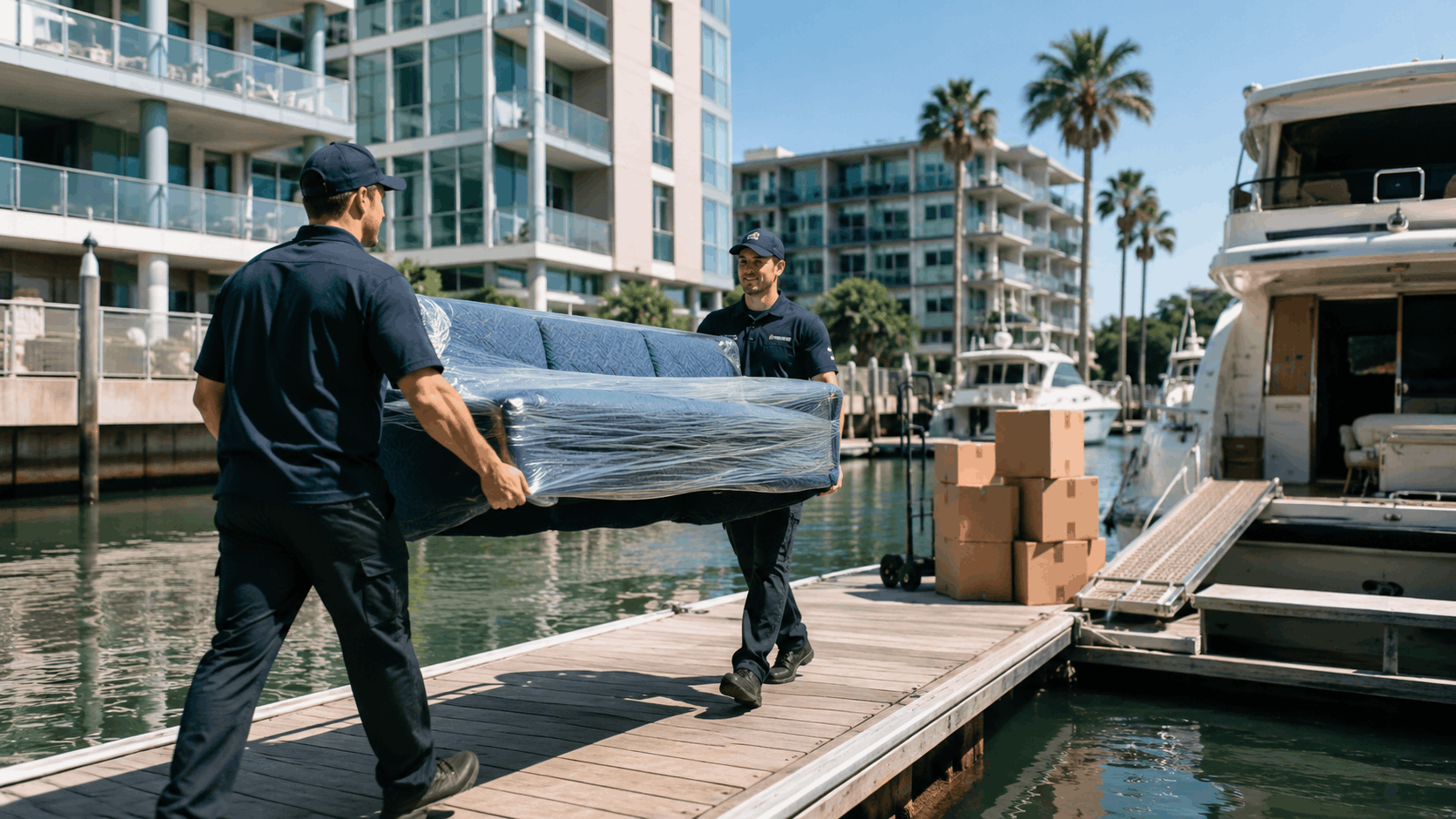
- Load and unload vessels safely across the gangway
- Move items down long docks with flatbed dock carts
- Stage loads near the parking lots at Fisherman's Village
- Time the job around tides and marina office hours
Moving On and Off Boats Safely
The gangway is the first hurdle for any boat move. It is often narrow, sometimes swaying, and always the point where a slip means a splash. Our team crosses the gangway one person at a time with heavy items and uses hand-to-hand relays for smaller boxes.
Boat unloading takes patience. We clear the deck and cabin in an order that keeps weight balanced so the vessel stays stable as items come off. Rushing this step is how things end up in the water.
A dry transfer is the goal every time. We keep boxes covered as they cross the dock and never set items directly on wet planking. Moisture-resistant bins and wrapping do the heavy lifting when the deck is damp.
For fragile or oddly shaped gear, our specialty moving crew brings the padding and custom handling these items need.
Handling Long Dock Walks and Carts
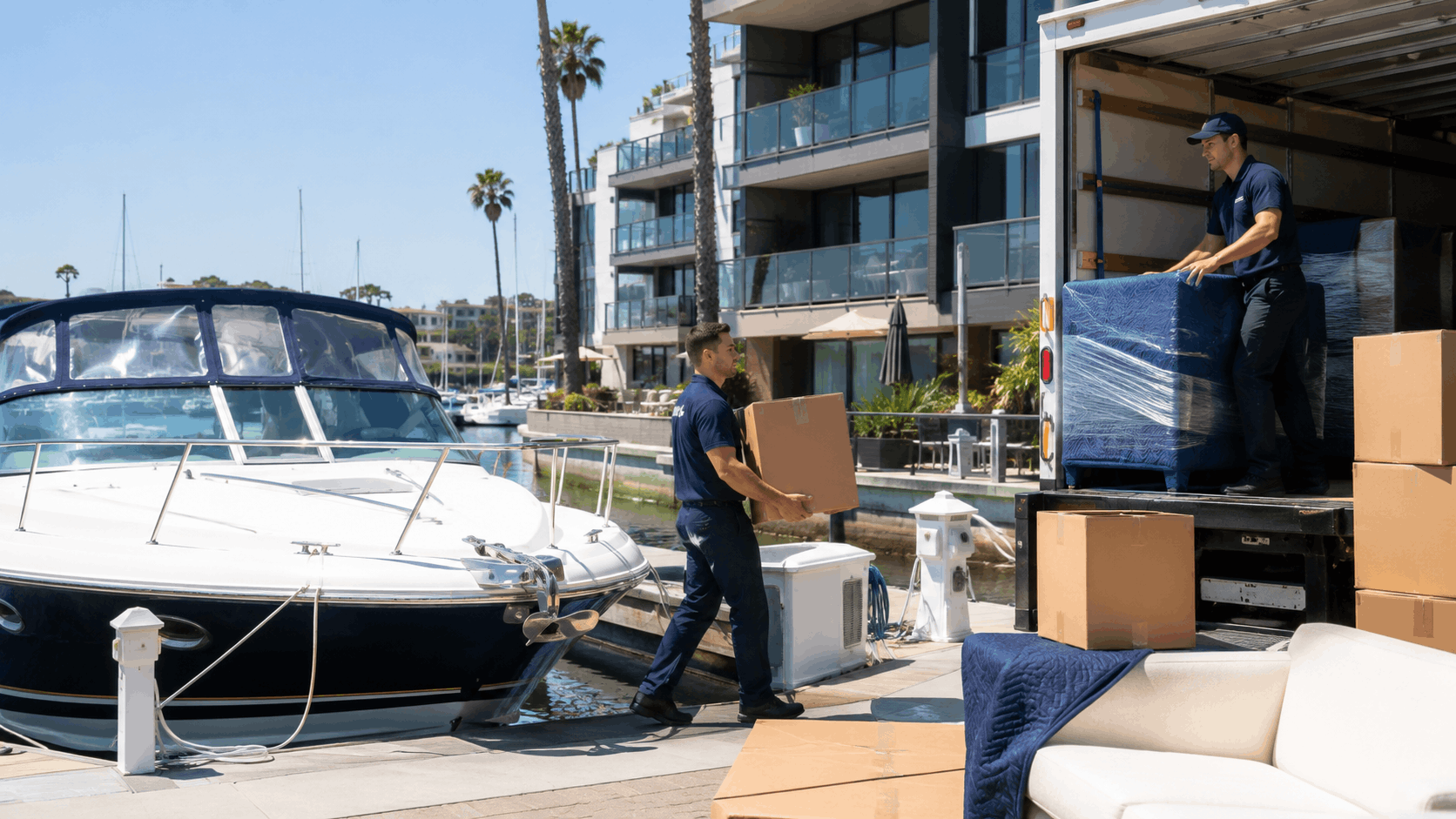
A dock walk can run hundreds of feet from the slip to the parking lot. Carrying everything by hand would take all day, so we bring flatbed dock carts and wheeled dollies built for long, flat runs. One loaded cart replaces four or five hand trips.
We set up a staging area near the parking lots at Fisherman's Village or the closest lot to your slip. Items come off the boat, ride the cart down the dock, and get grouped at the staging point before loading into the truck. This keeps the truck's parked time short.
Dock carts also protect your belongings. Instead of a mover balancing a box while dodging cleats and lines, the box sits secure on wheels. Fewer hands on each item means fewer chances for a drop.
The crew maps the cart path first, marking any tight turns or ramp transitions. A smooth route means faster loops and a lower final bill.
Timing Moves Around Tides and Marina Hours
Tide timing shapes the whole day for a dock move. We aim to load the heaviest items around low tide when the ramp is at its gentlest angle, or plan around high tide when the ramp is flatter, depending on your dock's setup. A quick check of the tide chart the week before tells us the best window.
Marina hours matter too. The marina office and gate access may only be staffed at certain times, and we schedule so a crew is never stuck waiting for someone to open a gate. Confirming office hours ahead avoids dead time on the clock.
Slip neighbors live close together, and many docks have quiet-time rules. We keep noise down and the dock clear so we are not blocking a neighbor's access to their own boat. Good dock manners keep the marina office on your side.
Booking early gives us room to pick the ideal tide and hour combination. Last-minute jobs lose that flexibility, so plan ahead when you can.
Protecting Fragile and Marine-Damaged Items
Humidity on a boat does slow damage over time. Before packing, we look over your items for early signs of mold, rust, or warping so nothing surprising shows up later. Spotting a problem before it goes in the truck saves a dispute down the road.
Items stored on a boat often need extra wrapping. Books, documents, and electronics get sealed in moisture-resistant materials so they do not pick up dampness during transport. Plain boxes alone are not enough for gear that has lived at sea.
Corrosion on metal fittings and frames gets a note in our inventory. We pad these pieces carefully and flag them so both sides agree on their condition. Clear records protect everyone.
When wrapping is done right, your belongings leave the marine environment in the same shape they arrived. That is the standard our crews hold to on every liveaboard job.

Need Help in Los Angeles?
Popeye Moving & Storage serves Los Angeles and all of Los Angeles County.
Waterfront Apartment and Condo Moves
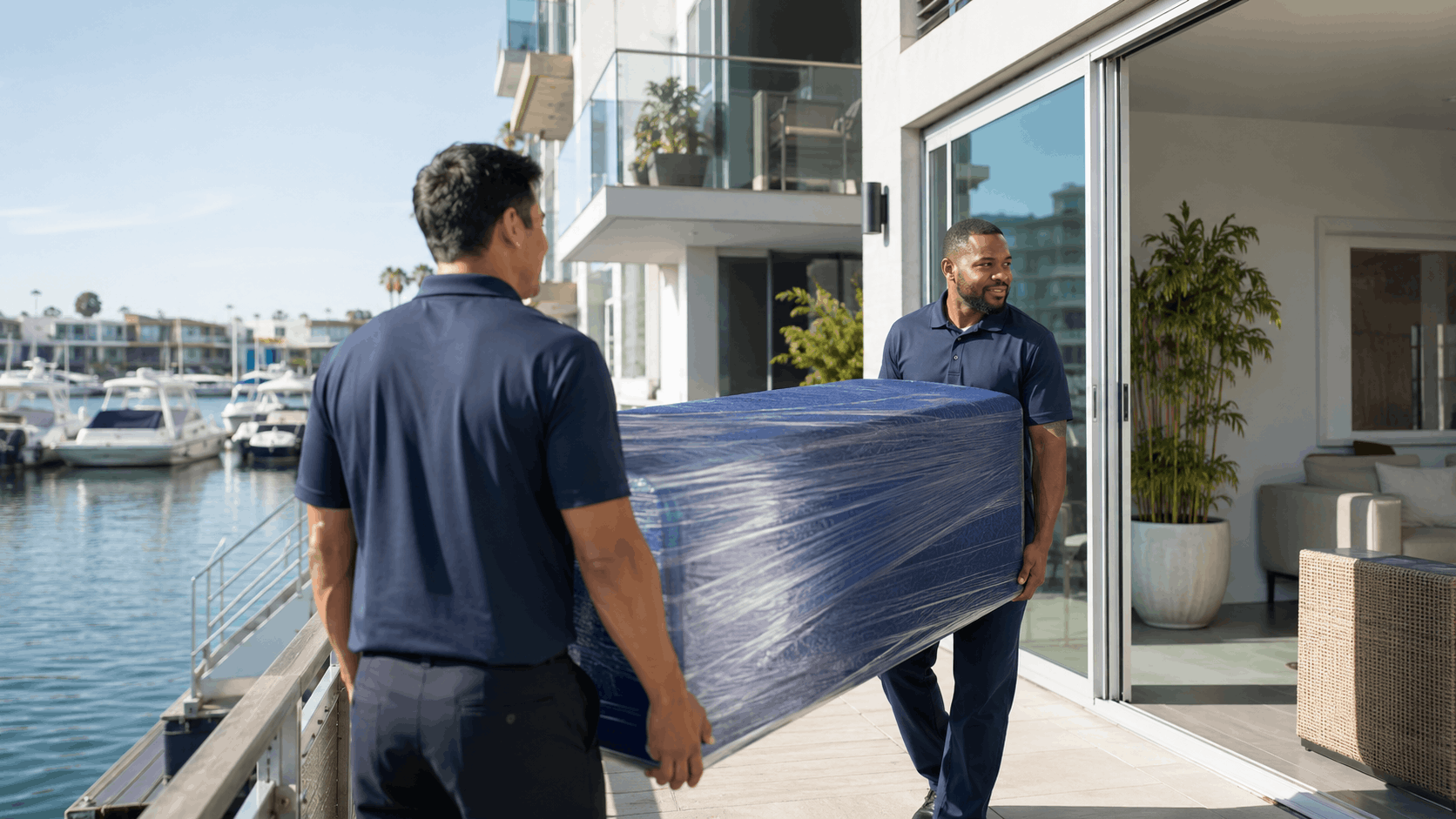
The marina's apartment and condo towers are where most of our waterfront work happens. These moves live or die on access details: elevator size, hallway width, and building rules. Our waterfront apartment movers handle each one as its own puzzle.
A condo move here is rarely a straight shot from truck to door. The table below shows the common hurdles and how our team clears them.
| Access Hurdle | Common Location | How We Handle It |
|---|---|---|
| Freight elevator reservation | Towers near Mindanao Way | Book ahead and pad the cab |
| Walk-up stairs | Mid-rise units | Extra crew for stair carries |
| Narrow hallways | Interior corridors | Disassemble large pieces |
| Balcony delivery | Tight-entry units | Hoist or angled maneuvering |
Elevator Reservations and Freight Lifts
Buildings near Mindanao Way and along the main waterfront almost always require a freight elevator reservation. If you show up without one, the front desk can turn the crew away or make you wait for hours. We confirm the reservation days ahead so the elevator is held for your slot.
Freight elevators need padding before use. Most buildings supply elevator pads, but some expect the movers to bring their own. We arrive ready either way so no wall or panel gets scratched during loading.
Elevator size limits what fits in one trip. A standard cab may not take a long sofa upright, which forces a tilt or a disassembly. We measure the cab against your largest items during the walkthrough so there are no surprises on the day.
When only one elevator serves the whole building, timing gets tight. We work in loads that keep the cab moving and free for residents between runs.
Stairs, Narrow Hallways, and Balcony Deliveries
Not every waterfront unit has elevator access. Walk-up units mean carrying everything up flights of stairs, and that calls for a bigger crew to keep the pace up and the strain down. More hands on stairs means fewer breaks and a faster finish.
Interior hallways in these towers can be tight, with sharp corners that a queen box spring simply will not clear. When a hallway is too narrow, we disassemble bed frames, table legs, and shelving to get them through. Reassembly happens once the piece is inside the unit.
Sometimes the only way in is over a balcony or through a patio. A sofa that will not fit the door or elevator may need to be hoisted up to a low balcony or angled through a wide patio slider. This takes planning and the right straps, which we bring when the walkthrough flags it.
Every one of these paths gets mapped before moving day. Knowing the route in advance is how we avoid last-minute scrambling.
Working With HOA and Building Managers
Most marina towers are run by an HOA or a building manager with firm rules. A common requirement is a certificate of insurance naming the building as covered, and no COI usually means no move. We provide this document to management before your date.
Move-in windows are set by the building, not by you. Many allow moves only on weekdays during set hours, and some charge for weekend or after-hours access. We build the schedule around your building's approved window.
Front desk check-in is part of the routine. The crew signs in, confirms the elevator hold, and follows any loading-dock rules the staff hands over. Respecting these steps keeps management cooperative for the whole day.
We handle HOA paperwork on plenty of buildings across the marina and greater Marina Del Rey, so the requirements rarely catch us off guard.
Protecting Floors, Walls, and Common Areas
Shared spaces in these buildings come with damage fees, and a scuffed lobby floor can cost you your deposit. We lay floor runners across lobbies, hallways, and elevator paths to guard against scratches and dirt. Clean floors keep management happy and your deposit intact.
Corners take the most abuse during a move. We fit corner guards on wall edges and door frames along the route so a passing dresser does not gouge the drywall. These small guards prevent big repair bills.
Door jamb protection matters in tight entries. Padding on the jamb lets us angle furniture through without leaving marks on the frame. Buildings notice this care and it reflects well on you as the resident.
Protecting common areas is not just courtesy, it is how you avoid damage fees. Our crews treat every shared space as if the bill lands on us, because a careful move protects your money too.
Permits, Parking, and Building Rules in Marina Del Rey
Paperwork and parking trip up more marina moves than heavy furniture ever does. Marina Del Rey sits under Los Angeles County oversight, and both the county and individual buildings set rules you need to plan around. Getting this sorted early keeps moving day smooth.
Below are the four areas to handle before the truck arrives.
Truck Parking Near Waterfront Buildings
Street parking is thin around the waterfront, especially on Palawan Way and the peninsula drives. Much of it is metered or time-limited, so a truck cannot legally sit there for a full day of loading. We scout the nearest legal spot in advance and plan the carry from there.
Metered lots near the buildings sometimes allow a truck for a fee, but the truck may still end up a distance from the entrance. That distance turns into a long carry, which affects both time and cost. We factor the walk into the plan so there is no confusion on the bill.
Some buildings have a designated loading spot, but it may only fit a smaller truck. When a big rig will not fit, we may shuttle loads with a smaller vehicle. Knowing the parking reality ahead of time prevents a stalled morning.
We have parked and loaded on nearly every marina block, so we already know which spots work and which draw a ticket.
County Beaches and Harbors Requirements
The marina is overseen by the Los Angeles County Department of Beaches and Harbors, which manages the harbor and its docks. They can set rules for dock access, vehicle entry, and how vendors operate on marina property. It pays to know these rules apply on top of any building policy.
Dock access for a move may need coordination with the marina office. Some anchorages restrict when and how outside vehicles or carts can use the docks. We check these county rules for your specific slip before scheduling.
Vehicle rules on marina property can limit where a truck drives or parks near the water. Straying past a posted limit risks a citation or a blocked path. Following the county's layout keeps the job moving.
When the rules are unclear, we call the marina office directly. A quick confirmation beats a moving day held up at a gate.
Building Certificate of Insurance and Deposits
Most towers require a certificate of insurance before they let any mover in the door. This document proves the moving company carries coverage and names the building as protected. We prepare and send the COI to management ahead of your date as a standard building requirement.
Some buildings also collect a move deposit from the resident. This deposit is refunded if no damage occurs to common areas, which is exactly why our floor and wall protection matters. Careful work gets your deposit back.
Requirements vary building to building, so we confirm what your tower needs during the walkthrough. Handling the paperwork early means no scramble the night before. Management wants these items in hand, not on moving day.
Getting the COI and deposit sorted is often the single biggest step to a delay-free move in these towers.
Scheduling Around Peak Marina Traffic
Weekends bring crowds to the marina, especially near Mother's Beach where families pack the sand and lots fill early. A move on a busy Saturday means fighting traffic and hunting for truck space. Weekday moves dodge most of that.
Event days clog Admiralty Way and the surrounding streets. Holiday boat parades, summer concerts, and Fourth of July crowds can gridlock the whole marina. We check the local event calendar before setting a date so the truck is not stuck in peak traffic.
Summer mornings and afternoons draw the heaviest beach and boating traffic. Booking an early weekday start beats the crowds and the heat. A clear road means a faster, cheaper move.
We know which days the marina jams up, so we steer clients toward windows that keep the truck rolling.
How Much a Marina Del Rey Move Costs
Cost is the first question most people ask, and the honest answer is that it depends on access. A dock move with a long carry costs more than a ground-floor unit near the loading dock. Below are real ranges to help you budget.
| Move Type | Typical Range | Main Cost Drivers |
|---|---|---|
| Studio or 1-bedroom condo | $500 - $900 | Crew size, elevator |
| 2-3 bedroom waterfront unit | $1,000 - $2,200 | Volume, long carry |
| Liveaboard or boat move | $700 - $1,800 | Dock length, tide timing |
| Packing add-on | $300 - $1,200 | Number of rooms |
Hourly Rates and Crew Size
Most marina moves are billed by the hour. A two-mover crew typically runs in the range of $120 to $180 per hour, and a three-mover crew runs higher. Waterfront jobs with long carries often call for a larger crew to keep the clock from running long.
Crew size is a balance. More movers cost more per hour but finish faster, which can lower the total on a long-carry dock job. We size the crew to the access so you are not paying for a slow day.
Travel time is a standard charge on most moves. It covers the drive from our yard to your marina address and back, and the rate matches the hourly crew rate. We are based in Los Angeles, so the trip to the marina is short.
During the walkthrough we estimate the hours based on your access, so the quote reflects the real job, not a generic guess.
Long Carry and Stair Fees
A long carry fee applies when the truck cannot park close to the door. On peninsula streets and long docks, this is common, and the fee covers the added labor of walking each item the extra distance. We flag it in the quote so it is never a surprise.
Stair charges come into play at walk-up units. Each flight adds labor, and a fourth-floor walk-up costs more than a second-floor one. A working elevator usually avoids this charge entirely.
Distance fees measure the gap between truck and door. The marina's layout means this gap is often larger than a normal driveway move. Knowing the distance ahead lets us price it fairly instead of padding the estimate.
These fees are not upsells. They reflect the real extra work that the marina's access forces on the crew.
Packing, Materials, and Storage Add-Ons
Packing service is a common add-on for busy residents. Our team can pack a full unit or just the fragile items, and the cost scales with the number of rooms. Explore our full service packing options if you want the whole job handled.
Materials cost extra unless bundled into a flat package. Boxes, tape, wrapping, and specialty crates for fragile pieces add up, so we give a materials estimate up front. Buying the right amount avoids a mid-move supply run.
Short-term storage helps buyers caught between marina moves. When your dates do not line up, we hold your belongings in our secure storage solutions facility until the new place is ready. This is common when a slip change or condo closing slips a few days.
Bundling packing, materials, and storage into one job often costs less than booking them piecemeal.
Ways to Keep Costs Down
The easiest way to save money is to stage your boxes near the truck path before the crew arrives. When items are grouped and ready, the movers spend their hours carrying, not searching. This alone can trim an hour off a marina job.
A mid-week move is cheaper and faster. Weekday rates are often lower, and the marina's lighter traffic means the crew is not stuck idling. Booking Tuesday through Thursday is the sweet spot.
Doing your own packing cuts the packing line off the bill. If you handle the boxes and let the crew handle the heavy lifting, you pay only for the muscle. Just make sure boxes are sealed and labeled so nothing slows the load.
Clear the dock or hallway path ahead of time too. A staging plan that keeps the crew moving is the single biggest lever on your final cost.
Need Help in Los Angeles?
Popeye Moving & Storage serves Los Angeles and all of Los Angeles County.
Storage Options for Marina Residents
Waterfront living means small units and shifting dates, so storage comes up often. Boaters downsizing into a slip and residents between condos both need a safe place to park their things. Our storage keeps marina residents covered between moves.
Here are the storage needs we see most in the marina.
Short-Term Storage Between Moves
Dates rarely line up perfectly in the marina. A slip change or an apartment turnover can leave a gap of a few days or weeks where your belongings have nowhere to go. Short-term storage bridges that gap without a scramble.
We handle the hand-off both ways. Items go into storage on move-out day and come back out when your new place is ready, so you only move things once each direction. This saves the hassle of renting a unit and moving twice.
Turnover between condos is a frequent reason residents call us. Closings slip, leases overlap, and belongings need a home in the meantime. A short-term hold keeps your move on track when the calendar does not cooperate.
We match the storage window to your dates so you are not paying for a full month when you need ten days.
Climate-Controlled Space for Coastal Items
Salt air and coastal humidity are hard on stored belongings. Climate-controlled storage keeps temperature and moisture steady, which protects items that would suffer in a plain unit near the water. For marina residents, this is the smarter choice.
Electronics do not tolerate damp storage well. Screens, speakers, and computers can corrode or short in a humid space, so climate control guards these pieces during a longer hold. The cost is worth avoiding a ruined TV.
Wood furniture and paper documents also need steady conditions. Wood warps and paper molds in coastal humidity, so climate control keeps heirlooms and files in good shape. Anything you care about long-term belongs in a controlled space.
Our long term storage options include climate-controlled units for exactly these coastal concerns.
Storing Boat Gear and Seasonal Items
A small waterfront unit fills up fast. Boat gear like sails, fenders, lines, and cushions takes room that a compact apartment simply does not have. Storing this gear off-site frees up your living space.
Seasonal items make sense to store too. Holiday decorations, winter clothing, and rarely used sports gear can live in storage until you need them. Rotating items in and out keeps the unit livable year round.
Boat gear needs the right handling. Sails and canvas store best dry and folded, and we make sure gear goes into storage clean and protected from mildew. Damp gear in a box is a mold problem waiting to happen.
When your slip or unit is small, off-site storage is often the difference between a cramped space and a comfortable one.
Secure Access and Inventory Tracking
Every item that enters storage gets logged. We inventory and label your belongings so nothing goes missing and everything is easy to find when you need it back. A clear list gives you confidence in what is stored.
Secure access is part of the deal. Our facility controls who enters, so your things stay protected during the storage period. You are not leaving valuables in an open, unwatched space.
Item tracking makes retrieval simple. When you want a specific box or piece of furniture back, the inventory tells us right where it sits. No digging through a pile to find one lamp.
Good records protect both sides. You know what you stored, and we know what to return in the same condition it arrived.
How Popeye Moving & Storage Handles Marina Del Rey Jobs
A marina move runs smoothly when the crew knows the ground before they arrive. Our local moving process starts with a real look at your access and ends with your furniture placed where you want it. Here is how Popeye Moving handles a Marina Del Rey job from the first call.
Free In-Person or Video Walkthrough
Every marina move starts with a walkthrough. We survey the dock length, elevator size, hallway corners, and parking so the moving estimate reflects the real job. A guess over the phone rarely matches waterfront reality.
The site survey can happen in person or over video. A quick video tour of your slip or unit lets us measure access and spot problems without a scheduling delay. Either way, we see what the crew will face.
The walkthrough is where we catch the details that drive cost. Long carries, tight elevators, and balcony deliveries all show up here, so the quote you get is the price you pay. No surprises on moving day.
We would rather spend twenty minutes surveying than send a crew into a job they were not sized for.
A Crew That Knows the Marina Streets
Our local crew drives to the marina from central Los Angeles regularly, so the routes are second nature. We know how Via Marina loops, where Admiralty Way backs up, and which turns onto the peninsulas a big truck can actually make. That knowledge saves time before the work even starts.
Marina parking is its own skill. We already know the legal spots, the metered lots, and the buildings with usable loading zones. A crew that has to hunt for parking burns your money.
Local knowledge extends to the buildings themselves. We have worked the towers along the waterfront and know their move windows and COI rules. That familiarity keeps management on your side.
Whether you are moving from Santa Monica or across the marina, our team knows the routes that keep the truck moving.
Full Packing and Unpacking Support
Small waterfront units are easier to settle into with help. Our optional packing service boxes and labels everything so the move is organized from the start. Labeled boxes mean the right items land in the right room.
Unpacking support gets you living faster. Our unpacking services can empty and break down boxes so you are not surrounded by cardboard in a tight apartment. In a compact unit, that cleared space matters.
Set-up rounds out the service. We reassemble beds, place furniture, and put major pieces where you want them so the unit is ready to use. You walk into a finished home, not a project.
For busy residents, letting the crew pack and unpack turns a stressful week into a single day.
Insurance and Damage Protection
Every move carries some risk, so coverage matters. We offer moving insurance and damage protection options so your belongings are covered on the dock and in the truck. You choose the level that fits your goods.
Documentation backs the coverage. We inventory items and note existing wear, especially on marine-exposed pieces, so any claim starts with a clear record. Good records make claims straightforward.
If something does go wrong, we handle claims directly. Our team walks you through the process rather than leaving you to sort it out alone. Standing behind the work is part of the service.
Coverage plus careful handling is how we keep marina moves worry-free. You can read more about our team and our approach.
Tips for a Smooth Waterfront Move
A little prep saves real money on a marina move. These moving tips come straight from the jobs our crews run every week along the waterfront. Follow them and moving day moves faster.
Measure Doors, Elevators, and Gangways First
Big furniture is the classic problem. Before the truck arrives, measure your largest pieces and check them against doorways, the elevator cab, and the gangway. Confirming furniture fit ahead of time prevents a piece stuck halfway through a door.
Gangway width is easy to overlook. A narrow gangway may not clear a wide dresser, which changes the plan entirely. Measuring it during your move prep tells us whether disassembly or a different route is needed.
Elevator size decides your load count. If your sofa will not stand up in the cab, we plan to tilt or take it apart. Knowing this before the day keeps the crew from stalling in the lobby.
Send us your measurements during the walkthrough and we will confirm the fit before we load a single item.
Book Elevators and Loading Zones Early
Building resources get claimed fast. Reserve the freight elevator and loading zone with management several days ahead so your slot is locked in. A missed elevator booking can stall the whole move.
Reschedule fees are avoidable. If you show up without a reserved loading zone and the building turns the crew away, you may pay to rebook. Early reservations protect against that cost.
Confirm the reservation the day before. Buildings sometimes double-book or lose a request, so a quick check with the front desk saves a morning. We follow up on these holds as part of our process.
Locking in the elevator and loading zone early is the simplest way to keep moving day on schedule.
Pack a First-Night Bag for a Small Unit
Unpacking a full move in a compact waterfront apartment takes time. Pack a first-night bag with essentials so you are not digging through boxes for a toothbrush at midnight. A day or two of clothes, toiletries, chargers, and medications covers the basics.
Keep the bag with you, not on the truck. In a small unit, boxes stack up fast, and finding one item can mean unstacking the whole pile. Your essentials bag keeps the first night comfortable.
Add a few kitchen basics too. A pan, a couple of plates, and coffee gear let you function before the kitchen boxes are opened. Small comforts matter after a long moving day.
Think of it as your survival kit until the unit is unpacked and settled.
Plan Around Marine Layer Mornings
The morning fog is a real factor on the water. On a heavy marine-layer morning, docks and floors stay damp and slippery until the sun burns it off. Starting a little later keeps the move dry and safe.
Wet surfaces slow a crew and threaten your belongings. A damp dock means careful footing and covered boxes, both of which add time. A drier start keeps the pace up.
Check the forecast the night before. If the fog looks thick, a mid-morning start beats fighting moisture at dawn. We adjust the arrival time when the marine layer calls for it.
A dry move protects your furniture and your floors, so timing around the fog is worth the small delay.
Need Help in Los Angeles?
Popeye Moving & Storage serves Los Angeles and all of Los Angeles County.
Final Thoughts
Moving in Marina Del Rey rewards planning. The narrow peninsula streets, gated docks, waterfront towers, and coastal weather all demand a crew that knows the ground and the rules. With the right prep and the right movers, a dock or waterfront move goes off without the stress.
Our team has worked these marina blocks for years, from the boat slips near Fisherman's Village to the condo towers along Admiralty Way and Via Marina. We handle the permits, the parking, the elevators, and the salt air so you do not have to.
If you are planning a boat dock move, a liveaboard relocation, or a waterfront apartment move, reach out to Popeye Moving & Storage for a free walkthrough and quote. Contact our Los Angeles team or call today to lock in your date and get a plan built around your marina access.
Frequently Asked Questions
Do movers handle boat and liveaboard moves in Marina Del Rey?
Yes. Our team moves belongings on and off boats and down long docks using flatbed dock carts and wheeled dollies. We cross gangways one person at a time, keep items dry during transfers, and stage loads near the closest parking lot. Liveaboard moves are a regular part of our marina work, and we plan each one around the slip's access and the tide.
How much does a Marina Del Rey move cost?
Most marina moves are billed hourly, with two-mover crews commonly running $120 to $180 per hour plus travel time. A studio or one-bedroom condo often lands between $500 and $900, while larger waterfront units run higher. Long carries on peninsula streets, walk-up stairs, and elevator reservations all affect the total. A walkthrough gives you an accurate quote based on your actual access.
Do I need a permit to move in the marina?
You usually do not need a personal moving permit, but most towers require a certificate of insurance from the moving company before the crew can enter. The Los Angeles County Department of Beaches and Harbors also oversees the marina and may set rules for dock access and vehicles. We handle the certificate of insurance and confirm county and building rules before your move date.
How far in advance should I book a waterfront move?
Two to four weeks is a good target for most marina moves. Book on the longer end if your building requires a freight elevator reservation or if you are moving at month-end, when both movers and elevator slots fill up fast. Early booking also lets us pick the best tide window for a dock move and avoid peak marina traffic. Last-minute jobs are possible but leave less flexibility.
What if the truck cannot park near my building?
This is common on the peninsula streets and long docks, so we plan for it. The crew stages the truck at the nearest legal spot and uses flatbed dock carts and dollies to handle the long carry. We map the walking route in advance to keep loops fast and efficient. A long-carry fee may apply, and we flag it in the quote so there is no surprise on the bill.
Do you provide packing and unpacking?
Yes. We offer full and partial packing services, which work well for small waterfront units where organized boxes make a big difference. Our crew can box and label everything or just handle the fragile items. We also provide unpacking and set-up, breaking down boxes and placing furniture so you settle into a compact apartment faster instead of living around a pile of cardboard.
Can items be stored between move dates?
Yes. Short-term storage bridges the gap when a slip change or condo closing leaves your dates out of sync. We move items into storage on move-out day and deliver them when your new place is ready. Climate-controlled units are available for coastal residents, which protects electronics, wood furniture, and documents from the salt air and humidity common near the water.
How do you protect furniture from salt air and humidity?
We wrap items in moisture-resistant materials rather than plain blankets alone, and we add extra padding for pieces exposed to damp conditions. Before packing, the crew checks for early mold, rust, or warping and notes it in the inventory. Timing the load around the morning marine layer keeps water off your belongings and the dock. For longer holds, climate-controlled storage adds another layer of protection.
Are the movers insured?
Yes. We offer moving insurance and damage protection options so you can choose the coverage level that fits your belongings. Our team inventories items and documents existing wear, especially on marine-exposed pieces, so any claim starts with a clear record. If something goes wrong, we handle the claims process directly and walk you through each step rather than leaving you on your own.
What areas near Marina Del Rey do you serve?
We serve Marina Del Rey and the surrounding coastal communities, including Venice, Playa Del Rey, Culver City, and Santa Monica. Our crews cover the greater Los Angeles area and drive to the marina from central LA regularly. Wherever your move starts or ends along the coast, our team knows the routes and building rules that keep the job moving.
Frequently Asked Questions
- Do movers handle boat and liveaboard moves in Marina Del Rey?
- Yes. Our team moves belongings on and off boats and down long docks using flatbed dock carts and wheeled dollies. We cross gangways one person at a time, keep items dry during transfers, and stage loads near the closest parking lot. Liveaboard moves are a regular part of our marina work, and we plan each one around the slip's access and the tide.
- How much does a Marina Del Rey move cost?
- Most marina moves are billed hourly, with two-mover crews commonly running $120 to $180 per hour plus travel time. A studio or one-bedroom condo often lands between $500 and $900, while larger waterfront units run higher. Long carries on peninsula streets, walk-up stairs, and elevator reservations all affect the total. A walkthrough gives you an accurate quote based on your actual access.
- Do I need a permit to move in the marina?
- You usually do not need a personal moving permit, but most towers require a certificate of insurance from the moving company before the crew can enter. The Los Angeles County Department of Beaches and Harbors also oversees the marina and may set rules for dock access and vehicles. We handle the certificate of insurance and confirm county and building rules before your move date.
- How far in advance should I book a waterfront move?
- Two to four weeks is a good target for most marina moves. Book on the longer end if your building requires a freight elevator reservation or if you are moving at month-end, when both movers and elevator slots fill up fast. Early booking also lets us pick the best tide window for a dock move and avoid peak marina traffic. Last-minute jobs are possible but leave less flexibility.
- What if the truck cannot park near my building?
- This is common on the peninsula streets and long docks, so we plan for it. The crew stages the truck at the nearest legal spot and uses flatbed dock carts and dollies to handle the long carry. We map the walking route in advance to keep loops fast and efficient. A long-carry fee may apply, and we flag it in the quote so there is no surprise on the bill.
- Do you provide packing and unpacking?
- Yes. We offer full and partial packing services, which work well for small waterfront units where organized boxes make a big difference. Our crew can box and label everything or just handle the fragile items. We also provide unpacking and set-up, breaking down boxes and placing furniture so you settle into a compact apartment faster instead of living around a pile of cardboard.
- Can items be stored between move dates?
- Yes. Short-term storage bridges the gap when a slip change or condo closing leaves your dates out of sync. We move items into storage on move-out day and deliver them when your new place is ready. Climate-controlled units are available for coastal residents, which protects electronics, wood furniture, and documents from the salt air and humidity common near the water.
- How do you protect furniture from salt air and humidity?
- We wrap items in moisture-resistant materials rather than plain blankets alone, and we add extra padding for pieces exposed to damp conditions. Before packing, the crew checks for early mold, rust, or warping and notes it in the inventory. Timing the load around the morning marine layer keeps water off your belongings and the dock. For longer holds, climate-controlled storage adds another layer of protection.
- Are the movers insured?
- Yes. We offer moving insurance and damage protection options so you can choose the coverage level that fits your belongings. Our team inventories items and documents existing wear, especially on marine-exposed pieces, so any claim starts with a clear record. If something goes wrong, we handle the claims process directly and walk you through each step rather than leaving you on your own.
- What areas near Marina Del Rey do you serve?
- We serve Marina Del Rey and the surrounding coastal communities, including Venice, Playa Del Rey, Culver City , and Santa Monica. Our crews cover the greater Los Angeles area and drive to the marina from central LA regularly. Wherever your move starts or ends along the coast, our team knows the routes and building rules that keep the job moving.
P
Popeye Moving & Storage Co. Team Team
Licensed moving and storage professionals serving Los Angeles and Los Angeles County.
Licensed in California · License #PUC: CAL T 189749 | DOT: 1472924 | MC: 498816C
Why trust Popeye Moving & Storage?
Founded in 1994, Popeye Moving & Storage is a licensed and insured moving and storage service serving Los Angeles and Los Angeles County. All content is reviewed by our licensed technicians.

Need Help in Los Angeles?
Popeye Moving & Storage serves Los Angeles and all of Los Angeles County.
Related Articles
How-To Guides
Hancock Park Movers: Historic Home Crating and Heritage Property Service
A local guide to moving historic Hancock Park homes, covering custom crating, heritage property care, timing, costs, storage, and how to choose the right LA mover.

Tips & Advice
Santa Monica Movers North of Montana: Coastal Estate Service
A local expert guide to estate moving north of Montana Avenue in Santa Monica, covering coastal conditions, fragile crating, neighborhood logistics, storage, and permits.

Tips & Advice
Storage for Playa Vista Apartment Dwellers: Seasonal Gear, Bikes, and the Second-Bedroom Problem
A local guide for Playa Vista renters on storing seasonal gear, bikes, and clearing out the second bedroom with smart off-site storage options.