Cost Guides
Marble, Glass, and Stone Tops: Crating Thresholds and Transport Costs in LA

Key Takeaways
- Marble and stone crack along hidden veins under uneven pressure, while glass fails at chipped edges and from twisting force.
- Crating becomes the safer choice once a top exceeds roughly 4 feet wide or 150 pounds, or when it is antique, imported, or high-value.
- Custom crates use exact measurements, dense foam, corner guards, and upright A-frame loading to protect stone and glass in transit.
- Crating costs run about $150 to $350 for small glass tops and $400 to $900 or more for large stone slabs, plus labor and access fees.
- LA neighborhoods add real challenges: canyon roads may need shuttle trucks, historic homes have tight doorways, and high-rises require freight elevator reservations.
- Homeowners can prep by separating tops from bases, measuring doorways, clearing paths, and photographing existing condition before moving day.
- Full-value protection covers a top's real worth, while basic coverage pays only a small amount per pound.
- A pre-move assessment produces an accurate estimate and lets the crew plan crating, crew size, and access ahead of time.
In This Article
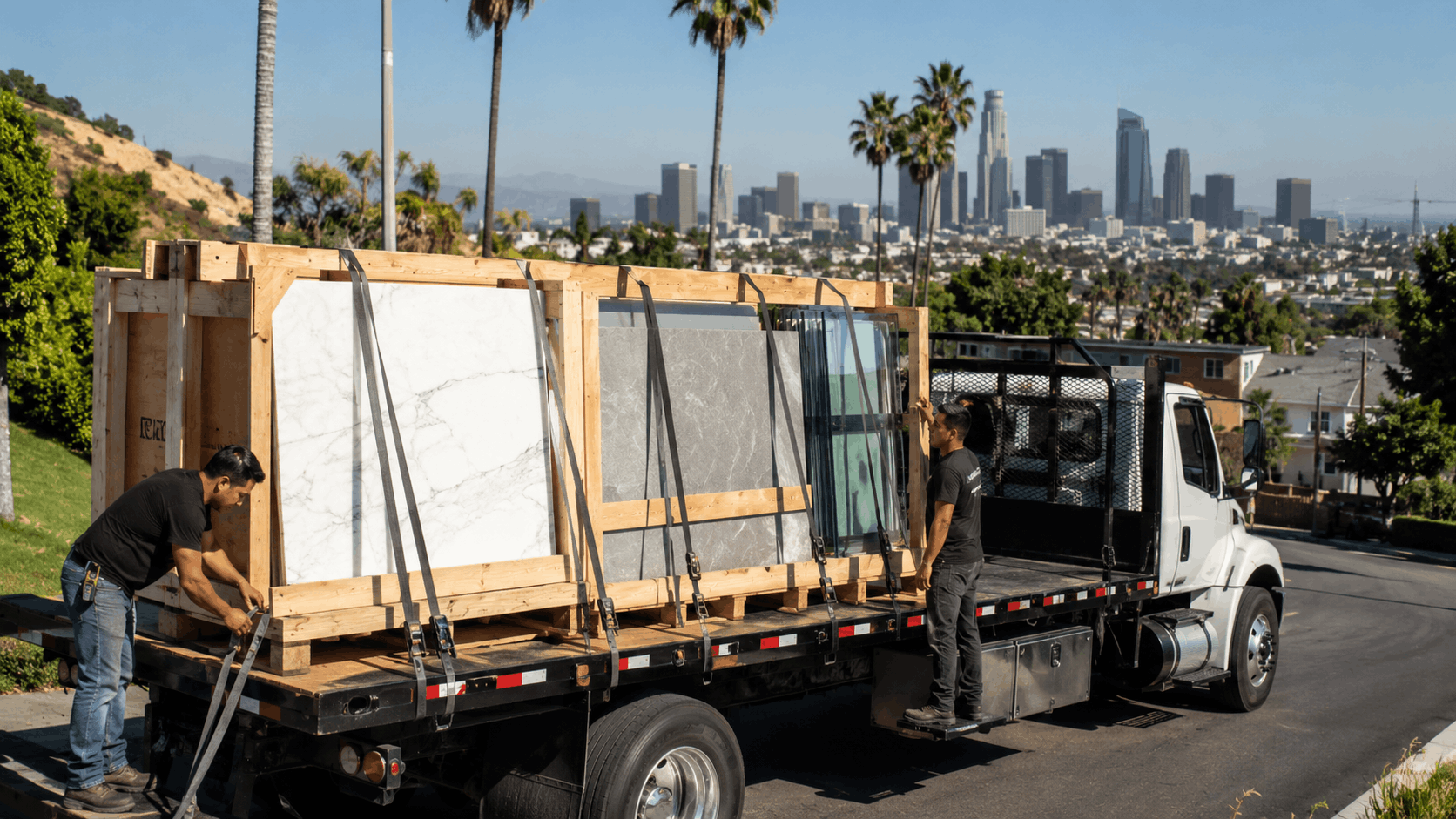
A homeowner in the Hollywood Hills called our team last spring with a problem we hear often. She had a marble dining table that seated ten, and the only way out was down a steep, curving driveway off Mulholland. Two friends had already offered to help carry it, and she wanted to know if that was a mistake. It was.
That table weighed close to 400 pounds, and the marble had a vein running right through the middle. One wrong step on that grade, one moment where the weight shifted, and the slab would have split in half on the concrete. This is the exact situation where crating stops being optional and becomes the smart call.
Why Marble, Glass, and Stone Tops Need Special Handling
Most furniture bends a little, flexes, or absorbs a bump without much drama. A dresser can take a knock and shrug it off. Marble, glass, and stone tops do not work that way.
These fragile surfaces combine two hard problems at once: they are heavy, and they are brittle. A regular sofa is heavy but forgiving. A granite slab is heavy and unforgiving, which is a very different challenge for furniture moving.
- They do not flex. Stone and glass have almost no give, so pressure that would bend wood will crack them instead.
- They fail suddenly. There is rarely a warning. A slab holds until it does not, then splits in one motion.
- Weight and fragility fight each other. The same mass that makes stone tops hard to lift is what causes them to break under their own weight if handled wrong.
- Damage is often permanent. A cracked marble top usually cannot be repaired invisibly, unlike a scratched table leg.
Understanding that split between weight and fragility is what shapes every decision our crews make. The rest of this section breaks down how each material fails so the reasoning is clear.
How Stone Cracks Along Hidden Veins
Marble and granite are natural stone, which means they carry the fault lines nature gave them. Those beautiful marble veins that make a countertop look expensive are also the weakest paths through the slab. Under uneven pressure, the stone splits along the vein like a piece of wood splitting along its grain.
Our team has seen this firsthand on jobs across the city. On one Los Feliz move, a client insisted on carrying a marble console flat with the weight resting on two corners. By the time it reached the truck, a hairline had opened along a gray vein, and within a week it had spread across the whole top.
The tricky part is that these weak points are often invisible until stress finds them. A slab can look flawless and still carry a hidden vein a fraction of an inch below the polished surface. That is why our crews assume every stone top has a fault line and support it evenly across its full length.
Granite is harder than marble but still prone to stone cracks when flexed. Even a slab that survived quarrying and fabrication can fail during a bumpy ride if it is laid flat and allowed to bounce. Proper support removes that gamble entirely.
Why Glass Tops Fail at the Edges
Glass tops rarely break from a clean, flat push against the face. They fail at the edges, where a small chip becomes the starting point for a full crack. Twist the glass even slightly, a force called torsion, and that edge flaw races across the whole panel.
This is why edge protection matters more than face padding for glass. A tiny nick on the corner of a coffee table top, invisible to the eye, can turn into a shattered piece the moment the glass flexes during a lift. Our crews guard every edge and corner before the glass leaves the room.
Tempered glass and annealed glass behave very differently. Tempered glass is heat-treated to be stronger, but when it does fail it explodes into thousands of small pieces all at once. Annealed glass is weaker and breaks into large, sharp shards, which is common in older shelf tops and vintage tables.
Knowing which type a client owns changes how we handle it. A tempered patio table gets treated for sudden shatter risk, while an antique annealed mirror top gets treated for slow crack propagation. Both need a crate once they cross into large or high-value territory.
The Weight Problem With Stone Slabs
People underestimate granite weight almost every time. A standard granite countertop runs roughly 18 to 20 pounds per square foot at three centimeters thick. A modest kitchen island top can hit 300 to 500 pounds on its own.
That granite weight changes the entire moving plan. It dictates how many movers are needed, what equipment comes off the truck, and whether a piece can even be carried through a given doorway safely. A four-person lift is common for large slabs, and rushing it invites both injury and cracked stone.
Slab handling is also about distributing that mass correctly. Stone must be supported along its length, not gripped at two ends where the middle sags under its own weight. That sag is exactly what opens a vein and produces a break.
Our team plans slab handling before anyone touches the piece. We map the lift, the carry path, and the load position in the truck so the weight is controlled at every step rather than fought against.
Common Damage We See in LA Homes
Most of the moving damage we get called about started with a DIY attempt that went sideways. Dropped glass tabletops are the classic. A friend loses grip on a stairwell landing, and a $2,000 designer piece is gone in a second.
Hairline stone fractures are sneakier. A homeowner moves a marble top themselves, sees no damage, then notices a thin line weeks later that keeps growing. That crack was almost always born on moving day from uneven pressure or a hard set-down.
We also see chipped edges on glass and stone that got scraped against door frames in tight older homes. A cracked countertop from a rushed lift is one of the more expensive lessons a homeowner can learn. These failures are avoidable with the right protection and crew.
For fragile items like these, our specialty moving team plans around exactly these failure points. The goal is simple: no surprises weeks later.
Get Your Free Quote
Tell us about your move and we'll get back to you fast.
What Is a Crating Threshold and When Does It Apply
The crating threshold is the point where blankets and padding stop being enough and a custom crate becomes the safer choice. Think of it as a line. On one side, a heavy blanket wrap protects the item fine. On the other side, only a rigid crate will do the job.
Knowing where that line sits helps homeowners make smart calls about moving protection and budget. Below are the factors that push an item across it.
- Size and weight that make an item awkward or dangerous to carry padded.
- Distance and route that expose the piece to more road shock and handling.
- Value and rarity that make replacement impossible or very costly.
- Fragility type that leaves the item vulnerable to twist and edge damage.
Most pieces that cross two or more of these factors belong in a custom crate. Our crews apply these same rules on every estimate.
Size and Weight Triggers for Crating
The clearest triggers are physical. As a general rule, our team recommends crating for any top wider than about 4 feet or heavier than roughly 150 pounds. Past those numbers, blankets alone cannot control the stresses on the piece.
Glass follows a similar logic. A glass top larger than around 40 by 40 inches, or thicker glass panels that flex under their own weight, moves far safer in a crate. The larger the panel, the more torsion it sees during a lift.
Crating size also depends on shape. A long, narrow marble console or a wide round glass tabletop both create leverage that works against the material. Thin proportions raise the crating case even when total weight seems modest.
These weight limits are guidelines, not hard walls. A 130-pound marble top with a bad vein might still call for a crate, while a compact tempered piece might travel fine padded. Our crews judge each piece on its own.
Distance and Route Factors
A short hop from Culver City to Santa Monica is a different risk than a haul up the coast. The longer the trip, the more bumps, turns, and load shifts a fragile top endures. Distance stacks the odds against padding alone.
A cross-town move on the 405 during rush hour means constant stop-and-go, and every hard brake sends force through the load. A long-distance move adds hours of highway vibration on top of that. Both raise the case for a full crate.
For any long distance move, our team almost always crates fragile tops. The transport route simply exposes them to too much cumulative shock to trust to blankets.
Route quality matters too. Rough surface streets, steep canyon grades, and tight switchbacks all add jolts that a crate absorbs and a blanket does not. We factor the actual roads into every recommendation.
Value and Irreplaceability of the Piece
Sometimes the number that matters most is the price tag, not the weight. A smaller top can still justify a crate if it is antique furniture, custom made, or simply hard to replace. Imported marble and designer glass fall squarely in this group.
We regularly crate imported Italian marble tops that a client waited months to receive. Even at moderate size, the cost and lead time to replace them make a crate an easy decision. The same goes for hand-cast designer glass that no longer exists in stores.
High-value items also tend to be one of a kind. There is no second chance to get an heirloom or a discontinued piece to the new home intact. For these, our team treats crating as the default, not the upgrade.
Insurance value plays in here as well. If a claim would run into the thousands, the modest cost of a crate is cheap protection by comparison. We walk clients through that math during the estimate.
Blanket Wrap Versus Full Crate
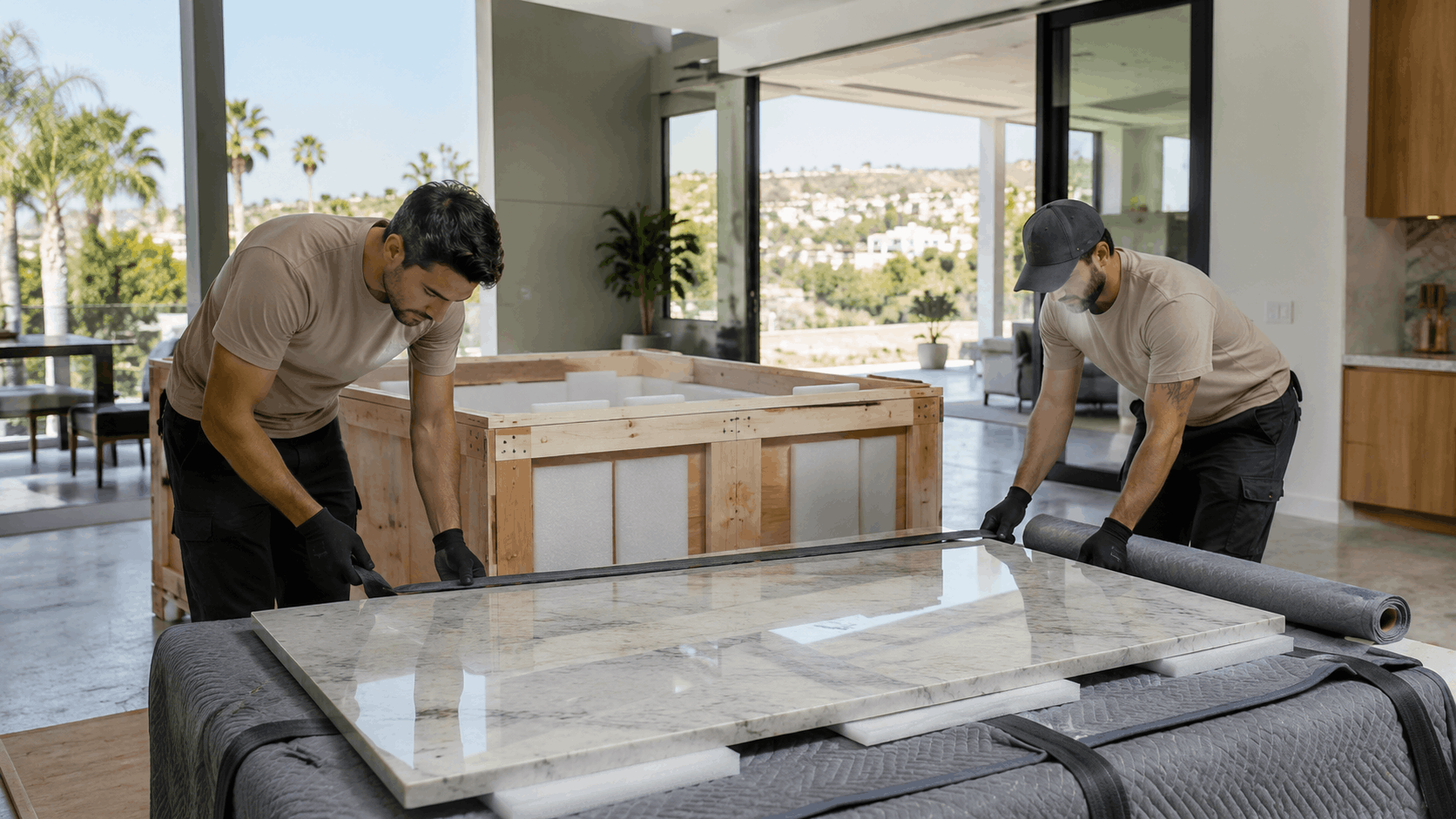
A blanket wrap uses moving pads, shrink wrap, and edge protectors to cushion an item. It guards against scuffs, minor bumps, and surface scratches. For sturdy furniture and smaller tops on short trips, it does the job well.
A full crate is a rigid wooden box built to the exact piece. It guards against impact, crushing, torsion, and the weight of other items shifting nearby. Nothing touches the top except the foam that cradles it inside.
The difference in protection is large, and so is the difference in cost. Clients paying for a crate are paying for a structure that treats the top like precious cargo, not just soft padding around it. Our packing and crating service covers both options.
Our crews explain which method fits each item so the choice is clear. The aim is honest advice, not upselling a crate onto a piece that does not need one.
Need Help in Los Angeles?
Popeye Moving & Storage serves Los Angeles and all of Los Angeles County.
How Custom Crates Are Built for Fragile Tops
A good crate is built around one specific piece, not pulled off a shelf. That custom crate build is part measurement, part carpentry, and part padding science. Done right, the top rides inside its own protective shell.
Here is how our team approaches crate construction and fragile packing for marble, glass, and stone tops.
Measuring and Framing the Piece
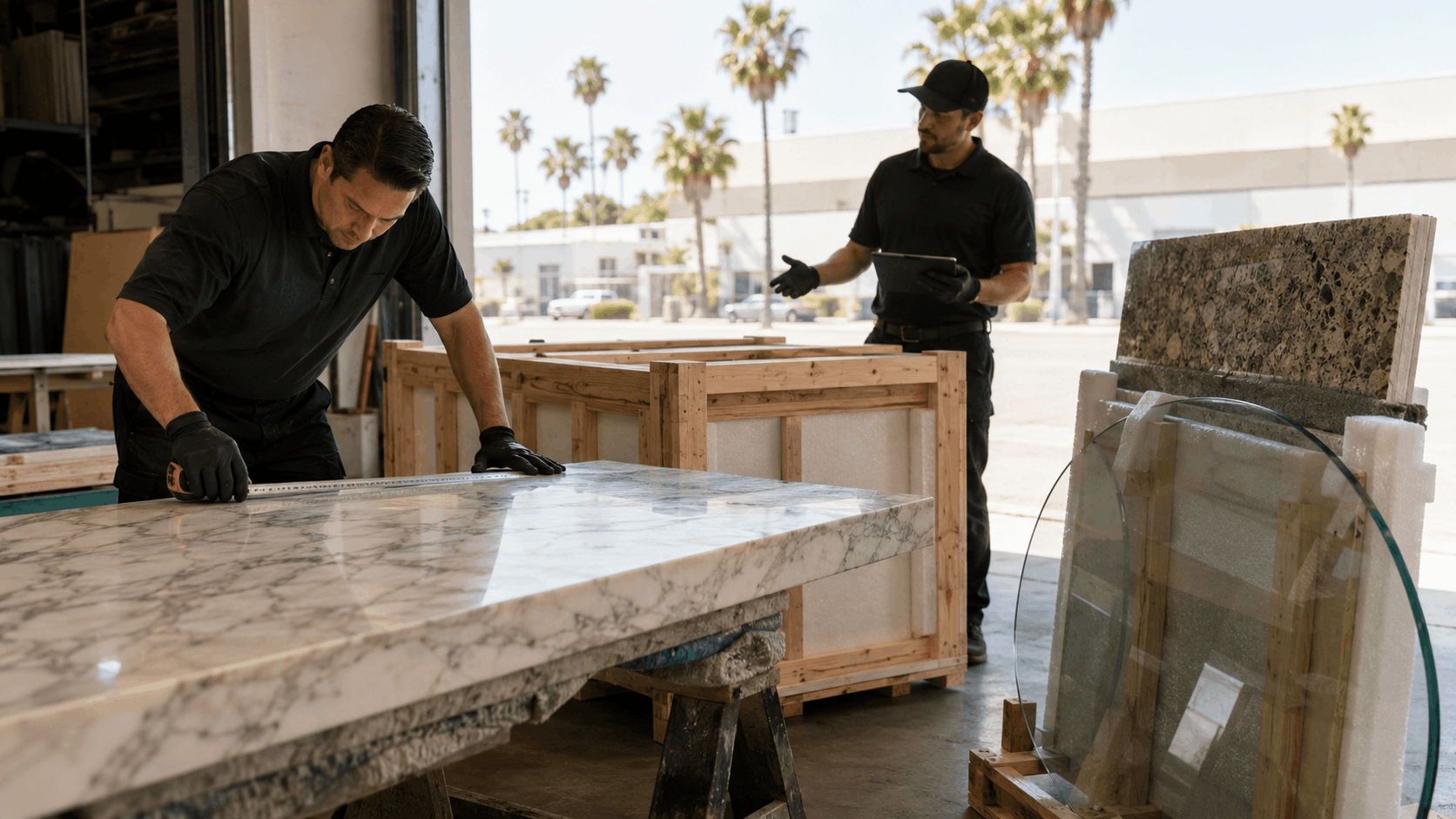
Everything starts with exact measurements. Our crews measure the top at the client's home, capturing length, width, thickness, and any irregular edges or overhangs. A crate that is even an inch too loose lets the piece move, and movement is what breaks it.
From those numbers we build a wood frame sized to the top with almost no wiggle room. The frame becomes the skeleton of the crate, giving it rigidity and defining how the interior padding will sit. Precise crate measuring is what makes the whole build work.
On-site measuring also catches surprises. A tabletop that looked square might have a beveled edge or a mounting bracket that changes the build. Seeing the piece in person means the finished crate fits the first time.
For unusual shapes, like a kidney-shaped glass top or an oval marble slab, the frame is drawn to match the actual outline. That extra care keeps the piece supported evenly all the way around.
Foam, Corner Guards, and Cushioning
Once the frame is set, the padding goes in. We line the interior with dense foam that cradles the top and absorbs road shock before it reaches the surface. Foam padding is the layer that turns a hard box into a safe one.
Corner guards protect the most vulnerable points on glass and stone. Since edges and corners are where cracks begin, rigid guards shield them from any contact or pressure. This single detail prevents a large share of fragile failures.
The cushioning is layered for a reason. Softer foam sits against the surface to prevent scratching, while firmer foam behind it handles impact and holds the piece in place. Together they stop both scuffing and point pressure.
Point pressure is the quiet killer of stone tops. A single hard spot pressing into a slab during transport can start a crack, so our packing spreads support across the whole face. Nothing presses on one spot alone.
Vertical Loading for Stone Slabs
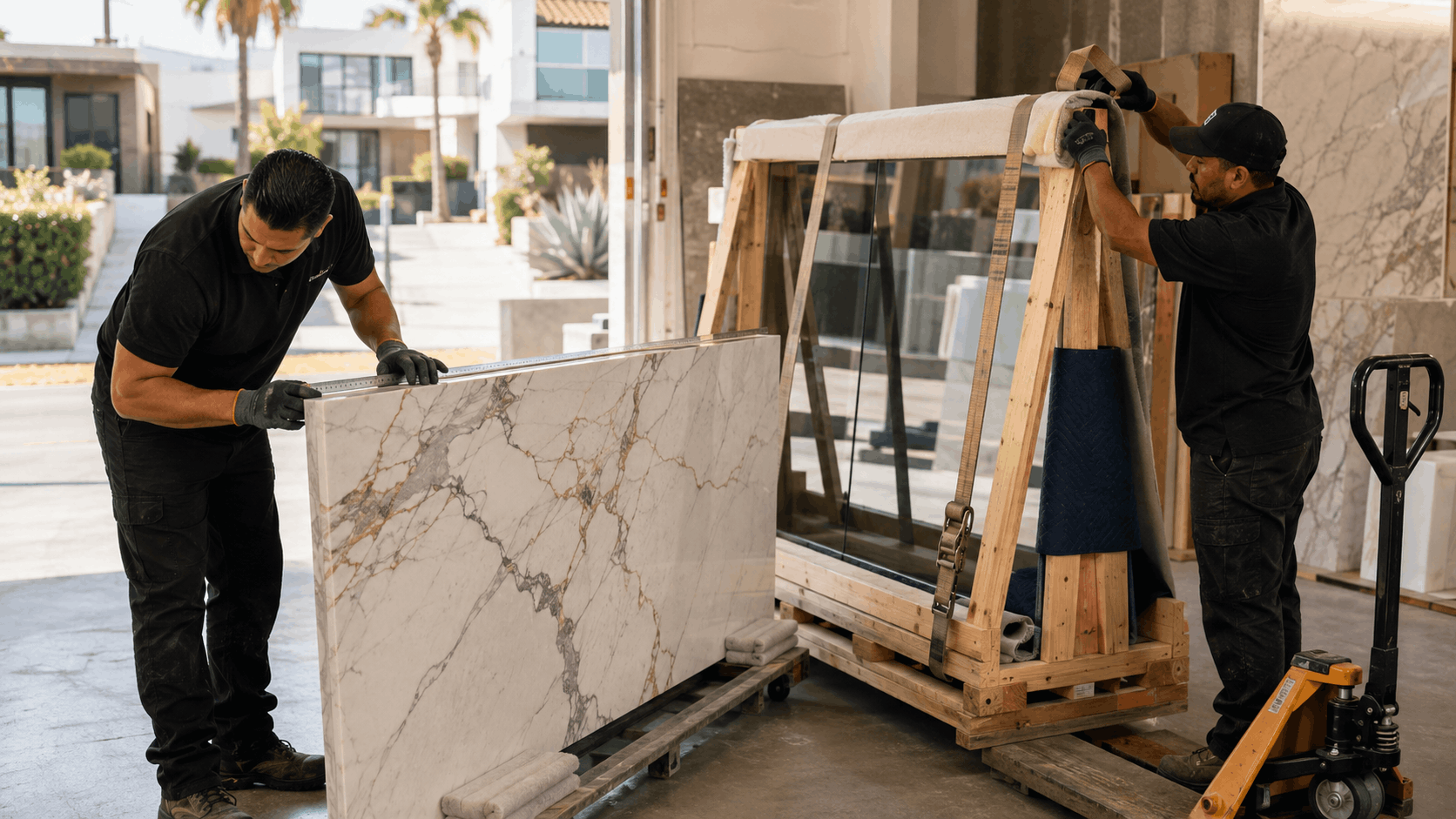
Stone slabs travel standing upright, not lying flat. Laid flat, a slab sags in the middle under its own weight and any road bounce, which opens veins and causes cracks. Standing on edge, the weight runs down through the stone's strongest direction.
To do this safely, crews load stone against an A-frame, a slanted rack that holds slabs upright and secure. The A-frame is standard practice in the stone industry for exactly this reason. Vertical loading is the single biggest factor in getting a marble or granite top there whole.
The crate itself is often built to ride upright too, with clear markings so no one lays it down. A slab that survives the lift can still crack if it is set flat in the truck. Orientation matters from the room to the road.
Our team secures the upright load so it cannot tip or slide during transit. Straps, blocking, and the A-frame work together to hold the slab dead still all the way to the new home.
Labeling and Handling Instructions
A crate is only as good as the handling it gets. Every crate leaves marked with orientation arrows showing which way is up and fragile warnings that every mover can read at a glance. Clear labels remove guesswork.
Fragile labeling keeps handling consistent across the crew. Whether the first mover or the fifth touches the crate, they all get the same instructions from the box itself. That consistency is what prevents a careless flat set-down.
Handling instructions go beyond arrows. We note weight, lift points, and any special notes so anyone loading or unloading treats the piece correctly. On multi-stop moves, that information travels with the crate.
These small marks protect big investments. A client's imported marble top does not care how experienced the crew is if someone sets it the wrong way. The labels make the right handling automatic.
Transport Costs for Heavy and Fragile Tops in LA
Pricing for moving fragile tops comes down to a handful of factors that stack together. Once homeowners see the parts, the total makes sense. Below are the main drivers behind transport costs and crating cost in Los Angeles.
Here is a general breakdown of moving prices LA clients can expect for these items.
| Cost Factor | Typical Range | Notes |
|---|---|---|
| Custom crate (small glass top) | $150 - $350 | Depends on size and edge work |
| Custom crate (large stone slab) | $400 - $900+ | Heavy framing and A-frame support |
| Extra crew per mover | $50 - $90 / hour | Heavy slabs need 3 to 4 movers |
| Stair or long-carry charge | $75 - $250+ | Varies by flights and distance |
| Shuttle service (canyon access) | $200 - $500+ | When trucks cannot reach the door |
| Full-value protection | 1% - 2% of declared value | Based on item worth |
These are guidelines. A pre-move assessment produces the real number for a given piece and home.
Crating Fees and Material Costs
Crating fees track size and material more than anything else. A small glass shelf top might run $150 to $350 to crate, while a large marble island top can reach $900 or more. The bigger and heavier the piece, the more lumber, foam, and labor go into the box.
Material costs rise with complexity. An odd shape, a fragile beveled edge, or a slab that needs A-frame support all add build time and materials. A plain rectangular glass top is the least expensive to crate.
Thickness and weight push costs up too. A three-centimeter granite slab needs heavier framing than a thin glass panel, which means sturdier construction. That stronger crate protects the heavier load but costs more to build.
Our team quotes crating separately so clients see exactly what the crate itself costs. There are no mystery line items folded into the total.
Labor and Crew Size
Heavy stone tops need more hands, and more hands mean higher labor cost. A large slab often takes three or four movers to lift and carry safely, versus one or two for ordinary furniture. That crew size drives the hourly rate up.
Moving labor is priced by the crew and the hours. A job that needs a four-person team for a heavy marble top will cost more per hour than a standard two-person move. The extra people are what keep the slab and the crew safe.
Crew size also depends on the home. A slab that must go up a flight of stairs or around a tight landing may need an extra mover just to control the weight through the turn. Difficult paths add bodies.
We size the crew to the job during the assessment. Sending too few movers to save money is how tops get cracked and people get hurt, so we plan for the right number.
Access Charges and Stairs
Where the piece lives affects the price. A steep driveway in Silver Lake, a narrow vintage staircase in an older Los Feliz home, or a long carry from a truck parked down the block all add access fees. These charges reflect the extra effort and risk.
Stair charges are common in the older hillside neighborhoods across the city. Carrying a 400-pound stone top down a curving exterior staircase is slow, careful work that needs more crew and time. That labor gets reflected in the quote.
Long carries add up when a truck cannot park near the door. If movers must haul a crate 150 feet from the street, that distance costs time on every trip. Tight parking on many LA streets makes this frequent.
Our crews scope access ahead of time so these charges are known before the day. A surprise flight of stairs on moving morning is exactly what we work to avoid.
Insurance and Valuation Coverage
Coverage is where high-value tops earn their protection. Basic released-value coverage is included but pays only a small amount per pound, which is little comfort for a marble slab. Full-value protection covers the actual worth of the piece.
Valuation coverage is priced against the declared value of the item, often around 1 to 2 percent of that value. For a $5,000 imported top, that is a small cost to guarantee full replacement. The math favors coverage on expensive pieces.
The Federal Motor Carrier Safety Administration explains the difference between these coverage types for consumers. Reviewing their guidance at Protect Your Move helps clients choose wisely. Our team walks through the options during the estimate.
We recommend full-value protection on any top that would be costly or impossible to replace. Basic coverage suits everyday items, but fragile high-value tops deserve the real thing.
LA Neighborhood Challenges That Raise Moving Costs
Every part of Los Angeles moves a little differently. The streets, the buildings, and the traffic all shape what a fragile-top move costs. Our crews have worked these LA neighborhoods for years and plan around their specific moving obstacles.
Here is how local moving conditions across the city affect heavy and fragile tops.
Steep Streets in the Hollywood Hills and Laurel Canyon
The Hollywood Hills and Laurel Canyon are famous for their tight switchbacks and narrow drives. Full-size moving trucks often cannot reach the front door on these roads. When that happens, a smaller shuttle truck ferries the load between the home and the big truck.
That shuttle service adds cost, but it protects the crate and the crew. Trying to force a large truck up a road it cannot handle risks the vehicle, the load, and the neighbors' cars. A shuttle is the safe answer on many canyon jobs.
Steep grades also complicate the carry itself. Moving a heavy marble top down a sloped driveway means controlling the weight against gravity every step, which calls for extra crew. These homes routinely need more hands than a flat lot.
Our team scouts canyon access before the move so the right equipment shows up. That planning keeps a Mulholland-area move from stalling on a road the truck cannot climb.
Older Homes in Los Feliz and Hancock Park
The historic homes of Los Feliz and Hancock Park are beautiful and tricky to move out of. Narrow doorways, tight landings, and original staircases were not built with 400-pound stone slabs in mind. Every turn becomes a careful maneuver.
Vintage staircases in these areas often have tight switchback landings. Getting a crated top around them takes measuring, planning, and sometimes removing a door to gain inches. Our crews handle these without forcing the piece.
Doorway width is the frequent chokepoint. A wide glass or marble top may not clear a narrow original doorframe flat, which changes how the piece is angled and carried. We measure these openings during the assessment.
These older Hancock Park and Los Feliz homes reward patience and experience. Rushing a fragile top through a tight vintage space is how edges chip and veins crack, so our team takes the time the house demands.
Traffic and Parking Along Wilshire and the 405
Moving through the Westside and downtown means dealing with LA traffic head-on. Rush-hour gridlock along Wilshire and the 405 stretches out every trip and affects timing. A move that would take an hour off-peak can double midday.
Parking is its own hurdle. Many streets require parking permits or have loading restrictions that limit where the truck can sit. Securing a legal spot near the door sometimes means arranging a permit in advance.
Loading zones downtown often have strict time windows. If a truck can only park for a set period, the crew works to a schedule, which shapes how the day runs. Our team factors these limits into the plan.
For businesses in these corridors, our West Los Angeles commercial moving crew knows the parking and traffic patterns well. That local knowledge keeps a fragile-top delivery on time.
High-Rise Buildings in Downtown and Century City
High-rise moving comes with its own rulebook. Buildings in Downtown and Century City usually require a freight elevator reservation and a scheduled move window. Miss the window, and the move may have to wait for another day.
Freight elevators set the pace for these jobs. A crated marble top must fit the elevator and be moved during the approved hours, which the building controls. Our crews confirm elevator size and timing before arriving.
Building move rules vary widely. Some require certificates of insurance, protective floor coverings, or a building engineer on site. We handle these requirements so the delivery goes smoothly.
Coordinating all of this takes lead time. Reserving the elevator, meeting building rules, and timing traffic all come together in the plan. For commercial clients, our commercial moving team manages the whole sequence.
Need Help in Los Angeles?
Popeye Moving & Storage serves Los Angeles and all of Los Angeles County.
How to Prepare Your Stone or Glass Top Before Moving Day
A little moving prep from the homeowner makes the whole day faster and safer. A few simple steps clear the path for our crews and cut the risk of surprises. Here is a practical moving checklist to prepare furniture before we arrive.
Separating Tops From Bases
Most stone and glass tops sit on a separate base, and moving them as one piece is asking for trouble. Detaching the top from its base reduces breakage risk and makes both parts easier to handle. A table top and a table base travel far safer apart.
Some tops lift right off with no fasteners. Others are secured with brackets, adhesive, or hidden clips that need care to release. If disassembly looks uncertain, it is worth having our crew handle the removal.
Pro removal matters most on heavy stone tops. A marble slab that seems loose can still be bonded to its base, and prying it wrong cracks the stone. Our team knows how these joints are built.
Once separated, each part gets its own protection. The base wraps in blankets while the fragile top goes into its crate or padded wrap. Keeping them apart during transit prevents them from damaging each other.
Clearing Paths and Measuring Doorways
Before moving day, homeowners can clear the route the crew will use. Move rugs, cords, and small furniture out of hallways so the path is open. A clear path lets movers focus on the fragile load instead of dodging obstacles.
Doorway measuring saves headaches. Measure the width of doors, halls, and stairwells the top must pass through, then compare them to the piece. Knowing a top will not clear a doorway flat changes the plan in advance.
Tight spots deserve extra attention. A narrow entry or a sharp turn at a landing is exactly where a careful angle is needed. Flagging these ahead of time lets our crew arrive ready.
Clearing the path outside helps too. Move cars, trash bins, and planters off the carry route between the door and the truck. Every foot of open path makes the move smoother.
Documenting Existing Condition
Before anything moves, photograph the top from several angles. Capture any existing chips, scratches, or hairlines so there is a clear record. A condition report protects both the client and the movers.
Move photos settle questions before they start. If a small chip already existed, the photos show it, and everyone knows the true starting condition. This transparency keeps the process fair.
Focus the camera on edges and corners, since those hide small flaws. Good lighting and close-up shots reveal tiny nicks that matter for glass and stone. Save the images with a date stamp.
This simple habit supports any coverage claim as well. If a question ever arises, clear before photos make the facts easy to establish. Our team welcomes this documentation.
Booking a Pre-Move Assessment
The best prep step is a pre-move assessment. Our team visits the home or does a video walkthrough to see the pieces, measure access, and plan the crating. That visit produces an accurate moving estimate before the day arrives.
Seeing the actual home removes guesswork. We spot the steep driveway, the narrow doorway, or the tricky staircase and plan around it. That planning is what keeps the quote honest and the day on schedule.
The assessment is also when crating decisions get made. We identify which tops need a full crate and which travel fine padded, then price each one. Clients leave the visit knowing the plan and the cost.
Booking early gives time to build crates and reserve the right crew. A rushed job has fewer options, so an early assessment pays off. Reach out through our contact page to schedule one.

Why Popeye Moving & Storage Handles Fragile Tops the Right Way
Moving marble, glass, and stone tops across Los Angeles takes more than muscle. It takes route knowledge, real crating skill, and honest pricing. Here is what sets our approach to fragile movers LA work and professional crating apart.
- Local crews who know the streets and plan around them.
- On-site crating built at the home for the exact piece.
- Clear estimates with no surprise fees on moving day.
- Real experience handling high-value surfaces citywide.
Local Crews Who Know LA Streets
Our local movers have driven the narrow canyon roads and downtown corridors for years. That means we plan routes around switchbacks in the hills and loading restrictions in the city core. Route planning protects the fragile load before it ever leaves the house.
Knowing the streets saves time and risk. We know which addresses need a shuttle, which have tight parking, and which sit at the top of a grade that eats crew time. That knowledge shapes the crew and equipment we send.
Every neighborhood teaches its own lessons. A Laurel Canyon home moves differently from a Century City tower, and our teams adjust to each. Local experience is what keeps a delicate top safe through those differences.
This street-level know-how also keeps quotes accurate. We price access honestly because we have already worked roads like yours many times.
On-Site Crating and Storage Options
We build crates right at the home, sized to the piece in front of us. On-site crating means the top goes straight from the room into a box made for it, with no risky transport in between. That is the safest path for a fragile slab.
Between moves, clients sometimes need a place to keep a crated top. Our storage solutions keep fragile pieces safe with climate-aware options. A marble or glass top can wait securely until the new space is ready.
Storage suits many situations. A renovation delay, a staggered move, or an out-of-state relocation can all leave a top needing a safe home for weeks. We keep it crated and protected the whole time.
Designers and businesses use this often. For trade clients, our designer receiving and consolidation service holds pieces until the install date arrives.
Clear Estimates With No Surprise Fees
Nobody likes a moving bill that grows on the day. We spell out crating, labor, and access charges up front so the moving estimate reflects the real cost. Transparent pricing means the number you approve is the number you pay.
Our estimates break the job into its parts. Clients see the crate cost, the crew cost, and any access fees for stairs or shuttles separately. That clarity makes the total easy to understand.
We flag access issues early on purpose. A steep driveway or a reserved freight elevator is priced in the estimate, not sprung on moving morning. Honest scoping is how we build trust.
Questions get answered before the job. If something changes, we explain the cost impact right away rather than at the end. There are no hidden line items waiting in the final bill.
Trained in Handling High-Value Surfaces
Our team has moved marble tables, glass shelving, and stone countertops for homes and businesses across Los Angeles. Marble moving and glass handling are regular work for our crews, not occasional gambles. That repetition builds real skill.
We handle residential and commercial pieces alike. A homeowner's imported dining table and a restaurant's stone bar top get the same careful treatment. Both are high-value surfaces that deserve proper crating.
Experience shows in the details. We know how to read a vein, guard an edge, and load a slab upright without hesitation. Those habits come from doing this work day in and day out.
For homes across the region, our residential moving team brings this same care to every fragile top. The goal is always the same: the piece arrives whole.
Need Help in Los Angeles?
Popeye Moving & Storage serves Los Angeles and all of Los Angeles County.
Final Thoughts
Marble, glass, and stone tops break for predictable reasons: hidden veins, edge chips, uneven pressure, and rough roads. Crating removes those risks by building a rigid shell around the piece. Knowing the crating threshold helps homeowners spend on protection where it actually matters.
Transport costs come down to crate size, crew, access, and coverage, all of which our team spells out in advance. Add in the real challenges of canyon roads, historic homes, and high-rise buildings, and local experience becomes the difference between a whole top and a cracked one.
If a heavy marble table, a designer glass top, or a stone countertop is part of an upcoming move, reach out to our team. Call Popeye Moving & Storage or visit our contact page to book a pre-move assessment and get a clear estimate for moving your fragile tops across Los Angeles.
Frequently Asked Questions
Does a marble tabletop always need a custom crate?
Not always. A marble crate makes sense once a top passes roughly 4 feet wide or 150 pounds, or when the piece is high-value or hard to replace. Smaller, sturdier tops on short local trips often travel fine in a heavy blanket wrap. Our team weighs size, weight, value, and the route, then recommends a crate only when the risk truly calls for one.
How much does it cost to crate a stone or glass top in LA?
Crating cost runs from about $150 to $350 for a small glass top and $400 to $900 or more for a large stone slab. Size, weight, and material drive the price, since heavier slabs need stronger framing and A-frame support. Odd shapes and fragile beveled edges add labor. We quote crating as its own line item so clients see exactly what the box costs.
Can glass tables be moved without a crate?
Sometimes. Small tempered glass tops on short trips can move safely in a padded wrap with strong edge and corner protection. Glass table moving turns risky once the panel gets large, thin, or high-value, since it flexes and cracks from the edges. For big or designer glass, a full crate is the safer call. Our crews judge each piece and advise honestly.
How heavy is a typical granite countertop?
Granite weight runs about 18 to 20 pounds per square foot at three centimeters thick. A modest island top can reach 300 to 500 pounds, and larger runs go higher. That weight decides crew size and cost, since a heavy slab often needs three or four movers to handle safely. We plan the lift and crew around the actual weight of your piece.
What extra charges apply in the Hollywood Hills or high-rises?
In the Hollywood Hills, narrow roads often require a shuttle truck, which adds $200 to $500 or more. Steep driveways and long carries add crew and time. In high-rises, access fees LA clients see include freight elevator reservations, building rules, and set move windows. We scope these during the assessment and price them up front so nothing surprises you on moving day.
Should stone tops be moved flat or upright?
Upright, almost always. Laid flat, a slab sags under its own weight and road bounce, which opens veins and causes cracks. Vertical transport on an A-frame runs the weight down through the stone's strongest direction, keeping it whole. Our crews load and secure stone slabs upright and mark the crate so no one lays it down during the trip.
How far in advance should a crated move be booked?
Booking a move at least one to two weeks ahead is wise for crated tops. That leaves time to measure the piece, build the crate, reserve the right crew, and arrange freight elevators or parking permits where needed. Larger or more complex jobs benefit from more lead time. An early pre-move assessment gives our team room to plan everything properly.
What happens if a top is damaged during the move?
With full-value protection, a damaged top is covered for repair or replacement based on its declared value. Basic released-value coverage pays only a small amount per pound, which rarely covers stone or glass. Moving insurance choices matter most on high-value pieces, so we walk clients through the options during the estimate. If damage occurs, we guide you through the claims process directly.
Can crated tops be stored between moves?
Yes. We offer short and long-term storage for crated fragile items, with climate-aware options for stone and glass. A renovation delay, a staggered move, or an out-of-state relocation can all leave a top needing a safe home for a while. Storing crated items keeps them protected until the new space is ready. We coordinate storage and delivery as one smooth process.
Does Popeye Moving handle both homes and businesses?
Yes. We serve residential and commercial clients across Los Angeles neighborhoods, from Hollywood Hills homes to Downtown offices and restaurants. Our commercial moving LA crews handle stone bar tops, glass partitions, and office pieces, while our residential teams move marble tables and designer glass. Whether the job is a single fragile top or a full relocation, our team handles it with the same care.
Frequently Asked Questions
- Does a marble tabletop always need a custom crate?
- Not always. A marble crate makes sense once a top passes roughly 4 feet wide or 150 pounds, or when the piece is high-value or hard to replace. Smaller, sturdier tops on short local trips often travel fine in a heavy blanket wrap. Our team weighs size, weight, value, and the route, then recommends a crate only when the risk truly calls for one.
- How much does it cost to crate a stone or glass top in LA?
- Crating cost runs from about $150 to $350 for a small glass top and $400 to $900 or more for a large stone slab. Size, weight, and material drive the price, since heavier slabs need stronger framing and A-frame support. Odd shapes and fragile beveled edges add labor. We quote crating as its own line item so clients see exactly what the box costs.
- Can glass tables be moved without a crate?
- Sometimes. Small tempered glass tops on short trips can move safely in a padded wrap with strong edge and corner protection. Glass table moving turns risky once the panel gets large, thin, or high-value, since it flexes and cracks from the edges. For big or designer glass, a full crate is the safer call. Our crews judge each piece and advise honestly.
- How heavy is a typical granite countertop?
- Granite weight runs about 18 to 20 pounds per square foot at three centimeters thick. A modest island top can reach 300 to 500 pounds, and larger runs go higher. That weight decides crew size and cost, since a heavy slab often needs three or four movers to handle safely. We plan the lift and crew around the actual weight of your piece.
- What extra charges apply in the Hollywood Hills or high-rises?
- In the Hollywood Hills, narrow roads often require a shuttle truck, which adds $200 to $500 or more. Steep driveways and long carries add crew and time. In high-rises, access fees LA clients see include freight elevator reservations, building rules, and set move windows. We scope these during the assessment and price them up front so nothing surprises you on moving day.
- Should stone tops be moved flat or upright?
- Upright, almost always. Laid flat, a slab sags under its own weight and road bounce, which opens veins and causes cracks. Vertical transport on an A-frame runs the weight down through the stone's strongest direction, keeping it whole. Our crews load and secure stone slabs upright and mark the crate so no one lays it down during the trip.
- How far in advance should a crated move be booked?
- Booking a move at least one to two weeks ahead is wise for crated tops. That leaves time to measure the piece, build the crate, reserve the right crew, and arrange freight elevators or parking permits where needed. Larger or more complex jobs benefit from more lead time. An early pre-move assessment gives our team room to plan everything properly.
- What happens if a top is damaged during the move?
- With full-value protection, a damaged top is covered for repair or replacement based on its declared value. Basic released-value coverage pays only a small amount per pound, which rarely covers stone or glass. Moving insurance choices matter most on high-value pieces, so we walk clients through the options during the estimate. If damage occurs, we guide you through the claims process directly.
- Can crated tops be stored between moves?
- Yes. We offer short and long-term storage for crated fragile items, with climate-aware options for stone and glass. A renovation delay, a staggered move, or an out-of-state relocation can all leave a top needing a safe home for a while. Storing crated items keeps them protected until the new space is ready. We coordinate storage and delivery as one smooth process.
- Does Popeye Moving handle both homes and businesses?
- Yes. We serve residential and commercial clients across Los Angeles neighborhoods, from Hollywood Hills homes to Downtown offices and restaurants. Our commercial moving LA crews handle stone bar tops, glass partitions, and office pieces, while our residential teams move marble tables and designer glass. Whether the job is a single fragile top or a full relocation, our team handles it with the same care.
P
Popeye Moving & Storage Co. Team Team
Licensed moving and storage professionals serving Los Angeles and Los Angeles County.
Licensed in California · License #PUC: CAL T 189749 | DOT: 1472924 | MC: 498816C
Why trust Popeye Moving & Storage?
Founded in 1994, Popeye Moving & Storage is a licensed and insured moving and storage service serving Los Angeles and Los Angeles County. All content is reviewed by our licensed technicians.

Need Help in Los Angeles?
Popeye Moving & Storage serves Los Angeles and all of Los Angeles County.
Related Articles

Cost Guides
Cheapest LA Movers vs Best Value: Why the Lowest Quote Costs More Long-Term
The cheapest LA moving quote often costs more once hidden fees, damage, and risk add up. Learn how to compare total cost and spot true best value in a mover.
Cost Guides
Commercial Office Relocation in LA: What 10,000 sqft Actually Costs to Move
A clear breakdown of what a 10,000 sqft commercial office relocation actually costs to move in LA, including labor, trucks, hidden fees, and ways to save.
Cost Guides
Why LA Moving Costs Spiked 40% Since 2020: Labor, Fuel, and Insurance Math
LA moving costs rose about 40 percent since 2020. Here is the real math behind labor, fuel, and insurance increases, plus tips to lower your moving cost.