Cost Guides
Hollywood Hills Move Cost: Why Steep Driveways Add $400-1200

Key Takeaways
- Steep driveways add $400 to $1200 to a Hollywood Hills move due to extra crew, carry distance, stairs, shuttles, and equipment.
- Narrow roads off Mulholland Drive and Laurel Canyon often force big trucks to park far away and shuttle items to the door.
- The Bird Streets and Sunset Plaza tend to cost the most, while lower canyon flats sit at the lower end of the range.
- Closer parking, decluttering, off-peak weekday dates, and early start times all help trim the hillside surcharge.
- An LADOT temporary no-parking permit reserves curb space and shortens the carry; request it about a week ahead.
- Rain, triple-digit heat, and fire season road closures can all add time and cost to a hillside move.
- A local crew that knows the canyon roads avoids costly mistakes that inflate a cheap out-of-area quote.
- Popeye Moving & Storage prices every hillside job with a walkthrough and a written estimate listing all access charges up front.
In This Article
Last spring, a family on a narrow street off Laurel Canyon Boulevard called our team in a panic. Their sofa was stuck halfway up a 40-foot stair run, the moving truck was double-parked around a blind curve, and a neighbor was leaning on the horn. They had booked a cheap flat-rate crew that had never worked the Hollywood Hills, and the crew had no idea how to reach the front door.
That story is common up here. The Hollywood Hills are one of the most beautiful places to live in Los Angeles, but the same winding roads and dramatic slopes that give homes their view also make moving day harder. Steep driveways, long stair carries, and streets that barely fit a sedan all add real labor to a move.
Why Hollywood Hills Terrain Makes Moving Harder
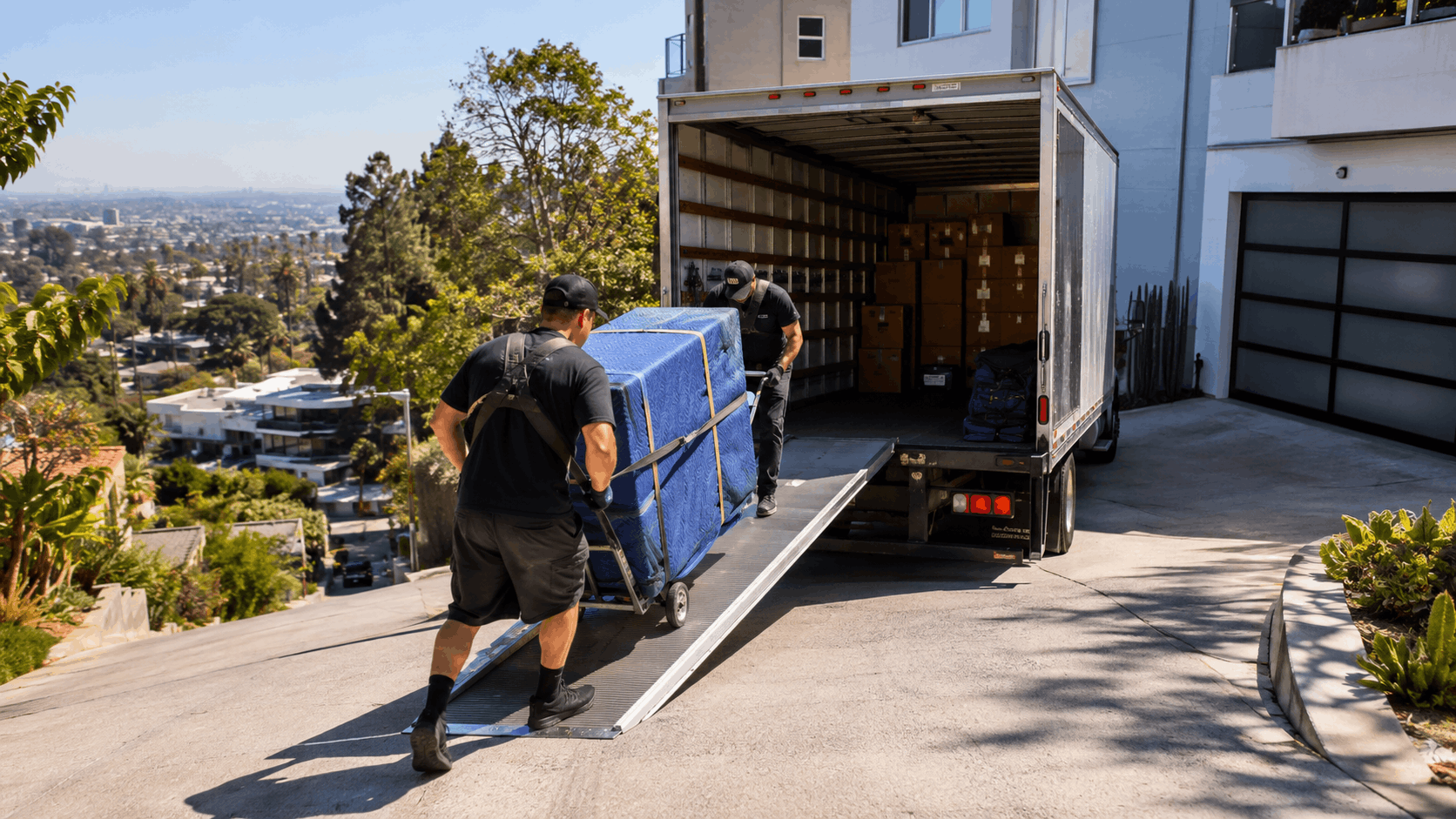
The Hollywood Hills terrain is nothing like the flat grid of the San Fernando Valley or the wide streets of Culver City. Homes here sit on slopes carved out of the Santa Monica Mountains, connected by roads that twist and climb. That geography is what makes steep driveway moving so different from a standard job.
A move on level ground is mostly about distance and box count. A move in the hills adds a third factor: gravity. Every heavy item that goes up or down a grade takes more people, more time, and more caution.
Here is what sets hillside homes apart from flatter parts of Los Angeles:
- Roads too narrow for a standard 26-foot moving truck
- Driveways that climb or drop at steep angles
- Long stair runs between the street and the front door
- Little to no legal parking near the home
- Blind curves and switchbacks that slow every trip
Narrow, Winding Roads Like Mulholland and Laurel Canyon
The roads that branch off Mulholland Drive and Laurel Canyon Boulevard were often laid out decades ago for far smaller vehicles. Many are barely wide enough for two cars to pass, and some feel like one-lane paths with a drop on one side. A full-size moving truck simply cannot fit down a lot of these lanes.
When our team studies a route, the width of these narrow roads is the first thing we check. A big rig that works fine in Brentwood or the Beverly Hills flats can get wedged on a tight bend off Woodrow Wilson Drive. Backing a 26-foot truck out of a dead-end canyon street is slow, risky, and sometimes impossible.
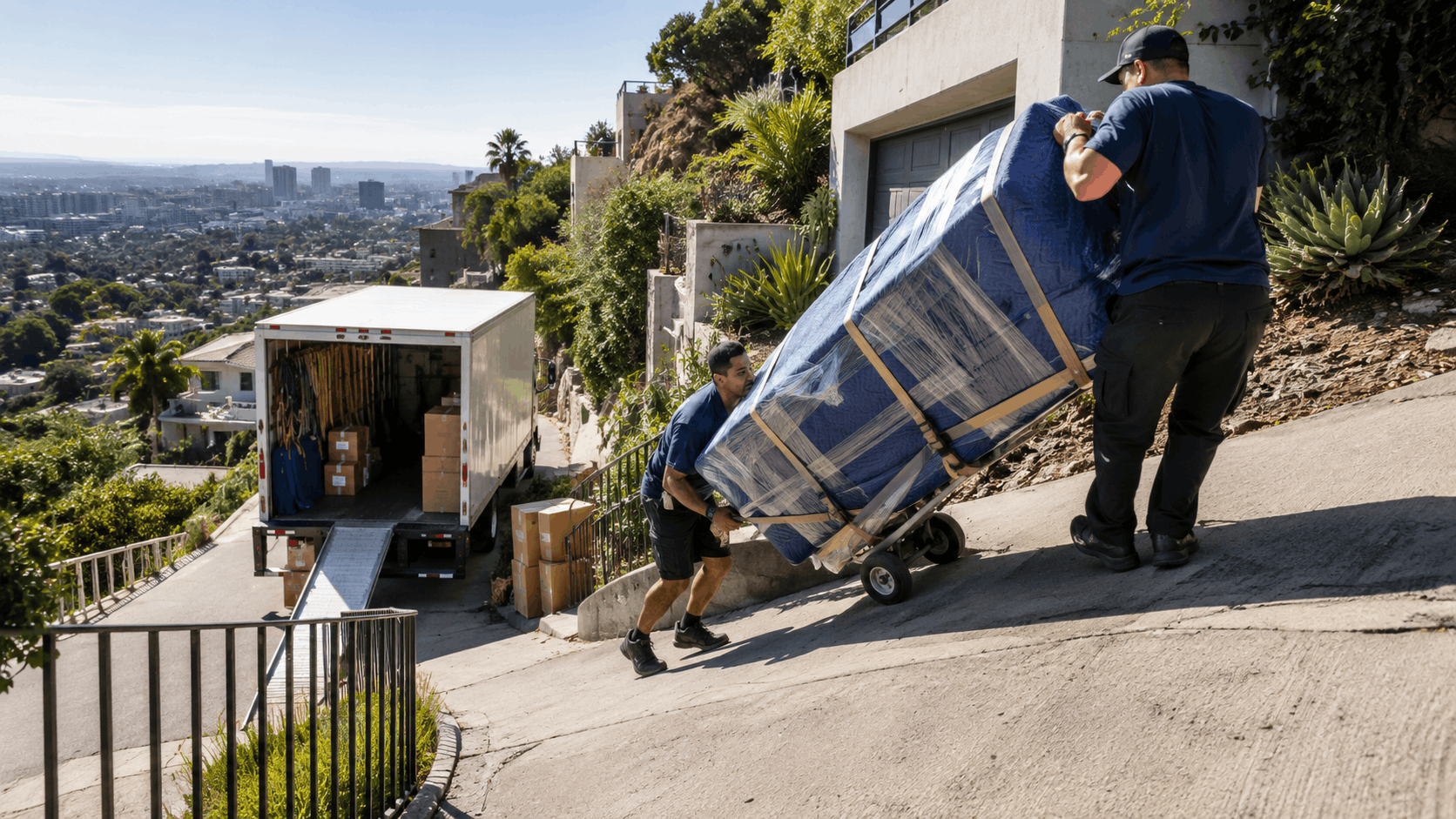
Because of that, large trucks often park at the nearest wide spot and the crew carries or shuttles items the rest of the way. On Laurel Canyon side streets, that gap between the truck and the door can stretch a hundred feet or more. Every trip up and back adds minutes, and those minutes add up across a full house of furniture and boxes.
These access limits are the root cause of most hillside surcharges. The steeper and narrower the approach, the more the terrain dictates how the day runs. Knowing this ahead of time lets us plan crew size and equipment instead of scrambling on move day.
Steep Grades and Hillside Home Layouts
Many homes near Woodrow Wilson Drive and Nichols Canyon do not sit at street level. Some perch above the road with a steep stair climb to the entry, while others drop below the street down a long flight of steps. That vertical distance is the hillside layout challenge that flat homes never face.
Grade matters more than most people expect. A driveway with a 15 percent grade is noticeable but manageable. Once a grade passes roughly 20 to 25 percent, movers slow down for safety, and heavy items may need extra hands to control the descent or climb. That is the point where a stair carry or grade surcharge usually kicks in.
Stair runs are the other big factor. A single flight of 10 to 15 steps is routine, but hillside homes often have 30, 50, or even 80 steps split across landings. Carrying a dresser or washer up that many stairs is exhausting and slow, and fatigue raises the risk of damage if a crew is too small.
We plan these jobs around the grade and step count rather than square footage alone. A modest two-bedroom home with 60 stairs can take longer than a larger flat house. For heavy or awkward pieces, our specialty moving team maps the exact path before anything leaves the truck.
Limited Parking and No Turnaround Space
Parking is the quiet budget killer in the hills. Many streets have no curb space at all, and tight cul-de-sacs off the canyon roads leave nowhere for a truck to sit legally. When there is no turnaround, a big truck cannot even reverse safely.
When legal parking is far from the door, the crew has to shuttle items over that distance by hand or with a smaller vehicle. This shuttle problem is exactly why the long carry fee exists. The truck stays put in a safe spot while movers ferry your belongings back and forth.
Double-parking is sometimes the only option on a busy stretch, but that creates its own headaches. Neighbors get blocked, delivery drivers pile up, and in fire-prone canyons a blocked lane can draw a citation fast. We coordinate parking ahead of time so move day does not turn into a standoff.
The lack of turnaround space also affects how quickly a crew works. If movers have to walk boxes 150 feet to a truck parked on the shoulder, every load takes longer. Reducing that carry distance is one of the best ways to keep costs down, which we cover later in this guide.
Get Your Free Quote
Tell us about your move and we'll get back to you fast.
What the $400 to $1200 Surcharge Actually Pays For
The driveway surcharge is not a random add-on. It reflects the extra labor, time, and equipment a steep property demands. When customers see the moving fee breakdown in writing, the range starts to make sense.
Where a job lands in the $400 to $1200 window depends on how many of these factors stack up. A short carry with one flight of stairs sits near the low end. A long carry, a shuttle truck, and a piano push toward the top. Here is how the pieces add up.
| Cost Factor | Typical Range | What Drives It |
|---|---|---|
| Extra crew members | $150 - $400 | One or two added movers for grade and stairs |
| Long carry fee | $75 - $300 | Distance from truck to door over threshold |
| Stair carry fee | $50 - $250 | Per flight beyond the first |
| Shuttle truck | $150 - $450 | Smaller vehicle plus transfer time |
| Specialty equipment | $50 - $300 | Ramps, straps, piano gear, sliders |
Extra Labor Hours and Crew Members
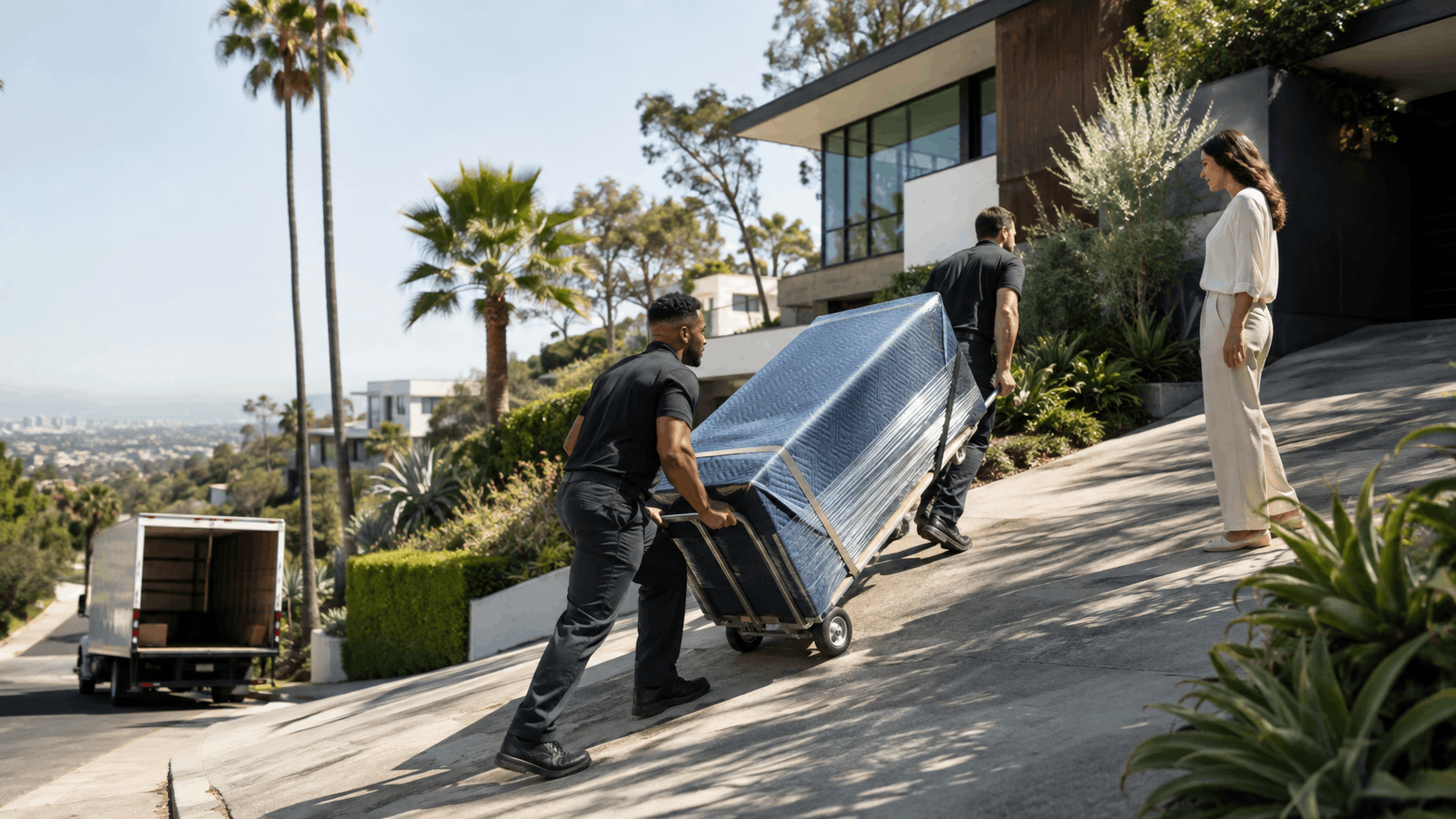
A steep property almost always needs more hands. On flat ground, a two- or three-person crew moves efficiently, but a hillside job with 50 stairs may call for a fourth or fifth mover. More people keep loads controlled and reduce the chance of an injury or a dropped item.
The math is simple once you see it. If a mover bills at roughly $50 to $70 per hour and the grade slows the job by two to three hours, one extra crew member alone can add $150 to $400. Add a second, and the labor hours climb further.
Slower carry times are the hidden driver here. A dresser that takes 90 seconds to load on flat ground might take four or five minutes up a long stair run with careful footing. Multiply that across dozens of items and the extra crew earns its cost by finishing sooner.
We size the crew to the terrain, not just the home. Our goal is to match enough people to the grade so the job stays safe and the clock does not run longer than it should. Right-sizing the team is often cheaper than a short crew that grinds through the day.
Long Carry and Stair Carry Charges
A long carry charge kicks in when the distance from the truck to your door passes a set threshold, often around 75 to 100 feet. Beyond that point, most movers bill for the added walking time. In the hills, carry distances of 150 feet or more are common when the truck cannot reach the house.
Stair carry fees work on a per-flight basis. The first flight is usually included, but each additional flight may add $50 to $75 or so. A home with three full flights between the curb and the entry can rack up a couple hundred dollars in stair fees alone.
These charges exist because both distance and elevation eat time and energy. Walking a fridge 200 feet is tiring. Doing it up two flights of switchback steps is far harder, and the crew must slow down to stay safe. The fee covers that real labor.
When we quote a job, we measure the actual carry path, not a guess. Knowing whether your door is 40 feet or 180 feet from legal parking changes the estimate a lot. Sharing that detail up front helps us give an accurate local residential move quote.
Shuttle Trucks and Smaller Vehicles
Sometimes the only way to reach a home is with a smaller shuttle truck. When a 26-foot truck cannot fit a narrow canyon lane, the crew loads a box truck or van that can, drives it up to the house, and transfers items there. This shuttle move is standard on the tightest hillside streets.
The shuttle adds cost in two ways. First, there is the second vehicle itself. Second, and often bigger, is the transfer time as movers unload from the large truck into the smaller one and then unload again at the door.
That double handling can add an hour or more to the job. On a full three-bedroom move, a shuttle setup might run $150 to $450 depending on how many trips the small vehicle needs. The steeper and farther the route, the more trips it takes.
We do not spring a shuttle on customers at the last minute. During the walkthrough, we decide whether the road can take a full-size truck or needs a shuttle, and we price it clearly. That way the smaller vehicle cost is part of the written estimate, not a surprise.
Specialty Equipment for Hillside Access
Steep grades call for the right moving equipment. Our crews carry heavy-duty straps, four-wheel dollies, portable ramps, and furniture sliders to move items safely on a slope. This gear turns a risky carry into a controlled one.
Heavy items are where costs climb fastest. A piano or a gun safe on a 25 percent grade is a serious job that needs extra movers, specialized straps, and sometimes a stair-climbing dolly. That is why heavy pieces push a quote toward the top of the range. Our piano moving team handles these on a regular basis.
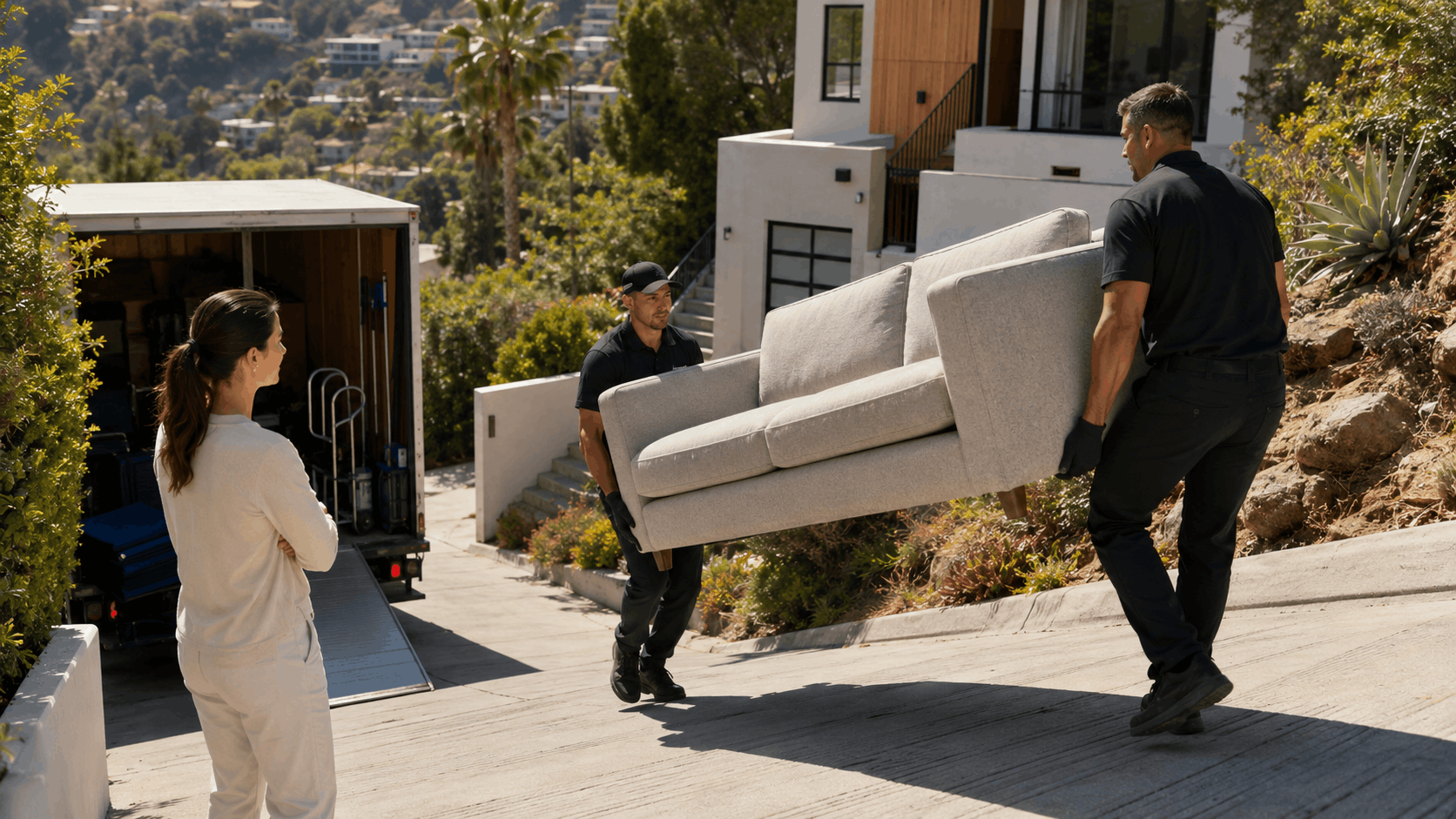
Ramps and sliders protect both your belongings and your property. Dragging a couch up rough concrete steps damages the piece and the stairs. The right hillside access gear lets the crew glide items over thresholds and short runs without scraping anything.
Good equipment also shortens the job. A well-outfitted crew moves faster and safer than one improvising with a single hand truck. The small equipment fee usually saves money by trimming the labor hours a tough carry would otherwise require.
Need Help in Los Angeles?
Popeye Moving & Storage serves Los Angeles and all of Los Angeles County.
Which Hollywood Hills Streets and Neighborhoods Cost the Most
Not every Hollywood Hills address is equally tough. Some micro-areas have wide enough roads and short driveways, while others force a shuttle every time. Knowing where your street falls helps you estimate the hillside access challenge before you call.
Below is a rough guide to how different pockets tend to price out. These are general patterns from years of working these roads, not hard quotes. Your exact home can land higher or lower depending on stairs and parking.
| Neighborhood / Street Area | Typical Difficulty | Common Surcharge Range |
|---|---|---|
| Upper Nichols Canyon / Hollywoodland | High | $600 - $1100 |
| Sunset Plaza / Bird Streets | Very High | $800 - $1200 |
| Outpost Estates | Moderate to High | $400 - $900 |
| Lower canyon flats | Moderate | $400 - $600 |
Upper Nichols Canyon and Hollywoodland
The streets near the Hollywood sign in Hollywoodland and Beachwood Canyon are famous for their charm and their tight turns. Roads like Beachwood Drive climb steadily, and the side streets branch off into narrow, curving lanes. A full-size truck rarely makes it far up these routes.
Switchback roads are the defining feature here. The road doubles back on itself as it climbs, which means a long truck cannot take the turns. Shuttle moves are the norm, and crews plan for the extra transfer time from the start.
Upper Nichols Canyon shares the same story. Homes tuck into the hillside with driveways that climb sharply off the main canyon road. Between the shuttle need and the stair runs, jobs here often land in the $600 to $1100 range.
We know these streets well and route our vehicles to legal, safe staging spots. Planning the shuttle and parking ahead of time keeps these tricky Hollywoodland moves from running long.
Sunset Plaza and the Bird Streets
The Bird Streets, with names like Oriole Drive, Blue Jay Way, and Thrasher Avenue, sit above the Sunset Plaza area and hold some of the most expensive homes in Los Angeles. The roads are steep, private in places, and lined with luxury homes that have dramatic entries.
Long stair entries are common up here. A modern home may have a gated motor court above the road with a flight of steps down to the living level, or the reverse. Moving furniture along those runs takes time and care, especially with designer pieces and glass.
These jobs land at the high end for good reason. The combination of steep private roads, long carries, valuable contents, and heavy modern furniture pushes many moves toward the $800 to $1200 mark. Careful handling is not optional with high-value items.
Our crews treat these homes with the extra caution they demand, from floor protection to custom crating. For fragile and high-value pieces, our packing and crating services reduce the risk on those long stair runs.
Outpost Estates and Runyon Canyon Edge
Outpost Estates near Outpost Drive is one of the older enclaves in the hills, with many Spanish-style homes built in the 1920s and 1930s. The charm is real, but the original narrow driveways were designed for the cars of that era.
Older homes bring quirks that affect access. Driveways may be steep and short, with tight aprons that a modern truck struggles to enter. Some homes near the Runyon Canyon edge have stone stairs and terraced yards that add to the carry.
Age and design together decide the difficulty. A restored 1930s home might have a lovely but slender staircase that only allows one mover past at a time. That bottleneck slows the whole job and can nudge the surcharge upward.
Because these homes vary so much, a walkthrough matters more here than almost anywhere. We look at the driveway apron, the stair width, and the parking to price the job right the first time.
How Popeye Moving & Storage Prices a Hillside Move
We built our hillside quoting process around one idea: no surprises on move day. A steep property has too many variables to guess at over a quick phone call. Our estimate reflects what we actually see at your home.
Here is how our process works from first contact to a booked date, so you know exactly what to expect from our team.
| Step | What Happens | Timeline |
|---|---|---|
| Walkthrough | On-site or video review of driveway, stairs, parking | 1 - 3 days after inquiry |
| Estimate | Written quote with access charges listed | Same or next day |
| Crew planning | Right crew size and equipment assigned | Before move date |
| Move day | Locked pricing, no surprise fees | Booked date |
The On-Site or Virtual Property Walkthrough
Every hillside quote starts with a walkthrough. Our team reviews the driveway grade, the number of stairs, and where a truck can legally park. Seeing the site tells us far more than a square-footage number ever could.
For an on-site survey, a coordinator visits, walks the carry path, and notes tight turns or gates. For a virtual estimate, we ask for a short video that pans from the nearest wide parking spot all the way to the front door, plus close-ups of any stairs.
We also ask about heavy or oversized items. A piano, a safe, a treadmill, or a large armoire changes the crew and gear we bring. Knowing this during the site survey lets us plan instead of react.
The walkthrough is where accuracy comes from. A five-minute video of your driveway and steps can be the difference between a quote that holds and one that balloons on move day. We would rather spend that time up front.
Flat Fee Versus Hourly Pricing for Steep Access
There are two common ways to price steep access: a flat surcharge or hourly billing. Each fits a different situation, and we explain which one suits your home during the estimate.
A flat fee works well when the access challenge is predictable. If your home has a known 60-step carry and a fixed shuttle route, we can price that surcharge once so you know the total. Predictable jobs suit a flat rate.
Hourly pricing fits jobs where the carry could vary, such as when parking depends on the day or when the item count is uncertain. With hourly billing, you pay for the actual time, and a fast crew saves you money. We are upfront about the hourly rate and expected range.
The right choice depends on your priorities. Some customers want a firm number for budgeting, while others prefer to pay only for the time used. We walk through both so you can pick with clear eyes.
Written Estimates With No Surprise Fees
Every access charge appears in writing before you book. Our written estimate lists the long carry fee, stair fee, shuttle cost, and any equipment charges as separate lines. You see the full $400 to $1200 picture in advance.
Transparent pricing is how we earn repeat customers and referrals across the hills. Nobody likes a bill that grows on move day. When the range is disclosed up front, there is nothing to argue about later.
If something on move day changes the scope, we pause and talk it through before adding a dime. A blocked driveway or a last-minute added item gets discussed, not silently billed. That habit keeps trust intact.
You can reach our team any time through our contact page to start a walkthrough. We would rather answer your questions before booking than surprise you after.
Ways to Lower Your Steep Driveway Moving Cost
You have more control over the surcharge than you might think. A few smart moves before the crew arrives can shave real money off a hillside job. Here are the tactics that work best to save on moving in the hills.
- Shorten the carry distance with closer parking
- Declutter and pre-stage boxes near the curb
- Book off-peak dates and early time slots
- Ask whether a shuttle is truly needed
Arrange Closer Parking or a Neighbor's Space
The single biggest lever is carry distance. If you can borrow a neighbor's flat driveway or a closer spot for the truck, you cut the long carry fee, sometimes entirely. A friendly conversation with the neighbors a week ahead often does the trick.
If your street has an HOA or is a private road, ask about temporary parking arrangements for move day. Many communities allow it with notice. Coordinating this early avoids a scramble when the truck arrives.
For public streets, a temporary no-parking permit from the City of LA can reserve curb space right at your door. Reserving that spot keeps the truck close and the carry short. We cover the permit process in the next section.
Even shaving 50 feet off the carry adds up over a full house. When the truck sits close, every trip is faster and the crew finishes sooner, which lowers your total either way you are billed.
Declutter and Pre-Stage Boxes Near the Curb
Lighter loads move faster and cost less. Every box you donate, sell, or toss before move day is one the crew does not carry up or down your stairs. Decluttering is free and it directly reduces labor.
Pre-staging is the other easy win. If you can safely carry boxes yourself and stack them near the curb or top of the driveway, the crew handles them in seconds instead of walking each one from inside. This reduces labor time on the clock.
Here is a realistic before-move checklist: purge closets and the garage two weeks out, box up non-essentials early, label everything by room, and stage sealed boxes in the garage or entry the night before. Leave the heavy furniture to the pros.
Do not overdo the self-carry on steep stairs, though. Save your energy and skip anything heavy or awkward. If you have a lot of boxes and want them handled start to finish, our full-service packing team can take that off your plate.
Book Off-Peak Dates and Early Time Slots
Timing changes cost. Weekends and the end of the month are the busiest and often priciest windows. A mid-month weekday move usually books easier and can come at a better rate.
Early start times help even more in the hills. An 8 a.m. start beats the traffic that clogs Cahuenga Boulevard and Highland Avenue later in the day. Less time stuck in traffic between locations means fewer billable hours on an hourly job.
Heat is another reason to start early. Crews work faster in the cool morning than in the afternoon sun, especially on long stair carries. An early slot gets the heavy lifting done before the day warms up.
If your schedule is flexible, ask us which dates are lighter. Off-peak moving often means a larger, less rushed crew and a smoother day overall. Flexibility is one of the cheapest ways to save.
Ask About Shuttle Alternatives
A full shuttle setup is not always the cheapest path. On some streets, a smaller crew making multiple trips with a right-sized truck beats the cost of staging a large truck plus a shuttle vehicle. It depends on the road and the load.
When you book, ask directly: does my street truly require a shuttle, or can a smaller truck reach the house? A mover who knows the hills can answer fast. If a mid-size truck fits, you skip the transfer time entirely.
For a smaller home or a partial move, multiple trips with one right-sized truck can be the smarter play. Fewer vehicles and less double-handling sometimes wins on total cost. The answer varies block by block.
We run this analysis for every hillside quote. Our aim is the lowest safe total, not the biggest invoice. Asking the shuttle alternative question up front keeps your options open.
Need Help in Los Angeles?
Popeye Moving & Storage serves Los Angeles and all of Los Angeles County.
Permits, HOAs, and Access Rules in the Hills
Paperwork can make or break a hillside move day. The right permit keeps a spot open at your door, while the wrong assumption about a private road can stall the whole crew. A little prep avoids fines and delays.
Los Angeles has specific processes for reserving curb space and for entering gated pockets. Here is what you need to line up before the truck rolls out.
Temporary No-Parking Permits From LADOT
The Los Angeles Department of Transportation issues temporary no-parking permits that reserve curb space for a move. Posting those signs guarantees the truck a legal spot right where you need it. That is gold on a street with almost no parking.
Lead time matters. LADOT generally asks for the request several business days in advance, and the posted signs must go up a set number of hours before the move. Start this at least a week out to be safe. You can review the process on the LADOT website.
The permit fee is modest compared to the long carry cost it can prevent. Reserving the closest legal space often pays for itself by shortening the carry. It also keeps neighbors from parking in the exact spot you need.
We are glad to point you to the right LADOT forms and timing. Getting the curb space locked in is one of the best small investments for a hillside move.
Private Road and Gated Community Restrictions
Several pockets near the Bird Streets and elsewhere in the hills sit on private roads or behind gates. These areas often have their own rules about vehicle size, hours, and check-in. Ignoring them can leave a truck stuck at the gate.
Some private roads limit truck length or weight to protect the pavement. Others require the move to happen during set hours to keep noise down. Confirm these limits with your HOA or road association before booking so the crew brings the right vehicle.
Gated communities usually need advance notice and a name on a list. Give the gate attendant our company and crew details ahead of time so entry is quick. A blocked entry burns clock time you would rather not pay for.
We handle these access restrictions all the time and will help you gather what the community needs. A quick call to your HOA a week out clears most of it.
Fire Lane and Emergency Access Concerns
The hills take fire safety seriously, and so do we. LAFD fire lane rules limit where a truck can block a road, especially on the narrow canyon lanes where an engine must be able to pass. A blocked fire lane can bring a citation and force the truck to move mid-job.
On red flag warning days, when brush fire danger is high, restrictions tighten further. Roads must stay clear for emergency access, so double-parking that is tolerated on a calm day is off the table. We watch the weather and plan around it.
The safe move is to reserve legal parking and keep the lane open. That may mean a shuttle or a permitted curb spot rather than parking across a narrow road. Emergency access always comes first in these neighborhoods.
Our crews know the LAFD rules for the canyons and route vehicles to comply. Keeping the roads clear protects your neighbors and keeps your move on schedule.
Seasonal and Weather Factors That Change the Cost
The Hollywood Hills climate is mild most of the year, but a few seasonal patterns can affect timing and price. Planning around them helps you avoid weather delays and extra safety time.
Rain, heat, and fire season each change how a hillside move runs. Here is what to expect and how to time your move around them.
Winter Rain and Slick Driveways
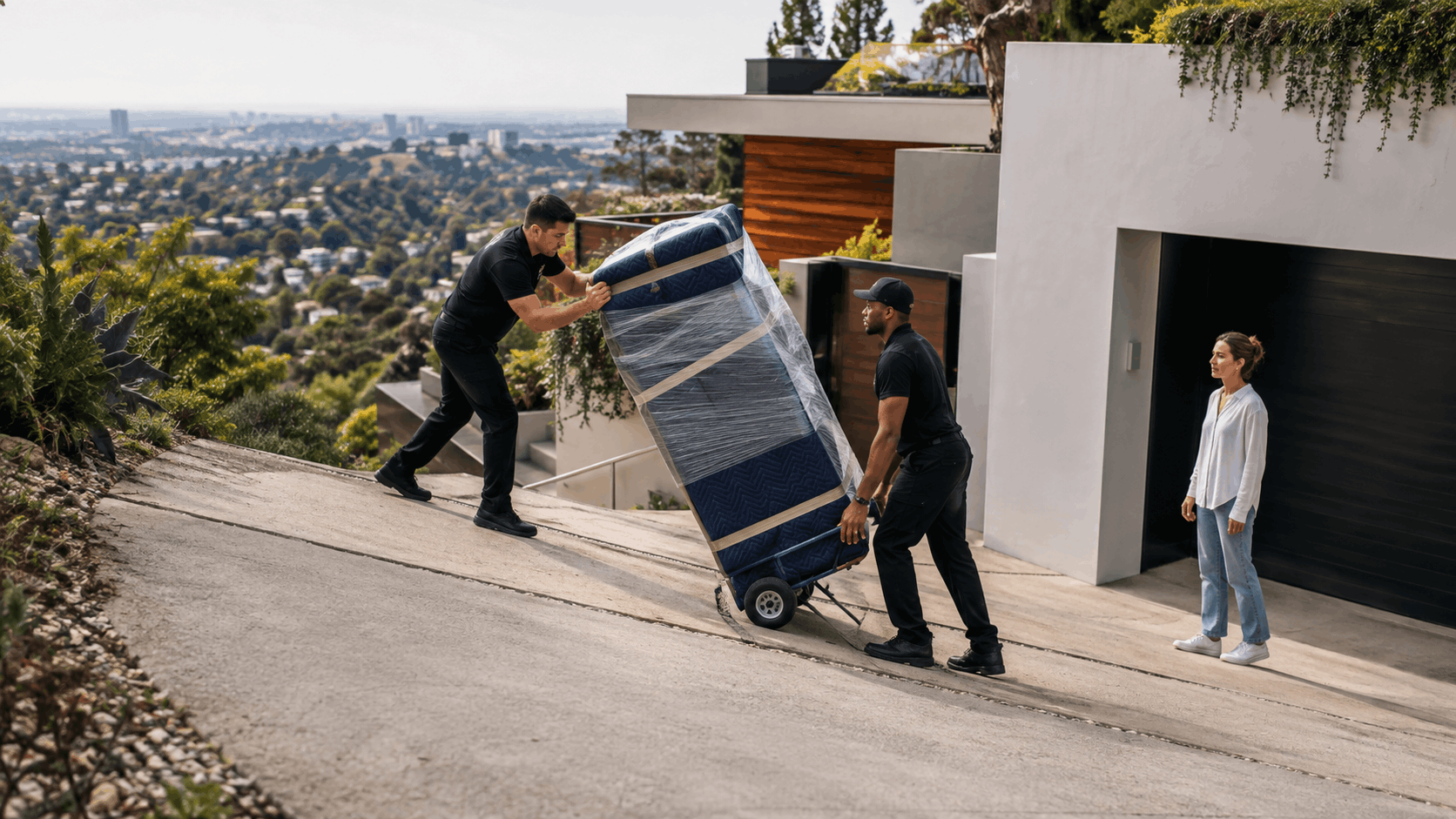
Los Angeles does not get much rain, but when a winter storm rolls through, steep concrete driveways turn slick fast. Water sheeting down a 20 percent grade makes footing treacherous with a heavy load in hand.
On rainy days, crews slow down for safety, lay extra floor and stair protection, and add grip mats where needed. That safety time adds to the clock. It is the right call, but it does cost a bit more time.
If your move date is flexible and rain is in the forecast, moving the date a day or two can save money and stress. A dry driveway is faster and safer for everyone. We keep an eye on the forecast for hillside jobs.
When rain cannot be avoided, we come prepared with covers and traction gear. Protecting your belongings and the crew is worth the small added time on a wet day.
Summer Heat and Longer Carry Fatigue
Summer in the hills can hit triple digits, and heat is brutal on a long stair carry. Movers tire faster, need more water breaks, and slow down to avoid heat illness. That fatigue stretches the job on a hot afternoon.
To keep a hot-weather move on track, we may add a crew member so the team can rotate and rest. More hands cost more per hour but finish the job sooner and safer. It is a fair trade on a scorching day.
Early morning starts are the best defense against summer heat. Getting the heaviest items down the stairs before noon avoids the worst of it. We push for early slots on hot dates whenever possible.
Hydration and pacing are not optional in that heat. A crew that overheats works slower and risks injury. Planning around the temperature keeps both cost and safety in check.
Fire Season Road Closures and Rerouting
Fire season brings its own risks to hillside moves. Brush fire alerts near Runyon Canyon or the surrounding hills can close roads with little notice. When a canyon road shuts, crews reroute through the Cahuenga Pass, which adds drive time.
Rerouting stretches the day on an hourly job and can delay a fixed appointment. We monitor alerts and adjust routes to keep things moving. Sometimes that means a longer approach from a different direction.
If an active fire threatens access, safety comes first and we may reschedule. No move is worth putting a crew or your belongings at risk. We stay in touch so you always know the plan.
Booking outside the peak of fire season, when possible, reduces the odds of a closure. If your date lands in a high-risk window, we build a little buffer into the plan.
Choosing a Mover Who Knows the Hollywood Hills
The cheapest quote is rarely the cheapest move in the hills. A crew that has never worked these roads can get stuck, damage items, or blow through the estimate. Local experience is what keeps a hillside move on budget.
Here is how to tell an experienced hillside moving company from a bargain gamble, and what our team brings to tough Los Angeles properties.
Questions to Ask Before Booking
Before you book any mover, ask about hillside experience directly. How many steep driveway moves have they done in the last month? Which canyon streets have they worked? Vague answers are a red flag.
Ask about shuttle equipment and crew size. Do they own a smaller shuttle truck, or will they improvise on move day? A mover without the right vehicle for a narrow lane will cost you time. Confirm they can staff enough people for your stairs.
Insurance is the other must-ask on your movers checklist. Confirm they are licensed and carry valuation coverage for your belongings. A high-value move on long stairs deserves real protection, not a bare-minimum policy.
Finally, ask for a written estimate with access charges listed. Any mover who dodges that question up front will likely surprise you later. Clear answers now save arguments on move day.
Why Local Experience Beats a Cheaper Quote
A low bid from an out-of-area company often hides real risk. A crew unfamiliar with the switchbacks off Mulholland may send the wrong truck, get stuck, and then charge for the wasted time. The bargain evaporates fast.
Local experience prevents the costly mistakes that inflate a low bid. A crew that knows to shuttle a certain block, or which cul-de-sac has no turnaround, plans correctly the first time. That foresight is worth more than a small price gap.
Hidden costs are the danger with a cheap quote. Wasted hours, damaged furniture on tight stairs, and citations for blocking a fire lane all add up. A slightly higher quote from a hills-savvy crew often ends up cheaper overall.
We have driven and worked nearly every canyon road in these hills. That knowledge shows up in a smoother, faster, and safer move. Experience is the cheapest insurance you can buy.
How Popeye Moving & Storage Handles Tough Access
Our routine on steep Los Angeles properties starts long before move day. We survey the driveway, stairs, and parking, then assign the right crew size and equipment for the grade. Nothing is left to guess on the day itself.
Equipment prep is part of every hillside job. The truck rolls out with straps, ramps, sliders, and the right dollies for stairs. For heavy pieces, we bring specialized gear so a piano or safe moves safely down a slope.
Crew planning matches people to the terrain. A 70-step home gets more movers than a flat two-bedroom, and we schedule accordingly. The right team finishes sooner, which protects your budget and your belongings. If you need storage between homes, our storage solutions can bridge the gap.
We serve the whole hillside area and the neighborhoods around it, from the canyons to nearby West Hollywood and the Sunset Strip. Wherever your home sits, our team plans the access before we ever load the first box.
Need Help in Los Angeles?
Popeye Moving & Storage serves Los Angeles and all of Los Angeles County.
Final Thoughts
A steep driveway in the Hollywood Hills adds $400 to $1200 to a move because the terrain demands more crew, more time, and more equipment. Narrow roads, long stair carries, and tight parking all feed that range. The more of those factors your home has, the higher the surcharge climbs.
The good news is that you can plan around most of it. Closer parking, decluttering, off-peak dates, and the right permit all trim the bill. And hiring a crew that knows these roads keeps a low-risk quote from turning into a costly day.
Our team has worked hundreds of hillside homes across Los Angeles, and we price every one with a clear, written estimate. If you are planning a move in the hills, reach out to contact us or explore our residential moving services to start a walkthrough today. We will help you plan a smooth, fairly priced move.
Frequently Asked Questions
How much does a steep driveway add to a Hollywood Hills move?
A steep driveway typically adds $400 to $1200 to a Hollywood Hills move. The low end covers a short carry with one flight of stairs, while the high end reflects a long carry, a shuttle truck, many stairs, and heavy items like a piano. The more of these factors stack up, the closer your job lands to the top of the range.
Why do movers charge extra for stairs and long carries?
Stairs and long carries take far more time and effort than flat, close access. Carrying a heavy dresser up 50 steps can take several times longer than loading it on level ground, and crews must slow down for safety. The extra fee covers that added labor time and the higher risk of injury or damage on steep, lengthy paths.
What is a shuttle move and when is it needed?
A shuttle move uses a smaller truck to reach a home when a full-size truck cannot fit the road. Crews load the big truck at a wide spot, transfer items into the smaller vehicle, and drive it to the door. Narrow canyon lanes and switchback streets off Mulholland Drive and Laurel Canyon often require this setup.
Can I avoid the steep driveway surcharge?
You can reduce or sometimes avoid it. Arranging closer parking through a neighbor or an LADOT permit shortens the carry. Decluttering and pre-staging boxes near the curb cuts labor time. Booking a mid-month weekday with an early start also helps. Ask your mover whether a shuttle is truly needed, since a right-sized truck can skip that cost.
Do I need a parking permit for a move in the Hollywood Hills?
A temporary no-parking permit from LADOT helps a lot when your street has little legal parking. It reserves curb space right at your door, which shortens the carry and prevents another car from taking the spot. Request it at least a week ahead, since signs must be posted a set number of hours before the move.
How long does a hillside move usually take?
A hillside move often takes longer than a flat one of the same size. A flat two-bedroom might take five to six hours, while the same home with 50 stairs and a long carry can run seven to ten hours. Shuttle setups, heavy items, and hot weather add more time, which is why crew size matters so much.
Are pianos and heavy items more expensive on steep driveways?
Yes. Pianos, safes, and other heavy items need extra movers, specialized straps, and sometimes a stair-climbing dolly on a steep grade. Controlling that weight down a slope or up a long stair run takes more people and more care. These pieces are a major reason a hillside quote lands near the top of the $400 to $1200 range.
Does weather affect my move cost in the hills?
It can. Winter rain makes steep concrete driveways slick, so crews slow down and add safety gear, which extends the clock. Summer heat causes fatigue on long carries and may require an extra mover or more breaks. Fire season road closures can force rerouting through the Cahuenga Pass, adding drive time to your day.
How do I get an accurate quote for my hillside home?
Start with a walkthrough. We do an on-site visit or a virtual estimate where you send a short video panning from the nearest parking to your front door, plus close-ups of any stairs. Share details about heavy items and gate access. That information lets us list every access charge in a written quote before you book.
Should I hire a local mover or an out-of-area company?
Hire a mover who knows the Hollywood Hills. A local crew understands which streets need a shuttle, where trucks can park, and how to handle switchback roads. An out-of-area company with a cheap quote may get stuck, waste billable hours, or damage items on tight stairs, which often makes the low bid more expensive in the end.
Frequently Asked Questions
- How much does a steep driveway add to a Hollywood Hills move?
- A steep driveway typically adds $400 to $1200 to a Hollywood Hills move. The low end covers a short carry with one flight of stairs, while the high end reflects a long carry, a shuttle truck, many stairs, and heavy items like a piano. The more of these factors stack up, the closer your job lands to the top of the range.
- Why do movers charge extra for stairs and long carries?
- Stairs and long carries take far more time and effort than flat, close access. Carrying a heavy dresser up 50 steps can take several times longer than loading it on level ground, and crews must slow down for safety. The extra fee covers that added labor time and the higher risk of injury or damage on steep, lengthy paths.
- What is a shuttle move and when is it needed?
- A shuttle move uses a smaller truck to reach a home when a full-size truck cannot fit the road. Crews load the big truck at a wide spot, transfer items into the smaller vehicle, and drive it to the door. Narrow canyon lanes and switchback streets off Mulholland Drive and Laurel Canyon often require this setup.
- Can I avoid the steep driveway surcharge?
- You can reduce or sometimes avoid it. Arranging closer parking through a neighbor or an LADOT permit shortens the carry. Decluttering and pre-staging boxes near the curb cuts labor time. Booking a mid-month weekday with an early start also helps. Ask your mover whether a shuttle is truly needed, since a right-sized truck can skip that cost.
- Do I need a parking permit for a move in the Hollywood Hills?
- A temporary no-parking permit from LADOT helps a lot when your street has little legal parking. It reserves curb space right at your door, which shortens the carry and prevents another car from taking the spot. Request it at least a week ahead, since signs must be posted a set number of hours before the move.
- How long does a hillside move usually take?
- A hillside move often takes longer than a flat one of the same size. A flat two-bedroom might take five to six hours, while the same home with 50 stairs and a long carry can run seven to ten hours. Shuttle setups, heavy items, and hot weather add more time, which is why crew size matters so much.
- Are pianos and heavy items more expensive on steep driveways?
- Yes. Pianos, safes, and other heavy items need extra movers, specialized straps, and sometimes a stair-climbing dolly on a steep grade. Controlling that weight down a slope or up a long stair run takes more people and more care. These pieces are a major reason a hillside quote lands near the top of the $400 to $1200 range.
- Does weather affect my move cost in the hills?
- It can. Winter rain makes steep concrete driveways slick, so crews slow down and add safety gear, which extends the clock. Summer heat causes fatigue on long carries and may require an extra mover or more breaks. Fire season road closures can force rerouting through the Cahuenga Pass, adding drive time to your day.
- How do I get an accurate quote for my hillside home?
- Start with a walkthrough. We do an on-site visit or a virtual estimate where you send a short video panning from the nearest parking to your front door, plus close-ups of any stairs. Share details about heavy items and gate access. That information lets us list every access charge in a written quote before you book.
- Should I hire a local mover or an out-of-area company?
- Hire a mover who knows the Hollywood Hills. A local crew understands which streets need a shuttle, where trucks can park, and how to handle switchback roads. An out-of-area company with a cheap quote may get stuck, waste billable hours, or damage items on tight stairs, which often makes the low bid more expensive in the end.
P
Popeye Moving & Storage Co. Team Team
Licensed moving and storage professionals serving Los Angeles and Los Angeles County.
Licensed in California · License #PUC: CAL T 189749 | DOT: 1472924 | MC: 498816C
Why trust Popeye Moving & Storage?
Founded in 1994, Popeye Moving & Storage is a licensed and insured moving and storage service serving Los Angeles and Los Angeles County. All content is reviewed by our licensed technicians.

Need Help in Los Angeles?
Popeye Moving & Storage serves Los Angeles and all of Los Angeles County.
Related Articles
Cost Guides
Beverly Hills Moving Cost: 4-Bedroom Estate Move Pricing Breakdown
A clear pricing breakdown for a 4-bedroom estate move in Beverly Hills, covering cost ranges, local fees, packing, storage, and how to compare quotes.

Cost Guides
Hollywood Hills Move Pricing: Why Steep Driveways Add 1-3 Hours
Steep driveways in the Hollywood Hills add 1 to 3 hours to most moves. Learn why terrain shapes pricing and how to save time on your hillside move.

Cost Guides
Hollywood Hills Movers: Steep Driveway and Switchback Road Pricing
Steep driveways and switchback roads make Hollywood Hills moves cost more. Learn how grade, stairs, and access shape pricing and how to lower your bill.