Cost Guides
Hollywood Hills Movers: Steep Driveway and Switchback Road Pricing

Key Takeaways
- Hollywood Hills moves cost more than flatland moves because of steep driveway grade, long carries, high stair counts, and limited truck access.
- Driveways in the hills often run 15 to 25 percent grade, which adds labor and requires extra crew and equipment for heavy items like pianos and safes.
- Switchback roads off Mulholland and Laurel Canyon often defeat full-size trucks, triggering a shuttle fee for transfer to a smaller vehicle.
- Common hillside add-ons include shuttle fees, long carry and stair fees, hoisting and rigging, and LADOT parking permits.
- An on-site or video walkthrough gives a far more accurate quote than a phone estimate for a hillside home.
- Homeowners can lower costs by clearing the driveway, reserving street parking, starting early to beat canyon traffic and heat, and staging boxes near the exit.
- Weather matters: winter rain makes steep concrete slick, fire season can close canyon roads, and summer heat requires more crew breaks.
- Choose a licensed, insured mover with real canyon knowledge to avoid stuck trucks and inaccurate estimates.
In This Article
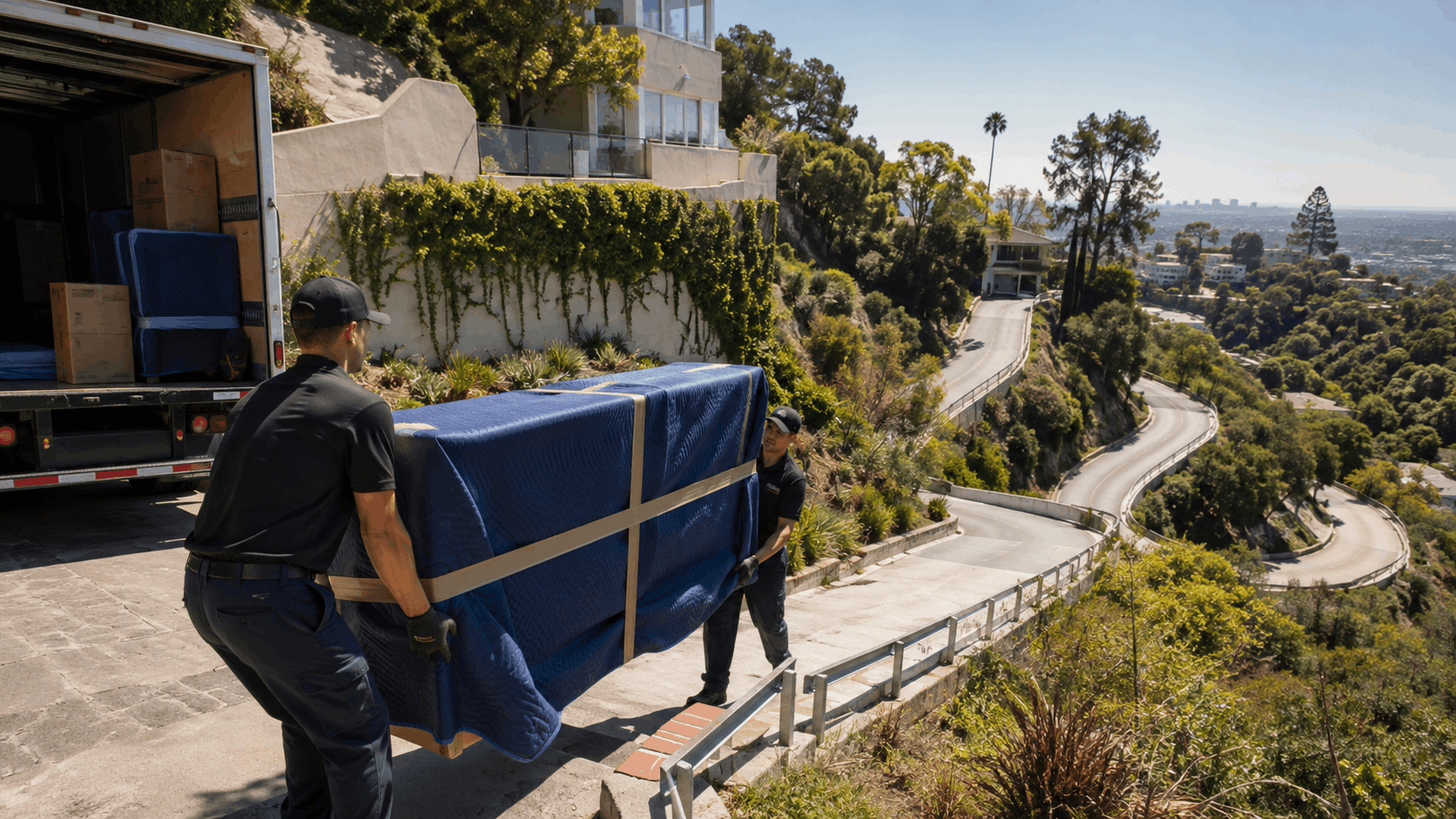
A moving truck idles halfway up a switchback near Mulholland Drive, its back wheels inches from a hairpin edge. The driver cannot go forward, cannot back down, and a line of frustrated commuters is stacking up behind him. This is a scene our crews know well, and it happens more often than most people expect in the Hollywood Hills.
Moving in these hills is nothing like moving on a flat lot in Culver City or the beach flats near Redondo. The roads twist, the driveways climb at angles that scare first-time visitors, and homes tuck themselves above or below the street in ways that add real labor and real cost. Two homes with identical square footage can price hundreds of dollars apart based on access alone.
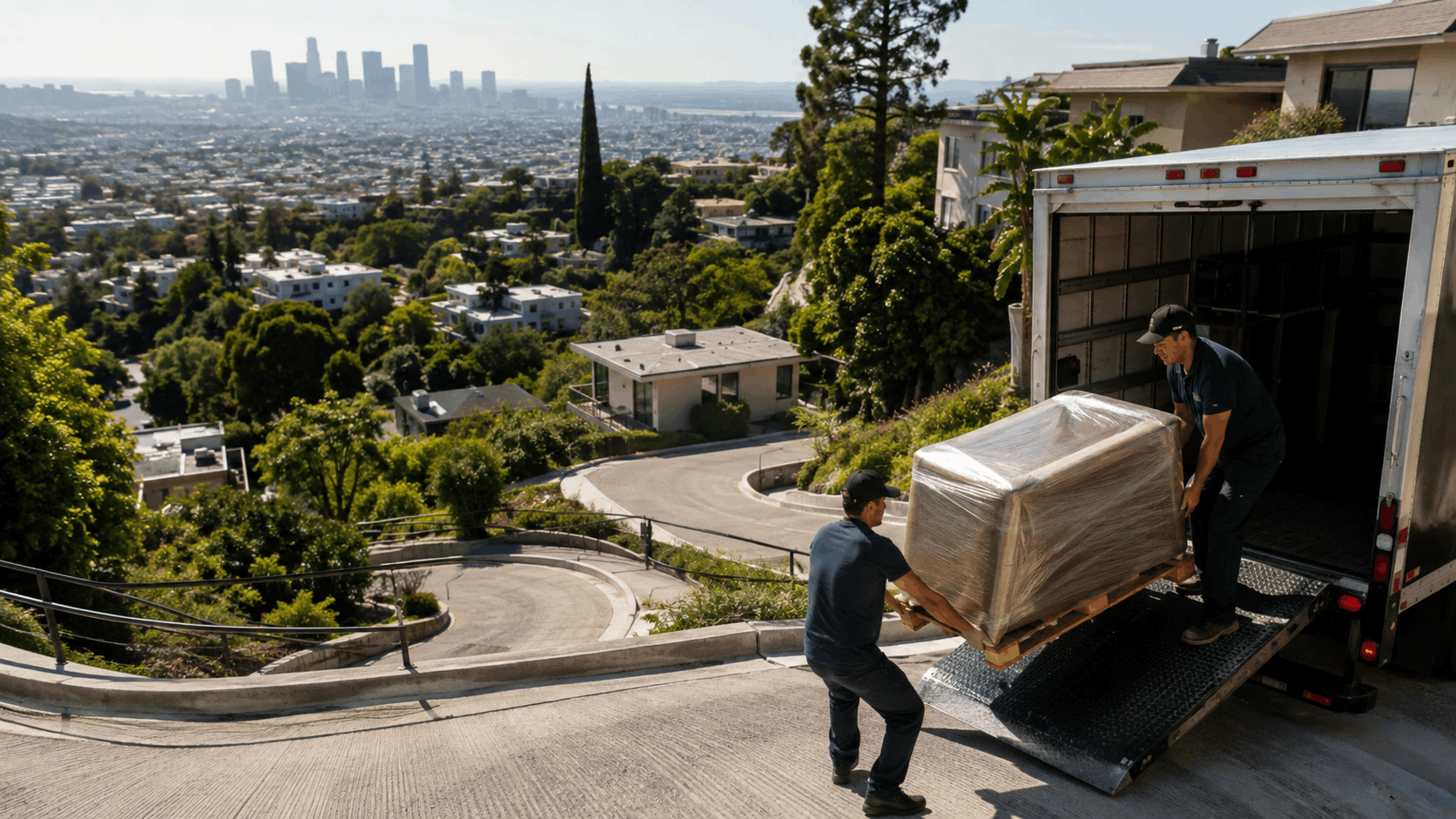
Why Hollywood Hills Moves Cost More Than Flatland Moves
Hillside moving is a physics problem before it is a pricing problem. A flat lot in Culver City lets a truck back right up to the garage, drop a ramp, and roll furniture straight inside. A home off Laurel Canyon rarely offers that luxury.
The hillside move cost climbs because of a handful of predictable factors. Our crews plan around these before we ever quote a number:
- Distance from truck to door - narrow lots force long carries on foot
- Driveway grade - steep concrete slows every trip and demands extra safety steps
- Stair counts - homes above or below the street add dozens of steps each way
- Truck access limits - big rigs cannot fit on many canyon roads
- Parking restrictions - narrow shoulders and no-stopping zones limit where crews work
Once you understand these drivers, the price of Hollywood Hills moving makes a lot more sense. Let us look at each one in detail.
The Long Carry Problem on Narrow Lots
On homes near Wonderland Avenue and Woodrow Wilson Drive, there is often no place to park close to the front door. The road is barely wide enough for one car, and the driveway may only hold the homeowner's vehicle. That means our crew parks down the street and carries every box and couch by hand across a long stretch.
A long carry fee applies when the distance between the truck and the door passes a set threshold, usually around 75 feet. In the hills, that threshold gets crossed constantly. A crew might walk 150 feet each way, and every one of those trips eats labor time that adds up across a full move.
Narrow lot access also slows the pace of the work. Movers cannot walk side by side with a large dresser, so they take turns or reposition awkwardly around parked cars and retaining walls. What takes two hours on a flat driveway can stretch to three or four when the carry path is long and pinched.
We map this carry distance during every estimate so there are no surprises. If we know a home has a rough 200-foot walk to the truck, we can staff the job with extra hands and plan the timing right the first time.
Elevation Change and Stair Counts
Many hillside homes sit well above or below the street. You might see a house perched up a set of forty concrete steps, or a home that drops down a hillside with the front door two levels below the curb. Both add serious labor.
A stair carry charge kicks in when crews haul items up or down a certain number of steps. Every trip up forty stairs with a loaded dolly is slow and physically demanding, so the crew moves smaller loads and takes more breaks. Elevation moving simply cannot happen at the same speed as a ground-level move.
The direction matters too. Carrying a heavy sofa down a steep stairway is often harder and riskier than carrying it up, because gravity works against control. Our crews use extra straps and spotters on these descents to keep both the furniture and the movers safe.
We count stairs during the walkthrough and factor them into the labor estimate. A home with a hundred total steps across the property is a very different job than one with ten, and honest pricing reflects that reality.
Slower Truck Turnaround and Shuttle Needs
Some Hollywood Hills streets cannot fit a full-size 26-foot moving truck at all. The turns are too tight, the branches hang too low, or the road simply dead-ends without room to turn around. In those cases, our crew uses a smaller shuttle vehicle.
Shuttle service means we park the big truck at a wider staging spot and transfer belongings into a smaller box truck or van that can reach the home. Items get carried to the shuttle, driven up the hill, and unloaded at the door. It works, but it adds a second handling step and more time.
Truck access issues also slow turnaround on move day. A driver may need to inch around a blind curve, wait for oncoming cars to pass, or reposition several times to get a clean angle at the driveway. Each of those delays adds minutes that stack across a long move.
When we scout a property, one of the first things we check is whether a full-size truck can safely reach it. If not, we plan the shuttle from the start rather than discovering the problem when the truck is already stuck. Our residential moving team handles this kind of access planning every week.
Get Your Free Quote
Tell us about your move and we'll get back to you fast.
How Steep Driveways Affect the Price of Your Move
A steep driveway changes the whole rhythm of a move. What looks like a short walk from the truck to the garage becomes a slow, careful climb with heavy loads. Steep driveway movers price these jobs differently for good reason.
During an estimate, our crew studies the driveway closely. They look at how steep it is, how long it is, and whether the surface offers good traction. All three shape the final driveway grade pricing.
Measuring Driveway Grade and Length
Driveway grade percentage measures how much a slope rises over its length. A 10 percent grade rises 10 feet over 100 feet of run. Many hillside driveways run between 15 and 25 percent, which feels dramatically steep when you are pushing a loaded dolly up it.
Length matters just as much as steepness. A short but sharp incline is manageable in one push. A long steep incline that runs a hundred feet or more forces crews to work in shorter bursts, resting the load and their arms along the way.
Our team eyeballs the grade during the walkthrough and often measures the run so we can staff the job correctly. A driveway that combines steep grade with real length is one of the biggest cost drivers we see in the hills.
We also note the surface. Smooth sealed concrete can be slick, while textured or broom-finished concrete gives dollies better grip. Both affect how fast and how safely the crew can work.
Extra Crew and Equipment for Heavy Items
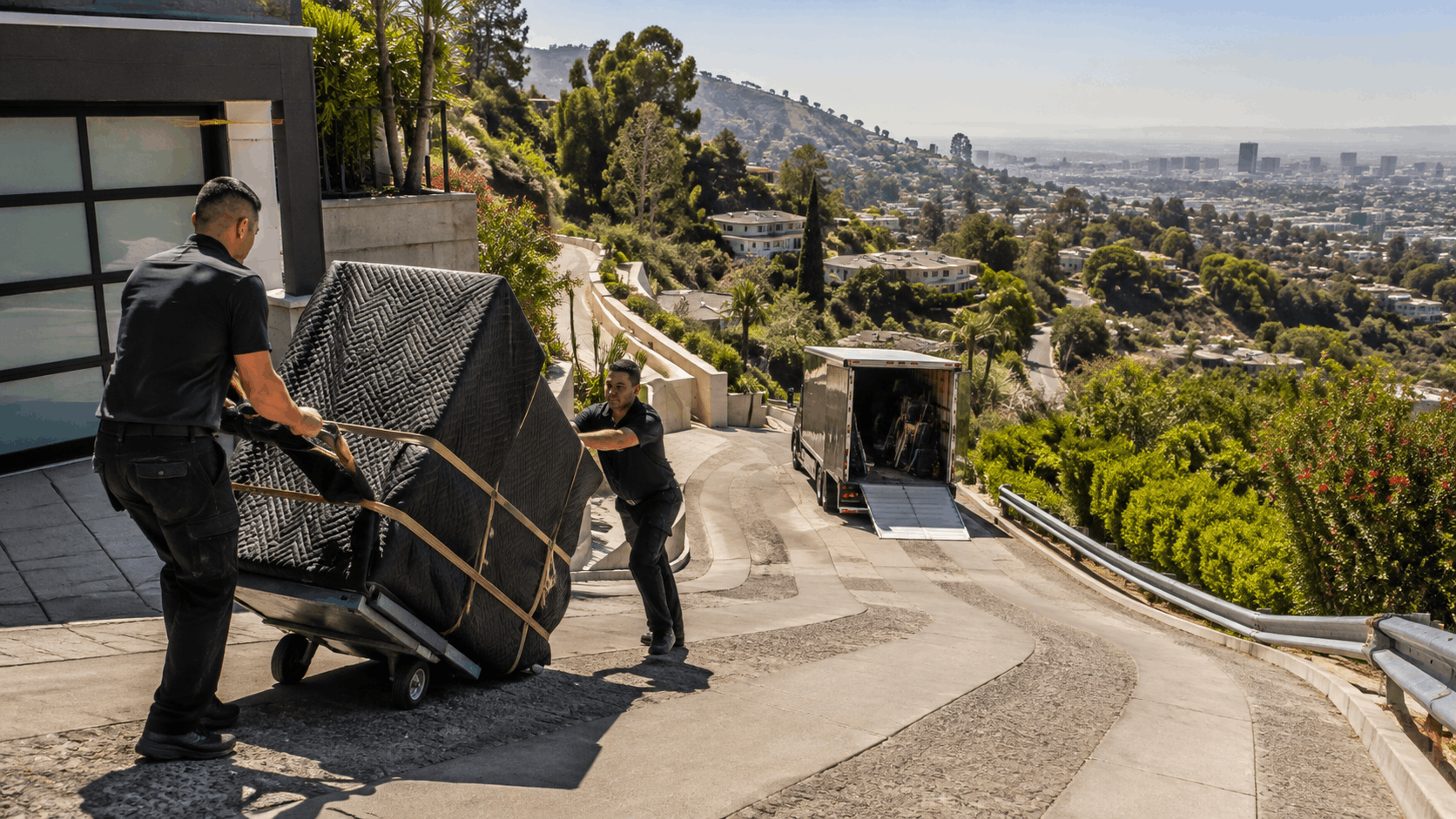
Heavy items on a steep grade need more hands. A piano, a gun safe, or a solid oak armoire that two movers handle easily on flat ground may require four movers on a 20 percent slope. The heavy item surcharge covers that extra labor and gear.
Piano moving on a hillside is a specialty in its own right. Our crews use piano boards, heavy-duty straps, and multiple movers to control the weight on the descent or climb. One person guides while others bear the load, keeping the instrument steady the whole way. Our piano moving service is built for exactly these conditions.
Safes and oversized furniture get the same careful treatment. We bring extra dollies, ramps, and straps so the load never gets away from the crew on a slope. Rushing a heavy item down a steep driveway is how furniture gets damaged and people get hurt.
When we log a heavy item during the estimate, we plan the crew size around it. That way the right number of movers and the right equipment show up on move day rather than us improvising on the spot.
Braking Safety and Truck Positioning
Positioning a truck on a grade takes skill. Near Nichols Canyon and Outpost Estates, driveways and streets tilt at angles that make parking a loaded truck a careful process. Our drivers chock the wheels every time to prevent any roll.
Truck positioning also affects how the crew works. We angle the truck so the ramp meets the ground at the safest possible slope, and we set the parking brake plus wheel chocks as a backup. On steep streets, this is not optional.
Moving safety guides every choice on a grade. Crews avoid loading a dolly so heavy it becomes hard to control downhill, and they always keep a clear path so no one is caught between a rolling load and a wall. These habits slow the pace slightly, but they prevent the accidents that turn a routine move into a disaster.
Homeowners can help by keeping the driveway clear and letting the crew choose where to park. The spot that looks convenient to you may not be the safest angle for a loaded truck on a hillside.
Need Help in Los Angeles?
Popeye Moving & Storage serves Los Angeles and all of Los Angeles County.
Switchback Roads and the Access Challenges They Create
The switchback roads that thread through the Hollywood Hills are beautiful to drive and difficult to move on. These tight, winding routes force pricing decisions before the truck ever leaves our yard. Switchback road movers plan the approach as carefully as the move itself.
Narrow road access shapes everything from truck size to crew count. Here are the main challenges we plan around:
- Tight hairpin turns that full-size trucks cannot clear
- Narrow shoulders with little or no legal parking
- No-stopping zones near popular landmarks
- Blind curves that require a spotter to guide the truck
- Two-way traffic on roads barely wide enough for one vehicle
Each of these can add time or require a shuttle, so we scout the route in advance whenever possible.
Tight Turns Off Mulholland and Laurel Canyon
Some of the tightest turns in the city branch off Mulholland Drive and Laurel Canyon Boulevard. A full-size moving truck simply cannot make certain hairpins without crossing into oncoming traffic or scraping a retaining wall. On those roads, we bring a smaller vehicle from the start.
Laurel Canyon Boulevard itself carries heavy traffic, and the side streets that climb off it get narrow fast. A road may look fine on a map and turn out to have a turn radius no 26-foot truck can handle. Local knowledge saves us from these surprises.
We keep notes on which streets defeat full-size trucks, built from years of moves in these hills. When a customer books a home off a known tight route, we plan the shuttle and the timing before move day. That planning is why our Los Angeles moving crews avoid the stuck-truck scenario that catches out-of-area movers.
Limited Parking and No-Stopping Zones
Near Beachwood Canyon and the streets below the Hollywood Sign, parking is tight and heavily regulated. Narrow shoulders leave little room for a truck, and no parking zones limit where crews can legally stop. A ticket or a tow can derail an entire move.
In some spots, a moving truck needs a temporary permit to park where it would otherwise be barred. We handle that coordination so the crew has a legal, safe place to work. A parking permit arranged in advance beats scrambling on move day.
Beachwood Canyon in particular sees heavy tourist traffic heading toward the Hollywood Sign. Cars circle looking for parking, and that congestion makes it even harder to hold a spot for a moving truck. Early starts help us claim the space before the crowds arrive.
When we scout the property, we identify exactly where the truck will sit and whether a permit is needed. Sorting this out early keeps the move on schedule and off the tow list.
Blind Curves and Two-Way Traffic Delays
Blind curves are common on canyon roads, and they slow every part of a move. A driver cannot see oncoming cars around a sharp bend, so the truck creeps and waits. On the tightest stretches, we station a spotter to wave the truck through safely.
A spotter adds labor hours, but it prevents collisions and keeps traffic flowing. One crew member walks ahead, checks the curve, and signals the driver when the road is clear. It is slow, careful work that pays off in avoided accidents.
Two-way traffic on a one-lane-wide road creates constant traffic delay. When another car appears, someone has to yield, and on a hillside that often means backing up to a wider spot. Each of these pauses eats a few minutes, and they add up over a full day.
We build these delays into our time estimates for hillside jobs. A move that would take five hours in the flats can run six or seven in the canyons purely because of the roads.
What Popeye Moving Checks During a Hillside Estimate
An accurate moving estimate for a hillside home takes more than a quick phone call. Popeye Moving Los Angeles surveys the property carefully so the quote matches the real conditions. Here is what our team looks at before we give you a number.
The On-Site or Video Walkthrough
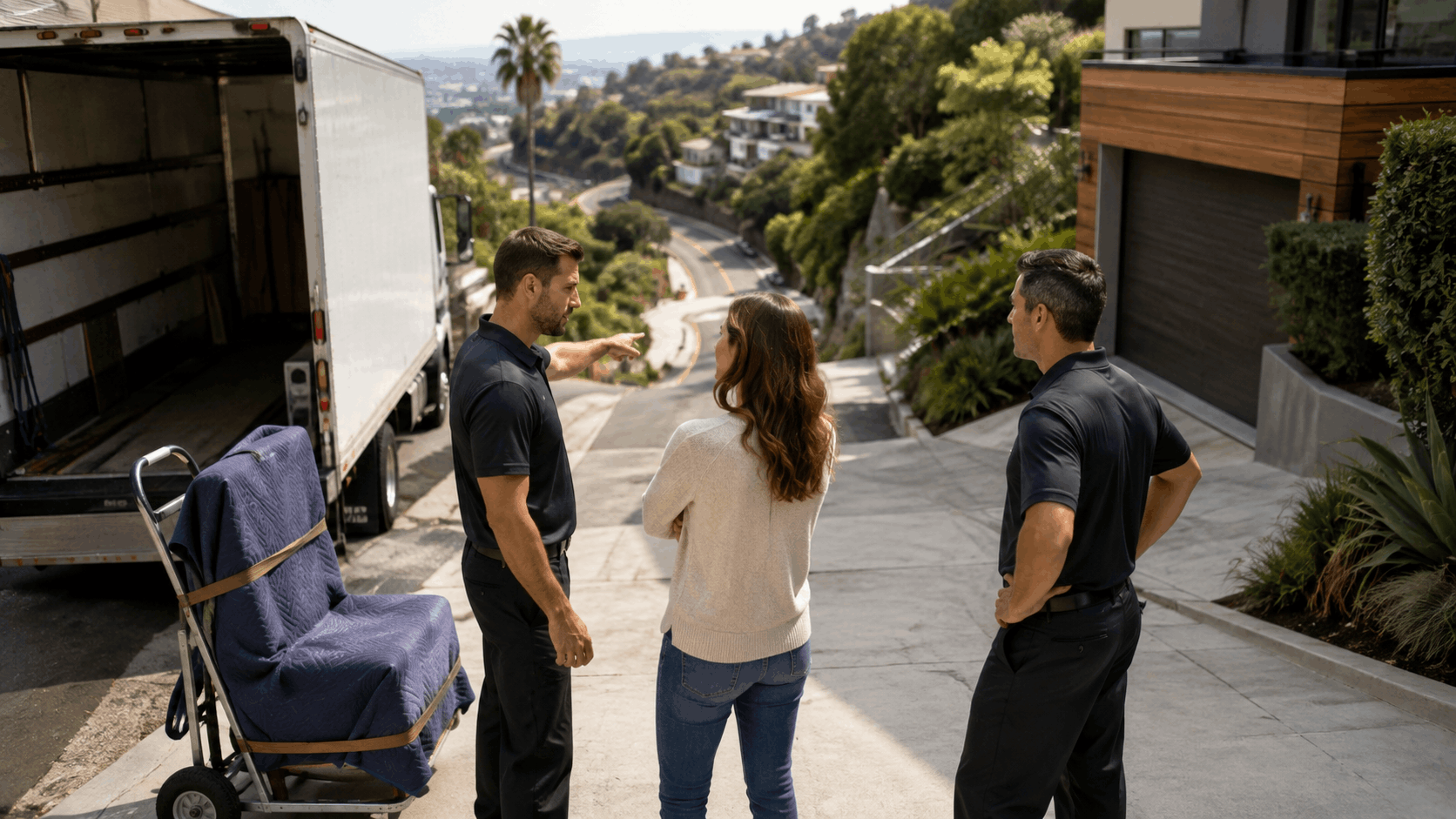
Hillside homes rarely get accurate quotes over the phone. There are too many variables - grade, stairs, road access, parking - that a homeowner cannot describe fully without training. That is why we prefer an on-site estimate or a detailed video survey.
During an on-site visit, our estimator walks the property, the driveway, and the street. They see the exact carry path, count the stairs, and check whether a truck can reach the door. This firsthand look produces a quote you can trust.
A video survey works well when an in-person visit is not practical. The homeowner walks their phone through the home and along the driveway while our estimator directs the camera to the details that matter. It is nearly as reliable as being there in person.
Either way, the goal is the same. We want to see the real access conditions so the price on move day matches the price we quoted, with no last-minute surprises.
Access Route Mapping From Street to Door
Once we understand the property, we map the exact access route items will travel. This carry path runs from where the truck parks to the front door and through the home to each room. We look for pinch points along the way.
Pinch points are the tight spots where a large item might not fit - a narrow gate, a sharp turn on a stairway, a low-hanging beam. Spotting these early lets us plan a solution, whether that is disassembly, a different route, or hoisting.
The route map also tells us how many movers to send and how long the job will take. A clean, short path needs fewer hands than a long, twisting one with multiple turns and elevation changes. This is where hillside experience really shows.
We share the plan with the homeowner so everyone knows how move day will unfold. When the crew arrives already knowing the path, the work goes faster and smoother.
Inventory Weight and Special Item Notes
Our estimator builds a moving inventory of everything being moved, with special attention to heavy and fragile pieces. A grand piano, a marble table, or a large safe changes the plan on a steep property in ways a standard couch does not.
Special items get their own notes in the estimate. We record the weight, the dimensions, and any handling requirements so the crew arrives prepared. A 700-pound safe on a hillside needs different gear than a bookshelf.
Fragile and high-value pieces also get flagged for extra protection. Art, antiques, and delicate electronics may need custom crating before they travel a rough carry path. Our packing and crating team handles these items with care.
Logging all of this during the estimate means the quote reflects the true scope of the job. It also means move day runs on a real plan rather than guesswork.
Common Pricing Add-Ons for Hollywood Hills Properties
Hillside moves often come with add-on fees that flatland moves never see. We explain each one up front so there are no surprises on move day. Here is a breakdown of the most common hillside moving cost extras.
| Add-On Fee | When It Applies | What It Covers |
|---|---|---|
| Shuttle Fee | Streets too tight for a full-size truck | Transfer to a smaller vehicle and extra handling |
| Long Carry Fee | Truck parks over ~75 feet from the door | Extra labor for the long walk |
| Stair Fee | Items carried up or down many steps | Added labor for elevation change |
| Hoisting / Rigging | Items too large for stairs or doors | Lifting over railings or balconies |
| Permit / Parking | No legal truck parking near the home | LADOT permit and coordination |
Shuttle Fee for Homes Big Trucks Cannot Reach
A shuttle fee covers the transfer between a large truck and a smaller vehicle. When a street cannot fit a 26-foot truck, we park the big rig at a wider staging spot and move belongings into a transfer vehicle that can reach the door.
This adds a second handling step. Items get loaded into the shuttle, driven up, and unloaded, then the process reverses at the destination if needed. That extra work is what the shuttle fee pays for.
We always flag a likely shuttle during the estimate so the cost is never a surprise. Knowing about it in advance also lets us plan the staging spot and timing to keep the transfer efficient.
Long Carry and Stair Fees Explained
A long carry fee is based on distance. When the truck parks beyond a set threshold from the door, usually around 75 feet, the extra walking distance triggers the charge. The farther the carry, the higher the fee, because each round trip takes longer.
A stair fee is based on step count. Crews tally the total number of steps items must travel, and the charge scales with that count. Ten steps is minor, but a hundred steps across a hillside property adds real labor.
Both fees reflect actual work, not padding. Carrying furniture 150 feet up forty stairs is simply slower and harder than rolling it ten feet across a flat garage, and honest pricing accounts for that difference.
Hoisting and Rigging for Oversized Items
Sometimes an item is too large to fit through a door or up a stairway. On homes near Sunset Plaza, a sofa or a bed might need to go over a balcony railing instead. That is where a hoisting service comes in.
Rigging involves ropes, straps, and sometimes a lift to raise an oversized item to an upper level or lower it to a lower one. It takes trained crew and the right gear to do it safely. The rigging fee covers that specialized labor and equipment.
We identify hoisting needs during the estimate by measuring doorways, stairwells, and the items themselves. Discovering that a couch will not fit on move day is a headache, so we plan the hoist ahead of time whenever the numbers call for it.
Permit and Parking Coordination
Many hillside streets offer no legal spot for a moving truck without a permit. Our team handles LADOT permit applications and parking coordination so the crew has a safe, legal place to work on move day.
A LADOT permit reserves curb space for the truck and prevents tickets or tows. Arranging it takes lead time, so we start the process well before the move. You can find permit details on the LADOT official site.
Parking coordination also means picking the safest, most efficient spot and, where helpful, asking neighbors to keep the space clear. Small courtesies like this smooth out a move day that could otherwise stall over a parking dispute.
Need Help in Los Angeles?
Popeye Moving & Storage serves Los Angeles and all of Los Angeles County.
How Homeowners Can Lower Their Hillside Moving Costs
You have more control over your moving bill than you might think. A few smart moves before move day cut access problems and keep labor hours down. Here is how to lower moving cost on a hillside property.
- Clear the driveway and reserve street space early
- Time the move to dodge canyon traffic and midday heat
- Stage packed boxes near the exit point
- Disassemble large furniture before the crew arrives
- Tell your mover about every heavy or oversized item
Clearing the Driveway and Reserving Street Space
Move your personal cars off the driveway and out of the way the night before. An empty driveway gives the crew room to work and often lets the truck or shuttle park closer to the door, which shortens the carry.
Reserve parking on the street if you can. Talk to neighbors ahead of time and ask them to keep a stretch of curb open for the moving truck. On a narrow canyon street, one cooperative neighbor can save an hour of shuffling.
If your street needs a permit for truck parking, coordinate with us early so we can arrange it. A clear driveway plus reserved street space is one of the simplest ways to cut labor time on a hillside move.
Timing the Move Around Canyon Traffic
Canyon roads near Runyon Canyon and Laurel Canyon clog with commuter traffic during rush hours. A crew stuck in that traffic burns paid time before the work even starts. An early start beats the worst of it.
We often recommend beginning hillside moves early in the morning. The roads are quieter, parking is easier to hold, and the crew makes faster trips up and down the driveway before the day heats up.
Move timing also helps with the tourist traffic near landmarks like the Hollywood Sign. Getting the bulk of the work done before midday keeps you clear of the congestion that builds as the day goes on.
Packing and Staging Items Near the Exit Point
Staging items close to the door shrinks the carry time on the inside of your home. If boxes are already stacked near the exit, the crew grabs and loads instead of hunting through rooms. Every foot saved on the interior carry adds up.
Good packing prep speeds things too. Boxes that are sealed, labeled, and stacked let the crew load efficiently rather than waiting on last-minute packing. If you want help, our full-service packing team can handle it for you.
Staging is especially valuable on hillside homes with long carries. When the interior portion of the walk is already handled, the crew can focus its energy on the tough part - the driveway and the stairs.
Seasonal and Weather Factors in the Hollywood Hills
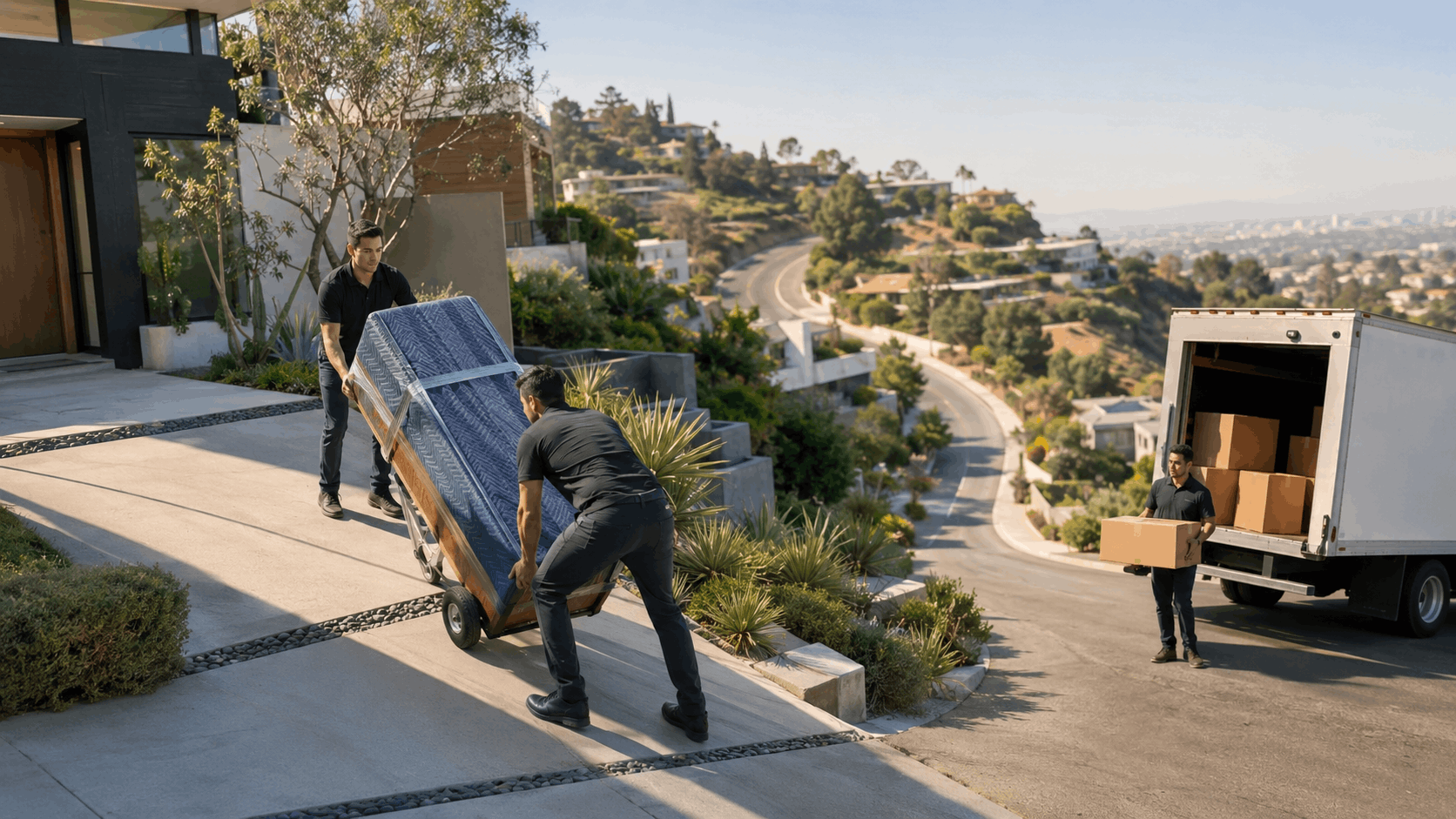
Weather in the hills changes the way a move plays out. Rain, fire season, and summer heat all affect pace, safety, and sometimes scheduling. Planning around them keeps your move on track.
Winter Rain and Slick Driveways
Los Angeles winters are dry most days, but when rain comes, steep concrete turns slick fast. A wet driveway at a 20 percent grade is genuinely dangerous for a crew carrying heavy loads. Rain moving safety slows the whole operation.
On rainy days, our crews move slower and use extra traction gear and more spotters. They protect your belongings from the wet, lay down mats or runners where they can, and take the descents with extra caution.
If a storm is heavy enough to make a steep driveway unsafe, we may suggest adjusting the timing. A short delay beats a slip that damages furniture or injures a mover. We watch the forecast closely for hillside jobs in winter.
Fire Season Road Closures and Evacuation Routes
Fire season brings its own challenges to the hills. Brush fire risk runs high in the dry months, and closures near Griffith Park or in the canyons can block access with little warning. We monitor conditions when a move falls in fire season.
A road closure on a canyon route can force a longer detour or, in rare cases, a schedule change. Evacuation orders take priority over everything, and we will never send a crew into an area under active threat.
We stay aware of active incidents through official channels like CAL FIRE. If your move date lands during a fire event near your neighborhood, we work with you to reschedule safely if needed.
Summer Heat and Longer Carry Times
Summer heat in the hills can push well into the 90s, and carrying furniture up a long steep driveway in that heat is exhausting. Crews need more crew breaks and hydration to work safely, which can add a bit to the move length.
We plan hot-weather moves for early starts so the heaviest work happens before the peak afternoon temperatures. A morning that begins at 7 a.m. spares the crew the worst of the sun.
Homeowners can help by offering shade and cold water and by keeping interior spaces cool where possible. A crew that stays hydrated and rested works faster and safer than one pushing through dangerous heat.
Choosing a Mover Who Knows Hillside Access
Not every moving company handles the Hollywood Hills well. A flatland crew that has never faced a switchback can get stuck, damage furniture, or blow past their time estimate. Experienced Los Angeles movers plan for the hills from the start.
Questions to Ask Before Booking
Before you book any mover, ask direct questions about access. Ask whether they have moved homes in your specific canyon and how they handle steep driveways and tight streets. The answers tell you fast whether they know the territory.
Good moving questions include: Will a full-size truck reach my home? Do you provide a shuttle if needed? How do you price long carries and stairs? A company that answers clearly has done this before.
Also ask how they handle heavy items on a grade and whether they arrange parking permits. When booking movers, the goal is to find a crew that anticipates the challenges rather than one that discovers them on move day.
Why Local Knowledge of the Canyons Matters
A crew that knows Beachwood, Nichols, and Laurel Canyon plans smarter routes. Local movers know which streets defeat full-size trucks, where parking is legal, and how traffic flows at different hours. That knowledge saves time and money.
Canyon knowledge also means fewer surprises. A crew familiar with the hills already expects the long carries, the stair counts, and the tight turns, so their estimate is accurate and their move day runs on plan.
Our team has driven and worked these hills for years, from Outpost Estates to Sunset Plaza. That experience is why our hillside moves rarely hit the snags that catch out-of-area crews off guard.
Insurance and Licensing for High-Value Homes
Hillside estates often hold high-value belongings, and moving them demands proper coverage. Licensed movers carry the insurance and credentials that protect your property if something goes wrong. Always confirm both before you book.
Moving insurance matters most on tricky access jobs where the risk of damage runs higher. Ask what coverage the company carries and what your options are for valuation on high-value pieces. You can verify a mover's license through the FMCSA Protect Your Move resource.
A properly licensed and insured mover gives you real protection, not just a promise. On a steep hillside with valuable furniture and art, that protection is worth confirming before the truck ever arrives.
Need Help in Los Angeles?
Popeye Moving & Storage serves Los Angeles and all of Los Angeles County.
Final Thoughts
Moving in the Hollywood Hills costs more than moving in the flats because the access is genuinely harder. Steep driveways, switchback roads, long carries, and endless stairs all add labor and require careful planning. The price reflects real work, not padding.
The good news is that a mover who knows these hills can keep your move smooth and your bill fair. With an accurate estimate, smart scheduling, and a little prep from you, even the trickiest hillside home moves without drama.
Our team knows these canyons, these driveways, and these roads. If you are planning a move in the Hollywood Hills, contact Popeye Moving for an honest estimate and a plan built around your property's exact access.
Frequently Asked Questions
How much more does a steep driveway add to a move?
A steep driveway typically adds labor time rather than a fixed charge, so the added cost depends on the grade, the length, and the weight of your items. Expect anywhere from a modest bump to several hundred dollars on heavy moves with long, steep driveways. The extra hands and equipment needed for heavy pieces on a slope drive most of that added cost.
What is a shuttle fee and when will I pay one?
A shuttle fee covers transferring your belongings from a full-size truck into a smaller vehicle that can reach your home. You pay one when the street is too tight or too steep for a 26-foot truck, which is common on narrow canyon roads. We flag a likely shuttle during the estimate so the cost is never a surprise on move day.
Can a full-size moving truck reach my home off Mulholland?
It depends on the width of your street and the sharpness of the turns. Some roads off Mulholland Drive handle a full-size truck fine, while others have hairpins no 26-foot truck can clear. We check truck access during the walkthrough and plan a shuttle if the road cannot accommodate the big rig safely.
Do I need a parking permit for the moving truck?
On many hillside streets with narrow shoulders or no-stopping zones, a moving truck permit reserves legal curb space and prevents tickets or tows. Our team handles LADOT permit applications and coordinates parking for you. We start the process early because permits take lead time, so let us know your move date as soon as you book.
How are stair and long carry fees calculated?
A long carry fee is based on distance, usually triggered when the truck parks beyond about 75 feet from your door. A stair fee is based on the total number of steps items must travel. Both scale with the amount of extra work involved, so a longer carry or a higher step count means a higher fee. We count both during the estimate.
Can Popeye Moving move a piano up a steep hillside driveway?
Yes. Piano moving on a hillside is a specialty our crews handle regularly. We use piano boards, heavy-duty straps, and multiple movers to control the instrument's weight on the climb or descent. The crew size and equipment scale with the grade, so a steep driveway simply means more hands and more careful staging to move the piano safely.
Is a video estimate accurate for a hillside home?
A video estimate is nearly as reliable as an in-person visit when done well. You walk your phone through the home, the driveway, and the street while our estimator directs the camera to the details that matter. It captures grade, stairs, and access conditions accurately enough to produce a quote you can trust for a tricky hillside property.
What time of day is best to move in the canyons?
Early morning is the best time to move in the canyons. Roads near Runyon Canyon and Laurel Canyon are quieter before commuter traffic builds, parking is easier to hold, and the crew works before the midday heat. An early start also helps you avoid the tourist congestion that clogs streets near the Hollywood Sign later in the day.
Does rain or fire season change my move date?
It can. Heavy rain makes steep driveways dangerous, so we may adjust timing for safety. During fire season, road closures or evacuation orders near your neighborhood can force a reschedule. We monitor conditions closely and work with you to find a safe date if weather or a fire event threatens your original move day.
How can I get a firm price for my Hollywood Hills move?
The most reliable way is an on-site or video survey where our team sees your property's real access conditions. From there, we build a moving quote that reflects the grade, stairs, road access, and inventory. Reach out to book your move, and we will schedule a walkthrough and give you an honest, detailed price for your hillside home.
Frequently Asked Questions
- How much more does a steep driveway add to a move?
- A steep driveway typically adds labor time rather than a fixed charge, so the added cost depends on the grade, the length, and the weight of your items. Expect anywhere from a modest bump to several hundred dollars on heavy moves with long, steep driveways. The extra hands and equipment needed for heavy pieces on a slope drive most of that added cost.
- What is a shuttle fee and when will I pay one?
- A shuttle fee covers transferring your belongings from a full-size truck into a smaller vehicle that can reach your home. You pay one when the street is too tight or too steep for a 26-foot truck, which is common on narrow canyon roads. We flag a likely shuttle during the estimate so the cost is never a surprise on move day.
- Can a full-size moving truck reach my home off Mulholland?
- It depends on the width of your street and the sharpness of the turns. Some roads off Mulholland Drive handle a full-size truck fine, while others have hairpins no 26-foot truck can clear. We check truck access during the walkthrough and plan a shuttle if the road cannot accommodate the big rig safely.
- Do I need a parking permit for the moving truck?
- On many hillside streets with narrow shoulders or no-stopping zones, a moving truck permit reserves legal curb space and prevents tickets or tows. Our team handles LADOT permit applications and coordinates parking for you. We start the process early because permits take lead time, so let us know your move date as soon as you book.
- How are stair and long carry fees calculated?
- A long carry fee is based on distance, usually triggered when the truck parks beyond about 75 feet from your door. A stair fee is based on the total number of steps items must travel. Both scale with the amount of extra work involved, so a longer carry or a higher step count means a higher fee. We count both during the estimate.
- Can Popeye Moving move a piano up a steep hillside driveway?
- Yes. Piano moving on a hillside is a specialty our crews handle regularly. We use piano boards, heavy-duty straps, and multiple movers to control the instrument's weight on the climb or descent. The crew size and equipment scale with the grade, so a steep driveway simply means more hands and more careful staging to move the piano safely.
- Is a video estimate accurate for a hillside home?
- A video estimate is nearly as reliable as an in-person visit when done well. You walk your phone through the home, the driveway, and the street while our estimator directs the camera to the details that matter. It captures grade, stairs, and access conditions accurately enough to produce a quote you can trust for a tricky hillside property.
- What time of day is best to move in the canyons?
- Early morning is the best time to move in the canyons. Roads near Runyon Canyon and Laurel Canyon are quieter before commuter traffic builds, parking is easier to hold, and the crew works before the midday heat. An early start also helps you avoid the tourist congestion that clogs streets near the Hollywood Sign later in the day.
- Does rain or fire season change my move date?
- It can. Heavy rain makes steep driveways dangerous, so we may adjust timing for safety. During fire season, road closures or evacuation orders near your neighborhood can force a reschedule. We monitor conditions closely and work with you to find a safe date if weather or a fire event threatens your original move day.
- How can I get a firm price for my Hollywood Hills move?
- The most reliable way is an on-site or video survey where our team sees your property's real access conditions. From there, we build a moving quote that reflects the grade, stairs, road access, and inventory. Reach out to book your move, and we will schedule a walkthrough and give you an honest, detailed price for your hillside home.
P
Popeye Moving & Storage Co. Team Team
Licensed moving and storage professionals serving Los Angeles and Los Angeles County.
Licensed in California · License #PUC: CAL T 189749 | DOT: 1472924 | MC: 498816C
Why trust Popeye Moving & Storage?
Founded in 1994, Popeye Moving & Storage is a licensed and insured moving and storage service serving Los Angeles and Los Angeles County. All content is reviewed by our licensed technicians.

Need Help in Los Angeles?
Popeye Moving & Storage serves Los Angeles and all of Los Angeles County.
Related Articles
Cost Guides
Beverly Hills Moving Cost: 4-Bedroom Estate Move Pricing Breakdown
A clear pricing breakdown for a 4-bedroom estate move in Beverly Hills, covering cost ranges, local fees, packing, storage, and how to compare quotes.
Cost Guides
Hollywood Hills Move Pricing: Why Steep Driveways Add 1-3 Hours
Steep driveways in the Hollywood Hills add 1 to 3 hours to most moves. Learn why terrain shapes pricing and how to save time on your hillside move.
Cost Guides
Movers in Beverly Hills: COI Requirements and Estate Move Pricing
A local guide to COI requirements and estate move pricing in Beverly Hills, covering insurance limits, high-value item handling, and move day planning from Popeye Moving.