Cubicle Reconfiguration and Onsite Office Relocations: The Move That Never Leaves the Building
Key Takeaways
- An onsite office relocation moves furniture and layout within the same building, keeping the same lease and address.
- Cubicle reconfiguration reworks furniture a company already owns to add seats or open up collaboration space without renting more square footage.
- The reconfiguration process follows a set order: measure and map, disassemble, move, rebuild, and reconnect power and data.
- After-hours, weekend, and phased scheduling keep the office running with little or no downtime.
- Padding, corner guards, floor runners, and elevator pads protect both furniture and building common areas.
- Surplus furniture can go into short or long term warehouse storage in Los Angeles, tracked by inventory logs.
- LA high-rises require freight elevator reservations, dock coordination, and a certificate of insurance for internal moves.
- Popeye Moving & Storage handles moving, reconfiguring, and storage with one crew and a single point of contact across LA.
In This Article
A growing team on Grand Avenue in Downtown LA called us last spring with a problem that had nothing to do with a new address. Their headcount had jumped from 40 to 65 people, but their lease still had three years left on the same floor of the same tower. They did not want to move buildings. They wanted to fit more people into the space they already paid for.
This is one of the main requests we handle. It is called an onsite office relocation, and it looks very different from a truck-and-highway move across town. Instead of loading everything into a moving van, the crew shifts furniture within the building, breaks down cubicles, and rebuilds them in a smarter layout.
What an Onsite Office Relocation Really Means?
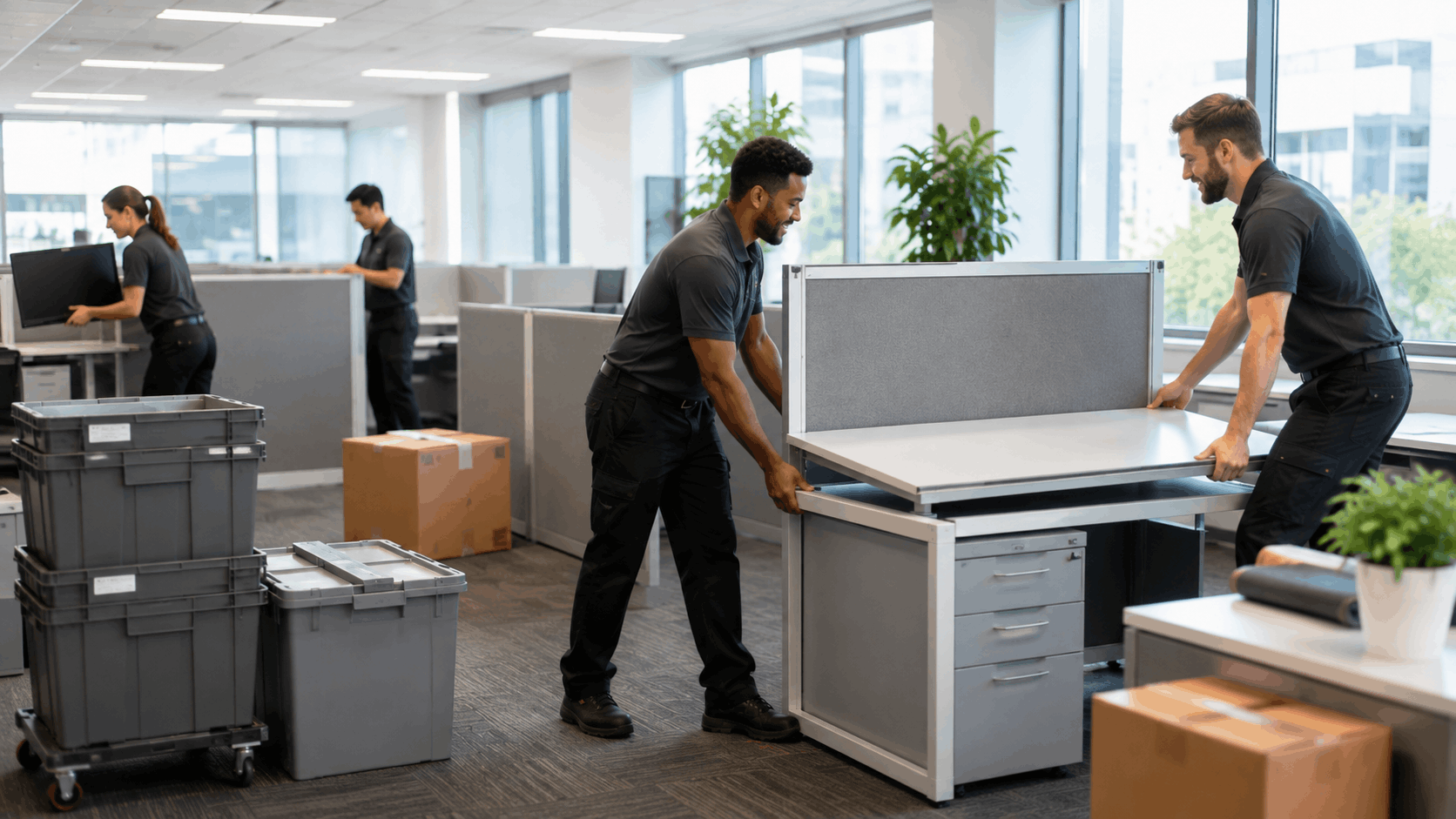
An onsite office relocation is a move that never leaves the building. The business keeps the same address, the same lease, and often the same floor. Only the furniture, equipment, and layout change.
Los Angeles companies pick this route for a lot of reasons. Here is what an internal office move usually involves:
- Shifting desks and cubicles from one part of a floor to another
- Moving an entire department up or down a few floors in the same tower
- An office reconfiguration that adds seats without renting more space
- Breaking down and rebuilding systems furniture in a new pattern
- Storing surplus furniture the new layout no longer needs
The goal stays the same across all of these: get more use out of the space a company already controls. Our commercial moving team handles these projects across the region every week.
Moving Floors Without Moving Addresses
A floor to floor move happens when a company grows or shrinks and shifts to a different level of the same high-rise. Picture a law firm near the Financial District on Figueroa Street. They signed for the 12th floor years ago, and now the 18th floor opened up in the same building.
Instead of ending their lease and hunting for a new tower, they take the larger floor upstairs. The mailing address stays identical. Clients, vendors, and staff all keep the same building on their calendars.
A same building move like this leans heavily on the freight elevator and building coordination. The crew stages furniture in the elevator lobby, rides it up a few floors, and rebuilds. No trucks, no street loading, no highway time.
The savings show up in more than money. Employees keep their commute, their parking arrangement, and their favorite lunch spots on the ground floor. Nothing about the daily routine changes except the number on the elevator button.
Reconfiguring Space You Already Have
Cubicle reconfiguration is the art of rearranging what a company already owns. Teams pull apart existing workstations and rebuild them in a tighter or more open pattern. This adds seats or creates collaboration zones without renting a single extra square foot.
Good space planning starts with the panels. A row of six-foot cubicles might get reworked into eight smaller benching stations. Overhead bins come off, panels drop in height, and suddenly a closed-off room feels open and connected.
We see this constantly with creative and tech offices in areas like the Arts District. They want fewer tall walls and more shared tables. The furniture they own can usually be reconfigured to match that new style.
The math is simple and appealing. Renting more office space in Los Angeles costs thousands per month. Reworking existing furniture is a one-time project that pays for itself.
Why LA Businesses Pick Internal Moves Over New Leases
Los Angeles office space is expensive, and lease terms rarely favor the tenant. When a company in Century City faces a lease renewal, they weigh the cost of staying against the cost of moving out entirely. Staying usually wins.
A full building move means new signage, new stationery, updated marketing, and a scramble to notify every client. An internal move avoids all of that. The company reshapes its footprint and keeps everything else steady.
Commute stability matters too. Staff in Culver City or Playa Vista built their lives around a specific location near the 405 or the Expo Line. Moving the office across town can cost a company good employees who do not want a longer drive.
Lease flexibility is the other driver. Many LA landlords offer better terms to renew in place, sometimes covering part of a reconfiguration. That turns an internal move into the cheapest path to more usable space.
Get Your Free Quote
Tell us about your move. We'll be in touch soon.
How Cubicle Reconfiguration Works Step by Step
The cubicle reconfiguration process follows a clear order of operations. Skip a step and panels end up mismatched or power outlets land in the wrong spot. Our crew works through it the same way every time.
Here is the basic sequence from first measurement to the moment staff sit down:
| Step | What Happens | Typical Time |
|---|---|---|
| 1. Measure and map | Field-verify the floor, draft the new layout | 1-2 days ahead |
| 2. Workstation disassembly | Take apart panels, surfaces, and bins; label hardware | Evening one |
| 3. Move and stage | Relocate parts to their new spots on the floor | Same night |
| 4. Cubicle reassembly | Rebuild, level, and align every station | Evening two |
| 5. Reconnect | Restore power, data, and seating | Final night |
Measuring the Floor and Mapping the New Layout
Everything starts with a tape measure and a floor plan. The team field-verifies the space, checking column locations, window lines, and where power access points sit in the floor or walls. A drawing on paper means nothing if the real outlets do not match.
Next comes the panel layout. Cubicle panels come in fixed widths, usually 24, 30, 36, 42, and 48 inches. The new plan has to add up to those exact dimensions or the run will not close cleanly against a wall.
We also map power and data early. Every workstation needs to land near a power whip drop or an outlet the electrician can reach. Planning this on paper avoids a nasty surprise on move night.
The finished map shows each station numbered and placed. The crew uses it like a blueprint, so nobody guesses where a desk belongs at midnight.
Taking Apart Cubicle Panels and Systems Furniture
Systems furniture comes apart in a specific order. Overhead bins and shelves come off first, then work surfaces, then the panels themselves. Rushing this step is how brackets get bent and finishes get scratched.
Modular panels connect with hardware that varies by brand. Herman Miller, Steelcase, Haworth, and Knight all use different connectors, hooks, and tiles. A crew that knows these systems moves efficiently because they recognize how each one locks together.
Hardware tracking is the make-or-break detail. Every screw, connector, and bracket goes into labeled bags tied to a station number. Lose the connectors and a $2,000 workstation becomes a pile of panels that will not stand up.
We bag, label, and box the small parts before anything leaves its original spot. That discipline is why our rebuilds go back together clean instead of turning into a scavenger hunt.
Rebuilding Workstations in Their New Spots
Cubicle reassembly is disassembly in reverse, guided by the map. Panels go up first, connected in the planned runs. The crew checks that each panel stands plumb before locking the next one on.
Leveling matters more than people expect. An office floor is rarely perfectly flat, especially in older Mid-Wilshire buildings. Leveling glides get adjusted so work surfaces sit even and drawers glide instead of drifting shut.
Panel alignment is what makes a finished workstation build look new. Tops line up, tiles match, and the seams run straight down the row. A sloppy line stands out the second the lights come on.
Once the shells are up, work surfaces and overhead bins go back on. Each station gets checked against its number so the right person sits at the right desk in the morning.
Reconnecting Power, Data, and Chairs
A cubicle without power is just a wall. Power whips get routed back through the panel raceway and plugged into the building's floor or base feed. In many LA high-rises a licensed electrician handles the final tie-in, and we coordinate the timing.
Data cabling runs alongside the power. Network drops get pulled through the same raceway and terminated at each station. We keep power and data separated inside the panel to avoid interference on the lines.
Chairs and personal items come last. The crew rolls seating back to labeled stations and sets monitors, docks, and phones on the surfaces. Employees find their setup waiting rather than a box maze.
The finish line is a floor ready for work. By the time staff arrive, panels are locked, power is live, and every chair sits where it belongs.

Need Help in Los Angeles?
Popeye Moving & Storage serves Los Angeles and all of Los Angeles County.
Planning an Internal Move Around Your Business Hours
The biggest worry with any internal move is downtime. No business wants to lose a day of work while furniture shifts around. Good office move scheduling makes that fear go away.
The answer is almost always to work when the office is empty. An after hours office move keeps the reconfiguration invisible to the workday.
After Hours and Weekend Move Windows
Most of our Downtown LA reconfigurations happen at night. Crews start around 6 pm after staff head home and work until the job hits its stopping point. Employees leave a working office and return to a new layout.
A weekend office move gives even more room to work. A full-floor reconfiguration might run Friday night through Sunday, so the crew has three shifts instead of one. That extra time matters when a project involves 80 or 100 stations.
A night move also dodges building traffic. Freight elevators sit idle after hours, and the loading dock is quiet. The crew moves more freely with the whole path to themselves.
The tradeoff is after hours labor rates, which run higher than daytime work. Most companies gladly pay it to avoid losing a business day. The lost revenue from downtime almost always dwarfs the labor premium.
Phased Moves for Larger Teams
Not every reconfiguration happens in one weekend. A phased office move breaks the job into stages, moving one group at a time while the rest of the office keeps running. This works well for companies that cannot go fully dark even for a weekend.
A department relocation might start with accounting on week one and sales on week two. Each team packs its personal items, the crew reconfigures that zone, and people settle in before the next group moves. The office never fully stops.
Phasing takes tighter coordination but reduces disruption. We map the sequence so no team loses access to the copier, kitchen, or conference rooms mid-move. Shared resources stay reachable at every stage.
This approach fits growing firms in places like Culver City that add staff in waves. They reconfigure section by section as new hires arrive rather than shutting down all at once.
Coordinating With Building Management and Freight Elevators
LA high-rises run on rules, and the freight elevator sits at the center of them. Buildings require advance reservations for freight use, often with specific time blocks. Miss the window and the move stalls.
Loading dock rules add another layer. Many Downtown and Wilshire towers limit dock access to certain hours and require a security check-in. We confirm these details with property management before the first panel comes down.
A certificate of insurance is almost always required. The building manager wants proof that the moving crew carries liability and workers' compensation coverage naming the property. Without it, security will not let the crew past the lobby.
We handle this paperwork as part of the planning. Elevator reservations, dock times, and the certificate of insurance all get lined up days ahead so move night runs without a hitch.
Protecting Furniture, Floors, and Equipment During the Move
Shifting heavy furniture across a working floor is where damage happens if a crew gets careless. A gouged desk or a scraped elevator wall turns a smooth move into a repair bill. Office furniture protection is built into every step we take.
The goal is simple: leave the furniture, the floors, and the building exactly as clean as they were before. Here is how the crew makes that happen.
Padding, Corner Guards, and Shrink Wrap
Moving pads are the first line of defense. Desks, credenzas, and file cabinets get wrapped in thick quilted blankets before they move an inch. The padding absorbs the bumps that happen in doorways and tight corners.
Corner guards protect the spots that take the most abuse. Panel corners and desk edges get hard guards taped in place so a clip against a wall does not chip the finish. These small pieces prevent the usual scratches.
Shrink wrap holds everything together and keeps drawers shut. We wrap file cabinets so drawers do not slide open in transit and stretch-wrap loose parts into tidy bundles. Wrapped fabric panels also stay clean instead of picking up dust from the floor.
For high-value or fragile pieces, our packing and crating team can build custom protection. Reception desks and glass surfaces sometimes need more than a blanket.
Guarding Elevators, Doorways, and Carpet
The building's common areas need as much protection as the furniture. Masonite floor runners get laid down across lobbies and hallways to shield carpet and stone from cart wheels. These rigid sheets take the wear instead of the floor.
Door jamb guards wrap around every doorway on the move path. In older Mid-Wilshire properties along the boulevard, those jambs are original and expensive to repair. A foam or hard guard keeps carts from chewing up the frames.
Elevator protection is standard in any high-rise move. The crew hangs pads inside the freight elevator to cover the walls and rails. Many buildings actually require this before they release the elevator for a move.
All of this protective material goes in before the first piece of furniture moves. It comes out only after the last cart clears the path. The building manager should not be able to tell a move happened.
Moving Computers, Monitors, and Sensitive Gear
Technology needs its own careful handling. Computer relocation starts with labeling every device so it returns to the right desk and the right user. A tower and monitor that get separated create a headache for IT.
Monitors travel in padded bins or their original foam when available. Loose cables get bagged and taped to the matching machine. This keeps the IT equipment move from becoming a tangle of unmarked wires the next morning.
We coordinate closely with in-house IT teams on the tech. Our crew moves and reconnects the physical hardware, while IT usually handles server shutdowns and network configuration. Clear lines between the two prevent finger-pointing later.
The payoff is a smooth restart. When machines are labeled and cables are bundled, IT can get systems live sooner instead of hunting for parts across a reconfigured floor.

Storing Extra Furniture When You Downsize a Floor
Reconfigurations often leave leftovers. A tighter layout means some desks and chairs no longer fit. Office furniture storage solves the question of what to do with the extras.
Rather than junk usable furniture, most companies store it. Our warehouse storage in Los Angeles gives that surplus a safe home until it is needed again.
Short Term Storage During a Remodel
Sometimes furniture leaves only for a few weeks. Short term storage holds desks and cubicles offsite while a floor gets painted or recarpeted. The empty floor lets contractors work without dodging furniture.
Remodel storage follows a simple cycle. The crew pulls everything out, the trades do their work, and the furniture comes back into the fresh space. We schedule the return to match the contractor's finish date.
This works especially well for phased refreshes. A company can update one floor at a time, storing that floor's furniture while the paint dries. The rest of the building keeps humming.
Timing is the whole game here. We coordinate pickup and redelivery around the remodel schedule so furniture is never in the way and never late coming back.
Long Term Storage for Growing Companies
Growing firms often keep surplus furniture on purpose. Long term storage holds extra cubicles in a warehouse until the company hires enough people to need them. Buying furniture once and storing it beats buying it twice.
Surplus furniture that matches the existing brand is worth keeping. When a startup in Playa Vista adds a dozen staff next year, matching workstations pulled from storage look far better than mismatched new ones. Our commercial business storage covers exactly this need.
Warehouse conditions protect the investment. Panels stay wrapped and off the ground so fabric stays clean and metal stays rust-free. Furniture that sits in storage for a year comes out ready to install.
The economics favor holding. Storage costs a fraction of buying new systems furniture, and it keeps a company's whole floor consistent as it grows.
Inventory Tracking So Nothing Gets Lost
Storage only helps if a company knows what it has. Inventory tracking logs every stored item with a label and a location in the warehouse. A business can ask what is in storage and get a real answer.
Good asset management records quantities, conditions, and part types. Forty 30-inch panels, twenty task chairs, fifteen work surfaces - all counted and logged. That list makes planning the next reconfiguration far easier.
We tag items when they enter storage and update the log when anything leaves. Nothing disappears into a warehouse corner never to be found. The record stays current.
When it is time to expand, the inventory list becomes the shopping list. The company sees exactly what it already owns before buying a single new panel.
Need Help in Los Angeles?
Popeye Moving & Storage serves Los Angeles and all of Los Angeles County.
Common Challenges in Los Angeles Office Buildings
Every Los Angeles office building has its own personality. Some make moves easy, and some fight you at every doorway. Years of high-rise move work across the city taught our crew where the trouble spots hide.
Here are the challenges we plan around most often:
- Narrow loading docks in older Downtown and Wilshire towers
- Rush-hour traffic and thin parking near the freeways
- Strict property rules in Century City and Culver City campuses
- Freight elevator time limits and after-hours-only move rules
- Insurance paperwork that varies building by building
Tight Loading Docks Downtown and on Wilshire Boulevard
Older towers were not built for modern moving trucks. Loading docks in some Downtown LA buildings barely fit a 26-foot truck, and turning radius is tight. The crew often shuttles loads with smaller carts to make it work.
Buildings near the Arts District add their own wrinkle. Many are converted industrial spaces with docks that face busy streets. Staging furniture there means blocking part of a lane, which requires timing and sometimes a permit.
Along Wilshire Boulevard, dock sharing is common. Several tenants use one dock, so the crew reserves a window and works efficiently to clear out for the next mover. Overstaying the slot creates friction with building security.
We scout the dock before move day whenever possible. Knowing the clearances and rules ahead of time keeps the crew from getting stuck at the curb with a full truck.
Parking and Traffic Around Business Districts
LA traffic shapes every move plan. A crew crossing from the Westside to Downtown during rush hour on the 10 or the 110 can lose an hour before they even start. We schedule around the worst windows.
Truck parking is its own puzzle. Near the 101 and the 110, street parking for a moving truck is scarce and metered. After-hours moves help because loading zones open up once daytime deliveries stop.
Crew parking matters too. In dense districts like West Los Angeles, the team coordinates parking so movers are not circling the block while the clock runs. Building garages sometimes offer temporary passes for move nights.
Planning these details up front saves real money. Every minute a crew spends parking or stuck in traffic is a minute billed to the job.
Building Rules in Century City and Culver City Campuses
Class A campuses run tight ships. Century City towers often have HOA-style property rules that dictate move hours, elevator use, and even how furniture may be wrapped. These rules are not suggestions.
Insurance paperwork varies by property. Some buildings want a certificate of insurance with specific coverage amounts and the landlord named as additional insured. We match each building's exact requirements rather than sending a generic form.
Move approvals can take days. Culver City creative campuses sometimes require a submitted move plan and sign-off from property management before a date is confirmed. Booking late means waiting for that approval.
We know these buildings from repeat work across the Westside. Knowing which properties need what paperwork keeps the approval process from delaying a move date.
What to Look For in an Onsite Office Moving Crew
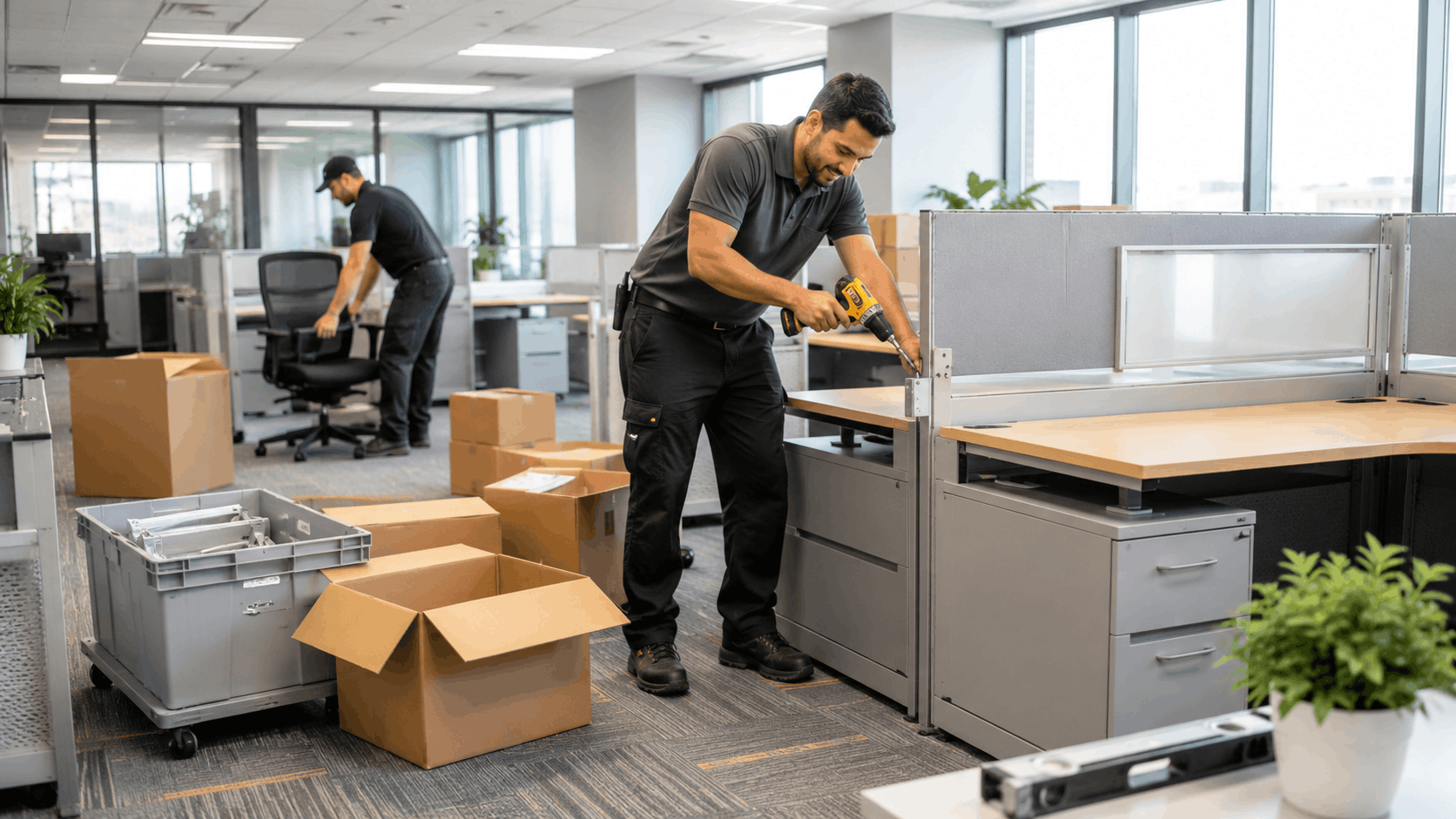
Not every mover can handle systems furniture. Moving boxes is one skill; taking apart and rebuilding cubicles is another entirely. When hiring office movers in Los Angeles, a few checkpoints separate the crews that can do this work from the ones that cannot.
Here is what a business should confirm before booking commercial movers for an internal project.
Experience With Systems Furniture Brands
Cubicle brands are not interchangeable. Herman Miller, Steelcase, Haworth, Knoll, and Teknion each build panels that connect differently. A crew with real systems furniture experience recognizes a brand on sight and knows how it comes apart.
That knowledge shows up in speed and safety. A crew that knows the connectors works carefully and rarely breaks a part. A crew guessing its way through a strange brand bends brackets and strips screws.
Ask a mover which cubicle brands they have handled. A confident, specific answer signals real experience. A vague reply is a warning sign for a systems furniture job.
Our team works with all the major brands routinely. That familiarity is why our reconfigurations rebuild clean instead of leaving a pile of leftover mystery hardware.
Proper Insurance and Building Certificates
Insurance protects everyone involved. Moving insurance covers damage to furniture and the building during the job. Without it, a business could be on the hook for a scratched lobby or a dropped credenza.
A certificate of insurance is what the building manager demands. It proves the mover carries liability and workers' compensation, often naming the property as additional insured. No certificate usually means no elevator access.
The mover should produce this document promptly. A crew that fumbles the paperwork or cannot meet a building's coverage amounts will stall the move at the lobby. We keep coverage ready and match each building's requirements.
Confirming insurance up front avoids a nasty move-day surprise. It also signals a professional operation that has done this many times before.
Clear Timelines and a Single Point of Contact
An internal move has many moving parts, and confusion is the enemy. A dedicated move coordinator keeps the project timeline straight and answers questions as they come up. One point of contact beats a rotating cast of names.
The coordinator handles the details that matter. Elevator reservations, crew scheduling, building approvals, and the reconfiguration plan all run through one person. Nothing falls through the cracks that way.
A clear timeline sets expectations. The business knows when the crew arrives, when power comes back on, and when staff can return. Surprises are what turn a smooth move into a stressful one.
Our office and business moving service assigns a coordinator to every project. That person owns the schedule from the walkthrough to the final reconnection.
Need Help in Los Angeles?
Popeye Moving & Storage serves Los Angeles and all of Los Angeles County.
How Popeye Moving & Storage Co. Handles Internal Moves
Popeye Moving & Storage runs onsite relocations and reconfigurations across Los Angeles every week. Our approach is built to keep the process simple for the business and easy on the building. Here is how we work.
- A free walkthrough and a written move plan before any work starts
- Crews familiar with every major systems furniture brand
- Coverage and certificates matched to each building's rules
- One team for moving, reconfiguring, and storing furniture
- Scheduling built around business hours to avoid downtime
Free Walkthroughs and Written Move Plans
Every project starts with an office move walkthrough. A team member visits the floor, measures the space, and looks at the existing furniture. This visit is free and comes with no obligation to book.
From the walkthrough we build a written plan. It shows the new layout, the move sequence, the timeline, and a clear move quote. The business sees the whole project on paper before anyone lifts a panel.
The written plan prevents surprises. Everyone agrees on the layout, the schedule, and the price up front. Move night follows the plan instead of improvising.
A short call to our office sets up the walkthrough. Most visits take under an hour and give a business the information it needs to decide.
Serving Downtown, Hollywood, and the Westside
Our crews work across the whole region daily. Downtown high-rises, Hollywood creative offices, and Westside towers all fall inside our regular routes. We know the buildings and their rules from repeat visits.
A Hollywood office move might involve a converted studio space with tight access. A Westside relocation in Santa Monica could mean a Class A tower with strict elevator windows. We adjust to each area's quirks.
Local knowledge speeds everything up. Knowing that a Wilshire tower shares its dock or that a Culver City campus needs a submitted move plan keeps our projects on schedule. That familiarity comes from years on these streets.
Wherever the office sits, from the Financial District to the beach cities, our team has likely worked that building or one just like it.
One Crew for Moving, Reconfiguring, and Storage
Using one team for the whole project keeps things simple. The same crew that moves the furniture also reconfigures the cubicles and stores the surplus. There are no handoffs between different companies pointing fingers.
A full service office move covers every piece. Disassembly, moving, rebuilding, reconnection, and storage solutions for the extras all come from one source. One invoice, one coordinator, one point of accountability.
This matters most when something needs adjusting. If a station needs to move or furniture needs to come out of storage, the same team handles it. No new vendor has to learn the layout from scratch.
Combining storage and moving under one roof also saves money. Furniture goes straight from the floor to our warehouse without a middle handoff. When it is needed again, the same crew brings it back.
Final Thoughts
An onsite office relocation lets a Los Angeles business grow or reshape without the cost and disruption of leaving the building. The address stays the same, the commute stays the same, and only the layout changes. Cubicle reconfiguration turns furniture a company already owns into a floor that fits how it works today.
The details decide whether it goes smoothly. Careful measuring, after-hours scheduling, solid protection, and a crew that knows systems furniture keep the project on track. Building coordination and the right paperwork keep it moving.
If your team has outgrown its floor or needs a smarter layout, our crew can help. Call Popeye Moving & Storage or reach out for a free walkthrough, and we will map a move plan around your business hours. Learn more about our corporate relocation services across Los Angeles.
Frequently Asked Questions
- What is an onsite office relocation?
- An onsite office relocation is a move within the same building or campus without changing the business address. The company keeps its lease and mailing address while furniture, equipment, and layout shift to a new floor or a new configuration. It avoids the cost and disruption of relocating to a different property. Many Los Angeles companies choose this route to grow in place.
- How much does cubicle reconfiguration cost in Los Angeles?
- Cost depends on the number of workstations, the panel type, and whether the work happens after hours. Small reconfigurations of a handful of stations may run a few thousand dollars, while a full floor with 80 to 100 stations climbs much higher. After-hours and weekend labor adds a premium but prevents lost business days. A walkthrough gives an exact written quote for your specific job.
- How long does an internal office move take?
- Timing scales with office size. A small suite of a dozen stations can be reconfigured in a single evening. A mid-size office often takes a weekend, running Friday night through Sunday. A full floor with 80 or more workstations may need several nights or a phased approach spread across a week or two.
- Can the move happen without shutting the office down?
- Yes. Most internal moves happen after hours or over a weekend so staff leave a working office and return to a new layout. For larger teams, a phased move relocates one department at a time while the rest of the office keeps operating. Careful scheduling keeps the business running with little or no downtime.
- Do movers reconnect computers and phones?
- Our crew moves and reconnects the physical hardware, including setting monitors, docks, and phones back on the desks with cables bundled. In-house or contracted IT teams usually handle server shutdowns, network configuration, and phone system programming. Clear coordination between the moving crew and IT keeps systems coming back online smoothly on the first morning.
- What happens to furniture that no longer fits?
- Surplus cubicles and chairs have a few paths. They can go into short or long term storage until the company grows and needs them again. Some businesses resell matching furniture, and worn-out pieces can be disposed of responsibly. Storing brand-matched furniture is often the smart choice for growing companies that plan to add staff.
- Do LA buildings require insurance paperwork for moves?
- Almost always. Most Los Angeles office buildings require a certificate of insurance showing the mover carries liability and workers' compensation, often naming the property as additional insured. Coverage amounts vary by building. We match each property's exact requirements and submit the paperwork ahead of move day so the crew is cleared for elevator and dock access.
- Can any cubicle brand be reconfigured?
- Most major systems furniture brands can be reconfigured, including Herman Miller, Steelcase, Haworth, Knoll, and Teknion. Compatibility matters within a project, since panels from different brands rarely connect to each other. A crew experienced with the specific brand works more efficiently and avoids damaging parts. Mixing brands usually requires keeping each system in its own run.
- How far in advance should a business book an internal move?
- Two to four weeks is a good target for most internal moves. That lead time allows for the walkthrough, a written plan, freight elevator reservations, and building approvals. Larger projects or moves in strict Century City and Culver City campuses need more notice. Booking early also helps during busy seasons like the end of a quarter or year.
- Does Popeye Moving & Storage Co. offer free estimates?
- Yes. We provide a free onsite walkthrough where a team member measures the floor, reviews the furniture, and discusses the new layout. From that visit we build a written move plan with a clear quote before any work begins. There is no obligation to book. Contact our office to schedule a walkthrough for your Los Angeles office.
Popeye Moving & Storage Co. Team Team
Licensed moving and storage professionals serving Los Angeles and Los Angeles County.
Licensed in California · License #CAL T 189749 | USDOT 1472924 | MC 498816C
Why trust Popeye Moving & Storage?
Founded in 1994, Popeye Moving & Storage is a licensed and insured moving and storage service serving Los Angeles and Los Angeles County. All content is reviewed by our licensed technicians.

Need Help in Los Angeles?
Popeye Moving & Storage serves Los Angeles and all of Los Angeles County.
Related Articles

Office Movers in Culver City and Playa Vista: Studio-Adjacent and Tech-Campus Moves
A local guide to office movers in Culver City and Playa Vista, covering studio security, tech-campus docks, IT gear, parking permits, storage, and cost.

South Park DTLA Movers: High-Rise Building COI and Elevator Reservations
A local guide to South Park DTLA high-rise moves, covering COI requirements, freight elevator reservations, building rules, and how to plan a move near L.A. Live.

Sunset Strip Movers: West Hollywood High-Rise Building Requirements
A local guide to moving into a Sunset Strip high-rise in West Hollywood, covering COI requirements, elevator bookings, parking permits, building rules, and how Popeye Moving handles it all.