Office Decommissioning in LA - Returning Your Space to Lease Condition After the Move

Key Takeaways
- Office decommissioning restores a leased space to the condition your contract requires, which is a separate job from the move itself.
- Read the surrender and restoration clauses in your lease before packing anything - vague wording can still cost you money.
- Skipping decommissioning risks security deposit loss and holdover rent charged at 150 to 200 percent of normal rent.
- The full checklist covers furniture removal, cabling and server teardown, wall repairs, signage removal, and deep cleaning.
- California law bans throwing electronics in the trash - route e-waste to certified recyclers and shred sensitive documents.
- LA neighborhoods have different rules: downtown needs freight elevator and dock scheduling, Hollywood and Wilshire need street permits.
- Decommissioning runs roughly $1 to $10 per square foot depending on build-out complexity, timeline, and high-rise access.
- Documenting the space with dated photos and passing a well-prepped final walkthrough is the best way to protect your deposit.
In This Article
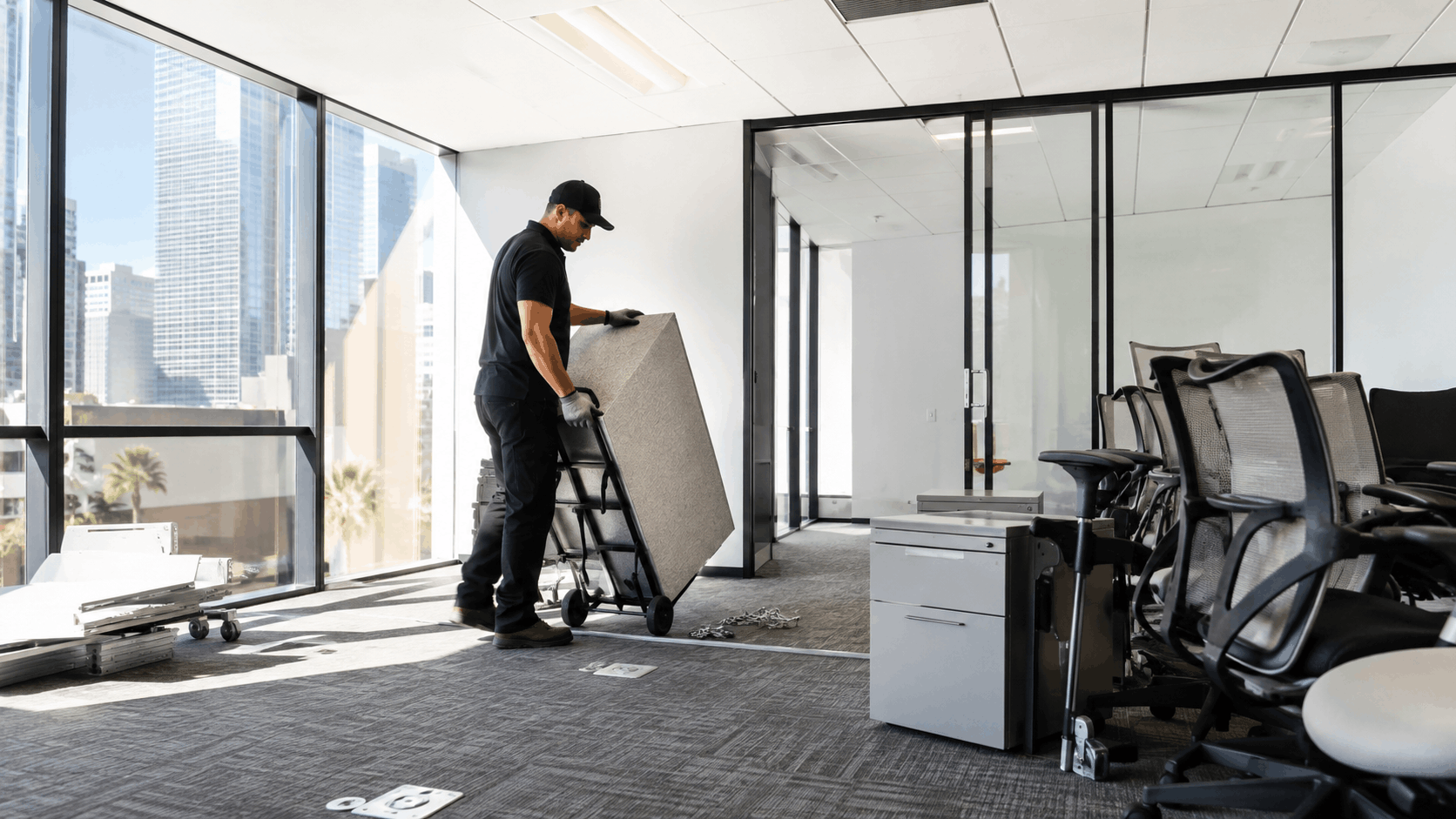
The lease ends in three weeks. The desks are already gone, the servers were pulled last Friday, and the corner office on the 34th floor of a Downtown LA tower sits mostly empty. Yet the landlord's move-out letter still lists a page of items that need attention before the space changes hands. Logo screws left holes in the reception wall. The break room carpet has coffee stains. The server room still holds a rack of low-voltage cabling snaking through the ceiling. This is the moment many business owners realize that clearing out the furniture was only half the job.
Office decommissioning is the work of returning a leased space to the condition your contract requires. It is not the same as a move. It comes after the boxes leave, and it decides whether you get your security deposit back or watch it disappear into repair invoices. In a market like Los Angeles, where high-rise leases carry strict surrender clauses, that gap between "empty" and "lease condition" can cost thousands of dollars.
What Office Decommissioning Actually Means?
Office decommissioning is the process of restoring a rented workspace to the state your landlord expects at the end of your lease. Most tenants think the job is finished once the last chair rolls out the door. It is not. The lease agreement drives everything that happens next, and it usually asks for a lot more than an empty room.
At its core, decommissioning covers the removal, repair, and cleaning tasks that bring a space back to its agreed condition. Here is what that generally includes:
- Removing furniture, cubicles, and any equipment left behind
- Pulling out network cabling and dismantling server rooms
- Patching walls, repairing anchor holes, and repainting where needed
- Taking down signage and removing custom fixtures
- Deep cleaning floors, carpets, and surfaces to the lease standard
The gap between a regular move-out and full decommissioning is where budgets get blown. Reading your lease early, before the first box is packed, keeps that gap from turning into a surprise bill.
Decommissioning vs. a Standard Office Move
A standard office relocation is about getting your things from point A to point B. The goal is a smooth transfer of desks, files, and equipment to the new address with as little downtime as possible. Our office and business moving teams handle that side of the work every week across LA.
Decommissioning starts where the move ends. Once the furniture and equipment are gone, the empty shell still has to meet the lease terms. That means the walls, floors, ceilings, and building systems all need to be handed back in a specific state.
Think of it as two separate projects that overlap. The move gets your business out. The space restoration gets the landlord satisfied. Skipping the second one is what puts a deposit at risk.
Many companies budget carefully for the relocation and forget the restoration entirely. Then the move-out inspection arrives and they scramble to cover repairs at rushed, premium rates. Planning both sides at once avoids that trap.
How the Lease Defines 'Broom-Clean' or 'Base Building' Condition
Commercial leases use a handful of phrases to describe the required handover state, and each one means something different. "Broom-clean condition" is the lightest standard. It means the space is swept, cleared of debris, and free of loose trash, with the floors and surfaces reasonably tidy.
"Base building condition" asks for much more. It usually means stripping the space back to the shell the landlord originally delivered, removing tenant improvements like added walls, extra electrical, and custom rooms. That is a far bigger job than a broom sweep.
Tenants in LA high-rises often miss clauses that sit between these two. A lease might say broom-clean but then add a line requiring removal of "all tenant-installed cabling" or "restoration of any wall penetrations." Those add-ons quietly turn a light cleanout into a real restoration.
Read the entire surrender section, not just the headline phrase. The devil hides in the sub-clauses, and a single overlooked line about cabling or flooring can cost a deposit. When in doubt, our team reviews the exact commercial lease language with clients before any work begins.
Who Is Responsible - Tenant or Landlord
The split between tenant responsibility and landlord obligations comes straight from the lease. As a general rule, tenants own the removal of everything they brought in and the repair of any damage they caused. Landlords typically handle normal wear and tear and structural systems.
Tenant improvements complicate the picture. If you added a server room, a reception counter, or interior glass walls, the lease decides whether those stay or go. Some landlords want the space returned exactly as delivered. Others prefer to keep certain build-outs for the next tenant.
Tenant improvement allowances shift the math too. If the landlord paid for part of your build-out, the contract often spells out what happens to it at move-out. Read those sections closely, because they change who pays for removal.
When responsibility is unclear, a short conversation with the property manager before the deadline saves money. Getting the split in writing protects both sides and prevents a fight over the deposit later.
Why LA Businesses Cannot Skip This Step
Skipping decommissioning has real financial teeth in Los Angeles. The most immediate hit is your security deposit. If the space fails inspection, the landlord deducts repair and cleaning costs, and commercial deposits often run several months of rent.
Holdover rent is the second danger. If you cannot hand back the space on the lease end date, many contracts charge holdover rent at 150 to 200 percent of your normal rate. A few extra weeks at that rate can cost more than the decommissioning itself.
There are legal reasons too. A signed lease is a binding contract, and failing to meet the surrender terms can expose your business to claims beyond the deposit. LA landlords with prime downtown space rarely let those terms slide.
Getting the space back on time and in condition protects your money and your business reputation. That is why the smart move is to plan the exit as carefully as the entrance.
Get Your Free Quote
Tell us about your move. We'll be in touch soon.
Reading Your Lease Before You Do Anything
Before a single box gets packed, the lease has to be read cover to cover. The exit clauses shape the entire move-out plan, from how much work is required to how much time you have. Guessing at these terms is how businesses end up over budget and past deadline.
Our team sits down with the lease alongside our clients at the start of every commercial project. We look for the language that spells out move-out requirements and flag anything that changes the scope. Here is what that review targets:
- The surrender and restoration clauses that define required work
- Any rules about tenant improvements and custom build-outs
- Notice periods and inspection scheduling
- Documentation requirements for the handover
Catching these details early turns a chaotic scramble into a clear plan. It also gives us time to book elevators, order supplies, and line up disposal.
Surrender and Restoration Clauses to Look For
The surrender clause is the section that tells you the condition the space must be in on the last day. It often sits near the end of the lease under a heading like "Surrender of Premises" or "End of Term." This is the first place we read.
The restoration clause is its partner. It describes what must be removed or repaired, and it is where you find requirements about walls, cabling, flooring, and fixtures. Some restoration clauses are detailed and specific, which is actually easier to plan around.
Vague wording is the real hazard. A clause that says the tenant must return the space in "good condition, reasonable wear excepted" leaves plenty of room for the landlord to interpret. That ambiguity can cost money if you and the property manager disagree on what "good" means.
When the language is loose, we recommend confirming expectations with the landlord in writing before work starts. A short email that lists what you plan to do, answered with a yes, prevents disputes at the final walkthrough.
Handling Tenant Improvements and Custom Build-Outs
Tenant improvements are the changes you made to fit your business into the space. Added walls, a dedicated server room, a built-in reception counter, extra electrical drops, and glass conference rooms all count. The lease decides their fate at move-out.
Some leases require full build-out removal, sending the space back to the open shell the landlord delivered. That can mean demolishing walls, capping electrical, and repairing the floor and ceiling where the improvements sat. It is the most expensive kind of restoration.
Other leases let improvements stay, especially if the next tenant might use them. A well-built server room or a nice reception area sometimes adds value the landlord wants to keep. Knowing which applies to you changes the budget dramatically.
Creative offices in areas like the Arts District and Culver City often carry heavy custom build-outs. If your lease requires removal, that work needs to start early. Our crews coordinate the teardown alongside the furniture removal so nothing gets missed.
Timelines and Notice Periods in LA Commercial Leases
Most LA commercial leases require written notice before you leave, often 30 to 90 days out. Miss that window and you can trigger an automatic renewal or holdover penalties. The notice period is the first date to circle on your calendar.
The move-out timeline after notice depends on the size of the space. A small suite might need a week of decommissioning work. A full floor in a downtown tower can take three to four weeks once build-out removal and repairs are factored in.
Downtown property managers usually schedule a pre-move-out walkthrough and a final walkthrough. The first flags what they expect fixed. The second is the official inspection that decides your deposit. Both need to fit inside your lease end date.
Building this timeline backward from the lease end date is how we plan. We set the final walkthrough first, then work back through cleaning, repairs, removal, and disposal so every task has a slot.
Documenting the Space Before Work Starts
Photos are your best protection in a deposit dispute. Before any work begins, we recommend a full photo record of the space, including existing damage, wall conditions, and flooring. Date-stamped images settle arguments cleanly.
A written condition report backs up the photos. It lists the state of each room, notes pre-existing wear, and records anything the landlord already knew about. Pairing the report with your original move-in documentation is even stronger.
This dispute protection matters because memories fade and property managers change. If a landlord claims you damaged a wall that was already marked, your dated record ends the debate. It is cheap insurance against a withheld deposit.
We hand every client a photo package at the close of a decommissioning job. That way, if any question comes up after handover, the evidence is ready and the deposit refund stays on track.

Need Help in Los Angeles?
Popeye Moving & Storage serves Los Angeles and all of Los Angeles County.
The Full Decommissioning Checklist for LA Offices
A good decommissioning checklist turns a huge job into a series of manageable tasks. It lets you see the whole scope at once and hand a clear plan to your crew. Below is the task-by-task breakdown we work from on an office move-out and space cleanout.
| Task Area | What It Involves | Typical Timing |
|---|---|---|
| Furniture & Cubicles | Disassemble workstations, haul out systems furniture, book freight elevator | Days 1-3 |
| IT & Server Room | Remove cabling, dismantle racks, secure data drives | Days 2-4 |
| Signage & Fixtures | Take down logos, remove fixtures, patch and paint walls | Days 4-6 |
| Deep Cleaning | Carpet cleaning, floor buffing, final cleanout | Final days |
The order matters. Cleaning comes last so the space stays presentable for the landlord inspection. Everything else feeds into that final handover.
Furniture, Cubicles, and Workstation Removal
Systems furniture and modular cubicles are heavier and more complicated than they look. A single workstation cluster can weigh hundreds of pounds once you account for panels, work surfaces, and storage. Disassembly is usually required before anything moves.
High-rise buildings add rules on top of the physical work. Freight elevators must be reserved in advance, and many downtown towers cap the weight per load or restrict move hours to evenings and weekends. Missing an elevator reservation can stall a whole crew for a day.
We plan the furniture removal around those building constraints. Our teams handle cubicle disassembly, protect the common areas from damage, and stage loads to match the freight elevator schedule. That keeps the job on pace and the building manager happy.
If any of the furniture is heading to a new office, we can move it directly or hold it in commercial business storage until the new space is ready. Combining removal and storage in one process saves a second round of handling.
IT Equipment, Cabling, and Server Room Teardown
The server room is often the most technical part of a decommissioning. Network cabling, patch panels, and low-voltage wiring frequently run through walls and ceilings, and many leases require every foot of it removed. Leaving it behind can trigger a repair charge.
Cable removal takes care. Ripping wiring out carelessly damages walls and ceiling tiles, which then need repair. Our crews pull cabling methodically and cap or patch penetrations as they go, so the teardown does not create new restoration work.
Data safety is a separate concern. Hard drives, servers, and network gear may hold sensitive company or customer information. Those items need data-safe handling, whether they go to your new office, to secure storage, or to a certified recycler for IT decommissioning.
We coordinate the server room teardown with your IT team so nothing is unplugged before it is backed up. Racks come down, wiring comes out, and the room is left clean and ready for the next tenant or the landlord's inspection.
Signage, Fixtures, and Wall Repairs
Signage removal is more than unscrewing a logo. Mounted signs, lobby lettering, and window graphics leave holes, adhesive, and shadow marks behind. Landlords expect all of it gone and the surface returned to a clean finish.
Wall repair is where small tasks pile up. Every anchor hole, TV mount, shelf bracket, and picture hanger leaves a mark that needs patching. Fixture removal for things like custom lighting or built-in cabinets adds more spots to fix.
Most landlords want walls patched, sanded, and repainted to match the original color. Some require a specific paint or finish named in the lease. Skipping the repaint, or using the wrong shade, is a common reason a deposit gets docked.
Our crews handle the full surface restoration, from pulling anchors to patching and repainting. We match the finish the lease calls for so the walls pass inspection without a second visit.
Deep Cleaning and Floor Restoration
Deep cleaning is the last step, and it decides the first impression the landlord gets. General cleanout covers dusting, wiping surfaces, and clearing every scrap of debris. Break rooms and restrooms usually need extra attention.
Flooring type changes the work. Carpet cleaning handles stains and traffic wear, while hard floors need buffing or polishing. Vinyl, tile, and polished concrete each call for different products and methods to reach lease standards.
Older buildings around Mid-Wilshire and the Financial District sometimes have original flooring that needs careful floor restoration rather than aggressive machine work. Using the wrong technique can damage a surface and create a new charge instead of fixing one.
We finish every decommissioning with a full deep clean matched to the flooring and the lease requirement. A clean, bright space is what turns a passing inspection into a prompt deposit refund.
Furniture Liquidation, Donation, and E-Waste Disposal
Once you know what has to leave the space, the next question is where it all goes. Furniture liquidation, donation, and proper e-waste disposal each have a place, and the right mix keeps costs down and items out of the landfill. California rules also limit what you can simply throw away.
The goal is to divert as much as possible from the dump. Reselling recovers cash, donating earns a tax receipt, and recycling keeps you compliant. Whatever is left goes to disposal handled the legal way.
Selling or Reselling Used Office Furniture
There is a real resale market for used office furniture in LA. Quality desks, ergonomic chairs, conference tables, and filing systems from recognizable brands hold value if they are in good shape. Selling them offsets your move-out costs.
Not everything sells, though. Older cubicles, worn task chairs, and heavily branded pieces usually have little resale value and cost more to move than they return. Being realistic about office furniture value saves wasted effort.
High-end and recent purchases move fastest. A two-year-old sit-stand desk or a set of quality conference chairs can find a buyer readily through used furniture resale channels and liquidators. Older stock is better donated or recycled.
We help clients sort what is worth selling from what is not. That way the resale effort goes toward the items that actually bring money back, and the rest moves to donation or disposal without delay.
Donating to LA Nonprofits and Schools
Donation is a strong option for furniture that still works but will not sell. Los Angeles has many nonprofits, charter schools, community centers, and startup incubators that welcome desks, chairs, and storage. Your surplus becomes their resource.
Furniture donation also helps at tax time. Registered nonprofits provide a tax receipt for donated goods, which your accountant can apply against the business return. That receipt turns unwanted furniture into a real deduction.
Local schools and youth programs across the area often need basic office and classroom furniture. Community groups serving families and job seekers can also use conference tables and filing cabinets. A brief call usually confirms what they will accept.
Our crews coordinate nonprofit donation pickups as part of the cleanout. We handle the loading and delivery so the items leave the building efficiently and you get the paperwork for your records.
California E-Waste and Recycling Rules
California treats electronics as hazardous waste, so they cannot go in the regular trash. Monitors, computers, printers, phones, and networking gear all fall under state e-waste recycling rules. Tossing them in a dumpster is against the law.
The state has firm California disposal rules for this reason. Electronics contain metals and chemicals that harm the environment, and improper dumping carries fines. The California Department of Resources Recycling and Recovery (CalRecycle) outlines how businesses must handle this equipment.
Certified recyclers serving Los Angeles County take these items and process them the legal way. Using a certified electronics recycling facility gives you documentation that the disposal was compliant. That paper trail protects your business from liability.
We route all e-waste to certified recyclers during a decommissioning. You get the disposal handled correctly and the records to prove it, with no risk of an illegal dumping fine landing on your company.
Secure Document Shredding and Data Destruction
Old paper files pile up in any office, and they cannot just be recycled if they hold private information. Secure document shredding destroys client records, financial files, and personnel documents so nothing sensitive escapes. For many businesses this is a legal duty.
Hard drives and storage media need data destruction, not just deletion. Wiping or physically destroying drives prevents old data from being recovered. Simply throwing out a computer leaves customer and company information exposed.
Legal and medical offices face extra compliance concerns. Rules like HIPAA and state privacy laws require secure disposal of protected records. The Federal Trade Commission's disposal guidance spells out how businesses must handle records containing consumer data.
We coordinate secure disposal of paper and drives as part of the move-out so nothing sensitive gets left behind. Combining shredding and data destruction with the cleanout keeps your compliance intact and your final walkthrough clean.

Neighborhood-Specific Challenges Around Los Angeles
A move-out in a Downtown high-rise looks nothing like one in a Culver City warehouse loft. Every LA district has its own buildings, streets, and loading rules. Our crews know these differences because we work them every week.
Here is how decommissioning shifts across the areas we serve most:
- Downtown towers with strict freight elevator and dock schedules
- Century City and Westwood suites with tight parking and traffic timing
- Creative lofts in Culver City and the Arts District with heavy build-outs
- Hollywood and Mid-Wilshire streets that need parking permits
Knowing the local rules before the truck arrives is what keeps a job on schedule.
High-Rise Move-Outs in Downtown LA and the Financial District
Downtown LA high-rise move-outs run on the building's schedule, not yours. Towers along Figueroa and Flower Streets require freight elevator scheduling days or weeks ahead, and slots fill up at month-end when many leases turn over.
Loading dock access is just as tight. The Financial District towers near 7th and Figueroa share docks among many tenants, so time windows are short and strictly enforced. Show up without a booked slot and you may lose the day.
After-hours rules add another layer. Many downtown buildings only allow large move-outs in the evening or on weekends to avoid disrupting daytime tenants. That protects the building but can raise labor costs for the crew.
Our teams handle the freight elevator scheduling, dock booking, and after-hours coordination as part of the job. We have worked these towers enough to know how each building runs its dock and its elevators.
Century City, Westwood, and West LA Corporate Suites
Century City and Westwood pack corporate suites into busy blocks with limited parking. Building management often restricts where trucks can stage and for how long, so a plan is required before arrival. Guessing leads to citations and delays.
Traffic timing matters here more than almost anywhere. Santa Monica Boulevard and the 405 clog badly during peak hours, and a truck stuck in that traffic burns billable time. We schedule around the worst windows to keep the job moving.
Building rules in these towers can be strict about insurance, elevator use, and protective coverings. Our crews arrive with the paperwork and materials the property manager expects. That familiarity keeps commercial moving in West Los Angeles smooth from start to finish.
West LA parking is the recurring headache. We handle staging, permits where needed, and tight loading windows so the move-out does not stall on a full block or a ticket.
Creative Office Spaces in Culver City and the Arts District
Culver City and the Arts District are full of converted warehouses and open-plan lofts. These creative spaces look great, but they often hide extensive custom build-outs that need restoration at move-out. That is where the extra work hides.
Warehouse conversions frequently include added mezzanines, exposed cabling runs, custom lighting, and specialty flooring. Many leases require all of it removed and the shell returned to its raw state. That teardown takes more time than a standard suite.
Open-plan lofts also have quirky access. Freight elevators may be older and slower, and loading may run off a narrow alley or a single roll-up door. Planning around those limits keeps the crew productive.
Our teams handle these spaces regularly, including commercial moving in Culver City. We plan the build-out removal and restoration alongside the furniture haul so a creative office hands back clean.
Street Permits and Loading Rules in Hollywood and Mid-Wilshire
Hollywood and Mid-Wilshire often lack the loading docks that downtown towers have. That means loading from the street, which usually requires a temporary no-parking permit to hold curb space for the truck. Without one, there may be nowhere legal to park.
Narrow streets around Hollywood make access even harder. Some buildings sit on blocks where a large truck barely fits, so timing and positioning have to be planned. A wrong turn can cost an hour.
LA street parking enforcement is active along Wilshire Boulevard and the surrounding blocks. Parking a moving truck without the right permit invites tickets and possible towing. The city's Department of Transportation manages these temporary permits and curb rules.
Our crews pull the street parking permits and plan the loading approach before the move date. That keeps the truck legal, the crew working, and the neighbors from complaining.
Need Help in Los Angeles?
Popeye Moving & Storage serves Los Angeles and all of Los Angeles County.
How Much Office Decommissioning Costs in LA
Cost is the first question most business owners ask, and the honest answer is that it depends. Decommissioning cost in LA swings based on space size, build-out complexity, timeline, and building access. Still, there are ranges that help you budget before you get quotes.
Below we break down office move-out price by square footage, the factors that push it up, and the hidden fees to watch for. Knowing these upfront makes it easier to compare LA moving cost quotes fairly.
Price Ranges by Square Footage
As a rough guide, basic decommissioning runs about $1 to $4 per square foot for a light broom-clean handover. Full restoration with build-out removal can climb to $5 to $10 per square foot or more.
For example, a 2,500 square foot suite with modest work might land between $2,500 and $10,000. A 10,000 square foot floor with heavy build-out removal could run $50,000 or higher. The spread reflects how much restoration the lease demands.
Office size pricing is not perfectly linear. Larger spaces sometimes get a better cost per square foot on cleaning and hauling, but complex build-outs can offset that saving. The lease scope drives the final number more than raw square footage.
These are planning figures, not quotes. Two offices of the same size can cost very different amounts depending on cabling, walls, and flooring. A walkthrough is the only way to pin the number down.
What Drives the Cost Up
Extensive build-outs are the biggest cost factor. Demolishing added walls, removing a server room, and capping electrical takes skilled labor and time. The more custom your space, the more restoration it needs.
Tight timelines add cost too. A rushed move-out means more crew working longer hours to hit the lease deadline. When there is only a week to do three weeks of work, the price reflects the overtime.
After-hours work raises the bill in high-rise buildings. Many downtown towers only permit large move-outs on evenings and weekends, which carries premium labor rates. Build-out removal outside normal hours costs more than the same work at midday.
High-rise access itself drives cost. Freight elevator limits, dock scheduling, and protective coverings all add labor. A ground-floor suite with a roll-up door is far cheaper to clear than a 30th-floor office.
Hidden Fees to Watch For
Dump fees catch many businesses off guard. Landfills and transfer stations charge by weight, and a floor of old cubicles adds up. A clear quote should spell out disposal charges rather than tack them on later.
Elevator deposits are common in high-rises. Buildings often require a refundable deposit to reserve the freight elevator, plus a fee if the move runs long. Ask the property manager about these before move day.
Disposal surcharges apply to e-waste and hazardous items. Electronics recycling and secure data destruction carry their own costs that a bare-bones quote may leave out. Hidden fees like these turn a cheap bid into an expensive surprise.
We list every line item in our quotes, including hauling, disposal, and building fees. A transparent estimate up front is how you avoid a bigger bill at the end.
Getting an Accurate On-Site Estimate
A phone quote is a guess. A moving quote based on an on-site estimate reflects reality. Walking the space is the only way to see the true scope of a decommissioning.
During an office walkthrough, our team checks the wall conditions, counts the anchor points, inspects the flooring, and looks at the cabling and server room. We note the build-outs that must come out and the access rules in the building. Those details shape the price.
We also review the lease alongside the space. Matching the surrender clause to what we see on-site tells us exactly what work is required. That prevents scope surprises later.
An accurate estimate protects your budget and your timeline. Book a walkthrough early, well before the lease deadline, so there is time to plan the work and reserve the building.

How Popeye Moving & Storage Handles Decommissioning
Every decommissioning we run follows the same local process, from the first planning meeting to the final handover. The goal is simple: protect your deposit and hit the lease deadline. Here is how our LA office movers approach the job.
- Map every task against your lease and deadline
- Combine removal, storage, and disposal in one coordinated project
- Handle all building management paperwork and scheduling
- Prep the space and hand you a photo record for the inspection
Combining the move-out service and the cleanout under one roof means fewer vendors and fewer things falling through the cracks.
Project Planning and Lease Review Support
Our process starts with a planning meeting and a lease review. We read the surrender and restoration clauses with you, then map each requirement to a task and a date. That turns the lease language into an actionable plan.
The project timeline is built backward from your lease end date. We schedule the final walkthrough first, then work back through cleaning, repairs, removal, and disposal. Every task gets a slot so nothing gets rushed at the end.
We also flag the risky spots early. If a clause requires cabling removal or a repaint in a specific color, we plan for it now instead of discovering it during the landlord inspection. Early move-out planning is what keeps a job on budget.
You leave that first meeting with a clear scope, a schedule, and a cost estimate. No guesswork, no surprises at the deadline.
Coordinated Removal, Storage, and Disposal
We fold moving, storage, and disposal into a single process. Items headed to your new office get moved directly. Items that need to wait go into our storage solutions until the new space is ready.
The removal service handles the heavy lifting - furniture, cubicles, equipment, and cabling. Anything worth selling or donating gets routed to those channels, and the rest goes to certified disposal. One team manages it all.
Short-term office storage bridges the gap when your new space is not ready. Rather than paying to move things twice or renting a separate unit, you keep everything with one provider. That saves handling and cost.
Disposal coordination ties it together. E-waste to certified recyclers, donations to nonprofits, and general debris to the dump - all handled and documented as part of the job.
Working With Building Management and Property Managers
LA property managers require paperwork and scheduling before any move-out, and we handle it. A certificate of insurance naming the building is almost always required, and we provide it without delay. That keeps the crew from being turned away at the dock.
Elevator bookings and dock scheduling are part of our coordination. We contact the property manager, reserve the freight elevator, and confirm the loading window. In busy downtown towers, that scheduling can make or break the timeline.
We know the building rules across LA because we work these towers constantly. Protective coverings, move hours, and access routes vary by building, and we arrive prepared for each one. That property manager coordination keeps the job on track.
Familiar buildings mean fewer surprises. When our crew already knows a tower's dock and elevator setup, the move-out runs smoother.
Final Walkthrough and Handover Prep
We close every job with a handover checklist. Before the landlord arrives, our team confirms the walls are patched and painted, the floors are clean, the cabling is gone, and every fixture is removed. Nothing is left to chance.
We prep the space specifically for the landlord inspection. That means walking it as the property manager would, catching any small item they might flag, and fixing it before they see it. A clean first impression speeds the deposit refund.
You get a photo record of the finished space at handover. Those dated images prove the condition you returned, which protects you if any question comes up later. It is the same dispute protection we recommend at the start.
Passing the final walkthrough on the first try is the goal. A well-prepped handover gets your deposit back sooner and closes the lease cleanly.
Need Help in Los Angeles?
Popeye Moving & Storage serves Los Angeles and all of Los Angeles County.
Avoiding Common Move-Out Mistakes
We have seen the same move-out mistakes cost LA businesses money over and over. Most are avoidable with planning. Here are the errors that lead to deposit disputes and lease compliance problems, drawn from real jobs our crews have handled.
Underestimating How Long Decommissioning Takes
A frequent mistake is thinking the cleanout will take a weekend. It rarely does. Tenants budget for the move and forget that repairs, cabling removal, and cleaning all take days on top of it.
A mid-size office of around 5,000 square feet often needs two to three weeks from start to handover. That covers furniture removal, cabling teardown, wall repairs, repainting, and deep cleaning, with building schedule delays factored in. Rushing it invites errors.
Scheduling mistakes compound the problem. If the freight elevator is booked out or the landlord's inspection is set for a fixed date, there is no room to slip. A realistic move-out timeline built backward from the deadline prevents the last-minute panic.
Start planning the moment you give notice. The earlier the schedule is set, the more time there is to absorb the surprises every move-out brings.
Skipping Repairs That Trigger Deposit Loss
Small skipped repairs add up to a big deposit loss. Anchor holes from shelving, TV mounts left on the wall, and unfilled screw holes each seem minor. Together they give a landlord plenty of reasons to withhold funds.
Carpet damage is a frequent culprit. Coffee stains, chair-wheel wear, and cabling burns in the flooring often get overlooked in the rush to leave. Wall repairs left undone are just as visible to an inspector.
Landlords add up these items and charge for the total. A few hundred dollars of patching and cleaning skipped can turn into a few thousand withheld from the deposit. The math never favors the tenant.
Our crews handle the small repairs most people miss. Filling every hole, matching the paint, and cleaning the carpet is cheaper than losing the deposit over them.
Improper Disposal That Breaks California Law
Tossing electronics in a dumpster is illegal dumping in California, and it carries real fines. Monitors, computers, and networking gear are all regulated e-waste. The rules apply to businesses, not just households.
Disposal fines can hit hard, and the liability follows your company, not the mover who did it wrong. Paint, batteries, and certain fixtures also have disposal rules that a careless crew might ignore.
Proper recycling avoids all of it. Routing electronics to certified recyclers and hazardous items to the right facility keeps you compliant and gives you documentation. That paper trail is your protection if anyone asks.
We handle disposal the legal way on every job. Compliance is built into our process so you never face a fine for how your old office gear was thrown out.
Hiring Movers Without Building Experience
Hiring a cheap crew with no high-rise experience is a costly gamble. Movers who do not know LA building rules show up without a certificate of insurance, miss the elevator window, or damage common areas. Any of those stalls the job.
High-rise rules are unforgiving. Buildings turn away crews without the right paperwork, and a missed dock slot can push the move past your lease deadline into holdover rent. Local knowledge prevents those delays.
Damage prevention matters too. Experienced movers protect the floors, walls, and elevators, avoiding damage claims that eat into your budget. A crew that scratches the lobby marble creates a new problem, not a solution.
Our teams work LA buildings every week and know their rules, their docks, and their managers. That experience keeps the job on time and free of avoidable claims. Explore our full range of commercial moving services to see how we handle office projects across the city.

Final Thoughts
Office decommissioning is the difference between walking away with your deposit and losing it to repair bills. The work starts with reading the lease, not packing boxes. From there it is a clear sequence: remove, repair, clean, dispose, and hand back on time.
Los Angeles adds its own challenges - high-rise elevators, tight docks, street permits, and strict disposal law. Handling all of it under one plan is how businesses hand back a clean space and close a lease without a fight. Our crews at Popeye Moving & Storage bring that plan and the local knowledge to make it work.
Frequently Asked Questions
- What does office decommissioning include?
- Office decommissioning includes removing all furniture, cubicles, and equipment, then tearing down network cabling and server rooms. It also covers repairing walls and anchor holes, removing signage and fixtures, repainting to the lease standard, and deep cleaning the floors and surfaces. Disposal of unwanted items through resale, donation, and certified recycling rounds out the scope. The exact tasks depend on what your lease requires at handover.
- How much does office decommissioning cost in Los Angeles?
- A light broom-clean handover runs roughly $1 to $4 per square foot, while full restoration with build-out removal can reach $5 to $10 per square foot or more. A 2,500 square foot suite might cost $2,500 to $10,000, and a larger floor with heavy work can run much higher. Build-out complexity, timeline, disposal needs, and high-rise access all move the number. An on-site walkthrough gives the accurate figure.
- How long does it take to return an office to lease condition?
- A small suite might take a few days to a week. A mid-size office around 5,000 square feet usually needs two to three weeks. A full floor in a downtown tower can run three to four weeks once build-out removal and repairs are included. Building schedules, elevator availability, and the amount of restoration required all affect the timeline, so start planning as soon as you give notice.
- Who pays for restoring the office - the tenant or the landlord?
- The lease decides. As a general rule, tenants pay to remove what they installed and repair any damage they caused, while landlords cover normal wear and structural systems. Tenant improvements like added walls or server rooms usually fall on the tenant to remove unless the lease says otherwise. Tenant improvement allowances can shift responsibility, so read the surrender and restoration clauses closely before assuming who pays.
- What is 'broom-clean' condition?
- Broom-clean condition is the lightest handover standard. It means the space is swept, cleared of all debris and loose trash, and left reasonably tidy with floors and surfaces cleaned. It does not usually require removing built-in improvements or restoring the space to its original shell. Many leases pair broom-clean with extra requirements, though, such as cabling removal or wall repairs, so read the full clause carefully.
- Do I have to remove tenant improvements I added?
- It depends on your lease. Some leases require full removal of custom build-outs like added walls, server rooms, and reception counters, returning the space to the original shell. Others let those improvements stay, especially if the next tenant might use them. Check the restoration clause and confirm with the property manager in writing before starting work, since removal is expensive and you do not want to demolish something the landlord wanted kept.
- What happens to my old office furniture and electronics?
- You have three main options. Quality, recent furniture from known brands can be resold to recover cash. Working furniture that will not sell can be donated to LA nonprofits and schools, which provides a tax receipt. Electronics must go to certified e-waste recyclers under California law, never the trash. Our crews sort and route each category so items are handled efficiently and disposed of legally with proper documentation.
- Can decommissioning be done after business hours?
- Yes, and in many LA high-rises it must be. Downtown towers often restrict large move-outs to evenings and weekends to avoid disrupting daytime tenants. After-hours work carries premium labor rates, so it adds to the cost, but it keeps you compliant with building rules and avoids blocking shared elevators and docks during business hours. We coordinate these windows with property managers as part of the job.
- How do I protect my security deposit during move-out?
- Document the space with dated photos and a written condition report before any work begins. Complete every repair the lease requires, including anchor holes, wall patching, repainting, and carpet cleaning. Route electronics to certified recyclers and keep the disposal records. Then pass the final walkthrough by prepping the space as the landlord would inspect it. A clean handover with a photo record is your strongest protection against a withheld deposit.
- Does Popeye Moving & Storage handle both the move and the decommissioning?
- Yes. We combine the office relocation, short-term storage, and the full decommissioning cleanout into one coordinated project. That means one team moves your business to its new space, holds anything not ready to land, and returns the old office to lease condition. Handling both under one roof reduces vendors, prevents tasks from slipping, and keeps your timeline and deposit protected. Contact our team to plan your move-out. Ready to hand back a clean space on time and keep your deposit? Our crews know the buildings, streets, and lease rules across Los Angeles, from Downtown towers to Culver City lofts. Call Popeye Moving & Storage today or reach out for a consultation and an on-site estimate for your office decommissioning.
Popeye Moving & Storage Co. Team Team
Licensed moving and storage professionals serving Los Angeles and Los Angeles County.
Licensed in California · License #CAL T 189749 | USDOT 1472924 | MC 498816C
Why trust Popeye Moving & Storage?
Founded in 1994, Popeye Moving & Storage is a licensed and insured moving and storage service serving Los Angeles and Los Angeles County. All content is reviewed by our licensed technicians.

Need Help in Los Angeles?
Popeye Moving & Storage serves Los Angeles and all of Los Angeles County.
Related Articles
Cubicle Reconfiguration and Onsite Office Relocations: The Move That Never Leaves the Building
A complete guide to cubicle reconfiguration and onsite office relocations in Los Angeles - how internal moves work, how to plan around business hours, and how to protect furniture.

Office Furniture Storage Between Leases: Decommission Today, Refurnish the Next Space Later
Learn how LA businesses store office furniture between leases, decommission the old space, and refurnish later - with costs, timing, and practical tips from Popeye Moving.

Office Movers in Culver City and Playa Vista: Studio-Adjacent and Tech-Campus Moves
A local guide to office movers in Culver City and Playa Vista, covering studio security, tech-campus docks, IT gear, parking permits, storage, and cost.