What Can't Go Into Storage in California - The Real Prohibited List

Key Takeaways
- California storage bans come from three layers: state law, fire code, and facility insurance policy, all built to protect every tenant in a building.
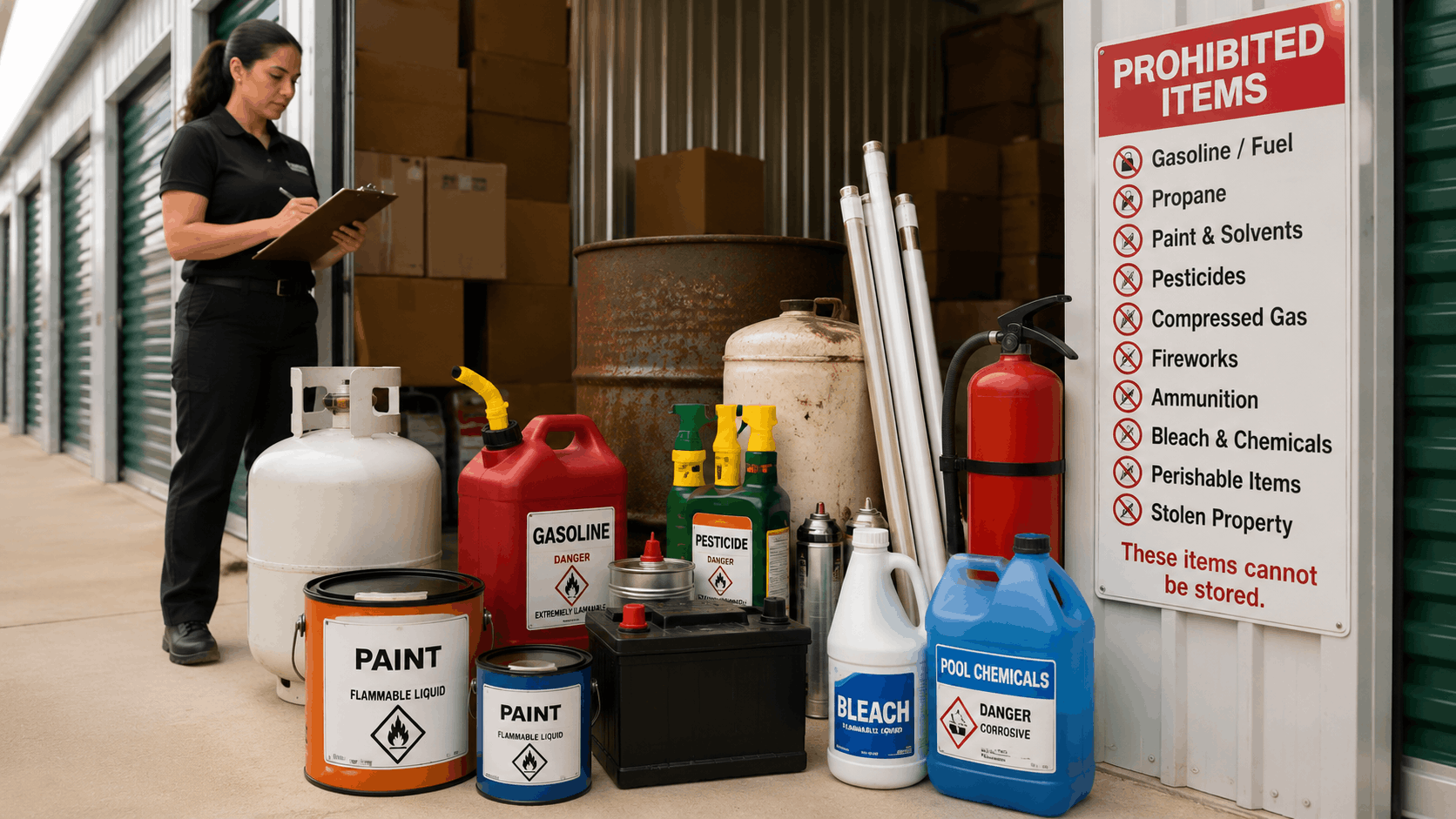
- Fuels, propane tanks, oil-based paint, solvents, fireworks, ammunition, aerosols, and pool chemicals are banned from nearly every unit due to fire risk.
- Perishable food, live plants, soil, and any living animal are prohibited because they attract pests, grow mold, or violate animal welfare law.
- Hazardous materials like asbestos, medical waste, sharps, car batteries, and corrosive acids require proper disposal, never storage, or they risk LA County fines.
- Illegal drugs, unregistered firearms, stolen goods, and counterfeit merchandise bring police involvement since facilities cooperate fully with law enforcement.
- Vehicles, electronics, wine, and valuables are allowed only with conditions such as drained fuel, current registration, or climate-controlled space.
- The LA Basin's heat, especially in the San Fernando Valley, makes climate control necessary for electronics and wine to avoid damage.
- Popeye Moving & Storage reviews items before packing day, serves neighborhoods across LA, and points clients to LA County hazardous waste drop-off sites.
In This Article
A family in Silver Lake spent last weekend clearing out a garage that had not been touched in fifteen years. Half-empty paint cans, a rusted propane tank, boxes of old files, and a wine collection all needed a new home. When they called our team, the first question was simple: what can actually go into a storage unit in California?
The answer surprises most people. California has one of the strictest sets of storage rules in the country, shaped by fire code, insurance demands, and the odd swings of heat across the LA Basin. A lot of everyday garage items are flat-out banned, and storing one wrong thing can put an entire building at risk.
Why California Has Stricter Storage Rules Than Most States?
California storage laws are not just a facility being fussy. They come from three layers working together: state law, fire code, and each operator's own policy. Once residents understand the reasoning, the list of prohibited items makes a lot more sense.
- State and county law sets hard limits on hazardous and illegal materials.
- Fire code controls anything flammable, combustible, or pressurized.
- Facility policy and insurance add another layer that can be even tighter than the law.
The result is a system built to protect every tenant in the building, not just the one renting a single unit. Our team has helped hundreds of families move across the city, and the same handful of banned items shows up in nearly every garage.
State Fire Marshal Regulations and Local Fire Codes
The California State Fire Marshal writes rules that every storage building has to follow, and local departments add their own on top. In Los Angeles, the LAFD inspects and enforces these codes with real teeth. Combustible materials are the main target because a single stored container of fuel can turn a small fire into a total loss.
Fire safety rules get even tighter in dense neighborhoods. Facilities in Downtown LA and Koreatown sit close to housing, offices, and heavy foot traffic, so inspectors pay closer attention to what tenants bring in. A building that passes in a spread-out area might face stricter limits when it is wedged between apartments.
The logic is straightforward. Storage units are packed tight, often without sprinklers in every space, and a fire spreads rapidly through cardboard and cloth. Keeping fuels and flammable liquids out is the cheapest way to stop a disaster before it starts. You can review the state rules through the California State Fire Marshal if you want the technical detail.
For residents, the takeaway is simple. If it burns, off-gasses, or came with a flammable warning label, assume it cannot go into a unit until you confirm otherwise.
Facility Liability and Insurance Requirements
Behind every storage building is an insurance policy, and that policy comes with conditions. Carriers require operators to ban certain items as a term of coverage. If a facility lets those items in and something goes wrong, the insurer can deny the claim.
That is why facility policy often reads stricter than state law. Operators are not guessing. They are following a contract that protects the whole property, and they lose their liability coverage if they ignore it. One tenant storing a gas can breaks the rules for everyone.
The scary part is how far the damage spreads. A single hazardous item that leaks or ignites can void protection for an entire building, leaving neighboring tenants without any recourse for their lost belongings. Storage insurance is written around this exact fear.
When our clients set up a unit through our storage solutions, we walk them through these terms up front so no one signs a contract they cannot honor.
How Climate in the LA Basin Adds Restrictions
Heat is the quiet enemy of stored goods across the LA Basin. A unit in the San Fernando Valley can hit well over 100 degrees inside during a July afternoon, then cool sharply at night. Those swings warp, crack, and melt items that would survive a milder climate.
The contrast across the region is dramatic. A facility near Santa Monica stays relatively cool thanks to the coastal marine layer, while a Valley building in Van Nuys or Reseda bakes for months. What is safe in one zip code can be a bad idea in another.
This is why certain temperature-sensitive items get restricted or steered toward climate-controlled space. Aerosols and pressurized cans can burst in extreme heat. Candles, vinyl records, and electronics degrade. The climate itself becomes part of the reason a facility limits what sits in a standard unit.
Understanding the heat map of the city helps residents decide not just what they can store, but where and how. Our team knows which neighborhoods run hot and plans around it.
Get Your Free Quote
Tell us about your move. We'll be in touch soon.
Flammable and Combustible Items You Cannot Store
Flammable items top the prohibited list at nearly every California facility. These are the fuels, chemicals, and pressurized products that fire code bans outright. The tricky part is that many of them are ordinary garage leftovers people forget about, like the spare gas can behind the lawnmower.
| Category | Common Examples | Why It Is Banned |
|---|---|---|
| Fuels | Gasoline, diesel, propane, kerosene | Highly flammable, explosive vapors |
| Paints and solvents | Oil-based paint, thinner, varnish | Fumes ignite, off-gas in heat |
| Explosives | Fireworks, ammunition, flares | Detonation and fire risk |
| Pressurized goods | Aerosols, pool chlorine, fertilizer | React or burst under heat |
If an item shipped with a hazard symbol or a flammable warning, treat it as banned hazardous materials until proven otherwise. Below are the categories that trip people up most.
Gasoline, Propane, and Lighter Fluids
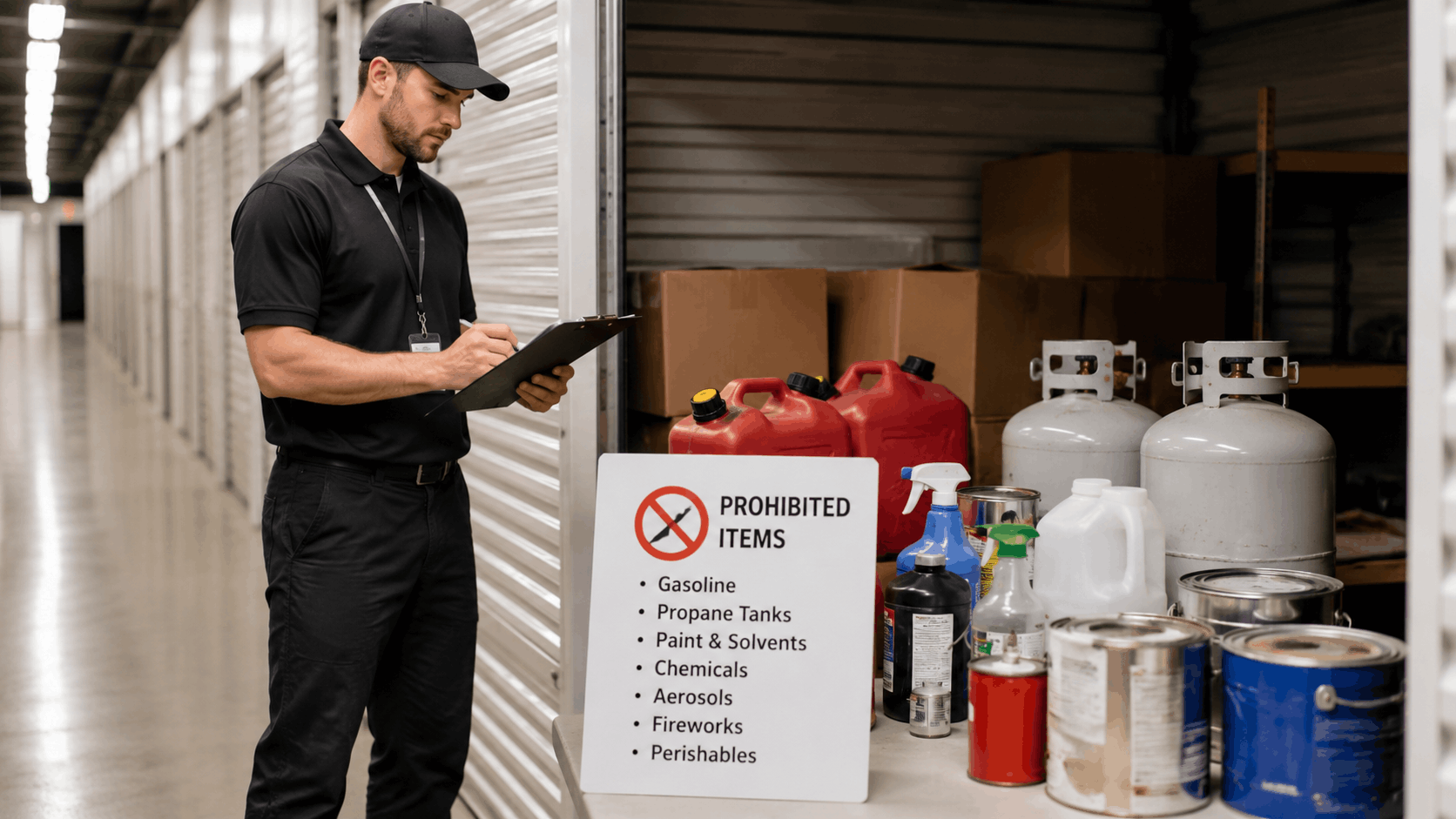
Any fuel source stays out of a unit, full stop. That means gasoline in a red can, kerosene for a heater, and lighter fluid for the grill. These liquids give off vapors that can ignite from a single spark, and in a sealed unit those vapors build up.
Propane tanks catch people off guard. Even an empty tank holds residual gas and pressure, so fire code treats it the same as a full one. The BBQ tank from a Highland Park backyard cannot come along just because it looks empty.
Lawn equipment is another common source. Weed trimmers, chainsaws, and mowers often hold fuel in their tanks, and that fuel has to be drained completely before the equipment can be stored. We show clients how to empty and air out gas-powered tools before packing day.
Proper fuel storage belongs in a ventilated shed or an approved container at home, never in a rented unit. When residents ask, the answer is always the same: drain it, dispose of the fuel correctly, and store the dry equipment.
Paint, Solvents, and Cleaning Chemicals
Oil-based paints, paint thinners, and varnishes are all banned because they release fumes and ignite easily. Industrial cleaners fall in the same bucket. These products do not just sit quietly; in a hot unit they off-gas and create a hazard for the whole row of lockers.
Renovation leftovers are the biggest culprit we see. Older homes near Highland Park and Eagle Rock go through constant remodels, and the garage fills with half-used cans of primer, stain, and solvent. Those cans routinely get flagged during a pre-move review.
Water-based latex paint is sometimes allowed if fully dried, but the safer move is to finish the can or dispose of it. Solvents and chemicals never make the cut. The fume risk alone is enough for most facilities to refuse them.
For disposal, LA County runs free drop-off events for exactly this kind of material. We point clients to the nearest site rather than letting old paint block a move.
Fireworks, Ammunition, and Explosives
Fireworks are banned from storage and illegal in most of LA County to begin with. The city and county prohibit the sale and use of consumer fireworks in nearly every neighborhood, so storing them adds a legal problem on top of a fire risk. Flares and any explosive material fall under the same ban.
Ammunition sits in a stricter category. Most facilities ban it outright because of the fire and detonation risk in a confined space. Even where a policy allows small quantities, the conditions are narrow and rarely worth the trouble.
The reasoning is obvious once you picture a fire reaching a box of shells. Explosives and live rounds turn a manageable incident into a dangerous one for firefighters and neighboring tenants alike. Fire code treats them as a non-starter.
Safer alternatives exist. Registered gun owners can use a licensed firearms storage service or a proper home safe, and ammunition should be kept separately in an approved container at home, not in a general storage unit.
Aerosols, Fertilizers, and Pool Chemicals
Pressurized aerosol cans are a hidden hazard. Spray paint, WD-40, and cleaning sprays can burst when a Valley unit heats past 100 degrees, spraying flammable contents into an enclosed space. Most facilities ban them for this reason.
Nitrogen-based fertilizers are reactive and can combust under the right conditions. A bag of lawn feed from a garage in Sherman Oaks might seem harmless, but in concentrated form and high heat it becomes a real risk. Facilities keep it out along with other garden chemicals.
Pool chemicals are the classic LA backyard problem. Chlorine tablets and shock treatments react violently with heat and moisture, and they can release toxic gas or even ignite when mixed. A typical pool maintenance kit holds several banned items at once.
When clients downsize a backyard setup, we help them sort the safe from the banned. The furniture and umbrellas can be stored; the chemicals go to a hazardous waste site.
Need Help in Los Angeles?
Popeye Moving & Storage serves Los Angeles and all of Los Angeles County.
Perishable and Living Items That Are Off Limits
Anything alive or spoilable cannot go into a unit. Perishable items rot, attract pests, and create odors that spread far beyond a single locker. One forgotten box can turn into a facility-wide problem within weeks.
| Item Type | Examples | Main Problem |
|---|---|---|
| Food | Canned goods, dry pantry items, pet food | Attracts rodents and insects |
| Plants | Potted plants, cut flowers, seeds | Die, mold, spread pests |
| Garden material | Soil, mulch, compost | Harbors bugs and fungus |
| Animals | Any live pet or creature | Illegal and inhumane |
Pest control is the driving concern here. A storage building shares walls, vents, and floors, so an infestation in one unit soon becomes everyone's problem.
Food and Perishable Goods
Fresh, canned, and dry food all stay out of storage. Even sealed canned goods can leak or rot, and dry items like flour and cereal are a magnet for rodents. Pet food is one of the worst offenders because it draws mice almost immediately.
The problem is how easily it spreads. One forgotten box of pantry items can trigger an infestation that moves through the walls into neighboring units. By the time anyone notices the smell, the pests have already found the whole row.
People often assume canned food is safe because it is shelf-stable. In a hot unit, cans swell, seams fail, and the contents spoil, leaving a mess that attracts insects. Perishables of any kind simply do not belong in shared storage.
Before a move, we check pantries and garage shelves for stray food. It is one of the frequent items we pull from a packing pile, and catching it early saves clients from a much bigger headache later.
Plants and Garden Materials
Live plants cannot survive in a dark, sealed unit, and dead plants create mold. Soil and mulch carry insects, fungus, and moisture that spread to other belongings. Facilities ban all of it to keep the building clean and pest-free.
This comes up constantly when clients downsize a garden. Families leaving larger properties in Pasadena and Eagle Rock often have potted trees, bags of soil, and stacks of mulch they hope to keep. Sadly, none of it can go into storage.
Mold is the bigger long-term threat. Damp soil in a warm unit grows spores that spread onto furniture, boxes, and fabric, ruining items far beyond the original plant. Even a small potted fern can seed a problem.
The better path is to gift plants to neighbors, donate them, or move them directly to the new home. We help coordinate that so nothing valuable gets tossed and nothing banned gets packed by mistake.
Animals and Pets
No living animal can ever go into a storage unit. This is a strict, non-negotiable ban backed by animal welfare law. A storage unit has no ventilation, no light, and no temperature control suited to a living creature, and leaving an animal in one is both illegal and cruel.
The rule covers everything from dogs and cats to reptiles, birds, and fish. There is no version of pet storage that is legal or humane. Facilities enforce this without exception and will involve authorities if an animal is found.
We mention it because transitions get chaotic. Families in the middle of a move sometimes look for any short-term solution for a pet, and a locked unit is never one of them. California law is clear on this point.
Humane alternatives exist for owners between homes. Boarding facilities, pet-friendly short-term rentals, and trusted friends all work while a move is underway. Our team can suggest local options so no one is left scrambling.
Hazardous, Toxic, and Biological Materials
Some banned items carry real legal weight. Hazardous waste, toxic materials, and biohazards are regulated by state and county agencies, and improper handling can lead to fines from LA County. These are not gray areas; they are hard prohibitions.
| Material | Examples | Risk |
|---|---|---|
| Building materials | Asbestos insulation, old tile, treated drywall | Airborne toxins |
| Medical waste | Sharps, lab samples, expired meds | Biohazard, infection |
| Corrosives | Car batteries, acids, drain cleaner | Leaks, burns, fire |
Disposal of these materials is handled through specific channels, and LA County provides free drop-off sites for most of them. Storing them is never the right answer.
Asbestos and Contaminated Building Materials
Old insulation, floor tiles, and drywall can contain asbestos, and none of it can be stored. When these materials are disturbed, they release fibers that are dangerous to breathe. That is why they fall under strict handling and disposal rules.
Los Angeles has a lot of mid-century housing stock, and many older properties near Mid-Wilshire and Hancock Park still contain asbestos in their original materials. Homeowners doing renovations often end up with debris they do not know how to handle.
Contaminated building materials require licensed abatement and specialized disposal. They cannot sit in a storage unit where fibers could spread or where a future tenant might disturb them. The contamination risk is simply too high.
If a remodel turns up suspect materials, the safe move is testing and professional removal, not storage. We flag these items during a walkthrough and steer clients toward licensed disposal rather than packing them.
Medical Waste and Chemicals
Biological, medical, and lab materials are banned across the board. This includes sharps like needles, expired medications, blood or tissue samples, and any chemical used in a medical setting. The biohazard risk to staff and other tenants is real.
Sharps are a particular concern because a stray needle can injure anyone handling nearby boxes. Facilities have no way to safely contain medical waste, so they refuse it entirely. There is no permit that changes this for a general storage unit.
Proper disposal runs through specific channels. Pharmacies, hospitals, and county programs accept sharps and expired medication for safe destruction. LA County publishes drop-off locations for exactly this purpose.
For clients closing a home medical setup or clearing an estate, we point them to the right disposal sites. It keeps banned material out of the moving truck and out of the unit.
Batteries, Corrosives, and Acids
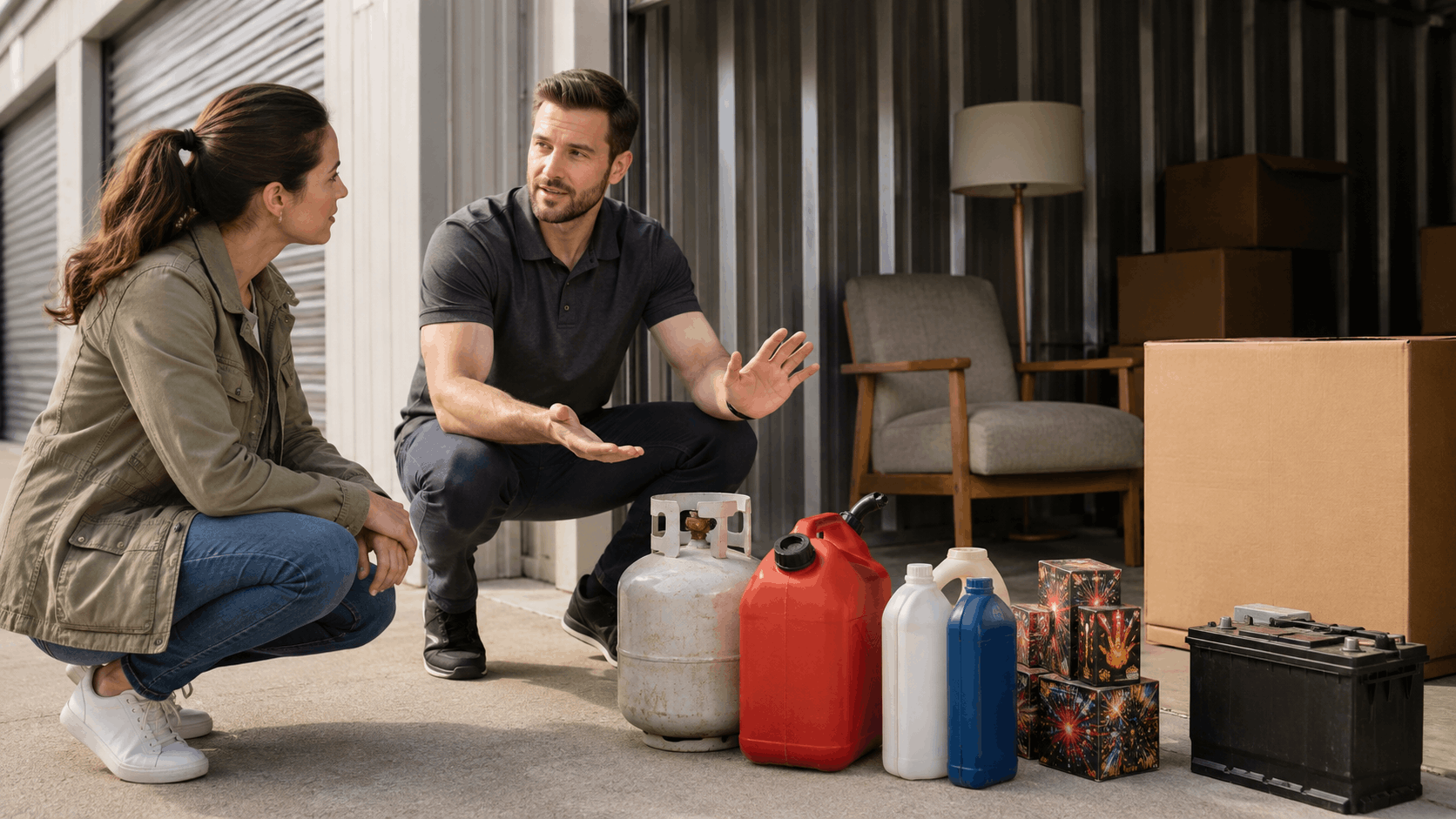
Car batteries, industrial acids, and corrosive liquids leak and damage everything around them. A cracked battery casing spills sulfuric acid that eats through concrete and metal. Facilities ban these because one leak can ruin multiple units.
Corrosives like drain cleaner and muriatic acid pose the same threat. They react with heat and moisture, and their fumes are toxic. In a sealed unit that bakes through a Valley summer, the risk multiplies.
Lithium batteries deserve a special note. Loose lithium cells and damaged battery packs can overheat and catch fire, which is a growing concern as more devices use them. Storing a pile of old power tool batteries in a hot unit is asking for trouble.
Retailers like auto parts stores accept old car batteries for recycling, and county sites take corrosives and acids. We help clients route these items to the proper drop-off so nothing dangerous ends up in storage.
Need Help in Los Angeles?
Popeye Moving & Storage serves Los Angeles and all of Los Angeles County.
Illegal, Stolen, and Restricted Property
A storage unit is not a legal blind spot. Storage law treats a unit like any other property under a tenant's control, which means illegal items bring police and legal trouble straight to the door. Restricted property has no safe harbor in a locker.
| Category | Examples | Consequence |
|---|---|---|
| Controlled substances | Illegal drugs, unlicensed pharmaceuticals | Criminal charges |
| Unregistered weapons | Unregistered firearms, illegal modifications | Felony exposure |
| Stolen property | Goods without legal ownership | Seizure, arrest |
| Counterfeit goods | Fake branded items, untaxed products | Fines, prosecution |
Facilities cooperate fully with law enforcement, so a unit offers no protection for illegal items. The legal risk falls entirely on the tenant.
Illegal Drugs and Unregistered Firearms
Controlled substances are banned by both state law and every facility contract. Storing illegal drugs in a unit is a criminal offense, and the lease agreement gives the operator grounds to terminate and report. There is no privacy exception that shields the contents.
Unregistered firearms carry the same exposure. California has detailed registration and transfer rules, and storing a weapon that violates them creates serious legal risk. Facilities do not want that liability anywhere in their building.
When law enforcement obtains a warrant, facilities cooperate. Staff will grant access and provide records, so a unit is never a place to hide something illegal. The tenant is fully responsible for what goes inside.
The safest approach for any legally owned firearm is a licensed storage service or a compliant home safe, with all registration current. Ammunition should be handled separately under the fire rules covered earlier.
Stolen Goods and Unregistered Vehicles
Tenants can only store property they legally own. Storing stolen goods leads to seizure and arrest once the items are traced, and facilities are required to report suspected stolen property. Ownership matters, and it gets checked.
Vehicles have their own paperwork rules. A car or motorcycle stored in a unit generally needs current registration and a clear title in the tenant's name. Facilities ask for this to avoid becoming a dumping ground for abandoned or disputed vehicles.
Unregistered or untitled vehicles cause problems. If the registration lapses or the ownership is unclear, the facility can refuse the vehicle or require proof before allowing it back in. Keeping documents current avoids the whole issue.
For clients storing a car during a long trip or a move, we confirm the paperwork is in order first. It keeps the vehicle in a proper, vehicle-approved space without a compliance headache down the road.
Counterfeit and Unlicensed Goods
Counterfeit merchandise is banned, and it comes up more than people expect. Fake branded handbags, shoes, and electronics tied to reseller operations are illegal to possess for sale, and a storage unit does not launder that fact. Facilities will not knowingly house them.
Untaxed and unlicensed goods fall in the same category. Bulk products moved without proper tax handling or licensing create legal exposure for the tenant. Using a unit as a warehouse for this kind of inventory invites an investigation.
The legal risk lands squarely on the person renting the space. Seizure, fines, and prosecution are all on the table, and the lease agreement offers no cover. Facilities protect themselves by banning these goods outright.
Legitimate businesses storing real inventory are welcome, and our commercial business storage handles that properly with the right documentation. The line is simple: legal, owned, and documented goods only.
Items That Are Allowed But Come With Conditions
Not everything is a flat ban. Some items are allowed under conditional storage rules that call for special handling. These are the gray-area valuables and sensitive goods that need extra thought before they go into a unit.
Cash, Jewelry, and Irreplaceable Documents
Cash, fine jewelry, and irreplaceable documents are technically allowed, but a storage unit is the wrong home for them. A bank safe deposit box or a home safe offers far better security. These items concentrate a lot of value in a small space, which makes them a theft target.
Insurance limits are the real catch. Most storage insurance policies cap coverage on cash, jewelry, and high-value paper at low amounts, so if something disappears, the payout will not come close to the loss. The math rarely works in the tenant's favor.
Documents like birth certificates, deeds, and passports are hard or impossible to replace. Leaving them in a unit exposes them to theft, water, and heat. A fireproof safe at home or a bank box is the smarter place.
When clients ask, we tell them plainly: store the furniture and the boxes, keep the valuables close. It saves grief if anything ever goes wrong.
Vehicles, Boats, and Trailers
Cars, boats, and trailers can be stored, but only under specific conditions. Fuel tanks usually need to be drained or nearly empty to meet fire rules, and registration must be current. The vehicle also has to sit in a space rated for it, not a general locker.
Demand for vehicle storage runs high across the LA area, especially for residents in dense neighborhoods with no driveway. Classic cars, RVs, and boats need a secure home when there is no room at the house. A proper vehicle space handles that.
Leaks are the main concern. A vehicle dripping oil or fuel creates a fire and contamination hazard, so facilities inspect for this before accepting one. Drip pans and a clean engine bay make the process smooth.
Our team helps clients prep a vehicle correctly, from draining fuel to confirming paperwork, so it goes straight into an approved space without delay.
Temperature-Sensitive Electronics and Wine
Electronics and wine survive in storage only with climate control. A standard unit in the San Fernando Valley swings from stifling heat to nighttime cool, and that cycle destroys sensitive gear. Climate-controlled space holds a steady temperature and humidity instead.
Electronics suffer from heat in ways that are not always obvious. Circuit boards, screens, and batteries degrade, and condensation from temperature swings can short components. Valley facilities see this damage often when clients use a standard unit for computers and TVs.
Wine is even more delicate. Heat spoils it, cooking the flavor and pushing corks out as the liquid expands. A collection worth thousands can turn to vinegar in one hot summer inside a standard locker.
For these goods, we steer clients toward climate-controlled options and explain the difference clearly. Our long-term storage keeps sensitive items in stable conditions rather than gambling on the weather.
Need Help in Los Angeles?
Popeye Moving & Storage serves Los Angeles and all of Los Angeles County.
How Popeye Moving & Storage Helps LA Residents Store the Right Way
Sorting the banned from the allowed is a lot to handle during a move. Our team at Popeye Moving & Storage guides clients through prohibited-item questions before packing day, so nothing gets loaded that cannot be stored. We work across Los Angeles and know the local rules cold.
- We flag prohibited items during a home walkthrough before packing starts.
- We serve neighborhoods across the city with crews who know the streets.
- We point clients to proper disposal and safe alternatives for gray-area goods.
The goal is a clean, legal move with no surprises at the storage door. Here is how that works in practice.
Pre-Move Item Reviews and Checklists
Before packing day, our team walks through a home and flags anything that cannot go into storage. That spare gas can, the half-used paint, the bag of fertilizer in the garage all get pulled aside early. Catching them ahead of time saves time and avoids surprise fees.
We build a moving checklist for each client that separates storable goods, conditional items, and banned material. It turns a confusing pile into three clear stacks. Clients know exactly what is coming with them and what needs another plan.
This review also speeds up packing day itself. When the crew arrives, there is no debate over questionable items because the sorting is already done. Our full-service packing team can then move carefully and safely.
The result is fewer delays, no rejected items at the facility, and a client who understands the rules. That clarity is worth a lot when a move is already stressful.
Serving Neighborhoods Across Los Angeles
Our crews cover the whole spread of the city, from Echo Park and Silver Lake to West Hollywood and Culver City. We run the 101 and the 405 daily, so we plan around traffic windows and know which routes actually work at which hours.
Local familiarity matters more than people think. Tight streets in the hills, permit-only parking zones, and narrow driveways in older neighborhoods all shape how a move goes. We handle moves in Culver City and know the parking realities block by block.
We also serve the coast and the Valley, adjusting our storage advice to the local climate. A move in Santa Monica gets different guidance than one in Van Nuys because the heat is different.
That neighborhood-level knowledge means fewer parking tickets, smoother load times, and storage plans that fit the actual conditions of each area.
Disposal and Alternative Storage Guidance
When we flag a banned item, we do not just leave the client stuck. We point them to the right disposal site for hazardous material and safe options for conditional goods. LA County runs hazardous waste drop-off centers across the region for paint, chemicals, and batteries.
You can find the nearest site and rules through LA County Sanitation Districts, which lists free drop-off events and permanent collection centers. We match clients to the closest option so old paint and dead batteries get handled correctly.
For conditional items, we recommend the right kind of storage. Climate control for electronics and wine, vehicle-approved space for cars, and a home safe for valuables. Each item lands where it actually belongs.
This guidance closes the loop. Nothing dangerous rides in the truck, nothing banned reaches the unit, and every item ends up in a place that is legal and safe.
Final Thoughts
California's storage rules exist for a reason. Fire code, insurance terms, and the harsh heat of the LA Basin all shape a prohibited list that protects every tenant in a building. Fuels, chemicals, perishables, hazardous waste, and illegal goods stay out, while valuables, vehicles, and sensitive electronics need special handling.
The good news is that planning around these rules is simple once you know them. Sort your items early, dispose of the banned ones properly, and use the right kind of storage for the gray-area goods. That is all it takes to avoid a rejected load or a voided policy.
If you are clearing a garage in Silver Lake or downsizing a home anywhere across the city, our team is ready to help you do it right. Contact Popeye Moving & Storage for a consultation, and let us walk through your items before packing day so your move goes smoothly from start to finish.

Frequently Asked Questions
- Can someone store an empty propane tank in a California unit?
- No. Even an empty propane tank holds residual gas and pressure inside, which makes it a fire and explosion hazard. Fire code and nearly every facility policy in California ban propane tanks regardless of how empty they seem. The tank cannot be vented safely enough to qualify. Store it in a ventilated outdoor space at home or exchange it for a full one when you settle into your new place.
- Is it legal to store a car in a storage unit in Los Angeles?
- Yes, under specific conditions. The vehicle needs current registration and a clear title in your name, and it must have no fuel leaks. Most facilities require a nearly empty or drained tank to meet fire rules, and the car has to sit in a vehicle-approved space rather than a general locker. Our team helps prep the vehicle and confirm the paperwork so it goes straight into an approved spot.
- Why can't food go into a storage unit?
- Food attracts rodents and insects, and a storage building shares walls and vents between units. One forgotten box of pantry items can trigger an infestation that spreads to neighboring tenants within weeks. Canned goods swell and leak in the heat, while dry items and pet food draw mice almost immediately. Facilities ban all food to protect the whole building from pests and odors.
- Are firearms allowed in California storage units?
- It depends on the item and the facility. Registered, legally owned firearms may be allowed under some policies, but unregistered weapons are banned and illegal. Ammunition is usually prohibited outright because of the fire and detonation risk in a confined space. California has strict registration rules, so check the specific facility contract first. A licensed firearms storage service or a compliant home safe is often the safer choice.
- What happens if someone stores a banned item?
- Consequences range from contract termination to fines and legal action. A facility can immediately end your lease and remove the item once it is discovered. Hazardous items can bring fines from LA County, and illegal goods bring police involvement, since facilities cooperate fully with law enforcement. A single banned item can also void the building's insurance, leaving neighboring tenants exposed. It is never worth the risk.
- Can plants or soil be kept in storage?
- No. Live plants cannot survive in a dark, sealed unit, and once they die they grow mold. Soil and mulch carry insects, fungus, and moisture that spread to other belongings and neighboring units. This comes up often when clients downsize gardens in areas like Pasadena and Eagle Rock. The better options are to gift plants, donate them, or move them directly to the new home.
- Where can LA residents dispose of banned hazardous items?
- LA County operates hazardous waste drop-off centers and free collection events across the region. These sites accept paint, solvents, pool chemicals, batteries, and similar materials at no charge. Check the LA County Sanitation Districts website for the nearest permanent center and upcoming event dates. Our team matches clients to the closest site during a move so old paint and dead batteries get handled the right way.
- Is climate-controlled storage required for electronics?
- It is strongly recommended for heat-sensitive electronics in the LA area, especially in the San Fernando Valley. Standard units swing from extreme heat to nighttime cool, and that cycle degrades circuit boards, screens, and batteries while condensation can short components. Climate-controlled space holds steady temperature and humidity. For computers, TVs, and audio gear stored more than a few weeks, climate control protects your investment.
- Can old paint from a home renovation be stored?
- Oil-based paints, thinners, and solvents are banned because they release fumes and ignite easily, and renovation leftovers get flagged constantly in older homes. Dried latex paint is sometimes allowed, but the safer move is to finish or dispose of the can. LA County runs free hazardous waste drop-off sites for exactly this material. We point clients to the nearest one so old paint does not block a move.
- Does Popeye Moving & Storage help identify prohibited items?
- Yes. Our team walks through your home before packing day and flags anything that cannot go into storage, from spare fuel to old paint to garden chemicals. We build a checklist that separates storable, conditional, and banned items so there are no surprises at the facility. We also guide clients toward proper disposal and safe alternatives. Contact us to schedule a pre-move review.
Popeye Moving & Storage Co. Team Team
Licensed moving and storage professionals serving Los Angeles and Los Angeles County.
Licensed in California · License #CAL T 189749 | USDOT 1472924 | MC 498816C
Why trust Popeye Moving & Storage?
Founded in 1994, Popeye Moving & Storage is a licensed and insured moving and storage service serving Los Angeles and Los Angeles County. All content is reviewed by our licensed technicians.

Need Help in Los Angeles?
Popeye Moving & Storage serves Los Angeles and all of Los Angeles County.
Related Articles
Staging Storage for LA Home Sellers: Clearing Rooms and Getting Everything Back After Close
How LA home sellers use staging storage to clear rooms before an open house, keep belongings safe during the sale, and get everything back after close.

Storage During a Divorce or Household Split: Neutral-Ground Storage While Decisions Get Made
Neutral-ground storage gives Los Angeles couples a fair, safe place to keep shared belongings during a divorce or household split. Learn setups, access rules, costs, and legal tips.
Storage for Santa Monica and Brentwood Households: Where Westside Furniture Actually Goes Between Homes
A local guide to furniture storage for Santa Monica and Brentwood households, covering storage types, costs, coastal climate risks, and how Westside families bridge the gap between homes.