Carrying Furniture Through Spanish Colonial Revival Entries in Madison Heights

Planning a Move? Contact Us Now
Free estimates. Licensed and insured movers.
Get Your Free Quote
Tell us about your move. We'll be in touch soon.

Key Takeaways
- Arched entries in Madison Heights period homes lose clearance at the top corners, so large pieces must be measured against the real opening, not the frame width.
- An on-site survey of the full house, including attic, basement, garage and outbuildings, is the only reliable way to price these moves and plan the route.
- Original hardwood, tile, plaster, banisters, ironwork and leaded glass are protected as part of the job, set up before the carry begins.
- Pasadena requires no permit for vehicles 25 feet or less, a permit for 26 feet and over, applications 10 days prior, and No Parking signs posted 24 hours ahead and registered on (626) 744-6440.
- The California default coverage is up to $20,000 actual cash value; the 60-cent per pound figure is only the rate basis, so full value protection with declared items is right for antiques.
- Typical area ranges include local moving $150 to $200 per hour, piano moving $200 to $600, chandelier moving $150 to $450 and vaulted storage $60 to $90 per vault per month.
- Hours come from volume and handling across multiple floors, and California bills local moves on a double drive time convention charging travel at twice the actual driving time.
- Full-service vaulted storage at the Mar Vista warehouse suits remodels, with no minimum or maximum term and specialty pieces like pianos and fine art accepted.
In This Article
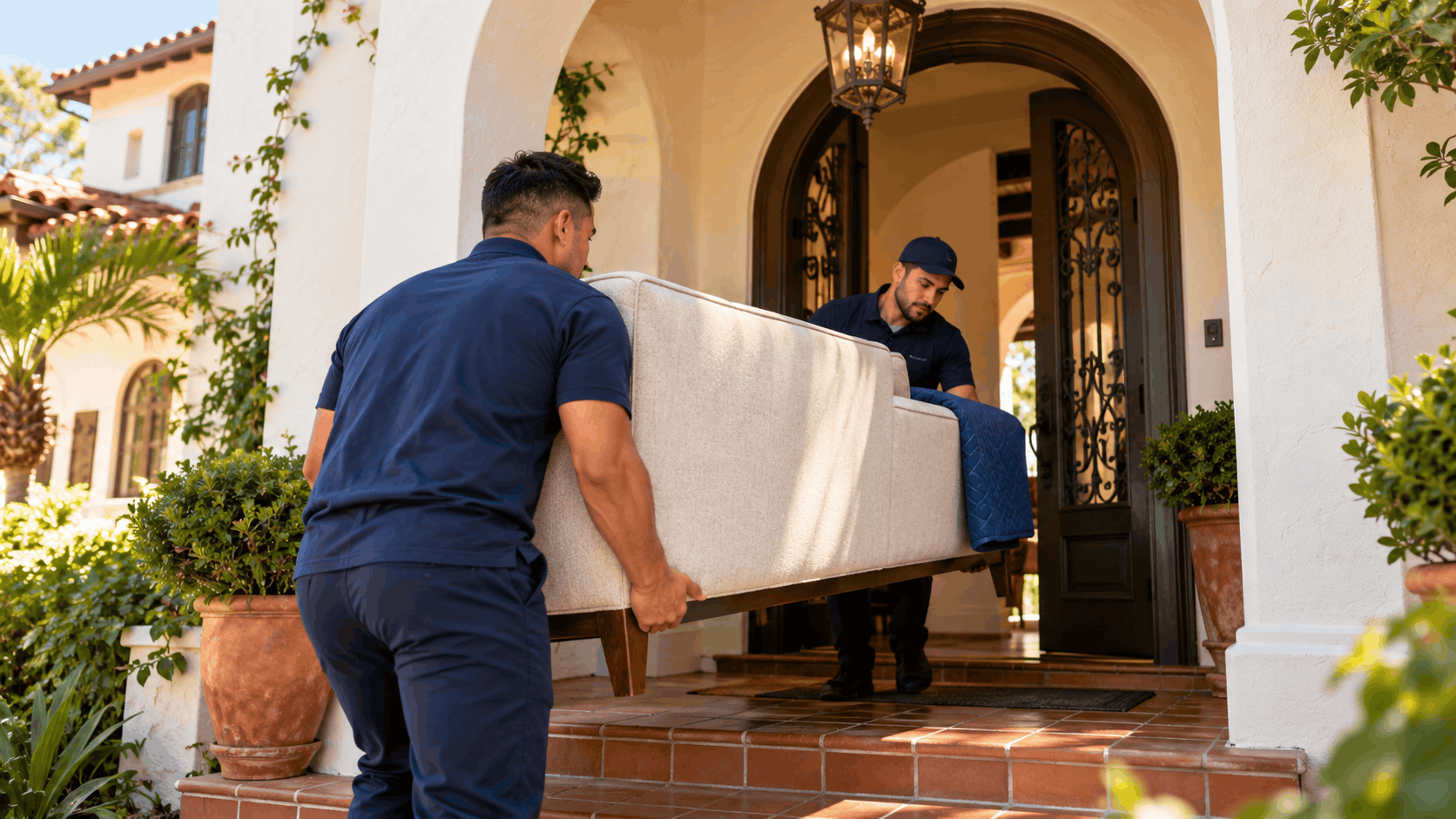
A nine-foot sofa stops dead at the arched front door of a 1920s home off El Molino Avenue. The arms clear, but the top corners catch the curve of the opening, and three people are now standing on the walk trying to turn the thing sideways without cracking the plaster. Anyone who has moved into a Madison Heights period house knows this moment. These are beautiful homes, built to last, with doorways sized for the furniture of their day rather than the oversized pieces people own now.
Carrying large furniture through these original entries is a planning problem long before it is a muscle problem. The arch at the top of the opening steals clearance exactly where a tall piece needs it. Add tight stair turns against original plaster, narrow service stairs that cannot take anything big, and original hardwood and tile floors that have to survive the day, and you have a job that rewards measuring twice.
Let's talk about what actually makes these entries hard, how a crew maps the route before lifting anything, how finishes get protected, how specialty pieces like pianos and chandeliers move through a narrow opening, the Pasadena permit rules that decide where the truck parks, and why valuation matters so much on a house full of antiques. It closes with how our team at Popeye Moving & Storage runs these moves from the first survey to the written price.
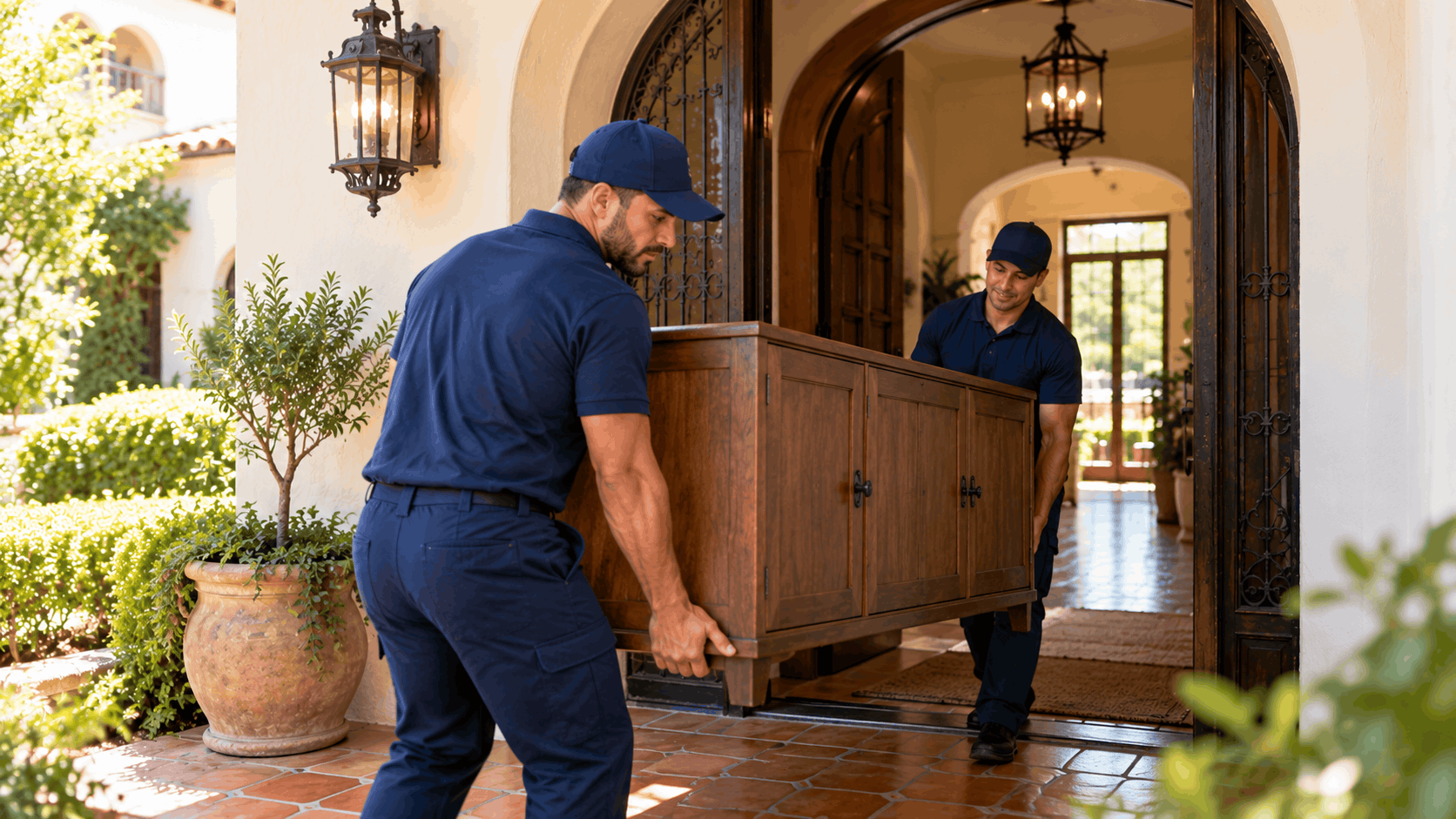
Why Spanish Colonial Revival Entries Are Tight for Furniture?
Madison Heights sits in south-central Pasadena, roughly south of California Boulevard between Los Robles and El Molino, in ZIP 91106. The district holds large early twentieth century houses in Craftsman, Colonial Revival, Mediterranean, Tudor and period revival styles on generous lots with mature street trees. Among them, Spanish Colonial Revival homes carry some of the tightest entries for furniture because of how their builders shaped the front door.
The features that make these houses so handsome are the same ones that complicate a move. Thick walls, arched openings, heavy wood doors, decorative ironwork and original tile all look wonderful and all reduce the room a crew has to work with. None of these period entries were designed around a modern sectional or a king mattress.
When our crews survey a home in Madison Heights, the entry is the first thing measured, because it sets the limit for everything that follows. A piece that cannot pass the front door cannot reach the living room, no matter how much space is inside. Understanding each feature and the handling problem it creates is how a crew plans a move that does not damage the house or the furniture.
Narrow Original Door Apertures and Arched Openings
The original door apertures in these homes are often narrower than what new construction uses today. A standard arched front door may give a clear opening that is comfortable for people but tight for a wide upholstered piece. The exact width matters, and it has to be measured against the largest item rather than guessed from the doorway's appearance.
The arch is the real trap. On a square opening, the full width is available right up to the top of the frame. On an arched entry, the opening narrows as it curves, so the usable clearance at the top corners is less than the width at the middle. A tall headboard, a china cabinet or a high-back sofa needs that top-corner space, and the arch takes it away exactly where the piece is widest and tallest at once.
This is why a sofa that looks like it should fit gets stuck. The arms clear the lower width, then the back corners hit the curve. A crew that has measured the arch knows in advance whether the piece goes through standing, tilted, or not at all in one piece. Measuring the arched entry before the truck is loaded saves the piece and the plaster around the opening.
Decorative wood doors and heavy hardware add another layer. The door itself, when open, can cut into the clear width, and ironwork or a fixed screen reduces it further. A good survey records the clear opening with the door fully open, not the frame width, because that is the number that decides the carry.
Tight Stair Turns Against Plaster Walls
Once a large piece is inside, the stairs decide whether it reaches an upper floor. Period revival homes in Madison Heights were built with staircases that turn, and those turns are frequently tight against original plaster walls. A straight flight is easy. A turn with a wall on both sides is where large furniture gets pinned.
Plaster is the complication. It is not drywall, and a gouge in original plaster is a repair, not a patch. The crew has to protect the wall at the turn and work the piece around the corner without letting a leg or a corner drag the surface. Paneled halls near the stair add fixed obstacles that cannot be moved out of the way.
The pinch point is usually the landing. A dresser or a sofa has to pivot in a confined space, often with a banister on one side and plaster on the other. If the piece is longer than the landing is deep, it cannot make the turn without being tilted up on end, and some pieces cannot tilt without opening or breaking. This is the calculation a crew runs before anything goes up.
When a piece cannot make the stair turn, the options are disassembly, a different route, or deciding the item stays on the ground floor. None of those are decisions to make on the stairs with the piece already halfway up. They belong in the survey, measured against the actual turn.
Why the Build Era Created These Constraints
These large period revival houses south of California Boulevard went up in the early twentieth century, and their openings were sized for the furniture of that era. Furniture then was often built to come apart, or was simply narrower and lower than the deep sectionals, oversized armoires and tall mattresses people own now. The builders had no reason to leave clearance for pieces that did not yet exist.
The craftsmanship that makes these homes landmark-worthy also locks in the dimensions. Original door frames, plaster walls and built-in staircases are part of what the Madison Heights landmark district protects, so widening an opening is not an option a homeowner takes lightly. The house is meant to stay as built, which means the move adapts to the house.
This history is why route planning is the fix rather than force. A crew cannot change the entry, so it changes the approach: measuring, choosing which items come apart, and selecting the path that uses the available clearance. The constraint is permanent, so the planning carries the whole job.
It also explains why two homes a block apart can move completely differently. Build era set the pattern, but each house has its own entry width, stair geometry and interior layout. The only way to know what a specific home allows is to measure it, which is the reason an on-site survey matters so much in this district.
Service Stairs That Cannot Take Large Pieces
Many of these houses have a narrow rear service stair, originally built for staff moving between floors without using the main staircase. These stairs are often steep and tight, and in many homes they simply cannot take large pieces. A crew that assumes the service stair is a backup route can lose hours discovering it is not.
The service stair is usually narrower than the main stair and frequently has a sharper turn or a lower ceiling. It was built for a person carrying linens, not two movers carrying a dresser. When it cannot take the load, the main stair or an alternate route has to carry everything, which changes how the day is sequenced.
Knowing which stair works is part of the survey. If the main stair is the only option for large items, the crew plans the carry around it, including which pieces go up first and whether anything needs to come apart to make the turn. A route that depends on a stair nobody checked is a route that fails on move day.
Sometimes the answer is that a very large piece does not go upstairs at all. A crew that has measured both stairs and the entry can tell a homeowner this before the move, so there is a plan for where the piece lives instead. That honesty up front beats a stuck wardrobe on the landing.
Get Your Free Quote
Tell us about your move. We'll be in touch soon.
Planning the Route Before Anything Gets Lifted
Route planning is the part of the job that happens before the first piece leaves the truck. A crew maps the path from the vehicle to each room, identifying every entry, hall and turn that a large item has to pass. In a Madison Heights period home, this is the difference between a smooth move and a wedged piece blocking a doorway.
Good furniture moving in these homes is mostly thinking done in advance. The crew works out which items clear which routes, which have to come apart, and what order everything moves in so the path stays open. A truck full of furniture carried in without a plan creates a traffic jam inside the house.
The homes here are full-house moves across multiple floors, with basements where they exist, attics, service stairs, detached garages and outbuildings. That is a lot of space to account for, and the route has to connect all of it to the truck. Planning the route well is how a long job stays organized from the first piece to the last.
Measuring the Entry, the Hall and the Turns
Measuring starts at the entry and follows the path inward. The crew records the clear door opening, the width of the hall, and the dimensions of every stair turn and landing. Each number gets checked against the largest pieces, because the tightest point on the route sets the limit for what can pass.
Clearance is measured in three dimensions, not one. A piece has a width, a depth and a height, and a tight turn may allow it one way and block it another. A sofa might clear a doorway standing upright but need to be tilted to make a stair turn, and the crew works out that sequence from the measurements rather than discovering it mid-carry.
Arched entries get special attention because the usable clearance at the top corners is less than the width at the center. The crew measures the curve, not just the frame, so a tall piece is assessed against the real opening. This is the measurement that most often decides whether an item goes through whole.
Deciding which items clear which route is the output of all this measuring. Some pieces take the main stair, some stay on the ground floor, and some come apart. By the time the truck is unloaded, the crew already knows where each large item is going and how it gets there.
Deciding What Comes Apart and What Goes Through Whole
Furniture assembly and disassembly for standard items is how a wide piece fits a narrow arched opening. Bed frames, table legs, modular sectionals and some cabinets come apart, which shrinks the footprint that has to pass through the entry. A piece that will not fit in one block often fits easily in two.
Not everything comes apart, and not everything should. Antique pieces with original joinery, solid-built cabinets and older furniture can be damaged by taking them apart, so sometimes the right call is to carry a piece through whole on a different route. The crew weighs the risk of disassembly against the risk of forcing the piece through a tight opening.
When a piece has to go through whole, the route planning carries more weight. The crew finds the path with the most clearance, which might mean a different door, a window opening, or a particular stair. Protecting the piece and the house along that path becomes the focus, since there is no option to shrink the item.
Standard furniture assembly and disassembly runs in a typical area range, and it is part of the handling on these moves rather than an afterthought. Planning which items come apart happens during the survey, so the crew arrives with the right tools and the right plan for each piece.
Why an On-Site Survey Beats a Phone Quote Here
A phone quote cannot see an arched entry, a stair turn or an attic. These full-house period homes with attics, basements, garages and outbuildings hold more than a quick conversation can capture, and the estimate fails when those spaces are not seen. An on-site survey is the right approach for Madison Heights.
The hours on these moves come from volume and handling rather than street access, and volume is exactly what a phone call misses. An attic full of stored items, a basement workshop and a detached garage each add to the job, and none of them show up unless someone looks. A survey that walks every space produces a number a homeowner can trust.
The survey is also where the route gets planned and the specialty pieces get identified. The surveyor measures the entry and the stairs, notes the piano or the chandelier, and decides what needs crating or separate valuation. That groundwork turns into a written estimate that reflects the actual job rather than a guess.
A verbal rate quotation, whether per hour or per hundred pounds, is not an estimate and is not binding. The in-person survey leads to a proper written agreement, which is the document that protects the homeowner. Confirm the details of any estimate against what you were sent, because that list is checkable.
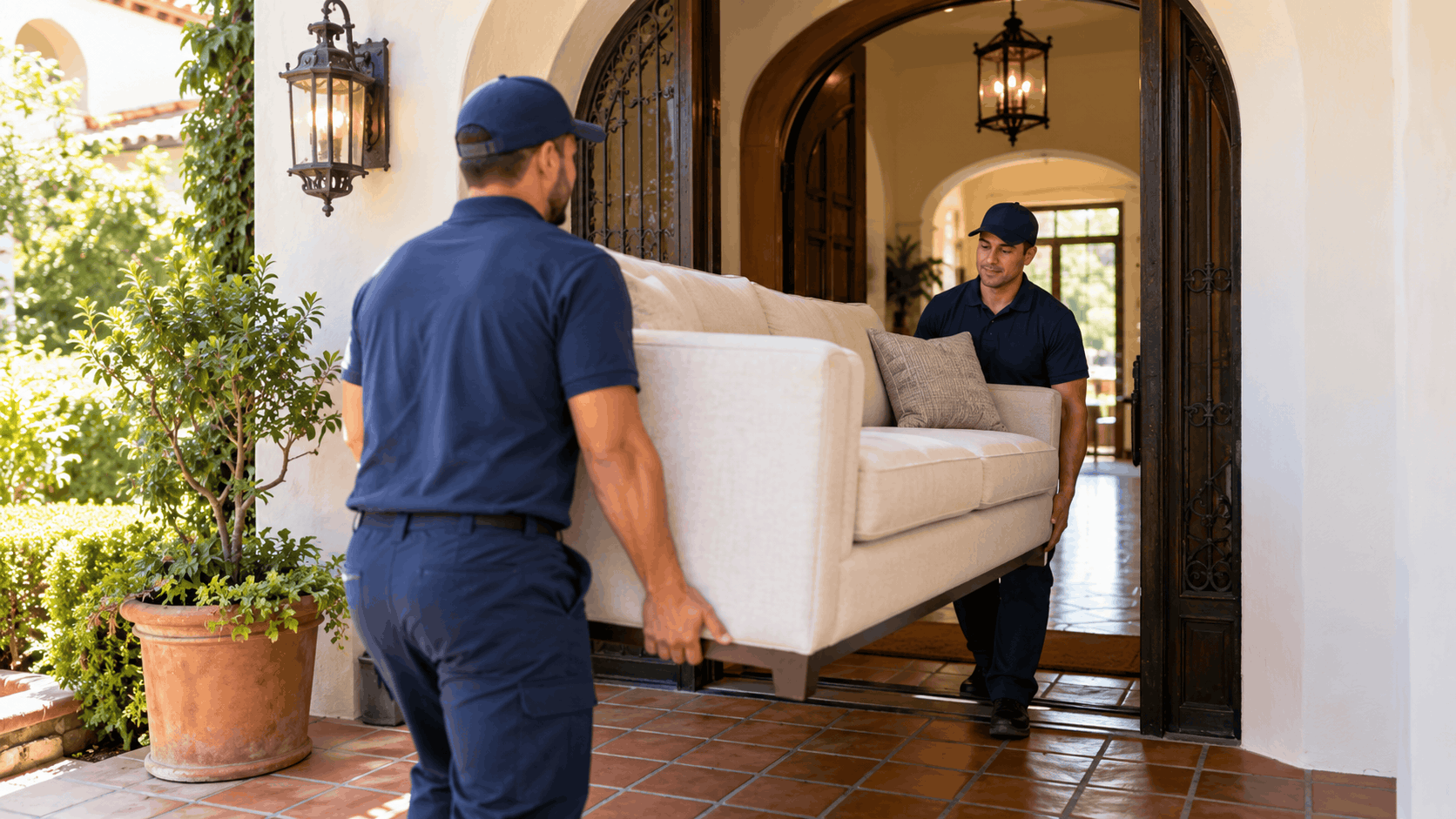
Need Help in Los Angeles?
Popeye Moving & Storage serves Los Angeles and all of Los Angeles County.
Protecting Original Finishes at the Entry and Beyond
Madison Heights homes are known for finishes that cannot be replaced like-for-like. Original hardwood, tile, plaster, paneling, ironwork and art glass are part of what makes the district a landmark area. Protecting them while carrying furniture in and out is part of the job, not an upsell.
Owners here are invested in preserving their homes, and they notice whether a crew treats the finishes with care. Floor, doorway and banister protection is set up before the carry begins, so the house is covered at the points where furniture passes. That preparation is faster than any repair.
The protection plan follows the route the crew already mapped. Wherever a large piece passes, the surface gets padded or covered first. This section covers how the floors, the tight points and the glass get protected across a typical Madison Heights move.
Guarding Original Hardwood and Tile Floors
Original hardwood and tile floors run through the entry and halls of these homes, and they take the most traffic on move day. Hardwood scratches and dents under a dragged leg or a dropped corner, and original tile can crack under a point load. Protecting these floors across the carry path is treated as part of the job.
The crew lays down floor protection along the full route before carrying anything heavy. Runners and protective coverings over the hardwood and tile keep grit, wheels and furniture feet off the finish. The protection goes where the traffic goes, from the front door through the halls to each room.
Original tile in these period homes is often decorative and irreplaceable, so it gets particular care at the entry where it usually sits. A cracked entry tile is not something a homeowner can run to a store to match. Keeping weight distributed and the carry path padded is how the crew avoids that outcome.
Furniture feet, caster wheels and metal fittings are the usual culprits for floor damage. The crew keeps those off the bare floor and uses protection under heavy pieces as they are set down and repositioned. Across a long full-house move, that discipline is what keeps the floors looking the same at the end of the day as at the start.
Doorways, Banisters and Decorative Ironwork
The tight points a large piece passes through are the points most likely to take damage, so door jambs, banisters and decorative ironwork get padded and wrapped before the carry. A dresser squeezing through an arched opening will touch the jamb, and padding means that contact leaves no mark.
Banisters along the main stair are exactly where a piece being worked around a turn can press. Original banisters are part of the home's character, and they are not built to take the weight of a sofa leaning against them. Padding the banister protects both the rail and the piece as it makes the turn.
Decorative ironwork at the entry or on the stair is beautiful and unforgiving. It does not flex, and a piece pressed against it can bend the iron or scratch the furniture. The crew pads these fixed points so the carry can use the full opening without risking the ironwork.
Door jambs on arched openings deserve extra attention because the arch already reduces clearance. With less room to spare, a piece is more likely to brush the frame, so wrapping the jamb keeps that contact from marking the wood. Protecting the tight points is how a crew moves large furniture through a narrow entry without a trace.
Leaded and Art Glass Near the Entry
Leaded and art glass is common in these entries, set into front doors, sidelights and windows near the door. It is original, handmade and effectively irreplaceable, and it sits right where furniture is being carried in and out. Keeping the carry path clear of it is a planning decision made before anything moves.
The crew routes the carry so large pieces never swing toward the glass. That sometimes means approaching the entry from a particular angle or carrying a piece in a specific orientation. The glass is treated as a fixed hazard that the route works around rather than near.
Where glass sits close to the only workable path, it gets protected or the crew adds a spotter to guide the piece clear. A single careless swing can shatter a leaded panel that took an artisan days to make a century ago. The caution is proportionate to how irreplaceable the glass is.
Leaded and art glass is one more reason the survey matters. Spotting it in advance lets the crew plan the carry so the glass is never in the path of a heavy piece. By move day, everyone on the team knows where the glass is and keeps the work away from it.
Handling the Specialty Pieces These Homes Hold
Period homes in Madison Heights tend to hold pieces that need more than a standard carry. Pianos, antiques, oversized art and mirrors, chandeliers, stone-topped furniture, libraries and collections fill these large houses. Each needs specific handling, and through a tight arched entry the handling gets more demanding.
Specialty handling is expected in this district, and owners notice when it is missing. Custom crating for art and mirrors, piano equipment, wardrobe and library packing, and full property protection are priced in and described as part of the job. These are not add-ons invented on move day.
The specialty moving work on these homes is where experience shows. Getting a grand piano or a tall china cabinet through a narrow opening without damage takes the right equipment and the right plan. This section covers the pieces these homes hold and what each needs.
Pianos, Chandeliers and Stone-Topped Furniture
Pianos are among the hardest pieces to move through a tight entry. Piano moving uses specific equipment, piano boards, straps and padding, to control the weight and protect the instrument. Grands often have to come apart, with the legs and lyre removed, so the body can be maneuvered through a narrow arched door on its side.
Chandeliers are the opposite problem: light but extremely fragile and awkward. Chandelier moving means careful disconnection, packing of the arms and crystals, and crating so the fixture survives the move. A chandelier carried loose through an entry is a chandelier that arrives broken, so it gets handled as a crated piece.
Stone-topped furniture carries a hidden risk. The stone top is heavy and can crack under its own weight if lifted wrong, so the top is usually removed and carried separately from the base. Through a narrow opening, splitting the piece also shrinks the footprint, which helps it clear the arch.
Each of these pieces needs specific equipment because each fails in a specific way. The piano needs weight control, the chandelier needs fragility protection, and the stone top needs separate handling. A crew that arrives with the right gear for each item moves them through the entry safely rather than improvising.
Oversized Art, Mirrors and Antiques
Oversized art and mirrors frequently will not fit an arched door without protection, and some need custom crating to pass at all. Custom crating builds a rigid box around a piece so it can be handled, turned and carried through a tight opening without flexing or cracking. A large framed canvas or a heavy mirror is far safer in a crate than wrapped in a blanket.
Fine art and antique handling is its own discipline. Fine art and antique moving accounts for fragile frames, old finishes and joinery that modern furniture does not have. These pieces are often the most valuable items in the house, which is why crating and careful handling matter so much.
Crating also solves the clearance problem. A crated piece has known, rigid dimensions, so the crew can plan its route through the entry and stairs with certainty. An uncrated canvas can flex and catch, while a crate moves as a predictable block that either fits the measured opening or does not.
Custom crating runs in a typical per-crate range, and fine art and antique moving falls in its own range, both listed later in the cost section. For irreplaceable pieces passing through a narrow period entry, crating is the protection that lets the piece move at all. It is the correct handling for the kind of items these homes hold.
Libraries and Collections
Large period homes often hold libraries and collections, and these need organized packing to move cleanly through an entry. Library packing boxes books in manageable weights and keeps them in order, so a crew is carrying stacked, labeled cartons rather than loose armloads through the door.
Collections, whether ceramics, records, glassware or anything else a homeowner has gathered over decades, get packed to protect each item and to keep the set together. The packing is planned so the carry through the entry stays organized and nothing fragile is left loose. A well-packed collection moves as a tidy set of boxes.
Keeping the carry organized matters more than it sounds. On a full-house move with hundreds of boxes, an orderly pack means the entry is never clogged and boxes go to the right rooms. Full-service packing handles this so the homeowner does not face a wall of unlabeled cartons.
Libraries are also heavy, and weight distribution matters through a period entry and up original stairs. Packing books in smaller boxes keeps each carton liftable and keeps the load off the floors and stairs in concentrated form. Organized packing is what keeps a library move from becoming a slow, cluttered struggle at the door.
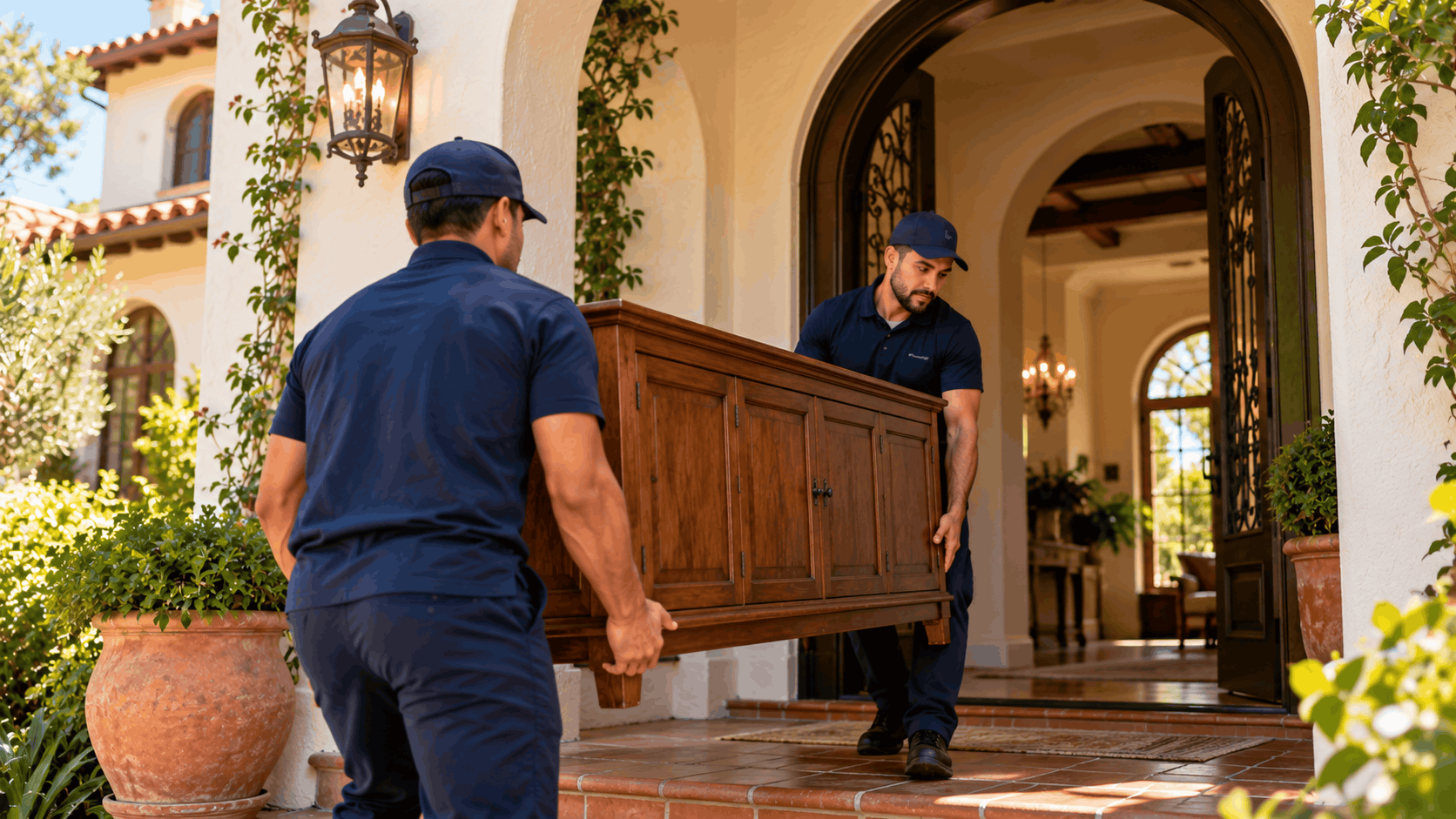
Parking the Truck and Pasadena Moving Permits
Where the truck parks changes how far furniture gets carried to the entry, so the Pasadena permit rules and the street situation in Madison Heights matter to the whole job. Madison Heights is in the City of Pasadena, which runs its own Department of Transportation parking division with its own rules.
Pasadena's rules are specific, and getting them right avoids a citation or an unenforceable sign on move day. The rules cover vehicle length, application timing, sign posting and the city's own schedule. Knowing them in advance is part of planning a Madison Heights move.
Confirm current fees with the Parking Office, since amounts change. The rules below are the Pasadena framework as it stands, and they shape where the truck sits relative to the front door.
Pasadena Permit Rules and the 25-Foot Threshold
Moving vehicles 25 feet long or less do not require a permit in Pasadena. A vehicle 26 feet in length or over does require one, and the City recommends confirming vehicle size approval before renting or scheduling. A smaller truck both clears the streets more easily and removes the permit requirement, which is worth weighing when planning the move.
Applications must be submitted 10 days prior to the move date, or an expedited fee is added. A traffic review is required for all moving vehicle requests, so the application is not a rubber stamp. Submitting on time avoids the extra fee and gives the City room to complete its review.
The City is closed every other Friday, and off-Friday applications are processed the following working Monday. That schedule affects timing, so an application sent near a closed Friday may not move until Monday. Planning around the City's calendar keeps the permit on track with the move date.
Confirm current permit amounts with the Parking Office, since fees change over time. The thresholds and timing above are the rules; the dollar figures are set by the City and should be checked when applying. Getting the vehicle size confirmed before scheduling is the step the City itself recommends.
No Parking Signs and Advance Posting
Temporary No Parking signs are bought from the Parking Office at 100 N. Garfield Avenue, Room N106. These signs reserve the curb space in front of the home so the truck can park close to the entry. Without them, the crew may find the best spots taken on move day.
The signs must be posted at least 24 hours in advance and registered by phone with Parking Enforcement on (626) 744-6440, or they are not enforceable. Posting without registering leaves the signs powerless, so both steps have to happen. The 24-hour window gives other drivers notice to clear the space.
Signs are charged per sign, plus street usage fees per hour per space in non-metered areas. The cost scales with how many spaces and how many hours the move needs. Confirm the current amounts with the Parking Office when buying the signs, since the fees are set by the City.
Reserving the curb close to the entry shortens the carry, which matters on a full-house move with heavy pieces. Every extra foot between the truck and the arched front door is distance carried for every item. The signs are a small step that keeps the carry tight and the day efficient.
Trees, Street Width and Why Popeye Qualifies Faster
On these residential streets, curb space is generally available, so parking itself is rarely the constraint. The limiting factors are the mature tree canopy overhanging the roadway and the turning room for a larger vehicle. Those are checked before dispatch so the truck that arrives can actually reach the home.
The mature street trees that make Madison Heights so attractive hang low over the carriageway in places. A tall truck can catch low branches, which is a reason a vehicle of 25 feet or less is often the better fit here. It clears more easily and removes the permit requirement at the same time.
Popeye has insurance on file with the City of Pasadena, which changes the permit timeline. Moving companies with insurance already on file should allow a minimum of two working days for permit issuance, while all others should allow a minimum of two weeks. That on-file status means the permit side moves quickly rather than holding up the date.
Checking the route for low branches and turning room before the truck leaves the yard is standard before a Madison Heights job. The crew matches the vehicle to the street, so the truck fits the canopy and the turns. Pairing that with the faster permit path keeps the parking side of the move from becoming the bottleneck.
Need Help in Los Angeles?
Popeye Moving & Storage serves Los Angeles and all of Los Angeles County.
Valuation and Protecting High-Value Pieces
Valuation decides what a homeowner actually recovers if something is damaged, and on a house full of antiques and art it is the part of the quote worth the most attention. The default coverage pays almost nothing on period pieces, so understanding the options is how an owner protects what matters.
Valuation is set by Maximum Rate Tariff 4, the rulebook for moves inside California, administered by the Bureau of Household Goods and Services. The homeowner has a right to be offered better coverage and a right to decline it knowingly. For the kind of pieces these homes hold, the right choice is rarely the default.
This section explains the $20,000 default, the 60-cent basis that is often misunderstood, full value protection, and which items an owner should carry personally. Getting valuation right is the core of a responsible quote for a Madison Heights home.
The $20,000 Default and What the 60-Cent Basis Really Is
Under Maximum Rate Tariff 4 Item 136(2), unless the shipper expressly declares a value other than $20,000 for the shipment, the mover's maximum liability for lost and damaged articles is up to $20,000 of actual cash value. That is the California intrastate default, and it is what applies to a customer who declares nothing.
The 60 cents per pound per article figure at Item 136(1) is a separate thing entirely. It is the rate basis, the declared value the transportation rates are computed on, not the payout. The two are true at once, and the 60-cent figure must never be mistaken for what a damaged item pays out.
The 60-cent rate basis is weight-based, which is why it pays almost nothing on antiques, art or period pieces. A valuable antique chair might weigh very little, so a weight-based figure would return a tiny sum for a piece worth thousands. For a Madison Heights home, that math makes the rate basis irrelevant to real protection.
Maximum Rate Tariff 4 requires each valuation option to be listed, with the charge and a space for the shipper to initial. The homeowner chooses the level of protection knowingly. Understanding that the $20,000 actual cash value default is the floor, and the 60-cent basis is not a payout, is the starting point for that choice.
Full Value Protection for Antiques and Art
Full value protection is the paid alternative to the default, and for this housing it is the correct handling. With full value protection, items of extraordinary value are declared separately on the inventory, each with a value, so the coverage reflects what the pieces are actually worth. Antiques and art need that level of coverage.
Valuation is not insurance, and the distinction matters. Released value is a liability limit, and full value protection is the mover's higher level of liability, not a policy from an insurer. The language is worth being clear about, because the two are often confused and they work differently.
Declaring items of extraordinary value separately is the mechanism that makes full value protection work for a home full of valuable pieces. Antiques, art, and gold or silver articles should each be described on the inventory with a value declared. A blanket figure does not capture the real worth of individual period pieces.
For a Madison Heights home where the furniture may be as valuable as anything in it, full value protection with declared items is the responsible choice. It aligns the coverage with the value passing through a tight entry and up original stairs. The fine art and antique moving side of the job and the valuation side go together.
Items Best Carried by the Owner
Some items are best not shipped at all. Money, jewelry and important papers are best carried by the customer rather than placed on the truck. These are small, high-value and hard to replace, so keeping them personally avoids the question of valuation entirely.
Items of extraordinary value such as antiques, art, and gold or silver articles should be separately described on the inventory with a value declared for each. The inventory is the record that supports coverage, so listing valuable pieces individually is how an owner makes sure they are accounted for. A thorough inventory protects both sides.
The inventory also pairs with the move-out-and-back pattern common during renovations. A proper list of what left the house is what gets each piece back to the right room when it returns. For a home with collections and valuables, the inventory is the backbone of the whole move.
Carrying the irreplaceable personal items yourself and declaring the valuable furniture on the inventory covers both ends. The small valuables stay with the owner, and the large valuables are documented and protected. That split is the practical way to handle a Madison Heights home full of things that matter.
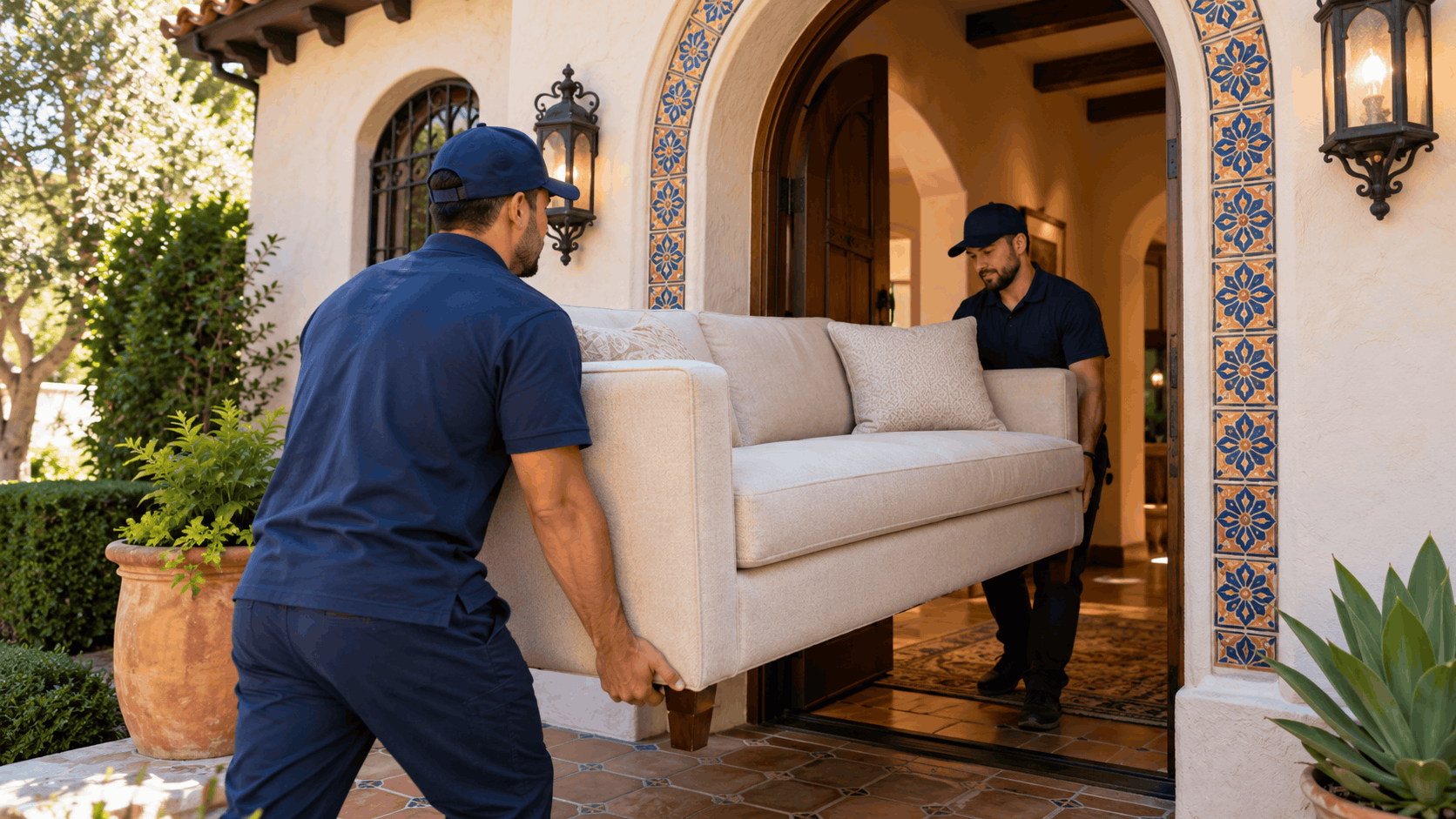
What a Move Through These Entries Typically Costs?
Cost on a Madison Heights period home comes from volume and handling, not from street access. These are full-house moves with specialty pieces, so the hours reflect the work inside rather than the distance to the curb. Below are the typical area ranges and what drives the time.
These are typical market ranges for moving in the Los Angeles area, not a quote or a fixed price from us. The actual price for a specific move depends on that move and is set in writing before anything is loaded, with the Not To Exceed figure on a move inside California. Use the ranges to know what to expect, then get a written estimate for the real number.
| Service | Typical Area Range |
|---|---|
| Local residential moving (two-person crew and truck) | $150 to $200 per hour |
| White glove moving | $150 to $250 per hour |
| Furniture assembly and disassembly (standard items) | $75 to $200 |
| Custom crating | $150 to $800+ per crate |
| Fine art and antique moving | $300 to $1,200+ |
| Piano moving | $200 to $600 |
| Chandelier moving | $150 to $450 |
Typical Local Moving Rates in the Area
Local residential moving in the area typically runs $150 to $200 per hour for a two-person crew and truck. That is the baseline rate for a standard local move, and it scales with crew size and the time the job takes. For a full-house period home, the hours add up because of the volume inside.
White glove moving typically runs $150 to $250 per hour. This is the higher-touch service that fits a home full of antiques, art and original finishes, with the extra care that handling and protection require. The rate reflects the attention these pieces and these homes need.
Furniture assembly and disassembly for standard items typically runs $75 to $200. On a Madison Heights move, this is often part of getting wide pieces through narrow arched openings, so it is a line that shows up regularly rather than an occasional add-on. Taking a bed frame or table apart to clear the entry falls in this range.
These are typical area ranges, not quotes. The number for a specific home depends on the volume, the handling and the specialty pieces, which is why the written estimate follows the survey. The ranges give a homeowner a sense of the market before that estimate is prepared.
Specialty and Crating Costs
Custom crating typically runs $150 to $800 or more per crate, depending on the size and complexity of the piece. A crate for a large mirror or an oversized canvas costs more than one for a smaller item. On a home with art and mirrors that will not fit an arched door otherwise, crating is often the line that makes the move possible.
Fine art and antique moving typically runs $300 to $1,200 or more. This covers the specialized handling these pieces need, from fragile frames to old finishes. For a Madison Heights home where these items are often the most valuable in the house, the cost reflects the care rather than the weight.
Piano moving typically runs $200 to $600, with upright pianos costing less than grand pianos. The difference comes from the handling: a grand often has to come apart and takes more crew and equipment to move safely through a narrow opening. The range covers both, depending on the instrument.
Chandelier moving typically runs $150 to $450. The cost reflects the disconnection, packing and crating a fragile fixture needs, not its weight. These specialty ranges are typical for the area and are quoted specifically once the survey identifies which pieces a home holds.
Why Volume and Handling, Plus Double Drive Time, Set the Hours
The hours on a Madison Heights move come from volume and handling across multiple floors, attics, basements and garages. A full-house period home holds far more than its rooms suggest once the stored spaces are counted. Carrying that volume carefully through tight entries and up original stairs is what fills the day.
Handling drives time as much as volume. Each specialty piece, each protected finish and each careful carry through an arched opening takes longer than hauling boxes out of a modern apartment. The care that protects the house and the pieces is time, and it is time well spent in a landmark home.
California bills local hourly moves on a double drive time convention, charging travel time between origin and destination at twice the actual driving time. It is a legitimate, regulated charge rather than a padding tactic. The 210, 134 and 110 serve Pasadena, and the city's major events can close streets, so the timing of the date is worth checking.
Because travel is charged at double the actual drive time, the timing of a move affects the bill. Traffic on the routes into Pasadena stretches the drive time, which the double drive time convention then doubles. Planning the date and departure around that is one more reason the survey and written estimate matter.
Pairing the Move With Storage During a Remodel
Renovation of period houses is constant in Madison Heights, so moving furniture out to storage and back during a remodel is a recurring pattern. Homeowners restoring an original house often need their belongings out of the way while work happens, then returned once the rooms are finished.
Our vaulted storage fits that pattern well. The furniture comes out of the home, goes into storage for the length of the remodel, and returns when the house is ready. One crew handles both ends, with an inventory connecting them.
Storage during a remodel pairs naturally with the move itself, since the same team that knows the house and its pieces handles the storage. This section covers how the storage works, what it accepts, and why the inventory matters for the return trip.
Full-Service Vaulted Storage at the Mar Vista Warehouse
Our storage is full-service vaulted storage at the warehouse at 5509 1/2 S Centinela Ave, Los Angeles, in Mar Vista on the Westside. The customer has no key, no individual unit and no right of entry, and goods are handled by Popeye crews. This is warehouse storage, not a self-storage unit the owner visits.
Because it is full-service vaulted storage, the belongings are loaded into vaults by the crew and handled as units. That model keeps the goods organized and handled fewer times than a self-storage cycle would require. The owner does not manage the storage day to day; the warehouse does.
There is no minimum and no maximum storage term, which suits a remodel that may run shorter or longer than planned. The storage flexes with the renovation rather than locking the owner into a fixed period. Vaulted storage runs $60 to $90 per vault per month as a typical area range.
The Mar Vista warehouse shares its address with the business location, and the hours shown are business hours for calls and scheduling. Those are not customer access hours, since full-service vaulted storage does not involve the customer entering the facility. The crew handles the goods at both ends.
Storage That Takes the Specialty Pieces
The storage accepts wine, fine art, pianos and chandeliers, which matches exactly what these Madison Heights homes hold. A remodel does not mean leaving valuable or fragile pieces exposed; they go into storage with the rest of the household. The specialty items that need careful handling in the move get careful handling in storage too.
Accepting these pieces matters because a period home's most valuable items are often the hardest to store elsewhere. A piano or a collection of fine art cannot sit in a standard unit without risk. Full-service vaulted storage that takes these items keeps the whole household together through the renovation.
Goods are placed into vaults the same day, with no overnight hold on the truck. The items come out of the home and go into storage in one motion, rather than sitting loaded overnight. That same-day placement reduces handling and keeps the belongings secure from the moment they leave the house.
For a homeowner clearing a period house for restoration, storage that accepts the specialty pieces and places them the same day removes a real worry. The valuable and fragile items are handled by the same crew that moved them, stored properly, and ready to return when the remodel is done.
Keeping an Inventory for the Return Trip
A proper inventory pairs naturally with move-out-to-storage-and-back during a remodel. The list records what left the house, which is what gets each piece back to the right room when the renovation is finished. Without an inventory, the return trip becomes guesswork.
For a full-house period home, the inventory is the thread that ties the whole project together. Furniture, art, collections and specialty pieces all go on the list, so nothing is lost between the move out and the move back. The more a home holds, the more the inventory earns its keep.
Storage within a move can fall under storage-in-transit, where the tariff treats the storage as part of the regulated mover service for up to 90 days, after which the warehouse's own contract governs. The paperwork for the storage leg is part of the same record set as the move. Keeping those documents organized strengthens any claim.
When the remodel is done, the inventory guides the return so pieces land where they belong. The owner is not sorting through unlabeled vaults trying to remember what went where. A good inventory makes the return trip as organized as the move out was.
Need Help in Los Angeles?
Popeye Moving & Storage serves Los Angeles and all of Los Angeles County.
How Popeye Moving & Storage Handles a Madison Heights Entry Move
Our team runs these jobs the same careful way every time, from the first look at the house to the paperwork that backs a claim. A Madison Heights entry move is a planning job first, and the way we work reflects that. Here is how a job actually runs.
The process starts with an on-site survey and ends with a written price and the documents that protect the homeowner. Along the way, the route gets planned, the finishes get protected and the specialty pieces get the handling they need. The structure is what keeps a long, detailed move on track.
This section covers the survey and the written price, the licensing and paperwork that back the move, and the crew conduct owners in this landmark district expect. These are the parts that turn a hard move into a smooth one.
The On-Site Survey and Written Not-To-Exceed Price
Every Madison Heights move starts with an in-person survey of the full contents, including the attic, basement, garage and outbuildings. Those spaces hold volume a phone call cannot capture, and the estimate fails when they are not seen. Walking the whole house is how we build a number that matches the actual job.
The survey produces a written Agreement For Moving Services with a Not To Exceed figure agreed before anything is loaded. That figure is the maximum total the homeowner can be billed for the move and the services ordered, and the final bill cannot exceed it except through a Change Order the customer agrees to. On a move inside California, that written ceiling is the main protection.
The agreement describes the shipment in enough detail to show what is included in the Not To Exceed price, the transportation and accessorial services, the number of helpers and packers, and the rates and charges. That detail is checkable against the job. A homeowner can read exactly what they are paying for before the truck is loaded.
The Not To Exceed price is a right the customer has, not a courtesy. It is set before any goods move, so there are no surprises at delivery. For a full-house move with specialty handling, that written cap is what lets a homeowner plan with confidence.
Licensing, Insurance and Keeping Your Paperwork
Popeye operates under CAL T 189749 for intrastate work, and USDOT 1472924 and MC 498816C for interstate work, and is fully insured. A customer can and should ask for the permit number and verify it before booking. We are also BBB accredited with an A+ rating.
Keep your paperwork, because it is what backs any claim. The estimate, the Agreement For Moving Services and the bill of lading together make the record of what was moved and agreed. The single most common reason a consumer loses a dispute is that they cannot produce the paperwork.
Under Maximum Rate Tariff 4 Item 92(14), a written claim must be filed within nine months after delivery, and suit must be instituted within two years and one day from the date the mover gives written notice that it has disallowed the claim. Item 92(15) requires the mover to acknowledge a written claim within 30 days and to pay, decline, or make a firm offer within 60 days. Business and Professions Code section 19265 provides that a claim shall not be denied solely because the damage was not noted at delivery.
Complaints and verification for a California mover go to the Department of Consumer Affairs Bureau of Household Goods and Services, the BHGS, reachable on (916) 999-2041. The BHGS regulates household movers in California, and its consumer information is published at bhgs.dca.ca.gov. That is the authority to check a permit or raise a problem.
Crews That Protect the House and the Pieces
Owners in this landmark district expect kept appointments, a written price before work starts, protected finishes, tidy crews and discretion. Our crews work to that standard, because a period home and the people who own it deserve it. The way the house looks at the end of the day matters as much as moving the furniture.
Full property protection is set up before the carry and taken down after, covering the floors, doorways, banisters and the points a large piece passes. The protection is part of the job, not an extra a homeowner has to request. A Madison Heights home comes out of a move looking the way it went in.
Specialty handling is priced in rather than assumed. The crating for art and mirrors, the piano equipment, the chandelier packing and the library packing are planned into the estimate from the survey. Owners here notice when specialty handling is missing, so it is built into the plan rather than improvised.
Estate moves, common in a district of long-tenured owners, need patience and often a storage element while decisions are made. Our crews work with that reality, giving these moves the time and care they take. Discretion and a steady pace are part of how we handle a home that has held a family for decades.
Moving a Madison Heights Period Home the Right Way
A move through an arched period entry in Madison Heights is won in the survey, where the crew measures the opening, plans the route and prices the specialty handling before a single piece is lifted. That is how our team at Popeye Moving & Storage keeps the furniture whole, the floors unmarked and the bill capped by a written Not To Exceed figure.
Call us at (310) 823-9510 to schedule an on-site survey for your Madison Heights home, and we will walk the full house, measure the entries and stairs, and put a written price in your hands before anything moves.
Frequently Asked Questions
- Will a large sofa fit through a narrow arched entry in a Madison Heights home?
- It depends on the door aperture and the arch shape, measured against the piece. An arched entry narrows at the top corners, so a tall sofa may clear the lower width but catch the curve. Disassembly, tilting, or an alternate route often solves it. The only way to know for sure is to measure the opening against the sofa, which is exactly why an on-site survey matters before move day in these period homes.
- Do I need a moving permit in Madison Heights, Pasadena?
- Vehicles 25 feet or less need no permit, while vehicles 26 feet and over do. Applications should be submitted 10 days prior to the move to avoid an expedited fee, with a traffic review required. If you buy temporary No Parking signs, they must be posted at least 24 hours ahead and registered by phone with Pasadena Parking Enforcement on (626) 744-6440, or they are not enforceable. Confirm current fees with the City's Parking Office.
- Does the Madison Heights landmark designation restrict my move?
- No. The Madison Heights landmark district controls exterior alterations, not moving, so it does not restrict a move. What the designation signals is original, protected housing owned by people invested in preserving it. That is why careful route planning and full finish protection matter so much here, but the designation itself places no limit on moving your furniture in or out of the home.
- How are my antiques and art covered if something is damaged?
- Under Maximum Rate Tariff 4, the default is up to $20,000 of actual cash value unless you declare a different value. The 60 cents per pound per article figure is only the rate basis the charges are computed on, never the payout, and it pays almost nothing on antiques. Full value protection, with items of extraordinary value declared separately on the inventory each with a value, is the right choice for period pieces. Valuation is a liability limit, not insurance.
- How much does moving a piano or chandelier out of a period home cost?
- Piano moving typically runs $200 to $600, with upright pianos costing less than grand pianos because grands often have to come apart to clear a narrow opening. Chandelier moving typically runs $150 to $450, covering the disconnection, packing and crating a fragile fixture needs. These are typical area ranges, not a quote. The specific price is set in the written estimate after the survey identifies the pieces your home holds.
- Why do you charge for travel time twice?
- California bills local hourly moves on a double drive time convention, charging travel time between origin and destination at twice the actual driving time. It is a legitimate, regulated charge rather than a padding tactic. Because the 210, 134 and 110 serving Pasadena can carry heavy traffic, the timing of your move affects the drive time that then gets doubled. Planning the date around traffic and street closures helps keep that portion of the bill down.
- Can you store my furniture while my home is being renovated?
- Yes. We offer full-service vaulted storage at the Mar Vista warehouse at 5509 1/2 S Centinela Ave, Los Angeles, with no minimum and no maximum term, which suits a remodel of any length. The storage accepts specialty pieces like pianos, fine art, wine and chandeliers, matching what these homes hold. Goods are placed into vaults the same day with no overnight hold on the truck, and the customer has no key or individual unit.
- Can you give me a price over the phone?
- A verbal rate quotation is not an estimate and is not binding. For a full-house period home with attics, basements and garages, a phone call cannot capture the volume or the handling. We do an on-site survey of the full contents, which leads to a written Agreement For Moving Services with a Not To Exceed price agreed before anything is loaded. On a move inside California, that written figure caps your bill.
- How long do I have to file a claim after my move?
- Under Maximum Rate Tariff 4, a written claim for loss or damage must be filed within nine months after delivery as shown on the shipping document. The mover must acknowledge the claim within 30 days and pay, decline, or make a firm offer within 60 days. A claim cannot be denied solely because the damage was not noted at the time of delivery. Keep your estimate, agreement and bill of lading to support any claim.
- Who regulates movers in California if I have a problem?
- The Department of Consumer Affairs Bureau of Household Goods and Services, the BHGS, regulates California household movers, reachable on (916) 999-2041, with consumer information at bhgs.dca.ca.gov. It is not the CPUC, which no longer regulates movers. Authority transferred to the BHGS effective July 1, 2018. You can verify a mover's permit and file a complaint through the BHGS, so ask for the permit number and check it before booking.
Popeye Moving & Storage Co. Team Team
Licensed moving and storage professionals serving Los Angeles and Los Angeles County.
Licensed in California · License #CAL T 189749 | USDOT 1472924 | MC 498816C
Why trust Popeye Moving & Storage?
Founded in 1994, Popeye Moving & Storage is a licensed and insured moving and storage service serving Los Angeles and Los Angeles County. All content is reviewed by our licensed technicians.
Need Help in Los Angeles?
Popeye Moving & Storage serves Los Angeles and all of Los Angeles County.
Related Articles
Furniture Installation Day for Designers: White Glove Delivery, Placement, and Debris-Out in One Visit
How LA interior designers get a reveal-ready room in one visit with white glove delivery, assembly, precise placement, and full debris removal from Popeye Moving.
Office Furniture Storage Between Leases: Decommission Today, Refurnish the Next Space Later
Learn how LA businesses store office furniture between leases, decommission the old space, and refurnish later - with costs, timing, and practical tips from Popeye Moving.
Preparing Furniture for Months in Storage: Wrapping, Moisture, and Pest Prevention Done Professionally
A professional guide to preparing furniture for months in storage in Los Angeles, covering cleaning, breathable wrapping, moisture control, pest prevention, and smart unit loading.