White Glove Moving for Pacific Palisades Homes With Art and Antiques
Key Takeaways
- White glove moving means hand-wrapping, custom crating and controlled handling for fragile, high-value pieces, scoped at the estimate before the crew arrives.
- On canyon, bluff and Alphabet Streets where a full-size truck cannot reach or turn, a staged shuttle is the professional method, identified and priced at the estimate.
- The 60 cents per pound figure is a rate basis, not a payout; the default liability is up to $20,000 of actual cash value, and full value protection suits a high-value home.
- California claim windows: a written claim within nine months, acknowledgment within 30 days, a decision within 60 days, and a claim cannot be denied solely for not noting damage at delivery.
- Full-service vaulted storage in Mar Vista is climate controlled with no minimum or maximum term; storage-in-transit is capped at 90 days before goods move under the warehouse contract.
- Typical area ranges include white glove moving $150 to $250 per hour, fine art and antique moving $300 to $1,200+, custom crating $150 to $800+ per crate, and vaulted storage $60 to $90 per vault per month.
- The Not To Exceed figure agreed in writing caps your California move, and a local hourly move is billed on the double drive time convention.
- Movers in California are regulated by the Bureau of Household Goods and Services, not the CPUC; verify a mover's permit number before booking.
In This Article
Across Pacific Palisades, families on the Riviera and up in the Highlands are moving art and antiques out of homes, into storage, and in some cases back into a rebuild. After the January 2025 fire, the pattern on the ground is clear: oil paintings, inherited furniture, pianos and wine collections being packed, crated and held while owners figure out what comes next. The pieces are valuable, often irreplaceable, and the streets they sit on are some of the hardest to reach in the city.
We work these canyon and hillside addresses every week, from the Alphabet Streets near the Village to the switchbacks above Pacific Coast Highway. Moving a collection here is not the same job as clearing a flat grid in the valley. The access shapes the plan, the handling protects the pieces, and the paperwork protects their value if something goes wrong.
What White Glove Moving Means for a Palisades Home With Art and Antiques?
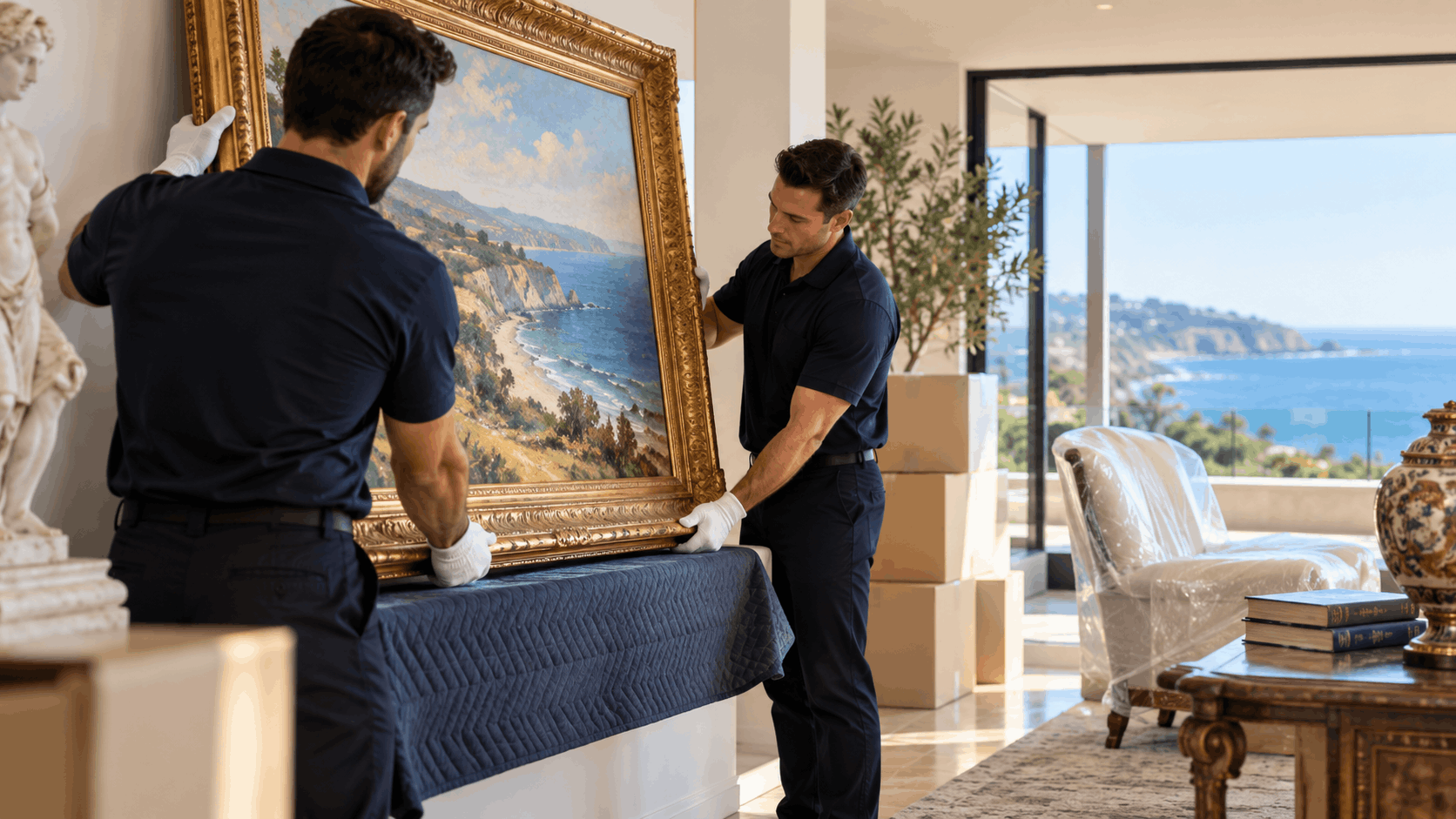
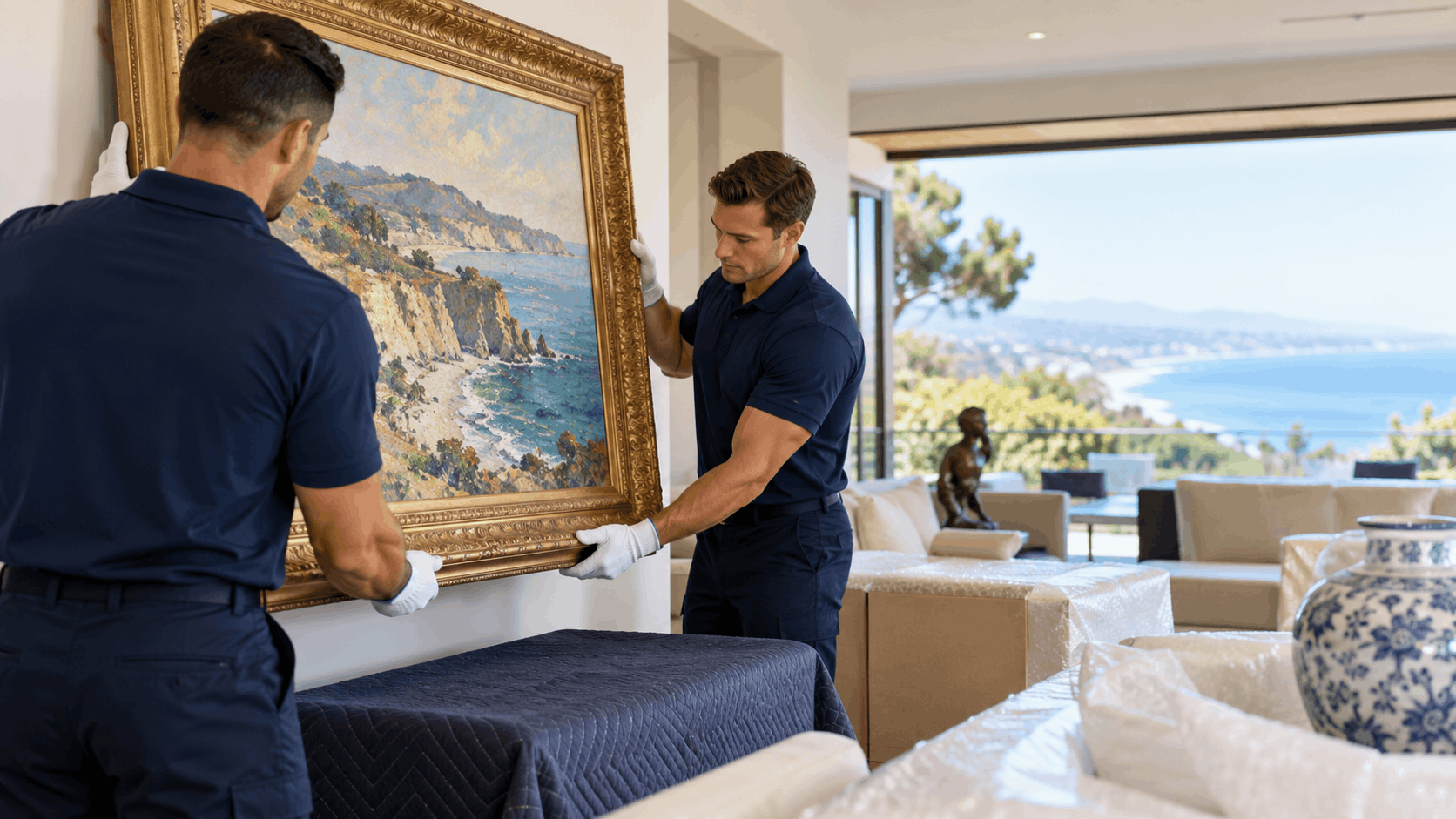
White glove moving is slow, controlled, hands-on handling of belongings that cannot be replaced or that would cost a fortune to repair. For a Palisades home holding fine art and antiques, it means each piece is wrapped, padded and often crated by hand, then loaded and secured so it never shifts in transit. It is the opposite of a fast, volume-driven household move.
The short answer to the question is this: it covers the extra protection, the extra labor and the extra time that oil paintings, veneered furniture, pianos, chandeliers and wine need to arrive intact. On a street like Monument or above Castellammare, it also means planning the approach before the truck ever leaves our yard.
Our specialty moving teams treat a collection as a set of individual problems, not a stack of boxes. Each material reacts differently to pressure, vibration and humidity, so the handling method changes from piece to piece.
How White Glove Service Differs From a Standard Move
A standard household move is built around speed and volume. Furniture gets blanket-wrapped, boxes get stacked, and the crew keeps the truck moving. That works fine for a couch and a dining set, but it is the wrong approach for a signed canvas or an inlaid writing desk.
White glove service slows the whole process down and adds layers of protection. Oil paintings and rigid paint layers on canvas are hand-wrapped and often built into custom crates rather than leaned against a dolly. Veneer and marquetry furniture, where thin decorative wood is glued over a base, gets padded protection of its finishes so nothing scuffs, lifts or cracks.
Panel pieces and anything with weak adhesion are handled with the understanding that a sudden jolt can separate a layer. The crew moves deliberately, lifts rather than drags, and secures each item so it cannot slide. Custom crating is the backbone of this work, because a rigid box takes the impact that a blanket never could.
The other difference is sequencing. On a white glove job, the high-value pieces are planned for first and loaded last, so they spend the least time on the truck and come off first at the other end. That order is set during the estimate, not improvised on the day.
The Kinds of Pieces Palisades Homes Tend to Hold
The housing stock here runs the full range. There are bluff and canyon estates on the Riviera, the Huntington, and in Rustic and Temescal canyons, hillside homes in Castellammare and the Highlands, and Village condominiums and apartments near Swarthmore and Via de la Paz. Each type tends to hold a different mix of belongings.
The estates often carry serious fine art, antiques passed down through generations, grand pianos and chandeliers. Wine collections are common in the canyon and bluff homes, sometimes running to hundreds of bottles. These are the pieces that make a move complex, because each one has its own weight, fragility and value.
Village condominiums and apartments produce tighter moves with the same care requirements on a smaller scale, often a few key pieces of art or an upright piano in a building with an elevator and a loading rule. The method scales, but the attention to each item does not change.
Knowing the mix matters because it tells us what to crate, what to carry separately, and how many crew members and crates to scope. A home with three oil paintings, a grand piano and a chandelier is a very different job from one with a single antique cabinet, even if both are white glove moves.
Where the Crew Draws the Line on Assessing Condition
Our crew wraps, crates, carries and protects. What the crew does not do is judge the condition of a property or a piece in any formal sense. We do not assess fire damage, smoke contamination or structural safety, and we will not tell you whether a wall, a floor or a foundation is sound.
Those judgments belong to the owner, an engineer or architect, and the Los Angeles Department of Building and Safety. In the burn area especially, that line matters. A home may look standing but carry hidden structural or air-quality issues that only a qualified professional and LADBS can evaluate.
What we can do is handle your belongings carefully once you and the right professionals have decided the property is safe to work in. If smoke or soot has affected pieces, we move them as they are; we do not clean, restore or certify them, and we do not estimate restoration outcomes.
This split keeps everyone in their lane. You get movers who protect your collection and professionals who assess the building, rather than a crew guessing at things outside their trade. For anything touching damage or safety, the recovery resources at the City of Los Angeles recovery portal and LADBS are the right starting points.
Get Your Free Quote
Tell us about your move. We'll be in touch soon.
Protecting Art and Antiques in Transit
Protection in transit comes down to mechanism, not promises. The goal is simple: stop the piece from moving, stop anything from touching its surface, and stop impact and vibration from reaching it. How that is achieved changes with the object.
A painting fails differently from a piano, which fails differently from a chandelier. So the packing method is chosen for the specific risk each item faces. That is the heart of fine art and antique moving.
Everything below is scoped at the estimate, so you know what is being crated, what is being wrapped, and what the labor looks like before the crew arrives.
Custom Crating for Paintings, Mirrors and Sculpture
Rigid paint layers on canvas do not flex. When a frame is knocked or the canvas is pressed, the paint can crack or flake, and that damage is often permanent. A blanket and a strap cannot stop a corner impact, which is why these pieces get a built crate.
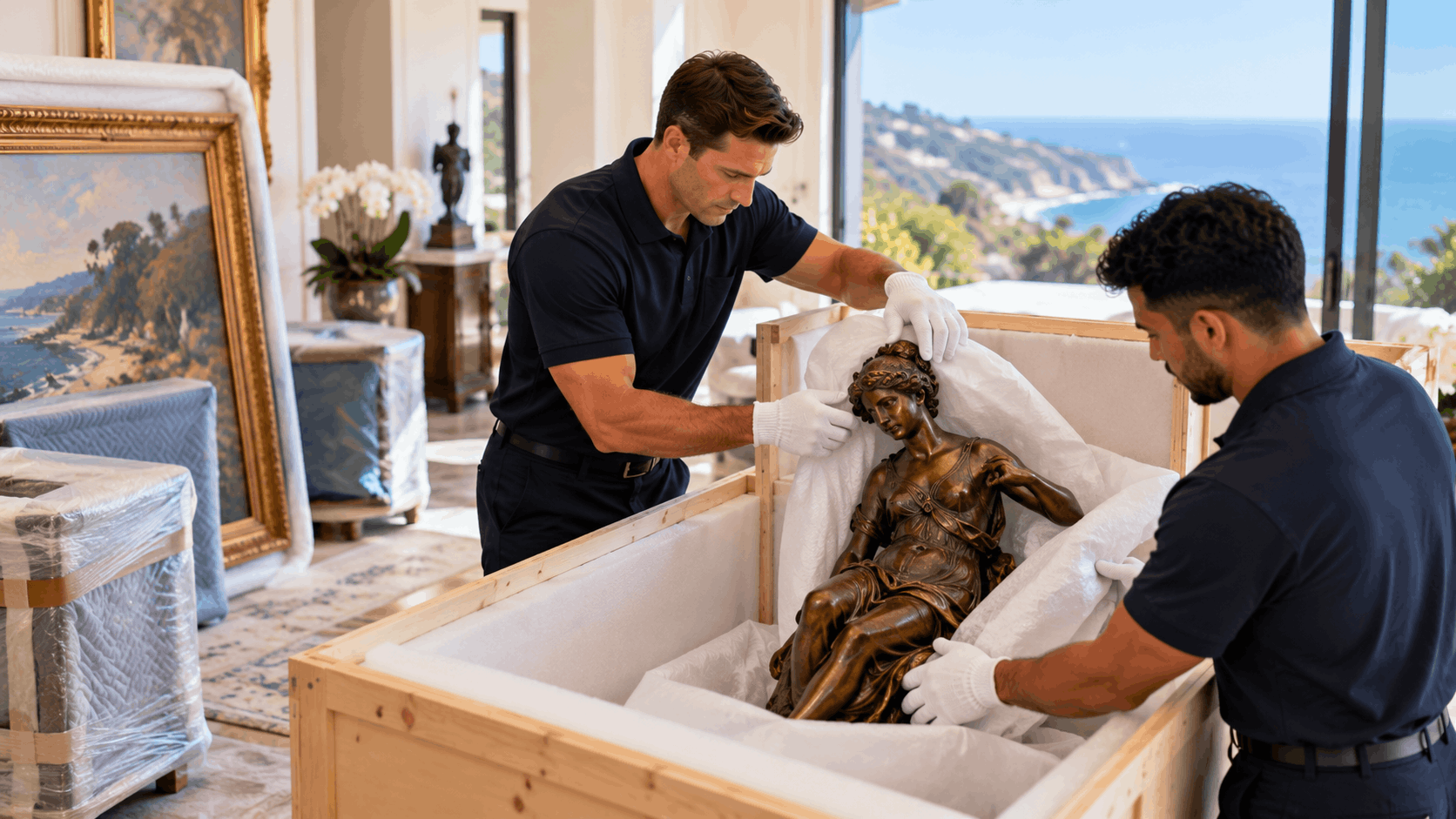
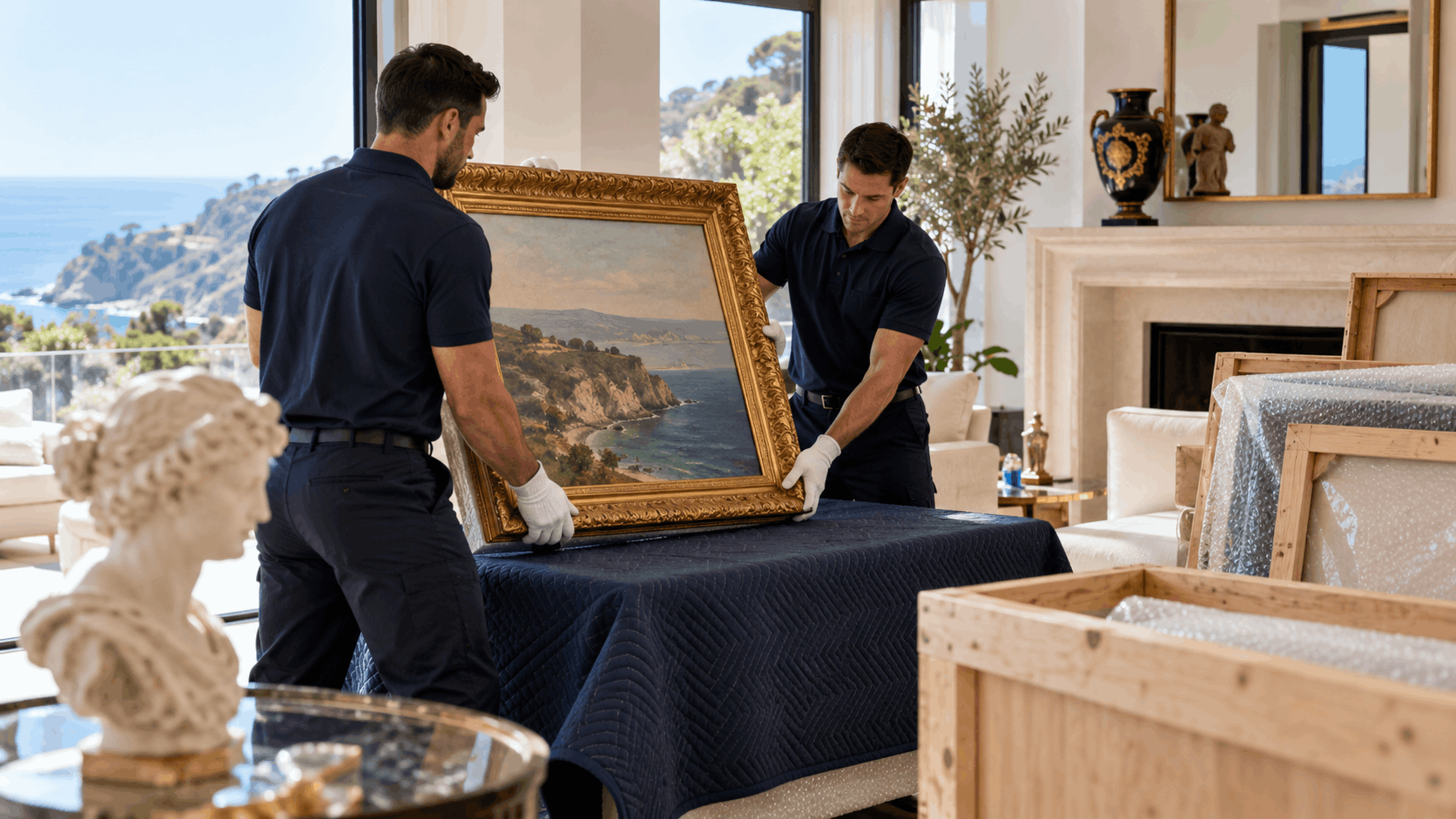
A custom crate is constructed to the dimensions of the piece, with internal padding that holds the item away from the crate walls. Mirrors and framed glass get the same treatment because a flexing sheet of glass shatters, and a rigid box is what prevents the flex. Sculpture, which often has fragile projections and an awkward center of gravity, is braced inside the crate so it cannot rock or tip.
On the estimate, each crate is scoped individually. A crate is priced by its size and complexity, so a large painting with glazing costs more to crate than a small framed work. The research puts typical custom crating in this area at $150 to $800+ per crate.
The reason we build rather than wrap these items is risk math. A crate costs money, but a damaged canvas or a shattered antique mirror costs far more and may be irreplaceable. For high-value pieces, the crate is the cheaper outcome. You can see how this fits into the broader packing and crating work we do.
Handling Pianos, Chandeliers and Wine Collections
Pianos are heavy, top-heavy and delicate inside. A grand piano is partly disassembled, the legs and lyre removed, and the body wrapped and moved on a piano board so the weight is controlled through doorways and down steps. An upright is more compact and simpler to maneuver, which is why upright pianos cost less to move than grand pianos. Our piano moving crews handle both.
Chandeliers are fragile in a different way. Arms, crystals and wiring are all vulnerable, so a chandelier is often partly taken down, padded, and crated so nothing swings or snaps. The arms and drops are protected individually, and the whole fixture is immobilized. This is specialized work, covered by our chandelier moving team.
Wine collections need steady, careful handling and purpose-built packing so bottles do not knock together or tip. Bottles are kept controlled through the move rather than loose-packed, and the collection is treated as fragile cargo. In canyon and bluff homes with large cellars, this can be a job of its own within the larger move.
All three categories are accepted specialist items, and all three are scoped at the estimate. Typical ranges in this area run $200 to $600 for piano moving and $150 to $450 for chandelier moving, with fine art and antique moving at $300 to $1,200+.
Listing Items of Extraordinary Value on the Inventory
Items of extraordinary value are handled differently on paper, not just in the truck. Antiques, art, and gold or silver articles should be separately described on the inventory, with a value declared for each item rather than lumped into a general total. This is how high-value pieces are properly accounted for.
The declared value on an individual piece matters because it sets what that item is worth for the purposes of the move. A one-line inventory entry that reads "boxes, misc" protects nothing. A line that names the painting, describes it and declares its value gives you a record that stands up later.
Some things are best never put on the truck at all. Money, jewelry and important papers are best carried by the owner rather than shipped. They are small, easy to keep with you, and far too valuable to hand off to any shipment.
We walk through the inventory with you during the in-home assessment so the extraordinary-value pieces are listed properly from the start. That record is part of what protects the collection if a claim ever becomes necessary.
Why Breathable Protection Matters for Delicate Finishes
Veneer, marquetry and leather react to humidity swings. These materials expand and contract with moisture in the air, and the glues and finishes on them respond too. The wrong wrapping can trap moisture against the surface and create exactly the conditions you are trying to avoid.
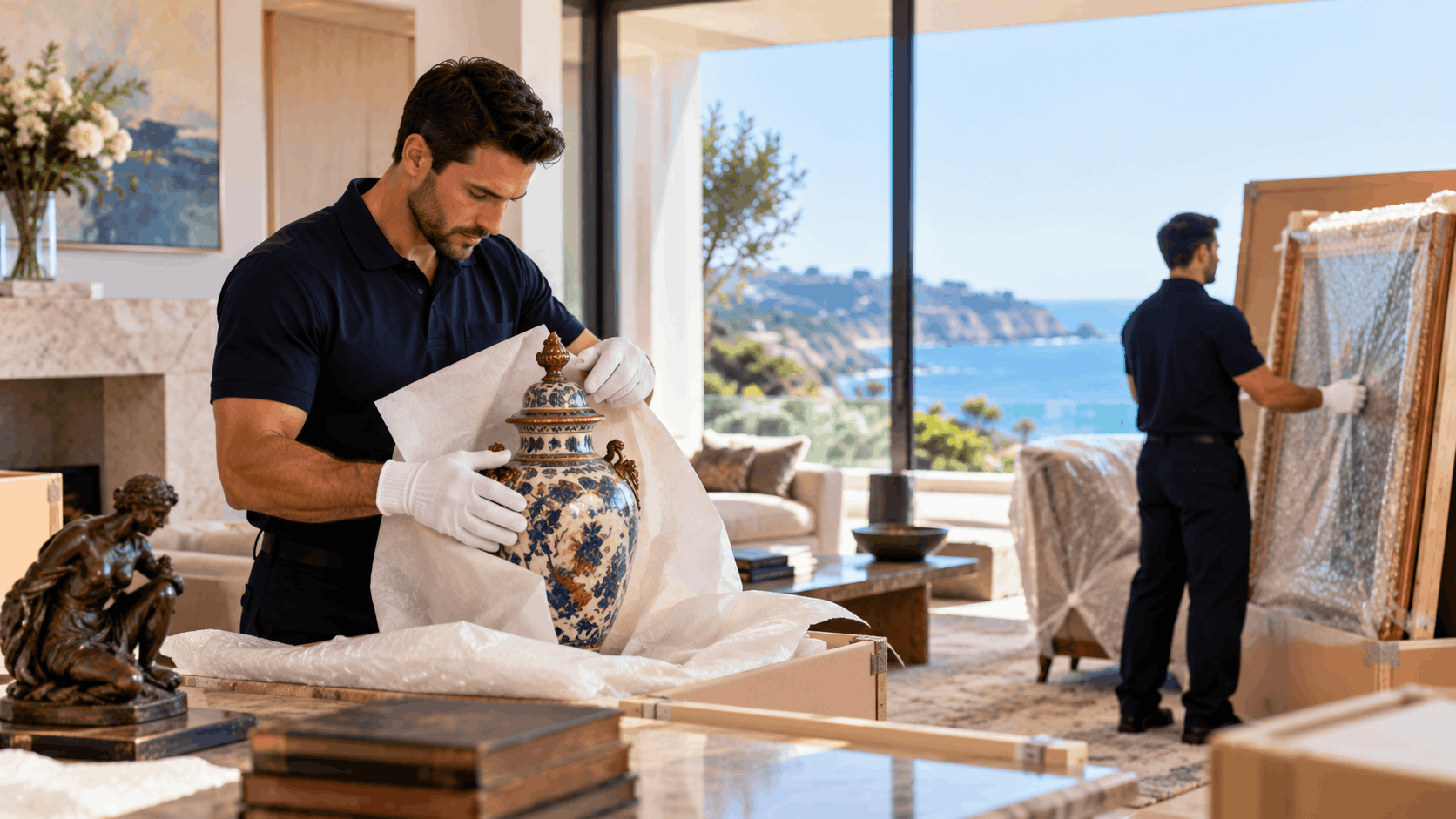
That is why breathable dust covers such as muslin or Tyvek are used rather than sealed plastic for delicate finishes. A breathable cover keeps dust and handling marks off the piece while letting the material breathe. Sealed polyethylene, by contrast, is a containment response to active mold, not a general storage or moving method for fine furniture.
Leather in particular is sensitive at both ends of the humidity range, stiffening and embrittling when the air is too dry and encouraging mold when it is too damp. Veneer and marquetry, with their thin glued layers, can lift or buckle when moisture gets trapped underneath. Breathable protection is the fix that respects the material.
On the truck and in storage, we match the covering to the surface. For fine furniture and leather, that means breathable layers and padded protection rather than a wrapped-in-plastic approach that looks tidy but works against the piece.
Need Help in Los Angeles?
Popeye Moving & Storage serves Los Angeles and all of Los Angeles County.
Valuation: How a Collection Is Actually Protected on a California Move?
Valuation is the most misunderstood protection in moving, and getting it wrong is expensive. People hear "60 cents a pound" and panic, or they assume the mover carries insurance that covers everything. Neither is quite right.
Here is the honest picture. Valuation is a liability limit, not insurance. On a California move, it is governed by Maximum Rate Tariff 4, administered by the Bureau of Household Goods and Services. Understanding it is how you make sure a collection is actually covered.
The sections below separate the rate basis from the payout, explain the default, and walk through choosing full value protection for a high-value home.
The 60 Cents Per Pound Figure Is a Rate Basis, Not a Payout
Maximum Rate Tariff 4 Item 136(1) states that transportation rates are based upon a declared value of 60 cents per pound per article. That is how the rate is computed. It is a math input, not a promise of what a lost piece pays out.
This is where most confusion starts. People read the 60 cents figure on a document and believe that is all they would ever recover. In reality, it is describing the valuation basis used to calculate the moving charge, nothing more.
Think of it as the gear the pricing runs on. A 10-pound item at 60 cents a pound would be a tiny number, which is obviously not what a valuable antique is worth. The figure never claims to be the payout, and no one should read it that way.
Because it is so easily misunderstood, we explain it plainly during the estimate. The rate basis and the actual liability are two separate things, and the next section covers the one that matters for a claim.
The $20,000 Actual Cash Value Default
Item 136(2) sets the real default. Unless the shipper expressly declares a value other than $20,000 for the shipment, the mover's maximum liability for lost and damaged articles is up to $20,000 of actual cash value. That is the standing protection on a California move.
Actual cash value means the item's value accounting for age and condition, not what it would cost to buy new. Both the 60 cent basis and the $20,000 default are true at the same time: one computes the rate, the other sets the liability ceiling.
For a modest household, $20,000 of actual cash value may be enough. For a Palisades home with significant art and antiques, it often is not, because a single painting or antique can exceed that figure on its own. That gap is exactly why the higher option exists.
It bears repeating that this is a liability limit, not insurance. It defines the most the mover is liable for under the tariff, which is a different thing from an insurance policy. For a true collection, the default is a floor, not a plan.
Choosing Full Value Protection for a High-Value Home
Full value protection is the paid alternative to the released-value default. Under MAX 4, each valuation option offered by the carrier must be listed, with the carrier's charge and a space for the shipper to initial. You have a right to be offered better coverage and a right to decline it knowingly.
For a home with real art and antiques, full value protection is the option that fits. It raises the liability well beyond the $20,000 default so the coverage matches what you actually own. The per-pound valuation charge appears on the agreement, and you initial the option you choose.
This is where declaring extraordinary-value pieces separately on the inventory pays off. When a painting or antique is named and valued on the document, full value protection has something specific to attach to. A vague inventory undercuts even good coverage.
We lay the options out during the estimate so you can see the charge for each and pick the level that matches your collection. For a high-value Palisades home, choosing full value protection is usually the sensible call, and the decision is yours to make in writing.
Filing a Claim If Something Is Lost or Damaged
If a piece is lost or damaged on an intrastate move, California sets clear windows. MAX 4 Item 92(14) requires a written claim filed with the mover within nine months after delivery to the consignee as shown on the shipping document. Item 92(15) requires the mover to acknowledge a written claim within 30 days and to pay, decline, or make a firm compromise settlement offer within 60 days.
If a claim is disallowed in writing, suit must be instituted within two years and one day from the date of that written disallowal. These are the California figures, and they differ from the federal interstate rules, so it matters that a move inside California is handled under the state tariff.
One protection is worth knowing. Business and Professions Code section 19265 provides that a claim shall not be denied solely because the lost or damaged goods were not noted at the time of delivery. Damage you spot after unpacking is still claimable.
The single best thing you can do is keep your paperwork. The estimate, the Agreement For Moving Services and the bill of lading are what support a claim. Complaints about a California mover go to the Bureau of Household Goods and Services, not the CPUC.
Canyon and Hillside Access in Pacific Palisades
The roads here decide how the move happens. Pacific Palisades is not a flat grid; it is canyons, bluffs, switchbacks and a long climb into the Highlands. A full white glove plan starts with the question of whether the truck can even reach, turn and legally stand near the door.
When it cannot, a shuttle is the professional method, not a workaround. Getting that right before the day is the difference between a smooth move and a scramble. This is the part of the job that a crew unfamiliar with the Palisades tends to get wrong.
Because this community sits within the City of Los Angeles, the access questions tie into city permitting too, which the next main section covers.
The Highlands, Palisades Drive and the Alphabet Streets
Palisades Drive is a long sustained climb into the Highlands, with narrow streets and limited turnarounds once you are up there. A large truck can make the climb, but maneuvering and staging at the top is tight, and a fragile load does not want to be jostled on a difficult approach.
The Alphabet Streets near the Village are a different challenge. They form a compact grid of narrow roadways parked on both sides, so legal standing space for a big truck is scarce. Double parking is not an option when you are carrying crated paintings in and out over a period of hours.
For staging a truck with fragile loads, these conditions push toward a smaller vehicle that can get close to the door. The less distance a crated piece travels by hand over uneven ground, the lower the risk. Planning the staging point is part of protecting the collection, not an afterthought.
We scope all of this at the estimate so the approach is decided before the crew arrives. Where the Highlands or an Alphabet Street block a full-size truck, the plan already accounts for it.
Castellammare and the Bluff Streets Off PCH
Castellammare is reached by short, steep switchback streets off Pacific Coast Highway. These streets are tight and winding, and a full-size tractor trailer usually cannot turn or stage on them. Forcing a large truck onto them is not safe for the truck, the street or the load.
The bluff streets add their own problem. Some are single-loaded with no through route, meaning a truck that drives in has to back out the same way. That is a serious constraint for a big vehicle carrying crated art, where tight reversing raises the risk to both the truck and the cargo.
Rustic and Temescal canyon roads are winding and narrow as well, and Chautauqua Boulevard is steep. Across this whole stretch, the geometry of the road, not the size of the house, is what decides the method. A grand estate on a street a trailer cannot reach still needs a shuttle.
We know these streets because we work them. The approach to a Castellammare or bluff address is planned around where a vehicle can actually turn and stand, which leads directly to the shuttle method.
When a Shuttle Is the Right Method, Not an Improvisation
Where a full-size truck cannot reach, turn or legally stand, a smaller shuttle truck staged at a workable point is the professional method. The shuttle carries goods between the home and the larger truck parked at a legal, accessible spot. This is standard practice on hillside and restricted-access properties, not a sign something went wrong.
The shuttle is identified at the estimate rather than discovered on the day. That matters for two reasons. First, it affects the price, so it belongs in the written estimate up front. Second, planning it in advance means the crew arrives with the right equipment and the right staging point already chosen.
For art and antiques, a well-planned shuttle actually reduces risk. It shortens the carry over difficult ground and keeps crated pieces moving in controlled, short hops rather than long hauls across a steep or uneven approach. Done right, it is protective.
Properties with no vehicle access at all are qualified on the phone before a date is confirmed. That early conversation is how we avoid a crew showing up to a situation no truck can serve. For complex specialty loads, that planning is built into how we handle residential moves here.
Road Status and the Construction Layer in the Burn Area
In the burn area, there is a construction layer sitting on top of the normal access challenges. Contractor traffic, debris hauling and utility crews are often in the roadway, which narrows an already tight street and can block a staging spot that would otherwise work.
The major routes have been changing too. Caltrans reopened Pacific Coast Highway on 23 May 2025 after a five-month closure, initially at 25 mph, and has continued single-lane closures for recovery and utility work. That affects timing and the approach to any address reached off PCH, including the Castellammare switchbacks.
Because of all this, current access, checkpoints and closures must be confirmed before a move is scheduled. A street that was open last month may have a new utility closure this week, and a staging spot can be taken over by a debris crew without notice.
We confirm road status for the specific address before setting the date, and we build in the realities of contractor traffic and closures. In winter, Los Angeles County has issued evacuation warnings for burn-scar areas ahead of storms, which can overtake a scheduled move, so timing stays flexible when weather is a factor.
Street and Curb Permits for a Palisades Move
Parking a truck legally on a Palisades street is part of the move, not a detail to sort out on the day. Because this is the City of Los Angeles, curb and street use runs through city departments, and the rules depend on the specific address.
On narrow, double-parked streets, a legal standing spot is scarce, so planning the curb access is part of planning the move. Securing where the truck or shuttle will stand protects the schedule and keeps the carry short.
We confirm the permit position for the specific address rather than assuming one rule covers the whole community.
Who Handles Street and Curb Access Here
Jurisdiction is the City of Los Angeles. LADOT handles street and curb permits, and LADBS handles building permits and inspections. For a move, the relevant department for truck parking and curb use is LADOT.
Because permit rules are decided locally and can differ sharply from one city to the next, the position is confirmed for the specific address rather than generalized across the region. A rule that applies in Santa Monica next door does not automatically apply inside the City of Los Angeles.
In the burn area, city recovery operations and street conditions add another layer, so what is allowed at the curb can be affected by nearby construction and closures. That is one more reason to confirm the specifics for your address.
We handle the curb and access side as part of scheduling, so the truck has a legal place to stand when the crew arrives. For moves anywhere across the city, this ties into our broader Los Angeles service.
Why Permit Planning Matters on Narrow Palisades Streets
The Alphabet Streets and canyon roads are exactly where curb planning earns its keep. These are narrow streets parked on both sides, so there may be very little legal standing space for a moving truck. Without a plan, the crew can end up blocks away.
For a white glove move, distance from the curb to the door is risk. Every extra foot a crated painting or an antique cabinet travels by hand over uneven pavement is another chance for a knock. Securing a close, legal staging spot shortens that carry.
On the bluff and canyon streets, where a full-size truck cannot stand at all, the curb plan and the shuttle plan work together. The large truck gets a legal spot where it fits, and the shuttle bridges the gap to the house.
We treat securing a staging spot as part of the plan, not a hope. That is what keeps a move on the narrow streets of the Palisades from stalling at the curb.
Confirming Access Before the Date Is Set
Before we quote, we confirm the practical details: current road access including any checkpoint or closure, whether a full-size vehicle can reach and turn, where a shuttle could stage, driveway grade and overhead clearance, and whether the job involves storage.
Driveway grade and overhead clearance matter more here than on flat streets. A steep driveway changes how a piano or a crated piece is carried, and a low branch or wire can stop a truck from pulling in. These are checked ahead of time, not discovered on moving day.
Properties with no vehicle access at all are qualified on the phone first. If no truck and no shuttle can reach, we work out the method before a date is confirmed rather than sending a crew to an impossible situation.
This front-loaded confirmation is how a complex Palisades move stays predictable. By the time the date is set, the access, the staging and the method are already known.
Need Help in Los Angeles?
Popeye Moving & Storage serves Los Angeles and all of Los Angeles County.
Storing Art and Antiques While a Palisades Home Is Rebuilt
Many households here need their contents held while a home is rebuilt. That makes storage part of the move, not a separate errand. For art and antiques, the type of storage and the legal footing behind it both matter.
There is a clear boundary at 90 days that changes which rules apply, and the conditions inside storage matter for the pieces most sensitive to humidity. Getting both right protects a collection that may be stored for a long stretch.
Our storage solutions are built around full-service vaulted storage, which is well suited to delicate, high-value belongings.
Full-Service Vaulted Storage in Mar Vista
Popeye offers full-service vaulted storage at our own warehouse at 5509 1/2 S Centinela Ave in Mar Vista, on the Westside. This is vaulted storage, not a self-storage unit. The customer has no key, no individual unit and no right of entry, and goods are handled by our crews.
That model fits art and antiques well. Each shipment is loaded into a wooden vault, and the vault is moved and stored as a unit, so goods are handled fewer times than in a self-storage cycle where you come and go. For fragile pieces, fewer handling events is a good thing.
The warehouse is climate controlled for both temperature and humidity, which is what delicate materials need over a long hold. There is no minimum and no maximum storage term, so goods can be held for a short gap between homes or through a lengthy rebuild.
Because the warehouse is staffed and the goods are handled by our crew, retrieving items is done by appointment rather than by walking in. For households rebuilding after the fire, this full-service long-term storage keeps a collection in one controlled environment until the home is ready.
Storage in Transit Versus Long-Term Warehouse Storage
There is a legal line at 90 days that every storing customer should understand. MAX 4 Item 4 defines storage-in-transit as storage of a shipment at one point between origin and destination for a period not to exceed 90 days. Inside that window, the move is still a regulated mover service.
Past 90 days, the footing changes. MAX 4 Item 96 provides that upon placement in a public warehouse, the liability of the mover ceases and becomes that of the warehouseman in possession. From that point, the goods fall under the warehouse contract and outside Bureau of Household Goods and Services regulation of the move.
This boundary should be set out in writing before goods go in. For a rebuild, which often runs well past 90 days, that means knowing you are moving into warehouse storage and understanding the terms of that agreement. It is not a trap, it is a shift in which rules apply.
We explain this line plainly when storage is part of the job, so there is no surprise about who is liable and under what contract as the months pass. The written agreement is where those terms live.
Why Conditions Matter for the Pieces Most at Risk
Some object types are more sensitive to humidity swings than others, and they are often the exact pieces a Palisades home is storing. Conservation references list oil paintings and rigid paint layers on canvas, photographs and negatives, panel paintings with weak adhesion, veneer and marquetry, musical instruments, and fine furniture with inlays among the most vulnerable.
Humidity acts on these materials in specific ways. High humidity promotes mold and swelling, and low humidity causes shrinkage and brittleness. Wood swells and warps when the air is too damp and shrinks, warps and cracks when it is too dry. Leather stiffens and embrittles in dry air and is prone to mold when it is damp.
These are the categories where storage conditions genuinely change the outcome, which is why climate control matters for a stored collection rather than a bare warehouse. A stable environment is what keeps a signed canvas or an inlaid cabinet from reacting to the swings a non-conditioned space would see.
Published conservation ranges, such as those from the National Park Service and the Smithsonian, describe the conditions these materials prefer, and they inform good practice. We keep the environment stable for the pieces that need it most.
What Cannot Go Into Storage or on the Truck
Some things cannot go on the truck or into storage, and the main one is federal law, not company preference. Hazardous materials as defined by the US Secretary of Transportation are not accepted, including common household combustibles, corrosives, explosives and flammables. Under 49 CFR 171.2(e), a mover accepting undeclared hazmat is the accepting party, which is why the line is firm.
A practical pre-move checklist saves trouble on the day. Flammable liquids, propane, pool chemicals, aerosols and similar items need to be dealt with separately before the crew arrives, so they are not sitting in a box bound for the truck.
Vehicles are not accepted for this service, so cars, motorcycles, boats and RVs are not part of what we store. That keeps the warehouse focused on household goods and the kind of specialist items a Palisades collection includes.
Specialist items are welcome. Wine, fine art, pianos and chandeliers are all accepted, in transit and in storage, with the handling those pieces require. For the fragile, high-value side of a collection, this is where vaulted storage earns its place.
What White Glove Moving Costs in the Pacific Palisades Area
Price is the question most owners want answered first, so here are the typical ranges for this area. These are typical market ranges for the Los Angeles area, copied as published. They are not a quote and not a fixed price. Your actual number is set in writing before anything is loaded, with a Not To Exceed figure on a move inside California.
| Service | Typical Range |
|---|---|
| White glove moving | $150 to $250 per hour |
| Fine art and antique moving | $300 to $1,200+ |
| Custom crating | $150 to $800+ per crate |
| Piano moving | $200 to $600 |
| Chandelier moving | $150 to $450 |
| Vaulted storage | $60 to $90 per vault per month |
What drives the number is the collection and the access, both of which we scope at the estimate.
Typical White Glove and Specialty Ranges
White glove moving runs $150 to $250 per hour in this area. That rate reflects the slower, hands-on handling and the extra protection that delicate pieces require, which is why it sits above a standard household rate.
The specialty pieces carry their own ranges. Fine art and antique moving is $300 to $1,200+, reflecting the variety from a single framed work to a large, complex collection. Custom crating is $150 to $800+ per crate, priced by the size and complexity of each crate built.
Pianos and chandeliers have their own figures. Piano moving runs $200 to $600, with upright pianos costing less than grand pianos because they are simpler to handle. Chandelier moving runs $150 to $450, depending on the fixture and how much disassembly it needs.
Every one of these is a typical area range, not a quote. The figure for your move depends on your pieces, your access and your choices, and it is written down before the crew starts.
Storage and Related Ranges
Vaulted storage runs $60 to $90 per vault per month in this area. For a household holding contents through a rebuild, the number of vaults and the length of the term together drive the storage cost.
Packing has its own ranges. Full-service packing is $300 to $800 for a one-bedroom and $600 to $1,500 for a three-bedroom. For a home with art and antiques, packing often overlaps with crating, since the fragile pieces need both careful wrapping and, in many cases, a built crate.
Furniture assembly and disassembly is $75 to $200 for standard items. That covers taking a piece apart to move it safely and putting it back together at the other end, which is common with larger furniture and beds.
These are typical ranges for the area, copied as published. The storage, packing and assembly that apply to your move are scoped at the estimate so the written price reflects the actual job.
How a Palisades Move Is Priced and Capped
Inside California, the price cap is the Not To Exceed figure agreed in writing before anything is loaded. It is the maximum total you can be liable for on the transportation and the additional services you ordered. The final bill cannot go above it except through a Change Order you agree to.
This is a right you have, not a courtesy. The ceiling is set before the truck is loaded, so you know the top of the number going in. On a Palisades move with crates, a piano and a shuttle, that cap gives you a firm boundary on the cost.
A local hourly move is billed on the double drive time convention. Travel time between origin and destination is charged at twice the actual driving time. It is a legitimate, regulated charge, and traffic timing affects it, which matters on routes using Sunset Boulevard, Chautauqua or PCH.
So two numbers shape the price: the Not To Exceed ceiling that caps the total, and the double drive time that affects a local hourly job. Both are explained before the move, not after.
What Shifts the Final Number
Several real drivers move the final figure. The number of crates is a big one, because each custom crate is scoped and priced individually. A home with many fragile pieces needs more crates, and that shows up in the estimate.
Access is another driver. Whether a shuttle is needed on a canyon or bluff street adds to the labor and time, which is why the shuttle is priced at the estimate rather than added later. Piano and chandelier handling also move the number, since those are specialist jobs with their own ranges.
Storage shifts the total too. If the job includes holding contents through a rebuild, the vault count and term are part of the overall picture. For a Palisades household storing during a rebuild, that can be a meaningful share of the cost.
Once the move is underway, changes happen only through a Change Order you agree to. Nothing gets added to the bill without your written agreement, and the Not To Exceed cap holds unless you approve a change.
Need Help in Los Angeles?
Popeye Moving & Storage serves Los Angeles and all of Los Angeles County.
How Popeye Moving and Storage Handles a Palisades Art and Antique Move
Here is how we actually run the job. The work rests on a proper written estimate, a Not To Exceed cap, same-day storage when it is needed, and licensing you can verify. There are no verbal quotes standing in for a real estimate.
Everything above about handling, access, valuation and storage comes together in how the move is planned and priced before the crew arrives. For a collection, that preparation is most of the protection.
These are the confirmed facts about how we work.
The Written Estimate and In-Home Assessment
A verbal rate quotation, whether per hour or per hundred pounds, is not an estimate and is not binding. The real document is the Agreement For Moving Services, and it is what you should expect before a white glove move.
That agreement describes the shipment in enough detail to identify the articles and services included in the Not To Exceed Price. It describes the transportation and accessorial services, including the number of helpers and packers, and it states the rates and charges, including any minimums and the per-pound valuation requirements. You can check what you receive against that list.
We do an in-home assessment because art and antiques cannot be scoped over the phone with any accuracy. Walking the home is how we count the crates, identify the pianos and chandeliers, confirm the access and staging, and list the extraordinary-value pieces on the inventory.
California requires a written estimate, and you are also entitled to the informational booklet "Important Information for Persons Moving Household Goods (within California)," which a mover must provide. If you have not received it, you can ask for it.
Licensing, Insurance and Verification
Popeye operates under California household mover permit CAL T 189749 for intrastate work. For interstate work, the company holds USDOT 1472924 and MC 498816C. The company is fully insured.
Household moving inside California is regulated by the Department of Consumer Affairs Bureau of Household Goods and Services, the BHGS, reachable at (916) 999-2041. It is not regulated by the CPUC; that authority transferred to BHGS effective 1 July 2018. You can verify a mover's license status through the bureau before booking.
Popeye is BBB accredited with an A+ rating. The simple consumer step is to ask for the permit number and verify it before booking rather than after a problem, which the bureau makes possible.
Verifying licensing is one of the clearest ways to avoid trouble. A legal California mover operates under a state permit, and an operator working without one is not merely uninsured in practice, it is unlawful.
Same-Day Storage and the Mar Vista Warehouse
When a move includes storage, goods are picked up and placed into vaults at the Mar Vista warehouse on the same day, with no overnight hold on the truck. That matters for a collection, because it means fragile pieces are not sitting loaded on a parked truck between the home and the warehouse.
The warehouse at 5509 1/2 S Centinela Ave is where the vaults live, and the full-service model means our crews handle the goods in and out. For a Palisades household storing through a rebuild, that same-day placement keeps the chain of custody tight.
Business hours are 6am to 9pm, seven days a week, including Sunday. Those are hours for calls and scheduling, not warehouse access hours for a customer collecting or depositing goods. Because storage here is full-service vaulted, retrieving items is arranged with us rather than by walking in.
Popeye also qualifies for the two working day minimum for a City of Pasadena moving permit, having insurance on file with that city, for moves touching Pasadena. For the Palisades, the City of Los Angeles rules apply, confirmed per address.
Planning Your Palisades Move With Popeye
Moving a collection out of the Palisades, into storage, or back into a rebuild starts with an in-home assessment and a written Agreement For Moving Services, with your Not To Exceed price set before anything is loaded. We scope the crates, the pianos and chandeliers, the access and staging, and the valuation, so the plan is settled before the crew arrives.
Call Popeye Moving and Storage at (310) 823-9510 to schedule your estimate. Our team can walk your home, confirm current access to your street, and give you a written price for the white glove handling and storage your art and antiques need.
Frequently Asked Questions
- What does white glove moving include for art and antiques?
- It includes hand-wrapping, custom crating, breathable protection of delicate finishes, and slow, controlled handling of fragile, high-value pieces. Oil paintings, mirrors and sculpture get built crates rather than blanket wrap, veneer and leather get breathable covers like muslin or Tyvek, and pianos, chandeliers and wine are handled with methods matched to each item. The whole process is sequenced so valuable pieces spend the least time on the truck and are loaded and unloaded with the most care.
- How much does white glove moving cost in Pacific Palisades?
- Typical area ranges are white glove moving at $150 to $250 per hour, fine art and antique moving at $300 to $1,200+, and custom crating at $150 to $800+ per crate. These are typical market ranges, not a quote. Your actual price depends on the collection, the access and your valuation choices, and it is set in writing before anything is loaded. Inside California, the Not To Exceed figure agreed in writing is the firm cap on your total.
- How are art and antiques protected if the truck cannot reach my street?
- On canyon, bluff and Alphabet Streets where a full-size truck cannot reach, turn or legally stand, a smaller shuttle truck is staged at a workable point and carries goods to the larger truck. This is the professional method, not an improvisation, and for crated art it actually shortens the carry over difficult ground. The shuttle is identified and priced at the estimate, and properties with no vehicle access at all are qualified on the phone before a date is confirmed.
- What happens if a piece of art is damaged during the move?
- On an intrastate California move, you file a written claim with the mover within nine months of delivery. The mover must acknowledge the claim within 30 days and pay, decline, or make a firm offer within 60 days. If a claim is disallowed in writing, suit must be brought within two years and one day of that notice. A claim cannot be denied solely because the damage was not noted at delivery, so damage found during unpacking is still claimable.
- Does the default valuation really only pay 60 cents per pound?
- No. The 60 cents per pound figure is the rate basis used to compute the moving charge, not the payout. The default liability is up to $20,000 of actual cash value unless you declare a different value. For a home with real art and antiques, that default is usually too low, so full value protection can be chosen, with each option listed, a charge shown and a space to initial. Valuation is a liability limit, not insurance.
- Can Popeye store my art and antiques while my Palisades home is rebuilt?
- Yes. We offer full-service vaulted storage at our Mar Vista warehouse, climate controlled for temperature and humidity, with no minimum and no maximum term. Goods are loaded into vaults by our crew and handled as a unit. Storage-in-transit is capped at 90 days under the tariff; past that point, goods move into warehouse storage under the warehouse contract, with the mover's liability becoming that of the warehouseman. That boundary is set out in writing before goods go in.
- Is my stored collection covered by the mover's cargo insurance?
- You should not assume so. The mover's cargo coverage is framed around property during transportation and storage in transit, and nothing confirms it extends into long-term warehouse storage. Once goods sit beyond storage-in-transit, they fall under the warehouse contract, which should be set out in writing before storage begins. We explain which regime your goods are in and what the storage agreement covers, so you know how your collection is protected during a long hold.
- Should I pack my jewelry and important papers myself?
- Yes. Money, jewelry and important papers are best carried by the owner rather than shipped, because they are small, high in value and easy to keep with you. For larger items of extraordinary value such as antiques, art, and gold or silver articles, each should be separately described on the inventory with a value declared for each piece. That record is part of what protects a high-value collection if a claim ever becomes necessary.
- Who regulates movers in California and how do I verify a company?
- Household moving inside California is regulated by the Bureau of Household Goods and Services, the BHGS, reachable at (916) 999-2041, not the CPUC. Authority transferred to BHGS on 1 July 2018. To verify a company, ask for its permit number and check its license status through the bureau before booking. Popeye operates under CAL T 189749 for intrastate work and USDOT 1472924 and MC 498816C for interstate work, and is BBB accredited with an A+ rating.
- Do I need a permit to park a moving truck in Pacific Palisades?
- Pacific Palisades is in the City of Los Angeles, so street and curb access runs through LADOT. The permit position should be confirmed for your specific address before the date is set, because rules are decided locally and the burn-area construction layer can affect what is allowed at the curb. On narrow, double-parked Alphabet Streets and canyon roads, securing a legal staging spot is part of the plan, and we handle that as part of scheduling.
Popeye Moving & Storage Co. Team Team
Licensed moving and storage professionals serving Los Angeles and Los Angeles County.
Licensed in California · License #CAL T 189749 | USDOT 1472924 | MC 498816C
Why trust Popeye Moving & Storage?
Founded in 1994, Popeye Moving & Storage is a licensed and insured moving and storage service serving Los Angeles and Los Angeles County. All content is reviewed by our licensed technicians.

Need Help in Los Angeles?
Popeye Moving & Storage serves Los Angeles and all of Los Angeles County.
Related Articles
Pacific Palisades Movers: Bluff and Cliffside Home Logistics
How bluff and cliffside homes in Pacific Palisades change moving logistics - shuttle trucks, long carries, permits, costs, and how Popeye Moving & Storage plans these jobs.
Piano and Specialty Movers for Santa Monica and Pacific Palisades - Stairs, Terraces, and Crane Access
A practical guide to piano and specialty moving in Santa Monica and Pacific Palisades - covering stairs, terrace lifts, crane access, costs, and how to plan safely.
Vaulted Storage for Pacific Palisades Families During a Remodel
How vaulted storage works for Pacific Palisades families during a remodel: full-service wooden vaults, flexible terms, valuation, climate control and typical LA costs.