Vaulted Storage for Pacific Palisades Families During a Remodel
Key Takeaways
- Vaulted storage is full-service: Popeye crews pack belongings into wooden vaults at the Mar Vista warehouse, where the family has no key, no individual unit and no right of entry.
- There is no minimum and no maximum storage term, which fits a remodel where the finish date can slip.
- A 90-day storage-in-transit line under MAX 4 marks where the mover's tariff liability hands off to the warehouse contract under Commercial Code Division 7.
- On steep or narrow Palisades streets like Palisades Drive, Castellammare and the Alphabet Streets, a shuttle staged at a workable point is the professional method, priced at the estimate.
- Released value is a liability limit, not insurance; the default is up to $20,000 actual cash value unless a higher value is declared, and the cargo policy is not confirmed to cover long-term storage.
- Vaulted storage typically runs $60 to $90 per vault per month in Los Angeles, and the final price is set by a written Not To Exceed figure before anything is loaded.
- Popeye holds CAL T 189749, is fully insured, is BBB accredited with an A+ rating, and accepts wine, fine art, pianos and chandeliers but not vehicles.
- California movers are regulated by the Bureau of Household Goods and Services, reachable on (916) 999-2041, not the CPUC.
In This Article
A remodel in Pacific Palisades usually starts with empty rooms. Before the demolition crew arrives, a family has to decide where the dining set, the sofas, the art on the walls and the contents of every closet will live for the next few months. For most homes along the Alphabet Streets, the Riviera or the Highlands, there is no spare garage big enough, and leaving furniture on-site through a kitchen or whole-house renovation invites dust, damage and theft.
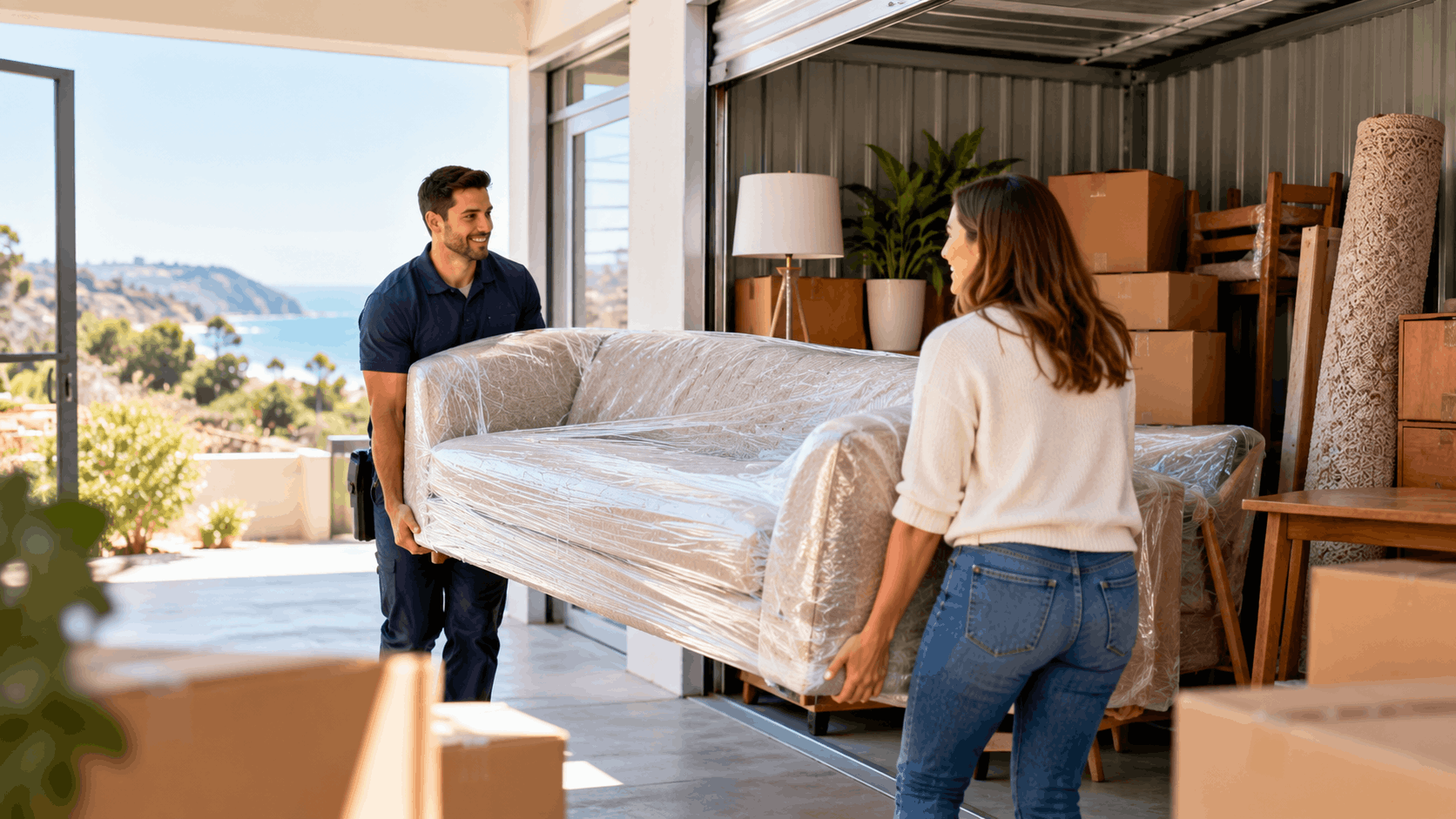
Vaulted storage answers that problem directly. Our crews pack belongings into individual wooden vaults and transport them to our warehouse at 5509 1/2 S Centinela Ave in Mar Vista. The family does not get a key and does not have an individual unit to visit. The goods are loaded once, sealed inside the vault, and held as long as the remodel takes. There is no minimum term and no maximum term, which matters when a finish date slips by weeks.
What Vaulted Storage Actually Is?
Vaulted storage is a full-service model. Instead of renting an empty room and filling it yourself, you hand your belongings to a crew who load them into wooden vaults and store those vaults inside a managed warehouse. It is a different product from the drive-up self-storage most people picture.
For a family clearing a house for a remodel, the distinction changes everything from pricing to access to the law that governs the goods. Here is how the pieces fit together.
No Key, No Unit, No Drive-Up Access
With full-service vaulted storage, the customer has no key, no individual unit and no right of entry. Our crews handle the goods from the moment they leave the home to the moment they come back. You are not driving to a facility, rolling up a metal door and stacking boxes yourself.
Compare that to a self-storage unit, where you rent a space, keep the only key and come and go as you please. That access is the whole point of self-storage, and it is also what defines it legally. Because a vaulted customer has no key and no entry rights, the arrangement sits outside the Self-Service Storage Facility Act entirely.
Under California law, a self-service storage facility is defined as real property rented to occupants who are to have access to the space, and the statute states plainly that such a facility is not a warehouse. Our vaulted storage service is warehouse storage, handled by our team, which is a deliberate choice for families who want their belongings managed rather than left to fend for themselves.
The trade-off is simple. You give up daily drive-up access and gain professional handling, a controlled environment and goods that are moved by forklift rather than dragged across a concrete floor. For a remodel, where you are not planning to visit your furniture anyway, that trade is usually the right one.
What a Storage Vault Looks Like
A typical wooden storage vault measures roughly 7 feet by 5 feet by 7 feet 10 inches on the outside. It is built from plywood set on a reinforced plywood floor with runners, so a forklift can pick it up from any of four sides. One empty vault weighs around 427 pounds before anything goes inside.
Manufacturers market the common vault around 250 to 274 cubic feet, but that is a typical catalog size and not an industry standard. There is no ANSI, ASTM, ISO or federal specification governing household goods vault dimensions, and builders make custom sizes to order.
Keep in mind that the published figure is exterior volume. Once you subtract the thickness of the plywood walls, the usable interior is lower than the number on the catalog page. We never publish a usable-capacity figure because no authoritative measurement exists for it, so plan on fitting somewhat less than the headline cubic footage suggests.
We run the full range of vault sizes, standard through oversized, so a one-bedroom condo near Swarthmore Avenue and a large Riviera home get matched to the right number and size of vaults rather than a one-size box.
Loaded Once, Moved as a Unit
The core mechanism of vaulting is that a vault is loaded once at origin and then moved as a single unit by forklift. Your belongings are padded, stacked and secured inside the vault at the point of pickup, and after that the vault itself is what gets handled.
In a self-storage cycle, items are carried off the truck, wheeled into a unit, then later carried out again, loaded back onto a truck and unloaded once more at the destination. Each of those touches is a chance for a scratch, a drop or a shifted load. With a sealed vault, the contents are handled fewer times because the box moves instead of the individual pieces.
We describe this as how the method works rather than attaching a number to it, because no published source quantifies the difference. What we can say plainly is that fewer handling steps generally means fewer opportunities for handling damage over a long storage term.
The vault is also a contained space. Once it is loaded and closed at your home, it is not reopened until retrieval, which keeps dust and foot traffic away from your furniture while it sits in the warehouse.
Why Families Choose It During a Remodel
A remodel has a natural shape that fits vaulting well. Belongings come out of the house in one organized visit, get stored off-site while the work happens, and come back when the rooms are finished. You are not making repeated trips to a facility in the meantime.
Because we run vault sizes from standard to oversized, the storage scales to the job. A kitchen-only remodel might need a couple of vaults for appliances, cookware and a dining set, while a whole-house renovation on the Huntington could fill many.
The term is flexible on both ends. There is no minimum and no maximum storage term, so a project expected to run three months but stretching to seven does not force you into an awkward contract. Families between homes during the work are a common fit for this model.
For households storing furniture through a renovation, our storage solutions are built around that off-site hold rather than around daily access you will not use.
Get Your Free Quote
Tell us about your move. We'll be in touch soon.
Getting Your Belongings Out of a Palisades Home
Before a single vault gets loaded, the belongings have to leave the house, and in Pacific Palisades that is often the hardest part. The community runs from the Village up into the Highlands and down to Pacific Coast Highway, and the roads between were not built for full-size moving trucks.
Knowing the street geometry ahead of time is what keeps a move day from falling apart. Here is what we plan around across the different sub-areas.
Narrow Streets and Steep Grades Across the Community
Palisades Drive is a long, sustained climb into the Highlands, with narrow streets and limited turnarounds once you are up there. A full-size tractor trailer can struggle to maneuver, and there are few places to legally stand a large vehicle while a crew works.
Castellammare is reached by short, steep switchback streets off Pacific Coast Highway. A full-size truck usually cannot turn or stage on those grades at all. The Alphabet Streets are a compact grid of narrow roadways with cars parked on both sides, which leaves little room for a large truck to pass or park.
Rustic and Temescal canyon roads wind and narrow as they climb, Chautauqua Boulevard is steep, and some bluff streets are single-loaded with no through route. Each of these conditions means a big truck often cannot reach the door, cannot turn around, or cannot legally stand long enough to load.
We know these roads because we work them. The point of knowing the geometry in advance is to pick the right equipment for the address rather than sending a truck that cannot get the job done.
When a Shuttle Is the Right Method
Where a full-size truck cannot reach, turn or legally stand, the professional method is a shuttle. A smaller truck is staged at a workable point, loaded at the home, and used to ferry belongings down to the larger vehicle or straight toward the warehouse.
A shuttle is not a day-of improvisation. It is identified at the estimate, once we understand the street, the driveway grade and the overhead clearance, and it is priced into the written estimate rather than sprung on you later. On hillside and restricted-access Palisades properties, it is simply how the work gets done.
Some properties have no vehicle access at all. Those are qualified on the phone before a date is confirmed, so there are no surprises when the crew arrives. Talking through access on the first call is how we avoid a wasted move day.
For a standard home move that feeds into storage, our residential moving team plans the shuttle and staging as part of the same job.
The Construction Layer in the Burn Area
Parts of the community carry an extra layer of traffic after the January 2025 Palisades Fire. Contractor vehicles, debris hauling and utility crews are working in the roadway across the burn area, which affects where a truck can stage and how long it can stand.
Caltrans reopened Pacific Coast Highway on 23 May 2025 after a five-month closure, initially at 25 mph, and has continued single-lane closures for recovery and utility work. That means the main coastal route and the streets feeding off it can change week to week.
Because road status, checkpoints and closures shift, current access should be confirmed before a move is scheduled. We check the route for your specific address rather than assuming last month's conditions still hold. Winter adds another factor, since Los Angeles County has warned that recent burn areas remain susceptible to mud and debris flows during storms, which can overtake a scheduled date.
None of this requires a crew to judge fire damage or structural safety at a property. Those determinations belong to the owner, an engineer or architect, and the Los Angeles Department of Building and Safety.
Street and Curb Permits in the City of Los Angeles
Pacific Palisades is part of the City of Los Angeles, so street and curb permits run through the Los Angeles Department of Transportation, LADOT, rather than a separate city hall. That is different from a move in neighboring Santa Monica or Malibu, which have their own rules.
Permit rules vary by situation, so the permit position should be confirmed for the specific address rather than generalized across the community. We handle that check as part of planning the job for your street.
We do not quote a permit fee or a processing time here, because those are set by the city and should come from the current city source rather than a blog. You can verify the current requirements with LADOT directly.
The practical upshot is that a large truck standing on a narrow Palisades street may need the right paperwork in place first, and that is something to sort out before move day rather than on it.

Need Help in Los Angeles?
Popeye Moving & Storage serves Los Angeles and all of Los Angeles County.
How Long Can Belongings Stay in Storage
For a remodel, the honest answer to how long goods can stay is: as long as you need. But there is an important legal line at 90 days that changes which set of rules governs your belongings, and understanding it helps you know what covers your goods at each stage.
Here is how the timing works and what the 90-day mark means for you.
The 90-Day Storage-in-Transit Line
Under Maximum Rate Tariff 4, administered by the Bureau of Household Goods and Services, Item 4 defines storage-in-transit as storage of a shipment at one point between origin and destination for a period not to exceed 90 days. Inside that 90-day window, the job is still a regulated mover service.
That means the protections of the Household Movers Act and MAX 4 apply to your goods while they are in storage-in-transit. The same tariff rules that govern the move itself continue to cover the belongings during that initial storage period.
Ninety days is the ceiling for storage-in-transit. Once a shipment passes that mark, or if storage-in-transit was never requested in the first place, the goods move under a different legal framework. For a short remodel, you may stay inside the window; for a longer one, you will cross it.
Knowing which side of the 90-day line your belongings sit on tells you which rules protect them, which is why we set the arrangement out in writing before anything goes into the warehouse.
What Changes After 90 Days
MAX 4 Item 96 is the pivot. On placement in a public warehouse, the liability of the mover ceases and becomes that of the warehouseman in possession. In plain terms, past storage-in-transit the goods are held under the warehouse contract rather than the mover's tariff.
That warehouse storage falls under Commercial Code Division 7, not the Self-Service Storage Facility Act, because the customer has no key and no access. The standard of care is that of a warehouse: it must exercise the care a reasonably careful person would use under similar circumstances, which is ordinary negligence rather than a guarantee against all loss.
This boundary should be set out in writing before goods go in. A family needs to know, before the truck is loaded, which regime their belongings will sit under and what the warehouse contract says about liability and claims. We put that in front of you rather than letting it surprise you months later.
For renovations that run long, our long-term storage is where this warehouse framework applies, and we explain the terms up front.
No Minimum and No Maximum Term for Popeye Storage
Our vaulted storage has no minimum and no maximum term. A remodel that finishes early does not leave you paying out a contract, and one that runs long does not force a renewal scramble. You store for exactly as long as the project takes.
That flexibility fits the reality of renovation, where a finish date can slip for permits, materials or weather. In the burn-area rebuild context, where permitting and construction timelines are still settling, the absence of a fixed term removes one worry from a stressful process.
The 90-day regulatory mark still applies to the legal framework, as covered above, but it does not cap how long you can store. It simply marks where the mover's tariff liability hands off to the warehouse contract. Your belongings can stay well past 90 days under the warehouse arrangement.
What this means for a family is straightforward: pick the storage you need, keep it as long as the remodel runs, and know which rules apply at each stage without having to repeat the explanation yourself.
Protecting the Value of Stored Belongings
Palisades families often store high-value contents during a remodel, from fine art to antique furniture to wine. Knowing how valuation works, and what the difference is between a liability limit and real coverage, protects you if something is lost or damaged.
Valuation is one of the most misunderstood parts of moving and storage, so here is how it actually works under California's tariff.
Released Value Is a Liability Limit, Not Insurance
MAX 4 Item 136 sets the baseline. The transportation rates are based upon a declared value of 60 cents per pound per article. That figure is how the rate is computed. It is not the amount you get paid if something is lost or damaged.
Item 136 also provides that unless the shipper expressly declares a value other than $20,000 for the shipment, the mover's maximum liability for lost and damaged articles is up to $20,000 of actual cash value. Both of those facts are true at the same time: 60 cents per pound is the rate basis, and $20,000 actual cash value is the default liability ceiling.
Released value is a liability limit, not insurance. Full value protection is the paid alternative, and MAX 4 requires that each valuation option be listed with the carrier's charge and a space for you to initial. You have a right to be offered better coverage, and a right to decline it knowingly.
For a home full of ordinary furniture, the default may be fine. For a home with meaningful contents, declaring a higher value is the move that actually protects you, and we lay out the options in writing.
Declaring Items of Extraordinary Value
Items of extraordinary value, such as antiques, art, and gold or silver articles, should be separately described on the inventory with a value declared for each. A single line on a general inventory does not do justice to a piece worth many times the default per-pound basis.
This matters for the estate contents common on the Riviera and the Huntington, where a household may include signed furniture, collections or artwork that far exceed what released value would ever cover. Listing each piece with its own declared value is how those items get protected properly.
Money, jewelry and important papers are best carried by the family rather than stored. Those items are small, high in value and easily misplaced, and keeping them with you removes them from the storage equation entirely.
When you have genuinely valuable pieces, our fine art and antique moving team handles the separate description and declaration so nothing of consequence gets folded into a generic inventory line.
Valuation While Goods Are in Storage-in-Transit
Protection during storage-in-transit is its own layer, separate from the transportation valuation. MAX 4 Item 136(8) sets the maximum fixed rate for Actual Cash Value protection while a shipment is in storage-in-transit at $0.16 for each $100 of declared value, and Full Value protection at $0.38 for each $100.
Those storage valuation charges are additional to the transportation valuation charges. They cover the period the goods sit in the warehouse during the regulated storage-in-transit window, not the move itself.
This protection must be offered by the mover and ordered in writing by the shipper. It is not automatic. If you want your belongings covered at a declared value while they are in storage-in-transit, you put that order in writing before the goods go in.
We walk families through this election when storage is part of the job, so the coverage during the hold is a deliberate choice rather than an afterthought discovered when a claim arises.
Why the Cargo Policy Does Not Cover Long-Term Storage
The mover's cargo insurance is framed around property during the course of transportation or storage-in-transit. Business and Professions Code section 19248(c) requires cargo insurance of $20,000, and the governing order frames that coverage around transportation and storage-in-transit.
Nothing confirms that the cargo policy extends past storage-in-transit into long-term warehouse storage. We will not tell a family that goods held in long-term storage are covered by the mover's cargo policy, because that is not established.
Fully insured describes the business. It does not mean stored goods are automatically covered by the cargo policy once they cross into warehouse storage. Those are two separate things, and conflating them is a common and costly mistake.
For belongings held past storage-in-transit, families should confirm what actually covers the goods, whether through the warehouse agreement's valuation terms or a separate policy. We set that out in writing so you know exactly what protects your belongings at each stage of the hold.
Keeping Furniture Safe While a Remodel Runs
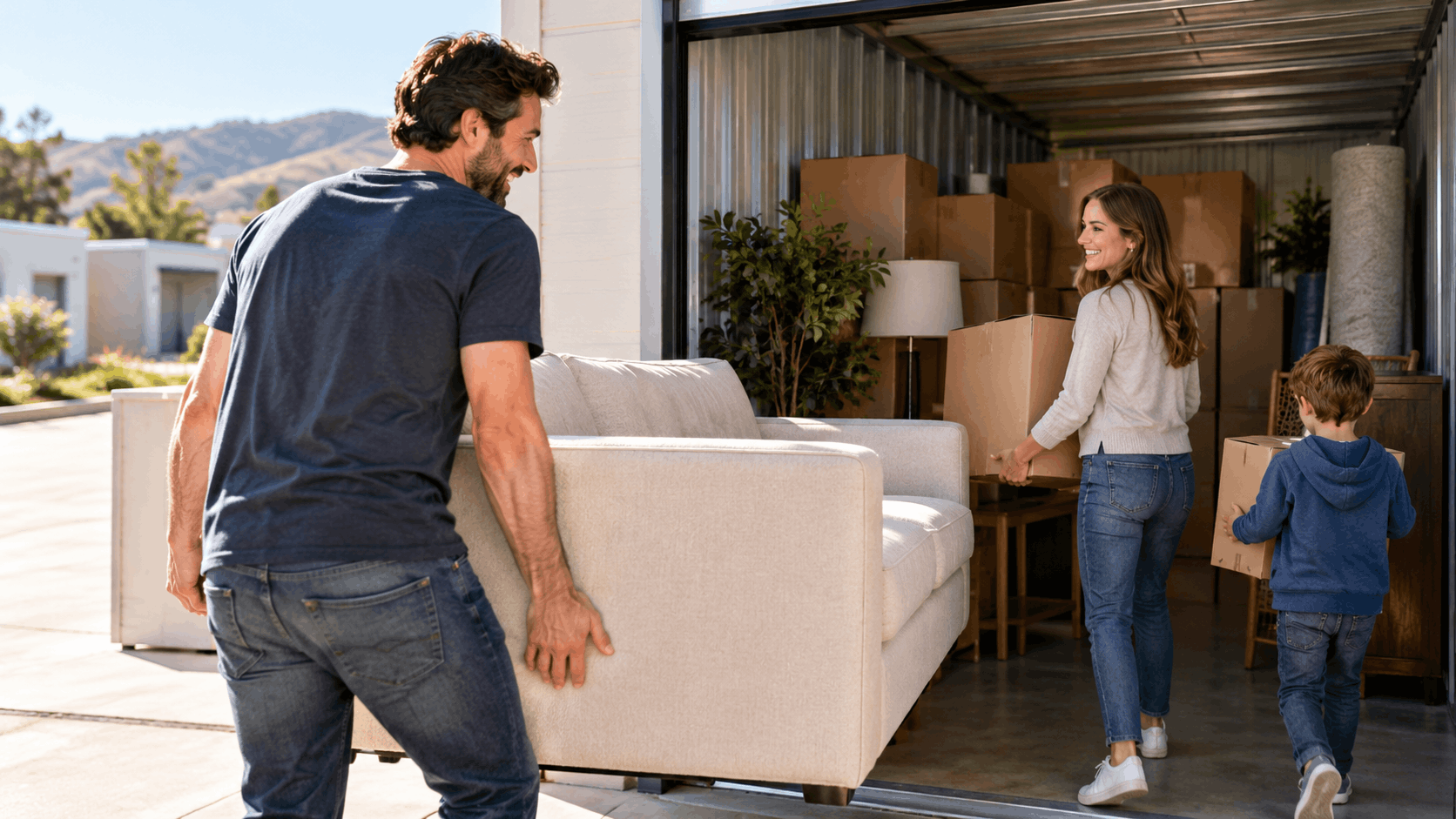
A remodel can run for months, and furniture that sits in the wrong conditions over that time can suffer. The point of storing in a managed, climate-controlled warehouse is to hold belongings in a stable environment so they come back in the condition they left.
Here is what actually threatens stored furniture and how vaulting addresses it, described as mechanism rather than as any rate of damage.
Climate-Controlled for Temperature and Humidity
Our Mar Vista warehouse is climate controlled for both temperature and humidity. That controlled environment is what makes a long storage hold safer for sensitive belongings than a garage, an uninsulated unit or a home full of construction dust.
We do not publish a specific temperature figure, humidity figure, range or tolerance as the warehouse specification, because the specification is confirmed per shipment. What a given shipment needs can differ, and the controlled setting is handled accordingly.
For context only, published conservation references give a sense of why humidity control matters. The National Park Service recommends relative humidity of 45 to 55 percent and warns that RH should not reach 65 percent because mold might develop. Those are conservation reference ranges, not statements of conditions at our warehouse.
The takeaway for a family is that a climate-controlled environment keeps temperature and humidity stable, which is exactly what sensitive furniture, art and instruments need over a multi-month remodel hold.
What Suffers From the Wrong Conditions
Certain categories are genuinely vulnerable to swings in humidity. The Canadian Conservation Institute lists oil paintings and rigid paint layers on canvas, photographs and negatives, panel paintings with weak adhesion, veneer and marquetry, musical instruments, and fine furniture with inlays among the most at-risk items.
Wood reacts to moisture in the air. The National Park Service notes that high RH above 65 percent causes wood to swell and warp, while low RH causes shrinkage, warping and cracking. A dining table or an antique chest that sits in an unstable environment can move with the moisture.
Leather is similarly sensitive. CCI states that RH above 65 percent promotes mold, darkening, stiffening and embrittlement on leather, while RH below 30 percent causes loss of flexibility, brittleness, tears and distortion. The goal of controlled storage is to keep conditions in a stable middle range.
We describe what these conditions do to materials, not how fast any individual piece would degrade, because that depends on far too many factors to state honestly. The practical point is that these are the categories where a controlled environment genuinely changes the outcome.
Pests and What Each One Targets
Pests are the other quiet threat to stored belongings, and different pests go after different materials. The National Park Service Conserve O Gram mapping is a useful guide to what is actually at risk.
Carpet beetles attack leather, fur, feathers, skin, mounted specimens, and woolen and silk textiles. Clothes moths go after woolen clothes, feather items, dolls and toys, bristle brushes, weavings and fabric wall hangings. If you are storing wool rugs, a leather sofa or a feather-filled piece, these are the pests to guard against.
Powderpost beetles attack frames, books, furniture, tool handles, lumber and paneling, while silverfish consume fabrics, paper, sizing and the glue and paste in older book bindings, and prefer moist conditions. Each pest targets a specific material, which is why controlling the environment and inspecting goods before storage both matter.
CCI advises inspecting woolens and other keratinous items for pests before storage. Catching a problem before the item goes into a sealed vault keeps it from spreading during a long hold, which is part of how we prepare goods for storage.
How Belongings Are Prepared and Padded
Proper preparation is drawn straight from recognized warehouse inspection standards. The federal household goods warehouse inspection form, DD 1812, treats finished surfaces not protected by pads or wrap as a deficiency, so we wrap and pad finished wood and upholstery before it goes into a vault.
Breathable dust covers matter more than people expect. The National Park Service advises breathable covers such as muslin or Tyvek rather than sealed plastic, since sealing items in polyethylene is a containment response to active mold and not a general storage method. Wrapping furniture airtight can trap moisture against the surface.
CCI recommends prewashing fabrics used for packing and never forcing a misshapen object back into its original form. Goods should also be elevated off the floor and kept away from exterior walls, because that arrangement leads to condensation. These steps are standard warehouse practice for a reason.
For a long remodel hold, this preparation is what carries belongings through months of storage intact. Our packing and crating team handles the wrapping, padding and crating before anything is loaded into a vault.
Need Help in Los Angeles?
Popeye Moving & Storage serves Los Angeles and all of Los Angeles County.
What Vaulted Storage Costs in the Los Angeles Area?
Cost is usually the first question, so here are the typical ranges for storage and the moving work that surrounds a remodel. These are typical market ranges for the Los Angeles area, copied exactly, and they are not a quote or a fixed price from us. The actual price for a specific job is set in writing before anything is loaded.
| Service | Typical Los Angeles Range |
|---|---|
| Vaulted storage | $60 to $90 per vault per month |
| Local residential moving (two-person crew and truck) | $150 to $200 per hour |
| One-bedroom apartment local move | $350 to $650 |
| Full-service packing (one-bedroom) | $300 to $800 |
| Full-service packing (three-bedroom) | $600 to $1,500 |
| Custom crating | $150 to $800+ per crate |
| Fine art and antique moving | $300 to $1,200+ |
| Piano moving | $200 to $600 |
| Chandelier moving | $150 to $450 |
Typical Vaulted Storage Rates
The typical range for vaulted storage in the Los Angeles area is $60 to $90 per vault per month. That figure is presented as a typical area range, not a quote or a fixed price from us.
The number you actually pay depends on how many vaults your belongings fill. A kitchen-only remodel might need a vault or two, while a whole-house clear-out on the Huntington or the Riviera could require several.
Because the charge is per vault per month, a longer remodel costs more simply because the vaults are held longer, and there is no minimum or maximum term forcing you into a fixed stretch. You pay for the vaults you use for the months you need them.
We size the vault count at the estimate, after seeing the full contents, so the storage cost reflects the actual volume rather than a guess.
Moving the Belongings In and Out
Getting goods into and out of storage is local moving work, and the typical ranges apply. Local residential moving runs $150 to $200 per hour for a two-person crew and truck, and a one-bedroom apartment local move typically runs $350 to $650. Those are copied exactly as typical ranges.
Local hourly moves in California are billed on the double drive time convention, which means travel time between origin and destination is charged at twice the actual driving time. It is a legitimate, regulated charge rather than a padding tactic.
On Palisades jobs, timing affects that drive time. Moving during lighter traffic on Sunset Boulevard or Pacific Coast Highway keeps the drive time down, while a peak-hour run adds to it. We plan the window with that in mind.
Remember there are two moving legs with storage: one to get belongings into the vaults, and one to bring them back when the remodel is done. Both are priced in the written estimate.
Packing and Specialty Items
Remodel contents often include items that need more than a moving blanket. Full-service packing runs $300 to $800 for a one-bedroom and $600 to $1,500 for a three-bedroom. Custom crating runs $150 to $800+ per crate.
Specialty pieces have their own ranges. Fine art and antique moving runs $300 to $1,200+, piano moving runs $200 to $600, with upright pianos costing less than grand pianos, and chandelier moving runs $150 to $450. All of these are copied exactly as typical ranges.
Many Palisades homes have at least one of these. A grand piano in a Riviera living room, a chandelier over a Village dining table, or art that has hung on the same wall for decades all benefit from proper crating before a long storage hold.
Our piano moving and chandelier moving crews handle those pieces so they go into the vault protected rather than wrapped in a hurry on move day.
What the Written Price Covers
The figure that actually protects you on a California move is the Not To Exceed price. Under MAX 4, it is the maximum total dollar amount you can be liable for, agreed in writing before any goods are moved or any services performed.
The final bill cannot exceed that ceiling except through a valid Change Order that you agree to. If you add services or items mid-job, you sign off on the change first. That is a right you hold, not a courtesy we extend.
California requires a written estimate. It does not require a binding one, so you should never be told state law demands a binding estimate. The Not To Exceed figure in writing is what caps your bill.
A proper Agreement For Moving Services describes the shipment, the services, the number of helpers and packers, and the rates and charges, so you can check it against what you were quoted. A verbal quote, whether per hour or per hundred pounds, is not an estimate and is not binding.

Getting Belongings Back When the Remodel Is Done
When the rooms are finished, the belongings come home. Retrieval works differently with vaulted storage than with a self-storage unit, and keeping the right paperwork protects you if anything is wrong when the goods come back.
Here is how getting your belongings back actually works.
How Retrieval Works With Vaulted Storage
Because the family has no key, retrieving goods means the warehouse brings out and opens the vault. Our crew pulls your vaults, opens them and either delivers the contents back to your home or releases them per your instructions.
That is why retrieval happens by appointment. It is ordinary practice for vaulted storage, since the warehouse has to schedule the retrieval and the crew rather than letting you walk in and grab a box. No statute, tariff or code sets a required notice period or appointment rule, so we work out timing with you directly.
Planning the redelivery around the remodel's completion keeps the furniture from coming back before the dust settles. A day or two of lead time lets us line up the crew and the vehicle for your street.
On the return leg, the same access planning applies as on the way out: the right equipment for a steep or narrow Palisades street, and a shuttle where a full-size truck cannot reach.
Warehouse Hours Are Business Hours
Our business hours are 6am to 9pm, seven days a week, including Sunday. Those hours are for calls and scheduling. They are not customer access hours at the warehouse.
The warehouse is at 5509 1/2 S Centinela Ave in Mar Vista, on the Westside. Because storage is full-service and vaulted, you do not visit to access your goods during the term. Retrieval is arranged through us rather than by drive-up access.
The wide calling window makes it easy to reach us to schedule a pickup or a redelivery around a busy remodel timeline. A Sunday call to set up the return move is no problem.
Keeping the distinction clear matters: the hours tell you when you can reach us, not when you can walk into the warehouse, because with vaulted storage you do not walk in at all.
Keep the Paperwork That Protects You
The single most common reason a family loses a storage or moving dispute is that they cannot produce the paperwork. Keep the estimate, the Agreement For Moving Services and the bill of lading from the day goods were loaded.
Those documents establish what you were quoted, what services were agreed, what valuation you elected and what condition the inventory recorded. If something is missing or damaged on return, the paperwork is what supports your claim.
MAX 4 Item 92(14) requires a claim for loss or damage to be filed in writing with the mover within nine months after delivery to the consignee as shown on the shipping document. The mover must acknowledge a written claim within 30 days and pay, decline or make a firm settlement offer within 60 days.
Importantly, a claim cannot be denied solely because the lost or damaged goods were not noted at the time of delivery. If you spot an issue after the crew leaves, you still have a path to a claim, provided you file within the window and have your documents.
Need Help in Los Angeles?
Popeye Moving & Storage serves Los Angeles and all of Los Angeles County.
How Popeye Handles a Remodel Storage Job
From the first phone call to the day your belongings come home, here is how we run a Pacific Palisades remodel storage job. Everything here comes from how we actually work, not a generic process.
The First Call and What We Confirm
On the first call, we establish who authorizes the work, who signs, who pays and who will be present. On remodel jobs the caller is often an agent, a business manager or a family member coordinating the project, so pinning down those roles up front keeps the paperwork clean.
We confirm current road access for your address, whether a full-size vehicle can reach and turn, and where a shuttle could stage if it cannot. On a Highlands or Castellammare property, that conversation shapes the whole plan.
We go through the full contents so the vault count and crew are right, and we ask specifically about any piano, safe, art or wine, since those need special handling and sometimes separate crating.
Getting these details on the first call is how we quote accurately and avoid a scramble on move day. The more we know before the estimate, the tighter the plan.
A Written Price Before Anything Is Loaded
You receive a written Not To Exceed price before any goods are moved. That figure caps what you can be liable for, and the final bill cannot exceed it except through a Change Order you agree to.
We provide the booklet Important Information for Persons Moving Household Goods (within California) at the time of first in-person contact or when the Agreement For Moving Services is issued. It is a required piece of consumer information, and you are entitled to it.
The valuation options are offered in writing, each listed with its charge and a space for you to initial. You decide whether to keep the default liability limit or elect full value protection, and you do it knowingly rather than discovering the coverage question after a problem.
Having the price and the valuation settled in writing before the truck is loaded is what turns a stressful remodel clear-out into a planned, predictable job.
Same-Day Vaulting at the Mar Vista Warehouse
We pick up your belongings and place them into vaults at the Mar Vista warehouse the same day, with no overnight hold on the truck. Your goods are loaded, transported and vaulted in one cycle rather than sitting on a truck overnight.
We are fully insured and hold California household mover permit CAL T 189749. We are BBB accredited with an A+ rating. Those are the credentials behind the work.
Same-day vaulting matters for security and for condition. The sooner belongings are inside a sealed vault in a climate-controlled warehouse, the less time they spend exposed on a truck or at a curb on a narrow Palisades street.
For the storage itself, our vaulted storage runs at our own warehouse, so your goods stay within our handling from pickup to retrieval.
Specialist Items We Accept
We accept wine, fine art, pianos and chandeliers for storage. Palisades homes frequently include at least one of these, and they get the handling and placement they need rather than being treated as ordinary furniture.
We also accept commercial and business storage alongside household goods. A home office, a small business inventory or records can be vaulted in the same job as the household contents during a remodel that affects a live-work space.
Vehicles are not accepted. We do not store cars, motorcycles, boats or RVs, so those need a separate arrangement elsewhere.
For businesses storing through an office remodel or relocation, our commercial and business storage handles that alongside the household side of a project.

Planning a Remodel Storage Job in Pacific Palisades
Every remodel storage job starts with a call where we confirm access for your street, the full contents and any specialist items, then put a written Not To Exceed price in front of you before anything is loaded. From there we vault your belongings the same day at our Mar Vista warehouse and hold them for as long as the work takes.
To get a written estimate for your Pacific Palisades remodel, call Popeye Moving and Storage at (310) 823-9510 and we will plan the pickup, the vaulting and the return around your project.
Frequently Asked Questions
- How is vaulted storage different from a self-storage unit?
- With vaulted storage, the family has no key, no individual unit and no right of entry, and our crews handle the goods. That places it under Commercial Code Division 7 rather than the Self-Service Storage Facility Act, which applies only where occupants have access to their own space. A self-storage unit is one you drive up to and unlock yourself. Vaulting is a full-service model where belongings are packed into wooden vaults and stored in a managed warehouse.
- How much does vaulted storage cost in Los Angeles?
- Vaulted storage typically runs $60 to $90 per vault per month in the Los Angeles area. That is a typical market range, not a quote or a fixed price from us. The total depends on how many vaults your belongings fill, which we size at the estimate after seeing the full contents. Because the charge is per vault per month and there is no minimum or maximum term, a longer remodel simply means the vaults are held longer.
- How long can I keep my belongings in storage during a remodel?
- There is no minimum and no maximum term, so you store for exactly as long as the remodel takes. The one legal line to know is the 90-day storage-in-transit cap under Maximum Rate Tariff 4 Item 4. Inside 90 days the job is a regulated mover service. Past 90 days the goods fall under the warehouse contract and Commercial Code Division 7. Your belongings can stay well beyond 90 days under that warehouse arrangement.
- Can a moving truck reach my home in the Highlands or Castellammare?
- Often a full-size truck cannot reach or turn on the steep switchbacks off Pacific Coast Highway in Castellammare or on the narrow climb into the Highlands along Palisades Drive. In those cases a shuttle staged at a workable point is the professional method, decided at the estimate and priced in. Properties with no vehicle access at all are qualified on the phone before a date is confirmed, so we plan the right equipment before move day.
- Are my stored belongings insured?
- Released value is a liability limit, not insurance, and the default is up to $20,000 of actual cash value unless you declare a higher value. The mover's cargo policy is framed around transportation and storage-in-transit, and nothing confirms it extends into long-term warehouse storage. Fully insured describes the business, not automatic coverage of stored goods. For belongings held past storage-in-transit, confirm what covers them through the warehouse agreement, which we set out in writing before goods go in.
- Is the warehouse climate controlled?
- Yes, our Mar Vista warehouse is climate controlled for both temperature and humidity. We do not publish a single temperature or humidity figure as the warehouse specification, because the specification is confirmed per shipment according to what a given shipment needs. The controlled environment is what keeps sensitive items like wood, leather, veneer and fine furniture stable through a multi-month remodel hold, holding conditions steady rather than letting them swing with the weather outside.
- Can I access my belongings while they are in storage?
- Because your goods are vaulted, there is no drive-up access. To retrieve items, the warehouse brings out and opens the vault, so retrieval is arranged by appointment through us. Our business hours of 6am to 9pm seven days a week are for calls and scheduling, not for walking into the warehouse. Most remodel storage customers are not planning to access belongings during the term anyway, which is part of why the vaulting model fits the use so well.
- Do you store pianos, fine art, wine and chandeliers?
- Yes, we accept wine, fine art, pianos and chandeliers for storage, which matters for the kind of contents common in Palisades homes along the Riviera and the Huntington. We also accept commercial and business storage alongside household goods, so a home office or small business inventory can be vaulted in the same job. Vehicles are not accepted, so we do not store cars, motorcycles, boats or RVs.
- What paperwork should I keep?
- Keep the estimate, the Agreement For Moving Services and the bill of lading. The most common reason families lose a dispute is that they cannot produce the documents. Under MAX 4 Item 92(14), a written claim for loss or damage must be filed within nine months after delivery as shown on the shipping document. A claim cannot be denied solely because the loss or damage was not noted at delivery, so file within the window and keep your records.
- Who regulates California movers and where do I check a license?
- California movers are regulated by the Department of Consumer Affairs, Bureau of Household Goods and Services, the BHGS, reachable on (916) 999-2041, with complaint information at bhgs.dca.ca.gov. The CPUC no longer regulates household movers; that authority transferred to BHGS on 1 July 2018 under Senate Bill 19. You can verify a mover's license status through the bureau. We operate under CAL T 189749 for intrastate work and USDOT 1472924 with MC 498816C for interstate moves.
Popeye Moving & Storage Co. Team Team
Licensed moving and storage professionals serving Los Angeles and Los Angeles County.
Licensed in California · License #CAL T 189749 | USDOT 1472924 | MC 498816C
Why trust Popeye Moving & Storage?
Founded in 1994, Popeye Moving & Storage is a licensed and insured moving and storage service serving Los Angeles and Los Angeles County. All content is reviewed by our licensed technicians.

Need Help in Los Angeles?
Popeye Moving & Storage serves Los Angeles and all of Los Angeles County.
Related Articles
Contents Storage During an LA Remodel: Pack-Out, Vaulted Hold, and Redelivery Room by Room
A complete guide to contents storage during an LA remodel: how pack-out, vaulted hold, and room-by-room redelivery protect your belongings from demolition to final walkthrough.
Long-Term Storage for a Los Feliz Household When the Remodel Has No End Date
How full-service vaulted storage protects a Los Feliz household during an open-ended remodel, including costs, access rules, hillside pickup and why there is no minimum or maximum term.
Storage During Probate: Holding a Parent's Household Intact While the Family Decides
How storage during probate helps Los Angeles families hold a late parent's household intact, protect belongings, and decide together without pressure from the court clock.