Long-Term Storage for a Los Feliz Household When the Remodel Has No End Date
Key Takeaways
- Full-service vaulted storage carries no minimum and no maximum term, which suits a remodel with no firm finish date.
- With vaulted storage the customer has no key, no unit and no right of entry, so goods are handled by crews and retrieved by appointment.
- After the 90-day storage-in-transit window, goods move from moving law into Commercial Code Division 7 warehouse law, which sets an ordinary-care standard.
- The mover's cargo coverage is built around transportation and storage-in-transit, so confirm in writing what covers goods in long-term storage.
- Vaulted storage typically runs $60 to $90 per vault per month in the Los Angeles area, with the vault count depending on how much the household fills.
- Los Feliz loads out differently in the flats versus the hills, where a shuttle from a smaller vehicle is the professional method, priced in the estimate.
- LADOT handles parking permits with a five working day lead time, and California caps the bill with a written Not To Exceed price before loading.
- California movers are regulated by the Bureau of Household Goods and Services on (916) 999-2041, not the CPUC.
In This Article
A Los Feliz remodel almost never ends when the contractor first promises. The kitchen gut that was supposed to wrap in three months hits a permit delay, then a plumbing surprise behind a 1930s plaster wall, and suddenly the family is living around drop cloths with a house full of art, period furniture and collections that have nowhere safe to sit. When the finish line keeps moving, the storage question changes from "where do I park my stuff for a few weeks" to "where do my things live safely for an unknown stretch."
That is a different problem, and it deserves a different answer. Full-service vaulted storage lets a household pack up, hand the goods to a crew, and stop worrying about them while the work drags on. There is no key to lose, no unit to drive to, and no end date to commit to.

Why an Open-Ended Remodel Changes Your Storage Problem?
A dated move is simple to plan. You know the pickup day, the delivery day, and the gap between them. An open-ended remodel removes the one number everyone wants, which is when the goods come home. That uncertainty should drive the storage choice more than anything else.
Los Feliz sits at the foot of Griffith Park, running from the flats around Hillhurst and Vermont up into the hills toward the Observatory. The housing here leans heavily toward significant 1920s and 1930s architecture, and those homes are exactly the ones that spring surprises mid-remodel. When you cannot name an end date, you need storage that does not force you to.
For households weighing long-term storage during a remodel in Los Feliz, the flexibility to come and go on your own timeline matters more than any single feature.
When Three Months Turns Into a Year
Remodels stretch for reasons nobody controls on day one. Permit cycles with the City of Los Angeles take their own time, and inspections have to clear before the next phase starts. A contractor juggling several jobs cannot always hold your slot when a prior project runs over.
Older homes add their own delays. Once a wall opens up in a 1930s house, crews often find knob-and-tube wiring, failed plumbing, or framing that was never meant to carry a modern kitchen. Each discovered condition means a new bid, a new permit, and more waiting.
The honest planning move is to stop guessing at a date. Instead of booking storage for a window you cannot predict, choose an arrangement that bends with the project. A storage term tied to a fixed number of months only sets up a scramble when the remodel outlasts it.
That is why framing the decision around not knowing is the right call. You are not buying three months of space. You are buying a safe place for your things until the house is ready, whenever that turns out to be.
What Los Feliz Houses Are Usually Storing
The period houses above Los Feliz Boulevard tend to hold contents that reward careful handling. We see oil paintings, framed works, antiques, period and designer furniture, pianos and collections built over decades. These are not boxes of kitchenware, they are pieces with real value and real sensitivity.
Many of these homes are architecturally significant, and owners are often protective of both the house and what is inside it. A Spanish Colonial Revival living room full of inlaid furniture and art needs a storage plan that treats each category on its own terms, not a one-size approach.
The flats around Hillhurst and Vermont tell a different story. The 1920s and 1930s courtyard buildings, Spanish-style blocks and duplexes hold smaller, quicker loads, often from renters and younger professionals. Those jobs move faster and fill fewer vaults.
Knowing which profile a household fits shapes everything downstream, from how goods are prepped to how many vaults the load fills. A house of fine art and antiques is a different storage job than a one-bedroom apartment, and we price and plan it that way.
No Minimum and No Maximum Term
Our vaulted storage carries no minimum and no maximum term. Goods can stay for a few weeks or well over a year, and there is no penalty built around a term you have to commit to up front.
For an open-ended remodel, that flexibility is the whole point. You are not forced to predict the completion date to sign a storage agreement, and you are not locked into paying for months you may not need.
If the remodel wraps early, the goods come out when the house is ready. If it drags, they stay as long as the work runs. Neither outcome triggers a fee for guessing wrong.
That open-ended structure is what makes vaulted storage a sensible match for a project with no firm finish. You pay for the time you actually use, month to month, without a calendar deadline hanging over the job.
Get Your Free Quote
Tell us about your move. We'll be in touch soon.
What Full-Service Vaulted Storage Actually Is?
Full-service vaulted storage is warehouse storage where a crew packs your goods into a large wooden container, seals it, and stores it in a managed facility. The customer does not get a key, a unit number, or the right to walk in and rummage. That single difference separates it from self-storage and changes the law that applies.
With vaulted storage, the handling is done by professionals and the goods are tracked as a unit. The table below lays out how the two models compare so the trade-off is clear before you choose.
| Feature | Vaulted Warehouse Storage | Self-Storage Unit |
|---|---|---|
| Who handles the goods | Popeye crews | The renter |
| Customer key | No | Yes |
| Individual unit | No | Yes |
| Right of entry | No, retrieval by appointment | Yes, during facility hours |
| Governing law | Commercial Code Division 7 | Self-Service Storage Facility Act |
| Best for | Hands-off storage during a move or remodel | Frequent personal access |
Vaulted Storage vs. a Self-Storage Unit
With a self-storage unit, you rent a space, get a key or code, and come and go on your own schedule. You load it, you lock it, and you are responsible for what is inside. That model works for people who need to grab things often.
Vaulted warehouse storage is the opposite arrangement. The customer has no key, no individual unit and no right of entry, and the goods are handled by our crews start to finish. You are not driving to a facility to unload your own boxes.
By law, a self-service storage facility is not a warehouse. That distinction is not a marketing line, it decides which set of rules protects your goods, which we cover further down.
For a household in the middle of a stressful remodel, the hands-off model is usually the relief. The goods are packed once, stored by people who do this daily, and left alone until you ask for them back through our vaulted storage service.
How a Vault Is Loaded and Handled
A storage vault is a wooden container built from plywood on a reinforced floor set on runners, with four-way forklift access. It is loaded once at origin, sealed, and then moved as a single unit by forklift rather than repacked each time it shifts within the warehouse.
That load-once method reduces how many times your individual pieces are handled compared with a self-storage cycle where you move boxes in and out yourself. Fewer touches on a fragile antique is a real advantage, though it is the mechanism that matters, not any specific count.
A typical catalogue vault runs roughly 7 feet by 5 feet by 7 feet 10 inches on the exterior, marketed around 250 to 274 cubic feet. That is a typical size, not an industry standard, because there is no ANSI, ASTM or federal specification governing vault dimensions and every manufacturer builds to order.
Keep in mind that the published figures are exterior volumes. Usable interior space is lower once wall thickness is subtracted, so capacity numbers should always be read as approximate rather than exact.
The Mar Vista Warehouse
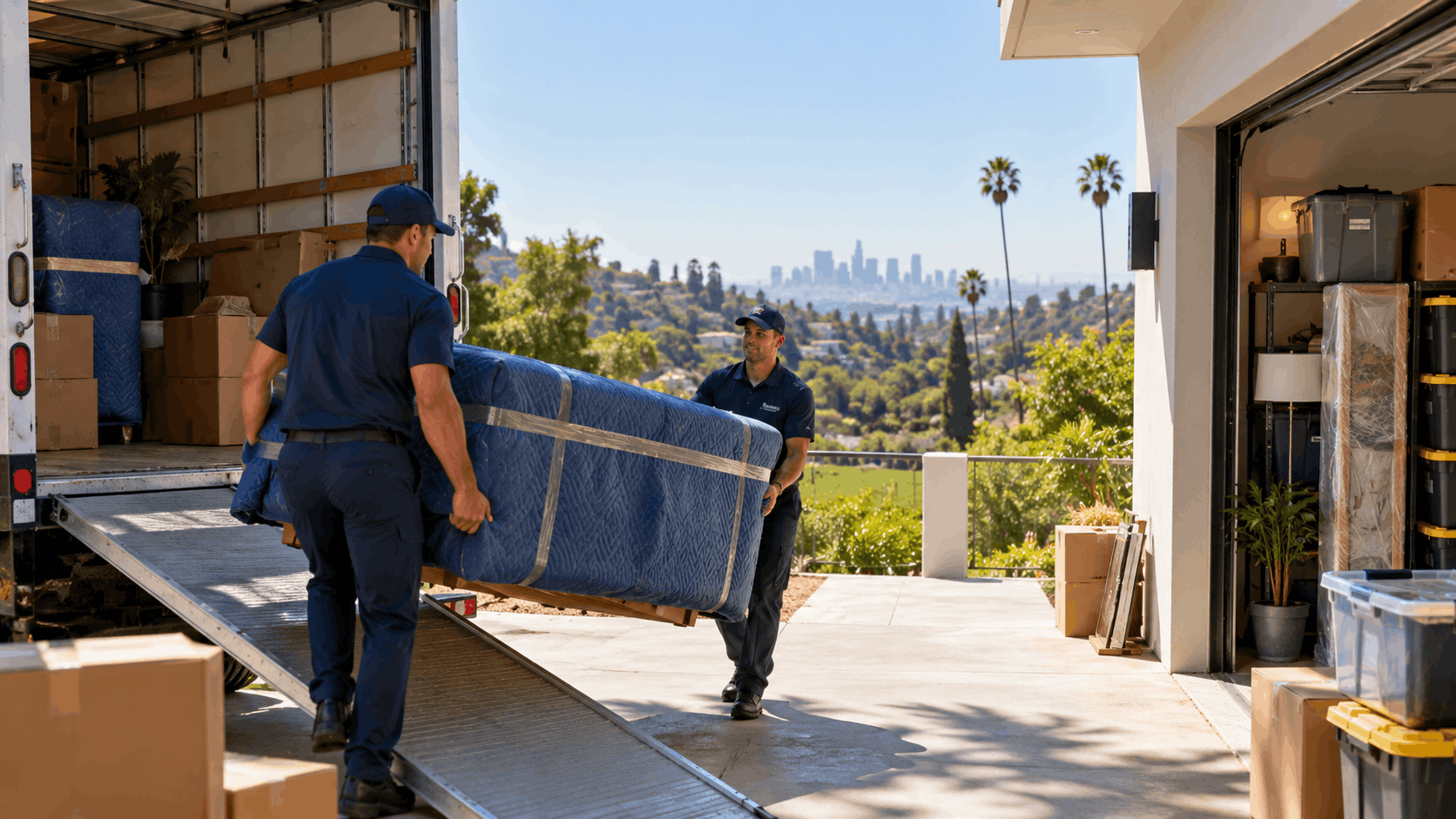
Our full-service vaulted storage lives at our own warehouse at 5509 1/2 S Centinela Ave, Los Angeles, CA 90066, in Mar Vista on the Westside. Goods from Los Feliz are picked up, driven down, and placed into vaults at that single location.
The route from Los Feliz heads down from the park-side neighborhood toward the Westside, which sets the drive for the pickup day. Griffith Park and Observatory traffic on the front end, and Westside congestion on the back end, both factor into timing.
Because the warehouse and our business location share the same address, scheduling and the storage site are one and the same. That keeps the chain of custody simple from your front door to the vault.
When the remodel finishes, the same warehouse is where retrieval is arranged. You are dealing with one facility and one crew for the full cycle.
What the Warehouse Accepts
The climate-controlled vaulted storage handles household goods and commercial or business inventory alike. A family between homes and a business holding records can both use the same vaulted model.
Specialist items are accepted as well, including wine, fine art, pianos and chandeliers. Those are exactly the categories a Los Feliz house tends to hold, and they are handled with the prep each one calls for rather than tossed in with general furniture.
For art and instruments, the pairing with careful crating matters. A grand piano or a framed canvas goes into storage protected the way it should be moved, which ties the storage decision to proper piano handling and crating.
Vehicles are not accepted. Cars, motorcycles, boats and RVs cannot go into the vault with this service, so a household storing a classic car alongside the furniture will need a separate arrangement for the vehicle.
Need Help in Los Angeles?
Popeye Moving & Storage serves Los Angeles and all of Los Angeles County.
Which Rules Protect Your Goods While They Are Stored
Storage is not a lawless handoff. Two different legal regimes can apply depending on how long the goods sit and how the storage was requested, and knowing which one covers your goods tells you what protection you have.
For a remodel that runs long, the goods usually start under moving law and then cross into warehouse law. Understanding that line in California is the single most useful thing a long-term storage customer can learn.
The 90-Day Storage-in-Transit Line
Maximum Rate Tariff 4 Item 4 defines storage-in-transit as storage of a shipment at the request of the consignor or consignee at one point between origin and destination for a period not to exceed 90 days. Inside that window, the job is still a regulated mover service.
A remodel very often runs past 90 days, which is where the picture shifts. Once storage-in-transit ends, or where storage-in-transit was not requested in the first place, the goods fall under the warehouse's own contract.
MAX 4 Item 96 states that upon placement in a public warehouse the mover's liability ceases and liability thereafter is that of the warehouseman in possession. That is the boundary that matters most on any long-term storage job.
So the practical takeaway is simple. For the first stretch your goods sit under moving law, and after the 90-day line they sit under warehouse law, which has its own standard of care and its own rules on claims.
Why Vaulted Storage Falls Under Commercial Code Division 7
Because the customer has no key, no individual unit and no right of entry, vaulted warehouse storage sits outside the Self-Service Storage Facility Act. Business and Professions Code section 21701(a) is explicit that a self-service storage facility is not a warehouse.
That same section provides that where the owner issues a warehouse receipt, bill of lading or other document of title, the parties come under Division 7 of the Commercial Code and the self-storage act does not apply. Vaulted storage with no customer access lands squarely in Division 7.
This is the most common mistake in storage content, and it is worth getting right. Self-storage lien, auction and access rules do not apply to vaulted warehouse storage, because the two are governed by different law.
The distinction turns on exclusive use and access, not on whether something is a container or a room. Since our vaulted model gives the customer neither a key nor entry, Division 7 is the framework that protects the goods.
The Standard of Care and Liability Limits
California Commercial Code section 7204(a) sets the standard. A warehouse is liable for loss of or injury to goods caused by its failure to exercise the care that a reasonably careful person would exercise under similar circumstances.
That is ordinary negligence, not strict liability. Unless otherwise agreed, the warehouse is not liable for damage that could not have been avoided by that level of care, which means a warehouse is not an insurer of the goods.
Section 7204(b) allows the storage agreement to limit damages, with a few constraints. The limit does not cover conversion of the goods to the warehouse's own use, and on the bailor's request the liability can be increased on part or all of the goods, with increased rates charged on the higher valuation.
There is no statutory floor on how low a limit can be set and no type-size requirement, so reading the storage agreement is the customer's real protection. Know the limit, and ask to increase it in writing if the contents warrant it.
Insurance on Stored Goods vs. Mover Cargo Coverage
Business and Professions Code section 19248(c) requires cargo insurance of $20,000, and General Order 136-C frames that coverage around property during the course of transportation or storage in transit. That coverage is built around the move, not around indefinite warehouse storage.
Nothing confirms that the mover's cargo policy extends past storage-in-transit into long-term warehouse storage. For that reason, a customer should never assume long-term stored goods are covered by the moving cargo policy.
The right step is to ask directly what coverage applies to goods in long-term storage and to get the answer in writing. That removes any guesswork about where protection starts and stops once the goods cross the 90-day line.
Remember too that the warehouse standard is ordinary care, not a guarantee against all loss. Separate insurance on high-value contents is a conversation worth having before the goods go in, not after something happens.
Keeping Period Furniture and Art Safe for a Long Stay
An unknown length of storage raises the stakes on preparation. The goal is to prep contents so they keep, using methods conservators trust, without pretending anyone can predict exactly how a given piece will behave over time.
The categories a Los Feliz house tends to store are also the categories most sensitive to their environment. A little attention at pack-up pays off across months in a vault.
What Humidity Swings Act On
Humidity and salt air act on organic materials. Timber, leather, rattan and upholstery all respond to moisture in the air, which is why the environment matters more for them than for metal or glass.
Conservation references name the categories most sensitive to humidity swing. The Canadian Conservation Institute lists oil paintings and rigid paint layers on canvas, photographs and negatives, panel paintings with weak adhesion, veneer and marquetry, musical instruments, and fine furniture with inlays among the most vulnerable.
On leather, CCI notes that high relative humidity promotes mold, darkening, stiffening and embrittlement, while very low humidity causes loss of flexibility and cracking. On wood, the National Park Service notes that high humidity causes swelling and warping while low humidity causes shrinkage and cracking.
These are general conservation findings about how conditions act on materials, not a prediction of how fast any single piece in any single facility will change. The point for a homeowner is that a stable environment and the right wrapping matter most for the organic, finished and inlaid items in the collection.
Climate Control and What That Term Means
Our Mar Vista warehouse is climate controlled for both temperature and humidity, with the specification confirmed per shipment. No code, standard or trade body fixes a single definition of what temperature or humidity a facility must hold to use the term "climate controlled."
Because the term is not standardized across the industry, a figure one facility quotes may differ from another. For that reason we confirm the specification per shipment rather than publishing one blanket number.
The credible reference ranges come from conservation practice rather than the storage trade. The National Park Service recommends 59 to 77 degrees Fahrenheit and 45 to 55 percent relative humidity, and the Smithsonian standard for storage space is 45 percent relative humidity plus or minus 8 and 70 degrees plus or minus 4.
Those are published conservation references, not the stated conditions at any one warehouse. The practical advice is to ask for the facility's stated specification for your shipment rather than assuming a number.
Declaring Value on Art and Antiques
Valuation is where a Los Feliz house protects its most important pieces. Items of extraordinary value such as antiques, art, and gold or silver articles should be separately described on the inventory with a value declared for each.
Money, jewelry and important papers are best carried by the customer rather than shipped. Those items do not belong in a vault, and keeping them with you removes the risk entirely.
On the moving side, the default matters. Maximum Rate Tariff 4 Item 136(2) provides that unless the shipper expressly declares a value other than $20,000, the mover's maximum liability for lost and damaged articles is up to $20,000 of actual cash value. The 60 cents per pound figure at Item 136(1) is only the rate basis the transportation charge is computed on, not the payout.
Released value is a liability limit, not insurance, and full value protection is the paid alternative. Each valuation option must be listed with the carrier's charge and a space to initial, so a house full of art can declare value knowingly rather than leaving it to a default.
Prepping Items So They Keep
Good prep favors breathing over sealing. The NPS advises breathable dust covers such as muslin or Tyvek rather than sealed plastic, since wrapping goods in polyethylene is a containment response to active mold and not a general storage method.
Fabrics and natural fibers deserve a look before they go in. CCI advises prewashing fabrics used for packing and inspecting woolens and other keratinous items for pests before storage, because carpet beetles and clothes moths target exactly those materials.
Leather and shaped objects need thoughtful handling. CCI suggests wrapping leather in buffering layers and never forcing a misshapen object back into its original form, which can crack or tear a piece that has already settled into a new shape.
None of this is about predicting damage, it is about reducing the chances. Clean, inspected, breathably wrapped goods, raised and kept away from exterior walls, are simply better set up to come out the way they went in.

What It Costs to Store a Los Feliz Household Long Term
Cost comes down to two things: the monthly storage itself, and the move into and out of the vault. The figures below are typical market ranges for the Los Angeles area, presented as ranges and never as a quote.
The actual price for a specific household is set in writing before anything is loaded, with a Not To Exceed figure on a move inside California. The table gives a quick reference, and the subsections break it down.
| Service | Typical Area Range |
|---|---|
| Vaulted storage | $60 to $90 per vault per month |
| Local residential moving | $150 to $200 per hour for a two-person crew and truck |
| Piano moving | $200 to $600 |
| Chandelier moving | $150 to $450 |
| Fine art and antique moving | $300 to $1,200+ |
| Custom crating | $150 to $800+ per crate |
Typical Monthly Storage Ranges
Vaulted storage runs a typical $60 to $90 per vault per month in the Los Angeles area. That is the recurring cost that stacks up over an open-ended remodel, so it is the number to plan around.
The total depends on how many vaults the household fills. A full period house above Los Feliz Boulevard, with its art, pianos and larger furniture, uses more vaults than a one-bedroom flat near Hillhurst.
Because each vault is priced per month, a larger load simply means more vaults at the same per-vault range. There is no separate penalty for volume beyond the vault count itself.
Over a long stay, those monthly figures are what make term flexibility valuable. With no minimum, you stop paying when the goods come out, rather than carrying a fixed contract past the point you need it.
The Move Into and Out of Storage
The move itself is where the specialty ranges come in. Local residential moving runs a typical $150 to $200 per hour for a two-person crew and truck, which covers the general load and the drive to Mar Vista.
Specialty items are priced on their own. Piano moving runs $200 to $600, with upright pianos costing less than grand pianos, and chandelier moving runs $150 to $450.
For the art and antiques common in Los Feliz houses, fine art and antique moving runs $300 to $1,200+, and custom crating runs $150 to $800+ per crate. A fragile canvas or a marble-topped antique often calls for a built crate rather than pads alone.
Each of these is a typical area range, not a Popeye quote. The mix of specialty items in a given house is what moves the total up or down, which is why a survey comes before any price.
How Double Drive Time and the Hills Affect the Bill
California bills local hourly moves on a double drive time convention, meaning travel time between origin and destination is charged at twice the actual driving time. It is a legitimate, regulated charge, not padding.
In Los Feliz, timing shapes that figure. Observatory and Greek Theatre traffic, especially on weekends and holidays, congests Vermont, Los Feliz Boulevard and the canyon roads, so an early weekday start lowers the drive time and the bill.
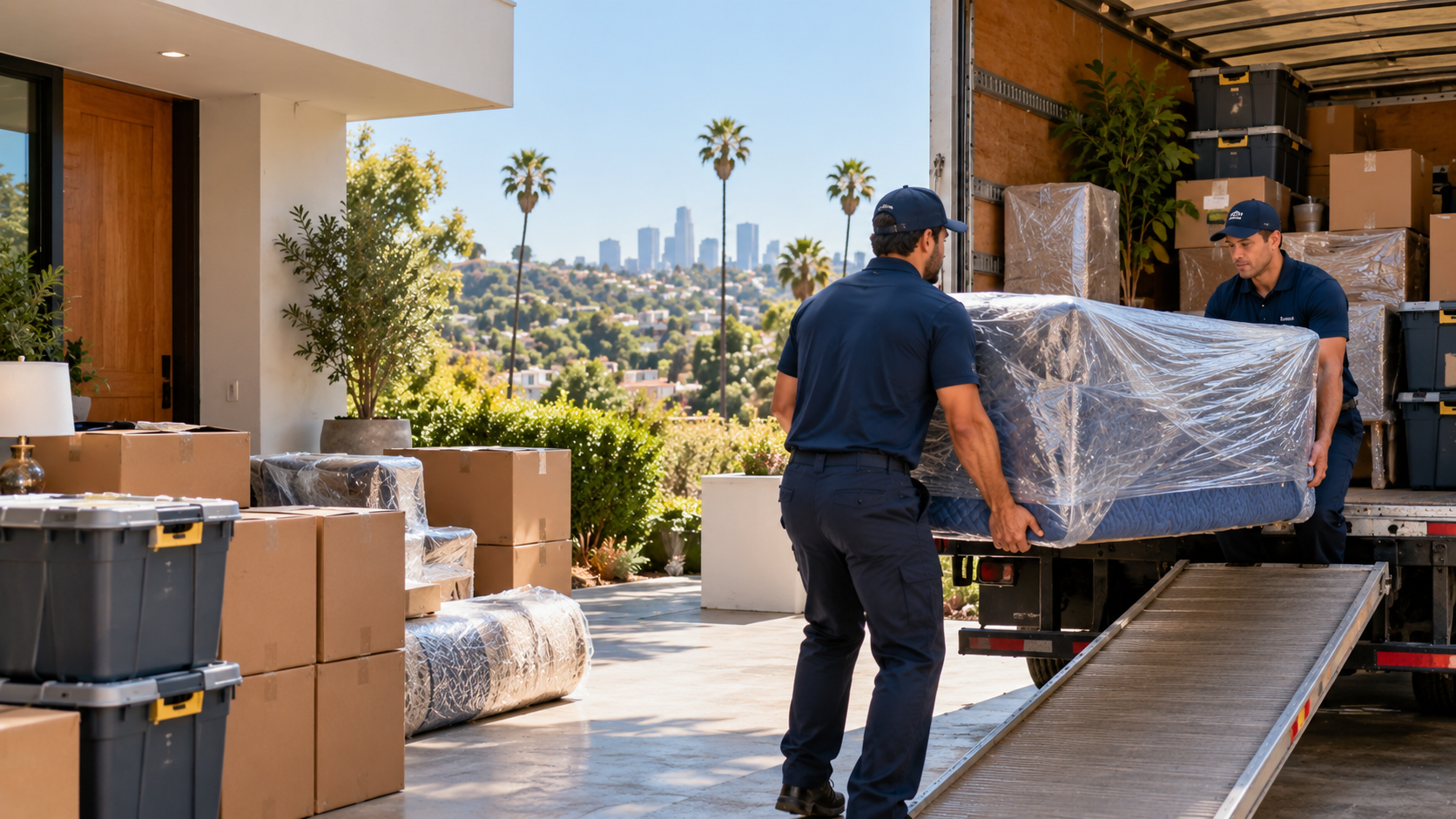
The hills add another layer. On steep, narrow streets above Los Feliz Boulevard a full-size truck often cannot reach or turn, so a shuttle from a smaller vehicle is used, and those extra trips belong in the written price rather than appearing as a surprise.
None of this makes a hillside move cost a fixed multiple of a flat one. It simply means the access method and the traffic window both feed into the hours, which is why they are quoted up front.
Your Price in Writing Before Anything Loads
The Not To Exceed amount under Maximum Rate Tariff 4 is the maximum total dollar amount the customer can be liable for, agreed in writing before any goods are moved or services performed. The final bill cannot exceed it except through a Change Order the customer agrees to.
That ceiling is a right, not a courtesy. It is set out in the notice and in the Agreement For Moving Services, and failing to include it has been cited by regulators as a violation.
California requires a written estimate, not a binding one. A verbal rate quote, whether per hour or per hundred pounds, is not an estimate and is not binding, so the written document is what counts.
The Not To Exceed figure is what actually caps the bill. Combined with valuation options you initial, the written estimate tells you the maximum before the truck is ever loaded.
Need Help in Los Angeles?
Popeye Moving & Storage serves Los Angeles and all of Los Angeles County.
Getting the Load Out of a Los Feliz Home
Loading out of Los Feliz is really two different jobs depending on the address. The flats around Hillhurst and Vermont and the hills above Los Feliz Boulevard call for different equipment, different access planning and sometimes different vehicles.
Establishing which one an address sits on is the first step before anything else. It changes the crew plan, the truck, and whether a shuttle enters the picture.
The Flats Around Hillhurst, Vermont and Franklin
The flats hold the neighborhood's 1920s and 1930s courtyard buildings, Spanish-style apartment blocks, duplexes and period houses on regular streets. The constraints here are stairs, small original door apertures and contested curb space.
Those original doorways and tight stair turns with plaster walls limit what can pass without careful handling. An armoire or a large framed piece sometimes has to come apart or take a different route through the building.
Protecting original fabric is not optional in these buildings. Decorative tilework, original hardwood or tile floors, arched openings and period banisters are easily damaged, so a crew plans its route through the home before lifting anything.
For renters and owners alike, the flats tend to produce faster jobs than the hill houses, closer to a standard apartment move. The care, though, stays the same because the housing is period stock worth protecting.
The Hills Above Los Feliz Boulevard
The hills are narrow, winding and steep, with switchbacks, blind bends and minimal turning room. Hillside houses are often built down the slope, with driveways cut into the grade and little room for a full-size truck.
On many of these streets a full-size truck simply cannot reach or turn. A shuttle from a smaller vehicle is the professional method for those addresses, and it is priced at the estimate, not improvised on the day.
Floor count does not describe the carry up here. Many hill properties are entered at the top with living space below, or have a garage above the house reached by an exterior stair, so the real question is which door is the practical route and how many exterior steps sit between the vehicle and the door.
Properties with no vehicle access at all are qualified on the phone before a date is confirmed. That avoids a crew arriving to a job that needs a staging plan nobody set up in advance.
LADOT Parking Permits and Oversize Trucks
Los Feliz is in the City of Los Angeles, so permits run through LADOT. Temporary street parking restriction signs reserve curb space, with a stated lead time of five working days.
Applications go to LADOT by phone on (213) 485-2298 between 8AM and 12:30PM Monday to Friday, as well as online and in person at a DOT Public Service Center, and there is a non-refundable fee. An oversize vehicle parking permit is published at $10.00 per day for up to three days.
The two permits do different things. The oversize permit legalizes the truck's size and overnight parking but reserves no space, while the signs reserve the curb, and signs do not override red curb, street cleaning or peak-hour restrictions.
One more rule matters for larger trucks. Commercial trucks with a logo or longer than 22 feet may not park overnight on city streets. Fees change, so readers should confirm current figures with LADOT.
Film Production and Griffith Park Traffic
Los Feliz is a frequent filming location, and a production permit can close a block or remove parking at short notice. The date should be checked rather than assuming the street will be as it was at survey.
Griffith Park also drives the traffic picture. Observatory and Greek Theatre traffic, especially at weekends and holidays, congests Vermont, Los Feliz Boulevard and the canyon roads, and on peak days the hill routes are genuinely slow.
Weekday morning slots are materially easier for both access and drive time. Starting early sidesteps the worst of the tourism traffic and keeps the double drive time charge down.
Brush-lined canyon streets also mean seasonal fire-weather awareness and winter run-off affecting steep driveways. Those conditions feed into how and when a hill job is scheduled.
What You Cannot Put in the Vault
A short checklist of what cannot go on the truck saves a headache on moving day. Each item on the list has a real reason behind it, usually law or safety rather than company preference.
Sorting these out before the crew arrives keeps the load moving and avoids last-minute repacking. Here is what will not make it into the vault.
Hazardous Materials and Why They Are Refused
Hazardous materials as defined by the US Secretary of Transportation are not accepted for shipment. That includes common household combustible liquids, corrosives, explosives and flammables.
This is federal law, not a company rule. 49 CFR 171.2(e) provides that no person may offer or accept a hazardous material for transportation in commerce unless it is properly classed, described, packaged, marked, labeled and in condition for shipment.
A mover who accepts undeclared hazmat is the accepting person under that rule. That is why the refusal is firm and applies regardless of how small the quantity seems.
Common culprits include propane, gasoline, paint thinner, pool chemicals and aerosols. Those should be used up, given away or disposed of properly before the move, never boxed for the vault.
Perishables, Plants and Open Liquids
Food, plants and open liquids are a different kind of problem, driven by spoilage, pest attraction and agricultural quarantine rather than fire code. They do not belong in long-term storage.
Perishable food will rot and draw pests. A warehouse works hard to keep carpet beetles, clothes moths, silverfish and cockroaches out, and cockroaches in particular are drawn to items stained with food, so leaving food in a vault undercuts the whole effort.
Plants need light and water and will die in a sealed vault, and they can carry pests or soil of concern. Open containers of liquid can spill and damage everything around them.
The simple rule is that anything that can spoil, sprout or spill stays out. Clearing the kitchen and the garden before pack-up avoids a mess that would otherwise sit for months.
Vehicles and Fuels
Vehicles are not accepted for storage with this service. Cars, motorcycles, boats and RVs cannot go into the vault, so a household storing a vehicle alongside the furniture needs a separate arrangement for it.
Fuel is part of the reason. Motorized items generally need gas and oil drained before storage, which the federal warehouse inspection standard treats as a basic preparation point.
That applies to smaller motorized equipment too, like mowers and generators. Drained of fuel and oil, those can often travel, but a running vehicle is a different category altogether.
If a vehicle is part of the picture, it is worth raising on the phone early. We can plan the household goods around it, but the car itself will not share the vault.
Need Help in Los Angeles?
Popeye Moving & Storage serves Los Angeles and all of Los Angeles County.
How We Handle a Long-Term Storage Job
From the first call to the day the goods come home, a long-term storage job follows a clear sequence. The aim is to handle the contents as few times as possible and to give the customer a price in writing before anything moves.
Here is how the work runs, using the facts we can confirm about our own operation.
The Survey and the Written Estimate
The survey starts by establishing whether the address is in the flats or the hills. From there we confirm truck access and turning room, where a shuttle can stage, driveway grade, gate aperture and overhead clearance.
Inside the home, we note the internal layout, including split levels and exterior steps, and in period houses we check door apertures, stair turns and floor finishes that need protection. That detail is what keeps a 1930s banister or a tile floor intact.
The written estimate and Not To Exceed price follow from that survey. The Agreement For Moving Services describes the shipment in enough detail to identify the articles and services in the price, including the number of helpers and packers and the rates quoted.
Valuation options are listed for the customer to initial, so a house of art and antiques can choose full value protection knowingly. You see the ceiling and the coverage choices before the crew returns to load.
Same-Day Pickup Into the Vault
We pick up and place goods into vaults at the Mar Vista warehouse the same day, with no overnight hold on the truck. The goods go from your home into the vault on the same visit.
That matters during a remodel because it reduces handling. The load is packed once at origin and vaulted once at the warehouse, rather than sitting on a truck or being shuffled between vehicles.
Fewer touches is especially valuable for fragile and high-value pieces. An inlaid cabinet or a framed canvas that is handled once at each end is better protected than one moved repeatedly.
For a household already dealing with construction stress, a clean same-day handoff is one less thing to track. The goods are in the vault at Mar Vista before the day is out.
Retrieving Your Goods When the Remodel Finishes
Because this is vaulted storage with no customer key, retrieval is arranged with the warehouse by appointment. That is ordinary trade practice for vaulted goods, since the warehouse has to retrieve and open the container for you.
Our business hours are 6am to 9pm, seven days a week, for calls and scheduling. Those are hours to reach us, not warehouse access hours for a customer to collect goods on their own.
When the house is ready, you call and we schedule the delivery back. The vault is pulled, opened, and the goods are moved into the finished home.
There is no minimum term holding you to a date, so retrieval happens when the remodel is actually done. If the project finishes early, the goods can come out early.
Credentials and Keeping Your Paperwork
Popeye Moving and Storage holds California household mover permit CAL T 189749 for intrastate work, and USDOT 1472924 and MC 498816C for interstate work, and is fully insured. We are BBB accredited with an A+ rating.
You can verify a mover's license status through the Bureau of Household Goods and Services, which is the right first step before booking any mover. Asking for the permit number and checking it before the job, not after a problem, is simple and worthwhile.
Keep your paperwork from the start. The estimate, the Agreement For Moving Services and the bill of lading are what strengthen any claim, and the most common reason a consumer loses a dispute is being unable to produce them.
Store those documents somewhere you can find them for the whole storage term. If a question ever comes up about the goods, that file is your record.
Storing a Los Feliz Home the Right Way
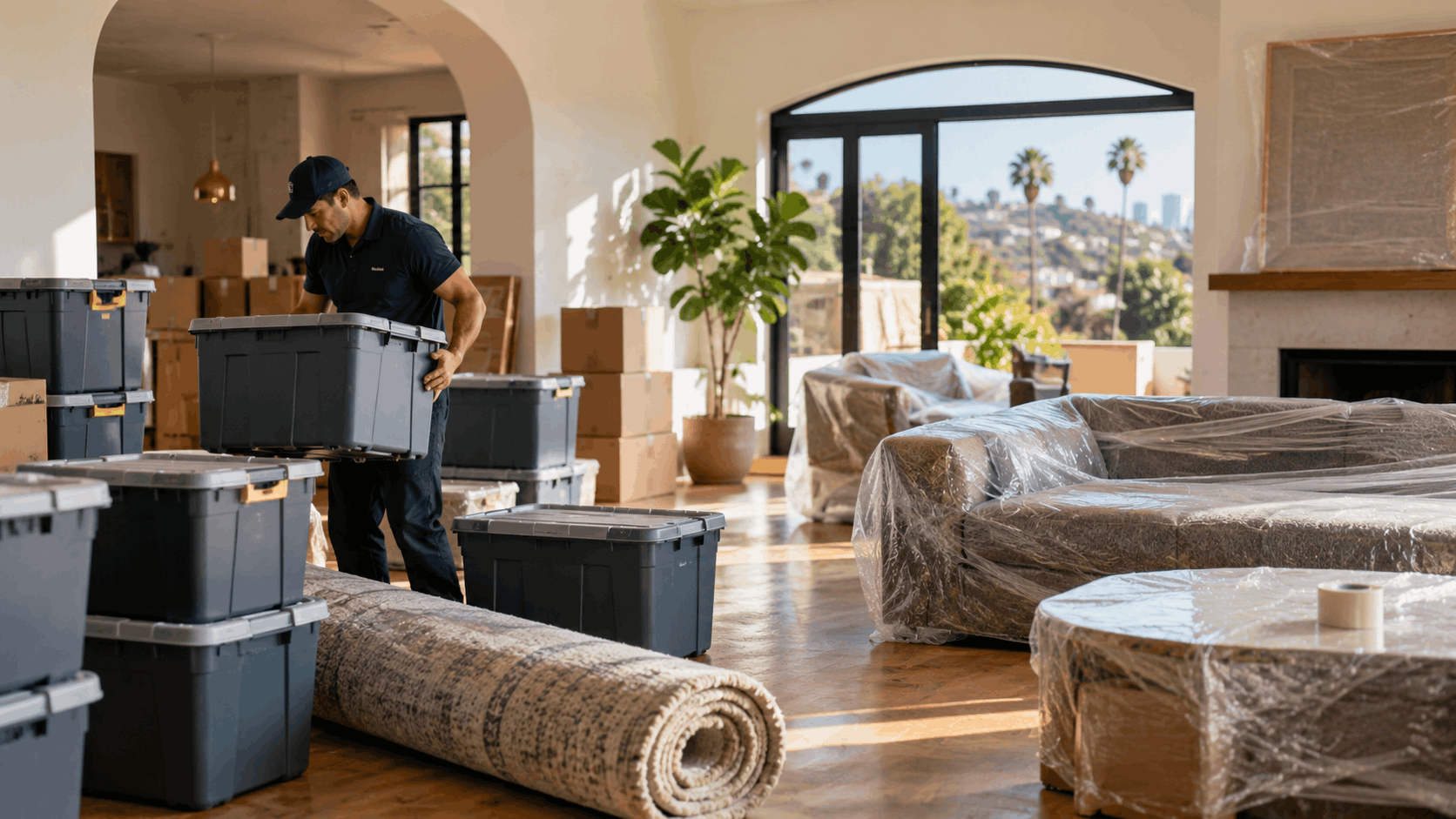
When a remodel has no end date, the move that matters is handing your period furniture, art and collections to a crew who will pack them once, vault them at our Mar Vista warehouse, and hold them with no term deadline. Every job starts with a survey of your address, flats or hills, and a written estimate with a Not To Exceed price before anything is loaded.
To set up a survey or ask about storing a Los Feliz household through your remodel, call Popeye Moving and Storage at (310) 823-9510 or reach us through our contact page. We will confirm access, list your valuation options, and put the price in writing so you know the ceiling before the truck arrives.
Frequently Asked Questions
- Is there a maximum length I can store my things during a remodel?
- No. Our vaulted storage carries no minimum and no maximum term, so goods can stay as long as the remodel runs, whether that is a few weeks or well over a year. Keep in mind that past the 90-day storage-in-transit window defined in Maximum Rate Tariff 4 Item 4, the arrangement falls under warehouse law rather than moving law, which changes the standard of care and claim rules that apply to the goods.
- How much does vaulted storage cost per month in the Los Angeles area?
- The typical area range is $60 to $90 per vault per month. That is a typical market range, not a quote or a fixed price from us. The total depends on how many vaults the household fills, so a full period house above Los Feliz Boulevard with art, pianos and large furniture uses more vaults than a one-bedroom flat near Hillhurst. Your specific price is set in writing after a survey.
- Can I access my belongings while they are in storage?
- Vaulted storage means no key, no individual unit and no right of entry, which is the opposite of a self-storage unit. When you need something, the warehouse retrieves and opens the vault for you by appointment, since you do not have independent access. That appointment step is ordinary trade practice for vaulted goods. If you expect to need frequent access to your things, a self-storage unit is the better fit for that need.
- Is my furniture insured while it sits in long-term storage?
- The mover's cargo coverage is built around transportation and storage-in-transit, and nothing confirms it extends into long-term warehouse storage. Ask what coverage applies to goods in long-term storage and get the answer in writing before the goods go in. Under California Commercial Code section 7204(a), a warehouse must exercise the care a reasonably careful person would under similar circumstances, which is ordinary negligence and not a guarantee against all loss, so separate insurance on valuable contents is worth discussing.
- Is the warehouse climate controlled, and to what temperature?
- Our Mar Vista warehouse is climate controlled for both temperature and humidity, with the specification confirmed per shipment. No industry body fixes a single definition of the term, so a figure one facility quotes can differ from another. Ask for the stated specification for your shipment rather than assuming a number. Published conservation references like the National Park Service range of 59 to 77 degrees Fahrenheit and 45 to 55 percent relative humidity are general guidance, not the conditions at any one warehouse.
- What happens if my remodel finishes sooner than expected?
- With no minimum term, there is no penalty for an early finish. The goods can come out whenever the home is ready, arranged by appointment with the Mar Vista warehouse. You call to schedule the delivery back into the finished house, and scheduling runs through our business hours of 6am to 9pm, seven days a week. Those are hours to reach us for scheduling, not warehouse access hours for collecting goods yourself.
- Can you reach a hillside house above Los Feliz Boulevard?
- On the narrow, steep, winding streets above Los Feliz Boulevard, a full-size truck often cannot reach or turn. In those cases a shuttle from a smaller vehicle is the professional method, and it is priced in the written estimate rather than improvised on the day. Properties with no vehicle access at all are qualified on the phone first, so we can plan a staging point before confirming a date. Floor count does not describe the carry when living space sits below the entry.
- Do I need a parking permit to load the truck in Los Feliz?
- Los Feliz is in the City of Los Angeles, so permits run through LADOT. Temporary street parking restriction signs have a stated five working day lead time, and an oversize vehicle permit is published at $10.00 per day for up to three days. Apply by calling LADOT on (213) 485-2298 between 8AM and 12:30PM Monday to Friday, or online or in person. Fees change, so confirm current figures with LADOT before the move.
- What cannot go into the storage vault?
- Hazardous materials are refused, including common household combustible liquids, corrosives, explosives and flammables, and that refusal is federal law under 49 CFR 171.2(e), not company preference. Perishables, plants and open liquids also stay out, driven by spoilage, pest attraction and quarantine concerns. Vehicles are not accepted with this service, so cars, motorcycles, boats and RVs cannot go into the vault. Motorized equipment that does travel needs its gas and oil drained first as a basic preparation step.
- Who regulates movers and storage in California if I have a problem?
- Household moving inside California is regulated by the Department of Consumer Affairs Bureau of Household Goods and Services, the BHGS, reachable on (916) 999-2041. It is not the CPUC, which no longer regulates movers. Complaints go to BHGS, and you can verify a mover's license there as well. Keeping your estimate, Agreement For Moving Services and bill of lading strengthens any claim, since the most common reason a dispute is lost is missing paperwork.
Popeye Moving & Storage Co. Team Team
Licensed moving and storage professionals serving Los Angeles and Los Angeles County.
Licensed in California · License #CAL T 189749 | USDOT 1472924 | MC 498816C
Why trust Popeye Moving & Storage?
Founded in 1994, Popeye Moving & Storage is a licensed and insured moving and storage service serving Los Angeles and Los Angeles County. All content is reviewed by our licensed technicians.

Need Help in Los Angeles?
Popeye Moving & Storage serves Los Angeles and all of Los Angeles County.
Related Articles

Storage During a Divorce or Household Split: Neutral-Ground Storage While Decisions Get Made
Neutral-ground storage gives Los Angeles couples a fair, safe place to keep shared belongings during a divorce or household split. Learn setups, access rules, costs, and legal tips.
Storage During Probate: Holding a Parent's Household Intact While the Family Decides
How storage during probate helps Los Angeles families hold a late parent's household intact, protect belongings, and decide together without pressure from the court clock.
Storage for Santa Monica and Brentwood Households: Where Westside Furniture Actually Goes Between Homes
A local guide to furniture storage for Santa Monica and Brentwood households, covering storage types, costs, coastal climate risks, and how Westside families bridge the gap between homes.