Canal-Facing Homes in Venice and What Access Looks Like on Move Day
Key Takeaways
- Canal homes along Carroll, Linnie, Howland, Sherman, Eastern and Grand have no vehicle access to the door, so everything is carried on foot from the nearest bordering road, often over a footbridge.
- Access must be confirmed on the first call, because the carry distance, crew size and whether a smaller shuttle vehicle is needed all decide the method and the price.
- Venice is City of Los Angeles, so parking permits run through LADOT, not Santa Monica, with temporary signs needing a five working day lead time and an oversize permit at $10.00 per day for up to three days.
- Local residential moving typically runs $150 to $200 per hour for a two-person crew and truck, with a long carry and any shuttle adding hours within the range.
- California bills local hourly moves on double drive time, and the Not To Exceed figure in the written Agreement caps the bill before anything is loaded.
- On a California intrastate move, declaring nothing covers goods up to $20,000 of actual cash value, not the weight of the box, and full value protection is the paid alternative.
- Popeye offers full-service vaulted, climate-controlled storage at its Mar Vista warehouse with same-day placement and no minimum or maximum term, running $60 to $90 per vault per month.
- California movers are regulated by the BHGS at (916) 999-2041, not the CPUC; Popeye operates under CAL T 189749 and is BBB accredited with an A+ rating.
In This Article
Most canal homeowners picture move day the same way: the truck backs up, the ramp comes down, and the crew loads straight through the front door. On the Venice canals, that picture is wrong before the first box is lifted. The homes along Carroll, Linnie, Howland, Sherman, Eastern and Grand sit on pedestrian paths, reached only on foot from the nearest road, often across a footbridge. No driveway. No vehicle access to the door at all.
That one fact decides the whole move. Access on a canal home means everything is carried from the nearest legal truck position, sometimes a long way, sometimes over water. Crew size, equipment, time and price all follow from the walk, not the truck. A canal move planned like a curbside move goes sideways fast.

Why Canal-Facing Homes Change the Move Before Anything Else?
The Venice canals are the one neighborhood feature that sets the method before any other detail. Every ordinary assumption about move day - truck at the curb, short walk to the door, dolly straight up the ramp - falls apart on a home facing the water. The crew works from the nearest legal truck position and carries in on foot.
That is not a complication to work around. It is the starting point. Once a crew knows the home has no vehicle access to the door, they size the job around the walk: how many people, what equipment, how long. Understanding that the carry drives everything is the difference between an accurate estimate and an ugly surprise on move day.
The Canals Were Built for People, Not Trucks
The Venice Canal Historic District was listed on the National Register in 1982. It keeps the Carroll, Linnie, Howland, Sherman, Eastern and Grand canals between Strongs Drive and Eastern Court. These are the six that survived after the other five original canals were filled in, and they were laid out for foot traffic and small boats, not delivery vehicles.
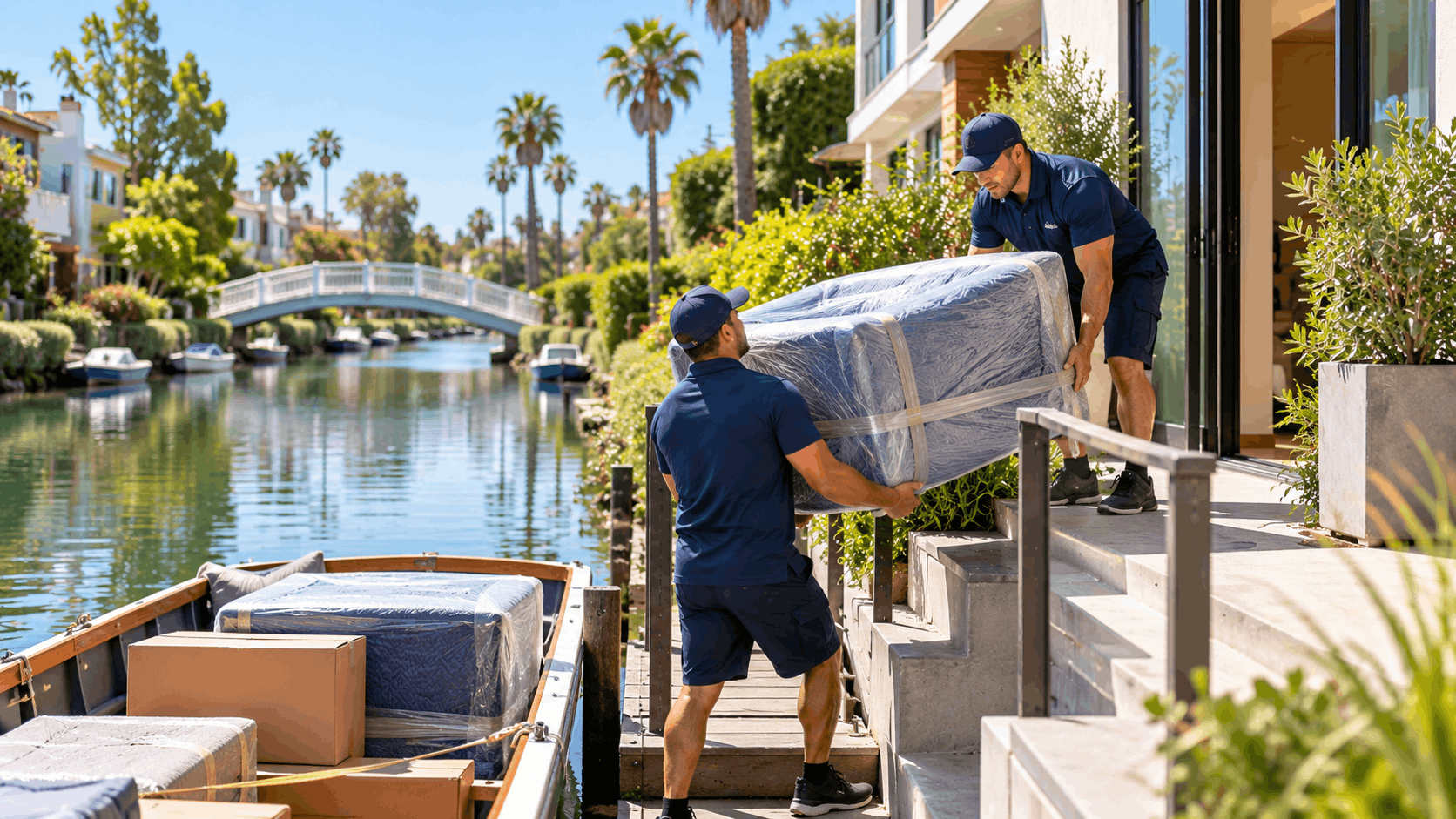
Homes here face the water, and you reach them on foot along a pedestrian path from the nearest bordering road. There is no road running past the front door, no driveway cutting in, and in many cases a footbridge between the street and the home. That layout is exactly why a truck never reaches the front of a canal house.
The original design is the reason the problem is permanent, not occasional. This was never a street grid with cars in mind. The paths and bridges were the circulation plan from the start, so no amount of planning gets a full-size truck to the door. The crew plans around it instead.
For anyone buying or selling a canal home, this is the first thing to understand about move day. The water view that makes the property special is the same feature that rules out curbside loading. A crew that knows the district plans the carry from the moment the address comes up.
Everything Is Carried, Sometimes Over a Bridge
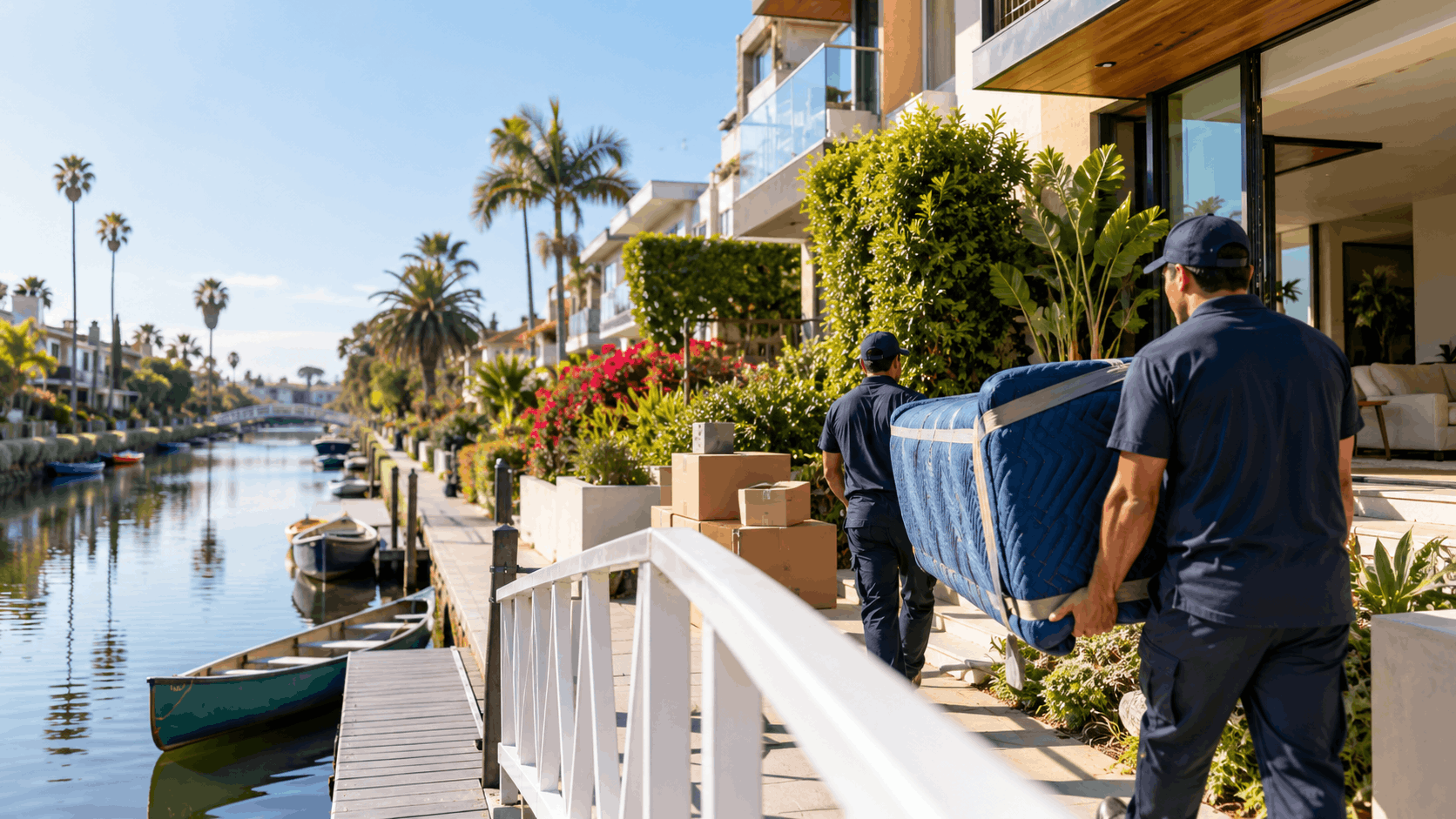
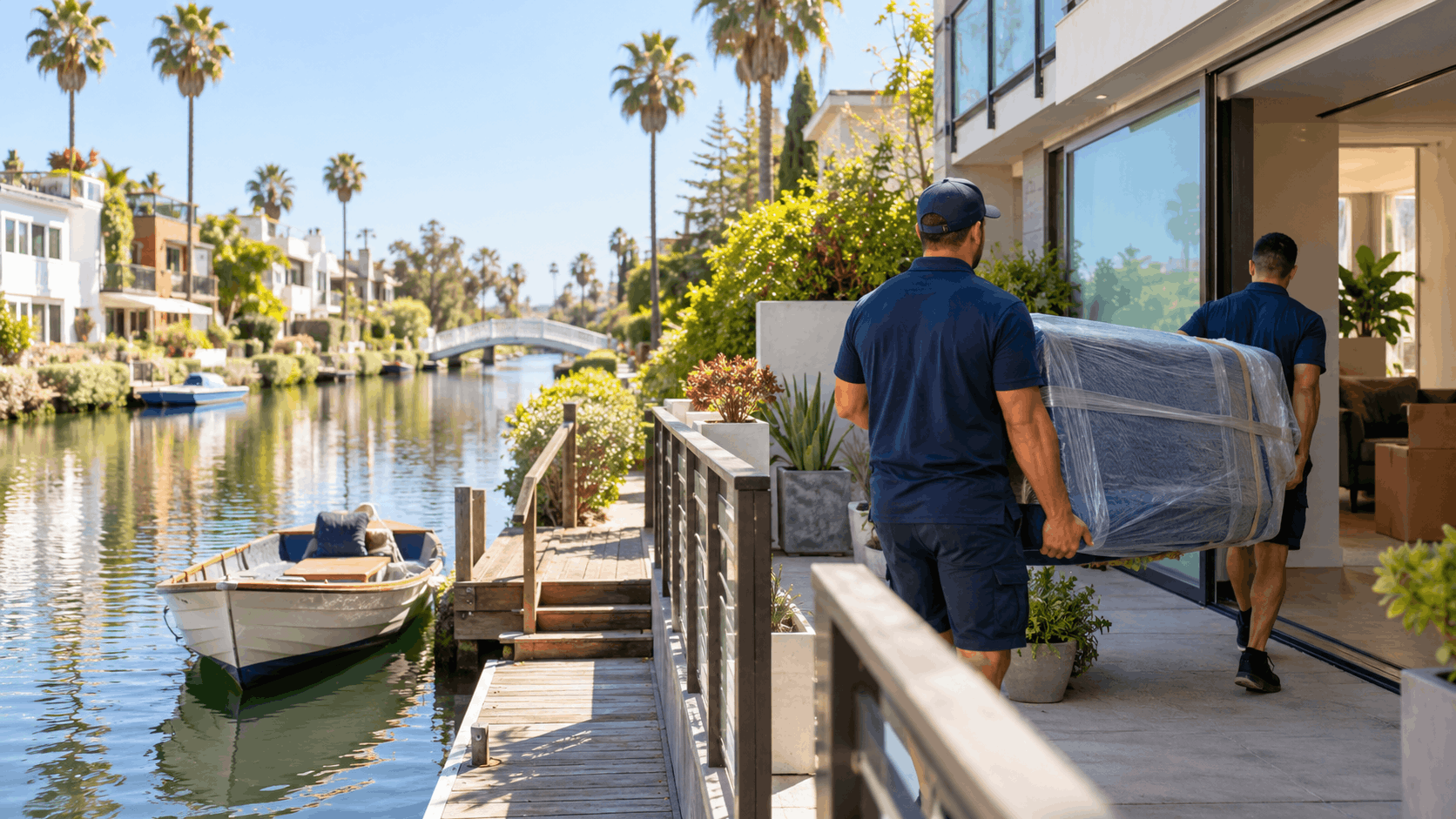
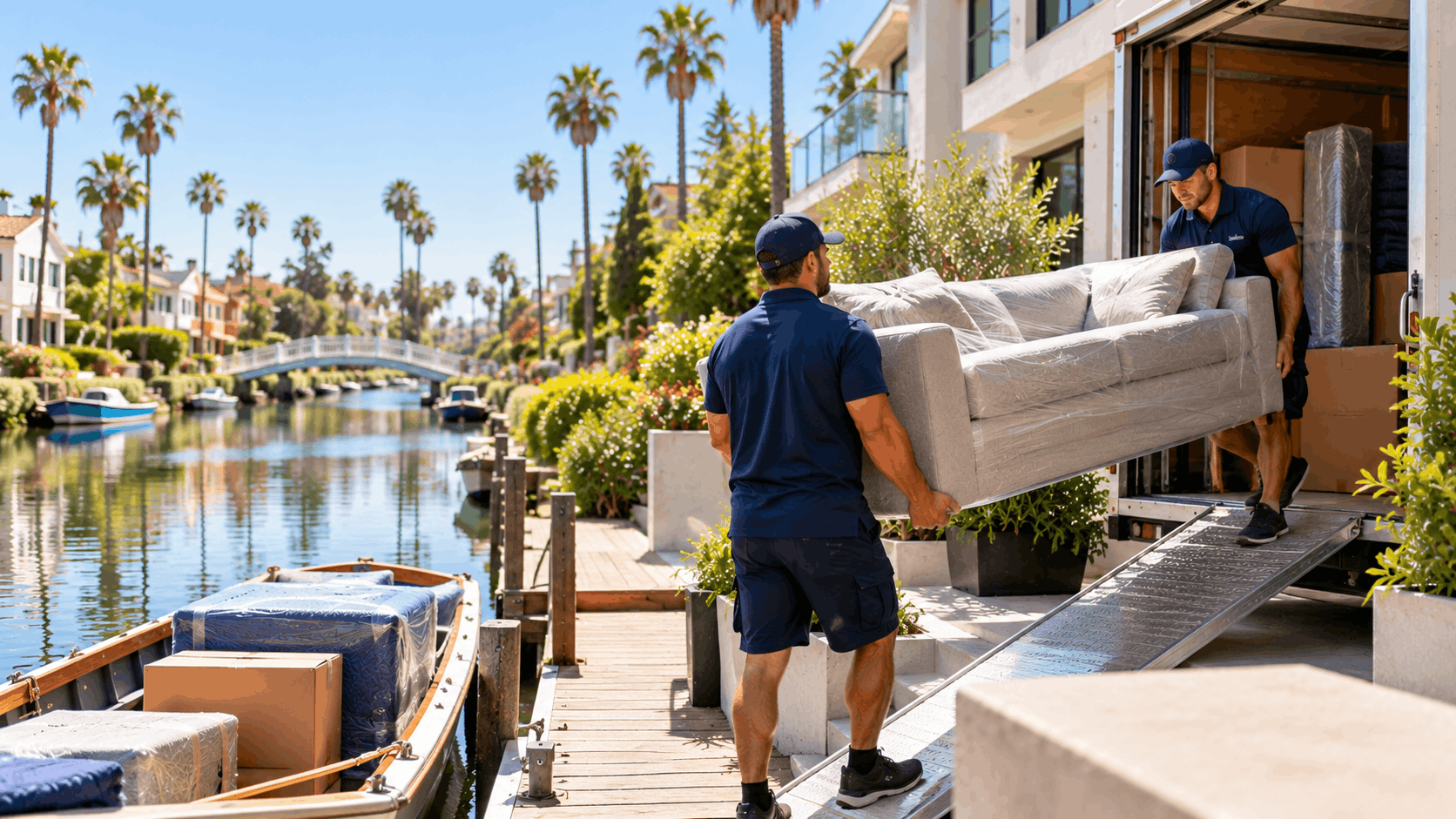
On a canal move, the crew carries each item on foot from the nearest legal truck position to the door. Depending on where the home sits along the canal, that walk can be a considerable distance, and it frequently crosses a canal footbridge. Furniture, boxes, appliances - all of it travels the path by hand or by dolly where the surface allows.
That carry changes the three things that drive a move: crew size, equipment and time. A longer walk means more people to keep the pace workable, or more hours with the crew you have. Bulky pieces that cross a narrow bridge need careful handling and sometimes extra hands on a turn.
The equipment list shifts too. Four-wheel dollies, furniture pads and straps matter more when the path is long and the surface is uneven. A piece that would roll straight off a tailgate into a garage instead gets walked the length of the path and over a bridge rail.
None of this is a reason to dread the move. It is simply the honest shape of the work on a canal home, and it is why the carry has to be measured, not guessed. A crew that has walked these paths builds the distance into the plan from the start.
Why Quoting a Canal Home Like a Curbside Move Fails
Quoting a canal property as though a truck can pull up outside is the worst mistake available in this neighborhood. The estimate collapses the moment the crew arrives and finds a footbridge between the street and the door. Everything that got left out - the carry, the extra hands, the shuttle - has to be added on the day, and that is where moves go wrong.
The fix is simple. Access has to be established on the first call, before a date is confirmed. We ask whether the home is on a canal or walk street, whether a truck can get anywhere near it, and how far the carry runs. Those answers shape the whole estimate.
When access is pinned down early, the written price reflects reality. The crew size matches the walk, the shuttle vehicle is priced in, and the hours account for the distance. For a straightforward look at how a full-service residential move is planned, access is always the first variable we settle.
A canal home can move smoothly. It just cannot move the way a curbside home does, and pretending otherwise helps no one. An honest access assessment at the outset is what keeps the move on time and on budget.
Get Your Free Quote
Tell us about your move. We'll be in touch soon.
Finding the Nearest Legal Truck Position Near the Canals
Since the truck cannot reach the door, the real question becomes where it can legally sit. That spot is the start of the carry, and everything downstream depends on it. The roads that border the canal district and the larger corridors that feed Venice both matter here.
Canal homes are reached from the streets that edge the district. The truck parks on the nearest one, the crew walks in, and the distance from that position to the door is a big part of the estimate. Knowing these streets and routes is how a crew turns a no-access property into a workable plan.
Strongs Drive, Eastern Court and the Streets Bordering the Canals
Strongs Drive and Eastern Court mark the edges of the canal district. The six canals sit between them, and the homes are reached from these bordering roads and the streets that run along the district. The truck takes the nearest legal position on one of those streets, and the crew walks in from there.
Which bordering street a crew uses depends on where the home sits along its particular canal. A house deep on Howland or Linnie may have a longer approach than one near the edge. The crew identifies the closest legal spot and measures the carry from that point to the door.
This is why an on-site or detailed phone survey matters so much on the canals. The nearest street changes the whole shape of the job, and two homes a block apart can have very different walks. Settling the truck position early is how the rest of the plan falls into place.
It also affects parking strategy. The closest bordering street may have contested curb space, which is where a reserved spot through LADOT earns its keep. More on that permit below, but the point starts here: find the legal position, then plan the carry and the parking around it.
The Roads That Feed the Area: Lincoln, Washington, Venice and the 90
Lincoln Boulevard, Washington Boulevard, Venice Boulevard and the 90 are the routes that bring a truck in and out of the area. They connect the canal district to the wider Westside and to our Mar Vista base, and the timing on them feeds directly into the move.
That timing matters because California bills local hourly moves on a double drive time convention. Travel between origin and destination is charged at twice the actual driving time, so a crew stuck on Lincoln at the wrong hour costs more than one that moves at an easier time of day. It is a regulated charge, not a padding tactic.
Weekend and summer traffic near the beach makes these corridors slower, which is another argument for an early weekday start. Getting the truck in and positioned before the area fills up protects both the schedule and the drive time on the bill.
Knowing the roads is part of knowing the neighborhood. A crew that works Venice regularly plans the approach around the realities of Lincoln, Washington, Venice and the 90 rather than discovering them on the day. That planning keeps the hours honest.
Tiny Lots, Narrow Frontages and Contested Curb Space
Venice lots are small and built out to their limits. Street frontages are narrow, and curb space is contested by residents, beach visitors and the steady trade along Abbot Kinney Boulevard. Open parking near a canal home is not something to count on.
Even with a reserved space, the carry is often longer than the customer expects. A narrow frontage means the truck may not sit directly opposite the path, and the walk to the door adds distance on top of the pedestrian approach. The reserved spot helps, but it rarely erases the carry.
This is why reserving curb space genuinely matters here rather than being optional. Without it, a crew can end up parked a long way off and walking even farther, which runs up the hours. With it, the truck gets as close as the law and the layout allow.
The Abbot Kinney trade is a real factor. Shops, restaurants and visitors keep the nearby streets busy through the day and into the evening, so a mid-afternoon start competes with all of that for space. Planning around it is part of doing the job well.
When a Smaller Vehicle and More Trips Is the Right Tool
On restricted-access canal and walk street homes, a shuttle from a smaller vehicle is the professional method, not an improvisation. A smaller truck can get closer to a tight approach, work a narrow street more easily, and run more trips to and from a full-size truck staged elsewhere. That is sometimes the right answer on the canals.
The shuttle is priced at the estimate, not sprung on the customer later. When a crew sees that a full-size truck cannot work the nearest position, the smaller vehicle and the extra trips go into the written price from the start. The customer knows the method and the cost before anything is loaded.
More trips in a smaller truck sounds slower, and it does add labor time, but it is often faster and safer overall than fighting a large vehicle into a space it does not fit. The math favors the tool that matches the access.
A crew that works Venice treats the shuttle as a standard option, not a fallback. The question is simply which vehicle gets the goods from the door to the truck with the least risk and the fewest wasted hours, and on many canal homes that answer is the shuttle.
Need Help in Los Angeles?
Popeye Moving & Storage serves Los Angeles and all of Los Angeles County.
Walk Streets, Alleys and the Rest of Venice Access
Buyers drawn to canal homes often look at walk street houses too, and the alley network serves much of the rest of Venice. Understanding how these access types work rounds out the picture around the water, because the same no-vehicle-access condition shows up on the walk streets, and the alleys carry much of the neighborhood's real traffic.
Access in Venice is rarely a simple matter of pulling up to a driveway. Between pedestrian paths, tight rear alleys and narrow vertical houses, the method has to be matched to the property. That is as true a few streets inland as it is on the canals.
Walk Streets Have No Vehicle Access Either
Walk streets carry the same condition as the canals. Marco Place, Amoroso Place, Nowita Place and Crescent Place are reached only on foot from the nearest road. No driveway, no vehicle access to the door, just a pedestrian path from where the truck can legally sit.
For a mover, that means a walk street home is planned the same way as a canal home. The crew finds the nearest legal truck position, measures the carry, and sizes the job around the walk. The absence of a bridge does not change the basic shape of the work.
These streets were laid out as pedestrian ways, which is exactly why they have the charm that draws buyers. The same feature that makes them pleasant to live on makes them a carry-everything job on move day. A crew that knows Venice treats them accordingly.
If a home sits on one of these walk streets, say so on the first call. It changes the plan as much as a canal address does, and getting it on the table early keeps the estimate accurate and the move day calm.
Alleys Are Often the Real Service Route
Much of Venice is served by narrow rear alleys rather than street frontage. Garages, gates and trash collection share that same space, so the alley is where a lot of the neighborhood's loading and unloading actually happens. On many properties it is the practical route to the door.
The catch is that the alleys are tight. They are frequently blocked by parked vehicles, and they are hard for a full-size truck to enter and harder still to reverse out of. A crew that commits a big truck to a blocked alley can lose a lot of time backing out.
This is another place where a smaller vehicle running more trips is often the right call. A compact truck can work an alley that a full-size vehicle cannot, and the extra trips still beat getting stuck. The shuttle method applies to alleys just as it does to the canals.
Checking the alley in advance - whether it exists, whether it is clear, and whether a full-size vehicle can use it - is part of a proper access assessment. Guessing wrong here turns a smooth job into a slow one.
Vertical Houses and Internal Stairs Add Carry Inside the Door
Contemporary Venice houses on small lots are frequently narrow and vertical. They stack living space over multiple internal flights with tight stair turns, so the floor count understates the carry. A three-level home on a small footprint can mean far more stair work than the square footage suggests.
Once the crew clears the pedestrian path, the carry continues inside. Roof decks, internal stairs and tight turns all add handling time, especially for large or awkward pieces that need two people and a careful pivot on a landing. A sofa that walked the canal path still has to climb the stairs.
This is why the internal layout has to be established, not assumed. Asking only how many bedrooms or floors there are misses the real work. A crew needs to know about the stairs, the turns and the roof deck to size the job properly.
Describe the inside of the home on the first call. The more a crew knows about the flights, the turns and the tight spots before move day, the closer the estimate lands to the final bill. On a vertical Venice house, the stairs are a big part of the story.
Parking Permits for a Venice Move Through LADOT
Venice sits in the City of Los Angeles, so moving permits run through LADOT, not Santa Monica. That surprises people, given Santa Monica sits immediately north with an entirely different process. Reserving curb space near the canals and legalizing the truck's size are both LADOT matters.
Two things are in play: temporary signs that reserve the curb, and an oversize vehicle permit that legalizes the truck's size and overnight parking. They do different jobs, and a canal move often wants both. Here is how each works.
Temporary Street Parking Restriction Signs
LADOT temporary street parking restriction signs reserve curb space for the move. The stated lead time is five working days, so this is not a same-day arrangement. On a contested Venice street, those reserved signs are the difference between parking near the path and parking a long walk away.
Applications go through LADOT by phone at (213) 485-2298 between 8AM and 12:30PM Monday to Friday, online, or in person at a DOT Public Service Center. There is a non-refundable fee for the service. Because fees change, confirm the current amount directly with LADOT when you apply.
The five working day lead time is the reason booking early matters on a canal move. A crew can plan the carry and the shuttle, but the reserved curb space has to be arranged well ahead of the date. Leaving it to the last minute risks having no reserved spot at all.
We handle this as part of planning the move, flagging the lead time so the signs are in place when the truck arrives. On a street where curb space is fought over by residents and beach visitors, that reserved spot earns its cost.
The Oversize Vehicle Parking Permit
The oversize vehicle parking permit is published at $10.00 per day for up to three days. It legalizes the truck's size and its overnight parking on a city street. What it does not do is reserve any space - that is the job of the temporary signs.
So the two permits work together. The oversize permit keeps the truck legal where larger vehicles would otherwise be restricted, and the signs hold the curb. On a canal move that may need a truck staged nearby overnight, both pieces matter.
Keep the roles straight. The oversize permit is about the vehicle's size and overnight status. The signs are about holding the space. Confusing the two leads to a legal truck with nowhere to park, or a reserved spot the truck is not permitted to occupy overnight.
Because the published figure can change, confirm the current oversize permit fee with LADOT when you book. The $10.00 per day for up to three days is the published rate at the time of writing, and LADOT is the source of truth on it.
Why Venice Surprises People Compared to Santa Monica
Santa Monica sits immediately north of Venice with an entirely different permit process. People who have moved in Santa Monica, or who assume the beach areas all work the same way, often expect Venice to follow suit. It does not.
Because Venice is City of Los Angeles, the permit runs through LADOT. That single jurisdictional fact changes the application route, the lead time and the rules. A plan built on Santa Monica's process will not fit a Venice move.
One LADOT rule matters a great deal for movers: commercial trucks with a logo or longer than 22 feet may not park overnight on city streets. That restriction shapes how a crew stages a large vehicle around a canal move, and it is part of why a smaller shuttle vehicle is often the right tool.
Getting the jurisdiction right from the start saves a lot of trouble. A crew that works both sides of the Santa Monica line knows not to carry one city's process across the boundary. For moves on the other side of that line, our Santa Monica moving team works to that city's separate rules.
What to Confirm Before a Canal Move Is Quoted
A canal or walk street move is only as good as the information behind the estimate. The checklist below is what decides the method and the price, and settling each item before the date keeps the written price honest. None of it is optional on a home near the water.
We work through these points on the first call. They determine the crew size, the equipment, the vehicle and the hours, and they are the reason an experienced Venice crew can quote a canal home accurately where a general mover guesses.
Whether There Is Any Vehicle Access at All
The first question is whether a truck can reach the door at all, and for most canal houses it cannot. Properties with no vehicle access are qualified on the phone before a date is confirmed, because that single fact reshapes the entire move.
If the home is on a canal or a walk street, a crew needs to know immediately. The answer sets the method: shuttle vehicle or full-size truck, large crew or standard crew, long carry or short. There is no sense in confirming a date before this is clear.
This is not a detail to discover on move day. A truck that arrives expecting a driveway and finds a footbridge has to improvise, and improvising costs time and money. Qualifying access on the phone prevents that scramble entirely.
Be straight about the access when you call. Telling a crew the home has no vehicle access is not bad news - it is exactly the information needed to plan a smooth, correctly priced move. The honest answer up front protects everyone.
Carry Distance From the Nearest Legal Position
The distance from where the truck can legally sit to the front door drives crew size and time. A short carry needs fewer hands and fewer hours. A long one, especially across a canal footbridge, needs more of both, and that belongs in the estimate rather than arriving as a surprise.
On a canal home the walk may cross a bridge, which slows every trip and demands care with larger pieces. A crew measuring the carry accounts for the bridge, the path surface and the number of trips the volume of goods will require. That is how the hours get estimated honestly.
This is also where crew size and total time trade off against each other. More people shorten the clock on a long carry but cost more per hour. A crew balances the two to keep the move efficient, and that balance depends on knowing the real distance.
Because the carry is such a large part of a canal move, pinning it down is one of the most valuable things done before the date. A measured carry means an estimate that holds, rather than one that climbs on the day.
Filming, Events and Beach Season on the Date
Venice is a frequent filming location and hosts regular events, either of which can close a block or remove parking at short notice. A street that was clear at survey can be shut for a production on move day, so the date has to be checked, not assumed.
Weekend and summer visitor traffic fills every space near the beach and boardwalk. Ocean Front Walk and the blocks around it draw crowds that compete for every inch of curb, which makes a weekend summer move the hardest version of the job.
That is why an early weekday start is worth materially more here than in most neighborhoods. Getting the truck positioned before the area fills up protects the parking, the carry and the drive time all at once. The quiet early hours are the friend of a canal move.
Checking the date against filming and events is part of planning. A crew that works Venice knows to look rather than assume the street will be as it was at survey. A little homework on the date avoids a lot of trouble on the day.
The Internal Layout Before the Crew Arrives
Narrow vertical houses with multiple flights and tight turns need to be described, not guessed, because floor count understates the work. A crew that knows only the bedroom count walks in blind to the stairs that make up much of the labor.
Describing the inside means talking through the flights, the stair turns, any roof deck, and the pieces that will fight a tight landing. A grand piano on the third floor of a vertical Venice house is a very different job from the same piano in a ground-floor flat.
Establishing this early keeps the estimate accurate. The internal carry adds hours on top of the pedestrian path and the bridge, and leaving it out of the quote is how a fair estimate turns into a disappointing bill. The stairs have to be counted.
We ask about the layout on the first call for exactly this reason. The more a crew knows about the inside of the home before move day, the closer the written price lands to the final total. On a vertical house, the interior is half the work.
Need Help in Los Angeles?
Popeye Moving & Storage serves Los Angeles and all of Los Angeles County.
What a Canal Move Costs in Venice
Price on a canal move comes down to the researched area ranges plus the access factors that move the final number within them. The figures below are typical ranges for the Los Angeles area, presented as ranges and never as a quote. On a move inside California, the Not To Exceed figure in the written agreement caps the bill before anything is loaded.
| Service | Typical Area Range |
|---|---|
| Local residential moving (two-person crew and truck) | $150 to $200 per hour |
| One-bedroom apartment local move | $350 to $650 |
| White glove moving | $150 to $250 per hour |
| Unpacking | $50 to $75 per hour per crew member |
| Fine art and antique moving | $300 to $1,200+ |
| Piano moving | $200 to $600 |
| Chandelier moving | $150 to $450 |
| Custom crating | $150 to $800+ per crate |
| Vaulted storage | $60 to $90 per vault per month |
Typical Local Moving Ranges
Local residential moving in the area runs $150 to $200 per hour for a two-person crew and truck. A one-bedroom apartment local move typically falls between $350 and $650. These are typical ranges for the Los Angeles area, not a fixed price for any one move.
White glove moving, with extra care and handling, runs $150 to $250 per hour. Unpacking is $50 to $75 per hour per crew member. Where a move needs more hands or a higher level of service, the range reflects it.
The actual price for a specific move depends on that move. Volume, access, crew size and the services ordered all shape where a job lands within these ranges. That is why the written estimate, not a published range, is the real number.
Treat these figures as a guide to what to expect, not a quote. The quote comes after access and layout are settled, and on a move inside California it carries a Not To Exceed cap. The ranges simply tell you the territory.
How Carry Distance and Crew Size Move the Number
A long carry over a bridge, or a smaller shuttle vehicle running more trips, adds labor time, and that time belongs in the quote. More carry means more crew or more hours, which moves the total within the hourly range. This is the single biggest variable on a canal home.
A short-carry, ground-floor move sits near the bottom of a range. A long-carry canal home with a footbridge and internal stairs sits higher, because the same volume of goods takes more hours and often more people to move safely. The access does the work of setting the price.
The shuttle method factors in here too. Extra trips in a smaller truck add time, but they are the correct method for the access and are priced in from the start. The goal is the efficient route, not the cheapest-looking one that falls apart on the day.
None of this is padding. Every added hour traces back to a real feature of the property - the carry, the bridge, the stairs, the shuttle. A crew that explains where the hours come from gives the customer a quote they can trust.
Double Drive Time and the Not To Exceed Figure
California bills local hourly moves on a double drive time convention. Travel between origin and destination is charged at twice the actual driving time. It is a regulated charge, not a padding tactic, and it is why traffic timing on Lincoln, Venice and Washington affects the bill.
Explaining double drive time up front is better than leaving a customer to find it on the invoice. It is a legitimate, regulated part of a local California move, and an early weekday start that avoids the worst traffic keeps that charge as low as the route allows.
The customer's main protection on a move inside California is the Not To Exceed amount. Set out in the Agreement For Moving Services before any goods are moved, it is the maximum total for which the customer may be liable, and the final bill cannot exceed it except through a Change Order the customer agrees to.
That ceiling is a right, not a courtesy. The shuttle vehicle and the long carry are priced into the Not To Exceed figure, so they are not added later as surprises. The customer knows the cap before the truck is loaded.
Specialty Items Common in Canal Homes
Higher-value canal and contemporary houses often hold art, designer furniture and electronics. Those pieces have their own handling and their own ranges. Fine art and antique moving runs $300 to $1,200+, and our fine art and antique moving service is built for exactly these contents.
Piano moving runs $200 to $600, with upright pianos costing less than grands. On a vertical Venice house with a third-floor music room, the stairs and the carry push a piano job toward the top of its range. Our piano moving crews plan the route before the day.
Chandelier moving runs $150 to $450, and custom crating runs $150 to $800+ per crate. A fragile fixture or a valuable sculpture crossing a footbridge is exactly the kind of item that earns a purpose-built crate. Our custom crating team builds to the piece.
These specialty ranges stack on top of the base move. A canal home full of art and designer furniture is a different job from an empty rental, and the estimate reflects the real contents. Naming the valuable pieces early lets the crew plan and price them properly.
Protecting Your Belongings on a Canal Move
Canal homes often hold art and designer furniture, which makes valuation a real concern. On a California intrastate move, what you are actually covered for is set by Maximum Rate Tariff 4, and the common belief about it is wrong. Here is what the default coverage is and what to declare separately.
Valuation is not insurance, and the language matters. Released value is a liability limit. Full value protection is the paid alternative. Knowing the difference is how a canal homeowner with valuable contents makes an informed choice before the truck is loaded.
What the Default Coverage Actually Is
Maximum Rate Tariff 4 Item 136(1) bases transportation rates on a declared value of 60 cents per pound per article. That is how the rate is calculated, and it is widely misstated as the payout. It is not the payout.
Item 136(2) says that unless the shipper expressly declares a value other than $20,000 for the shipment, the mover's maximum liability for lost and damaged articles is up to $20,000 of actual cash value. Both facts are true at once: 60 cents per pound is the rate basis, and $20,000 actual cash value is the default coverage.
So on a California intrastate move, declaring nothing does not leave a television covered for the weight of the box. It leaves goods covered to actual cash value up to $20,000. That is a meaningful protection, and it is the opposite of what the 60-cent figure is often taken to mean.
For a canal homeowner, that distinction matters. A home full of valuable contents should understand the real default before deciding whether to pay for more. The tariff gives a genuine floor, not a few dollars a pound.
The Paid Options and Your Right to Be Offered Them
Released value is a liability limit, not insurance. Full value protection is the paid alternative, offering a higher level of coverage for a charge. Each valuation option is listed on the Agreement with the mover's charge and a space for the shipper to initial.
The customer has a right to be offered higher coverage and a right to decline it knowingly. The tariff requires each option to be set out so the shipper can choose, and regulators have cited carriers for failing to allow a higher valuation than the 60-cent basis. The choice belongs to the customer.
For a canal home with art and designer furniture, full value protection is worth a close look. The value of the contents can far exceed the default cap, and the paid option raises the limit to match. Reading the valuation section of the Agreement is the moment to decide.
A crew should walk the customer through these options rather than leaving them buried in paperwork. The initial next to each choice is there precisely so the decision is made on purpose. An informed choice is the whole point of the requirement.
Declaring Art, Antiques and High-Value Pieces
Items of extraordinary value - antiques, art, and gold or silver articles - should be separately described on the inventory with a value declared for each. A blanket valuation does not do justice to a single high-value piece, so each one is listed on its own.
This separate declaration protects both sides. The crew knows which pieces demand the most care, and the customer has a documented value if a claim ever arises. On a canal move, where art often crosses a footbridge, that documentation matters.
Money, jewelry and important papers are best carried by the customer rather than shipped. Small, high-value and irreplaceable items belong in the customer's own hands, not on the truck. That is the simplest protection of all, and it costs nothing.
Taking a few minutes to list the extraordinary items and to set aside the valuables for personal transport is time well spent. For a home full of art and designer pieces, it is the difference between a documented, protected move and a hopeful one.
Storage When the Canal Timeline Does Not Line Up
Canal moves often involve a gap between homes, or goods coming out of a beach property with nowhere to go yet. Full-service vaulted storage bridges that gap, and the salt air near the water makes climate control a sensible choice for the contents.
Our storage is full-service and vaulted, handled by our own crews at our Mar Vista warehouse. That operating model matters for how the storage is regulated and for what it means for the customer, and it suits a canal move well.
Full-Service Vaulted Storage at the Mar Vista Warehouse
We offer full-service vaulted storage at our warehouse at 5509 1/2 S Centinela Ave, Los Angeles, CA 90066, in Mar Vista. The customer has no key, no individual unit and no right of entry, and goods are handled by our crews. It is storage done for you, not self-storage you visit.
That model places the service under Commercial Code Division 7 rather than the self-storage rules. Because the customer does not have exclusive use and access, the vaulted operation sits outside the self-service storage framework, and the standard of care and the rules that apply are the warehouse ones.
For a canal move, full-service storage is a natural fit. The crew that carries the goods across the footbridge loads them straight into vaults, and the whole handoff stays with one team. Our vaulted storage keeps the chain simple.
The Mar Vista location keeps the goods close to the Westside, a short run from the canals along the same corridors the move uses. That proximity makes a same-day move-into-storage straightforward rather than a cross-town haul.
Why Climate Control Matters for Beach-Area Contents
Sand and salt air are practical concerns for goods coming out of a canal or beach property. Salt air and humidity act on timber, leather, rattan and upholstery, which is exactly the kind of furniture common in a Venice home near the water.
Our storage is climate controlled for both temperature and humidity. A sealed, conditioned inland building is a different environment from the air at a beach property, which is why climate-controlled storage is a reasonable recommendation for contents coming out of the canals.
The specification is confirmed per shipment rather than fixed to a single published number. Conservation references for temperature and humidity exist, but the right conditions depend on what is being stored, and the specification is set for each shipment accordingly.
For wood furniture, leather pieces, art and upholstery from a beach home, the controlled environment is the sensible choice. It is the difference between storing valuable contents thoughtfully and leaving them to the swings of an unconditioned space.
Same-Day Placement and Vault Sizes
We pick up and place goods into vaults the same day, with no overnight hold on the truck. The crew loads at the canal home and the goods go straight into the warehouse that day, which keeps the handling to a minimum.
We run the full range of vault sizes, standard through oversized, so the storage matches the volume of the move. A one-bedroom's worth of goods and a full house take different numbers of vaults, and the range covers both.
Vaulted storage runs $60 to $90 per vault per month, presented as a typical range for the area. There is no minimum and no maximum term, so a short gap between homes and a long-term store are both workable. Our long-term storage covers the longer timelines.
For a canal move where the next home is not ready, that flexibility is the point. The goods come out of the beach property, into conditioned vaults the same day, and stay as long as the timeline needs.
Need Help in Los Angeles?
Popeye Moving & Storage serves Los Angeles and all of Los Angeles County.
How Our Team Handles a Canal-Facing Move
From the access call to the written price, a canal or walk street move follows a clear path with us. Knowing how it works tells a customer exactly what to expect and why the estimate is built the way it is.
The thread running through all of it is honest access assessment. Everything else - crew, vehicle, hours, price - follows from getting the access right on the first call.
Establishing Access on the First Call
We confirm whether the home is on a canal or walk street with no vehicle access, whether an alley can be used, and the carry distance from the nearest legal position, all before a date is confirmed. Those three answers set the method.
If the property has no vehicle access at all, that is qualified on the phone, because a date cannot be sensibly confirmed without it. A canal home that needs a shuttle and a long carry is a different job from a curbside one, and the plan starts there.
We also ask about the internal layout - the flights, the stair turns, the roof deck - so the carry inside the door is counted too. The goal is a complete picture before the crew is scheduled, not a surprise on the day.
This front-loaded planning is what lets us quote a canal home accurately. The harder the access, the more it matters to settle it early, and the canals are about as demanding as access gets on the Westside.
The Written Price and the Not To Exceed Figure
On a move inside California, the Not To Exceed amount is set in writing in the Agreement For Moving Services before any goods are moved. The final bill cannot exceed it except through a Change Order the customer agrees to. That is the customer's main protection, and it is a right, not a favor.
The shuttle vehicle and the long carry are priced into that figure, not added later. Because access is settled on the first call, the written price reflects the real method from the start. There is no gap between the quote and the job on the day.
If something genuinely changes - more goods than described, a service added - it goes through a Change Order the customer signs off on. The ceiling only moves with the customer's agreement, which is exactly how the tariff intends it to work.
A proper written estimate also describes the shipment, the services and the charges in enough detail to check. A verbal quote is not an estimate and is not binding. The written Agreement is the document that holds.
Licensing, Insurance and Who to Verify With
We operate under CAL T 189749 for intrastate work and USDOT 1472924 and MC 498816C for interstate work. We are fully insured, and we are BBB accredited with an A+ rating. A canal move inside California runs under our intrastate permit.
Household moving inside California is regulated by the Department of Consumer Affairs Bureau of Household Goods and Services, the BHGS, reachable at (916) 999-2041. The BHGS is where a customer verifies a mover's license and files a complaint. The CPUC no longer regulates California movers and has not since 2018.
The practical advice is simple and checkable: ask for the permit number and verify it before booking rather than after a problem. You can confirm our status with the BHGS, and you can review our accreditation independently.
Keeping the estimate, the Agreement For Moving Services and the bill of lading strengthens any claim, so hold on to the paperwork. The most common reason a customer loses a dispute is being unable to produce the documents.
Planning Your Canal Move With Us
A Venice canal move starts with one honest phone call about access, and from there we build a written estimate with a Not To Exceed figure that caps the bill before anything is loaded. The shuttle vehicle, the carry across the footbridge and the stairs inside the door are all priced in, not added later.
Call Popeye Moving & Storage at (310) 823-9510 to walk through your canal or walk street address, and we will confirm the access and the plan before a date goes on the calendar.
Frequently Asked Questions
- Can a moving truck reach a canal-facing home in Venice?
- In most cases, no. Canal homes sit on pedestrian paths with no vehicle access to the door, so the truck parks on the nearest bordering road, such as the streets edging the district between Strongs Drive and Eastern Court. The crew then carries everything in on foot, often across a canal footbridge. That carry is why access has to be confirmed on the first call before a date is set.
- How much does it cost to move out of a Venice canal home?
- Typical area ranges are local residential moving at $150 to $200 per hour for a two-person crew and truck, and a one-bedroom apartment local move at $350 to $650. These are typical ranges, not a quote. On a canal home, the long carry and any shuttle vehicle add hours within those ranges. The actual price is set in writing with a Not To Exceed cap before anything is loaded.
- Do I need a parking permit for a move near the Venice canals?
- Venice is City of Los Angeles, so temporary parking signs go through LADOT with a five working day lead time, applied for at (213) 485-2298 between 8AM and 12:30PM Monday to Friday, online, or in person, with a non-refundable fee. An oversize vehicle permit runs $10.00 per day for up to three days and legalizes the truck's size and overnight parking. Confirm current fees with LADOT.
- Why is moving in Venice different from Santa Monica?
- Santa Monica sits immediately north with an entirely different process, which trips people up. Venice falls under LADOT because it is City of Los Angeles, so the permit route and the overnight truck rules are different. One LADOT rule matters most: commercial trucks with a logo or longer than 22 feet may not park overnight on city streets, which shapes how a crew stages a large vehicle around a canal move.
- What is double drive time and will it apply to my move?
- California bills local hourly moves on a double drive time convention, so travel between origin and destination is charged at twice the actual driving time. It applies to local hourly moves in the state. It is a regulated charge, not padding, and traffic on Lincoln, Venice and Washington affects it. An early weekday start that avoids the heaviest traffic keeps that charge as low as the route allows.
- How are my belongings covered if something is damaged?
- On a California intrastate move, declaring nothing covers goods up to $20,000 of actual cash value, not the weight of the box. The 60 cents per pound figure is only the rate basis, not the payout. Full value protection is the paid alternative, listed on the Agreement with a space to initial. Claims must be filed in writing with the mover within nine months after delivery, so keep your paperwork.
- What if my canal home has stairs or no alley access?
- Narrow vertical houses and no-access properties are established before a date is confirmed, so the crew, equipment and time match the carry. On a vertical Venice house, the stairs and tight turns add real work that floor count understates. For tight alleys that a full-size truck cannot use, a smaller shuttle vehicle running more trips is often the right method, and it is priced into the estimate from the start.
- Can Popeye store my belongings during a canal move?
- Yes. We offer full-service vaulted storage at our Mar Vista warehouse at 5509 1/2 S Centinela Ave, climate controlled for both temperature and humidity, with the specification confirmed per shipment. Goods are picked up and placed into vaults the same day with no overnight hold on the truck, and there is no minimum or maximum term. Vaulted storage runs $60 to $90 per vault per month.
- Who regulates movers in California and how do I verify a mover?
- Household moving inside California is regulated by the Department of Consumer Affairs Bureau of Household Goods and Services, the BHGS, reachable at (916) 999-2041. That is where you check a license and file a complaint, not the CPUC, which stopped regulating movers in 2018. We operate under CAL T 189749 for intrastate work. Ask any mover for its permit number and verify it before booking.
- How far in advance should I book a canal move?
- Book early. Access has to be confirmed on the first call, and LADOT temporary parking signs need a five working day lead time, so the reserved curb space must be arranged ahead of the date. Booking early also secures an early weekday start, which is worth more here than almost anywhere, because it avoids the beach and boardwalk traffic that fills the area on weekends and through the summer.
Popeye Moving & Storage Co. Team Team
Licensed moving and storage professionals serving Los Angeles and Los Angeles County.
Licensed in California · License #CAL T 189749 | USDOT 1472924 | MC 498816C
Why trust Popeye Moving & Storage?
Founded in 1994, Popeye Moving & Storage is a licensed and insured moving and storage service serving Los Angeles and Los Angeles County. All content is reviewed by our licensed technicians.

Need Help in Los Angeles?
Popeye Moving & Storage serves Los Angeles and all of Los Angeles County.
Related Articles
Moving in the LA Hills: What Steep Streets and Narrow Roads Mean for Your Move
Hillside moves in Los Angeles aren’t like flat-land moves. Here’s what to expect with steep streets, narrow roads, and limited truck access in neighborhoods from Hollywood to Brentwood.
Storage for Santa Monica and Brentwood Households: Where Westside Furniture Actually Goes Between Homes
A local guide to furniture storage for Santa Monica and Brentwood households, covering storage types, costs, coastal climate risks, and how Westside families bridge the gap between homes.
Vaulted Storage for Venice Renters Between Short Leases
A clear guide to vaulted storage for Venice renters between short leases: how it differs from self-storage, the 90-day rule, valuation, access, and Venice move-out permits.