Storage in Trousdale Estates with Same-Day Mid-Century Estate Pickup
Key Takeaways
- Popeye picks up in Trousdale Estates and places goods into vaults at the Mar Vista warehouse the same day, with no overnight hold on the truck.
- Loma Vista Drive's terraced cul-de-sacs on a steep grade mean a full-size truck often cannot turn, so a planned shuttle method is used and priced at the estimate.
- North of Sunset, 18-wheelers require police escorts and 72 hours notice, and traffic plans take four business days (96 hours), so timing is confirmed before quoting.
- California's valuation default is up to $20,000 of actual cash value; the 60 cents per pound figure is only the rate basis and pays almost nothing on art or designer furniture.
- This is full-service vaulted storage with no key, no unit, and no right of entry; there is no minimum or maximum term, and vehicles are not accepted.
- A written estimate with a not-to-exceed figure caps the bill before any goods are loaded; California does not require a binding estimate.
- California household moves are regulated by the BHGS at (916) 999-2041, not the CPUC; Popeye operates under CAL T 189749, USDOT 1472924, and MC 498816C.
- Storage-in-transit runs up to 90 days under tariff rules; past that, goods fall under the warehouse's own contract and Commercial Code Division 7.
In This Article
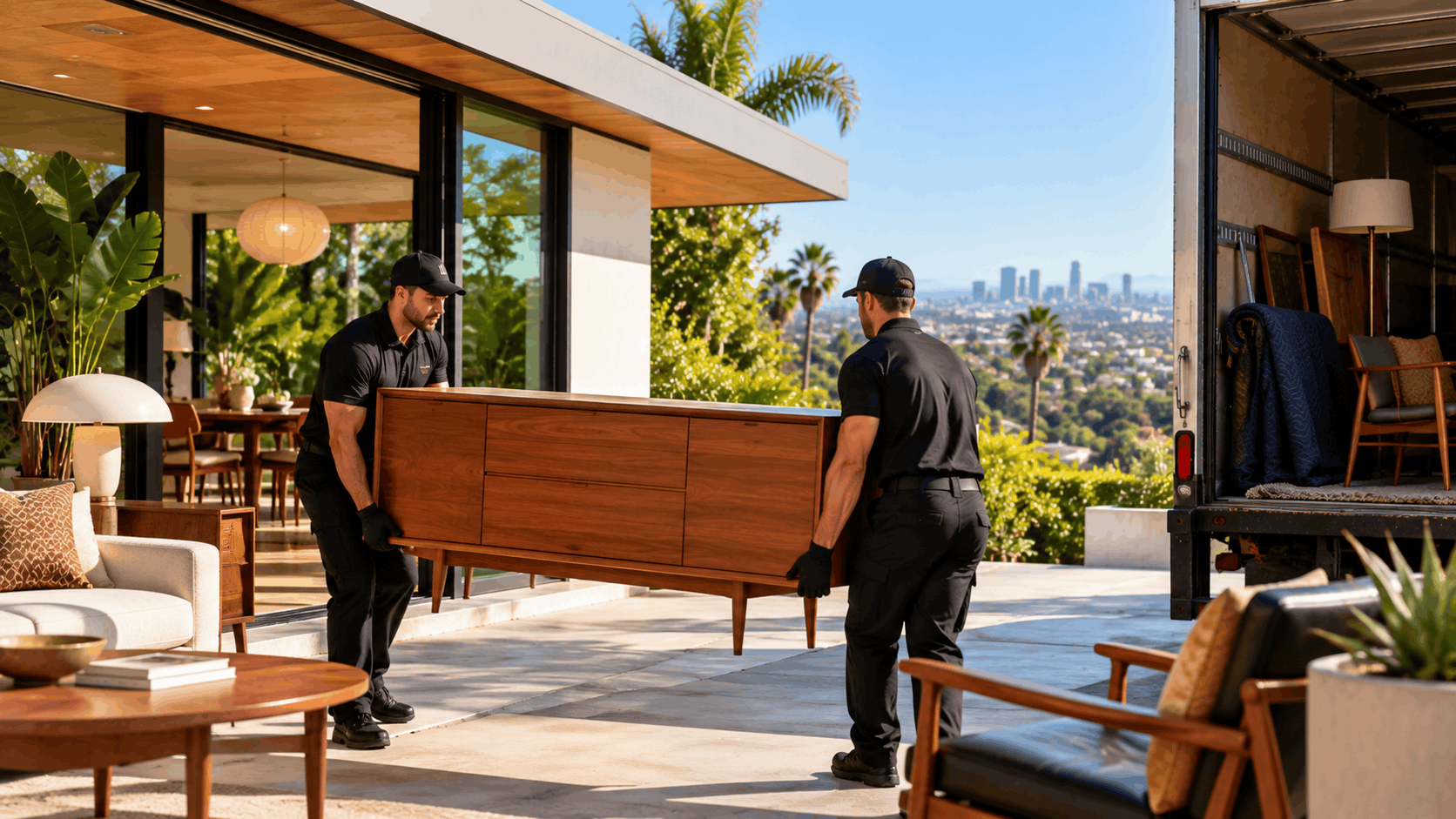
Picture a Trousdale Estates owner standing in an open-plan mid-century living room on a graded pad above Sunset. The home is full of designer furniture, art, large mirrors, and stone-topped pieces, and all of it needs to come out and go into storage the same day. The catch is the street itself: a terraced cul-de-sac on a steep grade where a full-size moving truck has nowhere to turn around.
Here is the direct answer. Popeye Moving & Storage picks up in Trousdale Estates and places goods into vaults at its Mar Vista warehouse the same day, with no overnight hold on the truck. The customer is usually between homes, or storing belongings without any plan to visit them during the term, so the goal is a clean path from the Loma Vista pad to a sealed vault in one working day.
How Same-Day Pickup to Vaulted Storage Works in Trousdale?
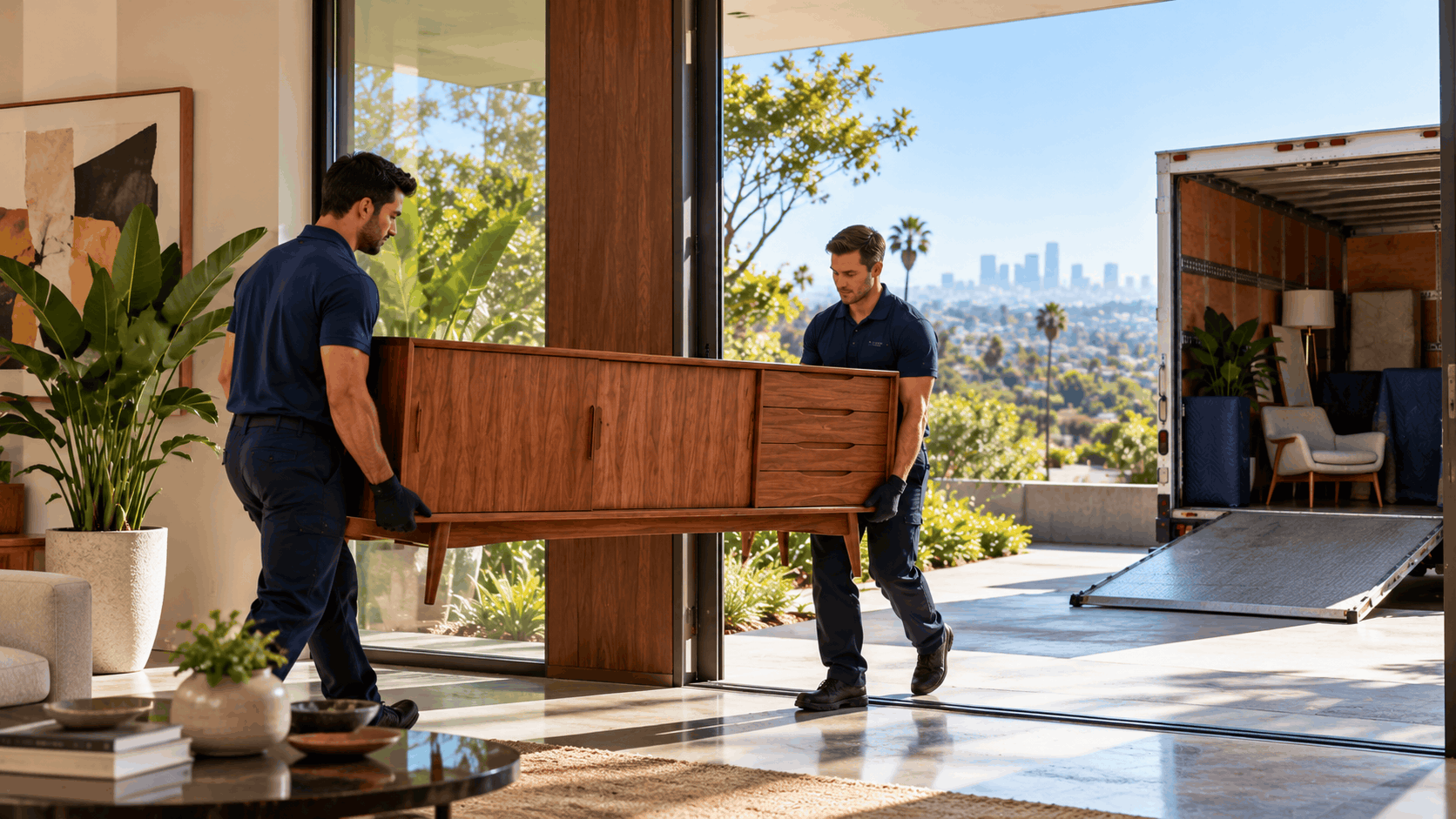
The whole point of same-day pickup is to avoid a truck sitting loaded overnight. Goods leave the Loma Vista pad, travel down the hill, and go straight into vaults at the Mar Vista warehouse the same working day. For an owner who is between homes, that means the collection is a single, planned event rather than a drawn-out process.
Vaulted storage is different from a self-storage unit. The customer does not get a key, an individual unit, or a right of entry. A crew loads each wooden vault, and the warehouse handles it from there. That model fits the Trousdale customer who is storing without intending to open boxes for a while.
Here is the path from the property to the vault, step by step.
| Stage | What happens | Where |
|---|---|---|
| Pre-quote | Access, vehicle size, escort and traffic-plan windows, and contents are confirmed | Phone and site check |
| Written price | Not-to-exceed figure set in writing, shuttle and drive time included | Before anything is loaded |
| Pickup and loading | Route protected, items wrapped and loaded into vaults or onto the shuttle | Trousdale Estates pad |
| Transport | Goods driven down the hill to the Westside | Loma Vista to Mar Vista |
| Same-day placement | Goods placed into vaults, no overnight hold on the truck | Mar Vista warehouse |
Pickup and Loading at the Property
On the day, the crew walks the house before lifting a single piece. Trousdale homes are open-plan with wide door openings, which helps on the inside, but the route from the front door to the curb is where most of the risk sits. Planning that route first means fewer corrections and less handling of fragile items once they are off the ground.
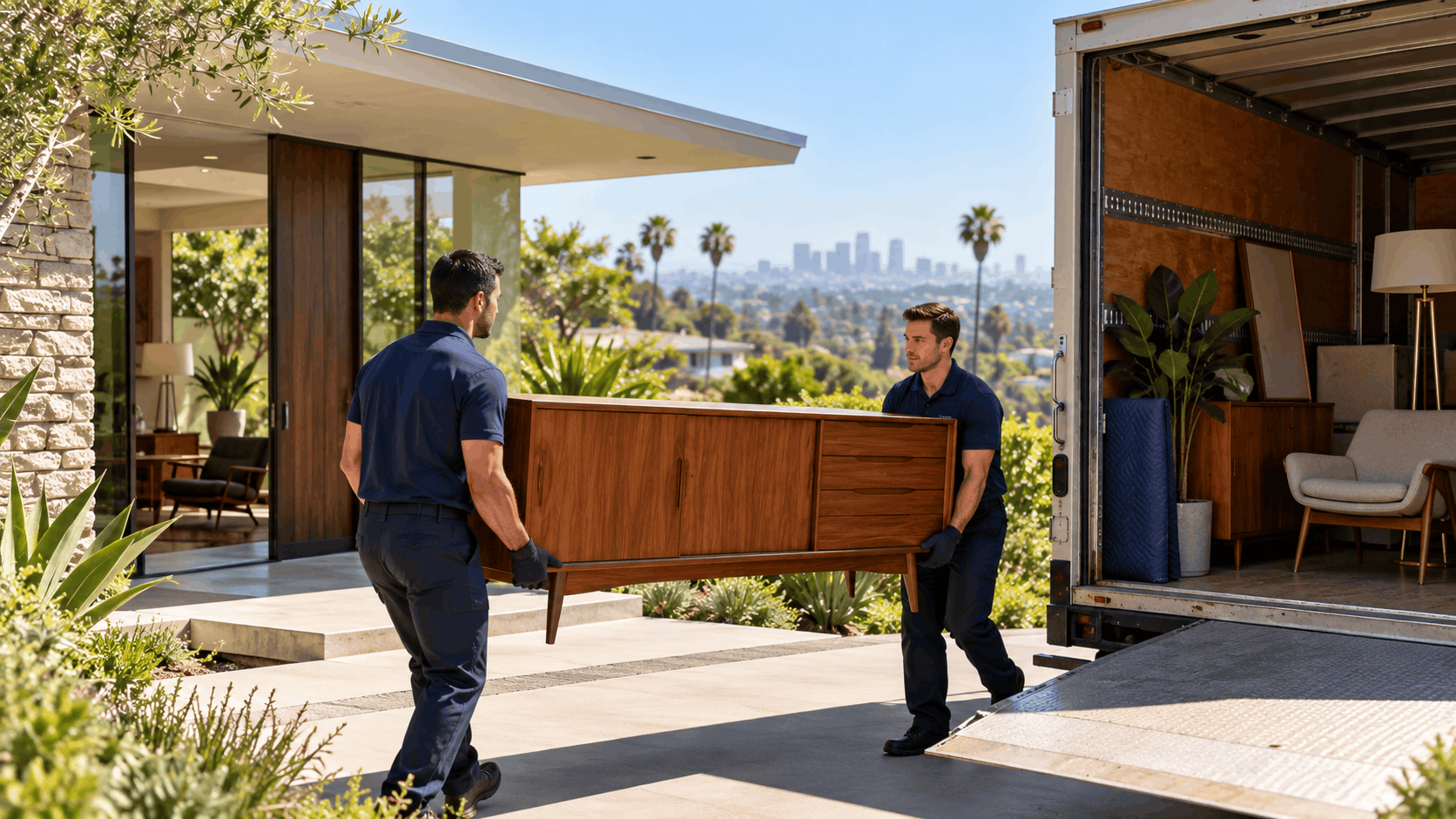
Loading depends on whether a full-size truck can reach the pad. Where it can, the crew packs directly into vaults or the truck body. Where it cannot, items move onto a smaller shuttle vehicle that runs between the property and a larger truck staged legally lower down the hill. Either way, the sequence is the same: protect the item, carry it out along the cleared route, and secure it for transport.
Fragile and high-value pieces get attention first in the plan, even if they load last. Large glass, mirrors, and stone-topped furniture are mapped against doorway widths and the driveway grade so there are no surprises at the threshold. Our residential moving crews treat the walk-through as part of the job, not a formality.
Once everything is loaded, the vehicle heads down Loma Vista Drive toward the Westside. The aim is a single trip to the warehouse where the goods go into vaults the same day.
Why the Same-Day, No-Overnight-Hold Method Matters Here
A vault is loaded once at origin and then moved as a complete unit by forklift. Because it travels and stores as one container, the contents are handled fewer times than they would be in a self-storage cycle, where items are carried in, set down, and often shifted again later. Fewer touches means fewer chances for a scratch, a chip, or a dropped corner.
Placing goods into vaults the same day removes the overnight hold on the truck entirely. The belongings are not sitting in a parked vehicle on the street or in a yard waiting for the next morning. For a home full of art and designer furniture, that shortens the window where things sit staged and exposed.
This matters more in Trousdale than in flatter neighborhoods. The access constraints already add steps, so collapsing the storage placement into the same day keeps the total handling as low as the job allows. The goods go from the pad to a sealed vault in one continuous process.
It also keeps the schedule clean for the customer. One date, one crew, one placement, with the written price agreed before any of it starts.
Who Usually Calls for This
The calls come from owners, real estate agents, interior designers, and business or estate managers. In a neighborhood known for its residents, access, gate arrangements, and crew details are agreed in advance rather than sorted out at the door. Discretion is part of the service here.
Designers and estate managers often coordinate the collection around a renovation or a staging timeline. They want a firm written price, a confirmed access plan, and goods off the property on a set day. The vaulted model suits them because the contents are secured and tracked without anyone needing to visit a unit.
The typical storage customer is between homes during a move, or is putting belongings away without intending to touch them during the term. That is exactly what full-service vaulted storage is built for. Our storage solutions are set up around that customer rather than around a self-storage walk-in.
Agents arranging a sale often need the house cleared quickly and cleanly. Same-day pickup to vaults lets them hand back an empty, undamaged home on schedule.
Get Your Free Quote
Tell us about your move. We'll be in touch soon.
Getting a Moving Truck In and Out of Trousdale Estates
Trousdale Estates is the terraced hillside enclave in the north-east corner of Beverly Hills, above Sunset and served primarily by Loma Vista Drive and its adjoining cul-de-sacs. It is the most tightly regulated area in the city for heavy vehicles, and the rules are specific enough to get wrong. This section covers hillside access, escorts, and advance notice once, in full.
The terrain is the starting point. Streets are cut into a steep grade, pads are wide but shallow, and the cul-de-sacs do not give a large vehicle room to turn. Every access decision follows from that.
Why a Full-Size Truck Often Cannot Turn on These Streets
Trousdale occupies about 410 acres of foothill above Sunset Boulevard on the former Doheny Ranch, bought by developer Paul Trousdale in 1954 and cut into roughly 532 graded pads. Those pads sit on terraced cul-de-sacs climbing a steep grade from Doheny Road. The layout was designed for mid-century homes and cars, not for tractor-trailers.
A large truck needs room to turn around, and a terraced cul-de-sac on a hillside rarely provides it. Backing a full-size vehicle down a curving, graded street is both unsafe and often impossible. That is the practical reason a shuttle is used rather than a preference.
The grade also affects braking and staging. A heavy vehicle parked on a slope is a different proposition from one on flat ground, which is why the city regulates heavy vehicles here so tightly. The physical constraints that prompted those rules apply to any large vehicle, moving trucks included.
For an owner near the top of Loma Vista Drive, this is the single biggest factor in how the job runs. The access method is decided before the date is confirmed, not improvised on the morning.
The Shuttle Method, Planned and Priced at the Estimate
The realistic method on most Trousdale pads is a smaller shuttle vehicle working between the property and a larger truck staged legally lower down the hill. The shuttle makes short runs up to the pad, loads, and ferries goods to the main truck. This is the professional approach on hillside and restricted-access properties, not a workaround.
Because the shuttle adds trips, it is planned and priced at the estimate. The customer sees it in the written quote, not on the final invoice. Presenting the shuttle as a compliant, built-in method is what makes the price credible and keeps the day predictable.
Staging the larger truck matters as much as the shuttle itself. The main vehicle has to sit in a legal spot that does not block the right-of-way or violate the city's heavy-vehicle rules. Our team checks where a truck can legally stage before the date is set.
Properties with no vehicle access at all are qualified on the phone first. If a shuttle cannot reach the pad either, that is a conversation to have before a crew is booked, not on the day it arrives.
Escorts, Advance Notice, and Heavy Haul Streets
Trousdale sits north of Sunset, so the city's requirement that 18-wheel vehicles traveling to destinations north of Sunset Boulevard require police escorts and a minimum of 72 hours advance notice applies. That window has to be built into the schedule. A last-minute 18-wheeler move north of Sunset is not something that can be arranged on short notice here.
Police escorts may also be required whenever vehicle or load size exceeds 8 feet in width. Vehicles over 6,000 lbs GVW, or wider than 8 feet 6 inches, must use designated heavy haul streets per the City's Approved Heavy Haul Street Map. Route selection is part of the plan, not an afterthought.
Traffic plans take four business days, which is 96 hours, during normal business hours. Evening and weekend work needs after-hours approval from the City Traffic Engineer. Staging a second vehicle in the right-of-way is prohibited, so the staging plan has to work with a single vehicle in place at a time.
All of this is confirmed before quoting so the schedule is realistic. You can read the city's own requirements on the City of Beverly Hills site, and our Beverly Hills moving team handles the notice windows as part of the booking.
What the City's Construction Rules Tell You About the Grade
In 2015 the City adopted Ordinance 15-O-2683, codified at Beverly Hills Municipal Code Title 9 Chapter 8, establishing heavy truck regulations for Trousdale Estates. The headline figure, a maximum loaded weight of 50,400 pounds, applies to all construction-related vehicles on projects requiring a City permit. It is a construction measure, not a rule governing household moving trucks.
What it reveals is useful. For construction vehicles exceeding 26,000 pounds GVW, or 10,000 pounds GVW with three or more axles, the City requires inspection for a secondary braking system, with an approved decal affixed to the driver's side window and annual re-inspection. The City does not certify vehicles exceeding 50,400 pounds, nor roll-off trucks or containers.
A secondary braking requirement tells you everything about the grade on Loma Vista Drive. The City found heavy vehicles on these streets hazardous enough to regulate them tightly, and that same steepness is why a large moving truck needs careful staging and often a shuttle.
So while the 50,400-pound rule does not govern a moving job, the reasoning behind it does shape how one is planned. The terrain drives the method, and the method is set before the crew arrives.
Need Help in Los Angeles?
Popeye Moving & Storage serves Los Angeles and all of Los Angeles County.
Protecting Mid-Century Furniture, Art, and Glass During Pickup
Mid-century estates hold designer and period furniture, art, large glass and mirrors, and stone-topped pieces. Most of it is light relative to its value or awkward relative to its weight. Protecting both the contents and the restored interiors is where a careful crew earns its fee.
The homes themselves are part of the problem to solve. Restored interiors bring finishes that mark easily, and glazing sits close to the paths people walk. The plan has to protect the house as much as the belongings.
What These Homes Actually Contain
Trousdale houses are single-story, open-plan, and built with large glazed elevations and flat or low-pitch rooflines. Many have been extensively restored or rebuilt. The open floor plan gives a crew room to work inside, which is a genuine advantage when carrying large flat pieces.
Contents skew to designer and period furniture, art, large glass and mirrors, and stone-topped pieces. These items share a trait: they are either light for their value or heavy and awkward for their size. A stone-topped console is both deceptively heavy and fragile at the edges, and a large mirror is unforgiving of a bad grip.
Wide door openings help on the way out. The driveway and the street do not. The pinch point is almost always the transition from a protected interior to a graded driveway and a narrow hillside curb, which is where the route plan matters most.
Knowing the mix of contents in advance lets the crew bring the right protection and the right number of people. That is confirmed during the pre-quote conversation.
Floor, Doorway, and Glazing Protection
Restored mid-century interiors often feature terrazzo, polished concrete, original stone floors, and glass walls close to the circulation routes. These surfaces mark, scratch, or crack under the wrong contact. Floor protection, doorway protection, and glazing protection are expected on a job like this.
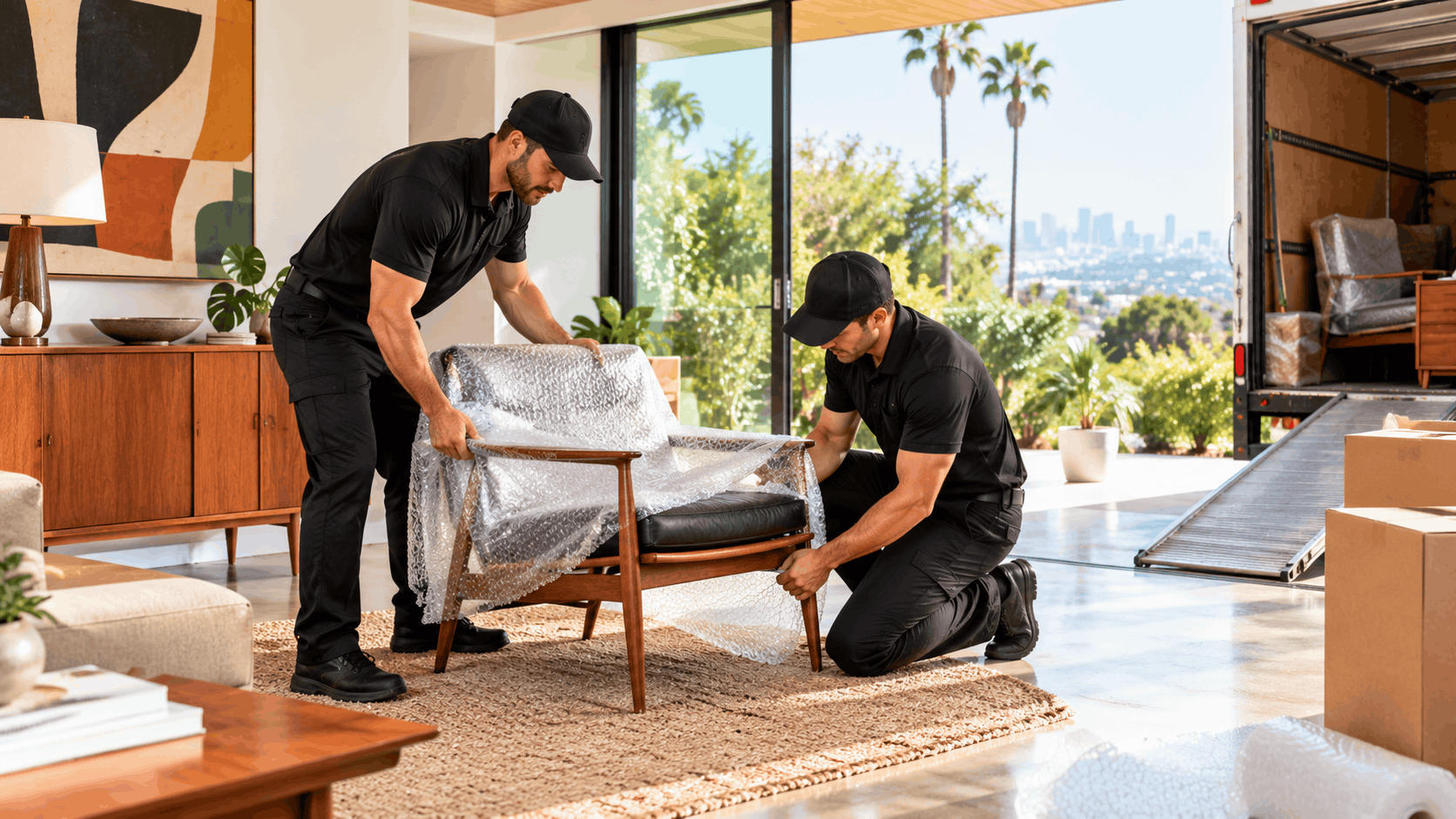
The crew lays protection along the planned route before carrying anything heavy across it. Floors get covered where loads will travel, doorways get padded at the jambs, and glazing near the path gets attention so nothing swings into it. The route is walked and protected first, then the lifting starts.
Terrazzo and polished concrete are especially unforgiving because the damage shows and the repair is specialized. Dragging anything across them is off the table, which is why the crew plans lifts and carries rather than slides. Our specialty moving approach treats the interior as part of what is being protected.
Glass walls close to a corner or a turn get the most care. A crew that has mapped the route already knows where the tight spots are and slows down there.
Crating and Specialty Handling for Storage-Bound Items
Items of extraordinary value such as antiques, art, and gold or silver articles should be separately described on the inventory, with a value declared for each one. That record matters both for protection and for any later claim. Listing a piece by name and value is the correct handling for an estate full of high-value objects.
Money, jewelry, and important papers are best carried by the customer rather than shipped. These are small, high-value, and easy to keep in hand, so they do not belong in a vault. Keeping them with the owner removes a whole category of risk.
Fragile and high-value pieces often warrant a custom crate. A built-to-fit crate protects a framed work, a glass top, or a sculptural piece far better than blankets alone. Our custom crating and fine art and antique moving services exist for exactly these items.
Specialist items accepted into storage include wine, fine art, pianos, and chandeliers. A piano or a chandelier each needs its own method, and both can go from the pad into vaulted storage the same day.
Valuation on a Trousdale Move Into Storage
This neighborhood is full of high-value, low-weight items, which makes valuation the single most important protection to get right. The California intrastate default and the paid alternative are explained here, once, in full. Getting this wrong is where owners of art and designer furniture are most exposed.
The short version: the default is a dollar cap on the whole shipment, and the per-pound figure people hear about is only how the rate is calculated. For light, valuable pieces, the difference between the two is enormous.
The $20,000 Default and Why 60 Cents a Pound Is Not the Payout
Under Maximum Rate Tariff 4 Item 136(2), unless the shipper expressly declares a value other than $20,000 for the shipment, the mover's maximum liability for lost and damaged articles is up to $20,000 of actual cash value. That is the California intrastate default, and it is what applies to a customer who declares nothing. It is a shipment-wide cap, not a per-item figure.
The 60 cents per pound per article figure at Item 136(1) is the rate basis only. It is the declared value the transportation rates are computed on. It is not the payout.
That distinction matters hugely in Trousdale. Sixty cents per pound pays almost nothing on a piece of art or a designer chair, because those items are light for their value. A valuable chair that weighs little would be worth only a few dollars under the rate-basis figure, which is why nobody should treat it as coverage.
Released value is a liability limit, not insurance. Knowing that going in is what lets an owner make a real decision about protection rather than discovering the limit after a loss.
Full Value Protection and Declaring High-Value Pieces
MAX 4 requires each valuation option offered by the carrier to be listed, with the carrier's charge and a space for the shipper to initial. The shipper has a right to be offered a higher valuation than the 60 cent basis and a right to decline it knowingly. That choice belongs to the customer, in writing.
Full value protection is the paid alternative to the released-value limit. It is the correct handling for a home full of art and designer furniture, where the default cap would not come close to the real value of the contents. For these estates, full value protection plus separate declaration of extraordinary-value items is the right approach rather than an upsell.
Each item of extraordinary value should carry its own declared value on the inventory. A single line that lists a painting or a sculpture with a dollar figure gives both the crew and any later claim something concrete to work from. Without that, a high-value piece sits under the general cap.
The takeaway is simple. Read the valuation options, initial the one chosen, and declare the valuable pieces by name and value before the goods move.
Valuation While Goods Sit in Storage-in-Transit
Protection during storage is separate from protection during the move. MAX 4 Item 136(8) sets the maximum fixed rate for Actual Cash Value protection while a shipment is in storage-in-transit at $0.16 for each $100 of declared value, and Full Value protection at $0.38 for each $100. These charges are separate from and additional to the transportation valuation charges.
This storage-in-transit protection must be offered by the mover and ordered in writing by the shipper. It is not automatic. If an owner wants the goods protected while they sit in the vault during the storage-in-transit period, that has to be set up in writing when the move is arranged.
For an owner storing art and designer furniture, this is worth deciding deliberately. The declared value drives the charge, and the charge is small relative to the value of the pieces involved. Declaring a realistic value is the point of the exercise.
All of this is handled at the same time as the move valuation, so the goods are covered both in transit and in storage under one written arrangement.
Full-Service Vaulted Storage at the Mar Vista Warehouse
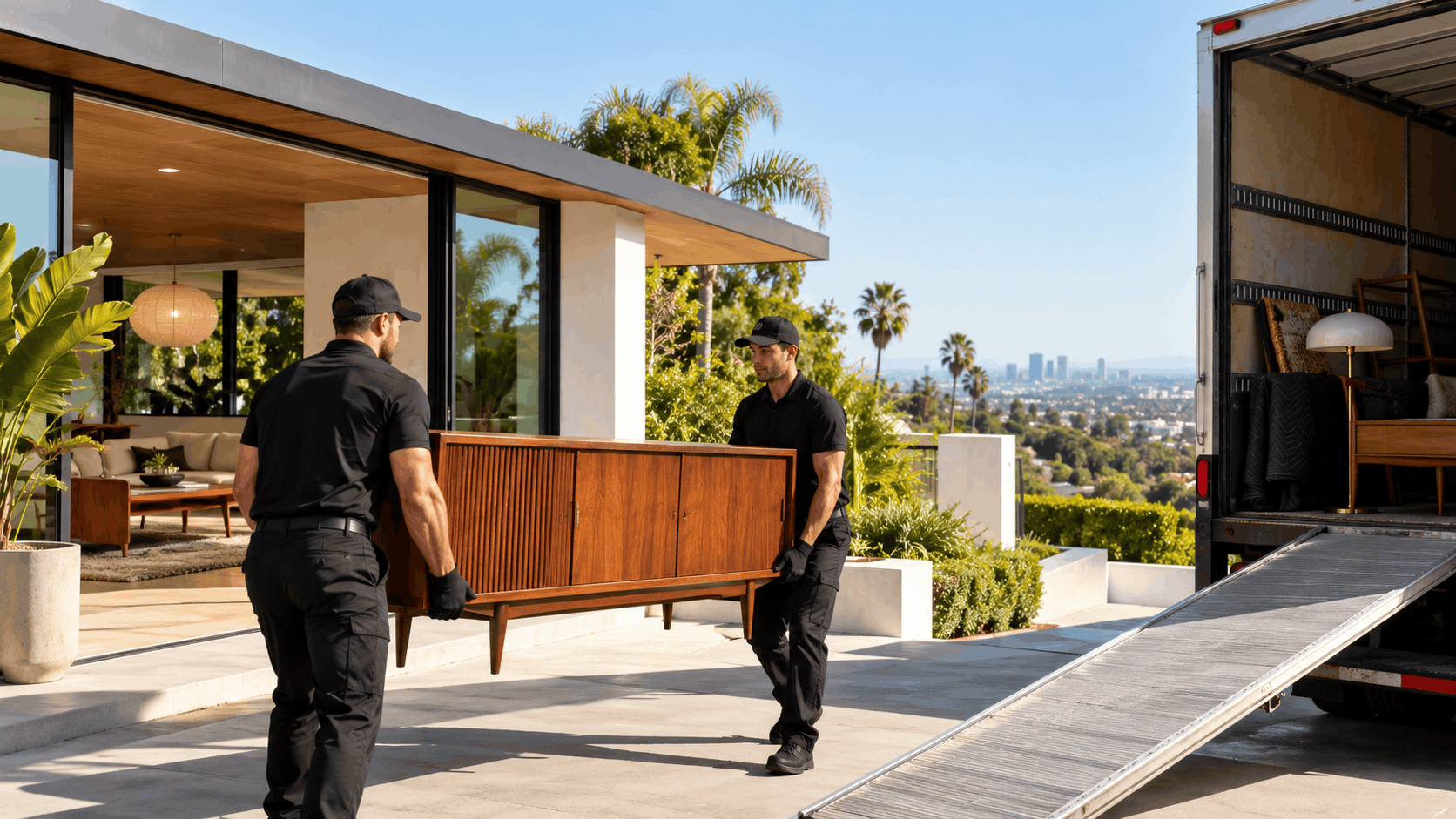
The storage here is full-service vaulted storage at Popeye's own warehouse. The customer has no key, no individual unit, and no right of entry. Goods are handled by Popeye crews from pickup to placement. This section covers what a vault is, what is accepted, and the terms.
That model is what keeps Trousdale goods under professional handling the whole time. It is not a drive-up unit you load yourself.
Where the Warehouse Is and How Vaulted Storage Works
The warehouse is at 5509 1/2 S Centinela Ave, Los Angeles, CA 90066, in Mar Vista on the Westside. That is a straightforward run down from Trousdale, which is part of why same-day placement works on this route. It is the same address as the Google Business Profile location.
Vaulted storage means the goods go into wooden vaults rather than an open unit. A vault is a wooden container loaded once at origin and then moved as a single unit by forklift. The customer does not get a key or a right of entry, because the warehouse manages the vaults.
Loading a vault once and moving it as a unit is what reduces handling. The container is sealed after loading and lifted into place, and it stays as one piece until the goods come out. That is a different cycle from self-storage, where items are carried in and out by hand each time.
Our vaulted storage at the Mar Vista warehouse is built for customers who want their goods stored and handled by professionals, not stored and handled by themselves.
Vault Sizes, Terms, and What Gets Accepted
Popeye runs the full range of vault sizes, standard through oversized. A common wooden storage vault is roughly 7 feet by 5 feet by 7 feet 10 inches on the exterior, which is a typical size rather than an industry standard, and usable interior volume is lower than the exterior figure once wall thickness is accounted for. Capacity figures are approximate for that reason.
There is no minimum and no maximum storage term. An owner can store for a few weeks between homes or for a long stretch during a rebuild. The term is driven by the customer's needs, not by a contract floor or ceiling.
Commercial and business storage is accepted alongside household goods. A business clearing an office or a designer consolidating inventory can use the same vaulted model. Our commercial and business storage runs through the same warehouse.
Vehicles are not accepted. There is no car, motorcycle, boat, or RV storage. Specialist items such as wine, fine art, pianos, and chandeliers are accepted, which fits the contents of most Trousdale estates.
Climate-Controlled Storage for Sensitive Pieces
Storage is climate controlled for both temperature and humidity. That matters for the kinds of pieces these homes hold, because humidity swings act on certain materials more than others. The mechanism is what to understand here, not any single number.
Conservation guidance explains why. Oil paintings and rigid paint layers on canvas, veneer and marquetry, panel paintings, musical instruments, and fine furniture with inlays are among the object types most vulnerable to humidity swing. Wood swells and warps at high humidity and shrinks and cracks at low humidity, and leather suffers at both extremes.
References such as the National Park Service, the Smithsonian, the Canadian Conservation Institute, and the Library of Congress publish general ranges for temperature and relative humidity in collection storage. Those are general conservation references, not the specification at this warehouse, and the specification is confirmed per shipment. The point is that stable conditions protect exactly the materials common in a mid-century estate.
For an owner storing a veneered sideboard, a canvas, or an instrument, controlled conditions are the reason to choose professional vaulted storage over an uncontrolled space. The sensitive pieces are the ones that benefit most.
Access and Collecting Goods Later
Because the goods are vaulted, retrieving them means the warehouse opens the container. The customer does not walk in and pull items out. For that reason, arranging an appointment is ordinary trade practice when goods need to come out or be accessed.
Business hours are for calls and scheduling. They are Monday to Sunday, 6:00 AM to 9:00 PM. Those are hours to reach the team, not customer access hours at the warehouse, and they should not be read as drop-in hours for stored goods.
No statute, tariff, or code sets a fixed notice period for access, so none is stated as a rule. What is true is that the vault has to be retrieved and opened, which takes coordination. Calling ahead to arrange it is simply how vaulted storage works.
For the typical Trousdale customer who is storing without planning to visit, this rarely comes up during the term. When it does, a quick call sets up the access.
Need Help in Los Angeles?
Popeye Moving & Storage serves Los Angeles and all of Los Angeles County.
What Cannot Go Into the Vault
A short checklist of what cannot be loaded or stored saves a problem on the day. Each category has a real reason behind it rather than one blanket label. Sorting these items out before the crew arrives keeps the pickup clean.
The three groups below cover most of what gets set aside: hazardous materials, perishables and living things, and items that belong with the owner.
Hazardous Materials and Why It Is Federal Law
Hazardous materials as defined by the US Secretary of Transportation are not accepted for shipment. That includes common household combustible liquids, corrosives, explosives, and flammables. These are refused for a legal reason, not a company preference.
Under 49 CFR 171.2(e), no person may offer or accept a hazardous material for transportation in commerce unless it is properly classed, described, packaged, marked, labeled, and in condition for shipment. A mover accepting undeclared hazmat is the accepting person under that rule. So the refusal is federal law, and it protects the whole shipment and the warehouse.
In practice, that means things like propane tanks, gasoline, paint thinners, pool chemicals, and aerosols stay off the truck. The Federal Motor Carrier Safety Administration sets the framework for hazardous materials in transport.
Draining gas and oil from any motorized equipment before storage is part of the same logic. A fueled item is a flammable item.
Perishables, Plants, and Open Liquids
Perishables, plants, and open liquids are kept out for a different reason than hazmat. The driver here is spoilage, pest attraction, and agricultural quarantine, not fire code. Food and open containers cause problems in a shared storage environment.
Food spoils, and spoiled food draws pests. In a warehouse holding many customers' goods in vaults, that risk is shared, so perishables are not accepted. The same goes for anything that can leak or ferment.
Plants bring their own issues. They need light and water that storage cannot provide, and they can carry pests or fall under agricultural rules. Living plants simply do not belong in a vault.
Open liquids can spill in transit or storage and damage surrounding goods. Anything that can leak should be emptied, sealed, or left behind before the crew loads.
Vehicles and Items Best Kept by the Owner
Vehicles are not accepted, which covers cars, motorcycles, boats, and RVs. This storage is for household and commercial goods in vaults, not for motorized vehicles. That is a firm line for this warehouse.
Money, jewelry, and important papers are best carried by the customer rather than shipped. They are small, valuable, and easy to keep in hand. Keeping them with the owner is both safer and simpler than placing them in a vault.
There is also a protection worth knowing about the mover's lien. No lien attaches to food, medicine, or medical devices, to items used to treat or assist a person with a disability, or to items used for the care of a minor child. Those categories are protected from being held for payment.
That protection is specific and rarely publicized, and it is the kind of detail that tells a customer their rights are being handled honestly.
What It Costs to Store Mid-Century Estate Goods?
Cost is one of the first questions on a storage-and-pickup job, so here are the relevant typical Los Angeles ranges. These are typical area ranges, not a quote or a fixed price from Popeye. The actual price for a specific move is set in writing before anything is loaded, with the not-to-exceed figure on a move inside California.
| Service | Typical LA-area range |
|---|---|
| Vaulted storage | $60 to $90 per vault per month |
| Local residential moving (two-person crew and truck) | $150 to $200 per hour |
| White glove moving | $150 to $250 per hour |
| Custom crating | $150 to $800+ per crate |
| Fine art and antique moving | $300 to $1,200+ |
| Piano moving | $200 to $600 |
| Chandelier moving | $150 to $450 |
| Furniture assembly and disassembly | $75 to $200 for standard items |
Typical Storage and Local Move Ranges
Vaulted storage runs $60 to $90 per vault per month as a typical area range. How many vaults a home fills depends on its contents, which is why the storage figure is per vault rather than per household. A larger estate simply uses more vaults.
Local residential moving runs $150 to $200 per hour for a two-person crew and truck. That is the base rate for a standard local job. The crew size and vehicle may differ on a job with heavy or awkward pieces.
White glove moving runs $150 to $250 per hour. This is the higher-attention service that fits a home of art and designer furniture, where protection and careful handling drive the method. Many Trousdale jobs fall into this category because of what the homes contain.
These are typical ranges for the area, not a promise for a specific address. The written estimate is where the real number for a given job appears.
Specialty Handling That Changes the Price
Specialty items carry their own ranges because they need their own methods. Custom crating runs $150 to $800+ per crate, which reflects the size and complexity of the piece being crated. A large framed work or a glass top costs more to crate than a small object.
Fine art and antique moving runs $300 to $1,200+. Piano moving runs $200 to $600, with upright pianos costing less than grand pianos. Chandelier moving runs $150 to $450.
Furniture assembly and disassembly runs $75 to $200 for standard items. Mid-century pieces that need to come apart to clear a doorway or load into a vault fall here. The disassembled parts should be packaged and inventoried so nothing goes missing.
These line items stack onto the base move cost based on what the home actually holds. The estimate itemizes them so the customer sees each one.
How the Shuttle, Escort Windows, and Double Drive Time Affect Cost
The shuttle method adds trips, and those trips add time. Because a smaller vehicle runs between the pad and a larger truck staged below, the loading stage takes longer than it would on a flat, accessible property. That extra time is quoted at the estimate.
California bills local hourly moves on a double drive time convention, meaning travel time between origin and destination is charged at twice the actual driving time. It is a legitimate, regulated charge, not padding. Traffic timing on the run from Trousdale to Mar Vista affects it, which is why scheduling matters.
Escort and traffic-plan timing affect scheduling rather than the hourly rate directly. The 72-hour notice for 18-wheelers north of Sunset and the 96-hour traffic plan window shape when the job can run. Building those windows in avoids delays on the day.
All of this is quoted at the estimate, not discovered later. The shuttle, the double drive time, and the access windows are on the written price before the crew is booked.
The Not-to-Exceed Price and a Written Estimate
California requires a written estimate. It does not require a binding estimate, so no one should be told that California law requires one. A verbal rate quotation, whether per hour or per hundred pounds, is not an estimate and is not binding.
The not-to-exceed figure in the Agreement For Moving Services is the maximum total dollar amount the customer can be billed for, agreed before any goods are moved or any services performed. The final bill cannot exceed it except through a Change Order the customer agrees to. In plain terms, the ceiling is set before the truck is loaded.
That estimate should describe the shipment in enough detail to determine the articles and services included, including the number of helpers and packers, and state the rates and charges, including any minimums and per-pound valuation requirements. A proper estimate is checkable against what the customer was sent.
Treat the not-to-exceed price as a right, not a courtesy. It is the main consumer protection on a move inside California.
Licensing, Claims, and Your Protections
Knowing who regulates the move, how claims work, and where storage liability sits lets a Trousdale customer book with confidence. These protections are specific and checkable. They also decide which rules apply if something goes wrong.
The most common error in mover content is naming the wrong regulator or mixing federal and California rules. Here is the accurate picture for an intrastate move.
Who Regulates This Move and How to Verify a Permit
Household moving inside California is regulated by the Department of Consumer Affairs, Bureau of Household Goods and Services, the BHGS, reachable at (916) 999-2041. It is not regulated by the CPUC. Authority transferred to BHGS effective July 1, 2018, under SB 19, so any content naming the CPUC as the current regulator is years out of date.
Popeye Moving & Storage operates under CAL T 189749 for intrastate work, and USDOT 1472924 and MC 498816C for interstate work, and is fully insured. The company is BBB accredited with an A+ rating. A move from Los Angeles across a state line falls under federal rules instead, and our interstate moving service holds the federal authority for that work.
The practical advice for any customer is simple: ask for the permit number and verify it before booking rather than after a problem. You can check a mover's license status and file complaints through the California Department of Consumer Affairs, which houses the BHGS.
A refusal to provide a permit number is a red flag. A legal California household mover operates under a state permit, and that number is something a customer can check.
Filing a Claim and Keeping Your Paperwork
Under MAX 4 Item 92(14), a claim for any loss or damage must be filed in writing with the mover within nine months after delivery to the consignee as shown on the shipping document. Suit must be instituted within two years and one day from the date the mover gives written notice that it has disallowed the claim. These are California deadlines, not federal-only ones.
Item 92(15) requires the mover to acknowledge a written claim within 30 days and to pay, decline, or make a firm compromise settlement offer within 60 days. The federal 120-day resolution figure does not apply in California; 60 days is the California figure. Those timelines give a customer something concrete to hold the process to.
Business and Professions Code section 19265 provides that a claim shall not be denied solely because the lost or damaged goods were not noted at the time of delivery. So a scratch found after the vault is unloaded is not automatically barred. That protection matters when goods come out of storage later.
Keep the estimate, the Agreement For Moving Services, and the bill of lading. The single most common reason a consumer loses a dispute is that they cannot produce the paperwork.
The Storage Liability Boundary at 90 Days
MAX 4 Item 4 defines storage-in-transit as storage of a shipment at the request of consignor or consignee at one point between origin and destination for a period not to exceed 90 days. Inside that window, the move is still a regulated mover service. The tariff rules and the nine-month claim clock apply.
Past 90 days, or where storage-in-transit was not requested, the goods fall under the warehouse's own contract and Commercial Code Division 7. Under that code, a warehouse is liable for loss or injury to goods caused by its failure to exercise the care that a reasonably careful person would exercise under similar circumstances. That is ordinary negligence, not strict liability, and a warehouse is not an insurer of the goods.
This is vaulted warehouse storage, where the customer has no key, no individual unit, and no right of entry. That places it outside the self-service storage lien and access rules entirely, because a self-service storage facility is defined as one where occupants have access to their space. The distinction is exclusive access, and a vaulted customer does not have it.
For long-term storage, the storage agreement sets the claim and liability terms, so reading it is the customer protection there. Our long-term storage operates under that code boundary.
Need Help in Los Angeles?
Popeye Moving & Storage serves Los Angeles and all of Los Angeles County.
How Popeye Handles a Same-Day Trousdale Pickup
The working process for this job is built around the terrain and the rules covered above. It runs from a pre-quote confirmation to a written price, then to same-day placement into vaults with no overnight hold. Each step is set before the crew arrives.
The goal is a predictable day with no surprises at the curb or on the invoice.
What We Confirm Before Quoting
Before quoting, we confirm vehicle size against the 8-foot escort trigger and the north-of-Sunset 18-wheeler requirement. We check whether the 72-hour notice and the 96-hour traffic-plan windows can be met for the chosen date. Those windows shape when the job can run.
We confirm whether a full-size truck can reach and turn at the property, and where a shuttle can stage legally if it cannot. That decides the access method. Driveway grade, gate aperture, and carry distance all factor into how the crew works the pad.
We review the contents, with particular attention to art, glass, and stone-topped furniture. Knowing what is in the home tells us how many people to send, what protection to bring, and what needs crating. Properties with no vehicle access at all are qualified on the phone first.
This confirmation is what makes the written price accurate rather than a guess. Nothing about the access or the contents is left to discover on the day.
The Written Price Before Anything Is Loaded
The move is quoted in writing with the not-to-exceed figure before any goods are moved. That price includes the shuttle and the double drive time, so the method and the travel convention are built into the number the customer sees. There is no separate charge that appears later.
Access, gate arrangements, and crew details are agreed in advance. In Trousdale, that includes how the crew enters, where the shuttle runs, and when the main truck stages. Discretion is handled for the neighborhood as part of the arrangement.
The written agreement describes the shipment and the services in enough detail to show what the price covers. That is what lets a customer check the estimate against the work. It is also what caps the bill at the not-to-exceed figure.
With the price agreed and the access confirmed, the day itself becomes a matter of execution.
Pickup and Same-Day Placement Into Vaults
On the day, the crew protects the route first, then loads. Floors, doorways, and glazing along the path are covered before anything heavy crosses them. High-value and fragile pieces are handled with the crating and protection set out in the plan.
Where the pad needs it, the shuttle ferries goods down to the larger truck staged legally below. The main vehicle holds the load for the run to the Westside. The whole sequence follows the route that was walked and agreed in advance.
The goods are placed into vaults at the Mar Vista warehouse the same day, with no overnight hold on the truck. The belongings go from the pad to a sealed vault in one continuous process. That is the core of how this job is run.
For an owner between homes, that means one date and a clean handover of an empty property.
Booking a Same-Day Pickup and Storage for Your Trousdale Home
Every Trousdale pickup starts with a pre-quote check of access, vehicle size, escort and traffic-plan windows, and contents, followed by a written price with the not-to-exceed figure before any goods are moved. From there, the crew protects the route, loads, and places the goods into vaults at the Mar Vista warehouse the same day.
To set up a collection or ask about vaulted storage, call Popeye Moving & Storage at (310) 823-9510 or reach us through our contact page.
Frequently Asked Questions
- Can Popeye really pick up and store my Trousdale goods the same day?
- Yes. Popeye picks up in Trousdale Estates and places the goods into vaults at the Mar Vista warehouse on the same day, with no overnight hold on the truck. The belongings move from the Loma Vista pad straight into sealed vaults in one working day. That suits an owner who is between homes or clearing a property on a set date, and it keeps the schedule to a single coordinated event.
- What kind of storage is this, a unit or a vault?
- It is full-service vaulted storage at Popeye's own Mar Vista warehouse, not a self-storage unit. The customer has no key, no individual unit, and no right of entry. Goods are handled by Popeye crews and loaded into wooden vaults that move as a single unit by forklift. That professional-handling model is what keeps the contents under care from pickup through placement, and it is what places the service outside the self-storage access rules.
- How much does vaulted storage cost?
- Vaulted storage runs $60 to $90 per vault per month as a typical area range, not a quote. How many vaults a home fills depends on its contents, so the figure is per vault rather than per household. The actual price for a specific job is set in writing before anything is loaded, with the not-to-exceed figure capping the total. Specialty handling such as crating or piano moving is quoted as separate line items.
- Why do you need a shuttle on Loma Vista Drive?
- Trousdale's terraced cul-de-sacs sit on a steep grade, and a large tractor-trailer has nowhere to turn around. A smaller shuttle vehicle works between the property and a larger truck staged legally lower down the hill. It is the professional method for hillside and restricted-access properties, not an improvisation, and it is planned and priced at the estimate. Where even a shuttle cannot reach the pad, the access is qualified on the phone before a date is confirmed.
- Does a moving truck here need a police escort?
- Trousdale is north of Sunset, so 18-wheel vehicles traveling to destinations north of Sunset Boulevard require police escorts and a minimum of 72 hours advance notice. Escorts may also be required whenever vehicle or load size exceeds 8 feet in width. Traffic plans take four business days, or 96 hours, during normal business hours, with after-hours approval needed for evening and weekend work. These windows are confirmed before quoting so the schedule is realistic.
- What happens if my art or designer furniture is damaged?
- The default liability is up to $20,000 of actual cash value unless a higher value is declared, under MAX 4 Item 136(2). For a home of art and designer furniture, full value protection plus separate declaration of each high-value item on the inventory is the right handling, because the per-pound rate basis pays almost nothing on light, valuable pieces. A claim is filed in writing within nine months of delivery, and it cannot be denied solely because the loss was not noted at delivery.
- Is there a minimum storage term?
- No. There is no minimum and no maximum storage term, so an owner can store for a few weeks between homes or for a long stretch during a rebuild. Both household goods and commercial or business storage are accepted at the Mar Vista warehouse. The term is driven by the customer's needs rather than a contract floor or ceiling, and billing is per vault per month.
- Can I store my car or motorcycle in the vault?
- No. Vehicles are not accepted, including cars, motorcycles, boats, and RVs. The vaulted storage is for household and commercial goods. Specialist items are accepted, including wine, fine art, pianos, and chandeliers, which covers most of what a mid-century Trousdale estate holds. Each of those specialty items is handled with its own method during pickup and placed into storage the same day.
- Can I visit my goods while they are in storage?
- Because the goods are vaulted, the warehouse has to retrieve and open the container, so arranging an appointment is ordinary practice when goods need to come out or be accessed. Business hours of 6:00 AM to 9:00 PM, seven days a week, are for calls and scheduling, not customer access hours at the warehouse. For most storage customers who are between homes and not planning to visit, this rarely comes up during the term.
- Who regulates my move and how do I check the permit?
- Household moving inside California is regulated by the Department of Consumer Affairs, Bureau of Household Goods and Services, the BHGS, reachable at (916) 999-2041, not the CPUC. Popeye operates under CAL T 189749 for intrastate work, with USDOT 1472924 and MC 498816C for interstate work, and is fully insured and BBB accredited with an A+ rating. Ask any mover for the permit number and verify it before booking rather than after a problem.
Popeye Moving & Storage Co. Team Team
Licensed moving and storage professionals serving Los Angeles and Los Angeles County.
Licensed in California · License #CAL T 189749 | USDOT 1472924 | MC 498816C
Why trust Popeye Moving & Storage?
Founded in 1994, Popeye Moving & Storage is a licensed and insured moving and storage service serving Los Angeles and Los Angeles County. All content is reviewed by our licensed technicians.

Need Help in Los Angeles?
Popeye Moving & Storage serves Los Angeles and all of Los Angeles County.
Related Articles
Storage in Bel Air with Same-Day Gated-Estate Pickup
How same-day gated-estate pickup works in Bel Air: vaulted storage at the Mar Vista warehouse, canyon-road shuttle access, pricing, valuation and permits explained.
Storage in North Hollywood and Valley Village with Same-Day Metro-Adjacent Pickup
Same-day vaulted storage pickup near the North Hollywood Metro station, with goods placed into vaults at the Mar Vista warehouse the same day and no overnight hold on the truck.
Old Pasadena Storage: Same-Day Mixed-Use Pickup to Our Vaults
How same-day pickup into vaulted storage works for Old Pasadena's mixed-use lofts and offices, including Pasadena permit rules, access, protection and typical costs.