Storage in Bel Air with Same-Day Gated-Estate Pickup
Key Takeaways
- Goods are collected from a Bel Air estate and vaulted at the Mar Vista warehouse at 5509 1/2 S Centinela Ave the same day, with no overnight hold on the truck.
- Narrow, steep canyon roads above the West Gate often require a shuttle: the main van stages lower down and a smaller vehicle runs the property leg, priced on the written estimate.
- Vaulted storage is full-service with no key, no unit and no walk-in access, which places it under Commercial Code Division 7 rather than the Self-Service Storage Facility Act.
- Vaulted storage typically runs $60 to $90 per vault per month as a market range, with the actual price set in writing before anything is loaded.
- Under Maximum Rate Tariff 4, 60 cents per pound is only the rate basis; the default liability is up to $20,000 actual cash value, and full value protection is a paid choice.
- Only posted LADOT temporary signs reserve curb space in the City of Los Angeles, requested with at least five working days' notice, and red flag days in the fire hazard zone bring strict parking bans.
- The Not To Exceed price, agreed in writing before loading, caps the bill on a California move and can only be raised through a Change Order the customer agrees to.
- Popeye operates under CAL T 189749, is fully insured and BBB accredited with an A+ rating, and is regulated by the BHGS, not the CPUC.
In This Article
An estate above the West Gate goes on the market, and the staging crew needs the current owner's furniture, art and wine out of the house before the first showing. Or a renovation on Nimes Road is about to start, and everything from the main house and the pool house has to clear the property in a single day. In both cases the last thing anyone wants is a loaded truck sitting on a narrow canyon street overnight.
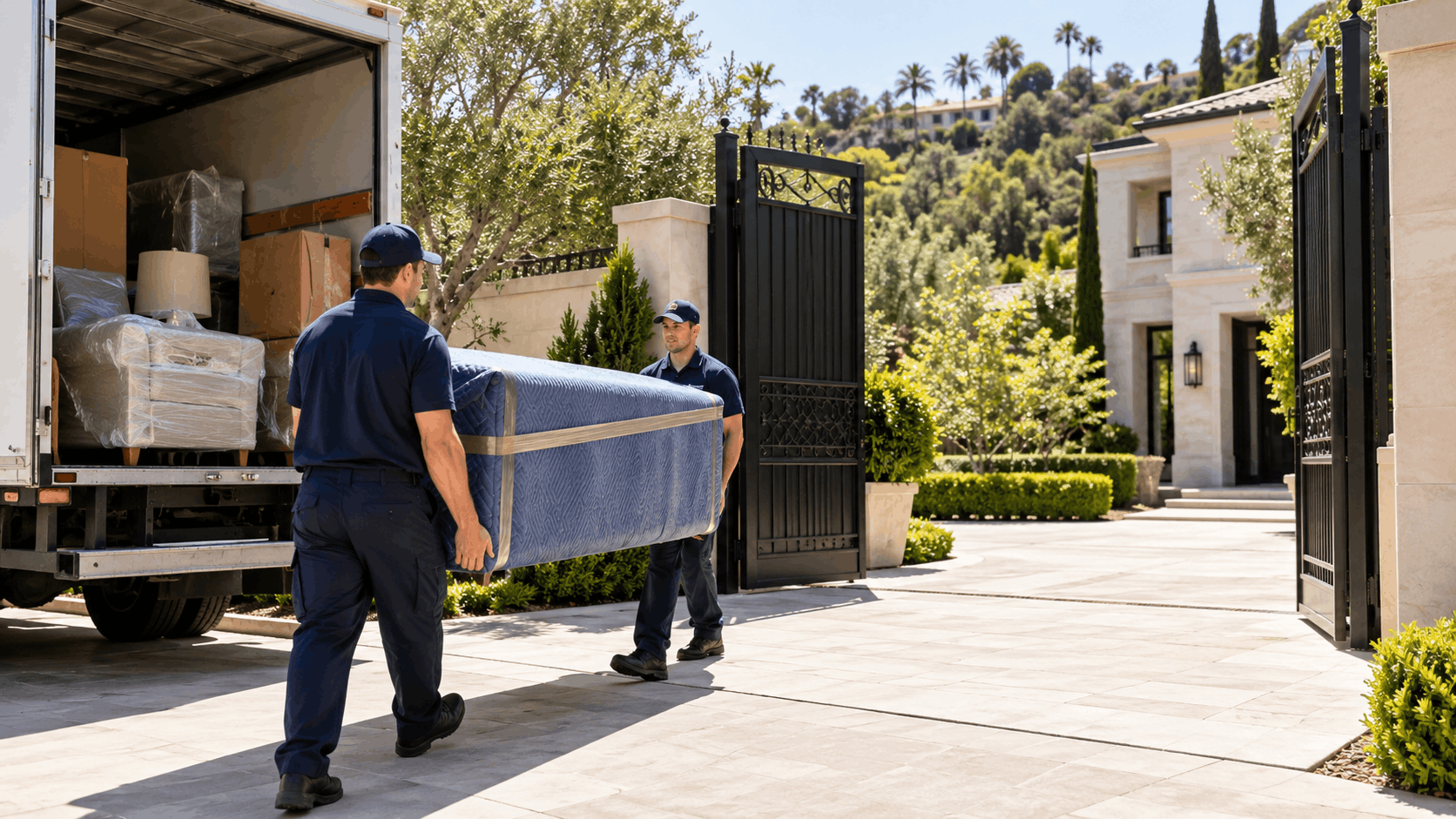
That is exactly the job this guide covers: belongings collected from a Bel Air estate and placed into vaults at our Mar Vista warehouse the same day, with nothing left loaded on the truck. We walk through how the gated-estate pickup actually runs, what vaulted storage is and how it differs from a self-storage unit, what it costs, how access works, and how valuation protects your goods.
We also deal plainly with the part most people underestimate: the canyon roads behind the West Gate and up Roscomare Road. The terrain decides the method, and the method decides the day. Here is how we handle it.
How Same-Day Gated-Estate Pickup Works in Bel Air
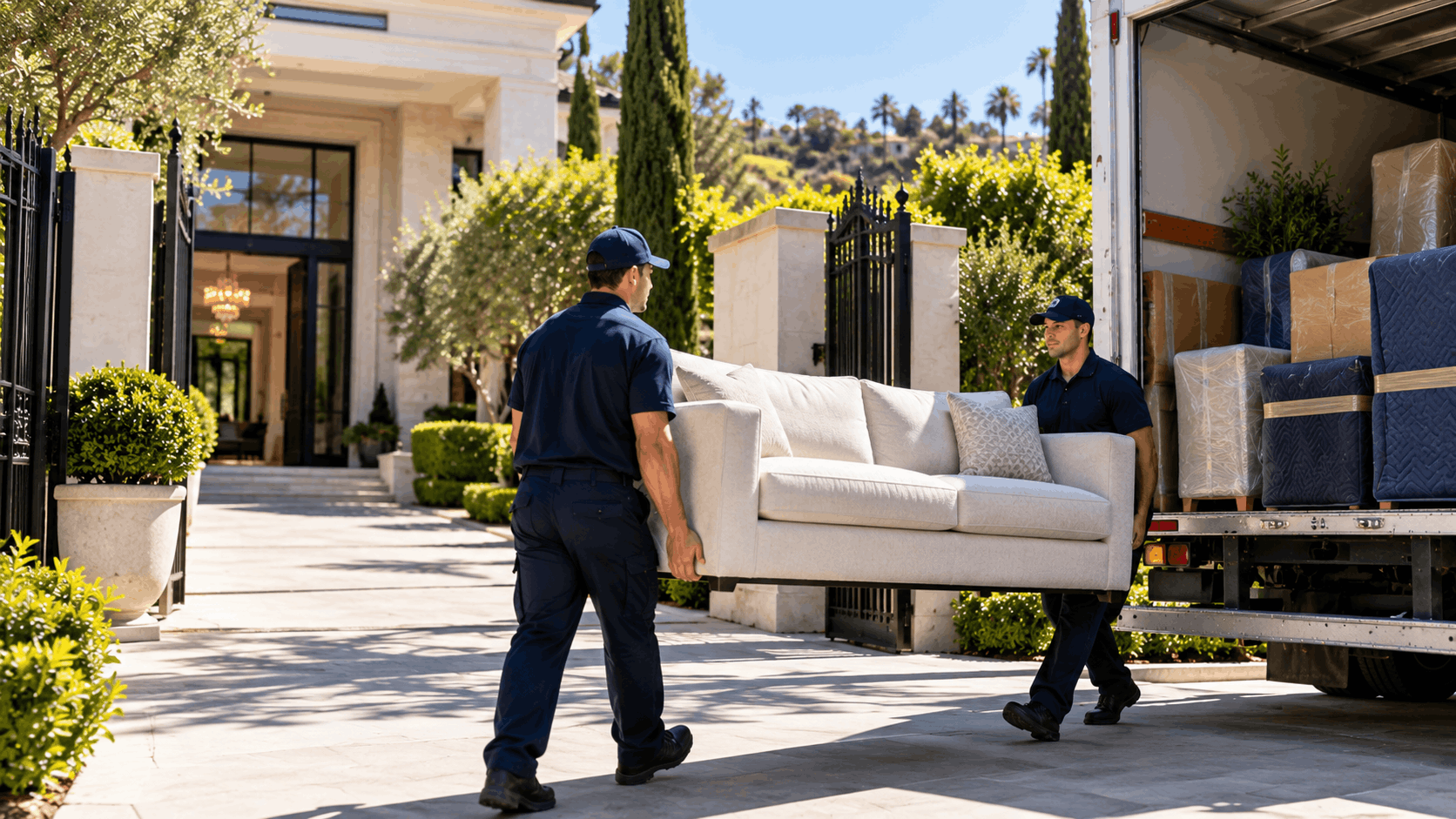
The core promise is simple to state and demanding to execute. Our crew loads at the Bel Air address, drives to the warehouse, and places the goods into vaults the same day. There is no overnight hold on the truck. For a property between sales or mid-renovation, that means the house clears and the belongings are already inside a building by the end of the day.
Bel Air sits in the Santa Monica Mountains foothills on the west side of the City of Los Angeles, bounded by Sunset Boulevard to the south, Beverly Glen to the east, Mulholland Drive above and the 405 to the west. Jurisdiction is the City of Los Angeles, which shapes everything about curb space, oversize trucks and timing. Same-day pickup from a gated estate here is as much about logistics and access as it is about handling.
What Same-Day Really Means Here
Same-day means the goods are collected at the Bel Air address and vaulted at our warehouse at 5509 1/2 S Centinela Ave in Mar Vista on the same calendar day. The truck does not become overnight storage. Once the shuttle or the main truck reaches Centinela Avenue, the vaults are loaded, sealed and placed inside.
This matters more on hillside property than it does on a flat city block. On the upper Bel Air roads there is nowhere legal to leave a loaded commercial truck overnight, and the streets are too tight to want one sitting there anyway. Moving the goods straight into the warehouse removes that problem entirely.
Vaulted storage is full-service by design, which is what makes same-day placement possible. Our crews handle the goods from the house to the vault, so there is no second stage where a customer has to unload into a unit. The chain runs from the estate directly into the warehouse in one controlled pass.
For an estate customer that single pass is the point. The fewer times belongings are touched, moved and restaged, the fewer chances there are for a scratch or a knock. A vault loaded once at origin and handled as a unit afterward keeps that count low.
Clearing a Gate Before Arrival
Gated property in Bel Air needs preparation that a street-level home does not. Crew names, vehicle details and arrival windows are lodged with the gate or the estate office in advance, so the crew is cleared at the entrance rather than held there while someone makes calls. A truck idling at a closed gate helps no one.
When a shuttle is part of the plan, those details go in too. The smaller vehicle that runs the property leg needs the same clearance as the main truck, so both are listed ahead of time. Gate staff know who is arriving, in what, and when.
Many of these properties sit behind controlled entrances with their own security, and some are on private roadways above the canyon streets. Lodging the information early is simply how the job runs smoothly on this kind of property. It is standard practice on gated and high-profile estates, not an extra step we invent on the day.
We treat arrival details as part of the booking, not an afterthought. The estate manager or assistant who coordinates the gate gets what they need in writing, and the crew arrives knowing exactly where to stage and where to pull the shuttle.
Who Authorizes the Pickup
In an estate market the person who calls is often not the person moving. The caller may be a real estate agent, a business manager, an interior designer, an estate manager or a personal assistant. Each of them may be acting for the owner without being the owner.
Because of that, we confirm at the first call who authorizes the work and who pays. The person walking the house may be neither. Establishing this early avoids a situation where the crew arrives and no one on site can approve a change or sign the paperwork.
This also keeps the written price clean. The Agreement For Moving Services and any later Change Order need a sign-off from someone with authority, so we identify that person before the date is set. On a large estate job with several structures, that clarity saves time on the day.
Discretion matters to these clients, and so does order. Knowing who holds authority and who handles payment lets the crew work without pausing for approvals, which is exactly what an agent or estate manager expects from a residential moving team on a high-profile property.
Why Nothing Sits on the Truck Overnight
Leaving goods loaded overnight is a staging method some movers use when storage is not ready. We do not run the job that way for same-day storage. The goods go straight into the warehouse vault instead of spending a night on a parked vehicle.
On Bel Air's hillside streets this is not just a preference, it is practical. The City of Los Angeles does not allow a commercial truck to be left standing on a residential block beyond the time reasonably needed to load or unload. An overnight truck on Roscomare Road or Chalon Road would be both unlawful and unsafe.
There is also a handling benefit. A sealed vault inside a conditioned building is a stable, secure environment. A truck parked on a street is exposed to weather, temperature swing and the general risk of sitting outside unattended.
So the pattern is always the same: load, transport, vault, close out the day. The customer ends the day knowing their belongings are inside the vaulted storage warehouse, not parked somewhere on the hill.
Get Your Free Quote
Tell us about your move. We'll be in touch soon.
The Canyon Roads Above the West and East Gates
Access is the hard part of almost every Bel Air job. The Los Angeles Fire Department documented this road network after the 1961 fire, describing steep, winding and extremely narrow dead-end streets, many of them private roadways, and ridge roads reachable only by an indirect route. That description still fits the ground today.
The East Gate stands at Beverly Glen and Sunset, and the West Gate at Bellagio Road and Sunset, opposite UCLA. Above them, Roscomare Road, Chalon Road, Nimes Road and Bellagio Road climb in switchbacks above Stone Canyon Reservoir. The terrain is what decides whether a full-size truck can reach a door, and when it cannot, the shuttle method takes over.
Why Full-Size Vans Struggle Above Stone Canyon
The upper Bel Air roads were not built for large trucks. Roscomare Road, Chalon Road, Nimes Road and Bellagio Road twist up the slope in tight switchbacks with blind bends and long stretches of single-lane width. A full-size van meets conditions here that it simply cannot work in.
The specific problems repeat from street to street: no turning room at the top of a driveway, nowhere legal to reverse, single-route canyons with no alternative way out, gated entrances, and driveways cut steeply into the slope. Many of these are private roadways with no shoulder and no margin for a wide vehicle.
The LAFD's own record after the 1961 fire captured how difficult this network is, noting ridge roads a short distance above the canyon street below that can only be reached by a ten-minute indirect drive. That is the reality a moving crew faces on an ordinary Tuesday, not just in an emergency.
For these reasons, we assess access before we ever put a truck on the hill. Sending a full-size van up a road it cannot turn around in helps no one, so we plan the approach around what the street actually allows.
The Shuttle Method, Not an Improvisation
When a full-size van cannot reach or turn at the property, the professional answer is a shuttle. The main van stages legally lower down, usually nearer Sunset or on a street with room, and a smaller vehicle runs the property leg up the canyon. This is the normal method on restricted-access hillside property.
A shuttle is not something the crew improvises on the day. It is identified during the survey, planned into the route, and priced on the written estimate with the extra time and cost stated there. The customer knows before booking that a shuttle is part of the job and what it adds.
The smaller vehicle makes several trips between the staged van and the house, carrying loads the main truck could never bring up a narrow switchback. It is slower than a single-vehicle load, which is why the time shows up in the estimate rather than as a surprise on the invoice.
On the kind of estate found above the West Gate, the shuttle is often the only way the job can happen at all. Treating it as the standard method for this terrain is what keeps the day predictable and the price honest.
What We Confirm Before Booking a Date
Before we quote, we confirm the access facts that decide the method. Whether a full-size vehicle can reach the address and turn, where a shuttle can legally stage, gate aperture, driveway grade and overhead clearance all go on the list. Each one can change the plan.
Gate aperture tells us what vehicle fits through the entrance. Driveway grade tells us whether a loaded dolly or a smaller truck can manage the slope safely. Overhead clearance flags low branches, gate arches or carport roofs that would stop a tall vehicle. These are measurements and observations, gathered during the survey.
Properties with no vehicle access at all are qualified on the phone before a date is confirmed. If the only way to the door is a long private footpath or a stairway, we establish that first so the crew and the schedule match the reality on the ground.
This is also where we map the full contents, because an estate is rarely just the main house. Guest houses, pool houses, garages and outbuildings all feed into the plan, and an unsurveyed structure is the single most common reason an estimate breaks on a hillside job.
Why Crews Do Not Judge Driveway Safety
There is a clear line on what the crew does and does not assess. Our team does not judge the structural or geological condition of a driveway, a retaining wall or a slope. That is an engineering question, and it is not ours to answer.
What the crew does assess is operational: turning room, staging location, gate aperture, driveway grade for the purpose of moving goods, and overhead clearance. Those are the facts that decide whether a truck or a shuttle is the right tool and where it can safely work.
The distinction protects the customer. A moving crew is not qualified to certify that a hillside driveway can bear a certain weight or that a wall is sound, and pretending otherwise would be irresponsible. We work within what we can observe and measure.
If a property raises a genuine structural or geological question, that belongs with the owner's engineer or the appropriate professional, not with the moving crew. Keeping those roles separate is part of how a careful job runs on steep Bel Air terrain.

Need Help in Los Angeles?
Popeye Moving & Storage serves Los Angeles and all of Los Angeles County.
What Vaulted Storage Is and How It Differs From Self-Storage?
The storage a Bel Air estate customer buys here is full-service vaulted storage, and it is a different product from a self-storage unit. There is no key, no individual unit and no right of entry. Our crews handle the goods, and the belongings live inside sealed wooden vaults in our warehouse.
This distinction is not just marketing language. California law treats vaulted warehouse storage and self-service storage under different legal frameworks, and the operating model here places this service firmly on the warehouse side of that line. The table below lays out the core differences.
| Feature | Vaulted Warehouse Storage | Self-Service Storage |
|---|---|---|
| Customer key | No key | Customer holds the key |
| Individual unit | No, goods in sealed vaults | Yes, a rented space |
| Walk-in access | No, by appointment only | Yes, customer enters freely |
| Who handles goods | Popeye crews | The customer |
| Governing law | Commercial Code Division 7 | Self-Service Storage Facility Act |
No Key, No Unit, No Walk-In Access
In full-service vaulted storage, the customer does not have a key, a unit number or the ability to walk in and browse. Our crews load the goods into a vault at origin, and from that point the vault is handled as a single sealed unit. That is the whole model.
Each vault is loaded once at the property, then closed and moved by forklift into its place in the warehouse. After the initial load, the belongings inside are not handled individually again until they come out. This is part of what keeps handling low across the storage term.
Because the customer has no independent access, any retrieval runs through the warehouse. The crew pulls the vault, opens it, and gets what is needed. That is how a professional vaulted facility works, and it is a trade-off: less casual access in exchange for controlled, crew-managed handling.
For an estate owner storing art, furniture or wine between homes, that controlled handling is usually the point. The goods sit undisturbed in a sealed container rather than being shuffled in and out of an open unit over and over.
Why This Is Not a Self-Storage Facility
California law draws a sharp line that trips up a lot of storage content. Business and Professions Code section 21701(a) defines a self-service storage facility as real property rented to occupants who have access to the space, and it states plainly that a self-service storage facility is not a warehouse. Those are two different things.
The test is whether the customer has exclusive use and access. In our vaulted storage, the customer has no key, no unit and no right of entry, so it does not meet the definition of a self-service storage facility. It falls under Division 7 of the California Commercial Code instead.
That distinction has real consequences. The lien, auction and access rules written for self-storage do not apply to vaulted warehouse storage. Instead, warehouse rules on care, receipts and liens govern the arrangement. Content that applies self-storage rules to a vaulted warehouse is simply describing the wrong law.
For Popeye, this is not a theoretical point. Our storage is full-service vaulted only, with no customer key, unit or entry, which is exactly what places it under Commercial Code Division 7. It is the actual operating model at the Centinela Avenue warehouse.
What a Storage Vault Looks Like
A typical wooden storage vault runs roughly 7 feet by 5 feet by 7 feet 10 inches on the exterior, built from plywood on a reinforced plywood floor set on runners, with four-way forklift access. That is a convention in the trade, not a fixed standard. It is the common size, not a required one.
There is no ANSI, ASTM, ISO or federal specification that governs household goods storage vault dimensions. Every manufacturer builds custom sizes, so vaults vary from one facility to the next. Any capacity figure for a vault is approximate, since published numbers are exterior volumes and the usable interior is smaller once wall thickness is deducted.
Popeye runs the full range of vault sizes, standard through oversized. That flexibility matters for estate contents, where an oversized piece of furniture or a large art crate may not fit a standard vault. The right vault size is matched to what is actually being stored.
Thinking of a vault as a sturdy, forklift-ready wooden box that is loaded once and then left sealed is the right mental model. It is not a room you enter, it is a container your belongings travel and rest in.
Climate-Controlled and What That Means
Our Mar Vista warehouse is climate controlled for both temperature and humidity, with the specification confirmed per shipment. We do not publish a single temperature or humidity figure as our specification, because the right setting depends on what is being stored and is set for the shipment.
Climate control genuinely matters for certain categories, and estate contents are full of them. The Canadian Conservation Institute lists oil paintings and rigid paint layers, photographs and negatives, veneer and marquetry, musical instruments, and fine furniture with inlays among the object types most vulnerable to humidity swings. These are exactly the items a Bel Air home tends to hold.
The mechanisms are well understood in conservation practice. On wood, high relative humidity causes swelling and warping while low humidity causes shrinkage and cracking. On leather, humidity that is too high promotes mold and darkening while humidity that is too low causes brittleness and tears. Stable conditions reduce that stress.
It is worth being honest about the term itself. There is no industry definition that fixes what temperature or humidity a facility must hold to call itself climate controlled. What matters is the facility's own stated specification for a given shipment, which is why we set it per shipment rather than quoting a blanket number.
What Popeye Stores at the Mar Vista Warehouse
The warehouse at 5509 1/2 S Centinela Ave in Mar Vista accepts a broad range of goods, which suits the mixed contents of a Bel Air estate. Household belongings, business inventory and specialist items all have a place here, with sensible exceptions driven by law rather than preference.
Term length is flexible, with no minimum and no maximum. That works for the owner between homes during a sale and for the client storing long term without planning to touch the goods. Below is what goes in and what stays out.
Household Goods, Commercial and Business Storage
Both household goods and commercial or business storage are accepted at the Centinela Avenue warehouse. For a Bel Air estate that flexibility is useful, because an estate move often mixes personal belongings with items tied to a business or a professional practice.
Household goods cover the furniture, furnishings and personal effects you would expect from a residence: furniture, art, rugs, cased goods and boxed contents. These are the bulk of most estate storage jobs and the reason vaulted storage exists in the first place.
Commercial and business storage serves the agents, designers and managers who often coordinate these jobs. A designer consolidating pieces for an install, or a business manager holding office contents during a relocation, can use the same warehouse. Our commercial and business storage runs alongside household goods under the same roof.
Having both options in one facility simplifies the logistics for anyone handling a complex estate. The main house contents and any business-related items can be stored together and managed through a single point of contact.
Wine, Fine Art, Pianos and Chandeliers
We accept specialist items that are common in Bel Air's estate stock: wine, fine art, pianos and chandeliers. These are precisely the belongings an owner on Nimes Road or above Stone Canyon is most likely to need stored with care.
Fine art and antiques need handling that ordinary movers are not set up for, which is why our fine art and antique moving team handles those pieces. Pianos, both upright and grand, call for dedicated equipment and crew, and chandelier removal and crating is its own discipline given how fragile and awkward large fixtures are.
Items of extraordinary value, such as antiques, art, and gold or silver articles, should be separately described on the inventory with a value declared for each. That is the correct way to document high-value pieces, and it protects the customer if a claim ever arises. Money, jewelry and important papers are best carried by the owner rather than shipped.
Wine storage sits alongside these. Collections stored here go into the climate-controlled environment with the rest of the vaulted goods, with conditions confirmed per shipment. For an estate with a cellar, that is often the deciding factor in where the collection goes during a move or renovation.
No Minimum or Maximum Storage Term
There is no minimum storage term and no maximum. A customer can store for a few weeks between homes or for years without access during the term. The term bends to the situation rather than the situation bending to a fixed contract length.
The typical storage customer here fits one of two patterns. The first is someone between homes during a move, who needs belongings held while escrow closes or a new house is ready. The second is someone storing long term who does not intend to access the goods during the term at all.
For an estate between sales, the open-ended term removes pressure. If a sale takes longer than expected, there is no penalty for the storage running on, and no scramble to empty a unit by a deadline. The goods stay vaulted until they are needed.
For long-term storage, the same flexibility applies in reverse. There is no requirement to commit to a minimum, so a client can store for exactly as long as the situation calls for. Our long-term storage is built around that kind of open-ended need.
What Cannot Go Into the Vault
Some things cannot go into the vault, and the biggest category is vehicles. Cars, motorcycles, boats and RVs are not accepted. The warehouse stores household and commercial goods, not motor vehicles, so vehicle storage is simply not part of the service.
Hazardous materials are refused as well, and this is federal law rather than company preference. Hazardous materials as defined by the US Secretary of Transportation are not accepted, including common household combustible liquids, corrosives, explosives and flammables. 49 CFR 171.2(e) bars any person from accepting a hazardous material for transport unless it is properly classed and packaged.
In practice that means items like propane tanks, gasoline, paint thinner, pool chemicals and fireworks stay out of the vault. A pre-move checklist of what cannot go on the truck saves a problem on pickup day, because these items have to be dealt with separately before the crew arrives.
Perishables, plants and open liquids are also unsuitable for storage, driven by spoilage and pest attraction rather than fire rules. Clearing these out ahead of time keeps the vault clean, safe and free of anything that could damage the rest of the stored goods.
How Valuation and Liability Work on Your Stored Goods
For an estate client storing valuable pieces, how liability works is not a footnote. Different rules apply during the move, during storage-in-transit, and during longer warehouse storage. Knowing which regime covers your goods at each stage lets you make an informed decision about coverage.
California intrastate moves run under Maximum Rate Tariff 4, enforced by the Bureau of Household Goods and Services. Warehouse storage beyond a defined window shifts to the California Commercial Code. Here is how each piece fits together.
Released Value Versus Full Value Protection
Under Maximum Rate Tariff 4, the transportation rates are based on a declared value of 60 cents per pound per article. That 60 cent figure is the rate basis, the number the rates are calculated on. It is never the payout, and it must not be read as one.
Separately, MAX 4 Item 136(2) provides that unless the shipper expressly declares a different value, the mover's maximum liability for lost and damaged articles is up to $20,000 of actual cash value. Both facts are true at once: 60 cents per pound is how the rate is computed, and $20,000 actual cash value is the default liability.
Released value is a liability limit, not insurance. Full value protection is the paid alternative, and it is a right the customer can choose rather than a favor the mover grants. MAX 4 requires each valuation option to be listed with the charge and a space for the shipper to initial.
For an estate with art, antiques and high-value furniture, this choice is where real coverage decisions get made. Declaring a higher value and listing items of extraordinary value individually is compliance with the tariff, and it is how you protect pieces that are worth far more than any per-pound figure.
Valuation While Goods Are in Storage-in-Transit
When goods sit in storage-in-transit, MAX 4 sets specific valuation charges for that period. Item 136(8) fixes the maximum rate for Actual Cash Value protection during storage-in-transit at $0.16 for each $100 of declared value, and Full Value protection at $0.38 for each $100.
These charges are separate from and additional to the transportation valuation charges. In other words, the protection you choose for the move and the protection during storage-in-transit are handled as distinct items, each with its own rate under the tariff.
Protection during storage-in-transit must be offered by the mover and ordered in writing by the shipper. It is not automatic, and it is not assumed. If a customer wants a particular level of protection while goods are in that window, it goes on the paperwork in writing.
For an estate owner whose belongings may sit in storage during an escrow or a renovation, understanding these rates helps when weighing how much protection to carry. The figures are set by the tariff, so they are the same regulated numbers regardless of which compliant mover you use.
The 90-Day Line and Warehouse Liability
There is a clear jurisdictional line at 90 days. MAX 4 Item 4 defines storage-in-transit as storage at the request of the consignor or consignee at one point between origin and destination for a period not to exceed 90 days. Inside that window, the move is still a regulated mover service.
Past 90 days, or where storage-in-transit was not requested, the goods fall under the warehouse's own contract and are no longer regulated by the bureau. MAX 4 Item 96 states that upon placement in a public warehouse, the mover's liability ceases and liability becomes that of the warehouseman in possession. That boundary decides which rules apply.
Under warehouse rules, California Commercial Code section 7204(a) sets the standard of care. A warehouse is liable for loss or injury to goods caused by its failure to exercise the care that a reasonably careful person would exercise under similar circumstances. That is ordinary negligence, not strict liability, and a warehouse is not an insurer of the goods.
Section 7204(b) allows the storage agreement to limit damages, with limits that cannot cover conversion and that the customer can ask to increase at the time of signing. There is no statutory floor on how low a limit may go, so reading the storage agreement is the customer protection here. That is where any liability limit is written.
Why Long-Term Storage Coverage Is Not Automatic
A customer should not assume that goods in long-term warehouse storage are covered by the mover's cargo policy. Business and Professions Code section 19248(c) requires cargo insurance of $20,000, and General Order 136-C frames that coverage around property during transportation or storage in transit.
Nothing confirms that the mover's cargo coverage extends past storage-in-transit into long-term warehouse storage. Because of that, goods in long-term storage should not be treated as automatically covered by the moving cargo policy. The regime has shifted to the warehouse contract, and coverage follows that contract.
The practical step for an estate client is to confirm what coverage applies to the stored goods and to read the storage agreement. That agreement is where the liability terms live once storage runs past the storage-in-transit window, and it is the document that answers the coverage question.
This is not a reason to avoid storage, it is a reason to go in informed. For high-value estate contents, understanding exactly what protection covers the goods at the long-term stage lets the owner decide whether additional coverage is warranted for their collection.
Need Help in Los Angeles?
Popeye Moving & Storage serves Los Angeles and all of Los Angeles County.
Parking, Permits and the Rules That Govern Pickup Day
Because Bel Air is City of Los Angeles jurisdiction, pickup day runs through LADOT rules. Curb space, oversize trucks and fire-zone restrictions all affect timing, and on a hillside street they can affect it a lot. Here is what changes the plan.
Only posted signs reserve the curb, oversize trucks have their own rules, and the whole area sits in a fire hazard zone with red flag day restrictions. We confirm the permit position for the specific address rather than guessing from the neighborhood.
Only Posted Signs Reserve the Curb
In Los Angeles, only posted temporary parking restriction signs reserve curb space. Nothing else holds a spot. A cone, a note or a verbal arrangement does not reserve the curb. The signs are the only thing that does.
Requests go to the LADOT Special Traffic Control Division at (213) 485-2298, with at least five working days allowed before the move date. That lead time matters on a hillside pickup where legal staging is already tight, so we plan the request well ahead of the day.
For the current fee and the application channel, the right source is LADOT directly, since those figures change over time. We point customers to LADOT rather than quoting a number that could be out of date by the time of the move.
On a narrow Bel Air street, reserved curb space can be the difference between a smooth load and a crew circling for somewhere to stop. Where the street allows it, posted signs secure the working space the truck or shuttle needs.
Oversize and Commercial Vehicle Rules
LAMC 80.69.4 defines an oversize vehicle as one over 22 feet in length or over 84 inches in height, and it bars parking such a vehicle between 2:00 a.m. and 6:00 a.m. where authorized signs are posted. A full-size moving truck falls squarely into that oversize category.
LADOT can issue an advance permit exempting the holder, capped at three consecutive days on the street segment purchased. But the code is explicit that the permit does not guarantee or reserve an on-street parking space. The permit exempts the vehicle from the restriction, it does not hold the spot. Only the posted signs hold the space.
LAMC 80.69.2 adds a commercial vehicle rule. It is unlawful to leave a commercial vehicle standing on a residential block except while loading or unloading, with the time reasonably needed to finish. A truck actively working the job is covered. A truck left standing afterward is not.
Together these rules explain why we vault the same day and never leave a truck overnight on the hill. The combination of oversize restrictions and the commercial loading rule means a parked, idle truck on a Bel Air residential street is not an option.
Red Flag Days in the Fire Hazard Zone
Bel Air Estates and Beverly Glen are named by the LAFD among the areas in the Very High Fire Hazard Severity Zone. That designation dates from 1999 and carries real restrictions that affect a moving day during fire season.
The LAFD declares a red flag day at wind speeds of 25 miles per hour or more with humidity of 15 percent or less. On a red flag day, parking is strictly prohibited in posted areas inside the zone, and illegally parked vehicles will be towed. That turns a routine curb into a no-parking zone with teeth.
We check the flag status and the map on the LAFD site before dispatch. If a red flag day is in effect, the staging and parking plan has to account for it, because the posted restrictions override the normal curb arrangement. This is part of why hillside schedules need slack rather than a tight window.
The history behind this is not abstract. The Bel Air fire of November 1961 destroyed 484 dwellings and burned over 6,000 acres, driven by Santana winds and humidity as low as 4 percent. The red flag rules exist because this terrain and climate have burned before.
How the Permit Position Is Confirmed for Your Address
Curb and staging options vary street by street between the East Gate and the upper canyon roads, so we confirm the permit position for the specific Bel Air address rather than generalizing. What works at a lower sub-area near the East Gate may not apply on a narrow road above Stone Canyon.
That means checking what the particular street allows: whether posted signs can reserve space, where a shuttle can legally stage, and how the oversize and commercial rules play out at that exact location. Each address gets its own answer.
Where the position is settled, we confirm it for the address. Where a street is tight or access is restricted, the plan is built around what that street actually permits, including the shuttle staging point lower down the hill.
This address-specific approach is the only honest way to handle Bel Air parking. Generalizing one street's rule across the neighborhood would set a false expectation, and on these roads a false expectation turns into a delay on the day.
What Same-Day Gated Pickup and Storage Costs in Bel Air
Cost on an estate job comes from volume, handling, specialty items and access, not from the Bel Air address itself. The figures below are typical market ranges for the Los Angeles area, copied exactly, and they are ranges to set expectations, never a quote. The actual price for your move is set in writing before anything is loaded.
| Service | Typical Range |
|---|---|
| Vaulted storage | $60 to $90 per vault per month |
| Local residential moving (2-person crew and truck) | $150 to $200 per hour |
| White glove moving | $150 to $250 per hour |
| Fine art and antique moving | $300 to $1,200+ |
| Piano moving | $200 to $600 |
| Chandelier moving | $150 to $450 |
| Custom crating | $150 to $800+ per crate |
Typical Storage and Local Moving Ranges
Vaulted storage in the Los Angeles area typically runs $60 to $90 per vault per month. That is a per-vault figure, so a larger estate that fills several vaults will carry a monthly cost that reflects how many vaults it uses.
Local residential moving typically runs $150 to $200 per hour for a two-person crew and truck. Estate jobs often use larger crews and more time, so the hourly rate is only one input into the total. The volume of goods drives the hours.
White glove moving typically runs $150 to $250 per hour. This higher-touch service suits estate contents where finishes, art and delicate furniture need extra protection and slower, more careful handling throughout the move.
These are typical area ranges, not a quote from us. The number that applies to a specific job depends on that job, and it is set in writing before any goods move. Treat the ranges as a way to gauge order of magnitude, not a final price.
Specialty Item Ranges for Estate Contents
Bel Air estates tend to hold items that carry their own ranges. Fine art and antique moving typically runs $300 to $1,200 or more, reflecting the custom handling, padding and sometimes crating these pieces require.
Piano moving typically runs $200 to $600, with upright pianos costing less than grand pianos because grands are heavier and harder to maneuver. Chandelier moving typically runs $150 to $450, given how fragile and awkward large fixtures are to remove, wrap and transport.
Custom crating typically runs $150 to $800 or more per crate. For a one-of-a-kind sculpture, a large mirror or a valuable artwork, a purpose-built crate is often the safest way to move and store it, and our custom crating team builds to the piece.
These specialty ranges are typical area figures as well. The exact figure for a particular piano, chandelier or artwork depends on the item, the access and the handling it needs, all of which are assessed during the survey and priced in writing.
What Drives the Number on a Hillside Estate
The real cost drivers on a Bel Air estate job are volume and handling, the number of vaults, any specialty items, the shuttle leg on restricted-access property, and double drive time on local hourly work. These are the levers that move the total, not the neighborhood name.
Double drive time applies to local hourly moves across California. Travel time between origin and destination is charged at twice the actual driving time. It is a legitimate, regulated charge rather than padding, and how traffic timing lands can affect it, so we explain it plainly rather than let it surprise anyone on the invoice.
The shuttle leg adds time and cost on restricted-access hillside property, and it is identified and priced at the estimate. Because the smaller vehicle makes multiple trips up the canyon, those hours show up in the written price rather than appearing later.
What most often breaks an estimate here is an unsurveyed guest house, pool house or outbuilding. An estate is rarely just the main house, so a secondary structure nobody counted can change the volume significantly. That is exactly why the on-site survey covers every structure on the property.
The Not-To-Exceed Price Caps Your Bill
On a move inside California, the Not To Exceed figure is the customer's main price protection. It is the maximum total dollar amount the consignor can be liable for, agreed in writing before any goods are moved or any services performed. The final bill cannot exceed it.
The only way the total goes above the Not To Exceed amount is through a valid Change Order that the customer agrees to. If something comes up on the day that was not in the original scope, it is handled as a documented change the customer signs off on, not a silent addition to the bill.
This is a right the customer has under Maximum Rate Tariff 4, not a courtesy. Failing to include a Not To Exceed Price on the required documentation has been cited by regulators as a violation, which is how seriously the rule is treated.
For an estate client, the Not To Exceed figure turns a complex multi-structure job into a known ceiling. You see the maximum before the truck is loaded, and nothing above it appears without your agreement. That is the California protection, and it is the one to insist on.
Need Help in Los Angeles?
Popeye Moving & Storage serves Los Angeles and all of Los Angeles County.
How Popeye Handles a Bel Air Pickup and Storage Job
The working process runs from an on-site survey, to a written price, to same-day vaulting at the Mar Vista warehouse. Each step is grounded in how a licensed California mover is supposed to work, and each one is built around the realities of a gated hillside estate.
Here is how a Bel Air pickup and storage job actually unfolds, from the first walk-through to the moment the vaults are placed inside the warehouse.
The On-Site Survey and Written Estimate
The survey covers the full contents, and on an estate that means every structure. We walk the main house, the guest house, the pool house, the garage and every outbuilding, because an unsurveyed structure is the fastest way to break an estimate on this kind of property.
During the survey we also note whether there is a piano, a safe, art or wine, since each of those changes the handling plan and the equipment the crew brings. We confirm access at the same time: whether a full-size vehicle can reach and turn, where a shuttle can stage, and the gate aperture, driveway grade and overhead clearance.
From the survey comes a written Agreement For Moving Services. MAX 4 requires that agreement to describe the shipment in enough detail to determine the articles and services included in the Not To Exceed Price, to describe the transportation and accessorial services including the number of helpers and packers, and to state the rates and charges.
A verbal quote, whether per hour or per hundred pounds, is not an estimate and is not binding. The written agreement is the document that counts, and it is the one a customer can check against what was discussed. That written price is where the Not To Exceed figure lives.
Licensing and Insurance You Can Verify
Popeye operates under California household mover permit CAL T 189749 for intrastate work, and under USDOT 1472924 and MC 498816C for interstate work. The company is fully insured and is BBB accredited with an A+ rating. These are facts a customer can verify before booking.
California household movers are regulated by the Department of Consumer Affairs Bureau of Household Goods and Services, the BHGS, reachable at (916) 999-2041. Authority transferred to BHGS on July 1, 2018, and the bureau is where license status is checked and complaints are filed. The CPUC no longer regulates California movers.
Verifying a permit before booking is the simple, checkable step every customer should take. Ask for the permit number, and confirm it through the bureau rather than after a problem arises. An operator working without a valid permit is not merely uninsured in practice, it is unlawful.
For an estate client handing over high-value contents, that verification is worth doing. A licensed, insured and accredited mover is working within a regulated framework with real consumer protections, including the valuation and Not To Exceed rules already covered.
Same-Day Vaulting at the Mar Vista Warehouse
On the day, the crew stages the truck where the street allows and runs a shuttle up the canyon where the terrain requires it. Finishes are protected with pads and wrap as the goods come out of the house, with particular care on art, antiques and inlaid furniture.
Once loaded, the goods travel to 5509 1/2 S Centinela Ave in Mar Vista and go into vaults the same day. There is no overnight hold on the truck. The vaults are loaded, sealed and placed inside the warehouse by the end of the day.
Mar Vista sits on the Westside, and the warehouse is the same address as our Google Business Profile location. For a Bel Air pickup the route down from the hill to Centinela Avenue is a manageable local run, which is part of what makes same-day vaulting workable.
The result is a clean handoff: the estate clears, the belongings are inside a sealed, climate-controlled vault, and the paperwork documents what went in. Our storage solutions are built around exactly this kind of same-day move-and-store job.
Discretion on Gated and High-Profile Property
Estate clients expect appointments kept, tidy uniformed crews, finishes protected and discretion throughout. On gated and high-profile property, discretion is not a nicety, it is part of the job. The crew works quietly and professionally and does not advertise who they are working for.
Gate details are lodged in advance with crew names and vehicle information, including any shuttle vehicle, so the crew is cleared at the entrance and the gate office knows exactly who is arriving and when. That preparation keeps the arrival smooth and avoids a crew waiting at a closed gate.
Many Bel Air callers are agents, designers, business managers or estate managers acting for the owner, and they expect a team that handles the property with care and keeps to the agreed windows. Appointments kept and a written price before work starts are part of what they are paying for.
The combination of careful handling, confirmed gate access and a quiet, uniformed crew is what makes this service suit the estate market. It is the standard for high-profile property, from Holmby Hills next door to the upper reaches of Bel Air.
Store With a Licensed Local Mover
If an estate above the West Gate or along Roscomare Road needs to clear the same day and go into secure vaulted storage, start with an on-site survey of every structure and a written Agreement For Moving Services that carries your Not To Exceed price before any goods move. To schedule the survey or ask about same-day gated pickup and storage, call Popeye Moving & Storage at (310) 823-9510 or reach us through our contact page.
Frequently Asked Questions
- Can you pick up from a Bel Air estate and store the same day?
- Yes. We collect goods from the Bel Air address and place them into vaults at our Mar Vista warehouse the same day, with no overnight hold on the truck. On restricted-access hillside property, a shuttle may run the property leg while the main van stages lower down. Once the goods reach 5509 1/2 S Centinela Ave, the vaults are loaded, sealed and placed inside the warehouse before the day ends.
- What is vaulted storage and how is it different from a storage unit?
- Vaulted storage is full-service. There is no key, no individual unit and no walk-in access. Our crews handle the goods, loading them once into sealed wooden vaults at origin. A self-storage unit, by contrast, is a space you rent with your own key and free access. Because the customer has no access or exclusive use here, this storage falls under Commercial Code Division 7, not the Self-Service Storage Facility Act.
- How much does vaulted storage cost in the Los Angeles area?
- Vaulted storage typically runs $60 to $90 per vault per month in the Los Angeles area. That is a per-vault figure, so a larger estate filling several vaults carries a monthly cost that reflects the number of vaults used. This is a typical area range, not a quote. The actual price for your storage is set in writing based on the goods and how many vaults they fill.
- Can a moving truck reach my house above Stone Canyon?
- Often a full-size van cannot. Many upper Bel Air roads, including Roscomare Road, Chalon Road, Nimes Road and Bellagio Road, are too narrow, steep and winding for a large truck to reach or turn. The answer is a shuttle: the van stages legally lower down and a smaller vehicle runs the property leg. That shuttle is confirmed during the survey and priced on the written estimate, not improvised on the day.
- Do I need a parking permit for the moving truck in Bel Air?
- In the City of Los Angeles, only posted temporary parking restriction signs reserve curb space. Requests go to the LADOT Special Traffic Control Division at (213) 485-2298, with at least five working days' notice before the move. Check LADOT for the current fee. We confirm the permit position for your specific address, since curb and staging options vary street by street between the East Gate and the upper canyon roads.
- How long can I store my belongings?
- There is no minimum and no maximum storage term. That works for customers between homes during a move, who need belongings held until a sale closes or a new house is ready, and for those storing long term without planning to access the goods during the term. The storage runs for exactly as long as the situation calls for, with no deadline to empty a unit and no penalty if a sale takes longer than expected.
- Can I access my goods while they are in storage?
- Vaulted goods require the warehouse to retrieve and open the container, so an appointment is ordinary practice. The crew pulls the vault, opens it and gets what you need. The warehouse business hours are for calls and scheduling, not open customer access hours for walking in and browsing. If you expect to need items during the term, it is worth discussing that upfront so retrieval can be planned.
- Are my stored items covered if something is lost or damaged?
- During the move and storage-in-transit, Maximum Rate Tariff 4 sets your valuation options, with a default of up to $20,000 actual cash value unless you declare more, and full value protection available as a paid choice. Once storage runs past the 90-day storage-in-transit window, the goods fall under the warehouse's own contract, governed by Commercial Code section 7204. Read the storage agreement and confirm what coverage applies to your stored goods.
- Do you store wine, fine art, pianos and chandeliers?
- Yes. Wine, fine art, pianos and chandeliers are accepted as specialist items, which suits the estate stock common in Bel Air. Items of extraordinary value, such as antiques, art, and gold or silver articles, should be separately listed on the inventory with a value declared for each. That documentation is the correct way to handle high-value pieces and protects you if a claim ever arises.
- Who regulates California movers and how do I verify a mover?
- Intrastate movers in California are regulated by the Department of Consumer Affairs Bureau of Household Goods and Services, the BHGS, reachable at (916) 999-2041. It is not the CPUC, which stopped regulating movers in 2018. You can verify a mover's permit, such as our CAL T 189749, through the bureau before booking. Asking for the permit number and checking it first is the simplest protection a customer has.
Popeye Moving & Storage Co. Team Team
Licensed moving and storage professionals serving Los Angeles and Los Angeles County.
Licensed in California · License #CAL T 189749 | USDOT 1472924 | MC 498816C
Why trust Popeye Moving & Storage?
Founded in 1994, Popeye Moving & Storage is a licensed and insured moving and storage service serving Los Angeles and Los Angeles County. All content is reviewed by our licensed technicians.

Need Help in Los Angeles?
Popeye Moving & Storage serves Los Angeles and all of Los Angeles County.
Related Articles
Between-Leases Storage in LA - The Week-to-Month Playbook With Pickup and Redelivery
Caught between leases in LA? Learn how week-to-month storage with pickup and redelivery bridges the gap, plus LA parking rules, costs, and packing tips.
Storage in Carlson Park, Culver City with Same-Day Pickup to Our Vaults
Full-service vaulted storage with driveway pickup in Carlson Park, Culver City. How it works, Culver City permits, costs to confirm, climate control and your claim protections.

Old Pasadena Storage: Same-Day Mixed-Use Pickup to Our Vaults
How same-day pickup into vaulted storage works for Old Pasadena's mixed-use lofts and offices, including Pasadena permit rules, access, protection and typical costs.