Storage in North Hollywood and Valley Village with Same-Day Metro-Adjacent Pickup
Key Takeaways
- Popeye picks up near the Lankershim and Chandler Metro station and places goods into vaults at the Mar Vista warehouse the same day, with no overnight hold on the truck.
- Full-service vaulted storage means no key, no individual unit and no right of entry; goods are handled by Popeye crews and retrieved by appointment.
- Vaulted storage runs a typical $60 to $90 per vault per month in the Los Angeles area, with the figure for a specific shipment set in writing.
- The 60 cents per pound figure is only the rate basis; the California default liability is up to $20,000 of actual cash value unless a different value is declared.
- Storage-in-transit runs up to 90 days under mover rules; past 90 days goods fall under the warehouse contract and Commercial Code Division 7.
- North Hollywood permits run through LADOT, with a five working day lead time for temporary no-parking signs and an oversize permit published at $10.00 per day for up to three days.
- California household movers are regulated by the BHGS at (916) 999-2041, not the CPUC; Popeye operates under CAL T 189749 and is BBB accredited with an A+ rating.
- Climate-sensitive items like instruments, art and wood furniture should not sit in a closed truck through a Valley afternoon, so an early start protects them.
In This Article
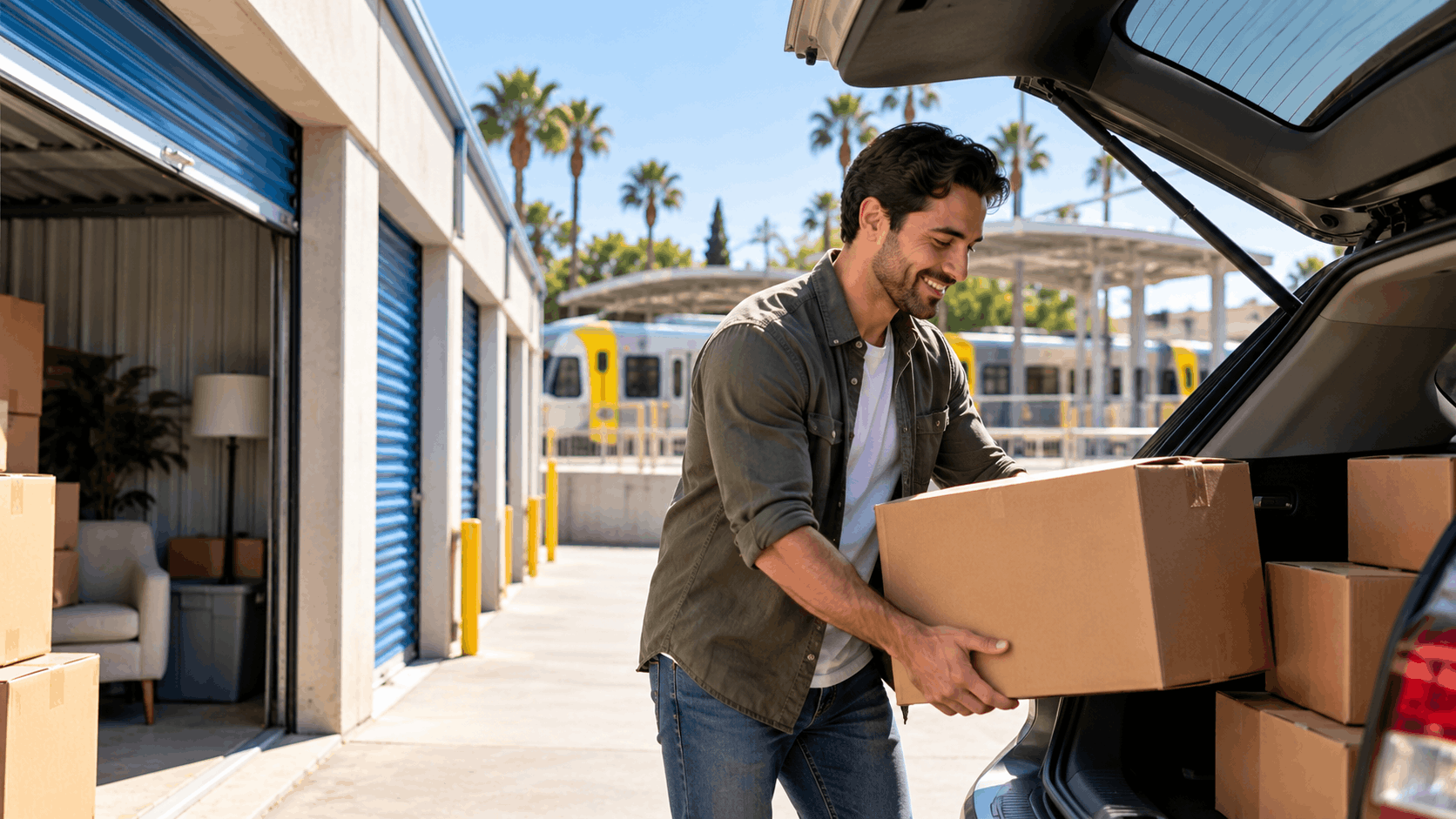
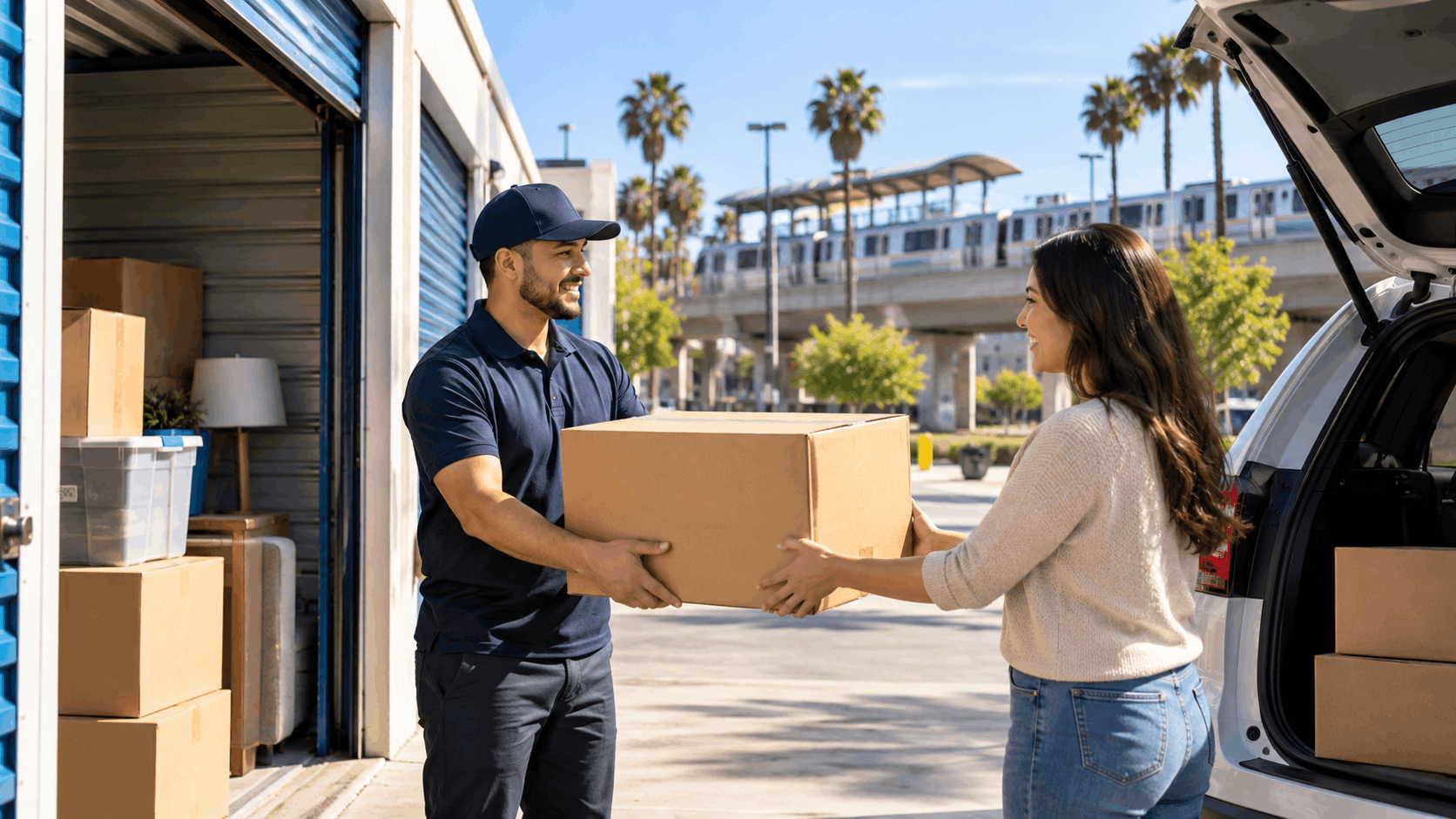
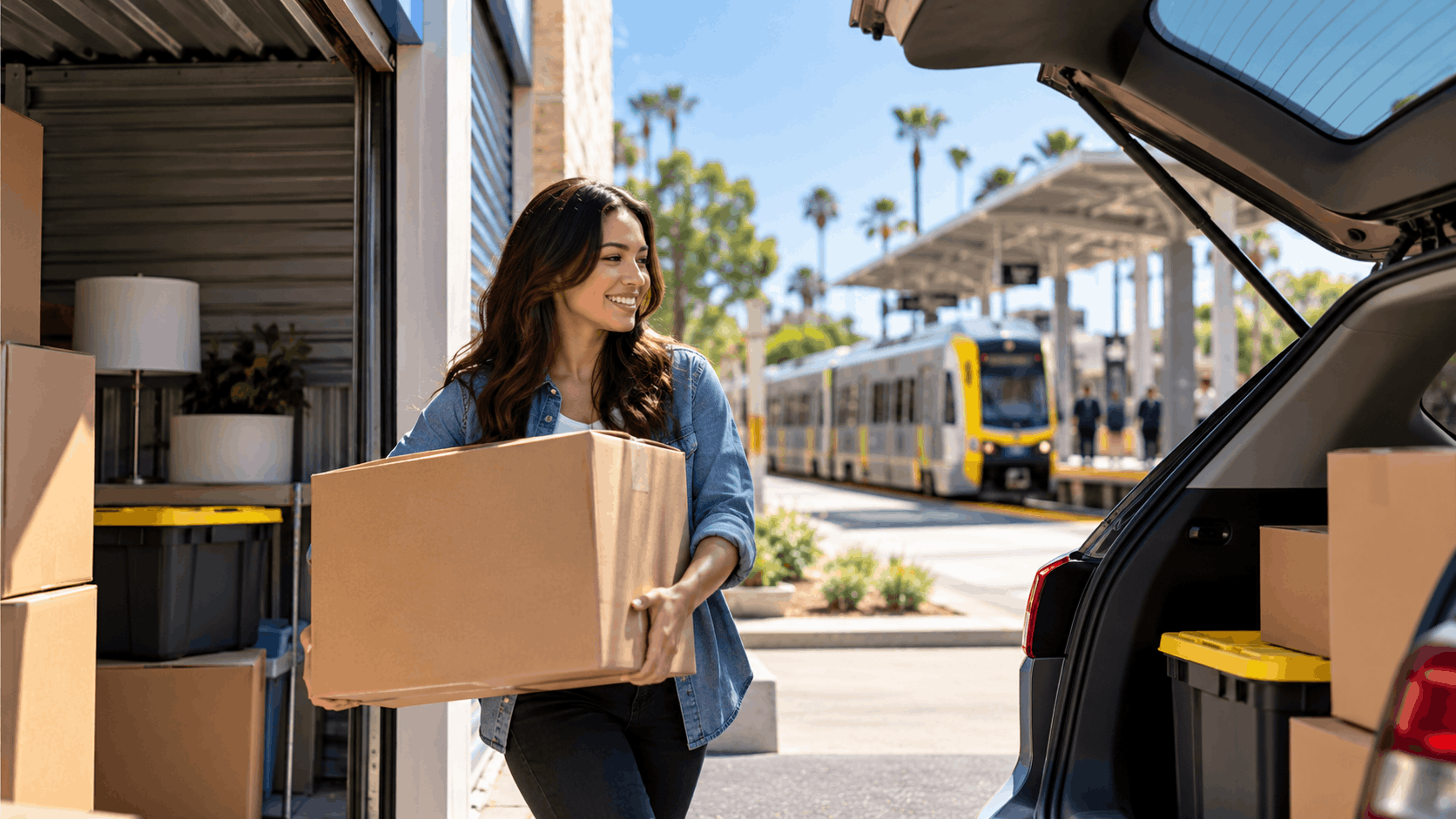
A renter near the Lankershim and Chandler Metro station reaches the end of a lease on the first of the month, with a new place not quite ready and a truck they do not want sitting outside overnight. The question is simple: where do the belongings go today, and does a truck have to park on the street until morning? The answer is no. Popeye Moving & Storage Co. picks up near the station the same day and places goods into vaults at our Mar Vista warehouse, with no overnight hold on the truck.
That means the move-out and the storage happen in one visit. The crew loads at the North Hollywood address, drives the goods over the hill, and the belongings go into a vault at 5509 1/2 S Centinela Ave the same day. Nothing waits in a truck through a Valley night, and nothing sits exposed on a residential street where a logo truck is not allowed overnight anyway.

Same-Day Pickup for North Hollywood and Valley Village Moves
North Hollywood runs on a fast rental cycle. The eastern San Fernando Valley around Lankershim, Magnolia and Victory boulevards has a large renter share and short tenancies, so studio, one- and two-bedroom moves come up constantly, often at short notice and bunched at month end and on the first. A same-day pickup fits that rhythm, because the goods go straight from the unit into storage without a gap.
The pickup and the storage are one job. We load at the North Hollywood or Valley Village address, route the truck to the Westside, and unload into vaults at the Mar Vista warehouse the same day. There is no overnight hold on the truck, which matters in the city of Los Angeles where logo trucks and vehicles over a certain length cannot park on residential streets overnight.
What Same-Day Pickup Actually Means
Same-day pickup means the crew arrives, loads the belongings, and delivers them into vaults at the Mar Vista warehouse before the day is done. The goods do not spend a night on the truck, and they do not wait in a staging lot for a second crew to finish the job later in the week. One visit covers the move-out and the placement into storage.
The practical benefit is that the belongings are handled on a controlled timeline rather than left in a vehicle outside a building. A loaded truck parked overnight on a North Hollywood street is both a parking problem and a security concern, and the city's own rules push against it. Getting the goods into the warehouse the same day removes both issues.
It also tightens the schedule for the customer. A renter who has to be out by a certain hour knows the belongings are placed and accounted for that day, rather than tracking a truck that is still out on the road. For a short-notice move at month end, that certainty is worth a great deal.
Because the pickup is part of the storage job, we quote the hourly move work and the storage together and put it in writing before loading. The timeline for the pickup day depends on the building, the floor, and the carry distance, which is why we confirm those details on the first call.
Metro-Adjacent Access Around Lankershim and Chandler
The North Hollywood station sits at 5357 Lankershim Boulevard at Chandler, and it is the Metro B Line terminus and the G Line eastern terminus. That makes the surrounding blocks one of the busiest transit hubs in the Valley, with heavy foot and vehicle traffic through the day. A pickup within a few blocks of the station has to account for that density.
Truck positioning near the station takes more planning than a quiet residential street. Curb space is contested, buses and riders move through constantly, and the newer mid-rise buildings that have gone up around the station often have service entrances and loading zones that must be used rather than the main frontage. We work out where the truck can legally sit before the crew arrives.
The 170, 134 and 101 all feed the district, which helps the drive to the Westside but also means the approach roads carry real traffic at peak times. California bills local hourly moves on a double drive time convention, so travel is charged at twice the actual driving time. A move over the hill is slow on the clock, which is one more reason an earlier start pays off.
For moves starting in or near the arts district, our team treats the first call as the moment to map the route, the parking, and the building access together. The station's pull on the neighborhood shapes everything from where the truck stops to how long the carry runs. Our Los Angeles moving team knows these blocks.
Serving Valley Village and Adjoining Neighborhoods
Valley Village sits directly next to North Hollywood and shares its housing mix and its fast rental turnover. Toluca Lake and Studio City adjoin as well, and the four neighborhoods trade residents constantly as leases end and new ones begin. A same-day storage pickup works the same way across all of them, with the truck routed to the Mar Vista warehouse the same day.
The ZIP codes for the area are 91601, 91602, 91605 and 91606, and the district is framed by the 170 Hollywood Freeway and the 134 Ventura Freeway. Those freeways are both a convenience and a constraint, because they feed the main boulevards that the crew uses to reach a building and then to head over the hill.
Each adjoining neighborhood brings its own building stock. Studio City runs toward hillside streets and single-family homes, while Valley Village carries more of the post-war apartment and duplex pattern that defines the eastern Valley. Confirming the building type on the first call lets us bring the right crew size and the right access plan.
Whether the pickup is a one-bedroom apartment off Magnolia or a larger place near Valley Village, the storage end is the same vaulted warehouse service. The neighborhood changes the access and the carry, not the storage model itself.
Why an Early Start Helps in the Valley
Summer temperatures in the eastern Valley run well above the coastal side of the hills. That heat affects crew pacing and safety, and it affects what rides in the truck. Instruments and electronics in particular do not do well sitting in a closed truck through a Valley afternoon.
An early start is the sensible method for a summer move here, not a preference. Loading in the cooler part of the morning keeps the crew working safely and gets heat-sensitive gear off the truck and into the climate-controlled warehouse sooner. A camera body, a synthesizer or a laptop left in a hot cargo box all afternoon is exposed to heat it does not need.
The double drive time convention adds another reason to begin early. Because travel over the hill to the Westside is charged at twice the actual driving time, a move that starts in the morning beats the worst of the afternoon traffic on the 101 and 134 and keeps the clock down.
For NoHo's entertainment workers moving recording and AV equipment, the early start and the climate-controlled destination work together. The gear spends less time in the heat and lands in a warehouse built to hold conditions steady. That combination protects exactly the belongings most likely to be worth the most.
Get Your Free Quote
Tell us about your move. We'll be in touch soon.
How Full-Service Vaulted Storage Works
Popeye offers full-service vaulted storage, not self-storage units. That is a different product with different rules, and the difference matters for how the belongings are handled, who touches them, and which law governs the arrangement. Understanding the model up front saves confusion later.
With vaulted warehouse storage, the goods go into wooden vaults that our crews load and seal, and the vaults live inside our Mar Vista warehouse. The customer does not drive to a unit and open a roll-up door. The warehouse holds the goods and retrieves them when the customer needs them back.
Vaulted Storage Versus a Self-Storage Unit
In a self-storage arrangement, the customer rents a space, holds a key, and drives up to load and unload whenever they like. They have exclusive use of the unit and a right of entry. That is the model most people picture when they hear the word storage, and it is governed by the Self-Service Storage Facility Act.
Vaulted storage is the opposite in every one of those respects. The customer has no key, no individual unit and no right of entry. Goods are handled by Popeye crews, loaded into vaults at pickup and retrieved by the warehouse when the customer arranges it. There is no walking up to a door.
That distinction is not just about convenience. Because the customer has no key and no exclusive access, the arrangement sits outside the self-storage statute entirely and falls under Commercial Code Division 7, which governs warehouses. The rules on liability, liens and claims that apply are the warehouse rules, not the self-storage rules.
For most storage customers between homes during a move, the full-service model is simpler. The crew does the loading and the lifting, the goods are protected inside a sealed vault, and there is no monthly trip to a unit. Our vaulted storage service page covers how the handling works.
What a Storage Vault Is
A household goods storage vault is a wooden container, built from plywood on a reinforced plywood floor set on runners, with four-way forklift access so it can be lifted and moved as a unit. A common size runs roughly 7 feet by 5 feet by 7 feet 10 inches on the exterior, though that is a typical size and not a fixed standard.
There is no ANSI, ASTM, ISO or federal specification governing household goods vault dimensions. Every manufacturer builds to its own sizes and makes custom sizes to order, so any figure quoted for a vault is a typical figure rather than an industry standard. Popeye runs the full range of vault sizes, standard through oversized.
Capacity figures should be read the same way. Published volumes are exterior measurements, and the usable interior is lower once the wall thickness is deducted. Any capacity number is approximate, and the right vault size for a given shipment is matched to the goods rather than assumed from a catalog figure.
The forklift access is what makes the vault practical. Once loaded and sealed, the vault is moved and stacked by machine rather than unpacked and repacked. That is the core of why vaulted storage handles goods the way it does, which the next point explains.
Loaded Once and Moved as a Unit
A vault is loaded once at the origin and then moved as a unit by forklift for the rest of its time in storage. The crew packs the belongings in at pickup, seals the vault, and from that point the whole container is what gets lifted, carried into the warehouse, and stacked.
Because the container moves as one piece, the goods inside are handled fewer times than they would be in a self-storage cycle, where items are carried in and out by hand each time the unit is accessed. The belongings are not repeatedly lifted, shifted or restacked individually once they are in the vault.
That mechanism reduces the number of touchpoints where a scratch or a knock can happen. Each time a chair or a box is handled by hand is a chance for something to go wrong, and the vault model collapses many of those handlings into a single loading at the start.
It also keeps the contents together. Everything from one pickup stays in its vault, sealed, rather than spread across a unit that gets rearranged over time. When the customer needs the goods back, the warehouse retrieves the vault.
No Minimum and No Maximum Term
There is no minimum and no maximum storage term. A customer can store for a few weeks between leases or for a long stretch while a new home gets sorted out, without being locked into a fixed period at either end. The term fits the situation rather than the situation fitting the term.
That flexibility suits NoHo's rental market directly. Many customers here are renters between homes, out of one place on the first and not yet into the next, who need somewhere for their belongings for an uncertain stretch. A short term with no minimum matches that gap.
It also suits customers who are storing without planning to touch the goods during the term. Someone consolidating a household, holding furniture during a renovation, or keeping belongings while working on a production out of town can store for as long as the project runs.
Because there is no maximum, the arrangement can run long term, though the rules that govern the storage change once goods pass the 90-day storage-in-transit window. That boundary is covered in its own section below, and it is worth reading before committing to a long stay. For extended needs, see our long-term storage option.
Need Help in Los Angeles?
Popeye Moving & Storage serves Los Angeles and all of Los Angeles County.
Where Your Belongings Are Stored
The belongings from a North Hollywood pickup are stored at Popeye's own warehouse on the Westside. This is not a third-party facility or a rented unit somewhere unknown. It is the same address as our Google Business Profile business location, which means the goods are held by the company that moved them.
The warehouse is climate controlled for both temperature and humidity, and it accepts a wide range of household and commercial goods. There are limits on what it will take, and vehicles are one of them, which the sections below set out.
The Mar Vista Warehouse on Centinela Avenue
The warehouse is at 5509 1/2 S Centinela Ave, Los Angeles, CA 90066, in Mar Vista on the Westside. That is the same address as our Google Business Profile, so a customer can verify where their goods are going before the pickup. There is no mystery about the destination.
For North Hollywood and Valley Village goods, that means a Valley-to-Westside route over the hill. The crew loads in the eastern Valley and drives the belongings to Mar Vista the same day. The drive is part of why an early start helps, since the double drive time convention applies to the local hourly portion of the work.
Mar Vista sits inland from the immediate coast, which gives the warehouse a different environment from a facility right at the water. A sealed vault inside a conditioned building is a controlled space, distinct from an exposed or waterfront location. We handle Mar Vista moves directly, so the warehouse is on home ground.
Keeping the storage at our own warehouse rather than handing it to another operator means the chain of custody stays with one company from pickup to retrieval. The crew that loaded the vault and the warehouse that holds it are the same business.
Climate-Controlled Storage
Storage at the Mar Vista warehouse is climate controlled for both temperature and humidity. The specification is confirmed per shipment rather than fixed at a single setting, because different goods call for different handling and the right conditions are set for what is being stored.
There is no industry definition that fixes what temperature or humidity a facility must hold to call itself climate controlled. No code or trade body sets those numbers. That is why the specification for a given shipment is confirmed directly rather than quoted from a generic figure, and the conditions are set to the goods.
Conservation bodies publish reference ranges that inform good practice. The National Park Service, for example, recommends keeping relative humidity below the point where mold can develop, and warns that high humidity promotes mold growth on vulnerable materials. Those are published conservation references, not the stated conditions at this warehouse.
For the entertainment gear, wood furniture and artwork that NoHo customers often store, stable conditions matter more than for a box of dishes. Humidity swings are what damage sensitive materials, which is why a conditioned warehouse space is a meaningful part of the service rather than a label.
Specialist and Commercial Items Accepted
The warehouse accepts specialist items alongside ordinary household goods. Wine, fine art, pianos and chandeliers are all accepted, which matters in a neighborhood full of musicians, collectors and creative professionals. These are exactly the belongings that need careful handling and stable conditions.
Commercial and business storage is accepted as well. The arts district holds small theaters, rehearsal spaces, recording studios and production companies, and those businesses sometimes need to store equipment, inventory or fixtures. The warehouse takes commercial goods alongside residential ones. Our commercial storage page covers business needs.
Specialist items are handled with the right method for each. A piano, a chandelier and a crated painting each call for different packing and lifting, and declaring high-value items separately on the inventory is part of protecting them, which the valuation section covers. Our piano moving and fine art and antique moving teams handle these.
One firm limit applies: vehicles are not accepted. There is no car, motorcycle, boat or RV storage at this warehouse. Customers looking to store a vehicle need a different kind of facility, because that is not a service offered here.
Business Hours Are Not Warehouse Access Hours
Business hours for calls and scheduling are 6am to 9pm, seven days a week, including Sunday. Those hours are when the office can be reached to book a pickup, ask a question or arrange a retrieval. They are generous hours that fit the odd schedules of a production-driven neighborhood.
Those are business hours, not warehouse access hours for a customer. Because this is full-service vaulted storage with no customer entry, there is no walking into the warehouse during those hours to visit a unit. The customer does not have access to the floor at all.
Retrieving stored goods works by appointment. The warehouse locates the vault, opens it and brings out what the customer needs. An appointment is ordinary trade practice for vaulted storage, since the container has to be retrieved and opened by staff rather than accessed by the customer directly.
So the hours to remember are the scheduling hours, which is when to call to set anything up. The retrieval itself is arranged within those scheduling hours and handled by the warehouse crew, not by the customer letting themselves in.
Protecting an Entertainment Worker's Gear in Storage
NoHo is home to a large population working in film, television, theater and music, much of it project-based and geographically mobile. That workforce stores instruments, recording and AV equipment, costume and prop collections, scripts and archives. These items are light, expensive and fragile, which is exactly where basic coverage falls short.
Valuation is the mechanism that protects stored goods, and it is not insurance. Understanding how the default works, and why a higher declaration matters for light high-value gear, is the single most useful thing an entertainment worker can learn before storing.
Why the 60-Cent Rate Basis Is Not the Payout
Maximum Rate Tariff 4 Item 136(1) states that transportation rates are based upon a declared value of 60 cents per pound per article. That figure is the rate basis, the number the transportation rates are computed on. It is not the amount a customer gets paid if something is lost or damaged.
The reason this matters so much for NoHo gear is that the 60-cent basis is weight-based. It pays by the pound, and the belongings an entertainment worker stores weigh very little relative to their worth. A guitar, a synthesizer, a camera body or a laptop weighs almost nothing on a scale.
So on the 60-cent rate basis, the payout on those items would be close to nothing. A few pounds times 60 cents comes nowhere near what the item cost or what it would take to replace. Presenting that basis as the coverage would badly mislead anyone storing their livelihood.
This is why content and conversation about valuation has to be scrupulous. The 60-cent figure explains how the rate is calculated, not what protection the customer has. The actual protection comes from the default below and from declaring a higher value.
The $20,000 Actual Cash Value Default
Maximum Rate Tariff 4 Item 136(2) states that unless the shipper expressly declares a value other than $20,000 for the shipment, the mover's maximum liability for lost and damaged articles is up to $20,000 of actual cash value. That is the California intrastate default for a customer who declares nothing.
Both the 60-cent basis and the $20,000 default are true at the same time. The 60 cents explains the rate math, and the $20,000 is the liability ceiling that applies when no other value is declared. A customer who signs without declaring anything is covered up to that actual cash value figure, not the near-zero weight payout.
Actual cash value means the depreciated value of the item, not what it would cost to buy new. For a shipment worth more than $20,000, or for high-value gear where a declared per-item value makes sense, the shipper has the right to declare a different value and should.
The mover is required to offer each valuation option, list the charge for each, and give the shipper a space to initial. A customer has a right to be offered better coverage and a right to decline it knowingly. That choice should be made on purpose, not by default.
Valuation While Goods Sit in Storage-in-Transit
Maximum Rate Tariff 4 Item 136(8) sets the maximum fixed rate for Actual Cash Value protection while a shipment is in storage-in-transit at 16 cents for each $100 of declared value, and Full Value protection at 38 cents for each $100. These charges are separate from and additional to the transportation valuation charges.
Protection during storage-in-transit must be offered by the mover and ordered in writing by the shipper. It does not attach automatically just because the goods are sitting in the warehouse. A customer who wants the goods covered while in storage-in-transit needs to request it and have it written into the paperwork.
The two options work differently. Actual Cash Value pays the depreciated value of a lost or damaged item, while Full Value protection is the paid alternative that provides broader coverage. The per-$100 rates above are the maximum fixed rates for each during the storage-in-transit period.
For an entertainment worker storing valuable gear, ordering storage-in-transit protection in writing is the step that extends meaningful coverage into the storage period. Skipping it leaves a gap, so it is worth raising at the time the estimate is signed rather than after.
Declaring High-Value Items Separately
Items of extraordinary value, such as instruments, art and recording gear, should be separately described on the inventory with a value declared for each. A blanket shipment value does not give a single expensive item the attention it needs, and listing it individually is how its worth is documented.
For an entertainment worker, that means walking through the gear and naming the pieces that carry real value. A vintage instrument, a high-end camera, a rack of recording equipment, or an original piece of art each belongs on the inventory with its own line and its own declared value.
Some items are better carried by the customer than shipped at all. Money, jewelry and important papers should travel with the owner rather than going into storage. These are small, high-value and easy to misplace, and the safest handling is to keep them in hand.
Taking the time to build an accurate inventory is the practical answer to the weight-based coverage gap. It documents what is being stored and at what value, which is what makes any later claim provable. The paperwork is the protection.
The 90-Day Line Between a Move and Warehouse Storage
There is a hard line at 90 days that changes which law governs stored goods and what protections apply. Inside the window, the storage is part of a regulated mover service. Past it, the goods fall under the warehouse's own contract and a different body of law. This boundary is the single most useful thing to understand about storage.
The table below summarizes what changes at that line, and the subsections explain each side in detail.
| Feature | Storage-in-transit (up to 90 days) | Warehouse storage (past 90 days) |
|---|---|---|
| Governing law | Household Movers Act and MAX 4 | Commercial Code Division 7 |
| Regulator | Bureau of Household Goods and Services | Warehouse contract, not the bureau |
| Liability | Mover's regulated liability | Warehouseman's standard of care |
| Coverage document | Agreement For Moving Services | Storage agreement or warehouse receipt |
What Storage-in-Transit Covers
Maximum Rate Tariff 4 Item 4 defines storage-in-transit as storage of a shipment at the request of the consignor or consignee at one point between origin and destination, for a period not to exceed 90 days. It is storage that sits in the middle of a move, holding the goods on the way to their final destination.
Inside that 90-day window, the move is still a regulated mover service. The goods are covered by the Household Movers Act and Maximum Rate Tariff 4, administered by the Bureau of Household Goods and Services. The protections that apply to a move apply to the storage.
That means the Not To Exceed price, the valuation rules, and the claim windows set out in MAX 4 all reach the goods during this period. For a renter between leases storing for a month or two, the storage sits comfortably inside storage-in-transit and the mover rules govern throughout.
Storage-in-transit has to be requested, which is part of why the arrangement is discussed and written down at the estimate. It is the default regime for short storage during a move, and it carries the full set of mover protections with it.
What Changes After 90 Days
Past 90 days, or where storage-in-transit was not requested, the goods fall under the warehouse's own contract. At that point the arrangement is governed by Commercial Code Division 7 rather than by the bureau. The regime shifts from mover rules to warehouse rules.
Maximum Rate Tariff 4 Item 96 states that upon placement in a public warehouse, the mover's liability ceases and liability thereafter is that of the warehouseman in possession. The protection does not disappear, but it changes form, and the document that governs it becomes the storage agreement rather than the moving paperwork.
This matters because the mover's cargo insurance is not confirmed to extend past storage-in-transit into warehouse storage. Business and Professions Code section 19248(c) requires cargo insurance tied to the course of transportation or storage in transit, and nothing confirms it reaches long-term warehouse storage. A customer storing long term should not assume the mover's cargo policy covers the goods.
The practical takeaway is to know which side of the 90-day line the storage sits on, and to read the storage agreement for long-term goods. The rules, the liability and the claim timing all follow from which regime applies.
Standard of Care in Warehouse Storage
California Commercial Code section 7204(a) provides that a warehouse is liable for loss of or injury to goods caused by its failure to exercise the care that a reasonably careful person would exercise under similar circumstances. Unless otherwise agreed, the warehouse is not liable for damage that could not have been avoided by that care.
That is ordinary negligence. The warehouse is held to the standard of a reasonably careful operator, and it is responsible when its own failure to meet that standard causes harm to the goods. It is a real and enforceable duty, not a hollow one.
It is not strict liability, and the warehouse is not an insurer of the goods. Damage that happens despite reasonable care, from a cause the warehouse could not have prevented, does not automatically fall on the warehouse. This is the key distinction between a storage duty and an insurance policy.
Understanding that distinction helps a customer decide whether they want additional protection on stored goods. The standard of care covers negligence, but a customer who wants broader coverage for high-value items should address it in the storage agreement, which the next point explains.
Reading the Storage Agreement
Section 7204(b) allows damages to be limited by a term in the warehouse receipt or storage agreement. That means the agreement itself can set a cap on what the warehouse pays, which is why reading the storage agreement is the real customer protection here. The document controls the terms.
The statute gives the customer a lever. A bailor may request increased liability on part or all of the goods, in a record at the time of signing or within a reasonable time after receiving the receipt. Increased rates may then be charged on the increased valuation, so broader coverage is available for a cost.
There are a few limits that protect the customer. The liability limit is not effective for the warehouse's liability for converting the goods to its own use, and added terms cannot impair the delivery obligation or the duty of care. Those duties stand regardless of what the agreement says.
There is no statutory floor on how low a limit may go and no required type size. That is precisely why the agreement has to be read rather than skimmed. A customer who wants their high-value instruments or art fully protected should ask for increased liability in writing and confirm the terms before signing.
Need Help in Los Angeles?
Popeye Moving & Storage serves Los Angeles and all of Los Angeles County.
What It Costs to Store in North Hollywood
Storage cost for a North Hollywood job has two parts: the monthly vaulted storage rate and the pickup move that gets the goods there. The figures below are typical ranges for the Los Angeles area as published on our service pages. They are typical ranges, not a quote or a fixed price from Popeye, and the price for a specific shipment is set in writing.
| Service | Typical Los Angeles range |
|---|---|
| Vaulted storage | $60 to $90 per vault per month |
| Local residential moving | $150 to $200 per hour for a two-person crew and truck |
| One-bedroom apartment local move | $350 to $650 |
| Piano moving | $200 to $600 |
| Fine art and antique moving | $300 to $1,200+ |
| Chandelier moving | $150 to $450 |
| Custom crating | $150 to $800+ per crate |
Typical Vaulted Storage Rates
Vaulted storage runs $60 to $90 per vault per month as a typical Los Angeles area range. That is the monthly cost to hold one vault in the warehouse. The number of vaults a shipment fills depends on how much is being stored and the vault sizes used.
This is a typical range, not a fixed price. The actual figure for a specific shipment is set in writing, because it depends on the vault count, the vault sizes and the arrangement for that customer. A studio's worth of belongings fills fewer vaults than a three-bedroom home.
For a renter storing between leases, the monthly vault rate is the ongoing cost, and the pickup is the one-time cost. Knowing roughly how many vaults the belongings fill is what turns the per-vault range into a monthly estimate, which we work out at the estimate stage.
Because there is no minimum term, the monthly rate applies for as long as the goods stay, short or long. A two-month hold and a longer stay both bill by the vault per month at the rate set in writing.
Local Move Costs That Feed Into Storage
The pickup is a local move, and local residential moving runs $150 to $200 per hour for a two-person crew and truck as a typical area range. A one-bedroom apartment local move typically runs $350 to $650. These figures are part of the storage job, because the goods have to be loaded and driven before they can be stored.
The hourly structure means the building and the access drive the cost. A ground-floor unit with a short carry runs fewer hours than a third-floor walk-up with narrow stairs. That is why we confirm the floor, the flights and the carry distance before quoting.
Double drive time applies on local hourly moves. California's tariff rules charge travel time between origin and destination at twice the actual driving time. It is a legitimate, regulated charge, not a padding tactic, and for a Valley-to-Westside route over the hill it is worth factoring in. A morning start keeps that time down.
Our apartment moving and residential moving teams handle the pickup end, so the whole job from unit to vault is one company's work on one timeline.
Specialty Handling for NoHo Belongings
NoHo's belongings often include items that need specialty handling, and those carry their own typical ranges. Piano moving runs $200 to $600, with upright pianos costing less than grands. Fine art and antique moving runs $300 to $1,200 and up. Chandelier moving runs $150 to $450. Custom crating runs $150 to $800 and up per crate.
These are all typical ranges for the area, not fixed prices. A piano's cost depends on its type, the access at both ends and the stairs involved. Fine art varies with the piece, its size and the crating it needs. Each specialty item is priced to the work it actually takes.
Custom crating in particular matters for the instruments, recording gear and art that entertainment workers store. A built-to-fit crate protects an irregular or fragile item far better than a standard box, which is why custom crating is its own line. Our custom crating team builds to the item.
Chandeliers and pianos are accepted in storage and need specialist handling both to move and to store. Declaring high-value specialty items separately on the inventory, as the valuation section covers, goes hand in hand with the specialty handling that protects them physically.
The Not-to-Exceed Price Caps Your Bill
Under Maximum Rate Tariff 4, the Not To Exceed amount is the maximum total dollar amount the consignor may be liable for, covering the transportation and any additional services ordered, agreed to in writing before any goods are moved or any services performed. It is a ceiling set before the truck is loaded.
That ceiling is a right the customer has, not a courtesy the mover extends. The final bill cannot exceed the Not To Exceed figure except through a Change Order that the customer agrees to. A customer who wants to add a service or change the scope signs off on the change, and nothing is added behind their back.
This is the California intrastate protection, and it is different from the federal interstate rules that apply to moves crossing a state line. For a move and storage job that begins and ends inside California, the Not To Exceed figure in writing is what actually caps the bill.
So the typical ranges above tell a customer what to expect, and the Not To Exceed figure on their own paperwork is what binds. The written estimate and the Not To Exceed amount together turn an area range into a firm ceiling for that specific job.
Getting the Truck Parked Legally in North Hollywood
North Hollywood is city of Los Angeles ground, so moving truck parking permits run through LADOT, the Los Angeles Department of Transportation. The parking rules shape a same-day pickup, because the truck has to have a legal place to sit while the crew loads. Getting that sorted ahead of time keeps the day on schedule.
There are two separate things to handle: reserving the curb space and legalizing an oversize truck's parking. They are different permits that do different jobs, and the building type adds its own access rules on top.
Temporary No-Parking Signs Through LADOT
Temporary street parking restriction signs reserve curb space for the truck. LADOT publishes a stated lead time of five working days for these, so a same-day pickup that needs reserved curb space has to be planned ahead rather than arranged the morning of. The signs are what hold the spot.
Applications go through LADOT by phone on (213) 485-2298, between 8am and 12:30pm Monday to Friday, as well as online and in person at a DOT Public Service Center. There is a non-refundable fee. Customers should confirm the current fee directly with LADOT, since published figures change.
The five working day lead time is the detail that catches people out on a short-notice move. A renter who finds out on Thursday that they need to be out Monday may not have time to post signs, which is one more reason to raise parking on the first call so we can plan around it.
Reserving the curb matters most on the busy blocks near the station, where open space is scarce. A posted no-parking zone gives the truck a legal place to sit close to the building, which shortens the carry and keeps the hourly clock down.
Oversize Vehicle Parking and Overnight Rules
An oversize vehicle parking permit is published at $10.00 per day, for up to three days. It legalizes the truck's size and its overnight parking, but it reserves no space. It solves a different problem from the no-parking signs, which do reserve space but do not address the truck's size.
The two permits work together. The oversize permit makes it legal for a large truck to be parked and to sit overnight, while the temporary signs hold the curb. A job that needs both reserved space and an oversize vehicle legalized uses both, and customers should confirm current fees with LADOT.
There is a firm overnight rule that drives the whole same-day model. Commercial trucks with a logo, or longer than 22 feet, may not park overnight on city streets. A loaded Popeye truck cannot legally sit on a North Hollywood street through the night, which is exactly why the goods go into the warehouse the same day.
So the overnight restriction is not just an inconvenience to work around. It is the reason the same-day pickup exists. Getting the belongings into a vault the same day means there is no truck to park overnight in the first place.
Walk-Ups, Courtyards and Managed Buildings
Much of NoHo's apartment stock is two- and three-story buildings with no elevator, narrow stairwells, tight landings and small original door apertures. The 1950s courtyard buildings add an open walkway between the street and the unit door. These older buildings set the pace of a move through their access, not their size.
Newer buildings near the Metro station are a different situation. They often have service elevators and management offices, which means an elevator reservation in a fixed window, a certificate of insurance naming the owner and the management company, sometimes a deposit, and permitted move hours. Those requirements have to be lined up before the crew arrives.
Establishing which type of building is involved is a first-call question. A walk-up and a managed mid-rise call for completely different preparation, from the crew approach to the paperwork, and finding out on the day wastes time. We ask early so the right plan is in place.
For managed buildings, the insurance certificate and the elevator window are the two items that most often need lead time. Management offices have their own schedules, and a certificate naming the right parties takes a moment to issue, so raising it on the first call keeps the pickup day clean.
Why Carry Distance Sets the Hours
In these buildings, stairs and carry distance set the hours rather than the volume of goods. A one-bedroom on the third floor of a walk-up takes longer to move than the same belongings on the ground floor, because every box and every piece of furniture travels the flights by hand.
Flights and stairwell turns are the big drivers. A tight stairwell with sharp turns slows every carry, and large pieces may have to be worked around corners or taken apart. A courtyard route adds the open walkway distance between the street and the door, which lengthens every trip.
Carry distance from the nearest legal truck position also counts. If the truck cannot park at the door, the crew carries the goods further, and that distance multiplies across every item. This is where a reserved curb space earns its keep, by shortening the carry and cutting the hours.
For a same-day pickup, the carry details determine how the day runs. Knowing the floor, the flights, the stairwell turns and the carry distance up front lets us estimate the hours realistically and make sure the goods reach the warehouse the same day.
Preparing Belongings for Time in Storage
Preparing goods well before they go into storage protects them while they sit. The guidance below is drawn from conservation practice and from the federal household goods warehouse inspection standard, so it is practical and checkable rather than opinion. Good preparation is the difference between belongings that come out as they went in and ones that do not.
The focus here is on what reacts to storage conditions, how to cover goods correctly, what cannot go in at all, and which pests target which materials.
Which Items React to Humidity Swings
The Canadian Conservation Institute lists the object types most vulnerable to humidity swings: oil paintings and rigid paint layers on canvas, photographs and negatives, panel paintings with weak adhesion, veneer and marquetry, musical instruments, and fine furniture with inlays. These are the categories where storage conditions genuinely change the outcome.
Wood is a clear example of why conditions matter. The National Park Service states that high relative humidity above 65 percent causes swelling and warping, while low humidity causes shrinkage, warping and cracking. Wood moves with the moisture around it, which is why a conditioned space protects furniture and instruments.
Leather responds the same way. Conservation references note that high humidity promotes mold and darkening while very low humidity causes loss of flexibility and embrittlement. These are published conservation references, not the stated conditions at the Mar Vista warehouse, and they explain why stability matters for these materials.
For NoHo customers, this maps directly onto what they store. Instruments, artwork, photographs and fine furniture are exactly the vulnerable categories, and they are exactly what a creative household is likely to own. A climate-controlled warehouse space addresses the risk these materials carry.
Breathable Covers, Not Sealed Plastic
The National Park Service advises breathable dust covers such as muslin or Tyvek rather than sealed plastic. The reason is that sealing goods in polyethylene is a containment response to active mold, not a general storage method. Wrapping healthy goods in airtight plastic can trap moisture against them.
Breathable covers let goods exchange air and avoid the condensation that builds up inside sealed plastic. Furniture, upholstery and wood do better under muslin or a breathable wrap that keeps dust off without sealing moisture in. The cover protects from dust while letting the item breathe.
Fabric preparation helps too. The Canadian Conservation Institute advises prewashing fabrics used for packing, so that any residue or sizing does not transfer to stored items, and inspecting woolens and other keratinous items for pests before they go into storage. Clean, pest-free packing materials protect what they wrap.
These steps cost little and prevent the problems that show up months later. A breathable cover, clean packing fabric, and a quick pest check before an item goes in are small efforts that keep belongings sound through a long storage term.
What Cannot Go on the Truck or Into Storage
Hazardous materials as defined by the US Secretary of Transportation are not accepted for shipment or storage. That includes common household combustible liquids, corrosives, explosives and flammables. A practical pre-move check of what cannot go on the truck prevents a problem on the day.
This is federal law, not company policy. 49 CFR 171.2(e) provides that no person may offer or accept a hazardous material for transportation in commerce unless it is properly classed, described, packaged, marked, labeled and in condition for shipment. A mover that accepts undeclared hazmat is the accepting person under that rule.
So the refusal to take flammables and the like is not a preference the crew could waive. The law puts the responsibility on the accepting party, which is the mover. Items like propane tanks, gasoline, paint thinner, aerosols and similar products have to be dealt with separately before the move.
A quick sweep of the garage, the kitchen under-sink cabinet and the storage closet usually turns up the items that cannot go. Setting them aside before the crew arrives keeps the pickup moving and keeps everyone within the law.
Pests and What Each One Targets
Pests target specific materials, and knowing which pest eats what lets a customer protect the right belongings. The National Park Service Conserve O Gram 3/11 maps this out clearly, and it is worth checking vulnerable items before they go into storage.
Carpet beetles attack leather, fur, feathers, skin, and woolen and silk textiles. Clothes moths attack woolen clothes, feather hats, dolls and toys, bristle brushes, weavings and fabric wall hangings. Both go after the natural animal fibers that are common in a household's textiles and clothing.
Powderpost beetles attack frames, books, toys, furniture, tool handles, lumber, paneling and crating, so they threaten wood goods. Silverfish consume fabrics, paper, sizing and the glue and paste in older book bindings, and they prefer moist conditions in the 70 to 80 degree range, which is why moisture control matters for papers and books.
The practical step is to inspect the vulnerable items before they go in. Woolens, furs, leather, wood furniture and boxes of books and papers are the categories to check and clean first. Catching a problem before storage keeps it from spreading inside a sealed vault.
Need Help in Los Angeles?
Popeye Moving & Storage serves Los Angeles and all of Los Angeles County.
How Popeye Handles Your North Hollywood Storage Job
A same-day storage pickup runs on a clear sequence: a written estimate with a firm ceiling, licensing a customer can check, and a qualifying call that confirms the access before the date is set. Each of those is something the customer can verify, which is the point. The work is documented, not improvised.
The Written Estimate and Not-to-Exceed Figure
A verbal rate quotation, whether per hour or per hundred pounds, is not an estimate and is not binding. California does not require a binding estimate, but it does require a written one, and a proper written estimate is what a customer should expect and check against what they have been sent.
The Agreement For Moving Services describes the shipment in enough detail to determine the articles and services included in the Not To Exceed price. It describes the transportation and accessorial services, including the number of helpers and packers, and states the rates and charges quoted, with any minimums for hours, weights and materials.
The Not To Exceed figure on that agreement caps the bill before anything is loaded. It is the maximum the customer can be liable for, and the final bill cannot exceed it except through a Change Order the customer agrees to. That ceiling is the customer's main protection on a California move.
For a same-day storage job, the written estimate covers both the pickup move and the storage arrangement, so the customer sees the whole cost in writing before the crew begins. The ranges elsewhere in this guide set expectations, and the written figure binds.
Licensing You Can Verify Before Booking
Popeye operates under California household mover permit CAL T 189749 for intrastate work, and USDOT 1472924 and MC 498816C for interstate work, and is fully insured. Those numbers can be checked before booking, which is the sensible order: verify first, then book, rather than finding a problem after.
Popeye is BBB accredited with an A+ rating. A customer can ask for the permit number and verify a mover's license status before committing. An operator working without a valid permit is not merely uninsured in practice, it is unlawful, which is why the permit check is worth doing.
California household movers are regulated by the Department of Consumer Affairs Bureau of Household Goods and Services, the BHGS, reachable on (916) 999-2041, with complaint and verification information published at its website. The California Public Utilities Commission no longer regulates household movers and has not since 2018. For a California move, the BHGS is the authority.
So the verification path is clear. A customer can confirm the permit, check the BBB accreditation, and reach the bureau directly if they want to confirm a mover's standing. Doing that before booking is the protection that matters most.
Confirming Access Before the Pickup Date
Before a pickup date is set, we confirm the access details that drive the day. That means establishing whether the building is a walk-up or a managed building, and if managed, the elevator window, the insurance certificate, any deposit and the permitted move hours. Those items need lead time.
For a walk-up, we confirm the floor, the number of flights, the stairwell turns and whether the route runs through a courtyard, along with the carry distance from the nearest legal truck position. Those details set the hours and let us estimate the job honestly rather than guessing.
We also confirm whether the move is at month end, when scheduling is tightest in NoHo, and whether instruments, recording or AV equipment are involved and need separate valuation. High-value gear is flagged early so the inventory and the valuation can be handled properly.
Properties with no vehicle access at all are qualified on the phone before a date is confirmed. Where a shuttle from a smaller vehicle is needed for restricted access, that is the professional method and is priced at the estimate, not treated as a surprise on the day.
Store Near the Station Without the Overnight Worry
A same-day pickup near the Lankershim and Chandler station puts your belongings into a climate-controlled vault at our Mar Vista warehouse the same day, with a written estimate and a Not To Exceed figure set before anything is loaded. To book a pickup or get an estimate, call Popeye Moving & Storage Co. at (310) 823-9510, and have your building type, floor and move date ready so we can confirm access and plan the parking.
Frequently Asked Questions
- Can I store my belongings the same day I move out in North Hollywood?
- Yes. Popeye picks up and places goods into vaults at the Mar Vista warehouse the same day, with no overnight hold on the truck. The move-out and the storage happen in one visit, so the belongings go straight from the unit into a vault at our Westside warehouse that day. This also avoids the city rule against logo trucks parking overnight on residential streets, which is one reason the same-day model exists.
- Do I get a key or can I visit my stored items?
- No. This is full-service vaulted storage, so the customer has no key, no individual unit and no right of entry. Goods are handled by Popeye crews, loaded into vaults at pickup and retrieved by the warehouse when you need them. It is different from a self-storage unit you drive to. When you want something back, the warehouse locates and opens the vault, and that retrieval is arranged by appointment during our scheduling hours.
- How much does vaulted storage cost in the Los Angeles area?
- Vaulted storage runs $60 to $90 per vault per month as a typical Los Angeles area range. That is the monthly cost to hold one vault, and the number of vaults your belongings fill depends on how much you store and the vault sizes used. This is a typical range, not a quote. The figure for your specific shipment is set in writing as part of the estimate, along with the pickup move cost.
- Is there a minimum or maximum storage term?
- No. There is no minimum and no maximum storage term. You can store for a few weeks between leases or for a long stretch, and the term fits your situation rather than being fixed at either end. This suits NoHo renters who are out of one place and not yet into the next. Just note that goods stored past 90 days move from storage-in-transit into warehouse storage, which changes the governing rules.
- Where is my stuff actually stored?
- At Popeye's own warehouse at 5509 1/2 S Centinela Ave, Los Angeles, CA 90066, in Mar Vista on the Westside. That is the same address as our Google Business Profile, so you can verify where the goods are going before the pickup. For North Hollywood and Valley Village jobs, the belongings are driven over the hill from the Valley and placed into vaults at that warehouse the same day. The storage stays with the company that moved it.
- What happens to coverage on my goods after 90 days in storage?
- Storage-in-transit runs up to 90 days under the mover's regulated service, governed by the Household Movers Act and Maximum Rate Tariff 4. Past 90 days, the goods fall under the warehouse's own contract and California Commercial Code Division 7. At that point, under MAX 4 Item 96, the mover's liability ceases and becomes that of the warehouseman. The mover's cargo policy is not confirmed to extend past storage-in-transit, so read the storage agreement for long-term goods.
- What is the default liability if I do not declare a value?
- Under MAX 4 Item 136(2), unless you expressly declare a different value, the mover's maximum liability for lost and damaged articles is up to $20,000 of actual cash value. That is the California intrastate default. The 60 cents per pound per article figure in Item 136(1) is only the rate basis the charges are computed on, not the payout. Because it is weight-based, it pays almost nothing on light, valuable items, so declaring a higher value is worth doing.
- Do you store instruments, recording gear and fine art?
- Yes. Wine, fine art, pianos and chandeliers are all accepted, alongside household and commercial goods. For instruments, recording gear and art, declare the high-value pieces separately on the inventory with a value for each, since basic weight-based coverage pays little on light, expensive items. Custom crating protects fragile and irregular pieces. Money, jewelry and important papers are best carried by you rather than stored. Vehicles are not accepted, so there is no car, motorcycle, boat or RV storage.
- Do I need a parking permit for the pickup truck in North Hollywood?
- North Hollywood is city of Los Angeles ground, so permits run through LADOT. Temporary no-parking signs reserve curb space and carry a stated five working day lead time, applied for on (213) 485-2298 between 8am and 12:30pm Monday to Friday, online, or in person, with a non-refundable fee. An oversize vehicle parking permit is published at $10.00 per day for up to three days. Confirm current fees with LADOT, and raise parking on the first call so we can plan around the lead time.
- How do I check that Popeye is a licensed mover?
- Popeye operates under CAL T 189749 for intrastate work, and USDOT 1472924 and MC 498816C for interstate work. California household movers are regulated by the Department of Consumer Affairs Bureau of Household Goods and Services, which handles verification and complaints at (916) 999-2041. Ask for the permit number and verify it before booking rather than after a problem. The CPUC no longer regulates California movers, so the BHGS is the authority for a California move.
Popeye Moving & Storage Co. Team Team
Licensed moving and storage professionals serving Los Angeles and Los Angeles County.
Licensed in California · License #CAL T 189749 | USDOT 1472924 | MC 498816C
Why trust Popeye Moving & Storage?
Founded in 1994, Popeye Moving & Storage is a licensed and insured moving and storage service serving Los Angeles and Los Angeles County. All content is reviewed by our licensed technicians.

Need Help in Los Angeles?
Popeye Moving & Storage serves Los Angeles and all of Los Angeles County.
Related Articles
Storage in Bel Air with Same-Day Gated-Estate Pickup
How same-day gated-estate pickup works in Bel Air: vaulted storage at the Mar Vista warehouse, canyon-road shuttle access, pricing, valuation and permits explained.
Storage in Carlson Park, Culver City with Same-Day Pickup to Our Vaults
Full-service vaulted storage with driveway pickup in Carlson Park, Culver City. How it works, Culver City permits, costs to confirm, climate control and your claim protections.
Storage This Week When a NoHo Lease Ends and the Next One Has Not Started in North Hollywood
Caught between NoHo leases? Same-day vaulted storage at our Mar Vista warehouse with no minimum term, plus LADOT permit, cost, and valuation facts explained.