How-To Guides
Storage in Old Pasadena with Same-Day Mixed-Use Pickup

Key Takeaways
- A same-day pickup loads your goods at the Old Pasadena address and moves them straight into vaults at the Mar Vista warehouse the same day, so you manage one job instead of two dates.
- Pasadena requires no permit for trucks 25 feet or less, but a Moving Permit for 26 feet or over; a registered mover with insurance on file can secure a permit in about two working days versus two weeks for everyone else.
- Old Pasadena's historic buildings bring older or absent lifts, narrow corridors, stairs from street doors and shared alley access, so shuttles and extra carries are the professional method on tight sites.
- Early morning windows beat afternoons because the district trades through the day, and dates must be checked against the City event calendar since parades close Colorado Boulevard.
- Vaulted storage is not self-storage; the customer has no key, unit or right of entry, which places it under California Commercial Code Division 7 rather than the Self-Service Storage Facility Act.
- Default California liability is up to $20,000 of actual cash value unless you declare otherwise; the 60 cents per pound figure is only the rate basis, and full value protection is the paid alternative.
- Vaulted storage typically runs $60 to $90 per vault per month, with no minimum or maximum term, and commercial goods plus specialist items like wine, fine art, pianos and chandeliers accepted.
- Popeye holds CAL T 189749 for intrastate work plus USDOT 1472924 and MC 498816C for interstate, is fully insured and BBB accredited with an A+ rating; California moves are regulated by the BHGS, not the CPUC.
In This Article
A tenant in a loft above the shops on Colorado Boulevard calls on a Tuesday. The lease ends Friday, the goods need to come out, and there is nowhere to put them yet. The job is not just a move. It is a pickup and a place to store everything, ideally handled on one day so the customer is not juggling two separate dates and two separate crews.
Old Pasadena makes this harder than a regular apartment move. The buildings are historic commercial structures with retail and restaurants trading below, shared alleys for service access, and building management that controls who gets in and when. On top of that, the City of Pasadena runs its own permit rules for moving trucks, and those rules decide whether the truck can even park where the crew needs it.
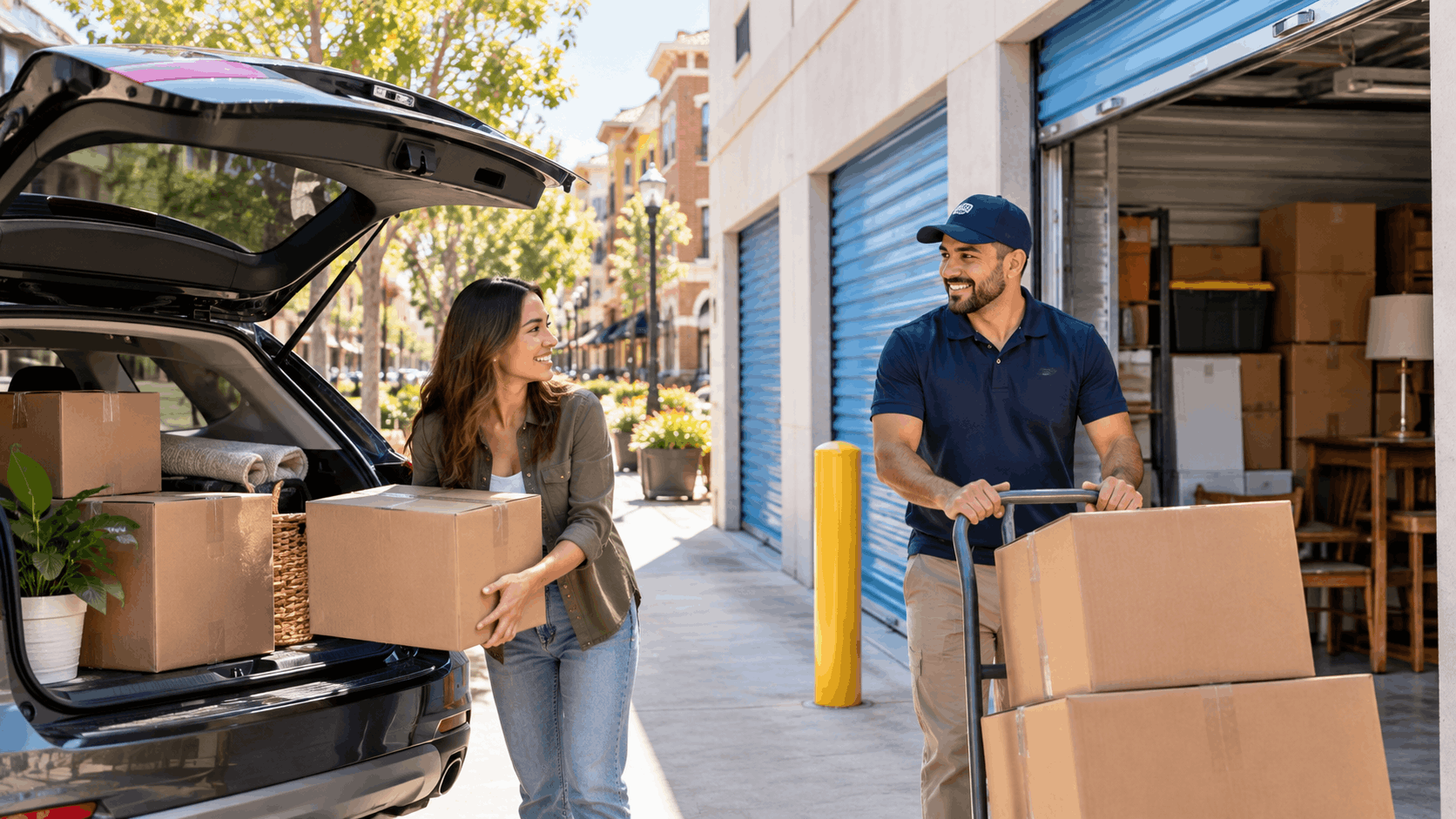
What Same-Day Mixed-Use Pickup Means in Old Pasadena?
A same-day pickup means a crew loads your belongings at the Old Pasadena address and takes them straight into storage on the same calendar day, so you are not booking a move for one day and storage for another. For a mixed-use building, where homes and offices sit above and behind the shops, this combines a careful load-out with a destination that is already arranged. The result is one coordinated job instead of two loose ends.
Old Pasadena is the original commercial core of the city, listed on the National Register as the Old Pasadena Historic District. It runs roughly around Colorado Boulevard, Fair Oaks and Raymond Avenues, with a working alley network behind the main streets. That history is exactly what makes the pickup its own kind of job.
A plain apartment complex has a loading zone, a service elevator and a parking lot. Old Pasadena has none of that built in. The crew is working around live retail trade, metered curbs, and buildings that were never designed for modern furniture. Planning the pickup around those realities is what keeps the same-day promise from falling apart on the morning of the move.
Lofts and Offices Above the Shops on Colorado Boulevard
The district is a dense collection of late nineteenth and early twentieth century commercial buildings. The street-level frontage holds shops and restaurants, while the floors above and the spaces behind hold offices and residential lofts. That stacked arrangement around Colorado Boulevard, Fair Oaks Avenue and Raymond Avenue is the defining feature of the area.
Many of these upper-floor residences are conversions. A space that once served as commercial storage or office floor has been turned into a loft, often keeping the original windows, exposed structure and tight stairwells. The character that makes these units desirable is the same character that complicates a move out of them.
Because the retail frontage is active all day and into the evening, the crew is never working in an empty building. There are customers on the sidewalk, deliveries arriving for the shops, and foot traffic moving along Colorado. A pickup from a loft here shares the block with a working commercial district, which is a different environment from a quiet residential street.
Offices in these buildings add another layer. A business relocating out of an upper floor wants the least possible downtime, and often prefers a window when the surrounding shops are closed. Knowing which units are residential and which are commercial shapes how the whole day is scheduled.
Why a Mixed-Use Address Is Not a Standard Apartment Move
In a standard apartment building, the move is between the tenant and the leasing office. In a mixed-use building, the crew is dealing with active retail and restaurant trade on the ground floor, which limits when and how the truck can work without blocking a business during its busiest hours.
Service access is usually shared. The alley behind the building, the single freight route, the back door by the kitchen - these are used by the restaurants, the shops, the refuse collection and everyone else in the building. A moving crew has to fit into that shared access rather than claiming it.
Building management often controls entry to the upper floors and the service routes. That means confirming access ahead of time, understanding any house rules on hours, and knowing whether a service elevator can be held for the job. None of this applies the same way at a plain apartment complex with a dedicated move-in elevator.
All of this is why a mixed-use pickup needs more planning up front. For an apartment move in a modern complex, the biggest question is often parking. In Old Pasadena, parking is only the start.
Pickup and Storage on the Same Day, How the Flow Works
The practical sequence is straightforward once the access is confirmed. The crew arrives at the Old Pasadena address within the agreed window, protects the route, and loads your belongings onto the truck. The goal is a clean load-out that respects the building's shared access and the trade going on below.
From there, the truck heads to the warehouse in Mar Vista, where the goods go directly into storage vaults the same day. You are not storing everything overnight on a truck or moving it twice. It goes from your loft or office straight into the vault.
Because the destination is arranged before the crew ever arrives, there is no gap where your goods are sitting without a home. The pickup and the storage are a single job with a single set of paperwork, which also keeps your protection clear from end to end.
For customers between homes or clearing out an office on short notice, that single-day flow removes the hardest part of the logistics. Our vaulted storage is the destination, and the pickup is built around getting your goods into it on the same day.
Get Your Free Quote
Tell us about your move and we'll get back to you fast.
Pasadena's Moving Permit Rules for Old Pasadena Pickups
Pasadena runs its own Department of Transportation parking division. That matters because neither City of Los Angeles nor Los Angeles County rules apply to a move inside Pasadena. The permit, the notice periods and the sign rules all come from the City of Pasadena, and they are unusually specific.
Getting these rules right is what lets a same-day pickup in Old Pasadena actually happen on schedule. A truck that cannot legally park where the crew needs it turns a one-day job into a problem. Here is how the Pasadena rules break down.
| Rule | What the City Requires |
|---|---|
| Vehicle length | 25 feet or less needs no permit; 26 feet or over requires a Moving Permit |
| Application notice | Submit 10 days before the move or an expedited fee applies |
| Insurance on file | Minimum 2 working days to issue; all others a minimum of 2 weeks |
| No Parking signs | Posted at least 24 hours in advance and called in to register |
| Traffic review | Required for all moving vehicle requests |
| City closure | City closes every other Friday; off-Friday applications process the following Monday |
The 25-Foot and 26-Foot Vehicle Length Threshold
The City draws a clear line at vehicle length. A moving vehicle 25 feet long or less does not require a permit. If the moving vehicle is 26 feet in length or over, a Moving Permit is required. That single measurement decides whether paperwork is even in play.
Because the threshold is so precise, the City recommends confirming the size of the vehicle before renting or scheduling the move. That advice is worth following. A truck chosen for capacity without checking its length can push the job across the permit line and add days to the timeline.
For an Old Pasadena pickup, the right call is to match the truck to both the load and the permit threshold. Sometimes a vehicle under 26 feet handles the job with no permit at all, which removes a whole layer of lead time from a same-day plan.
When the volume genuinely needs a larger vehicle, the permit becomes part of the schedule rather than a surprise. Knowing the length in advance means the application can be filed on time instead of forcing an expedited fee.
Ten Days Notice, Expedited Fees, and the Insurance-on-File Advantage
Applications must be submitted 10 days prior to the moving date, or an expedited fee will be added. For a customer planning a move weeks out, that window is easy to meet. For a short-notice job, it is where timing gets tight.
This is where the most useful rule in Pasadena comes in. Moving companies with insurance already on file with the City should allow a minimum of two working days for permit issuance. Everyone else should allow a minimum of two weeks. That gap is enormous when you are trying to pull off a same-day pickup.
A customer handling the permit themselves is looking at a two-week lead time. A mover already registered with the City can secure the same permit in a fraction of that. That single difference is a concrete, checkable reason to use a registered company rather than self-manage the curb.
For a last-minute move out of an Old Pasadena loft, the insurance-on-file advantage is often the difference between hitting the date and missing it. The permit process stops being the bottleneck.
Posting and Registering No Parking Signs
Temporary No Parking signs are purchased from the Parking Office. They are not optional decoration. They are how the curb space in front of the building gets reserved so the truck has somewhere legal to park on the day.
The signs must be posted at least 24 hours in advance and then called in to Parking Enforcement at (626) 744-6440 to register them. If they are not registered, they are not enforceable. A sign taped up without that call does nothing, and a car can legally sit in the space you were counting on.
The same number is used to report unauthorized vehicles occupying a paid space on the day of the move. If someone parks in the reserved zone despite the posted signs, that is the line to call. Having the number ready keeps a small problem from stalling the whole load-out.
Signs are purchased from the Parking Office at 100 N. Garfield Avenue, Room N106. That is also where current fee figures come from, since published amounts change over time. Confirm the current charges with the Parking Office before the move.
The Every-Other-Friday Closure That Shortens Your Window
The City of Pasadena closes every other Friday. An application received on one of those off-Fridays is processed the following working Monday. That quietly removes a day from a tight schedule, and it can catch a customer who assumed a Friday submission would move the same day.
A traffic review is also required for all moving vehicle requests. That review is part of why the lead times exist. The City is checking how a reserved curb affects the surrounding traffic before it signs off, which matters in a dense district like Old Pasadena.
When you line up the closure with the notice periods, the picture gets clearer. A registered mover with insurance on file can work inside the short two-working-day window, but even that window has to account for which Fridays the City is open. Planning around the calendar keeps the permit from slipping.
For a same-day pickup, none of this should surprise you on the morning of the move. The permit, the signs and the City's own schedule are worked out ahead of time so the crew arrives to a reserved, legal space.

Need Help in Los Angeles?
Popeye Moving & Storage serves Los Angeles and all of Los Angeles County.
Working Around Old Pasadena's Historic Buildings and Alleys
The permit gets the truck to the curb. The building decides what happens next. Old Pasadena's historic commercial buildings carry real physical access challenges that shape how a same-day pickup is planned and crewed.
These are structures from the late nineteenth and early twentieth century, converted for modern use but never rebuilt for modern furniture. The lifts, corridors, stairwells and service routes all reflect that. A crew that knows the district plans for these constraints instead of discovering them on arrival.
Older Lifts, Narrow Corridors, and Stairs From a Street Door
Residential units in Old Pasadena are largely conversions above and behind retail. Where a lift exists, it is often older and smaller than the freight elevators in a modern building. Some buildings have no lift at all, which means everything comes down the stairs.
The corridors and door apertures are narrow. A sofa or a large wardrobe that fit easily through a modern doorway can require careful maneuvering, disassembly, or a different route entirely through one of these older openings. Measuring the tight points in advance avoids a piece getting stuck halfway.
Many units are reached by a flight of stairs from a street door. That carry adds time and crew, and it changes how the load is sequenced. Heavy and awkward pieces are planned around the stair route rather than treated as an afterthought.
Knowing which building has a working lift and which is a stairs-only carry is one of the first things confirmed before a date is set. It directly affects how many people are on the crew and how long the pickup takes.
Alley Service Access on Mills Place, Miller Alley, and Mercantile Place
Behind Colorado Boulevard runs a working alley network that is part of the district's fabric. It includes Mills Place, Miller Alley, Mercantile Place and Braley Court alongside the One Colorado courtyard. For many buildings, these alleys are the only realistic service route.
The catch is that these alleys are narrow and busy. They are shared with deliveries for the shops, refuse collection, and restaurant operations. A moving truck working the alley is sharing it with the daily commerce of the district, which limits timing and maneuvering room.
Whether the alley can actually take the moving vehicle is a question answered before the day. Some alleys will not accommodate a larger truck, which is one more reason vehicle length is confirmed early. A truck that fits the permit but not the alley helps no one.
When the alley is the service route, the pickup is timed to avoid clashing with deliveries and trash pickup where possible. Early morning is usually the clearest window, which ties the building access question directly to the timing question.
Why the Buildings Here Constrain the Work
The core reason these pickups are harder comes down to when the buildings were built. Late nineteenth and early twentieth century commercial structures were designed for the goods and trade of their era, not for modern bedroom sets, sectional sofas and oversized office furniture.
Apertures, stairwells and service routes reflect that original purpose. A doorway sized for the foot traffic of a shop floor was never meant to pass a king-size mattress. The result is that standard-sized furniture meets undersized openings, and the crew has to plan the path carefully.
On the tightest sites, a shuttle from a smaller vehicle or an extra carry is the professional method, not an improvisation. When a large truck cannot reach the door or the alley, moving the goods in a smaller vehicle between the building and the main truck is how experienced crews handle restricted access. It is priced into the estimate.
Properties with no vehicle access at all are qualified on the phone before a date is confirmed. There is no point committing to a same-day pickup if the truck physically cannot reach the goods, so that is settled first.
Timing a Same-Day Pickup Around the District's Trade
Old Pasadena is a commercial district first. The retail trade, the restaurants and the events calendar all dictate the best time of day to run a same-day pickup. Picking the right window is as much a part of the plan as the permit and the building access.
Get the timing wrong and the crew is fighting foot traffic, delivery trucks and crowds for every trip to the curb. Get it right and the same volume of work goes far more smoothly. Here is how the district's rhythm shapes the schedule.
Early Morning Windows Beat Any Afternoon
The district trades through the day and late into the evening, with heavy weekend and event traffic. That means the sidewalks, the curbs and the alleys get busier as the day goes on, not quieter. An afternoon pickup runs straight into the district's busiest hours.
Early morning windows are materially easier than any afternoon. Before the shops open and the restaurants fill, the streets are calmer, parking is easier to hold, and the alley service routes are clearer of deliveries. The same job done at 7 a.m. is a different experience from the same job done at 2 p.m.
For a residential loft, an early start also means the crew has the full day to get the goods to the Mar Vista warehouse and into vaults without racing the clock. The same-day flow has more breathing room when the pickup begins early.
Weekends in particular draw crowds to Old Pasadena. A weekend pickup is best started as early as the building and permit allow, because the trade traffic builds quickly once the district wakes up.
Events That Close Colorado Boulevard
Pasadena hosts major events and parades that close Colorado Boulevard and the surrounding streets entirely. The new year period is the obvious one, when the area around the parade route is effectively off limits to a moving truck.
A street closure does not just slow a pickup. It can make the address unreachable for the day. If Colorado and the connecting streets are shut, there is no legal way to park a truck and run a load-out, no matter how well the permit was filed.
That is why the date is checked against the City's event calendar rather than assumed to be available. A move scheduled on a parade day is a move that will not happen as planned, so the calendar check is part of setting the date.
Outside the obvious holiday closures, the district runs smaller events through the year that can affect specific blocks. Confirming the date against the City's calendar catches those before they become a problem on the morning of the move.
After-Hours Windows for Commercial and Office Pickups
For commercial jobs, an agreed after-hours window with the business beats arriving mid-trade. Retail units, restaurants and offices turn over, and for those businesses downtime matters more than the headline price. Moving during trading hours costs a business sales it cannot recover.
An after-hours load-out, arranged with the business and with building management, keeps the storefront or office open during its earning hours. The crew works when the unit is closed, which also means clearer access through the shared alleys and service doors.
This is where confirming building management's rules on hours pays off. Some buildings allow after-hours service access and some do not, and that answer shapes when a commercial pickup can run. It is settled before the date is set.
For an office or retail relocation out of Old Pasadena, we plan the window around the business, not the other way around. Our office and business moving and retail and restaurant moving work is built around keeping downtime low.
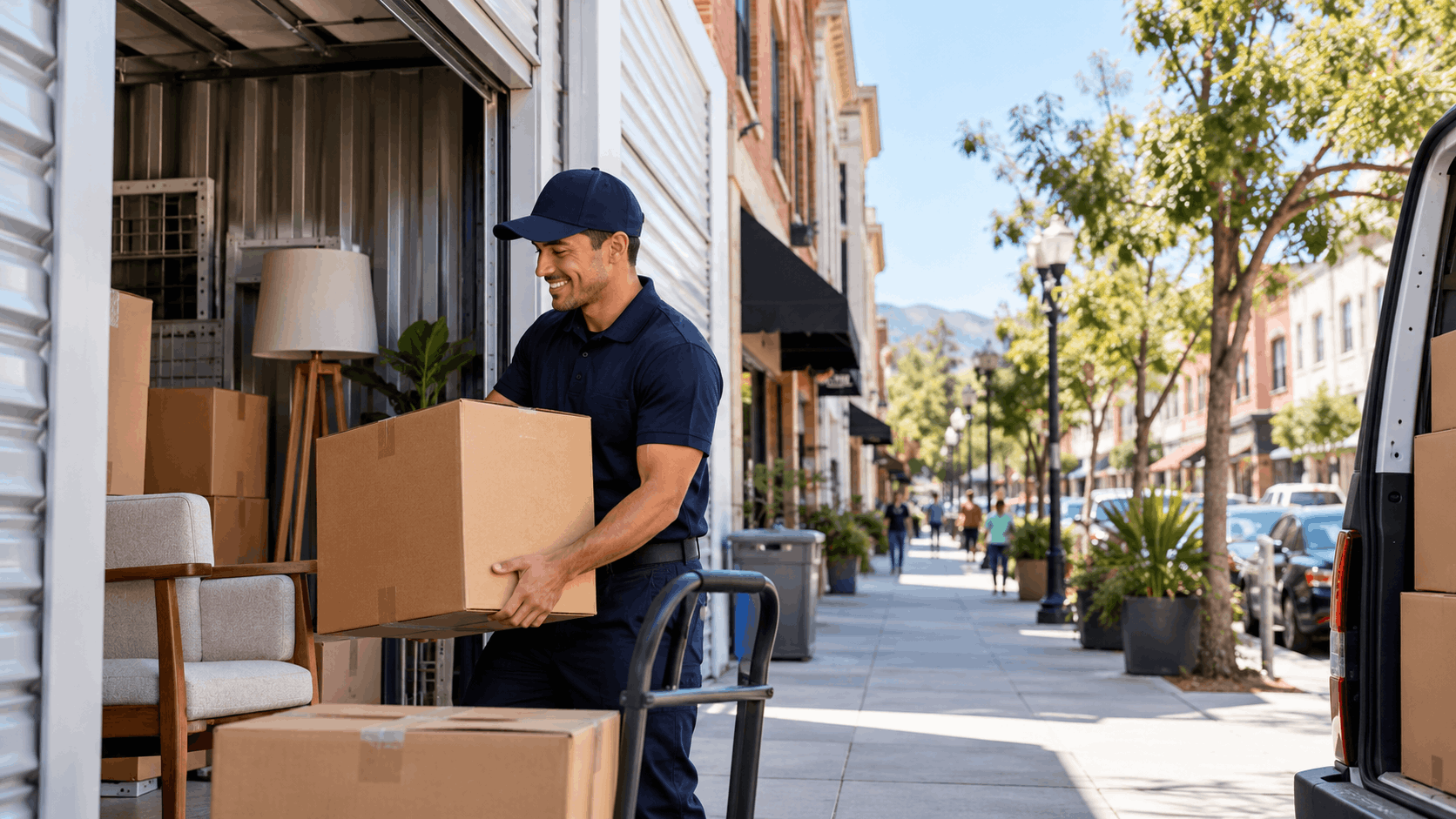
How Full-Service Vaulted Storage Works
Once the goods leave the Old Pasadena address, they go into full-service vaulted storage at the Mar Vista warehouse. This is a different model from a self-storage unit, and understanding the difference tells you how your belongings are handled and what legal protections apply.
In vaulted storage, trained crews handle your goods and store them in wooden vaults inside a warehouse. You do not have a unit you walk into. That distinction is not just operational, it decides which body of California law governs the arrangement.
Vaulted Storage Is Not a Self-Storage Unit
With vaulted storage, the customer has no key, no individual unit and no right of entry. The goods are loaded into vaults by crews and handled by crews. That is the opposite of a self-storage facility, where you rent a space, keep the key and come and go as you please.
That difference matters legally. Under California law, a self-service storage facility is defined as real property rented to occupants who have access to the space, and the statute states plainly that a self-service storage facility is not a warehouse. Because vaulted storage gives the customer no access, it falls outside the Self-Service Storage Facility Act.
Instead, vaulted warehouse storage is governed by Division 7 of the California Commercial Code. The self-storage lien, auction and access rules simply do not apply. The warehouse's duty of care, the lien rules and the claim procedures all come from the Commercial Code instead.
For the customer, the practical takeaway is that the goods are in the care of the warehouse, handled by professionals, rather than sitting in a unit you manage yourself. Our storage solutions are built around that full-service model.
What a Storage Vault Is and Roughly Holds
A typical wooden storage vault measures roughly 7 feet by 5 feet by 7 feet 10 inches on the exterior. That is a typical size, not an industry standard. There is no ANSI, ASTM, ISO or federal specification governing household goods storage vault dimensions, and manufacturers build custom sizes.
Because that figure is an exterior measurement, the usable interior is lower once the wall thickness is deducted. A published volume describes the outside of the vault, not the space inside it, so any capacity figure should be treated as approximate rather than exact.
Popeye runs the full range of vault sizes, from standard through oversized. A one-bedroom loft's contents and a full office relocation call for different amounts of space, and the vault count is matched to the actual volume of goods.
The vault is loaded once at the origin and then moved as a unit by forklift inside the warehouse. That design means your goods stay packed in the same vault through the storage term rather than being repacked or shuffled piece by piece.
Climate Controlled Storage and What That Does and Does Not Mean
The Mar Vista warehouse is climate controlled for both temperature and humidity. That said, climate controlled has no fixed industry definition. No code, standard or trade body sets a specific temperature or humidity a facility must hold to use the term, so the honest answer is that it means the facility's own stated specification.
What climate control genuinely helps is a specific set of belongings. Conservation guidance points to wood, leather, fine art, musical instruments, and furniture with veneer or inlay as the categories most affected by humidity swings. These are the items where stable conditions change the outcome.
On wood, high relative humidity causes swelling and warping while low humidity causes shrinkage and cracking. On leather, high humidity promotes mold and stiffening while very low humidity causes brittleness. A loft full of furniture, artwork or an instrument benefits from stable conditions in a way that, say, sealed plastic bins of kitchenware does not.
For art, antiques and instruments specifically, controlled conditions protect the finish and structure over a storage term. If you are storing pieces like these, say so when the storage is arranged so the right handling is planned. Our fine art and antique moving covers how those pieces are handled into storage.
No Minimum Term, Commercial Goods, and Specialist Items Accepted
There is no minimum and no maximum storage term. Whether you need the goods held for a few weeks between homes or for a long stretch, the arrangement fits the term you need rather than forcing a fixed commitment.
Commercial and business storage is accepted alongside household goods. An office clearing out of Old Pasadena can store furniture, files and equipment in the same warehouse as a residential customer's belongings. Our commercial and business storage handles that mixed inventory.
Specialist items are accepted, including wine, fine art, pianos and chandeliers. These are exactly the pieces an Old Pasadena loft or office might hold, and they are handled with the care those items require rather than treated as ordinary freight.
One limit to note: vehicles are not accepted. Cars, motorcycles, boats and RVs are not part of the storage offering. For everything else, from a studio's worth of furniture to a full commercial inventory, the vault storage scales to the job. Longer holds fit our long-term storage.
Need Help in Los Angeles?
Popeye Moving & Storage serves Los Angeles and all of Los Angeles County.
Protecting Your Goods: Valuation and the 90-Day Line
From the moment the crew loads the truck through the time the goods sit in storage, liability follows specific California rules. Knowing how that protection works tells you what you actually have on a same-day pickup into vaulted storage, and where the coverage changes hands.
There are two things to understand here: how valuation works on the move itself, and the 90-day line that separates a regulated mover service from a warehouse contract. Both affect your protection.
Valuation on the Pickup Is Not Insurance
Under California intrastate rules, unless the shipper expressly declares otherwise, the mover's maximum liability for lost and damaged articles is up to $20,000 of actual cash value. That is the default protection on a move inside California when you declare nothing.
The 60 cents per pound per article figure that often gets quoted is only the rate basis. It is the declared value the transportation rates are computed on, not the payout. Treating 60 cents a pound as your coverage would badly understate what the default actually provides, so it is worth being clear about the difference.
Released value is a liability limit, not insurance. Full value protection is the paid alternative, and the mover is required to offer valuation options so you can choose better coverage or decline it knowingly. Each option is listed with its charge and a space to initial.
For items of extraordinary value such as antiques, art, and gold or silver articles, declare each one separately on the inventory with a value. Money, jewelry and important papers are best carried by you rather than shipped. That separate declaration is how high-value pieces get the protection the default does not reach.
Storage-in-Transit and the 90-Day Boundary
Storage-in-transit is storage of a shipment at one point between origin and destination for a period not to exceed 90 days. Inside that window, the move is still a regulated mover service under the Household Movers Act and Maximum Rate Tariff 4.
That 90-day line is a jurisdictional boundary, not just a contract term. For the first 90 days, your goods sit under the mover's regulated service and the tariff rules apply. The claim windows, the valuation rules and the mover's responsibilities all flow from that framework.
Past 90 days, or where storage-in-transit was not requested, the goods fall under the warehouse's own contract and California Commercial Code Division 7. The mover's liability ends and the warehouse's liability as a bailee begins. That is the single most useful thing to understand about long-term storage.
For a same-day pickup where you plan a short hold between homes, you may well stay inside the storage-in-transit window. For a longer hold, the arrangement moves into warehouse storage, and the governing rules change with it. Knowing which regime your storage sits in tells you what protection applies.
Valuation Protection While in Storage-in-Transit
During storage-in-transit, the tariff sets maximum fixed rates for valuation. Actual cash value protection is capped at $0.16 for each $100 of declared value, and full value protection at $0.38 for each $100. These charges are separate from and additional to the transportation valuation charges.
This protection must be offered by the mover and ordered in writing by the shipper. It is not automatic at the higher level, so if you want valuation coverage while the goods are in storage-in-transit, it is arranged and recorded in writing when the storage is set up.
Once storage runs past the storage-in-transit window into long-term warehouse storage, do not assume the mover's cargo policy still covers the goods. The cargo insurance required of a mover is framed around property during transportation or storage in transit, and nothing confirms it extends into long-term warehouse storage.
For goods going into a longer hold, the storage agreement under the Commercial Code is what sets the standard of care and any liability limit. Reading that agreement is how you understand your protection for a long-term stay, and it is worth asking what coverage applies before the goods go in.

What Same-Day Pickup and Storage Costs in the Area
Cost comes down to the pickup labor, the storage, any specialty handling, and the permit and parking charges unique to Old Pasadena. Below are the typical Los Angeles area ranges that apply, presented as typical ranges rather than a quote. The exact figure for your job is set in writing before anything is loaded.
Typical Local Pickup and Labor Ranges
For the pickup itself, local residential moving typically runs $150 to $200 per hour for a two-person crew and truck in the Los Angeles area. A one-bedroom apartment local move typically runs $350 to $650. Those are typical area ranges, not a fixed price.
California bills local hourly moves on a double drive time convention. That means travel time between origin and destination is charged at twice the actual driving time. It is a legitimate, regulated charge, not a padding tactic.
Route and start time affect that drive time. The 210, the 134 and the 110 all serve Pasadena, so when the crew travels and which route it takes changes the bill. An early start that avoids peak congestion keeps the drive time, and therefore the double drive time charge, lower.
For an Old Pasadena loft, the hourly labor also reflects the building access. A stairs-only carry or a shuttle through a tight alley takes more time and crew than a ground-floor load, and that time is part of the hourly total. Our local residential moving covers how that hourly work is structured.
Vaulted Storage and Specialty Item Ranges
Vaulted storage typically runs $60 to $90 per vault per month. The number of vaults depends on the volume of your goods, so a studio's contents cost less to store than a full office or three-bedroom load.
Specialty items common to Old Pasadena's lofts and offices have their own typical ranges. Piano moving typically runs $200 to $600, with upright pianos costing less than grand pianos. Chandelier moving typically runs $150 to $450.
Fine art and antique moving typically runs $300 to $1,200 and up, depending on the piece and the handling it needs. Custom crating typically runs $150 to $800 and up per crate, which is how fragile or high-value items are protected for both the move and storage.
These figures are typical area ranges, not quotes. A loft with an upright piano and a few framed pieces carries different specialty costs from an office with nothing fragile. For items like these, our piano moving, chandelier moving and custom crating services handle the protection.
Permit, Metered Parking, and Access Costs That Change the Day
Old Pasadena is almost entirely metered. Nearly every usable curb in the district is metered or restricted, so a reservation attracts meter fees on top of the sign charges. That makes the district the expensive end of the city for curb reservations.
Signs are charged per sign, plus meter fees per hour per space in metered areas. The number of spaces needed and the number of hours multiply those charges. A job that needs two or three reserved spaces for several hours in a metered block costs more at the curb than a single space on a quiet street.
Because those counts drive the cost, they are established before a price is set. How many spaces, for how many hours, in which metered block - those answers shape the parking portion of the bill. There is no way to quote the curb cost accurately without them.
Published fee amounts change over time, so the current figures come from the Parking Office at 100 N. Garfield Avenue, Room N106. The structure is fixed - per sign plus meter fees per hour per space - but the exact numbers are confirmed with the City.
What Gets Confirmed Before a Price Is Set
Several things are confirmed before a price is set so the quote reflects the actual job. The vehicle length is checked against the 25-foot and 26-foot thresholds. Whether the 10-day application window is met and whether the company's insurance is already on file with the City both affect timing.
Access details come next. How many metered spaces and hours are needed, whether the building has a lift and what its dimensions are, and whether alley service access exists and can take the vehicle all change the labor and the parking. Any city event affecting the date is checked against the calendar.
Once those are known, the Not To Exceed figure is set in writing before anything is loaded. That figure is the maximum total you can be liable for, agreed before the truck is loaded, and the final bill cannot exceed it except through a Change Order you agree to.
A verbal quote, whether per hour or per hundred pounds, is not an estimate and is not binding. California requires a written estimate, and the written Agreement For Moving Services describes the shipment, the services and the rates. That written estimate and Not To Exceed figure are your real protection on cost.
Need Help in Los Angeles?
Popeye Moving & Storage serves Los Angeles and all of Los Angeles County.
How Popeye Moving & Storage Handles an Old Pasadena Pickup
Here is how a same-day mixed-use pickup into vaulted storage actually runs with our team. The process is built around the two things that make Old Pasadena difficult: the permit and the building access, with the Mar Vista warehouse as the destination.
Permit Filing and Access Planning
The pickup is planned around the Pasadena permit from the start. We check the vehicle size against the City's 25-foot and 26-foot thresholds, arrange the Moving Permit where the truck requires one, and handle the sign posting so the curb is reserved on the day.
Because the permit lead time depends on insurance being on file with the City, a registered mover can work inside the shorter two-working-day window rather than the two weeks a customer handling it alone would face. That is what keeps a same-day pickup realistic in Old Pasadena.
Building access is worked out alongside the permit. We confirm whether the unit has a lift, whether the carry is up a flight of stairs from a street door, and whether the alley service route can take the vehicle. On the tightest sites, a shuttle is planned and priced rather than improvised.
Properties with no vehicle access at all are qualified on the phone before a date is confirmed. There is no point setting a same-day pickup if the truck cannot reach the goods, so that question is settled first.
Loading Into Vaults at the Mar Vista Warehouse
On the day, the crew loads your belongings at the Old Pasadena address within the agreed window. The goods are protected for the carry through the building and the alley, loaded onto the truck, and taken the same day to the warehouse.
That warehouse is at 5509 1/2 S Centinela Ave, Los Angeles, CA 90066, in Mar Vista on the Westside. Your goods go straight into full-service vaulted storage there, handled by our crews rather than left for you to manage.
Because the load-out and the storage are a single job, there is no overnight gap on the truck and no second move. The goods move from your loft or office into the vault on one day, with one set of paperwork covering the whole chain.
The vault is sealed and stored in the climate controlled warehouse for as long as you need, with no minimum or maximum term. When you are ready to retrieve your goods, the warehouse pulls and opens the vault for you.
Licensing, Credentials, and Paperwork
Popeye Moving & Storage holds California household mover permit CAL T 189749 for intrastate work, and USDOT 1472924 and MC 498816C for interstate work. We are fully insured, and we are BBB accredited with an A+ rating.
Moves inside California are regulated by the Department of Consumer Affairs Bureau of Household Goods and Services, the BHGS, not the CPUC. The CPUC has not regulated household movers since authority transferred to the BHGS in 2018. You can verify a mover's permit status and file complaints through the BHGS at (916) 999-2041.
Keeping your paperwork strengthens any claim. Hold onto the written estimate, the Agreement For Moving Services and the bill of lading. The single most common reason a consumer loses a dispute is that they cannot produce the paperwork, so keep every document from the job.
Before booking any mover, ask for the permit number and verify it rather than taking it on trust. A legal California mover operates under a state permit, and checking it before the move is simple and worth doing. For the full picture of our credentials, see our about page.

Planning Your Old Pasadena Pickup
A same-day pickup into vaulted storage comes down to settling the permit, the building access and the destination before the day, then running the load-out and the storage as one job. Our team files the Pasadena permit, plans the access, loads at your Old Pasadena address and takes your goods the same day to the Mar Vista warehouse, with the Not To Exceed figure set in writing before anything is loaded.
To get started, call Popeye Moving & Storage at (310) 823-9510 or reach us through our contact page to go over your address, your goods and your dates.
Frequently Asked Questions
- Can you really pick up and store my belongings the same day?
- Yes. The crew loads at your Old Pasadena address and takes the goods the same day to full-service vaulted storage at our Mar Vista warehouse, so you are not managing two separate dates. The one thing that makes this work is confirming access and permit timing first. Once the vehicle size, building access and curb reservation are settled, the pickup and storage run as a single coordinated job.
- Do I need a permit to have a truck pick up in Old Pasadena?
- It depends on the truck. The City of Pasadena requires no permit for a moving vehicle 25 feet long or less, but a Moving Permit is required for a vehicle 26 feet or over. A registered mover with insurance already on file with the City can secure that permit in a minimum of two working days, while anyone else should allow a minimum of two weeks. That gap is why a registered company makes a same-day pickup realistic.
- How much does vaulted storage cost per month?
- Vaulted storage typically runs $60 to $90 per vault per month in the Los Angeles area. That is a typical range, not a fixed quote. The exact figure depends on the volume of your goods, since that determines how many vaults are needed, and on the vault size. A studio's contents cost less to store than a full office or three-bedroom load.
- What is the difference between vaulted storage and a self-storage unit?
- With vaulted storage, you have no key, no individual unit and no right of entry, and your goods are handled by crews. A self-storage unit gives you a space you rent, a key, and the ability to come and go. That difference is legal as well as practical. Vaulted warehouse storage falls under California Commercial Code Division 7, not the Self-Service Storage Facility Act, so the self-storage lien, auction and access rules do not apply.
- Can I access my goods while they are in storage?
- Your goods are sealed in a vault that the warehouse retrieves and opens, so an appointment is ordinary practice rather than walk-in access. There is no unit you enter yourself. Note that our business hours of 6 a.m. to 9 p.m. seven days a week are for calls and scheduling, not customer access hours at the warehouse. Contact us to arrange retrieval when you need your belongings.
- Is there a minimum storage term?
- No. There is no minimum and no maximum storage term. Whether you need your goods held for a few weeks between homes or for a long stretch, the arrangement fits the time you actually need. That flexibility suits customers who are between homes during a move as well as those storing belongings without a fixed end date in mind.
- What protection do my goods have against loss or damage?
- On a California move, unless you declare otherwise, the mover's maximum liability is up to $20,000 of actual cash value. The 60 cents per pound figure often quoted is only the rate basis the charges are calculated on, not the payout. Full value protection is the paid alternative, offered so you can choose better coverage or decline it. For items of extraordinary value such as art, antiques and gold or silver articles, declare each one separately on the inventory.
- Can you store office and commercial items, not just household goods?
- Yes. Commercial and business storage is accepted alongside household goods, so an office clearing out of Old Pasadena can store furniture, files and equipment in the same warehouse as a residential customer's belongings. Specialist items are also accepted, including wine, fine art, pianos and chandeliers. These are exactly the pieces an Old Pasadena loft or office might hold, and they are handled with the care those items require.
- What items cannot go on the truck or into storage?
- Hazardous materials as defined by federal law are not accepted for shipment. That includes common household combustible liquids, corrosives, explosives and flammables. A mover accepting undeclared hazardous material is the accepting party under federal law, so these are refused as a legal requirement, not just company preference. Vehicles are also not accepted for storage, including cars, motorcycles, boats and RVs. A pre-move checklist of what cannot go on the truck prevents a problem on the day.
- How long do I have to file a claim on stored or moved goods?
- A claim for loss or damage must be filed in writing with the mover within nine months after delivery. The mover must acknowledge a written claim within 30 days and must pay, decline or make a firm compromise settlement offer within 60 days. Suit must be instituted within two years and one day from the date the mover gives written notice that it has disallowed the claim. A claim cannot be denied solely because the damage was not noted at the time of delivery.
P
Popeye Moving & Storage Co. Team Team
Licensed moving and storage professionals serving Los Angeles and Los Angeles County.
Licensed in California · License #CAL T 189749 | USDOT 1472924 | MC 498816C
Why trust Popeye Moving & Storage?
Founded in 1994, Popeye Moving & Storage is a licensed and insured moving and storage service serving Los Angeles and Los Angeles County. All content is reviewed by our licensed technicians.

Need Help in Los Angeles?
Popeye Moving & Storage serves Los Angeles and all of Los Angeles County.
Related Articles
How-To Guides
Between-Leases Storage in LA - The Week-to-Month Playbook With Pickup and Redelivery
Caught between leases in LA? Learn how week-to-month storage with pickup and redelivery bridges the gap, plus LA parking rules, costs, and packing tips.
Tips & Advice
Storage in Carlson Park, Culver City with Same-Day Driveway Pickup
Full-service vaulted storage with driveway pickup in Carlson Park, Culver City. How it works, Culver City permits, costs to confirm, climate control and your claim protections.
Seasonal
Storage Near LMU and UCLA - Student Summer Storage With Pickup From the Curb
Curbside summer storage near LMU and UCLA lets students skip shipping fees and truck rentals. Learn how pickup, storage, pricing, and fall delivery work.