Tips & Advice
How Mover Warehouses Control Pests and Moisture - and Why Coastal Self-Storage Often Doesn't
Key Takeaways
- Coastal LA air carries salt and marine-layer humidity that corrode metal, warp wood, and grow mold on stored belongings.
- Managed mover warehouses hold steady temperature and humidity, raise items on pallets or in vaults, and keep air moving to fight moisture.
- Warehouse pest control works in layers: sealed buildings, scheduled licensed treatments, intake inspections, and wrapped, spaced fabric items.
- Coastal self-storage often falls short due to open roll-up doors, shared walls, part-time climate control, and renter-handled packing.
- Wood furniture, antiques, photos, documents, electronics, and soft goods face the highest risk in exposed coastal units.
- Popeye Moving & Storage uses an inland managed warehouse, full-service packing, labeled vault storage, and inventory tracking across Greater LA.
- Before renting, ask about real humidity ranges, inspection and pest schedules, who packs your items, and how far the facility sits from the coast.
In This Article
A family in Santa Monica called our office last spring after opening a coastal storage unit they had rented for eight months. What they pulled out shook them. The bottom of every box near the roll-up door was water-stained and soft. The legs of a mid-century dresser had swelled and cracked. And when they lifted an upholstered chair, they found the tell-tale signs of mice - chewed fabric, shredded stuffing, and droppings tucked into the seams.
They had done nothing wrong. They packed carefully, locked the door, and paid every month. The problem was the unit itself, sitting a few blocks from the ocean, breathing in salt air and humidity every single day while nobody checked on it.
Why Coastal Los Angeles Is Hard on Stored Belongings?
The LA coastline looks like a dream, but it is rough on anything you store there. The same ocean air that makes Venice and Marina del Rey so pleasant to walk through carries moisture and salt that slowly work into your furniture, boxes, and electronics.
Coastal humidity in Los Angeles storage sits higher than most people realize, and it stays high for months at a time. Add older buildings and steady pest pressure, and you have a setting that quietly damages belongings before anyone notices. Understanding the problem is the first step to storing things the right way.
Salt Air and Marine Layer Near Venice and Marina del Rey
Anyone who lives near the water knows the morning marine layer. That thick gray blanket rolls in off the Pacific and hangs over Venice, Marina del Rey, and Playa del Rey well past sunrise on many days. What feels like a mild, cool morning is actually air loaded with moisture, and that moisture settles onto everything it touches.
Salt air makes it worse. Ocean spray carries fine salt particles that drift inland for a mile or more. When that salt lands on metal, it speeds up corrosion in a way plain humidity never could. We have seen brand-new screws, hinges, and staples show rust after just a few months in coastal storage.
Salt corrosion does not stop at hardware. It attacks the metal frames inside sofas, the springs in mattresses, and the joints on folding tables. For anyone using Venice storage or a unit near the marina, that constant salt-heavy air is a slow, steady threat that works around the clock.
The tricky part is that the damage is invisible at first. A dresser can look fine on the outside while the metal drawer slides quietly corrode. By the time you notice, the harm is already done.
Pests Common to Older Coastal Buildings
A lot of storage near the coast sits in older warehouse and commercial buildings. These structures have gaps, cracks, and aging seals that give pests easy ways in. Rodents are the biggest offender, squeezing through openings smaller than a dime to reach the shelter and nesting material your boxes provide.
Silverfish love damp, dark spaces, and coastal humidity gives them exactly that. They feed on paper, cardboard, book bindings, and photos, leaving behind ragged edges and yellow stains. Once they settle into a stack of stored documents, they can chew through a lot before you ever open the box.
Moth damage hits fabric and clothing the hardest. Clothes moths lay eggs in wool, upholstery, and stored linens, and the larvae eat through natural fibers. A wool coat or a favorite blanket can come out of storage full of holes with no warning at all.
The reason these pests thrive is simple. Older coastal buildings offer warmth, moisture, and food in the form of cardboard and fabric, all in a quiet space nobody visits for weeks. That combination is exactly what pests look for.
Seasonal Swings From June Gloom to Santa Ana Winds
Los Angeles weather is not steady, and that swing is hard on stored wood. In late spring and early summer, June gloom brings weeks of damp, overcast mornings that push humidity up. Wood furniture absorbs that moisture and swells slightly at the joints.
Then the Santa Ana winds arrive, hot and bone-dry, sometimes dropping humidity into the teens within a day. That sudden shift pulls moisture back out of the wood fast. The wood shrinks, and the stress from swelling and shrinking over and over is what causes real damage.
This cycle leads to wood warping, splitting along the grain, and loose joints on tables and chairs. Antiques and solid-wood pieces suffer the most because they react strongly to changes in humidity. A dining table that was perfectly flat can develop a curve after a few of these seasonal swings.
Mold rides along with the damp phase. When humid air lingers inside a closed unit, mold spores find the moisture they need on wood, fabric, and paper. The dry Santa Ana stretch may pause the growth, but the next gloomy season starts it up again.
Get Your Free Quote
Tell us about your move and we'll get back to you fast.
How Professional Mover Warehouses Control Moisture
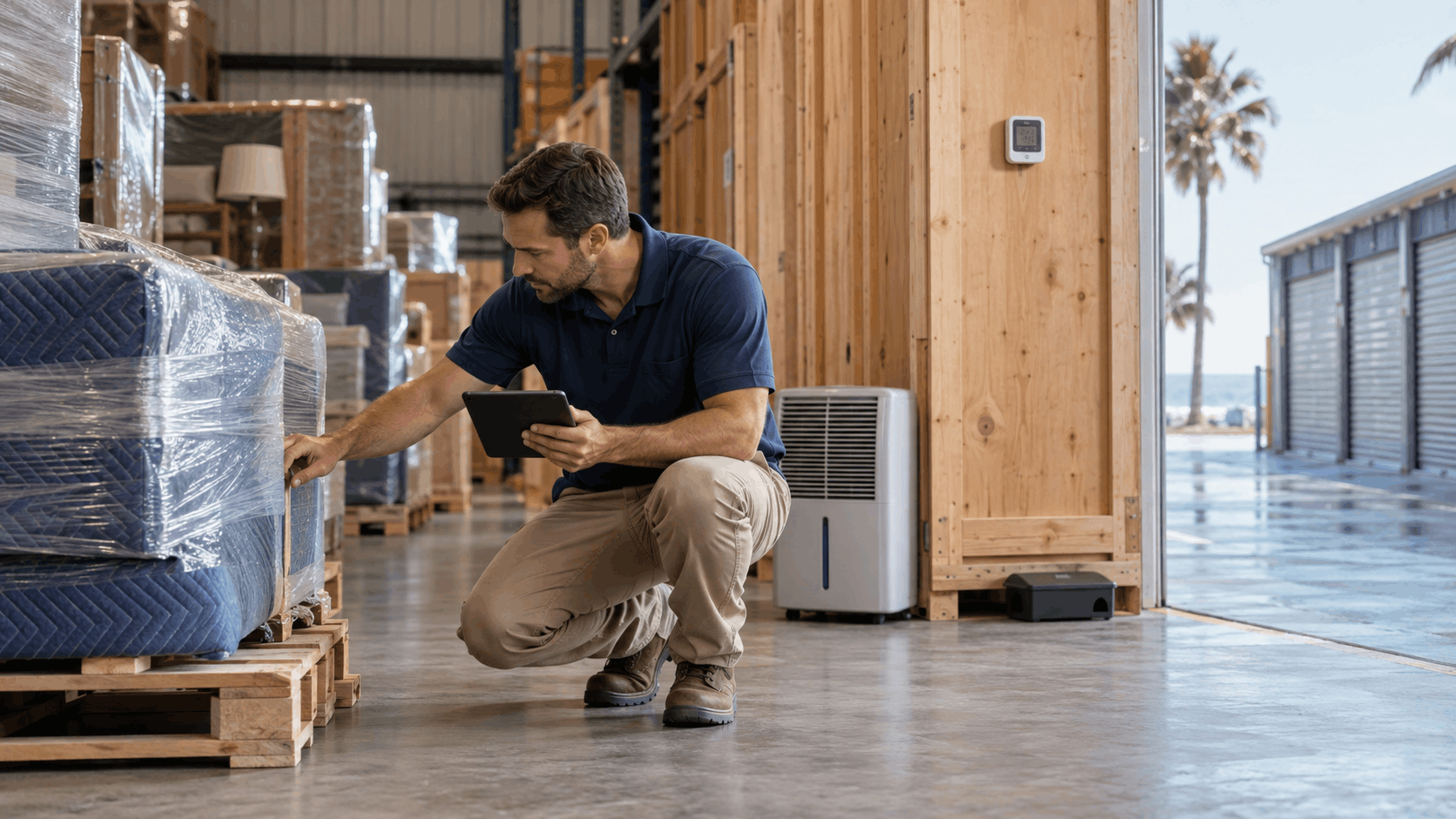
A managed mover warehouse is built to fight moisture, not just hold boxes. Instead of letting the outdoor climate run the show, the building holds steady conditions and keeps items off the ground and properly wrapped.
The result is real moisture protection that a basic storage box cannot match. Here is a quick look at how the two compare before we get into the details.
| Moisture Factor | Managed Mover Warehouse | Basic Coastal Storage Unit |
|---|---|---|
| Humidity control | Held in a steady range year-round | Matches outdoor swings |
| Floor contact | Items raised on pallets or in vaults | Boxes often sit on concrete |
| Wrapping | Breathable pads and materials | Renter uses plastic and cardboard |
| Leak checks | Staff inspect regularly | Nobody checks between visits |
Climate-Controlled Zones and Steady Temperatures
The biggest advantage of climate-controlled storage is that it refuses to follow the weather outside. While a coastal unit heats up, cools down, and dampens with every marine layer morning, a managed warehouse holds a steady temperature range and humidity range around the clock.
For most stored goods, a temperature range in the mid-60s to mid-70s Fahrenheit works well. The humidity range matters even more, and keeping it around 40 to 55 percent protects both wood and paper from the swelling and shrinking that cause damage.
That steady environment stops the seasonal stress cycle we talked about earlier. Wood furniture stays at a consistent moisture level, so it does not warp or crack. Documents and photos stay dry and flat instead of curling and spotting.
This is the single biggest reason sensitive items belong in a controlled space. When the conditions never spike, the slow damage that ruins belongings simply does not get a chance to start.
Elevated Palletized Storage and Air Flow
Concrete floors pull moisture up from the ground, especially in buildings near the coast. That is why professional warehouses rarely let boxes sit directly on the floor. Palletized storage raises everything off the concrete so ground moisture cannot wick into the bottom of your belongings.
Storage vaults take this further. Each vault is a wooden crate that holds one household's goods, lifted off the floor and stacked with space around it. Your items sit inside their own protected box rather than loose on a shared surface.
Air circulation ties it all together. When air can move around and between stored goods, moisture does not build up in still pockets where mold likes to grow. A well-run warehouse keeps the air moving instead of letting it sit heavy and damp.
Compare that to a drive-up unit where boxes are stacked tight against a concrete slab and a metal wall. Moisture has nowhere to go, and the bottom layer of that stack is usually the first thing to fail.
Proper Wrapping and Packing Materials
How items are wrapped decides how they hold up over months of storage. Our crews use quilted moving pads and breathable wrap that let furniture release moisture instead of trapping it. Air can pass through, so the surface stays dry.
Plastic tarps and shrink wrap do the opposite. They seal moisture against the surface, and when temperatures shift, condensation forms inside the plastic. That trapped water sits on the wood or fabric and grows mold, which is one of the most common mistakes we see in self-packed units.
For items that need extra protection, desiccants help pull moisture out of the surrounding air inside a crate or vault. Placed with electronics or documents, they add a layer of defense against dampness that would otherwise settle in.
The lesson is that the right materials matter as much as the right building. You can store an item in a perfect climate and still ruin it by sealing condensation against it in cheap plastic. Our full-service packing team uses materials chosen for long-term storage, not just quick transport.
Regular Inspections and Leak Checks
A managed warehouse has people in it every working day. Staff walk the floor, notice the smell of dampness, and spot a stain on a ceiling long before it becomes a flood. That constant human attention is something a locked self-storage unit never gets.
Roof checks are part of the routine. Coastal weather and the occasional heavy rain test every seam and drain, and catching a small leak early keeps it from soaking rows of stored goods. Warehouse monitoring means problems get fixed while they are still small.
Leak inspection also covers the small things - a sweating pipe, a door seal that has worn down, a low spot where water pools. Each of these can quietly damage belongings, and each is easy to catch when someone is looking.
A self-storage renter cannot do any of this. They visit once every few weeks at most, and by the time they open the door, whatever went wrong has had days or weeks to spread. Ongoing eyes on the space is a quiet but powerful form of protection.

Need Help in Los Angeles?
Popeye Moving & Storage serves Los Angeles and all of Los Angeles County.
How Professional Mover Warehouses Keep Pests Out
Good pest control in a warehouse is a system, not a single spray. It starts before your items ever arrive and continues the entire time they are stored. The goal is to stop pests at the door and keep them out.
Warehouse pest management works in layers, and each layer catches what the last one might miss. Here is how the approach compares to a typical rented unit.
| Pest Factor | Managed Mover Warehouse | Basic Coastal Storage Unit |
|---|---|---|
| Building seal | Sealed doors and screened vents | Roll-up doors open to outside |
| Treatment | Scheduled licensed pest service | Rare or none inside units |
| Intake check | Items inspected before storage | Renter loads anything in |
| Fabric items | Wrapped and spaced | Left however renter packs them |
Sealed Buildings and Managed Entry Points
Pests get in through gaps, so a well-run warehouse closes those gaps. Sealed dock doors keep the largest openings tight when they are not in use, and weather seals along the bottom block the space where rodents usually slip through.
Vents get screened so insects and mice cannot use them as a highway indoors. Every opening in the building is treated as a potential entry point, from utility penetrations to the small gaps around door frames.
Controlled access adds another layer. Because only staff move in and out through managed doors, the building is not standing open the way a self-storage row is during business hours. Fewer open doors means fewer chances for pests to wander in.
Pest exclusion is really about making the building boring to a mouse. No easy way in, no food, no quiet corner to nest. When the structure is sealed, most of the pest problem is solved before treatment even begins.
Scheduled Professional Pest Treatments
A managed warehouse works with a licensed pest control company on a set schedule. That means treatments and inspections happen on a regular calendar, not just when someone notices a problem. Staying ahead of pests is far more effective than reacting to them.
Monitoring stations placed around the building act as an early warning system. Technicians check them each visit to see whether any activity is showing up, and where. If something turns up in one corner, they know exactly where to focus before it spreads.
A pest treatment schedule also creates a record. The warehouse can see trends over time and adjust, sealing a new gap or adding a station where needed. That kind of tracking is impossible in a rented unit nobody services.
Licensed pest control matters because coastal pests are persistent. Between the rodents in older buildings and the insects that thrive in humidity, a one-time effort does not hold. Regular professional service is what keeps a warehouse genuinely protected.
Inspection at Pickup Before Items Enter Storage
Many infestations start with items that already have a problem. A box stored in a garage might carry silverfish. A sofa might have moth eggs in the cushions. If those items go straight into shared storage, the pests come with them.
Our crew performs an intake inspection during pickup. We look over furniture and boxes for signs of pests or food residue before anything enters the warehouse. Catching a problem at the door protects everyone else's belongings in the building.
Furniture inspection is part of loading, not an afterthought. We check the seams of upholstered pieces, the undersides of tables, and the corners of drawers where insects hide. It only takes a moment and it stops big problems later.
Food residue is one of the most common attractants people miss. A kitchen box with crumbs or an appliance with old food inside is a dinner bell for rodents. Spotting and handling that before storage keeps the whole warehouse cleaner and safer.
Separation and Wrapping of Upholstered Items
Soft goods are what pests want most. Sofas, mattresses, and fabric items give moths and rodents both food and nesting material, so they need extra care. Wrapping each piece cuts off easy access to the fibers inside.
Mattress wrap seals the surface so moths and dust cannot settle into the fabric. Upholstery protection does the same for sofas and chairs, keeping the cushions and seams covered during the entire storage period.
Spacing matters too. When fabric items are packed tight against each other, they create dark, still pockets that make ideal nests. Giving pieces room and keeping air moving around them removes those hiding spots.
Nesting prevention comes down to denying pests what they need. Cover the fabric, keep the items spaced, and store them in a sealed, treated building. Do all three, and soft goods that would be at risk in a coastal unit come through storage clean.
Why Coastal Self-Storage Units Often Fall Short
Self-storage is convenient, and for some short, local needs it works fine. But near the water, the way these facilities are built and run creates real weaknesses. The problems are structural and financial, not just bad luck.
Coastal storage puts most of the protection on the renter and the building on you to inspect, which is a recipe for unit damage. Here is where these facilities tend to break down.
Open Drive-Up Units and Outside Air
Drive-up units are popular because they are easy to load. You pull your car right up to the roll-up door and carry things in. But that same design leaves the unit exposed to everything outside.
Roll-up doors do not seal well. There are gaps at the sides and bottom that let outside air move freely in and out. Near the coast, that means salt air and humidity flow straight into the unit every day.
Those same gaps let pests in. A mouse looking for shelter finds an easy path under a roll-up door, and insects come in with the moist air. The unit is basically as exposed as an outdoor shed.
So while a drive-up unit is convenient the day you load it, it offers little protection over the months that follow. The outside climate and coastal pests come along for the ride.
Shared Walls and No Individual Monitoring
Storage units share walls, and problems do not respect those walls. If one renter brings in an infested couch, the pests spread to neighboring units through gaps and shared framing. Your careful packing does not protect you from the unit next door.
The same goes for leaks. Water that starts in one unit can travel along the floor into yours. You may never know until you open the door and find damage that started somewhere you have no control over.
The bigger issue is that nobody inspects your rented space. Once the door is locked, the facility does not look inside until you return. A pest or leak can grow for weeks in an unattended unit with no one to catch it.
That lack of monitoring is the core weakness. Even a clean, well-built facility cannot help you if no one is watching the inside of your space between your visits.
"Climate Controlled" Claims That Fall Short
Plenty of coastal facilities advertise climate control, and the phrase sounds reassuring. But the reality behind the marketing varies a lot. Some run the air only part of the day, or only in select buildings on the property.
Near areas like Redondo Beach and San Pedro, we have talked with customers who rented a "climate controlled" unit only to find the system ran during business hours and shut off overnight. Humidity crept back in every night, undoing whatever the daytime cooling accomplished.
Climate controlled claims can also mean just temperature, with no real humidity control at all. On the coast, humidity is the bigger threat, so temperature alone leaves your belongings exposed to the moisture that causes mold and warping.
The point is to ask hard questions and get specifics. If a facility cannot tell you the humidity range they hold and whether the system runs 24 hours, the label on the door may not mean much. Anyone comparing options near Redondo Beach should press for real numbers.
The Renter Handles Their Own Packing
With self-storage, packing is entirely on you. That freedom sounds fine until you realize most people are not equipped to pack for long-term coastal storage. They use what is cheap and on hand.
Plastic bags are a common mistake. They trap moisture against clothing and fabric, and in a humid unit that trapped moisture turns into mildew and odor. What was meant to protect the items ends up ruining them.
Cardboard is the other problem. Boxes sitting on a concrete floor soak up ground moisture, go soft, and collapse. Cardboard also feeds silverfish and gives rodents nesting material, so it invites the exact pests you want to avoid.
Without pest prevention or proper materials, the renter is fighting the coastal climate alone. Most do not realize the packing is the weak link until they open damaged boxes months later.
What Items Are Most at Risk in Coastal Storage
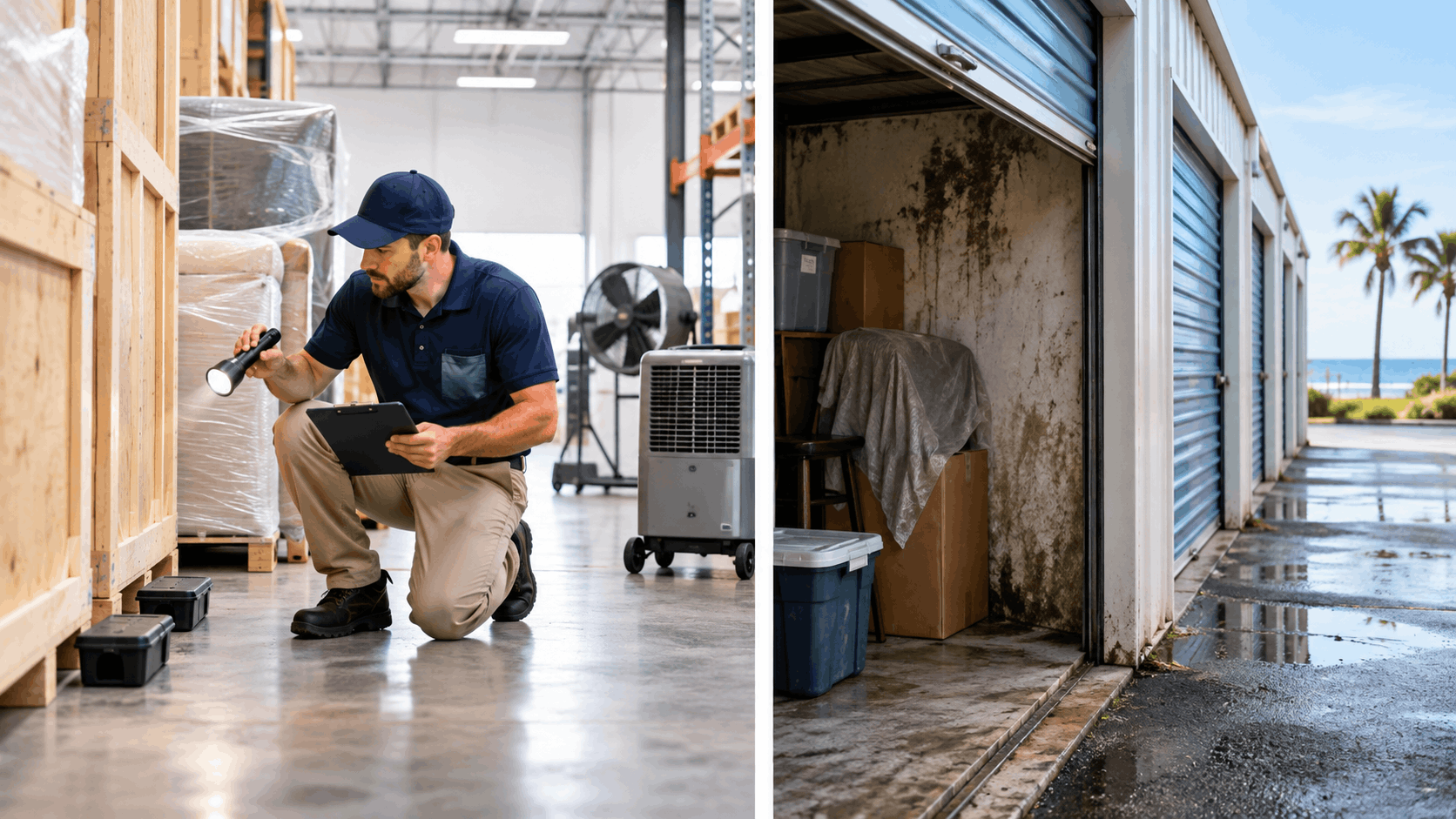
Not everything reacts the same way to coastal conditions. Some items shrug off a little humidity, while others start degrading within weeks. Knowing which of your belongings are the at-risk items helps you decide what needs real moisture damage protection.
These are the categories we see damaged most often when customers move things out of coastal units. If you own any of them, storage protection is worth taking seriously.
Wood Furniture and Antiques
Solid wood furniture is one of the most sensitive things you can store near the coast. Wood breathes, taking on moisture in humid weather and releasing it when the air dries out. Each swing stresses the joints and the grain.
That stress shows up as warping, splitting, and loose joints. A tabletop can cup, drawers can stick, and veneer can lift and bubble. Once wood warps, it rarely returns to its original shape.
Antiques and heirloom pieces are even more vulnerable because their old glue and finishes react strongly to humidity. Water stains and mold can settle into the finish and become permanent. These pieces often cannot be replaced, which raises the stakes.
Steady conditions are what protect wood. When temperature and humidity stay level, the wood stays stable and the damage cycle never starts. That is exactly what a controlled warehouse provides and a coastal unit does not.
Documents, Photos, and Artwork
Paper is thirsty. In a damp unit, documents absorb moisture, curl at the edges, and stick together. Important papers can become fragile and hard to separate without tearing.
Photos are especially fragile. Humidity makes prints stick to each other or to the glass in a frame, and the emulsion can lift right off. Ink and dyes fade, so colors wash out over time in a damp space.
Framed art and canvases suffer from mold most of all. Mold spots bloom on the back of a canvas or along the edges of a mat board, and once mold sets into paper or fabric it is very hard to remove without damage.
These items need dry, stable air and no direct floor contact. If you are storing family photos, records, or artwork, a coastal unit is one of the riskier places you could choose.
Mattresses, Fabric, and Clothing
Soft goods attract both pests and moisture. Mattresses hold humidity deep inside their padding, and in a damp unit that trapped moisture leads to mildew and a lasting musty smell. A mildewed mattress usually cannot be saved.
Clothing faces the same threat. Wool, cotton, and linen all absorb moisture, and moths target natural fibers to lay eggs. A stored wardrobe can come out spotted with mildew and full of moth holes.
Rodents make it worse. They shred fabric for nesting and leave droppings and odor behind. A single mouse can ruin a box of linens or a stack of stored clothes in a matter of weeks.
Sealed wrapping and dry, controlled conditions are the answer for mattress storage and clothing alike. Cover the items, keep the air dry, and store them where pests cannot reach, and soft goods stay clean.
Electronics and Metal Items
Salt air is brutal on anything metal or electronic. Fine salt particles settle onto circuit boards, connectors, and metal casings, and combined with humidity they speed up corrosion far faster than plain air would.
Electronics are the most expensive victims. Corrosion on internal contacts can leave a TV, computer, or stereo dead even though it looked fine going into storage. The damage happens inside where you cannot see it.
Tools, appliances, and metal furniture parts rust in the same conditions. Hinges seize, chrome pits, and steel develops that reddish film that never fully cleans off. On the coast, rust forms in months, not years.
Controlled, dry storage away from salt air is the only reliable protection for these items. If you are keeping electronics or valuable tools, keeping them out of a coastal unit is the safer choice.
Need Help in Los Angeles?
Popeye Moving & Storage serves Los Angeles and all of Los Angeles County.
How Popeye Moving & Storage Protects Belongings in Los Angeles
We built our storage process around the exact problems described above. As a local Los Angeles storage and moving warehouse operation, we know what the coastal climate does to belongings because we have unpacked the results too many times.
Here is how our team keeps items safe from the moment we pick them up to the day you get them back. Popeye Moving and Storage handles the whole chain so nothing gets left to chance.
Our Inland Warehouse Away From the Salt Air
Location is the first line of defense. Our managed warehouse keeps items in controlled conditions, away from the heavy salt air that hangs over shoreline units in Marina del Rey and Playa del Rey. Distance from the water alone cuts down on corrosion and humidity.
Inside, we hold steady temperature and humidity instead of letting the coastal climate dictate the conditions. Your belongings are not breathing in marine layer moisture every morning the way they would in a drive-up unit near the beach.
That combination of an inland location and controlled conditions is a different world from an open unit sitting a block from the sand. If you are moving from a coastal spot like Marina del Rey, moving your goods inland protects them from the very air that would slowly damage them by the water.
It is a quiet advantage that pays off most over long storage periods. The longer your items are stored, the more that steady, salt-free environment matters.
Full-Service Packing and Wrapping by Our Crew
We do the packing so your items enter storage ready to last. Our crews wrap and pad furniture during pickup across neighborhoods like Brentwood, Culver City, and Silver Lake, using breathable materials chosen for long-term storage rather than quick moves.
That means quilted pads on wood furniture, proper wrap on upholstery, and sturdy boxes instead of the soft cardboard that fails in humidity. Every piece is prepped the right way before it ever reaches the warehouse.
Doing this at pickup also lets us inspect items for pests and food residue before they join shared storage. Homeowners in Brentwood and around Culver City get the benefit of professional prep without lifting a finger.
Good packing is the difference between items that survive months of storage and items that come out damaged. Our team treats it as part of the protection, not just the transport.
Inventory Tracking and Vault Storage
Every customer's goods are logged and stored in labeled vaults. Inventory tracking means we know exactly what came in and where it sits, so nothing gets lost on a shared floor or mixed up with someone else's belongings.
Vault storage keeps your items in their own enclosed wooden crate, raised off the floor and sealed away from dust and pests. Your household is not stacked loose against a stranger's furniture the way it might be in a general storage room.
That separation protects against the pest spread and cross-contamination that happens in shared self-storage. If you want to know more about how this works, our vaulted storage service lays out the details.
Labeled, tracked, and enclosed storage also makes retrieval clean and quick. When you need your things back, we know right where they are.
Short-Term and Long-Term Storage Options
Storage needs vary, so we handle both quick gaps and long stretches. If your new place is not ready for a few weeks, short-term storage bridges the gap without you renting and packing a unit yourself.
For longer situations - a remodel, a relocation, or time between homes - our long-term storage keeps items safe for months in the same controlled conditions. The protection does not change with the length of stay.
We work with customers relocating all around Greater Los Angeles, from the Westside to the Valley to the beach cities. Whether you are moving across town or across the state, our storage solutions flex to fit the timeline.
The goal is simple. Your belongings stay protected for as long as you need, and they come back in the condition they went in.
Questions to Ask Before You Choose Storage in LA
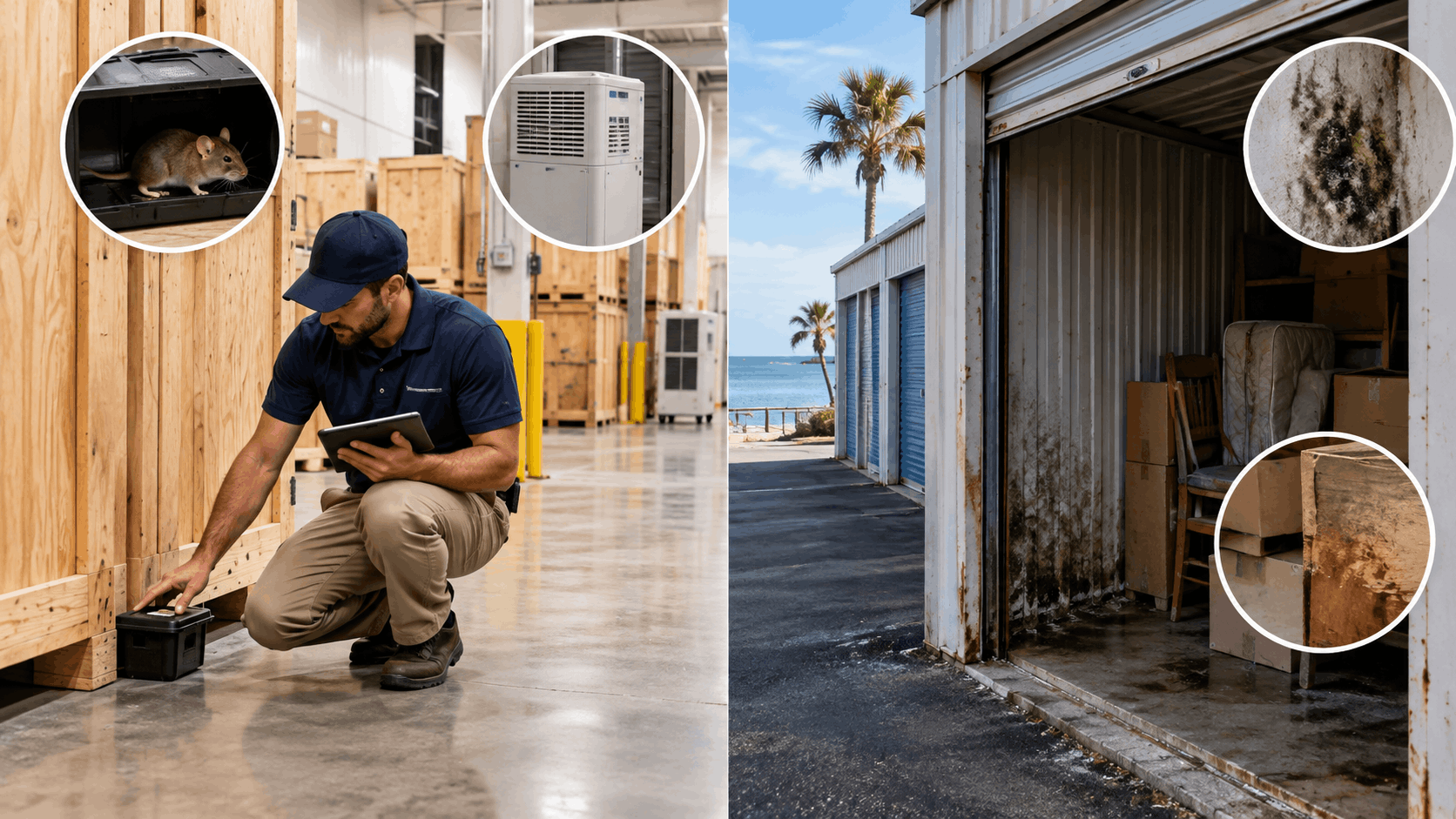
Before you sign anything, a few pointed questions will tell you a lot. Use this storage checklist to compare a mover warehouse against a self-storage facility, and do not settle for vague answers.
Choosing storage is easier once you know what actually matters. These four questions cut through the marketing.
Is the Space Truly Climate Controlled?
Ask for specifics on temperature and humidity control. A real answer includes a temperature range and, more importantly, a humidity range the facility holds. If they only mention temperature, humidity is probably not controlled at all.
Ask whether the system runs 24 hours or only during business hours. Part-time control lets coastal humidity creep back in overnight, which defeats the purpose for sensitive items.
Watch for storage marketing that sounds good but stays vague. "Climate controlled" on a sign means nothing without numbers behind it. A serious facility can tell you exactly what conditions they maintain and how they measure it.
If the answers are fuzzy, treat that as your answer. Real humidity control is something a good operator is happy to explain in detail.
Who Inspects the Space and How Often?
Find out whether anyone looks at the space between your visits. Regular staff inspections catch leaks, dampness, and pest activity early, and that ongoing attention is one of the biggest differences between a warehouse and a rented unit.
Ask about the pest schedule. A facility that works with a licensed pest company on a set calendar is actively protecting your goods, while one with no schedule is simply hoping for the best.
Confirm how storage checks actually happen. Who walks the floor, how often, and what do they look for? A clear answer shows the place is managed rather than just rented out and forgotten.
If nobody inspects your space until you return, you are the only line of defense. For long-term or valuable storage, that is a real gap.
Who Handles the Packing and Wrapping?
Decide honestly whether you want to pack for long-term coastal storage yourself. Packing services from a professional crew mean the right materials and methods, while self-packing puts the whole job on you.
Wrapping affects long-term condition more than most people expect. Breathable pads protect furniture, while plastic bags and thin cardboard can cause the very damage you are trying to avoid.
If you do pack yourself, invest in proper materials and skip the plastic that traps moisture. Our packing and crating team can also handle the prep so items enter storage the right way.
The bottom line is that packing is part of the protection. Whoever does it needs to do it with long-term storage in mind, not just moving day.
How Far Is the Facility From the Coast?
Distance from the water changes everything for stored goods. An inland facility sees less salt air and lower humidity than a unit sitting near the shoreline, which means slower corrosion and less mold risk.
Ask where the storage actually sits. A location a few miles inland is meaningfully drier than one near the beach, even within the same city. That coast distance directly affects how well your belongings hold up.
Factor location into your decision alongside price and convenience. A cheaper unit two blocks from the sand may cost you far more in damaged furniture and electronics over time.
For sensitive or valuable items, reduced salt exposure is worth a slightly longer drive. Your belongings sit in that environment every day, so the environment matters.
Final Thoughts
Coastal Los Angeles is beautiful, but it is hard on stored belongings. Salt air, marine layer humidity, seasonal swings, and steady pest pressure all work against anything sitting in an exposed unit near the water.
A managed mover warehouse fights all of that with steady climate control, raised vault storage, proper wrapping, scheduled pest treatment, and daily eyes on the floor. A basic coastal self-storage unit leaves most of that protection to you and to luck.
If you own wood furniture, photos, electronics, or anything you would hate to lose, where and how you store it is a real decision. Choosing a controlled, inland, professionally managed option is what keeps those items safe for the long haul.

Need Help in Los Angeles?
Popeye Moving & Storage serves Los Angeles and all of Los Angeles County.
Frequently Asked Questions
Do mover warehouses really control pests better than self-storage?
Yes, and the difference is large. A mover warehouse uses sealed doors, screened vents, scheduled treatments from a licensed pest company, and monitoring stations checked on a regular calendar. Items are also inspected at pickup before they enter shared storage. A rented self-storage unit gets none of that ongoing attention, so a pest problem can grow for weeks behind a locked door with no one watching.
Why does coastal storage cause mold and mildew?
Coastal air holds more moisture, and the morning marine layer near Venice, Marina del Rey, and Playa del Rey pushes humidity high for months. That damp air combines with ground moisture from concrete floors and poor air flow inside closed units. When moisture cannot escape, it settles on wood, fabric, and paper, and mold and mildew take hold. Controlled climate and raised, ventilated storage prevent the buildup.
Is climate-controlled self-storage enough near the beach?
Sometimes, but read the fine print. Many coastal facilities run their systems only during business hours or only in select buildings, and some control temperature without controlling humidity. Near the water, humidity is the bigger threat. Open roll-up doors and drive-up access also let salt air and pests in regardless of the label. For antiques, photos, and electronics, part-time climate control may not be enough protection.
How long can furniture stay in warehouse storage safely?
In a controlled warehouse with steady temperature and humidity, quality furniture can be stored safely for many months or even years. The steady conditions stop the swelling and shrinking that damage wood over time. Proper wrapping and raised vault storage add to that protection. The length of stay matters less than the conditions, which is why an inland, managed space works well for long-term storage.
What items should never go into a coastal self-storage unit?
Electronics, solid wood furniture, antiques, family photos, documents, and artwork are the highest risk. Salt air corrodes electronics and metal, humidity swings warp wood and heirlooms, and damp conditions fade photos and grow mold on paper. Mattresses and natural-fiber clothing also suffer from mildew and moths. Anything valuable or hard to replace belongs in controlled, inland storage rather than an exposed coastal unit.
How do I keep rodents out of my stored boxes?
Start by removing all food residue from kitchen items and appliances before packing. Use sealed, sturdy plastic bins instead of cardboard, which rodents chew and nest in. Wrap upholstered items and keep them off the floor with space around them. Most of all, choose a monitored, sealed storage space where a licensed pest company services the building on a schedule, since a rented unit gets no such protection.
Does Popeye Moving & Storage offer storage in Los Angeles?
Yes. We offer short-term and long-term storage in a managed, controlled warehouse serving Greater Los Angeles. We handle pickup and packing across neighborhoods like Brentwood, Culver City, Silver Lake, Santa Monica, and the beach cities, then store your goods in labeled vaults away from coastal salt air. Reach out through our contact page to talk through your storage needs.
How much does professional warehouse storage cost compared to self-storage?
Professional warehouse storage usually costs more per month than a bare self-storage unit, but the price includes far more. You get controlled climate, professional packing and wrapping, raised vault storage, scheduled pest treatment, inventory tracking, and regular inspections. With self-storage you pay for empty space and handle everything else yourself. For valuable or long-term items, the added service often prevents damage that would cost far more to replace.
Can I access my belongings while they are in warehouse storage?
Yes, though it works differently than 24-hour self-storage. Because items are stored in sealed, labeled vaults within a managed facility, access is arranged by scheduling with our team. We locate your vault using the inventory record and have your items ready. This trades round-the-clock walk-in access for stronger protection, tracking, and controlled conditions that keep your belongings safe between visits.
How should I prepare my items before storing them?
Clean and fully dry everything first, since trapped moisture leads to mold and mildew. Empty and clean appliances and kitchen items to remove food residue that attracts pests. Wrap furniture in breathable pads rather than plastic, and pack in sturdy bins instead of soft cardboard. Disconnect and protect electronics from salt air. If you prefer, our crew handles this prep during pickup so items enter storage ready to last.
Store With a Team That Knows the LA Coast
Your belongings deserve better than an exposed unit near the water. If you are weighing storage options anywhere around Greater Los Angeles, from the beach cities to the Westside to the Valley, our team can walk you through what will actually protect your things.
Call Popeye Moving & Storage or reach out through our contact page for a consultation. We will help you plan a move and storage setup that keeps your furniture, photos, and electronics safe from coastal salt air, humidity, and pests for as long as you need.
Frequently Asked Questions
- Do mover warehouses really control pests better than self-storage?
- Yes, and the difference is large. A mover warehouse uses sealed doors, screened vents, scheduled treatments from a licensed pest company, and monitoring stations checked on a regular calendar. Items are also inspected at pickup before they enter shared storage. A rented self-storage unit gets none of that ongoing attention, so a pest problem can grow for weeks behind a locked door with no one watching.
- Why does coastal storage cause mold and mildew?
- Coastal air holds more moisture, and the morning marine layer near Venice, Marina del Rey, and Playa del Rey pushes humidity high for months. That damp air combines with ground moisture from concrete floors and poor air flow inside closed units. When moisture cannot escape, it settles on wood, fabric, and paper, and mold and mildew take hold. Controlled climate and raised, ventilated storage prevent the buildup.
- Is climate-controlled self-storage enough near the beach?
- Sometimes, but read the fine print. Many coastal facilities run their systems only during business hours or only in select buildings, and some control temperature without controlling humidity. Near the water, humidity is the bigger threat. Open roll-up doors and drive-up access also let salt air and pests in regardless of the label. For antiques, photos, and electronics, part-time climate control may not be enough protection.
- How long can furniture stay in warehouse storage safely?
- In a controlled warehouse with steady temperature and humidity, quality furniture can be stored safely for many months or even years. The steady conditions stop the swelling and shrinking that damage wood over time. Proper wrapping and raised vault storage add to that protection. The length of stay matters less than the conditions, which is why an inland, managed space works well for long-term storage.
- What items should never go into a coastal self-storage unit?
- Electronics, solid wood furniture, antiques, family photos, documents, and artwork are the highest risk. Salt air corrodes electronics and metal, humidity swings warp wood and heirlooms, and damp conditions fade photos and grow mold on paper. Mattresses and natural-fiber clothing also suffer from mildew and moths. Anything valuable or hard to replace belongs in controlled, inland storage rather than an exposed coastal unit.
- How do I keep rodents out of my stored boxes?
- Start by removing all food residue from kitchen items and appliances before packing. Use sealed, sturdy plastic bins instead of cardboard, which rodents chew and nest in. Wrap upholstered items and keep them off the floor with space around them. Most of all, choose a monitored, sealed storage space where a licensed pest company services the building on a schedule, since a rented unit gets no such protection.
- Does Popeye Moving & Storage offer storage in Los Angeles?
- Yes. We offer short-term and long-term storage in a managed, controlled warehouse serving Greater Los Angeles. We handle pickup and packing across neighborhoods like Brentwood, Culver City, Silver Lake, Santa Monica, and the beach cities, then store your goods in labeled vaults away from coastal salt air. Reach out through our contact page to talk through your storage needs.
- How much does professional warehouse storage cost compared to self-storage?
- Professional warehouse storage usually costs more per month than a bare self-storage unit, but the price includes far more. You get controlled climate, professional packing and wrapping, raised vault storage, scheduled pest treatment, inventory tracking, and regular inspections. With self-storage you pay for empty space and handle everything else yourself. For valuable or long-term items, the added service often prevents damage that would cost far more to replace.
- Can I access my belongings while they are in warehouse storage?
- Yes, though it works differently than 24-hour self-storage. Because items are stored in sealed, labeled vaults within a managed facility, access is arranged by scheduling with our team. We locate your vault using the inventory record and have your items ready. This trades round-the-clock walk-in access for stronger protection, tracking, and controlled conditions that keep your belongings safe between visits.
- How should I prepare my items before storing them?
- Clean and fully dry everything first, since trapped moisture leads to mold and mildew. Empty and clean appliances and kitchen items to remove food residue that attracts pests. Wrap furniture in breathable pads rather than plastic, and pack in sturdy bins instead of soft cardboard. Disconnect and protect electronics from salt air. If you prefer, our crew handles this prep during pickup so items enter storage ready to last.
P
Popeye Moving & Storage Co. Team Team
Licensed moving and storage professionals serving Los Angeles and Los Angeles County.
Licensed in California · License #PUC: CAL T 189749 | DOT: 1472924 | MC: 498816C
Why trust Popeye Moving & Storage?
Founded in 1994, Popeye Moving & Storage is a licensed and insured moving and storage service serving Los Angeles and Los Angeles County. All content is reviewed by our licensed technicians.

Need Help in Los Angeles?
Popeye Moving & Storage serves Los Angeles and all of Los Angeles County.
Related Articles
Tips & Advice
Climate-Protected Storage Near the 405: Answering the "Storage with AC" Search Honestly for Coastal LA
Searching "storage with AC" for coastal LA? Learn why humidity, not heat, is the real threat near the 405, what items need climate protection, and honest pricing.
Tips & Advice
Santa Monica Movers North of Montana: Coastal Estate Service
A local expert guide to estate moving north of Montana Avenue in Santa Monica, covering coastal conditions, fragile crating, neighborhood logistics, storage, and permits.
Tips & Advice
Storage Near the 405 in West LA: What's Actually Available and Why a Mover-Run Warehouse Beats the Roll-Up Units
A clear guide to storage near the 405 in West LA, comparing roll-up self-storage units with a mover-run warehouse on cost, safety, and hassle for local movers.