How-To Guides
Marina del Rey Movers: Tower Elevators, Dock Carts, and Boat-Slip Logistics

Key Takeaways
- Marina del Rey moves mix high-rise towers, waterfront condos, and liveaboard boat slips, each with its own access problems.
- Reserve the freight elevator early through building management, since popular weekend slots book out two to three weeks ahead.
- Standard dollies fail on wet docks, so wide-wheel dock carts and non-slip mats are needed for long piers and gangways.
- Boat-slip moves must be timed around high tide, when the gangway sits at a safe, near-level carrying angle.
- Salt air and coastal humidity require extra wrapping for wood, electronics, and metal, plus climate-controlled storage.
- Tight streets near Fisherman's Village and Mother's Beach often require parking permits, careful truck staging, or shuttle runs.
- Liveaboard residents usually need off-site storage for seasonal gear and overflow that will not fit in a compact cabin.
- An on-site survey before move day maps elevators, docks, and truck routes so crews avoid costly surprises.
In This Article
A young couple signs a lease on a 12th-floor unit near Fisherman's Village. They picture sunset views over the water and morning coffee on the balcony. Then move day arrives, and reality sets in. The freight elevator holds a time slot they never booked, the sofa is two inches too wide for the cab, and the parking spot they counted on is packed with weekend beachgoers.
Marina del Rey moves come with a set of problems most people never think about until they are standing on a dock with a dresser and nowhere to put it. Whether the new home is a high-rise condo along Admiralty Way or a liveaboard slip in the main channel, the path from truck to front door rarely runs in a straight line. It winds through elevators, gangways, salt spray, and tight streets.

What Makes Moving in Marina del Rey Different?
Most moves in Los Angeles follow a familiar pattern. Park the truck, roll the ramp down, and carry boxes to a door on solid ground. Marina del Rey breaks that pattern almost every time.
This community packs three very different kinds of homes into a small footprint. High-rise towers rise along the waterfront. Low-slung condos line the channels. And hundreds of people live aboard boats tied up in slips. Each one changes how our team plans access, gear, and timing.
- Towers require freight elevator reservations and long service corridor walks
- Waterfront condos often sit behind gated walkways with limited truck access
- Liveaboard slips demand dock carts, tide timing, and careful transfers over water
- Salt air and moisture threaten wood, electronics, and metal during every move
Our experience with moves throughout Marina del Rey taught us to survey each address before quoting a plan. What works for a Via Marina tower fails completely on a dock in Basin H.
Tower Living Near Admiralty Way and Via Marina
The high-rise buildings along Admiralty Way and Via Marina are some of the most sought-after addresses on the Westside. They offer water views, doormen, and quiet units well above the street noise. They also come with move rules that catch new residents off guard.
These towers share a single freight elevator among dozens of units. On a busy Saturday, that one cab handles deliveries, contractors, and multiple moves at once. A high-rise elevator that seems roomy on paper often has a low ceiling or a shallow floor that blocks tall or long items.
The service corridors add another slowdown. Movers cannot roll a loaded dolly through the lobby, so they use back hallways that twist and narrow before reaching the freight cab. Those corridors can add 100 feet or more to every trip between the truck and the door.
We plan tower moves along Admiralty Way and Via Marina around these choke points. That means measuring the elevator, mapping the corridor route, and staging boxes so the crew never waits idle at the cab door.
Liveaboard Slips and Dock-Based Homes
A surprising number of Marina del Rey residents call a boat home. Liveaboard slips let people live full-time aboard sailboats and motor yachts tied up in the harbor. It is a great lifestyle, but it turns a normal move into a waterfront operation.
Getting furniture to a boat home means crossing a locked gate, a long main dock, a finger pier, and finally a gangway that shifts with the water. None of that path is flat or wide. A queen mattress that slides easily down a hallway becomes a two-person balancing act on a swaying dock.
Dock access rules also matter. Many docks limit cart weight and forbid rolling gear during certain hours to protect the boards and keep walkways clear. Our crews check these rules before loading a single item.
Moving onto or off a boat means every piece gets handled more times than a normal move. From truck to cart, cart to dock, dock to gangway, and gangway to deck. Each transfer is a chance for damage, so we treat liveaboard moves as their own category with their own gear.
Tight Streets and Limited Parking Around Fisherman's Village
Anyone who has driven near Fisherman's Village on a warm weekend knows the traffic. Cars circle for parking, cyclists share the road, and the narrow streets leave little room for a 26-foot truck. Truck parking here takes real planning.
The lots near Mother's Beach and Burton Chace Park fill early on weekends. A moving truck cannot simply idle in a red zone or block a bike lane while the crew works. Doing so risks a ticket and a very unhappy building manager.
Streets like Palawan Way and Bora Bora Way were not built for large trucks to sit for hours. Some condo driveways have low clearance or tight turns that a full-size truck cannot handle at all.
We scout the streets around Fisherman's Village ahead of time to find legal staging spots and backup plans. When a truck cannot get close, we switch to a shuttle setup, which we cover further down.
Get Your Free Quote
Tell us about your move and we'll get back to you fast.
Working With Tower Elevators the Right Way
The freight elevator is the heart of any high-rise moving job. Get the reservation and prep right, and the move flows. Get it wrong, and the crew stands around while the meter runs.
Building management in Marina del Rey towers takes elevator rules seriously. Most require advance booking, insurance paperwork, and padding before a single box goes up. Here is how to handle each step.
Reserving the Freight Elevator and Loading Dock
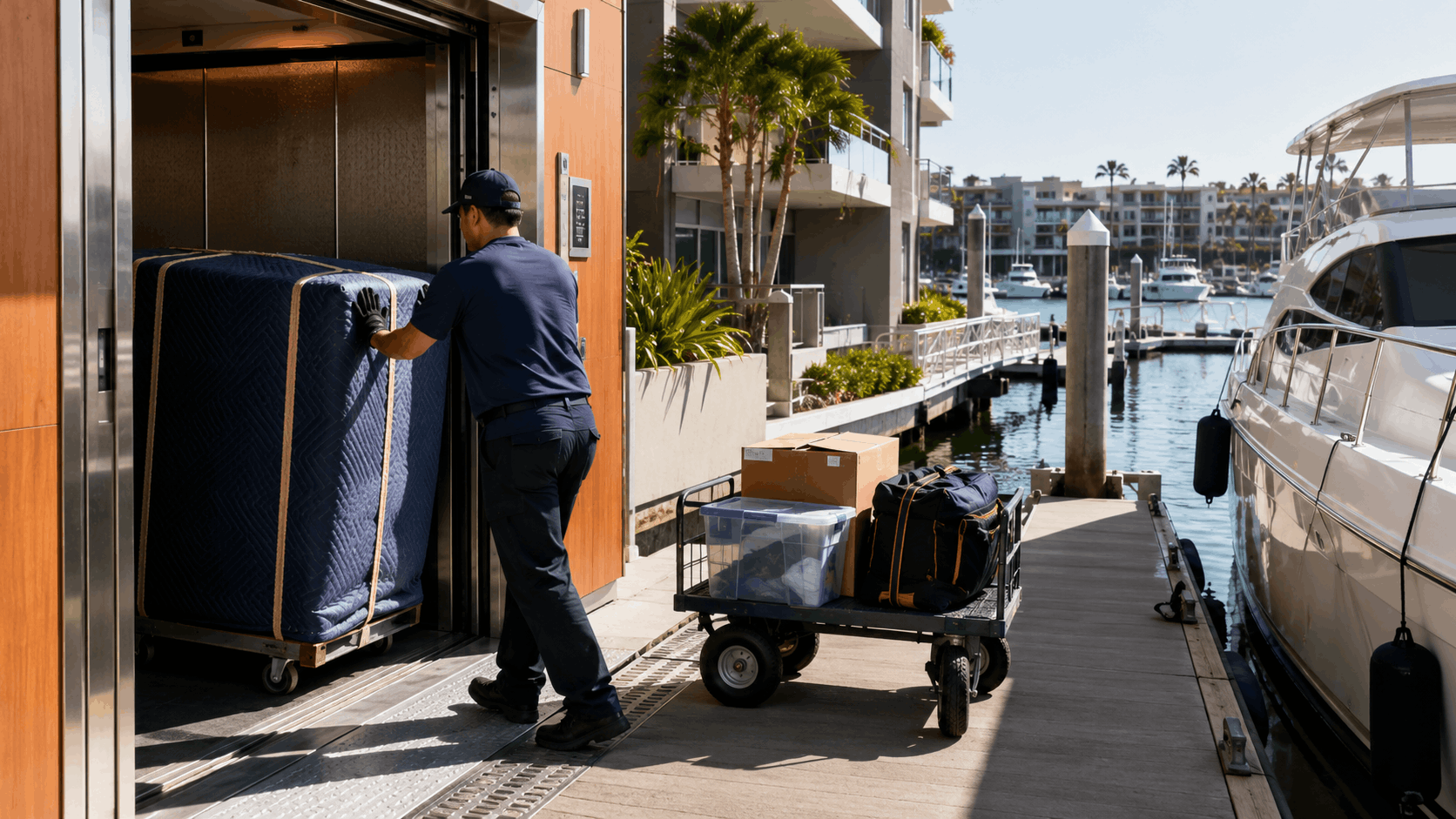
Every tower we work in requires a freight elevator reservation booked through building management. Residents usually call the front desk or property manager to claim a time slot, often a two- or four-hour window. Some buildings charge a fee for the reservation on top of any deposit.
Weekend windows fill up fastest. In popular Admiralty Way towers, the Saturday morning slots can book out two or three weeks ahead during busy moving months. A resident who waits until the last minute may be forced into a weekday move or a less convenient afternoon window.
The loading dock ties into the elevator booking. Many towers have a single dock bay where trucks unload, and that bay serves the freight cab. If another move or a delivery holds the dock, the whole schedule slips.
We ask residents to confirm both the elevator slot and dock access when they book. Then our team arrives early to claim the space before the window opens, so no time is wasted.
Elevator Padding and Damage Deposits
Before a move starts, most towers require the freight elevator to be padded. Building staff or the movers hang protective blankets on the cab walls to guard against dents and scratches. Some buildings supply the pads, while others expect the moving company to bring them.
A certificate of insurance is the other big requirement. Property managers want proof that the moving company carries liability and workers coverage, with the building named as an additional insured. Without that certificate on file, many towers will not release the elevator at all.
Refundable damage deposits are common too. A building might hold a few hundred dollars against any damage to the lobby, corridors, or elevator during the move. The resident gets it back after staff inspect the common areas.
We handle the certificate of insurance paperwork directly with building management well before move day. That keeps the deposit safe and prevents the kind of last-minute holdup that pushes a move into overtime.
Measuring Oversized Items for Small Cabs
Freight elevators look big until a long sectional sofa refuses to fit. The trick is measuring both the item and the elevator before move day, not after the truck arrives. Cab dimensions include width, depth, and the diagonal from corner to corner.
We measure the elevator opening, the interior depth, and the ceiling height. A tall armoire might clear the door but hit the ceiling once inside. A long couch may need to tilt on its end, which requires enough diagonal room in the cab.
Common problem pieces include queen and king mattresses, sectional sofas, dining tables, refrigerators, and treadmills. For each one, we compare the tightest measurement against the cab. When an item will not fit any way, we plan for disassembly or, as a last resort, a stair carry.
Measuring ahead of time saves hours. Discovering a fit problem at the elevator door with a full crew waiting is the fastest way to blow a schedule and rack up extra cost.
Timing Moves Around Peak Elevator Traffic
Even with a reserved window, other building activity competes for the elevator. Residents heading to work, dog walkers, grocery deliveries, and contractors all use the same cab in many towers. Timing the move around those rushes keeps things moving.
Early morning slots tend to be quietest. Starting at 8 a.m. on a weekday means the crew works before the lunch crowd and afternoon deliveries clog the dock. It also beats the beach traffic that builds up outside.
Mid-month weekdays see far less move activity than the first and last few days of a month, when leases turn over. If the schedule allows, a mid-month weekday move faces less elevator competition and easier booking.
We build the move plan around these patterns. Our residential moving crews stage the truck and boxes so the elevator runs constantly during the reserved window, with no gaps that waste the slot.

Need Help in Los Angeles?
Popeye Moving & Storage serves Los Angeles and all of Los Angeles County.
Dock Carts and Moving Gear Built for the Waterfront
Rolling gear across a dock is nothing like rolling it across a driveway. Boards flex, gaps catch wheels, and spray makes everything slick. The right equipment turns a dangerous slog into a smooth run.
Standard moving gear built for hardwood floors and paved lots fails fast on the water. Our waterfront logistics setup uses purpose-built carts and mats that handle the marina environment.
| Equipment | Best Use | Why It Works on Docks |
|---|---|---|
| Wide-wheel dock cart | Long main docks and finger piers | Wheels bridge board gaps and resist tipping |
| Pneumatic-tire hand truck | Appliances and heavy single items | Air tires cushion loads over uneven boards |
| Non-slip dock mats | Gangways and wet transfer points | Adds grip where spray makes boards slick |
| Marine-grade straps | Securing loads on swaying docks | Resist salt and hold items steady in motion |
Why Standard Dollies Fail on Wet Docks
A typical furniture dolly rides on small hard wheels around three inches wide. Those wheels work great on smooth concrete. On a dock, they drop into the gaps between boards and stop the load dead.
Wet surfaces make it worse. When a dolly wheel hits a slick, algae-coated board, it can slide sideways and pull a heavy load off balance. That is how movers lose control of a dresser over open water, which no one wants near the edge of a pier.
The narrow wheelbase of a standard dolly also tips easily. Docks are never perfectly flat, and even a slight slope combined with a swaying pier can roll a top-heavy load right over. A tipped load damages both the item and the dock boards.
We leave the standard dollies on the truck for tower work and switch to dock-rated gear the moment a job involves piers. It is a small change that prevents big accidents.
Choosing the Right Dock Cart for Long Walkways
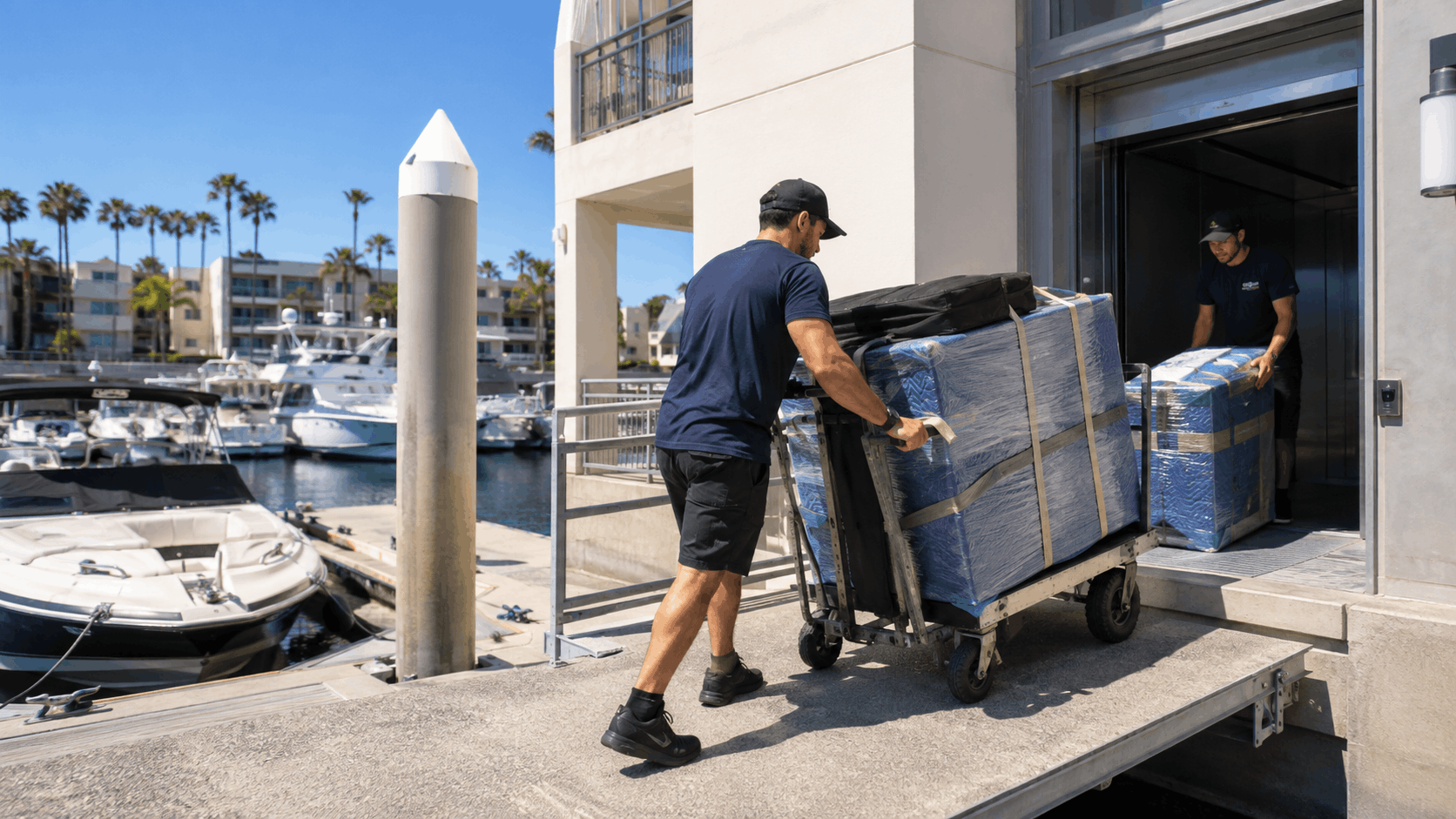
The main docks in Marina del Rey can run hundreds of feet from the gate to a boat slip. A good dock cart has wide, soft wheels that roll over board gaps instead of catching in them. Those wheels also spread the load so the cart does not gouge the wood.
Load capacity matters on a long walkway. A cart rated for 500 pounds or more lets the crew move more per trip, which cuts the number of round trips across a long dock. Fewer trips mean less time and less risk on the water.
The gangway is the trickiest stretch. It changes angle with the tide and often has a raised lip where it meets the dock. A cart with large wheels and a low deck rolls over that lip and down the slope without dumping the load.
We match the cart to the dock. A short finger pier might only need a mid-size cart, while a long run to a boat home in Basin F calls for the widest, highest-capacity cart we carry.
Protecting Belongings From Salt Air and Spray
Salt air is hard on furniture even during a short move. A single splash of harbor water can leave a stain or start corrosion on metal fittings. Wrapping items before they ever reach the dock keeps them dry.
We wrap wood furniture in moving blankets, then add a plastic outer layer for the dock crossing. The blanket cushions the piece and the plastic sheds spray and mist. Electronics get sealed in plastic and padded boxes so no moisture reaches the components.
Metal items like bed frames, appliances, and tool chests get special attention. Even a light coating of salt spray can begin surface rust within days. A wrap of plastic and a quick wipe-down after the crossing protect the finish.
Our packing and crating team preps every item for the marine environment before it leaves the truck. That upfront wrapping is faster and cheaper than repairing water damage later.
Boat-Slip Logistics for Liveaboard Moves
Moving to or from a boat is a different animal. The home floats, the access shifts with the tide, and the harbor has rules about who does what and when. Good boat-slip logistics start long before the truck rolls up.
Our team treats liveaboard moves as a coordinated operation with the harbor, the tide chart, and the boat owner all in the plan. Here is how the pieces fit together.
Coordinating With the Harbor and Marina Office
Every slip move starts with a call to the marina office. The Los Angeles County Department of Beaches and Harbors oversees the public marina, and private marinas each have their own management. They control gate access, dock rules, and cart policies.
The marina office can tell the crew where to park, which gate to use, and whether the docks allow rolling gear during the planned hours. Some marinas require a resident escort for anyone entering the dock area. Skipping this call can leave a full crew locked out at the gate.
You can review public marina information through the Los Angeles County Department of Beaches and Harbors before planning a slip move. Knowing the rules in advance prevents surprises on move day.
We confirm slip access, gate codes, and dock cart rules with the marina office days ahead. That coordination lets the crew walk straight in and start work instead of waiting for permission.
Timing Around Tides and Gangway Angles
Tides change everything about a slip move. At low tide, the gangway from the fixed dock down to the floating dock drops to a steep angle. Carrying a heavy load down a steep, wet ramp is risky for both the crew and the cargo.
At high tide, that same gangway flattens out to a gentle slope. The safest carrying windows fall around high tide, when the ramp is closest to level. We check the tide chart for the move date and plan the heaviest items for those windows.
The tide swing in Marina del Rey can run several feet between low and high. That is a big difference on a short gangway. A ramp that is easy to walk at noon might be a slick chute a few hours later.
We schedule the largest and heaviest pieces for the safest tide window and save lighter boxes for the steeper hours. Free tide charts from NOAA Tides and Currents help our team plan exact carrying times down to the hour.
Loading Onto Boats Without Damage
Getting furniture aboard a boat means threading it through tight openings without scraping the hull, rails, or deck. Boat surfaces scratch and gouge easily, and repairs are expensive. Protection comes first.
We pad the rails and hatch edges before anything comes aboard. Fenders and boards protect the hull where the dock and boat meet. The crew works slowly through cabin openings, which are often far smaller than a house doorway.
Many items simply will not fit down a companionway or through a hatch in one piece. Bed frames, tables, and shelving usually come apart for the trip aboard and get reassembled inside. Our crews carry tools for on-site disassembly and rebuild.
Deck protection stays in place the whole time. We lay down mats and blankets on decks and cabin soles so foot traffic and cart wheels never mark the finish. A careful boat load leaves the vessel exactly as clean as we found it.
Downsizing for Compact Living Spaces
Boats offer a wonderful life but very little storage. A three-bedroom house worth of belongings will never fit aboard a sailboat. Most liveaboard residents need to downsize hard before they move aboard.
We help sort what goes aboard, what goes to storage, and what leaves the picture entirely. Seasonal gear, extra furniture, and keepsakes usually head to an off-site unit rather than the boat. Only daily-use items make the cut for the cabin.
Compact living also means smart packing. Soft-sided bins fit into odd boat lockers better than hard boxes. Vacuum bags shrink clothing and bedding so they tuck into the small spaces a boat offers.
Our storage solutions give liveaboard residents a home base for everything that does not fit aboard. That way the boat stays livable and the extra belongings stay safe and reachable.
Planning Truck Access and Staging in the Marina
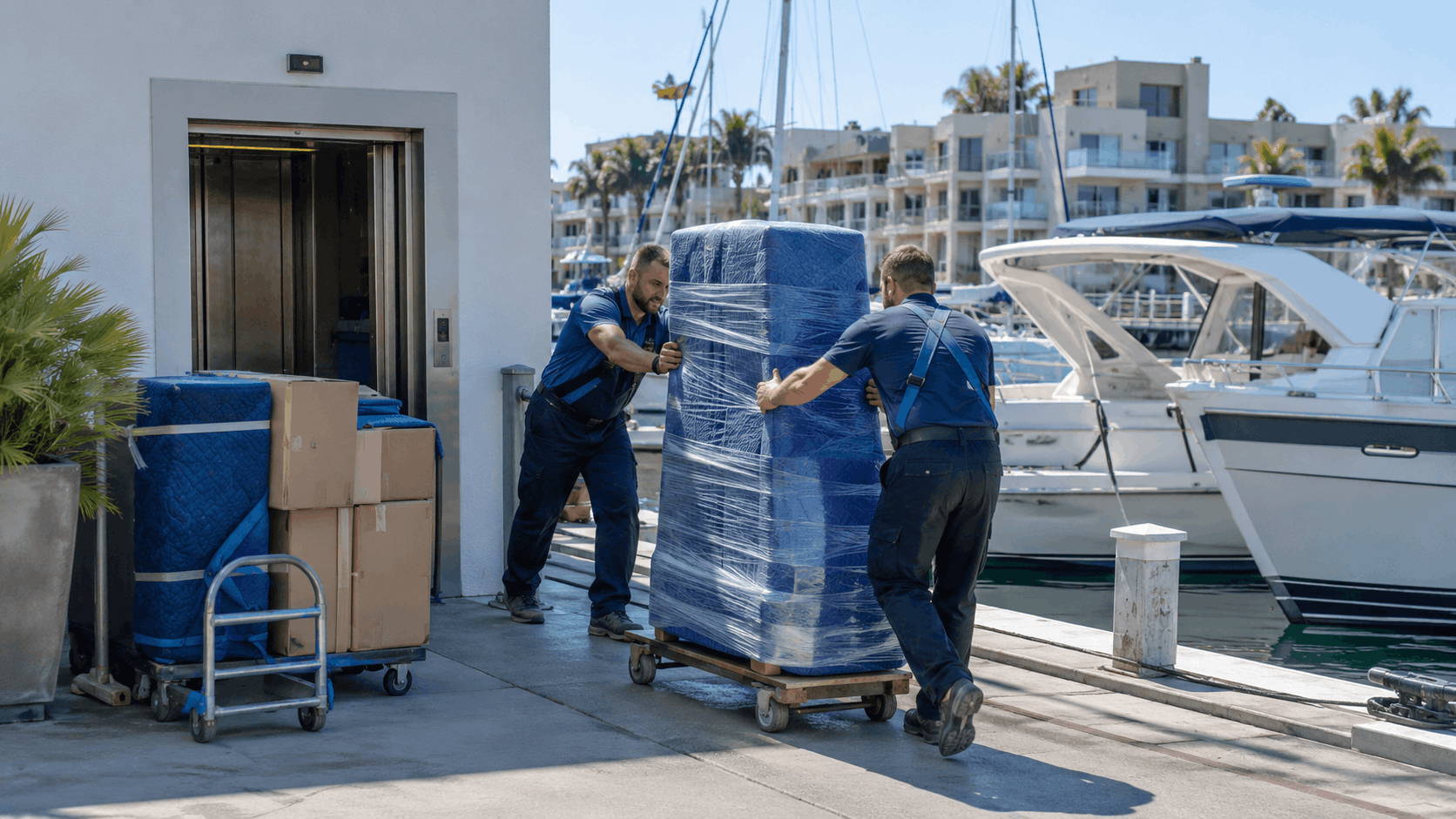
A moving truck needs a legal, reachable spot to park and unload. In a crowded waterfront area, that spot is not always near the front door. Smart truck staging bridges the gap.
Our team scouts each address for the best staging plan, backup parking, and shuttle options. Here is what goes into that plan.
Parking Permits and Loading Zones
Some Marina del Rey buildings have a designated loading zone, and others do not. Where street parking is the only option, a temporary loading zone permit can reserve curb space for the truck. That prevents a crew from circling for parking with a loaded truck.
The City of Los Angeles handles permits for many streets in and around the marina, and Los Angeles County covers others. Rules vary by exact block, so checking the right agency for a given address matters. A permit request usually needs a few days of lead time.
Without a reserved spot, a big truck may end up parked far from the entrance. That distance turns into a long carry that eats into the clock and the budget. A permit pays for itself by cutting carry time.
We help residents figure out which agency governs their block and how to request a temporary loading zone. Getting the curb secured early is one of the simplest ways to keep a marina move on schedule.
Shuttle Runs When Trucks Cannot Get Close
Some slips and towers sit where a full-size truck simply cannot reach. Narrow lanes, low clearances, and gated dock areas block a 26-foot truck entirely. That is when a shuttle move solves the problem.
A shuttle move parks the big truck at a legal staging spot, then uses a smaller van or box truck to ferry loads to the entrance. The small truck slips into tight driveways and gets close to the dock gate or lobby. It runs back and forth while the crew keeps loading and unloading.
Shuttle runs add some time, since loads get handled an extra time. But they beat the alternative of a 300-foot hand carry down a public sidewalk. For many marina addresses, a shuttle is the only realistic option.
We plan shuttle runs into the quote whenever a survey shows a truck cannot get close. Knowing the access limits ahead of time means the right vehicles show up on move day.
Avoiding Weekend Congestion by Mother's Beach
Mother's Beach and Burton Chace Park draw big crowds on warm weekends. Families, paddlers, and picnickers pack the lots and streets from mid-morning through the afternoon. That congestion turns a short truck route into a crawl.
The traffic near Admiralty Way and Via Marina backs up as beach visitors search for parking. A truck trying to reach a building during that window loses time it can never get back. Weekend afternoons are the worst stretch.
Early weekend starts help. A crew that begins at 8 a.m. often finishes the heavy work before the beach crowd arrives. Weekday moves dodge the crowds almost entirely.
We steer marina moves toward early hours and weekdays whenever the schedule allows. When a weekend move is unavoidable, we plan routes that skirt the busiest blocks near Mother's Beach and Burton Chace Park.
Need Help in Los Angeles?
Popeye Moving & Storage serves Los Angeles and all of Los Angeles County.
Protecting Your Belongings During a Waterfront Move
A waterfront move handles each item more times and exposes it to more moisture than a normal move. Extra protection is not optional here. It is what keeps furniture and electronics safe from dock to door.
Our packing approach for a waterfront move accounts for salt air, spray, and the many transfer points between truck and home. Here is how we protect the load.
Wrapping Electronics and Wood for Humid Conditions
The air near the water carries steady humidity that can harm sensitive gear. Electronics left unwrapped can pick up condensation inside their cases, especially when moving from a warm truck to a cool cabin. Sealed plastic and padded boxes block that moisture.
Wood furniture reacts to humidity too. Solid wood can swell and warp, and veneers can lift at the edges when exposed to damp air. A moving blanket plus a plastic wrap keeps the wood dry through the dock crossing and the elevator ride.
We pack electronics in their original boxes when possible, since those fit the device best. When originals are gone, we use double-walled boxes with foam and a plastic inner liner. Every port and seam gets covered.
For antiques and fine wood pieces, we add a layer of breathable padding under the plastic. That prevents trapped moisture from sitting against the finish. The goal is dry, cushioned, and sealed for the whole trip.
Padding for Multiple Transfer Points
A normal move might handle a dresser twice, from truck to room. A marina move can handle that same dresser six or seven times across trucks, carts, docks, gangways, and elevators. Every transfer is a new chance for a bump or scrape.
Because of those extra handling points, we pad more heavily than a standard move requires. Corners get extra protection, since they take the hits when an item swings through a tight gangway or elevator door. Edge guards and doubled blankets do the job.
Wrapping also has to survive the whole trip. A blanket that comes loose halfway down a long dock leaves the item exposed for the rest of the carry. We secure every wrap with marine-grade straps and tape that hold through repeated handling.
The extra padding costs a little more in materials and prep time. It costs far less than replacing a scratched heirloom or a dented appliance after a rough crossing.
Labeling Boxes for Fast Elevator Loads
When the freight elevator window is short, every second counts. A clear labeling system lets the crew load the cab fast and unload it into the right room without stopping to guess. That speed protects the reserved slot.
We label every box with the destination room and a number tied to an inventory list. During the tight elevator window, the crew loads by room so each cab run empties into one area. That keeps the corridor clear and the flow steady.
Labeling also tracks boxes across long dock walks. On a liveaboard move, a box might sit on a cart at the gate before its turn on the gangway. The inventory list confirms every numbered box made the trip and nothing got left on the dock.
Our team builds the inventory during packing and checks it at each end. That written record backs up any claim and gives the resident a simple way to confirm the whole load arrived.
Storage Options for Marina del Rey Residents
Storage solves a lot of marina moving problems. Gap dates between homes, tight boat cabins, and moisture worries all point toward a good storage unit. The right facility protects belongings and buys flexibility.
Here are the storage situations we see most often for waterfront and high-rise residents.
- Short-term holds when move-in and move-out dates do not line up
- Climate-controlled units that guard against coastal moisture
- Overflow space for liveaboard residents with tiny cabins
- Long-term storage for seasonal gear and keepsakes
Short-Term Storage Between Move Dates
Lease dates and slip transfers rarely line up perfectly. A resident might move out of one place on the first but not get keys to the next until the tenth. Those gap days leave belongings with nowhere to go.
Short-term storage bridges that gap. The crew loads everything into a secure unit, and it waits there until the new home is ready. No need to crash with friends surrounded by boxes.
Marina moves see gap dates often, since slip assignments and building move-in windows are not flexible. A liveaboard resident waiting on a slip transfer may need a few weeks of storage between boats. Planning for that gap early keeps the move calm.
Our storage options flex from a few days to many months. The same crew that packs the load handles the storage and the final delivery, so nothing gets handled by strangers.
Climate-Controlled Units for Marine Air
Storing belongings near the coast means fighting moisture. Marine air carries salt and humidity that can damage stored items over time. A climate-controlled unit holds steady temperature and humidity to keep that damage away.
Wood furniture, electronics, artwork, and documents all suffer in a damp, unregulated unit. Metal fittings corrode, paper curls, and mold can take hold in a humid box. Climate control removes those risks.
For anyone storing items near the water long-term, climate control is worth the added cost. The steady environment protects the value of everything inside. It is the difference between belongings that come out fresh and belongings that come out musty.
We steer coastal residents toward climate-controlled units for anything sensitive to moisture. Given the marine air throughout Marina del Rey, that covers most of what people store here.
Storing Extra Gear for Liveaboard Residents
A boat cabin holds only so much. Liveaboard residents constantly balance what fits aboard against what they want to keep. Off-site storage gives them room to keep both.
Seasonal gear is the biggest use. Winter clothing, holiday items, extra bedding, and sports equipment rotate between the boat and the storage unit as the seasons change. The cabin stays livable while nothing gets thrown out.
Overflow storage also holds the belongings that simply will not fit aboard but matter too much to sell. Family furniture, book collections, and tools all wait safely in a unit. The boat carries daily life while the unit carries everything else.
We set up many liveaboard residents with units sized to their overflow. As their needs change through the year, the storage plan flexes with them so the boat never gets overloaded.
How Popeye Moving & Storage Co. Handles Marina del Rey Moves
Marina del Rey moves reward local knowledge. A crew that has worked these docks and towers before knows the tricks that keep a move smooth. Popeye Moving & Storage Co. brings that experience to every waterfront job.
Here is how our team plans and runs a move in this community.
- On-site surveys to map elevators, docks, and truck routes before move day
- Local crews who know the marina's gangways, cabs, and slip access
- Direct coordination with building management and marina offices
- Full packing, storage, and specialty gear for waterfront conditions
On-Site Surveys Before Move Day
We visit the tower or slip before the move whenever we can. That survey lets us measure the freight elevator, walk the dock route, and find the best truck staging spot. Nothing about a marina address should be a surprise on move day.
During the survey, we note the elevator cab dimensions against the largest items. We check gate codes, dock cart rules, and the distance from a legal parking spot to the front door. Each of those details shapes the crew size, the gear list, and the time estimate.
The survey also flags problems early. If a sofa will not fit the elevator, we plan disassembly before move day rather than discovering it with the clock running. If a truck cannot reach the dock, we bring the shuttle vehicle.
This upfront planning is why our Los Angeles movers rarely hit surprises in the marina. The route is mapped before a single box moves.
Crews That Know the Marina's Docks and Towers
Our crews have worked the docks and towers across Marina del Rey for years. They know which Admiralty Way buildings have low elevator ceilings and which slips sit at the far end of a long main dock. That knowledge saves time on every job.
An experienced crew reads a gangway at a glance and knows how to carry a load down a steep tide angle safely. They handle boat rails and cabin openings without the guesswork that leads to scratches. Local knowledge turns a tricky slip move into a routine one.
We also know the neighboring beach communities well, from moves in Santa Monica to jobs down the coast. That regional experience means our crews handle coastal conditions with confidence wherever the address sits.
The same team handles high-rise and waterfront work, so no job gets passed to a crew that has never seen a dock. Every mover on a marina job has done it before.
Coordinating Insurance and Building Requirements
Building management rules trip up more marina moves than any other single issue. Missing insurance paperwork or an unbooked elevator can stop a move cold. We handle that coordination so residents avoid the delay.
Our office sends the certificate of insurance to building management ahead of move day, naming the building as required. We confirm the elevator reservation, the loading dock access, and any deposit rules. That paperwork clears before the crew arrives.
For slip moves, we coordinate gate access and dock rules with the marina office in the same way. The crew shows up with the codes, the escort arranged, and the cart rules understood. No standing at a locked gate.
Handling these building requirements is part of the service, not an afterthought. It is the quiet work that keeps a marina move on schedule and on budget.
Need Help in Los Angeles?
Popeye Moving & Storage serves Los Angeles and all of Los Angeles County.
Final Thoughts
Moving in Marina del Rey means dealing with tower elevators, dock carts, tide charts, and tight streets all in one job. A standard move plan will not work here. The right approach starts with a survey, plans around the elevator and the tide, and protects every item from the marine air.
Whether the new home is a high-rise on Via Marina or a liveaboard slip in the main channel, the details make the difference. Book the elevator early, measure the big pieces, secure a legal truck spot, and wrap everything for moisture. Get those right and a waterfront move goes smoothly.
Popeye Moving & Storage Co. runs moves like this throughout Marina del Rey and the surrounding Westside every week. To plan a tower or slip move with a crew that knows these docks and buildings, contact our team for a consultation and a clear, detailed quote.
Frequently Asked Questions
How much does a Marina del Rey move cost?
Costs vary with the size of the home and the access challenges. A small condo move might run a few hundred dollars, while a large tower or slip move can reach several thousand. Factors that raise the price include reserved elevator time, long dock distances, shuttle runs, and boat-slip transfers. A survey lets us give an accurate quote based on the exact address and its access hurdles.
Do I need to reserve the freight elevator myself?
Residents usually book the freight elevator directly with building management, since the building controls the schedule and any fees. Once the slot is booked, our team handles the rest, including the certificate of insurance and elevator padding. We coordinate closely with the property manager so the reservation, dock access, and paperwork all line up before move day. Just tell us the confirmed window when you book.
Can movers get furniture onto a boat in a slip?
Yes. Our crews use wide-wheel dock carts to move items down long docks and finger piers, then transfer them carefully across the gangway. We pad the boat's rails and cabin openings and disassemble large pieces that will not fit through a hatch. The whole slip move is timed around the tide so the gangway sits at a safe angle for carrying heavier loads aboard.
What is the best time of day to move in Marina del Rey?
Early morning is best, ideally starting around 8 a.m. That beats the beach crowds near Mother's Beach and Burton Chace Park and dodges the afternoon delivery traffic in the towers. Weekdays are far easier than weekends, and mid-month dates see less move activity than the first and last days of a month. Early weekday moves face the least elevator competition and the lightest street traffic.
Do I need a parking permit for the moving truck?
Often, yes. Where a building has no loading zone, a temporary permit can reserve curb space so the truck parks close to the entrance. The City of Los Angeles governs many streets near the marina, while Los Angeles County covers others, so the right agency depends on the exact block. We help residents figure out which permit applies and request it with enough lead time.
How do movers protect items from salt air and moisture?
We wrap wood and upholstered furniture in moving blankets, then add a plastic outer layer for the dock crossing to shed spray and mist. Electronics get sealed in plastic and packed in padded boxes so no moisture reaches the components. Metal items get wrapped to prevent surface rust from salt spray. All wrapping is secured with marine-grade straps that hold through repeated handling on the docks.
What happens if my furniture is too big for the elevator?
We measure large items against the elevator cab during the survey, so this rarely surprises anyone on move day. If a piece will not fit any way, we plan for disassembly and reassembly at the destination. When disassembly is not possible, a stair carry becomes the backup. Measuring ahead of time lets us choose the right approach before the crew and the clock are waiting at the elevator.
Does tide affect a boat-slip move?
Very much. At low tide, the gangway from the fixed dock to the floating dock drops to a steep, sometimes slick angle that makes carrying heavy loads risky. At high tide, that ramp flattens toward level, which is the safest carrying window. We check the tide chart for the move date and schedule the heaviest items for the high-tide hours to keep the crew and cargo safe.
Can I store belongings that will not fit on my boat?
Yes, and many liveaboard residents do exactly that. We set up storage units sized to hold seasonal gear, extra furniture, and keepsakes that will not fit in a compact cabin. Climate-controlled units protect those items from the coastal moisture. The same crew that handles your move can move belongings in and out of storage as your needs change through the year.
How far in advance should I book a Marina del Rey move?
Two to four weeks of lead time is a good target for most marina moves. That window lets us schedule the crew, complete an on-site survey, and handle the certificate of insurance with building management. It also leaves time to reserve a popular weekend elevator slot, which can book out two or three weeks ahead. For end-of-month or summer moves, booking even earlier is wise.
Frequently Asked Questions
- How much does a Marina del Rey move cost?
- Costs vary with the size of the home and the access challenges. A small condo move might run a few hundred dollars, while a large tower or slip move can reach several thousand. Factors that raise the price include reserved elevator time, long dock distances, shuttle runs, and boat-slip transfers. A survey lets us give an accurate quote based on the exact address and its access hurdles.
- Do I need to reserve the freight elevator myself?
- Residents usually book the freight elevator directly with building management, since the building controls the schedule and any fees. Once the slot is booked, our team handles the rest, including the certificate of insurance and elevator padding. We coordinate closely with the property manager so the reservation, dock access, and paperwork all line up before move day. Just tell us the confirmed window when you book.
- Can movers get furniture onto a boat in a slip?
- Yes. Our crews use wide-wheel dock carts to move items down long docks and finger piers, then transfer them carefully across the gangway. We pad the boat's rails and cabin openings and disassemble large pieces that will not fit through a hatch. The whole slip move is timed around the tide so the gangway sits at a safe angle for carrying heavier loads aboard.
- What is the best time of day to move in Marina del Rey?
- Early morning is best, ideally starting around 8 a.m. That beats the beach crowds near Mother's Beach and Burton Chace Park and dodges the afternoon delivery traffic in the towers. Weekdays are far easier than weekends, and mid-month dates see less move activity than the first and last days of a month. Early weekday moves face the least elevator competition and the lightest street traffic.
- Do I need a parking permit for the moving truck?
- Often, yes. Where a building has no loading zone, a temporary permit can reserve curb space so the truck parks close to the entrance. The City of Los Angeles governs many streets near the marina, while Los Angeles County covers others, so the right agency depends on the exact block. We help residents figure out which permit applies and request it with enough lead time.
- How do movers protect items from salt air and moisture?
- We wrap wood and upholstered furniture in moving blankets, then add a plastic outer layer for the dock crossing to shed spray and mist. Electronics get sealed in plastic and packed in padded boxes so no moisture reaches the components. Metal items get wrapped to prevent surface rust from salt spray. All wrapping is secured with marine-grade straps that hold through repeated handling on the docks.
- What happens if my furniture is too big for the elevator?
- We measure large items against the elevator cab during the survey, so this rarely surprises anyone on move day. If a piece will not fit any way, we plan for disassembly and reassembly at the destination. When disassembly is not possible, a stair carry becomes the backup. Measuring ahead of time lets us choose the right approach before the crew and the clock are waiting at the elevator.
- Does tide affect a boat-slip move?
- Very much. At low tide, the gangway from the fixed dock to the floating dock drops to a steep, sometimes slick angle that makes carrying heavy loads risky. At high tide, that ramp flattens toward level, which is the safest carrying window. We check the tide chart for the move date and schedule the heaviest items for the high-tide hours to keep the crew and cargo safe.
- Can I store belongings that will not fit on my boat?
- Yes, and many liveaboard residents do exactly that. We set up storage units sized to hold seasonal gear, extra furniture, and keepsakes that will not fit in a compact cabin. Climate-controlled units protect those items from the coastal moisture. The same crew that handles your move can move belongings in and out of storage as your needs change through the year.
- How far in advance should I book a Marina del Rey move?
- Two to four weeks of lead time is a good target for most marina moves. That window lets us schedule the crew, complete an on-site survey, and handle the certificate of insurance with building management. It also leaves time to reserve a popular weekend elevator slot, which can book out two or three weeks ahead. For end-of-month or summer moves, booking even earlier is wise.
P
Popeye Moving & Storage Co. Team Team
Licensed moving and storage professionals serving Los Angeles and Los Angeles County.
Licensed in California · License #PUC: CAL T 189749 | DOT: 1472924 | MC: 498816C
Why trust Popeye Moving & Storage?
Founded in 1994, Popeye Moving & Storage is a licensed and insured moving and storage service serving Los Angeles and Los Angeles County. All content is reviewed by our licensed technicians.

Need Help in Los Angeles?
Popeye Moving & Storage serves Los Angeles and all of Los Angeles County.
Related Articles
How-To Guides
Bel Air Movers: Gated Community Logistics and Custom Estate Service
A local expert guide to moving in Bel Air, covering gated entry logistics, canyon road challenges, estate handling, storage, and how to choose the right movers.

How-To Guides
Los Feliz Movers: Hillside Home and Narrow Street Logistics
A local guide to moving into Los Feliz hillside homes, covering narrow streets, permits, equipment, storage, and how Popeye Moving handles tough hillside jobs.

Tips & Advice
Marina Del Rey Movers: Boat Dock and Waterfront Apartment Service
A local guide to moving in Marina Del Rey, covering boat dock moves, waterfront apartment access, permits, parking, real costs, storage, and expert tips.