Moving Cost by Home Size in LA: 1,200 vs 2,500 vs 4,000+ Sq Ft Real Ranges With Crew and Truck Counts
Key Takeaways
- A 1,200 sq ft home typically needs 2 movers and one 16 to 20 foot truck, costing roughly $600 to $1,400 locally.
- A 2,500 sq ft family home usually needs 3 to 4 movers and a 26 foot truck, landing around $1,600 to $3,500.
- A 4,000+ sq ft home often needs 5 to 7 movers and two trucks, running $4,000 to $9,000 or more.
- Volume, access, stairs, and LA traffic matter more than raw square footage when setting the price.
- A larger crew often lowers the total bill by finishing sooner, even at a higher hourly rate.
- Decluttering, moving mid-week and mid-month, and reserving parking permits all cut costs without risking belongings.
- Hillside homes near the Hollywood Hills and gated estates often require a shuttle vehicle for access.
- Hourly billing is usually cheapest for short local LA moves, while a fixed price suits fixed-scope jobs.
In This Article
A family in Silver Lake recently reached out to our team with a common problem. They had signed a lease on a bigger place across town, but they had no idea how to budget the move. Was it a two-person job or a four-person one? One truck or two? Nobody had given them a straight answer.
That confusion is normal. Moving cost in LA swings widely based on home size, access, and the neighborhood you live in. A tight loft in Downtown behaves nothing like a hillside house in Los Feliz, even if the square footage looks similar on paper.
What Actually Drives Moving Costs in Los Angeles?
Before home size even enters the picture, a handful of moving cost factors set the baseline. Los Angeles moving has its own quirks that push numbers up or down, and understanding them helps you read any quote with clear eyes.
Most local moves in LA run on an hourly rate. That rate covers the crew, the truck, and the driving time between your two addresses. The three biggest variables are how much stuff you own, how hard it is to reach, and how far apart your homes sit.
| Cost Factor | Effect on Price | LA-Specific Note |
|---|---|---|
| Volume of belongings | High | Garages and storage lofts hide extra load |
| Access and parking | Medium to high | Permit zones near Hancock Park add walk time |
| Stairs and elevators | Medium | K-town walk-ups slow crews down |
| Distance and traffic | Medium | The 405 at rush hour adds billable time |
Home Size and Volume of Belongings
Square footage gives movers a rough starting point, but what really matters is the volume of belongings inside. A 1,200 square foot condo owned by a minimalist can weigh less than a packed 900 square foot apartment. Home size predicts box count and furniture load, yet two homes of the same size can differ by a full truckload.
Movers think in cubic feet, not just square feet. A three-seat sofa, a king bed, and a dresser eat up far more cubic feet than the same room full of small boxes. When our team surveys a home, we count large furniture first because those pieces set the truck size.
Garages and attics throw off estimates the most. People forget the bikes, tools, holiday bins, and old furniture stashed out of sight. When we walk a home in person or over video, those hidden spaces often add 15 to 25 percent more volume than the owner expected.
This is why we ask about volume rather than trusting square footage alone. A precise count of your residential move details keeps the quote honest and avoids the day-of surprise of a truck that is too small.
Access, Parking, and LA Street Conditions
Los Angeles streets are not built for large trucks. Narrow roads in Echo Park force crews to park half a block away, which means every box travels farther on foot. That walking distance adds up on an hourly job.
Permit parking makes it worse in older neighborhoods. Around Hancock Park and parts of Larchmont, street parking is restricted, so a truck without a reserved spot may sit blocks from the door. A parking permit for the truck can save an hour or more of carry time.
Street access also depends on the building. A single driveway shared by four units in West Hollywood can trap the truck while another tenant blocks the path. We plan around these choke points because they quietly inflate the final bill.
When we handle jobs near the West Hollywood Sunset Strip, we scout parking ahead of time. Reserving the right spot keeps the crew moving instead of hauling belongings across a crowded block.
Stairs, Elevators, and Building Types
Not every home sits at ground level. A third-floor walk-up in Koreatown demands more labor time than a single-story ranch, because every item goes up and down stairs by hand. Stairs are one of the most reliable cost drivers we see.
Elevators help, but they come with their own delays. A shared elevator in a DTLA high-rise often needs to be reserved, and if another resident grabs it, the crew waits. Building management may cap the reservation window, which forces a tighter pace or a longer day.
Hillside homes bring a different challenge. In the Hollywood Hills, a house may sit up a steep set of exterior steps with no driveway close to the door. That long carry turns a normal load into a slow, careful haul.
Crew size often grows to match the building type. More movers on a walk-up or hillside home spread the load and keep the total hours down, which we explain in the next section.
Distance and Traffic Between Points
A local move across a few blocks costs far less than a cross-town haul. Distance matters, but in LA traffic matters more. Ten miles on paper can mean 45 minutes of billable driving during rush hour.
The 405 and the 101 are the usual culprits. A move from the Westside to the Valley that crosses the Sepulveda Pass at 5 p.m. can double the drive time compared to a mid-morning run. That extra time lands on your invoice.
Short local moves stay cheap because the truck spends less time on the road. A move within Culver City or within Pasadena often wraps up in a single window with minimal driving between points.
We schedule departure times around known bottlenecks. Leaving before the morning crush or waiting out the afternoon peak keeps a local residential move efficient and predictable.
Get Your Free Quote
Tell us about your move. We'll be in touch soon.
How Crew Size and Truck Count Are Decided
People often assume a smaller crew saves money. The opposite is usually true. Crew size and truck count are chosen to match your load, and the right combination almost always costs less overall.
Our team looks at volume, access, and distance together. A moving crew that is too small on a big job drags out the hours, while an oversized crew on a small job wastes money. The sweet spot balances speed against the hourly cost of each mover.
Why More Movers Can Lower the Total Bill
Hourly billing rewards speed. A two-person crew might take eight hours on a job that a four-person crew finishes in four and a half. Even though the four-person crew costs more per hour, the shorter labor time can produce a lower total.
The math works because loading and unloading are the slowest parts. With more hands, one mover packs the truck while others carry, and the flow never stalls. A single person waiting on stairs is dead time you pay for.
We see this most on homes with stairs or long carries. Adding a third or fourth mover on a Koreatown walk-up can cut an hour or two off the clock, which more than pays for the extra person.
The goal is the lowest total bill, not the lowest hourly rate. When we recommend a larger crew, it is because the numbers point that way, not to pad the invoice.
Matching Truck Size to Your Load
Truck size is the other half of the equation. The common options are 16, 20, and 26 foot trucks. A 16 foot truck suits a small apartment, a 20 foot handles a larger condo, and a 26 foot truck carries most family homes in one trip.
One trip beats two almost every time. If the load fits in a single 26 foot truck, the crew loads once, drives once, and unloads once. Two trips double the driving time, and in LA traffic that gets expensive.
We size the truck to your volume with a little margin. A truck packed to the ceiling with no room to secure items risks damage, so we plan for a snug but safe fit. Underestimating the truck is a frequent mistake we correct on quotes.
Getting the truck right up front avoids the worst-case scenario: a half-loaded home and a full truck at 3 p.m. That situation forces a second trip or a scramble for another vehicle, both of which cost time and money.
When One Truck Is Not Enough
Large homes often need two trucks or multiple trips. A 4,000 square foot house with a full garage and outdoor furniture rarely fits in one 26 foot truck. Two trucks let both loads move at once and keep the timeline tight.
Hillside roads add another wrinkle. Near Los Feliz and in parts of the Hollywood Hills, streets are too narrow or steep for a full-size truck. In those cases we run a shuttle service, using a smaller vehicle to ferry items from the house down to the big truck parked below.
Shuttle runs take extra time, so we account for them in the estimate. A gated community with a long private drive may also require a shuttle if the truck cannot reach the front door. It is slower, but it protects both the home and the belongings.
For estate-level moves, two trucks and a shuttle sometimes work together. Our specialty moving planning covers these access issues before move day so nothing stalls when the crew arrives.

Need Help in Los Angeles?
Popeye Moving & Storage serves Los Angeles and all of Los Angeles County.
1,200 Sq Ft Moves: Condos and Small Homes
Smaller homes make up a huge share of LA moves. Condos, one-bedroom houses, and roomy apartments across the city usually fall in this range. The 1,200 sq ft moving cost is the most predictable of the three sizes, but it still has traps.
A small home move sounds simple, and often it is. Still, a packed condo can surprise a crew that treated it as a light job. Here is what this size typically requires.
| Item | Typical Range |
|---|---|
| Crew size | 2 movers |
| Truck | 16 to 20 foot |
| Time estimate | 4 to 6 hours |
| Local cost range | $600 to $1,400 |
Typical Crew and Truck for This Size
Most 1,200 square foot moves run with 2 movers and a 16 foot truck. That setup handles a one or two bedroom home with standard furniture and a normal amount of boxes. A 20 foot truck steps in when the home leans full or has bulky pieces.
Time usually lands between four and six hours for a local move. That window covers loading, a short drive, and unloading at the new place. Add an hour if there are stairs on either end.
A third mover sometimes makes sense even at this size. If the condo sits on the third floor with no elevator, an extra pair of hands shortens the day and can lower the total despite the higher hourly rate. We weigh that call during the survey.
The 16 foot truck fits most condos in one trip. Only when a home is unusually packed do we bump up to a 20 foot truck to avoid a second run across town.
Real Cost Range in Los Angeles
For a local move at this size, the honest cost range runs roughly $600 to $1,400. The low end covers a light, easy-access move with no stairs. The high end reflects a fuller home, stairs, or a longer cross-town drive.
Location changes the local move price. A DTLA loft with elevator reservations and loading dock rules often costs more than a ground-floor Sherman Oaks apartment with easy parking. The building rules, not the square footage, drive that gap.
Distance still matters at this size. A move within Santa Monica stays near the low end, while a haul from the beach to the east side climbs because of drive time. We factor traffic into every quote.
These ranges assume you pack your own boxes. Adding packing services raises the total, which we cover in the mid-size section since it applies across all home sizes.
Common Surprises for Smaller Moves
The biggest hidden costs on small moves come from stuff nobody counted. Overstuffed closets hold far more than they appear, and a single walk-in can add ten or more boxes. Those boxes take time to carry.
Garage items catch people off guard too. Bikes, tools, camping gear, and storage bins in a shared garage can add a surprising amount of volume to a move that looked small on the walkthrough. We always ask to see the garage.
Elevator reservations add another layer in condo buildings. If the elevator is not booked, the crew waits for it or shares it with residents, both of which burn billable time. Reserving it ahead keeps the job on schedule.
Parking is the last common surprise. A condo in a dense area without a reserved spot can force a long carry from wherever the truck lands. A little planning around packing and prep smooths out most of these issues.
2,500 Sq Ft Moves: Mid-Size Family Homes
Mid-size family homes are the backbone of LA neighborhoods. Three and four bedroom houses across the Valley and the Westside usually land here. The 2500 sq ft moving cost jumps from the small-home range because the volume and furniture load grow a lot.
A family home move involves more than boxes. It brings large furniture, appliances, kids' rooms, and often a home office. Here is the typical setup for a mid-size move.
| Item | Typical Range |
|---|---|
| Crew size | 3 to 4 movers |
| Truck | 26 foot |
| Time estimate | 6 to 9 hours |
| Local cost range | $1,600 to $3,500 |
Typical Crew and Truck for This Size
A 2,500 square foot home usually calls for a 3 to 4 person crew and a 26 foot truck. Three movers handle a standard home, while four make sense when there is a bonus room, a full garage, or heavy furniture. The 26 foot truck fits most of these homes in one trip.
Time runs from six to nine hours for a local move. Loading a full family home takes longer than a condo, and the drive plus unloading fills out the day. Stairs on either end push toward the higher end.
Heavy items change the math. A large sectional, a treadmill, or a solid wood dining set adds labor time and sometimes calls for a fourth mover. We flag these during the survey so the crew arrives sized correctly.
The 26 foot truck is the standard here for a reason. It carries a full three or four bedroom home in one load, which avoids the costly second trip that a smaller truck would force.
Real Cost Range in Los Angeles
The realistic family move price for a local job at this size runs about $1,600 to $3,500. The low end assumes good access and a short drive. The high end reflects four movers, stairs, and a longer cross-town route.
Neighborhood access shapes the number. A home near Studio City with a flat driveway and street parking moves more easily than a hillside house with a long carry. A move within Culver City tends to stay efficient thanks to shorter distances.
Traffic between points still counts. A family moving from the Westside to the Valley pays for the time spent crossing the pass. We plan departure windows to keep that drive as short as possible.
These figures assume self-packing. Professional packing adds to the total, which is often worth it for a busy family, as the next section explains.
Packing Services and How They Change the Price
Packing is where families make the biggest budget choice. Partial packing covers just the fragile or tricky items, like the kitchen and artwork. Full packing means the crew boxes the entire home for you.
Full packing adds hours and a materials cost, but it saves you days of work. Boxes, tape, paper, and specialty containers all add up, and a full-service crew brings and uses them efficiently. For a mid-size home, packing can add several hundred to over a thousand dollars.
The payoff is speed and safety on move day. Professionally packed boxes load more easily and travel better, which trims the loading hours. Our full service packing team handles the whole home when time is tight.
Many families choose partial packing to balance cost and convenience. They pack their own clothes and books, then leave the kitchen and breakables to the pros. That split often gives the best value.
Handling Kids, Pets, and Multi-Day Timing
A family move is harder than a solo one because of the moving parts. Kids and pets need a plan so the crew can work without interruption. A quiet room or a day with a sitter keeps everyone safe and the job moving.
Move timing around school matters. Many families schedule around the LAUSD calendar, moving during breaks or on a light week so kids do not miss class. A move over a long weekend can spread the load across two days.
Staging rooms helps the flow. Labeling boxes by room and clearing a path lets the crew load and unload without hunting for space. We recommend picking one room to stage boxes as the crew empties the rest.
Pets do best away from the action. An open door and strangers carrying furniture stress most animals, so a closed room or a friend's house prevents an escape. A little planning here saves a stressful day.

4,000+ Sq Ft Moves: Large and Luxury Homes
Large homes are a different category entirely. Estate homes in Brentwood and sprawling houses in Encino carry far more volume, more furniture, and more specialty items. The 4000 sq ft moving cost reflects the crew, trucks, and time these homes truly need.
A large home move is a full-day or two-day operation. The planning is heavier because access, specialty items, and volume all scale up at once. Here is what this size usually requires.
| Item | Typical Range |
|---|---|
| Crew size | 5 to 7 movers |
| Truck | Two trucks or multiple trips |
| Time estimate | 10 hours to 2 days |
| Local cost range | $4,000 to $9,000+ |
Typical Crew and Truck Counts for Big Homes
A 4,000+ square foot home usually needs a large crew of 5 to 7 movers. That many hands keep a huge load moving and prevent the day from stretching into the night. Fewer movers on a home this size drags the job past a single window.
Trucks scale up too. Two trucks are common, or one large truck making multiple trips if access allows. Two trucks let the crew load and drive in parallel, which is the more efficient and often cheaper route for a big move.
Timelines run from a full ten-hour day to two days. A two-day plan lets the crew pack and load on day one, then deliver and unload on day two. That split reduces the risk of a rushed, exhausting single day.
We size these jobs carefully during the survey. Getting the crew and truck count right on a large home is the difference between a smooth two-day move and a chaotic one that runs into overtime.
Real Cost Range in Los Angeles
The luxury move price at this size runs roughly $4,000 to $9,000 or more for a local job. The range is wide because these homes vary so much. Volume, specialty items, and access all move the number.
Specialty items push the top of the range. Pianos, large art, wine collections, and gym equipment each add crew time and special handling. A home with several of these items climbs well past the base range.
Access is the other big variable. A gated estate with a long private drive or steep hillside approach requires a shuttle, which adds hours. We factor those conditions into the quote so the final bill holds no surprises.
Two-day moves add labor across both days, but they protect valuable belongings. For high-value homes, that careful pace is worth the cost.
Specialty Items and Extra Handling
Large homes tend to hold items that need dedicated handling. Pianos top the list. A grand piano requires trained movers, proper equipment, and sometimes a dedicated crew to protect both the instrument and the home.
Our piano moving service uses the right dollies, padding, and technique for uprights and grands alike. Trying to move a piano with a general crew risks damage and injury, so we treat it as its own task.
Gym equipment and wine collections need care too. A commercial-grade treadmill often disassembles for transport, and a wine collection needs stable, upright packing to protect the bottles. These add time but prevent costly loss.
Fragile art and antiques call for custom crating. We build wood crates around framed pieces, sculptures, and delicate furniture so they survive the drive. That extra step is what separates a routine move from a proper estate move.
Hillside Access and Long Carries
Many large LA homes sit in tough spots. Gated communities and steep driveways in the Hollywood Hills and Bel Air rarely accommodate a full-size truck at the door. Hillside access shapes the whole plan.
When a truck cannot reach the home, we run a shuttle. A smaller vehicle carries items down the narrow drive to the big truck parked on a wider road below. It is slower, but it is the only safe way to move a hillside estate.
Long carries also add labor. If the front door sits far from any parking, every item travels a longer path, and that distance multiplies across hundreds of pieces. More movers offset the time, which is why crew counts climb on these homes.
We scout access before move day on estate jobs. Knowing the driveway, the gate codes, and the turnaround room lets us bring the right vehicles and avoid a stalled crew.
Need Help in Los Angeles?
Popeye Moving & Storage serves Los Angeles and all of Los Angeles County.
Side-by-Side Cost Comparison and What You Get
Seeing all three sizes together makes the cost comparison clear. It helps you place your own home and build a moving budget that fits. The crew truck comparison below shows how the numbers scale.
| Home Size | Crew | Truck | Time | Local Cost Range |
|---|---|---|---|---|
| 1,200 sq ft | 2 movers | 16 to 20 foot | 4 to 6 hrs | $600 to $1,400 |
| 2,500 sq ft | 3 to 4 movers | 26 foot | 6 to 9 hrs | $1,600 to $3,500 |
| 4,000+ sq ft | 5 to 7 movers | 2 trucks | 10 hrs to 2 days | $4,000 to $9,000+ |
Crew and Truck at a Glance by Home Size
The crew count rises with home size in a steady pattern. Small homes get two movers, mid-size homes get three or four, and large homes get five to seven. The truck count follows, from one small truck to two large ones.
Typical hours climb the same way. A small move wraps in half a day, a mid-size move fills most of a day, and a large move can span two days. Those hours drive the bulk of the cost on an hourly job.
Access can shift any of these numbers up. Stairs, long carries, and hillside shuttles add crew and time regardless of square footage. That is why two homes of the same size can quote differently.
Use the table as a starting point, not a final answer. The real number comes from a survey that counts your actual belongings and checks your access.
Reading a Moving Estimate Line by Line
A clear moving estimate lists more than an hourly rate. Look for travel time, which covers the drive between homes and sometimes the trip from the yard. In LA, travel time reflects traffic, so it is a real line item.
Watch for minimum hours. Most local movers set a minimum, often two to four hours, so a very small job still meets a floor. Knowing the minimum helps you compare quotes fairly.
Material charges show up when you order packing supplies or crating. Boxes, tape, paper, and wardrobe boxes each carry a cost. A good estimate itemizes these so you see where the money goes.
Ask about anything vague. A quote that lumps everything into one number without a breakdown makes it hard to plan. Our estimates spell out the crew, truck, travel, and materials line by line.
Fixed Price vs Hourly in Los Angeles
Local LA moves usually price by the hour, and that suits most jobs. An hourly rate matches the cost to the actual work, so an efficient, well-prepped home costs less. It rewards you for doing your part.
A fixed price makes sense when the scope is fixed and clear. Long-distance moves and large estate jobs with known volume often quote flat, so you lock in the price up front. It removes the risk of a slow day inflating the bill.
The tradeoff is flexibility. Hourly billing can rise if access is worse than expected, while a fixed price protects you but may build in a cushion. For a short local move, hourly almost always comes out fairer.
We recommend the method that fits your move. For most homes across the city, an hourly local move gives the best value, and we explain exactly how the clock works before we start.

How to Lower Your Moving Cost Without Cutting Corners
You can trim the bill without risking your belongings. A few smart moves before the truck arrives make a real difference. These moving tips help you save on moving while keeping everything safe.
The theme is simple: less stuff, better timing, and easier access. Each one reduces the hours a crew spends, and hours are what you pay for. Here is how to reduce cost the honest way.
Declutter and Downsize Before the Truck Arrives
Every box you do not move saves time and money. Declutter room by room in the weeks before the move, and be honest about what you actually use. Fewer belongings can even drop you to a smaller truck.
Donating is the fastest way to cut volume. Local Goodwill and Salvation Army drop-offs across LA take furniture, clothes, and household goods. A short trip clears out the items that would otherwise ride the truck.
Selling works for higher-value pieces. Online marketplaces move furniture and electronics readily, and the cash offsets the moving cost. Give yourself a few weeks so items sell before move day.
Tackle the garage early. It holds the most forgotten volume, so sorting it first prevents a last-minute pile of boxes. A lighter garage often shaves an hour or more off the job.
Pick the Right Day and Season
When you move changes the price. Weekends and the summer rush cost more because demand spikes. An off-peak move on a Tuesday or Wednesday often books at a better rate.
Mid-month beats month-end. Leases across LA turn over on the first and last days, so those dates fill early and price high. A move in the middle of the month sidesteps that crush.
Moving season runs heavy from May through September. If your schedule allows, a fall or winter move avoids the busiest window. The crews are less booked and the rates ease up.
Book early either way. Even an off-peak move needs lead time, and locking a mid-week date weeks ahead secures both the rate and the crew you want.
Prep Access and Parking Ahead of Time
A clear path is free time savings. Move small boxes near the door, clear the hallways, and take down anything that blocks the route. The crew loses no time hunting for a way through.
Reserve a parking permit where streets are restricted. In West Hollywood and other permit zones, a reserved truck spot near the door cuts the carry distance. That single step can save an hour on a busy street.
Book the elevator if you live in a building that requires it. A reserved elevator window keeps the crew off the stairs and off the clock waiting for a car. Building management can usually set this up.
Disassemble what you can the night before. Beds, table legs, and shelving that come apart early let the crew load right away. Our last minute moving team can also handle prep when time runs short.
Need Help in Los Angeles?
Popeye Moving & Storage serves Los Angeles and all of Los Angeles County.
How Popeye Moving & Storage Co. Prices Local LA Moves
Our approach starts with an honest look at your home. We do not guess at a number over the phone and hope it holds. A proper survey and clear crew assignment produce a moving estimate you can trust.
As Los Angeles movers who work these streets every day, we build quotes around real conditions. Volume, access, and distance all go into the number, so there are no surprises when the truck arrives.
How the Team Sizes Up Your Home
Every accurate quote begins with a home survey. We walk the home in person or over a video walkthrough, room by room. We count the large furniture, check the garage, and note the closets people forget.
We look hard at access during the survey. Stairs, elevators, driveway length, and street parking all shape the crew and truck count. On a hillside home, we check whether a shuttle is needed before quoting.
Heavy and specialty items get flagged early. A piano, a safe, or a large art piece changes the plan, so we identify them up front. That way the right crew and equipment show up on move day.
The survey turns guesswork into a real plan. By the time we send the estimate, we know your volume, your access, and the hours the job should take.
Services Beyond Loading and Driving
A move often needs more than a truck. Our team handles packing from a single fragile room to the whole home. We bring the materials and pack items so they travel safely.
Storage rounds out the service when timelines do not line up. If your new place is not ready, our storage solutions hold your belongings safely until you can take delivery. That flexibility saves families caught between closing dates.
Furniture disassembly and reassembly comes standard on larger pieces. We take apart beds, tables, and shelving for transport, then rebuild them in the new home. It saves you the frustration of doing it yourself after a long day.
We also handle the extras that trip up general movers. Custom crating for art, specialty equipment handling, and careful appliance moves are all part of what we do across the city.
Neighborhoods and Routes the Team Knows Well
Local knowledge saves real time on move day. We run regular routes through Pasadena, Santa Monica, and the San Fernando Valley. We know which streets fit a 26 foot truck and which need a shuttle.
We plan around the routes that slow every mover down. The Sepulveda Pass, the 101 through the Cahuenga corridor, and the surface streets of the Westside all factor into our timing. Leaving at the right hour keeps the drive short.
We also know the building rules by neighborhood. DTLA lofts, K-town walk-ups, and hillside estates each have their own quirks, and we have handled them all. That experience shows up as fewer delays.
From the beach cities to the Valley, our crews have driven these streets for years. That familiarity is what keeps a local move efficient and predictable.
Final Thoughts
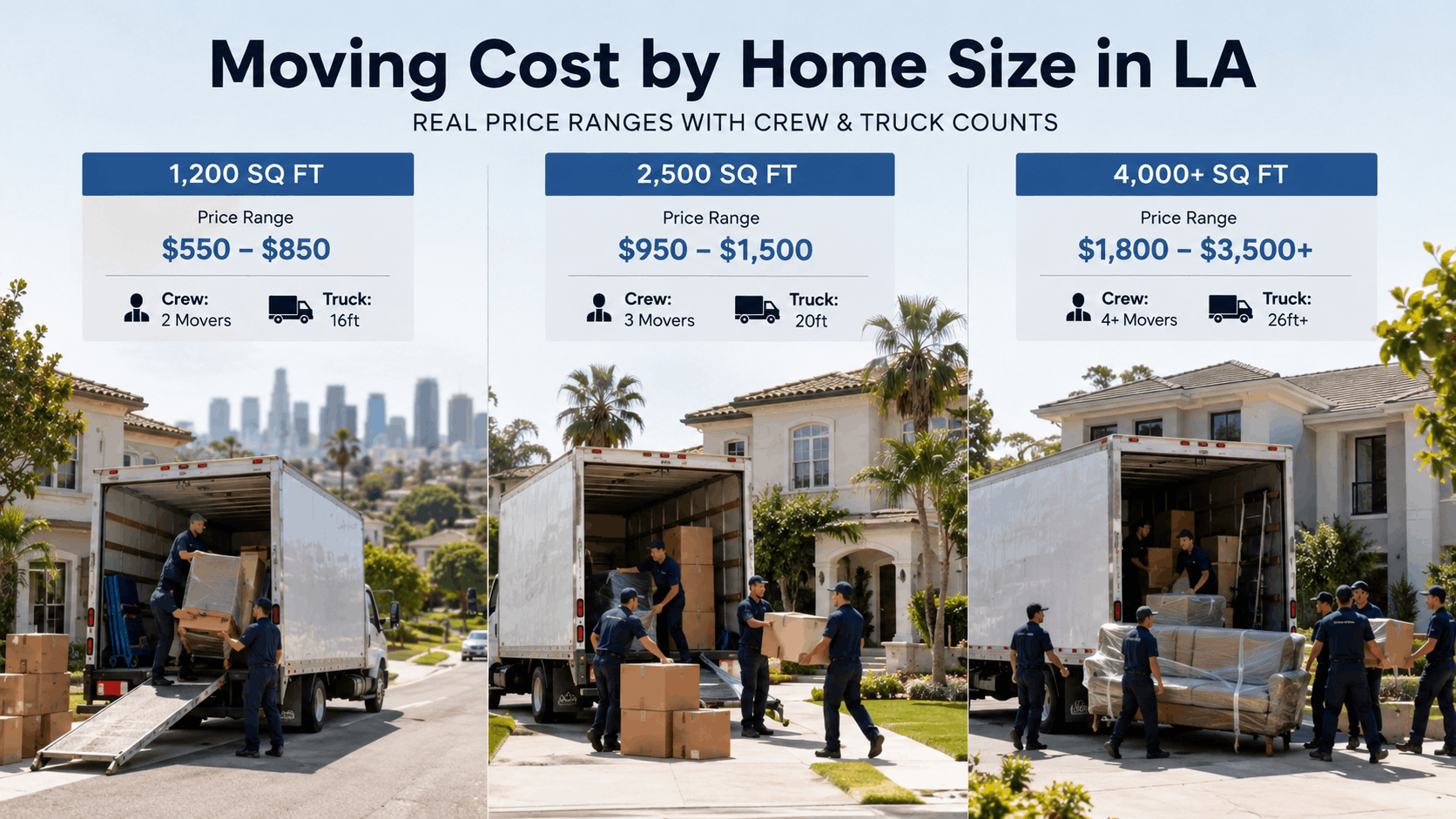
Moving cost in LA comes down to three things: how much you own, how hard it is to reach, and how far you are going. A 1,200 square foot home usually needs two movers and one truck, a 2,500 square foot home needs three or four movers and a 26 foot truck, and a 4,000+ square foot home needs a large crew and two trucks. Knowing where you land lets you budget with confidence.
The best way to trim the bill is to declutter, pick an off-peak day, and prep your access. None of those steps cut corners on safety. They simply give the crew a smoother, cleaner job.
When you are ready for a real number, our team is here to help. Contact Popeye Moving & Storage Co. for a walkthrough and an honest estimate on your Los Angeles move. Call us today and let a crew that knows these streets plan your move the right way.
Frequently Asked Questions
- How much does it cost to move a 1,200 sq ft home in LA?
- A local 1,200 square foot move usually runs $600 to $1,400. That covers a 2-person crew and a 16 to 20 foot truck over roughly four to six hours. The low end assumes easy ground-floor access and a short drive, while stairs, a full garage, or a longer cross-town route push toward the higher figure. Packing services add to the total.
- How many movers do I need for a 2,500 sq ft house?
- Most 2,500 square foot homes need a 3 to 4 person crew and a 26 foot truck. Three movers handle a standard family home, and a fourth makes sense when there is a bonus room, a full garage, or heavy furniture like a large sectional or gym equipment. Adding a mover often lowers the total by cutting hours on an hourly move.
- Do 4,000+ sq ft homes always need two trucks?
- Not always. A single 26 foot truck can handle some 4,000 square foot homes by making two trips if the drive is short and access is easy. Two trucks make sense when the volume is large, the distance is long, or a tight timeline calls for loading in parallel. The final call depends on your belongings and access, which we confirm during the survey.
- Is hourly or fixed price cheaper for a local LA move?
- For short local moves, hourly billing is usually cheaper and fairer. It matches the cost to the actual work, so a well-prepped home with easy access pays less. A fixed price suits fixed-scope jobs like long-distance or large estate moves, where locking the price protects against a slow day. Most homes across the city come out best on hourly.
- How long does a full house move take in Los Angeles?
- Timing scales with home size. A 1,200 square foot move takes about four to six hours, a 2,500 square foot move runs six to nine hours, and a 4,000+ square foot move can take ten hours to two full days. LA traffic and access add time, so a cross-town move during rush hour lands at the higher end of each range.
- What adds unexpected costs to a moving quote?
- The common surprises are stairs, long carries, and parking. A third-floor walk-up in Koreatown or a hillside home with a long path to the door adds labor time. Restricted street parking that forces the truck blocks away adds carry time. Overstuffed closets, garage items, and elevator waits also push the hours higher than a rough estimate suggests.
- Should I pack myself or pay for packing?
- DIY packing saves money if you have the time and pack carefully. Professional packing costs more but saves days of work and loads more smoothly on move day, which trims labor hours. Many families choose partial packing, handling their own clothes and books while leaving the kitchen and fragile items to the crew. That split balances cost and convenience well.
- What is the cheapest day to move in LA?
- Mid-week days like Tuesday and Wednesday cost the least, and mid-month dates beat the first and last of the month when leases turn over. Avoiding the summer rush from May through September also lowers the rate. A mid-week, mid-month, off-season move gives you the best price and the widest choice of crews if you book ahead.
- Do I need a parking permit for the moving truck?
- In many LA neighborhoods, yes. Areas with restricted or permit-only street parking, such as parts of West Hollywood and Hancock Park, may require a reserved spot for the truck. Without one, the truck may park blocks away, adding carry time and cost. We help arrange permits where needed so the crew works close to your door.
- How far in advance should I book a move?
- Book two to four weeks ahead for most moves. During the busy summer months and around month-end, aim for four to six weeks to secure your preferred date and crew. Off-peak mid-week moves need less lead time, but early booking always locks in the better rate and gives us time to plan access and parking.
Popeye Moving & Storage Co. Team Team
Licensed moving and storage professionals serving Los Angeles and Los Angeles County.
Licensed in California · License #CAL T 189749 | USDOT 1472924 | MC 498816C
Why trust Popeye Moving & Storage?
Founded in 1994, Popeye Moving & Storage is a licensed and insured moving and storage service serving Los Angeles and Los Angeles County. All content is reviewed by our licensed technicians.

Need Help in Los Angeles?
Popeye Moving & Storage serves Los Angeles and all of Los Angeles County.
Related Articles

Full-Service vs Self-Pack Move LA: Cost Comparison by Home Size
Compare full-service and self-pack moving costs in LA by home size, from studios to estates, plus hidden fees and tips to pick the right option for your budget.
Hourly vs Fixed Price Moving in LA: Which Costs Less and When
Compare hourly vs fixed price moving in LA with real price ranges, example moves, and local tips so you can pick the cheaper option for your situation.
Why LA Moving Costs Spiked 40% Since 2020: Labor, Fuel, and Insurance Math
LA moving costs rose about 40 percent since 2020. Here is the real math behind labor, fuel, and insurance increases, plus tips to lower your moving cost.