Restaurant Equipment Storage During a Remodel in Los Angeles - Stainless, Refrigeration, and Health-Ready Return

Planning a Move? Contact Us Now
Free estimates. Licensed and insured movers.
Get Your Free Quote
Tell us about your move. We'll be in touch soon.
Key Takeaways
- A kitchen has to be fully cleared before demo for flooring, hood, electrical, and plumbing work, and gear left on site risks dust, impact damage, and contractor liability.
- Full-service vaulted storage means no key, no unit, and no right of entry; Popeye crews handle the gear, load it into vaults, and place it at the Mar Vista warehouse the same day with no overnight hold on the truck.
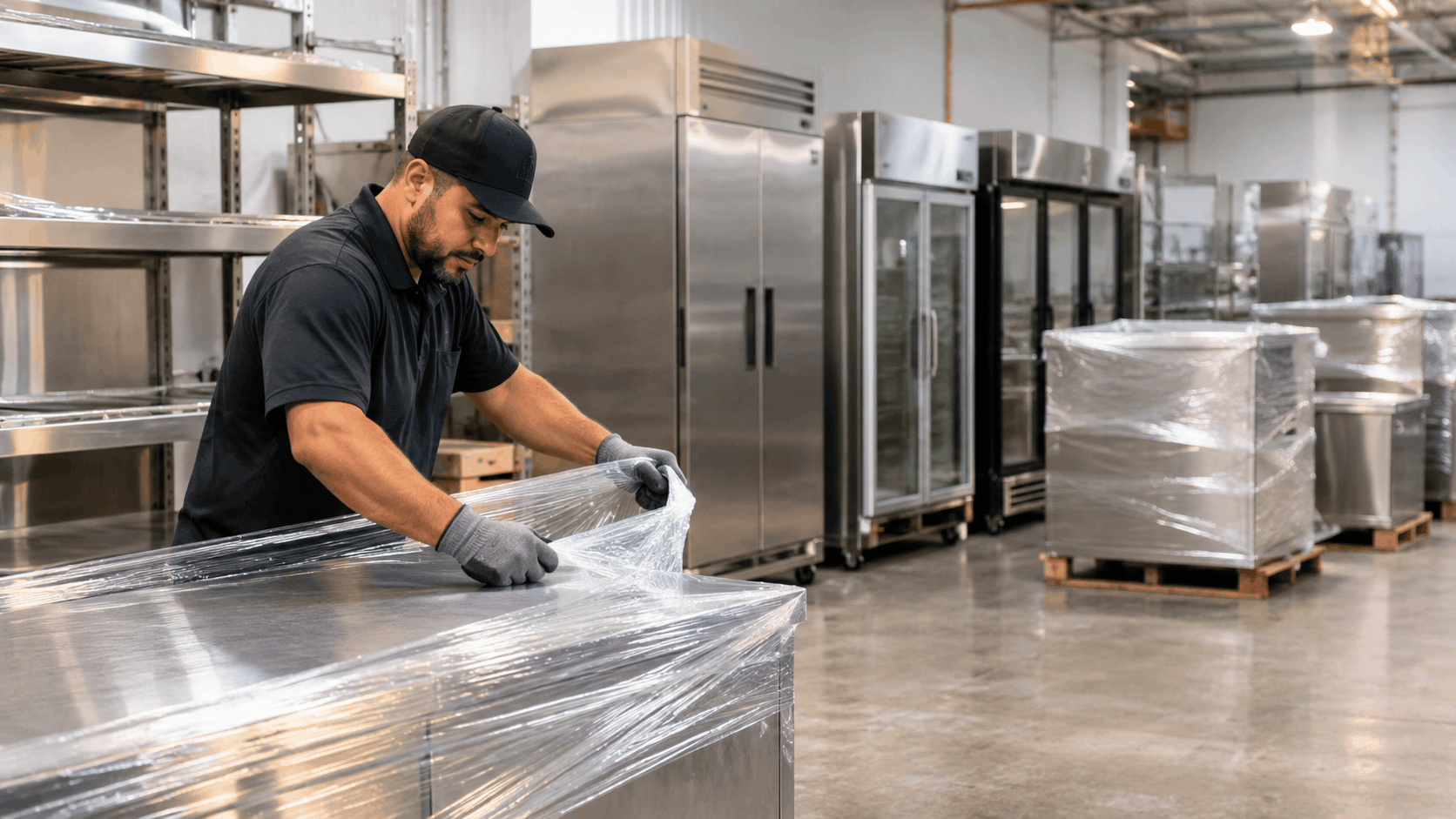
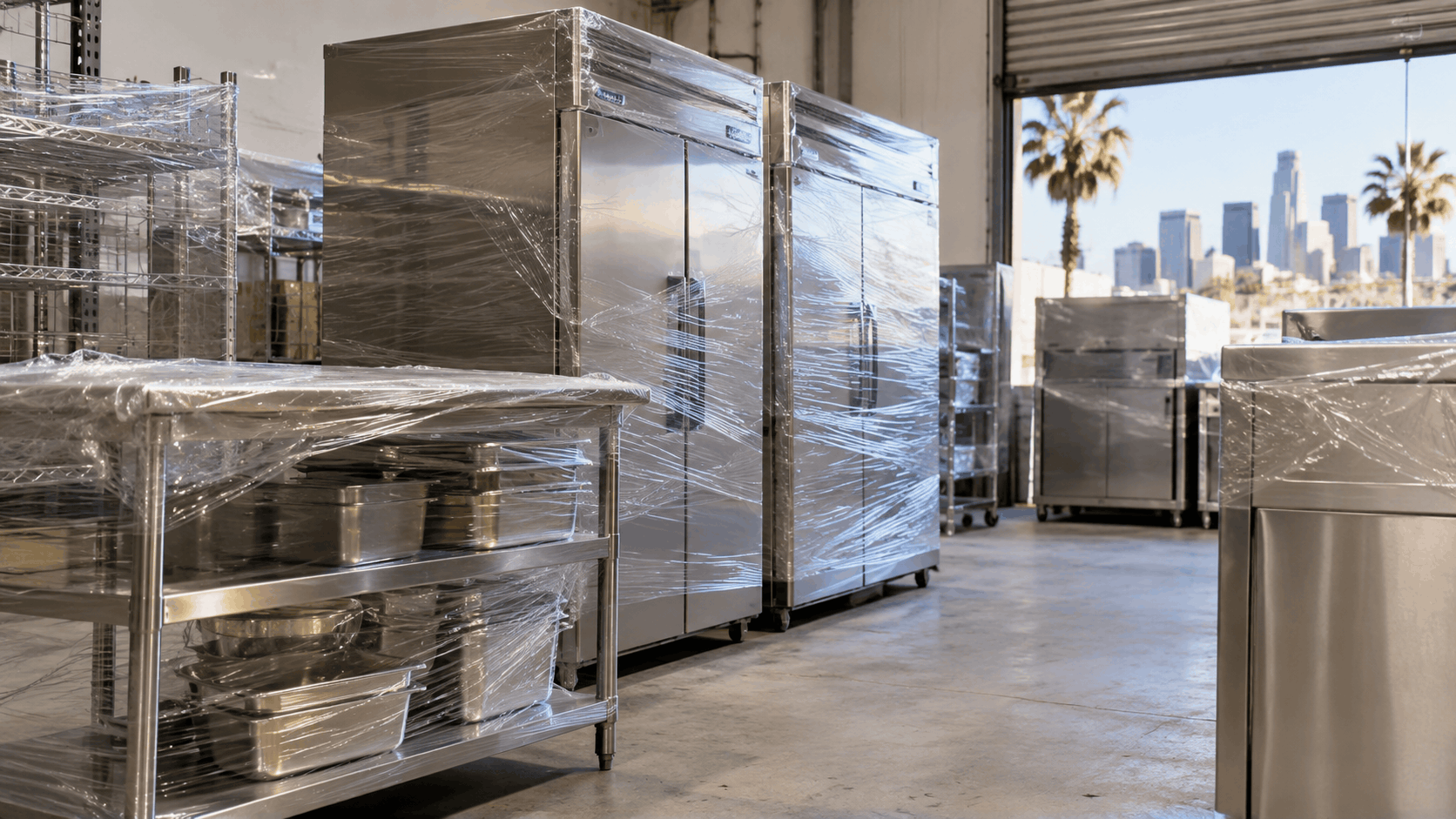
- Stainless should be degreased, padded or wrapped with breathable covers, elevated off the floor, and disassembled parts bagged, labeled, and inventoried to match the federal warehouse inspection standard.
- Refrigeration must be defrosted, drained, dried, and cleaned, kept upright to protect the compressor and oil, and stored with doors propped open so the interior breathes and does not grow mold.
- Propane, flammables, corrosive cleaners, food and perishables, and undrained motorized equipment cannot be stored; hazmat refusal is federal law under 49 CFR, not company preference.
- Typical LA ranges: vaulted storage $60 to $90 per vault per month, local moving $150 to $200 per hour, custom crating $150 to $800+ per crate, and a written Not To Exceed figure caps the bill before loading.
- In the City of Los Angeles, LADOT signs reserve curb space with five working days notice; neighboring cities run their own processes, so the permit is confirmed from the parcel, not the mailing address.
- Vaulted storage falls under Commercial Code Division 7 with an ordinary-negligence standard of care, has no minimum or maximum term, and keeping the agreement, inventory, and bill of lading protects any claim.
In This Article
Demo day is set. The contractor wants the kitchen empty by Monday morning, and the owner is standing in the middle of the line staring at a walk-in box, three reach-ins, a bank of stainless prep tables, and a mixer that takes two people to lift. None of it can stay while the floor gets torn up, the hood gets reworked, and new electrical goes in. The question is simple and stressful at the same time: where does all of it go, and will it come back ready for the health department?
That is the exact problem our crews solve for restaurants across Los Angeles, from Mid-Wilshire storefronts to Mar Vista cafes a few blocks from our own warehouse. Commercial kitchen gear is heavy, awkward, and covered in food-contact surfaces that an inspector will scrutinize the day a restaurant reopens. It needs to leave clean, travel upright, sit in the right conditions, and return without new damage or grease.
What Restaurant Owners Actually Need From Storage During a Remodel?
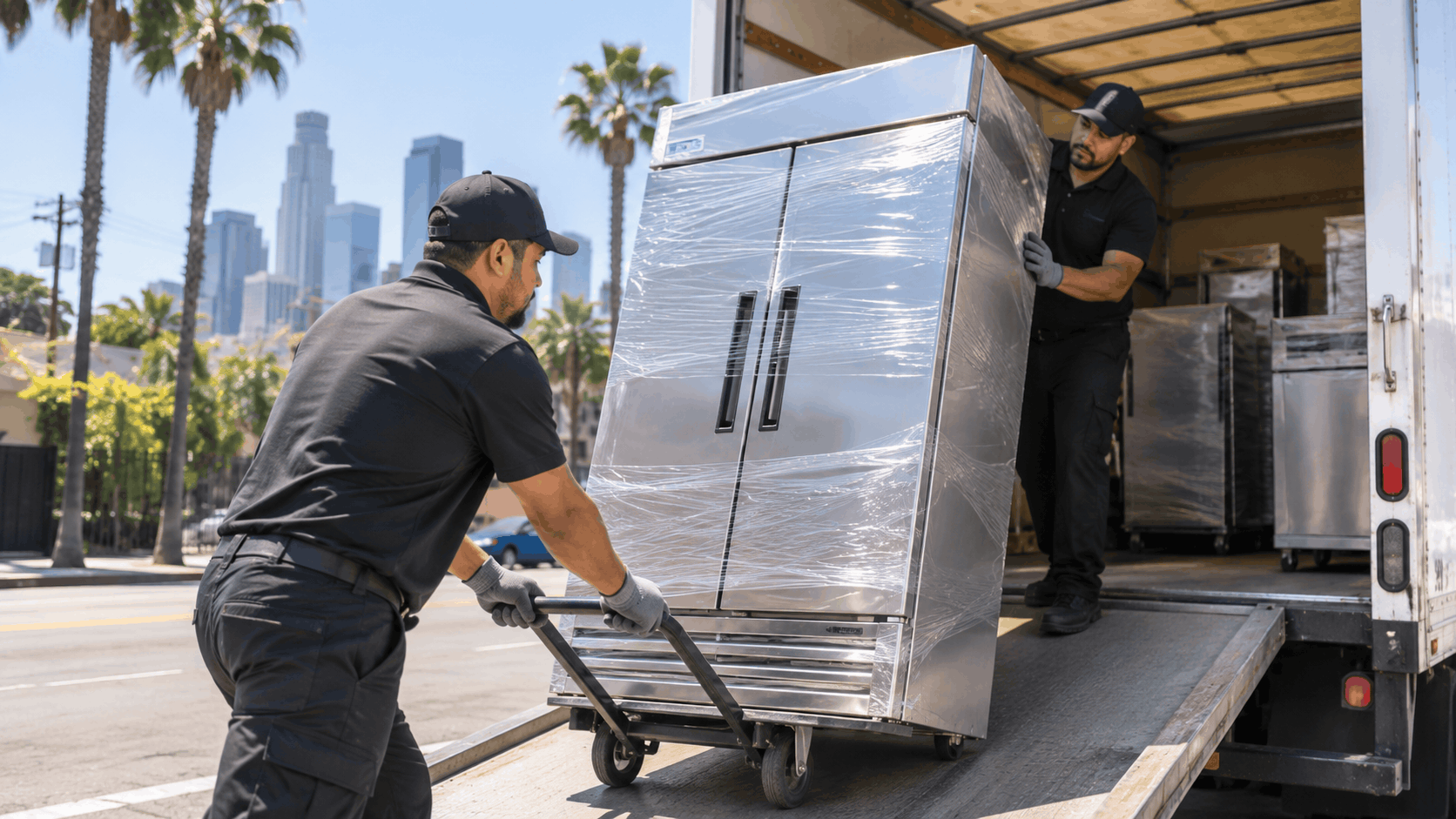
A restaurant remodel creates a logistics problem that most owners only face once or twice in the life of a lease. The kitchen is full of heavy, food-contact equipment that cannot stay in place while contractors work, yet every piece has to come back clean and functional when the new floor and hood are finished. That is commercial kitchen storage, and it is a different animal from boxing up a house.
The goods are expensive, the timeline is rarely fixed, and the return standard is set by a health inspector rather than by the owner. Our crews handle this as commercial and business storage alongside household goods at our Mar Vista warehouse, so a full kitchen can move out, sit safely, and move back without the owner renting a unit and wrestling the gear themselves.
Why the Kitchen Has to Be Emptied Before Demo
Most restaurant remodels touch the things a kitchen is bolted to. New flooring means the floor has to be completely clear, because epoxy, quarry tile, or sealed concrete cannot go down around a 400-pound prep table. Hood work, electrical upgrades, and plumbing reroutes all need open access to walls, ceilings, and floor drains.
Leaving equipment on site during that work is a real risk, not a convenience question. Demolition throws dust and debris that settles into refrigeration coils and onto food-contact surfaces. Tools get dropped, sheets of drywall get leaned against stainless, and a dented reach-in door that no longer seals is an expensive surprise.
There is also a liability piece that catches owners off guard. Once gear is sitting in an active construction zone, a contractor is working around property they did not agree to protect. Getting the kitchen out of the way removes that exposure and lets the trades move faster, which often shortens the job.
Clearing the floor before demo also gives the owner a clean inventory moment. Everything comes off the line, gets looked at, and gets accounted for, which is the right time to decide what goes to storage, what gets replaced, and what was already on its last legs.
The Types of Equipment That Come Off the Line
A full commercial kitchen breaks down into a handful of categories, and each one stores a little differently. Stainless prep tables, wall shelving, and fabricated counters make up the bulk by volume and are the sturdiest once padded. Reach-in and under-counter refrigeration, along with prep rails and walk-in components, are the most sensitive to handling.
Then come the cooking lines: ranges, ovens, char-broilers, and fryers, which need fuel and grease dealt with before they move. Mixers, slicers, and other motorized gear carry their own prep rules. Dish machines, three-compartment sinks, and the plumbing-connected pieces come out next, followed by the long tail of smallwares, pans, racks, and hand tools.
Specialty items round it out. A pizza deck oven, a wood-fired component, a custom chef's table, or a display case each gets treated on its own terms. We accept commercial and business storage at the Mar Vista warehouse, so the whole range can go into the same commercial and business storage program rather than being split across multiple providers.
Knowing the categories up front lets the crew plan the load order, the padding, and the vault count. Refrigeration and glass get the careful slots, stainless gets wrapped and stacked efficiently, and smallwares get boxed and inventoried so nothing walks off between the kitchen and the warehouse.
Vaulted Warehouse Storage vs a Self-Storage Unit
Our storage model is full-service vaulted storage, and it is worth understanding how that differs from the self-storage unit most people picture. With vaulted storage, the customer has no key, no individual unit, and no right of entry. Goods are loaded into wooden storage vaults by our crews and handled by our team from pickup to return.
A self-storage unit works the opposite way. The renter signs for a space, gets a key or a code, drives up, and loads their own unit however they like. They have access on their own schedule, and they are responsible for stacking, protecting, and moving the contents.
For restaurant equipment, the full-service model keeps trained crews on the gear the whole way. A reach-in stays upright because the people loading it know it has to, a stainless table gets padded because that is the standard, and a vault gets loaded once and then moved as a sealed unit by forklift. That means fewer hands on the equipment over the life of the storage.
This distinction also changes which law applies, which we cover later, but the practical point for a remodel is simple. The owner is not renting a box and doing the heavy lifting. The kitchen is handed off, stored, and handed back by one crew that knows what is inside each vault.
Why This Storage Model Fits a Remodel Timeline
Remodels rarely finish on the first date on the calendar. A six-week kitchen refresh slips when the hood inspection fails, when the electrical panel needs an upgrade nobody priced, or when a permit sits in review. A short job can stretch to five months, and the storage has to flex with it.
Our vaulted storage has no minimum and no maximum term. That means an owner is not forced into a three-month commitment on a job that finishes early, and they are not scrambling to find a second home for the gear when a job runs long. The storage runs as long as the remodel does.
The pickup side is built for the same pressure. We pick up the kitchen and place the goods into vaults at the Mar Vista warehouse the same day, with no overnight hold on the truck. The equipment is not riding around in a parked truck overnight on a city street, it is secured in the warehouse before the crew goes home.
That combination, open-ended term plus same-day vault placement, is what makes this model fit a remodel rather than fight it. The owner controls the clock based on the contractor's progress, not based on a storage contract that assumes a tidy end date.
Get Your Free Quote
Tell us about your move. We'll be in touch soon.
Prepping Stainless Steel Equipment for Storage
Stainless prep tables, wall shelving, and fabricated surfaces are the backbone of any commercial kitchen, and they are also the easiest gear to prep well for storage. Done right, they go into the vault clean and protected and come back looking ready for inspection. Done poorly, they pick up pests, scratches, and grease transfer that an inspector will flag on reopening day.
The goal with equipment prep is to control what the storage environment can act on. A clean, degreased, padded surface stored off the floor gives pests nothing to feed on and gives the finish nothing to rub against. Here is how our crews prepare stainless before it ever reaches the truck.
Cleaning and Degreasing Before the Truck Arrives
Food residue and grease are the single biggest reason kitchen gear attracts pests in storage. Cockroaches are drawn to items stained with food and sweat, and silverfish target residue, paper, and the starches in old labels. A table that goes into a vault with a film of grease is carrying a food source into a sealed box.
That is why every food-contact surface should be fully cleaned and degreased before pickup, not after return. The underside of shelves, the backs of tables, the seams where grease collects, and the legs all need attention, because those are exactly the spots pests find and an inspector checks.
Degreasing before storage also protects the next step. Pads and wrap trap whatever is on the surface against the metal, so a greasy table wrapped for storage holds that grease against itself for the length of the remodel. Clean first, then protect, and the stainless comes out the way it went in.
Our crews can load and move the gear, but the deep clean is most effective when the kitchen staff degrease their own stations before the truck arrives. They know where the buildup hides, and a degreased surface simply stores better and returns inspection-ready.
Protecting Finished Surfaces and Edges
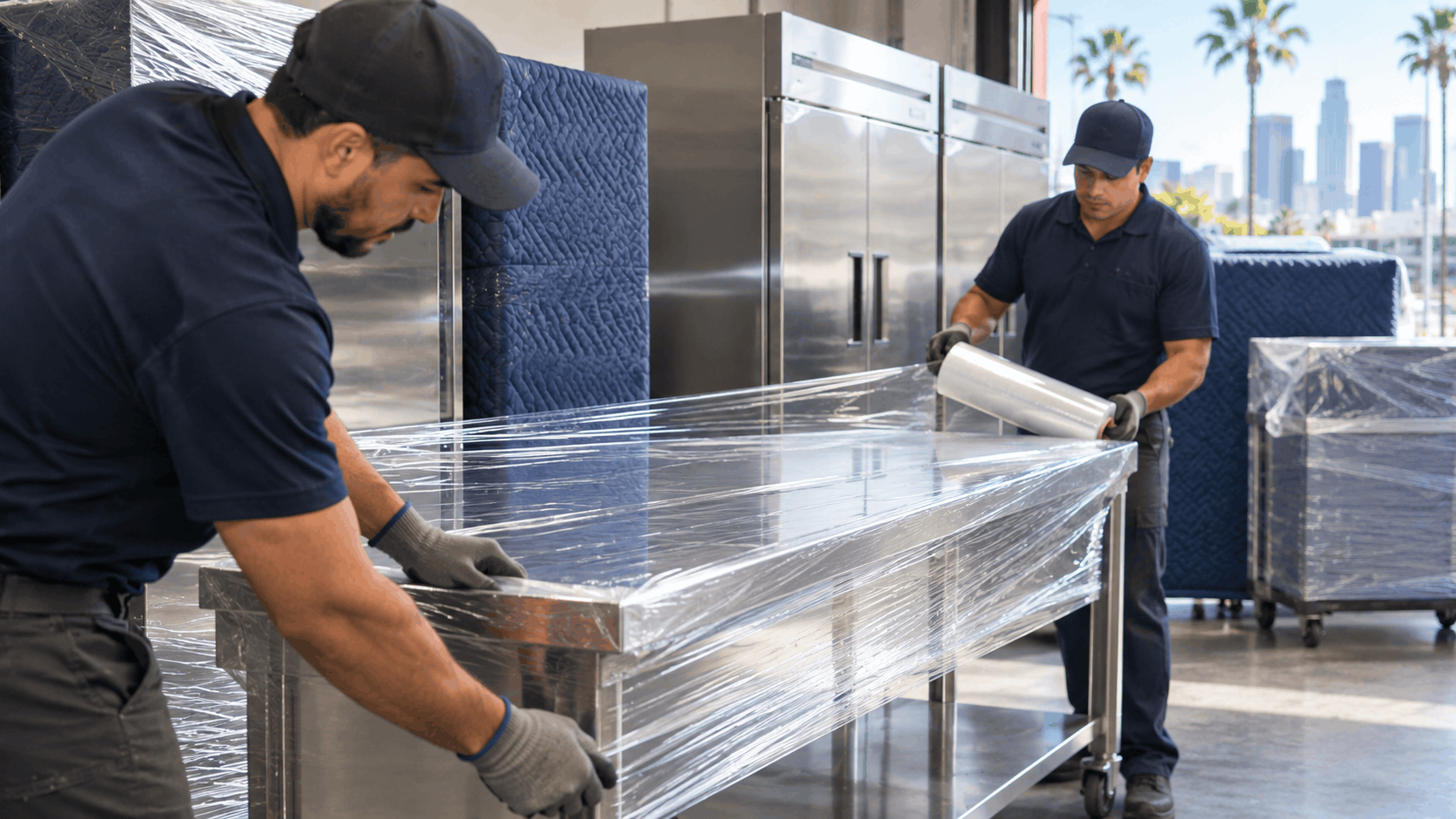
Bare stainless rubbing against bare stainless scratches, and corners take the worst of it during handling. Finished surfaces should be protected with moving pads or wrap rather than left exposed in the vault. The federal warehouse inspection standard treats finished surfaces left unprotected by pads or wrap as a deficiency, which tells you how basic this step is.
The covering matters as much as using one. Breathable dust covers like muslin or Tyvek are better than sealed plastic for long storage. Sealed polyethylene traps any moisture against the surface, and wrapping tight in plastic is a response to active mold, not a general storage method.
Edges, corners, and door handles get extra padding because they catch during loading and unloading. A corner guard on a prep table or a wrapped handle on a cabinet prevents the dings that turn a clean piece of equipment into one that looks beaten up on return.
Placement inside the vault follows the same logic as any good warehouse. Items are elevated off the floor and kept away from exterior walls, because that is where condensation tends to form against a cooler surface. Up off the floor and away from the wall keeps the stainless in the stable interior air of the vault.
Disassembly, Hardware, and Labeling
Shelving units, table legs, and modular rails often store better taken apart, but disassembly only helps if the parts come back together cleanly. The federal warehouse inspection standard treats disassembled parts that are not packaged or inventoried as a deficiency, and that same rule is the reason our crews bag and label as they break things down.
Every removed shelf, leg, and bracket gets bagged, and the small hardware stays with its unit rather than going into one anonymous bin. A bag of bolts taped to the frame it came off of turns reassembly from a guessing game into a quick job. Loose hardware in a shared box is how a restaurant reopens with a wobbly table and three mystery screws.
Labeling ties the whole inventory together. Each vault, each disassembled piece, and each box of smallwares gets recorded, so the crew knows what is where and the owner has a written list. That list is also the document that supports any claim if something is missing or damaged.
Doing this at the front end pays off most on the back end. When the remodel finishes, labeled parts and a clean inventory let the crew rebuild the line on the new floor without the owner directing traffic piece by piece. Good labeling going in is what makes a fast, clean return possible.
Need Help in Los Angeles?
Popeye Moving & Storage serves Los Angeles and all of Los Angeles County.
Refrigeration Units Need Special Handling
Refrigeration is the gear that most often comes back from storage with a problem, and almost always it traces to how it was prepped. Reach-ins, under-counters, walk-in components, and prep rails all hold water, trap odor, and can grow mold inside sealed compartments if they go into a vault wet and shut. The sealed compressor system is sensitive to how the unit is handled in transit.
Treating refrigeration right means three things: get it dry inside, keep it upright, and let the interior breathe. A reach-in that is defrosted, drained, cleaned, and stored with the door propped will come back ready to power up. Here is how our crews stage each part of that.
Defrost, Drain, and Dry Before Pickup
Refrigeration must be fully defrosted and drained before pickup, and that takes more time than owners expect. A walk-in evaporator and a packed reach-in hold ice and standing water that will not clear in an hour. Powering the unit down a day or two ahead lets it melt out completely.
Trapped water is the source of both odor and mold. Mold grows when relative humidity stays high, and a closed refrigeration cabinet with a puddle in the bottom is a high-humidity box no matter how good the warehouse air is around it. Drying the interior, including the drain pan and door channels, removes the fuel for that problem.
Drain lines and evaporator pans deserve special attention because they hold water out of sight. A quick wipe of the visible shelves misses the reservoir underneath, and that is exactly where smells start. Pulling the pan, draining the line, and wiping it dry clears the hidden water.
An empty, dry, propped-open compartment simply travels and stores far better than a sealed wet one. The dry interior does not feed mold, does not generate odor, and does not arrive at the warehouse already working against itself. This is the single most important refrigeration prep step.
Compressors, Coils, and Keeping Units Upright
Refrigeration should stay upright through the entire move and the entire storage period. Laying a unit on its side or back lets refrigerant oil migrate out of the compressor and into the lines, which can cause problems when the unit is powered back up. Keeping it vertical protects the compressor and keeps the oil where it belongs.
Condenser and evaporator coils are fragile and easy to crush. They should be cleaned of grease and dust before storage and protected from impact during handling, because a bent coil fin reduces cooling efficiency and a punctured line is a major repair. Our crews pad and position refrigeration so the coil side is shielded.
Gaskets around doors need cleaning before storage so they do not harden or hold food residue over a long remodel. A gasket caked with grease can stiffen and stop sealing, and a unit that will not seal will not hold temperature. Wiping the gasket channels clean keeps the door seating properly when the unit goes back in service.
Because our full-service crews load the vaults, the upright rule is enforced by the people doing the lifting rather than left to chance. That is a practical advantage of vaulted handling over self-storage, where a renter might tip a reach-in to fit it through a doorway without knowing the cost.
Doors, Gaskets, and Interior Air
A refrigeration door that is latched shut for months seals moisture, odor, and any residual humidity inside the cabinet. That closed, damp interior is exactly where mold and smells build up. The fix is simple: doors should be propped slightly open during storage so the interior air can move.
This follows the same principle as using breathable covers instead of sealed plastic on stainless. Air movement keeps humidity from pooling in a closed space, and a cabinet that breathes stays far closer to the stable warehouse conditions around it. A sealed box does the opposite, holding whatever moisture was trapped at closing.
A small wedge or a gasket-safe prop is enough to break the seal without stressing the hinge. Our crews stage the door at a slight open position and secure it so it does not swing during vault movement. The gap only needs to be enough to let air exchange, not enough to let the door flap.
Propping the door also makes the first post-storage check easier. An owner or technician can see straight into a dry, odor-free interior and confirm it is clean before power goes back on. A unit that breathed through storage smells neutral and looks ready, which is what an inspector wants to see.
Climate-Controlled Storage and Why It Matters for Gear
Our Mar Vista warehouse is climate controlled for both temperature and humidity. For kitchen gear, the humidity side is what matters most. Controlled humidity keeps the air from swinging to the levels where mold develops and metal picks up moisture, which protects refrigeration interiors, stainless, and anything stored alongside them.
A restaurant remodel often sends more than just the cooking line into storage. Leather banquette seating, wood fixtures, a host stand, and decorative pieces go in too, and those materials react to humidity. Conservation guidance is clear that high relative humidity promotes mold on leather and swelling on wood, while very low humidity makes leather brittle and causes wood to crack. Humidity control keeps those materials in a stable middle.
Metal gear benefits from the same stability. Swings in humidity encourage condensation on cooler surfaces, and controlled air reduces the conditions that lead to surface corrosion on fittings and hardware. For a kitchen that may sit in storage for months, a stable environment is doing quiet work the whole time.
The exact temperature and humidity specification is confirmed per shipment rather than published as a fixed number, because the right setting depends on what is being stored. We do not post a single figure as the warehouse standard. What we can say plainly is that the facility controls both temperature and humidity, and the specification for a given job is confirmed when the shipment is booked.
What Cannot Go in Storage, and Why
Every restaurant has items that cannot go into storage, and the reasons are not arbitrary. Some are banned by federal law, some by fire code, and some by simple spoilage and pest risk. Knowing the list before pickup day keeps the crew from refusing items at the curb and keeps a remodel on schedule.
The table below sorts the common refused items by the actual reason, because the driver is different for each category. Hazardous materials are a transportation-law issue, motorized fluids are a fire and contamination issue, and food is a spoilage and pest issue.
| Category | Examples | Why It Cannot Be Stored |
|---|---|---|
| Hazardous materials | Propane, LP-gas, combustible liquids, corrosives, flammables | Federal transportation law under 49 CFR |
| Motorized with fluids | Powered carts, equipment with gas or oil | Fuel and oil must be drained first |
| Food and perishables | Product, open liquids, anything with food residue | Spoilage and pest attraction |
| Cleaning chemicals | Degreasers, sanitizers, corrosive cleaners | Corrosives, treated as hazardous materials |
Fuel, Gas, and Hazardous Materials
Hazardous materials as defined by the US Secretary of Transportation are not accepted for shipment or storage. That category includes common household and commercial combustible liquids, corrosives, explosives, and flammables. This is federal law under 49 CFR, which states that no person may offer or accept a hazardous material for transportation unless it is properly classed, packaged, and labeled.
For a restaurant, propane and LP-gas containers are the ones that come up most. A portable propane tank for a patio heater or a backup burner cannot ride in the truck or sit in the vault. The International Fire Code also prohibits LP-gas containers from being stored in a basement, pit, or similar location where heavier-than-air gas could collect.
This is not company preference, it is the law the mover operates under. A crew that accepts undeclared hazmat becomes the accepting party in the eyes of the regulation, so the line is firm. Owners should plan to empty and return propane and other fuel containers to a proper supplier before the move.
Flammable aerosols, solvent-based cleaners, and similar products fall in the same bucket. The safest approach is to pull anything pressurized, flammable, or corrosive off the storage list during the pre-move walkthrough so there are no surprises when the truck arrives.
Motorized Equipment and Draining Fluids
Any motorized equipment that holds gas or oil needs those fluids drained before storage. The federal warehouse inspection standard treats motorized items with gas and oil not drained as a deficiency, because fuel and oil in storage are both a fire risk and a leak risk that can damage other goods in the vault.
In a restaurant that usually means powered carts, floor scrubbers, or any small-engine equipment the kitchen or facility uses. The engine should be run dry or drained, and the oil handled per its own disposal rules, before the item is accepted for storage.
Cleaning equipment that runs on a motor gets the same treatment, with the added step of making sure no chemical reservoir travels full. A floor machine with a tank of corrosive stripper is carrying two problems at once, the motor fluids and the chemical.
Draining is also kinder to the equipment itself. Old fuel left sitting in a small engine for months can gum up and cause starting trouble when the remodel ends. Draining before storage means the machine is ready for fresh fuel and a clean start on reopening.
Food, Perishables, and Open Liquids
Food, perishables, and open liquids are refused for a different reason than the hazardous list. The driver here is spoilage and pest attraction, not fire code. Anything with food residue or product in it brings a food source into a sealed vault, and that is an open invitation to the pests that target exactly those materials.
That is why the degreasing step earlier matters so much. A prep table wiped clean and a reach-in emptied and dried are no longer food sources. A bus tub of product, a half-full sauce container, or a bag of dry goods absolutely are, and none of those go into storage.
Open liquids also create a mess risk. A container that leaks in transit or in the vault can spoil, stain stainless, and feed mold. Even water left in a container can raise humidity inside a sealed space, which is the same mold problem refrigeration creates when stored wet.
Cleaning chemicals deserve a specific mention here because owners sometimes assume they are fine. Many commercial sanitizers and degreasers are corrosives, which puts them on the hazardous materials list rather than the food list. They come off the storage plan along with the perishables.
Coming Back Health-Ready for Reopening
The whole point of careful storage is the day the remodel ends and the health department comes to sign off. Health-ready return means equipment that comes back clean, undamaged, and reassembled so it can pass an LA County health inspection. That outcome is built on the back of how the gear was prepped going in, not on a last-minute scramble.
An inspector looks at food-contact surfaces, at whether equipment seals and holds temperature, and at whether the kitchen is clean and functional. Gear that was degreased, protected, inventoried, and stored upright supports every one of those checks. Here is how the prep steps pay off on return.
Why Clean-In, Clean-Out Protects the Inspection
Equipment that went into storage clean and degreased comes back without new grease or built-up residue. That is exactly what an inspector examines on food-contact surfaces: tables, cutting boards, shelving, and the interiors of refrigeration. A surface that was clean going in and protected during storage is clean coming out.
The alternative is a kitchen that stored dirty and now has to be deep-cleaned under deadline pressure while the contractor is still finishing punch-list items. That is the scenario that delays a reopening, because the health visit cannot pass a line with grease on the prep tables.
Clean-in, clean-out is why we push the degreasing step before pickup so hard. It is not just about pest prevention in the vault, it is about the condition the gear is in on the day it matters most. A piece that never picked up new residue in storage needs only a light wipe-down before the inspection.
This connection between prep-in and return condition is the quiet logic of the whole process. Every step at the front end, cleaning, wrapping, labeling, drying, is really a step toward passing the inspection at the back end. The storage is just the pause in between.
Reassembly and Placement on Return
Because parts were inventoried and labeled on the way into storage, reassembly on the way out goes faster and cleaner. The bagged legs, the labeled shelves, and the hardware kept with its unit mean the crew rebuilds each piece correctly instead of improvising. A clean inventory is what turns a return into a rebuild rather than a puzzle.
Placement on the newly finished floor is the next step. The crew sets heavy stainless, positions refrigeration, and lines up the kitchen on the fresh epoxy or tile without dragging gear across it. Protecting the new floor during setup is part of the return, since a scratched floor on day one is its own problem.
Refrigeration gets positioned and leveled before anything else, because a unit that sits unlevel can have drainage and door-seal issues. Leveling it as it goes back in place means the doors seat correctly and the condensate drains the way it should, both of which support the inspection.
The speed here comes directly from the discipline at pickup. A kitchen that was taken apart carelessly returns as a slow, frustrating reassembly. A kitchen that was labeled and inventoried returns as an orderly set-and-level job, which gets the line ready for the final steps before the health visit.
Letting Refrigeration Stabilize Before Service
Refrigeration that was kept upright and dry in storage can be powered up, allowed to reach temperature, and checked for hold before the first service. A unit that stored correctly should pull down to temperature and stay there, which is exactly what an inspector wants to confirm on a cold-holding check.
The upright storage pays off here because the compressor and refrigerant oil stayed where they belong. A unit that was laid down may need time for the oil to settle before it runs safely, which is why keeping it vertical through storage matters for a clean startup.
The dry, propped-open storage pays off too. A cabinet that breathed through the remodel comes back odor-free and mold-free, so once it is cleaned, sanitized, and powered on, it is ready to hold food. There is no hidden smell or growth to chase down first.
We treat this as mechanism rather than a promised timeframe, because how long a given unit takes to stabilize depends on the unit and the conditions. What the prep guarantees is that the refrigeration is in a position to be powered up, reach temperature, and demonstrate a stable hold ahead of reopening.
Need Help in Los Angeles?
Popeye Moving & Storage serves Los Angeles and all of Los Angeles County.
What Equipment Storage Costs in Los Angeles?
Cost is usually the second question after "where does it go," and the honest answer is that it depends on how many vaults the kitchen fills and how long the remodel runs. Below are the typical price ranges for the Los Angeles area so an owner knows roughly what to expect. These are typical area ranges, not a quote, and the actual number for a specific job is set in writing before anything is loaded.
| Service | Typical LA Area Range |
|---|---|
| Vaulted storage | $60 to $90 per vault per month |
| Local moving (2-person crew and truck) | $150 to $200 per hour |
| White glove moving | $150 to $250 per hour |
| Custom crating | $150 to $800+ per crate |
| Office moving | $1,500 to $8,000+ |
| Retail and restaurant moving | $1,500 to $8,000+ |
Vaulted Storage Rates
Vaulted storage runs $60 to $90 per vault per month as a typical area range. The total depends on two things: how many vaults the equipment fills and how many months the remodel lasts. A small cafe kitchen might fill a couple of vaults, while a full-service restaurant with a long cooking line and plenty of smallwares fills more.
Vault count is set when the crew sees the equipment, because a wooden storage vault holds a fixed volume and the gear gets loaded to use that space efficiently. Our crews run the full range of vault sizes, standard through oversized, so an awkward piece does not force an inefficient load.
The monthly structure is what makes this work for an open-ended remodel. With no minimum and no maximum term, an owner pays for the months the gear is actually in storage. A job that finishes early is not billed for unused time, and a job that runs long simply continues at the same per-vault rate.
For longer remodels, that per-vault monthly rate is the main line item to plan around. Multiply the vault count by the expected months and an owner has a realistic storage budget, with the understanding that the actual figure is confirmed in writing. Our vaulted storage service page covers how the program works in more detail.
Moving the Equipment In and Out
The labor to move the kitchen in and out is separate from the monthly storage. Local moving runs $150 to $200 per hour for a two-person crew and truck. White glove moving, which suits delicate or high-value gear that needs extra care, runs $150 to $250 per hour.
The hourly structure reflects that a kitchen load-out is a real job with heavy, awkward pieces. A long cooking line, multiple refrigeration units, and a full set of stainless take time to pad, wrap, carry, and vault correctly. The crew size and hours are described on the estimate before the work starts.
Custom crating comes into play for fragile or specialty items and runs $150 to $800+ per crate. A glass display case, a delicate pizza oven stone, or a chef's custom fixture may need a built-to-fit crate rather than pads and wrap. Each crate is priced on its own because the size and build vary with the item.
Both legs of the move, in and out, are part of the plan from the start. Budgeting a remodel storage job means accounting for the load-out labor, the monthly storage across the remodel, and the return labor, plus any crating for the few pieces that need it.
Specialty and Commercial Job Ranges
For broader context, commercial moves in the LA area run in recognizable bands. Office moving runs $1,500 to $8,000+, and retail and restaurant moving runs $1,500 to $8,000+. A restaurant equipment storage job sits in the commercial range because of the weight, the specialty handling, and the volume involved.
Where a job lands in that range depends on the size of the kitchen, the amount of refrigeration and specialty gear, the crating required, and the access at the restaurant. A tight street, a basement kitchen, or a shuttle requirement all factor into the plan and the price.
On any move inside California, a written Not To Exceed figure is set before anything is loaded. That figure is the maximum total the owner can be billed for the described services, and it cannot be exceeded except through a change order the owner agrees to. It turns the commercial range into a firm ceiling for the specific job.
Our retail and restaurant moving work is built around this kind of equipment handling, so the estimate reflects the real scope rather than a rough guess. The written figure gives the owner a number to budget against from the start.
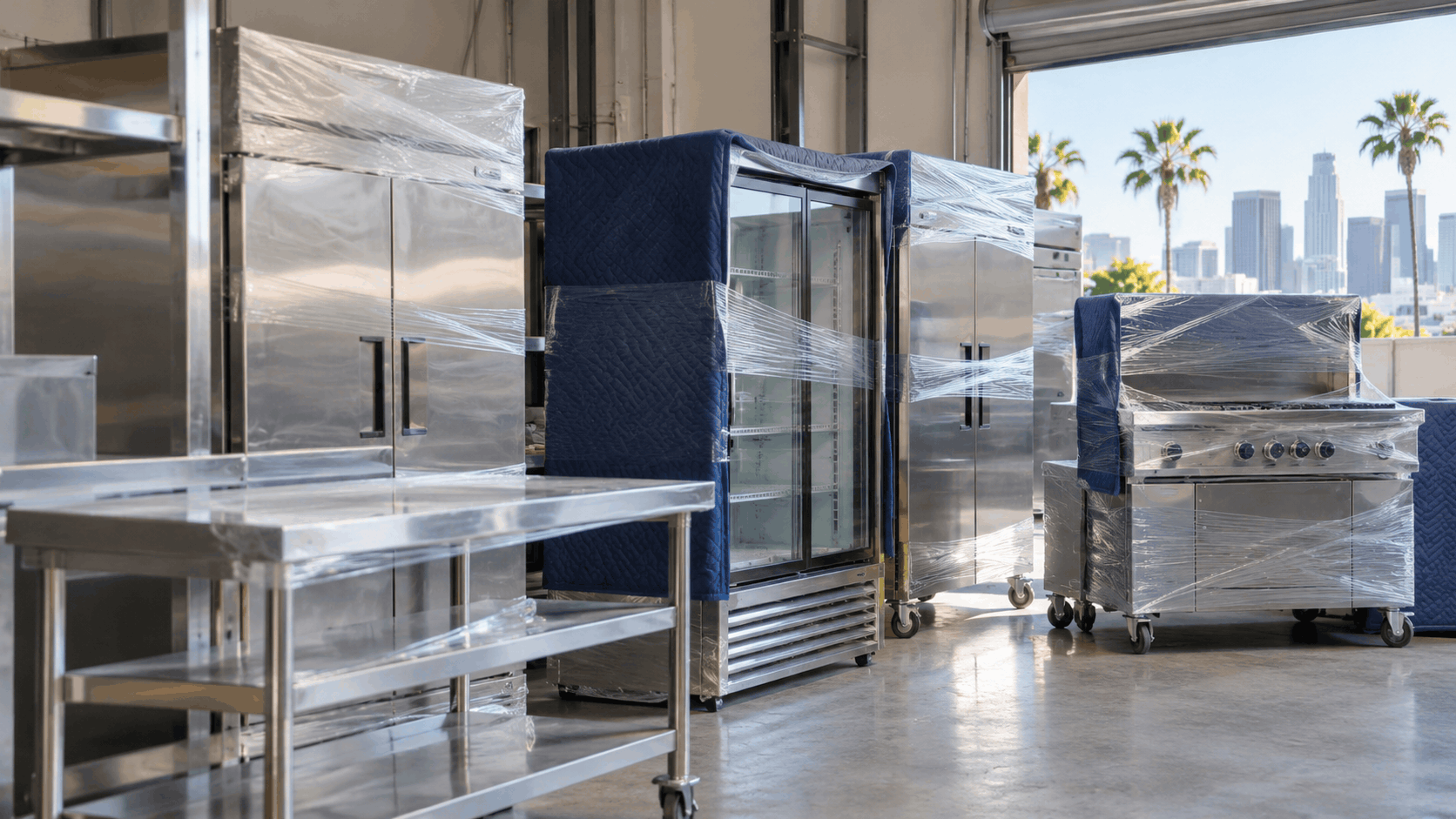
Parking, Permits, and Loading the Kitchen Out in LA
Getting a truck to a restaurant in Los Angeles is its own project, and it changes by address. A loading dock in Downtown is a different job from a curbside load-out on a busy commercial strip, and the parking rules depend entirely on which city governs the block. For restaurants inside the City of Los Angeles, the process runs through LADOT.
Neighboring cities run their own systems, and the differences are sharp enough that confirming the jurisdiction is the first step. Here is how the City of Los Angeles process works and where the lines fall between cities.
Reserving Curb Space With LADOT
In the City of Los Angeles, temporary parking restriction signs are what actually reserve curb space for a moving truck. LADOT asks for five working days to process a request. Applications go by phone to LADOT on (213) 485-2298 between 8AM and 12:30PM Monday to Friday, online, or in person at a DOT Public Service Center, and there is a non-refundable fee.
The signs are the enforceable piece. They post the no-parking window on the specific stretch of curb, which clears the space so the truck can get close to the restaurant on the day of the load-out. Without the signs, the crew is competing for curb space with every other vehicle on a commercial block.
Five working days of lead time is the planning number to remember. On a commercial strip where curb parking is tight all day, a reserved space can be the difference between carrying stainless twenty feet or two hundred. Requesting the signs early is part of scheduling the move, not an afterthought.
The non-refundable fee and the current process details are set by LADOT and can change, so confirming the current fee and window with LADOT when booking is worth the call. The agency administers this directly, and the specifics are theirs to set.
Oversize Trucks and Overnight Rules
There is a separate LADOT product for large trucks: the oversize vehicle parking permit, published at $10.00 per day for up to three days. It is important to understand what it does and does not do. The oversize permit exempts the truck from the oversize and overnight parking rules, but it does not reserve a space.
Only the signs reserve a space. The two are different products that solve different problems. The oversize permit keeps a large truck legal where oversize or overnight rules would otherwise apply, while the temporary signs clear a specific stretch of curb. A big job on a tight street may need both.
The overnight rule matters for restaurant jobs because of the gear involved. Trucks carrying a logo or over 22 feet long cannot park overnight on city streets. That is one more reason our same-day vault placement matters: the kitchen goes to the warehouse the day of pickup rather than sitting in a truck parked overnight.
For most restaurant load-outs the truck is working during the day and heading to the Mar Vista warehouse by evening, so the overnight question is handled by the schedule itself. Where a large truck needs daytime leeway on oversize rules, the permit covers it.
Which City Actually Governs the Address
LADOT covers the City of Los Angeles only. The moment a restaurant sits in a neighboring city, a different authority and a different process apply. Santa Monica, Beverly Hills, Culver City, and West Hollywood each run their own permit systems entirely, with their own notice periods and fees.
The jurisdiction traps are real and catch people who go by the mailing address. Marina del Rey proper is unincorporated Los Angeles County on leasehold land, with the Sheriff rather than LAPD, so it is not the City of Los Angeles process. Beverly Hills Post Office addresses carry a 90210 postcode but are actually in the City of Los Angeles.
Marina Peninsula and Silver Strand are City of Los Angeles, annexed with Venice back in 1925, even though they sit right next to county land. The right answer comes from the parcel, not the postal name on the restaurant's mail. Confirming the governing city from the parcel is how we avoid applying the wrong process to the wrong block.
For restaurants in these cities, our Culver City, Santa Monica, and Beverly Hills location pages reflect that each runs its own rules. The permit position for any given restaurant is confirmed for the specific address rather than generalized from one city to the next.
Restaurant Districts With Access and Schedule Pressure
Some restaurant locations carry a scheduling constraint on top of the parking question, driven by what is happening nearby on a given day. Event calendars at SoFi Stadium and the Intuit Dome can make an Inglewood-adjacent move effectively impossible on an event day, when traffic and street closures lock down the area.
For a restaurant near those venues, checking the event calendar before confirming a load-out date is as important as the permit. A move scheduled against a stadium event can stall at the curb, so we look at the date first and pick a day the access works.
Production districts run on their own clock too. Media and production areas operate on production schedules rather than standard business hours, where continuity on a shoot can outweigh everything else on a street. A restaurant inside one of those zones may have access windows shaped by filming rather than by normal traffic.
The practical step is to confirm the date against both the permit lead time and any nearby event or production schedule. Getting that right up front keeps the load-out from colliding with a game, a concert, or a shoot that would block the truck.
Storage Rules That Protect a Restaurant's Gear
Full-service vaulted storage sits inside a specific legal framework, and an owner storing tens of thousands of dollars in equipment should know their rights on valuation, liens, and claims. The rules are different from self-storage, and the differences favor careful handling and clear paperwork. Each point below matters to a restaurant storing a full kitchen.
Understanding this framework also helps an owner read the storage agreement with the right questions in mind. The agreement is the document that sets liability and claim terms, so reading it is the real protection.
Why Vaulted Storage Falls Under Commercial Code Division 7
Because the customer has no key, no individual unit, and no right of entry, vaulted warehouse storage sits under Commercial Code Division 7, not the Self-Service Storage Facility Act. California law is explicit that a self-service storage facility is one where occupants have access to their space, and it states plainly that such a facility is not a warehouse.
That distinction is not a technicality for this storage model, it is the operating reality. The customer hands the goods to the warehouse and the warehouse holds them, which is a bailment governed by Division 7. The self-storage lien, auction, and access rules simply do not apply here.
Under Division 7, the standard of care is ordinary negligence. California Commercial Code section 7204(a) provides that a warehouse is liable for loss or injury to goods caused by its failure to exercise the care a reasonably careful person would use under similar circumstances. It is not strict liability, and the warehouse is not an insurer of the goods.
For a restaurant owner, that means the warehouse is responsible for handling the gear with reasonable care, and it is responsible for damage that reasonable care would have prevented. It is not automatically liable for every possible loss, which is why valuation and insurance on high-value equipment deserve a conversation up front.
Valuation and What Insured Means for Stored Gear
The storage agreement sets any liability limit, and section 7204(b) allows that limit to be stated in the receipt or agreement. The important right for an owner is that liability can be increased. On request in writing at signing or within a reasonable time after, liability may be raised on part or all of the goods, with increased rates charged on the higher valuation.
For expensive refrigeration or custom fabrication, that written request is how an owner matches the coverage to the value. A blanket low limit may not reflect what a walk-in compressor or a custom chef's table is worth, so declaring a higher value in writing is the lever to pull.
It is worth being precise about what "fully insured" means. Fully insured describes the business, and it does not mean the mover's cargo policy covers goods sitting in long-term warehouse storage. The cargo coverage is framed around transportation and storage-in-transit, and nothing confirms it extends into long-term warehouse storage.
So for high-value equipment going into an extended remodel storage, the right move is to confirm coverage directly with the business and to look at declaring increased liability in the storage agreement. Reading the agreement and asking the valuation question before signing is the protection, since there is no type-size rule forcing the limit into plain view.
Storage-in-Transit vs Longer-Term Storage
There is a meaningful line at 90 days. Storage-in-transit, defined in Maximum Rate Tariff 4, is storage of a shipment at one point between origin and destination for a period not to exceed 90 days. Inside that window, the move is still a regulated mover service under the tariff.
Past 90 days, or where storage-in-transit was not requested, the goods fall under the warehouse's own contract and the bureau no longer regulates it. MAX 4 also provides that once goods are placed in a public warehouse, the mover's liability ceases and the warehouse's liability takes over. That handoff is the single most useful thing to understand about remodel storage timing.
For a remodel, the distinction matters because the job may run shorter or longer than 90 days. A quick six-week kitchen refresh may sit entirely in storage-in-transit, while a remodel that drags to five months crosses into warehouse storage governed by the storage agreement.
Knowing which regime the storage sits in tells an owner which rules apply to valuation and claims. It is why the storage agreement matters so much on a longer job, and why the per-shipment paperwork is worth keeping. The timing of the remodel decides the framework.
Filing a Claim and Keeping Your Paperwork
On the moving side, MAX 4 Item 92(14) requires a claim for loss or damage to be filed in writing with the mover within nine months after delivery as shown on the shipping document. The mover must acknowledge a written claim within 30 days under Item 92(15), and must pay, decline, or make a firm settlement offer within 60 days.
One protection worth knowing: Business and Professions Code section 19265 provides that a claim shall not be denied solely because the lost or damaged goods were not noted at the time of delivery. An owner who spots damage after the crew leaves has not forfeited the claim by missing it at the door.
If a claim is disallowed in writing, suit must be brought within two years and one day of that written notice. Those windows are specific, so an owner who believes something came back damaged should move promptly rather than waiting.
The thing that wins disputes is paperwork. Keeping the Agreement For Moving Services, the inventory, and the bill of lading gives an owner the documents to prove what went in and what it was worth. The most common reason a consumer loses a storage or moving dispute is that they cannot produce the paperwork, so hold onto all of it.
Need Help in Los Angeles?
Popeye Moving & Storage serves Los Angeles and all of Los Angeles County.
How Popeye Moving and Storage Handles a Restaurant Remodel Storage Job
We run a restaurant remodel storage job as one continuous process, from the first walkthrough to the health-ready return. The gear is assessed, priced in writing, picked up, vaulted the same day at our Mar Vista warehouse, stored for the length of the remodel, and delivered back reassembled when the kitchen is ready. Here is how each stage works.
Everything is built around keeping the equipment handled by our own crews and documented from end to end, so the owner is dealing with one team rather than stitching together a mover and a separate storage provider.
Assessment, Written Estimate, and the Not To Exceed Figure
It starts with a look at the actual kitchen. California requires a written estimate, not a binding one, so we provide a written estimate that describes the equipment and the services. That written document is the basis for the Not To Exceed figure, which is the real cap.
The Not To Exceed amount is the maximum total the owner can be billed for the described transportation and services, agreed in writing before any goods are moved. On a move inside California, the final bill cannot exceed it except through a change order the owner agrees to. It is a right the owner has, not a courtesy.
The Agreement For Moving Services describes the shipment in enough detail to identify the equipment and services included, including the crew size, the handling, and the rates and charges. For a kitchen that means the refrigeration, the stainless, the specialty pieces, and any crating are spelled out, so the scope is clear before pickup day.
This front-end paperwork is also what protects the owner later, since the estimate, agreement, and inventory are the documents that support any claim. Getting the scope and the figure in writing up front removes the guesswork from both the price and the record.
Pickup, Vaulting, and Same-Day Placement
On pickup day, the crew loads the kitchen with the handling each category needs. Stainless gets padded and wrapped, refrigeration stays upright to protect the compressor and oil, and specialty items get crated where the estimate calls for it. The gear is loaded for the vault, not just thrown on a truck.
Goods are placed into vaults at the Mar Vista warehouse at 5509 1/2 S Centinela Ave the same day, with no overnight hold on the truck. The kitchen is secured in the warehouse before the crew finishes, rather than riding around or sitting parked overnight on a city street.
The storage is climate controlled for temperature and humidity, with the specification confirmed per shipment, and there is no minimum or maximum term. A vault is loaded once and then moved as a sealed unit by forklift, which means the equipment is handled fewer times over the life of the storage than it would be in a self-storage cycle.
Through the remodel, the gear sits in that controlled environment until the owner calls it back. Because this is full-service vaulted storage, retrieval runs through our crew, and an appointment to access or return goods is ordinary trade practice rather than a drive-up visit.
Licensing, Insurance, and the Return Delivery
We operate as a licensed California household mover under CAL T 189749, and for interstate work under USDOT 1472924 and MC 498816C. The company is fully insured and is BBB accredited with an A+ rating. Business hours are 6am to 9pm seven days a week, including Sunday, for calls and scheduling, and those are office hours rather than warehouse access hours for customers.
Authority over California household movers sits with the Department of Consumer Affairs Bureau of Household Goods and Services, which an owner can use to verify a permit or file a complaint. The permit is the thing to check before booking any mover, and ours is listed above.
When the remodel finishes, the return delivery brings the kitchen back to the restaurant. The crew sets and levels the refrigeration, rebuilds the stainless using the labeled parts and inventory, and places the line on the new floor. Because everything was documented going in, the rebuild goes in order rather than piece by guesswork.
That return is the payoff of the whole process. Clean, undamaged, inventoried gear comes back ready to power up, stabilize, and support the county health inspection, so the owner can focus on reopening rather than hunting for missing hardware.
Getting Your Kitchen Stored and Back on the Line
A remodel storage job is handled the same way every time: a walkthrough of the actual kitchen, a written estimate with a Not To Exceed figure set before anything is loaded, same-day vault placement at our Mar Vista warehouse, and a return delivery that sets, levels, and reassembles the line on your new floor.
If a remodel is coming and the kitchen needs somewhere to go, call Popeye Moving and Storage at (310) 823-9510 to schedule a walkthrough and get the written estimate for your equipment.
Frequently Asked Questions
- Can commercial restaurant equipment go into vaulted storage?
- Yes. We accept commercial and business storage alongside household goods at our Mar Vista warehouse, including stainless prep tables and shelving, reach-in and under-counter refrigeration, ranges and ovens, mixers and slicers, dish machines, smallwares, and specialty pieces. A full commercial kitchen can go into the same vaulted storage program, handled by our crews from pickup through return, rather than being split across different providers.
- How much does vaulted storage cost per month in LA?
- Vaulted storage runs $60 to $90 per vault per month as a typical area range for Los Angeles. That is a market range, not a fixed quote. The total cost for a restaurant depends on how many vaults the equipment fills and how long the remodel runs, so a small cafe pays for fewer vaults than a full-service line. The actual figure is set in writing before anything is loaded.
- Is there a minimum storage term for a remodel?
- No. There is no minimum and no maximum storage term, which is exactly why this model fits a remodel. A six-week kitchen refresh that finishes early is not billed for unused months, and a job that stretches to five months simply continues at the same per-vault monthly rate. The storage runs as long as the remodel does, so the owner controls the clock based on the contractor's progress.
- How should refrigeration be prepped before pickup?
- Refrigeration should be fully defrosted, drained, dried, and cleaned before pickup, with the drain pan and door channels wiped out so no water is trapped. Units should stay upright to protect the compressor and refrigerant oil, and gaskets cleaned so they do not harden. During storage, doors should be propped slightly open so the interior breathes rather than sealing in moisture, which is where odor and mold build up.
- Is the warehouse climate controlled?
- Yes. Our Mar Vista warehouse is climate controlled for both temperature and humidity. Humidity control helps protect refrigeration interiors, stainless, and materials like leather seating and wood fixtures that get stored alongside kitchen gear. The exact temperature and humidity specification is confirmed per shipment rather than published as a single fixed figure, because the right setting depends on what is being stored for a given job.
- Can I access my equipment while it is in storage?
- This is full-service vaulted storage, so the customer has no key, no individual unit, and no right of entry. Goods are loaded into sealed vaults and handled by our crews. To access equipment during storage, the warehouse retrieves and opens the vault, so an appointment is ordinary trade practice. The business hours shown are for calls and scheduling and are not drive-up access hours at the warehouse.
- What cannot be stored from a commercial kitchen?
- Hazardous materials as defined by federal law under 49 CFR cannot be stored, including propane and LP-gas containers, combustible liquids, corrosives, and flammables. Corrosive cleaning chemicals fall in that category too. Food, perishables, and open liquids are refused because of spoilage and pest attraction. Motorized equipment must have its gas and oil drained before storage. Clearing these off the list during the walkthrough prevents refusals on pickup day.
- Will my equipment come back ready for a health inspection?
- Equipment that goes into storage clean, degreased, protected, inventoried, and stored upright comes back undamaged and reassembled, which is what supports an LA County health inspection. Food-contact surfaces stored clean return without new grease, and refrigeration kept upright and dry can be powered up, allowed to reach temperature, and checked for a stable hold before reopening. The prep at pickup is what sets up the return condition.
- Do I need a parking permit to load the truck at my restaurant?
- It depends on the address. In the City of Los Angeles, LADOT temporary parking restriction signs reserve curb space and require five working days notice, with applications by phone to LADOT on (213) 485-2298, online, or in person, plus a non-refundable fee. Neighboring cities like Santa Monica, Beverly Hills, Culver City, and West Hollywood run their own processes, so the rule is confirmed for the specific parcel, not the mailing address.
- Does Popeye give a price before the work starts?
- Yes. California requires a written estimate, and we provide one that describes the equipment and services. That written estimate carries a Not To Exceed figure, which is the maximum total the owner can be billed on a move inside California, agreed before anything is loaded. The final bill cannot exceed that figure except through a change order the owner agrees to, so the ceiling is set in writing up front.
Popeye Moving & Storage Co. Team Team
Licensed moving and storage professionals serving Los Angeles and Los Angeles County.
Licensed in California · License #CAL T 189749 | USDOT 1472924 | MC 498816C
Why trust Popeye Moving & Storage?
Founded in 1994, Popeye Moving & Storage is a licensed and insured moving and storage service serving Los Angeles and Los Angeles County. All content is reviewed by our licensed technicians.
Need Help in Los Angeles?
Popeye Moving & Storage serves Los Angeles and all of Los Angeles County.
Related Articles
Contents Storage During an LA Remodel: Pack-Out, Vaulted Hold, and Redelivery Room by Room
A complete guide to contents storage during an LA remodel: how pack-out, vaulted hold, and room-by-room redelivery protect your belongings from demolition to final walkthrough.
Vaulted Storage for Mar Vista Families During a Remodel
How Mar Vista families use full-service vaulted storage during a remodel: what it is, how it differs from self-storage, typical costs, the law, and getting the truck to your street.
Vaulted Storage for Pacific Palisades Families During a Remodel
How vaulted storage works for Pacific Palisades families during a remodel: full-service wooden vaults, flexible terms, valuation, climate control and typical LA costs.