Moving a Medical or Dental Practice: Equipment, Records Custody, and Patient-Schedule Protection
Key Takeaways
- A medical or dental practice move needs 8-12 weeks of planning because equipment, licensing, and patient records all raise the stakes.
- Imaging machines, dental chairs, autoclaves, and lab gear require manufacturer decommission, custom crating, and often recalibration after transport.
- Keep patient records HIPAA compliant with locked containers, numbered inventory, signed chain of custody logs, and limited access.
- A weekend or holiday closure window keeps appointment cancellations to one or two business days for most practices.
- Los Angeles buildings, docks, permits, and traffic vary by neighborhood, so reserve elevators and street permits early.
- Budget for crating, high-value insurance, manufacturer tech fees, permits, storage, and recalibration - not just the move itself.
- Choose a mover with real healthcare equipment experience, proper CA licensing and insurance, and clear record-privacy practices.
- An on-site walkthrough of both locations gives a far more accurate quote than any phone estimate.
In This Article
A Culver City dental office called our team on a Thursday afternoon with a tight ask. They wanted to be fully moved into a new suite by Monday morning, with the first hygiene patient in the chair at 8 a.m. and not a single appointment lost. Two operatories, a panoramic imaging unit, a wall of paper charts, and a practice management server all had to make the trip across town over one weekend.
That kind of move is doable, but only with real planning. A medical practice relocation or a dental office move is a different animal from a standard office move. Patients, licensing rules, and delicate equipment all raise the stakes, and one broken imaging head or one missing chart box can hurt a practice for months.
Planning a Practice Move That Does Not Interrupt Patient Care?
A dental office move is not something you figure out the week before. The offices we see run smoothly are the ones that started planning eight to twelve weeks out. That lead time is what protects both patient care and the business itself.
A good plan touches four areas early:
- The physical move of equipment and furniture
- The handoff and privacy of patient records
- The appointment schedule during the closure
- Notifying boards, vendors, and insurers about the new address
Handle those four together and a Los Angeles medical practice relocation stops feeling risky. Skip one and the whole move can wobble.
Why a Practice Move Is Not a Normal Office Move
When a marketing firm moves, the worst case is a slow Monday while people find their desks. A healthcare relocation carries far more weight because the gear is regulated and the data is protected by law. That difference shapes every step of the plan.
Think about what sits inside a single operatory. There are water lines, vacuum lines, compressed air, delicate control heads, and imaging equipment that only reads correctly when it is calibrated to the tenth of a degree. General movers who handle couches and file cabinets are not trained for that. Specialty moving crews are.
Then there are the charts. A drawer of patient records is not the same as a box of office supplies. If those files are exposed to the wrong eyes during transport, the practice has a privacy problem, not just a moving problem.
Because of all this, a practice move needs a mover who has actually handled dental chairs, imaging gear, and lab equipment before. Experience with the machines is what separates a smooth reopening from an expensive delay.
Building a Move Timeline Around the Appointment Book
The smartest move timelines start at the end and work backward. Pick the date you want to see your first patient in the new office, then count back to figure out when everything else has to happen. That target open date drives the entire schedule.
Next, block a short practice closure window. Most single-location dental offices only need one to three closed days if the move is planned well. Choosing a long weekend or a scheduled holiday keeps the number of affected appointments tiny.
We also look at your low-volume days. Many practices are lighter on Fridays or run a half day midweek, and those slower windows are perfect for loading and unloading. The goal is to touch as few booked patients as possible.
Once the window is set, everything else lines up behind it: crating day, disconnect day, transport day, and reconnection and testing before the doors reopen. A written timeline keeps every vendor pulling in the same direction.
Assigning a Move Coordinator Inside the Practice
Every clean practice move we have been part of had one internal person in charge. This move coordinator is usually the office manager or a senior staff lead who knows the practice inside and out. One point of contact keeps the whole project from turning into a game of telephone.
That coordinator handles vendor communication, so the movers, the IT tech, and the equipment service reps all talk to one person. They also handle staff planning, deciding who works the last day at the old office and who reports to the new one first.
On move day, the coordinator carries the punch list. That is the master checklist of what has to be disconnected, packed, loaded, delivered, reconnected, and tested. When something needs a prompt decision, they make the call.
We work best when a practice gives us that single contact. It speeds up every question and keeps small problems from becoming big ones on a tight weekend.
Notifying Boards, Vendors, and Insurers Before You Move
A new address is not just a change on your website. Several official parties need the update, and some require notice well before the move. Starting these license address change tasks early avoids compliance gaps.
The Dental Board of California or the relevant medical board needs your new location on file. So does your malpractice carrier, since coverage is tied to the practice address. If you hold a DEA registration, that address has to be updated too, and the DEA process is not instant.
Vendor notification matters just as much. Equipment service contracts, lab couriers, waste pickup, and your software support all need the new address so service does not lapse the week you reopen. A missed courier or a lapsed service window can stall a practice.
You can review DEA registration requirements directly through the DEA Diversion Control Division. We suggest making a simple list of every board, insurer, and vendor, then checking each one off as the address is confirmed.
Get Your Free Quote
Tell us about your move. We'll be in touch soon.
Moving Sensitive Medical and Dental Equipment Safely
The machines are where practice moves get expensive if they go wrong. Medical equipment moving is a discipline of its own because so much of the gear is heavy, calibrated, or fragile in ways furniture never is.
The equipment that tends to cause the most trouble falls into a few groups:
- Imaging and diagnostic machines
- Dental chairs, operatory units, and delivery systems
- Autoclaves, sterilizers, and lab equipment
- Small high-value tools and electronics
Each group needs its own handling plan. Dental chair transport, for example, has nothing in common with moving a filing cabinet.
Handling Imaging and Diagnostic Machines
Imaging machines are the single most sensitive items in most practices. X-ray units, CBCT scanners, ultrasound machines, and panoramic imaging systems are built to precise tolerances that road vibration can knock out of alignment.
Many of these units need a manufacturer-approved decommission before they move. That means a certified tech powers them down correctly, secures the moving parts, and sometimes removes calibrated components for separate transport. Skipping this step can void a warranty or damage the machine.
After transport, imaging machine relocation almost always requires recalibration. A tech confirms the unit reads accurately again before you scan a real patient, because a miscalibrated X-ray gives bad diagnostic images and creates liability.
We coordinate the physical X-ray equipment moving around those tech visits. Our crew handles the lift, the crating, and the safe transport, while the manufacturer tech handles the decommission and the recalibration. That split keeps everyone in their lane.
Dental Chairs, Operatory Units, and Delivery Systems
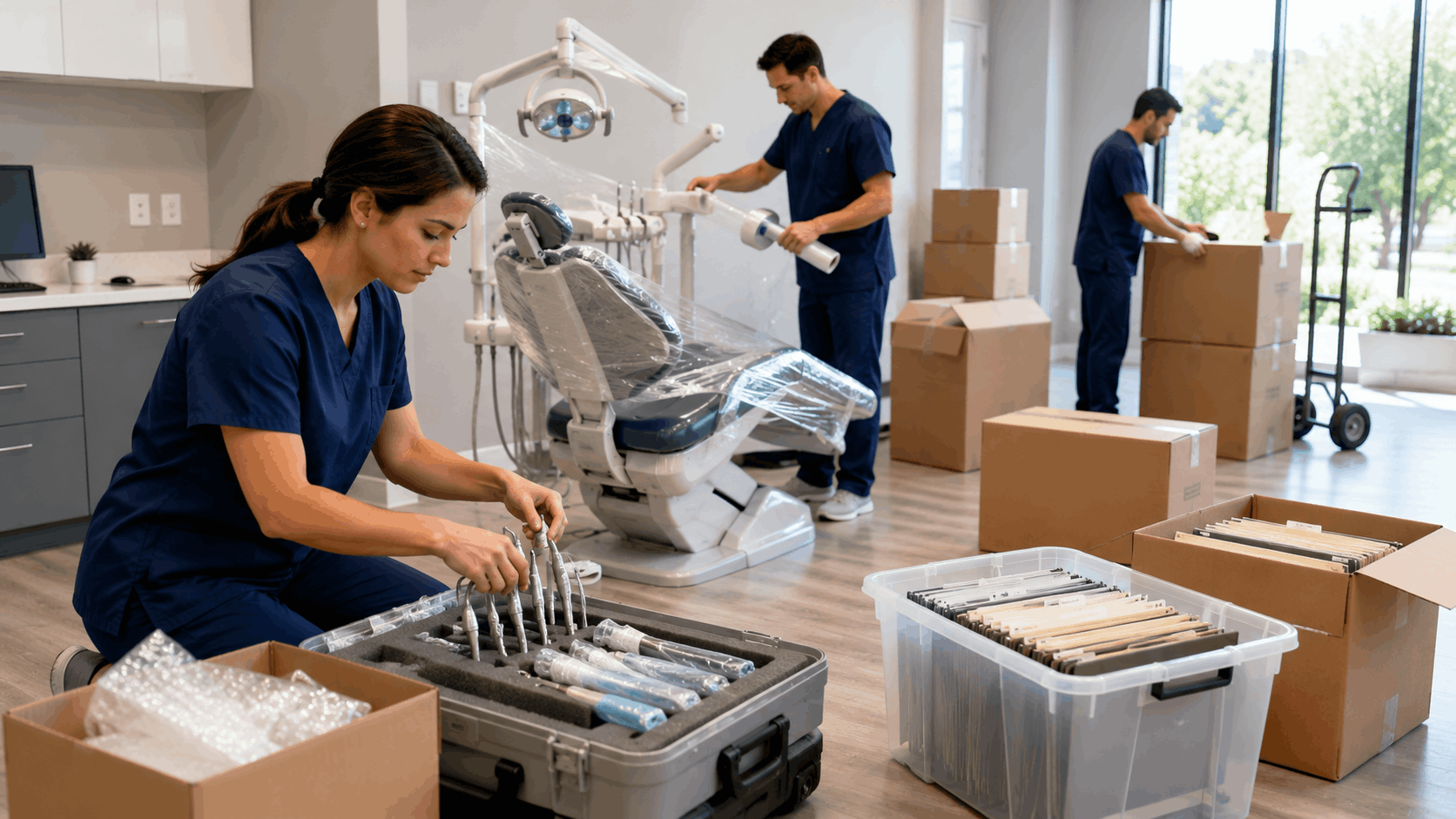
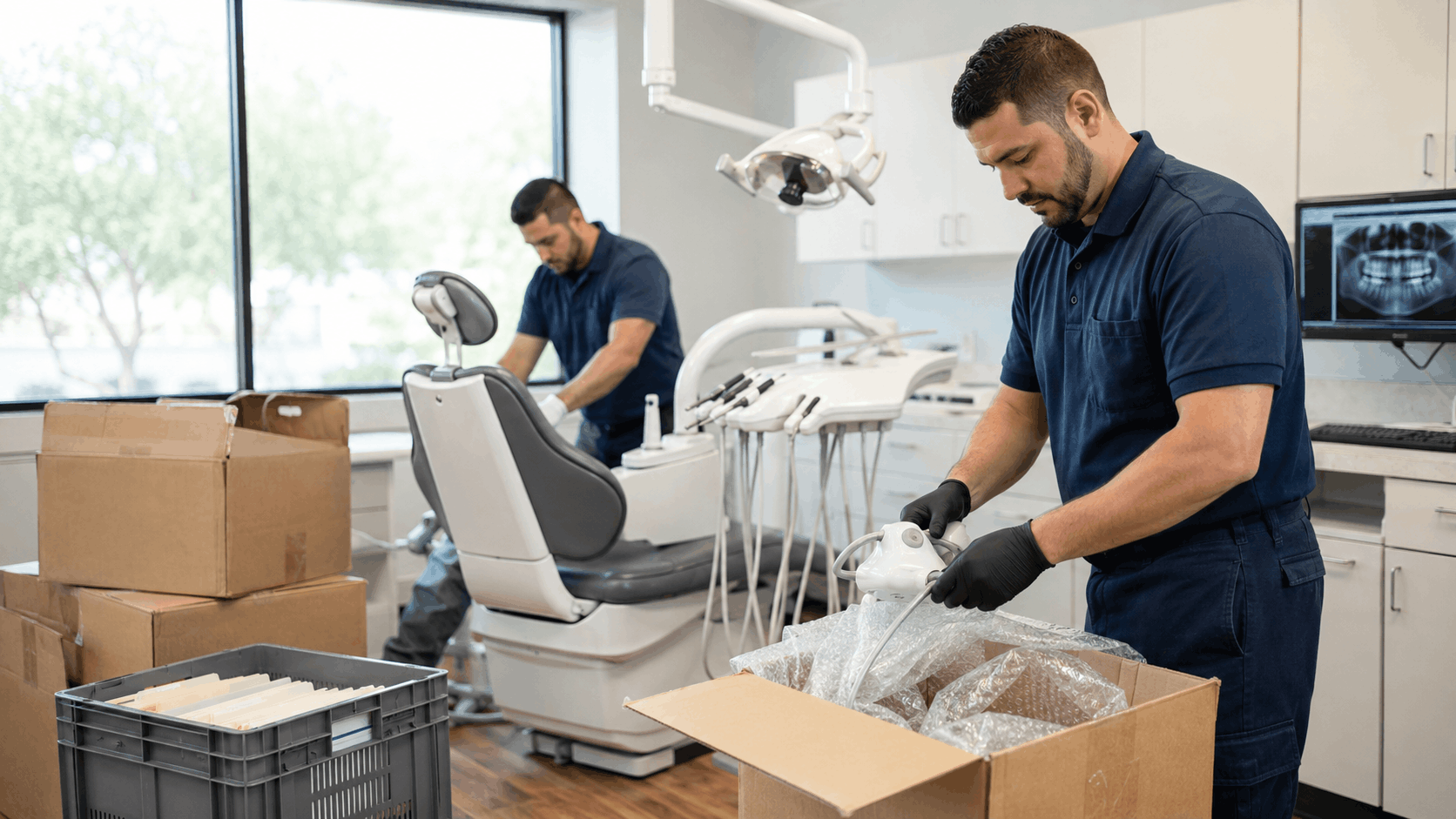
A dental chair looks bolted-down solid, but it connects to a web of lines under the floor. Dental chair moving starts with a proper operatory disconnect of water lines, vacuum lines, and compressed air. Rushing that step floods a floor or damages a delivery head.
The control heads and delivery systems are the delicate part. They hold precision valves and electronics that do not tolerate rough handling. We pad and secure each head separately rather than letting it swing loose during the drive.
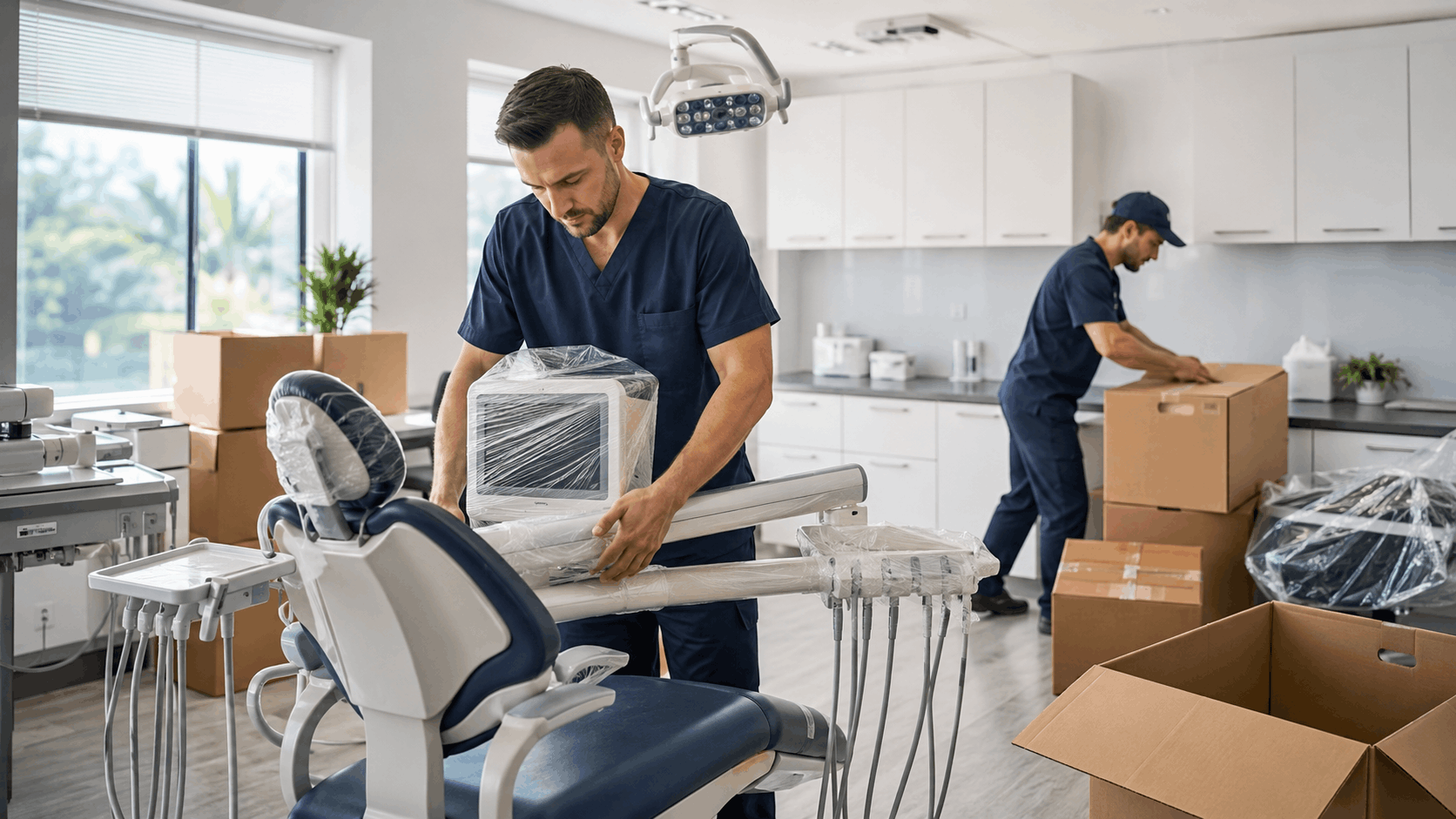
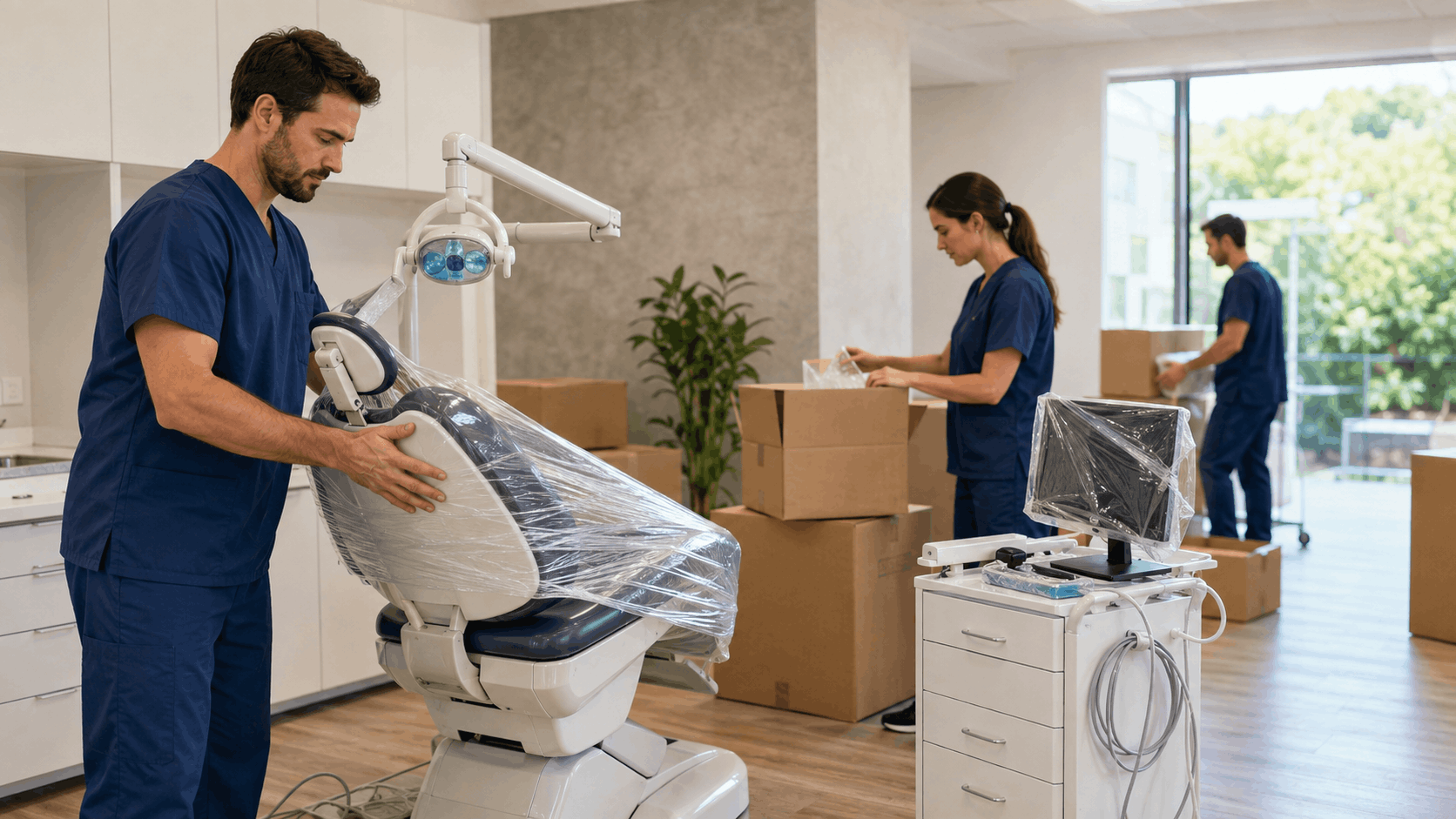
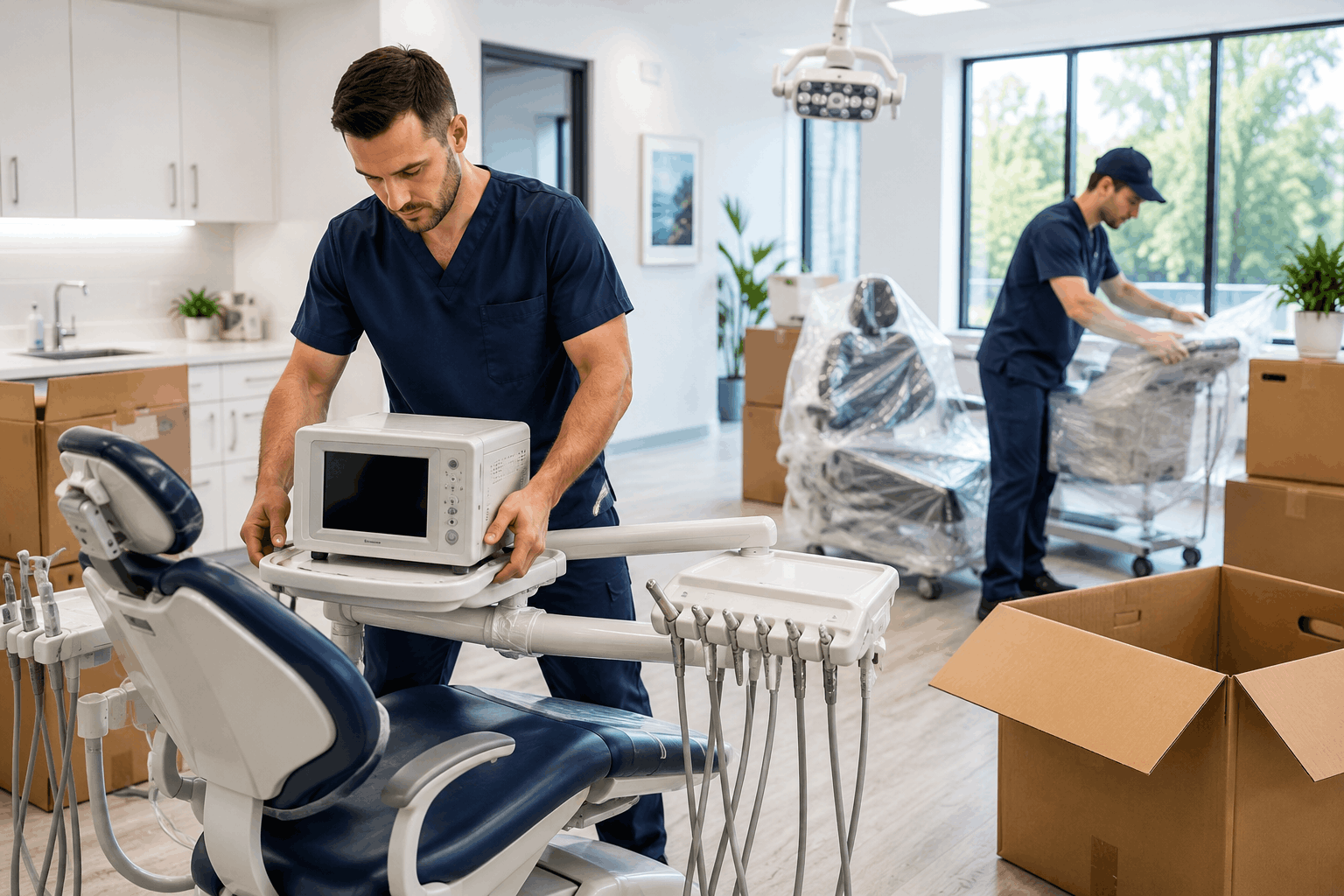
Upholstery is another quiet cost. A torn or scuffed chair cushion looks bad in front of patients and is expensive to reupholster. We wrap seating surfaces to protect them from tools, straps, and doorframes.
For a full commercial move of a busy practice, we map every operatory before disconnect day so each unit goes back together exactly the way it came apart. Photos of the setup before teardown save hours during reassembly.
Autoclaves, Sterilizers, and Lab Equipment
Sterilization gear needs a cool-down and drain before it can move. An autoclave transport that skips draining risks water damage inside the unit and a mess on the truck. We build in time for the machine to fully cool first.
Sterilizer moving also means protecting fragile internal components. These units have gaskets, sensors, and heating elements that crack under a hard jolt. Proper cushioning inside a fitted crate keeps them intact.
Lab equipment brings its own headaches. Model trimmers, mixers, curing units, and glassware all hold delicate parts, and lab benches often have small precision tools that get lost if they are not boxed and labeled carefully.
Our team packs sterilization and lab gear with the same care we give imaging equipment. When a practice needs specialty handling for odd-shaped or heavy items, our specialty moving crew steps in with the right crating and equipment.
Crating, Padding, and Climate Control on the Truck
Off-the-shelf boxes do not cut it for medical gear. High-value and calibrated items get custom equipment crating built to fit the exact piece. A snug crate stops the shifting that causes most transport damage.
Electronics also need anti-static wrapping so a stray charge does not fry a circuit board. Sensors, control heads, and server components all get this treatment before they go near the truck.
Heat is a real Los Angeles factor. Some reagents, medications, and electronics degrade in a hot cargo box, especially during a summer heat wave when a parked truck can bake. A climate controlled truck keeps temperature-sensitive items in a safe range across town.
Our packing and crating team builds the protection around the item, not the other way around. That is what gets a fragile machine from an old suite to a new one in one piece.
Need Help in Los Angeles?
Popeye Moving & Storage serves Los Angeles and all of Los Angeles County.
Protecting Patient Records and Chain of Custody
Patient records custody is where a move crosses from logistics into legal territory. Paper charts, films, and physical media all carry protected health information, and moving them the wrong way is a privacy violation waiting to happen.
A HIPAA moving plan comes down to three habits: keep records locked, track every box, and limit who touches them. Do those three consistently and the records move stays clean.
The federal privacy rules are worth reading before any move. You can review them through the U.S. Department of Health and Human Services HIPAA page.
Keeping Records Private During Transport
Loose charts in open boxes are a problem. A HIPAA compliant move keeps records in locked containers or sealed, labeled boxes the entire time they are out of the office. No file should be visible or reachable during transport.
Record privacy also means limiting who handles the charts. The fewer hands that touch protected files, the smaller the risk. We assign a small, named crew to records rather than letting the whole team dig through them.
Sealed containers also make tampering obvious. If a seal is broken on arrival, that is a flag to check the contents before signing off. It is a simple safeguard that carries real weight.
For practices with large paper archives, we plan the records portion of the move separately from the furniture and equipment. Keeping charts on their own controlled track keeps privacy front and center.
Documenting Chain of Custody Box by Box
Chain of custody sounds formal, but it is just proof of where every box was and who had it. We start with a numbered inventory log so each container has an ID before it leaves the building.
Each handoff gets a signature. When boxes leave the old office, someone signs. When they arrive at the new one, someone signs again. That signed handoff log means no box quietly disappears between locations.
Photos add another layer. A simple picture of the sealed, numbered boxes at pickup and at delivery creates a visual record that matches the log. If a question comes up later, the answer is documented.
At the new office, the coordinator checks the arrived boxes against the inventory list. Every number should match. Only then does anyone break seals and refile the charts.
Moving Servers, Backups, and Digital Records
Most practices now run on digital records, which makes the practice management server one of the most important items in the building. Server relocation has to be done carefully, because a dropped or damaged server can take patient histories with it.
The golden rule is to verify the data backup before anything gets disconnected. We confirm the cloud or offsite backup is current and complete first. If the physical server is damaged in transit, the data still exists.
Servers and networking gear get anti-static wrapping and cushioned crating like any other sensitive electronics. They ride protected, not stacked under boxes. Cables and drives are labeled so reconnection is smooth and correct.
At the new office, an IT tech reconnects and tests the system before the first patient. We time the server move so the practice management software is confirmed working well ahead of opening day.
Short-Term Secure Storage for Overflow Files
Sometimes the old lease ends before the new suite is ready. When there is a gap between closing and opening dates, records and equipment need a safe place to wait. That is where locked, secure storage comes in.
For patient files, storage has to protect privacy the same way transport does. Our records storage in Los Angeles keeps charts in a controlled, access-limited environment rather than a random self-storage unit.
Equipment often needs storage too, especially if the new office build-out runs long. Sensitive gear can sit in a climate-appropriate space until the operatories are ready.
Our commercial storage options give practices a bridge between locations without cutting corners on security. It is a common and easy piece to plan for once you know your dates.
Keeping the Patient Schedule Intact During the Move
Patient schedule protection is the part owners worry about most, and for good reason. A practice earns when chairs are full, so appointment continuity is the whole point of a well-run move.
The goal is simple: move the office without patients feeling the disruption. That takes a smart move window plus clear, early communication.
Choosing the Right Move Window
The closure window decides how many appointments you touch. A weekend move over a Friday-to-Monday stretch, or a move timed to a holiday closure, keeps disruption near zero for most practices.
We look at the calendar with the office to find the lightest possible days. If the practice already closes on a certain holiday, building the move around that date means the office is already dark anyway.
Longer moves with heavy imaging recalibration may need a three-day window. Even then, spanning a weekend means only one or two business days are affected instead of a full week.
The right window is the one that fits your equipment reality and your appointment book at the same time. We help balance both so the closed days are as few as possible.
Telling Patients About the New Address
Patients need to hear about the move more than once. Confirmation calls for the first week back are the safety net that catches anyone who missed the earlier notices. A brief reminder of the new address prevents no-shows at the old suite.
Text reminders and mailers reach the rest. A postcard with the new address and a map, plus a text a few days before each appointment, covers most patients. Repetition is what makes the new address stick.
Digital updates matter just as much. The website, the Google Business Profile, and every map listing need the new address updated the day you open, so patients searching for you land in the right place.
We suggest starting patient notification at least three to four weeks out. Early and repeated beats a single last-minute announcement every time.
Forwarding Calls and Handling Emergencies
The phone cannot go dark during the move. Call forwarding sends the old number to a working line so patients still reach a real person, even on the closed days. A missed phone means a missed patient.
An after-hours line or answering service handles calls during the physical move when staff are busy loading and unpacking. Patients get a clear message about the reopening date and how to reach the office.
Dental and medical emergencies do not pause for a move. A simple emergency plan tells patients who to call and where to go for urgent needs during the closure. Having that plan in writing protects both patients and the practice.
We build the move schedule so the phone system transfers cleanly the moment the old location goes quiet. No patient should ever hear a dead line.
Getting Operatories Ready Before the First Patient
Opening day readiness comes down to testing everything before a real patient sits down. Every operatory unit gets checked: water, air, vacuum, and the delivery head all confirmed working. A surprise leak at 8 a.m. is not the way to reopen.
Imaging calibration gets verified before the first scan. The tech confirms the machine reads accurately, because that first-day X-ray has to be diagnostic quality just like any other.
A dry run pulls it all together. Staff walk through a mock appointment start to finish, from check-in to chair to imaging to checkout. Any gap shows up in the practice run instead of in front of a patient.
We schedule reconnection and testing to finish with buffer time before opening, not right at the wire. That cushion is what lets the first appointment go off without a hitch.
Need Help in Los Angeles?
Popeye Moving & Storage serves Los Angeles and all of Los Angeles County.
Navigating Los Angeles Buildings, Parking, and Traffic
A Los Angeles medical move has to account for the city itself. Loading dock access, freight elevators, and street parking vary wildly by neighborhood, and getting those details wrong stalls the whole day.
Here is a short look at how conditions differ across the areas we serve most:
| Area | Main Challenge | What to Reserve Early |
|---|---|---|
| Beverly Hills / Wilshire towers | Freight elevators, strict dock hours | Elevator and dock time slots |
| Downtown / Silver Lake / Echo Park | Tight streets, scarce parking | Street parking permit |
| Sherman Oaks / Encino | Freeway timing on the 101 and 405 | Off-peak loading window |
| Santa Monica | Building rules, coastal parking limits | Building move approval |
Medical Buildings on the Westside and Beverly Hills Corridor
The medical towers near Cedars-Sinai and along the Wilshire corridor are some of the busiest healthcare buildings in the city. Many share a single freight elevator among dozens of suites, so dock times must be reserved early. Show up without a booked slot and you wait.
Beverly Hills buildings often have strict move-in hours and require certificates of insurance filed in advance. We handle those building requirements before move day so nothing holds up the crew at the door.
Practices around the Wilshire medical buildings also deal with metered street parking and valet operations out front. Staging the truck takes coordination with building management. Our crews who work the Beverly Hills Flats know these buildings and their rules.
Reserving the freight elevator and the loading dock is the first thing we lock in for a Westside practice. Everything else on the timeline depends on that access being confirmed.
Downtown, Silver Lake, and Eastside Practice Moves
A Downtown LA move means narrow one-way streets and almost no open curb space. Older DTLA buildings sometimes have small service elevators that slow a large equipment move. Planning around those limits keeps the day on track.
Silver Lake and Echo Park bring hilly, tight residential-style streets where a moving truck barely fits. A Silver Lake parking permit for the truck is often the only way to hold a legal loading spot near the door.
These neighborhoods reward early scheduling. Arriving before the streets fill up makes the difference between a smooth load and a truck circling the block. We plan Eastside arrivals for the calmest part of the morning.
We arrange the temporary street permits where the city requires them, so the truck has a legal place to park close to the practice. That saves the crew from carrying heavy gear an extra block.
Valley and Coastal Offices in Sherman Oaks and Santa Monica
Practices in Sherman Oaks and Encino live and die by freeway timing. The 101 and 405 crawl during rush hour, and a loaded truck stuck in traffic burns the schedule. We time Valley runs to slip between the worst congestion.
A Santa Monica dental office adds coastal parking limits and building-specific move rules. Some buildings only allow moves during set hours, and street parking near the beach fills up. Confirming the rules ahead avoids a wasted trip.
Building management in both areas often wants advance notice and proof of insurance. We take care of that paperwork so the crew is cleared to work the moment they arrive.
For coastal offices, our Santa Monica Wilshire-Montana commercial moving team knows the neighborhood buildings and the parking realities near Montana Avenue and Wilshire.
Timing the Move Around LA Traffic and Heat
LA traffic timing shapes every practice move. Loading before the morning rush and avoiding the afternoon crush keeps the truck moving instead of idling on the freeway. A short cross-town hop can double in time during peak hours.
Summer heat protection is the other factor. When temperatures climb, a parked cargo box heats up, and that is a risk for medications, reagents, and electronics. We use climate control and minimize how long sensitive gear sits in the truck.
We plan routes that dodge known bottlenecks and construction. Local knowledge of which corridors clog at which hours is what keeps a tight weekend on schedule.
The combination of smart timing and temperature control is how we protect both the schedule and the equipment across a hot LA summer weekend.
What a Practice Relocation Costs and How to Budget
A practice move cost depends on a handful of factors, and owners deserve real ranges rather than vague answers. A clear moving budget prevents surprises when the invoice lands.
Here is a general picture of what shapes the price:
| Cost Factor | Typical Impact |
|---|---|
| Equipment weight and count | Major driver, raises labor and crating |
| Custom crating | Adds per fragile or calibrated item |
| Number of floors / elevator | Adds labor time |
| Distance across LA | Adds transport time and fuel |
| After-hours or weekend labor | Higher hourly rate |
| Storage between dates | Monthly add-on |
What Drives the Price of a Medical Move
Equipment weight is the biggest single factor in move pricing factors. Heavy dental chairs, imaging units, and lab gear take more crew, more equipment, and more time. A practice packed with machines costs more than a light two-chair office.
Crating needs come next. Every item that requires a custom-built crate adds material and labor. The more fragile and calibrated your gear, the more crating enters the total.
Floor count and elevator access matter too. A ground-floor suite with a dock is easier than a fifth-floor office sharing one freight elevator. Distance across the city and after-hours labor round out the main drivers.
A weekend or overnight move, which most practices need to protect the schedule, carries a higher labor rate than a standard weekday job. That premium buys you a closure window that barely touches patients.
Specialty Handling and Insurance Add-Ons
Calibrated equipment coverage is worth budgeting for. Standard moving valuation may not fully cover a high-end imaging machine, so a high value coverage declaration protects the real replacement cost. It is a small line item against a large risk.
Moving insurance for medical gear often means declaring specific items at their true value. That declaration raises the coverage and the premium, but it is the right call for six-figure machines.
Manufacturer disconnect and reconnect fees are a separate cost from the mover. When a certified tech has to decommission and recalibrate an imaging unit, that visit bills on its own. We coordinate the timing but the tech charges directly.
Building these add-ons into the budget up front avoids sticker shock. They are normal parts of a medical move, not surprises, once you know to plan for them.
Hidden Costs Owners Often Miss
The costs that surprise owners are usually the small ones stacked together. Street permit fees for the truck, storage between dates, and IT reconnection all add up quietly. None is huge alone, but together they move the total.
Recalibration fees are the classic miss. Owners budget the move but forget the tech visits needed to certify imaging machines after transport. Those recalibration fees are non-negotiable for patient safety, so they belong in the plan.
Build-out delays are another hidden cost. If the new suite is not ready, storage stretches longer than planned. A little schedule cushion protects against that.
We walk owners through these hidden moving costs during planning so the budget reflects reality. A move with no surprises is one where every cost was named early.
Getting an Accurate On-Site Estimate
A phone quote for a medical move is a guess. An accurate on-site estimate comes from walking both locations, seeing the equipment, and checking the access at each end. That is the only way to price a healthcare move honestly.
During the walkthrough we note every heavy or calibrated item, measure doorways and elevators, and check parking at both suites. Those details decide the crew size, the crating list, and the timeline.
Seeing both ends also catches problems early. A tight service elevator or a loading zone that needs a permit is far cheaper to solve during planning than on move day.
Reach out through our contact page to set up a walkthrough. A moving quote based on a real visit is one you can actually plan around.
Need Help in Los Angeles?
Popeye Moving & Storage serves Los Angeles and all of Los Angeles County.
Choosing the Right Practice Moving Team in Los Angeles
Not every mover should touch a medical office. Choosing among medical movers in Los Angeles means checking experience, credentials, and how they handle privacy. A practice moving company earns trust before it earns the job.
The right questions up front save a lot of grief later. Here is what to look for.
Experience With Healthcare and Lab Equipment
General moving experience is not enough for a practice. Specialty movers who have handled dental chairs, imaging systems, and lab equipment know the traps that break machines. That equipment experience is what you are paying for.
Ask whether the crew has moved operatories before. Disconnecting water and vacuum lines, protecting control heads, and crating an imaging unit are skills built over many jobs, not learned on yours.
A mover who understands healthcare gear also coordinates smoothly with manufacturer techs. They know where their job ends and the certified tech's begins, which keeps the reconnection clean.
We have handled practice relocations across the city, from Westside medical towers to Valley and coastal offices. That hands-on history is what lets us plan a move that protects your machines.
Licensing, Insurance, and Privacy Practices
Always confirm a mover is properly licensed and insured. Licensed movers in California register with the state, and you can verify a company through the Bureau of Household Goods and Services website. An insured moving company protects you if something goes wrong.
Proof of insurance should be easy to get. A serious mover provides a certificate without hesitation and can name you as additionally insured for building requirements.
Privacy practices matter for a healthcare move specifically. Ask how the mover handles patient record confidentiality, chain of custody, and limited access. A vague answer is a red flag.
The right team treats your charts and data with the same care as your equipment. Both are protected, and both need a plan.
Questions to Ask Before You Sign
A short screening list separates the right mover from the wrong one. Before you sign, ask these:
- Have you moved dental chairs and imaging equipment before?
- How do you build crating for calibrated machines?
- Do you offer secure storage between locations?
- How do you protect patient records during transport?
- Who is on the crew, and are they your employees?
The answers tell you clearly whether a mover understands healthcare work. Vetting movers this way protects your practice from a crew that treats your operatory like office furniture.
Get the timeline commitment in writing too. A mover confident in your closure window will put the schedule on paper. That written plan is your assurance the move fits your appointment book.
How Popeye Moving & Storage Handles Practice Relocations
Our team at Popeye Moving & Storage plans each practice move around your patients first. We build the timeline backward from your open date, block the shortest possible closure, and coordinate with your staff coordinator every step.
We custom-crate the sensitive gear, protect and log every records box, and offer secure storage when your dates leave a gap. Our crews work the buildings, docks, and permit rules across Los Angeles daily, from West Los Angeles to the coast and the Valley.
We coordinate with your manufacturer techs on disconnect and recalibration so the machines are certified before your first patient. And we time the whole move around LA traffic and heat to protect both the schedule and your equipment.
You get one plan, one coordinator on our side, and a crew that has done this before. That is how a practice moves over a weekend and opens Monday like nothing happened.
Final Thoughts
A medical or dental practice move works when three things are protected at once: the equipment, the records, and the schedule. Miss one and the whole reopening suffers. Plan all three together and patients barely notice the change of address.
Start early, name an internal coordinator, choose a tight weekend or holiday window, and hire a mover who has actually handled healthcare gear. That combination is what keeps a Los Angeles practice running through a move.
When you are ready to plan your relocation, reach out to Popeye Moving & Storage for an on-site walkthrough and a real quote. Call our team or visit our contact page to schedule a consultation and protect your next appointment.
Frequently Asked Questions
- How long does it take to move a medical or dental practice?
- A single-location practice physical move often fits into one to three days. A straightforward weekend move can load Saturday and reopen Monday. Larger practices with heavy imaging usually need a multi-day window because machines require decommission before transport and recalibration after. The equipment recalibration and IT reconnection, not the furniture, are what stretch the timeline. Planning around a weekend keeps closed business days to one or two.
- How much does it cost to move a dental office in Los Angeles?
- A dental office move cost varies widely based on equipment count, crating needs, distance, floors, and whether the move runs after hours. Small offices land lower, while imaging-heavy practices cost more because of custom crating and manufacturer tech fees. Weekend labor, permits, storage, and recalibration all push the total up. The most accurate number comes from an on-site walkthrough of both locations rather than a phone estimate.
- Can a practice stay HIPAA compliant while moving patient records?
- Yes, with the right controls. A HIPAA records move keeps charts in locked or sealed containers, limits who touches them to a small named crew, and tracks every box with a numbered inventory and signed chain of custody log. Photos at pickup and delivery add proof. At the new office, boxes are checked against the list before any seals are broken. Those steps keep protected information private throughout.
- Do dental chairs and imaging machines need to be recalibrated after a move?
- Many do. Imaging units like X-ray, CBCT, and panoramic machines are calibrated to tight tolerances that road vibration can disturb. A manufacturer-certified tech should test and recalibrate them after transport before any patient is scanned, since a miscalibrated machine produces bad diagnostic images. Some dental chair components also need a tech check. Budget for equipment recalibration as a normal part of the move.
- How many appointments will a practice have to cancel during a move?
- With a good plan, very few. Moving over a long weekend or a scheduled holiday closure means only one or two business days are affected, so appointment cancellations stay minimal. Choosing low-volume days and blocking a short closure window keeps the appointment book nearly intact. Larger practices with heavy recalibration may lose a couple of extra days, but smart timing keeps that number low.
- Who disconnects and reconnects the equipment?
- It is a team effort. Our movers handle the lifting, crating, and transport, plus basic disconnects. A manufacturer-certified tech handles decommission and recalibration on calibrated machines like imaging units. Licensed contractors handle water, compressed air, vacuum, and electrical hookups at the new suite. We coordinate the timing across all three so the equipment disconnect and reconnection happen in the right order before your first patient.
- Can the movers store equipment or records between locations?
- Yes. When there is a gap between your closing and opening dates, we offer short-term secure storage for both equipment and records. Charts stay in an access-limited, private environment that protects patient information, and sensitive gear stays in an appropriate space until the new operatories are ready. This bridge is common when a build-out runs longer than expected, and it keeps everything safe in the meantime.
- What insurance covers expensive medical equipment during a move?
- High-value items should be covered with a declared value or specialty policy. A high-value declaration lists costly machines at their true replacement value so standard moving valuation does not leave you short. Calibrated imaging equipment often warrants specialty moving insurance coverage. We help you identify which items need extra protection and can provide a certificate of insurance and name you as additionally insured for building requirements.
- How far in advance should a practice book its move?
- Book six to twelve weeks ahead when possible. That booking lead time lets you reserve freight elevators and docks, arrange permits, notify boards and vendors, and coordinate manufacturer techs, all before move day. Early scheduling also locks in your preferred weekend window before it fills up. Rushed moves are still doable, but the more lead time you give, the smoother and safer the relocation.
- Does the practice need a street permit for the moving truck in LA?
- Often, yes, especially in tight areas like Downtown, Silver Lake, and parts of Santa Monica where curb space is scarce. A temporary parking permit reserves a legal loading spot near the door so the crew does not carry heavy equipment an extra block. We arrange these LA moving permits as part of the plan for neighborhoods that require them, so the truck has secure access on move day.
Popeye Moving & Storage Co. Team Team
Licensed moving and storage professionals serving Los Angeles and Los Angeles County.
Licensed in California · License #CAL T 189749 | USDOT 1472924 | MC 498816C
Why trust Popeye Moving & Storage?
Founded in 1994, Popeye Moving & Storage is a licensed and insured moving and storage service serving Los Angeles and Los Angeles County. All content is reviewed by our licensed technicians.

Need Help in Los Angeles?
Popeye Moving & Storage serves Los Angeles and all of Los Angeles County.
Related Articles
Beverly Hills Moving Permit Requirements: When City Approval Is Needed
A local mover's guide to Beverly Hills moving permit requirements: when city approval is needed, how to apply, costs, neighborhood access tips, and mistakes to avoid.
Beverly Hills Moving Permits and Restrictions: What You Need Before Moving Day
Beverly Hills moving permits, time restrictions, and street-by-street rules explained - what you need before moving day to avoid fines, towing, and delays.
Moving to Santa Monica: Parking Rules, Street Restrictions, and Building Access
Everything new Santa Monica residents need to know about permit parking zones, moving truck restrictions, building elevator rules, and city permits before moving day.