Cost Guides
Full Packing Service Cost in Los Angeles - Per-Room Ranges and Materials Included
Key Takeaways
- Full packing service costs by the room, with kitchens the most expensive ($250-$600) and bedrooms the least ($120-$300).
- A typical two-bedroom LA home runs roughly $600-$1,500 to pack, while larger homes reach $1,200-$3,000.
- Standard materials like boxes, tape, paper, bubble wrap, and blankets are included; custom crates for art usually cost extra.
- Costs rise with volume of belongings, fragile items, access challenges like stairs and parking, and peak-season timing.
- LA neighborhoods change the job: hillside steps in Silver Lake, freight elevators Downtown, and salt air on the coast.
- Save money by decluttering, packing non-fragile items yourself, booking off-peak weekdays, and bundling packing with moving and storage.
- An in-home or virtual survey gives the most accurate quote and helps avoid hidden fees like long carry and stair charges.
In This Article
The week before a big move, a Silver Lake family sat on their living room floor surrounded by flat, empty boxes. The parents had bought a stack of moving boxes from a hardware store on Sunset, but they had no idea where to start. Should the good china go in the same box as the mugs? How do you wrap a flat-screen TV so it survives the drive down the hill?
That scene plays out in homes across Los Angeles every weekend. A full packing service exists to take that stress off the table, but the pricing can feel like a mystery until someone breaks it down room by room.

What a Full Packing Service Actually Includes in Los Angeles?
A full packing service means trained packers box up everything in the home before moving day. Customers do not lift a finger with wrapping or taping. The crew brings all the moving supplies, packs each room, and labels every box for the truck.
Most Los Angeles movers offer this as a bundle: labor plus materials in one line item or split into two. Knowing exactly what falls under that label helps families compare quotes fairly. Below is a quick look at what a typical full packing service covers.
| Component | Included in Full Packing | Notes |
|---|---|---|
| Labor (packers) | Yes | Room-by-room wrapping and boxing |
| Boxes and cartons | Yes | All standard sizes provided |
| Tape and paper | Yes | Packing paper, tape, markers |
| Bubble wrap and padding | Yes | For fragile and electronics |
| Specialty crates | Sometimes extra | Art, marble, large mirrors |
| Hazardous materials | No | Paint, propane, chemicals excluded |
Labor: Who Packs and How Long It Takes
A packing crew is made up of trained movers who work one room at a time. They start with lower-use spaces, like guest rooms and dining areas, then finish with kitchens and everyday items. This order lets the family keep living in the home until the last day.
Crew size depends on the home. A one-bedroom apartment near Echo Park usually gets two packers for three to five hours. A three-bedroom house in the hills might need three or four packers for a full day.
Packing hours add up faster than most people expect. A fully loaded kitchen alone can take one packer two to three hours because every glass and plate gets wrapped by hand. Our crews track time by room so the customer sees where the labor goes.
The benefit of a professional team shows on the far end of the move. Boxes packed by trained hands survive the drive with far fewer breaks, and unpacking goes faster because everything is grouped and labeled. Families who try our full-service packing often say the time saved was worth more than the fee.
Materials Bundled Into the Price
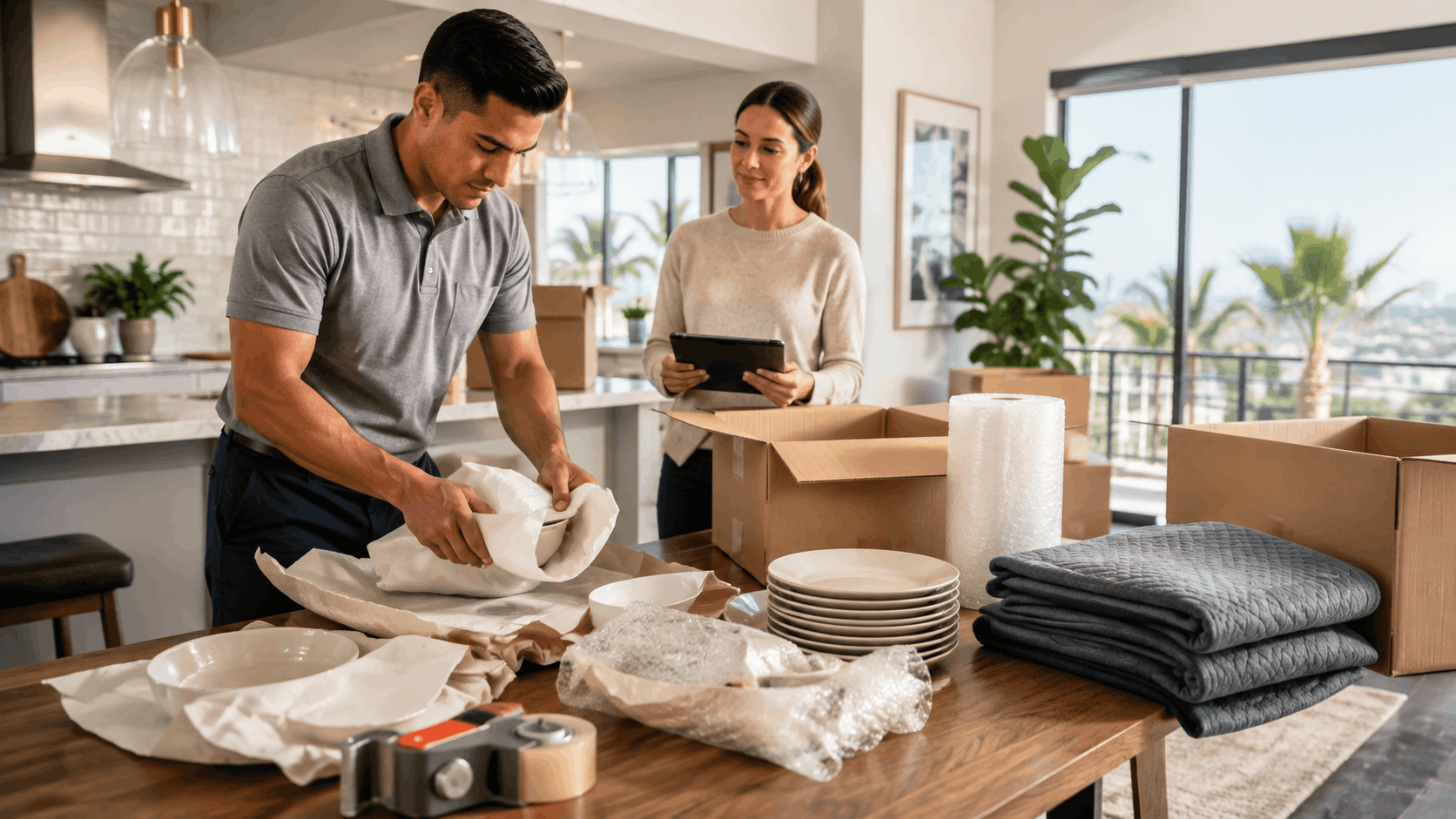
The materials are what separate a real pack from a rushed one. A full packing service includes small, medium, and large boxes, plus dish packs and wardrobe boxes. All the tape, markers, and packing paper come with it too.
Fragile items get bubble wrap and foam. Furniture gets moving blankets and stretch wrap so surfaces do not scratch. These packing materials are built into the quote, so customers are not running back to the store mid-pack.
Quality matters here. Thin, single-wall moving boxes from a discount store crush under weight, while professional double-wall dish packs protect stemware through a bumpy ride on the 101. We stock heavier cartons made for the load each room carries.
If a family wants supplies ahead of time to pack a few things themselves, our moving supplies delivery drops boxes at the door. That way the count is right and nothing gets underbuilt.
Full Packing vs Partial Packing
Full packing covers every item in the home from top to bottom. Partial packing lets the crew handle only certain rooms or fragile items while the customer packs the rest. Both are valid, and the right choice comes down to budget and time.
A full-service move works well for busy professionals, seniors, and anyone short on time. It is the most hands-off option, and it keeps breakage low because pros handle the fragile items.
Partial packing saves money for people who can box their own clothes and books. Many customers ask us to pack just the kitchen, art, and electronics, then handle the closets themselves. This hybrid path is one of the most popular requests we get.
The cost gap is real. Partial packing can cut a packing bill by 30 to 50 percent depending on how much the family takes on. We help each household draw the line where it makes the most sense for them.
What Is Not Included
Some items sit outside a standard packing service by law or by safety rule. Hazardous materials like paint, propane tanks, pool chemicals, and cleaning solvents cannot go on the truck. Movers will flag these during the survey so the family can dispose of them properly.
Live plants are another common packing exclusion. Long hours in a hot truck stress or kill them, and California has rules about moving certain plants across state lines. Most families carry plants in their own car.
High-value items like cash, jewelry, passports, and important documents should travel with the owner. We recommend packing a personal bag for these before the crew arrives. It keeps small valuables from getting boxed by mistake.
Certain pieces need separate handling rather than a standard box. Pianos, large safes, and fine art often require dedicated crating, which our specialty moving team handles as an add-on rather than part of the base pack.
Get Your Free Quote
Tell us about your move and we'll get back to you fast.
Per-Room Packing Price Ranges Across LA
Packing costs are easiest to plan when broken down by room. Every space holds a different mix of fragile and bulky items, so the per-room packing cost varies widely. A closet full of clothes is cheap to pack; a china cabinet is not.
The ranges below reflect typical Los Angeles packing jobs, including labor and materials. Actual numbers move with the amount of stuff and how fragile it is. Use these packing price ranges as a starting point, then confirm with an in-home estimate.
| Room | Typical Price Range | Main Cost Drivers |
|---|---|---|
| Kitchen / Pantry | $250 - $600 | Glassware, dishes, small appliances |
| Bedroom | $120 - $300 | Clothing, linens, wardrobe boxes |
| Living Room | $150 - $400 | Electronics, art, books |
| Home Office | $150 - $350 | Files, monitors, cables |
| Garage / Patio | $100 - $350 | Tools, outdoor gear, odd shapes |
Kitchens and Pantries
The kitchen almost always costs the most per room. It is packed with fragile dishware, glassware, and small appliances that each need paper and padding. A single packer can spend the better part of a morning here alone.
Dish pack boxes drive part of the kitchen packing cost. These are thick, double-wall cartons built to hold plates and glasses upright with dividers. They cost more than a regular box, and a full kitchen may need several of them.
Pantries add time too. Open food, spices, and half-used bottles have to be sorted, since movers will not load leaking or perishable goods. Sealed, unopened items get boxed, and the rest goes with the family or gets tossed.
For a mid-size LA kitchen, families should budget $250 to $600. A gourmet kitchen with a wine collection or a stand mixer and specialty cookware lands at the higher end. The upside is that a properly packed kitchen almost never shows up broken.
Bedrooms and Closets
Bedrooms are among the cheaper rooms to pack because so much of the contents is soft. Clothing, bedding, and linens go into boxes quickly with little wrapping. That keeps both labor and materials down.
Wardrobe boxes make bedroom packing faster and gentler on clothes. Hanging garments transfer straight from the closet rod into a tall box with its own bar. Nothing gets folded or wrinkled, which matters for suits and dresses.
Nightstands, lamps, and dresser mirrors add a little cost. Lampshades need their own boxes, and mirrors get wrapped and boxed separately. A packer usually clears a standard bedroom in one to two hours.
Most bedrooms run $120 to $300 depending on closet size and how many delicate items sit on shelves. A primary suite with a walk-in closet and a vanity full of perfume bottles costs more than a simple guest room.
Living Rooms and Home Offices
Living room packing centers on electronics, art, and furniture that needs wrapping. A big-screen TV, a sound system, and a stack of framed pieces all take careful handling. These items push the room toward the upper end of its range.
Electronics packing calls for original boxes when available, or padded TV cartons when not. Cables get bagged and labeled so the setup goes back together fast. Our crews photograph complex wiring before unplugging anything.
Home offices carry their own challenges. Files, monitors, and a desktop tower need order and padding, and important documents should be flagged so they do not get lost in a box. Bookshelves are heavy, so books go in small boxes to keep the weight manageable.
Living rooms and offices usually land between $150 and $400. Art collections, large mirrors, or a wall of built-in bookcases raise the number. If a home office is part of a business relocation, our office and business moving team can fold packing into the larger job.
Garages, Patios, and Storage Areas
Garages and patios are the rooms people forget until the last day. In LA, homes with pools and outdoor kitchens carry a surprising amount of gear. That overlooked space can add hours to a pack.
Garage packing deals with odd shapes and dirty items. Tools, sports equipment, holiday decorations, and half-empty paint cans all need sorting. The paint and chemicals get set aside, since those cannot ride on the truck.
Patio items bring their own quirks. Outdoor furniture, grills, umbrellas, and planters need wrapping to protect finishes and to keep dirt off other boxes. Cushions go in large boxes or bags.
Expect $100 to $350 for a garage or patio, with cluttered spaces near the top. A tip from our crews: clearing junk out of the garage before packing day is one of the fastest ways to cut this line item.

Need Help in Los Angeles?
Popeye Moving & Storage serves Los Angeles and all of Los Angeles County.
What Drives Packing Costs Up or Down in Los Angeles
Two homes of the same size can get very different quotes. The number moves with how much stuff there is, how fragile it is, and how hard the home is to access. Timing plays a part too.
Knowing these packing cost factors helps families read a moving quote in LA without surprise. Here are the biggest drivers our estimators weigh when building a packing estimate:
- Volume of belongings - more items means more boxes, materials, and labor hours.
- Fragility - glassware, art, and antiques need extra wrapping and time.
- Access - stairs, long carries, and parking distance add labor.
- Timing - peak season and end-of-month dates cost more.
- Specialty crating - custom boxes for art and mirrors add materials.
Home Size and Volume of Belongings
Square footage gives a rough starting point, but volume tells the real story. A minimalist in a two-bedroom loft may pack faster than a collector in a one-bedroom stuffed to the ceiling. Packers price by what is inside, not just the floor plan.
Clutter level changes everything. Homes with years of accumulated stuff in closets, garages, and under beds take far more boxes and hours. Every extra item is another thing to wrap, box, and label.
This is why a walkthrough matters so much. An estimator counts rooms, opens closets, and gauges the packing volume before quoting. A quote given over the phone without seeing the home is often off by a wide margin.
Families can directly lower this factor. The less that goes in boxes, the smaller the bill, which is why decluttering before packing day pays off twice - once on packing and again on the move itself.
Fragile and Specialty Items
Fragile items are the single biggest reason packing costs climb. Mirrors, TVs, artwork, and antiques all need slow, careful handling and premium materials. A room full of framed pieces takes far longer than a room of sofas.
Custom crating is the top tier of protection. A wood crate built around a large painting or a marble tabletop keeps it rigid during transport. These crates cost more in both materials and labor, but they prevent losses on irreplaceable pieces.
Certain items always trigger extra care. Chandeliers, glass cabinet doors, stone sculptures, and heirloom china fall into this group. Our crews wrap each one individually and mark the box as fragile for the loaders.
A home with lots of delicate pieces should expect a higher packing line. That extra cost buys real protection, and the alternative is filing a broken-item claim after the fact.
Access Challenges: Stairs, Elevators, and Parking
LA homes come with access quirks that add labor. A hillside house in Echo Park with 40 steps up from the street takes longer to load than a ground-floor unit. Every trip up and down eats packing and carry time.
Elevator buildings in Downtown and Koreatown have their own rules. Many require a reserved freight elevator and a certificate of insurance filed with the building. Booking the wrong window can stall a move for hours.
Parking is a constant LA challenge. Narrow streets in older neighborhoods leave no room for a large truck near the door, which means a longer carry. In some areas the city requires parking permits or temporary no-parking signs for the moving truck.
These access issues rarely change the packing labor itself, but they shape the full move quote. A good estimator asks about steps, elevators, and truck parking during the survey so nothing surprises the crew.
Timing and Season
When a family moves affects the price. Summer is the busy moving season in LA, roughly May through September, when demand and rates run highest. Schools are out and leases turn over, so crews book up fast.
The calendar within each month matters too. The end of the month and the start are peak moving dates because most leases begin on the first. Weekends draw a premium over weekdays for the same reason.
Holidays and three-day weekends spike demand as well. Families with flexible timing can save real money by choosing a mid-month weekday in the off-season. Rates soften in late fall and winter.
Booking early also protects the schedule. During peak weeks, the best crews fill up two to four weeks out, so waiting can mean fewer choices and higher last-minute pricing.
Neighborhood Notes: Packing in Different Parts of LA
Los Angeles is really a hundred neighborhoods stitched together, and each one moves differently. A pack in the hills is nothing like a pack in a beachfront condo. Local movers in LA plan around these differences every day.
Our crews cover packing service areas across the city and its surrounding towns. Here is how the job changes depending on where the home sits.
Hillside Homes in Silver Lake and Los Feliz
The hills east of the reservoir hold some of the most charming and challenging homes in the city. Long, steep driveways and staircases mean packers and loaders make many trips. That adds labor time on both ends of the move.
Older homes near Silver Lake and Los Feliz often have narrow doorways and tight stairwells built decades ago. Large furniture sometimes has to be disassembled to clear a landing. Packing these pieces takes planning so parts stay together.
Street parking on the hills is tight and often permit-only. Our crews scout the approach ahead of time and stage boxes to shorten the carry. For Silver Lake movers, knowing which streets a truck can actually fit down saves hours.
These homes reward experience. A crew that has worked the hills knows to protect original hardwood floors and vintage tile while carrying loaded boxes down a narrow hall.
High-Rise Living in Downtown and Koreatown
Condo and apartment towers in Downtown LA and Koreatown run on schedules. Most require a freight elevator reservation and a specific move-in or move-out window. Miss it and the whole day slides.
Loading docks add another layer. Buildings often assign a dock and limit truck size, and some only allow moves on weekdays to keep weekends quiet for residents. Our office confirms these rules before the truck rolls.
High-rise packing itself tends to go quickly since units are compact. The time cost shifts to elevator waits and long hallway carries. Freight timing becomes the thing that shapes the day.
We handle the building paperwork, including certificates of insurance, so the packing and loading run on time. That coordination is why high-rise residents lean on crews who know these towers well.
Westside and Coastal Areas Like Venice and Santa Monica
Moves near the coast bring salt air and permit parking into the mix. Homes in Venice and along the numbered streets in Santa Monica often sit on blocks where every space is permit-only. A temporary parking permit keeps the truck close to the door.
Salt air is a quiet threat to electronics and metal. Extra wrapping and sealed boxes help protect TVs, computers, and instruments during a coastal move. Our crews pad these items with moisture in mind.
Traffic shapes the timing too. Routes like the 10 freeway and Lincoln Boulevard clog badly at rush hour, so we schedule loading to beat the worst of it. A morning start beats an afternoon crawl every time.
For Venice moving and Santa Monica packing, the trick is combining early scheduling with permit planning. That keeps a coastal move smooth instead of stuck in traffic.
Valley Homes in Sherman Oaks and Studio City
Over the hill in the Valley, homes tend to be larger single-family properties. That means more rooms, bigger garages, and more to pack. Sherman Oaks movers plan for higher box counts than a typical Westside condo.
Summer heat is the Valley's defining packing challenge. Temperatures push past 100 degrees, so our crews start early and keep boxes out of direct sun. Heat also stresses candles, electronics, and anything that melts.
Garages here are often packed with tools, gym equipment, and storage bins. Studio City packing frequently includes a full garage and sometimes a backyard shed. These spaces need real time built into the plan.
The upside is easier access than the hills. Wider streets and driveways mean the truck usually parks close, which trims carry time and keeps labor costs in check.
Materials Breakdown: What Goes Into a Proper Pack
Good materials are the difference between boxes that arrive whole and boxes that arrive crushed. A proper pack uses the right box and the right padding for each item. Below is the packing materials list our crews carry to every job.
Quality moving boxes in LA cost a little more, but they hold up over rough roads and long carries. Protective wrapping does the rest. Here is how each piece works.
Box Types and Sizes
Different items call for different boxes. Small boxes hold heavy things like books and canned goods so no one has to lift a back-breaker. Medium and large boxes take lighter, bulkier items like linens and lampshades.
Dish pack boxes are the workhorse of the kitchen. Their thick, double walls and cell dividers keep plates and glasses from knocking together. They are the reason a well-packed kitchen arrives without a single chip.
Wardrobe boxes handle hanging clothes without folding. Garments hang from a built-in bar, so suits and dresses stay pressed. These tall boxes also swallow bulky closet items on the bottom.
Matching the box to the contents keeps everything safe and the count efficient. Our packers pull the right mix of box sizes for each room instead of forcing items into whatever is on hand.
Padding, Paper, and Wrap
Padding fills the gaps that cause breakage. Clean packing paper wraps dishes, glasses, and knickknacks, and crumpled paper fills empty space so nothing shifts. A box that rattles is a box waiting to break.
Bubble wrap protects the most fragile items. Stemware, framed art, and ceramics get a bubble layer before they go in the box. It cushions shocks that paper alone cannot absorb.
Foam sheets and pouches guard electronics and screens. These slide between items to stop scratches and pressure damage. They are light, so they add protection without adding much weight.
Furniture blankets wrap sofas, dressers, and tables. These thick moving blankets, held with stretch wrap, keep finishes from scratching during the carry and the drive. Every large piece gets covered before it leaves the room.
Specialty Containers and Crates
Some items need more than a box. Custom crates are built from wood to fit a specific painting, sculpture, or slab of stone. The item sits snug inside so it cannot move, which is the safest way to transport high-value art.
Mirror cartons are made for flat, fragile pieces. These adjustable boxes fit mirrors, glass tabletops, and large framed art. The frame gets corner protectors before it slides in.
TV boxes protect one of the most commonly damaged items in any move. A padded carton sized to the screen keeps pressure off the glass. When the original box is gone, a proper TV carton is the next best thing.
Our packing and crating team builds crates on site for oversized or oddly shaped pieces. For collectors and designers, this is often the reason they book a full service in the first place.
Labeling and Inventory Systems
A pack is only as good as its labels. Every box gets marked with its room and contents so the crew knows where it goes on the far end. Clear labels turn a chaotic unload into an orderly one.
Color coding speeds things up. Assigning each room a color lets movers drop boxes in the right space without reading every label. The family finds their kitchen boxes in the kitchen, not the garage.
A moving inventory list tracks what went where. For larger homes and long-distance moves, we number boxes and log them so nothing goes missing. Customers can check off items as they arrive.
Good box labeling also makes unpacking faster. When crews or families know a box holds fragile glassware, they open it with care. Our unpacking services lean on this same system to put a home back together quickly.
Need Help in Los Angeles?
Popeye Moving & Storage serves Los Angeles and all of Los Angeles County.
How to Get an Accurate Packing Quote
An accurate quote starts with a real look at the home. Guesswork over the phone leads to surprise charges on moving day. A proper packing quote comes from a survey, a clear line-item breakdown, and honest talk about the details.
Here is how the estimate process works and what to watch for when reading a moving estimate in LA.
In-Home vs Virtual Surveys
An in-home estimate is the gold standard. An estimator walks every room, opens closets, and counts fragile items to gauge boxes and hours. This gives the most accurate packing quote because nothing is hidden.
A virtual survey done over video works well for smaller homes and busy schedules. The customer walks their phone through each room while the estimator takes notes. It saves a visit and still beats a blind phone quote.
Each method has a best use. Large homes, art collections, and cluttered spaces deserve an in-home walkthrough, while a studio or one-bedroom is a fine fit for video. We offer both so families can pick what suits them.
Either way, the goal is the same: see the real contents before quoting. That is how a customer avoids the classic mid-move price jump.
Questions to Ask Before Booking
A few questions protect the customer before signing. Ask what materials are included and whether specialty crates cost extra. Confirm the crew size and how many hours the pack should take.
Ask about insurance and valuation coverage. Every mover offers basic released-value protection, and most offer fuller coverage for a fee. Knowing the difference matters if something breaks.
Timing questions come next. Ask how far in advance to book, whether the date is firm, and what happens if the move runs long. These booking questions surface any gaps in the plan.
Finally, ask for everything in writing. A clear moving contract that lists services, materials, and price prevents disputes later. A company that answers plainly is one worth trusting.
Reading a Packing Estimate
A good estimate reads like an itemized list, not a single vague number. It should break out labor, materials, and any specialty items separately. That way the customer sees exactly what each part costs.
Packing is often billed one of two ways. Hourly packing charges by crew time plus materials, which fits smaller or uncertain jobs. Flat rate packing sets one price for the whole pack, which gives budget certainty.
Each model has a place. Hourly can be cheaper for a light pack that finishes fast, while flat rate protects against a job that drags. Ask which one a quote uses and why.
Watch for vague quotes. A one-line number with no breakdown often hides charges that appear later. A detailed estimate is a sign of an honest company.
Hidden Fees to Watch For
Hidden moving fees are the thing that turns a fair quote sour. The most common is a long carry fee, charged when the truck cannot park near the door and the crew hauls boxes a long distance. LA's parking crunch makes this common.
Stair charges show up on hillside and walk-up jobs. Some companies add a fee per flight above the ground floor. Ask whether stairs are included so a Silver Lake or Echo Park move does not balloon.
Last-minute material costs catch people too. If a crew runs short on boxes and bills extra on the day, that adds up fast. A good estimate includes enough materials from the start.
We spell these out during the survey so there are no ugly moving-day surprises. An honest quote names every fee that could apply, even the ones that end up not mattering.

Ways to Lower Your Packing Costs Without Cutting Corners
Packing does not have to break the budget. Smart choices trim the bill while keeping belongings safe. Here is honest advice on how to save on packing without risking damage.
These tips come straight from what our crews see work for families across LA looking for affordable packing and a smarter moving budget.
Declutter and Donate Before Packing Day
The cheapest box to pack is the one that never gets packed. Every item removed before packing day cuts both labor hours and material cost. Decluttering is the single biggest lever a family controls.
Start weeks ahead, room by room. Sort into keep, donate, and toss piles, and be honest about what has not been used in a year. Kitchens and garages usually hide the most excess.
LA has plenty of donation options. Goodwill and Salvation Army centers dot the city, and many local charities pick up furniture. Donating clears space and can bring a tax receipt.
Less stuff also means a smaller truck and a faster move. The savings show up across the whole job, not just the pack.
Pack Non-Fragile Items Yourself
A hybrid pack splits the work to save money. Crews handle the fragile rooms while the family packs the easy stuff. This keeps the breakage risk low where it matters and cuts labor where it does not.
Books, clothes, shoes, and linens are ideal for DIY packing. They are hard to break and quick to box, so there is little downside to handling them at home. Just keep boxes under 50 pounds.
Leave the kitchen, art, electronics, and antiques to the pros. These are the rooms where a broken item costs real money. The pros have the materials and the hands for it.
Tell the estimator which rooms will be self-packed so the quote reflects it. A clear split keeps the price honest and the plan smooth.
Book Off-Peak Dates
Timing is a lever most people ignore. Off-peak moving in the fall and winter costs less than a summer move. Demand drops, and so do rates.
Within a month, aim for the middle. A weekday move mid-month avoids the crush around the first when leases turn over. That single choice can shave a meaningful amount off the total.
Flexibility pays. If a family can give a range of dates instead of one fixed day, we can slot them into a slower window at a better rate. Even shifting a Saturday to a Tuesday helps.
Booking ahead locks in the better date. The best off-peak slots still fill, so planning a few weeks out beats scrambling.
Bundle Packing With Moving and Storage
Using one company for the whole job usually costs less than piecing it together. When packing, moving, and storage come from the same team, there is no duplicate handling. Bundled moving services also mean one point of contact.
Storage often comes into play when move-out and move-in dates do not line up. Our storage solutions hold packed and labeled boxes safely until the new place is ready. That saves a second pack and a second crew.
Bundling also keeps the inventory consistent. The same team that packed the boxes moves and stores them, so the labeling and tracking stay intact. Fewer hands means fewer lost items.
For families moving out of the area, combining packing with our long distance moving service keeps everything under one roof and one bill.
Why Homeowners Across LA Trust Popeye Moving & Storage Co.
Choosing a packing crew is really about trust. Families are handing over their dishes, art, and memories. Popeye Moving has earned that trust across Los Angeles by treating every home like our own.
Here is what sets our Los Angeles packing service apart from the pack.
Local Crews Who Know the City
Our crews are local movers who know LA street by street. They know which hillside roads a truck can handle, where parking permits are required, and how DTLA buildings run their freight elevators. That knowledge saves time on every job.
Traffic planning is part of the work. We route around rush hour on the 10, the 101, and Lincoln Boulevard so loading does not stall. Knowing LA driving routes keeps moves on schedule.
Neighborhood know-how shows up in the small things. A crew that has worked Los Angeles for years anticipates the tight doorway, the steep step, and the narrow street before they become problems.
That experience is the reason repeat customers call us back. Local knowledge is hard to fake and easy to feel on moving day.
Care for Fragile and Valuable Items
Fragile packing is where our standards show. Glassware gets individual paper wrap and a dish pack cell. Art and mirrors get corner protectors and mirror cartons or custom crates.
Electronics get their own treatment. Screens are padded with foam, cables are bagged and labeled, and wiring is photographed for easy setup. Nothing gets tossed loose in a box.
For the most valuable pieces, we build crates on site. Careful movers know that a painting or a marble top only survives if it cannot shift. That extra step prevents the losses that ruin a move.
We pack as if every item is irreplaceable, because to the family, it often is.
Clear Pricing With No Surprises
Transparent pricing is a promise we keep. Every quote is itemized so customers see labor, materials, and any specialty charges laid out. No vague single numbers and no mystery fees.
We name potential costs up front. Long carries, stairs, and specialty crating all get discussed during the survey, not sprung on moving day. Honest movers put it in writing.
The estimate the customer signs is the estimate we honor. When the scope does not change, neither does the price. That predictability is why people recommend us to neighbors.
Trust is built one honest quote at a time, and we treat every one that way.
Packing, Moving, and Storage Under One Roof
A full-service move works best when one team handles it all. We pack, move, and store, so there is no coordinating between separate companies. One crew, one plan, one point of contact.
This continuity protects belongings. The team that packed and labeled the boxes is the team that loads and, if needed, stores them. Nothing gets lost in a handoff.
Our storage service covers gaps between homes and longer holds alike. Whether it is a two-week wait or a season, boxes stay safe and tracked. Families pick the pieces they need.
From a single-room pack to a full residential move, having everything under one roof keeps the whole process simple.
Need Help in Los Angeles?
Popeye Moving & Storage serves Los Angeles and all of Los Angeles County.
Final Thoughts
A full packing service in Los Angeles usually runs by the room, with kitchens costing the most and bedrooms the least. Materials, labor, access, and timing all shape the final number, and a real walkthrough gives the most accurate quote.
Families can lower the bill by decluttering, packing easy items themselves, choosing off-peak dates, and bundling services. Done right, professional packing protects belongings and saves days of stress.
When it is time to plan a move, our team is ready to help. Contact Popeye Moving & Storage Co. for a free packing consultation and an honest, itemized quote for any home across LA.
Frequently Asked Questions
How much does full packing service cost for an average LA home?
A full pack for a typical two-bedroom LA home runs roughly $600 to $1,500, while a three or four-bedroom house often lands between $1,200 and $3,000. The total depends on how many fragile items there are, the box count, and access. A home packed with art, glassware, or a large kitchen sits at the higher end. An in-home survey gives the most accurate figure.
Are packing materials included in the price?
Yes, a full packing service includes standard boxes, tape, packing paper, bubble wrap, and furniture blankets in the quote. Wardrobe and dish pack boxes usually come bundled too. Custom crates for art, marble, or oversized mirrors are typically an add-on because they are built to fit each piece. Our estimates list materials separately so customers see exactly what is included before booking.
How long does it take to pack a full house?
A one-bedroom apartment takes two packers three to five hours. A two-bedroom home runs most of a day with two or three packers, and a three or four-bedroom house often needs a full day with three or four crew members. Cluttered homes and large fragile collections add hours. We schedule packing a day or two before the move so the load-out stays on time.
Can I pack some rooms myself to save money?
Absolutely, and it is one of the best ways to cut costs. This hybrid approach has the family pack non-fragile items like books, clothes, shoes, and linens, while the crew handles the risky rooms. Leave the kitchen, art, electronics, and antiques to the pros, since those are where breakage costs the most. Just tell the estimator which rooms you will pack so the quote reflects it.
Which room costs the most to pack?
The kitchen almost always costs the most per room. It is full of fragile dishware, glassware, and small appliances that each need individual paper wrap and padding. Kitchens also require thick dish pack boxes, which cost more than standard cartons. A packer can spend two to three hours on a single kitchen, so budget $250 to $600 for a mid-size LA kitchen.
Do movers pack fragile items like art and TVs?
Yes, fragile items are exactly where professional packing shines. Art gets corner protectors and mirror cartons or custom wood crates, and TVs go in padded screen cartons with foam. Glassware is wrapped individually and set in dish pack cells. Our crews also photograph electronics wiring so setup at the new home is quick. These items get slow, careful handling with premium materials.
How far in advance should I book packing service?
Two to four weeks ahead is a safe window for most moves. During peak season from May through September, and around the end and start of each month, book four to six weeks out since crews fill up fast. Off-peak weekday moves in fall and winter give more flexibility. Earlier booking also locks in the better date and often a better rate.
Is packing service cheaper on weekdays?
Yes, weekday and mid-month dates cost less than weekends and month-end. Most leases turn over on the first, so the crush of demand lands on those dates and pushes rates up. A Tuesday in the middle of the month during the off-season is usually the cheapest option. Families with flexible dates can save a meaningful amount by choosing an off-peak slot.
What happens if something breaks during packing?
Every mover includes basic released-value protection, which covers a set amount per pound. Most companies also offer fuller valuation coverage for a fee, which pays closer to an item's actual value. If something breaks, the customer files a claim and the mover reviews it against the coverage chosen. We recommend discussing valuation options during the survey so high-value items are properly protected before packing day.
Does Popeye Moving & Storage Co. offer packing across all of LA?
Yes, we provide packing service across Los Angeles and the surrounding areas. That includes Silver Lake, Los Feliz, Downtown, Koreatown, the Westside, and Valley neighborhoods like Sherman Oaks and Studio City, plus nearby cities such as Santa Monica, Pasadena, Culver City, and Burbank. Our local crews know the streets, parking rules, and building requirements in each area. Reach out for a quote for your specific neighborhood.
Frequently Asked Questions
- How much does full packing service cost for an average LA home?
- A full pack for a typical two-bedroom LA home runs roughly $600 to $1,500, while a three or four-bedroom house often lands between $1,200 and $3,000. The total depends on how many fragile items there are, the box count, and access. A home packed with art, glassware, or a large kitchen sits at the higher end. An in-home survey gives the most accurate figure.
- Are packing materials included in the price?
- Yes, a full packing service includes standard boxes, tape, packing paper, bubble wrap, and furniture blankets in the quote. Wardrobe and dish pack boxes usually come bundled too. Custom crates for art, marble, or oversized mirrors are typically an add-on because they are built to fit each piece. Our estimates list materials separately so customers see exactly what is included before booking.
- How long does it take to pack a full house?
- A one-bedroom apartment takes two packers three to five hours. A two-bedroom home runs most of a day with two or three packers, and a three or four-bedroom house often needs a full day with three or four crew members. Cluttered homes and large fragile collections add hours. We schedule packing a day or two before the move so the load-out stays on time.
- Can I pack some rooms myself to save money?
- Absolutely, and it is one of the best ways to cut costs. This hybrid approach has the family pack non-fragile items like books, clothes, shoes, and linens, while the crew handles the risky rooms. Leave the kitchen, art, electronics, and antiques to the pros, since those are where breakage costs the most. Just tell the estimator which rooms you will pack so the quote reflects it.
- Which room costs the most to pack?
- The kitchen almost always costs the most per room. It is full of fragile dishware, glassware, and small appliances that each need individual paper wrap and padding. Kitchens also require thick dish pack boxes, which cost more than standard cartons. A packer can spend two to three hours on a single kitchen, so budget $250 to $600 for a mid-size LA kitchen.
- Do movers pack fragile items like art and TVs?
- Yes, fragile items are exactly where professional packing shines. Art gets corner protectors and mirror cartons or custom wood crates, and TVs go in padded screen cartons with foam. Glassware is wrapped individually and set in dish pack cells. Our crews also photograph electronics wiring so setup at the new home is quick. These items get slow, careful handling with premium materials.
- How far in advance should I book packing service?
- Two to four weeks ahead is a safe window for most moves. During peak season from May through September, and around the end and start of each month, book four to six weeks out since crews fill up fast. Off-peak weekday moves in fall and winter give more flexibility. Earlier booking also locks in the better date and often a better rate.
- Is packing service cheaper on weekdays?
- Yes, weekday and mid-month dates cost less than weekends and month-end. Most leases turn over on the first, so the crush of demand lands on those dates and pushes rates up. A Tuesday in the middle of the month during the off-season is usually the cheapest option. Families with flexible dates can save a meaningful amount by choosing an off-peak slot.
- What happens if something breaks during packing?
- Every mover includes basic released-value protection, which covers a set amount per pound. Most companies also offer fuller valuation coverage for a fee, which pays closer to an item's actual value. If something breaks, the customer files a claim and the mover reviews it against the coverage chosen. We recommend discussing valuation options during the survey so high-value items are properly protected before packing day.
- Does Popeye Moving & Storage Co. offer packing across all of LA?
- Yes, we provide packing service across Los Angeles and the surrounding areas. That includes Silver Lake, Los Feliz, Downtown, Koreatown, the Westside, and Valley neighborhoods like Sherman Oaks and Studio City, plus nearby cities such as Santa Monica, Pasadena, Culver City, and Burbank. Our local crews know the streets, parking rules, and building requirements in each area. Reach out for a quote for your specific neighborhood.
P
Popeye Moving & Storage Co. Team Team
Licensed moving and storage professionals serving Los Angeles and Los Angeles County.
Licensed in California · License #CAL T 189749 | USDOT 1472924 | MC 498816C
Why trust Popeye Moving & Storage?
Founded in 1994, Popeye Moving & Storage is a licensed and insured moving and storage service serving Los Angeles and Los Angeles County. All content is reviewed by our licensed technicians.

Need Help in Los Angeles?
Popeye Moving & Storage serves Los Angeles and all of Los Angeles County.
Related Articles
Cost Guides
Full-Service vs Self-Pack Move LA: Cost Comparison by Home Size
Compare full-service and self-pack moving costs in LA by home size, from studios to estates, plus hidden fees and tips to pick the right option for your budget.
Cost Guides
How Much Do Movers Cost in Los Angeles in 2026? A Complete Price Breakdown
Wondering what movers charge in LA? From hourly local moves to white glove and piano moves, here's a clear breakdown of moving costs in Los Angeles County for 2026.
Cost Guides
Moving Cost by Home Size in LA: 1,200 vs 2,500 vs 4,000+ Sq Ft Real Ranges With Crew and Truck Counts
Real LA moving cost ranges by home size, with honest crew and truck counts for 1,200, 2,500, and 4,000+ sq ft homes, plus tips to lower your bill.