Cost Guides
Crane-Assisted Moving in Los Angeles: When Furniture Goes Over the Balcony and What It Costs
Key Takeaways
- Crane-assisted moving lifts oversized furniture over a balcony or through a window when stairs and elevators cannot handle the item.
- Common triggers include narrow stairwells in Koreatown walk-ups, high-rise towers without freight elevators, heavy pianos and safes, and steep hillside homes.
- A single-item crane move in Los Angeles typically costs $700 to $2,500, starting with a $500 to $900 call-out minimum plus hourly rates.
- Most street lifts require an LADOT street use or parking permit, and many buildings need HOA approval and an insurance certificate.
- Prep the home by clearing the balcony, measuring openings, wrapping fragile pieces, and reserving curb space for the crane truck.
- Wind above roughly 20 to 25 mph and heavy marine-layer fog can delay a lift, so coastal jobs are often scheduled for calm mornings.
- Booking two to three weeks ahead allows time for permits, building approvals, and scheduling the crane.
- Popeye Moving & Storage Co. handles the equipment, permits, building coordination, and full-service packing and storage under one team.
In This Article
A couple in a Downtown high-rise on Grand Avenue called our team last spring with a problem we hear often. They bought a sectional sofa that looked perfect in the showroom, but it would not make the tight turn in their building's stairwell, and it was three inches too wide for the elevator. The couch sat in the lobby for two days while they figured out what to do.
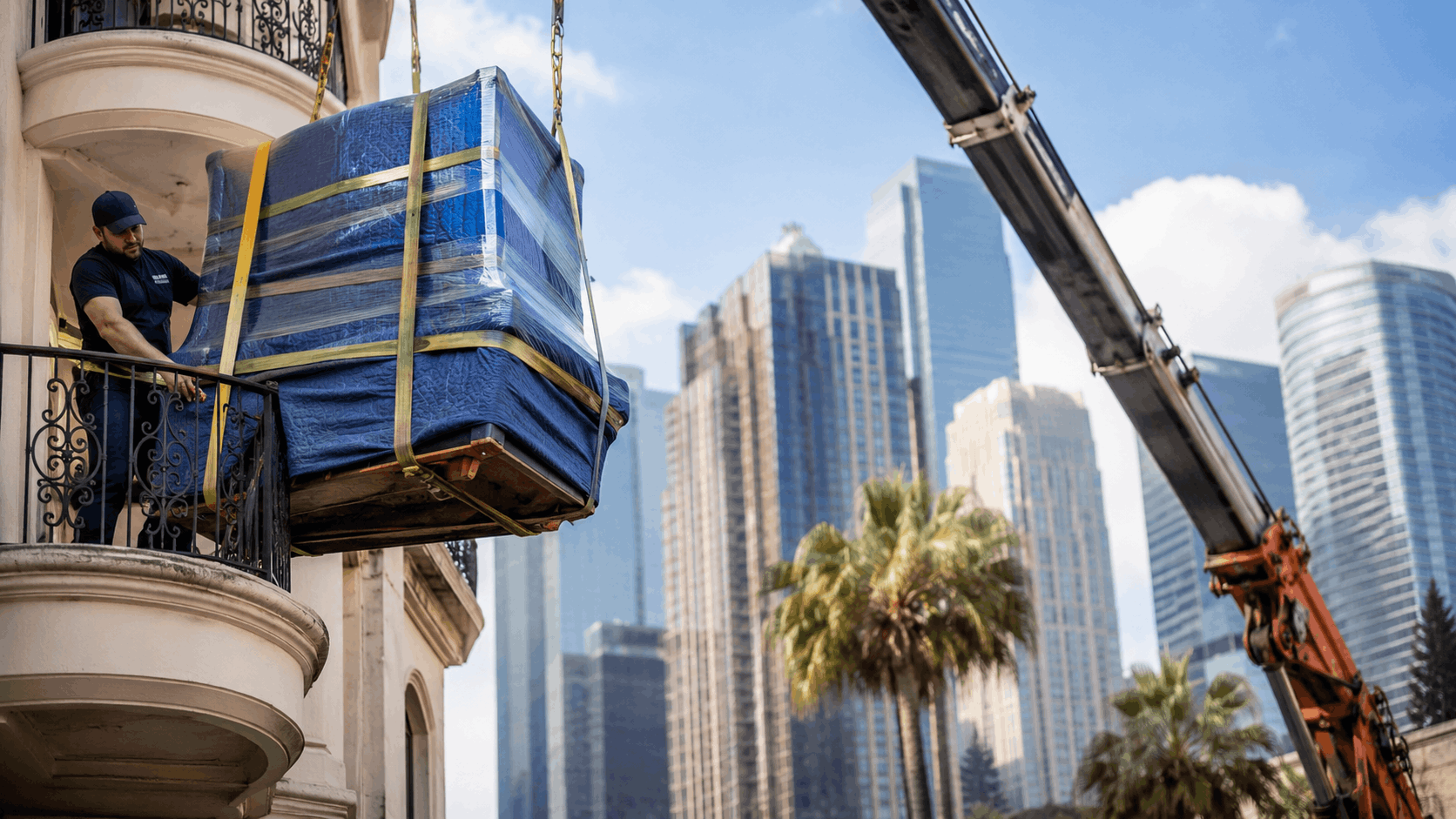
The answer was a crane. Crane-assisted moving lifts oversized furniture up and over a balcony railing or through a wide window opening, skipping the stairs and elevator entirely. It sounds dramatic, but for older walk-ups near Koreatown and glass towers along the Wilshire Corridor, it is often the only way to get a big piece into the home.
What Crane-Assisted Moving Actually Means
Crane-assisted moving is exactly what it sounds like. A crane or hoist lifts your furniture into the air, over the edge of a balcony or through a removed window, and sets it down inside your unit. It is the move you book when the front door path simply will not work.
Most people picture a giant construction crane, but the equipment used for furniture hoisting in Los Angeles is smaller and more precise. Here is what a typical job involves:
- A truck-mounted crane or a manual hoist system set up on the street or driveway
- Rigging straps and a lifting platform to cradle the furniture
- A ground crew guiding the load and a receiving crew on the balcony
- Padding and protection for the item, the railing, and the building wall
The whole point is to move something that cannot travel the normal route. Our team handles these lifts for clients across the city, from beach condos in Marina del Rey to hillside decks above Los Feliz.
How the Crane Lift Works Step by Step
The crane lift process starts long before move day, but the actual lift follows a clear sequence. First, the truck arrives and parks in the reserved curb space. The operator extends stabilizer legs, called outriggers, to keep the truck steady and level on the street.
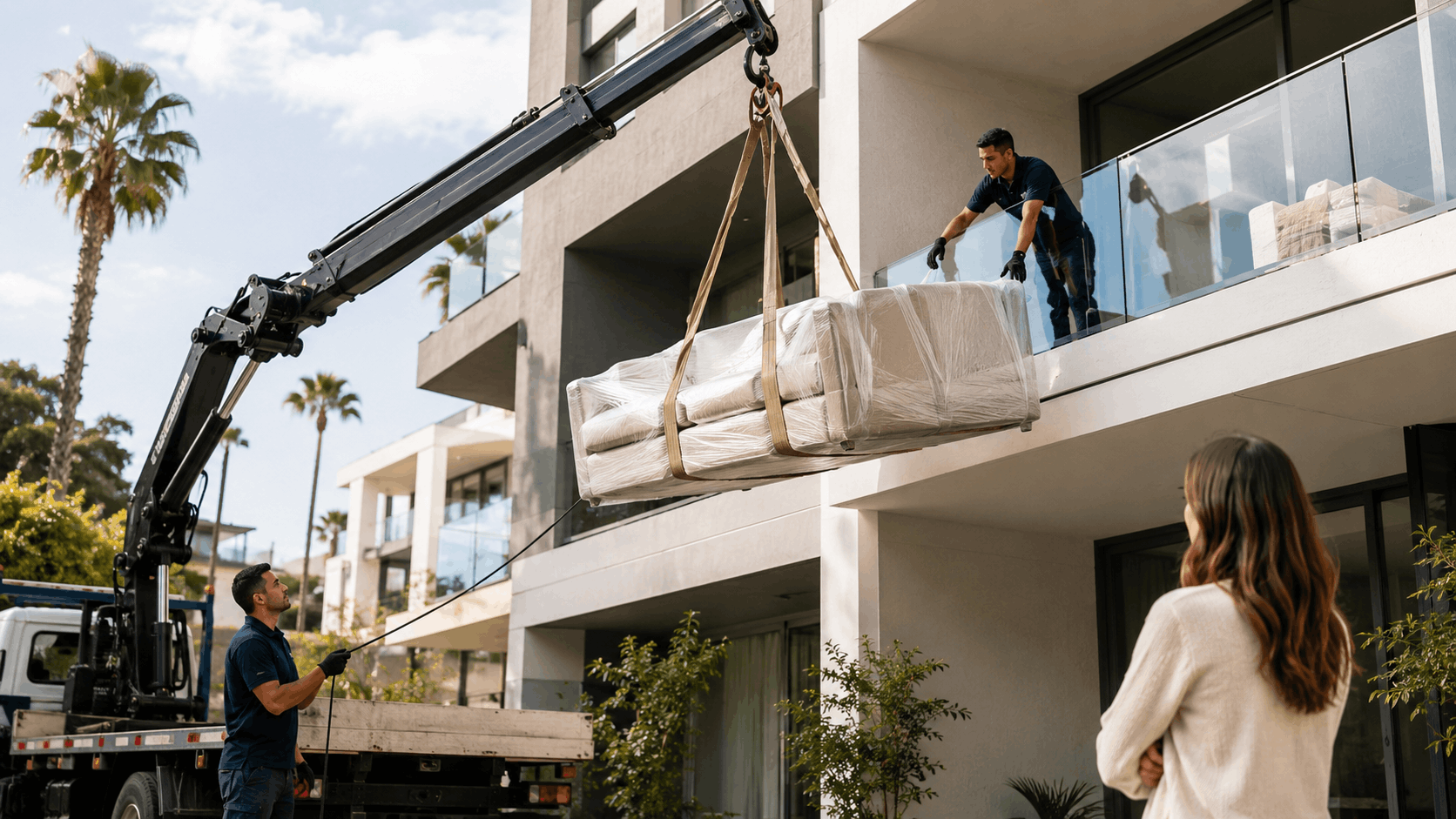
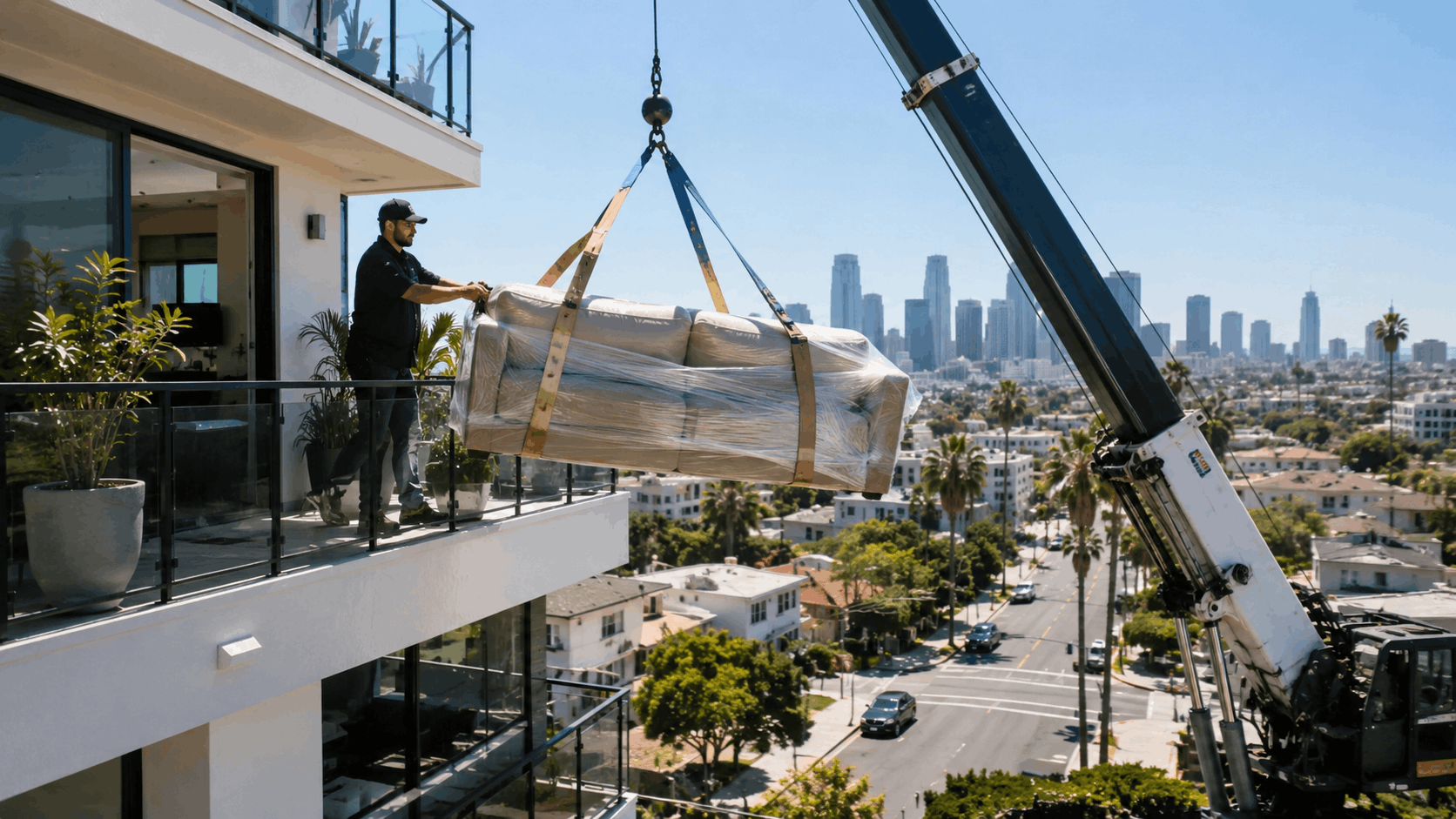
Next comes rigging. Our crew wraps the furniture in padding, then secures it with heavy straps rated for the item's weight. A sofa might sit on a flat lifting platform, while a piano gets cradled in a custom sling. The rigging is checked twice before anything leaves the ground.
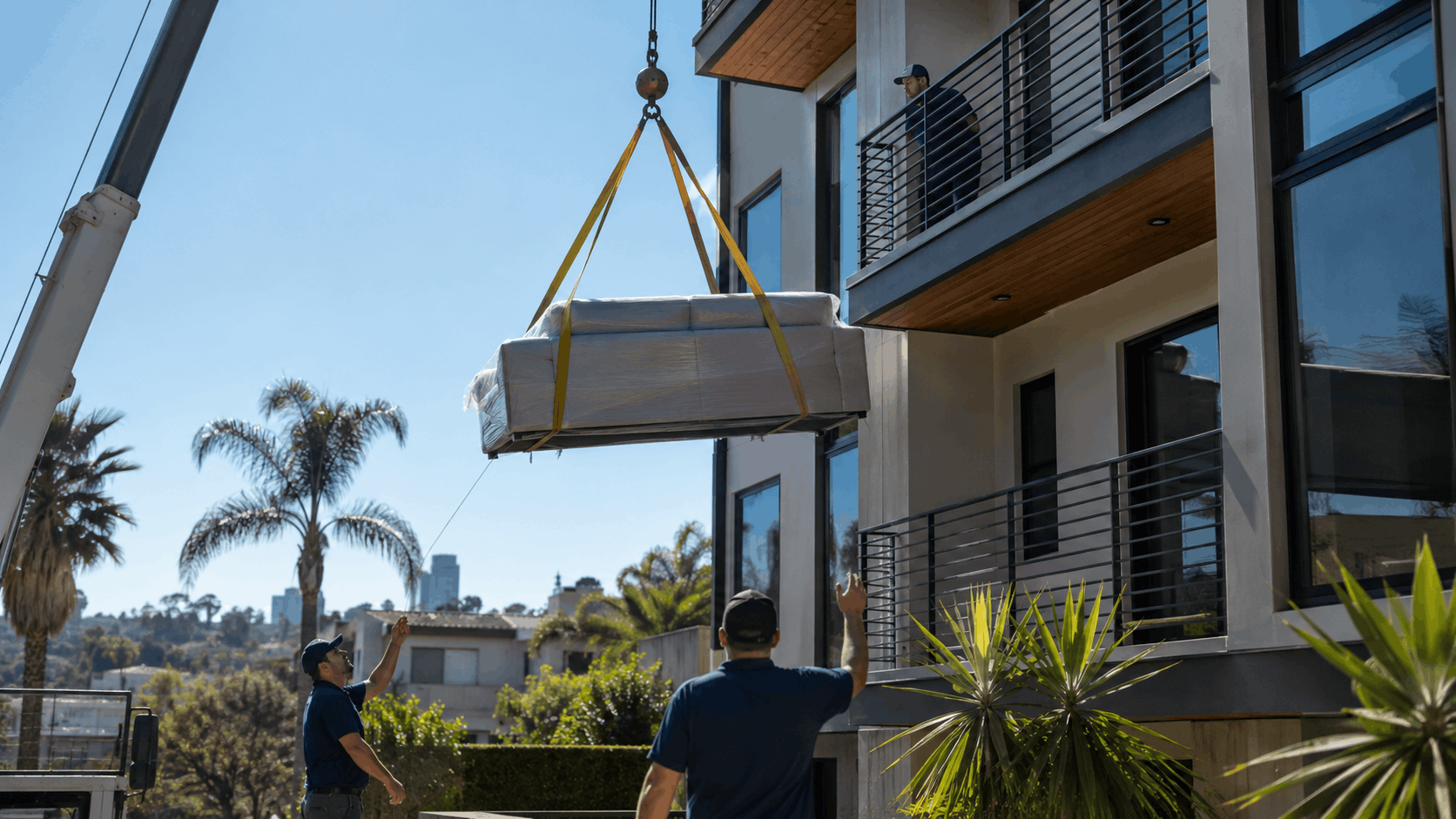
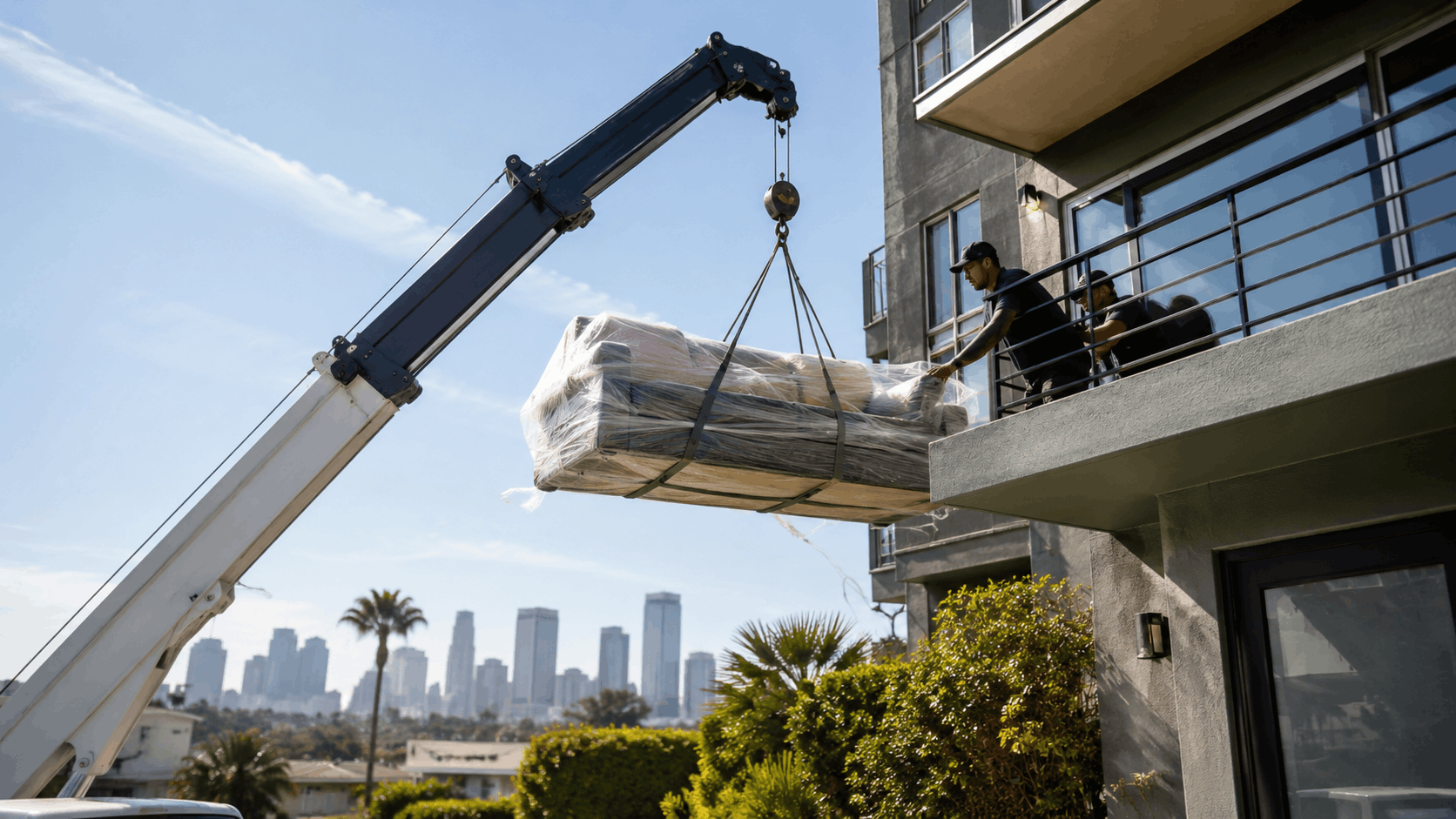
Then the lift begins. The operator raises the load slowly while a ground worker holds a tag line, a rope that keeps the item from spinning or swinging. As the piece rises to the balcony level, the receiving crew reaches out to guide it in over the railing.
Finally, the crew lowers the item onto the balcony or floor, removes the straps, and carries it to its spot inside. A clean lift of a single item usually takes 15 to 30 minutes once the crane is set up and rigged.
Balcony Lifts vs. Window Removals
There are two main ways to get furniture inside once the crane raises it. A balcony lift brings the item up and over the railing onto an open deck or patio. This is the simplest method because the balcony gives the crew room to receive and turn the piece.
Window removal is the other option, used when there is no balcony or the balcony is too small. The crew, or a glazier, removes a window pane or a sliding glass door from its frame. The furniture then passes straight through the opening into the room.
Balcony lifts fit most high-rise condos and apartments with patios. Window removals suit older buildings and units where the largest opening is a picture window. Both methods work, and our team picks the one that gives the widest, safest path for your specific item.
The choice also affects cost and timing. Window removals take longer because someone has to detach and later reinstall the glass. When we survey a job, we measure both the balcony railing gap and every window to decide which route saves time and risk.
The Difference Between a Crane and a Furniture Hoist
People use the words crane and hoist loosely, but they are different tools. A truck-mounted crane is a machine on a truck bed with a long hydraulic arm. It reaches high floors, handles heavy loads, and works best for towers and tall buildings.
A furniture hoist, sometimes called a ladder hoist or an outside elevator, is a motorized platform that runs up an angled track. It is lighter and cheaper, and it suits low- to mid-rise buildings, usually up to about the fifth or sixth floor.
The building height decides which one fits. A fourth-floor walk-up in Koreatown might only need a hoist, while a 20th-floor unit Downtown requires a crane with serious reach. Weight matters too, since a hoist has stricter load limits than a crane.
Our crews carry both options and match the equipment to the job. For a heavy safe going into a tall building, the truck-mounted crane is the clear choice. For a couch heading to a third-floor balcony, a hoist often does the work faster and for less money.
Get Your Free Quote
Tell us about your move and we'll get back to you fast.
When a Los Angeles Move Needs a Crane
Not every big item needs a crane. Most furniture goes through the door or up the stairs just fine. A crane comes into play only when the normal path is blocked, too tight, or too risky for the piece.
These crane moving situations show up again and again across the city. If your move matches one of these, a crane or hoist is likely the answer for your oversized furniture.
| Situation | Why a Crane Helps | Common LA Areas |
|---|---|---|
| Narrow, twisting stairwell | Big pieces cannot make the turns | Koreatown, Silver Lake |
| No freight elevator | Passenger elevator too small for the item | Downtown LA, Wilshire Corridor |
| Extra-heavy item | Too heavy to carry up stairs safely | Citywide |
| Steep or blocked ground access | Crane reaches upper decks from the street | Hollywood Hills, Mount Washington |
Narrow Stairwells in Older Buildings
Los Angeles has thousands of older walk-ups from the 1920s through the 1960s. Many sit near Koreatown, Silver Lake, and East Hollywood. These buildings have charm, but their stairwells were never built for modern oversized furniture.
The problem is usually the turns. A stairwell might be wide enough on the straightaway, but the landing where it doubles back leaves no room to pivot a long sofa or a tall armoire. Our crews measure the diagonal clearance, and often the math just does not work.
Handrails, low ceilings, and tight door frames at the top make it worse. Forcing a big piece through can gouge walls, scrape the item, or injure the crew. When we see one of these classic Koreatown walk-ups, a crane or hoist is frequently the safest call.
These same buildings often have small balconies facing the street, which makes a crane lift straightforward. We raise the item over the railing and skip the stairwell entirely, saving the walls and the furniture from damage.
High-Rise Units Without Freight Elevators
Downtown Los Angeles and the Wilshire Corridor are full of residential towers. Many have only passenger elevators, and those cabs are sized for people, not large furniture. A standard elevator often cannot fit a full sofa, a king mattress, or a tall armoire.
Even buildings with a freight elevator sometimes limit its use. Management may reserve it for certain hours, or the door opening may still be too narrow for the item. When high-rise moving hits these limits, the balcony becomes the entry point.
A truck-mounted crane can reach well past the 20th floor on many jobs. Our team has handled lifts into towers around Grand Avenue and along Wilshire, raising furniture that had no chance of fitting the elevator. For commercial jobs, our West Los Angeles commercial moving crews handle similar high-rise challenges.
The key with towers is planning the lift with building management. Balconies in these units face specific directions, and the crane has to set up where its arm can reach that side of the building from the street below.
Oversized Items Like Sofas, Pianos, and Safes
Some items are simply too big or too heavy to bend around corners. Large sectional sofas top the list, since they cannot flex or fold. An oversized sofa that measures over eight feet often will not clear a stairwell landing or an elevator door.
Pianos are another common reason for a crane. Grand pianos are heavy, awkward, and fragile all at once. Our piano moving specialists often use a crane to lift a grand onto an upper balcony rather than risk it on a narrow staircase.
Safes and gun safes are pure weight. A large home safe can weigh several hundred pounds or more, and no crew should carry that up multiple flights. A crane lifts it in one controlled motion instead.
Large appliances, oversized dining tables, and custom cabinetry round out the list. If an item is rigid, heavy, or extra long, and the path inside has tight turns, a crane lift is usually the right move. Our specialty moving team handles these tricky pieces every week.
Hillside Homes With Limited Ground Access
The hills around Los Angeles create their own moving puzzles. Homes in the Hollywood Hills, Mount Washington, and Echo Park often sit on steep lots with the living space above the street. The front door might be up a long flight of outdoor stairs.
In these hillside homes, the main living areas and decks are frequently on the upper floors to catch the view. Carrying a heavy piece up a steep exterior staircase is slow and risky. A crane parked on the street below can reach the upper deck directly.
Some hillside lots have no driveway at all, or a driveway too narrow for a moving truck. The crane sets up where it can, extends its arm over the slope, and lowers the furniture onto the deck. We have done this on winding roads above Beachwood Canyon and near the Hollywood sign.
Access surveys matter most for these jobs. Our team checks the road width, the slope, tree branches, and power lines before quoting. Once we confirm the crane can reach, a lift that seemed impossible becomes a routine 30-minute job.
Need Help in Los Angeles?
Popeye Moving & Storage serves Los Angeles and all of Los Angeles County.
What Crane-Assisted Moving Costs in Los Angeles
Cost is the first question most people ask, and it is a fair one. Crane-assisted moving costs more than a standard move because it involves special equipment, a licensed operator, and often a city permit. The good news is the pricing is predictable once you know the factors.
Here are typical ranges our clients in Los Angeles can plan around. Your final quote depends on the details of your building and item.
| Cost Component | Typical Range | Notes |
|---|---|---|
| Crane call-out minimum | $500 - $900 | Covers setup and first items |
| Hourly crane rate | $300 - $600 per hour | After the minimum, with operator |
| Furniture hoist (low-rise) | $400 - $800 | Lighter equipment, fewer floors |
| LADOT street use permit | $100 - $400 | Varies by street and closure |
| Full crane move total | $700 - $2,500+ | Single item, all-in |
Typical Price Ranges and Minimum Charges
Most crane jobs in Los Angeles start with a minimum charge. This call-out fee usually runs $500 to $900 and covers the truck, the operator, the setup, and the first item or two. The minimum exists because a crane costs the same to dispatch whether the lift takes 20 minutes or an hour.
Beyond the minimum, crane rental cost is often billed by the hour, roughly $300 to $600. That hourly rate includes the certified operator, since a crane cannot legally run without one. Extra items on the same visit add time but rarely double the price.
A furniture hoist for a lower building costs less, often $400 to $800 total. The equipment is lighter and needs less setup. For a single sofa going to a third-floor balcony, a hoist is usually the budget-friendly choice.
All in, a typical single-item crane move in LA lands between $700 and $2,500. Simple lifts to a low balcony sit at the low end. Tall towers, heavy pianos, and jobs needing street closures push toward the top.
Factors That Raise the Price
Several pricing factors move the number up or down. Building height is a big one. Reaching a 20th-floor balcony takes a larger crane with a longer arm than a fourth-floor lift, and bigger equipment costs more.
Weight is the next factor. A grand piano or a 600-pound safe needs heavier rigging and a crane with a higher load rating. The heavier and more fragile the item, the more careful and expensive the lift.
Street access changes the price too. If the crane has to set up on a busy road, a hill, or a spot far from the balcony, the job gets harder. Tight streets in the Hollywood Hills or crowded blocks Downtown sometimes require a full street closure, which adds permit and traffic-control costs.
Permit needs also affect the total. A quiet residential curb may need only a simple parking permit, while a busy avenue could require LADOT sign-offs and flaggers. We factor all of this into the quote so there are no surprises on move day.
How to Get an Accurate Quote
The best way to get a fair moving quote is an on-site survey. A photo or a phone description helps, but our team really needs to see the building, the street, and the item. Access details make or break the price.
During the survey, we measure the balcony railing gap, the window openings, and the item itself. We check where the truck can park and how far the crane arm must reach. We also look for obstacles like trees, awnings, and overhead wires.
Photos speed things up when an in-person visit is hard to schedule. We ask clients to send shots of the item, the balcony from inside and outside, and the street in front of the building. Clear measurements let us give a tight estimate before we arrive.
A good survey protects you from a low-ball quote that balloons on move day. When we quote a crane job, the number reflects the real conditions we saw. You can reach our team through our contact page to set up a survey.
Ways to Keep the Cost Down
There are real ways to save money on a crane move. Off-peak scheduling is the biggest one. Weekday mornings, especially outside the summer rush, often cost less than weekends, when demand and permit fees run higher.
Clearing the balcony ahead of time saves crew hours. If our team arrives to a patio full of plants, chairs, and a grill, that is time we spend moving your things instead of your furniture. A clear, open balcony makes the lift faster and cheaper.
Booking multiple items in one visit also helps. Since the crane minimum covers setup, adding a second or third piece to the same lift spreads that fixed cost across more items. It is far cheaper than two separate crane visits.
Finally, sharp measurements prevent wasted trips. If the item turns out to fit the elevator after all, you avoid the crane cost entirely. We always check the standard path first before recommending a lift.
Permits, Street Closures, and City Rules
Parking a crane on a Los Angeles street is not a free-for-all. The city regulates how equipment sits on public roads, and skipping the paperwork can stop your move cold or draw a fine. Here is the legal side, made simple.
Most crane jobs need at least one permit, plus building approval. Our team handles this paperwork for clients so the process stays smooth. Still, it helps to understand what is required and why.
Street Use and Parking Permits From LADOT
The Los Angeles Department of Transportation, known as LADOT, controls temporary street use for equipment like cranes. When a crane needs to occupy a lane or a stretch of curb, the job typically requires an LADOT permit. You can review the city's street use rules on the official LADOT website.
The permit type depends on how much of the street the crane blocks. A crane that fits in a metered parking zone needs a simpler permit than one that closes a travel lane. Busy corridors and bus routes face stricter review.
Processing time varies. A basic parking permit might be arranged in a few days, while a full lane closure on a major street can take a week or more. This is why booking early matters, especially for jobs in dense areas like Downtown.
Our team knows which permit each situation calls for and files it on the client's behalf. We coordinate the timing so the permit is active on move day and the crane has a legal, clear spot to set up.
HOA and Building Management Approvals
Beyond city permits, many buildings have their own rules. Condo boards and HOAs, common in Marina del Rey and along the coast, often require advance notice and an insurance certificate before any crane operates near the building. The Marina del Rey area has strict HOA communities in particular.
Building management may limit move hours, require a certificate of insurance naming the HOA, or ask for a security deposit against damage. Some towers only allow lifts on certain days to avoid disrupting other residents.
Getting HOA approval takes lead time. Boards may only meet weekly or monthly, and they often want to review the crew's insurance and the lift plan before signing off. Starting this process early keeps your move date on track.
Our team communicates directly with building staff and HOA managers. We provide the certificates and documents they ask for, and we schedule the lift within the building's approved window so the client does not have to chase paperwork.
Insurance and Liability Coverage
Crane work carries real risk, so proper insurance is non-negotiable. A qualified crane crew should carry general liability coverage plus specific coverage for the crane operation itself. Buildings ask for proof because a dropped item or damaged wall could be costly.
Moving insurance protects your furniture during the lift. Liability coverage protects the building, the neighbors, and anyone on the ground if something goes wrong. Reputable movers carry both and can name the building as an additional insured party on the certificate.
When a building requests a certificate of insurance, they want to see current limits and the right parties listed. Our team issues these certificates quickly so the approval process does not stall. It is a routine part of every crane job we handle.
Ask any mover for proof of coverage before a crane touches your furniture. A crew that hesitates or cannot produce a certificate is a warning sign. Our documentation is always ready and easy to share with your building.
How to Prepare Your Home for a Balcony Lift
A little prep on your end makes the whole lift faster, safer, and cheaper. When our crew arrives to a home that is ready, the crane job runs like clockwork. Here is how to prepare for a crane move.
Run through this checklist a day or two before the crew shows up. Each step removes a delay and lowers the risk of damage.
- Clear the balcony of plants, chairs, and clutter
- Measure every doorway, window, and railing gap
- Wrap and pad the item going up in the air
- Reserve curb space for the crane truck
- Confirm the lift time with your building or HOA
Clearing and Protecting the Balcony
The balcony is the landing zone, so it needs to be empty. Remove potted plants, patio furniture, grills, and anything else that blocks the space. The crew needs room to receive the item and turn it toward the door.
Sometimes the railing has to come off. A fixed railing may leave a gap too narrow for a wide sofa. In those cases, a section of railing is removed before the lift and reinstalled after. Check whether your railing detaches or is welded in place.
Protect the balcony surface too. If you have a tile or wood deck, a moving blanket or a sheet of plywood shields it from scuffs as the item lands and gets carried inside. Our crew brings padding, but clearing the space in advance speeds things up.
Let your building know if railing removal is planned. Some HOAs require their own maintenance staff to detach fixed railings, while others allow the moving crew to do it. Sorting this out early avoids a stall on move day.
Measuring Doorways, Windows, and Openings
Accurate measurements are the foundation of a smooth lift. Measure the item first, its length, width, height, and diagonal. The diagonal matters because a piece can sometimes tilt through an opening it would not fit flat.
Then measure the opening size at the balcony. Measure the width of the balcony door, the height of the sliding glass door, and the gap in the railing if a section comes out. Write these numbers down and share them with our team.
If a window removal is the plan, measure the window frame after the glass would be out. The clear opening is what counts, not the glass size. A few inches of clearance on each side makes for a safe, easy pass-through.
Double-check your numbers. A tape measure mistake is the most common reason a lift stalls. When we survey the job, we confirm every measurement, but your figures help us plan the right equipment before we arrive.
Wrapping and Securing Fragile Pieces
Anything going up in the air needs protection. Furniture wrapping starts with thick moving blankets around the whole piece. Blankets guard against scrapes from the rigging straps and any brush against the railing or wall.
Over the blankets, shrink wrap holds everything tight and keeps padding in place. For a sofa, this stops cushions from shifting mid-lift. For a wood piece, it guards the finish from the straps. Our crew wraps items on site, but you can pre-wrap smaller fragile things.
Delicate items like a piano or a glass-front cabinet get extra care. We add corner protectors and custom padding at stress points. Our packing and crating team can build custom crates for the most fragile or valuable pieces before a lift.
Secure loose parts before the lift. Remove cushions, drawers, glass shelves, and anything that could slide or fall. Transport these separately so the item going up is as tight and solid as possible.
Coordinating Parking on Your Block
The crane needs a clear, legal spot right where it can reach your balcony. On tight streets in Venice or Los Feliz, that curb space fills up fast. Reserving it ahead of time is a must.
If your street has metered or permit parking, our team arranges the LADOT permit to hold the space. On residential blocks, we sometimes place no-parking notices in advance so neighbors' cars do not block the crane's setup spot.
Narrow streets need extra thought. In parts of Venice near the canals or on the hillside lanes of Los Feliz, there may be only one workable spot for the truck. We scout this during the survey and lock in the location.
Give your neighbors a heads-up as a courtesy. A quick note that a crane will be on the block for an hour keeps everyone happy. Our crews work fast and clear the street as soon as the lift is done.
Need Help in Los Angeles?
Popeye Moving & Storage serves Los Angeles and all of Los Angeles County.
Safety and Weather on LA Crane Jobs
A crane lift looks dramatic, but it is a controlled, planned operation. Safety rules and weather limits guide every lift our crews perform. Understanding these helps you see why the process is steady and low-risk.
Los Angeles weather is mild most of the year, which is good for crane work. Still, wind and morning fog can affect the schedule. Here is how safety and local conditions shape a lift.
Wind Limits and Marine Layer Timing
Wind is the biggest weather factor for any crane. A suspended item catches the wind like a sail, and too much wind makes the load hard to control. Most crane operators set a wind limit, often around 20 to 25 miles per hour, above which a lift is postponed.
Coastal areas feel this more. Near Santa Monica and the beach cities, afternoon sea breezes can pick up quickly. For lifts in these areas, our team often schedules the work for the calmer morning hours. Clients in Santa Monica know the wind pattern well.
The marine layer is the other coastal factor. Morning fog rolls in along the coast and can limit visibility for the crane operator. On heavy marine-layer days, we may wait an hour or two for the fog to burn off before starting the lift.
Safety always wins over schedule. If the wind or fog crosses the limit, we reschedule rather than risk the load. A short delay is far better than a swinging item over a public street.
Securing the Load During the Lift
Keeping the item steady is the heart of a safe lift. It starts with rigging straps rated well above the item's weight. The straps cradle the piece so the load is balanced and cannot slip.
Tag lines control rotation and swing. A ground crew member holds one or two ropes attached to the load. As the crane raises the item, the tag line keeps it from spinning or drifting toward the building. This steady guidance is what makes the lift look smooth.
The operator raises and lowers the load slowly and deliberately. There are no sudden movements. Every motion is planned, and the crew communicates by radio or hand signals throughout. Load securing is a team effort from ground to balcony.
Before the lift, the crew does a test raise of a few inches. This confirms the balance and rigging are correct before the item goes high. Only then does the full lift proceed.
Protecting the Building and Neighbors
A good crane crew protects more than the furniture. Building protection means shielding walls, windows, and railings from contact during the lift. We use padding on the railing and any spot the item might brush.
The area below the lift is kept clear. No one stands under a suspended load. Our ground crew sets up a small safety zone on the sidewalk and keeps pedestrians and neighbors clear until the item is safely inside.
Shared spaces get attention too. In a condo building, we protect the balcony below and the common walkways. Neighbor safety is part of every plan, and we coordinate with building staff to manage foot traffic during the operation.
Cleanup is part of the job. Once the lift is done, we remove padding, notices, and any debris, and reopen the street or walkway. The block looks like nothing happened, aside from your new furniture upstairs.
Why Locals Trust Popeye Moving & Storage Co. for Crane Moves
Crane-assisted moving is a specialty, and experience shows in every lift. Our team has handled these jobs across Los Angeles for years, from beach condos to hilltop homes. Here is what sets our crane moving service apart.
We treat each lift as its own puzzle, because it is. The right equipment, the right permit, and the right crew make the difference between a smooth job and a stressful one.
Experience With LA High-Rises and Hillsides
Our crews know the towers and the hills. We have lifted furniture into high-rise units around Grand Avenue and along the Wilshire Corridor, where elevators simply cannot handle the item. That high-rise experience means we plan the crane setup right the first time.
The Hollywood Hills bring different challenges. Steep lots, narrow roads, and homes perched above the street call for careful access planning. We have reached upper decks above Beachwood Canyon and Mount Washington where a ground carry was impossible.
Each neighborhood has its own quirks. We know which Downtown blocks allow a crane to set up and which hillside roads are too narrow for a truck. That local knowledge saves time and avoids surprises on move day.
Years of these jobs have taught us how to read a building and a street quickly. When our team surveys your home, we draw on hundreds of past lifts across the city to plan yours.
Coordination With Permits and Building Staff
The paperwork is often the most tedious part of a crane move, so we handle it. Our team arranges LADOT permits, files for street use, and manages any closures the job requires. Clients do not have to figure out city forms.
We also work directly with building staff. Whether it is a Downtown high-rise doorman or a Marina del Rey HOA manager, we provide insurance certificates and schedule the lift within the building's approved window. Permit coordination is part of our full service.
This coordination prevents delays. A crane that shows up without the right permit or building approval wastes everyone's time and money. We confirm all approvals before the truck rolls out.
Our relationships with local building managers help too. Having worked in many of the city's towers and condo communities, we know their requirements and can move approvals along faster than a first-time crew.
Full-Service Moving and Storage Options
A crane lift rarely stands alone. It is usually one piece of a larger move. Our full-service moving means the same team can pack your home, transport your belongings, perform the crane lift, and unpack on the other side.
We also offer secure storage when timing does not line up. If your new place is not ready, or the building's crane day is weeks out, our storage solutions hold your furniture safely until the lift can happen.
Pairing services under one team simplifies everything. There is no coordinating between separate packers, movers, and crane operators. One crew, one plan, one point of contact for the whole job.
Whether you need a full local residential move with a crane lift at the end, or just the lift itself, our team handles it. Reach out through our contact page to talk through your job.
Need Help in Los Angeles?
Popeye Moving & Storage serves Los Angeles and all of Los Angeles County.
Final Thoughts
Crane-assisted moving turns an impossible move into a routine one. When the stairs twist too tight, the elevator is too small, or the home sits above a steep hill, a crane lifts your furniture safely over the balcony instead.
The cost is predictable, usually $700 to $2,500 for a single item, and the process is controlled from setup to landing. With the right permits, careful rigging, and a mild-weather window, a lift takes under an hour once the crane is in place.
If you have an oversized sofa, a piano, or a safe headed for an upper floor anywhere in Los Angeles, our team can plan the lift, handle the paperwork, and get it done. Call Popeye Moving & Storage Co. or reach us through our contact page for a survey and a fair quote.
Frequently Asked Questions
What is crane-assisted moving?
Crane-assisted moving lifts furniture over a balcony railing or through a removed window when stairs and elevators cannot handle the item. A truck-mounted crane or a hoist raises the piece from the street up to your unit, then the crew guides it inside. It is the standard solution for oversized sofas, pianos, and safes in tight buildings across Los Angeles where the normal entry path simply does not work.
How much does a crane move cost in Los Angeles?
A typical single-item crane move in Los Angeles runs about $700 to $2,500. Most jobs start with a call-out minimum of $500 to $900, then bill by the hour at $300 to $600. Factors like building height, item weight, street access, and permit needs push the price up or down. A furniture hoist for a low-rise building often costs less, around $400 to $800 total.
Do I need a permit for a crane on my street?
Most crane jobs on a public street need an LADOT street use or parking permit. The type depends on whether the crane fits in a parking zone or blocks a travel lane. Busy corridors and lane closures require more review and lead time. Our team arranges these permits for clients, files the paperwork, and times it so the permit is active on your move day.
How long does a balcony lift take?
Setup usually takes 30 to 60 minutes, including parking the truck, extending the outriggers, and rigging the item. The actual lift of a single piece then takes only 15 to 30 minutes from ground to balcony. A whole visit for one item often wraps up in one to two hours. Window removals or multiple items add time, but most lifts finish the same morning.
Is my furniture safe going over the balcony?
Yes, when the crew rigs it properly. Your item gets wrapped in blankets and shrink wrap, then secured with straps rated well above its weight. Tag lines keep it from swinging, and the operator raises it slowly with a test lift first. Trained crews perform these lifts every week and protect the item, the building, and the ground below throughout the operation.
What items usually need a crane?
The most common are large sectional sofas over eight feet, grand pianos, and heavy home safes. Big appliances, oversized dining tables, armoires, and custom cabinetry often need a crane too. These items are either too rigid to bend around corners, too heavy to carry up stairs safely, or too wide for an elevator. If your piece is big, heavy, and rigid, a lift is likely.
Can you lift furniture into a high-rise without an elevator?
Yes. A truck-mounted crane can reach well past the 20th floor on many buildings, so a missing or undersized freight elevator is not a dealbreaker. Our crews have lifted furniture into towers around Grand Avenue and the Wilshire Corridor where the item had no chance of fitting the passenger elevator. The crane sets up on the street and reaches the balcony directly.
What happens if it is too windy on move day?
Safety comes first, so a lift is postponed if wind crosses the operator's limit, usually around 20 to 25 miles per hour. Coastal areas near Santa Monica can get breezy in the afternoon, so we often schedule those lifts for calmer mornings. Heavy morning fog from the marine layer may also cause a short delay. We reschedule rather than risk a swinging load.
Do I need to remove my balcony railing?
Sometimes. If the railing gap is too narrow for your item, a section comes off before the lift and goes back on afterward. Some HOAs require their own maintenance staff to detach fixed railings, while others let the moving crew do it. We check this during the survey and sort out who removes it, so there is no delay on move day.
How far in advance should I book a crane move?
Book at least two to three weeks ahead when possible. Permits can take a few days to a week, and HOA or building approvals sometimes need board review that only happens weekly or monthly. Booking early gives time to file the LADOT permit, secure building sign-off, and reserve the crane. Last-minute lifts are sometimes possible, but early planning keeps your date secure.
Frequently Asked Questions
- What is crane-assisted moving?
- Crane-assisted moving lifts furniture over a balcony railing or through a removed window when stairs and elevators cannot handle the item. A truck-mounted crane or a hoist raises the piece from the street up to your unit, then the crew guides it inside. It is the standard solution for oversized sofas, pianos, and safes in tight buildings across Los Angeles where the normal entry path simply does not work.
- How much does a crane move cost in Los Angeles?
- A typical single-item crane move in Los Angeles runs about $700 to $2,500. Most jobs start with a call-out minimum of $500 to $900, then bill by the hour at $300 to $600. Factors like building height, item weight, street access, and permit needs push the price up or down. A furniture hoist for a low-rise building often costs less, around $400 to $800 total.
- Do I need a permit for a crane on my street?
- Most crane jobs on a public street need an LADOT street use or parking permit. The type depends on whether the crane fits in a parking zone or blocks a travel lane. Busy corridors and lane closures require more review and lead time. Our team arranges these permits for clients, files the paperwork, and times it so the permit is active on your move day.
- How long does a balcony lift take?
- Setup usually takes 30 to 60 minutes, including parking the truck, extending the outriggers, and rigging the item. The actual lift of a single piece then takes only 15 to 30 minutes from ground to balcony. A whole visit for one item often wraps up in one to two hours. Window removals or multiple items add time, but most lifts finish the same morning.
- Is my furniture safe going over the balcony?
- Yes, when the crew rigs it properly. Your item gets wrapped in blankets and shrink wrap, then secured with straps rated well above its weight. Tag lines keep it from swinging, and the operator raises it slowly with a test lift first. Trained crews perform these lifts every week and protect the item, the building, and the ground below throughout the operation.
- What items usually need a crane?
- The most common are large sectional sofas over eight feet, grand pianos, and heavy home safes. Big appliances, oversized dining tables, armoires, and custom cabinetry often need a crane too. These items are either too rigid to bend around corners, too heavy to carry up stairs safely, or too wide for an elevator. If your piece is big, heavy, and rigid, a lift is likely.
- Can you lift furniture into a high-rise without an elevator?
- Yes. A truck-mounted crane can reach well past the 20th floor on many buildings, so a missing or undersized freight elevator is not a dealbreaker. Our crews have lifted furniture into towers around Grand Avenue and the Wilshire Corridor where the item had no chance of fitting the passenger elevator. The crane sets up on the street and reaches the balcony directly.
- What happens if it is too windy on move day?
- Safety comes first, so a lift is postponed if wind crosses the operator's limit, usually around 20 to 25 miles per hour. Coastal areas near Santa Monica can get breezy in the afternoon, so we often schedule those lifts for calmer mornings. Heavy morning fog from the marine layer may also cause a short delay. We reschedule rather than risk a swinging load.
- Do I need to remove my balcony railing?
- Sometimes. If the railing gap is too narrow for your item, a section comes off before the lift and goes back on afterward. Some HOAs require their own maintenance staff to detach fixed railings, while others let the moving crew do it. We check this during the survey and sort out who removes it, so there is no delay on move day.
- How far in advance should I book a crane move?
- Book at least two to three weeks ahead when possible. Permits can take a few days to a week, and HOA or building approvals sometimes need board review that only happens weekly or monthly. Booking early gives time to file the LADOT permit, secure building sign-off, and reserve the crane. Last-minute lifts are sometimes possible, but early planning keeps your date secure.
P
Popeye Moving & Storage Co. Team Team
Licensed moving and storage professionals serving Los Angeles and Los Angeles County.
Licensed in California · License #PUC: CAL T 189749 | DOT: 1472924 | MC: 498816C
Why trust Popeye Moving & Storage?
Founded in 1994, Popeye Moving & Storage is a licensed and insured moving and storage service serving Los Angeles and Los Angeles County. All content is reviewed by our licensed technicians.

Need Help in Los Angeles?
Popeye Moving & Storage serves Los Angeles and all of Los Angeles County.
Related Articles
Cost Guides
Hourly vs Flat Rate Moving in LA: Which Costs Less and When
Compare hourly vs flat rate moving in LA with real price ranges, example moves, and local tips so you can pick the cheaper option for your situation.
Cost Guides
Why LA Moving Costs Spiked 40% Since 2020: Labor, Fuel, and Insurance Math
LA moving costs rose about 40 percent since 2020. Here is the real math behind labor, fuel, and insurance increases, plus tips to lower your moving cost.

Cost Guides
What Vaulted Storage Costs in Los Angeles - and Why It Beats a Self-Storage Unit for Furniture
Vaulted storage in LA runs $75-$150 per vault monthly and protects furniture better than a self-storage unit. See real costs, hidden fees, and when a vault wins.