Commercial Moving in Arts District, Los Angeles
Serving ZIP 90013, 90021
Arts District loft and studio moves planned around freight lifts, mezzanine stairs and crated artwork.
Popeye Moving & Storage has provided commercial moving to Arts District, Los Angeles and the rest of Los Angeles County since 1994. License #CAL T 189749 | USDOT 1472924 | MC 498816C. Fully insured.

Get Your Free Quote
Free in-home and video estimates. No obligation.
BBB A+ Rated
Accredited Business with an A+ rating from the Better Business Bureau.
Licensed and insured
CAL T 189749 | USDOT 1472924 | MC 498816C, fully insured.
Open seven days
6 AM to 9 PM, seven days a week. Call (310) 823-9510.
Free estimates, binding price
Free in-home and video estimates, with a guaranteed binding price after a video survey.
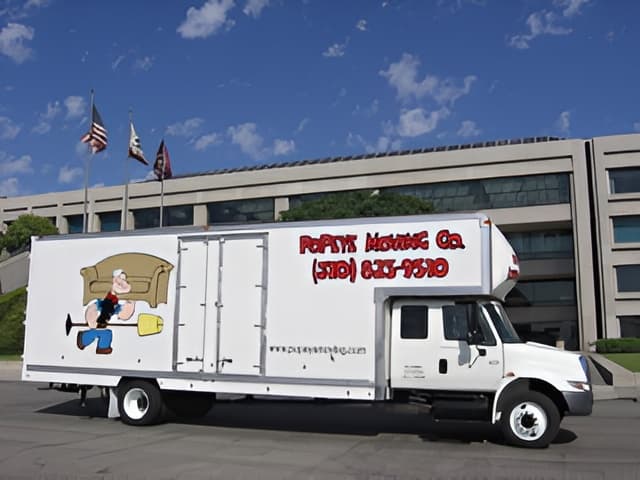
Reliable Commercial Moving in Arts District
Loft, studio and gallery moves in the Arts District, the converted warehouse quarter between Alameda Street and the Los Angeles River. Freight lifts, mezzanines, oversized furniture and crated artwork are planned before the date.
The Arts District sits on the eastern edge of Downtown Los Angeles between Alameda Street and the Los Angeles River, east of Little Tokyo and below the 101. Traction Avenue, Hewitt Street, Mateo Street, Santa Fe Avenue and Industrial Street form a warehouse grid where rail-era alleys and narrow dock aprons still control access, and former factories now hold live-work lofts, galleries, studios, restaurants and creative offices alongside newer residential buildings. It is in the City of Los Angeles, so curb reservations come from LADOT, with five working days of notice.
Commercial Moving in Arts District: What Changes Here
Commercial moving in the Arts District covers office and business relocations, retail and restaurant moves, and warehouse and industrial transfers in a neighborhood where converted freight buildings, live-work lofts and creative studios set the conditions for every job. The warehouse grid of Traction Avenue, Hewitt Street, Mateo Street, Santa Fe Avenue and Industrial Street still runs on rail-era alleys and narrow dock aprons, and the mix of gallery tenants, breweries, design firms and restaurant operators means after-hours scheduling, landlord coordination and specialty handling for large or fragile commercial contents are routine rather than exceptional.
Restaurant moves need licensed disconnect before loading
Retail and restaurant moving in the Arts District frequently involves ranges, refrigeration and bar fixtures in spaces that share alley loading with active breweries and food businesses. Gas and water lines must be disconnected by a licensed trade contractor before the crew can move equipment, and the building's loading bay height clearance and dock apron width need to be confirmed at the estimate, because older converted warehouses were not built for modern refrigeration units.
Warehouse moves face active dock competition
Warehouse and industrial moving along the Santa Fe Avenue and Industrial Street corridor means booking dock windows at both sites against competing delivery traffic, film production that can close a block at short notice, and rail spur frontage that limits where a truck can stage. Pallet racking layout at the destination should be mapped before the move begins so inventory stays accessible and the phasing plan does not stall mid-operation.
Office moves need building authorization confirmed first
Office and business moving in Arts District live-work conversions involves a landlord or building management that controls the freight lift booking, the loading bay and the certificate of insurance requirement, while the tenant is the one relocating. Establishing at the first call who authorizes the work and who pays, and obtaining building requirements in writing, prevents a situation where the crew arrives and the lift window has not been reserved.
Gallery contents need crating quotes, not volume quotes
Design businesses, galleries and artist studios in the Arts District move large framed work, canvases, sculpture, plinths, mirrors and studio equipment that is heavy and awkward rather than uniformly valuable. A commercial move quote built on cubic volume alone will not account for custom crating on individual pieces or the soft-handling work that glass, mirrors and finished surfaces require. The quote should reflect handling category by category, confirmed at the walkthrough.
Local Issues
Common Commercial Moving Issues in Arts District
Freight lift booking delays commercial move dates
In Arts District converted warehouses, a single freight lift often serves the entire building and is booked through management rather than simply used. For office and warehouse moves, a date without a confirmed lift window is not a real date. Management review of the certificate of insurance and the lift booking can take longer than expected, and a late request can push the move date by days or more.
Film production closes blocks without advance notice
Film production is frequent in the Arts District and can close a street at short notice, blocking truck access to a loading bay or dock apron that was clear at the site survey. For retail, restaurant and warehouse moves where timing is tied to a reopening date, check what is scheduled on the block on the move date rather than assuming conditions will match the walkthrough.
Corporate phasing plans stall without written dock windows
Corporate relocations consolidating Arts District sites depend on dock windows at each building being confirmed in writing before the phasing plan is finalized. If a dock window at the destination is not secured, inventory and equipment can arrive with nowhere to stage, stalling the operation and extending the time the business is not fully functional at either location.
Oversized commercial furniture blocked by corridor dimensions
Design firms and creative offices in Arts District lofts furnish for high-ceilinged open-plan spaces, and that furniture frequently will not pass through an older lift car or corridor turn. For office moves, measuring the lift car, door apertures and any stair turn against the largest workstations, conference tables or shelving units before the move date prevents a situation where a piece cannot be moved without disassembly that was not planned or priced.
Retail stock timing conflicts with alley delivery schedules
Retail moves along the Arts District warehouse grid share narrow alley loading with active food businesses, breweries and regular delivery vehicles working through the day. A retail move timed without checking the alley schedule can find the dock apron occupied or blocked. Confirming what deliveries or events are scheduled at neighboring businesses on the move date is part of planning the access, not an afterthought.
Get Your Free Quote
Tell us about your move. We'll be in touch soon.
What we offer in Arts District
Our Commercial Moving Services in Arts District
Office & Business Moving in Arts District
Most office moves are decided by the building, not the truck: when the service lift is free, when the dock is open and what the certificate of insurance has to say. Popeye Moving & Storage sorts that out first, then plans the move so your team is working again on the first morning in the new space.
Learn more →Corporate Relocation in Arts District
A corporate relocation is rarely one move. It is usually an office, an archive, a few executive suites and often several employees' homes, each with its own building rules and timeline. Popeye Moving & Storage has served Los Angeles since 1994 and builds the sequence for all of it before anything is loaded.
Learn more →Retail & Restaurant Moving in Arts District
A shop or restaurant loses money every day its doors are shut, so the move has to fit between the last service and the reopening. Popeye Moving & Storage plans around those two dates, the landlord's rules at both addresses and the trades who must disconnect equipment before our crew lifts it.
Learn more →Warehouse & Industrial Moving in Arts District
A warehouse move is planned around weight, dock access and what has to keep shipping while the move happens. Popeye Moving & Storage assesses both facilities first, then phases the work so orders keep going out and inventory is counted at each end.
Learn more →What to Expect - Commercial Moving in Arts District
- 1
Walkthrough estimate
Call (310) 823-9510. We visit both addresses, count workstations, check lifts and docks and note anything that needs a manufacturer's installer.
- 2
Building paperwork
We prepare the certificate of insurance, book the service lift and dock window with your property manager and confirm the curb permit for each city.
- 3
Move night or weekend
Furniture is dismantled, wrapped and labeled by destination room, moved and rebuilt to your floor plan, with IT equipment placed for reconnection.
- 4
Walk-through and sign-off
Your office lead checks the new space against the plan with our crew lead before we leave, so adjustments happen while we are still there.
Ready to Get Started?
Licensed CAL T 189749 | USDOT 1472924 | MC 498816C, fully insured and BBB A+ accredited. Free in-home and video estimates. Open 6 AM to 9 PM, seven days a week.
Local Tips
Commercial Moving Tips for Arts District Residents
For any office or warehouse move out of an Arts District converted building, get the building's freight lift dimensions, booking process and certificate of insurance requirements in writing from management before you confirm a move date with the crew.
If your commercial move involves pallet racking, send the destination layout to the crew before the first load leaves. Rebuilding racking to an unplanned layout on the day extends the time your inventory is inaccessible and can conflict with a dock window that has a fixed end time.
For restaurant and retail moves, confirm the alley loading schedule and any neighboring business delivery windows on your move date. The Arts District dock aprons are narrow and shared, and a blocked apron on the day has no easy workaround.
On a corporate relocation spanning multiple Arts District sites, ask for a written phasing plan that names each location, each move date and what moves in each phase, with dock windows at each building confirmed before the plan is signed off.
If your commercial contents include artwork, mirrors or studio equipment, ask for a line-by-line handling plan at the estimate rather than a single volume-based quote. Custom crating costs vary by piece, and the quote should reflect each handling category before anything is loaded.
Need Commercial Moving in Arts District? Get a Free Estimate.
What Customers Say About Our Commercial Moving in Arts District
Real reviews from Arts District and nearby Los Angeles neighborhoods.
“Porch pirates work our block by the Mid-Wilshire curb. They stayed with the truck and the Mid-Wilshire walk-through closed every latch.”
“Overnight drizzle glazed the Marina del Rey gate. Salt on the boards, slow dollies, and the Marina del Rey tile never spidered.”
“The cheap builder panel by the Marina del Rey curb already hummed. They kept magnets and metal dollies off it in Marina del Rey.”
Commercial Moving in Arts District - FAQs
Possibly two. Temporary street parking restriction signs reserve curb space, with five working days of lead time. An oversize vehicle parking permit, sold for up to three days at a time, legalizes a large truck's size and overnight parking but reserves no space, and online or mail applications can take up to two weeks. Commercial trucks with a logo or over 22 feet may not park overnight on city streets. Industrial frontage and red curb mean some blocks cannot be reserved, so we check yours and point you to LADOT for current fees.
Typical Los Angeles ranges are $150 to $200 per hour for a two-person crew and truck on local residential moving, $150 to $800+ per crate for custom crating and $300 to $1,200+ for fine art and antique moving. These are ranges, not a quote. Lift bookings, mezzanine carries and crating decide the actual figure, which is set in writing with a Not To Exceed amount before loading.
Yes, video and in-home estimates are both free, and a video survey gives a guaranteed binding price. Show the freight lift, the corridor, the mezzanine stair and your largest pieces, and send the building's booking rules so the estimate reflects them.
A freight lift is usually larger than a passenger lift, but in older conversions the lift car and corridor are often the tightest point rather than the unit door. We measure the lift car, door openings and stair turns against the piece in advance and plan disassembly or crating where it will not fit as is.
Yes. Framed work, canvases, glass, mirrors, sculpture, plinths and lighting are crated or soft-wrapped, and the quote reflects handling rather than volume alone. Studio tools and materials are planned separately because they are heavy and awkward rather than fragile. Items of extraordinary value are listed on the inventory with a declared value for each.
Usually building management or the landlord controls the dock, the lift booking and the insurance requirement, even though the tenant is the one moving. We establish at the first call who authorizes the work and who pays, and ask for the building's requirements in writing.
Under Maximum Rate Tariff 4, the default liability is up to $20,000 actual cash value unless you declare a different value. For canvases, framed work and studio electronics, which are light relative to their value, the weight-based rate basis pays very little. The responsible approach for Arts District commercial moves is to list items of extraordinary value separately on the inventory with a declared value for each, and to discuss full value protection at the estimate rather than after delivery.
Yes. Office, warehouse and retail moves in the Arts District are regularly phased around business hours or split across evenings and weekends so part of the operation stays running. A written phasing plan naming each location, each date and what moves in each phase is the starting point. For warehouse moves, the plan should also confirm dock windows at both sites and map racking at the destination before the first load leaves.
Confirm the freight lift dimensions and how it is booked through management, whether the building has a loading bay and its height clearance, door apertures and any corridor turns against the largest pieces, whether any unit has a mezzanine that is part of the carry, whether both LADOT permits are needed for the street, and what production, delivery or event activity is scheduled on the block on the move date.
Also serving