The Furniture a Small South Glendale Unit Cannot Fit and Where It Is Stored
Key Takeaways
- South Glendale's 1920s and 1930s courtyard buildings and walk-ups have narrow door openings, tight stairwell turns, and no elevators that stop wide or rigid furniture.
- Sectionals, sleeper sofas, armoires, china cabinets, large dining tables, pianos, and chandeliers are the pieces that most often will not fit a small unit here.
- Overflow furniture goes into full-service vaulted storage at the Mar Vista warehouse, where crews handle the goods and the customer has no key, unit, or independent access.
- Vaulted storage runs a typical area range of $60 to $90 per vault per month, with no minimum and no maximum term, and the warehouse is climate controlled.
- Most South Glendale streets sit in preferential parking permit districts under Municipal Code 10.36; a resident permit does not free a restricted curb, so confirm the block with Glendale Parking Services at (818) 548-3945.
- On a move into storage, California's default is up to $20,000 of actual cash value under Maximum Rate Tariff 4, while stored goods are governed by the warehouse standard of care under Commercial Code section 7204.
- Popeye Moving and Storage operates under CAL T 189749, is BBB accredited with an A+ rating, offers same-day pickup into the vault with no overnight hold, and can be verified with the Bureau of Household Goods and Services at (916) 999-2041.
In This Article
Someone signs a lease on a 1920s courtyard one-bedroom near Brand Boulevard, pictures the sectional in the living room, and then move-in day arrives. The sofa stops dead at the bottom of a narrow stairwell. The armoire will not clear the original door opening. The dining table has no angle left to turn on a tight landing. This is one of the most repeated scenes in South Glendale, and it catches good people off guard every month.
The housing stock here is the reason. South Glendale, below Colorado Street and running through ZIP codes 91204, 91205, and 91206, holds the densest apartment buildings in the city. These are period courtyard blocks and walk-ups built before oversized American furniture was common, with small door apertures, narrow stairs, and no elevator. A one-bedroom often cannot physically accept the furniture of the home a renter is leaving.
Why South Glendale Units Swallow So Little Furniture?
Walk the blocks around Central Avenue and you see the pattern fast. The South Glendale apartments south of Colorado Street were built mostly in the 1920s and 1930s, with mid-century blocks and 1960s and 1970s walk-ups filling in later. These are compact homes designed for the furniture of their era, not for a modern sectional or a king bed with a thick box spring.
A room count is a poor guide to what will actually fit. A one-bedroom in a courtyard building might have a decent living room floor area, yet the path to reach it defeats the furniture every time. The limit is almost never the room. It is the door, the stairwell, and the walkway between the curb and the unit.
That gap between what a room holds and what a route allows is why so many people end up needing storage. A small unit near Brand Boulevard can look spacious once you are standing inside it, but getting the big pieces through the building is the real test. Below are the four physical reasons furniture gets stuck here.
Period Courtyard Buildings and Their Original Door Apertures
The 1920s and 1930s courtyard and period apartment buildings around Central Avenue and Brand Boulevard were built with door openings sized for the furniture of that time. A door aperture from a 1920s building is often narrower than a modern builder would frame, because the sofas, wardrobes, and tables of the day were simply smaller and lighter.
That single factor stops wide pieces at the threshold more than anything else. A sectional cushion-to-cushion can measure wider than the clear opening of an original door, and no amount of tilting will push it through. The frame does not give, the casing does not move, and the piece goes no further.
A period apartment also tends to have doors that swing into tight entry halls, so even a piece that fits the opening may have nowhere to pivot once it is through. The entry geometry, not just the width, is what decides. We measure both the clear opening and the swing path before we ever quote a move into one of these units.
When a piece cannot clear a 1920s building door, there are only two honest outcomes. Either it comes apart into pieces that fit, or it goes into storage. Knowing which applies before move-in day saves a family a great deal of stress on the curb.
Narrow Stairwells, Tight Landings, and No Elevator
Most of the apartment stock here is two- to four-story walk-up buildings with no elevator. That means every large piece travels up a stairwell by hand, and the stairwell was not built with a modern armoire in mind. The run is often narrow, the headroom low, and the handrail eats into the usable width.
The real enemy is the turn. A long, rigid item has to pivot on a landing, and tight stairwell turns leave no room to swing a sofa or a long table around the corner. A piece that glides up the straight run can jam solid at the half-landing, wedged between the wall and the rail with nowhere to go.
This is why, in a South Glendale walk-up, the stairs and the carry distance set the hours, not the cubic volume of the load. A small one-bedroom with a third-floor unit and two tight turns can take longer than a larger ground-floor home. The crew is working the route, not just the boxes.
With no elevator as a backup, there is no shortcut. Either the piece makes the turns or it does not. For many of the biggest items, the sensible call is to store them rather than fight a stairwell that was never going to let them pass.
Open Courtyard Walkways Add a Second Obstacle
The older courtyard buildings add a problem the street never shows. Between the curb and the unit door runs an open courtyard walkway, often with a gate, a path, and sometimes a step or two before you even reach the stairs. That stretch is part of the move, and it adds real distance.
Every foot of that walkway is carry distance the crew covers by hand with each item. A longer carry means more time, and in an hourly move, more time means more cost. The walkway also tends to narrow at a gate or a planter, pinching the usable width right where a wide piece needs room.
Then come the corners. A courtyard layout rarely runs straight from street to stairwell, so a large piece faces several route turns before it even starts climbing. Each turn is another place a long sofa or a rigid cabinet can hang up and stall the whole carry.
We map the courtyard path on the pre-move check, counting the turns and noting any gate width or step. For buildings in the South Glendale area we serve, that walkway is often the deciding factor in whether a piece goes up or goes to storage.
More Contents Than a Room Count Suggests
Larger household sizes and multigenerational household living are common in South Glendale. That changes the math of a move. A one-bedroom here may hold the furniture of what was once a much bigger home, because two or three generations consolidated their belongings into a single lease.
The result is more contents than the room count would ever suggest. A studio can arrive packed with the dressers, tables, and seating of a full house, because the family brought what mattered rather than what fit. When the unit is small and the route is tight, a large share of that simply cannot stay.
That is where overflow furniture enters the picture. The pieces that will not fit, or that a family wants to keep for the next larger place, need somewhere to go that is not the sidewalk. Full-service vaulted storage is built for exactly this gap between a small current home and a bigger future one.
It is also worth knowing who is deciding. In a multigenerational home, the person calling may not be the person paying or the one who owns the contents being stored. We confirm who authorizes the work at the first call so the plan matches the household, not just the caller.
Get Your Free Quote
Tell us about your move. We'll be in touch soon.
The Furniture That Usually Loses the Fight
After enough South Glendale walk-ups, a clear list emerges of the pieces that repeatedly fail to fit. If you want to know in advance what is likely to become a storage candidate, these are the usual suspects. Walk your own rooms with this list before move-in day.
The common thread is simple. Oversized furniture that is wide, long, tall, or rigid struggles against narrow doors and tight stairwell turns. A piece can be beautiful and well made and still have no path through a 1920s building.
Below are the categories that most often become storage candidates. For each one, the issue is not whether there is floor space for it, but whether there is a route to carry it in. Knowing the difference is the whole point of this list of furniture that won't fit.
Sectionals, Sleeper Sofas, and Oversized Seating
A wide sectional sofa is the piece we see defeated most often in South Glendale. Even when the living room has clear floor space for it, the sofa has to reach that room first, and the narrow stairwell or the small door opening ends the trip. A one-piece sectional cushion is frequently wider than an original door frame will allow.
Modular sectionals give a little hope because they come apart into sections, which can clear a tight route where a single-piece unit cannot. But some sectionals are built as one rigid frame, and those have no give at all. Once a solid frame meets a landing turn it will not take, the move stops.
A sleeper sofa is worse again, because it hides a steel folding mechanism and a mattress inside. That makes it heavy, dense, and completely rigid, with no flex to help it around a corner. Carrying a sleeper up a narrow walk-up stairwell with a tight turn is one of the harder jobs in this housing stock.
Oversized seating of any kind, deep armchairs, reclining sofas, and chaises included, tends to fail the same test. When the piece will not make the route and cannot come apart, storage is the answer, and these bulky items are exactly what vaulted storage is built to hold.
Dining Tables, China Cabinets, and Armoires
Tall, rigid case goods are the next group that loses the fight. An armoire is often too tall to stand upright in a stairwell and too wide to tilt through a narrow door, and because it is a single sealed box, it cannot be made smaller. Grandma's armoire stalling at the threshold is a scene we know well in these buildings.
A china cabinet brings the same height and rigidity, with the added worry of glass doors and glazed panels. It cannot be angled sharply through a tight landing without risking the glass, so it either travels a route with room to spare or it does not travel at all. Many simply will not clear a period apartment's stairwell turns.
A large dining table is a mixed case. Many tables separate into a top and legs, or extend and collapse, which can turn an impossible carry into a manageable one. That disassembly is often the difference between a table that fits and one that heads to storage.
The honest point is that some of these pieces disassemble and some do not. A solid wood armoire with a fixed carcass has no breakdown path. When a rigid case good cannot be reduced and cannot make the turns, the vault is where it waits for a home with a wider door.
Pianos, Chandeliers, and Fine Furniture
Some pieces are not just hard to fit, they are items a family wants protected rather than squeezed into a small unit. A piano is both. An upright is heavy and awkward on a stairwell, a grand is larger still, and neither belongs wedged into a studio where it cannot be played or properly cared for.
A chandelier is the opposite problem. It is fragile rather than bulky, with arms and crystals that break on contact, and a small unit rarely has the ceiling height or the wiring to hang it anyway. Families moving into a courtyard one-bedroom often choose to store an inherited chandelier until a suitable home comes along.
Fine furniture, antiques, and inlaid or veneered pieces fall into the same category. They may technically fit, but a cramped unit with high foot traffic is a poor place for a delicate heirloom. Storing them keeps them out of harm's way during the stretch in a tight apartment.
These are exactly the categories accepted into our vaulted storage. Our warehouse takes wine, fine art, pianos, and chandeliers, handled by our own crews. For the specialty work itself, our piano moving team and our fine art and antique movers handle the pieces that need the most care.
Seasonal and Extra Bedroom Sets
When a household downsizes into a studio or one-bedroom, the spare room furniture is the first thing to go into storage. A full bedroom set, the bed frame, dresser, nightstands, and mirror, has no place in a unit that already struggles to hold one bedroom. There is simply no second room to put it in.
Extra beds are a particular problem. A guest bed, a child's bed that is not needed yet, or a second mattress set takes up space the new unit does not have, yet most families are not ready to part with it. Storage keeps it available for the next home without crowding the current one.
Seasonal furniture follows the same logic. Patio sets, outdoor seating, holiday pieces, and anything used only part of the year are easy to store and hard to justify keeping underfoot in a small apartment. These items sit in a vault until the season or the space calls for them.
Downsizing into South Glendale's smaller units is usually a step between homes rather than a permanent shedding. People keep the furniture of the larger life they expect to return to. Full-service storage bridges that gap, holding the extra sets safely until the household grows into more room.
Need Help in Los Angeles?
Popeye Moving & Storage serves Los Angeles and all of Los Angeles County.
Where the Overflow Goes: Vaulted Storage in Mar Vista
When the furniture will not fit, it goes to our full-service vaulted storage warehouse at 5509 1/2 S Centinela Ave in Mar Vista, on the Westside of Los Angeles. This is the same address as our business location. It is where South Glendale overflow furniture lives until a larger home is ready.
Our Mar Vista warehouse runs on a full-service vaulted model, which is different from the self-storage most people picture. You do not rent a room and keep a key. Our crews receive the furniture, load it into wooden storage vaults, and keep those vaults inside the warehouse.
That is what full-service storage means in practice. The customer hands off the furniture and we take it from there, from pickup through storage to the eventual return. The sections below explain exactly how that works and what it means for your belongings. You can read more on our vaulted storage page.
Full-Service Vaulted Storage, Not a Self-Storage Unit
With full-service vaulted storage, the customer has no key, no individual unit, and no right of entry. The furniture is handled by our crews from the moment it leaves the apartment until the day it comes back. This is a genuinely different model from renting a self-storage space where you come and go as you please.
The no key part surprises some people at first, but it is the heart of the service. Because our trained crews load, store, and retrieve the goods, the furniture is packed into the vault properly and left undisturbed. There is no risk of a customer's own hurried handling damaging a delicate piece during a late-night access run.
The self-storage difference also matters legally, which we cover later in this guide. In short, because you do not have a unit, a key, or independent access, this storage sits under a different set of California rules than a self-storage locker does. That changes how your goods are protected.
For a South Glendale renter between homes, this model fits the real need. Most storage customers here are not planning to visit their belongings during the term. They need the overflow held safely and professionally until the next place is ready, which is exactly what full-service vaulted storage provides.
What a Storage Vault Is and How Big It Runs
A wooden vault is a sturdy plywood container built on a reinforced floor set on runners, with forklift access on all four sides. Your furniture is loaded inside it, and the vault becomes the unit of storage. Several vaults are stacked and stored together inside the climate-controlled warehouse.
As for storage vault size, the common wooden storage vault runs roughly seven feet by five feet by just under eight feet on the outside, as a typical catalogue figure rather than any industry standard. There is no national specification governing vault dimensions, and manufacturers build custom sizes to order, so treat any size as approximate.
We run the full range of vault sizes, standard through oversized, to match the load. A small one-bedroom overflow might fill a single vault, while a larger consolidation needs several. We assess the furniture and tell you how many vaults the job calls for.
On vault capacity, published figures describe exterior volume, and usable interior is lower once the wall thickness is accounted for. For that reason we size the storage to your actual pieces rather than to a cubic-foot number on a spec sheet. What matters is that your furniture fits safely inside, padded and secure.
Loaded Once, Moved as a Unit
The real advantage of a vault is how little the furniture gets touched. A vault is loaded once at origin, or at the warehouse, and from then on it is moved as a single unit by forklift. Your belongings are not repacked or shuffled between shelves.
Because the furniture is handled once and then left sealed, there are fewer opportunities for the bumps and scrapes that come with repeated handling. Compare that to a self-storage cycle, where items are carried in, moved around, pushed to the back, and dug out again over the course of a tenancy. Every one of those touches is a chance for damage.
A sealed vault also keeps the contents together and protected from the general warehouse traffic. Once the lid is on, the vault is just a box the forklift lifts and places. The furniture inside rides along as one stable load.
This is how the mechanism works, and it is one of the practical reasons families trust full-service storage for pieces they care about. The less a china cabinet or a dining table is handled, the better its odds of coming out exactly as it went in.
Climate Controlled, With No Minimum or Maximum Term
Our Mar Vista warehouse is climate controlled for both temperature and humidity. That matters for the categories South Glendale households tend to store, since wood furniture, leather, veneer, and musical instruments respond to swings in conditions. The specification is confirmed per shipment rather than stated as a single fixed figure, because it varies with what is being stored.
On the storage term, there is no minimum and no maximum. Whether you need a few weeks between leases or a long stretch while you search for a larger place, the term bends to your situation. You are not locked into a length that does not match your move.
The warehouse also accepts commercial storage alongside household goods. If a South Glendale household is also storing business inventory, office furniture, or retail stock, it can go into the same operation. Our commercial and business storage handles that work.
What the warehouse does not take is vehicles. There is no car, motorcycle, boat, or RV storage here. For furniture, specialty pieces, and household or business goods, though, the climate-controlled vaulted model is built to hold them for as long as you need.
Getting Oversized Pieces Out of a Walk-Up
Knowing a piece will not fit is one thing. Getting it out of a South Glendale walk-up and onto the truck is the hands-on part. Here is how the hard-to-move furniture actually leaves the building and heads to storage.
Moving oversized furniture out of a period apartment is a planned operation, not a matter of brute force. The route, the disassembly, and the truck position all get worked out before the crew lifts a single item. That planning is what keeps a tight stairwell from turning into a stuck sofa.
Every walk-up move here turns on the same few questions. Where can the truck stand, what has to come apart, and how long is the carry. Disassembly answers the first of those for many pieces, and the rest follows from the building itself.
Measuring the Route Before Anything Moves
The job starts with a route measurement, not with lifting. We confirm the floor, the number of flights, the stairwell turns, and whether the path runs through a courtyard before we quote. These are the facts that decide how long the move takes and whether a given piece can make it out at all.
The stairwell turns get special attention. A long sofa or a rigid cabinet lives or dies on the landings, so we note the width at each turn and the headroom overhead. A piece that clears the straight run can still be impossible at the half-landing, and it is better to know that in advance than to discover it with the item wedged in place.
A proper pre-move check also covers the courtyard walkway, any gates, and the door apertures at the unit. For a South Glendale period building, those original openings are often the tightest point, so we measure the clear width rather than guessing from the door's appearance.
Photographs make the whole thing easier. For households where several family members are involved, pictures of a tight landing or a narrow door let everyone agree on the plan before the day. That is especially useful in the multigenerational homes common here, where more than one person has a say in the decision.
Disassembly and Protective Wrapping
Furniture disassembly turns many impossible carries into routine ones. Dining tables come apart into a top and legs, bed frames break down to rails and a headboard, and modular pieces separate into sections. Taking a piece apart often shrinks it below the width of the door and the turn that would otherwise stop it.
Not everything disassembles, and we are honest about which pieces do. A solid-carcass armoire or a one-piece sectional frame has no breakdown path, and those go to storage whole or not at all. For the pieces that do come apart, we keep the hardware organized so reassembly at the next home is straightforward.
Before anything travels, finished surfaces get protective wrap and padding. Moving blankets, pads, and wrap guard against the scrapes of a tight stairwell carry and the long stay inside a vault. A wood dresser that brushes a stairwell wall unprotected can pick up a gouge that a pad would have prevented.
Wrapping also matters for the storage stretch itself. Padded, covered pieces sit better inside the vault and are shielded from dust and contact with their neighbors. For items that need more than pads, our custom crating service builds a solid enclosure around the most fragile pieces.
Where the Truck Can Legally Stand
The truck parking position drives the whole job. Where the truck can legally stand sets the carry distance, and the carry distance drives the hours. In South Glendale that is the hardest part of the move, because the buildings hold far more households than the curb can serve.
Resident parking here is saturated at every hour, and most streets fall inside preferential parking permit districts. Finding a legal position for the truck close to the door takes planning, not luck. We work out the truck spot before the day rather than circling the block when the crew arrives.
The longer the carry from wherever the truck can stand, the more time the move takes, and on an hourly job that means more cost. A truck parked around the corner from the courtyard entrance adds distance to every single item. That is why the truck position is the first thing we settle.
Because the rules vary block by block, we point customers to Glendale Public Works Parking Services to confirm the requirements for their specific street. Glendale does not publish a single standard moving-truck permit process, so the only reliable answer comes from the city for that exact address.
Managed Buildings on the Arterials
Not every South Glendale building is a walk-up. Newer buildings along the arterials, the larger blocks on and near the main streets, have a service elevator and a management office instead of a narrow stairwell. The problem shifts from stairs to scheduling.
These buildings usually require an elevator reservation in a fixed window, so the move has to fit the building's calendar. They also commonly require a certificate of insurance naming the building owner and the management company before the crew can work. That document takes a little lead time to arrange, so it cannot wait until the morning of the move.
Many managed buildings add a deposit and set permitted move hours, often excluding evenings or weekends. Missing the window or skipping the paperwork can mean a wasted trip, which is why these details get locked down early.
We establish which type of building you are in at the first call. A walk-up and a managed tower need completely different plans, and sorting that out up front keeps the move on schedule. For apartment work of either kind, our apartment moving team handles the building requirements.
Glendale Parking Rules That Affect the Pickup
Parking is the single biggest variable in a South Glendale storage pickup. It decides where the truck stands and how long the carry takes, which in turn decides the hours on an hourly move. Here is the parking reality that shapes the job.
Glendale parking in this part of the city is tight everywhere, and the rules are local to Glendale, not Los Angeles. Confirm which city an address is in first, since the L.A. boundary sits close on the southern and western edges of South Glendale. The rule for a Glendale block does not match the rule a block over the line.
There is no single moving truck permit process you can count on across the city. Each block's requirements come from Glendale Public Works Parking Services, and the permit district covering the street changes what is allowed. The sections below cover what that means for your pickup.
Preferential Parking Permit Districts Cover Most Streets
South Glendale is heavily covered by preferential parking permit district designations. These are set under Municipal Code 10.36 and posted by sign on the affected streets. Finding a block in South Glendale that is not inside one of these districts is the exception, not the rule.
The districts exist because resident parking demand here outstrips the curb by a wide margin. The dense apartment buildings put far more cars on the street than the block can hold, so the city reserves parking for residents with permits. That same saturation is what makes a legal truck spot so hard to find.
For a storage pickup, this means the crew cannot simply pull up and park. The truck needs a legal position that respects the district's rules and the posted signs, and that position may not be right outside the door. The distance from it to the unit becomes carry distance, and carry distance becomes time.
Planning the truck spot against the permit district ahead of the day is the only way to keep the carry short and the hours down. We sort this out during scheduling so the crew is not left hunting for a spot while the clock runs.
A Resident Permit Does Not Free the Curb
Here is the point customers get wrong most often. A valid Preferential Parking Permit does not exempt a vehicle from posted No Parking zone restrictions or times. The permit lets a resident park in a district where others cannot, but it does nothing to override a posted ban.
So a resident permit neither frees a restricted curb nor legalizes a moving truck in a spot the signs prohibit. A tenant who assumes their permit will cover the truck is in for a ticket or a tow. The permit and the posted restrictions are two separate things.
Every posted restriction on the block still applies regardless of any permit. Street sweeping hours, red zones, loading limits, and time-of-day bans all stand. The crew works within those postings, which is another reason the truck position is settled in advance rather than improvised.
The safe approach is to read the signs on the exact stretch of curb the truck will use and confirm the rules with the city. Assuming a permit covers the move is the most common way a South Glendale pickup runs into trouble before it even starts.
Who to Call to Confirm the Block
To check whether an address sits in a permit district, Glendale gives the number (818) 548-3945 through its Parking Services office. That is the first call to make, because it tells you what rules govern the street before you plan anything else.
For permit processing questions, the city's Permit Processing Center is reached at (866) 470-3088, open 8am to 5pm Monday through Friday. These are the people who handle the paperwork side, and their hours are worth noting so a call does not fall on a weekend when the move is Monday.
The reason you have to confirm address by address is that Glendale does not publish a single standard moving-truck permit process. Unlike some neighboring cities, there is no one form and one fee that applies citywide. The requirement depends on the specific block.
We help customers work through this during scheduling, but the official word comes from the city for that exact street. Confirming the block early keeps the pickup legal and keeps the truck as close to the door as the rules allow. You can see more about our work across the city on our Glendale moving page.
Need Help in Los Angeles?
Popeye Moving & Storage serves Los Angeles and all of Los Angeles County.
What It Costs to Store the Overflow
Budgeting for storing furniture that will not fit means looking at two things: the monthly storage and the move that feeds it. Below are the typical price ranges for the Los Angeles area so you can picture the whole cost, not just one piece of it.
These are typical market price range figures for the area, not a quote or a fixed price from us. The actual moving cost and storage cost for your situation depend on your furniture, your building, and your block, and the price is set in writing before anything is loaded, with a not-to-exceed figure on a move inside California.
| Service | Typical Area Range |
|---|---|
| Vaulted storage | $60 to $90 per vault per month |
| Local residential moving (two-person crew and truck) | $150 to $200 per hour |
| One-bedroom apartment local move | $350 to $650 |
| Piano moving | $200 to $600 |
| Chandelier moving | $150 to $450 |
| Fine art and antique moving | $300 to $1,200+ |
| Custom crating | $150 to $800+ per crate |
Vaulted Storage by the Month
Vaulted storage runs a typical area range of $60 to $90 per vault per month. That is the vaulted storage cost figure to plan around, presented as a typical range for the Los Angeles market rather than a set price. The monthly bill tracks the number of vaults your furniture fills.
The per vault per month structure is why the amount of furniture matters so much. A single overflow sofa and a bedroom set might fit in one vault, while a full household consolidation needs several. More furniture means more vaults, and more vaults means a higher monthly figure.
Because there is no minimum term, the typical range applies whether you store for a month or much longer. You pay for the vaults you use for the time you use them. We assess the furniture during scheduling and tell you how many vaults the job is likely to need.
That vault count is the main lever on your storage budget, so it is worth sorting out which pieces truly need to go in. Storing only what will not fit, rather than everything, keeps the monthly cost in check.
The Local Move Into Storage
Getting the furniture from a South Glendale unit to the Mar Vista warehouse is a local move. The typical local moving rate for the area is $150 to $200 per hour for a two-person crew and truck. A full one-bedroom apartment local move typically runs $350 to $650, again as area ranges rather than a quote.
On an hourly crew job, the stairs and the carry are what fill the hours here. We said it earlier and it holds: in a South Glendale walk-up, the flights, the landing turns, and the distance from the truck set the time, not the cubic volume of the load.
That is why a smaller one-bedroom move out of a third-floor walk-up with tight turns can take longer than a larger ground-floor job. The route is the work. A long carry from a truck parked down the block, up three flights, adds real time to every item.
The upside is that this is predictable. Once we know the floor, the turns, and the truck position, we can estimate the hours and set a written not-to-exceed figure that caps what you pay. Our residential moving team handles these local pickups into storage.
Specialty Pieces and Protection
The pieces most likely to go to storage are often the specialty items, and they have their own typical ranges. Piano moving cost in the area runs $200 to $600, with upright pianos costing less than grand pianos. These require specific equipment and training, which the range reflects.
Chandelier moving typically runs $150 to $450, reflecting the care needed to take down, pad, and transport a fragile fixture without breaking an arm or losing a crystal. Fine art and antique moving typically runs $300 to $1,200 and up, depending on the piece and the protection it needs.
For the most delicate items, custom crating typically runs $150 to $800 and up per crate. A built enclosure protects a mirror, a glass cabinet panel, or a piece of art far better than pads alone during both the carry and the long stay in the vault.
These figures are typical area ranges, not quotes. The exact price depends on the piece, the building, and the protection required, and it is set in writing before any work begins. Our specialty moving service covers these items from pickup to the vault.
Why Double Drive Time and an Early Start Matter
California bills local hourly moves on a double drive time convention. That means travel time between origin and destination is charged at twice the actual driving time. It is a legitimate, regulated charge rather than a padding tactic, and it is worth understanding because it affects your bill.
Since the charge is built on drive time, traffic directly raises the cost of getting your furniture from South Glendale to Mar Vista. The 134, the 2, and the 5 all serve this area and congest heavily. The slower the drive, the more double drive time adds up.
This is where an early start pays off. Beating the worst of the traffic on those freeways shortens the actual drive, and because that time is doubled under the convention, every minute saved on the road counts twice on the bill. A morning pickup usually beats an afternoon one.
We plan pickups with the traffic in mind for exactly this reason. Timing the drive to the warehouse around the freeway crush keeps both the drive time and the doubled charge as low as the day allows.
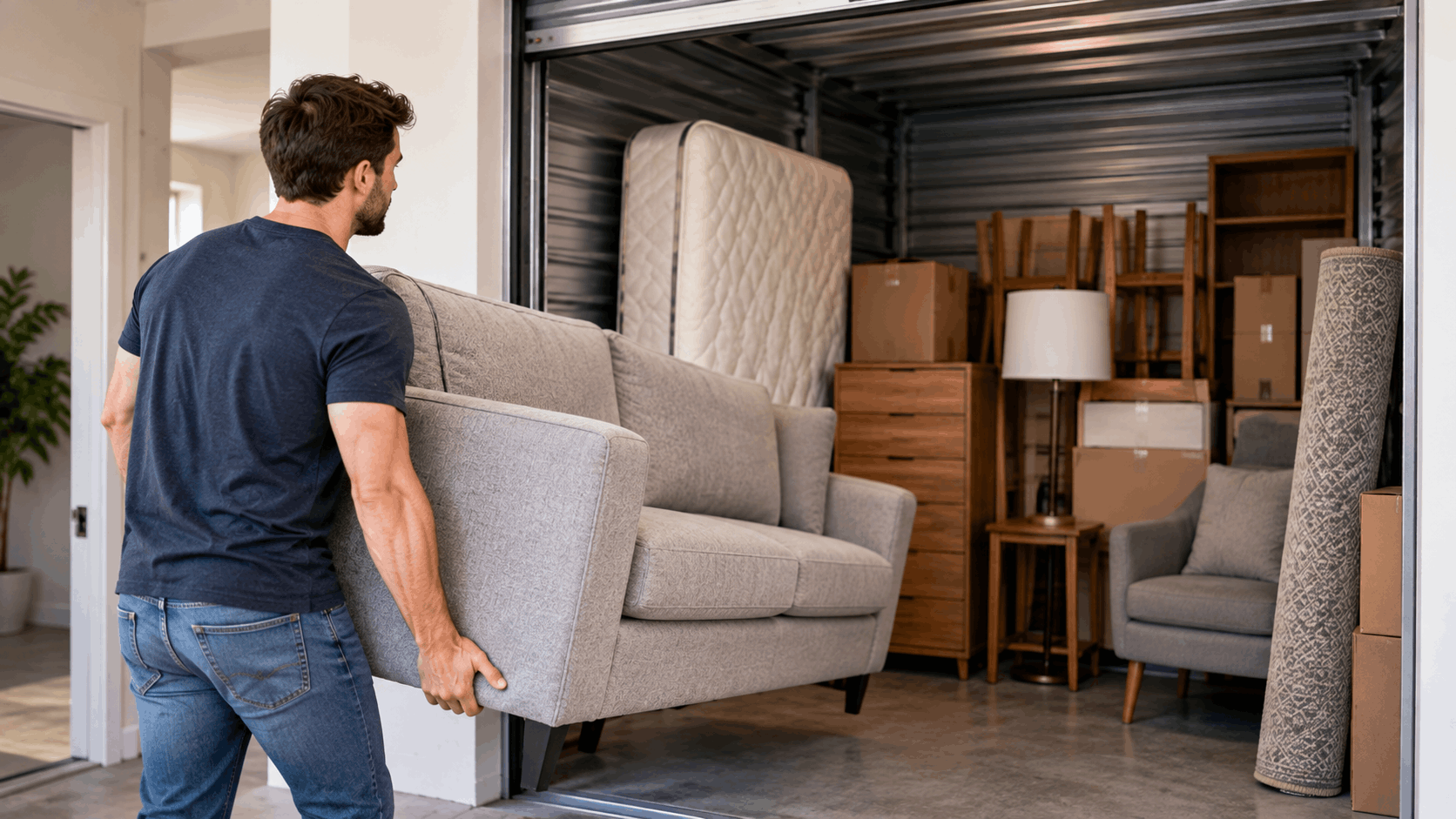
Protecting Furniture While It Sits in Storage
When furniture leaves the apartment and enters storage, two different sets of rules take over, and it helps to understand both. One governs the move into storage, and the other governs the goods once they are sitting in the warehouse. Knowing the difference lets you make decisions with your eyes open.
The storage valuation on the move in comes from California's intrastate moving rules, while the liability once the furniture is stored comes from the Commercial Code. The declared value you set and the storage agreement you sign both play a part. Here is how each works.
Valuation on the Move Into Storage
On the move into storage, California's intrastate default applies. Under Maximum Rate Tariff 4 Item 136(2), unless the shipper expressly declares a value other than $20,000 for the shipment, the mover's maximum liability for lost and damaged articles is up to $20,000 of actual cash value. That is what covers you if you declare nothing.
There is a figure people often misread. The 60 cents per pound per article in Item 136(1) is the rate basis, the declared value the transportation rates are computed on. It is not the payout. Content that treats 60 cents per pound as what you collect for a loss is simply wrong, and it is worth knowing the difference.
Valuation is not insurance. Released value is a liability limit, and full value protection is the paid alternative. The law requires that each valuation option be offered to you, with the charge listed and a space to initial, so you can choose a higher level of protection.
You can set a higher declared value than the default, and you can decline it knowingly if you prefer. The point is that the choice is yours, made before the furniture moves, rather than something you discover after a loss. We walk through the options so the decision is informed.
The Warehouse Standard of Care
Once the furniture is sitting in warehouse storage, a different rule governs. California Commercial Code 7204 holds the warehouse to the care that a reasonably careful person would exercise under similar circumstances. That is the standard of care, and it is ordinary negligence, not a guarantee.
The same section makes clear that a warehouse is not an insurer of the goods. Unless otherwise agreed, it is not liable for damage that could not have been avoided by that reasonable care. This is an important distinction for anyone picturing storage as a blanket guarantee against any harm.
Section 7204 also allows a liability limit to be set by a term in the storage agreement or warehouse receipt. There is no statutory floor on how low that limit can go and no required type size, so the document itself is where your protection is defined. Reading it is the real safeguard.
On request, you can ask in writing for liability to be increased on part or all of the goods, and increased rates may then apply to that higher valuation. If your furniture includes high-value pieces, that written request is how you raise the ceiling before anything goes wrong.
Full-Service Storage Is Not Self-Storage Legally
Because our storage is full-service vaulted, it falls under a different body of law than a self-storage locker. Under California law, a self-service storage facility is one where occupants have access to their space. Our model is the opposite: no key, no unit, no right of entry.
That places vaulted warehouse storage under Commercial Code Division 7 and not the Self-Service Storage Facility Act. When a warehouse issues a warehouse receipt, bill of lading, or other document of title, the parties are subject to Division 7, and the self-storage rules do not apply. This is not self-storage in the legal sense.
The distinction is not about containers versus units. It turns on whether the customer has exclusive use and access. Since our customers have neither, the self-storage lien, auction, and access rules do not govern their goods. The warehouse receipt or storage agreement does.
This is why it matters that you have no key and no independent access with our storage. That single fact changes which rules protect your furniture. It is also why the standard of care and the storage agreement, not self-storage statutes, are the documents to understand.
Items Best Kept With You
Some things should never go into storage at all, and should travel with you instead. Money, jewelry, and important papers are best carried by the customer rather than shipped or stored. These are small, irreplaceable, and easy to keep on hand, so there is no reason to hand them off.
Keep important papers like passports, deeds, titles, and financial records with you throughout the move. They are the documents you may need at short notice, and they are exactly the kind of item that causes real trouble if it ends up at the bottom of a sealed vault.
For the furniture that does go into storage, high-value items deserve special handling. Items of extraordinary value such as antiques, art, and gold or silver articles should be separately described on the inventory, with a value declared for each. That description is what supports the right coverage for the piece.
Declaring those values up front connects back to the valuation choices covered above. A one-of-a-kind antique or an inherited piece of art is worth listing individually rather than lumping into the general load, so its real value is on the record before it enters the vault.
Need Help in Los Angeles?
Popeye Moving & Storage serves Los Angeles and all of Los Angeles County.
How Popeye Moving and Storage Handles a South Glendale Overflow Job
Here is how we actually work a South Glendale overflow job from the first call to the day your furniture comes back. The moving process is built around a clear plan, a written price, and professional handling of the pieces that would not fit your unit.
At Popeye Moving and Storage, the goal is that nothing on move day is a surprise. The written estimate lays out the plan and the price before anything is loaded, and the vaulted storage gives your overflow a proper home. The steps below walk through it.
The First Call and the Written Estimate
Everything starts with the first call and an itemized written estimate. We put the quote in writing so it can be taken away and discussed with family, which matters in the multigenerational households common in South Glendale. A quote you can read over at the kitchen table beats a number shouted over the phone.
On that first call we also establish who authorizes and pays the work. The person calling is not always the person paying or the one who owns the furniture, so we confirm authorization up front. That keeps the plan aligned with the whole household rather than one member of it.
A verbal rate quotation, whether per hour or per hundred pounds, is not a binding estimate. A proper written estimate describes the shipment, the services, the crew, and the rates in enough detail that you can check it against what you were told. That is the document to insist on.
The written estimate includes a not-to-exceed figure, the maximum total you can be billed for the move into storage. The final bill cannot exceed it except through a change order you agree to before the work is done. That ceiling, agreed before anything is loaded, is your main protection on an intrastate move.
Same-Day Pickup Into the Vault
We pick up your furniture and place it into vaults at the Mar Vista warehouse on the same day. This is same-day storage: the goods go from your South Glendale unit straight into the vault, with no overnight stop in between.
There is no overnight hold on the truck. Your furniture does not sit in a loaded truck in a parking lot or a yard waiting for the next day's handling. It is loaded, driven to Mar Vista, and vaulted the same day, which keeps the handling tight and the goods secure.
That pickup and placement happening in one day is part of why the vaulted model protects furniture well. The fewer the stops and the handoffs, the fewer the chances for a bump or a loss. Loaded once, driven once, vaulted once.
For a household between leases, this also simplifies the day. You hand off the overflow in the morning and know it is already safely stored by evening, rather than tracking a truck that sits loaded overnight somewhere out of sight.
Licensed, Insured, and Verifiable
We operate under California household mover permit CAL T 189749 for intrastate work, and we are fully insured. For interstate work we hold USDOT 1472924 and MC 498816C. Every legal California household mover operates under a state permit, and you are entitled to ask for the number and verify it before booking.
We are also BBB accredited with an A+ rating. That accreditation and rating speak to how we handle customers and disputes, which matters in a price-sensitive market where unlicensed operators are common and the consequences land on the customer.
You do not have to take our word on the permit. A customer can verify a mover's license status with the Bureau of Household Goods and Services, which regulates household movers inside California. The bureau is reachable at (916) 999-2041, and it is the right place for verification and for any complaint about a California mover.
Checking a permit before booking rather than after a problem is the simplest protection against an unlicensed operator. An operator working without a valid permit is not just uninsured in practice, it is unlawful. Ask for the number, verify it with the bureau, then book.
Retrieving Furniture When the Space Opens Up
When a larger place is ready, your furniture comes back. Because you have no key and no direct access with vaulted storage, the warehouse retrieves and opens the vault by appointment. A crew locates the vault, brings it down by forklift, and opens it for the return.
Setting a retrieval appointment is ordinary trade practice for full-service storage, not a special hurdle. Since the goods are sealed in a vault inside the warehouse rather than sitting in a unit you can walk into, the warehouse arranges access. It is simply how the model works.
Vault access runs through our scheduling, and the business hours of 6am to 9pm, seven days a week, are for calls and scheduling. Those are not customer warehouse access hours, since customers do not have independent entry to vaulted storage in the first place.
The same crews that stored your furniture bring it back on the return delivery. Having one operation handle the pickup, the storage, and the return keeps the chain of custody clean from your old South Glendale unit to your next home. You can read more on our storage solutions page.
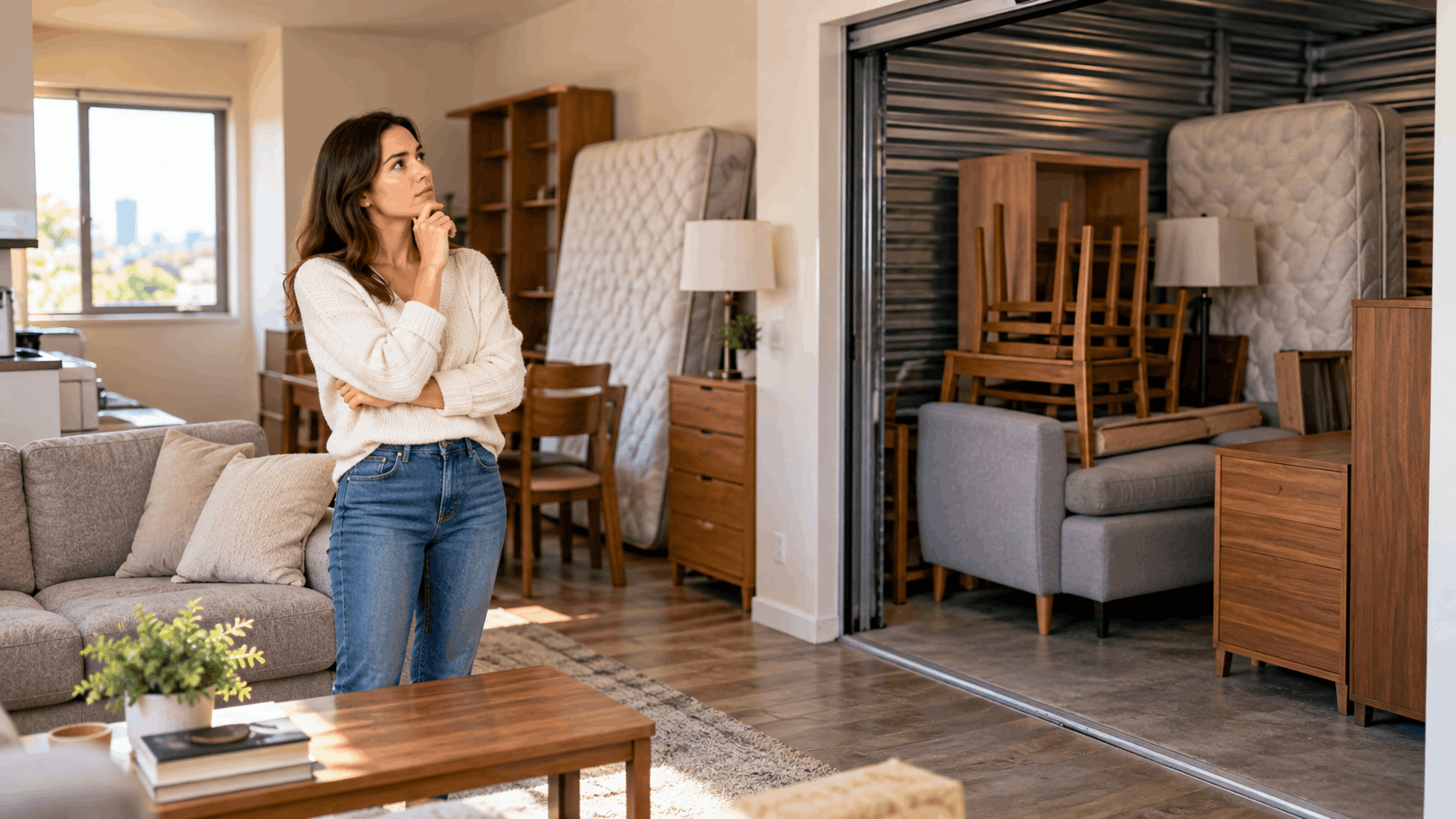
Store the Overflow With a Local Crew That Handles It All
If the sectional, the armoire, or grandma's china cabinet will not fit your new South Glendale unit, we pick it up, store it in a climate-controlled vault at our Mar Vista warehouse, and bring it back when a larger place is ready. The move into storage comes with an itemized written estimate and a not-to-exceed figure before anything is loaded.
Call Popeye Moving and Storage at (310) 823-9510 to go over your furniture and your building, and we will set up the pickup from there.
Frequently Asked Questions
- What furniture is most likely not to fit a small South Glendale apartment?
- Sectionals, sleeper sofas, armoires, china cabinets, and large dining tables are the usual pieces that fail to fit, along with pianos and chandeliers. The problem is the route, not the room. Narrow stairwells, tight landing turns, and the small original door openings in 1920s and 1930s buildings stop wide, long, or rigid pieces before they reach the unit. Some disassemble and some do not.
- Where does Popeye store furniture that won't fit?
- It goes into full-service vaulted storage at our Mar Vista warehouse at 5509 1/2 S Centinela Ave in Los Angeles, on the Westside. The furniture is handled by our own crews from pickup through storage. With vaulted storage you do not rent a unit or hold a key. We load your belongings into wooden vaults and keep them in the climate-controlled warehouse until you need them back.
- How much does vaulted storage cost per month?
- The typical area range is $60 to $90 per vault per month, presented as a market range rather than a quote. The number of vaults depends on how much furniture goes in, so a small overflow may fill one vault while a larger consolidation needs several. We assess your pieces during scheduling and tell you how many vaults the job is likely to require so you can budget the monthly cost.
- Is there a minimum storage term?
- No. There is no minimum and no maximum storage term for this storage. Whether you need a few weeks between leases or a long stretch while searching for a larger home, the term fits your situation. You are not locked into a set length that does not match your move, and you pay for the vaults you use for the time you use them.
- Can I access my stored furniture whenever I want?
- Vaulted storage means no key and no right of entry, so you cannot walk in and browse your goods. The warehouse retrieves and opens the vault by appointment when you need something. Our business hours of 6am to 9pm, seven days a week, are for calls and scheduling, not customer warehouse access. This full-service model is why the furniture is professionally handled and left undisturbed between pickup and return.
- What happens if a piece is damaged in storage?
- Once goods sit in warehouse storage, California Commercial Code section 7204 holds the warehouse to the care a reasonably careful person would exercise under similar circumstances. That is ordinary negligence, not a guarantee against all harm. A liability limit can be set in the storage agreement, so reading that document matters. Under California law, a claim will not be denied solely because the loss or damage was not noted at the time of delivery.
- Do I need a parking permit for the moving truck in South Glendale?
- Most South Glendale streets sit inside preferential parking permit districts posted by sign under Glendale Municipal Code Chapter 10.36. Glendale does not publish a single standard moving-truck permit process, so the requirement depends on the block. Confirm your specific street with Glendale Public Works Parking Services at (818) 548-3945, and reach the Permit Processing Center at (866) 470-3088, 8am to 5pm Monday through Friday. A resident permit does not free a restricted curb.
- Can you store a piano, chandelier, or fine art?
- Yes. Our warehouse accepts wine, fine art, pianos, and chandeliers alongside household and commercial goods, all handled by our own crews. These are exactly the pieces a small South Glendale unit often cannot hold or that a family wants protected rather than squeezed in. Vehicles are the exception: we do not accept car, motorcycle, boat, or RV storage. For everything else, the climate-controlled vaulted storage is built to hold it.
- How soon do my goods go into the vault after pickup?
- The same day. We pick up your furniture and place it into vaults at the Mar Vista warehouse on the same day, with no overnight hold on the truck. Your belongings do not sit in a loaded truck waiting for next-day handling. They are loaded at your South Glendale unit, driven to Mar Vista, and vaulted that day, which keeps the handling tight and the goods secure throughout.
- How do I confirm Popeye is a licensed mover?
- We operate under California household mover permit CAL T 189749 for intrastate work, and we are fully insured. You can verify a mover's permit status with the Bureau of Household Goods and Services, which regulates household movers inside California, at (916) 999-2041. Checking the permit before booking rather than after a problem is the simplest protection. The bureau is also the right place to direct any complaint about a California mover.
Popeye Moving & Storage Co. Team Team
Licensed moving and storage professionals serving Los Angeles and Los Angeles County.
Licensed in California · License #CAL T 189749 | USDOT 1472924 | MC 498816C
Why trust Popeye Moving & Storage?
Founded in 1994, Popeye Moving & Storage is a licensed and insured moving and storage service serving Los Angeles and Los Angeles County. All content is reviewed by our licensed technicians.

Need Help in Los Angeles?
Popeye Moving & Storage serves Los Angeles and all of Los Angeles County.
Related Articles
Receiving Services for Homeowners Mid-Renovation: Where Your Furniture Deliveries Go Before Install Day
Mid-renovation and furniture arriving early? Learn how receiving services hold your deliveries in climate-controlled storage until install day across Los Angeles.
Storage for Santa Monica and Brentwood Households: Where Westside Furniture Actually Goes Between Homes
A local guide to furniture storage for Santa Monica and Brentwood households, covering storage types, costs, coastal climate risks, and how Westside families bridge the gap between homes.

What Vaulted Storage Costs in Los Angeles - and Why It Beats a Self-Storage Unit for Furniture
Vaulted storage in LA runs $75-$150 per vault monthly and protects furniture better than a self-storage unit. See real costs, hidden fees, and when a vault wins.