A Garden Apartment Near the 405 in Fox Hills and the Overflow That Goes Into Storage

Key Takeaways
- Fox Hills moves often produce overflow because 1970s one- and two-bedroom units have narrower lifts, tighter corridors and smaller doors than newer buildings.
- Culver City permits a moving truck for one day only, with signs posted at least 48 hours ahead, but many buildings here have their own dock and management rules set in writing before the date.
- The service lift window can cap how much moves in a day regardless of crew size, which combined with the one-day permit can turn a large apartment into a two-day job.
- Popeye offers full-service vaulted storage, not self-storage: no key, no individual unit, no right of entry, with goods handled by crews and placed at the Mar Vista warehouse the same day.
- Storage-in-transit runs up to 90 days under the BHGS; past that, goods fall under the warehouse contract and Commercial Code Division 7.
- The California default valuation is up to $20,000 of actual cash value unless the shipper declares otherwise; the 60 cents per pound figure is only the rate basis, not the payout.
- Local residential moving runs $150 to $200 per hour, a one-bedroom local move $350 to $650, and vaulted storage $60 to $90 per vault per month as typical area ranges.
- Popeye holds CAL T 189749, USDOT 1472924 and MC 498816C, is BBB accredited with an A+ rating, and is regulated by the BHGS, not the CPUC.
In This Article
A move out of a Fox Hills garden apartment or tower unit off Green Valley Circle usually starts with a hard look at the new floor plan. The new place is smaller, the bedroom set that fit the old unit has nowhere to land, and the question becomes what to keep nearby and what to put away for a while. That question comes up again and again in this corner of Culver City, where condominium and apartment towers built in the 1970s hold a high share of one- and two-bedroom homes.
This article walks through three things that decide how that move goes. First, the Culver City move itself and the permit that governs a truck at the curb. Second, the building rules that quietly control the day, from the service lift window to the garage clearance. Third, how the leftover belongings go into full-service vaulted storage at our Mar Vista warehouse the same day, with no overnight hold on the truck.
We have worked these buildings along Buckingham Parkway and Bristol Parkway, and the pattern is consistent. The overflow is not a sign of a bad plan. It is the normal result of older, tighter buildings meeting a smaller new home, and it is exactly the kind of job that storage was built for.

Why Fox Hills Moves Often Leave Something Behind?
Fox Hills sits in a triangle of Culver City in ZIP code 90230, bounded by Slauson Avenue on the north, Centinela Avenue on the south, the 405 on the southwest and Canterbury Drive on the southeast. It filled with apartments, towers and offices after Fox Hills Mall opened in October 1975, and that build era shapes the moves we run here. The combination of smaller units, frequent turnover and aging building bones produces Fox Hills overflow on a regular basis.
Garden apartment storage is less an add-on and more a built-in part of how these moves work. When a household shifts from one unit to another, or downsizes into the neighborhood, the furniture math rarely balances. Something always needs a home that is not the new living room.
Smaller Units and the One- and Two-Bedroom Reality
The housing stock here leans heavily toward one- and two-bedroom condominiums and apartments. These were built in the 1970s for a density market, with compact layouts that make efficient use of square footage. That design is part of why Fox Hills remains popular, but it also sets a ceiling on how much furniture a unit can absorb.
When someone plans a one-bedroom move within the neighborhood, they often assume their existing pieces will carry over. The reality is that a sectional, a dining set and a bedroom suite that suited the last layout can overwhelm the new one. A bookshelf wall in one unit becomes an obstruction in another with a different window line.
Downsizing in Fox Hills adds another layer. A move from a two-bedroom to a one-bedroom means a whole room of belongings has to go somewhere, and most residents are not ready to part with things permanently. Storage gives them a middle path, keeping the furniture without forcing it into a space that cannot hold it.
We help residents sort this at the estimate, looking at what fits the new unit and what should be set aside. An honest assessment up front means fewer surprises on the day and a cleaner move for everyone. For a one-bedroom apartment move, that planning step saves both time and money.
Renters, Owners, and Timing Gaps Between Homes
Culver City runs about 54.6 percent owner-occupied, which means roughly 45.4 percent of homes are rented. Fox Hills carries a mix of owner-occupiers, long-term renters and investor-owned units. Renter households move more often than owners, so the neighborhood sees a steady flow of smaller, shorter-notice moves alongside the occasional larger owner relocation.
The trouble is that lease ends and purchase close dates almost never line up neatly. A tenant may have to be out on the first of the month while the new place is not ready for another two weeks. A buyer may close on a sale before the new unit is available. That lease gap is where storage earns its place.
The typical storage customer in Fox Hills is between homes during a move. They are not looking for a long-term warehouse arrangement so much as a bridge across a few weeks or months. Their belongings need a safe place to sit until the next door opens.
Because so many callers here are tenants while a landlord or property manager authorizes and pays, we establish who is authorizing at the first call. Property managers with multiple units in a single complex are a repeat relationship for us, and clarifying who signs off keeps the paperwork clean.
Fifty-Year-Old Buildings and Furniture That Will Not Fit
Buildings of this vintage were built to the standards of their day, which means narrower lifts, tighter corridors and smaller lobby doors than newer construction. A wardrobe or sofa that slides easily into a modern building may simply not fit through the service lift or down the hallway here. That is not a crew problem, it is a geometry problem baked into the structure fifty years ago.
A narrow service lift car is the most common choke point. If a large piece cannot stand upright or lie flat inside the car, it cannot ride up or down, full stop. The same goes for an oversized dining table trying to clear a lobby door built to 1970s dimensions.
When a piece will not fit the building, the owner faces a choice: disassemble it where possible, part with it, or store it. Oversized furniture that cannot come down the service lift often ends up in a vault rather than the new unit. That is frequently the simplest answer when the piece is valuable or hard to replace.
We measure the lift car and the door apertures where a large piece is involved, and we do it before the day rather than discovering the problem in a corridor. Knowing the numbers in advance lets us plan the sort between keep and store before the truck arrives.
Get Your Free Quote
Tell us about your move. We'll be in touch soon.
The Culver City Move Day: Permits and Building Rules
Fox Hills sits inside the City of Culver City, which runs its own Public Works permit process separate from Los Angeles. On top of the city rules, most buildings here add their own management requirements. Both layers control the day before a single box moves, so understanding the Culver City moving permit and the Fox Hills building rules is where planning starts.
In many Fox Hills jobs the street permit is not even the deciding factor. The building has its own loading dock and service lift, and the real constraints come from management. Getting both layers lined up in writing ahead of the date is what keeps a move on schedule.
The Culver City Street Permit for a Moving Truck
Culver City's permit application covers dumpsters, PODs and moving trucks with different limits for each. A moving truck is permitted for one day only. That one-day cap matters more than it sounds, because a large apartment combined with a slow lift can run past a single day.
Signs must be posted at least 48 hours in advance, with a minimum of two signs. That notice period means planning cannot be left to the last minute if a curbside spot is needed. The posting puts neighbors on notice and reserves the space for the move.
The space use fee is charged per space per day, at a lower rate outside downtown. Fox Hills falls into that lower-rate tier, which helps on cost, and reserving metered spaces costs extra. Because fees change, we tell customers to confirm current amounts directly with the City of Culver City rather than relying on a figure that may be out of date.
For many Fox Hills addresses, the question is whether a street permit is even needed. Where the building has its own dock, the job may never touch the public curb. We sort that at the estimate so the right permit, if any, is in hand before the date.
Association and Management Territory
Most Fox Hills buildings are association and management territory. They have their own loading dock or designated loading area, a service lift and a management office that sets the terms of any move. Those terms are not optional, and they are set building by building.
A management office typically requires a lift reservation in a fixed window and a certificate of insurance naming the owner and the management company as additional insured. Many also require a refundable deposit held against damage to common areas. Permitted move hours are set as well, and they commonly exclude evenings, weekends and holidays.
All of this is obtained in writing before the date is fixed. A verbal okay from a front desk is not the same as a confirmed lift reservation and an approved insurance certificate. We handle the certificate of insurance and confirm the reservation so the building has no reason to turn the crew away on arrival.
Getting these requirements squared away early also protects the customer's deposit. When the building's rules are followed to the letter, the refundable deposit comes back, and the move goes down as a clean one in the management office's records.
The Lift Window That Caps the Whole Day
The service lift window is the single biggest constraint on many Fox Hills moves. Where a building allows one household to use the service lift at a time within set hours, that caps how much can move in a day regardless of how large the crew is. A bigger crew cannot beat a lift that only moves one load at a time.
This is where the city permit and the building rule collide. Culver City grants a moving truck one day only, but the building may grant a lift window of just a few hours. A large apartment can easily exceed what a single short lift window allows.
When that happens, a move becomes a two-day job, which means a second one-day truck permit for the second day. That is not padding, it is the arithmetic of a slow lift and a one-day permit meeting a full apartment. Establishing it at the estimate avoids a scramble on move day.
We size the job against both the lift window and the truck permit before quoting. If the math says one day will not work, the customer knows that up front and can plan the second permit rather than being caught short with furniture still upstairs at closing time.
Garage Height and the Shuttle From Outside
The 1970s towers here are served by subterranean parking structures, and those structures have clearances a full-size moving truck cannot pass. The ramp and ceiling were built for cars, not for a box truck, so the truck simply will not fit down into the garage. Where the loading dock sits inside the structure, that creates a real access problem.
There are two professional ways to handle it. The truck can work from outside with a longer carry to the unit, or a smaller shuttle vehicle can run between the truck and the interior dock. A shuttle on a restricted-access property is the standard method, not an improvisation, and it is priced into the estimate.
We confirm the garage clearance and the designated loading position with management before dispatch. Discovering a low clearance at the ramp on move day costs everyone time, and it is entirely avoidable with a phone call ahead. The loading position also tells us how long the carry will be, which feeds the estimate.
None of this requires the crew to judge the structural or geological safety of a property, and it never should. The crew's job is to find the professional route for the goods, whether that is a longer carry or a shuttle, and to price it honestly at the estimate.

Need Help in Los Angeles?
Popeye Moving & Storage serves Los Angeles and all of Los Angeles County.
What Overflow Storage Actually Means Here
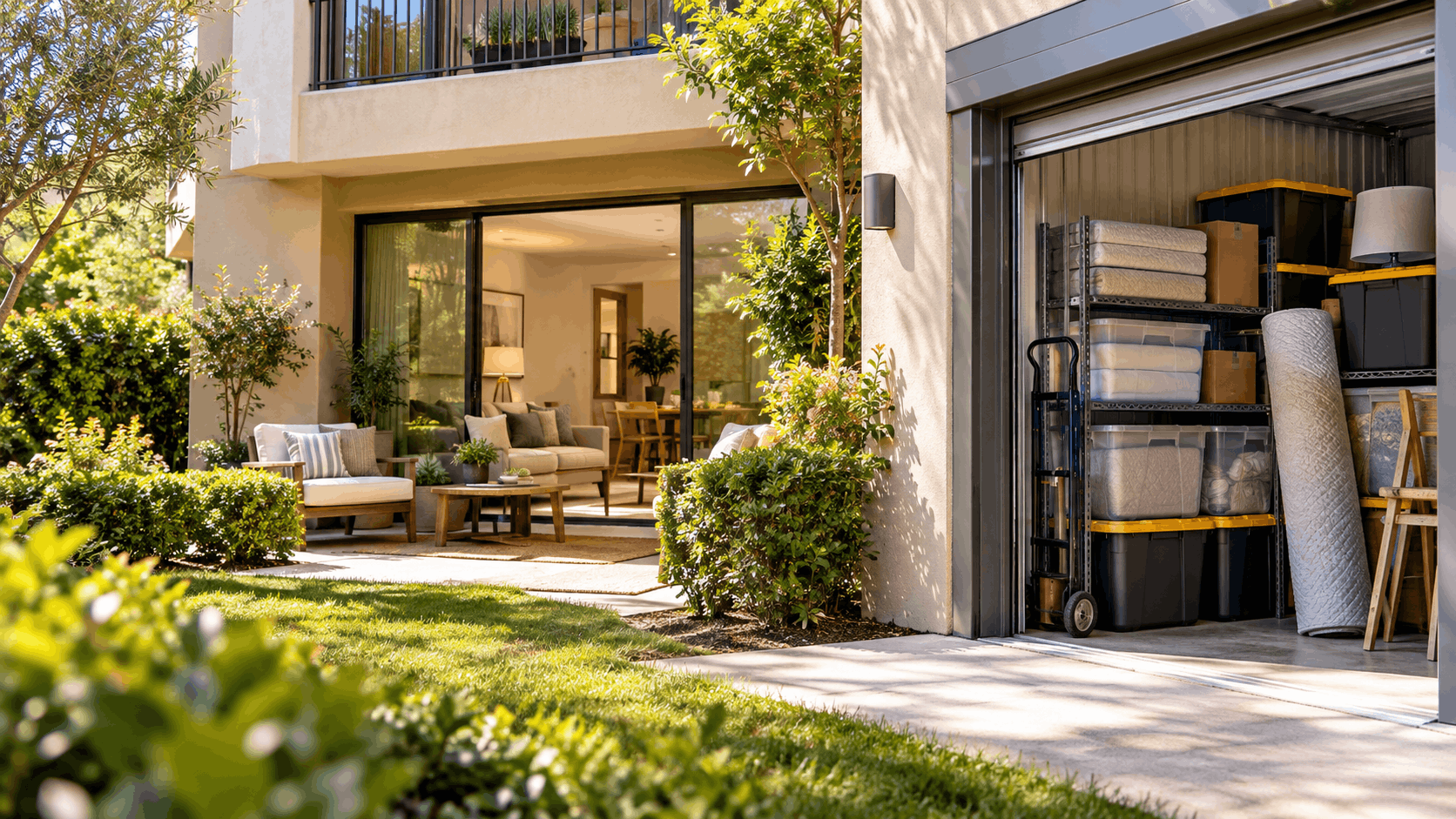
When a Fox Hills customer has furniture that will not fit the new unit, the storage they get from us is full-service vaulted storage, not a self-storage unit. That distinction changes how the service works and what the customer can expect. Understanding vaulted storage up front saves confusion later.
Full-service storage means our crews handle the goods from pickup through placement. The customer does not rent a room, drive a load over, or stack boxes themselves. For someone already managing a move out of a tight building, that is one less logistics headache to carry.
Vaulted Storage, Not a Self-Storage Unit
Our storage is full-service vaulted only. The customer has no key, no individual unit and no right of entry. The goods are loaded into a vault by our crew, moved to the warehouse, and handled by Popeye staff the entire time.
That is a different model from renting a self-storage room. With self-storage, the customer signs a rental agreement, gets a key or code, and comes and goes to a unit they control. Vaulted storage removes that daily access in exchange for a secure, crew-handled arrangement where the goods are packed once and left undisturbed.
The practical difference matters most for someone between homes during a move. They are not planning to rummage through their belongings every week. They want the furniture safely put away until the next place is ready, which is exactly what the vaulted model delivers.
Because there is no key and no individual unit, retrieving stored goods means the warehouse brings out and opens the vault. An appointment is ordinary trade practice for that, and we coordinate it when the customer is ready for their belongings back. Our vaulted storage service is built around that full-service handling.
What a Storage Vault Looks Like
A wooden storage vault is a sturdy container built from plywood on a reinforced floor set on runners. A typical size runs roughly 7 feet by 5 feet by 7 feet 10 inches on the exterior, with four-way forklift access so the loaded unit can be moved as a whole. It is designed to be packed once and then handled as a single unit.
There is no ANSI, ASTM, ISO or federal specification governing household goods storage vault dimensions. Every manufacturer builds to its own sizes, so the figures above are a typical size rather than a standard. Any capacity number for a vault is approximate, because published volumes are exterior measurements and usable interior space is lower once the wall thickness is deducted.
The value of the vault design shows in how the goods are handled after loading. A vault is filled once at origin, then moved by forklift as a sealed unit. That means the furniture inside is handled fewer times than it would be in a self-storage cycle where the customer loads, drives and unloads.
We run the full range of vault sizes, from standard through oversized, so a large piece that cannot fit the new unit still has a container that suits it. The number of vaults a move needs depends on how much overflow goes in, and we estimate that at the sort.
Same-Day Into the Mar Vista Warehouse
Our warehouse sits at 5509 1/2 S Centinela Ave in Mar Vista, on the Westside. We pick up the overflow and place it into vaults at that warehouse on the same day, with no overnight hold on the truck. The goods do not sit in a parked truck waiting for a slot the next morning.
Same-day storage matters a great deal when a Fox Hills building grants only a single lift window. If the lift is available for one block of hours, the crew works that window, loads the overflow, and takes it straight to Mar Vista. There is no need to hold the truck overnight or secure a second day just to warehouse the extra pieces.
Mar Vista is a short run from Fox Hills, which keeps the same-day cycle practical. The truck can clear the building, head to the warehouse, and have the vaults placed the same day. That timing keeps the whole move inside one permit window where the volume allows.
The warehouse address matches our Google Business Profile location, so customers can see where their belongings are stored. For anyone considering a longer arrangement, our long-term storage options run from the same facility.
No Minimum Term and What Gets Accepted
There is no minimum and no maximum storage term. A customer can store for a few weeks across a lease gap or for a much longer stretch while they figure out the next home. That flexibility suits the between-homes reality of most Fox Hills moves.
The warehouse accepts household goods and also handles commercial and business storage alongside them. Specialist items are welcome too, including wine, fine art, pianos and chandeliers. If a customer is storing a grand piano or a set of framed pieces, those are handled with the care they need.
Vehicles are not accepted. We do not store cars, motorcycles, boats or RVs, so that is one thing the vaulted model does not cover. Everything else from a typical household, from a bedroom set to a dining table, has a place.
The storage is climate controlled for both temperature and humidity. The specification is confirmed per shipment rather than fixed, so we match the conditions to what is being stored. For fine art and antiques, our specialty moving team coordinates the handling into storage.
How Long the Goods Can Stay and Which Rules Apply
How long overflow can stay in storage is partly a matter of choice and partly a matter of law. The legal regime over stored goods shifts at the 90-day line, and that shift changes which protections apply. A Fox Hills customer putting furniture away during a move should understand where that line sits.
The distinction comes down to storage-in-transit versus warehouse storage. One is part of a regulated mover service, the other falls under a different body of law. Knowing which applies tells a customer who oversees their goods and how claims work.
Storage-in-Transit and the 90-Day Window
Maximum Rate Tariff 4 defines storage-in-transit as storage of a shipment at the request of the consignor or consignee, at one point between origin and destination, for a period not to exceed 90 days. That is the window built into a regulated move. When overflow goes into a vault as part of a move, it starts in this category.
Inside that 90-day window, the arrangement is still a regulated mover service under the Bureau of Household Goods and Services. The protections of the Household Movers Act and the tariff continue to apply to the goods. That is a meaningful layer of oversight during the bridge period between homes.
For most Fox Hills customers crossing a lease gap, 90 days is plenty. A few weeks between the old unit and the new one fits comfortably inside the storage-in-transit window. The goods stay under the mover service regime the whole time.
Because the clock runs as part of the move, the paperwork ties the storage to the transportation. That keeps everything on one agreement rather than splitting it into a separate contract on day one. It is the simplest arrangement for a short bridge.
Past 90 Days: Warehouse Storage
Past 90 days, or where storage-in-transit was not requested in the first place, the goods fall under the warehouse's own contract. At that point the arrangement is governed by Division 7 of the California Commercial Code rather than by the bureau. The regime changes, and so do the rules that protect the customer.
This shift is worth understanding because it changes who oversees the goods. Under warehouse storage, the standard of care and the terms come from the Commercial Code and the storage agreement, not from the Household Movers Act. The customer's protections live in the contract and the code sections that govern warehouses.
For a customer who needs storage longer than 90 days, this is not a problem, it is simply a different framework. The goods remain safely stored, handled by the same crews at the same warehouse. What changes is the legal structure around them, and reading the storage agreement becomes the way to understand the terms.
Because there is no minimum or maximum term, a customer can cross from storage-in-transit into warehouse storage without moving anything. The goods stay put, and the paperwork reflects the change in regime. We explain which framework applies so nobody is surprised by it later.
Why It Is Not Self-Storage Law
Vaulted warehouse storage sits outside the Self-Service Storage Facility Act entirely. That act covers facilities where the occupant has access to their own space, and the law is explicit that a self-service storage facility is not a warehouse. Because our customers have no key, no individual unit and no right of entry, the self-storage framework does not reach our service.
This is the actual operating model, not a technicality. The customer never holds a key and never walks into a unit, so the lien, auction and access rules written for self-storage simply do not apply. The goods are handled under warehouse law instead.
The practical upshot is that the rules a customer may have read about self-storage units do not describe what happens here. Access works through the warehouse, not through a gate code. The governing law is the Commercial Code and the storage agreement, which is why we point customers to that agreement for the terms.
Understanding this distinction up front prevents confusion down the line. A customer who thinks they can drive over and open a unit will find the model works differently. We make clear from the first call that this is crew-handled vaulted storage.
Need Help in Los Angeles?
Popeye Moving & Storage serves Los Angeles and all of Los Angeles County.
Protecting the Furniture You Store
Knowing what belongings are covered for matters as much as knowing where they sit. Valuation applies both during the move and during storage, and the two are set separately. A Fox Hills customer should understand both before the truck is loaded.
Valuation is not insurance, and that difference shapes everything in this section. Released value is a liability limit. Full value protection is the paid alternative. Getting the right level set, in writing, is the storage protection that counts.
Valuation on the Move: The $20,000 Default
Under Maximum Rate Tariff 4, unless the shipper expressly declares a different value, the mover's maximum liability for lost and damaged articles is up to $20,000 of actual cash value. That is the California intrastate default, and it is what a customer who declares nothing is covered for. It is a meaningful floor of protection built into the regulated move.
The 60 cents per pound per article figure that appears in the tariff is the rate basis, not the payout. It is the declared value the transportation rates are computed on. It must never be mistaken for what the customer actually collects, because on a weight basis it pays almost nothing on light valuables like electronics.
Full value protection is the paid alternative to the default. The mover must list each valuation option with its charge and a space for the shipper to initial. A customer has a right to be offered better coverage and a right to decline it knowingly, and the choice is made in writing before the goods move.
We walk every customer through the valuation options at the estimate so the choice is an informed one. For higher-value pieces going into storage, declaring a value that reflects the goods is the sensible path, and we make that option clear on the paperwork.
Valuation While Goods Sit in Storage-in-Transit
Valuation during storage-in-transit is set separately from the transportation valuation. Maximum Rate Tariff 4 Item 136(8) sets the maximum fixed rate for Actual Cash Value protection while goods are in storage-in-transit at $0.16 for each $100 of declared value. Full Value protection during that window runs at $0.38 for each $100 of declared value.
These rates are additional to the transportation valuation charges, not folded into them. The protection during storage-in-transit must be offered by the mover and ordered in writing by the shipper. It is a separate decision from the valuation chosen for the move itself.
For a customer storing overflow across a lease gap, this is where the goods are covered while they sit in the vault during the storage-in-transit window. Setting the declared value correctly means the protection matches the worth of what is stored. A customer with furniture worth storing should declare a value that reflects it.
We present these storage-in-transit valuation options in writing so the customer can choose and initial. The choice is theirs, and it is made before the goods go into storage, not after. That is the protection that applies during the regulated window.
The Standard of Care in a Warehouse
Once goods move into warehouse storage, California Commercial Code section 7204(a) governs the standard of care. It holds a warehouse liable for loss of or injury to goods caused by its failure to exercise the care that a reasonably careful person would exercise under similar circumstances. That is the ordinary negligence standard.
It is important to understand what that standard is and is not. A warehouse is not an insurer of the goods and is not held to strict liability. Unless otherwise agreed, the warehouse is not liable for damage that could not have been avoided by the exercise of reasonable care. The duty is to act carefully, not to guarantee against every possible loss.
Because the terms live in the storage agreement, reading that agreement is the customer's protection. A storage agreement can limit damages by its terms, with some constraints set by the code, and it can set reasonable provisions on how and when to present a claim. Knowing what the agreement says is how a customer understands their coverage.
Separately, fully insured describes our business. It does not mean the mover cargo policy covers goods sitting in long-term warehouse storage. We draw that line clearly so a customer never assumes a coverage that does not reach their stored belongings past the storage-in-transit window.
Items Best Kept Out of the Vault
Some things are better off not going into storage at all. Money, jewelry and important papers are best carried by the customer rather than shipped or stored. These are small, high-value and easy to keep personally, so there is no reason to hand them over to a vault.
Items of extraordinary value such as antiques and art should be separately described on the inventory, with a value declared for each. That separate description is how the paperwork reflects their worth and how the valuation chosen actually protects them. A general line on an inventory does not capture a valuable piece the way a specific entry does.
Hazardous materials are not accepted, and that is federal law rather than a company preference. Common household combustibles, corrosives, explosives and flammables cannot go on the truck or into the warehouse. A simple pre-move check for paint, propane, pool chemicals and similar items prevents a problem on the day.
We help customers sort the carry-with-me pile from the store pile at the estimate. Keeping valuables personal, declaring the worth of fine pieces, and leaving hazardous materials out of the load are three habits that make a stored-overflow move go smoothly. For framed art and antiques, we handle the separate description and declared value as part of the inventory.
What a Fox Hills Move With Storage Costs
Cost is on every customer's mind, so it helps to have the typical ranges in hand. The figures below are typical market ranges for moving and storage in the Los Angeles area, not a quote or a fixed price from us. The actual price for a specific move is set in writing before anything is loaded, with the Not To Exceed figure on a move inside California.
Understanding both the move cost and the storage cost in Fox Hills lets a customer plan a budget. The move is usually an hourly local job, while storage is billed per vault per month. Here is how they typically break down.
| Service | Typical Range |
|---|---|
| Local residential moving (two-person crew and truck) | $150 to $200 per hour |
| One-bedroom apartment local move | $350 to $650 |
| Vaulted storage | $60 to $90 per vault per month |
| Piano moving | $200 to $600 |
| Chandelier moving | $150 to $450 |
| Full-service packing (one-bedroom) | $300 to $800 |
Local Move Rates for a Garden Apartment
Local residential moving runs $150 to $200 per hour for a two-person crew and truck. That hourly structure is the standard way a local Fox Hills move is priced, because the job is measured by the time it takes rather than by distance. The crew size and truck are included in that rate.
A one-bedroom apartment local move runs $350 to $650 as a typical range. That covers the common Fox Hills job, given how many one-bedroom units fill these towers. The spread reflects differences in how much there is to move and how the building's access plays out.
These are typical area ranges, not a fixed price. A move with a long carry from an outside loading position, or one that runs into a tight lift window, lands differently than a straightforward job. We size the hours against the real conditions at the building when we quote.
Where overflow is heading into storage, the move hours cover loading the vault portion as well as the pieces bound for the new unit. The sort between keep and store happens as part of the same crew's work, so the hourly rate carries through to the storage load.
Vaulted Storage Per Month
Vaulted storage runs $60 to $90 per vault per month. That is a per-vault figure, so the monthly cost depends on how many vaults the overflow fills. A single large piece and a few boxes may fit one vault, while a full room's worth of furniture may need more.
The number of vaults is estimated at the sort, once we see what is going to storage. That is why the storage cost is not a single flat number, it scales with volume. A customer storing a bedroom set and a dining table will use more vault space than one storing a single sofa.
Because there is no minimum term, a customer only pays for the months they actually use. A short bridge across a lease gap costs less than a long stretch, and the per-month structure keeps it straightforward. Our storage solutions page covers the full range.
Presenting this as a typical area range matters, because the figure above is a market range rather than a quote. The storage portion of a specific job is confirmed in writing along with the move. That written figure is what governs, not the range.
How Timing and the Lift Window Move the Bill
California bills local hourly moves on a double drive time convention, which means travel time between origin and destination is charged at twice the actual driving time. It is a legitimate, regulated charge, not a padding tactic. With the 405, Slauson Avenue and Sepulveda Boulevard all feeding this area, the timing of that drive affects the bill.
An early start lowers the cost and fits most buildings' permitted hours. Weekday morning slots are materially easier than weekend afternoons near the 405 and the Westfield Culver City mall, which draws constant traffic that is heavier on weekends and through the holiday season. A morning move beats the crowds and the clock.
Booking early in the month, or mid-month where the customer has flexibility, is genuinely easier and cheaper than the month-end rush. Fox Hills complexes hold many households sharing one dock and one lift, so bookings collide at month end and on the first when tenancies turn. Spreading out from those peaks helps on availability and cost.
Specialty items carry their own pricing where relevant. A piano move runs $200 to $600, with uprights costing less than grands, and a chandelier runs $150 to $450. Those figures apply only when such a piece is part of the job.
The Not To Exceed Price
On a move inside California, the Not To Exceed amount is the real cap, not the typical range. It is the maximum total dollar amount for which the customer can be liable, covering the transportation and any additional services ordered. It is agreed in writing before any goods are moved or any services performed.
The final bill cannot exceed that figure except through a Change Order that the customer agrees to. If something changes on the day that adds work, it is documented and approved before it happens, not sprung on the customer at the end. That makes the ceiling a genuine protection rather than a courtesy.
This is a right the customer holds under the tariff, not a favor the mover extends. A verbal quote, whether per hour or per hundred pounds, is not an estimate and is not binding. California requires a written estimate, and the Not To Exceed figure in writing is what actually caps the bill.
We set the Not To Exceed figure after assessing the job, so it reflects the real building, the real access and the real volume going to storage. That written number is what the customer should look to, with the typical ranges serving only as a guide to what to expect.

Need Help in Los Angeles?
Popeye Moving & Storage serves Los Angeles and all of Los Angeles County.
How Popeye Handles a Fox Hills Move and Storage
Running a Fox Hills move with overflow going into storage is a sequence, and we work it in order. Popeye Moving qualifies the job, confirms the building rules, sorts the goods on the day, and documents everything that protects the customer. Each step feeds the next.
The moving process starts well before the truck arrives. The building rules and access constraints here mean a job that is not qualified properly can stall at the ramp or the lift. Getting the details right up front is what keeps the day on track.
What the Team Confirms Before Quoting
Before we quote, we confirm the building's lift reservation window, insurance requirements, deposit and permitted hours. These four items from the management office set the shape of the day. Without them, any estimate is a guess.
We also confirm the garage height clearance and the designated loading position. That tells us whether a full-size truck can reach the dock or whether the job needs a longer carry or a shuttle vehicle. The loading position sets the carry distance, which feeds the hours.
Where a large item is involved, we measure the service lift car and the doorway apertures. A piece that will not fit the lift or the door has to be handled differently, whether that means disassembly or storage. Knowing the lift dimensions in advance avoids a stuck sofa in a corridor.
Finally, we work out whether the job fits one day given both the lift window and the one-day truck permit, and we establish who is authorizing and paying. In Fox Hills that is often a tenant moving while a property manager signs off, so clarifying authority early keeps the paperwork clean.
Separating Keep From Store on the Day
On the day, the crew splits the goods into two streams: what goes to the new unit and what goes to storage. That sort is planned from the estimate, where we already identified the overflow. The crew works the plan rather than deciding on the fly.
The storage-bound pieces are loaded for the vault and taken straight to the Mar Vista warehouse the same day. There is no overnight hold on the truck, so the goods are placed into vaults the same day they leave the building. That keeps the whole operation inside the available lift window where volume allows.
Working within a single lift window makes the same-day sort efficient. The crew brings everything down during the reserved hours, separates the two loads at the truck, and clears the building before the window closes. The new-unit pieces go to the new home and the overflow heads to Mar Vista.
This sequence is what makes a tight Fox Hills building workable. A slow lift and a one-day permit leave little room for wasted motion, so a clean keep-versus-store sort is how the job stays on schedule. Our residential moving team runs this split as standard on overflow jobs.
The Paperwork That Protects the Customer
The move runs on a written Agreement For Moving Services. That agreement carries the Not To Exceed figure, describes the shipment and services in enough detail to determine what is included, and states the rates and charges. It also lists the valuation options with a space for the customer to initial.
The valuation options are a right the customer exercises on that paperwork, choosing the level of protection for both the move and any storage-in-transit. We walk through those options rather than letting the default stand by accident. The customer's initials record the choice.
We advise customers to keep the estimate, the Agreement For Moving Services and the bill of lading. The single most common reason a consumer loses a dispute is that they cannot produce the paperwork. Holding those three documents strengthens any claim down the line.
We also provide the booklet the mover must furnish, "Important Information for Persons Moving Household Goods (within California)," at the first in-person contact or when the agreement is issued. That booklet is a required part of the process and a resource the customer can keep. For a corporate or office relocation with overflow, our office and business moving team runs the same documented process.
Licensing You Can Verify
We operate under California household mover permit CAL T 189749 for intrastate work, and USDOT 1472924 and MC 498816C for interstate work. We are fully insured and BBB accredited with an A+ rating. A customer can ask for the permit number and verify it before booking rather than after a problem.
California movers are regulated by the Department of Consumer Affairs Bureau of Household Goods and Services, the BHGS, not by the CPUC. Authority transferred to the BHGS in 2018, so any content naming the CPUC as the current regulator is years out of date. The bureau is where a consumer verifies a license and files a complaint.
The BHGS can be reached at (916) 999-2041, and complaint information is published at its website. That number belongs to the bureau, not to us. Verifying a mover's license through the bureau before booking is simple and checkable advice.
Working with a licensed, insured and BBB-accredited mover is the practical protection against the red flags that mark bad operators. No permit number, cash-only demands, a refusal to give a written estimate, or any suggestion that goods will be held until a higher figure is paid each signal a problem. You can learn more about our standards on our about page. For details on the bureau's role, see the California Department of Consumer Affairs, and for interstate rules see the Federal Motor Carrier Safety Administration.
Getting Your Fox Hills Move and Storage Started
When your Fox Hills move involves furniture that will not fit the new place, the sort between keep and store happens at the estimate, and the written price with the Not To Exceed figure is set before anything is loaded. We confirm the building's lift window, insurance and garage clearance up front so the day runs inside one permit where the volume allows. Call Popeye Moving and Storage at (310) 823-9510 to set up your estimate and get the overflow into a vault at Mar Vista the same day.
Frequently Asked Questions
- Do I need a permit to park a moving truck in Fox Hills?
- The Culver City street permit allows a moving truck for one day only, and signs must be posted at least 48 hours in advance with a minimum of two. Many Fox Hills jobs never touch the public curb because the building has its own loading dock. Fees are charged per space per day at the lower rate outside downtown, which covers Fox Hills. Confirm current amounts directly with the City of Culver City.
- What does it cost to store furniture that will not fit my new place?
- Vaulted storage runs $60 to $90 per vault per month as a typical area range for Los Angeles. That is a per-vault figure, so the monthly cost depends on how many vaults your overflow fills. A single piece and a few boxes use less space than a full room of furniture. We estimate the number of vaults at the sort, and the actual figure is confirmed in writing.
- Is this a self-storage unit I can come and visit?
- No. We offer full-service vaulted storage, not a self-storage unit. The customer has no key, no individual unit and no right of entry. Our crews handle the goods from pickup through placement at the Mar Vista warehouse. When you want your belongings back, we retrieve and open the vault, which is why access works by appointment rather than a gate code.
- How long can my belongings stay in storage?
- There is no minimum and no maximum term, so you can store for a few weeks or much longer. Note the 90-day line: Maximum Rate Tariff 4 defines storage-in-transit as up to 90 days, during which the move stays a regulated mover service under the BHGS. Past 90 days, the goods fall under the warehouse's own contract and Commercial Code Division 7 rather than the bureau. The goods stay put either way.
- What if my couch will not fit the building's service lift?
- The 1970s buildings here have narrower lifts, tighter corridors and smaller lobby doors than newer construction. An oversized piece that cannot come down the service lift often goes into storage rather than the new unit. We measure the lift car and the doorway apertures before the day where a large piece is involved, so there are no surprises in a corridor on move day. Knowing the numbers lets us plan the sort in advance.
- Can your truck fit in my building's subterranean garage?
- Often not. The 1970s towers here are served by subterranean parking structures with clearances a full-size truck cannot pass. Where the dock sits inside the structure, the crew works from outside with a longer carry, or runs a smaller shuttle vehicle to the dock. A shuttle on a restricted-access property is the professional method and is priced at the estimate. We confirm the clearance and loading position with management before dispatch.
- How much is my stuff covered for while it is stored?
- During storage-in-transit, valuation rates under Maximum Rate Tariff 4 Item 136(8) run $0.16 per $100 of declared value for Actual Cash Value and $0.38 per $100 for Full Value, ordered in writing. In warehouse storage, California Commercial Code section 7204(a) holds the warehouse to ordinary care, not strict liability, so read the storage agreement. Being fully insured describes our business and does not mean the cargo policy covers long-term storage.
- Can you move my overflow to storage the same day as my move?
- Yes. We pick up the overflow and place it into vaults at the Mar Vista warehouse the same day, with no overnight hold on the truck. That matters when a Fox Hills building grants only a single lift window. The crew brings everything down during the reserved hours, separates the keep load from the store load at the truck, and takes the storage pieces straight to the warehouse the same day.
- What is a Not To Exceed price and why does it matter?
- On a California move, the Not To Exceed amount is the maximum total you can be liable for, agreed in writing before any goods are moved. The final bill cannot exceed it except through a Change Order you approve. It is a right you hold under the tariff, not a courtesy. A verbal quote is not binding, which is why the written Not To Exceed figure, not a range, is the real cap on your cost.
- Who regulates movers in California if something goes wrong?
- The Department of Consumer Affairs Bureau of Household Goods and Services, the BHGS, regulates California movers and handles complaints, reachable at (916) 999-2041. It is not the CPUC, which stopped regulating movers in 2018. A claim for loss or damage must be filed in writing with the mover within nine months after delivery. The mover must acknowledge it within 30 days and pay, decline, or make a firm offer within 60 days.
Popeye Moving & Storage Co. Team Team
Licensed moving and storage professionals serving Los Angeles and Los Angeles County.
Licensed in California · License #CAL T 189749 | USDOT 1472924 | MC 498816C
Why trust Popeye Moving & Storage?
Founded in 1994, Popeye Moving & Storage is a licensed and insured moving and storage service serving Los Angeles and Los Angeles County. All content is reviewed by our licensed technicians.

Need Help in Los Angeles?
Popeye Moving & Storage serves Los Angeles and all of Los Angeles County.
Related Articles
Loft Living With No Closets Near the Culver Hotel, Culver City and What Goes Into Storage
Loft dwellers near the Culver Hotel have beautiful open space and no closets. Here is what goes into vaulted storage, the Culver City permit rules, and what it costs.
Storage Near the 405 in West LA: What's Actually Available and Why a Mover-Run Warehouse Beats the Roll-Up Units
A clear guide to storage near the 405 in West LA, comparing roll-up self-storage units with a mover-run warehouse on cost, safety, and hassle for local movers.
Showroom and Sample Storage for Westside Design Trades: The Overflow Room You Rent by the Vault
Westside design trades run out of studio space early. Learn how vault-based overflow storage protects samples and furniture, what it costs, and how retrieval works.