COIs and Freight Elevator Windows for a Downtown Long Beach Storage Load
Key Takeaways
- Downtown Long Beach towers set the terms for a move: a booked freight elevator window, a certificate of insurance and fixed move hours usually matter more than the curb.
- A certificate of insurance protects the building and often names it as an additional insured; it is separate from valuation, which covers your belongings up to $20,000 actual cash value by default.
- The freight elevator window is a fixed block of hours, and many buildings allow weekday-only moves or fixed weekend slots, so book early through the management office.
- Most downtown curb is metered or cannot be reserved, garage entrances rarely fit a full-size truck, and any on-street parking reservation goes through the City of Long Beach.
- Popeye offers full-service vaulted storage at its Mar Vista warehouse with same-day pickup, no overnight hold, no minimum or maximum term, and no customer key or individual unit.
- Storage-in-transit runs up to 90 days under Maximum Rate Tariff 4; past that, goods fall under the warehouse contract, so confirm what insurance covers long-term storage.
- California requires a written estimate and a not-to-exceed price in writing before loading; claims are filed within nine months and cannot be denied solely because loss was not noted at delivery.
- Household moving in California is regulated by the Bureau of Household Goods and Services, not the CPUC; Popeye operates under CAL T 189749, which customers can verify before booking.
In This Article
Moving belongings into storage from a Pine Avenue high-rise or an Ocean Boulevard tower rarely starts at the truck. It starts at the management office. Before anyone touches a box, the building wants a certificate of insurance on file and a freight elevator slot on the books.
That is the reality of a downtown storage load. The curb outside matters, but the paperwork inside the building usually decides how the day runs. A missing certificate or an unbooked elevator can send a crew home before a single item leaves the unit.
Why the Building, Not the Street, Runs a Downtown Long Beach Storage Load?
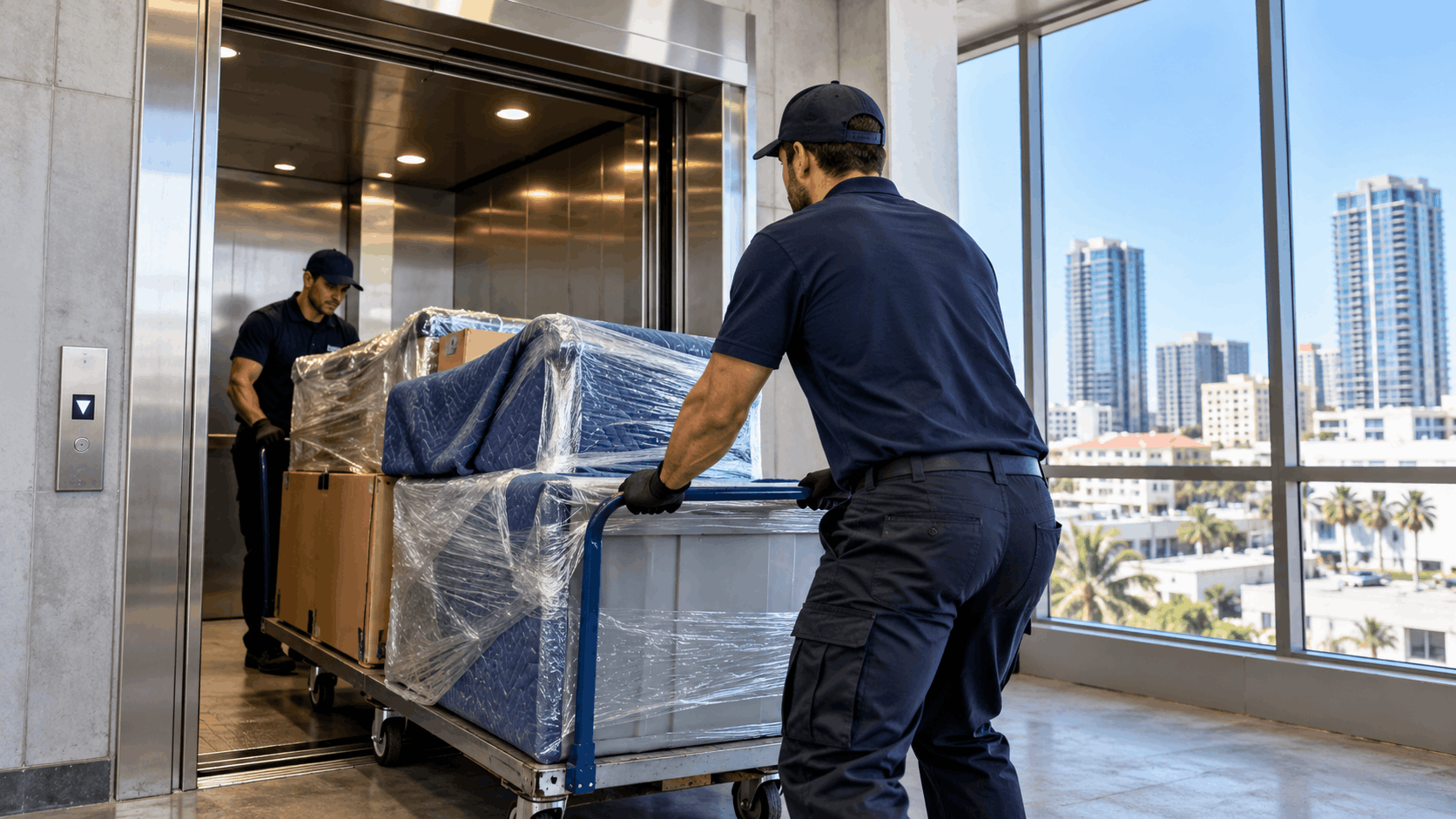
Residential housing in downtown Long Beach is mostly mid- and high-rise apartments and condominiums. They line Ocean Boulevard, Broadway and Pine Avenue, and almost every one of them has a management office that sets the terms for a move. That office controls the shared elevator, the loading area and the hours a crew is allowed to work.
For a high-rise move into storage, the building paperwork decides the day more than the curb does. A crew can have a perfect truck position and still be stuck if the elevator is not booked. The street is a problem you solve second. The building is the problem you solve first.
The towers from Ocean Boulevard to Pine Avenue set their own rules
Buildings along the Ocean Boulevard corridor, Broadway and Pine Avenue typically require a booked elevator window before move day. They also ask for a certificate of insurance, elevator pads to protect the cab, and fixed move hours that the crew has to work within. None of this is optional once the building has a management company.
Many downtown condos limit moves to weekdays only. Others set fixed weekend slots, so a Saturday move might only be available in a single morning or afternoon block. If a customer assumes any day and any hour works, the schedule can fall apart before it starts.
The condo rules also vary tower to tower, even on the same block. One building may allow a four-hour window with no deposit, while the one next door wants a larger window, a refundable deposit and strict end-of-day hours. There is no single downtown standard, so each building has to be checked on its own.
These rules exist because the service elevator is shared with everyone else in the tower. A move that runs long or blocks the cab affects every other resident trying to get groceries upstairs or furniture delivered. That is why the office enforces move hours so tightly.
What a management office asks for before loading begins
The list a management office hands over is usually short but firm. A booked elevator window comes first, since the whole day is planned around it. Then comes the certificate of insurance naming the building, which the office will not waive.
Many buildings also want a refundable deposit against damage to common areas, held until after the move and returned if the walls, floors and elevator come through clean. Elevator pads are installed to protect the cab, and set hours tell the crew exactly when loading can start and when it has to stop.
The smart move is to gather all of these items before the date is confirmed. An elevator reservation that is not actually booked, or a certificate with the wrong building name, turns into a last-minute scramble. We ask customers for the office contact early so we can line up every requirement in advance.
When a storage load is involved, this matters even more. The goods are heading straight to our warehouse the same day, so the window, the pads and the hours all have to line up with the truck schedule. One weak link in that chain pushes the whole plan.
Why this matters more here than in a Long Beach single-family move
Downtown is dense waterfront housing. A service elevator and a loading bay are shared by dozens or hundreds of units, so a single shipment competes with everyone else's access on that day. That is a different world from a house in a quieter part of Long Beach.
In a single-family move, the crew controls the driveway and the front door. There is no booked elevator, no deposit and no building office setting hours. The family decides the timing, and the only outside factor is the street.
Downtown, that shared access flips the whole plan. The building controls the elevator and the bay, so the building controls the clock. A crew that understands this schedules around the window instead of fighting it.
This is also why so many downtown storage loads pair with lease gaps and condo renovations. People between homes or waiting on a new unit store their belongings while the building sorts out their access. Long Beach has a high renter share, with well over half of homes rented citywide, so shorter-notice moves into storage are common in these towers. For a closer look at the area we serve, see our Long Beach moving and storage page.
Get Your Free Quote
Tell us about your move. We'll be in touch soon.
The Certificate of Insurance (COI) Explained in Plain Terms
A certificate of insurance is the document a building asks the mover to provide so the property is named and protected during the load. It proves the mover carries insurance and, in most downtown buildings, lists the property as an additional insured party. It is a building requirement, not a courtesy.
Getting the COI right is one of the two things most likely to stall a downtown move. The other is the elevator window. Both are paperwork, both are easy to handle with lead time, and both can stop a crew at the door if they are missing.
What a COI actually is and who it protects
At its simplest, a COI is proof of insurance. It is a one-page summary from the mover's insurer that confirms coverage is active, lists the policy types and often names the building or its management company. The building keeps it on file in case anything in the common areas is damaged during the load.
The point of the document is building protection. If a cart scuffs the lobby floor or a hand truck dings the elevator, the building wants to know the mover's insurance stands behind the work. That is why so many towers refuse to let a move start without one.
These are the COI basics every downtown customer should understand. The certificate protects the building, not the customer's belongings. Those are two separate things, and confusing them is one of the most common mistakes people make when they book a move into storage.
Because the certificate is between the mover's insurer and the building, the customer's main job is to pass along the building's exact requirements. Once we have those, we handle the rest with our insurer.
Details a Downtown Long Beach building usually wants on the certificate
Downtown buildings are specific about what goes on the certificate. The table below shows the items a management office commonly asks for.
| Item requested | What it means |
|---|---|
| Additional insured | The building or HOA's correct legal name listed on the policy coverage |
| Property address | The exact street address of the tower where the move happens |
| Coverage types | The categories of insurance the building wants shown, such as general liability |
| Move date window | The date or range the certificate needs to cover |
| Management company name | Often listed alongside the building as a named party |
The additional insured wording is the detail that trips people up most. The building wants its exact legal name, which is not always the name on the front door. An HOA or management company name has to match their records precisely, or the office may reject the certificate.
The property address and the coverage wording also have to match what the office asks for. Each building writes its requirements a little differently, so the only reliable path is to get the wording in writing from the management office and pass it straight to us. Guessing at it wastes everyone's time.
Because requirements differ building to building, confirm the exact wording with your management office rather than assuming last year's version still applies. We would rather issue the certificate once, correctly, than fix it on move day.
How Popeye provides the COI and why lead time matters
Popeye Moving and Storage is fully insured, and we issue a certificate of insurance on request. Once a customer sends us the building's exact wording, we coordinate with our insurer to produce the document and get it to the management office ahead of the date.
The thing that makes this smooth is lead time. Insurers do not always turn a certificate around instantly, and if the building rejects the first version for a wording error, a corrected one has to be requested. Starting early leaves room for a round of corrections without touching the move date.
When the certificate is handled late, it becomes a move day problem. A crew arrives, the office checks the file, and a wrong name or a missing coverage line stops the load. That is a lost day for the customer and the crew, and it is entirely avoidable.
Because COI requirements vary from building to building, we ask for the office's exact wording the moment a date is being discussed. Confirming it with the management office before the date is set is the single best way to keep the move on track.
The difference between the COI and protection on your goods
Here is the distinction that matters most. The COI protects the building. Protection on the customer's household goods comes from valuation under California's Maximum Rate Tariff 4, which is a completely separate thing.
Valuation is not insurance, and the language matters. Released value is a liability limit, and the transportation rates are based upon a declared value of 60 cents per pound per article. That 60-cent figure is how the rate is calculated, not what gets paid out on a claim.
The default protection is stronger than that basis suggests. Unless the shipper declares a different value, the mover's maximum liability for lost and damaged articles is up to $20,000 of actual cash value. Full value protection is the paid alternative that raises that ceiling, and the customer has the right to be offered a higher valuation and the right to decline it knowingly.
So two documents are in play on a downtown storage load. The certificate of insurance satisfies the building. The valuation on the Agreement For Moving Services covers the belongings. Keep them straight and neither the building nor the goods are left exposed. Our storage solutions team can walk through both before the date.

Need Help in Los Angeles?
Popeye Moving & Storage serves Los Angeles and all of Los Angeles County.
Booking the Freight Elevator Window Right
The freight elevator window is the block of time the building reserves for a single move. It controls how fast the load has to happen, because once the window closes, the elevator goes back to general use. Booking it correctly keeps the crew working instead of standing around.
In a downtown tower, the service elevator is a shared resource, so the building rations it carefully. An elevator reservation is not a formality, it is the backbone of the whole day. Get it right and the move flows. Get it wrong and the crew is stuck waiting for the cab between every trip.
What a reserved elevator window includes and how long it runs
A reserved window is a fixed set of hours assigned to one unit. During that block, the elevator is held for the move, usually with elevator pads installed to protect the interior walls of the cab. No other resident should be competing for it during that time.
The length of the booked window varies by building. Some offer a few hours, some a half day. The right question to ask the management office is simple: how long does your standard window run, and what happens if a move goes past it?
Going past the window can mean rebooking for another day, which is a real risk on a storage load with a truck already scheduled. That is why the move slot has to be matched to the size of the job honestly. A packed two-bedroom condo needs more window than a studio.
We plan the crew size and the loading sequence around the window the building gives us. A tight window calls for more hands and a tighter plan so the elevator never sits idle while the crew hunts for the next load.
Weekday-only and fixed weekend slots in downtown towers
Many downtown buildings restrict moves to weekday moves only. The logic is that weekdays are quieter in the common areas, so the building would rather absorb the disruption Monday through Friday than on a busy weekend.
Other buildings offer weekend slots, but as fixed blocks rather than open availability. A Saturday might only have a morning window or an afternoon window, and once another resident takes it, the next opening could be the following weekend.
This directly shapes scheduling a storage load. A customer who assumes they can move any Saturday may find the only slot is a Tuesday morning three weeks out. The sooner the window is requested, the more choice there is.
For apartment and condo moves specifically, this is the single biggest scheduling variable downtown. Our apartment moving crews work around these windows constantly, so we plan the truck and storage drop to fit whatever the building allows rather than the other way around.
Matching the elevator window to the carry distance and vault loading
A window is only as useful as the plan behind it. The crew builds the plan around the carry distance from the loading position to the unit. A long carry from a side street eats into the window, so the crew has to stage the work to keep moving.
The loading plan accounts for where the truck sits, how far items travel to reach it, and how the elevator trips are sequenced. On a tight window, a crew that stages items near the elevator and loads in a steady rhythm will finish inside the block. A disorganized load burns the window on wasted trips.
Because this is a storage load, the goods are loaded directly for same-day transport to the vault warehouse. There is no second handling at a transfer point, which keeps the timeline clean from the unit to the vault loading at the warehouse.
When the window is especially tight, the answer is more hands on the job, not a slower pace. We size the crew to the window and the carry so the elevator keeps running the whole time it is reserved.
Parking, Loading Bays and Truck Clearance Downtown
Most usable curb downtown is metered, red, or reserved for buses, valet stands and bike lanes. That reality means the building loading bay often decides the plan, not the street. Downtown parking and truck clearance both shape how a storage load is staged.
Downtown Long Beach runs from the Los Angeles River and the 710 freeway east to about Alamitos Avenue, and from Ocean Boulevard north to roughly 7th Street. This is the City of Long Beach, with its own police, permits and parking enforcement, so nothing from Los Angeles or LADOT applies here.
Metered curb, red zones and blocks with no space at all
Much of the downtown curb is metered curb, and much of the rest cannot be reserved at all. Red curb, bus stops, loading zone markings, valet stands and bike lanes take up the blocks that are not metered. That leaves far less usable space than people expect.
On some blocks there is no practical street position for a truck at all. When that happens, the plan has to use the building's own loading area or a side street with a longer carry to the elevator. This is normal downtown, not a failure of planning.
Establishing the curb reality before the move is the difference between a smooth day and a scramble. We would rather tell a customer up front that the truck parks on a side street than promise a space outside the door that does not exist.
This is also why the loading bay matters so much. A building bay that a truck can actually use is worth more than any street position, because it keeps the carry short and the elevator close.
Parking structure height is a real limit in downtown towers
Garage entrances in downtown towers are rarely tall enough for a full-size moving truck. The garage height clearance in these buildings is built for cars, not for a box truck with a tall body. Driving in without checking is how a truck gets stuck or damaged.
When the garage will not take the truck, the clearance decides the plan. The loading bay or a street position has to handle the load instead, and sometimes that means a shuttle vehicle, a smaller truck that ferries goods from the unit to the larger truck staged nearby.
A shuttle is the professional method on a restricted-access building, not an improvisation. It is planned and priced at the estimate when the access calls for it. The alternative, extra trips with a vehicle that does fit, is accounted for the same way.
The way to avoid any surprise here is to confirm the clearance with the building before the day. We ask for the garage height and the designated loading position as part of setting up the move, so the right vehicle shows up the first time.
On-street reservations go through the City of Long Beach
Any on-street parking permit, temporary no-parking sign or oversized vehicle question downtown is handled by the City of Long Beach. Not Los Angeles, not LADOT, and not any neighboring city's process. Long Beach runs its own system.
That means the lead time, the fee and the no-parking sign arrangement all have to be confirmed with the City before the move is quoted. The process in Long Beach is its own, and applying another city's rules to a downtown Long Beach block leads to wrong assumptions.
Where a reservation is needed, it is worth starting early because the City sets its own notice period for posting signs. We confirm the current lead time, fee and sign process with the City directly rather than assuming, so the curb is actually held on move day.
On blocks where no reservable curb exists at all, the plan goes back to the loading bay or a side street. The City process only helps where there is a space that can actually be reserved in the first place.
Events and street closures that can block your move date
Downtown Long Beach is an events district, and the waterfront brings crowds. The Convention Center and the Terrace Theater at 300 East Ocean Boulevard, the Aquarium of the Pacific at 100 Aquarium Way and the Queen Mary all draw traffic and can trigger street closures nearby.
The biggest one is the Long Beach Grand Prix, which closes streets around Shoreline Drive in spring. During the Grand Prix, large parts of the waterfront core are simply not accessible for a truck, and the closures extend for days around the event itself.
Checking the move date against the event calendar is part of planning any downtown load. A date that looks fine on paper can collide with a closure that blocks the only route to the building. We check this before confirming a date so the truck is not turned away at a barricade.
Seasonal timing matters here more than in most neighborhoods. A spring move near Shoreline Drive needs a careful look at the Grand Prix schedule, and waterfront events can affect access at other times of year too.
From the Tower to the Vault: How the Storage Load Travels
Once the goods leave the unit, they go into full-service vaulted storage at our Mar Vista warehouse the same day. This is same-day storage, not a transfer to a self-storage unit the customer manages. Here is what that means for a downtown customer and how the load is handled after loading.
The warehouse sits at 5509 1/2 S Centinela Ave, Los Angeles, CA 90066, in Mar Vista on the Westside. That is where the vaults live and where the goods are stored until the customer is ready for them.
What full-service vaulted storage means
Full-service vaulted storage is different from a self-storage unit. In full-service storage, the customer has no key, no individual unit and no right of entry. Popeye crews handle the goods from start to finish, which is what places this service outside the self-storage rules entirely.
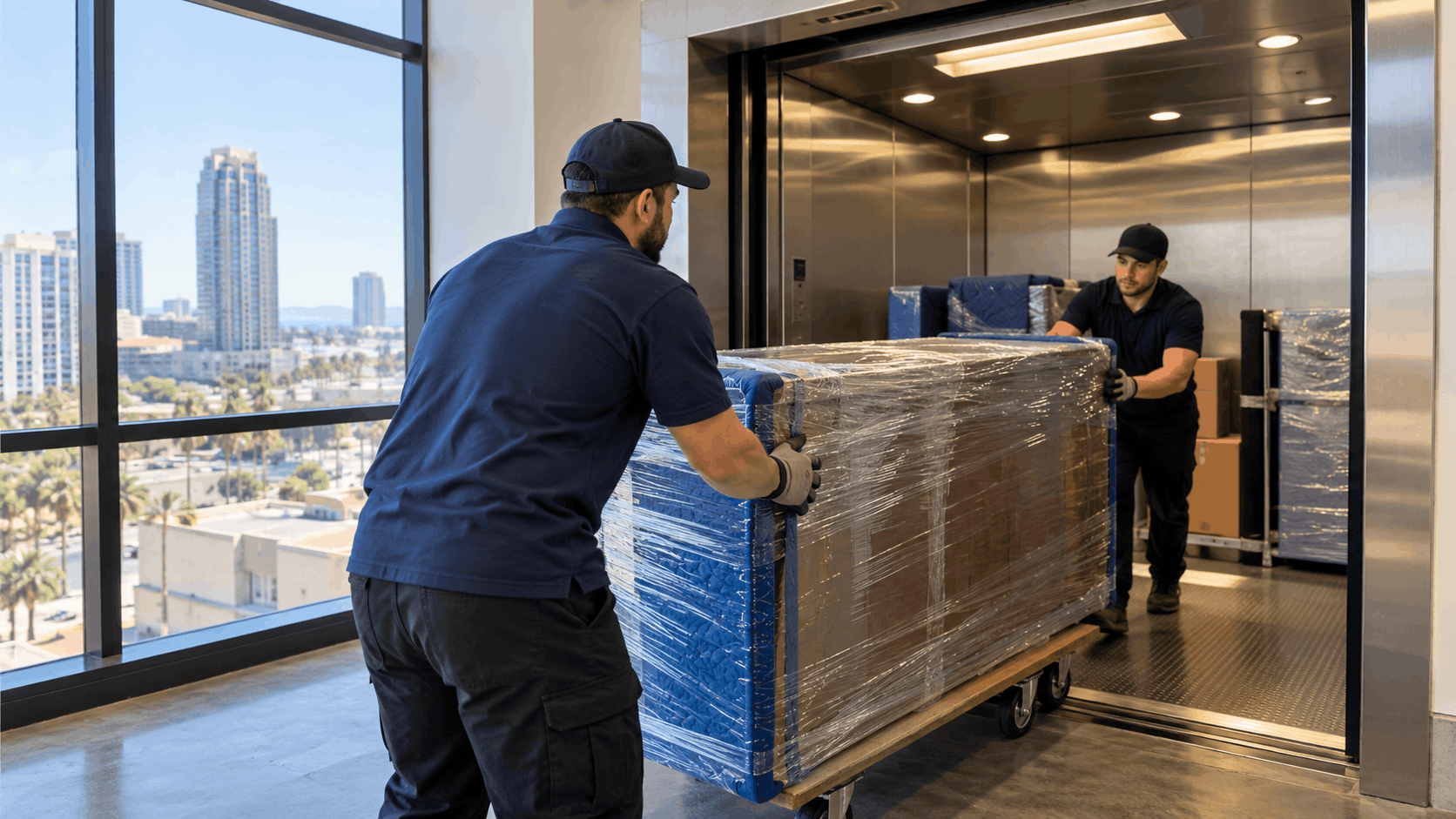
The goods are loaded into a wooden vault, a sturdy container built from plywood on a reinforced floor set on runners. Once packed, the vault is moved as a single unit by forklift inside the warehouse. The belongings are not repacked or shuffled between units.
Because this is no self-storage, there is no drive-up aisle and no gate code. The trade-off is that the goods are handled by professionals and stored as a sealed unit rather than left in an open bay. For many customers between homes, that is exactly the arrangement they want.
This is the actual operating model for our storage, not a general description. The customer's belongings go into the vault once and stay there as a unit until retrieval. Our vaulted storage service page covers how the vaults work in more detail.
Same-day pickup with no overnight hold on the truck
Popeye picks up and places goods into vaults at the Mar Vista warehouse the same-day. There is no overnight hold on the truck, so the belongings are not sitting in a loaded vehicle in a parking lot overnight.
This pickup to vault flow is why the elevator window and the parking plan have to run smoothly. The truck is scheduled to reach the warehouse the same day, so a load that drags past its window or gets stuck at the curb throws off the whole timeline.
For a downtown customer, same-day transport means the goods go from the tower to the vault in one clean move. No intermediate storage, no second handling, no overnight exposure. The load leaves the building and is secured in a vault the same day.
Keeping that promise depends on the front end of the day going right. That is the whole reason we push so hard on confirming the COI, the elevator window and the loading position before the date.
Storage-in-transit versus longer warehouse storage
There is a line at 90 days that every storage customer should understand. Under Maximum Rate Tariff 4, storage-in-transit is storage of a shipment at the customer's request at one point between origin and destination for a period not to exceed 90 days. Inside that window, the move is still a regulated mover service.
Past 90 days, or where storage-in-transit was not requested, the goods fall under the warehouse contract rather than the mover regime. At that point the warehouse terms govern, and the mover's liability has given way to the warehouseman's standard of care.
For a downtown customer bridging a lease gap, this distinction decides which rules apply to the stored goods. A short gap of a few weeks sits comfortably inside storage-in-transit. A longer stay crosses into warehouse storage, with its own agreement.
There is no minimum and no maximum storage term with us, so the length is up to the customer. The important thing is knowing which regime the storage sits in, because that changes which protections and claim rules apply. Our long-term storage page covers stays beyond the storage-in-transit window.
Access to stored goods and warehouse hours
Collecting or depositing stored goods needs an appointment. Because the goods are in a sealed vault, crews have to retrieve and open the container, so a customer cannot simply walk in and grab a box. The retrieval is a scheduled task, not open access.
Our business hours run 6am to 9pm seven days a week, but those are hours for calls and scheduling. They are not open warehouse access hours for a customer collecting or depositing goods. The distinction matters, because vaulted storage does not work like a self-storage facility with a gate code.
No statute or tariff sets an appointment requirement or a notice period for this, so scheduling a retrieval is simply ordinary trade practice. We ask for notice so the crew can pull the right vault and have it open and ready when the customer arrives.
For most customers, this is not a limitation. The typical downtown storage customer is between homes or storing belongings without needing to touch them during the term. When they do need something, a call sets up the appointment.
Need Help in Los Angeles?
Popeye Moving & Storage serves Los Angeles and all of Los Angeles County.
What a Downtown Long Beach Storage Load Typically Costs
Cost depends on the move itself, but typical Los Angeles area ranges set expectations. The not-to-exceed figure is agreed in writing before anything is loaded, so the customer knows the ceiling before the truck fills. Below are the ranges that apply to a downtown storage load.
| Service | Typical area range |
|---|---|
| Local residential moving (two-person crew and truck) | $150 to $200 per hour |
| One-bedroom apartment local move | $350 to $650 |
| Vaulted storage | $60 to $90 per vault per month |
Typical local moving and vaulted storage ranges
For local work, local residential moving runs $150 to $200 per hour for a two-person crew and truck. A one-bedroom apartment local move typically lands between $350 and $650 depending on the size of the job and the access.
The vaulted storage rate is $60 to $90 per vault per month. How many vaults a load needs depends on how much is being stored, which is worked out when the move is estimated. A studio or small one-bedroom often fits in fewer vaults than a packed larger unit.
These are typical range figures for the Los Angeles area, not a quote from us. The actual price for a specific move is set in writing before anything is loaded. We give these ranges so a reader knows roughly what to expect before they call.
Storage-only cost is straightforward once the vault count is set. The moving cost is where the downtown factors come in, because the building and the curb affect the hours on the clock.
How double drive time affects a downtown bill
California bills local hourly moves on a double drive time convention. That means travel time between origin and destination is charged at twice the actual driving time. It is a legitimate, regulated charge, not a padding tactic, and it applies to local hourly moves across the state.
Downtown geography makes this worth watching. The 710 freeway, Shoreline Drive and Ocean Boulevard all feed the waterfront core, and traffic on those routes directly affects the drive time that gets doubled. A load heading to the Mar Vista warehouse crosses the city, so the route matters.
Because of this, the start time has a direct effect on the bill. A move that begins early, ahead of the heaviest traffic, keeps the drive time down, and that saving is doubled. A load that starts in the middle of a busy afternoon costs more in drive time for the same distance.
We plan start times around the building's window and the traffic pattern together. The goal is to keep the crew working and the drive time low, since both land on the final hours.
How carry distance and extra trips change the number
The hours on the clock move with the access, and downtown access varies a lot. A longer carry distance from a side street, because no curb is reservable outside the door, adds time to every trip between the unit and the truck.
Garage height is the other big factor. If the entrance will not take a full-size truck, a smaller shuttle vehicle may be needed, or the crew runs extra trips with a vehicle that fits. Both add time, and time is what the hourly rate charges.
This is exactly why we push to confirm the loading position and the garage clearance early. Knowing the carry and the clearance before the day lets us size the crew and the vehicle correctly, which keeps the hours tight rather than ballooning on move day.
None of these factors multiply the cost by some fixed amount. They add real time for real work, and that time shows up on the clock. The clearer the access picture before the move, the closer the final hours land to the estimate.
The not-to-exceed figure in writing
The strongest cost protection on an intrastate move is the not-to-exceed amount. Under Maximum Rate Tariff 4, it is the maximum total dollar amount the customer can be liable for, agreed to before any goods are moved or any services performed.
This is set out in the written estimate and in the Agreement For Moving Services. The customer is told a ceiling before the truck is loaded, and the final bill cannot exceed it. That is a right the customer has, not a courtesy the mover extends.
The only way the figure rises is through a valid change order that the customer agrees to, for additional services ordered along the way. Without that signed change, the bill stays at or below the not-to-exceed amount no matter how the day runs.
For a downtown storage load, this matters because the access can be unpredictable. The not-to-exceed figure caps the exposure in advance, so a long carry or a shuttle does not turn into an open-ended bill.
Paperwork and Protections That Travel With Your Goods
Beyond the building COI, California rules give a storage-load customer specific protections and documents to keep. This section covers the written estimate, valuation and claims windows for an intrastate Long Beach move. A move that begins and ends in California is intrastate, so these rules apply to a downtown load going into local storage.
The written estimate and the documents to keep
California requires a written estimate. A verbal rate quotation, whether per hour or per hundred pounds, is not an estimate and is not binding. If a quote came over the phone with nothing in writing, the customer does not yet have a proper estimate.
The Agreement For Moving Services describes the shipment in enough detail to determine the articles and services included in the not-to-exceed price. It covers the transportation and accessorial services, the number of helpers and packers, and the rates and charges quoted. That is the document to read closely before signing.
Keeping the paperwork is what wins a dispute later. The Agreement For Moving Services and the bill of lading are the records that strengthen any claim. The single most common reason a customer loses a dispute is that they cannot produce the paperwork, so hold onto all of it.
For a storage load, that paperwork also documents what went into the vaults. If something is missing or damaged on retrieval, those records are the starting point for a claim.
Who regulates the move and how to verify the mover
Household moving inside California is regulated by the Department of Consumer Affairs Bureau of Household Goods and Services, the BHGS. It is reachable on (916) 999-2041, and complaint and verification information is published at the bureau's website. The CPUC no longer regulates household movers, and has not since July 2018.
Every legal California household mover operates under a state permit. Popeye Moving and Storage operates under CAL T 189749 for intrastate work, and USDOT 1472924 and MC 498816C for interstate work. The practical advice for any customer is simple: ask for the permit number and verify permit status before booking rather than after a problem.
You can check a mover's license status through the bureau. An operator working without a valid permit is not merely uninsured in practice, it is unlawful, so confirming the number is a real protection, not a formality.
If a question or complaint comes up on an intrastate move, it goes to the BHGS, not the CPUC. More on how we work, and our credentials, sits on our about page. For the authority on consumer protection in moving, the California Department of Consumer Affairs publishes guidance.
Claim windows for an intrastate storage load
The claim windows on an intrastate move come from Maximum Rate Tariff 4, and they are not federal-only rules. A claim for loss or damage must be filed in writing with the mover within nine months after delivery to the consignee as shown on the shipping document.
Once a claim is filed, the mover has to acknowledge it in writing within 30 days. The mover must then pay, decline, or make a firm compromise settlement offer within 60 days. That claim window structure gives the customer a clear timeline to expect a response.
If the claim is disallowed in writing, suit must be instituted within two years and one day from the date of that written notice. Those deadlines matter, which is another reason to keep the paperwork that proves when delivery happened.
One protection is worth knowing for an intrastate storage load specifically. A claim cannot be denied solely because the lost or damaged goods were not noted at the time of delivery. So discovering an issue after the vault is unloaded does not automatically sink a claim.
Need Help in Los Angeles?
Popeye Moving & Storage serves Los Angeles and all of Los Angeles County.
How Popeye Handles a Downtown Long Beach Storage Load
Here is how the crew plans around the COI, the elevator window and the loading position, then runs the same-day load to the Mar Vista vault warehouse. This is the practical sequence a downtown customer should expect from Popeye Moving and Storage. A solid storage load plan for Downtown Long Beach front-loads the building requirements so move day runs clean.
Confirming building requirements before the date
The work starts with the building. We gather the lift reservation window, the insurance wording the office requires, any deposit, and the permitted hours for the move. These come straight from the management office, since each tower sets its own terms.
Alongside the building office items, we confirm the garage height clearance and the designated loading position. Knowing whether a full-size truck fits the garage, or whether the load works from a bay or a side street, shapes the vehicle and the crew we send.
All of this is confirmed before the date is set. A date pinned down without the elevator window and the clearance is a date at risk, so we line up the building side first. That is the difference between a move that runs on schedule and one that stalls at the lobby.
We also check the move date against the downtown event calendar, including the spring Long Beach Grand Prix closures around Shoreline Drive. A date that collides with a waterfront closure gets flagged early rather than discovered at a barricade.
Issuing the COI and planning the loading position
Popeye is fully insured, and once we have the building's exact wording, we get the COI issued through our insurer with the right names and coverage lines. Getting that certificate to the office ahead of the date clears the biggest single hurdle to starting the load.
With the curb reality and garage height confirmed, we plan the loading position. If the garage takes the truck, the bay handles the load. If it does not, we plan for a street position, a side street with a managed carry, or a shuttle vehicle where the access calls for it.
The carry plan ties the loading position to the elevator window. The crew stages the work so the elevator keeps moving and the carry distance does not eat the window. On a tight block, this planning is what keeps the day on time.
Where an on-street reservation is needed, we handle it through the City of Long Beach and confirm the current lead time and sign process directly. That keeps the curb held and the truck legal on move day.
Same-day vault loading at the Mar Vista warehouse
On move day, the crew loads the goods into vaults and runs them to 5509 1/2 S Centinela Ave in Mar Vista the same-day vault drop, with no overnight hold on the truck. The belongings go from the downtown tower into a sealed vault at the warehouse in one clean move.
Storage has no minimum term and no maximum term, so a customer bridging a short lease gap and one storing for a longer stretch both fit the same service. The vault count is set by how much is being stored, and the monthly rate follows from there.
We accept household goods and commercial or business storage, along with specialist items like wine, fine art, pianos and chandeliers. Vehicles are not accepted. For downtown office moves in the Ocean Boulevard towers, our office and business moving team handles the same building coordination.
The through-line of the whole plan is that the front end has to run right for the back end to work. The COI, the elevator window and the loading position all feed the same-day vault drop, and we plan them together so the goods reach the warehouse secured the same day they leave the tower.
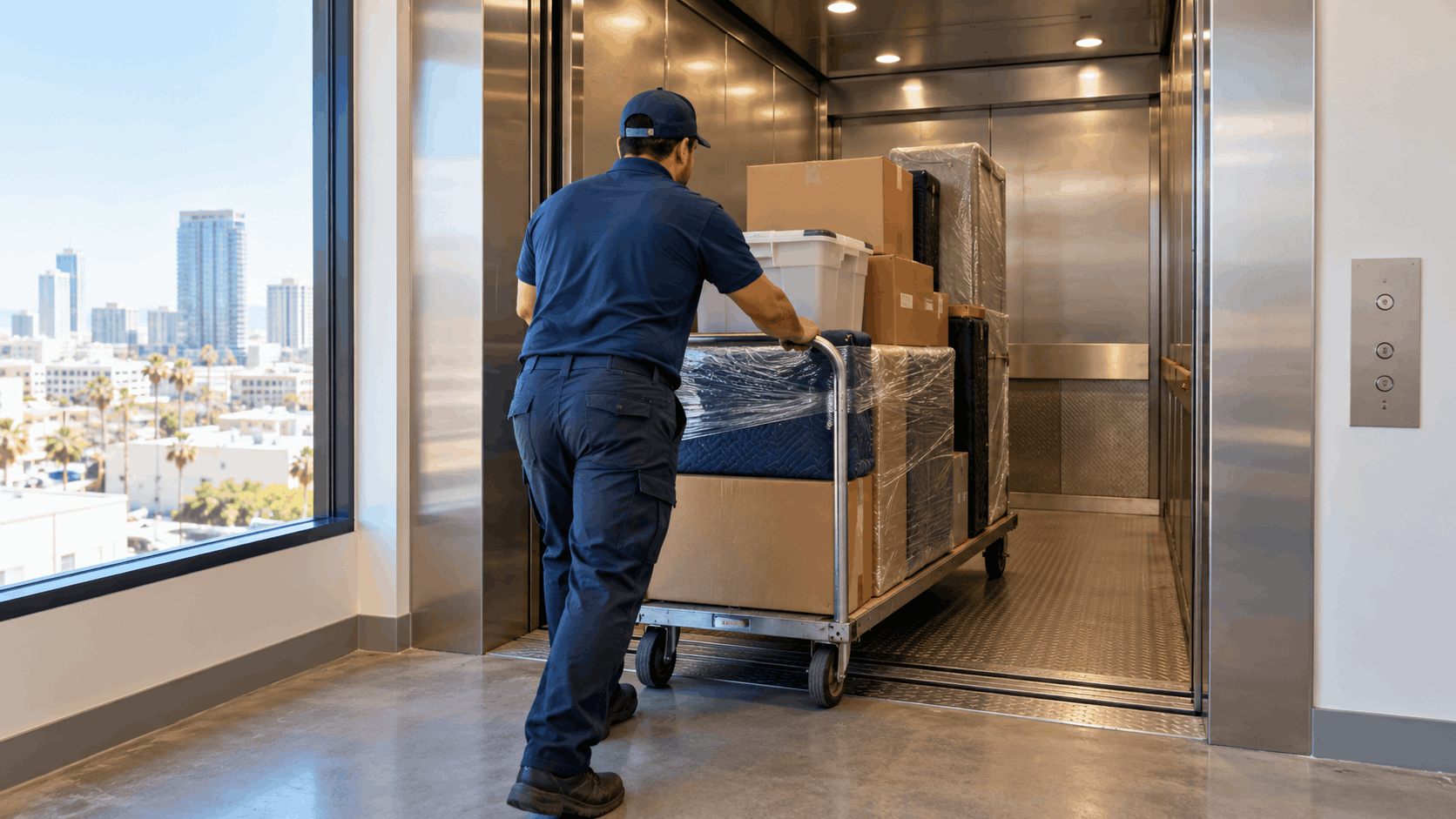
Planning Your Downtown Storage Load With Us
A Downtown Long Beach storage load comes down to handling the building before the truck arrives: the certificate of insurance with the right wording, the booked freight elevator window, and a loading position that works around metered curb and garage height. Get those confirmed and the same-day drop into our Mar Vista vaults runs clean.
We confirm the building requirements, issue the COI, and put the not-to-exceed price in writing before anything is loaded, so you know the ceiling going in. To set up a downtown storage load, call Popeye Moving and Storage at (310) 823-9510 or reach us through our contact page.
Frequently Asked Questions
- What is a certificate of insurance for a move?
- A COI is proof of the mover's insurance that names and protects the building during the load. Most downtown towers list the building or its management company as an additional insured party on the certificate. It covers the building's common areas, like the lobby and elevator, if something is damaged during the move. It is a building requirement, separate from any coverage on your belongings, and the office keeps it on file.
- How do I book the freight elevator for my Downtown Long Beach building?
- The elevator reservation goes through your building's management office, not the mover. The office assigns a fixed window of hours for your unit, often with elevator pads installed. When you call, ask whether moves are weekday-only or whether there are fixed weekend slots, since many downtown towers restrict the freight elevator to certain days. Book it as early as you can, because popular slots fill up and the window shapes the whole move schedule.
- Can a full-size moving truck fit in my downtown parking garage?
- Usually not. Garage entrances in downtown towers are rarely tall enough for a full-size moving truck, since they are built for cars. That garage height limit means the loading bay or a street position decides the plan, and sometimes a smaller shuttle vehicle or extra trips are needed. Confirm the truck clearance with your building before the day so the right vehicle shows up the first time and the load is not held at the entrance.
- Do I need a parking permit for the moving truck downtown?
- Any on-street reservation, temporary no-parking sign or oversized vehicle question downtown goes through the City of Long Beach , not Los Angeles or LADOT. The parking permit lead time, fee and sign arrangement have to be confirmed with the City before the move is quoted. On some blocks no curb is reservable at all, in which case the plan uses the building loading bay or a side street. We confirm the current City process directly rather than assuming.
- What kind of storage does Popeye offer?
- Popeye offers full-service vaulted storage at our Mar Vista warehouse. This is full-service storage, which means you have no key, no individual unit and no right of entry. Our crews handle the goods, loading them into a wooden vault that is moved as a single unit by forklift inside the warehouse. It is not a self-storage unit with a gate code. Household goods, commercial storage and specialist items like fine art and pianos are all accepted.
- Does my load go into storage the same day?
- Yes. Popeye picks up and places goods into vaults at the Mar Vista warehouse the same-day storage drop, with no overnight hold on the truck. Your belongings are not left sitting in a loaded vehicle overnight. They go from the downtown tower into a sealed vault the same day they are loaded. This is why the elevator window and the parking plan need to run smoothly, so the truck reaches the warehouse on schedule.
- How much does vaulted storage cost?
- Vaulted storage cost runs $60 to $90 per vault per month as a typical area range. How many vaults your load needs depends on how much you store, which is worked out when the move is estimated. The actual price is set in writing before anything is loaded. There is no minimum and no maximum storage term, so a short lease gap and a longer stay both work. These figures are a typical range for the area, not a quote.
- Are my stored goods insured by the mover's cargo policy?
- The mover's cargo insurance is framed around transportation and storage-in-transit, the window of up to 90 days. It does not clearly extend into long-term warehouse storage beyond that point. So you should not assume stored goods in long-term storage are covered by the mover's cargo policy. Ask us what protection applies to your stored goods for the length of your stay, since the answer depends on whether the storage sits inside or beyond the storage-in-transit window.
- Is a certificate of insurance the same as coverage on my belongings?
- No. The COI protects the building, while valuation under Maximum Rate Tariff 4 covers your household goods. These are two separate things. The default is up to $20,000 of actual cash value unless you declare a different value. That is the COI versus valuation distinction that trips people up most. The transportation rates are based on a declared value of 60 cents per pound per article, but that basis is how the rate is figured, not what gets paid on a claim.
- Who regulates movers and storage in California?
- The Bureau of Household Goods and Services , the BHGS, regulates household moving in California. It is reachable on (916) 999-2041, and that number belongs to the bureau, not to us. The CPUC no longer regulates movers and has not since July 2018, so any content naming the CPUC as the current regulation authority is out of date. Popeye operates under permit CAL T 189749, which you can verify through the bureau before booking.
Popeye Moving & Storage Co. Team Team
Licensed moving and storage professionals serving Los Angeles and Los Angeles County.
Licensed in California · License #CAL T 189749 | USDOT 1472924 | MC 498816C
Why trust Popeye Moving & Storage?
Founded in 1994, Popeye Moving & Storage is a licensed and insured moving and storage service serving Los Angeles and Los Angeles County. All content is reviewed by our licensed technicians.

Need Help in Los Angeles?
Popeye Moving & Storage serves Los Angeles and all of Los Angeles County.
Related Articles
Booked Delivery Windows on Melrose and Scheduling a Commercial Storage Load
How booked delivery windows work on Melrose, how LADOT signs reserve the curb, and how a commercial storage load gets scheduled into vaulted warehouse storage in Mar Vista.
Downtown LA Arts District Movers: Loft Conversion and Loading Dock Access
A local mover's guide to Arts District loft moves in Downtown LA, covering loading dock access, freight elevators, LADOT permits, parking, protection, and storage.
Moving in Downtown LA High-Rises: COI, Elevator Reservations, Loading Docks
A local mover's guide to Downtown LA high-rise moves, covering certificates of insurance, service elevator reservations, and loading dock access in DTLA towers.