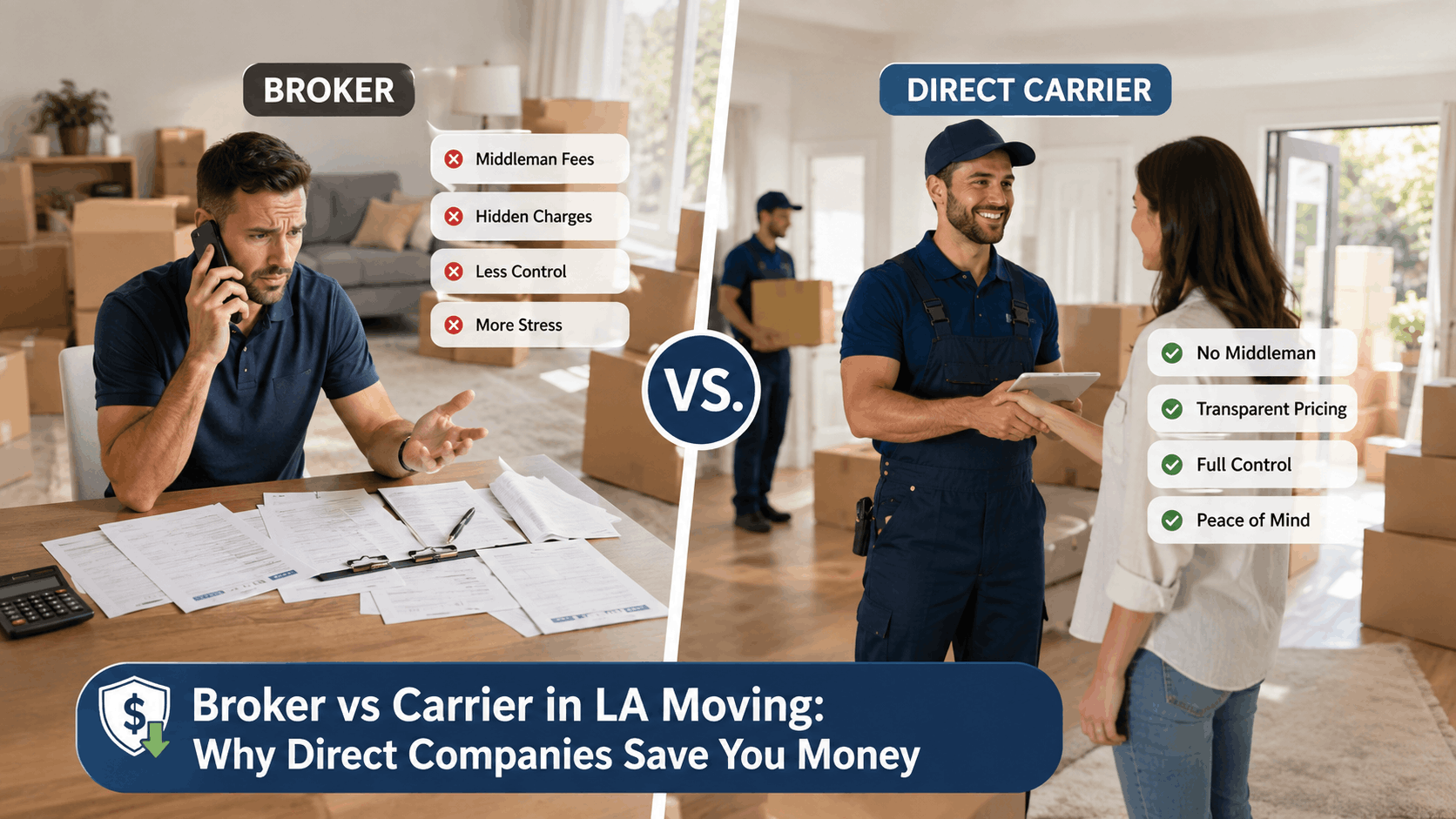
Broker vs Carrier in LA Moving: Why Direct Companies Save You Money
Key Takeaways
- A moving broker sells your job to a third-party carrier, while a direct carrier owns the trucks and crew that do the work.
- Low online quotes often come from brokers or lead-generation sites, not the actual movers, and prices frequently rise on moving day.
- Warning signs of a broker include large non-refundable deposits, no local address, and vague answers about who shows up.
- Direct carriers give one clear estimate, send their own vetted crews, and keep one point of contact from quote to delivery.
- Local LA crews plan for parking permits, freight elevators, COIs, hillside homes, and traffic that out-of-area brokers cannot.
- Verify a mover by asking if they own their trucks, checking for a local yard and Cal-T license, and reading deposit terms.
- California household movers must hold a state Cal-T permit number, and a legitimate carrier shares it readily.
- Popeye Moving & Storage Co. operates as a direct Los Angeles carrier with its own trucks, trained crews, and local storage support.
In This Article
A family in Los Feliz found a moving quote online that looked too good to pass up. They paid the deposit, circled moving day on the calendar, and felt ready. Then a truck they had never heard of pulled up to their curb, driven by a crew they had never spoken to, and the price on the paperwork was hundreds of dollars higher than the number they were promised.
That story plays out across Los Angeles every week. The problem is not always a bad crew. The problem is that the cheap number came from a moving broker, not the company that actually moves the boxes. By the time the family figured that out, their belongings were already on a stranger's truck.

What a Moving Broker Actually Is?
A moving broker is a middleman. They sell you a move, but they do not own a single truck or employ a single mover. Instead, they take your booking and hand the actual work to another company.
Many Los Angeles residents book a broker without ever realizing it. They see a low moving quote on a website, talk to a friendly salesperson, and assume that person represents the crew who will show up. In reality, the person quoting the job often has no idea who will end up doing it.
Brokers make money by charging you and then paying a carrier less to do the work. The gap in the middle is their profit. That setup can work fine, but it adds a layer between you and the people carrying your couch down the stairs, and that layer is where most surprises come from.
How Brokers Sell Your Job to Someone Else
The process usually starts with a deposit. A broker collects your moving deposit to lock in the date, and that money feels like a commitment. What many people do not know is that the broker then posts your job on a load board where other companies bid on it.
A third-party carrier picks up the job, often a company you never spoke to and never checked out. They agree to a rate the broker sets, which is lower than what you paid. The carrier then has every reason to make up the difference somewhere else, and that somewhere else is usually your final bill.
This is why the friendly voice on the phone rarely matches the crew at your door. The broker's job ends once the booking is sold. From that point on, you are dealing with a company that had no part in the promises made to you.
When something goes wrong, the broker points at the carrier and the carrier points at the broker. You end up stuck in the middle with no clear person to call. That runaround is the single biggest reason we tell Los Angeles families to know exactly who they are hiring.
Why Online Quotes Often Come From Brokers
A huge share of the low quotes floating around online come from lead generation sites, not real movers. These sites collect your name, phone number, and move details, then sell that information to multiple companies at once. Soon after, your phone lights up with calls.
Many of those callers are brokers using the same script. They quote a number low enough to win the booking, because their goal is the deposit, not an accurate price. The actual cost of moving your two-bedroom in Silver Lake never really entered the math.
Real Los Angeles movers can also advertise online, so a website alone does not tell you much. The difference shows up in how the company answers questions. A direct carrier can tell you about their trucks, their yard, and their crew because they own all three.
When you get an online moving quote, treat it as a starting point, not a promise. Ask who owns the equipment and who shows up. If the answers get vague, you are likely talking to a broker who plans to sell your job to someone else.
Warning Signs You Are Talking to a Broker
Certain broker red flags show up again and again. The first is a large upfront deposit, sometimes 25 percent or more of the total. A real carrier usually asks for a small deposit or none at all for a standard local move.
The second sign is no local address. If a company cannot point to a yard or office in the Los Angeles area, they probably do not have trucks parked anywhere nearby. Ask where their trucks sleep at night, and listen for a real answer.
Vague answers about moving day are the third warning. If you ask who will handle your belongings and hear something like "our network of trusted partners," that is broker language. A direct company will tell you the crew works for them.
Pressure to pay right away is the fourth. Brokers want the deposit before you have time to research, because research is how you catch them. Slow down, ask direct questions, and watch how the person on the phone reacts.
Get Your Free Quote
Tell us about your move. We'll be in touch soon.
What a Direct Carrier Does Differently
A direct carrier owns the trucks, hires the crew, and handles your move from the first phone call to the last box. There is no middleman selling your job. The company you talk to is the company that does the work.
Popeye Moving & Storage Co. operates this way as a direct local carrier in Los Angeles. Our trucks are ours, our movers are on our payroll, and the person who gives your estimate works in the same office as the crew who shows up. That is the whole point of booking a real moving company in Los Angeles instead of a broker.
This structure changes everything about your experience. Prices are steadier, communication is clearer, and one team owns the outcome. When you call about your move, you reach people who can actually make things happen.
One Company From Quote to Delivery
With a direct carrier, one company handles the estimate, the packing, the drive, and the delivery. The number you get during your quote is built by people who will be responsible for hitting it. That kind of accountability is hard to find in a broker deal.
Because the same business owns each step, there is no finger pointing. If a question comes up about your local residential move, one office has the answer. You are never bounced between a sales company and a mystery crew.
This continuity also means the crew arrives already knowing your job. The notes from your estimate follow the same team, so the movers understand your piano, your tight staircase, or your fragile art before they park the truck. Nothing gets lost in a handoff between companies.
Accountability sounds like a small thing until moving day goes sideways. When it does, you want one number to call and one company that owns the fix. A direct carrier gives you that from start to finish.
Trained Crews Who Know LA Streets
Our in-house movers work these neighborhoods every day. They know the parking headaches in Silver Lake, the narrow streets around Los Feliz, and the building rules that change block by block. That knowledge saves real time and real money.
A crew that knows LA plans ahead. They know which streets near Sunset Junction cannot fit a large truck, so they bring a shuttle plan instead of losing an hour circling for a spot. Out-of-area crews sent by a broker often learn these lessons on your clock.
Local movers also understand the mix of housing across the city. A hillside home in Los Feliz needs a different approach than a flat walk-up in Koreatown. Our teams have handled both, so they arrive with the right equipment and the right plan.
This is not knowledge you can fake. It comes from driving the same routes, loading in the same alleys, and working with the same building managers over and over. A broker's rotating cast of carriers cannot match that depth.
Direct Contact With Real People
When you call our local moving office, you reach the team that handles your job. You are not routed to a call center in another state that has never seen a Los Angeles street. You talk to people who can look at your file and give you a straight answer.
Good customer service in moving is mostly about access. If your move date changes or a question comes up the night before, you need to reach someone who can act. A direct carrier keeps that line open because the office and the crew are one company.
That access matters after the move too. If you need to schedule storage or ask about an item, you call the same place. There is no broker who has already forgotten your name and moved on to the next lead.
We think this is what most people actually want when they hire movers. Not a slick sales pitch, but a real person who picks up the phone and owns the job. That is what direct contact delivers.
Need Help in Los Angeles?
Popeye Moving & Storage serves Los Angeles and all of Los Angeles County.
Where Brokers Cost You More Money
The broker model looks cheaper at first and often costs more by the end. The savings you thought you had disappear into hidden moving fees, price bumps, and deposits you cannot get back. Here is where the money leaks out.
Understanding these costs helps you compare real prices instead of fantasy quotes. Moving costs in Los Angeles are not mysterious once you know what drives them. The trouble starts when a broker hides the real number to win your booking.
| Cost Type | Typical Broker Experience | Direct Carrier Experience |
|---|---|---|
| Upfront deposit | $300 to $1,000+, often non-refundable | Small or none for local moves |
| Final price vs quote | Often 20 to 50 percent higher | Matches the estimate closely |
| Stair and long carry fees | Added on moving day | Discussed during the estimate |
| Who you call for problems | Broker or carrier, unclear | One local office |
The Lowball Quote Trap
A lowball quote is the broker's main tool. They give you a price low enough to beat every honest competitor, knowing full well the real cost is higher. The goal is to collect your deposit before you shop around.
Once the carrier shows up and loads the truck, the price increase appears. Suddenly there are charges the broker never mentioned, and your belongings are already on the truck. At that point you have little leverage to argue.
We have talked to families in Echo Park and Highland Park who were quoted one number and billed almost double on the day. The extra charges were framed as normal, but they only existed because the first quote was never real. The broker won the booking with a number nobody intended to honor.
An honest estimate is built to be accurate, not to win at any cost. A direct carrier would rather quote a fair price you can trust than a fantasy number that blows up on moving day. That is the difference between selling a booking and doing a job.
Deposits That Are Hard to Get Back
Broker deposits are often non-refundable, and that detail is buried in the fine print. You pay to reserve your date, and if anything goes wrong, that money is gone. Many people never read the clause until it is too late.
This setup opens the door to a moving scam. Some outfits collect deposits, delay the move, and make the process so frustrating that you cancel and forfeit the money. Others simply stop answering after the deposit clears.
Even with an honest broker, the refund process is a maze. You might have a valid reason to cancel, but the broker points to the carrier and the carrier points back. Getting your own money returned turns into a part-time job.
A direct carrier keeps deposits small and refund terms clear because they are not trying to trap you. When one company owns the relationship, there is no incentive to hide behind confusing paperwork. You know what you paid and what happens if plans change.
Extra Charges for Stairs, Parking, and Long Carries
Los Angeles is full of buildings that trigger extra fees, and brokers love to spring them on moving day. A walk-up in Koreatown might come with a stair fee for every flight. A long carry fee kicks in when the truck cannot park close to the door.
The Hollywood Hills are a classic example. A home up a steep private drive often means the truck stops far from the entrance, and movers carry everything the rest of the way. If nobody discussed that during the quote, the charge feels like an ambush.
Parking is another hidden cost. In dense areas like Venice or parts of Downtown, the crew may need a permit or a shuttle vehicle. A broker rarely plans for this, so the cost lands on you at the worst moment.
A local carrier spots these issues before the truck rolls. During the estimate we look at your street, your stairs, and your access, then build those realities into the price. There is no surprise because the conversation already happened.
Why Direct Pricing Stays Honest
Direct carriers set their own prices, so they have no reason to hide the real number. The company that quotes the job is the company that gets paid for it. That alignment keeps pricing transparent.
We can offer a binding price or a clear hourly rate because we know our own costs. There is no broker in the middle skimming a cut and forcing the crew to invent fees. What you agree to is what you pay, barring changes you request.
Transparent pricing also builds trust that lasts beyond one move. Customers who feel treated fairly come back and refer their neighbors. A broker has no reason to care about that, since they may never book in your area again.
When you compare quotes, ask each company to explain how the final price could change. A direct carrier will walk you through it plainly. A broker will often get quiet, because the plan was never to hold the price in the first place.
The Trust and Safety Difference
Your belongings and your home are on the line during a move. Knowing exactly who handles them is a safety issue, not just a money issue. This is where the broker model shows its biggest gap.
A direct carrier can tell you who is coming, prove they are licensed movers, and back the move with real moving insurance. A broker often cannot, because the crew is assigned after you pay. Safety starts with knowing who is in your house.
Who Is Actually in Your Home
With a broker, you may not learn who is coming until the truck pulls up. The crew could be a well-run team or a group of day laborers hired that morning. You have no way to check ahead of time.
A direct carrier sends its own vetted crew. Our movers are hired by us, trained by us, and known to the office that booked your job. When they walk into your home, we can vouch for them because they work for us.
Background checks matter here. A company that runs its own crews can screen the people it hires. A broker that assigns your job to a stranger on a load board has no control over who ends up carrying your valuables.
Think about what a move involves. People walk through every room, handle your electronics, and know when your house is empty. You want a crew you can trust, and trust starts with knowing they are real employees of a real local company.
Licensing and Registration in California
Household movers operating within California must hold a permit from the Bureau of Household Goods and Services, still commonly written as a Cal-T license number. This applies to local moves inside the state. It is the state's way of tracking who is legally allowed to move your things.
You can verify a company through the Bureau of Household Goods and Services website. A legitimate carrier will hand you their Cal-T number without hesitation. A broker may not have one, because they do not actually transport goods.
For interstate moves, companies also need a USDOT number, which you can look up through the FMCSA Protect Your Move resource. Checking these registrations takes a few minutes and tells you a lot. A company that hides from these questions is a company to avoid.
We keep our licensing current and share it openly. If you ask, we tell you. That is how a real carrier operates, and it is a simple way to separate the honest companies from the middlemen.
How Claims and Damage Are Handled
Damage happens on moves, even good ones. What matters is how the company handles it. With a direct carrier, the moving liability sits with one company, and that company processes your damage claim.
Brokers turn claims into a nightmare. You file with one party, they redirect you to another, and weeks pass with no resolution. Since the broker never touched your items and the carrier never sold you the job, neither wants to own the problem.
A direct carrier cannot hide from a claim, because there is nobody else to blame. If our crew damaged something, our office handles it. That single point of responsibility is worth more than a slightly lower quote.
Before you book, ask how claims work and what coverage comes standard. A straight answer signals a company that stands behind its work. A confusing answer signals a broker who plans to disappear when trouble starts.

Need Help in Los Angeles?
Popeye Moving & Storage serves Los Angeles and all of Los Angeles County.
Local Knowledge That Only a Carrier Brings
An out-of-area broker cannot know Los Angeles the way a local crew does. They cannot know which streets flood the driveway or which buildings demand paperwork days in advance. That gap costs you time and money.
Local expertise is one of the biggest hidden benefits of booking direct. A real Los Angeles moving company has driven these routes hundreds of times. That experience turns a stressful day into a smooth one.
Parking Permits and Narrow Streets
Parking is a real challenge across the city. Echo Park has tight streets where a large truck barely fits. Venice mixes narrow lanes with permit zones that change by block. A local crew plans for both.
Sometimes the answer is a parking permit pulled ahead of time. Other times it is a smaller shuttle truck that reaches the door while the main truck waits nearby. Knowing which move to make comes from working these areas regularly.
A broker's assigned crew often arrives with no plan. They circle for parking, block a lane, or park too far and rack up long carry charges. Every wasted minute on an hourly move comes out of your pocket.
Our teams scout access during the estimate and arrange what the job needs. Narrow streets stop being a surprise when someone has already thought them through. That planning is part of what booking direct buys you.
High-Rise and Building Rules Downtown
Downtown LA and the towers along Wilshire Boulevard come with strict building rules. Many require a freight elevator reservation booked days ahead. Show up without one and you may wait hours or get turned away.
Most of these buildings also demand a certificate of insurance, or COI, before the crew can enter. The COI proves the mover carries proper coverage and names the building as protected. A broker's last-minute carrier often does not have this ready.
We handle COIs and elevator bookings as part of the job. Our office knows which Downtown and Wilshire corridor buildings require what, so the paperwork is done before moving day. That keeps the schedule intact and avoids costly delays.
For office and high-rise jobs, this local know-how is even more important. Our commercial moving team deals with building management regularly and knows how to keep a business move on track. A stranger from a load board rarely has that relationship.
Traffic and Timing Across the City
LA traffic can turn a short move into a long one. A crew that ignores timing will sit on the 405 during rush hour and burn your hourly rate doing nothing. Local movers plan the moving route around the clock.
We time jobs to dodge the worst of the 101 and the 405 when we can. Loading early or routing around a known bottleneck saves real hours. Those hours are money on an hourly move and stress off your day.
Knowing the city also means knowing shortcuts and side streets that a GPS misses. When one road is jammed, a local driver already knows the backup. That instinct only comes from driving these routes for years.
A broker's out-of-area crew treats every route like a first-time trip. They trust the app, hit the same traffic everyone else does, and you pay for the delay. Local timing knowledge is a quiet way direct booking saves money.
Hillside Homes and Older Properties
Hillside homes in the Hollywood Hills bring their own puzzles. Steep drives, tight switchbacks, and long walks from the truck all demand a plan. A hillside move done wrong means damaged items and blown budgets.
Older buildings in Silver Lake and around Echo Park need experienced hands too. Narrow doorways, tight vintage staircases, and delicate original details do not forgive rushed movers. Older homes reward crews who slow down and think.
Our teams have moved families in and out of these properties many times. They know to protect a fragile banister, measure a tight turn, and stage furniture so nothing scrapes a plaster wall. That care protects both your home and your belongings.
For fragile or high-value pieces, we bring the right approach and gear. If you own something that needs extra protection, our specialty moving service handles pianos, art, and antiques with the attention they need. Local experience makes all of this possible.
How to Tell if You Are Booking a Broker or a Carrier
You can protect yourself with a few minutes of checking before you pay. Knowing how to verify movers keeps you from handing a deposit to a middleman. The goal is to book direct movers, not a booking agent.
Use the questions and checks below before you sign anything. A real carrier will pass every one. A broker will stumble on most of them.
| Check | Direct Carrier | Likely Broker |
|---|---|---|
| Owns their trucks | Yes, can describe them | Vague or no |
| Local LA address and yard | Yes | Out of state or none |
| Cal-T license number | Provided readily | Cannot provide |
| Names the crew source | Own employees | Partner network |
| Deposit | Small or none | Large, non-refundable |
Questions to Ask Before You Book
Start with the most direct question: do you own your trucks? A carrier answers yes and can describe the fleet. A broker gets evasive or admits they use partners.
Then ask who does the moving. You want to hear that the crew works for the company you are talking to. If the answer involves a network, partners, or affiliates, you are talking to a broker.
Ask where their yard is and whether you can see their Cal-T number. A local carrier has a real address and a real license. These are simple facts an honest company shares without a fuss.
Finally, ask what could change the price on moving day. A direct carrier gives you a clear list. A broker keeps it vague, because the vagueness is where the extra charges hide.
Check the Local Address and Reviews
A real carrier has a local address you can look up. Search it and see if a moving yard or office actually sits there. A residential home or a virtual mailbox is a warning sign.
Reviews tell a story when you read enough of them. Look for consistent mentions of the same crew members, the same trucks, and the same office. Broker reviews often bounce between wildly different experiences because a different carrier did each job.
Watch for reviews that describe a bait and switch, a price jump, or a crew nobody expected. Those patterns point straight at a broker. Steady, specific praise points to a company that runs its own operation.
You can also check whether the same company name shows up across the areas they claim to serve. A local carrier has a real footprint you can trace. A broker often lists dozens of cities with no real presence in any of them.
Read the Fine Print on Deposits
Before you sign a moving contract, read the deposit terms carefully. Find out how much is due, whether it is refundable, and what happens if you cancel. If the terms are harsh, that tells you who you are dealing with.
Look for the total price and how it can change. A binding estimate protects you. A non-binding number that can climb without limit leaves you exposed on moving day.
Check whether the contract names the actual company doing the work. If it references a broker plus an unnamed carrier, you have found the middleman. The paperwork usually reveals the truth even when the phone call did not.
Never let anyone rush you past this step. A few minutes reading the fine print can save you hundreds of dollars and a ruined moving day. Honest companies expect you to read before you sign.

Need Help in Los Angeles?
Popeye Moving & Storage serves Los Angeles and all of Los Angeles County.
What Booking Direct Looks Like With Popeye Moving & Storage Co.
Booking direct removes the guesswork. When you call our Los Angeles team, you talk to the people who plan, run, and stand behind your move. There is no broker in the middle and no mystery crew waiting in the wings.
Here is what the process looks like from your first call to the day after your move. It is built to be clear, so you always know who you are working with and what you are paying for.
An Honest In-Person or Video Estimate
Every accurate moving estimate starts with actually looking at your home. We offer an in-person walkthrough or a video survey so we can see your belongings, your access, and any tricky spots. That is how a price stays honest.
During the survey we note the heavy items, the stairs, the parking, and the fragile pieces. Those details shape the quote so there is no surprise later. A number built on real information holds up on moving day.
A video survey works well for busy schedules. You walk your phone through each room and we build the estimate from what we see. It saves time while keeping the quote grounded in reality.
We would rather spend twenty minutes getting the estimate right than hand you a low number that falls apart. That upfront honesty is the opposite of the broker lowball. It is how direct booking keeps costs predictable.
The Same Team on Moving Day
The crew that arrives on moving day works for us. They are in-house employees, not strangers sent by a broker from a load board. They already know the plan from your estimate.
Because the same team owns the job, communication stays tight. If something changes, the crew and the office are one company. Nothing gets lost between a sales agent and an unknown carrier.
Our movers show up with the right trucks, pads, and tools for your specific home. Whether it is a senior move that needs patience or a busy office relocation, the crew is prepared. Preparation comes from planning the job as one company.
This is what people mean when they say they want to work with a real mover. One team, one plan, one company standing behind the result. That is what booking direct delivers.
Storage and Local Support After the Move
Sometimes a move needs a place to pause. We offer local storage in Los Angeles for the times when your new place is not ready or you need to hold items short or long term. Since we are based here, the handoff is simple.
Our storage solutions range from short stays to longer arrangements. Your belongings stay with the same company that moved them, so there is no second vendor to coordinate. One team keeps track of everything.
Support does not end when the truck leaves. If a question comes up after the move, you call the same local office. We are here in the city, not a call center that forgets your name after the deposit clears.
That ongoing access is part of what a direct carrier offers. We plan to be around for your next move and your neighbor's too. Being local means we answer for our work long after moving day.
Final Thoughts
The choice between a broker and a carrier comes down to who actually handles your move. A broker sells your job to someone else and adds a layer of cost and risk. A direct carrier owns the trucks, the crew, and the outcome.
For most Los Angeles families, booking direct means clearer prices, fewer surprises, and a crew you can trust in your home. The lowest online quote often turns into the highest final bill once the broker's math catches up. A fair, honest estimate from a real carrier usually wins in the end.
If you are planning a move anywhere in the LA area, talk to a company that owns its own operation. Contact Popeye Moving & Storage Co. for a straight estimate from the same team that will do the work. Call us and see what booking direct actually feels like.

Frequently Asked Questions
- What is the difference between a moving broker and a carrier?
- A broker arranges your move but does not own trucks or employ movers. They take your booking and sell it to another company. A carrier performs the move itself with its own trucks and its own crew. When you hire a carrier, the people who quote the job are the same people who do the work, which keeps prices and accountability clear.
- Are moving brokers a scam?
- Not all brokers are dishonest, and some run legitimate businesses. The issue is the extra middleman, which adds cost and risk to your move. Because the broker never touches your belongings, they have less reason to hold the price or own a problem. That gap is where surprise fees, hard-to-recover deposits, and finger pointing tend to show up.
- Why do broker quotes seem so cheap?
- Broker quotes look cheap because a low number wins the booking and secures your deposit. The goal is to lock you in before you compare other companies. Once the assigned carrier loads your belongings, the price often rises with fees the original quote never mentioned. The cheap number was never meant to be the final number you actually pay.
- How can I tell if a Los Angeles mover is a real carrier?
- Ask if they own their trucks and who does the moving. A real carrier has a local yard, a verifiable address, and a Cal-T license number they share readily. Check reviews for consistent mentions of the same crew and trucks. If a company relies on partners or a network and dodges these questions, you are likely dealing with a broker.
- Can I get my deposit back from a broker?
- Often you cannot. Many broker deposits are non-refundable, and the terms are buried in the fine print. Even with a valid reason to cancel, the refund process can bounce you between the broker and the carrier. Read deposit terms before you pay, and favor companies that ask for a small deposit or none for a local move.
- Does booking direct always save money?
- Booking direct usually saves money because it removes the middleman and the surprise fees that come with broker deals. A direct carrier sets its own prices and gives one clear estimate. You still get the best result by comparing honest quotes and reading the contract, but direct booking generally means fewer add-ons and a final bill that matches the estimate.
- How much does a local move in Los Angeles cost?
- Local moves in Los Angeles are often billed hourly, commonly ranging from around $120 to $200 per hour for a two-person crew and truck, with larger crews costing more. A small apartment might run a few hundred dollars, while a larger home can reach a few thousand. Stairs, long carries, and parking access all affect the total, so an accurate estimate matters.
- What license should a moving company in California have?
- Household movers operating within California must be registered with the Bureau of Household Goods and Services and hold a Cal-T number. This license shows the company is authorized to move goods legally in the state. For interstate moves, a company also needs a USDOT number. A legitimate carrier shares these numbers without hesitation, so ask before you book.
- Who is responsible if my items are damaged?
- With a direct carrier, that company handles the damage claim itself because there is no one else to blame. The moving liability rests with the business that moved your items. With a broker, claims can turn into a runaround between the broker and the assigned carrier, and neither wants to own the problem. One company means one clear point of responsibility.
- Does Popeye Moving & Storage Co. use its own crews?
- Yes. Popeye Moving & Storage Co. works as a direct carrier in Los Angeles with its own trucks and its own trained movers. The team that gives your estimate is part of the same company as the crew who shows up on moving day. There is no broker selling your job to a stranger, so you always know who is handling your belongings.
Popeye Moving & Storage Co. Team Team
Licensed moving and storage professionals serving Los Angeles and Los Angeles County.
Licensed in California · License #CAL T 189749 | USDOT 1472924 | MC 498816C
Why trust Popeye Moving & Storage?
Founded in 1994, Popeye Moving & Storage is a licensed and insured moving and storage service serving Los Angeles and Los Angeles County. All content is reviewed by our licensed technicians.

Need Help in Los Angeles?
Popeye Moving & Storage serves Los Angeles and all of Los Angeles County.
Related Articles
California Moving Industry Regulations Every LA Resident Should Know
Learn California moving industry regulations every LA resident should know - from state mover licensing and Cal-T permits to insurance rules, pricing laws, and your rights on moving day.
Popeye Moving vs Big Brand National Carriers: Why Local LA Wins on Service
Local LA movers vs big brand national carriers compared on service, pricing, licensing, and neighborhood know-how so you can choose the right team for your move.
Storage While House-Hunting in LA: Moving Out Decisively Without Buying Under Pressure
Sold your LA home before finding the next one? Learn how short-term storage lets house-hunters slow down, shop wisely, and move once without buying under pressure.