Family-Owned LA Movers vs Corporate Chains: Service Quality and Pricing
Key Takeaways
- Family-owned LA movers use consistent trained crews, while many corporate chains rely on rotating subcontractors or day labor.
- Local movers charge transparent hourly rates and give in-home quotes, while chains often use flat estimates padded with hidden fees.
- Typical LA moves range from $400-$700 for a studio to $2,500-$4,500 or more for a family home, depending on size and access.
- Watch for hidden charges like fuel surcharges, long-carry fees, and stair fees that inflate corporate invoices.
- Always verify a mover's state license and choose full-value protection over released value for valuable items.
- Genuine local reviews mention specific neighborhoods and crews; large deposits and no physical address are major red flags.
- Family-owned movers win for local and same-neighborhood LA moves; a national network mainly helps for long cross-country hauls.
- Book three to four weeks ahead for summer peak-season moves and confirm parking permits and building insurance requirements early.
In This Article
A family in Silver Lake stood in their living room last spring, laptop open, staring at two moving quotes side by side. One came from a national chain with a slick online calculator. The other came from a local family crew that had just spent 20 minutes walking through their apartment near Sunset Boulevard. The numbers were close, but the details told two very different stories.
That scene plays out across Los Angeles every week. Homeowners and renters try to figure out whether a family-owned mover or a corporate chain will treat their belongings, and their budget, better. The choice affects more than price. It shapes who shows up on moving day, how carefully your grandmother's dresser gets wrapped, and who answers the phone when something goes sideways.

What Sets Family-Owned Movers Apart From Corporate Chains?
The biggest difference between family-owned movers and corporate moving chains comes down to who owns the outcome. In a local moving company, the person who books your job often loads the truck and follows up afterward. In a large national franchise, the person selling you the move rarely touches your furniture.
That structure changes everything about how a company operates day to day. Here are the core differences we see across Los Angeles moves:
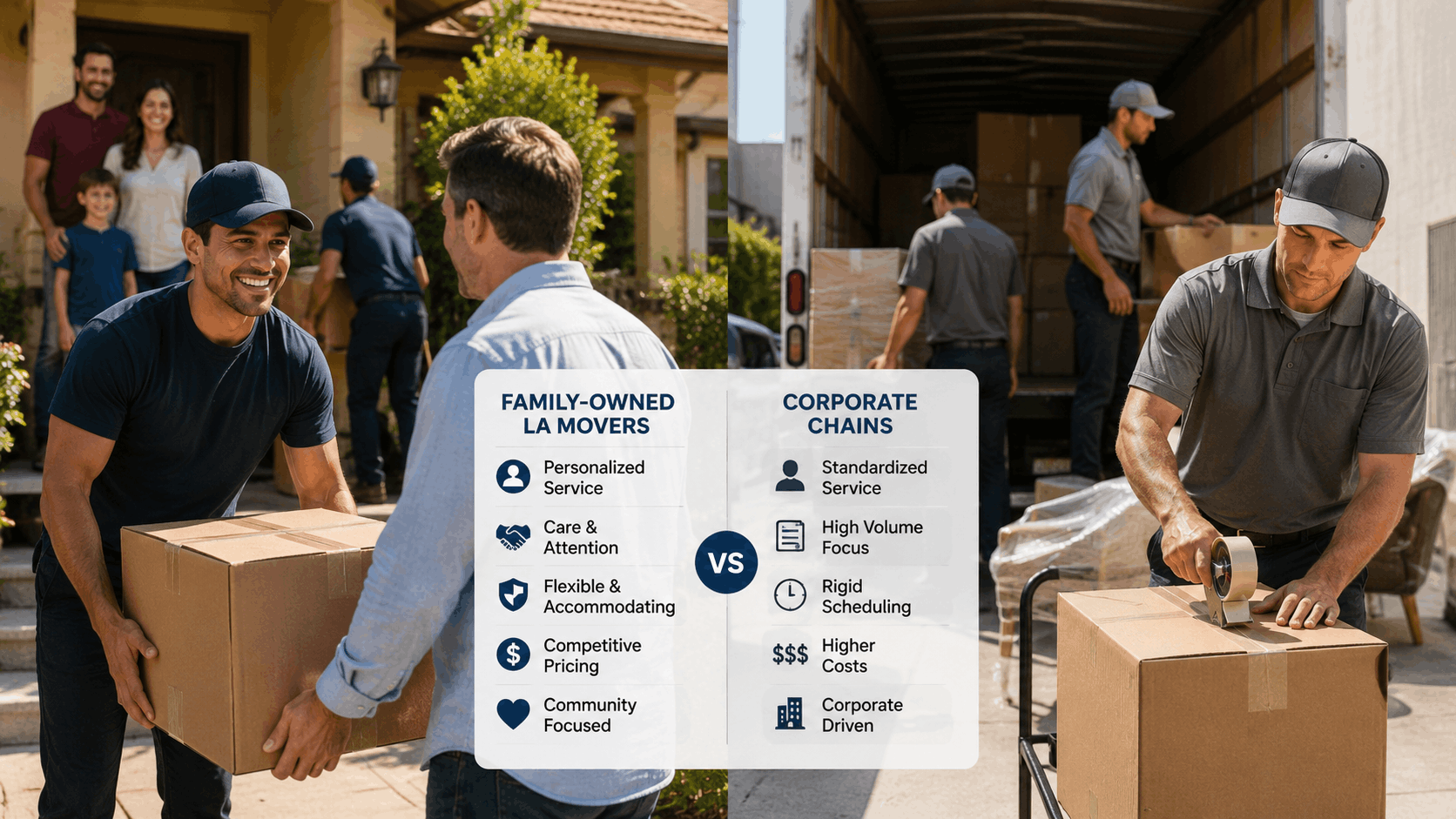
- Ownership: A family business is run by people whose name and reputation ride on every job. A franchise answers to regional managers and revenue targets.
- Accountability: Local owners handle complaints personally. Chains route them through a call center.
- Crews: Family movers keep the same trained team. Chains often pull from rotating labor pools.
- Local roots: A neighborhood mover knows the streets. A national operator sends whoever is closest.
None of this means every chain is bad or every local mover is great. It means the two models create different incentives, and those incentives show up on moving day.
Who Actually Shows Up on Moving Day
When you hire a family-owned mover, the crew that arrives is usually a team that has worked together for years. They know each other's pace, they know how to angle a couch through a narrow doorway, and they have a stake in doing the job right. That consistency matters when you are handing over everything you own.
Corporate chains work differently. Many national brands book the job under their name, then hand the actual labor to subcontractors or day labor hired that morning. The trained movers you were promised may turn out to be a rotating crew who have never met before that shift.
We have shown up to jobs in Echo Park where the previous mover, a big-name chain, had sent three guys who did not have a truck ramp and had never lifted a piano. The homeowner had no idea until the crew arrived. A steady local residential moving team avoids that surprise because the same faces come back week after week.
Ask any mover directly: will the crew be your own employees or subcontractors? A confident family business will tell you the names of the lead mover. A chain will often dodge the question or point you to a general policy.
Accountability When Something Goes Wrong
Things go wrong on moves. A box gets misplaced, a table leg gets scratched, or the timing slips. What separates good movers from bad ones is how well someone with authority responds. This is where family-owned movers pull ahead.
With a local company, the owner often answers the phone. If your dresser arrives damaged, you talk to the person who can approve a repair or refund on the spot. There is no ticket number, no three-day wait, no transfer to a department that has never heard of your move.
Corporate moving chains handle moving complaints through call centers that serve dozens of markets. The agent you reach may sit in another state and have no connection to the LA branch that moved you. Customer accountability gets diluted across layers of management and paperwork.
We have taken calls at 8 p.m. from clients in Los Feliz who just wanted to confirm a detail for the next morning. That kind of direct line is hard to replicate at scale. When your name is on the truck, you answer the phone.
Local Knowledge of LA Streets and Buildings
Los Angeles is not one city. It is dozens of neighborhoods with their own parking rules, street widths, and building quirks. A mover who works these streets daily saves you time and money because they already know the traps.
Take LA parking permits. Some buildings in Koreatown require a temporary no-parking permit so the truck can stage close to the entrance. A local crew knows to arrange that ahead of time. A chain crew unfamiliar with the area might circle the block for 30 minutes on your dime.
Building access is another local puzzle. Older walk-ups near Echo Park have steep stairs and no loading zone. Hillside homes off Fountain Avenue have tight turns that big trucks cannot manage, so experienced crews bring a shuttle. That kind of local knowledge only comes from driving these routes for years.
We know which streets in Los Feliz ban parking on street-cleaning days and which Silver Lake buildings need elevator reservations. That familiarity keeps your move on schedule and keeps billable hours down.
Get Your Free Quote
Tell us about your move. We'll be in touch soon.
How Pricing Really Works With Each Type of Mover
Moving costs confuse people because the two models quote differently. Family movers usually charge by the hour with a clear rate. Corporate chains often give a flat estimate that looks simple but hides add-ons in the fine print.
Both approaches can be fair. The problem starts when the final invoice does not match the moving quotes you were shown. Hidden fees are the number one reason clients switch from a chain to a local mover mid-move.
| Factor | Family-Owned LA Movers | Corporate Chains |
|---|---|---|
| Pricing model | Hourly, transparent rate | Flat estimate, often non-binding |
| Quote method | In-home or video walkthrough | Online calculator or phone |
| Hidden fees | Rare, disclosed upfront | Common (fuel, stairs, long-carry) |
| Who sets price | The owner you speak with | Central pricing department |
| Flexibility | Can adjust on site | Locked to the estimate |
Hourly Rates vs Flat Corporate Estimates
In Los Angeles, a typical hourly moving rate for a two-mover crew runs between $100 and $160 per hour, depending on season and truck size. Three-mover crews for larger homes run higher. The clock starts when the crew arrives and stops when the last box is placed.
Corporate chains often push a binding estimate, a single flat number for the whole job. On paper this sounds safer because it caps your cost. In practice, chains build padding into that number to protect their margins, so you may pay for hours the crew never worked.
A non-binding estimate is worse for the customer. It is only a guess, and the final bill can climb higher on moving day. Many clients who came to us from big brands were burned by a non-binding estimate that ballooned once the truck was loaded.
The hourly model rewards efficiency. An efficient, experienced crew finishes sooner and costs you less. A flat corporate estimate removes that incentive, because the price is the same whether the crew hustles or drags.
The Hidden Fees That Inflate Corporate Bills
The estimate is not the whole story. Corporate invoices often carry line items that never came up during the sales call. These surprise charges are how a $900 quote becomes a $1,400 bill.
Watch for a fuel surcharge, often a flat percentage added to the total regardless of distance. Then there is the long-carry fee, charged when the truck cannot park close to your door, which happens constantly in dense areas like Koreatown and Downtown. Stair fees get tacked on per flight above a certain number.
Other common add-ons include bulky item fees for pianos or safes, packing material markups, and a travel-time charge for the drive from the depot to your home. Individually they seem small. Stacked together, they distort the whole price.
Family movers tend to fold most of these into the hourly rate or disclose them clearly before booking. When we quote a job with a piano near Highland Park, we say so upfront and explain the piano moving charge before you sign anything.
Why Local Quotes Tend to Be More Honest
An accurate moving quote depends on someone actually seeing your stuff. Online calculators ask you to guess your box count and square footage, then spit out a number based on averages. Averages do not account for your spiral staircase or your marble dining table.
Family movers usually offer an in-home estimate or a live video walkthrough. The estimator counts your furniture, checks access points, and asks about parking. That in-person look turns a rough guess into a number you can trust within a narrow range.
During a walkthrough in Sherman Oaks, we might spot a tight hallway that adds 30 minutes or a heavy armoire that needs an extra mover. We factor those in before quoting, so the final bill matches the estimate. That is how you get an accurate moving quote instead of a moving-day shock.
Chains lean on remote quoting because it scales. It is easier for them, but it shifts the risk to you. If their calculator underestimates, you pay the difference, not them.
Cost Ranges for Common LA Moves
LA moving prices vary by home size, distance, and access. These ranges reflect typical local moves with a professional crew, packing labor not included unless noted.
- Studio apartment: $400 to $700 for a same-neighborhood move, such as within Highland Park.
- One-bedroom apartment: $700 to $1,200, depending on stairs and parking.
- Two-bedroom home: $1,200 to $2,200 across neighborhoods like Sherman Oaks to Silver Lake.
- Three to four-bedroom family home: $2,500 to $4,500 or more with packing.
An apartment move cost climbs when the building lacks a loading zone or has long carries to the elevator. A hillside home adds shuttle time. These ranges assume a licensed crew and standard weekday timing outside peak summer.
Need Help in Los Angeles?
Popeye Moving & Storage serves Los Angeles and all of Los Angeles County.
Service Quality: What You Get for Your Money
Price is only half the equation. Moving service quality decides whether your belongings arrive intact and whether the day feels smooth or stressful. This is where the family model consistently earns its reputation.
Quality shows up in small choices: how a crew wraps a fragile lamp, how they answer a question, how they handle a last-minute change. Those choices trace back to whether the movers have a personal stake in the outcome.
Packing and Handling of Fragile Items
Fragile packing is where rushed crews cause the most damage. A mover paid to rush the job may wrap a mirror in a single blanket and hope for the best. A mover who takes pride in the work double-wraps it, boxes it, and marks it clearly.
Furniture protection follows the same pattern. Good crews shrink-wrap upholstery, pad wooden edges, and disassemble bed frames properly instead of forcing them through doorways. That care prevents the scratches and dents that fill up damage claims.
When a crew has their name attached to the job, they slow down for the things that matter. We treat a client's china cabinet the way we would treat our own, because the client in Los Feliz may refer three neighbors. Our full service packing team crates artwork and glass tabletops that would never survive a blanket alone.
Ask how a mover handles fragile items before booking. A serious company describes their materials and method. A rushed operation gives a vague answer and moves on.
Communication Before, During, and After the Move
Moving communication separates a calm day from a chaotic one. With a local team, you often have a direct number to the crew lead or owner. If the truck is running 20 minutes late, someone texts you instead of leaving you guessing.
Corporate customer service usually runs through automated systems. You get a confirmation email and maybe a robocall reminder, but reaching a human who knows your specific move can take real effort. That gap frustrates clients when questions come up.
We keep clients in the loop from the first quote through the final box. Before the move, we confirm parking and timing. During the move, the crew lead checks in on placement. After the move, we follow up to make sure everything landed right.
That personal contact costs the company more time, which is exactly why chains automate it away. For most families, a real person on the other end is worth far more than a tracking link.
Flexibility With Last-Minute Changes
Moves never go perfectly to plan. A closing date slips, a couch needs to go to storage instead of the new place, or you need to add an hour. Flexible scheduling is where family movers shine and rigid chains struggle.
A local owner can shift the crew's afternoon or add a stop because they control the schedule. A corporate dispatcher juggling routes across the region often cannot. Their systems lock jobs into fixed windows.
We handle a lot of last minute moving requests in Los Angeles, because life does not always give notice. When a client in Echo Park needed to move up their date by two days, we made it work. A chain would have put them on a waitlist.
If your move has moving parts or an uncertain date, ask how a company handles changes. Family movers usually build in that flexibility. Chains usually charge to rebook or refuse outright.
Navigating LA's Unique Moving Challenges
Los Angeles presents logistical hurdles you will not find in most cities. LA moving challenges include brutal traffic, scarce parking, steep hillside access, and strict high-rise rules. Experience with these problems directly affects your final cost and stress level.
A crew that knows the terrain plans around it. A crew that does not wastes your billable hours learning on the job. Here is how the tough parts of an LA move play out.
Traffic Timing on the 101 and 405
LA traffic is a line item, whether you realize it or not. If your crew is billing by the hour, the drive between your old and new home eats into your budget. Timing that drive around rush hour saves real money.
Experienced local crews know that the 101 through Hollywood clogs by 3 p.m. and the 405 near the Getty crawls most mornings. They plan freeway routes and start times to dodge the worst of it. A crew from out of the area learns this the hard way.
For a move between the Valley and the Westside, we might schedule the truck to cross before 9 a.m. or after 7 p.m. Those windows can cut an hour off the drive. On an hourly job, that is money back in your pocket.
Ask your mover how they plan around LA traffic. A local team has an answer ready. A chain crew often just heads out and hopes the freeway cooperates.
Tight Streets and Hillside Homes
Hillside moving is its own skill. Homes in the Hollywood Hills, Mount Washington, and the steep streets above Echo Park sit on roads too narrow for a 26-foot truck. A crew that shows up with the wrong equipment gets stuck.
The fix is usually a smaller shuttle truck that ferries loads from the house to a larger truck parked below. Local crews know which addresses need this and plan for it in the quote. An unprepared crew discovers the problem on moving day and scrambles.
Narrow streets also mean careful maneuvering to avoid parked cars and mailboxes. We have moved families off winding roads in Mount Washington where the crew had to hand-carry items 100 feet uphill. Knowing that in advance means bringing enough movers to keep it efficient.
If your home sits on a hill or a tight street, tell your mover during the quote. A team with hillside experience adjusts the plan. A team without it turns your move into an all-day ordeal.
High-Rise and HOA Building Rules Downtown
A high-rise move in DTLA or Koreatown comes with paperwork most people never expect. Many towers require an elevator reservation, a certificate of insurance naming the building, and a designated loading dock window. Miss one and the building may turn your crew away.
A certificate of insurance is the document buildings demand most. It proves the mover carries liability coverage that protects the property. Family movers who work these buildings keep this ready and know each tower's HOA rules.
We have moved clients into Downtown high-rises where the HOA only allowed moves between 9 a.m. and 4 p.m. on weekdays through a service elevator. Booking that slot early kept the move on track. A chain unfamiliar with the building can lose a whole day to a missed reservation.
Before you book, ask whether the mover can provide a certificate of insurance and handle elevator scheduling. Our team coordinates these details for towers across Los Angeles so building management signs off before the truck arrives.
Summer Heat and Peak Moving Season
Peak moving season in LA runs from May through September, when leases turn over and families move before the school year. Demand spikes, calendars fill, and prices rise. Booking during this window takes planning.
Summer heat adds a real challenge too. Loading a truck in 95-degree Valley heat wears crews down and can damage heat-sensitive items like candles, electronics, and certain woods. Good crews start early to beat the afternoon sun.
We advise clients to book at least three to four weeks ahead for a summer move, and even earlier for the end of the month. Weekends in July book out early across every neighborhood. Off-peak, a week of notice is often enough.
If you can move on a weekday or mid-month, you often get better rates and more crew availability. Flexibility on timing is one of the easiest ways to lower your cost during the busy season.

Need Help in Los Angeles?
Popeye Moving & Storage serves Los Angeles and all of Los Angeles County.
Insurance, Licensing, and Protection Differences
Before you hand your belongings to anyone, verify they are legal and insured. Moving insurance and proper licensing separate legitimate movers from operations that vanish when something breaks. Both local and corporate movers must meet California rules.
The difference is often in how each type handles a claim when it happens. Knowing what coverage you have, and how to use it, protects you before the truck even loads.
Checking State Mover Licensing in California
Every legitimate mover in California must hold a state mover permit, issued by the Bureau of Household Goods and Services. This is the permit number, commonly written as a Cal-T number, that proves the company is authorized to move household goods within the state. No number means no license.
You can verify a mover's status directly through the Bureau of Household Goods and Services website. Search the company name or permit number to confirm they are active and in good standing. Licensed movers list this number on their site and paperwork.
Corporate chains and family movers alike must carry this license. The mistake customers make is assuming a big brand name ensures compliance. Always check the specific LA operator, since some franchise locations operate under separate licenses.
If a mover cannot produce a permit number, walk away. That single check filters out most rogue operators before they ever touch your furniture.
Basic vs Full-Value Protection
California movers must offer two coverage levels. Released value protection is the free minimum, but it only pays 60 cents per pound per item. If a mover breaks a 10-pound TV, released value pays $6, not the replacement cost.
Full-value protection is the upgrade worth considering for valuable items. Under this option, the mover must repair, replace, or pay the current value of damaged goods. It costs more, but it actually covers what your belongings are worth.
For a move with electronics, antiques, or art, released value is not enough. We walk clients through the tradeoff so they choose coverage that matches their inventory. The FMCSA Protect Your Move resource explains these coverage tiers in plain terms.
Ask both local and corporate movers which coverage applies by default and what the upgrade costs. Never assume your homeowners policy covers goods in transit, because most do not.
How Claims Get Handled by Each Type of Mover
Filing damage claims reveals the real gap between the two models. With a family mover, you often resolve a claim directly with the owner who ran your job. A cracked table might get repaired within days, no red tape.
Corporate chains route claims through a separate department, often out of state. The claims process involves forms, photos, timelines, and back-and-forth that can stretch for weeks. The person handling your paperwork never saw your move.
We have had clients come to us frustrated after a chain dragged a simple claim out for two months. When your mover is local, accountability is a phone call away, not a case number in a queue.
Before booking, ask how claims are handled and how long they typically take. A straight answer signals a company that stands behind its work. Vague answers signal trouble down the road.
Reading Reviews and Spotting Red Flags
Moving reviews are your best window into a company before you hire it. But reviews can be gamed, and ratings can mislead. Knowing how to read them, and which red flags to watch, keeps you clear of scam movers.
The goal is to separate genuine local experience from generic praise or manufactured ratings. Here is how to tell the difference.
What Genuine Local Reviews Look Like
Authentic local reviews mention specifics. They name the neighborhood, describe the crew, and reference real details like a tricky staircase in Silver Lake or a piano moved in Highland Park. Vague five-star reviews with no detail are less trustworthy.
Genuine feedback often names the lead mover or describes how the crew handled a problem. When a reviewer writes that a crew navigated a narrow Echo Park street without a scratch, that is real experience talking. Those details are hard to fake.
Look for reviews that span months and mention different neighborhoods across LA. A pattern of specific, location-based praise tells you the company actually works these streets. Our reviews often cite moves across Los Feliz, Sherman Oaks, and Downtown for exactly that reason.
Read the responses too. A local owner who replies thoughtfully to both praise and complaints shows they are engaged. Silence or copy-paste replies suggest a company that does not read its own feedback.
Warning Signs of a Bad Mover
Certain red flags should stop you cold. A large deposit demand is the biggest one. Legitimate movers rarely ask for a big deposit upfront, so a request for hundreds of dollars before any work is a classic moving scam signal.
No physical address is another warning sign. If a company only lists a phone number and a web form, with no verifiable office in Los Angeles, you have no one to hold accountable. A deposit red flag combined with no address often means trouble.
Be wary of any quote given without a walkthrough. A mover who quotes a firm price over the phone without seeing your home or asking detailed questions is guessing, and that guess usually favors them. Real quotes follow a real assessment.
Other flags include no state permit number, refusal to provide references, and pressure to book immediately. Trust your gut. If the process feels off before they even show up, it will not get better on moving day.
How Corporate Ratings Can Be Misleading
Franchise ratings pool reviews from many locations under one national brand. A chain might show a strong overall score built on branches in other states, while the LA branch handling your job has a very different track record.
Branch quality varies wildly within a franchise because each location hires its own crews and manages its own scheduling. The national reputation tells you little about the specific team loading your truck in Los Angeles. You have to dig for the local branch reviews.
When you research a chain, search for reviews tied to the exact LA location, not the corporate name. Look for mentions of local neighborhoods and specific crews. If you only find generic national reviews, you do not have the full picture.
This is one more reason families choose a single local mover. With a family-owned company, every review reflects the same crews and the same owner. There is no branch lottery.

Need Help in Los Angeles?
Popeye Moving & Storage serves Los Angeles and all of Los Angeles County.
Choosing the Right Mover for Your Situation
The right choice depends on your move. Choosing a mover is not about local versus national as a rule, it is about matching the job to the model. Here is how the local vs national mover decision usually breaks down.
For most LA moves, a family-owned company offers better value and care. For certain long-haul jobs, a large network has advantages. Your moving decision should weigh distance, budget, and the complexity of your move.
Best Fit for Local and Same-Neighborhood Moves
For a local move within Los Angeles, family-owned movers almost always win. They know the streets, the buildings, and the parking rules, which keeps hourly jobs efficient. That local edge translates directly into lower costs.
A same-city move between neighborhoods like Silver Lake and Highland Park rewards local knowledge. The crew plans the route, handles the permit, and works efficiently because they have done this exact trip before. A national chain brings none of that neighborhood memory.
Family crews also handle the small stuff that makes a local move smooth. They know which Los Feliz buildings need elevator pads and which Echo Park streets ban daytime parking. That familiarity is worth more than any national logo.
If your move stays within the LA area, a local family mover is usually the smarter, cheaper choice. The hourly model plus local experience beats a padded fixed price nearly every time.
When a Chain Might Make Sense
To be honest, a large network can help with a true long-distance move across state lines. An interstate move to another coast involves federal regulations, long-haul logistics, and coordination that a national footprint sometimes handles well.
That said, many family movers, including ours, handle long-distance and interstate jobs through established partnerships. You get local care on the packing and loading end without giving up the reach of a bigger network. Our interstate moving service covers exactly these routes.
The tradeoff with a pure corporate chain is that your goods may transfer between crews and trucks along the way. More handoffs mean more chances for damage or delay. A local mover who manages the whole route keeps accountability in one place.
For a cross-country corporate relocation with tight deadlines, weigh both options carefully. For most moves that stay in California or a neighboring state, a family mover with long-distance capability covers you.
Questions to Ask Before Booking Either One
A short list of questions for movers protects you no matter which type you choose. Run through this booking checklist before you sign anything:
- Will the crew be your own employees or subcontractors?
- What is your state mover permit number?
- Is the quote binding, and what could change it?
- What hidden fees might appear on the final bill?
- What insurance coverage is included, and what does full-value cost?
- Can you provide a certificate of insurance for my building?
- How do you handle damage claims and how long do they take?
- How flexible is the schedule if my date changes?
The answers tell you almost everything. A confident mover answers each clearly. A shaky one dodges, and that tells you to keep looking.
How Popeye Moving & Storage Co. Handles LA Moves
At Popeye Moving & Storage Co., we run our moves the way a family business should. Our Los Angeles movers use the same trained crews on every job, not day labor or unknown subcontractors. You meet the people who move you.
We quote through in-home or video walkthroughs so the number you get is the number you pay. No fuel surprise, no mystery long-carry fee buried in the final total. Pricing transparency is part of how we earn repeat clients.
Our coverage spans neighborhoods across the region, from Los Angeles proper to Pasadena, Santa Monica, and Culver City. We handle residential, commercial, storage, and specialty moves with the same local care. When you call, a real person picks up.
Whether you are moving a studio in Highland Park or a family home in Sherman Oaks, our team plans around LA traffic, parking, and building rules so your move stays on schedule and on budget.
Final Thoughts
The choice between a family-owned LA mover and a corporate chain comes down to who owns the outcome. Local movers bring consistent crews, honest hourly pricing, direct accountability, and deep knowledge of LA streets and buildings. Chains offer national reach that matters mainly for long cross-country hauls.
For nearly every move that stays in or near Los Angeles, a family business delivers better service and clearer pricing. Verify licensing, read local reviews, ask the right questions, and choose the coverage that fits your belongings.
Ready to plan your LA move with a team that treats your home like its own? Contact Popeye Moving & Storage Co. for a straightforward quote and a crew that knows these neighborhoods inside and out. Call us today for a free consultation.

Frequently Asked Questions
- Are family-owned movers cheaper than corporate chains in LA?
- In most cases, yes. Family-owned movers carry lower overhead than national franchises, so they pass fewer fees on to you. Their hourly pricing rewards efficient crews, while corporate flat estimates often include padding and surprise charges like fuel surcharges. For a local move within Los Angeles, a family mover usually costs less overall. The bigger savings come from honest quotes with all fees listed in writing up front.
- How much does a local move cost in Los Angeles?
- LA moving prices depend on size, distance, and access. A studio typically runs $400 to $700, a one-bedroom apartment $700 to $1,200, and a two-bedroom home $1,200 to $2,200. A three or four-bedroom family home ranges from $2,500 to $4,500 or more with packing. Stairs, long carries, and hillside access raise the cost. An in-home estimate gives you the most accurate number for your specific move.
- Do corporate movers use subcontractors?
- Many national chains do. They book the job under their brand, then hand the actual labor to third-party crews or day labor hired that morning. This means the trained movers you were promised may be a rotating team who never worked together. Ask directly whether the crew will be the company's own employees or subcontractors. A family-owned mover uses its own consistent crew, which is one of its biggest advantages.
- How do I verify a mover is licensed in California?
- Every legal California mover holds a state mover permit from the Bureau of Household Goods and Services, commonly written as a Cal-T number. Ask for that number, then verify it on the Bureau's website by searching the company name or number. Confirm the license is active and in good standing. Legitimate movers list this number on their site and paperwork. If a company cannot provide a permit number, do not hire them.
- What questions should I ask before hiring a mover?
- Ask whether the crew is employees or subcontractors, the state mover permit number, and whether the quote is binding. Ask what hidden fees might appear, what insurance is included, and the cost of full-value protection. Confirm they can provide a certificate of insurance for your building, explain their claims process, and describe how flexible the schedule is if your date changes. Clear answers signal a trustworthy mover.
- Do I need a parking permit for movers in LA?
- Often, yes. Many LA neighborhoods and buildings, including parts of Silver Lake and DTLA, require a temporary no-parking permit so the truck can stage near the entrance. The permit reserves curb space and prevents citations. A local mover usually knows when one is needed and helps arrange it ahead of time. Skipping this can force the crew to park far away, adding long-carry time to your bill.
- How far in advance should I book a mover in Los Angeles?
- For a standard weekday move outside summer, one to two weeks of notice is usually enough. During peak moving season from May through September, book at least three to four weeks ahead. End-of-month and weekend dates fill fastest, especially in July and August. The earlier you book, the better your crew availability and pricing. Last-minute moves are possible with flexible movers, but options narrow early.
- What is the difference between released value and full-value protection?
- Released value is the free minimum coverage, paying only 60 cents per pound per item. A broken 10-pound electronic would pay just $6, far below replacement cost. Full-value protection costs extra but requires the mover to repair, replace, or pay the current value of damaged goods. For moves with electronics, antiques, or art, full-value protection offers far better coverage and is usually worth the added cost.
- Are family-owned movers reliable for high-rise or HOA buildings?
- Yes, and often more so than chains. Experienced local movers know how to reserve service elevators, provide a certificate of insurance naming the building, and follow HOA loading dock and time-window rules. They handle these details in DTLA and Koreatown towers regularly. Ask whether the mover can supply a certificate of insurance and coordinate elevator scheduling. A prepared crew keeps your high-rise move on track and avoids getting turned away.
- Should I choose a local or national mover for a long-distance move?
- It depends on distance and how the local mover operates. For a cross-country interstate move, a national network can help with long-haul logistics. But many family movers handle long-distance jobs through partnerships, giving you local care on packing and loading plus the reach you need. Fewer handoffs mean less risk of damage. For moves within California or a neighboring state, a local mover with long-distance capability usually wins.
Popeye Moving & Storage Co. Team Team
Licensed moving and storage professionals serving Los Angeles and Los Angeles County.
Licensed in California · License #CAL T 189749 | USDOT 1472924 | MC 498816C
Why trust Popeye Moving & Storage?
Founded in 1994, Popeye Moving & Storage is a licensed and insured moving and storage service serving Los Angeles and Los Angeles County. All content is reviewed by our licensed technicians.

Need Help in Los Angeles?
Popeye Moving & Storage serves Los Angeles and all of Los Angeles County.
Related Articles

Brentwood Movers: Mansion Move Pricing and Insurance Requirements
A clear guide to Brentwood mansion move pricing, valuation and insurance requirements, HOA rules, and timelines for large estate relocations across West LA.

Manhattan Beach Movers: Beach Cities Premium Service Pricing
A clear breakdown of Manhattan Beach premium moving pricing, what drives cost in the Beach Cities, seasonal timing, add-ons, and how to plan a smooth, fairly priced move.

Movers in Beverly Hills: COI Requirements and Estate Move Pricing
A local guide to COI requirements and estate move pricing in Beverly Hills, covering insurance limits, high-value item handling, and move day planning from Popeye Moving.