Moving and Storage Cost for a Los Feliz Hillside Home
Key Takeaways
- Local moving in the Los Angeles area runs $150 to $200 per hour for a two-person crew and truck, with the hillside access method driving the final number.
- Narrow winding streets above Los Feliz Boulevard often require a shuttle from a smaller vehicle, which is the professional method and is priced into the written estimate.
- California bills local hourly moves on double drive time, so a weekday morning slot lowers the bill by avoiding park and freeway traffic.
- The Not To Exceed price, agreed in writing before loading, caps the bill and can only rise through a Change Order the customer agrees to.
- Default mover liability is up to $20,000 of actual cash value; the 60 cents per pound figure is only the rate basis, so art and antiques need full value protection.
- Vaulted storage runs $60 to $90 per vault per month at the Mar Vista warehouse, with no minimum or maximum term and goods handled by crews.
- Los Feliz permits run through LADOT, with temporary restriction signs needing a five working day lead time; confirm fees at (213) 485-2298.
- Intrastate movers are regulated by the Bureau of Household Goods and Services, not the CPUC, and Popeye operates under CAL T 189749.
In This Article
A one-bedroom apartment on Hillhurst Avenue and a house built down the slope above Los Feliz Boulevard are two very different moving jobs, even when they sit a mile apart. The flat is a straight carry down a sidewalk to a truck at the curb. The hillside house often means a smaller shuttle vehicle, a flight of exterior steps, and a living floor two levels below where the crew parks.
Here is the cost question answered up front. Local moving in the Los Angeles area runs $150 to $200 per hour for a two-person crew and truck, and vaulted storage runs $60 to $90 per vault per month. On a hill property, the access method is what moves the final number, because narrow streets and steps add labor and sometimes a shuttle.
The important part is this. On a move inside California, the price is set in writing before anything is loaded, with a Not To Exceed figure that caps what a customer can be billed. The rest of this guide walks through what drives that number on a Los Feliz slope, what vaulted storage actually buys, and how the written estimate protects the art and antiques that fill these period homes.

What Drives the Cost of a Los Feliz Hillside Move?
The quote for a hill property near Griffith Park reflects a few real things, not a guess. Access comes first, then the carry, then the hours. Understanding each one helps a homeowner read their written estimate and know why one address costs more than a neighbor's.
Los Feliz sits below Griffith Park in ZIP 90027, running from the flats around Hillhurst and Vermont up into the hills toward the Observatory. The flats and the hills produce different bills because they are different jobs. The table below lays out the main factors that change a hillside moving cost.
| Cost Factor | Why It Changes the Price |
|---|---|
| Access (flat street vs. narrow hill) | A hill street may stop a full-size truck, which means a shuttle and extra trips |
| Exterior steps and split levels | More steps between the vehicle and the door means more labor hours |
| Double drive time | Travel on a local hourly move is charged at twice the actual driving time |
| Park and freeway traffic | Slow routes add hours, so timing changes the bill |
| Property protection | Period floors and narrow doors need padding and planning, which is labor |
Flats Versus Hills: Two Different Jobs
The flats around Hillhurst, Vermont and Franklin hold 1920s and 1930s courtyard buildings, Spanish-style apartment blocks, duplexes and period houses on regular streets. Here the constraints are stairs inside the building, small original door openings, and contested curb space. A truck usually parks close, and the job runs on a predictable set of hours.
The hills above Los Feliz Boulevard are a different story. The streets are narrow, winding and steep, with switchbacks, blind bends and very little turning room. Hillside houses are built down the slope with driveways cut into the grade, so a full-size truck frequently cannot reach or turn near the door.
That is why access decides both the method and the price. On a flat, the question is how many stairs are inside. On a hill, the first question is whether a big truck can even get there, and if it cannot, how goods will bridge the gap. Our residential moving crews establish which type of property an address is before anything else.
We work both every week, so we know the Los Feliz flats reward a tight, fast plan while the hills reward careful access work. Getting that call right at the survey stage is how the written number stays accurate on moving day.
When a Full-Size Truck Cannot Reach the Door
Many homes above Los Feliz Boulevard sit on streets a full-size truck simply cannot work. Switchbacks and blind bends leave no room to maneuver a long box truck, and minimal turning room means the driver risks blocking the road or scraping a parked car. Driveways cut steeply into the grade add another barrier.
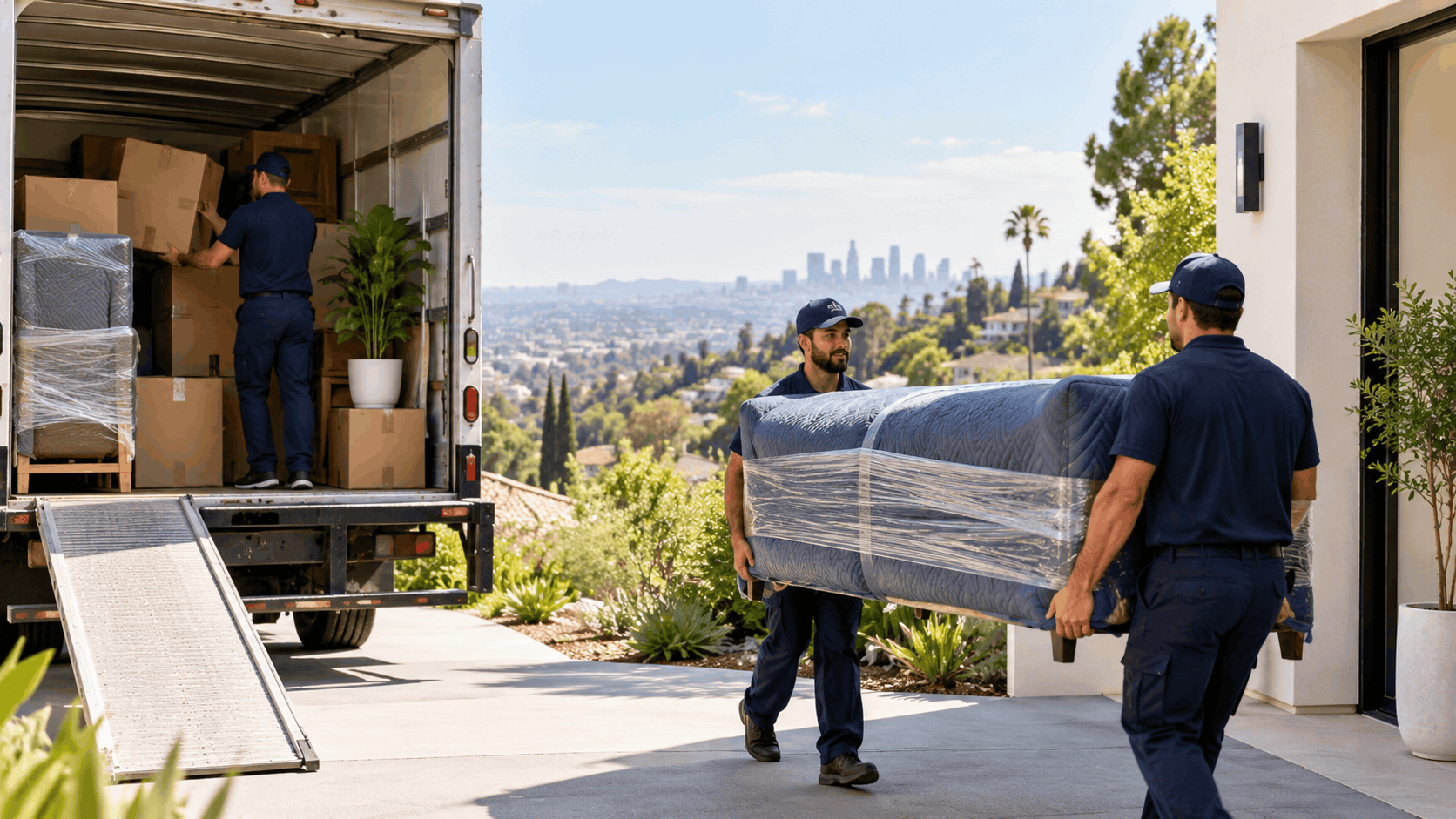
When that happens, the answer is a shuttle. Goods are loaded into a smaller vehicle that can reach the house, driven down to where the full-size truck can stage, and transferred. This is not an improvisation or a sign something went wrong. It is the professional method for restricted-access hillside properties.
Because a shuttle adds trips, those trips belong in the written estimate from the start. A crew that plans the staging point before the day avoids surprises, and the homeowner sees the shuttle labor as a line item rather than a mystery on the final bill. The goal is a number that matches the real job on the slope.
Where a property has no vehicle access at all, we qualify that on the phone before a date is confirmed. That protects the homeowner from a crew arriving to a job that cannot physically be done as planned, which is the kind of thing that wrecks a moving day.
Double Drive Time and Why an Early Start Lowers the Bill
California bills local hourly moves on a double drive time convention. That means travel time between the origin and the destination is charged at twice the actual driving time. It is a legitimate, regulated charge rather than padding, and every licensed California mover applies it on local hourly work.
This matters a lot in Los Feliz because the surrounding routes clog up. The 5 Golden State Freeway, the 101, Los Feliz Boulevard and Vermont all feed this area, and the canyon roads above are genuinely slow. Slow travel means more billed drive time, doubled.
The fix is timing. A weekday morning slot is materially easier and cheaper than a weekend afternoon, because Observatory and park traffic is lighter early in the week and early in the day. An early start lowers the hours, and because the drive time is doubled, every minute saved on the road counts twice.
We tell Los Feliz homeowners plainly that if the budget matters, book a morning weekday slot and have the home packed and ready. That keeps the hourly rate working for a small window and keeps double drive time from stretching the bill.
Exterior Steps and Split-Level Layouts
On a hillside, floor count does not describe the carry. Many hill houses are entered at the top with the living space below, and others have a garage above the house reached by an exterior stair. A "single-story" house on paper can mean three flights of outdoor steps in practice.
The number of steps between the vehicle and the front door changes the labor directly. Each item has to be carried up or down those steps, often on a surface that is uneven or steep. More steps means more time, and more time on an hourly move means a higher number.
Split-level interiors add to it. A home built into the slope may have bedrooms on one level, a kitchen on another, and a living room a half-flight down, each with its own tight turn. The crew has to plan a route through the house, not just to the door.
This is why we ask about internal layout and exterior steps at the survey, not on moving day. Knowing which door is the practical route and how many steps sit between the curb and that door lets us price the carry honestly up front.
Get Your Free Quote
Tell us about your move. We'll be in touch soon.
Typical Price Ranges for a Los Feliz Home Move
The figures below are typical market ranges for moving and storage in the Los Angeles area. They apply to a Los Feliz home move and are presented as ranges for the area, not as a quote or a fixed price. The actual price for a specific move depends on that move and is set in writing before anything is loaded.
Los Feliz house contents skew toward art, antiques, period and designer furniture, pianos and collections, so the packing and specialty figures matter here as much as the hourly rate. The table pulls the relevant ranges together.
| Service | Typical Range |
|---|---|
| Local residential moving (two-person crew and truck) | $150 to $200 per hour |
| One-bedroom apartment local move | $350 to $650 |
| White glove moving | $150 to $250 per hour |
| Full-service packing (one-bedroom) | $300 to $800 |
| Full-service packing (three-bedroom) | $600 to $1,500 |
| Custom crating | $150 to $800+ per crate |
| Fine art and antique moving | $300 to $1,200+ |
| Piano moving | $200 to $600 |
| Chandelier moving | $150 to $450 |
| Vaulted storage | $60 to $90 per vault per month |
Local Moving Rates and Small Apartment Jobs
For a local move inside the area, residential moving runs $150 to $200 per hour for a two-person crew and truck. That hourly structure is how most flat and small-house jobs are billed, and it includes the labor and the vehicle for the window the crew is on site.
A one-bedroom apartment local move typically runs $350 to $650. That fits a lot of the renter stock around Hillhurst and Vermont, where the job is smaller and quicker and the main variables are stairs inside the building and curb access. Our apartment moving crews run these jobs often in the Los Feliz flats.
For the period houses that need extra care, white glove moving runs $150 to $250 per hour. This is the right level for a home full of art, antiques and original finishes, where the crew moves slower, pads more, and protects the route through the house before lifting anything.
The choice between a standard local rate and white glove service usually comes down to the contents and the house. A flat with ordinary furniture is a standard hourly job. A 1930s Spanish Colonial Revival house full of collections is a white glove job, and the rate reflects the added protection.
Packing, Crating and Specialty Items
Packing is often the biggest variable in a Los Feliz house move. Full-service packing runs $300 to $800 for a one-bedroom and $600 to $1,500 for a three-bedroom. The range reflects how much there is, how fragile it is, and how much the homeowner wants done for them. Our packing and crating team handles both ends of that.
For the art and collections these homes hold, custom crating runs $150 to $800+ per crate, and fine art and antique moving runs $300 to $1,200+. A built-to-fit crate is the right answer for a framed piece, a sculpture or a delicate antique that cannot ride loose. Our fine art and antique moving service covers these items specifically.
Piano moving runs $200 to $600, with upright pianos costing less than grand pianos, and chandelier moving runs $150 to $450. Both are common in the larger period houses, and both need specialist handling because of weight, balance and fragility. A grand piano down a flight of exterior hillside steps is a careful, planned lift.
Moving supply packages run $45 to $120 if a homeowner wants to pack some of it themselves. For a hill house with art and antiques, though, most people lean on full-service packing and crating because the risk of a self-packed box of glassware riding down a shuttle is not worth the saving.
What the Hillside and Period Architecture Add
Two things on a Los Feliz hill job sit on top of the base rates: the shuttle and the protection. Neither is a hidden multiplier. They are labor that shows in the written price because the job genuinely takes more hands and more time.
A shuttle adds trips. The smaller vehicle makes several runs between the house and where the full-size truck stages, and each run is time. Those trips belong in the quote as a line the homeowner can see, so there is no gap between what was estimated and what happens on the slope.
Property protection is the second piece. Narrow original door openings, tight stair turns and original hardwood or tile floors mean the crew pads surfaces, protects banisters and plans the route before lifting. In a significant period house, that care is the point of hiring professionals, and it is time on the clock.
None of this changes because of the neighborhood as some flat rule. It changes because of what the specific property requires. We price the shuttle trips and the protection work into the written estimate so the number reflects the real carry, not a generic rate.

Need Help in Los Angeles?
Popeye Moving & Storage serves Los Angeles and all of Los Angeles County.
Vaulted Storage Costs and How It Works
Storage is the other half of a lot of Los Feliz moves, whether a homeowner is between houses or needs room cleared for a renovation. Vaulted storage runs $60 to $90 per vault per month, and what that buys is a full-service arrangement at our warehouse in Mar Vista.
This is not a self-storage unit with a roll-up door. It is a different service with different rules, different protection, and a different cost structure. The table and sections below explain what the customer is actually paying for.
| Storage Detail | What It Means |
|---|---|
| Vaulted storage rate | $60 to $90 per vault per month (typical range) |
| Term | No minimum and no maximum |
| Access | No key, no individual unit, no right of entry; retrieval by appointment |
| Handling | Loaded once by crews, moved as a unit by forklift |
| Location | Warehouse at 5509 1/2 S Centinela Ave, Mar Vista |
What Vaulted Storage Costs Per Month
Vaulted storage runs $60 to $90 per vault per month as a typical range for the area. The figure depends on how many vaults a household fills, which is set when the goods are inventoried and loaded. A one-bedroom's worth of belongings takes fewer vaults than a full hillside house.
There is no minimum and no maximum storage term. A homeowner can store for a few weeks between escrows or for a long stretch during a rebuild, and the arrangement flexes to that. Our vaulted storage service is built for both the short gap and the open-ended stay.
Belongings are handled by our crews rather than the customer. That is the core of the service. Instead of the homeowner renting an empty box and hauling things in, the team packs, loads and stores the goods, so the labor is part of the arrangement.
For a Los Feliz move that includes a storage stint, we fold the storage into the same written plan as the move itself. The homeowner sees the move cost and the monthly storage cost together, so there is no surprise when the first storage month comes due.
Full-Service Vaulted, Not a Self-Storage Unit
The key difference from a mini-storage facility is control of the space. With vaulted storage, the customer has no key, no individual unit, and no right of entry. The goods sit inside wooden vaults handled entirely by our crews at the warehouse.
Each vault is loaded once at the origin or at the warehouse, then moved as a unit by forklift. Because the vault is sealed and handled as one piece, the belongings inside are touched far fewer times than they would be in a self-storage cycle where things get moved in and out by hand.
That arrangement is why access works by appointment. When a customer needs something, the warehouse crew retrieves and opens the vault. An appointment for retrieval is ordinary trade practice for full-service storage, because there is no aisle the customer walks down to their own locker.
This model also has a legal consequence worth knowing. Because the customer has no exclusive use or access, the storage falls outside the self-storage rules and under the Commercial Code instead, which changes the protections and the paperwork, covered next.
Storage-in-Transit and the 90-Day Line
There is a line at 90 days that decides which rulebook governs stored goods. Under Maximum Rate Tariff 4, storage-in-transit is storage of a shipment at the customer's request at one point between origin and destination for a period not to exceed 90 days. Inside that window, the move is still a regulated mover service.
That matters for a Los Feliz homeowner storing goods during a short gap between houses. While the shipment sits in storage-in-transit, it is covered by the mover's regulated obligations, and the tariff rules on valuation and claims still apply to it.
Past 90 days, or where storage-in-transit was not requested, the goods fall under the warehouse's own contract, governed by Division 7 of the California Commercial Code. The mover's role as a regulated carrier ends, and the relationship becomes a warehouse arrangement with its own standard of care and its own lien and claim terms. Our long-term storage operates under that framework.
We explain which regime a stay falls under when the plan is set, because it affects how claims and timing work later. A short between-homes stint and an open-ended rebuild store are not the same legal animal, even if the vaults sit on the same shelf.
Why Climate Matters for Art, Wood and Leather
Temperature and humidity swings act on specific materials, and Los Feliz houses are full of exactly those materials. Oil paintings and rigid paint layers, veneer and marquetry, musical instruments, leather, and fine furniture with inlays are the categories most sensitive to changing conditions.
The mechanism is straightforward. Wood swells when humidity is high and shrinks when it is low, which stresses joints, veneers and inlays. Leather stiffens and darkens in damp conditions and grows brittle in very dry ones. Paint layers and panel paintings can loosen when the material underneath moves with the moisture in the air.
Our Mar Vista warehouse is climate controlled for both temperature and humidity, with the specification confirmed per shipment. Because the right setting depends on what is being stored, the specification is matched to the goods rather than fixed to one number for every vault.
For a homeowner storing art, antiques or a piano from a Los Feliz hill house, that control is the difference between belongings that come out as they went in and belongings that have quietly moved with the seasons. We talk through the contents so the storage conditions fit what is actually in the vault.
The Written Price and Your Not To Exceed Protection
The single strongest cost protection on a California move is the written price with a Not To Exceed figure. It is the reason the final bill cannot drift upward on a homeowner, and it is a right the customer has, not a courtesy the mover extends.
This protection is specific to moves that begin and end inside California, which are regulated by the Bureau of Household Goods and Services under the Household Movers Act. Knowing how it works lets a Los Feliz homeowner read an estimate and know exactly where the ceiling sits.
How the Not To Exceed Price Caps Your Bill
Under Maximum Rate Tariff 4, the Not To Exceed amount is the maximum total dollar amount a customer can be liable for, covering the transportation and any additional services ordered, agreed to before any goods are moved or any services performed. In plain terms, the homeowner is told a ceiling before the truck is loaded.
The final bill cannot exceed that ceiling. The only way it moves is through a Change Order the customer agrees to, for example if the job turns out to include services that were not in the original scope. Even then, it takes the customer's agreement.
This is a serious protection for a hillside move where access can surprise people. Because the shuttle and the stair carry are built into the Not To Exceed figure at the survey, the homeowner is not exposed to a bigger number appearing because the hill was harder than the crew guessed.
Failing to include a Not To Exceed Price on the required documentation is a violation, not a gray area. So a homeowner who does not see that figure on their paperwork should ask for it, because it is the number that actually caps what they owe.
A Verbal Quote Is Not an Estimate
A verbal rate quotation, whether per hour or per hundred pounds, is not an estimate and is not binding. A number given over the phone with no written document behind it does not protect the homeowner, no matter how confident it sounds.
California requires a written estimate. It does not require a binding estimate, so a homeowner should not expect that, but the written estimate paired with the Not To Exceed figure is what gives the cost certainty. The document that carries it is the Agreement For Moving Services.
That agreement has to describe the shipment in enough detail to identify the articles and services included in the Not To Exceed Price. It has to describe the transportation and accessorial services, including the number of helpers and packers, and state the rates and charges, including any minimums for hours, weights, packing materials and per-pound valuation.
A homeowner can check whatever they were sent against that list. If the number of packers is missing, or the rates are vague, or there is no Not To Exceed figure, the document is not doing its job yet. That checkability is the whole point of a written estimate.
What the Estimate Should Spell Out for a Hill Property
On a Los Feliz slope, the estimate should spell out the things that make a hill job a hill job. Shuttle trips, stair carries and packing materials all belong in the written price, so the homeowner can line up the paperwork against the real job on the grade.
If a shuttle is needed, it should appear in writing as an accessorial service, not be mentioned as a possibility on the day. The same goes for a long carry up exterior steps. These are the items that separate an accurate hill estimate from a flat-ground guess that falls apart on the slope.
Packing materials and any specialty handling, like a piano or a chandelier, should be itemized too. That way the homeowner knows the crating for a framed piece and the lift for the grand piano are already inside the ceiling, not waiting as add-ons.
When a homeowner can read the estimate and see the shuttle, the steps and the materials all accounted for, they know the Not To Exceed figure reflects their actual property. That is what we aim for on every hill survey in Los Feliz.

Need Help in Los Angeles?
Popeye Moving & Storage serves Los Angeles and all of Los Angeles County.
Protecting Art, Antiques and Period Pieces in Transit
Los Feliz house contents lean heavily toward art, antiques, period and designer furniture, pianos and collections. The default moving liability pays almost nothing on those items, so valuation is where a homeowner either protects the valuable things or leaves them exposed.
This is worth getting right before the move, not after a problem. The rules are specific, and the homeowner has both a right to better coverage and a right to decline it knowingly.
Valuation Is Not Insurance, and the Default Is $20,000
Valuation is a liability limit, not insurance, and the two work differently. Under Maximum Rate Tariff 4 Item 136(2), unless the shipper declares a value other than $20,000 for the shipment, the mover's maximum liability for lost and damaged articles is up to $20,000 of actual cash value. That is the California intrastate default, and it is what a homeowner who declares nothing gets.
The 60 cents per pound per article figure is often confused for the payout. It is not. That figure, at Item 136(1), is the rate basis, the declared value the transportation rates are computed on. It is how the rate is calculated, never what gets paid on a loss.
The 60-cent basis pays almost nothing on the kind of goods in a Los Feliz hill house. A heavy antique that weighs little relative to its value would settle for a pittance under a weight-based figure, which is exactly why it is the rate basis and not the protection.
Full value protection is the paid alternative. The mover has to list each valuation option offered, with the charge and a space for the shipper to initial, so a homeowner can choose better coverage or decline it. For a home full of valuable pieces, full value protection is the responsible choice.
Declaring Items of Extraordinary Value
Items of extraordinary value need to be handled separately. Antiques, art, and gold or silver articles should be separately described on the inventory, with a value declared for each. A blanket valuation on the whole shipment does not do justice to a single irreplaceable piece.
That separate description matters if something goes wrong. When a specific antique is listed with its own declared value, the protection attaches to that item at that value, rather than being lost in a shipment-wide figure that was never meant to cover it.
Some things are better not shipped at all. Money, jewelry and important papers are best carried by the homeowner personally rather than loaded onto the truck. They are small, high-value and easy to keep in hand, and there is no reason to put them through the move.
We walk Los Feliz homeowners through the inventory with this in mind, flagging the pieces that should be listed individually and the items that should travel with the family. Getting the declaration right is part of protecting a collection, not an afterthought.
Period Door Apertures, Stair Turns and Floor Finishes
Los Feliz holds an unusual concentration of significant 1920s and 1930s architecture, including Spanish Colonial Revival, Mediterranean and important modernist houses. In these homes, property protection is not optional, because the house itself is as fragile as what is being carried out of it.
Expect narrow original door openings, tight stair turns with plaster walls, decorative tilework and original hardwood or tile floors. Arched openings limit what can pass through them, and wrought iron or period banisters are easily damaged by a careless lift. A piece that fit through a modern door may not clear a 1930s arch.
The protection against that is planning. A crew that maps its route through the house before lifting anything knows which door is the real path, which turn is the tight one, and where a surface needs padding. That planning is what keeps original fabric intact.
Owners of architecturally significant Los Feliz houses are often acutely protective of original tilework, floors and ironwork, and rightly so. We treat the house as part of the job, protecting floors, wrapping banisters and planning the carry, so the move does not cost the homeowner a piece of the home's character.
Parking Permits and Timing That Affect the Day
Permits and timing change both the cost and the schedule on a Los Feliz street. The neighborhood is in the City of Los Angeles, so permits run through LADOT, and the hills get contested curb space and heavy park traffic.
Getting the parking and timing sorted ahead of the day is part of a smooth move. A truck with nowhere legal to park, or a job scheduled into weekend park traffic, costs the homeowner time and money that planning would have avoided.
LADOT Signs and the Oversize Vehicle Permit
Temporary street parking restriction signs reserve curb space for the move. They carry a stated lead time of five working days, and there is a non-refundable fee. Applications go through LADOT by phone, online, or in person at a DOT Public Service Center.
There is also an oversize vehicle parking permit, published at $10.00 per day for up to three days. That permit legalizes the truck's size and overnight parking, but it reserves no space. The signs reserve the curb, and the oversize permit covers the vehicle, so a job often needs both.
A limit worth knowing: commercial trucks with a logo, or longer than 22 feet, may not park overnight on city streets. The signs also do not override red curb, street cleaning or peak-hour restrictions, so the reserved space still has to sit on legal curb to begin with.
Fees and rules change, so a homeowner should confirm current figures with LADOT at (213) 485-2298, which takes calls between 8AM and 12:30PM Monday to Friday. We handle the permit coordination as part of planning a Los Feliz move, but the current fee always comes from the city.
Griffith Park Traffic and Film Production
Griffith Observatory sits at the top of this neighborhood, and the Greek Theatre draws crowds too. Observatory and park traffic congests Vermont, Los Feliz Boulevard and the canyon roads, especially on weekends and holidays, and on peak days the hill routes are genuinely slow.
That traffic feeds straight into double drive time. A move scheduled into a Saturday afternoon surge of park visitors spends more billed time crawling than the same move would on a Tuesday morning. A weekday morning slot is materially easier and cheaper for exactly this reason.
Filming is the other wildcard. Los Feliz is a frequent location for film production, and a permit can close a block or remove parking at short notice. A street that was open at the survey can be shut on moving day if a shoot moves in.
Because of that, we check the date against known conditions rather than assuming the street will look the way it did when we walked it. Confirming there is no shoot and no holiday surge on the chosen day is part of protecting the schedule and the bill.
Seasonal Conditions on Steep Canyon Streets
The hills above Los Feliz carry brush-lined canyon streets, and that brings seasonal considerations. Fire-weather awareness matters on these roads, and the access plan has to account for conditions that change with the season.
Winter run-off is the other one. Steep driveways cut into the grade can be slick or have water sheeting across them after rain, which affects how a shuttle stages and how a crew carries up an exterior stair. A driveway that is fine in July can be a hazard in a February storm.
This is why the access plan and the shuttle staging are confirmed before a date is set, not improvised on the morning. Knowing where the smaller vehicle can safely stage, and whether the grade is workable in current conditions, keeps the move safe and on schedule.
We qualify hillside access on the phone and at the survey with the season in mind. A Los Feliz canyon move in winter gets a different access look than the same house in summer, because the streets and driveways behave differently.
Need Help in Los Angeles?
Popeye Moving & Storage serves Los Angeles and all of Los Angeles County.
How Popeye Moving and Storage Handles a Los Feliz Hillside Job
A hill property runs smoothly when the survey is honest and the written price reflects the real job. Here is how our team works a Los Feliz hillside move from the first look to the final paperwork.
The whole approach is built around getting the access and the carry right up front, because that is what keeps the Not To Exceed figure accurate and the moving day free of surprises.
What We Confirm Before Quoting
The survey starts with the basic split: flats or hills. For a hill address, the first question is whether a full-size vehicle can reach and turn, and if not, where a shuttle can stage. That answer shapes the entire plan and the price.
From there we check driveway grade, gate aperture and overhead clearance, because a narrow gate or a low branch can decide which vehicle works. We look at the internal layout and the exterior steps too, since floor count does not tell us the real carry on a house built down the slope.
In the period houses, we confirm door openings and the floor finishes that need protection. A narrow 1930s doorway and an original hardwood floor change how the crew works and what the job requires in padding and planning.
All of that goes into the written estimate, so the shuttle trips, the stair carries and the protection work are priced before anything is loaded. The survey is where an accurate hill quote is made or missed, and we treat it that way.
Same-Day Storage at the Mar Vista Warehouse
When a move includes storage, goods are picked up and placed into vaults at our warehouse the same day, with no overnight hold on the truck. The belongings go from the Los Feliz house into vaults at 5509 1/2 S Centinela Ave in Mar Vista without sitting on a parked truck overnight.
The warehouse takes a wide range of goods. Household and commercial storage both work here, and specialty items like wine, fine art, pianos and chandeliers are accepted, which fits the kind of contents a Los Feliz hill house holds. Our storage solutions cover all of these.
One thing the warehouse does not take is vehicles. There is no car, motorcycle, boat or RV storage, so a homeowner planning a storage stint should keep that in mind and arrange vehicles separately.
For a Los Feliz homeowner moving out of a hill house and into storage, the same-day handling means the move and the store happen as one clean operation. The crew loads, drives to Mar Vista, and vaults the goods, all on the same day.
Licensing, Insurance and the Paperwork to Keep
Popeye Moving and Storage holds California household mover permit CAL T 189749 and is BBB accredited with an A+ rating. That permit is what makes a move inside California lawful, and a homeowner can and should ask for it before booking.
Intrastate moves in California are regulated by the Bureau of Household Goods and Services, not the CPUC. The authority moved to BHGS in 2018, so any content or company naming the CPUC as the current regulator is out of date. A homeowner can verify a permit or file a complaint with BHGS at (916) 999-2041.
Keeping the paperwork is the homeowner's own protection. The estimate, the Agreement For Moving Services and the bill of lading together strengthen any claim, and the most common reason a consumer loses a dispute is that they cannot produce the documents.
A claim cannot be denied solely because the lost or damaged goods were not noted at the time of delivery, and a written claim has to be filed within nine months of delivery. Holding onto the paperwork keeps those protections live, so we hand it over and tell homeowners to file it somewhere safe.
Planning Your Los Feliz Hillside Move
A hill move in Los Feliz comes down to an honest look at the access and a written price that reflects it. Once we survey the slope, confirm whether a shuttle is needed, and account for the exterior steps and period finishes, the Not To Exceed figure is fixed before anything is loaded.
To get that written estimate for your Los Feliz hillside home, or to arrange same-day vaulted storage at our Mar Vista warehouse, call Popeye Moving and Storage at (310) 823-9510 or reach us through our contact page. We will walk the access with you and put the real job in writing.
Frequently Asked Questions
- How much does it cost to move a hillside home in Los Feliz?
- Local moving runs $150 to $200 per hour for a two-person crew and truck, which is the base for most hill jobs. Shuttle access and exterior stair carries add to the labor, since a restricted hill street often needs a smaller vehicle and more trips. The final number is set in a written Not To Exceed price before anything is loaded, so the ceiling is fixed up front rather than drifting on the day.
- Why does my hillside address need a shuttle?
- The streets above Los Feliz Boulevard are narrow and winding, with switchbacks, blind bends and minimal turning room. A full-size truck often cannot reach the door or turn around safely near it. When that is the case, goods move in a smaller vehicle that can reach the house and transfer to the main truck at a staging point. This is the professional method for restricted-access hillside properties, and it is priced into the estimate.
- What is double drive time and will it increase my bill?
- California bills local hourly moves on a double drive time convention, charging travel between origin and destination at twice the actual driving time. It is a regulated charge, not padding. An early weekday start reduces it, because Observatory and park traffic and the 5 and 101 freeways are lighter then. Since the drive time is doubled, every minute saved on slow Los Feliz routes counts twice toward a lower bill.
- How much does vaulted storage cost per month?
- Vaulted storage runs $60 to $90 per vault per month as a typical range for the area. There is no minimum and no maximum term, so it works for a short gap between homes or a long rebuild. Goods are handled by our crews at the Mar Vista warehouse rather than by the customer, and the number of vaults a household fills is set when the belongings are inventoried and loaded.
- What happens if my goods stay in storage longer than 90 days?
- Storage at the customer's request between origin and destination for up to 90 days is storage-in-transit, which is still a regulated mover service under the tariff. Past 90 days, or where storage-in-transit was not requested, the goods fall under the warehouse's own contract, governed by Division 7 of the California Commercial Code. The protections and the claim terms shift at that line, so we explain which regime a stay falls under when the plan is set.
- How are my antiques and art covered during the move?
- Unless more is declared, the mover's maximum liability is up to $20,000 of actual cash value . The 60 cents per pound figure is only the rate basis used to calculate the rate, never the payout, and it pays almost nothing on art and antiques. Items of extraordinary value should be listed separately on the inventory with a value for each, and full value protection is the paid option for a home full of valuable pieces.
- Do I need a parking permit for a moving truck in Los Feliz?
- Los Feliz is in the City of Los Angeles, so permits run through LADOT. Temporary street parking restriction signs reserve curb space and carry a five working day lead time plus a non-refundable fee. There is also an oversize vehicle parking permit for the truck. Fees change, so confirm the current figures with LADOT at (213) 485-2298 , which takes calls between 8AM and 12:30PM Monday to Friday.
- Is a verbal quote the same as a written estimate in California?
- No. A verbal rate quotation, per hour or per hundred pounds, is not an estimate and is not binding. California requires a written estimate, carried on the Agreement For Moving Services, which describes the shipment, the services, the helpers and packers, and the rates. The Not To Exceed figure agreed in writing before anything is loaded is what actually caps the bill, so a phone number alone does not protect a homeowner.
- Who regulates movers in California, and how do I check a permit?
- Intrastate movers in California are regulated by the Bureau of Household Goods and Services, not the CPUC, which stopped regulating movers in 2018. Complaints and permit checks go to BHGS at (916) 999-2041 or through its website. Popeye Moving and Storage operates under CAL T 189749 , and a homeowner can ask for that permit number and verify it before booking rather than after a problem.
- How soon can you pick up and store my belongings?
- Goods are picked up and placed into vaults at the Mar Vista warehouse the same day, with no overnight hold on the truck. The crew loads at the Los Feliz house, drives to the warehouse, and vaults the belongings in one operation. Access to stored goods afterward is by appointment, since the warehouse crew retrieves and opens the vault rather than the customer walking to an individual unit.
Popeye Moving & Storage Co. Team Team
Licensed moving and storage professionals serving Los Angeles and Los Angeles County.
Licensed in California · License #CAL T 189749 | USDOT 1472924 | MC 498816C
Why trust Popeye Moving & Storage?
Founded in 1994, Popeye Moving & Storage is a licensed and insured moving and storage service serving Los Angeles and Los Angeles County. All content is reviewed by our licensed technicians.

Need Help in Los Angeles?
Popeye Moving & Storage serves Los Angeles and all of Los Angeles County.
Related Articles

Los Feliz Movers: Hillside Home and Narrow Street Logistics
A local guide to moving into Los Feliz hillside homes, covering narrow streets, permits, equipment, storage, and how Popeye Moving handles tough hillside jobs.
Moving Cost by Home Size in LA: 1,200 vs 2,500 vs 4,000+ Sq Ft Real Ranges With Crew and Truck Counts
Real LA moving cost ranges by home size, with honest crew and truck counts for 1,200, 2,500, and 4,000+ sq ft homes, plus tips to lower your bill.
Moving and Storage Cost for a Four-Bedroom Home in Bel Air
What sets the price of moving and storing a four-bedroom Bel Air estate: volume, hillside access, shuttles, LADOT permits, valuation and the written not-to-exceed price that caps your bill.