Prewar Courtyard Buildings in Hollywood and Their Stair Carries
Key Takeaways
- Hollywood's 1920s and 1930s courtyard walk-ups below Franklin Avenue send every item through a gate, along an open walkway, and up an exterior stair with no elevator, which sets the hours.
- Small original door openings and tight stairwell turns often require disassembling beds and large furniture, which the crew reassembles at the new place.
- Typical local ranges are $150 to $200 per hour for a two-person crew and truck, and $350 to $650 for a one-bedroom local move, with stairs and carry distance driving the hours up.
- California bills local moves with double drive time, charging travel between addresses at twice actual driving time, so an early start before mid-morning congestion lowers the bill.
- The written Not-To-Exceed price caps your bill on an in-state move and can only change through a Change Order you agree to; a verbal phone quote is not binding.
- Valuation defaults to $20,000 actual cash value unless you declare otherwise; the 60 cents per pound figure is only the rate basis, and full value protection is the paid alternative.
- Truck parking runs through LADOT with five working days' lead time for reservation signs plus a $10.00 per day oversize permit, and film shoots can close a block at short notice.
- Popeye Moving and Storage holds CAL T 189749, USDOT 1472924 and MC 498816C, is fully insured and BBB A+ accredited, and offers same-day vaulted storage at its Mar Vista warehouse.
In This Article
It is just after 7 in the morning on a side street off Hollywood Boulevard. The truck is parked at the curb because it cannot get any closer, and the first box starts its journey through an iron gate, along an open-air courtyard walkway, and up an exterior stair with a tight landing at the top. That single route, repeated a few hundred times over a morning, is what makes moving out of a 1920s courtyard building its own kind of job.
These buildings were put up when furniture was smaller, elevators were a luxury, and the Mediterranean courtyard plan was the fashion of the day. The charm is real, and so is the physical reality that every item leaves by hand. There is no loading dock, no service lift, and no shortcut around the stairs.
Why Hollywood Courtyard Buildings Are Built the Way They Are?
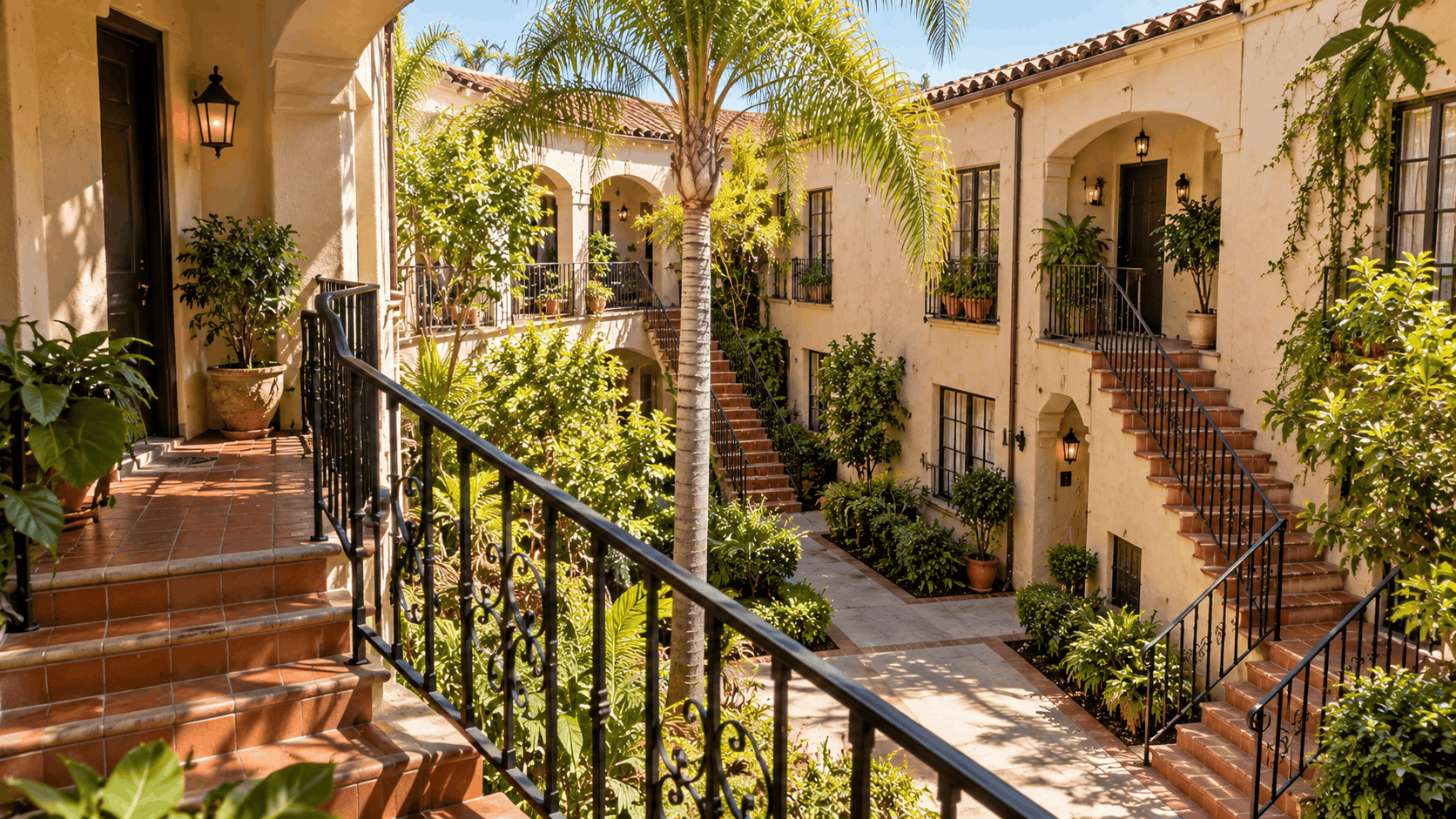
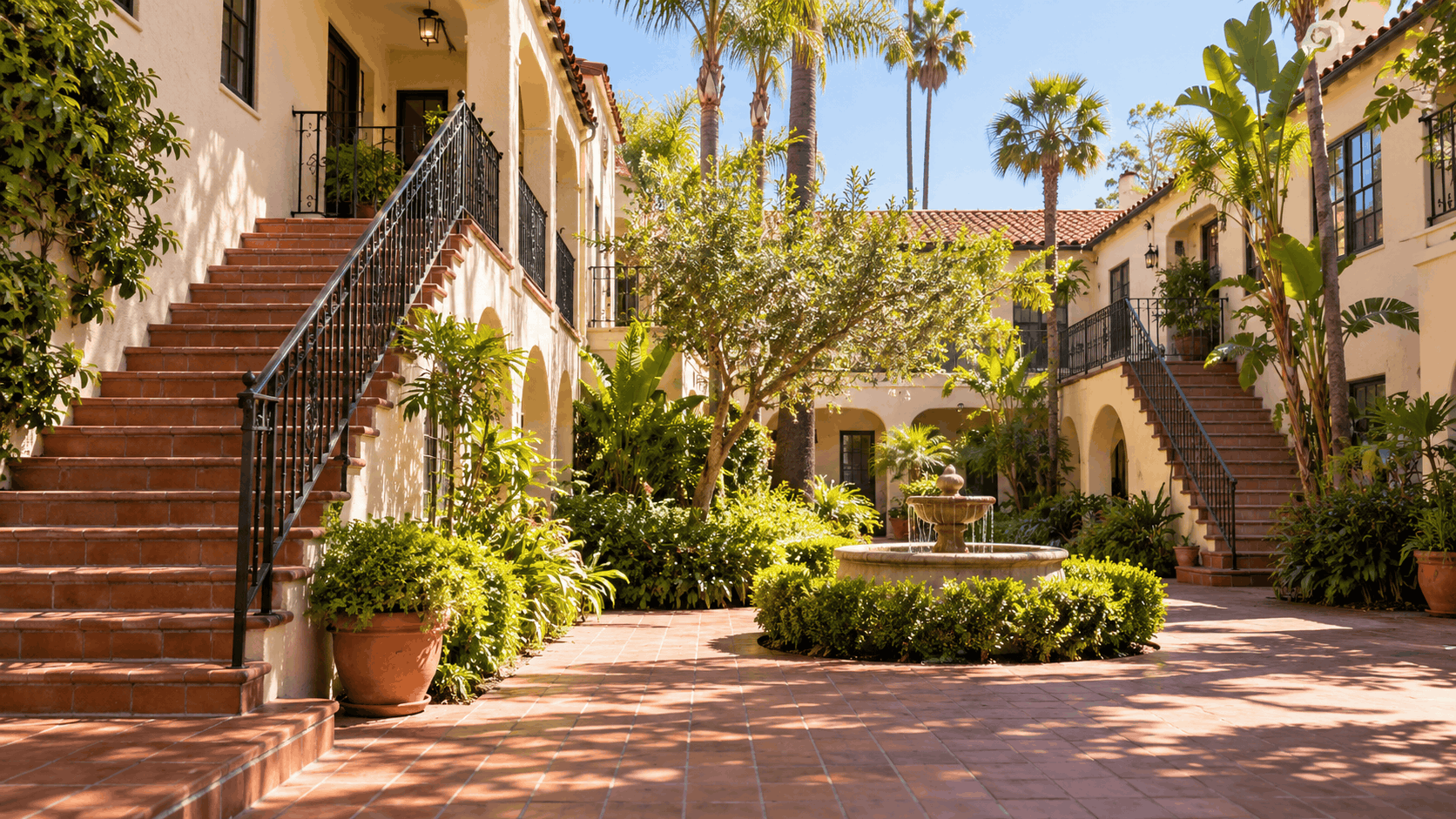
The housing in Hollywood tells its own history. The flats below Franklin Avenue are packed with 1920s and 1930s Spanish-style and courtyard apartment buildings, built in the boom years when the neighborhood filled with studio workers and newcomers. These prewar courtyard buildings share a layout that was practical then and is slow to move out of now.
The design put units around an open central courtyard rather than down an interior hallway. Light and air reached every apartment, which mattered before air conditioning. What it also means today is that the path from your front door to the truck runs partly outdoors, through shared space that was never designed for a dolly stacked with boxes.
Understanding that layout before the day is the difference between a smooth move and a surprise on the invoice. The route your belongings travel is fixed by how the building was drawn ninety or a hundred years ago, and no amount of planning changes the stairs themselves. What planning does change is how ready the crew is for them.
The courtyard layout and the route to the street
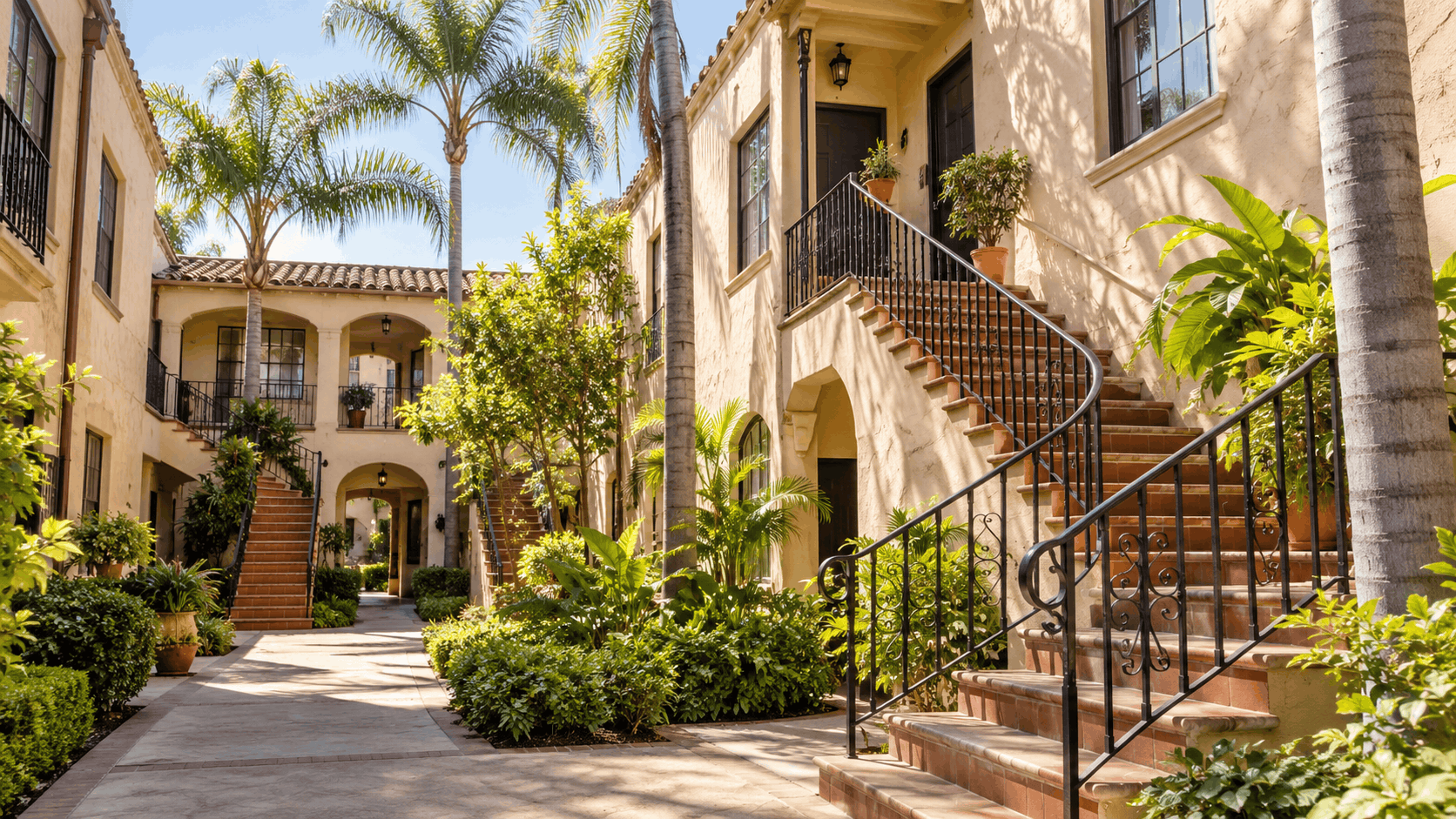
The classic route starts at your apartment door and leads onto an open courtyard walkway. From there it passes through a gate to the sidewalk, and then along the curb to wherever the truck could legally stop. Every one of those segments adds steps, and steps add minutes across hundreds of trips.
The exterior stair is the part that defines the whole job. In a two-story courtyard building the upper units open onto a walkway that connects to an open staircase, often with a turn or a landing partway up. Movers carry down that stair in the open air, in whatever weather the morning brings.
The gate itself is worth a look before the day. Older iron or wood gates can be narrow, and some latch in a way that makes propping them open awkward. A gate that keeps swinging shut on a loaded dolly slows everything and risks a scraped knuckle or a dropped box.
Because so much of this route is shared outdoor space, the crew also protects the walkway and courtyard as they go. Dropped padding at a turn or a pad over a railing is routine on these carries, and it keeps both your things and the building intact.
Narrow stairwells and small original door openings
The door openings in these buildings were sized for 1920s furniture, which was generally smaller and lighter than what people own today. A modern sectional sofa, a king bed frame, or a deep wardrobe can meet an original door that simply will not clear it in one piece. That is not a flaw in your furniture, it is a mismatch of eras.
Stairwell turns compound the problem. A straight flight is one thing, but a stair with a 90-degree turn and a tight landing limits how long a piece can be and still make the corner. The crew reads these turns on arrival and decides what can be walked up whole and what has to come apart.
Disassembly is the standard answer. Beds, large tables, modular couches and oversized shelving often come apart to clear the opening or the turn, then go back together at the new place. Planning for that ahead of time is far better than discovering it with the truck already loading.
Original plaster and tile also sit right at the edges of these tight turns, so careful movement matters. A piece forced through a gap that is too small damages the furniture, the door casing, or both, and nobody wins that trade. Taking the extra few minutes to disassemble is the cheaper path.
No elevator and multiple flights
Almost all of these courtyard walk-ups have no elevator. That single fact sets the labor and the hours for the job more than anything else. Every item is hand-carried up or down the flights, and the clock reflects the number of trips and the height climbed.
A ground-floor unit is a fast job by comparison. A second- or third-floor unit at the top of an exterior stair is a different animal, because each box, each lamp, and each piece of furniture makes the full climb. Fatigue is real on a long carry, which is why crew size matters on these buildings.
The flights also dictate how the crew stages the work. Heavy items come first while energy is highest, boxes are shuttled in efficient loads, and the dolly does the flat stretches while hands take the stairs. A good crew finds a rhythm on the stair that keeps the pace steady.
For anyone planning an apartment move out of one of these buildings, the honest expectation is that the stairs are the main driver of the hours. There is no way around that, only ways to make the climb as efficient as possible.
Where these buildings sit in Hollywood
The courtyard walk-ups cluster in the flats, running south from Franklin Avenue toward Melrose Avenue. Roughly between La Brea Avenue to the west and Western Avenue to the east, these dense blocks hold the bulk of Hollywood's prewar apartment stock. ZIP codes 90028 and 90038 cover much of it.
This is a different world from the hillside streets above Franklin, where narrow switchback roads and steep driveways call for a shuttle vehicle. Below Franklin the challenge is not the grade, it is the density, the stairs, and the saturated curb parking that keeps the truck from getting close.
These flats carry a high renter share, which produces a steady flow of studio and one-bedroom moves, often at month end. Across the city of Los Angeles about 64 percent of homes are rented, and in Hollywood's apartment blocks that figure runs higher still. That means a lot of walk-up moves, many at short notice.
Knowing exactly which block and which building you are in helps us plan the carry before we arrive. A unit near Hollywood/Vine is a different job from one tucked behind a gate off a quieter side street, even a few blocks apart.
Get Your Free Quote
Tell us about your move. We'll be in touch soon.
What a Stair Carry Actually Involves?
A stair carry is exactly what it sounds like, but the detail is where the time goes. It is the hand-carry of every item through the gate, along the courtyard walkway, and up or down the exterior stair, with no elevator to share the load. The crew is doing the lifting and the climbing, not a machine.
When customers see the hours add up on a walk-up, it helps to understand what each trip actually covers. A single box is not just a box, it is a walk from the apartment, down the flight, across the courtyard, through the gate, and out to the truck, then the same route back empty. Multiply that by the contents of a home and the picture is clear.
The work also includes protecting everything in transit. Tight turns and original finishes mean the crew wraps, pads, and sometimes disassembles before a single heavy piece moves. That preparation is part of the carry, not separate from it, and it is what keeps damage off the bill.
How carry distance is measured and why it matters
Carry distance is the full path from the truck to your door, counting the curb stretch, the gate, the walkway, and the stairs. The longer that path, the more time each trip takes, and the more the hours climb. It is one of the biggest factors in what a walk-up move costs.
On a quiet block where the truck parks right out front, the flat portion of the carry is short. On a saturated Hollywood street where the nearest legal spot is half a block down, that flat portion grows fast. Every extra yard is covered on every single trip, loaded and empty.
Height adds to it. A third-floor unit means the vertical carry is repeated for every item, and stairs take longer per foot than flat ground because of the care involved. A long carry combined with multiple flights is the slowest version of the job.
This is why reserving curb space close to the building pays off on these streets. Shortening the flat part of the carry is one of the few levers a customer actually controls, and it directly shortens the hours.
Protecting finishes, walls and railings
Prewar buildings are full of original plaster, tile, and ironwork that scratches or chips easily. Before heavy items move, the crew pads corners, wraps furniture, and sets down protection on surfaces that take the brunt of the turns. That protects your belongings and the building you are leaving.
Moving blankets and shrink wrap go on furniture to guard against scrapes on narrow stairwell walls. Corner protection goes on the pieces most likely to catch a doorway or a railing. On tight landings, pads on the railing itself keep metal from gouging wood or upholstery.
This matters doubly in a rental, where a damaged wall or chipped tile can become a deposit dispute. Careful protection on the way out is cheaper than a repair charge from the landlord later. The crew treats the building's finishes as part of the job, not an afterthought.
For fragile and high-value pieces, the protection goes further. Proper packing and crating for mirrors, art, and glass keeps the most breakable items safe on a route where every turn is a pinch point.
Disassembling furniture for tight turns
When a piece will not clear an original door or a stairwell turn in one piece, it comes apart. Bed frames, dining tables, large desks, and modular sofas are the usual candidates. The crew removes legs, separates sections, and takes off headboards so each part clears the gap.
Disassembly is not a sign of trouble, it is the professional answer to a building that was drawn for smaller furniture. A table that would never make the turn whole walks up easily in parts. Forcing a piece through a space too small is how both furniture and door casings get damaged.
Reassembly is part of the service. What comes apart at the old place goes back together at the new one, with hardware kept together so nothing goes missing. Keeping the small parts organized during the carry is how a bed ends up whole and sturdy at the other end.
Flagging the large pieces ahead of the date speeds this up. If the crew knows the king bed and the sectional are coming apart before they arrive, the morning runs smoother and the hours stay tighter.
Crew size and how it changes the carry
The number of movers on a job changes the pace of a stair carry directly. More hands mean more items moving at once and shorter idle time, but the right crew size depends on the floor, the flights, and how much there is to move. A balanced crew keeps the stair busy without people waiting.
On a long carry, a larger crew can set up a relay so the stairs stay in constant use. One mover stages at the truck, another works the courtyard, and others take the stair. That rhythm moves a home faster than the same number of people working in isolation.
The written agreement for the move lists the number of helpers and packers assigned. That transparency lets you see exactly what labor you are paying for and match it to the job in front of you. A thin crew on a third-floor walk-up can cost more in hours than a fuller crew that finishes faster.
When we survey a Hollywood courtyard move, crew size is one of the first things we set, because it has to fit the stairs and the carry distance, not a generic template.

Need Help in Los Angeles?
Popeye Moving & Storage serves Los Angeles and all of Los Angeles County.
What a Stair Carry Costs in Hollywood?
Nobody likes a surprise on moving day, so it helps to know the typical local ranges before you book. These figures are typical market ranges for the Los Angeles area, not a quote, and the actual price for your move is set in writing before anything is loaded. A walk-up move lands where it does because of the stairs, the carry distance, and the hours they take.
The honest driver of cost in these buildings is time. A ground-level move with the truck at the door is fast. A third-floor courtyard walk-up with saturated curb parking is slow, and the hourly clock reflects that. Understanding what pushes the hours up helps you keep the bill in check.
Below are the ranges that apply to the kind of moves these buildings generate, along with the parts of the day that add to them. Confirm the exact figure for your move with us, since it depends on your specific home and route.
Typical local moving ranges for the area
For local work in the Los Angeles area, local residential moving runs $150 to $200 per hour for a two-person crew and truck. That hourly structure is how most walk-up moves are billed, since the time on the stairs is the main variable.
A one-bedroom apartment local move typically falls in the $350 to $650 range. That spread reflects exactly the differences these buildings create: a ground-floor unit near the curb sits at the low end, while a third-floor walk-up with a long carry sits higher.
These are typical area ranges, presented so you know what to expect, not a fixed price from us. The size of your home, the floor you are on, the carry distance, and whether packing is involved all move the number within and sometimes beyond these bands.
For a full picture of how we handle local jobs, our residential moving service page lays out the process, and the written estimate puts a firm ceiling on your specific move.
Why stairs and carry distance raise the hours
A flat, ground-level move with the truck at the door is the fastest version of any job. Add a long open-air carry and multiple flights, and the same amount of stuff takes noticeably longer to move. The hourly clock runs longer because the work itself is slower.
Each item on a walk-up makes the full round trip on foot, up and down the stair, across the courtyard, and out to the truck. There is no elevator to carry a full load at once and no dock to roll onto. The crew's legs do the work a machine would do elsewhere.
Carry distance stacks on top of the flights. If the nearest legal parking is down the block, every trip gets longer at both ends. That is why a seemingly small amount of furniture can take a surprising number of hours out of one of these buildings.
None of this is padding. It is the real labor of a route the building's design dictates, and an honest estimate accounts for it up front rather than letting it balloon on the day.
Double drive time on local moves
California bills local hourly moves using a double drive time convention. That means the travel time between your old place and your new one is charged at twice the actual driving time. It is a regulated, legitimate part of a local move, not an extra invented by the mover.
The reason matters: the crew and truck are tied up for the drive in both the move and the return, and the tariff accounts for that with the double drive time rule. It applies across local hourly moves in the state, so it is not unique to any one company.
Timing is where you can soften the impact. Hollywood congestion builds from mid-morning, and tourist traffic around the Walk of Fame makes it worse. An early start means less time stuck between origin and destination, which keeps both the drive time and the doubled figure lower.
An early start also improves the odds of a clear curb before the block fills up, which shortens the carry. The two savings compound, and both come from simply beginning the day early.
Packing and specialty item costs
Packing is often where a walk-up move either stays efficient or drags. Full-service packing runs $300 to $800 for a one-bedroom. Having everything boxed and ready when the crew arrives keeps the stair carry moving instead of pausing while someone tapes a box shut.
Hollywood sees art, instruments, recording equipment, and AV gear in residential moves more often than most neighborhoods, given how many people here work in and around the entertainment business. Those items need more than a standard box on a stair carry where every turn is a pinch point.
Specialty handling has its own typical ranges. Custom crating runs $150 to $800+ per crate, piano moving runs $200 to $600, and fine art and antique moving runs $300 to $1,200+. Pianos and large art pieces on an exterior stair call for dedicated technique and often extra crew.
If your home includes a piano, our piano moving team handles the stair carry for those, and fine art and antique moving covers the valuable and fragile pieces common in these apartments.
The Not-To-Exceed Price and Written Estimates
A stair carry can feel open-ended to a nervous customer, especially when the hours are billed and the climb is long. California law gives you a solid protection against that uncertainty on a move that stays inside the state: a written Not-To-Exceed figure, agreed before anything is loaded. That ceiling is your main safeguard.
Moves that begin and end within California are intrastate moves, governed by the Household Movers Act and Maximum Rate Tariff 4, administered by the Bureau of Household Goods and Services. A move from a Hollywood apartment to another address in California falls squarely under those rules. The Not-To-Exceed price is built right into that framework.
Knowing how this works turns a worrying open-ended hourly job into a known quantity. You are told the maximum before the truck loads, and the rules spell out exactly how and when that figure can change.
How the Not-To-Exceed figure caps your bill
The Not-To-Exceed amount is the maximum total dollar figure you can be charged for the transportation and the services you ordered. It is agreed before any goods are moved, and it is written into the Agreement For Moving Services. That number is a ceiling, not an estimate you might drift past.
The final bill cannot go above the Not-To-Exceed figure except through a Change Order that you agree to. A Change Order covers extra services you request that were not in the original scope, and you have to approve it. Without your agreement, the ceiling holds.
This is a right you have under the tariff, not a courtesy the mover extends. Think of the Not-To-Exceed price as the number that protects you on a long stair carry where the hours might otherwise feel unpredictable. You know the worst case before you commit.
Once you pay the Not-To-Exceed price plus any agreed Change Order, the mover's lien on your goods is extinguished and your belongings are released. No one can hold your things for a figure higher than what was agreed.
Why a verbal quote over the phone is not an estimate
A number thrown out over the phone, whether per hour or per hundred pounds, is not an estimate and is not binding. A verbal rate quotation simply does not carry the protection a written document does. If a mover gives you a figure without putting it in writing, you have nothing to hold them to.
A proper Agreement For Moving Services describes the shipment in enough detail to identify the items and services, lists the transportation and accessorial work including the number of helpers and packers, and states the rates and charges. That document is what you check your final bill against.
California requires a written estimate. It does not require a binding one, so no one should tell you state law forces a binding estimate on an in-state move. The written Not-To-Exceed figure is what actually caps what you pay.
Binding estimates are available on interstate moves under federal rules, which is a separate framework. For a move inside California, the written agreement with its Not-To-Exceed ceiling is the document that matters.
The informational booklet you should receive
Movers are required to give prospective customers an informational booklet called "Important Information for Persons Moving Household Goods (within California)." It has to be provided at the time of first in-person contact, or when the Agreement For Moving Services is issued.
That booklet lays out your rights under the state rules in plain terms. If you have not received it, you are entitled to ask for it, and a mover who skipped it has missed a requirement. It is a good early signal of whether a company follows the rules.
Reading it before the day helps you recognize a proper agreement when you see one. You will know what a Not-To-Exceed price is, what valuation options should be offered, and what the paperwork should contain. An informed customer is harder to shortchange.
We provide the booklet as part of setting up a move, because it makes the whole process clearer for everyone. There are no surprises when both sides know the rules going in.
Why an in-home or video survey matters for these buildings
An accurate Not-To-Exceed figure depends on an accurate assessment of the job. For a courtyard walk-up, that means understanding the floor, the flights, the stairwell turns, the courtyard route, and the carry distance before a number is set. You cannot price a stair carry you have not seen.
An in-home or video survey lets us walk the actual route. We see the gate, the walkway, the stair, and the door openings, and we flag the large pieces that will need disassembly. That is what makes the written ceiling realistic instead of a guess that balloons on the day.
A quote given with no assessment at all is a red flag. A mover who sets a price without seeing or discussing the stairs is either going to come up short and pile on charges, or is not taking the job seriously. Either way, the customer loses.
The survey is also where we answer the practical questions: where the truck can park, what time to start, and how many movers the stairs call for. That planning is what keeps the move on schedule and on budget.

Protecting Your Belongings on the Stairs
A stair carry puts items through more handling than a flat move, and drops and scrapes are a real risk on tight turns and open stairs. Valuation is how your financial protection is set if something is damaged, and it is worth understanding before the day. It is not the same as insurance, and the default is better than many people think.
The entertainment-adjacent crowd in Hollywood often owns instruments, recording gear, art, and electronics. Those are exactly the items where the standard weight-based figure pays almost nothing, so knowing your options protects what matters most to you.
Getting valuation right is a decision you make knowingly, in writing, before the move. The mover has to offer you the options, and you have the right to choose a higher level or decline it.
Valuation is not insurance, and the default coverage
Under Maximum Rate Tariff 4, unless you expressly declare a different value, the mover's maximum liability for lost and damaged articles is up to $20,000 of actual cash value. That is the California intrastate default, and it is what applies if you declare nothing. It is a meaningful level of protection.
You may have heard about a 60 cents per pound per article figure. That number is only the rate basis, the declared value the transportation rates are calculated on. It is not the payout. Presenting the 60-cent basis as your actual coverage would be wrong, and the tariff is clear that the $20,000 actual cash value default is what governs.
Released value is a liability limit, not insurance. Full value protection is the paid alternative that covers your items at their full value. The mover has to list each valuation option with its charge and a space for you to initial, so you choose with the numbers in front of you.
On a long stair carry with many trips, choosing the right valuation level is a sensible precaution. Decide it deliberately rather than letting the default stand without a thought.
Declaring high-value items separately
Items of extraordinary value need to be listed separately on the inventory with a value declared for each. That covers antiques, art, and gold or silver articles. The weight-based rate basis pays little on these, so a separate declaration is how you protect them properly.
In Hollywood this is more than a formality. Instruments, recording equipment, and electronics turn up in these moves regularly, and they are valuable, fragile, and light for their worth. A weight-based figure would never come close to their value, which is exactly why they go on the inventory individually.
Describing each high-value piece with its value gives you standing if something goes wrong. A guitar, a camera rig, or a framed print listed and valued is handled with that value understood, and documented if a claim is ever needed.
Take the time before the day to identify these items. A quick inventory of your most valuable belongings, with values noted, is time well spent on a route where handling is heaviest.
What to carry yourself
Some things are best never put on the truck at all. Money, jewelry, and important papers should travel with you, in your own vehicle or bag. On a long open-air carry with many trips through a gate and up a stair, small valuables are easy to lose track of.
These items are small, high in value, and hard to replace. A box of important documents or a jewelry case does not belong in the stream of boxes moving up and down the stairs. Keeping them on your person removes the risk entirely.
Think of it as separating the irreplaceable from the movable. The crew handles the furniture and the household goods, and you handle the passport, the rings, and the paperwork. That division keeps the most sensitive items out of any dispute.
Pack these the night before and set them aside somewhere the crew will not touch. It is a simple step that saves a great deal of worry.
Filing a claim if something is damaged
If something is lost or damaged, you have a written claim window. Under Maximum Rate Tariff 4, a claim must be filed in writing with the mover within nine months after delivery. The mover must acknowledge your written claim within 30 days and then pay, decline, or make a firm settlement offer within 60 days.
If a claim is disallowed, you have two years and one day from the date of that written disallowal to file suit. Those timelines are set by the California tariff, not by federal rules, so they apply to your in-state move directly.
A claim cannot be denied solely because the damage was not noted at the time of delivery. If you find a scratch or a crack after the crew has left, you are not out of luck for having missed it in the moment. The law protects you there.
Keep your paperwork. The estimate, the Agreement For Moving Services, and the bill of lading are what back up any claim. The most common reason a customer loses a dispute is that they cannot produce the documents, so hold onto all three.
Need Help in Los Angeles?
Popeye Moving & Storage serves Los Angeles and all of Los Angeles County.
Parking the Truck and LADOT Permits in Hollywood
Hollywood sits in the city of Los Angeles, so moving truck parking runs through the Los Angeles Department of Transportation, LADOT. On these dense flats streets the curb is almost always full, and where the truck ends up parking directly affects your carry distance. Reserving space is often worth it here.
The courtyard buildings line blocks where resident parking is saturated day and night. Without a reservation, the crew may have to park well down the street, which lengthens the flat part of every trip. A reserved spot right out front is one of the best ways to keep a walk-up move efficient.
There are two separate things to understand: temporary signs that reserve the curb, and an oversize permit that legalizes the truck itself. They do different jobs, and a full move often uses both.
Temporary parking restriction signs and lead time
Temporary street parking restriction signs reserve curb space for your move. LADOT states a lead time of five working days, so this is not something to arrange the night before. Applications can be made by phone, online, or in person at a DOT Public Service Center, and there is a non-refundable fee.
The phone line for LADOT is (213) 485-2298, open 8AM to 12:30PM Monday to Friday. That number belongs to the city transportation department, not to us, and it is the right place to arrange your signs or ask about the current process.
The signs post the no-parking window on the curb ahead of time, which keeps other vehicles out of your spot on the day. On a saturated Hollywood block, that reserved space can be the difference between a short carry and a long one.
Fees change, so confirm the current amount with LADOT when you apply. Plan the five working days into your schedule so the signs are up well before the truck arrives.
Oversize vehicle permits and overnight parking rules
An oversize vehicle parking permit is published at $10.00 per day for up to three days. It legalizes the truck's size and its overnight parking, but it does not reserve any curb space. That is the key distinction: the oversize permit covers the truck, the signs reserve the spot.
There are hard limits on commercial trucks overnight. A commercial truck with a logo, or one longer than 22 feet, may not park overnight on city streets. For a move, that usually means the truck is not left on the street between days, which affects how multi-day jobs are planned.
The two permits work together on a full move. The oversize permit keeps the truck legal where size and overnight rules apply, and the temporary signs keep a space open at the curb. Depending on your move, you may need one or both.
Because fees and rules shift, confirm the current figures with LADOT directly. The $10.00 per day figure is the published rate, but the city is the source of truth for what applies on your date.
Film shoots, events and curb surprises
Hollywood carries constant location filming, more than almost anywhere else. A film production permit can close a block, pull parking, or restrict access at short notice, even on a street that was clear when we surveyed it. This is a genuine operational risk specific to the neighborhood.
Events along Hollywood Boulevard add to it. Premieres, road races, and heavy tourist volume around the Walk of Fame can make a block unworkable on a given day. The curb you planned on can vanish between the survey and the move.
Because of that, we check what is scheduled on your date and build a contingency into the plan. Knowing a shoot is booked on your block lets us arrange an alternative before the morning, rather than scrambling when the truck arrives.
If you are near the Boulevard or one of the Metro stations, flag any event you are aware of. Local knowledge from the resident often catches a closure the permit databases have not published yet.
What saturated curb parking means for the carry
When the truck cannot park close, the carry distance grows, and so do the hours. On a quiet block a few parking spaces either way makes little difference. On a saturated Hollywood flats street, the difference between a spot out front and a spot down the block is real time and real cost.
That is why reserving the curb matters more here than in most neighborhoods. The flat portion of every trip is one of the few things you can shorten, and a reservation does exactly that. It is a small outlay that can save a meaningful number of hours on a stair carry.
Combine a reserved spot with an early start and you address both the carry distance and the traffic. The crew gets a clear space before the block fills and before congestion builds, which keeps the whole day tighter.
We factor parking into the survey and the plan, because on these streets it is part of the job, not an afterthought. Knowing where the truck can legally stand shapes how the carry is organized.
Planning a Smooth Move Out of a Courtyard Walk-Up
A walk-up move rewards preparation more than almost any other kind. The things you confirm and ready before the day directly control how many hours the stairs take. A little planning keeps the carry efficient and the bill in line with the estimate.
The goal is to remove the slow moments: the piece that will not fit and has to be figured out on the spot, the box that was not sealed, the hazardous item that cannot go on the truck discovered mid-load. Each of those pauses the stair carry, and pauses cost time.
Here is what to measure, confirm, and set aside before moving day so the morning runs the way it should.
Measuring doorways, stairwell turns and the courtyard route
Measure the small original door openings in your apartment and at the building entrance. Those 1920s and 1930s doorways are often narrower than modern furniture expects, and knowing the width ahead flags which pieces need to come apart. Guessing on the day wastes time.
Measure the stairwell turns too. A tight landing limits how long a piece can be and still make the corner. If your sofa or table is longer than the turn allows, plan for disassembly rather than hoping it will squeeze through.
Walk the courtyard route and note anything tight: a narrow gate, a planter in the path, a step up onto the walkway. Clearing the path and knowing the pinch points lets the crew move without stopping to solve problems mid-carry.
Share these measurements when we survey the move. The more we know about the large furniture and the route before the day, the tighter the plan and the hours.
Managed buildings near the Metro stations
Not every move in Hollywood is an open-air walk-up. The newer mid-rise and high-rise buildings around the Hollywood/Vine and Hollywood/Highland Metro stations are a different job entirely. They usually have a service elevator, a management office, and set rules for moving.
These buildings often require a certificate of insurance naming the owner and the management company before a move can happen. Many ask for a reserved elevator window, sometimes a deposit, a designated loading position, and permitted move hours. That paperwork takes lead time to arrange.
The work itself is faster than a walk-up once inside, since the elevator carries full loads and there is often a loading area. But the coordination up front is heavier, and missing the insurance certificate or the reserved window can stop a move before it starts.
If your building is one of these, tell us early so we can supply the certificate and book the elevator window. It is a smoother job when the building's requirements are handled well ahead of the date.
Timing your move to beat the traffic
Start early. Hollywood congestion builds from mid-morning, and tourist traffic around the Walk of Fame makes it worse through the day. An early start means less time stuck between your old place and your new one, which lowers the double drive time charge.
An early start also improves your odds of a clear curb before the block fills with residents and visitors. The first hours of the day are the quietest on these streets, and that is when the crew can park close and move fast.
The two benefits reinforce each other. Less traffic shortens the drive time, and a clearer curb shortens the carry. Both come from simply beginning the day as early as the building and the crew allow.
If your building has permitted move hours, work backward from the earliest allowed start. Getting the bulk of the carry done before late morning is the single best timing move in this neighborhood.
Hazardous items that cannot go on the truck
Some things cannot go on the truck, and it is federal law, not company preference. Hazardous materials as defined by the U.S. Secretary of Transportation are not accepted for shipment. That includes common household combustible liquids, corrosives, explosives, and flammables.
Think about the items people forget: propane canisters, gasoline for a mower, cleaning chemicals, aerosols, paint thinner, pool chemicals, and ammunition. These are not loaded, so sorting them out before the day keeps the move from stalling when the crew hits them.
Plan to use up, give away, or dispose of these items ahead of the move. Los Angeles runs household hazardous waste collection sites for exactly this. Handling it early means no scramble on the morning and no item left behind at the last minute.
A quick pre-move sweep of the kitchen cabinets, bathroom, and any storage closet catches most of these. Clearing them out ahead keeps the stair carry focused on what actually belongs on the truck.
Need Help in Los Angeles?
Popeye Moving & Storage serves Los Angeles and all of Los Angeles County.
How Popeye Moving and Storage Handles a Hollywood Stair Carry
We work out of our Mar Vista base on the Westside and run these Hollywood courtyard moves regularly. From the survey through the written Not-To-Exceed figure, the whole process is built around the reality of the stairs, the carry, and the curb. The plan fits the building, not a template.
Every one of these jobs starts with understanding the route your belongings will travel. That is what sets the crew size, the time, and the price. Getting the survey right is what keeps the day predictable.
Here is how the team approaches a Hollywood stair carry from the first call.
Surveying the flats-versus-hill question first
The first question on any Hollywood call is whether the address is in the flats or on the hill. The two are completely different jobs. Below Franklin Avenue it is dense walk-up courtyard territory; above Franklin the streets are narrow, steep, and winding, where a shuttle vehicle is the workable method.
For a courtyard walk-up in the flats, the survey focuses on the carry. We cover the floor, the number of flights, the stairwell turns, the courtyard route, and the carry distance from where the truck can legally park. Those details set the whole plan.
We also look at the door openings and flag the large pieces that will need disassembly. Knowing the king bed and the sectional come apart before we arrive keeps the morning moving. Nothing gets figured out on the fly that could have been planned.
This survey is also where parking gets sorted, since on these saturated blocks the truck's position shapes the carry. For an Los Angeles move in Hollywood, that flats-or-hill answer drives everything that follows.
A written price before anything is loaded
The stair route and the carry distance are reflected in the written Not-To-Exceed figure, agreed before loading begins. That number is your ceiling, set once we understand the job, so the hours on the stairs are accounted for up front rather than piling up as a surprise.
Valuation options are offered in writing as part of the agreement. You see each level with its charge and choose knowingly, whether you take the $20,000 actual cash value default or add full value protection. That decision is yours, made with the numbers in front of you.
The agreement describes the shipment, the services, the number of helpers and packers, and the rates. It is a document you can check your final bill against. Everything that affects the price is written down before the truck loads a single box.
That written price is the heart of how we keep a walk-up move honest. A long stair carry is not open-ended when the ceiling is set in advance.
Licensed, insured and local
Popeye Moving and Storage holds California household mover permit CAL T 189749, along with USDOT 1472924 and MC 498816C for interstate work. We are fully insured, and we are BBB accredited with an A+ rating. Those credentials are checkable, and a legitimate mover will always give you the permit number on request.
Household moving inside California is regulated by the Department of Consumer Affairs Bureau of Household Goods and Services, the BHGS, not by the CPUC. You can verify a mover's license status and file complaints through the BHGS. Confirming a permit before booking is always smarter than discovering a problem after.
We operate from 5509 1/2 S Centinela Ave in Mar Vista, close enough to Hollywood to know these streets and the buildings on them. Being local means the crew has worked these courtyard carries before and knows what the stairs demand.
Booking a licensed, insured, local mover is the single best protection against the things that go wrong with a move. The permit, the insurance, and the accreditation are the foundation the rest of the service sits on.
Storage if your dates do not line up
Move-out and move-in dates rarely line up perfectly, and in a high-turnover rental neighborhood like Hollywood that gap is common. We offer full-service vaulted storage at our Mar Vista warehouse for customers who are between homes, so your belongings have somewhere to go in the meantime.
Our storage is vaulted and full-service, which means the crew handles your goods and places them into vaults. We pick up and place goods into the vaults the same day, with no overnight hold on the truck. Your things go straight into secure storage rather than sitting on a truck overnight.
There is no minimum and no maximum storage term, so a short gap between leases or a longer stretch both work. Whether it is a few days or several months, the arrangement fits your timeline.
If your dates do not match, our vaulted storage bridges the gap. It is one less thing to solve when a lease ends before the next place is ready.
Ready to Plan Your Hollywood Courtyard Move?
A walk-up carry out of a prewar Hollywood building goes smoothly when the route is surveyed, the large pieces are flagged for disassembly, and the price is set in writing before the truck loads. We handle all three as part of the job.
Call Popeye Moving and Storage at (310) 823-9510 to arrange a survey of your courtyard building and get a written Not-To-Exceed figure for your move. You can also reach us through our contact page to get started.
Frequently Asked Questions
- What is a stair carry and how does it affect my move?
- A stair carry is the hand-carry of every item through the building gate, along the courtyard walkway, and up or down an exterior stair, with no elevator to share the load. In Hollywood's 1920s courtyard walk-ups, this is the standard route. It adds time to a local hourly move because each box and piece of furniture makes the full climb by hand, so the stairs become the main driver of the hours.
- How much does moving out of a Hollywood courtyard apartment cost?
- Typical area ranges are local residential moving at $150 to $200 per hour for a two-person crew and truck, and a one-bedroom apartment local move at $350 to $650. These are typical ranges for the Los Angeles area, not a quote. A ground-floor unit near the curb sits at the low end, while a third-floor walk-up with a long carry sits higher. Your written estimate sets the exact figure.
- Why do stairs make a move cost more?
- A long open-air carry and multiple flights take longer per item than a flat, ground-level move. Every box and piece of furniture is hand-carried up or down the stair, across the courtyard, and out to the truck, with no elevator to move a full load at once. More trips and more climbing mean the hourly clock runs longer, which is where the added cost comes from on a walk-up.
- Is there a charge for the truck's travel time?
- Yes. California bills local hourly moves using a double drive time convention, where travel between your old place and your new one is charged at twice the actual driving time. It is a regulated part of a local move, not an extra invented by the mover. Starting early helps, since Hollywood congestion and tourist traffic build from mid-morning, and less time on the road keeps the doubled figure lower.
- What is a Not-To-Exceed price?
- The Not-To-Exceed price is the maximum total you can be charged for your move inside California, agreed in writing before anything is loaded. It is written into the Agreement For Moving Services. The final bill cannot go above it except through a Change Order you agree to for extra services. It is your main protection on a stair carry, turning an open-ended hourly job into a known ceiling.
- Do I need a permit to park a moving truck in Hollywood?
- Often, yes. Temporary parking restriction signs reserve curb space through LADOT with a five working day lead time and a non-refundable fee, arranged by phone at (213) 485-2298, online, or in person. There is also an oversize vehicle permit published at $10.00 per day for up to three days, which legalizes the truck but reserves no space. Confirm current fees with LADOT, since they change.
- Will my large furniture fit down the old stairwell?
- Often it needs to come apart first. The small original door openings and tight stairwell turns in 1920s and 1930s buildings were sized for smaller furniture, so beds, large tables, and modular sofas frequently have to be disassembled to clear them. The crew takes these pieces apart to make the turns and reassembles them at your new place. Measuring the openings and turns ahead of time flags which pieces are affected.
- What happens if something is damaged on the stairs?
- You have nine months after delivery to file a written claim with the mover. The mover must acknowledge it within 30 days and then pay, decline, or make a firm settlement offer within 60 days. A claim cannot be denied solely because the damage was not noted at delivery, so finding it later does not forfeit your rights. Keep your estimate, agreement, and bill of lading, since they back up any claim.
- How does valuation coverage work on my belongings?
- Unless you declare a different value, the mover's maximum liability is up to $20,000 of actual cash value, which is the California intrastate default. The 60 cents per pound per article figure you may hear about is only the rate basis used to calculate charges, not the payout. Full value protection is the paid alternative that covers your items at full value. The mover must offer you these options in writing to choose from.
- Can Popeye store my things if my dates do not match?
- Yes. We offer full-service vaulted storage at our Mar Vista warehouse for customers between homes. The crew handles your goods and places them into vaults the same day, with no overnight hold on the truck. There is no minimum and no maximum storage term, so a short gap between leases or a longer stretch both work. It is a straightforward way to bridge a move-out and move-in that do not line up.
Popeye Moving & Storage Co. Team Team
Licensed moving and storage professionals serving Los Angeles and Los Angeles County.
Licensed in California · License #CAL T 189749 | USDOT 1472924 | MC 498816C
Why trust Popeye Moving & Storage?
Founded in 1994, Popeye Moving & Storage is a licensed and insured moving and storage service serving Los Angeles and Los Angeles County. All content is reviewed by our licensed technicians.

Need Help in Los Angeles?
Popeye Moving & Storage serves Los Angeles and all of Los Angeles County.
Related Articles
Storage This Week When a NoHo Lease Ends and the Next One Has Not Started in North Hollywood
Caught between NoHo leases? Same-day vaulted storage at our Mar Vista warehouse with no minimum term, plus LADOT permit, cost, and valuation facts explained.
Vaulted Storage for Hollywood Residents Between Leases
How vaulted storage bridges the gap between Hollywood leases: what it is, how it differs from self-storage, what it costs, how goods are protected, and moving-day access.
West Hollywood Moving Rules: Building and Street Access Restrictions
A local mover's guide to West Hollywood moving rules, covering building access, elevator reservations, street parking permits, allowed hours, and neighborhood planning tips.