A Showroom Between Leases on Beverly Boulevard With the Stock in Storage
Key Takeaways
- A showroom closing one lease before the next opens can store its full stock in sealed wooden vaults at the Mar Vista warehouse, with no minimum or maximum term to match a gap of unknown length.
- Full-service vaulted storage means the crew loads, seals and handles every piece; the customer gets no key, no unit and no self-access, which places it under Commercial Code Division 7 rather than the Self-Service Storage Act.
- Beverly Hills right-of-way rules set the lead time: police escorts may be required over 8 feet wide, 18-wheelers north of Sunset need 72 hours notice, and traffic plans need four business days.
- Released value is a liability limit, not insurance; the default caps the mover's liability at up to $20,000 actual cash value, and full value protection is the paid alternative that must be offered.
- Storage-in-transit lasts up to 90 days under the mover's tariff with set valuation rates; past 90 days the warehouse contract and ordinary-negligence standard govern.
- Typical area ranges: vaulted storage $60 to $90 per vault per month, retail moving $1,500 to $8,000+, custom crating $150 to $800+ per crate, with the written Not To Exceed figure capping an intrastate move.
- California claims are filed in writing within nine months, acknowledged in 30 days and decided in 60 days, and cannot be denied solely because damage was not noted at delivery.
- Popeye operates under CAL T 189749 intrastate, USDOT 1472924 and MC 498816C interstate, is fully insured and BBB accredited A+, and is regulated by the BHGS, not the CPUC.
In This Article
A retailer on Beverly Boulevard reaches the end of a lease, and the next space is still being built out. The furniture, display fixtures, fine art and chandeliers on that showroom floor have to come off the floor by a fixed date, but there is nowhere to put them yet. That gap is where a lot of good businesses lose sleep, because the stock is the business, and it cannot sit on a sidewalk while a contractor finishes drywall.
This is a job we handle regularly for Westside and Beverly Hills retailers. The answer is full-service vaulted storage: the stock is loaded into sealed wooden vaults, moved to our Mar Vista warehouse, held as long as the gap lasts, and brought back ready to display when the new lease opens. It is clean, it is tracked, and it fits a timeline nobody can quite pin down.
Below we walk through how vaulted storage actually works, the Beverly Hills street rules that decide when a large truck can work your block, how valuation protects the dollar value of the stock during the move and during storage, and what the whole thing tends to cost in the Los Angeles area.
The Between-Leases Problem a Beverly Boulevard Showroom Actually Faces
The core question is simple, so here is the answer up front: a showroom closing one lease before the next opens needs its stock cleared out on a fixed date, stored whole and safe, then brought back ready to set up again. The storage has to flex to a gap of unknown length, and the stock has to come out looking the way it went in.
Retail stock is not a household move. A home has a mix of durable and disposable things, and a dropped box is a nuisance. A showroom holds display-grade pieces where a scuff is lost revenue. The handling standard is higher, the inventory matters more, and the value per cubic foot is often far greater than a typical home.
That is why showroom storage is treated as a commercial job from the first phone call. The vault model keeps everything sealed and handled by our crew, which is exactly what a floor full of fragile, high-value merchandise needs between two leases.
Why a Gap Between Leases Happens on Beverly Boulevard
The most common reason is timing that never lines up cleanly. An existing lease expires on a hard date, while the new space needs a build-out, and construction runs long. Permits, inspections and contractor schedules do not care that your old floor has to be empty by the first of the month.
A landlord's turnover window is another cause. Some leases require the space handed back broom-clean by a set day, with no overlap allowed into the next tenant's term. When that happens, the stock has to move out whether or not the new floor is ready to receive it.
Sometimes the new space is leased but still shell condition, waiting on flooring, lighting or fixtures. The retailer is paying rent on a room that cannot hold merchandise yet. In each case the stock needs a safe place to wait, and the length of that wait is rarely known at the start.
That uncertainty is the real planning problem. A fixed storage term does not fit a build-out that might finish in six weeks or sixteen. The right storage arrangement has to stretch without penalty, which is where a no-term vault model earns its place.
What Showroom Stock Is and Why It Travels Differently
A Beverly Boulevard showroom tends to hold a specific mix: display furniture, fine art, chandeliers, mirrors, and the fixtures and millwork that make the floor look finished. Much of it is fragile, much of it is high value, and almost all of it is meant to be seen, not just stored.
That changes how it travels. Finished surfaces need pads and wrap so edges and veneers do not rub. Chandeliers and mirrors need crating, not just a blanket. Art needs its own protection and its own line on the inventory. A showroom clear-out is really a packing and crating job attached to a storage job.
We accept commercial and business storage alongside household goods, so a full retail floor fits the model without a separate facility. The retail and restaurant moving crews handle fixtures and merchandise the same careful way whether the destination is a new store or our warehouse.
The other difference is the inventory itself. A household move can tolerate a rough count. A showroom cannot, because every piece has a value and a place on the next floor. The inventory becomes the document that proves what went in and what should come out.
Full-Service Vaulted Storage, Not a Self-Storage Unit
Vaulted storage works differently from the self-storage most people picture. The stock is loaded into large wooden vaults at pickup, handled only by our crew, and stored sealed at our warehouse. The customer does not get a key, an individual unit, or the right to walk in and browse the stock.
Self-storage is the opposite model. The renter gets a locked unit, their own key, and independent access during facility hours. They load and unload it themselves. That arrangement is governed by California's Self-Service Storage Facility Act, which covers access, liens and auctions for those keyed units.
Our full-service vaulted storage sits outside that act entirely. Because the customer has no key, no unit and no right of entry, the arrangement falls under Commercial Code Division 7, the law that governs warehouses. That distinction matters later when we talk about liability and claims, so it is worth knowing from the start.
For a showroom owner the practical upshot is control and care. The crew who packed the stock is the crew who stores it and the crew who brings it back. Nobody else handles it, and nobody is dragging a dolly past your merchandise in a shared hallway.
Get Your Free Quote
Tell us about your move. We'll be in touch soon.
How Vaulted Warehouse Storage Works on the Westside
Knowing exactly what happens to the stock takes the worry out of handing it over. Here is the mechanics of vaulted storage at our Mar Vista warehouse, from the vault itself to the climate control to same-day placement. All of it is built around protecting display-grade merchandise that has to come back out looking right.
| Feature | What It Means for Your Stock |
|---|---|
| Vaulted, not self-storage | Sealed in a wooden vault, handled only by our crew, no customer key or unit |
| Location | 5509 1/2 S Centinela Ave, Los Angeles, CA 90066, Mar Vista |
| Typical vault size | Roughly 7 by 5 by 7 feet 10 inches exterior, around 250 to 274 cubic feet (catalogue typical) |
| Climate control | Temperature and humidity controlled, specification confirmed per shipment |
| Same-day placement | Picked up and placed into vaults the same day, no overnight hold on the truck |
| Storage term | No minimum, no maximum |
Inside the Mar Vista Warehouse
The warehouse sits at 5509 1/2 S Centinela Ave, Los Angeles, CA 90066, in Mar Vista on the Westside. That is a short, direct run from Beverly Boulevard, which keeps the stock on the truck for less time between the showroom and the vault. For a retailer clearing a floor, a close warehouse is one fewer variable.
Once the stock is loaded, it is sealed into a wooden vault and moved as a single unit by forklift. The vault becomes the container for its whole stay. The crew does not open it and repack it to fit a shelf, because the vault itself is the storage slot.
That is the quiet advantage of the model. Compared with a self-storage cycle, where items are carried in, shelved, shifted and carried out, vaulted goods are handled fewer times. Every extra time a fragile piece is picked up is another chance to nick it, so fewer handling steps protect display merchandise.
Our vaulted storage service is built around that principle. Load once, seal, store, and open only when the stock is going back out. For a showroom owner who cannot afford scuffs, that sequence is the point.
What a Storage Vault Is and How Much It Holds
A typical wooden storage vault runs roughly 7 feet by 5 feet by 7 feet 10 inches on the outside. That is a typical size, not an industry standard, because there is no ANSI, ASTM or federal specification fixing vault dimensions. Manufacturers build to their own patterns and to custom sizes on order.
Capacity on that typical vault lands around 250 to 274 cubic feet, which is a catalogue figure for the exterior volume. Usable interior is lower once you account for wall thickness, so treat any capacity number as approximate rather than a guaranteed fit. Your actual stock may pack tighter or looser depending on the mix of pieces.
We run the full range of vault sizes, standard through oversized. A showroom with tall display cabinets, long console tables or oversized art needs more than the standard box, and oversized vaults handle those pieces without forcing them into a container that does not suit them.
In practice the stock from a single showroom usually fills several vaults. The crew assesses the floor, estimates the vault count, and the monthly storage cost scales with that number. More stock means more vaults, which is the straightforward way the storage charge grows.
Climate Control and What It Protects
The warehouse is climate controlled for both temperature and humidity. The exact specification is confirmed per shipment rather than published as a fixed figure, because the right setting depends on what is being stored and for how long. A showroom with a lot of fine wood and leather has different needs than one storing mostly metal fixtures.
Why it matters comes down to what reacts to humidity swings. Conservation guidance is consistent on the categories most at risk: oil paintings and rigid paint layers, veneer and marquetry, panel pieces with weak adhesion, musical instruments, and fine furniture with inlays. These are exactly the pieces a design-forward showroom tends to carry.
Wood is the clearest example. The National Park Service notes that high relative humidity above 65 percent causes swelling and warping, while low humidity causes shrinkage, warping and cracking. A veneered console or an inlaid cabinet does not just sit quietly in dry or damp air; it moves, and movement is what ruins the joint.
Leather tells a similar story. Conservation references note that humidity above 65 percent promotes mold, darkening and stiffening, while very dry air makes leather brittle and prone to tears. Holding temperature and humidity in a sensible band is what keeps display-grade leather and wood from changing while they wait for the new lease.
Same-Day Pickup and Placement, No Overnight Hold
We pick up the stock and place it into vaults the same day. There is no overnight hold on the truck, so the merchandise is not sitting in a parked vehicle outside the warehouse waiting for the next shift. It goes from the showroom to the vault in one continuous move.
For a retailer that matters on two fronts. First, the stock spends the least possible time exposed to the loading-day risks of a truck. Second, it is accounted for and secured inside the climate-controlled building by the end of the day, not in limbo.
There is no minimum and no maximum storage term. That is the feature that fits a between-leases gap best, because nobody has to commit to a term they cannot predict. If the build-out finishes early, the stock comes out early. If it drags, the stock stays as long as needed.
That flexibility removes the pressure to guess. A showroom owner does not have to overcommit to a long term to get a rate, nor scramble to renew a short one. The storage lasts exactly as long as the gap lasts, which is the honest shape of this problem.
Need Help in Los Angeles?
Popeye Moving & Storage serves Los Angeles and all of Los Angeles County.
Clearing a Beverly Hills Showroom: The Street Rules That Decide the Day
If the showroom is in Beverly Hills, the city's right-of-way rules shape when and how a large truck can work. These rules, administered by the Community Development Department, set the lead time for the job far more than crew availability does. A big move here is a planning exercise before it is a lifting exercise.
Beverly Hills is its own city with its own code, and nothing from Los Angeles practice transfers automatically. Beverly Hills Municipal Code Section 8-2-1 sets out when a public right-of-way use or utility permit is required. The practical message for a retailer is to confirm these timelines with the City early, not two days before the truck is due.
Width, Escorts and North of Sunset
The first rule is about width. The City states that Police Department escorts may be required when vehicle or load sizes exceed 8 feet in width. A large moving van can hit that threshold, so the escort question is routine planning for a full showroom clear-out, not an exotic edge case.
The second rule is about where the truck is going. The City states that 18-wheel vehicles traveling to destinations north of Sunset Boulevard require police escorts and a minimum of 72 hours in advance of vehicle activity. If a tractor-trailer is needed north of Sunset, that 72-hour clock is the real lead time.
Most Beverly Boulevard showroom addresses sit well south of Sunset, so the 18-wheeler escort rule may not apply to the pickup itself. It still shapes the planning if the stock is later delivered to a hillside space north of Sunset. Either way, the width threshold is the one to check first.
This is why truck size is a planning decision, not an afterthought. Choosing a vehicle that stays under the width trigger, or building the escort lead time into the schedule, is part of quoting the job honestly. We confirm the width and the destination before a date is locked.
Traffic Plans and the Four Business Day Window
Traffic plans must be submitted four business days, which is 96 hours, in advance of scheduled work during normal business hours. That window is set by the City, not by us, and it governs any job that affects the flow of traffic on a Beverly Hills street during the business day.
Here is the honest example. A retailer calls on a Wednesday wanting a Saturday clear-out with a large vehicle. That request falls outside the four-business-day window, and saying so on the first call is far better than discovering it two days out when it is too late to fix.
Work performed during evenings and weekends is subject to after-hours permits upon approval by the City Traffic Engineer. So a Saturday move is not impossible, but it runs through a different approval path, and that path still takes time. The schedule has to be built around the City's calendar, not around wishful thinking.
The takeaway for a showroom owner is to call early and give the job room. A clear-out tied to a lease end date should be planned weeks ahead, so the traffic plan and any escort can be arranged inside the City's windows. Last-minute Beverly Hills moves fight the clock.
Heavy Haul Streets and No Staging in the Right-of-Way
The City requires that vehicles exceeding 6,000 pounds gross vehicle weight, or wider than 8 feet 6 inches, use streets designated for heavy vehicle traffic, referring operators to the Approved Heavy Haul Street Map. A loaded moving truck clears that weight easily, so the route to the showroom follows the map, not the driver's shortcut.
Where deviation from designated streets is necessary to reach a destination, the rule is to use the shortest possible route over prohibited streets. If that shortest route would add more than two miles of travel, the most direct route may be used instead. The route is a documented planning choice with a published basis.
Staging is also prohibited. No one directing vehicles delivering or picking up goods may permit those vehicles to stage in the public right-of-way, which means stopping a truck in the right-of-way near an entrance behind another vehicle awaiting its turn. For a multi-vehicle clear-out, queueing a second truck on the street is out.
That rules out the obvious approach of lining up trucks and working them one after another at the curb. The clear-out has to be sequenced so vehicles are not waiting in the right-of-way, which affects the crew count and the timing. Planning the staging around the ban is part of doing the job legally.
Beverly Boulevard Address or BHPO: Confirm Which Rules Apply
There is a common trap worth naming. Beverly Hills Post Office addresses, the BHPO area, carry a Beverly Hills postal designation but are actually Los Angeles addresses. In that area, Los Angeles rules apply, not Beverly Hills rules. Confusing the two is a genuine and frequent error.
So before anything else, we confirm whether the showroom is genuinely inside the City of Beverly Hills or in BHPO. The answer decides which permit path the job follows, which escort and traffic plan rules bite, and which office issues the approval. Getting it wrong means applying the wrong rules to the whole move.
For a true Beverly Hills address, the Community Development Department is the office to confirm current permit fees, sign costs and processing details, since those are set by the City and change over time. For a BHPO address, the Los Angeles permit process governs instead. We check the Beverly Hills address against the city line before quoting.
This matters because Beverly Boulevard itself runs through both jurisdictions depending on the block. A showroom on one stretch may be City of Beverly Hills, while an address a little east may be Los Angeles. The ZIP code alone does not settle it, which is exactly why we verify the address, not the postal label.
Protecting the Value of the Stock While It Sits
Showroom stock carries real dollar value, so valuation deserves a clear explanation. There are two separate things to understand: how the mover's liability works during the move, and how it works during storage. Keeping released value and full value protection apart is where most people get confused, so we will keep them clearly separated.
The short version: released value is a liability limit, not insurance. Full value protection is the paid alternative that raises that limit. Both apply during transportation, and separate valuation rates apply while the stock sits in storage-in-transit. Knowing which is which protects the value of a floor full of merchandise.
Released Value Is a Liability Limit, Not Insurance
On an intrastate California move, transportation rates are based on a declared value of 60 cents per pound per article. That is how the rate is calculated. It is not the payout, and treating it as the payout is the mistake that costs retailers dearly when a valuable, lightweight piece is damaged.
Under Maximum Rate Tariff 4, unless the shipper declares a different value, the mover's maximum liability for lost or damaged articles is up to $20,000 of actual cash value for the shipment. Both facts are true at once: the 60-cent figure sets the rate, and the $20,000 figure sets the default liability ceiling.
Released value is a liability limit, not insurance. It caps what the mover owes, nothing more. For a showroom whose stock is worth far more than that default ceiling, released value alone leaves a lot of exposure, which is why the paid alternative exists.
Full value protection is that alternative. It is a higher level of coverage the mover must offer, with a charge attached, and the shipper can accept it or decline it knowingly. MAX 4 requires each valuation option to be listed with its charge and a space to initial, so the choice is made on paper, not by assumption.
Declaring Value on Fine Art, Antiques and High-Value Display Pieces
Items of extraordinary value need special handling on the paperwork. Antiques, art, and gold or silver pieces should be separately described on the inventory, with a value declared for each one. A single line reading "artwork" does not protect a six-figure canvas; the piece needs its own entry and its own number.
This is where a showroom's inventory earns its keep. Each high-value display piece listed individually, with its declared value, creates the record that a claim later depends on. If the value is not declared up front, recovering it after damage becomes a far harder argument.
You have the right to be offered a higher valuation than the 60-cent default, and the right to decline it knowingly. Regulators have cited movers for failing to allow shippers a higher valuation, so this is a protection, not a favor. For a floor full of fine art, taking the higher coverage usually makes sense.
One more practical point: money, jewelry and important papers are best carried by the owner rather than shipped. If a showroom holds small, high-value items of that kind, keeping them out of the vault and in the owner's hands avoids the whole valuation question for those pieces.
Valuation While the Stock Is in Storage-in-Transit
Storage-in-transit is storage at the customer's request, at one point between origin and destination, for a period not to exceed 90 days. Inside that window the job is still a regulated mover service under the Household Movers Act, which keeps the tariff protections in place while the stock waits.
Valuation during storage-in-transit has its own set rates under MAX 4 Item 136(8). Actual Cash Value protection is a maximum of $0.16 for each $100 of declared value, and Full Value protection is $0.38 for each $100. These are separate from, and additional to, the transportation valuation charges.
That protection has to be offered by the mover and ordered in writing by the shipper. It does not attach automatically. For a showroom storing a floor of merchandise through a build-out gap, declaring value and ordering storage-in-transit protection in writing is how the dollar figure is set while the stock sits.
The 90-day window is the line that matters here. For the first 90 days of a requested storage-in-transit arrangement, the move is still regulated and the tariff governs. What happens after that line is a different regime, which is the next thing to understand.
Past 90 Days: Warehouse Rules Take Over
Once storage runs past 90 days, or where storage-in-transit was not requested, the goods fall under the warehouse's own contract. At that point the governing law is Commercial Code Division 7, not the mover's tariff. MAX 4 Item 96 is explicit that upon placement in a public warehouse the mover's liability ceases and becomes that of the warehouseman.
Under that regime the standard of care changes. California Commercial Code Section 7204(a) makes a warehouse liable for loss or injury to goods caused by its failure to exercise the care a reasonably careful person would use in similar circumstances. That is ordinary negligence. A warehouse is not a strict insurer of the goods.
Liability can be limited by a term in the storage agreement under Section 7204(b), with important constraints: the limit does not cover conversion, and the bailor can request increased liability on part or all of the goods, with increased rates charged on the higher valuation. Reading the storage agreement is the protection here.
For a showroom owner, the practical rule is to know which regime the stock is sitting in. Inside 90 days of storage-in-transit, the tariff protections apply. Past that, the storage agreement terms govern, so review them, and if the stock has real value, ask about increasing the liability in writing. Our long-term storage team walks clients through that agreement before the stock moves in.
Packing and Preparing a Showroom's Stock for Storage
Showroom pieces are display-grade, so they have to come out of storage looking the way they went in. That standard drives how fragile and specialty items are prepared for the vault. Good preparation is the difference between stock that is ready for the new floor and stock that needs refinishing before it can be shown.
Most of what follows is inspectable rather than opinion. The federal household goods warehouse inspection form scores real deficiencies: finished surfaces not protected by pads or wrap, inadequate protection against mold and mildew, disassembled parts not packaged or inventoried. Those are the exact things good showroom prep gets right.
Custom Crating for Art, Mirrors and Chandeliers
A showroom usually holds the pieces that need crating most: fine art, large mirrors, chandeliers and fragile fixtures. A blanket and a strap do not protect a framed canvas or a crystal chandelier inside a vault that gets moved by forklift. These pieces need a rigid custom crate built around them.
Fine art and antiques are accepted specialist items, and fine art and antique moving is handled with crating sized to the piece. The crate protects the work both for the handling during the move and for the stacking that happens inside the vault, where other items sit around it.
Chandeliers are their own challenge. They are heavy at the center, fragile at the edges, and awkward to immobilize. Chandelier moving uses crating that supports the body and protects the arms and crystals, so the fixture does not flex or shed parts in transit or storage.
Mirrors and glass fixtures get the same treatment. A large mirror is both heavy and brittle, and a crate keeps it from flexing, which is what cracks glass. For a showroom, custom crating is not an upsell; it is the only way display-grade fragile pieces survive a storage cycle intact.
Furniture Disassembly and Inventory
Large display furniture usually comes apart for storage. Tables lose their legs, shelving breaks down, modular pieces separate. Disassembly protects the joints during handling and lets the pieces pack efficiently into the vault, so the vault count stays reasonable and the stock rides tighter.
Finished surfaces get pads and wrap before anything goes in. Veneers, lacquered tops and polished edges are exactly what scuffs against other items, and the federal inspection standard scores unprotected finished surfaces as a deficiency for good reason. Wrapping them is how the crew keeps display furniture presentable through the whole stay.
The inventory is what keeps a disassembled piece whole. Every bracket, bolt and shelf gets packaged and labeled against the item it belongs to. When the new lease opens, the crew reassembles from that inventory, so nothing is missing and nothing has to be sourced or replaced before the floor can be set.
For a showroom, the inventory doubles as proof. It records what went into storage and in what condition, which matters if anything is later damaged or missing. A careful inventory at pickup is the single most useful document a retailer can have when the stock comes back out.
What Cannot Go in the Vault
Some things cannot go on the truck or into the vault, and the main category is hazardous materials. Hazardous materials as defined by the US Secretary of Transportation are not accepted for shipment, including common household combustible liquids, corrosives, explosives and flammables. A showroom's cleaning supplies, aerosols and solvents fall in that bucket.
This refusal is federal law, not company policy. Under 49 CFR 171.2(e), no one may offer or accept a hazardous material for transportation in commerce unless it is properly classed, packaged, marked and labeled for shipment. A mover accepting undeclared hazmat is the accepting party, so the rule binds us directly.
Perishables and open liquids are also out, driven by spoilage and pest attraction rather than fire rules. A showroom rarely stores food, but display kitchens, cafes and sample stock can carry items that do not belong in a sealed vault for weeks. Those need to be cleared out before pickup.
Vehicles are not accepted either. Cars, motorcycles, boats and RVs are not part of this service, so a showroom with a display vehicle needs a separate arrangement for it. A quick pre-move checklist of what cannot go on the truck prevents a problem on loading day.
Guarding Against Pests and Moisture Damage
Stock that sits a while needs protection from pests and moisture. The most vulnerable categories are leather, wool and other animal-fiber textiles, and fine wood. These are exactly what a design showroom tends to store, which is why preparation focuses on them.
Pests target specific materials. Carpet beetles attack leather, fur, feathers and woolen and silk textiles. Clothes moths go after wool, feathers and weavings. Powderpost beetles attack frames, furniture and paneling. Silverfish consume paper, fabric and the glue in older bindings, and prefer moist, warm conditions. Knowing what each pest eats tells the crew what to inspect.
Preparation follows conservation practice. Textiles used for packing are prewashed, woolens and other animal-fiber items are inspected for pests before storage, and leather is wrapped in buffering layers. Breathable dust covers such as muslin rather than sealed plastic let pieces breathe, since sealing in plastic traps moisture against the surface.
Climate control does the rest by holding humidity in a sensible band, which is what keeps mold and material movement in check. We describe what these conditions do, not how fast they do it, because that depends on the piece, the material and the specification set for the shipment. The point is that proper prep plus a controlled environment is what protects display-grade stock over an open-ended gap.
Need Help in Los Angeles?
Popeye Moving & Storage serves Los Angeles and all of Los Angeles County.
What Storing a Showroom Between Leases Costs
Here are the typical Los Angeles area price ranges a showroom owner should expect, copied exactly as published, with an explanation of what drives each number. Treat every figure as a typical range for the area, never as a quote. The actual price for a specific job is set in writing before anything is loaded.
| Service | Typical Los Angeles Area Range |
|---|---|
| Vaulted storage | $60 to $90 per vault per month |
| Local residential moving (two-person crew and truck) | $150 to $200 per hour |
| Office moving | $1,500 to $8,000+ |
| Retail and restaurant moving | $1,500 to $8,000+ |
| Custom crating | $150 to $800+ per crate |
| Fine art and antique moving | $300 to $1,200+ |
| Chandelier moving | $150 to $450 |
Vaulted Storage and the Monthly Rate
Vaulted storage runs a typical area range of $60 to $90 per vault per month. That is the rate per vault, which is the unit the storage charge is built on. A showroom does not rent a square-footage unit; it fills vaults, and the monthly figure follows the vault count.
Because a full showroom floor usually fills more than one vault, the monthly figure scales with volume. Three vaults cost three times a single vault at the same rate. The crew estimates the number of vaults from the stock at the assessment, so the monthly cost is known before the stock moves in.
This is where the no-term flexibility shows up on the bill. Since there is no minimum or maximum term, you pay for the months you actually use. A build-out that finishes early ends the storage charge early, which matters when the gap length is uncertain.
For a between-leases gap, the storage line is usually the predictable part of the cost. Once the vault count is set, the monthly figure is steady. The variable is how many months the new space takes to be ready, which is the one thing nobody controls.
Moving the Stock Out and Back In
The move itself is priced by the kind of job. A smaller clear-out handled hourly follows the local rate of $150 to $200 per hour for a two-person crew and truck. That suits a boutique showroom with a modest floor and no heavy specialty handling.
A larger commercial clear-out is quoted as a project. Office moving runs $1,500 to $8,000+, and retail and restaurant moving runs $1,500 to $8,000+. A full showroom with fixtures, display furniture and merchandise generally falls in the retail range rather than the hourly residential rate.
The move happens twice: once to clear the floor into storage, and once to bring the stock back for the new lease. Both legs are priced, so a between-leases plan budgets for the move out and the move back in, not just one direction.
Which range applies depends on the size and complexity of the floor. A design showroom with heavy casework and a lot of fragile stock sits toward the higher end, while a small retail space with light fixtures sits lower. The commercial moving crew assesses the floor and quotes the right tier.
Crating and Specialty Handling Add-Ons
Specialty handling is priced per piece, on top of the move. Custom crating runs $150 to $800+ per crate, with the figure depending on the size of the piece and how much protection it needs. A large, fragile item needs a bigger, stronger crate, which sits higher in the range.
Fine art and antique moving runs $300 to $1,200+, reflecting the care and the custom protection those pieces require. A showroom with several significant works budgets this per piece, not as a single line, since each one is handled and crated on its own terms.
Chandelier moving runs $150 to $450, again depending on size and fragility. A simple fixture sits low in that range; a large crystal chandelier with delicate arms sits higher. The same logic applies across specialty items: the more fragile and the larger the piece, the higher within the range it lands.
These add-ons are where a showroom's cost diverges from a plain office move. A floor heavy with art, mirrors and chandeliers carries more specialty handling than a floor of desks and chairs. Listing the specialty pieces at the assessment is how those add-ons get priced accurately. Our packing and crating team prices each piece at the estimate.
What the Beverly Hills Street Rules Add to Timing
The Beverly Hills street rules affect timing more than the per-item price. Escort requirements, the four-business-day traffic plan window, and heavy haul routing all add lead time to the job. That is why a Beverly Hills clear-out has to be scheduled with room, not squeezed into a few days.
On restricted-access blocks, a shuttle may be the method. A smaller shuttle vehicle works between the showroom and a larger truck staged legally elsewhere, which keeps the move compliant with the staging ban and the heavy haul routing. A shuttle is a planned, professional method, and it is priced into the estimate.
Because of all this, the written price set before loading accounts for the method, including any shuttle and the routing the City requires. On an intrastate California move, the Not To Exceed figure caps what you can be billed, so the ceiling is fixed before the truck is loaded.
That ceiling is the main cost protection for a California move. The final bill cannot exceed the Not To Exceed amount except through a Change Order you agree to in writing. For a showroom owner budgeting a two-leg move with storage in the middle, knowing the cap up front keeps the whole plan under control.
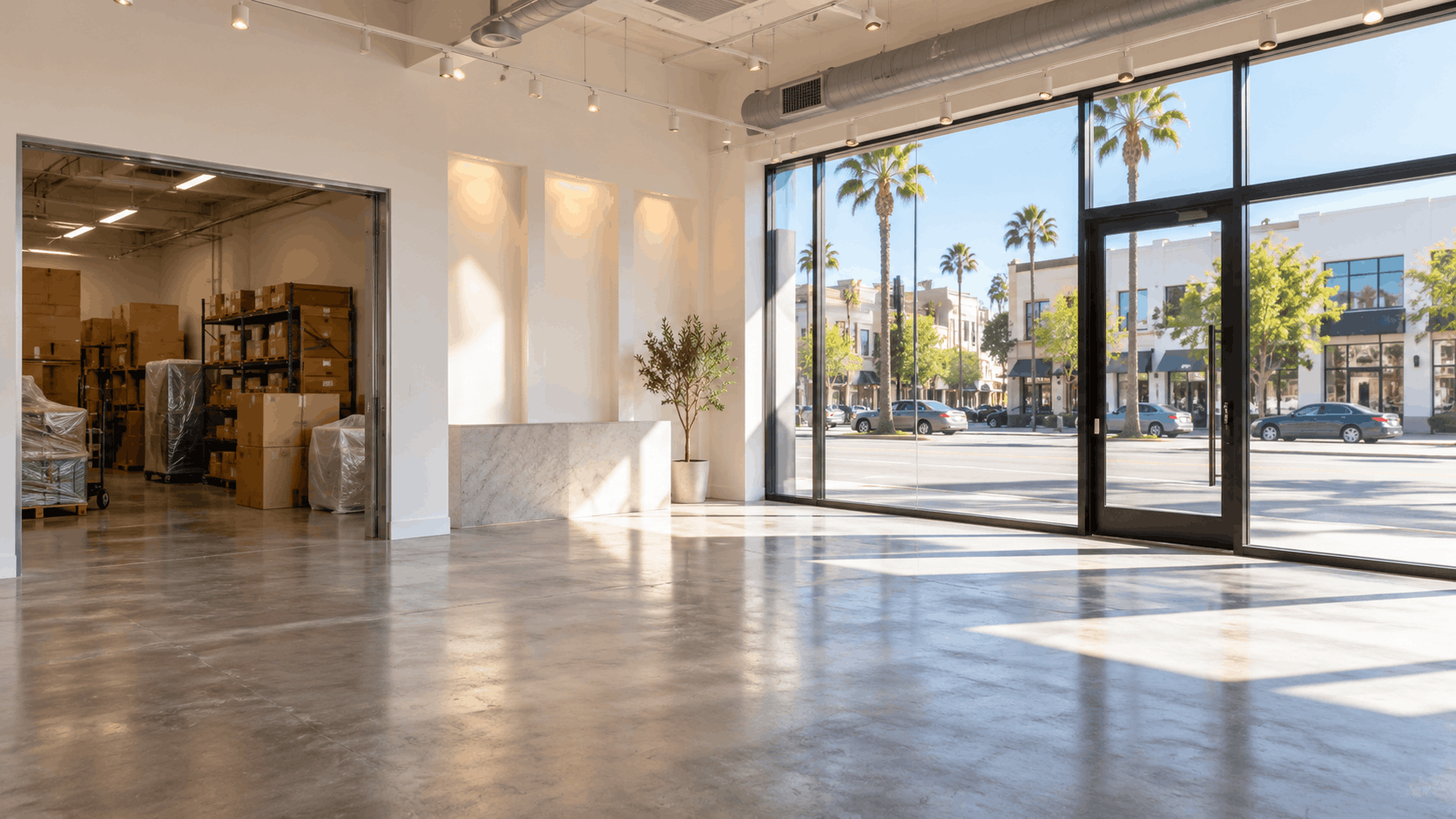
Getting the Stock Back for the New Lease
Storage is only half the job. The stock has to come back ready to display when the new lease opens. That means scheduling the return, understanding warehouse access, dealing with the new space's street and building rules, and knowing what to do if anything is damaged or missing.
The return runs on the same discipline as the move out: an assessment of the new space, the right method for the access, and a written plan. A good redelivery is as planned as the pickup, which is what gets a floor set on schedule.
Scheduling the Return and Warehouse Access
Retrieving vaulted goods means the warehouse opens and pulls the container, so the stock is not sitting on an open shelf for self-service. For that reason, retrieval is scheduled by appointment. That is ordinary trade practice for vaulted storage, not a special rule, and it lets the crew stage the pull before your crew or ours loads it.
The appointment model is a direct result of the vault design. Because the customer has no key and no unit, access runs through the warehouse. The upside is that the stock is never exposed to a shared facility; the trade-off is that pulling it takes scheduling rather than a walk-in.
The warehouse hours are business hours for calls and scheduling. They are not customer self-access hours, because this is full-service storage, not a keyed unit. A showroom owner does not drop by to browse the stock; the return is arranged, and the crew brings it out.
For a lease opening, we coordinate the retrieval with the new floor's readiness. The vault is pulled and opened, the stock is checked against the inventory, and it is loaded for delivery to the new space. Timing the pull to the build-out finish keeps the stock moving straight onto the floor.
Delivering Into a New Beverly Hills or LA Space
The same street and building rules that governed the pickup apply on the way back. If the new space is in Beverly Hills, the escort, traffic plan and heavy haul rules apply again at that address. If it is in Los Angeles or a BHPO address, LA rules govern the delivery.
A high-rise destination brings building rules of its own. The Wilshire corridor is lined with high-rise condominium and commercial space, where the building, not the street, is the constraint. Service elevator reservations, certificates of insurance naming the owner and management company, and agreed loading windows all have to be arranged before the truck arrives.
Those certificates and reservations take lead time, so they are lined up as part of the redelivery plan. A building that requires a certificate of insurance will not let the crew load without it, and a service elevator that is not reserved may be unavailable on the day. Both get handled in advance.
Hillside and restricted-access addresses may need a planned shuttle on redelivery, exactly as on pickup. If the new space sits on a street a full-size truck cannot work, a shuttle from a legally staged larger vehicle is the method. It is planned and priced, not an improvisation on the day.
Filing a Claim on Damaged or Missing Stock
If something comes back damaged or missing, California's intrastate claim rules apply. A claim for loss or damage must be filed in writing with the mover within nine months after delivery as shown on the shipping document. That nine-month clock is set by MAX 4 Item 92(14), and it runs from the out-of-storage delivery, not from when the goods went in.
The mover must acknowledge a written claim within 30 days and must pay, decline, or make a firm compromise settlement offer within 60 days. If the claim is disallowed in writing, suit must be instituted within two years and one day from the date of that written notice. Those are the California figures, not the federal ones.
A claim cannot be denied solely because the lost or damaged goods were not noted at the time of delivery. Business and Professions Code Section 19265 is clear on that point, which matters for a showroom unpacking a full floor where not every scuff is caught on delivery day.
The best protection is paperwork. Keep the written estimate, the Agreement For Moving Services, and the bill of lading, plus the inventory. The single most common reason a consumer loses a dispute is that they cannot produce the documents. For a showroom with valuable stock, that file is worth keeping safe from pickup through redelivery.
Need Help in Los Angeles?
Popeye Moving & Storage serves Los Angeles and all of Los Angeles County.
How Popeye Moving & Storage Handles a Showroom Store-and-Return
Here is how we actually run this job, from the first call through redelivery, based only on confirmed facts. The goal is a clear path: a licensed mover, a written price with a cap, careful handling, and storage that flexes to the gap between leases.
A showroom store-and-return is a commercial job with a storage middle and two moves on either end. We plan all three parts as one project, so the schedule, the permits and the price hang together instead of being arranged piecemeal.
Licensing and Who Regulates the Move
Household and commercial moving inside California is regulated by the Department of Consumer Affairs, Bureau of Household Goods and Services, the BHGS. It is not regulated by the CPUC, which has not licensed movers since authority transferred to the BHGS in 2018. Complaints and license checks go to the BHGS, reachable at (916) 999-2041, with information published at bhgs.dca.ca.gov.
We operate under California household mover permit CAL T 189749 for intrastate work. For interstate work we hold USDOT 1472924 and MC 498816C. Before booking any mover, a customer can and should verify the permit with the BHGS, which is a quick check that confirms the operator is legal.
We are fully insured, and BBB accredited with an A+ rating. Those are the credentials a showroom owner can confirm independently. Fully insured describes the business; it is a separate question from valuation on the stock, which is handled through the valuation choices described earlier.
The regulator split matters for a store-and-return. An intrastate move, origin and destination both in California, falls under the BHGS and MAX 4. A move that crosses a state line falls under federal FMCSA rules. A Beverly Boulevard showroom moving within Los Angeles County is intrastate, so the California protections apply throughout.
The Written Price Before Anything Is Loaded
California requires a written estimate. A verbal quote, whether per hour or per hundred pounds, is not an estimate and is not binding. So a proper quote for a showroom clear-out comes in writing, with the stock, the services and the charges laid out where you can check them.
The document that caps your bill is the Agreement For Moving Services, which carries the Not To Exceed figure. On an intrastate move, that figure is the maximum total you can be charged for the transportation and the services ordered, agreed before any goods are moved. The bill cannot exceed it except through a Change Order you agree to.
The Agreement should describe the shipment in enough detail to identify the articles and services in the price, name the transportation and accessorial services including the crew and packers, and state the rates and charges, including any minimums and the per-pound valuation. For a showroom, that means the stock, the crating, the storage and the valuation are all on the page.
That written price is the cost control for the whole project. It is set before the truck is loaded, so a showroom owner knows the ceiling going in, not after the fact. If the scope changes, the change is documented and agreed, which keeps surprises off the final invoice.
Planning the Beverly Hills Pickup and Mar Vista Storage
Planning starts with the questions that decide the day. We confirm the truck size and width, the destination relative to Sunset Boulevard, whether the address is genuinely Beverly Hills or BHPO, and what the route needs under the heavy haul rules. Those answers set the lead time and the method before a date is locked.
On restricted blocks, a shuttle is part of the plan. Beverly Hills hillside streets and the tight curb space in the Flats can make a full-size truck impractical at the door, so a shuttle from a legally staged larger vehicle is used. It is a planned, priced method, confirmed before the move, not decided on the day.
The stock is then stored same-day at our Mar Vista warehouse at 5509 1/2 S Centinela Ave, with no overnight hold on the truck. It goes from the showroom floor into sealed vaults and into the climate-controlled building the same day, where it waits with no minimum or maximum term until the new lease is ready.
When the new space is ready, we schedule the retrieval, check the stock against the inventory, and deliver into the new floor under whatever street and building rules apply there. Our commercial and business storage service ties the whole store-and-return together so the retailer deals with one plan, not three.
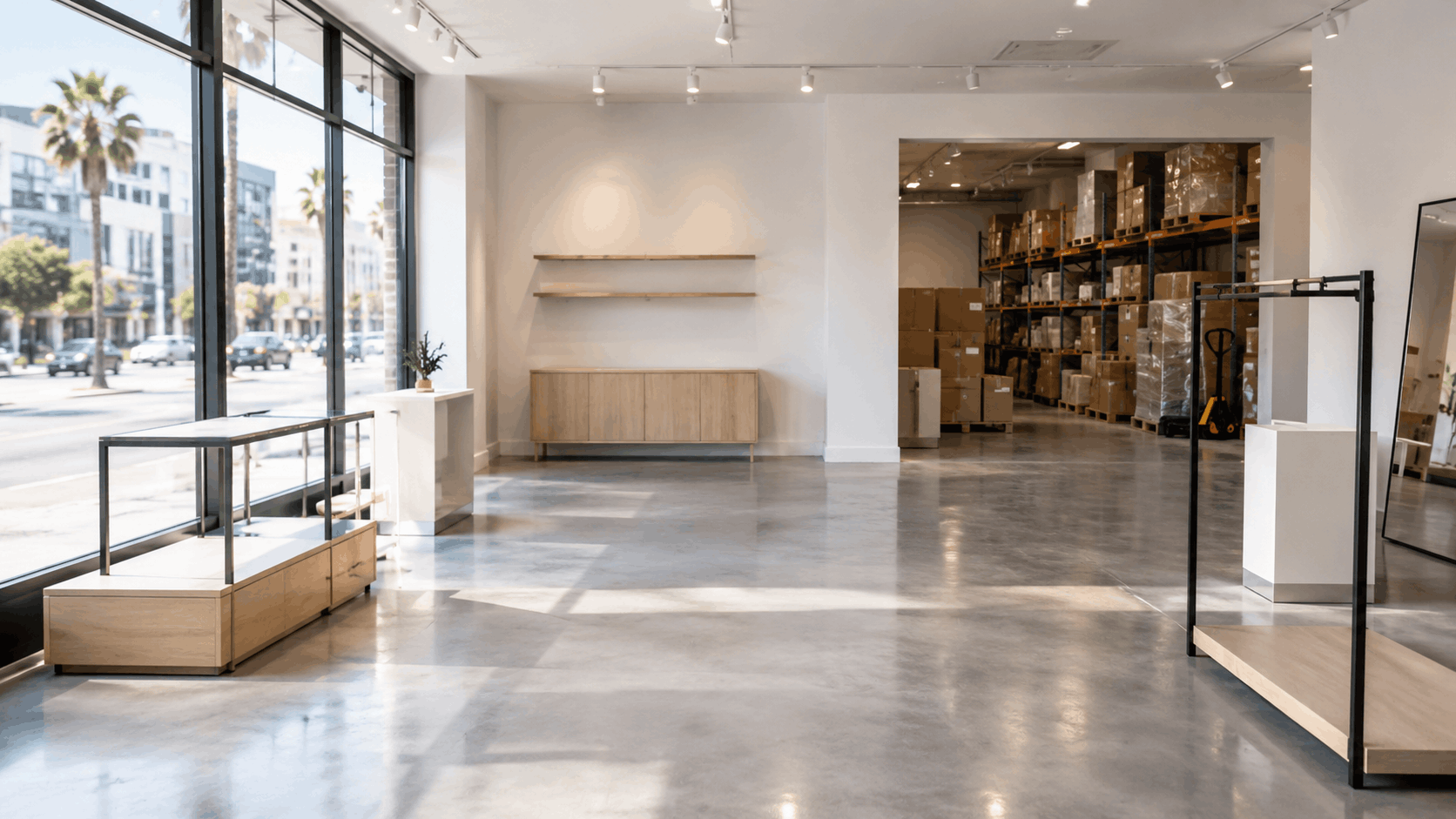
Planning Your Showroom Store-and-Return
A between-leases clear-out on Beverly Boulevard is a job we scope in writing before anything is loaded, with the Not To Exceed figure capping an intrastate move and the storage term left open to match the gap. The earlier we confirm the truck size, the route and whether the address is Beverly Hills or BHPO, the smoother the day runs.
Call Popeye Moving & Storage Co. at (310) 823-9510 to arrange an assessment of your showroom floor and a written estimate for the clear-out, storage and return.
Frequently Asked Questions
- Where does my showroom stock actually go during storage?
- Your stock is sealed into large wooden vaults at pickup and stored at our warehouse at 5509 1/2 S Centinela Ave in Mar Vista, on the Westside. Our crew handles every piece, loading it into the vault and moving the vault as a single unit by forklift. You do not get an individual unit or a key. This is full-service vaulted storage, so the stock is handled only by us from pickup to return.
- How much does vaulted storage cost per month?
- Vaulted storage runs a typical Los Angeles area range of $60 to $90 per vault per month. A full showroom floor usually fills more than one vault, so the monthly figure scales with how many vaults your stock takes. The crew estimates the vault count at the assessment, so you know the monthly cost before the stock moves in. That figure is a typical range for the area, not a quote for your specific job.
- Is there a minimum or maximum storage term?
- No. There is no minimum and no maximum storage term. That is what makes vaulted storage fit a between-leases gap so well, because the length of that gap is rarely known at the start. If the new space's build-out finishes early, the stock comes out early and the charge ends. If it drags, the stock stays as long as you need, with no commitment to a term you cannot predict.
- Can you store fine art, chandeliers and display fixtures?
- Yes. We accept specialist items including wine, fine art, pianos and chandeliers, and we store commercial and business stock alongside household goods. That covers the mix a showroom typically holds, from display furniture to mirrors and lighting. High-value pieces are crated and listed individually on the inventory. One thing we do not store is vehicles, so cars, motorcycles, boats and RVs are not part of this service and need a separate arrangement.
- Is the warehouse climate controlled?
- Yes, the warehouse is climate controlled for both temperature and humidity. The exact specification is confirmed per shipment rather than published as a fixed figure, because the right setting depends on what is being stored and for how long. That controlled environment matters most for the categories that react to humidity swings, including oil paintings, veneer and marquetry, leather, and fine furniture with inlays, which are exactly the pieces a design showroom tends to carry.
- What permits does a Beverly Hills pickup need?
- It depends on the truck and the route. Police escorts may be required when a vehicle or load exceeds 8 feet in width, and 18-wheel vehicles heading north of Sunset Boulevard require escorts with a minimum of 72 hours advance notice. Traffic plans must be submitted four business days ahead of daytime work. Confirm the current rule and fees for your exact address with the Beverly Hills Community Development Department, and verify whether the address is truly Beverly Hills or a BHPO Los Angeles address.
- Is my stock covered by insurance while it is stored?
- Valuation during storage-in-transit is available at set MAX 4 rates, ordered in writing: Actual Cash Value at $0.16 per $100 of declared value and Full Value at $0.38 per $100, for a period up to 90 days. Past 90 days the goods fall under the warehouse's own contract under Commercial Code Division 7, where the warehouse is liable for ordinary negligence. The mover's cargo policy does not clearly reach past storage-in-transit, so the storage agreement terms apply. Read that agreement.
- How fast can I get the stock back for my new lease?
- Retrieval is scheduled by appointment, because the warehouse opens and pulls the vault rather than leaving it for self-service. The warehouse hours are business hours for scheduling, not customer self-access hours. Redelivery timing then depends on the new address's street and building rules, such as a required traffic plan, an escort, or a service elevator reservation and certificate of insurance at a high-rise. We do not promise a fixed arrival time; we plan the return around the new space's readiness and its access requirements.
- What if something is damaged or missing when it comes back?
- On an intrastate California move you file a claim in writing within nine months of delivery. The mover acknowledges the claim within 30 days and pays, declines, or makes a firm settlement offer within 60 days. If it is disallowed in writing, suit must be filed within two years and one day of that notice. A claim cannot be denied solely because the damage was not noted at delivery. Keep the estimate, the Agreement For Moving Services, the bill of lading and the inventory.
- Do you do same-day pickup and storage?
- Yes. We pick up the stock and place it into vaults the same day, with no overnight hold on the truck. The merchandise goes from the showroom floor into sealed vaults and into the climate-controlled warehouse in one continuous move, rather than sitting in a parked vehicle waiting for the next shift. For a retailer clearing a floor on a fixed lease-end date, that means the stock is accounted for and secured inside the building by the end of the day.
Popeye Moving & Storage Co. Team Team
Licensed moving and storage professionals serving Los Angeles and Los Angeles County.
Licensed in California · License #CAL T 189749 | USDOT 1472924 | MC 498816C
Why trust Popeye Moving & Storage?
Founded in 1994, Popeye Moving & Storage is a licensed and insured moving and storage service serving Los Angeles and Los Angeles County. All content is reviewed by our licensed technicians.

Need Help in Los Angeles?
Popeye Moving & Storage serves Los Angeles and all of Los Angeles County.
Related Articles
Between-Leases Storage in LA - The Week-to-Month Playbook With Pickup and Redelivery
Caught between leases in LA? Learn how week-to-month storage with pickup and redelivery bridges the gap, plus LA parking rules, costs, and packing tips.
Office Furniture Storage Between Leases: Decommission Today, Refurnish the Next Space Later
Learn how LA businesses store office furniture between leases, decommission the old space, and refurnish later - with costs, timing, and practical tips from Popeye Moving.

Trade Show and Pop-Up Logistics in LA: Booth Transport, Storage Between Events, and Convention Timing
A local guide to trade show and pop-up logistics in LA, covering booth transport, storage between events, convention timing, and protecting valuable displays.