Hillside Move Logistics: Why Some LA Streets Need Smaller Trucks
Key Takeaways
- Many LA hillside streets have grades above 15-20%, turning radii under 30 feet, and road widths under 14 feet - conditions that physically prevent standard 26-foot moving trucks from operating safely.
- Neighborhoods like Laurel Canyon, Beachwood Canyon, upper Silver Lake, Mount Washington, and Topanga Canyon almost always require 10 to 16-foot trucks or a shuttle relay approach instead of full-size rigs.
- LADOT temporary no-parking permits are legally required on most hillside streets and take 2 to 5 business days to process - skipping them risks ticketing or towing on moving day.
- HOA and private road communities in Bel Air, Pacific Palisades, and similar areas set their own truck size and access hour rules that are completely separate from city regulations and must be confirmed in writing before booking.
- A pre-move street survey - an in-person physical inspection, not just Google Street View - is the most reliable way to catch access problems before they become moving-day emergencies.
- Hillside moves typically require larger crews than flat-street equivalents: a two-bedroom Silver Lake home with two stair flights and a 40-foot carry warrants a four-person crew rather than two.
- Accurate hillside moving quotes require sharing the exact street address, stair count, carry distance, driveway angle, and any HOA or gate access restrictions before the mover writes any number.
- Seasonal factors including winter rains and post-fire road restrictions can close or narrow hillside canyon roads for days or weeks - building a flexible backup date into hillside move bookings is a practical safeguard.
In This Article
Picture this: a family stands on the curb in Laurel Canyon, watching a 26-foot moving truck attempt a left turn onto their new street. The truck stops. The driver gets out. He walks the corner, shakes his head, and delivers the news nobody wants to hear on moving day - the truck cannot make the turn. The nose would clip the retaining wall, and the rear would swing into the embankment on the opposite side. The move is now on hold before a single box has left the truck.
This scenario plays out more often than most people expect across Los Angeles hillside neighborhoods. The streets in these areas were not built for modern moving equipment. They were cut into canyon walls decades ago, designed for Model A Fords and milk trucks - not 26-foot box trucks loaded with sectional sofas and refrigerators. The combination of steep grades, tight switchbacks, absent turnaround space, and overhead obstacles creates a set of access problems that flat-street movers simply never encounter.
Let's talk about the specific reasons hillside streets in Los Angeles demand a different approach, which neighborhoods most often require smaller trucks, how Popeye Moving & Storage Co. plans and executes these moves differently, and what readers can do before booking to avoid a moving-day disaster.
What Makes LA Hillside Streets So Different From Flat-City Moving
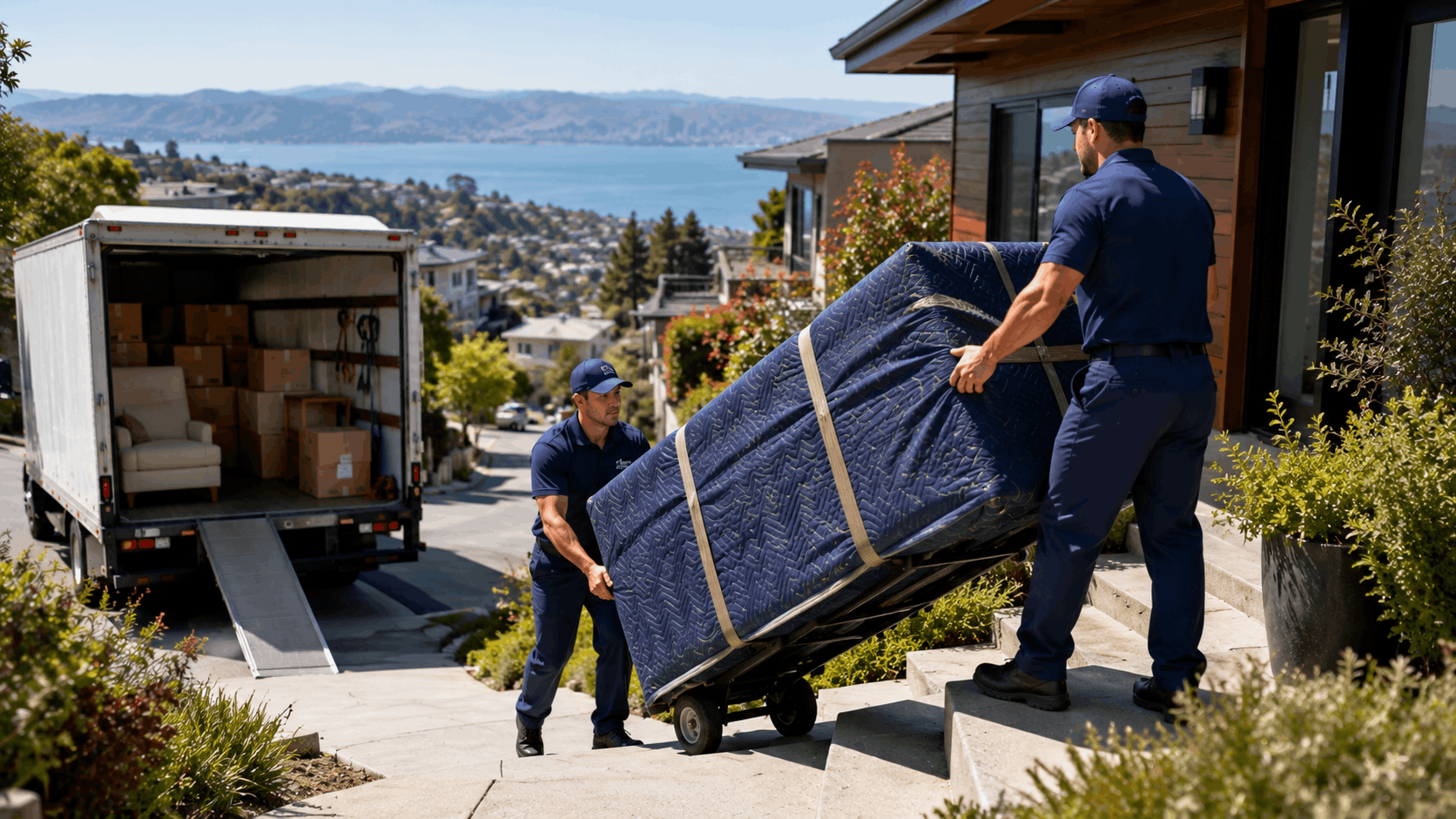
Flat-street moving is straightforward by comparison. The truck pulls up, the crew loads, the truck drives away. Hillside streets in Los Angeles introduce a layer of physical constraints that change every part of that equation. The roads are narrow, steep, and often end without any room to reverse course.
Many of these streets date back to the 1920s and 1930s when the hillside tracts were first developed. Road engineers of that era had no reason to account for vehicles longer than 20 feet. Today, those same roads see residents trying to move three-bedroom households using modern equipment that physically does not fit the geometry.
| Street Condition | Flat Street (Typical) | LA Hillside Street (Typical) |
|---|---|---|
| Road width | 24 - 36 ft | 10 - 18 ft |
| Grade | 0 - 5% | 10 - 25% |
| Turning radius available | Generous | Often under 20 ft |
| Turnaround space | Usually available | Rare to none |
| Overhead clearance | 13.5+ ft standard | Can drop below 12 ft with canopy |
| Curb parking available | Common | Rare or prohibited |
The Road Geometry Problem: Grades, Curves, and Dead Ends
A standard 26-foot box truck has a turning radius of roughly 42 to 45 feet. Many hillside streets in Beachwood Canyon, Laurel Canyon, and along Outpost Drive feature curves with available turning radius of 20 feet or less. The math simply does not work.
Grades are the other problem. Most major truck manufacturers rate their standard box trucks for grades up to about 15 percent under full load. Streets like portions of Durand Drive in Beachwood Canyon and sections of Wonderland Avenue in Laurel Canyon hit grades of 18 to 22 percent. A loaded truck attempting a grade like that risks brake fade on the descent and transmission stress on the climb.
Dead ends compound the problem further. A truck that cannot turn around must reverse down a blind hillside curve - a maneuver that is slow, dangerous, and often illegal on public streets. On a steep grade moving truck job in Laurel Canyon, a miscalculation on this point can strand the truck for hours waiting for tow assistance.
Parking Restrictions and No-Turnaround Zones
Hillside parking restrictions in Los Angeles are not suggestions. Red-curb zones, fire hydrant clearances, and street-width ordinances leave almost no room for a large truck to stage on a typical hillside street in Silver Lake, Echo Park, or Mount Washington. The nearest legal parking space for a truck may be a quarter mile downhill from the front door.
The Los Angeles Department of Transportation (LADOT) issues temporary no-parking permits that allow movers to reserve curb space on the day of the move. These permits are not optional on most hillside streets - they are the only way to legally hold the nearest loading zone. Without one, a crew may arrive to find their staging spot occupied, pushing the operation further from the home.
Many streets above Sunset Boulevard in Echo Park and on the upper grid of Mount Washington have no LADOT moving permit accommodation at all because the road is simply too narrow to safely allow a parked truck without blocking traffic entirely. In those cases, the decision about which truck to send is made before the crew ever leaves the yard.
Overhead Clearance and Tree Canopy Issues
A standard box truck stands 13.5 feet tall at the roofline. That number assumes clear air above. On streets like Durand Drive in Beachwood Canyon or portions of Mulholland Drive near the western ridge, mature sycamores and oak trees drop branches low enough to clip the top corners of a tall truck at posted speed limits.
Utility lines on older hillside blocks add another layer of risk. Many of the residential feeder lines in neighborhoods like Glassell Park and upper Highland Park run at lower clearances than main arterial lines. A driver unfamiliar with the specific block may not notice a dip in the line until it catches the antenna or roof of the truck.
The overhead clearance moving truck problem is one of the harder ones to assess remotely. Street View images may not show a branch that grew out two feet since the last camera pass. This is one reason a physical survey before the move matters so much on hillside jobs across Los Angeles.
Get Your Free Quote
Tell us about your move. We'll be in touch soon.
Which LA Neighborhoods Most Often Require Smaller Moving Trucks
Not every hillside neighborhood in Los Angeles presents the same degree of truck-access difficulty. Some areas have wider-than-average canyon roads. Others are almost universally inaccessible to anything larger than a cargo van. Based on years of running residential moving jobs across the city, Popeye Moving has a clear picture of which neighborhoods demand a small-truck approach every time.
- Laurel Canyon and upper Lookout Mountain Avenue - Nearly all side streets above Laurel Canyon Boulevard require trucks 16 feet or shorter.
- Beachwood Canyon above the Hollywoodland gates - Road width drops dramatically north of the gates. Two small trucks almost always replace one large one.
- Wonderland Avenue and Amor Drive in the Hollywood Hills - Switchbacks and parked cars on both sides make 20-foot trucks a liability.
- Upper Silver Lake above Sunset Boulevard - Streets off Micheltorena and Redesdale regularly require shuttle approaches.
- Mount Washington above Avenue 43 - Steep grades and staircase-access homes are common throughout this grid.
- Echo Park hillside streets off Baxter Street - One of the steepest paved residential streets in Los Angeles, Baxter tops 30 percent grade in sections.
- Bel Air off Chalon Road and upper Roscomare Road - Private road designations and gated entry points limit truck length and sometimes weight.
- Pacific Palisades bluff streets above Sunset - Single-lane access roads and HOA-restricted driveways frequently cap truck length at 20 feet.
- Topanga Canyon interior roads - Fire season closures and post-storm soft shoulders make large trucks a practical impossibility on certain months.
Laurel Canyon, Beachwood Canyon, and the Hollywood Hills
The canyon roads that connect Hollywood to the San Fernando Valley are among the most truck-restrictive streets in all of Los Angeles. Wonderland Avenue above the park, Amor Drive, and the upper reaches of Cahuenga Pass have one thing in common: they were paved in an era when the biggest vehicle expected was a panel delivery truck.
A Laurel Canyon moving truck job above the main boulevard almost always gets a 14 or 16-foot truck as the primary vehicle. The switchbacks that climb toward Mulholland simply do not accommodate anything larger. Large trucks attempting these turns risk getting high-centered on the inside curve, with the trailer overhang swinging out over steep drop-offs on the outside.
Beachwood Canyon presents a slightly different challenge. The lower section near Franklin is manageable for a 20-foot truck. Above the iconic Hollywoodland stone gates, the roads narrow sharply. Popeye Moving routinely stages larger trucks at the wide section near the bottom and runs smaller vehicles up to the homes. It adds time, but it keeps the job moving and keeps the truck out of trouble.
Silver Lake, Echo Park, and Mount Washington
The Silver Lake hillside streets that branch off Micheltorena, Redesdale, and Earl streets are a constant logistical puzzle. Many of the homes sit above street level, accessible only by long concrete staircases. The street itself may have room for a 16-foot truck, but carry distance from the truck to the front door can stretch 80 to 120 feet - mostly vertical.
Echo Park hillside streets add the drama of extreme grades. Baxter Street, which climbs from Alvarado toward Echo Park Avenue, regularly tops a 30 percent grade in its steepest sections. Large trucks do not attempt Baxter. Period. The local residential moving approach for this block involves smaller vehicles, a larger crew, and a frank conversation with the client about time.
Mount Washington has a quieter version of the same problem. The grid above Avenue 43 and around Museum Drive features moderate grades by canyon standards, but staircase access is the rule rather than the exception. Older bungalows in this area often have no direct driveway connection to the street, making crew size and equipment selection the deciding factor for how long the job runs.
Bel Air, Brentwood Heights, and Pacific Palisades Bluffs
The west-side hillside neighborhoods present a different flavor of access restriction. Bel Air off Chalon Road and upper Bellagio Drive has private road designations that carry their own rules about truck length, arrival hours, and driver credentialing. Some communities require the moving company to submit insurance certificates to the HOA or guard gate before the move date.
Pacific Palisades bluff streets above Sunset Boulevard include single-lane access roads where two vehicles cannot pass each other. A moving truck parked on one of these lanes blocks the entire street. HOA rules in some communities explicitly prohibit trucks over 20 feet and restrict moves to weekday hours between 8 a.m. and 5 p.m.
Bel Air moving restrictions vary by specific community. The Bel Air Country Club area and roads off St. Cloud Drive each have their own gatehouse protocols. Getting the rules in writing before booking - not the week of the move - is the only way to avoid a truck being turned away at the gate on moving morning. Popeye Moving contacts each relevant HOA or guard gate as part of the pre-move process for these jobs.
Need Help in Los Angeles?
Popeye Moving & Storage serves Los Angeles and all of Los Angeles County.
Truck Size Options and What Each One Can Actually Handle
Choosing the right truck is not just about how much furniture needs to move. On Los Angeles hillside streets, it is about what the road will physically accept. Knowing the real-world capacity and limitations of each truck size helps clients make informed decisions instead of guessing.
The 10 to 16-Foot Truck: The Hillside Workhorse
A 16-foot moving truck has a turning radius of roughly 28 to 32 feet and a height of about 11 to 12 feet at the box. Those numbers let it handle most hillside streets in Los Angeles without the geometry problems that plague larger rigs. It can manage grades up to about 20 percent under normal load conditions and fit through single-lane sections that would stop a bigger truck cold.
The tradeoff is volume. A 16-foot truck holds roughly 800 to 1,000 cubic feet of loaded goods - enough for a one-bedroom apartment or a lightly furnished two-bedroom home in a single trip. A fully furnished three-bedroom house will need two or three runs, which adds time and mileage to the job cost.
For clients moving a small truck hillside job, that extra trip time is usually the better trade compared to the alternative of a stuck 26-footer blocking a canyon road and requiring a tow. Popeye Moving is straightforward with clients about this tradeoff at the quoting stage, not after the truck arrives.
When a 20 to 26-Foot Truck Becomes a Liability
A 26-foot box truck has a turning radius of 42 to 45 feet, a height of 13.5 feet, and a gross vehicle weight that can exceed 26,000 pounds when loaded. On a flat arterial street, those numbers are fine. On a hillside street with a posted 3-ton weight limit and a switchback that offers 22 feet of clearance, that truck is a liability the moment it leaves the main road.
The 26-foot truck hillside risk plays out in specific ways. High-centering occurs when a long truck's undercarriage contacts the peak of a steep driveway apron - the truck sits with its drive wheels in the air and goes nowhere. Blocking single-lane roads creates a cascade of angry neighbors, blocked emergency access, and LAPD calls. Failing to complete a turn and needing tow assistance has happened on Wonderland Avenue and on streets off upper Beachwood - it is not a hypothetical.
Popeye Moving has declined to send a 26-foot truck onto streets where the pre-move survey says it will not make it. That call protects the client's belongings, the crew, and the neighbors. A moving truck stuck on a narrow hillside street in Los Angeles can shut down a residential block for hours.
Relay Loading: How Multiple Small Trucks Can Match One Big One
The shuttle or relay method solves the volume problem that smaller trucks create. The process works like this: a 14 or 16-foot truck loads at the hillside home and drives down to a flat staging point - often a wide commercial street or a nearby parking lot. A larger 24 or 26-foot truck waits there to receive the load. The smaller truck returns to the house for the next run while the crew continues packing.
This approach lets Popeye Moving access any hillside street in Los Angeles with the right small vehicle while still consolidating the load into a single large truck for transport. For long-distance jobs, this is particularly useful - the relay getting goods from a restricted Silver Lake street to a staging point on Sunset Boulevard, then into a highway-bound truck.
The relay moving method adds labor time, but it protects the client's property, keeps the schedule intact, and avoids the catastrophic scenario of a large truck getting stuck. For specialty moving items like grand pianos or large safes, the relay also gives the crew a controlled handoff point at grade level rather than attempting to load heavy items on a steep driveway slope.
Los Angeles Permits, Regulations, and Street Access Rules for Moving Trucks
The permit process for moving trucks in Los Angeles is more involved than most people expect. Skipping it is not just a risk of getting a ticket - it can result in the truck being towed, which stops the entire move. Getting permits right, and getting them early, is part of standard hillside move logistics for any experienced LA mover.
LADOT Street Use Permits: What They Cover and How to Get One
LADOT issues temporary no-parking permits that allow a moving truck to legally occupy curb space on a public street for a defined time window. The permit designates specific parking spaces or a stretch of curb as reserved for the moving truck on the stated date. Vehicles already parked there receive a warning notice the day before.
LADOT asks for at least five working days of notice. Applications can be submitted through the LADOT online permit portal or in person at a DOT Public Service Center. The fee is set by LADOT and is non-refundable, so confirm the current amount with LADOT before applying.
Popeye Moving handles LADOT permit applications as part of the move coordination process for hillside jobs. Clients who handle permits themselves need to start the application at least a week ahead to avoid being squeezed by the lead time. Waiting until 48 hours before the move is a gamble that frequently does not pay off.
Weight Limits on Hillside and Residential Streets
Posted weight limit signs on Los Angeles hillside streets are legally binding. Many residential streets in the Tujunga area, portions of Mulholland Drive near the western end, and several streets in the Verdugo Hills carry posted limits of 3 tons - which is 6,000 pounds. A loaded 26-foot moving truck can gross four to five times that.
Street weight limit restrictions in LA exist to protect aging roadway infrastructure, particularly on hillside roads where soil movement and drainage issues already stress the pavement. Violations carry fines, and in cases where a heavy truck causes road damage, the liability can follow the moving company - and potentially the client.
The moving truck weight restriction issue is one reason Popeye Moving asks about specific street addresses before finalizing truck selection. The crew checks posted limits during the pre-move survey and cross-references with city mapping before committing to a truck configuration. A 14-foot cargo van or smaller box truck typically comes in well under the 3-ton threshold even when loaded.
HOA and Private Road Rules in Gated Hillside Communities
Homeowner associations in communities like Mulholland Estates or portions of the Bel Air Country Club area operate outside of city jurisdiction when it comes to truck access on private roads. They set their own rules about truck length, arrival time, noise curfews, and insurance documentation requirements. City moving permits mean nothing at a private gate.
HOA moving rules in LA can include truck length caps as short as 20 feet, restrictions to specific entry gates, required move-in escrow deposits against property damage, and prohibited hours that run until 9 a.m. or as early as 4 p.m. Some communities in Pacific Palisades require a HOA representative to be physically present during the move.
Requesting HOA move-in rules in writing before booking a mover is not optional for gated communities - it is the only way to build an accurate job plan. Popeye Moving contacts every relevant HOA during the quoting phase for gated community moving truck jobs. Rules that surface on moving day are almost always more expensive to accommodate than rules learned three weeks earlier.

How a Pre-Move Street Survey Changes Everything
The single most effective thing a moving company can do before a hillside job in Los Angeles is physically look at the street. Not Google Street View. Not satellite imagery. A person walking the road, measuring the tight spots, and making notes about where the truck can and cannot go. This pre-move street survey is standard practice for Popeye Moving on any hillside job, and it changes the job plan more often than clients expect.
What the Survey Covers: Grade, Width, Clearance, and Staging
A moving site assessment for a hillside job in Los Angeles checks several specific measurements and conditions. Road width at the tightest point gets measured with a tape or a laser - for a 16-foot truck with mirrors, crews need at least 11 feet of clear travel width, ideally 13 feet. For a 20-foot truck, 14 to 15 feet is the minimum.
Driveway grade gets assessed with a simple inclinometer. A driveway above 12 percent starts to create ground-clearance problems for long trucks. Above 18 percent, a loaded truck risks high-centering on the apron. Overhead clearance from tree canopy and utility lines gets measured at the lowest point along the approach route.
The staging spot - where the truck will actually park to load or unload - gets selected and marked during the survey. For many hillside homes in Silver Lake or Glassell Park, the best staging location is two or three blocks downhill, which becomes the basis for calculating the carry distance and the long carry time that goes into the job estimate.
Using Google Street View vs. Actually Walking the Street
Google Street View is useful for initial research. It gives a moving company a rough sense of the road geometry before anyone drives out to look. But the imagery for many hillside streets in Los Angeles is 12 to 36 months old at the time of a given move. Trees grow, slide debris appears, construction barricades go up, and parked cars that block sight lines change from day to day.
The Google Street View moving planning problem is especially pronounced in canyon neighborhoods after rain events or fire seasons. A street that showed clear passage in the last camera sweep may have a rock slide berm on the shoulder that narrows it by four feet. That difference is the difference between a 16-foot truck getting through and not.
Popeye Moving uses Street View as a first-pass screening tool only. For any hillside job in a canyon or on a steep residential grid, a team member drives the route within a week of the move date. Recent photos of the tightest spots go into the job file. This approach has caught access issues that would have produced a stuck truck on moving day more times than the crew can count.
Seasonal Factors: How Rain and Fire Season Affect Hillside Access
Winter rains between November and March regularly close or narrow hillside and canyon roads across Los Angeles. Topanga Canyon Boulevard, Malibu Canyon Road, and streets in the Verdugo Hills above La Crescenta are among the most frequently affected. A mudslide that closes a road for 48 hours on moving day is not recoverable without a complete reschedule.
Post-fire debris in areas above Altadena or in the communities above La Crescenta can restrict large vehicle access for months. After the Eaton Fire events in early 2025, several roads in the foothill communities remained under truck weight restrictions while debris clearance operations continued. Seasonal moving challenges in LA require building flexibility into the move date - especially for Topanga Canyon moving access, which can change overnight after a rain event.
Popeye Moving checks road closure and advisory reports through the LA County Public Works road conditions database and the California Highway Patrol incident log before every hillside job in fire-prone or slide-prone areas. Clients in Topanga or the Verdugo foothills are advised to hold a flexible backup date during rainy season as part of their booking agreement.
Need Help in Los Angeles?
Popeye Moving & Storage serves Los Angeles and all of Los Angeles County.
Staircase Carries, Hand Trucks, and the Labor Reality of Hillside Moves
There is no polite way to say it: hillside moves are harder on people and equipment than flat-street moves. The labor reality of hillside moving in Los Angeles involves longer carry distances, more stair flights, heavier exertion per trip, and more precise equipment handling to prevent injuries and furniture damage. Honest movers account for this in the estimate. Others do not, and that is where surprise charges come from.
Why Hillside Homes Often Add Hours to the Move Timeline
A flat-street move estimate is typically built around an average carry distance of 30 to 50 feet from the truck to the interior room. A hillside home in Glassell Park or Highland Park with a long concrete staircase and a truck staged 60 feet downhill changes that carry distance to 90 to 140 feet - much of it vertical. Each trip takes two to three times as long as the flat-street equivalent.
Real time multipliers vary by job, but a reasonable working figure is that every flight of stairs beyond the first adds about 15 to 20 percent to the overall move time for a standard household. A two-bedroom Silver Lake home with two flights and a 60-foot carry can run 30 to 50 percent longer than a comparable flat-street job in Culver City.
The hillside move timeline reality is not something to learn about at the end of the job when the clock is well past the estimate. Popeye Moving walks through stair counts and carry distances with every hillside client during the quoting process and builds the time estimate from those specific numbers, not from a generic per-room formula.
Equipment That Helps: Stair Climbers, Dollies, and Ramps
Powered stair-climbing dollies changed the economics of staircase carry moving in Los Angeles. These motorized devices grip a heavy appliance or wrapped furniture piece and walk it up stairs using rotating treads, reducing the crew exertion required and the damage risk to both the item and the staircase. For a refrigerator or a large commercial-grade range, they are not optional - they are how the move gets done safely.
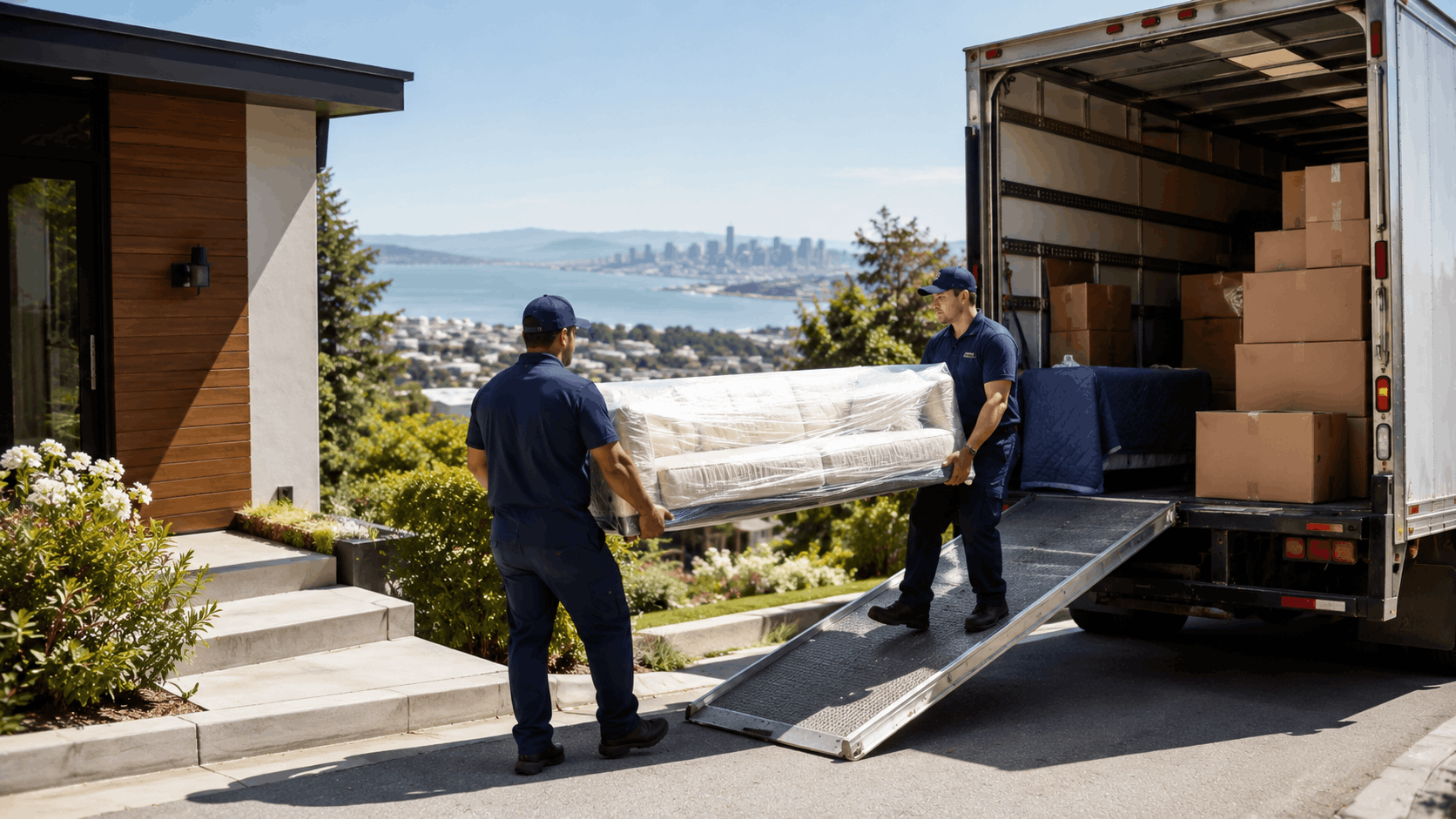
Aluminum loading ramps that bridge steep driveway lips let crews wheel furniture down to the truck bed level without lifting it over a sharp apron edge. On driveways with a pronounced lip drop - common on older hillside properties in Beachwood Canyon and upper Echo Park - a ramp system reduces the chance of dropping a piece and damaging it on the concrete edge.
Furniture sliders for narrow interior hallways round out the equipment picture. Many older hillside homes in Los Angeles were built with interior passages designed for people, not for movers carrying a king-size mattress turned on its side. Sliders let the crew move pieces through tight turns without gouging drywall or scratching hardwood. Good equipment is what separates a hillside moving crew from a crew that brings a big truck and figures it out from there.
Crew Size Recommendations for Hillside vs. Flat Moves
A two-person crew is the standard for a flat-street one-bedroom move. That math changes when stairs and long carries enter the picture. A two-bedroom hillside home in Silver Lake with two flights of stairs and a 40-foot carry from the nearest truck parking typically warrants a four-person crew - two people on the carry and two managing the truck, wrapping, and stacking.
The four-person moving crew recommendation is not about padding the labor bill. It is about keeping the physical load per person at a level that does not result in injuries or damaged furniture from fatigue. A two-person crew on a heavy staircase carry in the Los Angeles summer heat will slow dramatically after the first two hours. A four-person crew rotates positions and maintains pace through the full job.
For larger homes or jobs with specialty items like grand pianos - which Popeye Moving handles through its piano moving service - the crew size goes up further. A piano on a hillside staircase requires four people dedicated to that single piece, with additional crew continuing work on the rest of the load. Trying to do it with fewer people is how instruments get damaged and movers get hurt.

How to Get an Accurate Quote for a Hillside Move in Los Angeles
A hillside moving quote that looks attractively low is frequently a quote that was built without asking the right questions. The difference between an accurate estimate and a low-ball one almost always comes down to what information the moving company gathered before writing the number. Clients who know what details to share upfront get better quotes and fewer surprises.
Information to Share Before You Get a Quote
When requesting a hillside moving quote in Los Angeles, clients should have the following ready before the first phone call or online inquiry:
- The exact street address - not just the neighborhood. The difference between two addresses on the same hillside can mean the difference between a 16-foot truck and a 26-foot truck.
- Number of stairs and flights - from the front door to the closest parking position for a truck.
- Carry distance - estimate the distance from where the truck will park to the front door in feet.
- Driveway angle - if the driveway is steep enough to notice when walking up it, note that specifically.
- Any HOA, gate, or private road access rules - including truck size limits, arrival time restrictions, and required documentation.
- Permit situation - whether LADOT permits have been applied for or whether the mover needs to handle that.
The more detail shared upfront, the more the estimate accuracy improves. Moving quote information gaps are where surprise charges hide. A client who shares everything knows what the job actually costs. A client who shares the city and a bedroom count gets a number that may bear no resemblance to the final invoice.
Red Flags in a Hillside Moving Quote
A moving quote red flag for a hillside job is a number that matches or comes in below the going rate for a flat-street move of similar size. Hillside moves cost more to execute because they take more time, require more people, and sometimes require shuttle trucks. A company that quotes a three-bedroom Laurel Canyon move at the same price as a three-bedroom Sherman Oaks move either has not thought about the job or is planning to add charges later.
A frequent low-ball moving estimate tactic for hillside jobs is to give a flat-street hourly rate and then apply a steep-road surcharge on the day of the move, after the client is committed and the truck is parked. The surcharge may be framed as a long-carry fee, a stair fee, or a shuttle truck fee - all of which are legitimate costs, but all of which should have been in the original quote if the company asked the right questions.
Clients should also be cautious about companies that do not mention permits during the quoting conversation. LADOT permit costs and application time are knowable in advance. A mover who never asks about parking or permits is not planning the job - they are pricing the truck rental and leaving the rest for the client to figure out on moving day.
What Popeye Moving Checks Before Quoting a Hillside Job
The Popeye Moving Los Angeles quoting process for hillside jobs starts with satellite and street-level review of the exact address before anything else. The crew checks visible road width, identifies the closest legal staging point for the truck, and flags any overhead clearance concerns or obvious grade issues from the imagery.
The next step is a direct conversation with the client about parking availability, permit needs, HOA rules, stair counts, and carry distance. That conversation often reveals details that street-level imagery cannot show - a homeowner who mentions that the truck will need to park around the corner because the gate code only opens from the inside, for example.
For jobs in areas like upper Beachwood Canyon, Mount Washington, or the Bel Air private road zones, a Popeye Moving team member drives the route before the quote is finalized. The hillside moving quote process ends with a clear breakdown of truck selection, crew size, permit costs, and any relay or shuttle requirements - all before the client commits to a booking date. Readers can reach the team directly through the Popeye Moving contact page to start that conversation.
Need Help in Los Angeles?
Popeye Moving & Storage serves Los Angeles and all of Los Angeles County.
Real Hillside Move Scenarios From LA Streets We Have Worked
The logistics of hillside moving in Los Angeles are easier to understand through real situations than through general principles. The following scenarios come from actual Popeye Moving jobs in the canyon and hillside neighborhoods of Los Angeles. The details reflect the kind of problems that show up regularly on these streets and the approaches that kept the jobs on track.
The Beachwood Canyon Job Where the Big Truck Could Not Pass the Gate
A Beachwood Canyon move job came in looking manageable on the surface - a two-bedroom home, a standard amount of furniture, a Saturday date. The client had booked assuming a single 26-foot truck would handle it. The pre-move street survey told a different story.
Above the Hollywoodland stone gates, the road width at one specific curve measured 13.5 feet at the tightest point, including a parked car on the right shoulder that would not move for the move date. A 26-foot truck with mirrors extended needs at least 11 feet of clear travel width - but making the turn above that point required a swing radius the road could not accommodate. The call was made three days before the move: two 14-foot trucks instead of one large rig.
The small truck relay move kept the job exactly on schedule. Truck one loaded at the house while truck two staged at the wider section below the gates. Each run took 25 minutes from house to staging point. The client paid more in labor time than a single-truck job would have cost, but the job finished by early afternoon and no truck got stuck. The Hollywoodland moving truck lesson is simple: survey first, commit to equipment second.
A Silver Lake Hillside Home With 64 Stairs and No Driveway
The Silver Lake staircase move that Popeye Moving's crew still references involved a 1930s bungalow perched above Redesdale Avenue. The home had no driveway. Access from the street to the front door ran through 64 concrete steps with a landing at the halfway point. The nearest legal truck parking was 30 feet below the bottom step.
A standard two-person crew would have spent roughly 12 to 14 hours on this job. Popeye Moving sent four people and a powered stair-climbing dolly. The dolly handled a side-by-side refrigerator and a small upright piano - the two items that would have been dangerous to carry up 64 steps manually. The rest of the load moved by hand in a rotation system where two people carried while two wrapped and staged at the truck.
Total job time: 7.5 hours for a two-bedroom home. The piano moving hillside element alone took 90 minutes with the powered equipment and would have taken longer than that with manual carries, assuming no injuries. The four-person crew cost the client more per hour than two would have - but the job finished well ahead of a two-person pace, and no one got hurt. For packing and crating for fragile items in this home, the crew also had appropriate materials staged at the bottom of the stairs to avoid carrying heavy packed boxes up before they were ready.
Moving Out of Topanga During Fire Season Road Restrictions
A Topanga Canyon moving job in late January presented a challenge that had nothing to do with the property itself. The home was accessible, had a usable driveway, and the truck fit the road without issue. The problem was Topanga Canyon Boulevard, the primary route out of the canyon toward the Valley, which had active fire-related traffic management restrictions that reduced inbound and outbound traffic to alternating single-lane passage during designated windows.
Each truck run from the Topanga property to the storage facility in Burbank added 45 minutes compared to the pre-restriction route. The crew made three runs. The fire season moving road restriction added 2.25 hours to the total job time compared to the original estimate. The saving factor was early-morning scheduling - the crew started at 6:30 a.m. and completed the first run before the peak restriction window kicked in at 8 a.m.
The alternate routing the crew used on the later runs - out through Las Virgenes Road to the 101 - added mileage but avoided the restriction zone entirely. Route planning for a moving job sounds like a minor detail. On a fire season move out of Topanga, it was the difference between finishing by early afternoon and finishing at dusk. This kind of local knowledge is what clients are actually paying for when they hire a mover who works these streets every week. For clients using storage solutions as part of a canyon move, Popeye Moving factors routing time into the storage drop schedule as well.

Final Thoughts
Hillside moving in Los Angeles is not a standard job with a few extra stairs. It is a different category of logistical work that requires different trucks, different equipment, different crew sizes, and different planning timelines than a flat-street move in the Valley or along the Westside. The neighborhoods where these challenges live - Laurel Canyon, Beachwood Canyon, Silver Lake, Mount Washington, Bel Air, Pacific Palisades, Topanga - are some of the most interesting places to live in Los Angeles. They just require a moving company that has actually worked those streets and knows what to expect before the truck leaves the yard.
Popeye Moving & Storage Co. approaches every hillside job with a pre-move survey, an honest equipment selection conversation, and a quote that reflects the actual job - not a generic flat-street formula with surcharges added later. Readers planning a move to or from any Los Angeles hillside neighborhood are encouraged to reach out to Popeye Moving early, share the specific address, and start the conversation about what the street actually requires. The earlier that conversation happens, the better the outcome on moving day.
Frequently Asked Questions
- What size truck is safe for most LA hillside streets?
- Trucks in the 10 to 16-foot range handle the majority of Los Angeles hillside streets without access problems. Their shorter wheelbase, tighter turning radius of 28 to 32 feet, and lower roofline let them navigate switchbacks, tight curves, and steep grades that stop larger rigs. Trucks in the 20 to 26-foot range need to be assessed street by street before anyone commits to sending them up a canyon road. When in doubt, a smaller truck on more runs beats a stuck truck every time.
- Do I need a permit to park a moving truck on my street in Los Angeles?
- LADOT issues temporary no-parking permits for moving trucks on public streets in Los Angeles. These permits are legally required when the truck needs to occupy a section of curb that would otherwise be open to other vehicles. LADOT asks for at least five working days of notice, and the fee is non-refundable; confirm the current amount with LADOT. Skipping the permit risks a parking citation or having the truck towed, both of which can halt the move entirely at the worst possible time.
- Why does a hillside move cost more than a flat-street move?
- The cost difference comes from real operational factors: longer carry distances from the truck to the front door, stair flights that slow every trip, possible shuttle truck fees when the primary truck cannot access the street, LADOT permit costs, and larger crew requirements to handle the physical demands safely. These are not inflated charges - they reflect the actual labor and equipment time the job requires. A flat-street estimate applied to a hillside job produces a number that will not hold up past the first staircase.
- Can a moving company refuse to work on a steep street?
- Yes. Reputable moving companies can and sometimes do decline jobs where street access creates genuine safety risks for the crew or the truck. That threshold is typically reached when a road is too narrow for any appropriately sized truck to pass safely, when grade conditions exceed the rated capacity of available vehicles, or when overhead hazards cannot be cleared. A pre-move survey almost always surfaces these conditions before moving day, which lets both sides make an informed decision without a truck being dispatched unnecessarily.
- What is a shuttle or relay move and when is one needed?
- A shuttle move uses a smaller vehicle to carry items from a restricted hillside street to a flat staging area where a full-size truck can load. The smaller truck makes repeated runs between the home and the staging point while the larger truck waits below. This approach is used when the primary road is too narrow, too steep, or has weight restrictions that prohibit the main moving truck from reaching the property. In Los Angeles, shuttle moves are common in Beachwood Canyon, upper Silver Lake, and Topanga.
- How far in advance should I book a hillside move in Los Angeles?
- Booking 4 to 6 weeks before the move date gives adequate time to apply for LADOT permits, conduct a pre-move street survey, contact HOA or gatehouse staff for any private road requirements, and confirm crew and truck availability. Summer weekends and end-of-month dates fill fastest across the LA market. Hillside jobs in particular benefit from early booking because the logistics planning takes longer than a standard flat-street job and cannot be compressed into the final 48 hours before the move date.
- Which LA neighborhoods are hardest for moving trucks to access?
- Based on consistent field experience, the most truck-restrictive neighborhoods in Los Angeles are Laurel Canyon and its side streets, upper Beachwood Canyon above the Hollywoodland gates, Mount Washington above Avenue 43, upper Silver Lake along the Redesdale and Micheltorena corridors, Echo Park hillside streets above Baxter, portions of Bel Air off Chalon Road, Pacific Palisades bluff access roads, and Topanga Canyon interior roads during rain or fire season. These areas combine narrow roads, steep grades, and limited staging options in ways that require careful advance planning.
- Will rain or seasonal conditions affect my hillside move date?
- Heavy rain between November and March can cause road closures, soft shoulders, and mudslide conditions on canyon and hillside roads throughout Los Angeles. Topanga Canyon Boulevard, Malibu Canyon Road, and streets in the Verdugo Hills are among the most frequently affected. Clients scheduling moves in hillside areas during rainy season should build a backup date into their plan or book with a mover who offers flexible rescheduling when road conditions change. Checking LA County Public Works road advisories in the days before the move is good standard practice.
- Does Popeye Moving and Storage Co. serve all LA hillside areas?
- Popeye Moving serves hillside neighborhoods across Los Angeles including Laurel Canyon, Beachwood Canyon, the Hollywood Hills, Silver Lake, Echo Park, Mount Washington, Glassell Park, Highland Park, Bel Air, Pacific Palisades, and Topanga Canyon. Each job gets assessed individually based on the specific street address, access conditions, and permit requirements. Clients in any of these neighborhoods can contact Popeye Moving directly to discuss their specific street and get a quote that reflects the actual conditions at their address. The team also serves nearby areas through the Los Angeles location page .
- What should I do to prepare my hillside home for moving day?
- Start by clearing the staircase pathway of potted plants, outdoor furniture, and anything else that narrows the carry route. If LADOT permits are in place, set out cones or caution tape the evening before to hold the designated parking spot - other drivers will not know the space is reserved until the crew arrives. Confirm gate codes, lock combinations, or access entry procedures the day before the move and provide the crew with a direct contact number in case any access issue comes up at the start of the day. Pack an essentials bag so the most critical items stay with you rather than on the truck.
Popeye Moving & Storage Co. Team Team
Licensed moving and storage professionals serving Los Angeles and Los Angeles County.
Licensed in California · License #CAL T 189749 | USDOT 1472924 | MC 498816C
Why trust Popeye Moving & Storage?
Founded in 1994, Popeye Moving & Storage is a licensed and insured moving and storage service serving Los Angeles and Los Angeles County. All content is reviewed by our licensed technicians.

Need Help in Los Angeles?
Popeye Moving & Storage serves Los Angeles and all of Los Angeles County.
Related Articles
Beverly Hills Moving Permits and Restrictions: What You Need Before Moving Day
Beverly Hills moving permits, time restrictions, and street-by-street rules explained - what you need before moving day to avoid fines, towing, and delays.
How to Move Out of a Los Angeles Rent-Controlled Apartment Without Losing Your Deposit
Learn how to move out of an LA rent-controlled apartment without losing your security deposit - covering RSO rules, documentation, cleaning, and damage prevention.
Moving in the LA Hills: What Steep Streets and Narrow Roads Mean for Your Move
Hillside moves in Los Angeles aren’t like flat-land moves. Here’s what to expect with steep streets, narrow roads, and limited truck access in neighborhoods from Hollywood to Brentwood.