Container Storage vs Warehouse Storage in Los Angeles: Cost and Access Trade-Offs
Key Takeaways
- The real divide is access: container storage gives you exclusive use and your own key, while vaulted warehouse storage is crew-handled with no key and no right of entry.
- Vaulted storage runs $60 to $90 per vault per month in Los Angeles, and your total depends on how many vaults your belongings fill.
- Vaulted goods are retrieved by appointment; business hours of 6am to 9pm are for scheduling, not walk-in warehouse access.
- Vaulted warehouse storage falls under Commercial Code Division 7, not the Self-Service Storage Facility Act, with an ordinary-negligence standard of care under section 7204.
- Storage-in-transit is a regulated window of up to 90 days during a move; past that, goods fall under the warehouse's own contract.
- Hazardous materials, perishables, plants, open liquids and vehicles are not accepted; prepare goods by elevating them, using breathable covers, and inspecting for pests.
- A warehouse lien on household goods is strictly procedural, with the earliest lawful sale at least 25 days after notice and the right to stop it by paying.
- Popeye offers full-service vaulted storage at its Mar Vista warehouse with same-day placement, no minimum or maximum term, and specialty handling.
In This Article
Someone packing up a one-bedroom near Abbot Kinney or a condo off Montana faces the same awkward gap between move-out and move-in. The couch, the books, the bike and the boxes need to go somewhere for a few weeks or a few months. The question most people ask is simple: should those belongings sit in a container they can open themselves, or in a warehouse where a crew handles everything?
The honest answer comes down to four things: who holds the key, how the cost is structured, how fast you can get your things back, and which law protects you while the goods sit. Container storage usually gives you direct access on your own schedule. Vaulted warehouse storage is handled by crews, priced by the vault, and governed by a different body of law entirely. In the Los Angeles area, vaulted storage is listed around $60 to $90 per vault per month.
We run full-service vaulted storage out of our own warehouse in Mar Vista, so we see this decision play out every week. Below we lay out the real trade-offs so you can pick the model that fits your move, your budget and how often you actually need to reach your belongings.
What Each Type of Storage Actually Means?
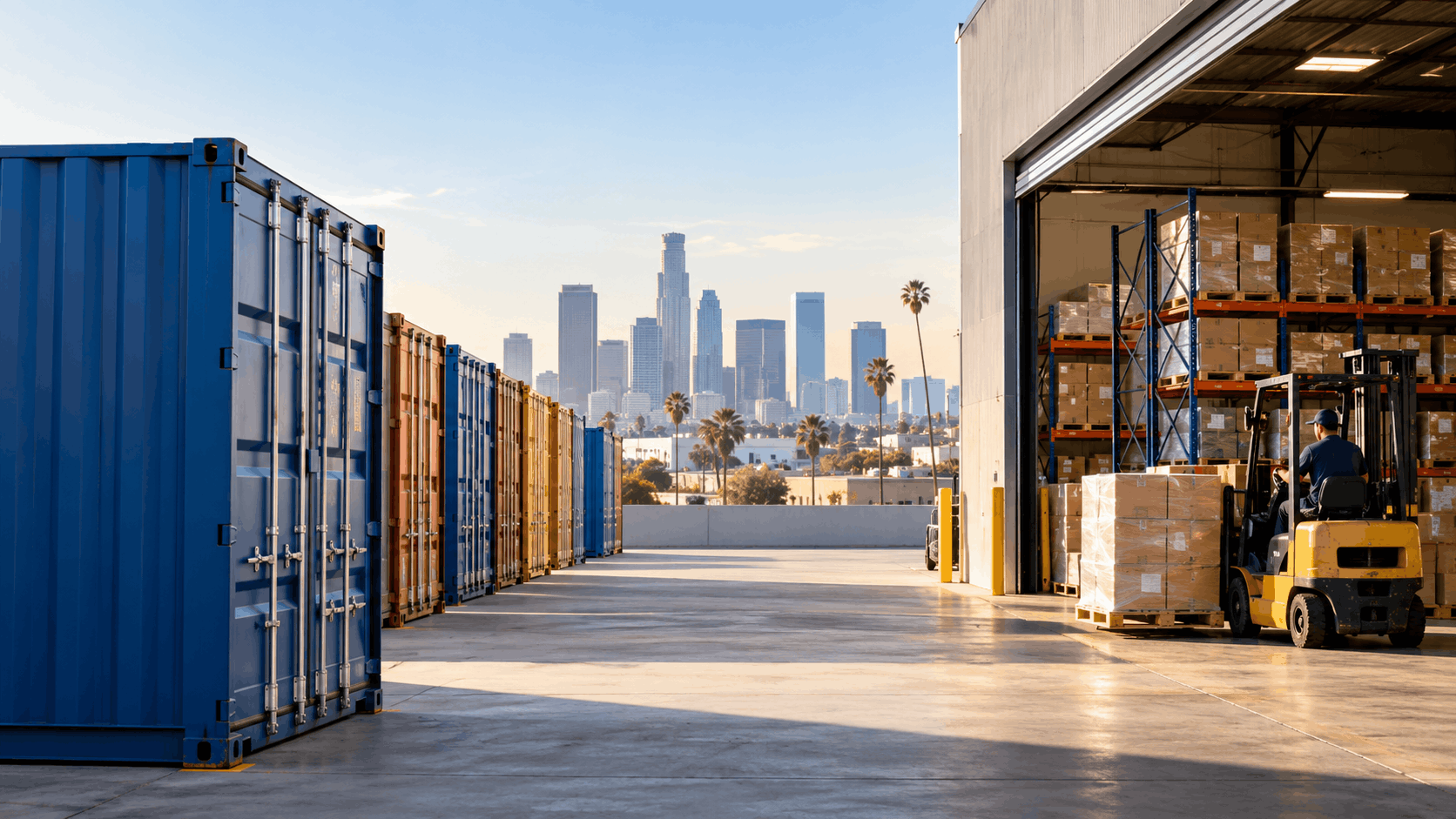
Before anyone looks at a price sheet, it helps to know what the two models really are. The marketing names blur together, but the dividing line is sharp once you know where to look. It is not about the shape of the box or whether it sits in a yard or a building. The real distinction is who has the key and the right to walk in.
Container storage and warehouse storage can both hold the same couch and the same boxes. What separates them is control over access. In one, you decide when to open the door. In the other, a crew does the handling and you book a time. That one fact changes the cost structure, the retrieval process, and which part of California law applies to your goods.
Container Storage: You Keep the Key
Container storage, in the self-service sense, gives the customer exclusive use of the container and the right to come and go. You get a lock, you get a code or a key, and you reach your belongings without asking anyone to move anything for you. This is the model people picture when they think of a rented unit or a portable box dropped in a driveway.
The defining feature is exclusive access. The space is yours for the term, and only you enter it. That suits someone who needs to pull out a tool, a seasonal item, or a box of files on a regular basis without scheduling around a warehouse crew.
California law recognizes this arrangement directly. Business and Professions Code section 21701(a) reaches some container arrangements under the Self-Service Storage Facility Act, specifically where the occupant has exclusive use and access to the container. That statutory home brings its own rules on liens, access and notices, which differ from warehouse law.
So when someone says they want to be able to get to their things whenever they like, they are describing self-service container storage. The convenience of walk-in access is the whole point of the model, and it is also what places it under a particular slice of the law.
Vaulted Warehouse Storage: Crews Handle It
Full-service vaulted warehouse storage works the opposite way. The customer has no key, no individual unit and no right of entry. Goods are packed into a wooden vault, and our crews load, move and store that vault as a single unit using a forklift.
A vault is loaded once at the origin and then handled as one sealed container. From that point it moves by forklift within the building. Because the goods are handled fewer times than in a self-service cycle where items go in and out repeatedly, there is less opportunity for the kind of wear that comes from repeated loading.
This is the model we run at our vaulted storage facility in Mar Vista. The customer does not walk the aisles or open their own container. When access is needed, our team retrieves the vault and opens it for you.
That hands-off structure is what makes it full-service. The trade-off for giving up the key is that the handling, stacking and protection of the vault are all managed by people who do it for a living, and the goods sit untouched between the day they go in and the day they come out.
Why the Key Is the Whole Distinction
The temptation is to think of this as containers versus units, or yards versus buildings. That framing misses the point. The real distinction is whether the customer has exclusive use and access, not what the storage looks like from the outside.
Section 21701(a) makes this explicit by reaching some container arrangements where the occupant has exclusive use of the container. A container can fall under self-storage law if the customer controls access to it. A vaulted service falls outside that law precisely because the customer does not.
That single fact decides which legal regime applies and how you reach your goods. With exclusive access, you deal with self-storage rules and you open the door yourself. Without it, you deal with warehouse law and you book a retrieval. Everything downstream, from liens to claims to daily convenience, flows from this one question.
So the first thing to settle is not the price. It is whether you want to hold the key or hand the whole job to a crew. Once that is clear, the rest of the comparison falls into place.
Get Your Free Quote
Tell us about your move. We'll be in touch soon.
What a Vault Is and How Much It Holds?
Since cost on the warehouse side is priced per vault, it helps to picture the actual unit. A vault is a wooden box built to hold household goods and move by forklift. Knowing roughly how big it is and how much it holds makes the monthly number mean something.
One thing to understand up front: vault sizes are a trade convention, not an official standard. Manufacturers build to common sizes because they work, not because a rulebook requires it. So any figure here is a typical size, and any capacity is approximate.
The Typical Vault Size
The common wooden storage vault runs roughly 7 feet by 5 feet by 7 feet 10 inches on the outside. It is built from plywood on a reinforced plywood floor set on runners, with four-way forklift access so the vault can be lifted and moved from any side.
An empty vault of this size weighs about 427 pounds. Catalogs market it around 250 to 274 cubic feet. That volume roughly corresponds to the contents of a modest room or two of furniture and boxes, though the real amount depends on how the goods pack together.
These numbers are typical, not a standard. Different manufacturers and different jobs produce different dimensions. When someone asks how much fits in a vault, the useful answer is a range tied to a typical size, not a fixed figure that pretends to be universal.
We handle the loading, so the packing density tends to be higher than a customer stacking their own unit. Experienced crews use the full height and square off the load, which is part of why professional vault loading often fits more than people expect.
Why There Is No Official Vault Standard
There is no ANSI, ASTM, ISO or federal specification governing household goods storage vault dimensions. The size you see quoted is a market convention that settled around what works for furniture and forklifts, not a dimension set by any standards body.
Because there is no standard, every manufacturer builds custom sizes to order. A facility can stock small, standard and oversized vaults depending on what its customers move. That flexibility is useful, since not every household fits neatly into one box size.
We run the full range of vault sizes, standard through oversized. A single-room move might need one standard vault, while a larger household could take several, or a mix of standard and oversized units to hold bulky pieces efficiently.
The absence of a standard is not a problem to worry about. It simply means capacity is matched to your goods rather than forced into a one-size box. During the estimate, the number and size of vaults are worked out from what you are actually storing.
Usable Space Versus Exterior Volume
Here is a detail that trips people up. The cubic-foot figures in catalogs are exterior volumes. They measure the outside of the box, including the walls and floor structure.
Usable interior space is lower once wall thickness is deducted. Plywood walls and a reinforced floor take up room, so the space you can actually fill is somewhat less than the marketed exterior volume. That is normal for any rigid container, not a shortcoming of vaults specifically.
No published figure exists for usable interior volume as distinct from exterior dimensions, so treating any capacity number as approximate is the honest approach. When we plan a job, we estimate from the goods in front of us rather than dividing a room by a catalog number.
The practical upshot is simple. Do not count on fitting an exact 274 cubic feet of belongings into a vault marketed at 274 cubic feet. Plan for a bit less, and let the estimate settle the real count of vaults you need.

Need Help in Los Angeles?
Popeye Moving & Storage serves Los Angeles and all of Los Angeles County.
Cost Trade-Offs in Los Angeles
Cost is where the two models diverge in a way you feel every month. Container storage and vaulted warehouse storage are priced differently, and the services around the storage add their own line items. The figures below are typical ranges for the Los Angeles area, not a quote or a fixed price from us.
The actual price for a specific job is set in writing before anything is loaded, and on a move inside California that written figure carries a Not To Exceed amount that caps your bill. Here is how the typical area ranges break down.
| Service | Typical Los Angeles Range |
|---|---|
| Vaulted storage | $60 to $90 per vault per month |
| Local residential moving (two-person crew and truck) | $150 to $200 per hour |
| One-bedroom apartment local move | $350 to $650 |
| Full-service packing, one-bedroom | $300 to $800 |
| Full-service packing, three-bedroom | $600 to $1,500 |
| Unpacking | $50 to $75 per hour per crew member |
| Custom crating | $150 to $800+ per crate |
| Piano moving | $200 to $600 |
| Chandelier moving | $150 to $450 |
What Vaulted Storage Runs Per Month
Vaulted storage runs $60 to $90 per vault per month in the Los Angeles area. That is the recurring figure to plan around, and it is priced per vault rather than per square foot or per unit.
Because the charge is per vault, your monthly total depends on how much you store. A small household that fits in one vault sits at the low end of the monthly math, while a larger home spread across several vaults multiplies that per-vault figure.
The number of vaults is worked out from the volume of your goods during the estimate. This is where the typical vault capacity matters, since the count of vaults, and therefore your monthly cost, follows directly from how many cubic feet of belongings you are storing.
Present this range as a typical area figure, not a personalized quote. Your exact monthly cost is confirmed in writing once the vault count is settled for your specific belongings.
The Costs Around the Storage Itself
Storage rarely sits alone on an invoice. The move-in and move-out labor, and any packing done before goods go into the vault, are separate services with their own typical ranges. Local residential moving runs $150 to $200 per hour for a two-person crew and truck.
If you want goods packed professionally before they go into storage, full-service packing runs $300 to $800 for a one-bedroom and $600 to $1,500 for a three-bedroom. Packing before storage is worth considering, since goods that sit for months benefit from being boxed and padded properly from the start.
On the way out, unpacking runs $50 to $75 per hour per crew member if you want help settling into the new place. Specialty pieces carry their own ranges, such as piano moving at $200 to $600 and chandelier moving at $150 to $450.
The point is that your total cost is the monthly storage plus the labor at each end, not the monthly figure alone. Budgeting for both ends gives you a realistic picture before anything is loaded.
How Access Frequency Changes Your Real Cost
How often you plan to reach your goods should steer your choice. A container you visit frequently suits a different budget and routine than vaulted storage you leave untouched during a move.
If you need to pull items out every week, the walk-in access of a self-service container matches that pattern. You are paying for the convenience of reaching your own stuff on your own schedule, and that convenience earns its keep when you use it often.
The typical vaulted customer is between homes during a move, or is storing belongings without planning to access them during the term. For that person, the hands-off model fits perfectly, since they have no need to open the container until the goods come out for good.
Matching the model to your access pattern is where real savings live. Paying for walk-in access you never use is waste, and so is picking hands-off vaulted storage when you actually need weekly access. Decide how you will use the goods first, then price it.
Why Westside Addresses Affect the Move Price
Westside geography can push the move portion of the cost up, though it does not touch the monthly storage fee. Hillside and restricted-access properties often need a shuttle from a smaller vehicle to reach the front door, and that is the professional method on those streets, priced at the estimate.
Single-route canyon streets like Mandeville Canyon, and the walk streets and canals of Venice where no vehicle reaches the house at all, are the clearest examples. On a walk street, the large truck stays on the nearest accessible road and a smaller vehicle shuttles the goods in. Properties with no vehicle access at all are qualified over the phone before a date is confirmed.
Our warehouse at 5509 1/2 S Centinela Ave sits in Mar Vista, central to the Westside, so the drive from a Santa Monica condo or a Venice bungalow into storage is short. That proximity keeps the transport portion of a local storage job efficient.
Any shuttle or access charge shows up in the move portion of the bill, not the recurring storage line. So when comparing costs, separate the one-time move-in and move-out labor from the ongoing monthly vault charge, since Westside access affects only the former.
Access and Retrieval: Getting Your Things Back
How you actually reach your belongings is the real daily difference between the two models. On paper it is a legal distinction. In practice it is the difference between opening a door yourself and booking a time for a crew to bring your vault out.
Both approaches work well for the right person. What matters is being honest about how each one feels when you need something, and setting expectations about hours and appointments before you commit.
Container Access on Your Schedule
Container storage with exclusive use lets the customer reach the goods directly. You go to the facility, open your own container, and take what you need without coordinating with staff to move anything for you.
This suits people who need frequent access. A contractor storing tools between jobs, a seller rotating inventory, or a household that keeps pulling out seasonal items will all appreciate being able to walk straight to their own space.
The convenience is the whole value proposition of self-service. You trade the full-service handling for direct control, which is exactly right when your goods are something you dip into regularly rather than park and forget.
If that describes your situation, the walk-in model earns its cost. The freedom to come and go on your own schedule is precisely what you are paying for.
Retrieving Vaulted Goods by Appointment
Vaulted goods work differently. Because the customer has no key and no right of entry, reaching the goods requires the warehouse to retrieve the vault and open it. That makes an appointment ordinary trade practice.
When you need something from a vault, you contact us and we schedule a time to bring the vault down from its stack and open it for you. The forklift handling and the sealed-vault structure mean this is not a walk-in situation, and booking ahead lets the crew have your vault ready.
No statute, tariff or code sets an appointment requirement or a notice period for this, so we will not pretend there is a legal rule here. It is simply how full-service vaulted storage operates. Scheduling retrieval is the practical reality of a model where crews, not customers, handle the goods.
For the typical customer who is between homes and does not expect to touch the goods until the move completes, this is rarely an issue. If you anticipate needing regular access, that is a strong signal to consider a self-service container instead.
Business Hours Are Not Your Access Hours
Our business hours are 6am to 9pm, seven days a week, including Sunday. Those hours are for calls and scheduling. They are not customer access hours at the warehouse.
This is an important distinction that catches people off guard. Being able to call us at 8pm on a Sunday to arrange a job does not mean you can show up at the warehouse and open a vault at 8pm on a Sunday. Vaulted storage is not an open-door unit you let yourself into.
The hours shown describe when we are reachable to plan your move, book a retrieval, or answer a question. Any actual handling of your vault happens by appointment with a crew, within the warehouse's operating schedule rather than around the clock.
If independent, come-and-go access is what you want, that points firmly toward a self-service container where the hours of entry are built into the model. For vaulted storage, think of us as the people who manage your goods, not a building you have a key to.

The Legal Line Most Storage Content Gets Wrong
Here is where a lot of storage advice goes sideways. People assume all storage falls under the same self-storage law, with the same lien rules and the same access rights. It does not, and the difference matters when something goes wrong.
Vaulted warehouse storage and self-service storage live under different parts of California law. Knowing which one covers your goods tells you what protections you have, how a lien would be enforced, and what the facility owes you as a standard of care.
Self-Storage Law Versus Warehouse Law
Business and Professions Code section 21701(a) states plainly that a self-service storage facility is not a warehouse. That is the hinge the whole distinction turns on. The same subdivision provides that if the owner issues a warehouse receipt, bill of lading or other document of title, the parties fall under Division 7 of the Commercial Code, and the Self-Service Storage Facility Act does not apply.
Vaulted warehouse storage, where the customer has no key, no individual unit and no right of entry, sits under Commercial Code Division 7, not sections 21700 to 21716. The customer does not have exclusive use and access, so the self-storage law simply does not reach it.
The practical consequence is that self-storage lien and access rules do not apply to vaulted storage. If you read advice about self-storage auctions or access rights and try to apply it to your vaulted goods, you will be working from the wrong rulebook.
This is the single most common error in storage content, and it matters because the two regimes handle liens, notices and the facility's duties differently. For our full-service storage, Division 7 is the governing law.
The Standard of Care in a Warehouse
California Commercial Code section 7204(a) sets the standard of care a warehouse owes. It provides that a warehouse is liable for loss of or injury to goods caused by its failure to exercise the care that a reasonably careful person would exercise under similar circumstances.
That is ordinary negligence. The same section provides that, unless otherwise agreed, the warehouse is not liable for damages that could not have been avoided by the exercise of that care. A warehouse that handles your goods carefully is not on the hook for losses it could not reasonably have prevented.
This is not strict liability, and a warehouse is not an insurer of the goods. That distinction surprises people who assume storing something makes the facility responsible for anything that happens to it. The duty is to act like a reasonably careful operator, not to guarantee the goods against all harm.
Understanding this standard helps set realistic expectations. It also explains why valuation and coverage questions, covered below, matter so much, since the standard of care alone does not make the facility a backstop for every possible loss.
Liability Limits and the Storage Agreement
Section 7204(b) allows a storage agreement to limit damages. That limit can be set by a term in the warehouse receipt or storage agreement, which is why reading the agreement is the real customer protection here.
The statute gives the customer a lever. On request of the bailor in a record at the time of signing, or within a reasonable time after receiving the receipt, liability may be increased on part or all of the goods. The warehouse may then charge increased rates on that increased valuation. If you have high-value items, you can ask for higher liability coverage rather than accepting the default limit.
There is no statutory floor on how low a limit may go, and no type-size or conspicuousness requirement in the statute. That means the terms are whatever the agreement says, so the burden is on the customer to read it and understand the limit before signing.
One protection does hold firm: under section 7204(b) the limit is not effective for the warehouse's liability for conversion of the goods to its own use. Short of that, the dollar figures live in the agreement, which is exactly why we encourage every customer to read the storage agreement carefully and ask about increasing coverage if needed.
The Household Goods Lien and How It Is Enforced
Section 7209(a) gives a warehouse a lien on goods covered by a warehouse receipt or storage agreement for storage and transportation charges, insurance, labor, other charges related to the goods, and expenses necessary for preservation. For household goods, defined as furniture, furnishings or personal effects used by the depositor in a dwelling, section 7209(d) makes that lien effective against all persons if the depositor was the legal possessor at the time of deposit.
Enforcement against a consumer is strictly procedural under section 7210(b). All persons known to claim an interest must be notified. The notice must include an itemized statement of the claim, a description of the goods, a demand for payment within a specified time not less than 10 days after the notice is received, and a conspicuous statement that the goods will be advertised and sold at auction if the claim is not paid.
After the demand period expires, the sale must be advertised once a week for two consecutive weeks in a newspaper of general circulation, and the sale must take place at least 15 days after the first publication. The earliest lawful sale is therefore at least 25 days after the customer receives the notice, and in practice longer.
The customer keeps a safety valve throughout. Under section 7210(c), any person claiming a right in the goods can stop the sale at any point before it happens by paying the lien amount plus the reasonable expenses of the process, and the goods must then be retained. These are rarely publicized protections, and they are exactly the sort of detail worth knowing before you ever fall behind.
Need Help in Los Angeles?
Popeye Moving & Storage serves Los Angeles and all of Los Angeles County.
Storage-in-Transit and the 90-Day Line
During a move, there is a special window where storage is still part of the regulated moving service rather than a standalone warehouse arrangement. That window has a hard edge at 90 days, and which side of it your goods sit on changes who protects them and how claims work.
This boundary is the most useful thing on any storage page, because it answers a question most people never think to ask: is my stuff covered by moving rules or warehouse rules right now?
What Storage-in-Transit Covers
Maximum Rate Tariff 4 Item 4 defines storage-in-transit as storage of a shipment, at the request of the consignor or consignee, at one point between origin and destination, for a period not to exceed 90 days. It is the pause button on a move when the new place is not ready yet.
Inside that window, the move is still a regulated mover service under the Bureau of Household Goods and Services, the state body that regulates household movers. The protections of the Household Movers Act and MAX 4 still apply while the goods sit in storage-in-transit.
This matters because a California intrastate move is governed by BHGS, not by the federal rules that apply to interstate work. The storage-in-transit window keeps your goods inside that California moving framework rather than dropping them straight into a warehouse contract.
For a Westside customer moving from, say, a Santa Monica apartment into a new home that is not quite ready, storage-in-transit bridges the gap while keeping the regulated moving protections in place for up to 90 days.
What Changes After 90 Days
Past 90 days, or where storage-in-transit was not requested in the first place, the goods fall under the warehouse's own contract and are no longer regulated by the bureau. The regulated-move framework steps aside and the Commercial Code Division 7 warehouse rules take over.
MAX 4 Item 96 spells out the handoff. Upon placement in a public warehouse, the mover's liability ceases, and liability thereafter becomes that of the warehouseman in possession. The duty of care shifts from the moving rules to the warehouse standard under section 7204.
This 90-day boundary is not just a contract term, it is a jurisdictional line. On one side, BHGS and the moving tariff govern. On the other, the Commercial Code and your storage agreement govern. The protections, the liability standard, and the claim timing all change at that edge.
Knowing which side your goods are on tells you who to look to if something goes wrong. For long-term storage that runs past 90 days, the storage agreement and Division 7 are your reference points.
Valuation While Goods Are in Storage-in-Transit
MAX 4 Item 136(8) sets maximum fixed rates for protection while a shipment is in storage-in-transit. Actual Cash Value protection is capped at $0.16 for each $100 of declared value, and Full Value protection at $0.38 for each $100 of declared value.
These charges are separate from and additional to the transportation valuation charges on the move itself. Protection during storage-in-transit must be offered by the mover and ordered in writing by the shipper, so it is not automatic. If you want your goods covered at a chosen value while they sit in storage-in-transit, you declare that value and order the protection in writing.
One caution matters here. Valuation is not insurance. It is a liability framework tied to the regulated move, and it applies within the storage-in-transit window.
Beyond that window, into long-term warehouse storage, the mover's cargo policy is not confirmed to reach the stored goods. We will not tell a customer that long-term stored goods are covered by the moving cargo policy. The right move is to ask directly what protection applies while your goods are in long-term storage, and to read the storage agreement for the answer.

Protecting Belongings in Long-Term Storage
When goods sit for months, a little preparation goes a long way. The good news is that most of what protects belongings in storage is practical and inspectable, not guesswork. The guidance below is drawn from established conservation and inspection sources and framed as what actually happens to materials, not as a rate of decay.
The categories that suffer most from the wrong conditions are the ones people store without a second thought: leather, wood, art and instruments. Getting the prep right matters most for exactly those items.
What Climate Controlled Really Means
Climate controlled is a term with no industry definition. No code, standard or trade body fixes what temperature or humidity a facility must hold to use the phrase. That is the honest line, and it means the words alone tell you very little.
Our storage is climate controlled for both temperature and humidity, with the specification confirmed per shipment. We will not publish a single temperature figure, humidity figure, range or tolerance as our own specification, because the right conditions depend on what is being stored and are set for each shipment.
The credible reference points for conditions come from conservation practice rather than the storage trade. The National Park Service recommends a range of 59 to 77 degrees Fahrenheit and relative humidity of 45 to 55 percent, and advises that RH should not be allowed to reach 65 percent because mold might develop. The Library of Congress gives 30 to 50 percent RH for photographs and warns that mold grows when RH exceeds 60 percent and temperature rises above 75 to 80 degrees.
Those are published conservation references, not a readout of conditions at our warehouse. They are useful for understanding why humidity control matters, and that is how we present them. The actual specification for your goods is set per shipment.
Which Items Are Sensitive to Conditions
Some belongings genuinely change with storage conditions. The Canadian Conservation Institute lists the object types most vulnerable to humidity swings: oil paintings and rigid paint layers on canvas, photographs and negatives, panel paintings with weak adhesion, veneer and marquetry, musical instruments, and fine furniture with inlays.
Leather is a clear case. CCI notes that relative humidity above 65 percent promotes mold, darkening, stiffening and embrittlement in leather, while RH below 30 percent causes loss of flexibility, brittleness, tears and distortion. The point is what the conditions do to the material, not how fast.
Wood responds to humidity too. The NPS states that high RH above 65 percent causes swelling and warping, while low RH causes shrinkage, warping and cracking. Veneer and inlaid furniture are especially sensitive because different materials in the same piece move at different rates.
These are the categories where storage conditions genuinely change the outcome, and they are also the ones people are most likely to store without thinking. A piano, a set of framed art, a leather sofa, an inlaid dresser, boxes of family photographs: these deserve attention to conditions in a way that a steel bed frame does not.
Preparing Goods Before They Go In
Good preparation is inspectable, not a matter of opinion. The federal household goods warehouse inspection form DD 1812 scores specific things as deficiencies, which tells you exactly what proper storage looks like. Lots not elevated, goods stored against exterior walls, finished surfaces not protected by pads or wrap, and inadequate protection against mold and mildew all count against a facility.
Elevate goods off the floor and keep them away from exterior walls. The NPS advises raising storage at least 4 and preferably 6 inches off the floor and keeping it clear of exterior walls, because that arrangement reduces condensation against cold outer surfaces.
Use breathable dust covers such as muslin or Tyvek rather than sealed plastic. Sealing goods in polyethylene is a containment response to active mold, not a general storage method, because sealed plastic can trap moisture against the surface. CCI also advises prewashing fabrics used for packing and inspecting woolens and other keratinous items for pests before they go into storage.
For motorized items, drain gas and oil before storage, which DD 1812 flags as a deficiency if left undone. A few hours of prep at the front end prevents the kind of problem that only shows up when the vault is opened months later, and it is far cheaper than dealing with damage after the fact.
What Cannot Go Into Storage
Some things simply cannot go in, and the reasons differ by category. Hazardous materials are refused under 49 CFR 171.2(e), which provides that no person may accept a hazardous material for transportation in commerce unless it is properly classed, described, packaged, marked, labeled and in condition for shipment. A mover accepting undeclared hazmat is the accepting person, so this is federal law, not company preference.
That covers common household combustible liquids, corrosives, explosives and flammables. Clearing these out before move day prevents a problem at the truck and keeps everyone safe.
Perishables, plants and open liquids are a different matter, driven by spoilage, pest attraction and agricultural quarantine rather than fire rules. Food draws pests, plants can carry quarantine concerns, and open liquids spill and spoil. None of these belong in a sealed vault for months.
Vehicles are not accepted at our facility. We do not store cars, motorcycles, boats or RVs. If you need vehicle storage, that is a separate service from household goods vaulted storage, and we will point you in the right direction rather than take something we are not set up to handle.
Need Help in Los Angeles?
Popeye Moving & Storage serves Los Angeles and all of Los Angeles County.
What Popeye Offers at the Mar Vista Warehouse
Having laid out the models and the law, here is how we actually handle storage. Everything below reflects how our operation runs, grounded in the specifics of our Mar Vista warehouse and the service we provide.
We built our storage around the full-service vaulted model because it gives us control over handling and protection from the moment goods leave your home until the day they come back.
Full-Service Vaulted Storage on the Westside
We offer full-service vaulted storage at our own warehouse at 5509 1/2 S Centinela Ave, Los Angeles, CA 90066, in Mar Vista on the Westside. Owning the building means your goods stay in our hands throughout, not passed to a third-party facility.
This is a full-service model. The customer has no key, no individual unit and no right of entry. Goods are handled by our crews from loading to storage to retrieval, which is exactly what places this service under Commercial Code Division 7 rather than the self-storage law.
The Mar Vista location is central to the Westside, close to Mar Vista, Venice, Culver City and the Santa Monica line. That keeps the transport leg short for local storage jobs on this side of town.
Because we run the storage ourselves, the same standards that govern our handling on move day carry straight through into how your goods are stored. There is no handoff to an outside operator with different practices.
Terms, Specialty Items, and What Is Accepted
There is no minimum and no maximum storage term. Whether you need a few weeks between homes or an open-ended arrangement, the term fits your situation rather than forcing you into a fixed commitment.
We accept commercial and business storage alongside household goods. A business clearing out an office, a retailer holding inventory, or a company between locations can store with us just as a household can. That flexibility suits the mix of residential and commercial storage needs we see across the Westside.
Specialty items we accept include wine, fine art, pianos and chandeliers. These are exactly the categories that benefit from careful, crew-handled storage, and our fine art and antique moving experience carries into how we store those pieces.
Vehicles are not accepted. We do not offer car, motorcycle, boat or RV storage, so if that is what you need, this is not the right service. For everything from a studio apartment's worth of boxes to a grand piano, the vault model works well.
Same-Day Placement and No Overnight Hold
We pick up and place goods into vaults at the Mar Vista warehouse on the same day. There is no overnight hold on the truck with your belongings sitting in it until the next morning.
Same-day placement means your goods go from your home into a vault in the warehouse on the day of the move. They are secured in the building rather than parked in a vehicle, which is both safer and more predictable.
This matters because a truck left loaded overnight is exposed in ways a vault inside a warehouse is not. Getting goods into the vault the same day closes that gap.
For a local Westside move into storage, this keeps the whole process tight: load at origin, drive the short distance to Mar Vista, and place into a vault, all in one day.
Permits and Access on Move Day
Move-day parking shapes how smoothly the loading goes, especially on busy Westside streets. In the City of Los Angeles, LADOT asks for five working days to arrange temporary parking restriction signs, which are what actually reserve the curb space for the truck.
It is worth knowing that signs and the oversize permit are different products. The signs reserve the space and make it enforceable. The oversize vehicle parking permit, published at $10.00 per day for up to three days, only exempts the truck from the oversize and overnight rules. It does not reserve a space. Both can be needed, and LADOT covers the City of Los Angeles only, so neighboring cities run their own processes. You can confirm current steps and fees through LADOT directly.
Permit rules are set city by city, and some neighbors differ sharply. We have insurance on file with the City of Pasadena, which qualifies us for the two working day minimum for a Pasadena moving permit rather than the two weeks required of movers without insurance on file there.
We plan the parking and permit side as part of scheduling your move, since the lead times above mean it cannot be left to the last minute. Sorting out the curb space ahead of time is what keeps the crew working instead of circling the block.

Choosing the Right Storage and Getting Started
The decision between container and vaulted warehouse storage comes down to whether you need to hold the key yourself or hand the whole job to a crew, and how that choice fits your budget and your move. We run full-service vaulted storage at our own Mar Vista warehouse, with same-day vault placement, no minimum or maximum term, and specialty handling for wine, fine art, pianos and chandeliers.
Your price is set in writing before anything is loaded, with a Not To Exceed figure capping your bill on a move inside California. To talk through your storage, get the vault count estimated for your belongings, and schedule a move into our Westside facility, call Popeye Moving and Storage at (310) 823-9510.
Frequently Asked Questions
- What is the difference between container storage and warehouse storage?
- The core difference is control over access. Container storage, in the self-service sense, gives you exclusive use and your own key, so you come and go as you please. Vaulted warehouse storage is crew-handled, with no individual unit, no key and no right of entry. Our team loads, moves and retrieves the vault by forklift. That one fact also decides which California law governs your goods.
- How much does vaulted storage cost in Los Angeles?
- Vaulted storage runs $60 to $90 per vault per month as a typical range for the Los Angeles area. That is a per-vault figure, so your total depends on how many vaults your belongings fill. A small household might fit in one vault, while a larger home takes several. The exact count, and therefore your monthly cost, is settled during the estimate and confirmed in writing before anything is loaded.
- Can I access my belongings in vaulted warehouse storage whenever I want?
- No. Vaulted goods are retrieved and opened by the warehouse, since you have no key and no right of entry. Access is by appointment, which is ordinary trade practice for full-service storage. Our business hours of 6am to 9pm seven days are for calls and scheduling, not walk-in access at the warehouse. If you need frequent, come-and-go access, a self-service container is the better fit for you.
- Which law protects goods in warehouse storage?
- Vaulted warehouse storage falls under Commercial Code Division 7, not the Self-Service Storage Facility Act. Business and Professions Code section 21701(a) states plainly that a self-service storage facility is not a warehouse. Because vaulted storage has no key and no entry, self-storage lien and access rules do not apply. The standard of care is set by Commercial Code section 7204, which holds the warehouse to ordinary negligence.
- Is my mover's cargo insurance the same as storage coverage?
- No. Valuation is not insurance, it is a liability framework. During storage-in-transit, MAX 4 valuation rates apply when ordered in writing. For long-term warehouse storage, the mover's cargo policy is not confirmed to reach the stored goods, so we will not tell you it covers them. Ask directly what protection applies while your goods are in long-term storage, and read the storage agreement, which sets the liability terms under section 7204.
- What is storage-in-transit and how long does it last?
- Storage-in-transit is a regulated window during a move, defined by Maximum Rate Tariff 4 Item 4 as storage at one point between origin and destination for a period not to exceed 90 days. Inside that window, the move is still a regulated mover service under the Bureau of Household Goods and Services. Past 90 days, or where storage-in-transit was not requested, the goods fall under the warehouse's own contract and the warehouse rules.
- What items cannot go into storage?
- Hazardous materials are refused under federal law at 49 CFR 171.2(e), including common household combustible liquids, corrosives, explosives and flammables. Perishables, plants and open liquids are also out, driven by spoilage, pest attraction and quarantine rather than fire rules. Vehicles are not accepted at our facility, so we do not store cars, motorcycles, boats or RVs. Clearing these out before move day keeps the process safe and smooth.
- Is a storage vault climate controlled?
- Climate controlled has no industry definition, since no code fixes a required temperature or humidity. Our storage is climate controlled for both temperature and humidity, with the specification confirmed per shipment rather than set to one fixed number. Conservation references from the National Park Service and the Library of Congress help explain why humidity control matters, but they describe published guidance, not a readout of conditions at our warehouse. The right conditions depend on what you store.
- Can the warehouse sell my goods if I fall behind on payment?
- Only through a strictly procedural process under Commercial Code section 7210. You must receive notice with an itemized claim, a demand for payment within a period not less than 10 days, and a statement that goods will be auctioned if unpaid. The sale must be advertised once a week for two consecutive weeks and held at least 15 days after first publication, so the earliest lawful sale is at least 25 days after notice. You can stop the sale any time before it happens by paying the lien and reasonable expenses.
- How long do I have to file a claim on goods from storage?
- It depends on which regime the storage sat in. For storage-in-transit, the nine-month tariff clock in MAX 4 Item 92(14) runs from the out-of-storage delivery to destination, not from the date goods went in. For long-term warehouse storage beyond storage-in-transit, there is no single statewide deadline, and section 7204(c) leaves the claim and suit timing to the storage agreement. So there is no one answer, and reading your agreement is how you learn the applicable window.
Popeye Moving & Storage Co. Team Team
Licensed moving and storage professionals serving Los Angeles and Los Angeles County.
Licensed in California · License #CAL T 189749 | USDOT 1472924 | MC 498816C
Why trust Popeye Moving & Storage?
Founded in 1994, Popeye Moving & Storage is a licensed and insured moving and storage service serving Los Angeles and Los Angeles County. All content is reviewed by our licensed technicians.

Need Help in Los Angeles?
Popeye Moving & Storage serves Los Angeles and all of Los Angeles County.
Related Articles
Long-Term Storage for Showroom Inventory Under a California Warehouse Agreement in Beverly Hills
Showroom inventory stored long term with a full-service warehouse falls under California Commercial Code Division 7, not self-storage law. Here is how liability, claims, the lien and Beverly Hills move-day rules work.
How Much Does Storage Cost in Bungalow Heaven, and What Drives the Number?
Vaulted storage near Bungalow Heaven runs $60 to $90 per vault per month. Here is what drives the number, how it differs from self-storage, and what the move adds.
What Vaulted Storage Costs in Los Angeles - and Why It Beats a Self-Storage Unit for Furniture
Vaulted storage in LA runs $75-$150 per vault monthly and protects furniture better than a self-storage unit. See real costs, hidden fees, and when a vault wins.